

Sample Category Title
Germany PMI manufacturing dropped to 57.6, starting to drag on overall growth
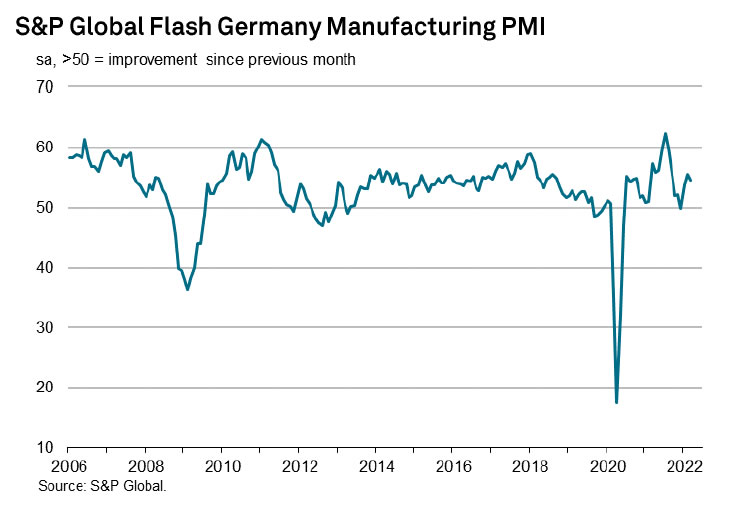
Germany PMI Manufacturing dropped from 58.4 to 57.6 in March, above expectation of 55.9. PMI Services dropped from 55.8 to 55.0, above expectation of 54.3. PMI Composite dropped from 55.6 to 54.6.
Phil Smith, Economics Associate Director as S&P Global said: "Manufacturing is already starting to drag on overall growth, due to its greater exposure to the supply chain disruption and drop in export demand that have resulted from the war in Ukraine and sanctions on Russia.... Already-high inflation pressure has been exacerbated by the war... business confidence has taken a considerable hit."
SNB keeps rate at -0.75%, upgrade inflation forecasts
SNB keeps sight deposit rate unchanged at -0.75% as widely expected. It reiterated that is is "willing to intervene in the foreign exchange market as necessary, in order to counter upward pressure on the Swiss franc". The Swiss franc remains "highly valued".
SNB said, "the war in Ukraine has had an effect on the Swiss economy above all via the strong increase in commodity prices", and are likely to "weigh on consumption and increase companies' production costs". Trade is likely to be affected by "albeit not severely given Switzerland's limited direct economic ties to Ukraine and Russia". Supply bottlenecks "could deteriorate further" and uncertainty could have an "adverse impact on investment activity.". 2022 growth forecasts was revised lower to around 2.5%.
The inflation forecast, conditioned on policy rate at -0.75%, was raised in general. But inflation is projected to peak at 2.2% in Q2 2022, then slow gradually to 0.7% in Q2 2023, then climb back to 1.1% in Q1. For the year as a whole, inflation is projected to be 2.1% in 2022 (upgraded from 1.0%), 0.9% in 2023 (up graded from 0.6%), and then 0.9% in 2024 (new).
(SNB) Swiss National Bank retains expansionary monetary policy
The SNB is retaining its expansionary monetary policy. It is keeping the SNB policy rate and interest on sight deposits at the SNB at −0.75% and is willing to intervene in the foreign exchange market as necessary, in order to counter upward pressure on the Swiss franc. In so doing, it takes the overall currency situation and the inflation rate differential with other countries into consideration. The Swiss franc remains highly valued. Russia's invasion of Ukraine has led to a strong increase in uncertainty worldwide. Against this backdrop, the SNB with its monetary policy is ensuring price stability and supporting the Swiss economy.
Inflation has risen again in recent months, and stood at 2.2% in February. This is primarily due to the significant increase in the prices for oil products and goods affected by supply bottlenecks. The tight situation with regard to these products and goods is likely to persist in the coming months owing to the war in Ukraine. The SNB's new conditional inflation forecast is therefore above that of December, particularly for 2022 (cf. chart 1). The upward revision is less pronounced over the longer term. The new forecast stands at 2.1% for 2022, and 0.9% for 2023 and 2024 (cf. table 1). The conditional inflation forecast is based on the assumption that the SNB policy rate remains at −0.75% over the entire forecast horizon.
The global economic recovery continued in the fourth quarter of 2021. However, economic activity was temporarily impaired at the turn of the year by a renewed wave of the pandemic. At the same time, inflation continued to rise in the US and the euro area. As a result of the war in Ukraine, there was a significant increase in financial market volatility in February, with strong rises in the prices of fossil fuels and other commodities.
In its baseline scenario for the global economy, the SNB assumes that energy prices will remain high for the time being, but that there will be no acute energy shortages in the major economic areas. It also anticipates that the global economic recovery will continue overall despite the war in Ukraine, albeit somewhat subdued. The higher commodity prices will lift inflation further in the short term.
Economic growth has slowed in Switzerland. Following a strong increase in both preceding quarters, GDP rose by 1.1% in the fourth quarter of 2021. For the year as a whole, however, the Swiss economy grew by 3.7%. Momentum remained positive through to February 2022. The situation on the labour market also continued to improve.
Thus far, the war in Ukraine has had an effect on the Swiss economy above all via the strong increase in commodity prices. The higher commodity prices are likely to weigh on consumption and increase companies' production costs. Foreign trade is also likely to be affected by the war, albeit not severely given Switzerland's limited direct economic ties to Ukraine and Russia. Supply bottlenecks in the case of imported intermediate products could deteriorate further, and uncertainty could have an adverse impact on investment activity.
In its baseline scenario for 2022, the SNB anticipates GDP growth of around 2.5%, this being lower than its previous forecast. In this scenario, growth is briefly subdued before rebounding, and unemployment is likely to decline further somewhat.
It is difficult to assess the future course of the war and its economic impact. The forecasts for the global economy and for Switzerland are therefore subject to very high uncertainty. The risks to growth are considerable and to the downside. In particular, a further escalation of the war and a widening of the sanctions could weigh more heavily on economic activity worldwide and in Switzerland than assumed in the baseline scenario. At the same time, a worsening in the tight supply of raw materials could lead to a further rise in inflation globally. This would also increase the risk of inflation dynamics firming as a result of second-round effects. Added to this, a renewed deterioration in the pandemic situation cannot be ruled out.
The momentum on the mortgage and real estate markets has continued, and the vulnerabilities have increased further overall. Against this backdrop, the Federal Council reactivated the sectoral countercyclical capital buffer on 26 January 2022 following a proposal by the SNB, setting the level at 2.5% of risk-weighted exposures secured by residential property in Switzerland. This will increase the capital requirements for these exposures as of 30 September 2022, and will maintain – and where necessary, strengthen – the banking sector's resilience. The SNB will continue to monitor developments on the mortgage and real estate markets closely.
France PMI composite rose to 56.2, Russia invasion intensified already existing issues
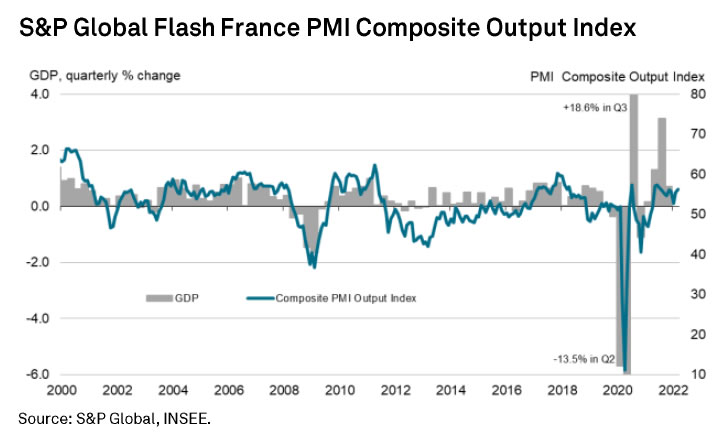
France PMI Manufacturing dropped from 57.2 to 54.8 in March, below expectation of 55.1. That's also a 5-month low. PMI Services rose from 55.4 to 57.4, above expectation of 55.2, a 4-month high. PMI Composite rose from 55.5 to 56.2, an 8-month high.
Joe Hayes, Senior Economist at S&P Global said: "Services was the sole driver of March's accelerated expansion as manufacturing output growth slowed sharply since February... Russia's invasion of Ukraine has intensified already existing issues for businesses. According to survey respondents, the war has worsened the availability of certain inputs, generated hesitancy among some clients to place new orders, dented business confidence and exerted further considerable upward pressure on costs due to the impact on fuel, energy and commodity prices."
USDCAD Breaks Long-Term Support, But Wait a Bit
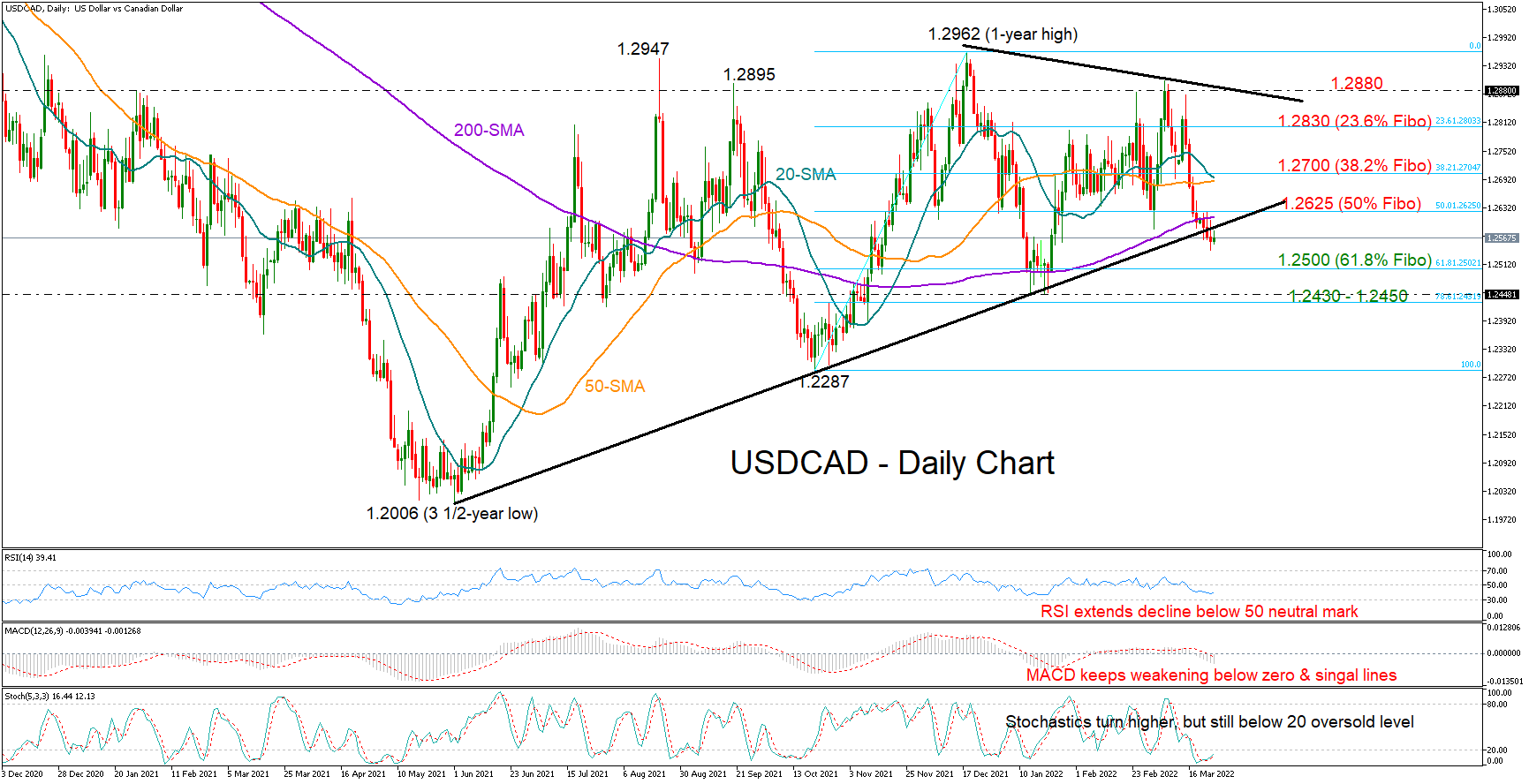
USDCAD closed marginally below the ascending trendline, which has been navigating the market since the plunge to a 3½-year low of 1.2006 in June 2021.
While the RSI has dipped further in the bearish area, and the MACD has strengthened its negative momentum below its zero and signal lines, the trendline breakout was not sizable and therefore confirmation is required before the spotlight shifts lower to 1.2500. Note that the Stochastics, although below their 20 oversold level, seem to have found a turning point.
Failure to bounce back above the 1.2600 – 1.2625 region, which encapsulates the broken trendline, the 200-day simple moving average (SMA) and the 50% Fibonacci retracement of the 1.2287 – 1.2962 upleg could press the price towards the 61.8% Fibonacci of 1.2500. Lower, the 1.2430 – 1.2450 tight zone could be the last opportunity for a rebound before the way clears towards the 1.2287 trough.
In the event of an upside reversal above 1.2625, the 20- and 50-day SMAs could immediately pause the bull run alongside the 38.2% Fibonacci of 1.2700. If not, the recovery may continue towards the 23.6% Fibonacci of 1.2830, while not far above, traders may pay attention to the tentative resistance trendline at 1.2880 before targeting the top of 1.2962.
All in all, USDCAD has stepped below a long-term supportive trendline, exposing itself to additional declines. Yet the bearish breakout is still at an early stage and only if the 1.2600 – 1.2625 area proves a firm resistance could the sell-off get new legs.
WTI Futures Hold Bullish Bias But StrongResistance Awaits at 261.8% Fibo
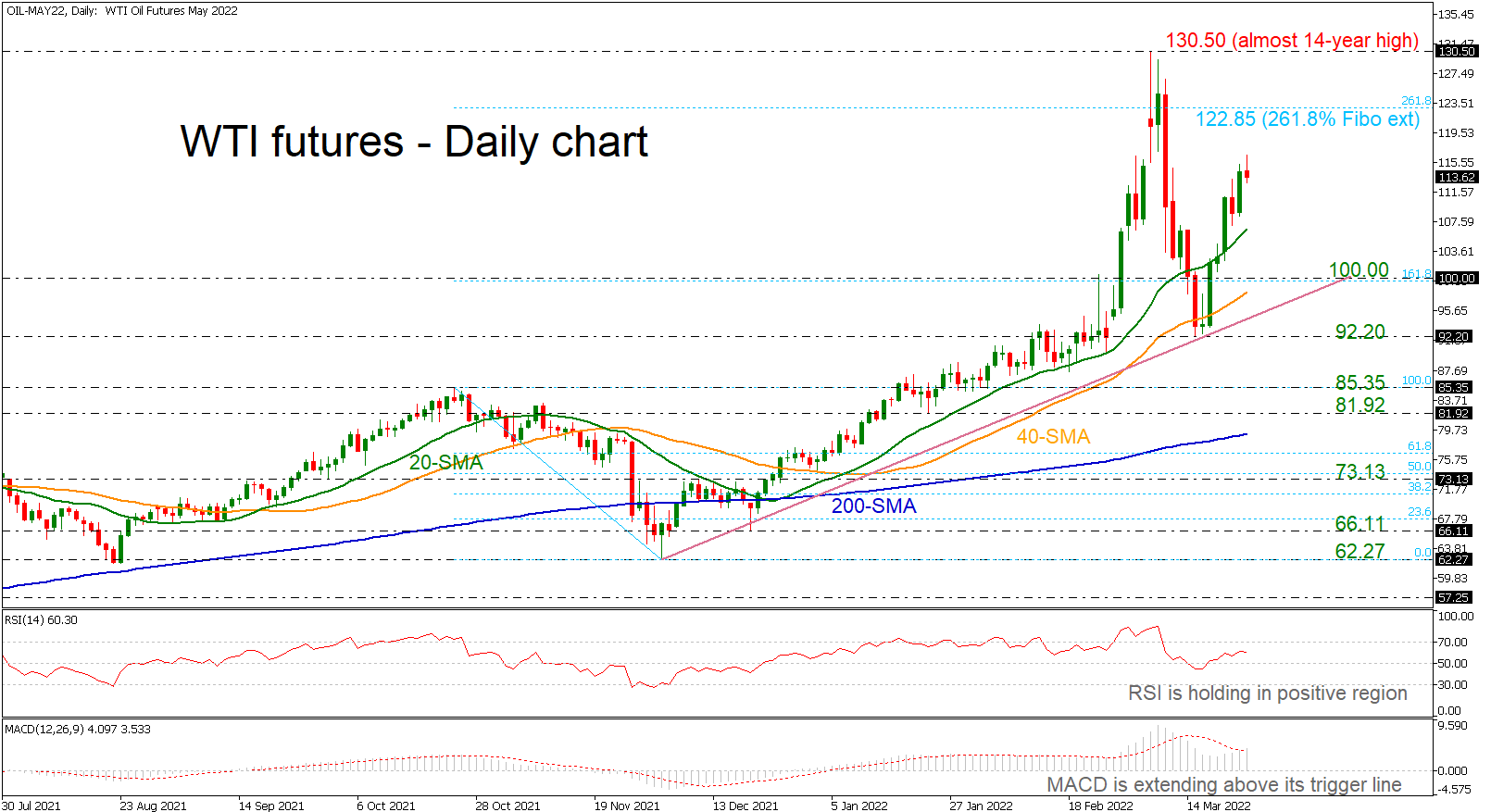
WTI crude oil futures has gained this week again, and it managed to hold above the 20- and 40-day simple moving averages (SMAs) and re-enter the area above 100.00.
The technical indicators are feeding prospects for a possible positive short-term trading session; the RSI holds well above 50, while the MACD continues to strengthen in bullish territory and above its red trigger line.
If the price moves higher, it could meet the 261.8% Fibonacci extension level from the down move from 100.00 to 62.27 at 122.85 again. If this level proves easy to get through, the spotlight will turn to the almost 14-month high of 130.50. Overcoming these obstacles, the high from June 2008 at 147.00 could be a crucial resistance for the bulls.
A failure to move higher could send the price down to the 20-day SMA at 105.65 ahead of the 100.00 round number, a challenging point over the last month. Lower, support could next be found around the 40-day SMA at 97.57 ahead of the uptrend line around 94.60, while a decisive close below it could stage a steeper sell-off.
In the medium-term picture, WTI futures are positive starting from the 62.27 low. Should the market continue the upward pattern, the outlook may turn brighter. A run above 130.50 would turn the outlook strongly bullish again.
Daily Technical Analysis
EUR/USD
The sell-off was limited to the support level at 1.0974 and the common European currency recovered part of its losses. However, the market sentiments remain negative and the bears would most probably try to regain control and attack the mentioned zone. A confirmed breach of that critical support would easily deepen the sell-off towards the psychological level at 1.0900. In the opposite direction, only a confirmed breach of the resistance at 1.1044 would allow the bulls to enter the market and lead the pair towards a test of the resistance at 1.1126. Today, an increase in market volatility can be expected around the announcement of the initial jobless claims for the United States at 12:30 GMT.
USD/JPY
The strong rally of the U.S. dollar, which started on 04.03.2022, seems to be slowing down and the pair has formed a support zone around the level at 121.32. The bulls start to lose momentum and a most likely scenario for today’s trading session is for the pair to enter a corrective phase before a potential continuation of the uptrend. On the other hand, this could be considered as an opportunity for the buyers to find a better entry level at the zone around 120.00. However, the market participants would most probably stay cautious and wait for the price to break the support at 120.44 before entering the market. In case the bulls prevail and manage to violate the resistance at 121.32, then we may expect the appreciation of the U.S. dollar to continue and the price to reach the levels at 122.15.
GBP/USD
After the pair bounced back from the resistance at 1.3290, the sterling lost ground against the U.S. dollar and, at the time of writing, the pair is hovering just above the support at 1.3185. The expectations are for this level to be tested and, if successfully breached, a short consolidation in the range 1.3100 – 1.3180 may take place. However, if the bears gain enough momentum to overcome the lower border of the range, this may deepen the sell-offs resulting in a sharp decline towards the critical psychological level at 1.3000. On the other hand, if the bulls take control over the markets and the support at 1.3185 resists the bearish pressure, we may expect GBP/USD to head towards a test of the important resistance at 1.3289, followed by the one at 1.3350.
EURGERMANY40
The bears entered the market over the past day and, at the time of writing, the sell-off is limited to just above the support area at 14135. Even though the price decreased, the index is still locked in the range 14135-14555. The most likely scenario is for a slight recovery towards the resistance zone at 14555. However, if the bears prevail and manage to overcome the critical support zone at 14135, a most probable result would be a decline in the price towards the support level at 13573. Investors are still cautious due to the high inflation rates and are expecting the development of the situation in Ukraine, which is still a major factor in determining the future direction of the market and the sentiments of the market participants.
US30
During the past trading session, the U.S. blue-chip stock index fell about 1.5% from the previous close. The bulls managed to limit the sell-off to around the support level at 34343 and, at the time of writing the analysis, we are seeing a consolidation taking hold immediately above the mentioned support. It is possible that we will also see a deepening of the sell-off, but before that, an adjustment towards the area at around 34600 is also expected. Only a confirmed breach of the support at 34343 would strengthen the negative expectations for a decline and the next target for the bears appears to be the support at 34100, followed by 33780. The statement of FOMC Member Waller (today; 13:10 GMT) is expected to be closely scrutinised by investors.
Markets (Temporarily?) Returned to a ‘Classic’ Risk-Off Script
Markets
Yesterday, markets (temporarily?) returned to a ‘classic’ risk-off script, with equities declining and bonds rebounding. We see the move meanly as a technical correction.
The bond market sell-off apparently was ripe for a pause as markets became well aware that the Fed is prepared to front-load its hiking cycle with 50 bps rate hikes in May and/or possibly in June if (inflation) data force them to do so. Still, with oil prices jumping and inflation expectations still rising (10-y TIPS inflation expectations are again near the cycle peak near 3.0%) a sustained bond rebound isn’t evident, not even in case of a further risk-off.
Even so, a US Treasury $16 bln 20-y auction (2.651%) attracted very strong investor interest and supported the intraday bond market momentum. US yields eased between 6.8 bps (2-y) and 11.7 bps (30-y), outperforming German Bunds. In a bull flattening move, German yields lost between 1.8 bps (2-y) and 5.3 bps (30-y).
Russian President Putin preparing an order that foreign clients will have pay Russian energy in ruble again raised tensions and triggered equity losses. Brent oil rebounded north of $120 p/b.
US equities lost about 1.30%. The Eurostoxx50 finished with a loss of 1.45%. The dollar gained, but only modestly (DXY 98.62). EUR/USD temporarily dropped to the 1.0965 area but at the end damage was contained (close 1.1004). Higher oil prices also aborted a tentative intraday rebound of the yen (USD/JPY close 121.15).
Sterling didn’t profit even as UK Fin Min Sunak in its Spring Budget statement announcement a bigger than expected fiscal relief to mitigate the sharp deterioration in UK living standards. However with yields declining and markets in risk-off modus, it didn’t help sterling. EUR/GBP even closed marginally higher in a daily perspective (0.8332 from 0.8316). Asian equities are trading mixed despite yesterday’s WS correction. US yields are reversing part of yesterday’s decline. The dollar is in the driver’s seat (DXY 98.84; EUR/USD 1.0984). Oil is holding north of $120 p/b.
In ‘normal’ circumstances, the EMU PMI’s would take center stage to assess the impact of higher prices on growth. The EMU composite PMI is expected at 53.5 from 55.5. Risks probably are to the downside. However, with commodity prices rising, persistent supply bottlenecks and growing signs of second round effects, central bankers have to keep the focus on inflation.
So, further bond losses are likely even in case of a risk-off. Next reference for the EMU 10-y swap rate and the 10-y Bund yield are at 1.19% and 0.58% respectively. On FX markets, the dollar retains the benefit of the doubt.
A return to EUR/USD 1.0806 remains possible. We look out whether a deal between the US and Europe on energy supply might help to bring back some calm to especially European (equity) markets and/or the euro.
News Headlines
The Japanese composite PMI bounced back from 45.8 in February to 49.3 in March, but stays below the 50 boom/bust level. Details showed a similar picture for the services PMI (48.7 from 44.2) while the manufacturing PMI pointed to slightly stronger growth at 53.2 from 52.7. The near return to growth in domestic services is linked to declining Covid-cases and the lifting of the quasi-state of emergency across Japan. Firms across the private sector reported a further intensification of price pressures with input prices rising at the fastest pace since August 2008. Uncertainty around war in Ukraine pushed the year-ahead outlook to a 14-month low despite falling Covid-infection rates. The yen didn’t respond to the data. JPY yesterday and this morning failed to fight back despite risk-off settings. Rising global yields, the BoJ’s easy monetary policy stance and surging energy prices strangle JPY. USD/JPY closes in on the 2016 top of 121.69 which serves as final resistance ahead of the 2015 (multi-year) high at 125.86.US President Biden national security adviser Sullivan said that an agreement to ensure supplies of American natural gas and hydrogen for Europe will be announced tomorrow. The deal is aimed at reducing dependence of Russian energy sources. EC president von der Leyen suggested that she aims for a commitment for additional (LNG) supplies for the next two winters. US President Biden travelled to Brussels for meetings with NATO, the G7 and EU leaders. While Europe is searching for alternative energy sources, German Chancellor Scholz in parliament stressed that an immediate Russian embargo is off the table as it would plunge the whole of Europe into recession. “Sanctions must not hit European states harder than Russian leadership”.
USDCHF Retreats ahead of the Swiss National Bank Decision
The US dollar retreated slightly after relatively weak new home sales data from the country. Data showed that new home sales declined from 788k in January to 772k in February. These numbers were weaker than the median estimate of over 810k. Still, the American housing sector is still strong, with home prices hovering near their all-time high. The dollar also declined after the latest statement by Jerome Powell. In a speech, he said that the economy was doing well and reiterated that the Fed will do whatever it takes to lower the current wave of inflation. The currency will react to important economic numbers like the American durable goods orders and initial jobless claims data. Also to several Fed officials like Chicago’s Charles Evans and Christopher Waller.
The Swiss franc moved sideways in the morning session as investors waited for the upcoming interest rate decision by the SNB. The decision comes at a time when the Swiss franc has strengthened significantly against the euro. Therefore, analysts expect the data to show that the SNB will leave interest rates unchanged at -0.75% where they have been for years. The bank is also expected to reiterate its views that the currency is significantly overvalued against its peers. The Swiss economy is doing modestly well, with inflation being significantly lower than in most countries. Its unemployment rate has also remained at historical lows.
The price of crude oil jumped to the highest point in weeks after the latest inventory numbers from the US. According to the Energy Information Administration (EIA), the country’s inventories declined by more than 2.5 million barrels last week. That was a significant drawdown considering that inventories jumped by more than 4.35 million barrels in the previous week. There are also concerns about Russia’s oil and gas supplies as the crisis in Ukraine escalates. While Russia’s oil and gas sector has not been sanctioned, it is estimated that many traders will avoid buying from the country. The key events to watch today will be the Mexican and South African central banks and flash PMIs.
XBRUSD
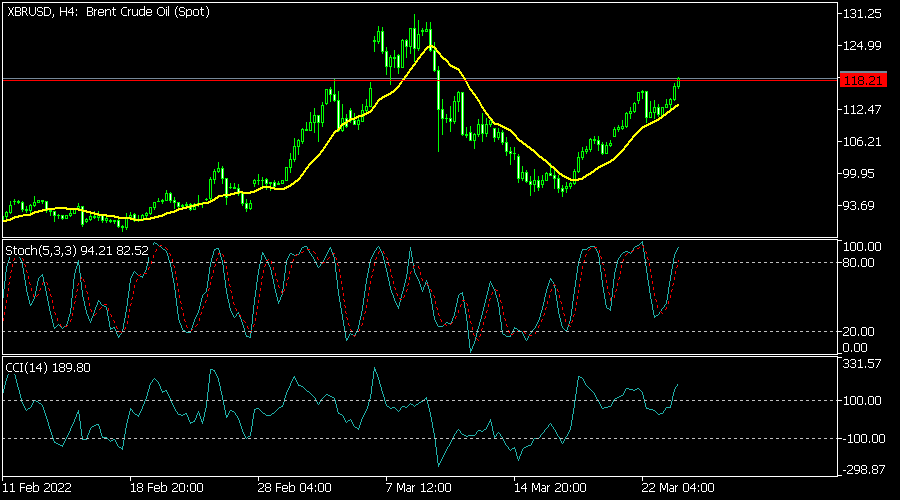
The XBRUSD pair maintained its bullish trend after the latest American inventories numbers. It rose to a high of 118.21, which was the highest level since March 9th. On the four-hour chart, the pair moved above the 25-day and 50-day moving averages. The Stochastic oscillator and the Commodity Channel Index (CCI) have moved to the overbought level. Therefore, there is a likelihood that the pair will likely keep rising as bulls target the next key resistance at 120.
EURUSD
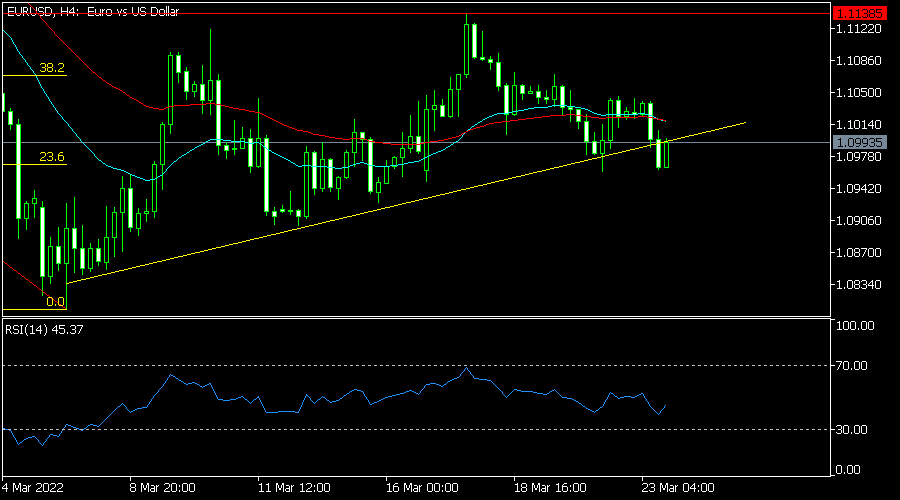
The EURUSD pair remained under pressure after the latest statement by Jerome Powell and the latest new home sales numbers. On the four-hour chart, the pair moved slightly below the ascending trendline shown in yellow and slightly below the 25-day moving average. It has also formed a head and shoulders pattern. Therefore, the pair will likely break out lower today.
USDCHF
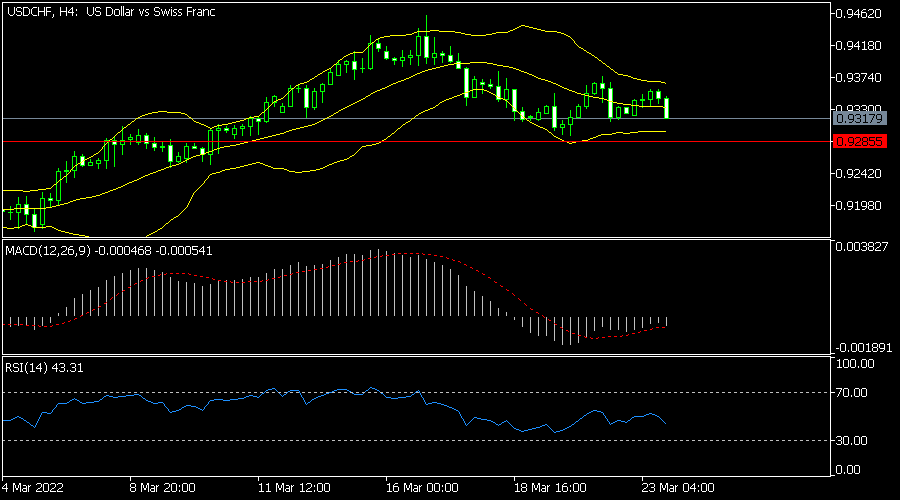
The USDCHF pair declined slightly ahead of the latest interest rate decision by the Swiss National Bank (SNB). It moved to a low of 0.9325, which is lower than the intra-week high of 0.9375. It moved below the middle line of the Bollinger Bands while the MACD is below the neutral line. Therefore, the pair will likely have a bearish breakout after the SNB decision.
Keep an Eye on Norges Bank, SNB and EU/NATO/G7 Meetings
Market movers today
We expect Norges Bank to deliver a 25bp rate hike to 0.75% today. This is in line with both the consensus and market pricing. The question is which signals will be given about rates going forward, illustrated by the rate path in the new Monetary Policy Report. We think Norges Bank will signal a continued gradual normalisation of monetary policy, with three more rate hikes this year and two hikes next year.
The Swiss National Bank (SNB) is set to leave monetary policy unchanged at today's meeting. Meanwhile, we expect a hawkish shift given strong CPI prints over the past months. Ultimately, we expect SNB to shadow policy moves from the ECB.
EU leaders will meet for a summit on Thursday and Friday. US President Biden will join the talks today for a discussion on support for Ukraine on strengthening the transatlantic response to Russia's aggression. European governments will also discuss security and defence, phasing out dependency on Russian energy imports and economic issues.
Also flash PMIs from euro area, US and UK are due out today. These are among the first indicators that we receive since the war started. In euro area, we expect a notable dip, especially in manufacturing activity, given the renewed disruptions the Ukraine war has created for supply chains. Also, for the service sector, it will be interesting to see whether consumers have been spooked by higher inflation pressures.
Two ECB speakers, Elderson and Schnabel, as well as several Fed speakers, are also on the wires. Particularly comments from Fed will be of great interest as recent comments by FOMC members have highlighted front-loading rate hikes. No FOMC member is ruling out 50bp rate hikes at this point
The 60 second overview
Russian gas in RUB: Yesterday, it was announced that Russian President Vladimir Putin demands gas payments in RUB from countries on the Russian "unfriendly list", i.e. Western countries. USD/RUB declined and European gas prices rose on the announcement. This makes gas purchases more complicated for Europe, as it introduces a FX risk for European utilities and RUB is difficult to come by due to sanctions etc. (although not all Russian banks are covered by sanctions). Near-term, it makes it more difficult for the West to "de-swift" the remaining Russian banks but also increases the incentive to divest from Russian gas. From a Russian perspective, it adds support to RUB in a situation where the Russian central bank cannot make FX interventions because of Western sanctions.
EU: EU leaders are expected to agree on buying gas jointly going forward, although they are unlikely to go as far as banning energy imports from Russia. Also EU and the US are likely to strike a deal so that the EU is going to buy more LNG.
Oil: Big draw on US strategic oil reserves last week of more than 4mb - the largest weekly draw since the oil shock in 2011 amid Arab spring and probably what helped push Brent briefly below USD100/bbl last week. Still a lot of reserves left. Brent oil is now above USD120/barrel.
Equities: Equities reverted lower on Wednesday in a fairly uneventful session. In the absence of market movers, the war took a more predominate role: The "war winners" materials and energy outperformed while banks and tech were some of the weaker groups. Despite the weaker sentiment, VIX barely picked up, which suggests that the weaker market was a reflection of the strong performance the last weeks more than anything else. S&P500 -1.2%, Nasdaq -1.3%, Russell 2000 -1.7% and Dow -1.3%. Asian markets are sneaking around the zero line this morning and US futures are slightly positive again.
FI: Yesterday, global bond yields declined after having risen significantly on the back of the hawkish comments from Fed Chairman Powell. 10Y Treasuries fell 10bp to 2.3%, while Bunds fell 5bp. The curves flattened modestly from the long end. Spreads such as BTPS-Bund spread was stable, while the Bund ASW-spread continued to grind tighter at a very modest pace.
FX: NOK has benefitted strongly from the surge over the last days in both oil and natural gas prices. Today's key event for NOK is the Norges Bank meeting. The Swiss National Bank (SNB) is set to leave the monetary policy rate unchanged.
Credit: After a strong week, credit markets took a breather yesterday. iTraxx Xover widened 9.7bp and Main 1.8bp. Cash bonds were broadly flat, with HY bonds 1bp wider and IG unchanged.