

Sample Category Title
USD/CAD Daily Outlook
Daily Pivots: (S1) 1.2535; (P) 1.2570; (R1) 1.2599; More...
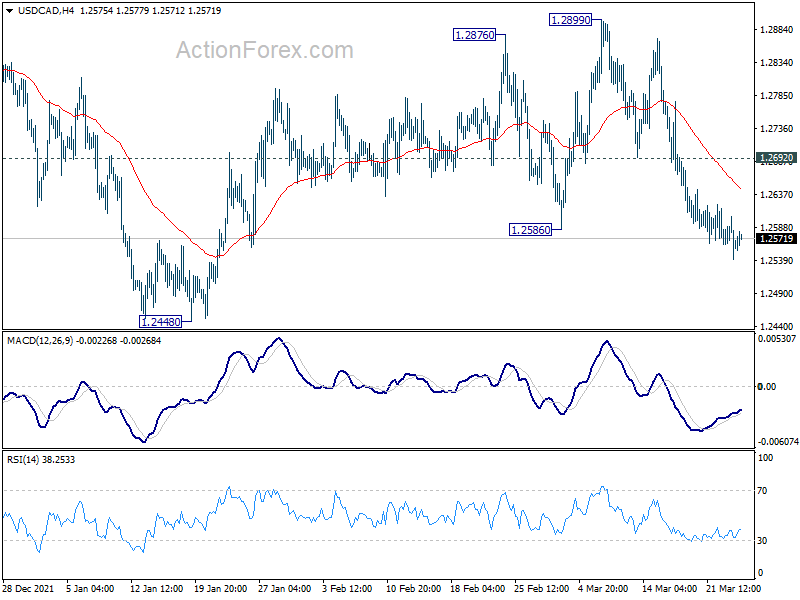
USD/CAD continues to lose downside momentum. But still, further decline is expected with 1.2629 resistance intact. Fall from 1.2899 would target retesting 1.2448 support. Nevertheless, on the upside, break of 1.2692 will mix up the outlook again.
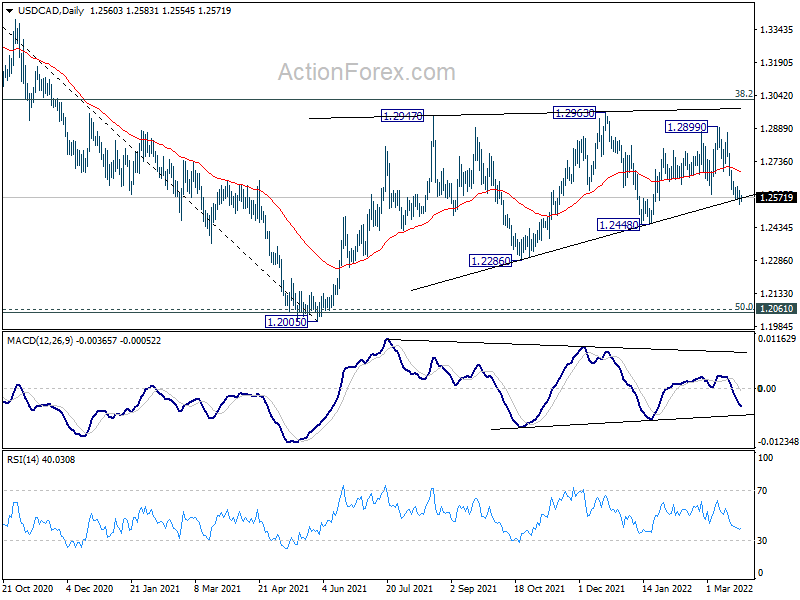
In the bigger picture, focus stays on 38.2% retracement of 1.4667 (2020 high) to 1.2005 (2021 low) at 1.3022. Sustained break there should confirm that the down trend from 1.4667 has completed after defending 1.2061 long term cluster support. Further rise would then be seen towards 61.8% retracement at 1.3650. However, rejection by 1.3022 will maintain medium term bearishness. Break of 1.2005 will resume the down trend from 1.4667 and that carries larger bearish implications too.
AUD/USD Daily Report
Daily Pivots: (S1) 0.7464; (P) 0.7486; (R1) 0.7521; More...
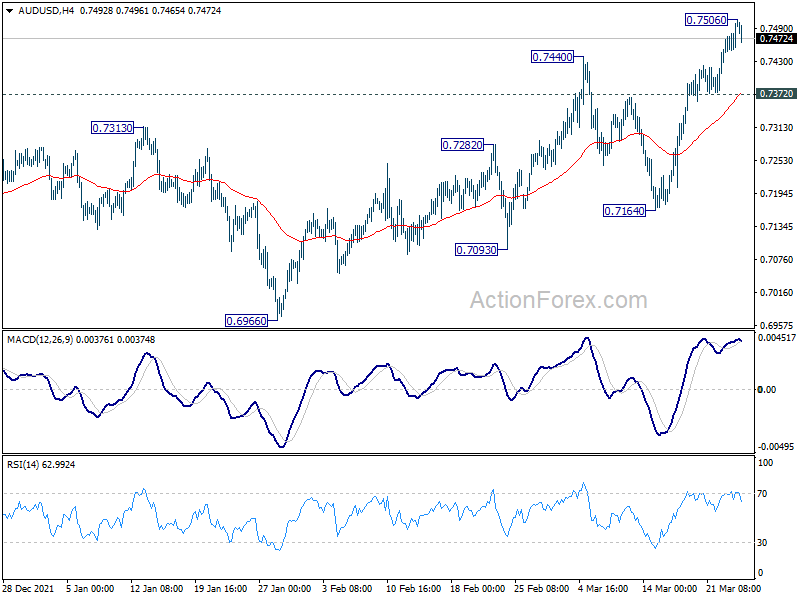
A temporary top is formed at 0.7506 on loss of upside momentum. Intraday bias in AUD/USD is turned neutral first. Further rally is expected as long as 0.7372 support holds. On the upside, above 0.7506 will target 0.7555 resistance. Decisive break there should confirm that whole corrective decline from 0.8006 has completed at 0.6966. On the downside, however, break of 0.7372 will dampen this bullish case, and turn bias back to the downside for 0.7164 support.
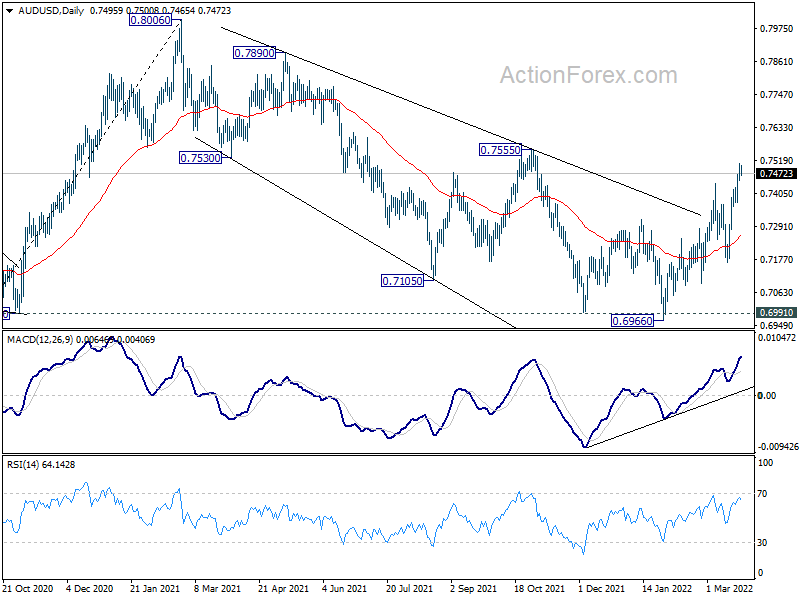
In the bigger picture, focus remains on 0.6991 key structural support. Sustained break there will argue that the whole up trend from 0.5506 might be finished at 0.8006, after rejection by 0.8135 long term resistance. Deeper decline would then be seen back to 61.8% retracement of 0.5506 to 0.8006 at 0.6461. Meanwhile, strong rebound from 0.6991 will retain medium term bullishness. That is, whole up trend from 0.5506 is still in progress for another rise through 0.8006 at a later stage.
Dollar and Yen in Consolidations, Aussie Firm
The forex markets are engaging in sideway trading in tight range in Asia today. The selling climax on Yen should have passed for the near term, with Yen pairs turned into consolidation mode. But the Japanese currency remains the runaway loser for the week, followed by Euro at a distant, and then Swiss Franc and Dollar. Australian Dollar is still the strongest one, together with other commodity currencies and Sterling.
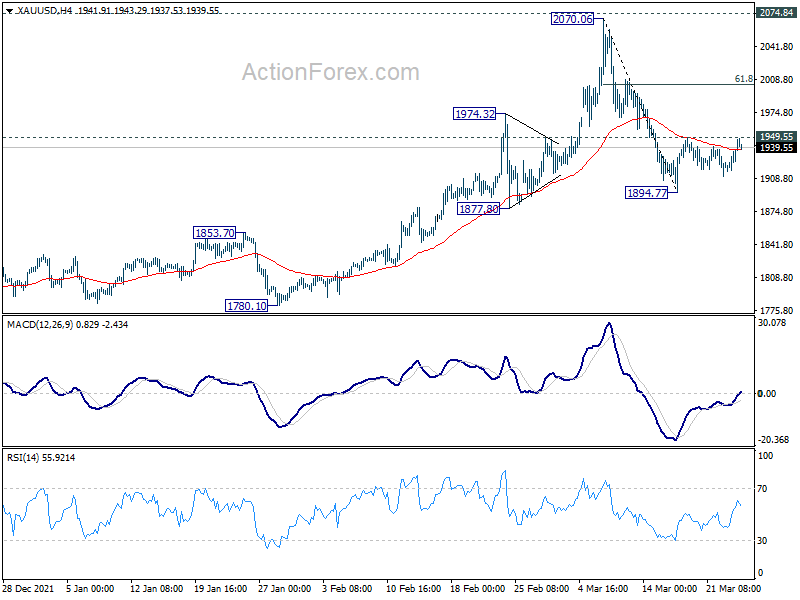
Technically, Gold's break of 4 hour 55 EMA is a near term positive sign. Yet, it still has to break through 1949.55 minor resistance to resume the rebound from 1894.77. In that case, Gold should target 61.8% retracement of 2070.06 to 1894.77 at 2003.09, which is close to 2000 handle. Such development, if happens, could be accompanied by resumption of EUR/USD's rebound from 1.0805.
In Asia, at the time of writing, Nikkei is down -0.25%. Hong Kong HSI is up 0.19%. China Shanghai SSE is down -0.54%. Singapore Strait Times is up 0.80%. Japan 10-year JGB yield is up 0.005 at 0.231. Overnight, DOW dropped -1.29%. S&P 500 dropped -1.23%. NASDAQ dropped -1.32%. 10-year yield dropped -0.052 to 2.321.
Fed Mester: We're going to need to do some 50 basis-point moves
Cleveland Fed President Loretta Mester reiterated yesterday that Fed should "front-load" interest rate hikes in the first of of the year, and start quantitative tightening at the same time. "We have to recognize that inflation is very elevated. It is well above our goal. We have to do what we can with both our policy tools to get inflation under control," she emphasized.
"I think we're going to need to do some 50 basis-point moves," Mester added. "I don't want to presuppose every meeting from here to July, but I do think we need to be more aggressive earlier rather than later."
Fed Daly: If we need to do 50, that is what we'll do
San Francisco Fed President Mary Daly said she has "everything on the table" for the May FOMC meeting. "If we need to do 50, that is what we'll do," she added. "We're prepared to do whatever it takes to ensure that we get price stability, which clearly no one thinks we have right now."
Daly pointed to the new dot plot projection that interest rate will rise to 1.9% this year, and 2.8% by the end of next. "Relative to previous periods of tightening, this is quite a bit of front-loading just as the SEP (Summary of Economic Projections) has indicated."
"I don't think it's appropriate to you, you know, really ratchet up so quickly, that we forget about the risks out there, but rather we be data dependent," she said.
"We could get a lot of tightening in financial conditions globally and that is something we have to think about," she said. "Some increase in the policy rate above neutral is likely to be required. That's down the road in 2023. Right now I don't think we need to be so decisional on what that looks like."
BoJ Kataoka: Pay attention to downside risks to economy, upside risks to prices
BoJ board member Goushi Kataoka warned in a speech to business leaders, "disruptions in Russia-related trade will weigh not just on Russia's economy but global growth by prolonging worldwide supply constraints." And for the time being, "we must pay attention to downside risks to Japan's economy...as well as upside risks to prices."
Separately, meeting of January BoJ meeting noted one member said, "We're seeing stock prices rise for companies that hike prices. Price hikes may broaden, and heighten medium- to long-term inflation expectations."
Another member said, "many companies are feeling the limit of sticking to a business model that was effective deflation. As they change their price-setting behaviour, inflationary pressure may heighten."
However, "nominal wage growth must exceed 2per cent for Japan to stably meet the BOJ's price target," on member was quoted.
Japan PMI manufacturing rose to 53.2 in March, PMI services rose to 48.7
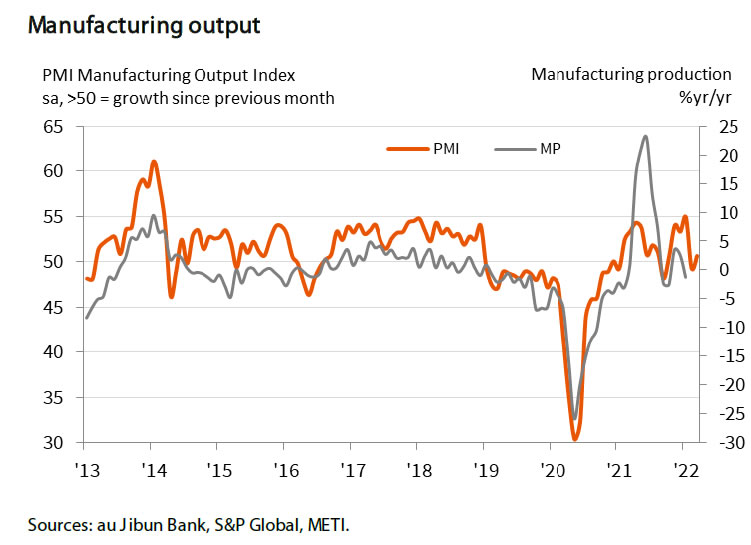
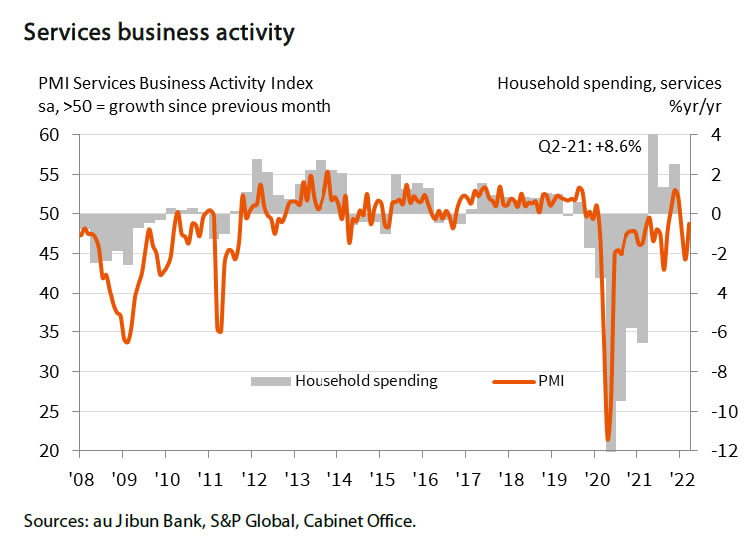
Japan PMI Manufacturing rose from 52.7 to 53.2 in March. Manufacturing output rose from 49.3 to 50.6. PMI Services rose from 44.2 to 48.7. PMI Composite rose from 45.8 to 49.3.
Usamah Bhatti, Economist at S&P Global, said: "Flash PMI data indicated that activity at Japanese private sector businesses fell for the third month running during March. The decline in output eased from the previous survey period however, and was only marginal as companies noted that COVID-19 cases had continued to reduce, allowing the lifting of the quasi-state of emergency across Japan. By sector, manufacturers noted a renewed rise in output in at the end of the first quarter, while service providers indicated a softer deterioration in business activity.
Australia PMI composite rose to 57.1, 10-mth high
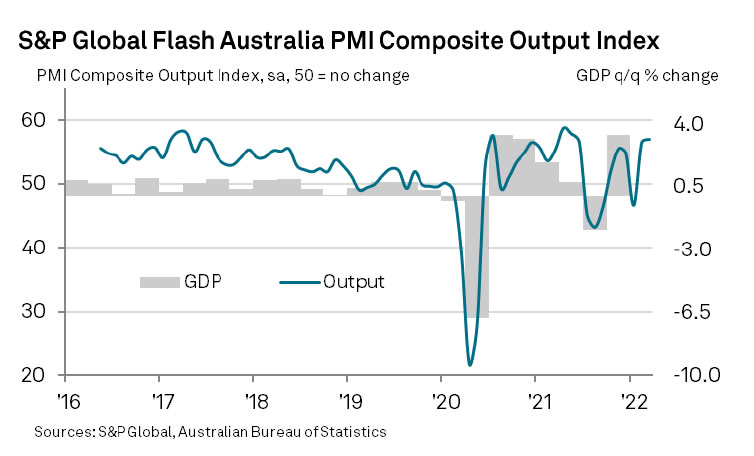
Australia PMI Manufacturing rose from 57.0 to 57.3 in March. PMI Services rose from 57.4 to 57.9, a 10-month high. PMI Composite rose from 56.6 to 57.1, also a 10-month high.
Jingyi Pan, Economics Associate Director at S&P Global said: "The Australian economy continued to expand strongly in March... reflecting robust business conditions post the COVID-19 Omicron wave. Price pressures worsened, however, unsurprisingly aggravated by the slew of issues including floodings in Australia, the Ukraine war and broader supply chain constraints...
"Higher employment levels in March had been a positive sign, though firms also widely reported higher wages. Meanwhile the reopening of the international borders led to the first new export business growth in the service sector since June 2021."
IMF: RBNZ should continue swift policy normalization
In a report, IMF urged RBNZ to have "significant increases" in interest range in the near term to address inflation as a priority.
IMF said, "with the recovery well-entrenched, tight labor market conditions, and elevated inflation, it is appropriate to withdraw fiscal and monetary support as envisaged."
Fiscal policy should "remain agile". "While the scheduled tightening of fiscal policy is appropriate, the authorities should calibrate the fiscal stance to the evolution of the pandemic and economic conditions, providing additional, targeted support where needed."
As for monetary policy, IMF said it should remain "data dependent, and continued, swift policy normalization will be appropriate under baseline conditions."
"Given New Zealand's strong cyclical position and inflationary pressures, significant increases in the Official Cash Rate in the near term are appropriate, signaling the RBNZ's commitment to addressing inflation as a priority."
Looking ahead
SNB is expected to keep interest rate unchanged at -0.75% today, and reiterate the need for negative rate and readiness for intervention. ECB will release monthly economic bulletin.
On the data front, PMIs from Eurozone and UK will be featured. US will release jobless claims, durable goods orders, current account and PMIs.
AUD/USD Daily Report
Daily Pivots: (S1) 0.7464; (P) 0.7486; (R1) 0.7521; More...
A temporary top is formed at 0.7506 on loss of upside momentum. Intraday bias in AUD/USD is turned neutral first. Further rally is expected as long as 0.7372 support holds. On the upside, above 0.7506 will target 0.7555 resistance. Decisive break there should confirm that whole corrective decline from 0.8006 has completed at 0.6966. On the downside, however, break of 0.7372 will dampen this bullish case, and turn bias back to the downside for 0.7164 support.
In the bigger picture, focus remains on 0.6991 key structural support. Sustained break there will argue that the whole up trend from 0.5506 might be finished at 0.8006, after rejection by 0.8135 long term resistance. Deeper decline would then be seen back to 61.8% retracement of 0.5506 to 0.8006 at 0.6461. Meanwhile, strong rebound from 0.6991 will retain medium term bullishness. That is, whole up trend from 0.5506 is still in progress for another rise through 0.8006 at a later stage.
Economic Indicators Update
| GMT | Ccy | Events | Actual | Forecast | Previous | Revised |
|---|---|---|---|---|---|---|
| 22:00 | AUD | Manufacturing PMI Mar P | 57.3 | 57 | ||
| 22:00 | AUD | Services PMI Mar P | 57.9 | 57.4 | ||
| 23:50 | JPY | BoJ Minutes | ||||
| 00:30 | JPY | Manufacturing PMI Mar P | 53.2 | 52.7 | ||
| 07:45 | EUR | France Manufacturing PMI Mar P | 55.1 | 57.2 | ||
| 08:15 | EUR | France Services PMI Mar P | 55.2 | 55.5 | ||
| 08:15 | CHF | SNB Interest Rate Decision | -0.75% | -0.75% | ||
| 08:30 | EUR | Germany Manufacturing PMI Mar P | 55.9 | 58.4 | ||
| 08:30 | EUR | Germany Services PMI Mar P | 54.3 | 55.8 | ||
| 08:30 | EUR | ECB Economic Bulletin | ||||
| 09:00 | EUR | Eurozone Manufacturing PMI Mar P | 56 | 58.2 | ||
| 09:00 | EUR | Eurozone Services PMI Mar P | 54.3 | 55.5 | ||
| 09:00 | GBP | Manufacturing PMI Mar P | 57.7 | 58 | ||
| 09:30 | GBP | Services PMI Mar P | 58 | 60.5 | ||
| 12:30 | USD | Initial Jobless Claims (Mar 18) | 210K | 214K | ||
| 12:30 | USD | Current Account (USD) Q4 | -218B | -215B | ||
| 12:30 | USD | Durable Goods Orders Feb | -0.60% | 1.60% | ||
| 12:30 | USD | Durable Goods Orders ex Transportation Feb | 0.50% | 0.70% | ||
| 13:45 | USD | Manufacturing PMI Mar P | 55 | 57.3 | ||
| 13:45 | USD | Services PMI Mar P | 56 | 56.5 | ||
| 13:45 | USD | Natural Gas Storage | -52B | -79B |
Technical Outlook and Review
DXY:
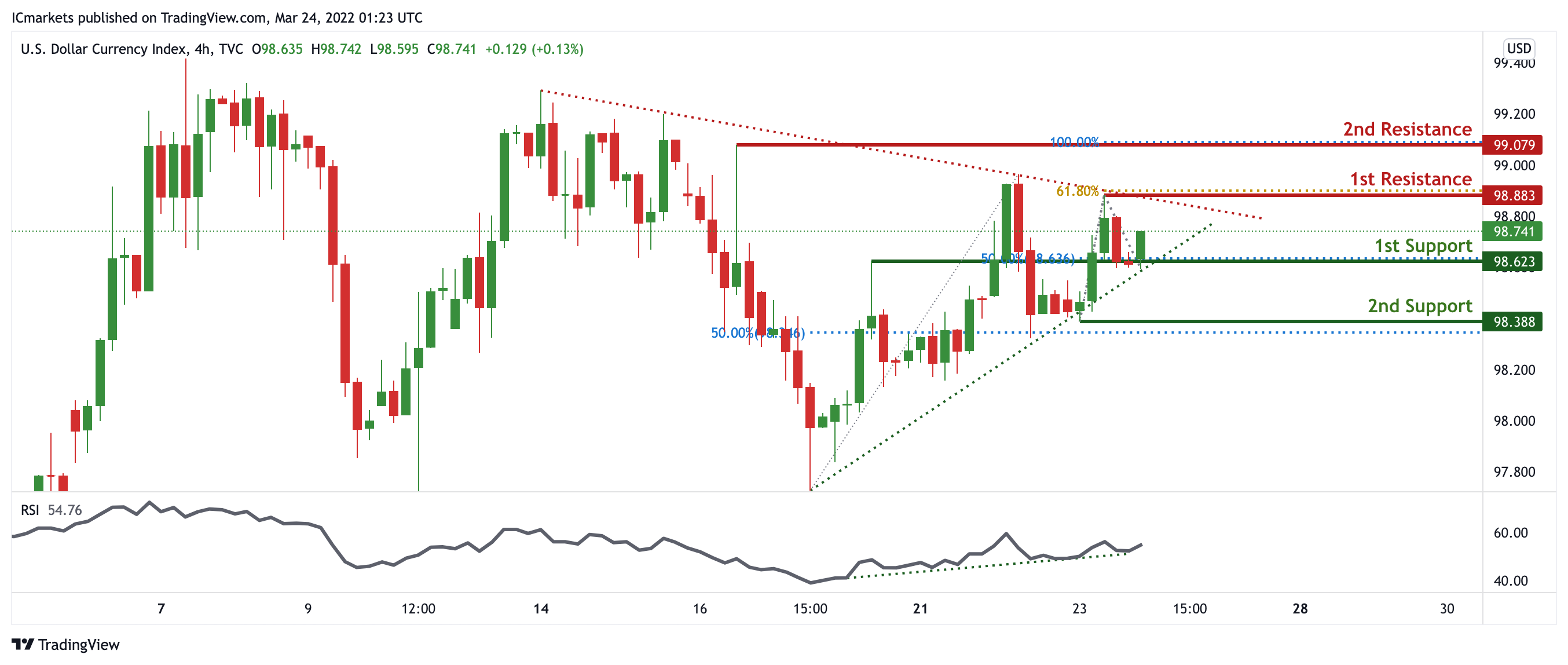
On the H4 timeframe, prices are consolidating in a triangle pattern. We see the potential for a bounce from our 1st support at 98.623 in line with 50% Fibonacci retracement towards our 1st resistance at 98.883 in line with 61.8% Fibonacci retracement. are trading below our ichimoku cloud resistance, further supporting our bullish bias.
Areas of consideration:
- H4 time frame, 1st resistance at 98.883
- H4 time frame, 1st support at 98.623
XAU/USD (GOLD):
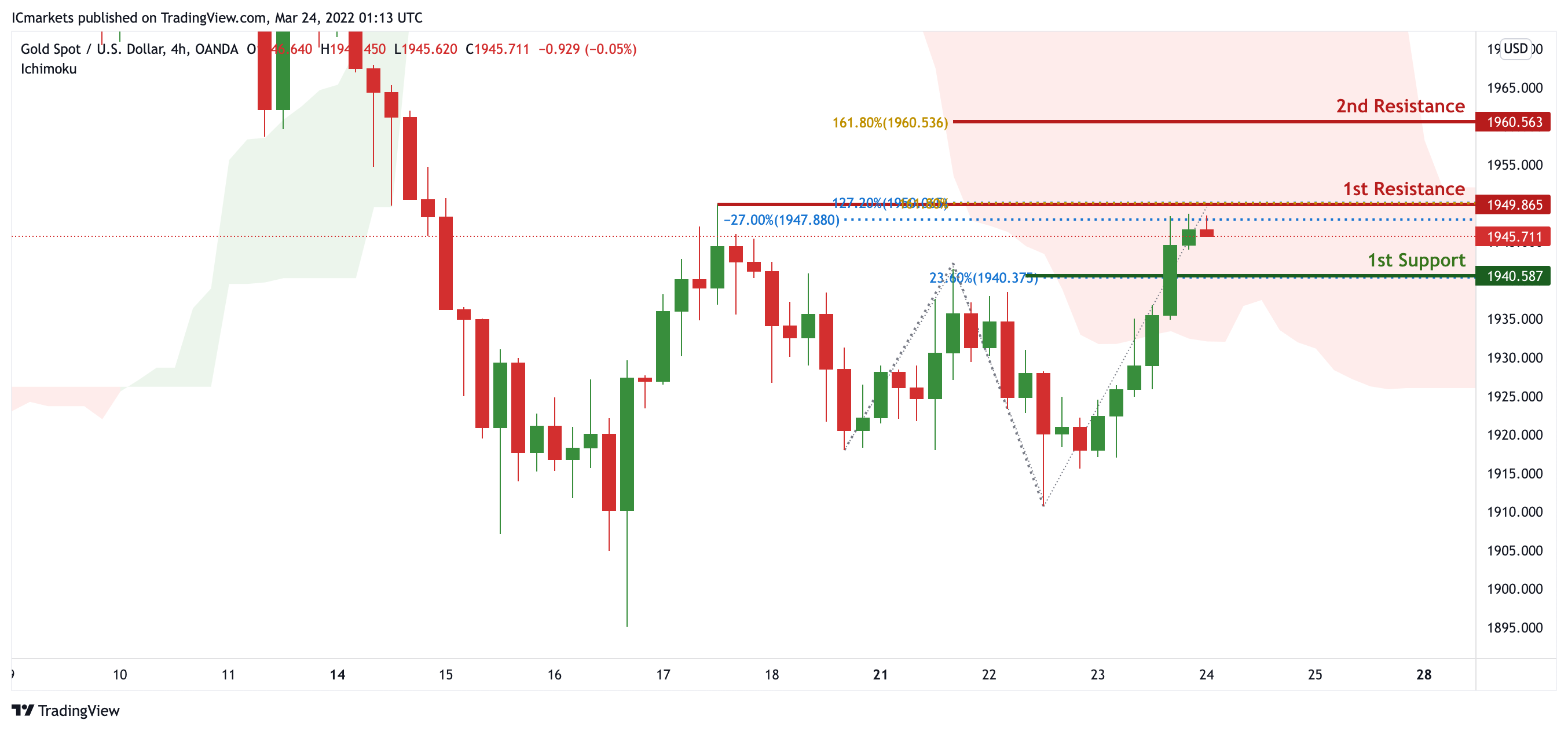
On the H4, prices are on bearish momentum and approaching a key pivot. We see the potential for a dip from our 1st resistance at 1949.865 which is an area of Fibonacci confluences towards our 1st support at 1940.587 in line with 23.6% Fibonacci Retracementand also graphical overlap. Prices are trading below our ichimoku clouds, further supporting our bearish bias.
Areas of consideration:
- 4h 1st support at 1940.587
- 4h 1st resistance at 1949.865
GBP/USD:
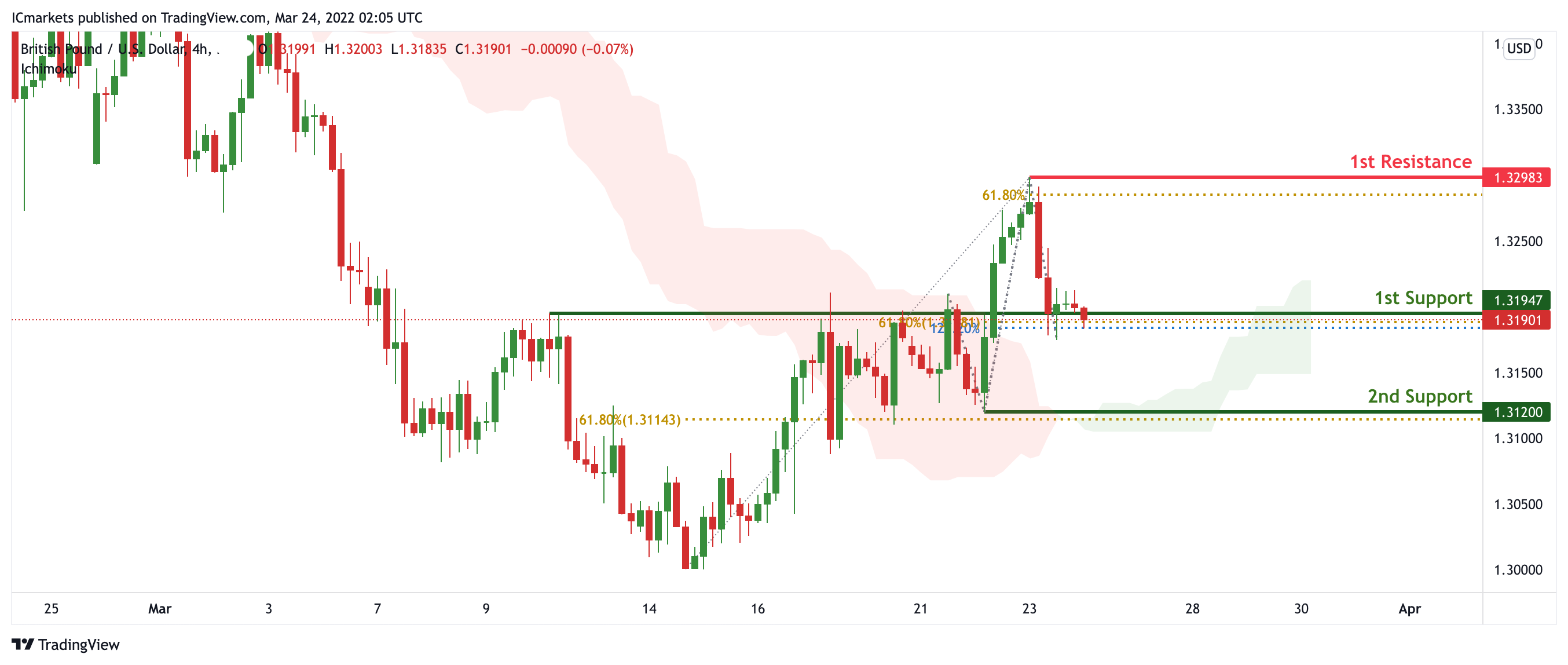
On the H4, prices are at a key pivot level. We see the potential for a bounce from our 1st support at 1.31947 which is a graphical overlap and an area of Fibonacci confluence towards our 1st support at 1.31947 towards our 1st resistance at 1.32983 in line with 61.8% Fibonacci projection. Prices are trading above our ichimoku clouds, further supporting our bullish bias. Alternatively, breaking the key graphical overlap will call for a bearish dip towards our 2nd support at 1.312 which was a graphical swing low and in line with 61.8% Fibonacci Retracement.
Areas of consideration:
- H4 1st resistance at 1.32983
- H4 1st support at 1.31947
USD/CHF:
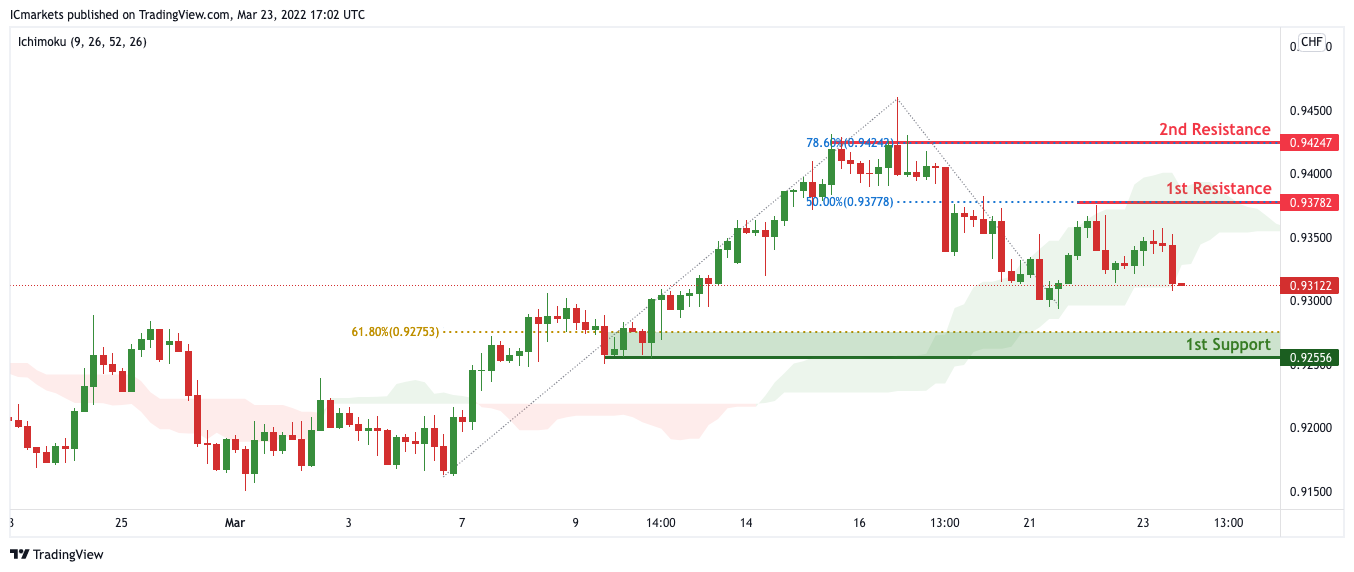
On the H4, with price moving below our ichimoku cloud, we have a bias that price will drop from 1st resistance at 0.93782 in line with the horizontal pullback resistance and 50% Fibonacci retracement to 1st support at 0.92556 in line with the pullback support and 61.8% Fibonacci retracement .Alternatively, price may break 1st resistance and head for 2nd resistance at 0.94247 in line with the 78.6% Fibonacci retracement.
Areas of consideration
- 1st support level 0.92556
- 1st resistance 0.93782
EUR/USD :
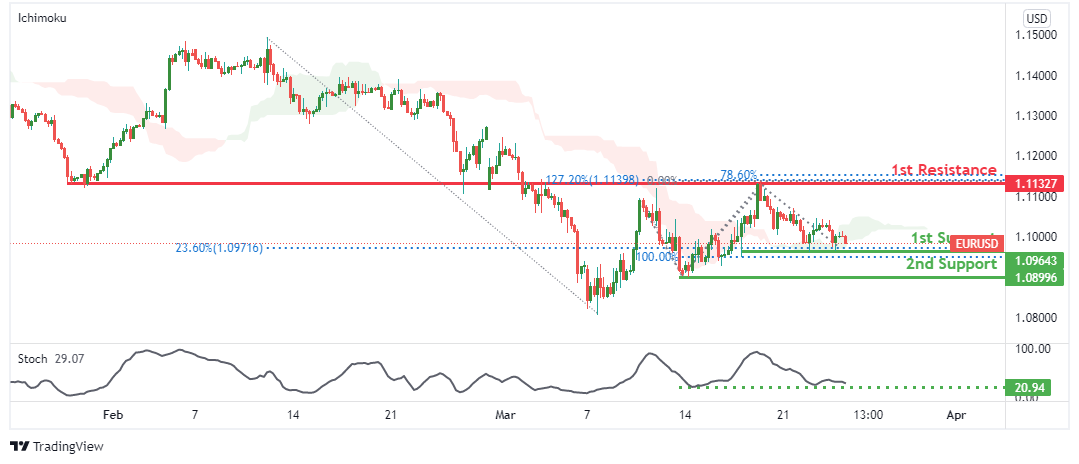
On the H4, price is near 1st support level of 1.09643 in line with 100% Fibonacci projection and 23.6% Fibonacci retracement. Price can move towards the 1st resistance level of 1.11327 which is in line with 127.2% Fibonacci extension and 78.6% Fibonacci projection. Our bullish bias is supported by the stochastic indicator where price is trading at support level..
Areas of consideration :
- H4 1st resistance at 1.11327
- H4 1st support at 1.09643
USD/JPY:
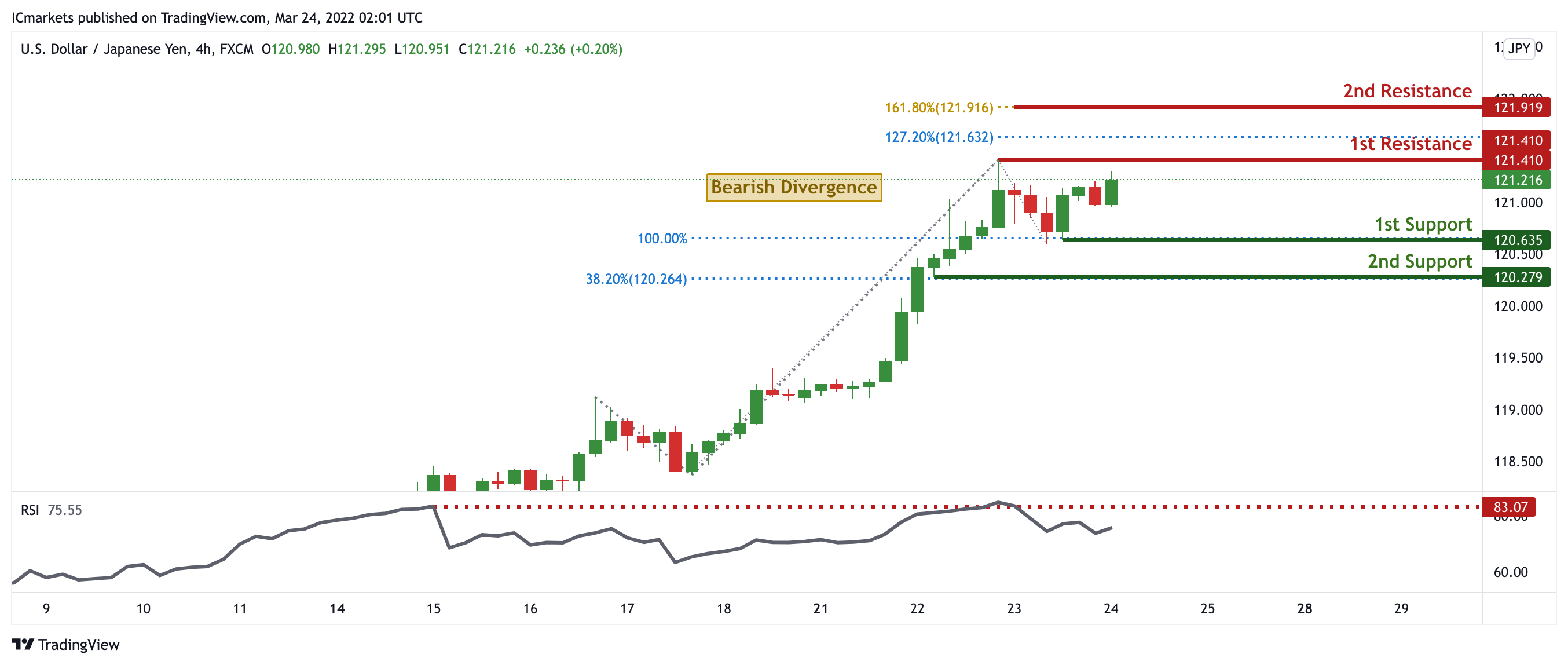
On the H4 timeframe, prices have approached pivot and swing high. We see the potential for a short pullback from our 1st resistance at 121.410 in line with 127.2% Fibonacci extension towards our 1st support at 120.635 in line with 100% Fibonacci Projection. Divergence is spotted on RSI, further supporting our bearish bias.
Areas of consideration:
- H4 time frame, 1st resistance at 121.410
- H4 time frame, 1st support at 120.635
AUD/USD:
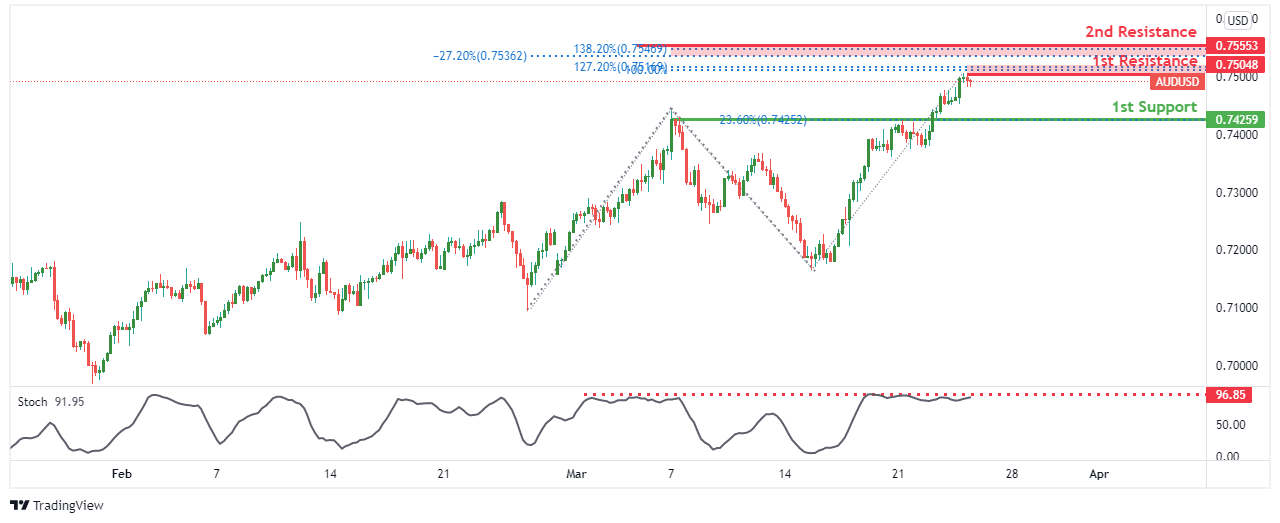
On the H4, price is near 1st resistance level of 0.75048 in line with 127.2% Fibonacci extension and 100% Fibonacci projection. Price can dip towards the 1st support level of 0.74259 which is in line with 23.6% Fibonacci retracement.Our bearish bias is supported by the stochastic indicator as it is at the resistance level
Areas of consideration
- H4 1st resistance at 0.75048
- H4 1st support at 0.74259
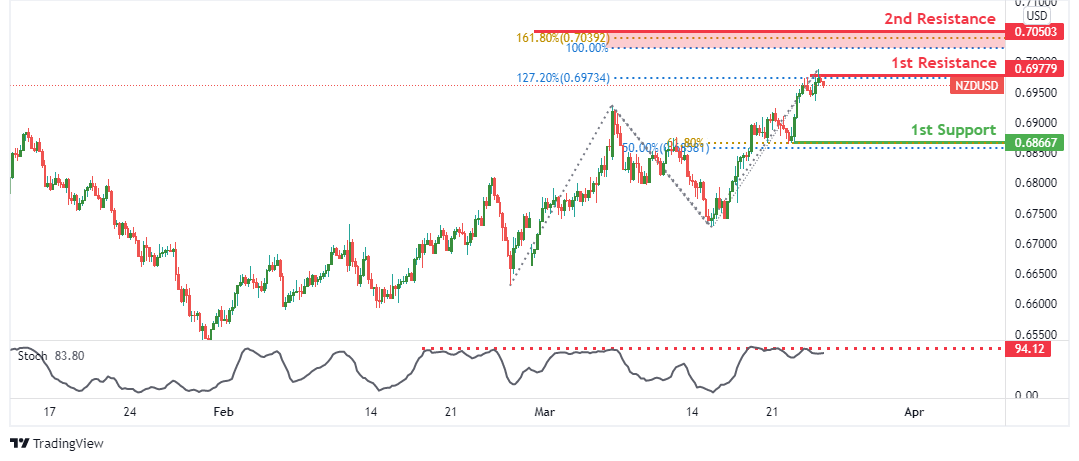
NZD/USD:
On the H4, price is near 1st resistance level of 0.69779 in line with 127.2% Fibonacci extension. Price can dip towards the 1st support level of 0.68667 which is in line with 50% Fibonacci retracement and 61.8% Fibonacci projection.Our bearish bias is supported by stochastic indicator as it is at resistance level.
Areas of consideration :
- H4 1st resistance at 0.69779
- H4 1st support at 0.68667
USD/CAD:
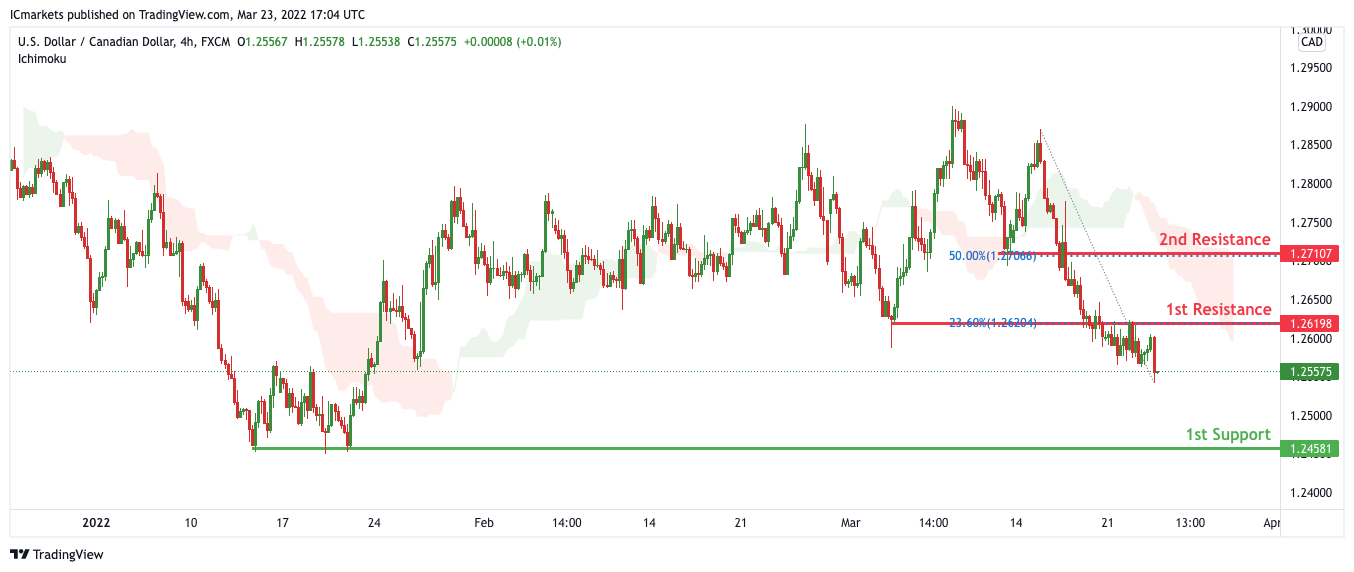
On the H4, with price moving below our ichimoku cloud, we have a bias that price will drop from 1st resistance at 1.26198 in line with the horizontal pullback resistance and 23.6% Fibonacci retracement to 1st support at 1.24581 in line with the swing low support .Alternatively, price may break 1st resistance and head for 2nd resistance at 1.27107 in line with the horizontal pullback resistance and 50% Fibonacci retracement.
Areas of consideration:
- H4 time frame, 1st support at 1.24581
- H4 time frame, 1st resistance at 1.26198
OIL:
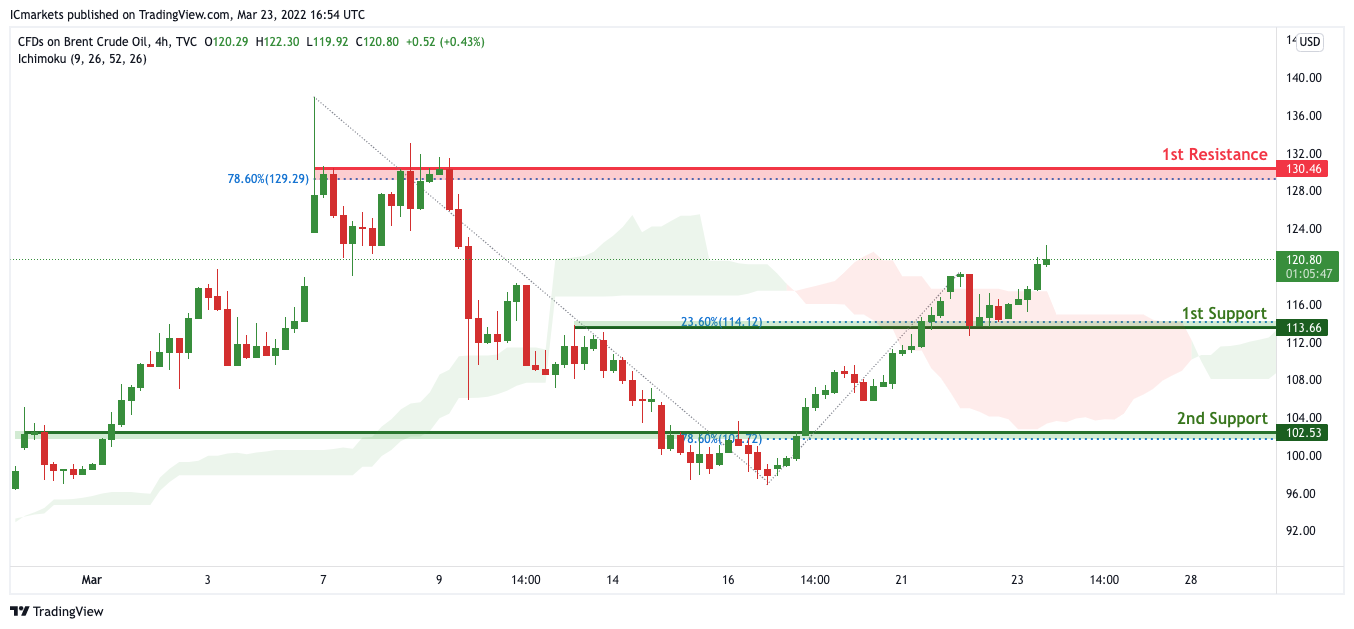
On the H4, with price moving above the ichimoku cloud, we have a bias that price will rise to our 1st resistance at 130.46 in line with the 78.6% Fibonacci retracement from our 1st support at 113.66 in line with the horizontal overlap support and 23.6% Fibonacci retracement. Alternatively, price may break 1st support structure and head for 2nd support at 102.53 in line with the horizontaL overlap support and 78.6% Fibonacci retracement.
Areas of consideration:
- H4 time frame, 1st resistance of 130.46
- H4 time frame, 1st support of 113.66
Dow Jones Industrial Average:
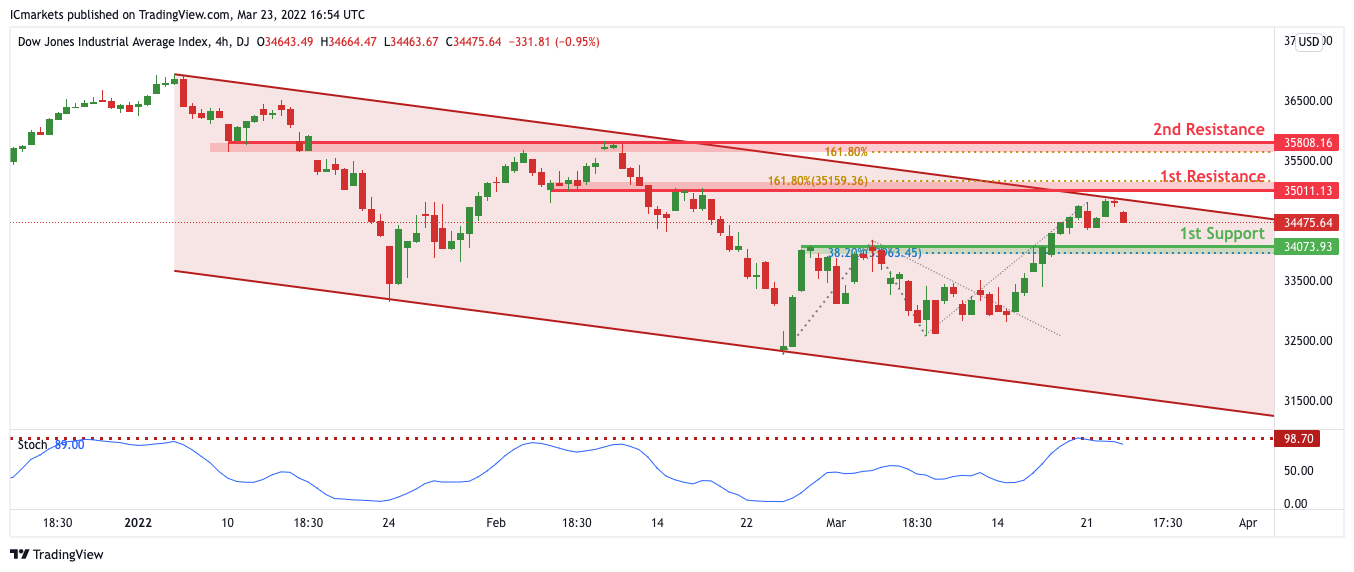
On the H4, with price expected to reverse off the stochastics level, we have a bias that price will drop from 1st resistance at 35011 in line with the horizontal overlap resistance and 161.8% Fibonacci extension to 1st support at 34073 in line with the pullback support .Alternatively, price may break 1st resistance and head for 2nd resistance at 35808 in line with the 161.8% Fibonacci extension.
Areas of consideration :
- H4 1st support at 34073
- H4 1st resistance at 35011
Japan PMI manufacturing rose to 53.2 in March, PMI services rose to 48.7
Japan PMI Manufacturing rose from 52.7 to 53.2 in March. Manufacturing output rose from 49.3 to 50.6. PMI Services rose from 44.2 to 48.7. PMI Composite rose from 45.8 to 49.3.
Usamah Bhatti, Economist at S&P Global, said: "Flash PMI data indicated that activity at Japanese private sector businesses fell for the third month running during March. The decline in output eased from the previous survey period however, and was only marginal as companies noted that COVID-19 cases had continued to reduce, allowing the lifting of the quasi-state of emergency across Japan. By sector, manufacturers noted a renewed rise in output in at the end of the first quarter, while service providers indicated a softer deterioration in business activity.
Australia PMI composite rose to 57.1, 10-mth high
Australia PMI Manufacturing rose from 57.0 to 57.3 in March. PMI Services rose from 57.4 to 57.9, a 10-month high. PMI Composite rose from 56.6 to 57.1, also a 10-month high.
Jingyi Pan, Economics Associate Director at S&P Global said: "The Australian economy continued to expand strongly in March... reflecting robust business conditions post the COVID-19 Omicron wave. Price pressures worsened, however, unsurprisingly aggravated by the slew of issues including floodings in Australia, the Ukraine war and broader supply chain constraints...
"Higher employment levels in March had been a positive sign, though firms also widely reported higher wages. Meanwhile the reopening of the international borders led to the first new export business growth in the service sector since June 2021."
IMF: RBNZ should continue swift policy normalization
In a report, IMF urged RBNZ to have "significant increases" in interest range in the near term to address inflation as a priority.
IMF said, "with the recovery well-entrenched, tight labor market conditions, and elevated inflation, it is appropriate to withdraw fiscal and monetary support as envisaged."
Fiscal policy should "remain agile". "While the scheduled tightening of fiscal policy is appropriate, the authorities should calibrate the fiscal stance to the evolution of the pandemic and economic conditions, providing additional, targeted support where needed."
As for monetary policy, IMF said it should remain "data dependent, and continued, swift policy normalization will be appropriate under baseline conditions."
"Given New Zealand's strong cyclical position and inflationary pressures, significant increases in the Official Cash Rate in the near term are appropriate, signaling the RBNZ's commitment to addressing inflation as a priority."
BoJ Kataoka: Pay attention to downside risks to economy, upside risks to prices
BoJ board member Goushi Kataoka warned in a speech to business leaders, "disruptions in Russia-related trade will weigh not just on Russia's economy but global growth by prolonging worldwide supply constraints." And for the time being, "we must pay attention to downside risks to Japan's economy...as well as upside risks to prices."
Separately, meeting of January BoJ meeting noted one member said, "We're seeing stock prices rise for companies that hike prices. Price hikes may broaden, and heighten medium- to long-term inflation expectations."
Another member said, "many companies are feeling the limit of sticking to a business model that was effective deflation. As they change their price-setting behaviour, inflationary pressure may heighten."
However, "nominal wage growth must exceed 2per cent for Japan to stably meet the BOJ's price target," on member was quoted.
Fed Daly: If we need to do 50, that is what we’ll do
San Francisco Fed President Mary Daly said she has "everything on the table" for the May FOMC meeting. "If we need to do 50, that is what we'll do," she added. "We're prepared to do whatever it takes to ensure that we get price stability, which clearly no one thinks we have right now."
Daly pointed to the new dot plot projection that interest rate will rise to 1.9% this year, and 2.8% by the end of next. "Relative to previous periods of tightening, this is quite a bit of front-loading just as the SEP (Summary of Economic Projections) has indicated."
"I don't think it's appropriate to you, you know, really ratchet up so quickly, that we forget about the risks out there, but rather we be data dependent," she said.
"We could get a lot of tightening in financial conditions globally and that is something we have to think about," she said. "Some increase in the policy rate above neutral is likely to be required. That's down the road in 2023. Right now I don't think we need to be so decisional on what that looks like."
Fed Mester: We’re going to need to do some 50 basis-point moves
Cleveland Fed President Loretta Mester reiterated yesterday that Fed should "front-load" interest rate hikes in the first of of the year, and start quantitative tightening at the same time. "We have to recognize that inflation is very elevated. It is well above our goal. We have to do what we can with both our policy tools to get inflation under control," she emphasized.
"I think we're going to need to do some 50 basis-point moves," Mester added. "I don't want to presuppose every meeting from here to July, but I do think we need to be more aggressive earlier rather than later."