Sample Category Title
USD/JPY Outlook: The Dollar Hits New Multi-Year High vs Sinking Yen
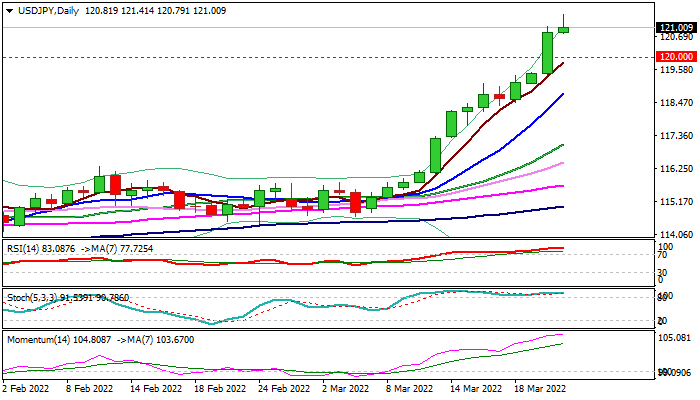
The USDJPY rose to the highest in six years on Wednesday, in extension of Tuesday’s 1.1% rally (the biggest one-day advance since Nov 10), as dollar continues to benefit from rising optimism on expectations of more aggressive Fed, while yen continues to weaken on diverging Fed/BOJ policies.
Close above pivots at 119.50/120.00 (Fibo 76.4% of 125.84/98.99 / psychological) was strong bullish signal for extension of the upleg from 114.64 (Mar 4 low), a part of larger uptrend from 102.59 (Jan 2021 low).
Immediate target lays at 121.67 (Jan 2016 high), with bulls capable of travelling to the levels last seen in 2015 (123.74 (Nov 215 peak) and 125.84 (2015 high).
Daily techs point to bullish bias above broken Fibo barrier at 119.50, now reverted to solid support, which should contain dips on overbought conditions.
Res: 121.41; 121.67; 122.00; 123.00.
Sup: 120.79; 120.00; 119.50; 119.00.
Bitcoin Rises on Capital Flight from Bonds
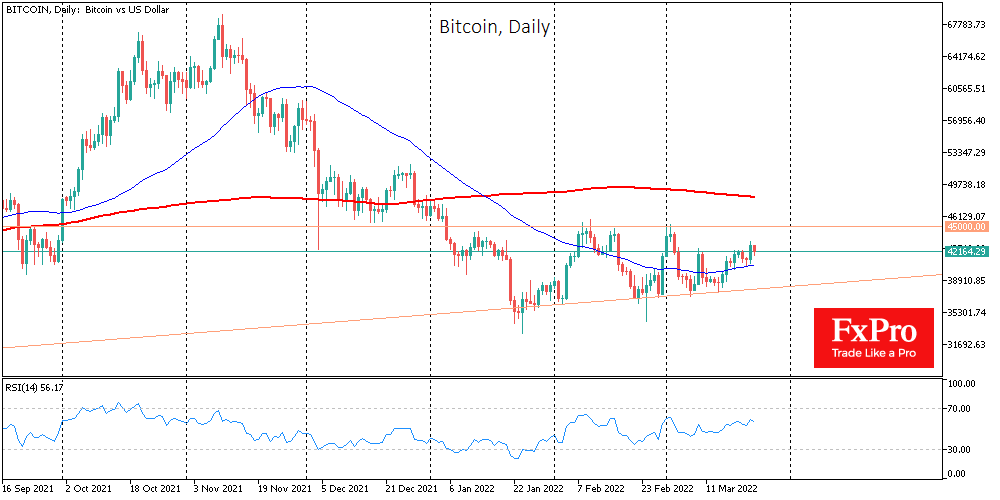
BTC rose 3.5% on Tuesday. At the peak of the day, the rate exceeded $43.2K, but by Wednesday morning it rolled back to $42K, demonstrating a 0.7% correction. Ethereum is losing 1% over 24 hours, while other leading altcoins from the top ten showed mixed dynamics yesterday: from a decline of 2.7% (Avalanche) to a rise of 3.8% (Polkadot).
According to CoinMarketCap, the total capitalization of the crypto market decreased by 0.5%, to $1.91 trillion. The Bitcoin dominance index fell by 0.1% to 41.9%. The Cryptocurrency Fear and Greed Index added another 5 points to 31, although it remains in a “fear” state.
Bitcoin tested 19-day highs above $43,000 supported by stock indexes with Chinese equities predominantly pulling it. BTC rose sharply during the Asian session, adding about $2,000 in a few hours, although a corrective mood then prevailed. Bitcoin clearly doesn’t have a reason for a solid establishment on the path of growth yet.
At the moment, on-chain metrics are consistent with a bear market, Glassnode notes. The rise in implied volatility and higher leverage in the derivatives market point to the possibility of a sharp swing in bitcoin.
However, the sell-off in “defensive” developed-country government bonds continues in financial markets as investors park their money in stocks and commodities that provide the best hedge against prolonged and high inflation. At the same time, there are no clear signs of an economic and financial catastrophe that could hurt stocks or commodities.
The world’s largest hedge fund Bridgewater Associates plans to invest in one of the third-party crypto funds, pointing to the risks for fiat currencies, which lose sharply during periods of military and economic wars.
High UK Inflation Erodes Confidence in the Bank of England
After the traditional January reset, UK consumer prices continued their flight. Morning data showed that CPI rose by 0.8% last month and 6.2% year-over-year. This data is 0.2 percentage points above market expectations, indicating that prices rise faster than initially forecast.
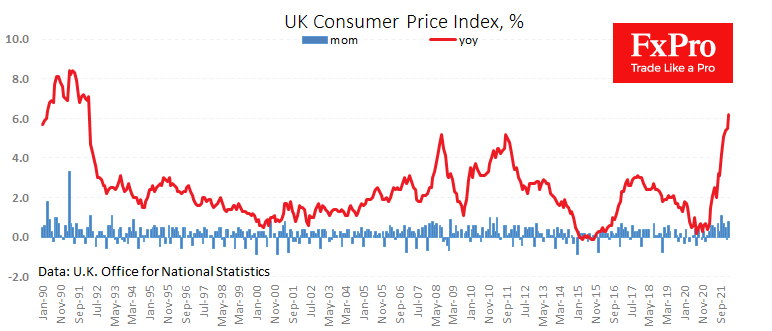
Last week the Bank of England indicated that inflation could peak near 8% but failed to vote unanimously to raise rates. In contrast, it would be much more logical to speed up rate hikes with inflation accelerating.
The Central Bank’s more dovish stance than circumstances requires turns the market reaction to solid inflation figures upside down. The British currency is under pressure to release stronger-than-expected figures as investors overestimate real bond yields.
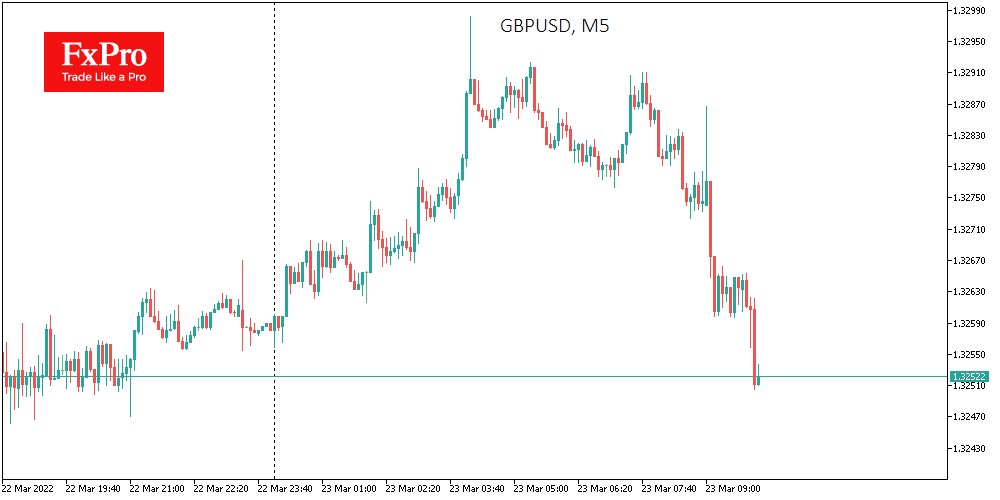
This currency reaction to inflation is mainly a characteristic of emerging markets, where confidence that the situation is under the control of the Central Bank is not too strong. So far, we are only witnessing a cautious distrust of the Bank of England by Forex traders.
However, the example of Japan, whose currency has lost over 6% in 3 weeks, clearly shows signs of a loss of confidence in central banks in developed countries which remain on the side of the economy and have not entirely switched over to fighting inflation.
NZDUSD Stretches Ascending Move to New 4-Month High
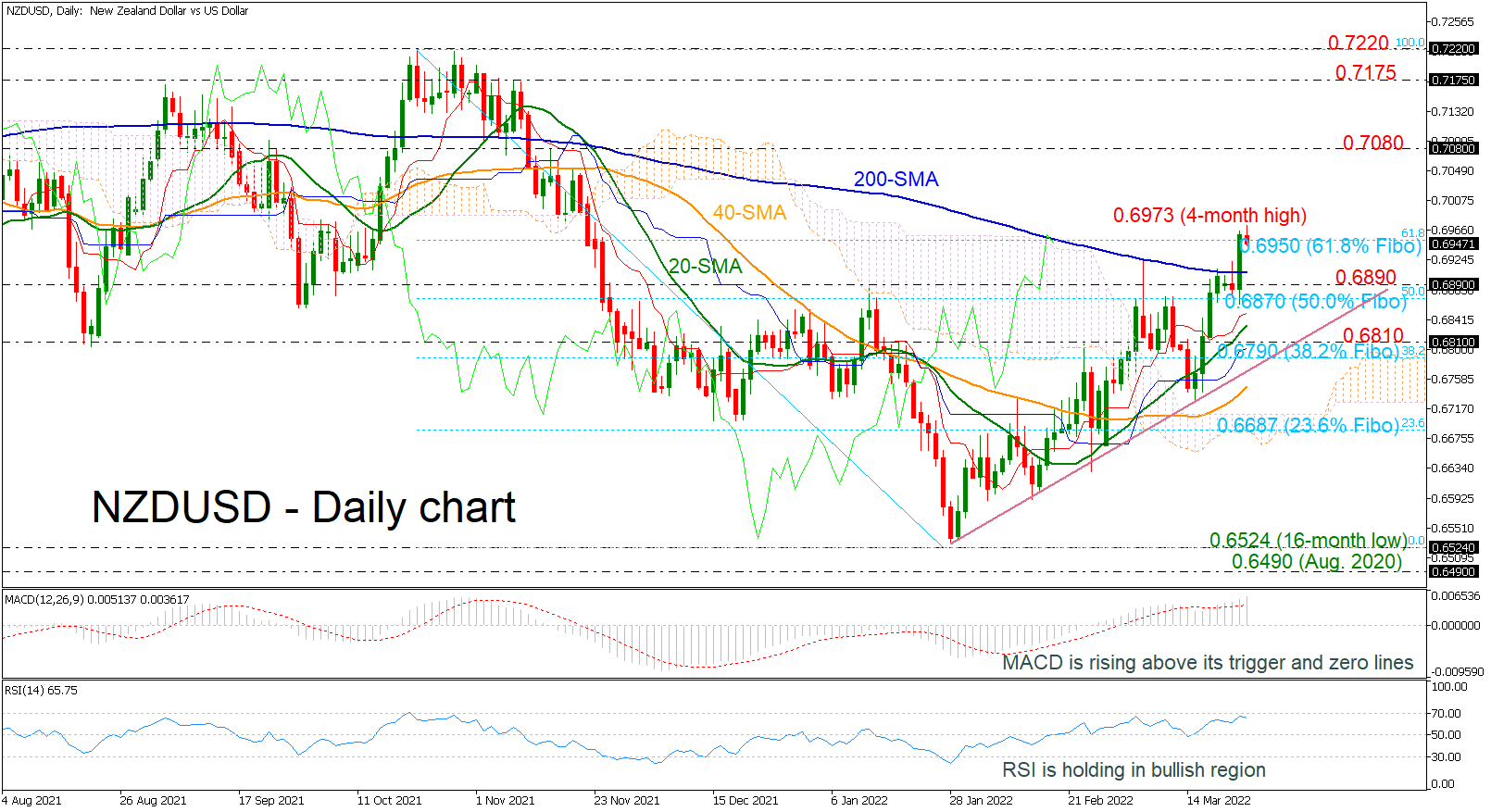
NZDUSD posted a fresh four-month high at 0.6973 today, but the bulls have yet to successfully breach the 61.8% Fibonacci retracement level of the down leg from 0.7220 to 0.6524 at 0.6950.
The MACD oscillator is strengthening its momentum above its trigger and zero lines, whereas the RSI indicator is sloping slightly down around the 70 level. In trend indicators, the price is holding above the strong 200-day simple moving average (SMA), and the short-term SMAs are moving higher as well.
If the pair overcomes successfully the recent high, it could move towards the 0.7080 resistance taken from the peaks in November 2021. Stepping higher, the price could make a pause between the 0.7175 barrier and the top from October 2021 at 0.7220.
On the other hand, a drop below the 61.8% Fibonacci at 0.6950 could open the door for the 200-day SMA at 0.6910. The 50.0% Fibonacci of 0.6870 could be the next stop, while sharper declines could meet the short-term uptrend line around the 0.6810 support and the 38.2% Fibonacci of 0.6790.
All in all, NZDUSD has been in an ascending movement since January 28, creating higher highs and higher lows. A slide below the rising trendline could switch the short-term bias to negative, shifting attention back to the medium-term downtrend.
USDJPY Unlocks Fresh 6-Year High; Bullish But Overbought
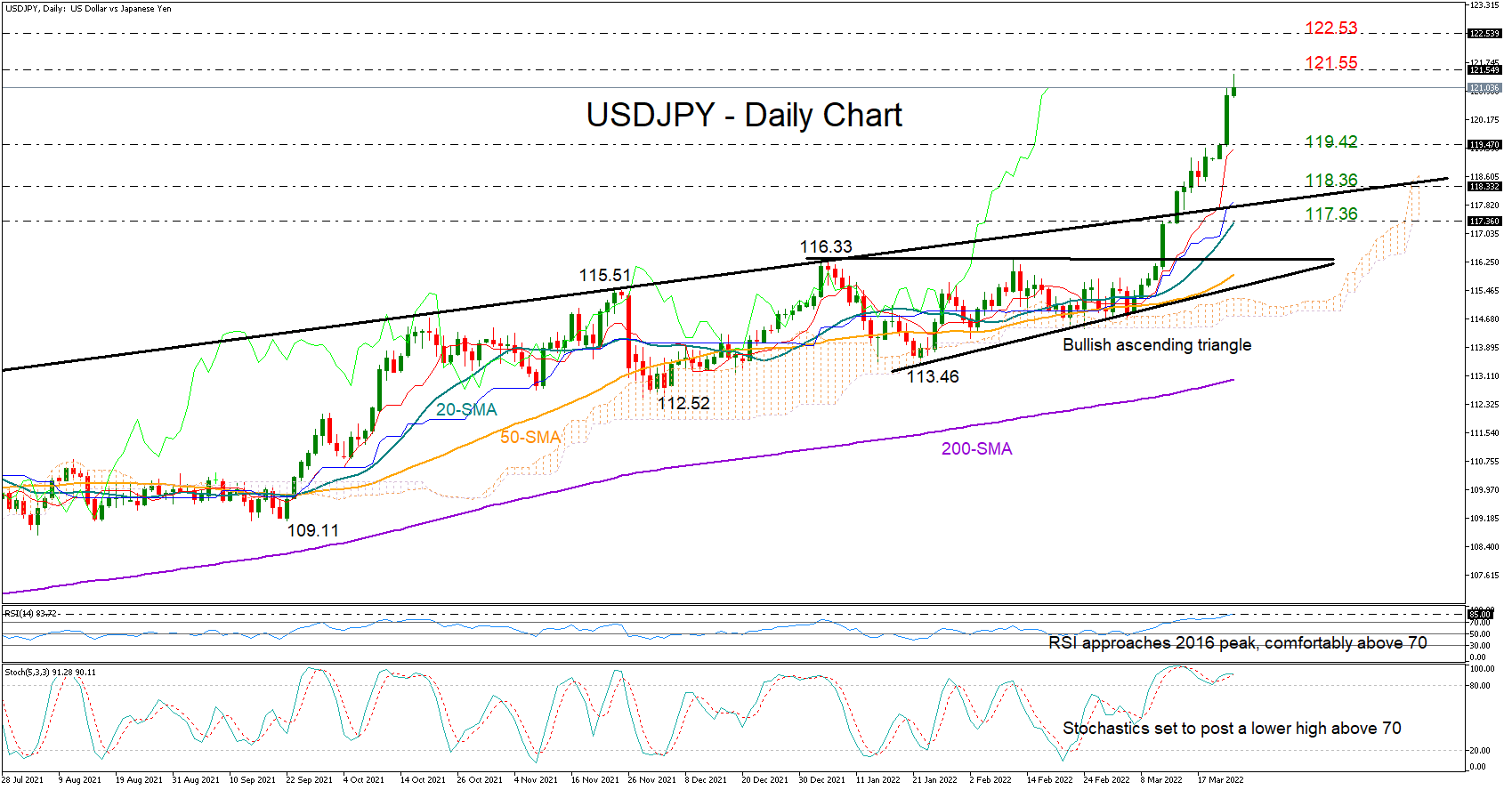
USDJPY stretched Tuesday’s exponential rally to a fresh 6-year high of 121.40 on Wednesday, boosting its gains by 5.2% so far in March.
The market structure is strongly bullish, underpinned by the upward sloping simple moving averages (SMAs). Yet, with the price trading way above its SMAs and the RSI approaching its 2016 high after deviating significantly above its 70 overbought level, there is growing speculation that the bulls could soon run out of fuel. The Stochastics are in line with this narrative as the blue %K and red %D lines are set for another bearish crossover above their 80 overbought level, which is lower than the one registered last week.
If the bulls surrender around 121.55, the pair may drift lower to seek support near Tuesday’s low of 119.42. Failing to rebound here could see an extension towards 118.36, while a steeper decline may test the broken resistance line currently at 117.80. Should sellers breach the 20-day SMA at 117.36 as well, the downfall could pick up steam towards January’s top of 116.33.
In the bullish scenario, where the rally gets fresh buying traction above 121.55, immediate resistance could emerge somewhere between 122.53 and 123.80. Higher, a tougher battle could start around the 2015 ceiling of 125.27 – 125.84.
Summarizing, USDJPY continues to hold a bullish bias, but with the pair trading within the overbought zone for a week now, conviction is growing that the impressive rally could soon take a breather.
Debt Dump Continues, Egged On by hawkish Fed
- Concerns over hawkish policy tightening fuel global bond selloff
- US yield curve heads towards inversion, signifying rising recession fears
- Global stocks continue to find a bid
- Further signs of stagflation could pull the rug from under stock bulls
Global bonds are extending their slump, driven by fears that central banks have to get more aggressive in quelling red-hot inflation. Earlier this week, Fed Chair Jerome Powell left the door open for a larger-than-usual 50-basis point hike at the FOMC meeting in May, with other Fed officials also adding their voices to this ultra-hawkish chorus this week. Fed Funds futures are now pricing in seven rate hikes at the FOMC’s six remaining meetings for the rest of 2022, suggesting a larger 50-basis point hike could take place soon.
Shorter-dated debt is especially bearing the brunt of the Fed’s more hawkish stance, with the year-to-date surge on 2-year Treasury yields now rising to 145 basis points. This would make for the worst quarter since 1984. Yields on 10-year Treasuries have also hit the psychologically important 2.40% level for the first time since 2019, as the spread between the 2-year and 10-year has whittled down to a mere 20 basis points or so, its flattest since the onset of the pandemic in 2020.
Battling inflation is Fed’s top target
Despite war still raging in the Ukraine, major central banks apparently are of the view that the main economic risks stemming from the military conflict are inflationary rather than a demand or sentiment shock. Policymakers at the Fed have made it clear that subduing inflation is their top priority and may be willing to risk a hard economic landing in order to achieve that goal.
More outflows from fixed-income assets can be expected as markets continue front-loading Fed interest rate hikes, while also pricing in the ramped-up prospects of a US recession occurring next year. The selloff in bonds also suggests that global investors are on the hunt for necessary hedges, not just against multi-decade high inflation, but also the prospects of a steeper tightening cycle.
Stocks unfazed by bond rout … for now
On the other hand, global equities are performing as if all is well with the world. Asian stocks are in the green while US and European futures are also adding to recent gains, with the S&P 500 halving its year-to-date losses on the back of its recent rally.
It’s tough to find a watertight explanation for such risk-on behavior in light of the looming threats, with the still-raging war between Russia and Ukraine compounding the risks of an ultra-hawkish Fed.
Bond outflows are perhaps finding their way into equities, but the two asset classes are sending out different messages. While bond investors are blaring on the recession foghorns, stocks appear more receptive to the Fed’s rosier outlook, with the central bank insisting that the US economy is strong enough to withstand higher interest rates. The stock bulls’ narrative assumes that companies have enough pricing power to pass on higher costs to enough customers with enough jobs, thus preserving profit margins, at least for 2022. One cannot also rule out the TINA (“there is no alternative”) mantra having its say on fund allocations for the time being.
Still, it may require further positive justification in order to sustain the advance in global stocks. More overt signs of stagflation in the months ahead could present a major moment of reckoning for equity bulls, with any shocking realisations potentially in turn unwinding gains in global equities.
A 50 bps Rate Hike (in May) Apparently Has Become the Preferred Scenario
Markets
Monday’s post-Powell bond market sell-off simply continued. A 50 bps rate hike (in May) apparently has become the preferred scenario not only for the hawkish wing within the Fed (Bullard, Bostic). Moderates (Mester/Daly) also voiced their support to step up the pace of policy normalization. A strong economy and unacceptably high inflation are building a consensus to frontload tightening and bring the policy rate to/above the neutral level.
US yields rose another 4.9bps (2-y) to 8.4 bps (30-y), with all tenors setting new cycle top levels. Interestingly, the curve steepened even as the Fed is stepping up its anti-inflation fight. The rise was driven by a further rebound in real yields, but inflation expectations didn’t ease.
ECB members also acknowledged the need to address inflationary risks, but their tone remains less aggressive. Still this leaves to door open for the ECB to leave the era of negative rates by the end of this year. German yields rose between 4.9 bps (2-y) and 1.9 bp (30-y).
This rise still was mainly the result of higher inflation expectations. Oil rebounding above $115 p/b apparently caused some investors to ponder stagflationary risks for the European economy.
The rise in (real) yields and risks to growth still don’t bother equity investors. US indices gained between 0.74% (Dow) and 1.95 % Nasdaq). The EuroStoxx 50 closed 1.14% higher. Given the sharp moves in bond markets, FX markets again was a place of remarkable calm.
Fed front-loading/higher short yields at best has only a mixed impact on the dollar. Yen remains an ‘outstanding underperformer’, with USD/JPY currently regaining the 121 barrier. However, the picture in the likes of EUR/USD or cable was balanced (close 1.1029) or even in favour of sterling (cable gaining from 1.317 to 1.326). EUR/GBP tumbled from 0.8366 to close at 0.8316. Markets aren’t convinced that the BoE will be able to maintain last week’s soft guidance with inflation expected to remain elevated for most of this year.
Risk sentiment in Asian remains positive, with Japanese (Nikkei +3.0%) and Chinese equities (CSI 1.8%) taking the lead. US treasuries maintain recent losses. The dollar trades little changed (DXY 98.45). The yuan eases further (USD/CNY 6.372).
The eco calendar only contains EC consumer confidence. Markets will look out for new sanctions against Russia as US president Biden meets with allies in Brussels. New sanctions on Russian energy resulting in a higher oil price might cause some market stress but probably won’t trigger fortunes of the bond market sell-off. For now, the dollar (EUR/USD) shows an indecisive picture.
Later today, UK Fin Min Sunak will propose its spring budget statement. Only some modest fiscal support to alleviate the cost of living crisis is expected. UK February inflation data released this morning again were higher than expected rising from 5.5% at 6.2% (headline) and 4.4% tot 5.2% (Core). No big directional move of sterling in a first reaction (EUR/GBP 0.8311).
News Headlines
The US and the UK agreed to drop Trump-era US tariffs on British steel and aluminum. The Biden administration removes the 25% levy on steel imports of up to 500 000 tonnes a year and the 10% charge on aluminum products of up to about 21 600 tonnes a year. The deal does require any UK steel company owned by a Chinese entity to audit their financial records to assess possible influence from China and share the results with the US. The UK from its side will remove tariffs on US bourbon, agricultural and other goods from June 1st onwards. The updated US-UK trade deal followed earlier pacts with the EU and Japan.
Russia’s deputy energy minister Sorokin said that the country needs to repair storm-damaged loading facilities at the Black Sea terminal of the Kazakh-Russian CPC (Caspian Pipeline Consortium) oil pipeline. Oil shipments may drop by as much as 1 million b/d. February data show CPC loadings reached roughly 1.55 million b/d. This corresponds with about 2.5% of global seaborne oil trade. The supply disruption might last up to two months. Storage tanks at the terminal near the port of Novorossisysk can about 6.2 million barrels of crude. Afterwards, Kazakh producers (responsible for 90% of crude flowing through CPC and 2/3 of total Kazakh oil exports) will have to cut output. Brent crude yesterday nearly touched $120/b..
GBP/USD Pair Started a Steady Increase above $1.3200
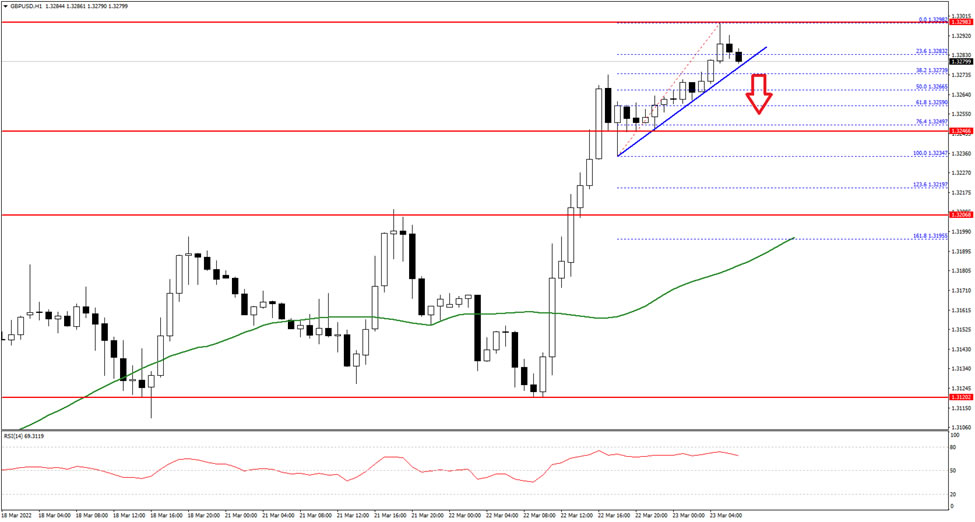
The British Pound started a steady increase above the 1.3200 resistance zone against the US Dollar. The GBP/USD pair even broke the 1.3250 level.
It even spiked above the 1.3280 level and settled above the 50 hourly simple moving average. The pair traded as high as 1.3298 before correcting lower. An initial support on the downside is near the 1.3275 and a bullish trend line on the hourly chart.
The main support is forming near the 1.3250 level. A break below the 1.3250 support could even push the pair below the 1.3200 support.
An immediate resistance is near 1.3290 on FXOpen. Any more gains might push the pair towards the 1.3320 level, where the pair might face resistance. If there is a clear upside break, the pair could rise steadily towards the 1.3350 level in the near term.
Daily Technical Analysis
EUR/USD
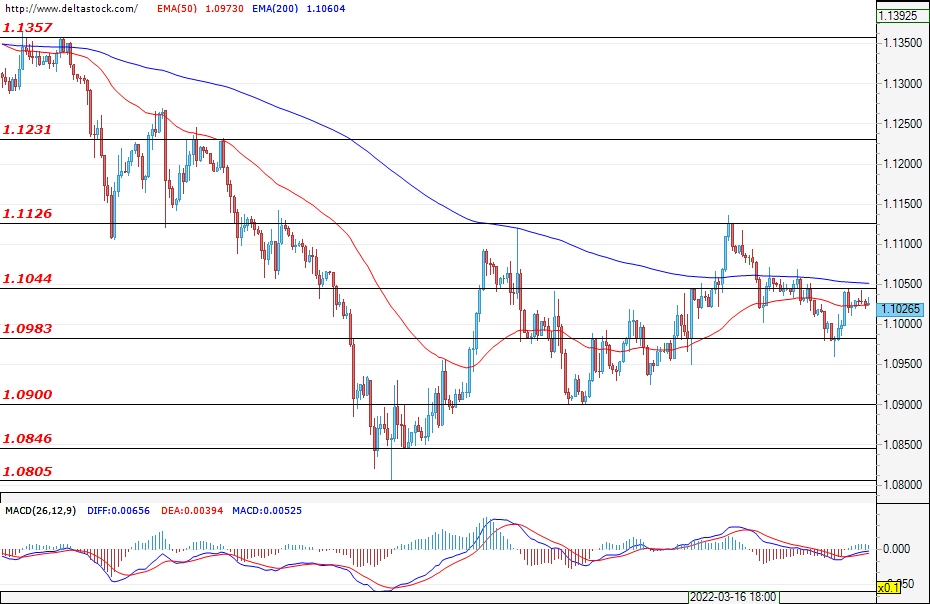
During the last trading session, the currency pair reported a growth after the bulls successfully limited the sell-off at the beginning of the day down to the support level at 1.0983. At the time of writing, the currency pair is just before a test at the 1.1044 resistance zone. A successful breach of the mentioned level could strengthen the positive sentiment - for an attack of the next significant resistance at 1.1126. There is no economic news planned for today that will affect the market participants.
USD/JPY
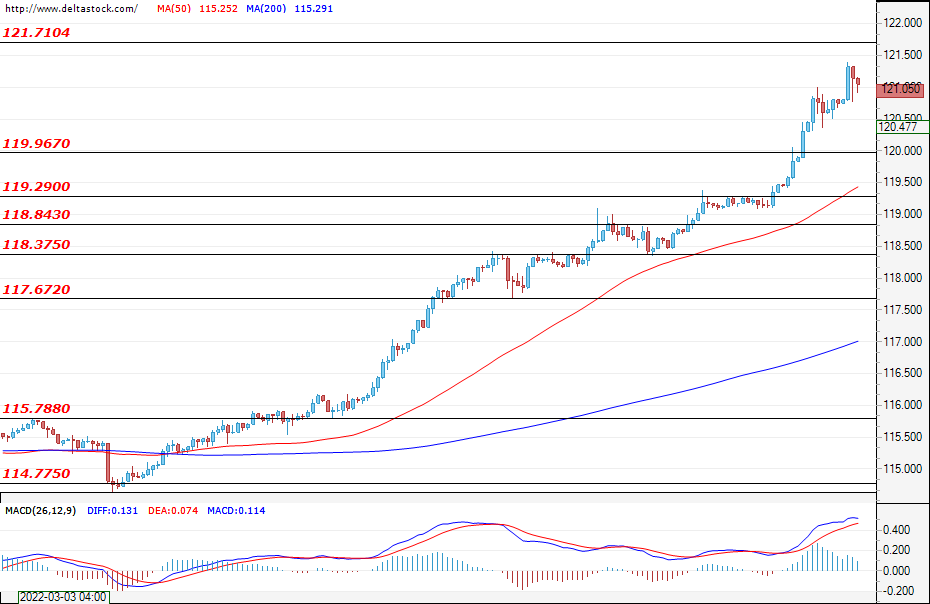
Day after day, the dollar continues to gain ground against the Japanese yen and at the time of writing the analysis, the bulls are just before a test of the resistance zone at 121.70. It is possible to observe a corrective move aimed at the 119.96 support level, but from the larger time frames the sentiment remains positive, especially with a successful breakthrough of the mentioned resistance, which is also a key level for the bulls.
GBP/USD
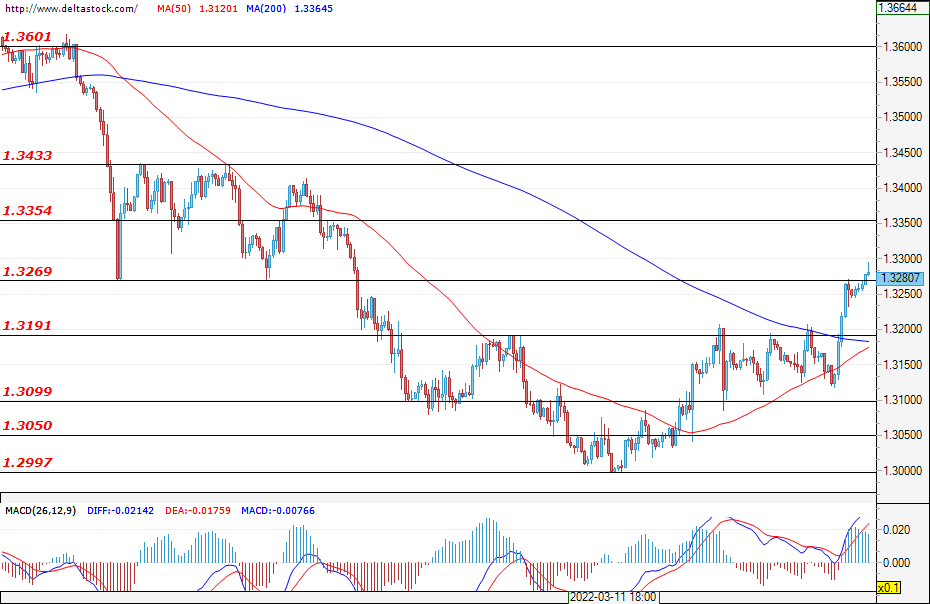
The last trading session was positive for the British pound against the US dollar after we observed a range move between 1.3099 - 1.3191 over the past few days. At the time of writing, the bulls managed to breach the resistance at 1.3269, and the next resistance would be the area around 1.3354. Today, the data on the consumer price index for the UK (07:00 GMT) could affect the volatility of the currency pair.
EUGERMANY40
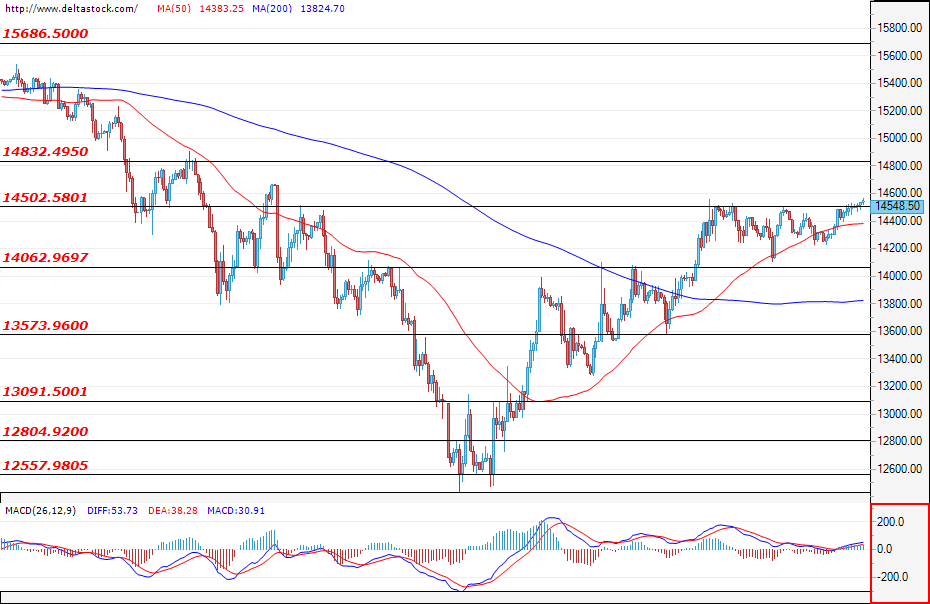
After the German index traded in the narrow range between 14062-14500 in the end of last week, in the early hours of today's trading session the bulls managed to establish themselves on the market and managed to cross the barrier at the upper boundary of the range - a level that is also the main resistance for buyers. The breakthrough needs a confirmation, but sentiments are positive - for a test of the next resistance level at 14832.
US30
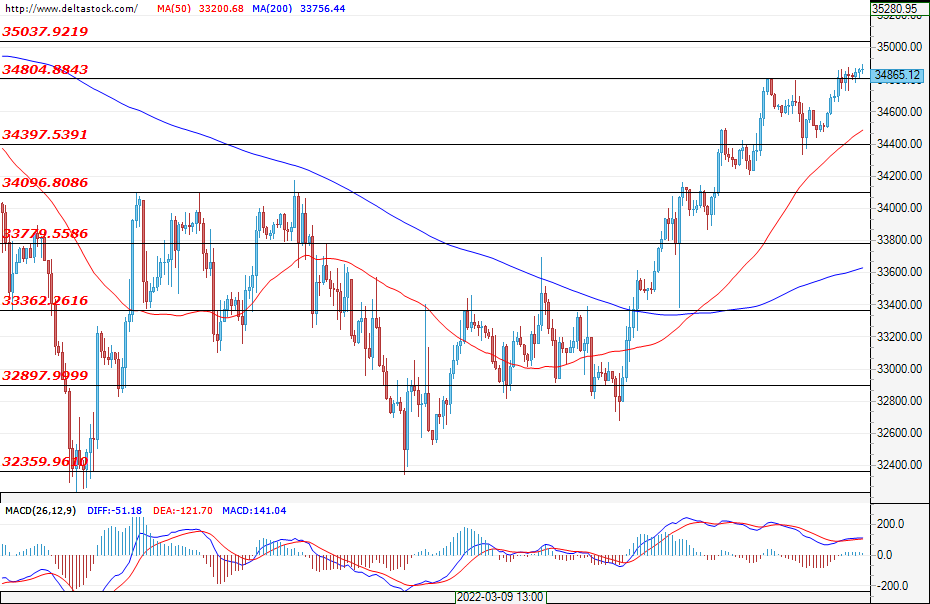
The recovery of the U.S. blue-chip stock index continues, as the bulls managed to gain a foothold in the market and, in the early hours of today's trading session, managed to breach the resistance at 34800. The sentiment for now is positive, as the most probable scenario for today is for a test of the next significant resistance around 35000. In the downward direction, the main support is the level at 34100.
Japanese Yen Retreats Sharply as BOJ Concerns Remain
US stocks rose on Tuesday even after the hawkish statement from Jerome Powell on Monday. The Dow Jones rose by over 250 points while the Nasdaq 100 index added about 300 points. On Monday, Powell said that he will support a more hawkish stance in the coming meeting in a bid to deal with the rising inflation. He added that the bank would consider hiking interest rates by about 0.50%. This means that the bank will be the most hawkish it has been in years. The best performing asset was financials as companies like Goldman Sachs and Morgan Stanley rose by over 1%. Technology companies like Meta, Bakkt, Alibaba, and BigCommerce were among the best performers.
The British pound rebounded in the overnight session ahead of the upcoming UK consumer price index (CPI) data. Economists expect the numbers to show that the headline CPI rose from 5.5% in January to 5.9% in February. They also expect that the core CPI, which excludes the volatile food and energy products rose from 4.4% to 5.0% in the same period. If they are correct, these will be the highest inflation numbers in decades. The producer price index is also expected to have held steady as the cost of doing business rose. These numbers will come a week after the Bank of England (BOE) hiked interest rates by 0.25%.
The economic calendar will have some key events on Wednesday. The Bank of England (BOE) governor will deliver his first speech since the bank made its interest rate decision. Governor Powell will talk although his statement is unlikely to move the US dollar as it did on Monday. The US will also publish the latest new home sales numbers. Economists expect the data to show that the country’s new home sales rose by over 810k even as prices jumped. The Energy Information Administration will publish the latest inventories numbers.
GBPUSD
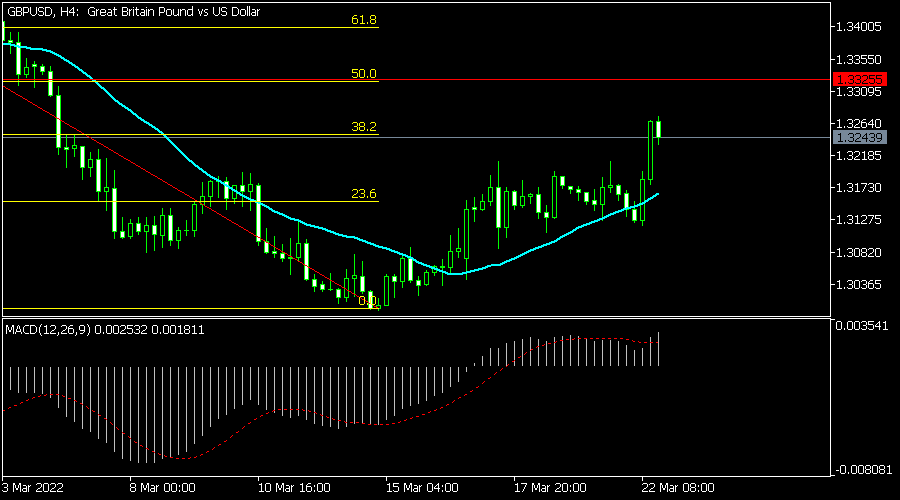
The GBPUSD pair rebounded in the overnight session ahead of the upcoming important UK inflation data. It is trading at 1.3247, which is significantly higher than Tuesday’s low of 1.3185. On the four-hour chart, it has formed an inverted head and shoulders pattern, which is also a bullish signal. It has also moved above the 25-day and 50-day moving averages. Therefore, the pair will likely keep rising as bulls target the next key resistance at 1.3250.
EURUSD
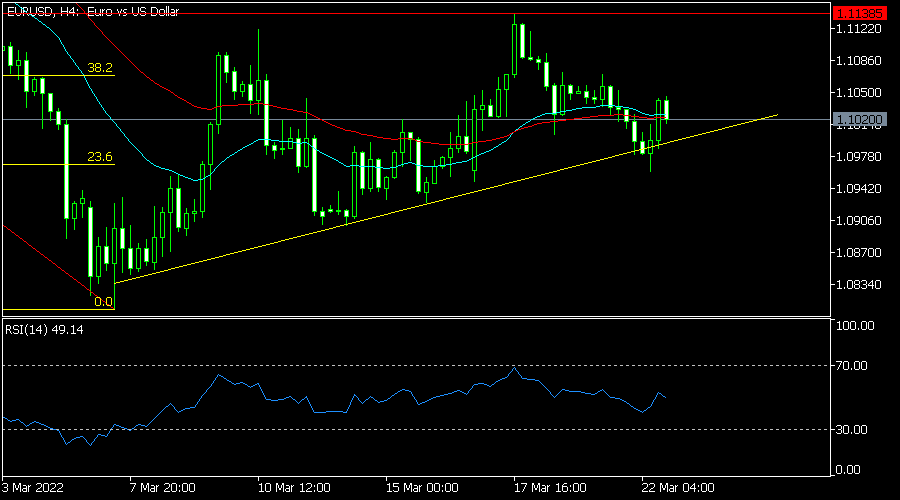
The EURUSD pair was also little changed as investors reacted to the statement by the Fed Chair. It is trading at 1.1017, where it has been in the past few days. It is slightly above the lower side of the triangle pattern. Also, the 25-day moving average has flattened while the Relative Strength Index is at a neutral level. Therefore, the pair will likely remain in this range today.
EURJPY
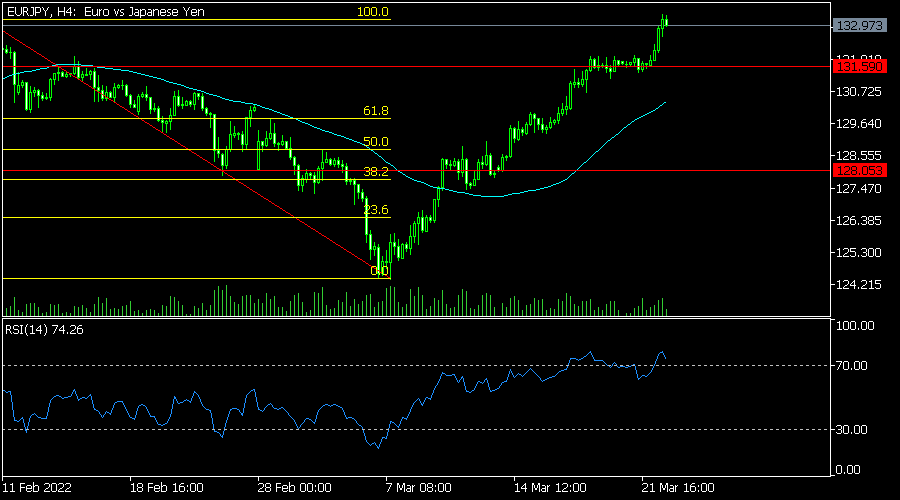
The EURJPY pair jumped to the highest point in months as the divergence between the ECB and BOJ widened. It is trading at 132.95, which is significantly higher than this year’s low of 124.42. It has moved above the 25-day and 50-day moving averages while the Relative Strength Index has moved above the overbought level. Therefore, the pair will likely maintain a bullish trend in the near term.