

Sample Category Title
EUR/GBP Weekly Outlook
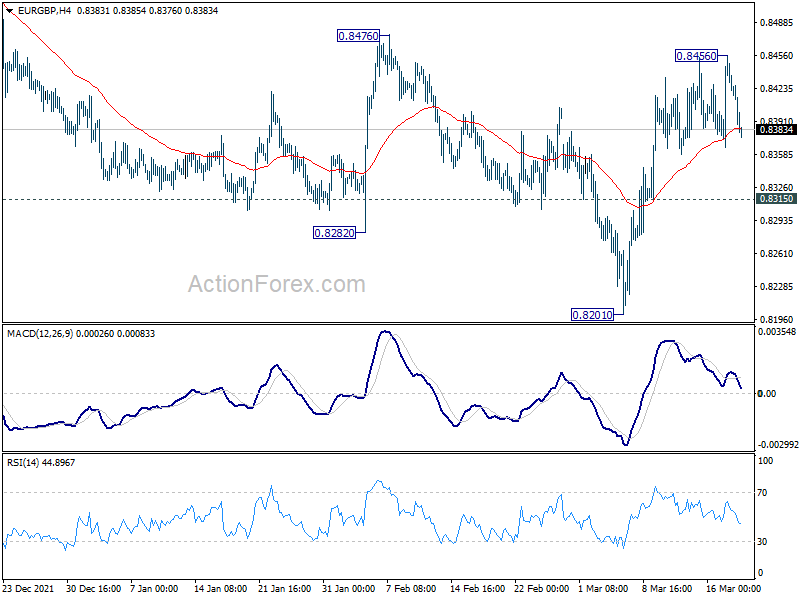
EUR/GBP edged higher last week but quickly retreated back into familiar range. Initial bias remains neutral this week first. On the upside, above 0.8456 will target 0.8476 structural resistance first. Firm break there will carry larger bullish implication and target 0.8598 resistance next. However, on the downside, break of 0.8315 minor support will retain near term bearishness, and bring retest of 0.8201 low.
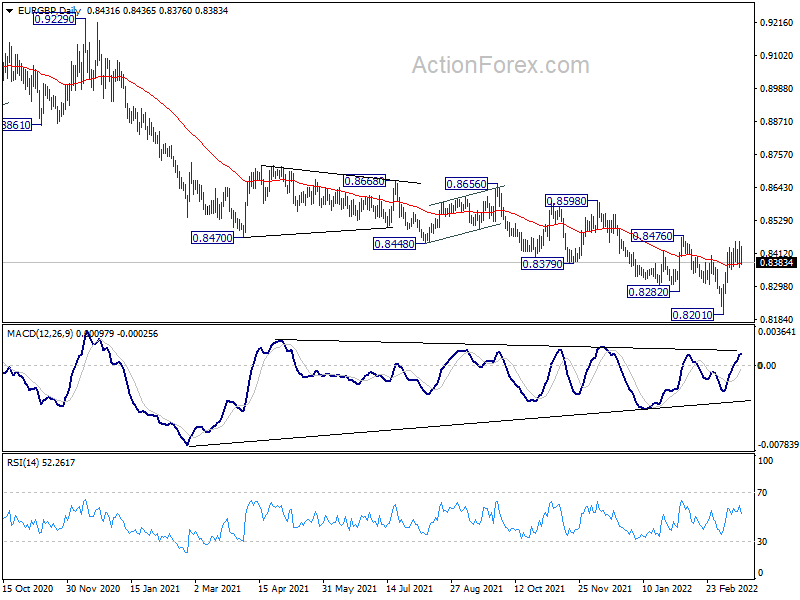
In the bigger picture, the down trend from 0.9499 is expected to continue as long as 0.8476 resistance holds. Sustained trading below 0.8276 support will argue that the whole up trend from 0.6935 (2015 low) has reversed. Deeper fall should be seen to 61.8% retracement of 0.6935 to 0.9499 at 0.7917 next. However, firm break of 0.8476 will indicate medium term bottoming at least. Focus will be back on 55 week EMA (now at 0.8523) for more evidence of bullish reversal.
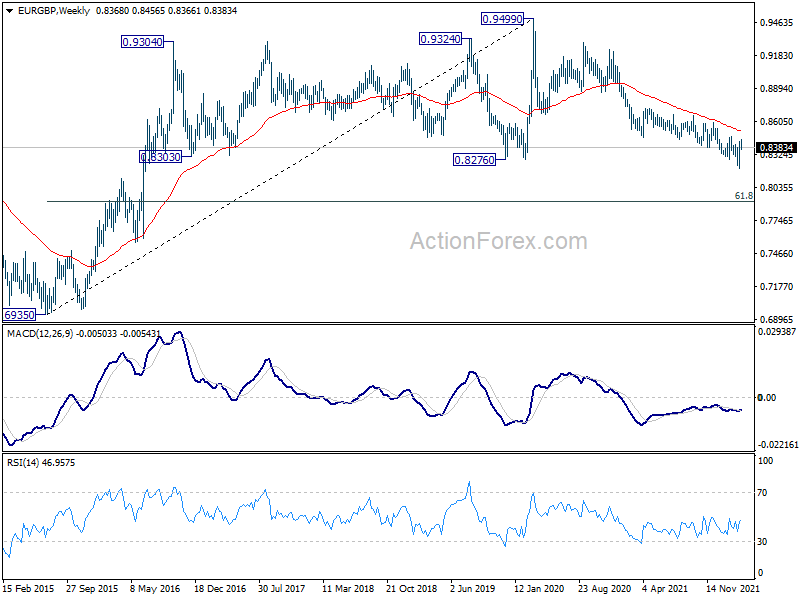
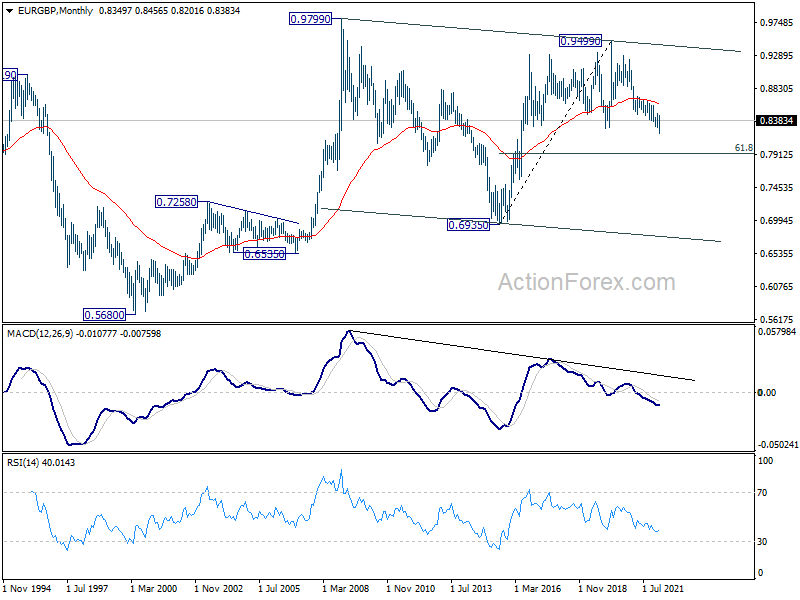
In the long term picture, current development argues that fall from 0.9499 is probably the third leg of the pattern from 0.9799 (2008 high). Sustained break of 61.8% retracement of 0.6935 to 0.9499 at 0.7917 will pave the way back to 0.6935 (2015 low) and probably below.
EUR/AUD Weekly Outlook
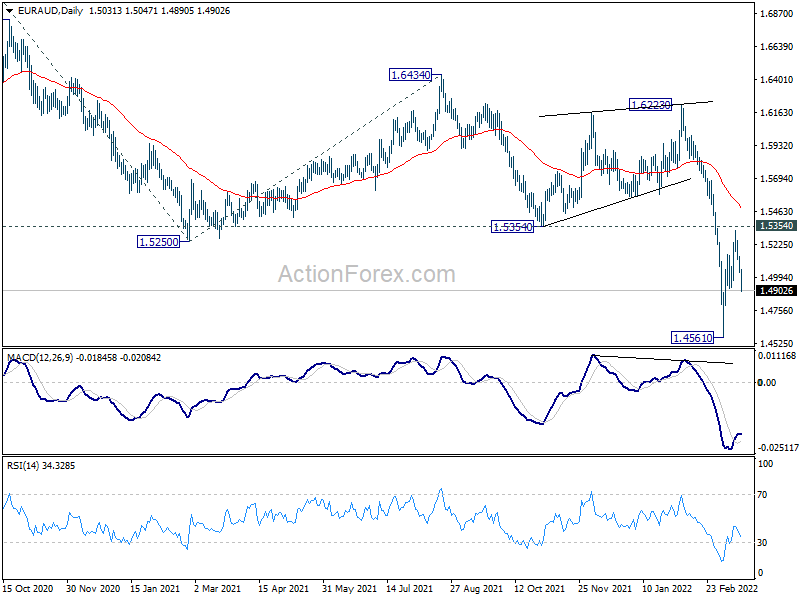
EUR/AUD rebounded to as high as 1.5327 last week but failed through break through 1.5354 support turned resistance. Break of 1.4920 minor support argues that the rebound is completed. Initial bias is now on the downside this week for retesting 1.4561 low first. Break there will resume larger down trend. In any case, outlook will remain bearish as long as 1.5354 holds.
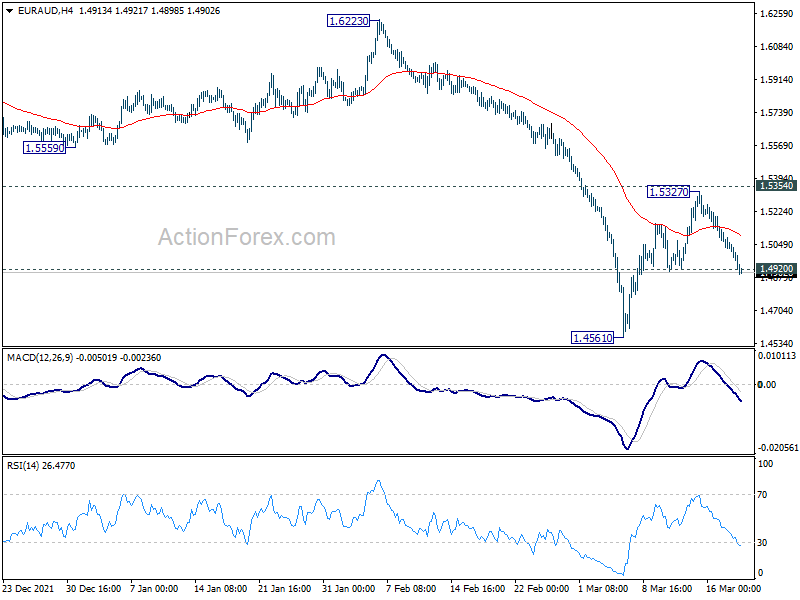
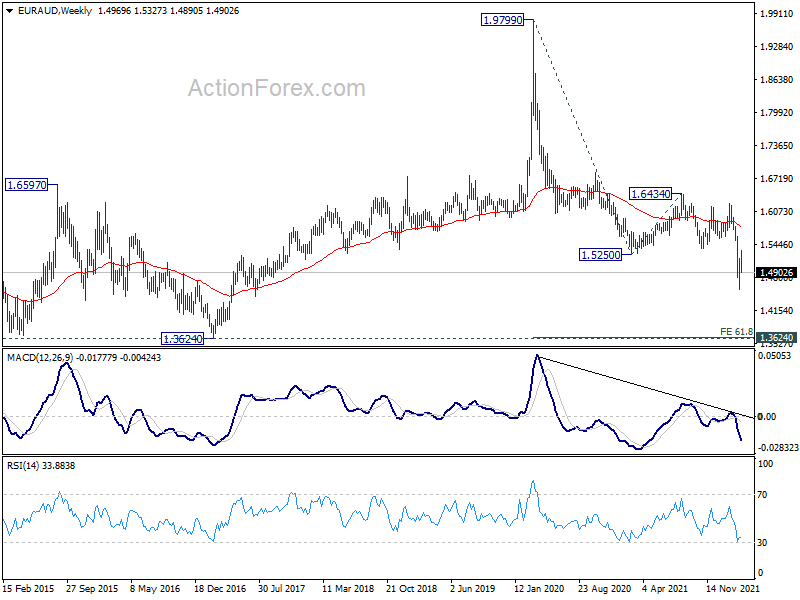
In the bigger picture, fall from 1.9799 is seen as a long term impulsive move. Next target is 61.8% projection of 1.9799 to 61.8% projection of 1.9799 to 1.5250 from 1.6434 at 1.3623, which is close to 1.3624 long term support (2017 low). Some support could be seen there to bring interim rebound. But overall, break of 1.5354 support turned resistance is needed to be the first sign of medium term bottoming. Otherwise, outlook will stay bearish in case of recovery.
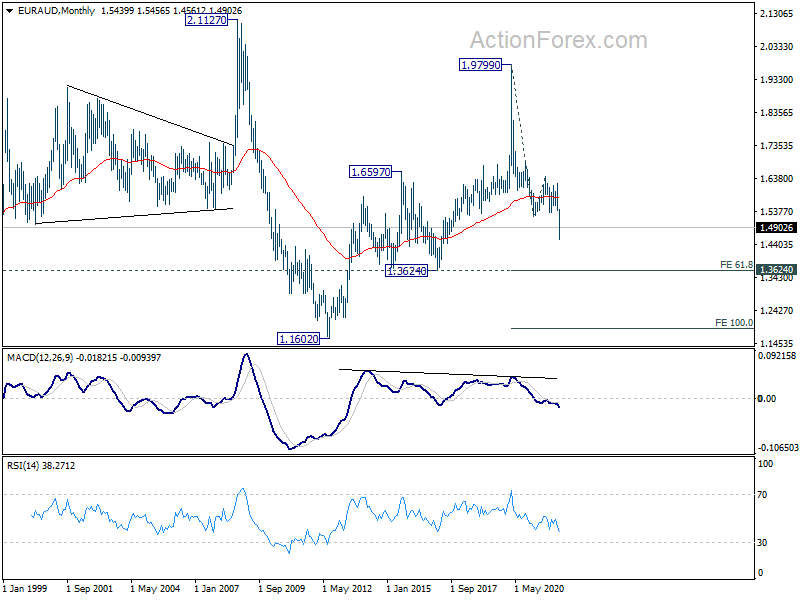
In the longer term picture, fall from 1.9799 (2020 high) is seen as the third leg of the pattern from 2.1127 (2008 high. Deeper fall should be seen to 1.3624 support. Decisive break there would pave the way back to 1.1602 (2012 low).
EUR/CHF Weekly Outlook
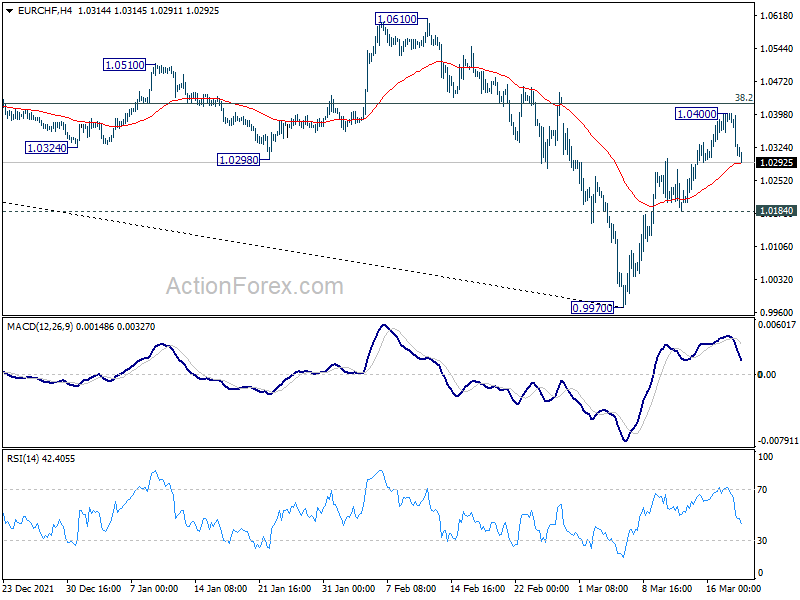
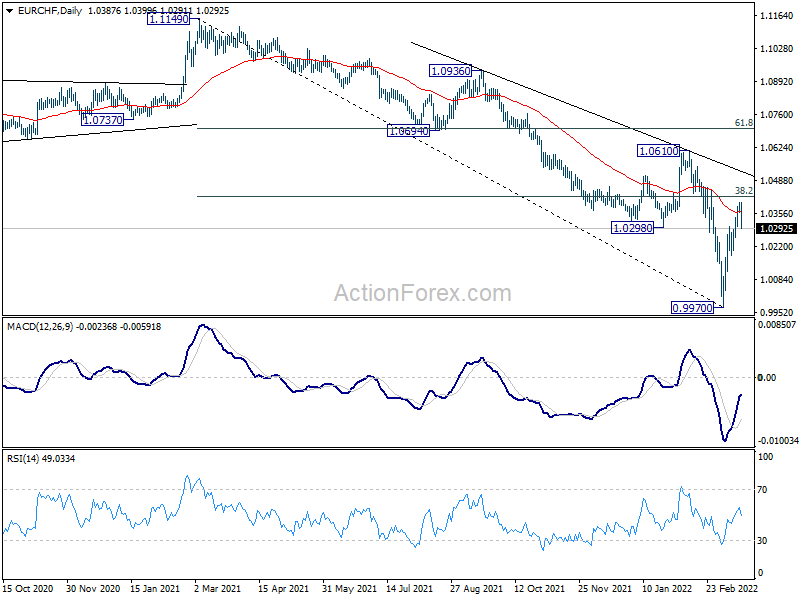
EUR/CHF rebounded further to as high as 1.0400 last week, but retreated ahead of 38.2% retracement of 1.1149 to 0.9970 at 1.0420. Initial bias is turned neutral this week first. On the upside, break of 1.0400 would resume the rebound to 1.0610 key structural resistance. However, break of 1.0184 minor support will argue that the rebound is finished, and bring retest of 0.9970 low.
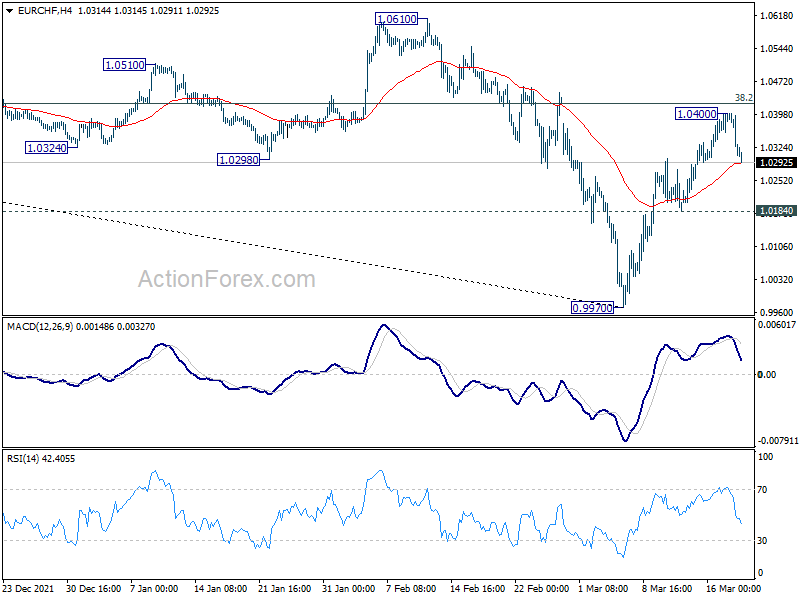
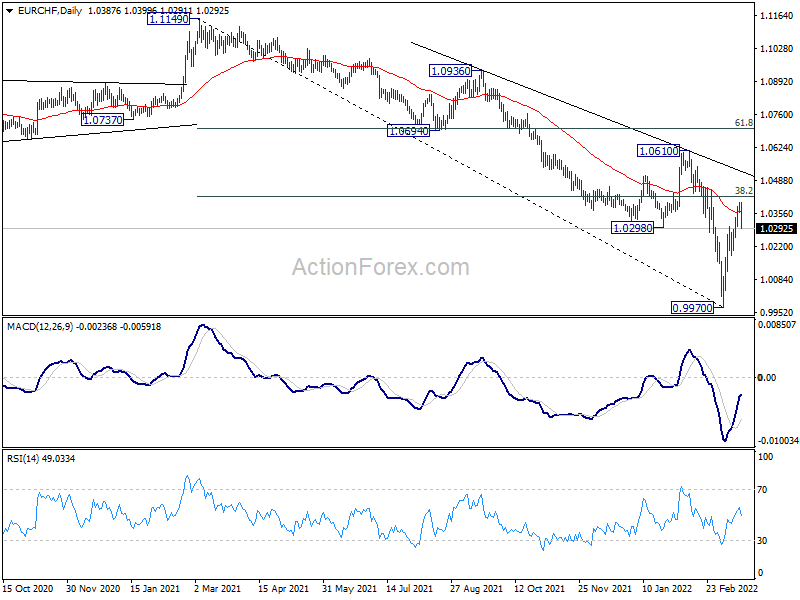
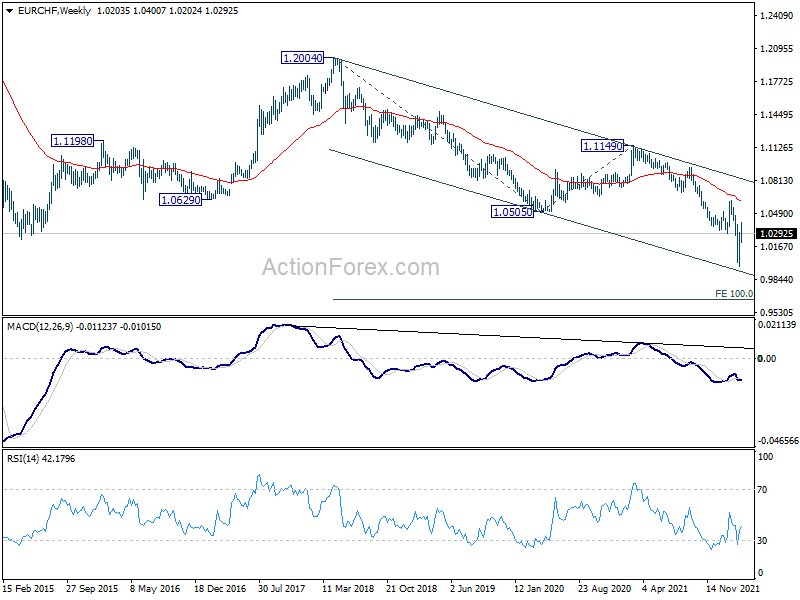
In the bigger picture, long term down trend from 1.2004 (2018 high) is still in progress. Next target is 100% projection of 1.2004 to 1.0505 to 1.1149 at 0.9650. In any case, sustained break of 1.0505 support turned resistance is needed to be the first sign of medium term bottoming. Otherwise, outlook will remain bearish.
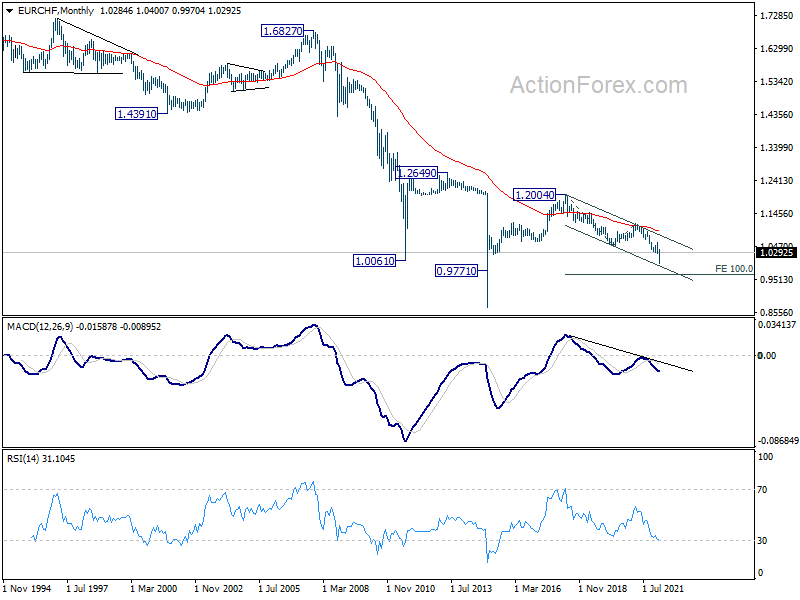
In the long term picture, capped below 55 month EMA, EUR/CHF is seen as extending the multi-decade down trend. There is no prospect of a bullish reversal until some sustained trading above the 55 month EMA (now at 1.0909).
Yen Extended Down Trend on Rise in Yields and Rebound in Stocks
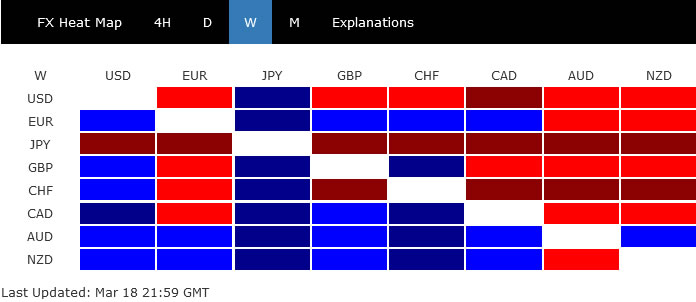
Yen's down trend continued last week and even accelerated against commodity currencies. Persistent rally in benchmark yields, rebound in stocks, and diverging central bank expectations are expected to weigh on Yen further. Meanwhile, expected rate hike by Fed and BoE didn't provide much support to Dollar and Sterling, as both closed among the weakest.
On the other hand Aussie and Kiwi ended as the best performer. Euro followed as third, but there was also sign of turning around towards the end of the week. The development in the coming days might decide whether Euro's rebound has completed and selloff is returning.
Fed started tightening, S&P 500 completed correction
Fed finally started the tightening cycle by delivering a 25bps rate hike to 0.25-0.50% last week. It also indicated that quantitative tightening will start "at a coming meeting". Fed Governor Christopher Waller later said that he actually preferred 50bps, but voted for 25bps hike only because of geopolitical events. That's probably the view of the majority in the FOMC. But then, by not "front-loading" the hikes now, Fed might risk being forced to doing it more aggressive later. The dot plot currently suggests a peak of 2.80% in federal funds rate next week, but that is clearly subject to revision based on upcoming developments.
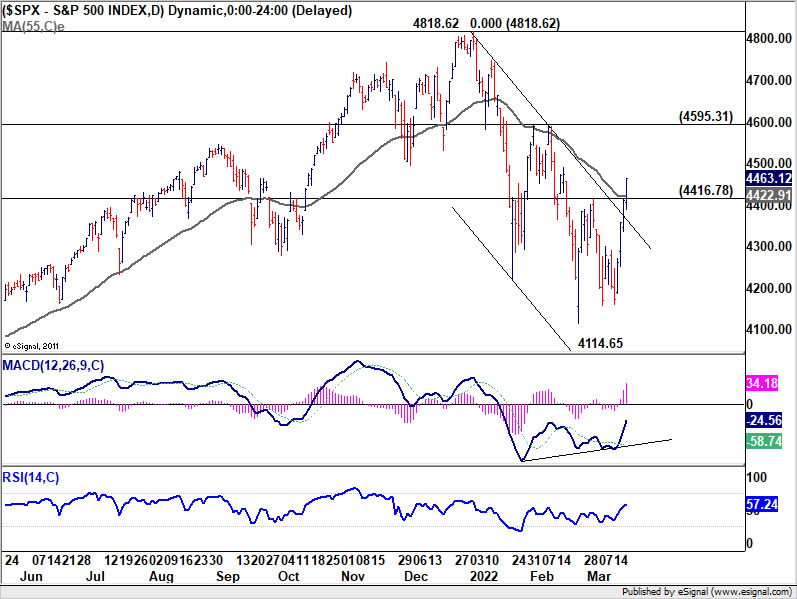
Anyway, stocks responded well last week. S&P 500's rebounded strongly last week and broke 4416.78 near term resistance. Corresponding levels in DOW (34179.07) and NASDAQ (13837.58) were also taken out. The development suggests that SPX's correction correction from 4818.62 has completed with three waves down to 4114.65 already. Further rise should seen to 4595.31 resistance next. Firm break there will pave the way to retest 4818.62 high.
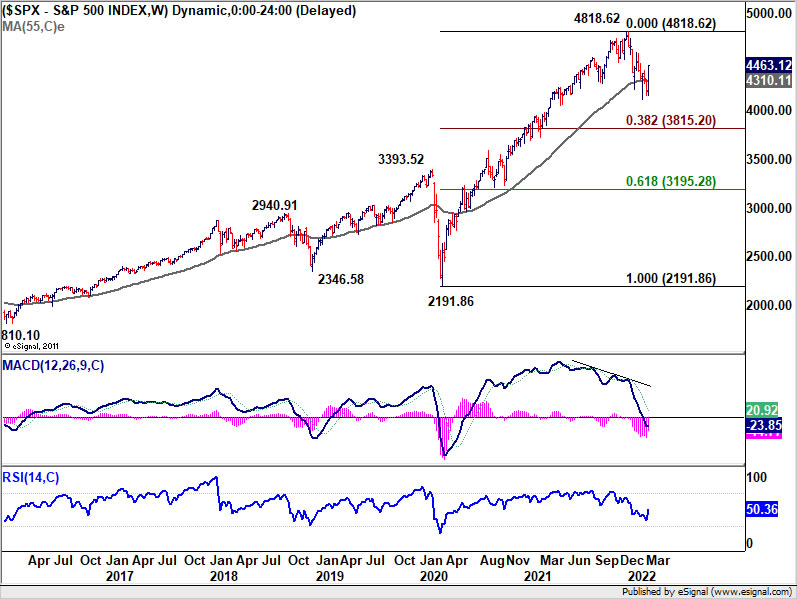
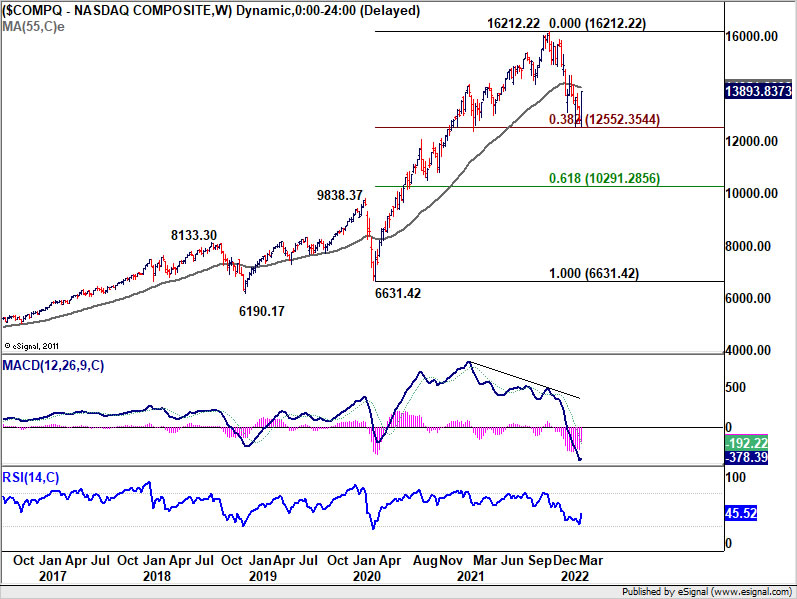
It's too early to say that long term up trend in SPX is ready to resume. The index could still extend the corrective pattern from 4818.62 with another falling leg towards 38.2% retracement of 2191.86 to 4818.62 at 3815.20. However, NASDAQ has already did that by testing corresponding level of 38.2% retracement of 6631.42 to 16212.22 at 12552.35 already. Hence, SPX's correcting could turn out to be shorter and shallower than envisaged.
10-year yield hit 2.246, pressing key resistance zone
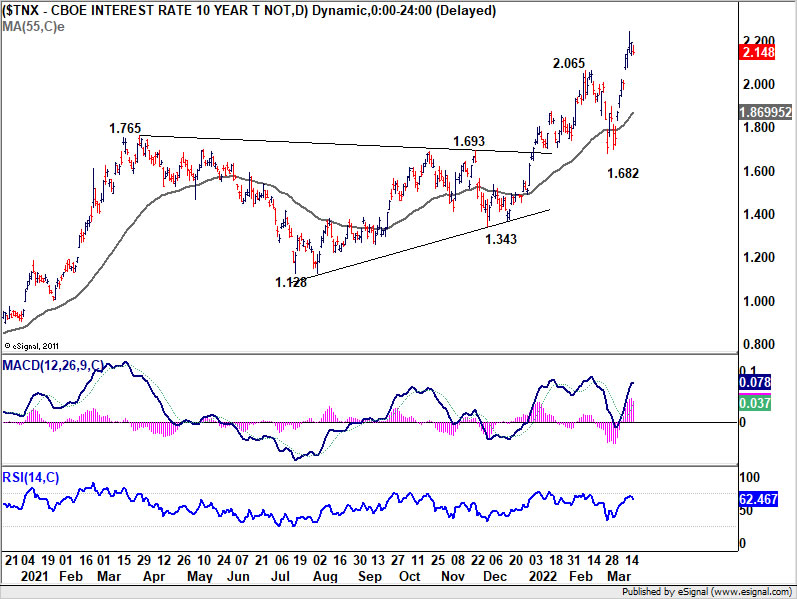
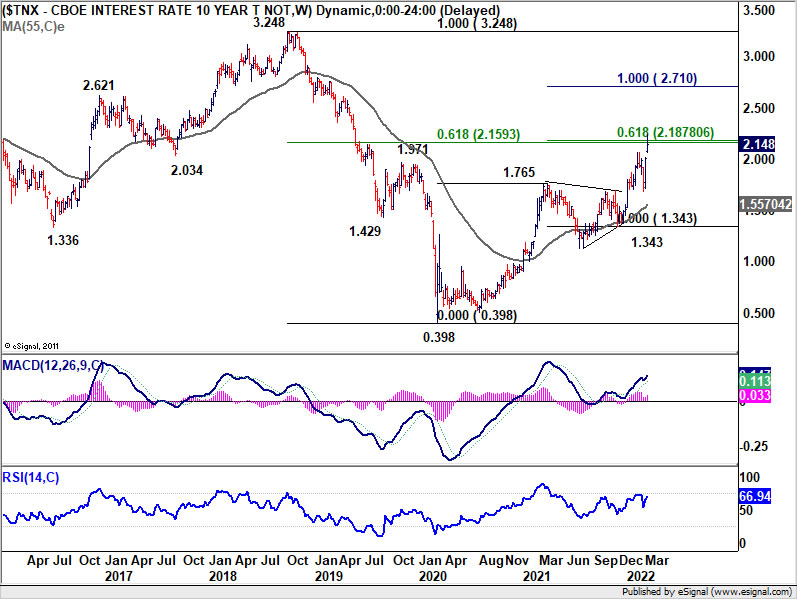
10-year yield surged through 2.065 high to resume the long term up trend last week, hitting as high as 2.246. It's still unsure if TNX would eventually be rejected by key cluster resistance level at 2.159/2.187 (61.8% retracement of 3.248 to 0.398 at 2.159, 61.8% projection of 0.398 to 1.765 to 1.343 at 2.187).
But in any case, break of prior week's high at 2.021 is needed to be the first sign of short term topping. Otherwise, further rally is still in favor. Sustained trading above 2.159.87 will pave the way to 100% projection at 2.710, which would be a rather significant development.
AUD/JPY and CHF/JPY resumed long term up trend
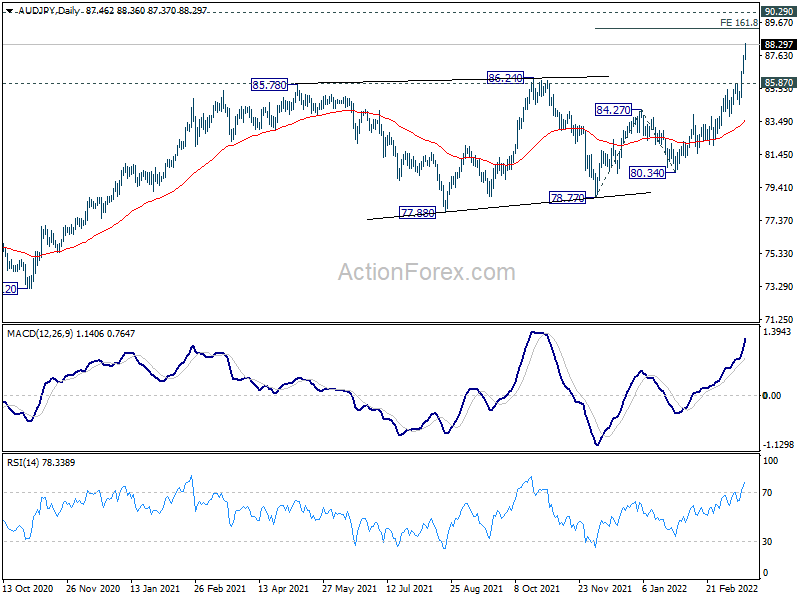
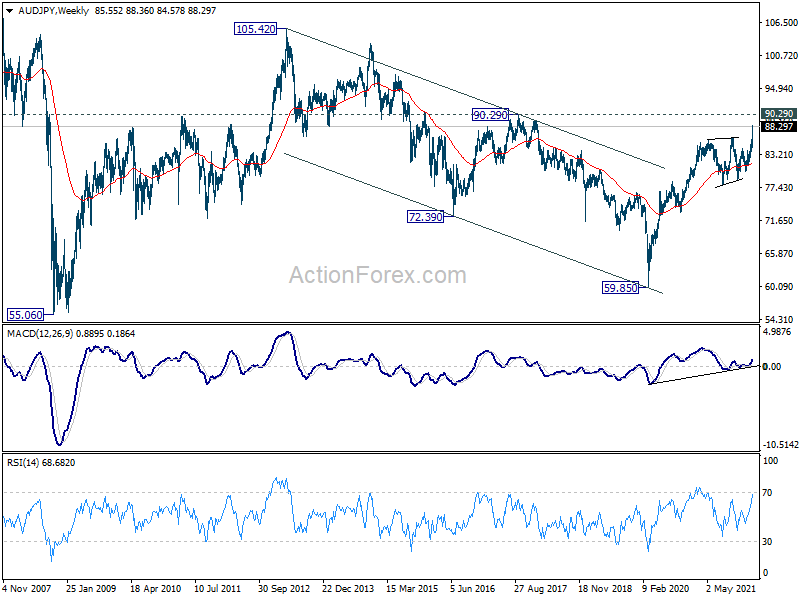
Yen ended as the worst performer on a combined factor of central bank divergence, rising global benchmark yields, and return of risk appetite. AUD/JPY was the top mover last week, gaining 3.12%. The strong break of 86.24 high confirms long term up trend resumption. Outlook will stay bullish as long as 85.87 resistance turned support holds. Next near term target is 161.8% projection of 78.77 to 84.27 from 80.34 at 89.23, which is close to 90.29 long term resistance.
It should also be noted that the whole down trend from 105.42 (2013 high) has completed with three waves down to 59.85. The support from 55 week EMA was a medium term bullish sign, and argues that AUD/JPY is reversing the whole down trend from 105.42. Sustained break of 90.29 would confirm this case and target 105.42 again.
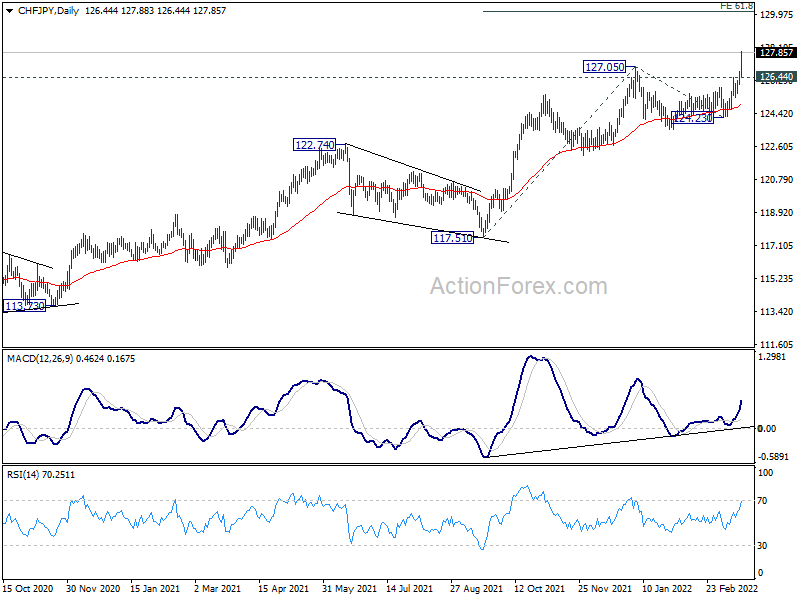
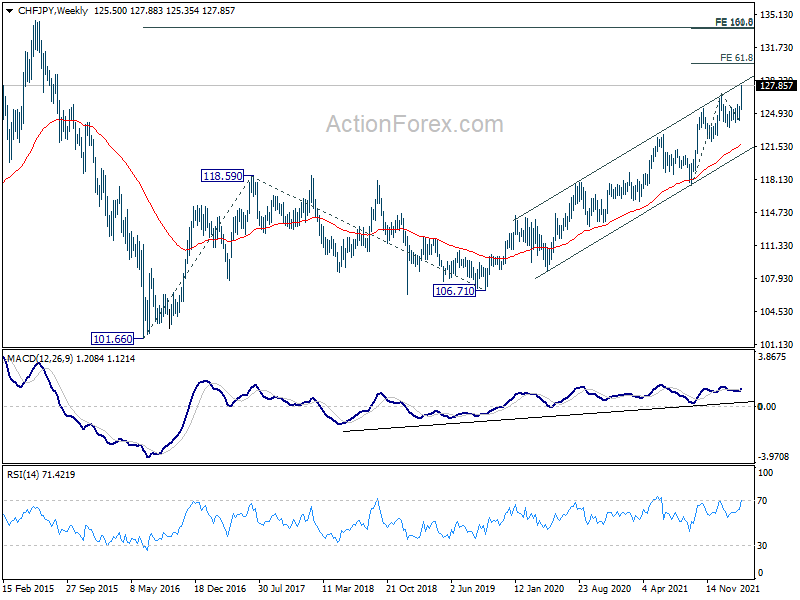
CHF/JPY also broke through 127.05 resistance last week to resume long term up trend from 106.71. The multiple support from 55 day EMA is a medium term bullish sign. Outlook will now stay bullish as long as 126.44 minor support holds. Current rally should now target 61.8% projection of 117.51 to 127.05 from 124.23 at 130.12 next.
More importantly, the next rise could come with a break of long term channel resistance, which signals upside acceleration. Further break of 130.12 would solidify this acceleration. CHF/JPY could then target cluster projection level of 100% projection of 117.51 to 127.05 from 124.23 at 133.77, and 161.8% projection of 101.66 to 118.59 from 106.71 at 134.10.
EUR/AUD finished rebound, EUR/CHF to follow lower?
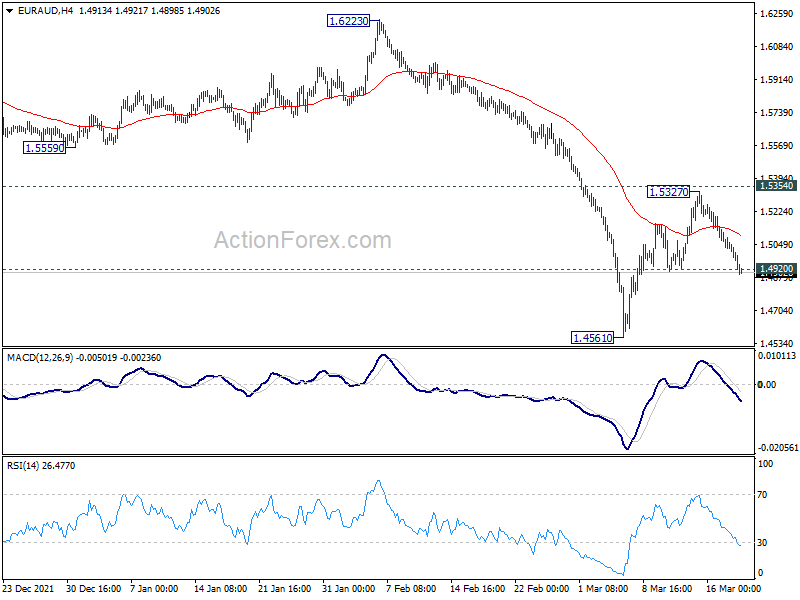
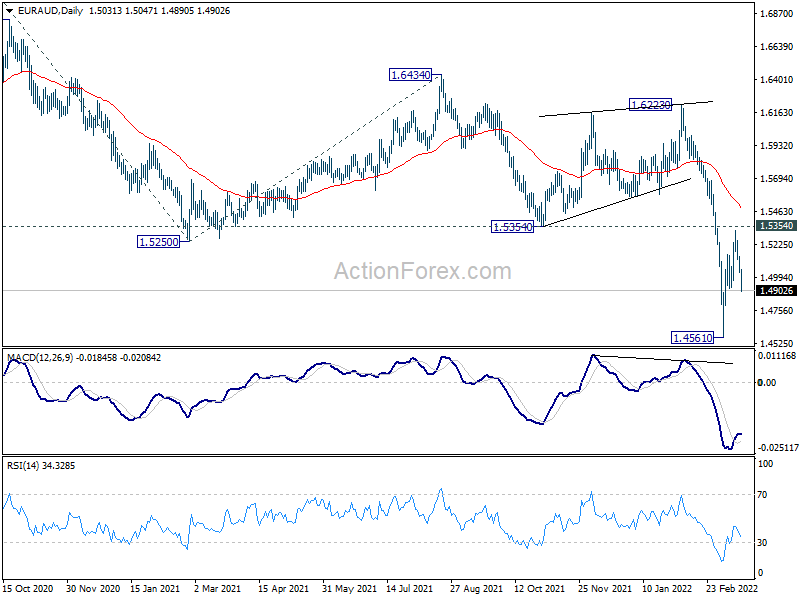
Euro spent most of the week attempting to extend the near term rebound. But its effort has somewhat faltered towards the end, except versus Yen. EUR/AUD's break of 1.4920 support on Friday argues that the rebound from 1.4561 has completed at 1.5327 already. The rejection by 1.5453 support turned resistance keeps near term outlook bearish. Retest of 1.4561 low should be seen next. Break there will resume long term down trend from 1.9799.
At same time, attention will be paid to development in EUR/CHF to confirm if selloff is back on Euro. The cross faced initial rejection by 38.2% retracement of 1.1149 to 0.9970 at 1.0420 and dropped notably to close the week. At this point, further rally could still be seen as long as 1.0184 support holds.
However, deeper decline this week, followed by break of 1.0184 support, should confirm that rebound from 0.9970 has finished. If happens, the development will keep medium term outlook bearish in EUR/CHF and bring retest of 0.9970 low first, even though there might still be another rebound before down trend finally resumes. Anyway, break of 1.0184 in EUR/CHF would be a sign of return to weakness in Euro in general.
USD/JPY Weekly Outlook
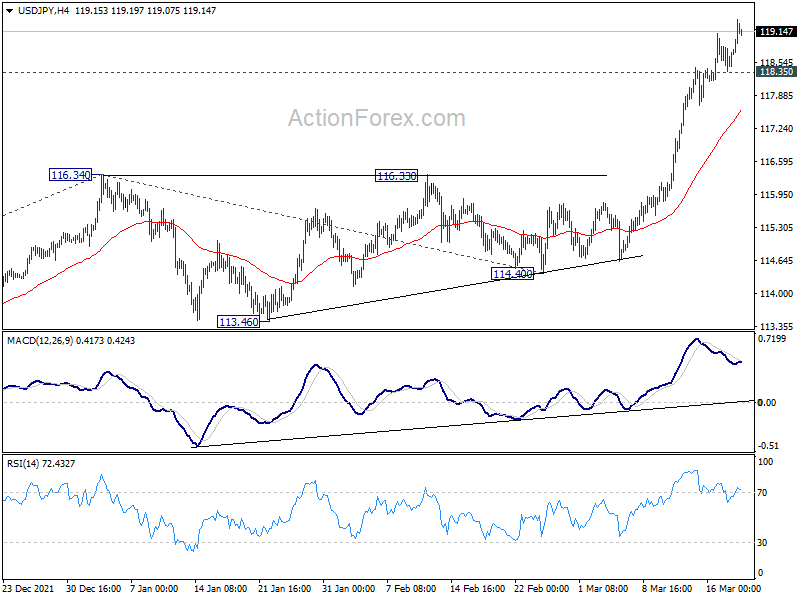
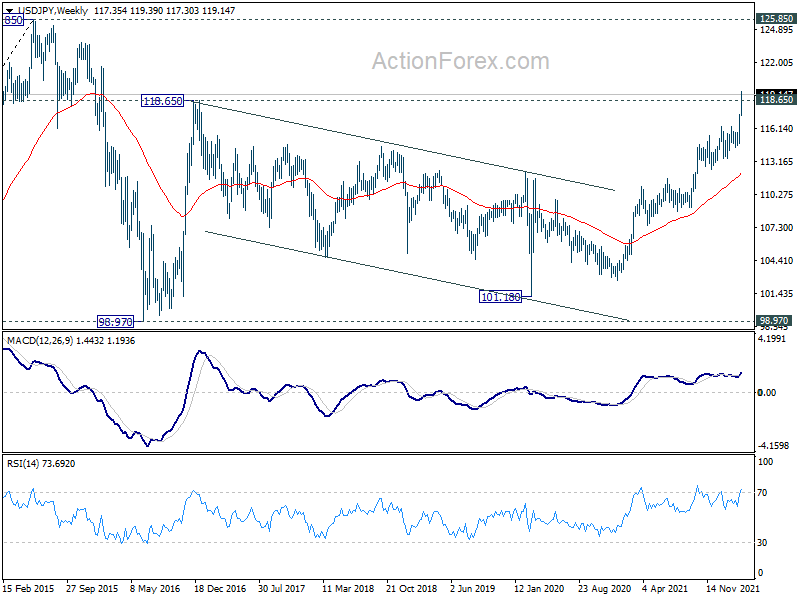
USD/JPY's up trend accelerated further to as high as 119.39 last week. Initial bias remains on the upside this week. Next target is 100% projection of 109.11 to 116.34 from 114.40 at 121.63 next. On the downside, below 118.35 will turn intraday bias neutral again and bring retreat. But downside should be contained above 116.34 resistance turned support to bring another rally.
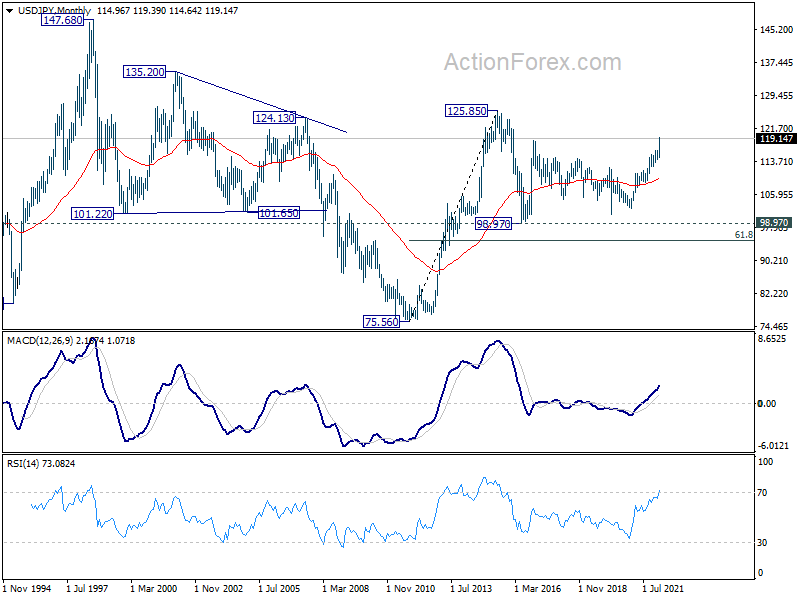
In the bigger picture, the break of 118.65 resistance (2016 high) suggest that up trend from 98.97 (2016 low) is resuming, with rise from 101.18 (2020 low) as the third leg. Medium term outlook will remain bullish as long as 113.46 low. Sustained trading above 118.65 will pave the way to 125.85 (2015 high).
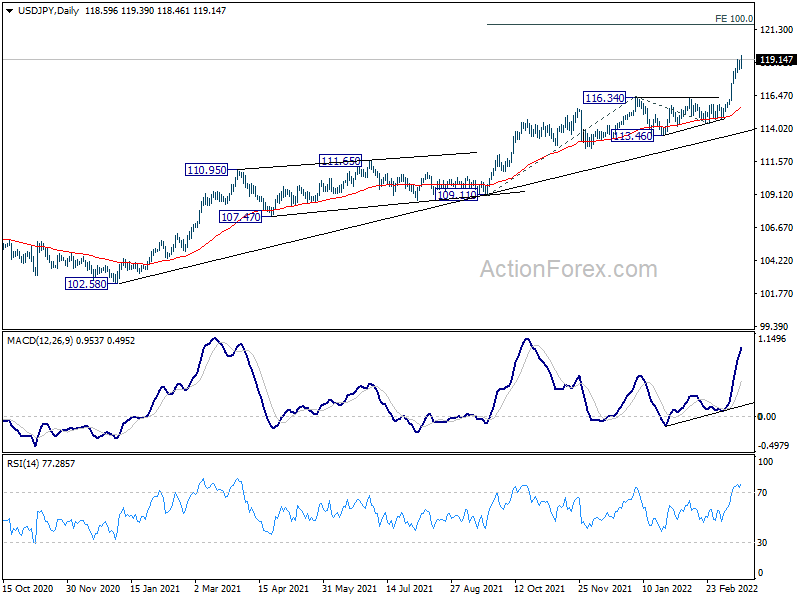
In the long term picture, the rise from 75.56 (2011 low) long term bottom to 125.85 (2015 high) is viewed as an impulsive move, no change in this view. Price actions from 125.85 are seen as a corrective pattern which could still extend. However, firm break of 128.85 will resume the up trend form 75.56 towards 135.20 long term resistance next.
Summary 3/21 – 3/25
Monday, Mar 21, 2022
[php_everywhere instance="1"]
Tuesday, Mar 22, 2022
[php_everywhere instance="2"]
Wednesday, Mar 23, 2022
[php_everywhere instance="3"]
Thursday, Mar 24, 2022
[php_everywhere instance="4"]
Friday, Mar 25, 2022
[php_everywhere instance="5"]
Weekly Economic & Financial Commentary: Significant Monetary Policy Tightening Ahead
Summary
United States: Significant Monetary Policy Tightening Ahead
- In a full week of economic data, Wednesday's FOMC meeting took center stage. FOMC officials lifted the target range for the federal funds rate by 25 bps. Meanwhile, data on retail sales, industrial production and housing underscored a similar backdrop across the economy—price pressure remains hot and supply is still hard to come by.
- Next week: New Home Sales (Tues), Durable Goods (Wed)
International: G10 and EM Central Banks Continue Hiking
- International central banks were quite active this week. In the G10, the Bank of England (BoE) opted to lift interest rates another 25 bps and take its main policy rate to 0.75%. While the decision to raise rates was largely expected, the details surrounding the decision were a bit of a surprise and were interpreted as relatively dovish. In the emerging markets, the Brazilian Central Bank opted to lift the Selic Rate 100 bps and take the main policy rate to 11.75%.
- Next week: South Africa CPI (Wed), Eurozone PMIs (Thurs), Central Bank of Mexico (Thurs)
Interest Rate Watch: FOMC Sends a Hawkish Signal
- As was widely expected, the Federal Open Market Committee (FOMC) decided to raise rates by 25 bps at its meeting on March 16. But the marked upward shift in the so-called "dot plot" indicates that most committee members now believe that a more aggressive pace of monetary tightening will be appropriate this year than they did just a few months ago.
Topic of the Week: Russia's Invasion of Ukraine Highlights Lagging Domestic Oil Production
- One of the economic consequences of Russia's invasion of Ukraine has been higher oil prices. Domestic crude oil production in 2021 was roughly 1.0% below the 11.3 million barrels per day averaged in 2020 and 9.0% below the 12.3 million barrels per day average registered in 2019 before the worldwide dropoff in global energy demand.
The Weekly Bottom Line: The Fed Amps Up its Fight Against Inflation
U.S. Highlights
- The U.S. Federal Reserve raised interest rates for the first time since 2018, and signalled it is prepared to raise rates substantially in order to contain inflation.
- Oil prices were down this week as renewed lockdowns in China raised worries about demand. Uncertainty on the outlook is very high given Russia’s war in Ukraine, and we have marked down our own economic forecast released this week.
- U.S. economic data continued to show resilience through February, with another jump higher in housing starts. Retail sales also showed people spending more on dining out, boding well for the expected pick up in services spending.
Canadian Highlights
- The heat from the Canadian economy just won’t let up. CPI is now at a 30-year high and elevated commodity prices should continue to this trend at least over the next month.
- Housing statistics continue to show incredible strength, with sales, listings, and prices all increasing in February.
- With Canadians spending more on housing-related items, other essentials, and durable goods, retail sales data grew 3.2% in January.
U.S. - The Fed Amps Up its Fight Against Inflation
There was a lot going on for markets this week: The Fed’s first interest rate hike since 2018, a busy economic data calendar, and the ongoing war in Ukraine. The most notable financial market move was the tumble in commodity prices, which has buoyed sentiment on equity markets worried about the impact on the global economy from sky-high energy costs. However, part of the reason for lower oil prices is not so positive. China has brought in new Covid lockdowns to restrain growth in cases, which is expected to dampen demand for energy.
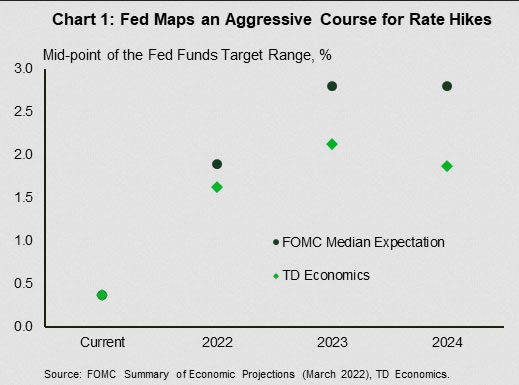
As was widely expected, the Fed raised its policy rate 25 basis points to a range of 0.25-0.50%. What surprised markets was the sharp move up in the number of hikes Fed members expect. The median expectation of Fed members is for the midpoint of the range of the funds rate to be 2.8% at the end of next year, up from 1.6% in December, and above its long-run expectation of 2.4%. The Fed is behind the curve on containing inflation, and it needed to demonstrate that it is prepared to act quite aggressively to contain it and preserve its credibility.
Whether we actually see that many rate hikes is another matter. The Fed’s rate hike projections are not always born out. In September 2018, when it was in the middle of raising rates, it projected the funds rate would reach 3.1% by the end of 2019, above its estimate of the long-run rate of 3%. Instead, the Fed only raised rates to 2.5% before having to cut rates back to 1.75% as inflation was weaker than expected and the yield curve inverted – a classic signal that markets were starting to price in a recession.
Our latest forecast also downgraded economic growth, upgraded inflation, and raised the number of rate hikes expected. However, we expect fewer hikes than the Fed (Chart 1). Our forecast for economic growth is a bit softer than the Fed, and is consistent with our view that fewer rate hikes are required.
Rate hikes take time to slow economic growth, but borrowing rates like mortgages, have already moved up. The average 30-year mortgage rate moved above 4% for the first time since 2019. Even so, home builders ramped up the pace of housing starts in February to 1.769 million units, coming in ahead of market expectations, and the highest monthly reading of the pandemic (see report). However, building permits were down for both single and multi-unit projects, pointing to some giveback in March. The U.S. housing market could certainly use some new supply with the existing home market drum tight, as we discussed in our recent report.
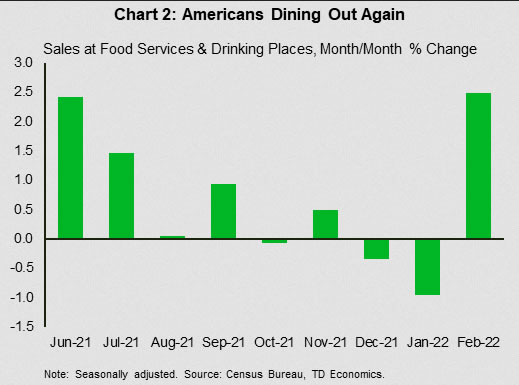
February retail sales were another sign of strength in the U.S. economy. January sales were revised upwards substantially, suggesting consumer spending is looking a bit stronger in Q1. There were also signs that consumers are shaking off their caution and heading back out to restaurants and bars, as fears of the Omicron variant subsided. Sales at food services and drinking places jumped up a healthy 2.5% in February (Chart 2) after falling through December and January. Overall, between higher rates, higher energy prices and, dwindling fiscal support, we expect the pace of growth in U.S. economy to slow through 2022. However, we expect low unemployment and pent-up demand to support a solid 2.3% pace through the year.
Canada - Canadian Data Continue to Show Signs of Overheating
Sentiment turned positive this week, with broad equity markets posting their first weekly gains since Russia invaded Ukraine. Declining commodity prices were a positive catalyst, with oil prices down around 5% and European natural gas down around 25%. For Canadian markets, the commodity-heavy TSX still eked out a modest gain, while the loonie rose back above 79 U.S. cents (Chart 1). A moderation of geopolitical risks alongside positive economic data saw government bond yields in Canada rise to their highest levels since 2018.
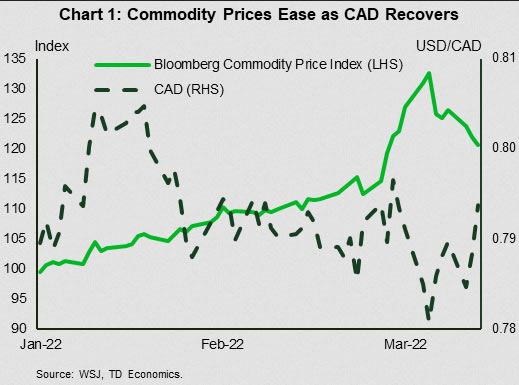
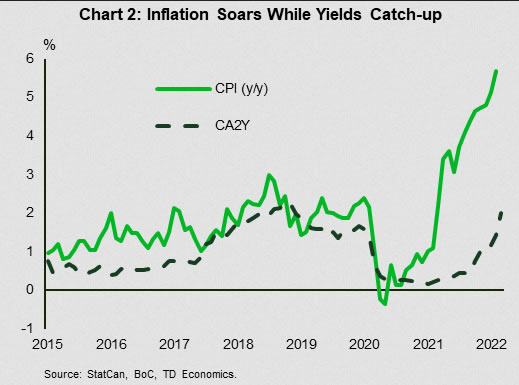
The improvement in sentiment has refocused investors on the strength of the Canadian economy. The data out this week reinforced that positive narrative. Top of the list, consumer price inflation accelerated to a 30-year high of 5.7% year-on-year (y/y) in February. Though energy and food prices led the move higher, even excluding these two components, price growth was up 3.9% y/y, well exceeding the pace of wage gains.
Though higher inflation is likely to weigh on consumer spending in the months ahead, the retail sales data for January were robust. The data showed a 3.2% gain on the month, driven by spending on motor vehicle/parts, furniture, electronics, and building materials. With the unemployment rate below its pre-pandemic level, pent-up demand had Canadians ready to spend. How long the spending spree can continue will depend on how quickly income can catch up to inflation.
Canadian housing data continued to show the impact of past monetary stimulus, as existing home sales climbed 4.6% month-on-month (m/m) in February, while the average price of homes sold and the MLS index (a like-for-like home price measure) were up 2.3% and 3.5% on the month, respectively. Thankfully, there are some signs of balance returning to the housing market with new listings jumping 24% on the month, bringing the sales-to-listings ratio to 75.3% – the lowest since last autumn. Supply may also lend a hand as housing starts were up over 7% in February, rising to 247 thousand units. More inventory should help to slow price gains, though this won't come online in time for the spring buying season, which is just starting up now.
The economic data this week reinforced our view that the Bank of Canada will have to be aggressive in raising rates at its upcoming policy meetings. With inflation likely to remain above 3% through this year, the central bank is expected to lift the overnight rate to 2% over the next 12 months, up from 0.5% today. This has bond yields moving up, with the Canada 2-year and 10-year yield reaching 1.9% and 2.2%, respectively. Expect more to come as the Bank sets out to hike rates at the fastest annual pace since the mid-1990s.
Week Ahead: 21 March 2022
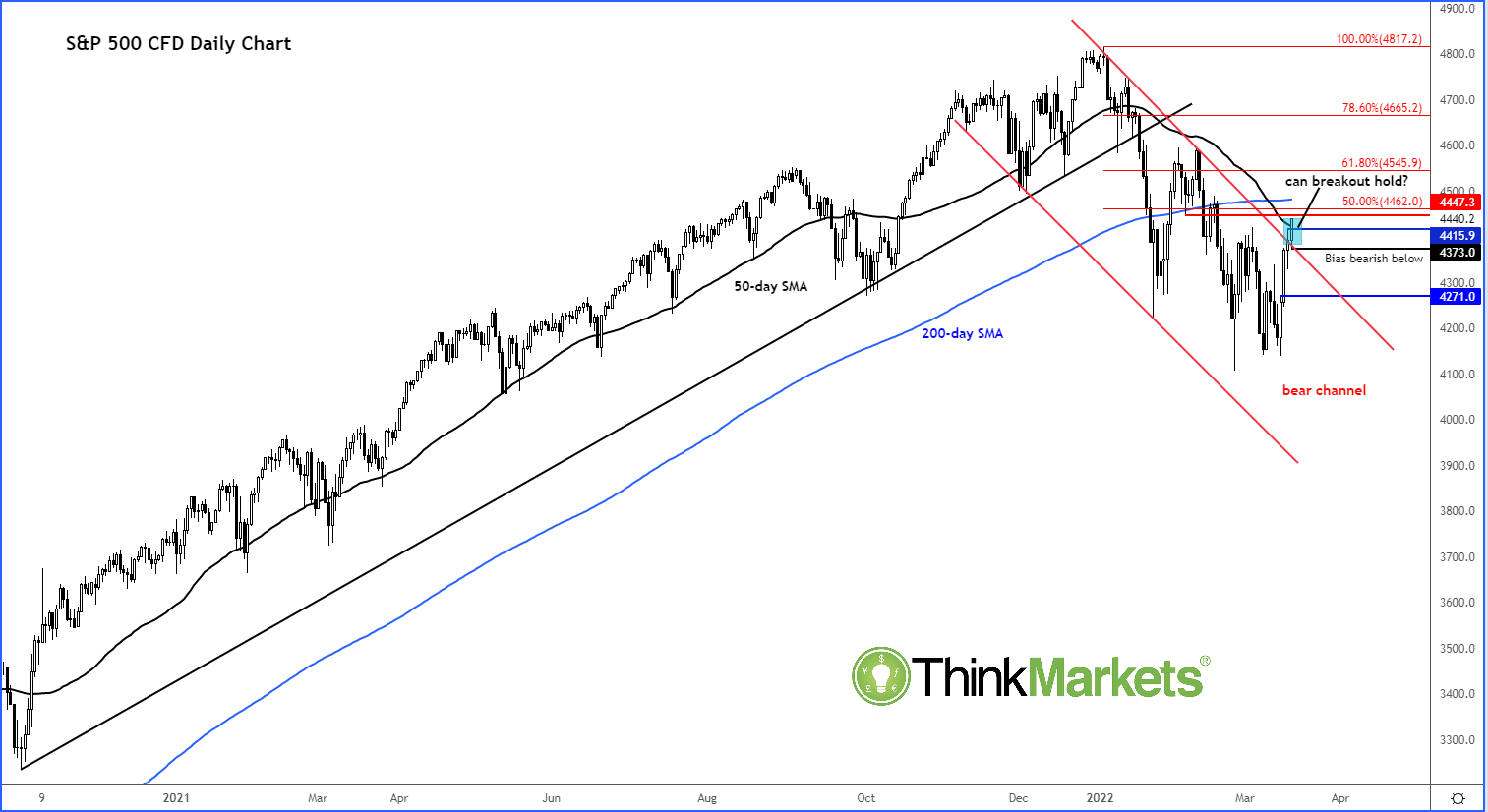
Stocks end week on the front-foot as S&P 500 eyes breakout. But will this prove to be a bull trap, given the technical "death crossover" signal, as well as macro concerns such as Ukraine-Russia conflict, soaring inflation and Fed tightening?
If you look at the financial markets this week, it was as if the Ukraine war never happened, or the Fed was not very hawkish. Stock markets roared back higher and were to close solidly in the black. This was the second consecutive weekly positive close for European indices, but the first one for Wall Street and Asia Pacific (APAC) markets. STOXX Europe 600 erased all the losses it had suffered since the invasion of Ukraine began. Risk-sensitive commodity dollars surged higher, while safe-haven Japanese yen and gold slumped. Yen pairs had a wonderful week. Cryptocurrencies traded mostly higher. Crude oil bounced sharply off the lows but was still set to end lower for the second consecutive week.
Ukraine-Russia ceasefire hopes
This week’s gains for most risk assets came despite continued uncertainty over the situation in Ukraine. Earlier in the week, Russia said that reports of major progress in peace talks are wrong and that their delegation is putting colossal energy into peace talks, but Ukraine is simply wasting time. Still, the markets were more eager to rally on any positive headlines than to sell off on negative news. Indeed, sentiment improved towards the latter parts of the week. According to comments from the Russian negotiator on Friday, the two sides were now 'halfway there' on the issue of Ukraine's demilitarization, and that on the issues where their views are most-closely aligned is Ukraine's neutral status and not joining NATO. Let’s see if Ukraine officials say something similar in the days ahead. If so, the end of the war could be closer, but with Ukraine and Russian being engaged in a war, nothing is guaranteed.
Watch FedSpeak
As well as the ongoing situation in Ukraine, the focus in the week ahead will also be on Fedspeak, with Powell speaking on both Monday and Wednesday. The Fed has signalled a much stronger appetite to combat inflation, indicating a further 6 rate increases in 2022. Judging by comments from some of the Fed officials that have spoken, there is a possibility that we may even see a 50 basis point increase in May. Let’s see if there is much appetite for that, and what plans they might have for running down the central bank’s $8.9 trillion balance sheet.
In terms of macro data, the highlights include durable goods orders and housing market data. From the UK, we have CPI and retail sales, while in Switzerland, the SNB will be making a “decision” on interest rates. Hint: no rate increases are coming. Another set of key data will be the latest PMI numbers, due on Wednesday from Eurozone.
S&P 500 breakout vs. death cross
A lot was made of the S&P’s so-called “death-cross,” but we haven’t seen much downside action. The “death cross” on the S&P describes the fact the 50-day has fallen beneath the 200-day moving average. This usually happens as a result of a correction or sell-off, which makes it a bit of a lagging indicator. Nonetheless, it provides an objective signal, telling traders that the market is no longer in an uptrend. As such, some traders and fund managers would be less inclined or unwilling to look for long trades in such a market. Others might even use this signal to look for short trades. So, it has some important implications. But by the time the moving average crossover happens, the bulk of the price move may have already taken place, as has been the case now. The bears need to see the S&P remain or go back inside its bearish channel again, otherwise the bulls will remain in charge.
Week Ahead – Accelerated Tightening
Central banks playing catch-up
The global economy is facing an incredible amount of uncertainty at the moment which is continuing to drive the volatility we’re seeing in financial markets.
Whether it’s uncertainty around inflation, interest rates, commodity prices, Covid or Ukraine, the growth outlook has become extremely unclear and is constantly subject to significant revisions.
That has been clearly evident in recent months as central banks have been forced to dramatically accelerate their tightening plans despite facing the prospect of slowing growth, even recession risks. As it stands, investors appear relatively calm about the situation but the way things are evolving, it may not take much to tip them over the edge.
US
Now that the Fed has raised interest rates for the first time since 2018 and signalled they are ready to do a lot more, investors are looking for clues if some of the next hikes will be supersized. It could be a choppy period for US stocks as investors assess whether the current inflationary environment will ultimately lead to a much sooner economic slowdown.
The upcoming week will primarily focus on all developments in Ukraine, President Biden’s attendance at the NATO emergency summit Brussels on Thursday and both Fed Chair Powell’s speech at the NABE conference on Monday and participation at the BIS panel about “challenges for central bank governors in a digital world” on Wednesday. Powell has made it clear that he is very confident in the economy and in the path of rate hikes the committee has forecasted.
The week is filled with a lot of economic data that include new home sales, durable goods orders, the flash PMI readings, and the final consumer sentiment readings for March. Widespread pricing pressures will likely weigh on consumer sentiment, manufacturing and service activity. The housing market still remains hot but surging mortgage rates will shortly cool that economy.
EU
Focus next week will naturally remain on Ukraine and the progress, if any, in talks with Russia. Both sides have talked up progress at times recently but there still seems to be a significant gulf. Russia is also continuing its assault on various cities, despite the talks, which may signal how serious it’s taking the negotiations. Markets are pricing in a lot of optimism at this stage, leaving them vulnerable to any disappointment. Complacency could prove costly.
Next week offers a selection of economic data, most notably flash PMIs as well as appearances from ECB policymakers including President Christine Lagarde.
UK
Next week offers some key data releases from the UK, most notably CPI inflation on Wednesday. The BoE is ahead of the curve compared to most others but it signalled that it may be preparing to ease off the accelerator after raising rates in March. Inflation is expected to continue to rise though and a faster rate could see it postpone potential plans to slow the hiking cycle. PMIs on Thursday and retail sales on Friday are also in focus.
Russia
Putin is showing no signs of easing Russia’s assault on Ukraine which means more sanctions will be coming its way soon enough. The crippling impact on the economy has been acknowledged during some fiery statements this week but he remains undeterred.
The CBR also acknowledged the economic impact when keeping rates on hold at 20% on Friday. New forecasts will be presented in April.
South Africa
Inflation rose to 5.8% in February, data is expected to show on Wednesday, which will likely push the SARB to raise rates a day later by another 25 basis points to 4.25%. This will be the third consecutive rate hike and the focus will be on how many more are signalled to follow. With inflation right at the upper end of the 3-6% target, further hikes will likely be warranted.
Turkey
Only tier three data being released next week. The CBRT left interest rates unchanged on Thursday and is still conducting its monetary policy review. No sign of a change of course despite inflation surpassing 54% and likely to rise further.
China
Chinese equities staged a huge reversal this past week, rallying aggressively after the government announced a number of stock market support measures. The rally has faded and markets appear to be waiting for concrete action instead of talk now. The first opportunity will be Monday when China announces its 1 and 5-year Loan Prime Rates decisions. A cut of the 1-year LPR is more likely and will give the rally renewed vigour.
The Ukraine conflict and the threat of sanctions for supporting Russia militarily still loom over China markets. Negative developments on this front or the US-China meeting could negatively impact equities.
Covid restrictions have been eased in Shenzhen but increased in Shanghai. Greater covid restrictions announced over the weekend could be negative for China equities.
India
India has no significant data this week except bank loan growth on Friday. A low number could be a negative for equities.
The rupee and local stocks continue to be buffeted by fast-money sentiment flows related to the evolution of the Ukraine situation.
Russia and India are exploring a rouble/rupee structure to circumvent international sanctions. The US and Europe have been quiet thus far, but if they decide that it may violate sanctions, and threaten direct sanctions, local equities could suffer.
Australia
Australian markets and equities have rebounded on better investor sentiment internationally, and very strong employment data in the week past. Markets are continuing to price a change in direction by the RBA because of this. RBA Governor Lowe speaks on Tuesday, and if he hints that a change is coming, that could boost the AUD, but be negative for equities.
New Zealand
The New Zealand Dollar has also rebounded on improved international sentiment, but like the AUD, remains acutely vulnerable to negative shifts in it. With noises mounting over the cost of living domestically, the RBNZ has found itself in a very bad place of its own making. A poor balance of trade number on Monday will further narrow its monetary box canyon and be a potential headwind for the currency and local equities.
Japan
USD/JPY has jumped above 118.00 as markets price in Japan’s soaring imported energy bill and the widening US/Japan interest rate differential. With the BoJ remaining unchanged, a firming of US yields could be enough to send USD/JPY over 120.00.
Japan releases Tokyo CPI on Friday, but given the BoJ has remained ultra-dovish, its effect will be minimal.
Japanese equities continue to follow the swings in international investor sentiment surrounding the Ukrainian situation.
Singapore
Singapore releases core and headline inflation on Wednesday. High prints could lock and load an expected MAS tightening in April and that could weigh heavily on local equities from the mid-week.
Economic Calendar
Saturday, March 19
Economic Data/Events
- PM Johnson to speak at UK Conservative Party’s two-day spring conference
- Japanese PM Kishida visits India
Sunday, March 20
- No scheduled major events
Monday, March 21
Economic Data/Events
- NABE conference with speeches from the Fed Chair Powell and Bostic.
- China loan prime rates
- New Zealand trade, card spending
- RBI Governor Das speak at an India Industry event
Tuesday, March 22
Economic Data/Events
- Fed’s Daly to speak at Bloomberg Equality Summit
- ECB President Lagarde to speak at BIS innovation summit
- RBA Governor Lowe attends the Meet the Regulators ASIC Annual Forum 2022.
- The ECB’s Fabio Panetta to speak at Fourth annual joint conference of Bundesbank, ECB and Federal Reserve Bank of Chicago
- New Zealand consumer confidence
- Australia consumer confidence
Wednesday, March 23
Economic Data/Events
- Fed Chair Powell and BOE Gov Bailey to speak at BIS panel on challenges for central bankers in a digital world
- UK Chancellor Sunak’s Spring Statement
- US new home sales
- UK CPI
- South Africa CPI
- Singapore CPI
- Russia industrial production
- Eurozone consumer confidence
- Mexico international reserves
- Thailand trade
- Japan leading index, machine tool orders
- EIA crude oil inventory report
Thursday, March 24
Economic Data/Events
- President Biden attends NATO emergency summit in Brussels
- US initial jobless claims, durable goods
- European Flash PMI readings: Eurozone, France, Germany, UK
- Mexico Rate Decision: Expected to raise rates 50bps to 6.50%
- Norway central bank (Norges) rate decision: Expected to raise rates by 25bps to 0.75%
- South Africa central bank (SARB) rate decision: Expected to raise rates by 25bps to 4.25%
- Switzerland central bank (SNB) rate decision: No changes expected with policy rate
- Eurozone Markit services PMI
- Australia PMI
- Japan PMI, department store sales
- China SWIFT payments CNY
Friday, March 25
Economic Data/Events
- US University of Michigan consumer sentiment
- China BoP current account balance
- Day 2 of Emergency NATO leaders Meeting
- Spain GDP Spain
- Germany IFO business climate
- Japan Tokyo CPI, PPI services
- Singapore industrial production
- Thailand foreign reserves, manufacturing production index, capacity utilisation
Sovereign Rating Updates
- Netherlands (Fitch)
- Germany (S&P)
- Saudi Arabia(S&P)
- Hungary (Moody’s)
- Sweden (Moody’s)
- European Union (DBRS)
Week Ahead – Flash PMIs to Bring Recession Risks to the Forefront, SNB Meets
The upcoming week will quieten down a bit after what was a busy time for central banks and geopolitical events. But there’s still plenty of activity ahead as the latest flash PMI readings are due and the Swiss National Bank will keep the monetary policy theme running, not to mention how the war in Ukraine will unfold amid slow progress in the negotiations for a ceasefire.
Will Eurozone PMIs flag a slowdown?
The fallout from the Ukraine conflict has had far-reaching consequences on global markets and on the economic outlook as the world has slipped into a new crisis just as it was emerging from another one. But the most startling impact has been on inflation, as the sanctions against commodity-rich Russia have inflamed already boiling price pressures.
With everything from energy, agricultural and metal commodities shooting higher since Russia invaded Ukraine, the squeeze on businesses and consumers has tightened even more, sparking fears of a recession. Europe is at a greater risk from suffering another downturn as it has become too dependent on Russian oil and gas for meeting its energy needs over the years.
European exporters will additionally have to bear the consequences of the tough Western sanctions, and combined with soaring input costs, business confidence has already started to dip. This puts all the more focus on Thursday’s flash PMI numbers for the euro area for March as investors will want to see whether the geopolitical turmoil on the European Union’s doorstep is denting economic activity. The Ifo business climate gauge on Friday will also be watched.
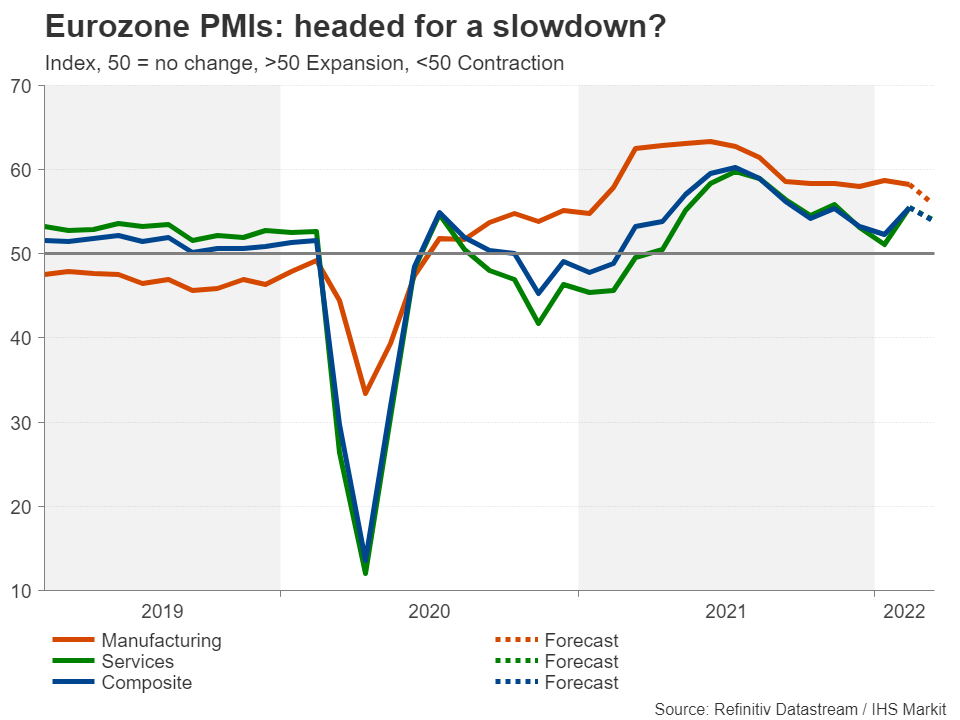
The European Central Bank just announced it is going to wind down its asset purchase programme at some point during the summer but did not commit to a timeline for raising rates. If the PMI data is weaker than anticipated, rate hike bets might be pared back and the euro could skid again, having only just bounced back from 22-month lows against the US dollar.
SNB not expected to alter policy path
The euro’s downfall against the Swiss franc was also quite pronounced. Euro/franc briefly fell below parity on March 7 as the fighting in Ukraine intensified and as speculation mounted that the ECB would delay its stimulus exit. The Swiss National Bank likely intervened to push down the franc, but its sight deposits data suggests it only did so modestly.
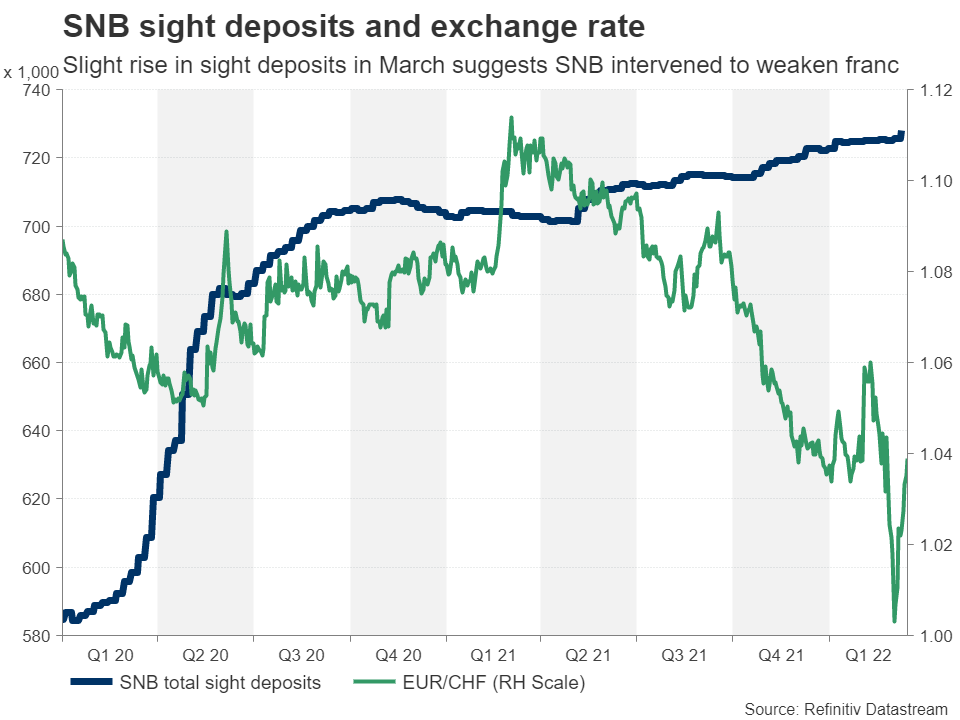
Nevertheless, the SNB is expected to reiterate its pledge to intervene if necessary to keep the franc down when it meets on Thursday, as the currency has appreciated along with other safe havens like the dollar and yen during this turbulent period. The SNB recently revised up its forecasts for inflation for 2022, while downgrading its growth projection for the year.
However, inflation is still seen at only 1.9%, thus, it’s unlikely the SNB will signal any tightening as it keeps the policy rate on hold at -0.75%. Switzerland’s economy is not very exposed to Russia, nor does the country rely much on oil and gas imports for energy as it mostly uses hydro-electric and nuclear power. So any impact from the Russia-Ukraine war will probably be limited.
Still, investors are predicting that the SNB will have lifted rates out of negative territory by the first quarter of 2023. Though, in reality, that can only be possible if the ECB does the same. Until then, the SNB is expected to stick to exchange rate intervention to prevent any unwarranted spikes in the franc while geopolitical risks remain elevated.
Can Sunak halt the pound’s slide?
Flash PMI prints are also due out of the UK on Thursday and like for the euro area, they are forecast to tick lower in March. Retail sales figures for February out on Friday will be important too. Although the economic pain in Britain from the sanctions against Russia will probably be less than in the Eurozone, investors were already worried about how rising inflation and energy bills would affect household spending in a consumer-driven economy.
Those worries might explain why the pound hasn’t really benefited much from the Bank of England’s rate increases. The BoE hiked the Bank Rate for the third consecutive meeting this week as inflation keeps heading higher. Data out on Wednesday is expected to show the UK consumer price index jumped by 5.9% year-on-year in February.
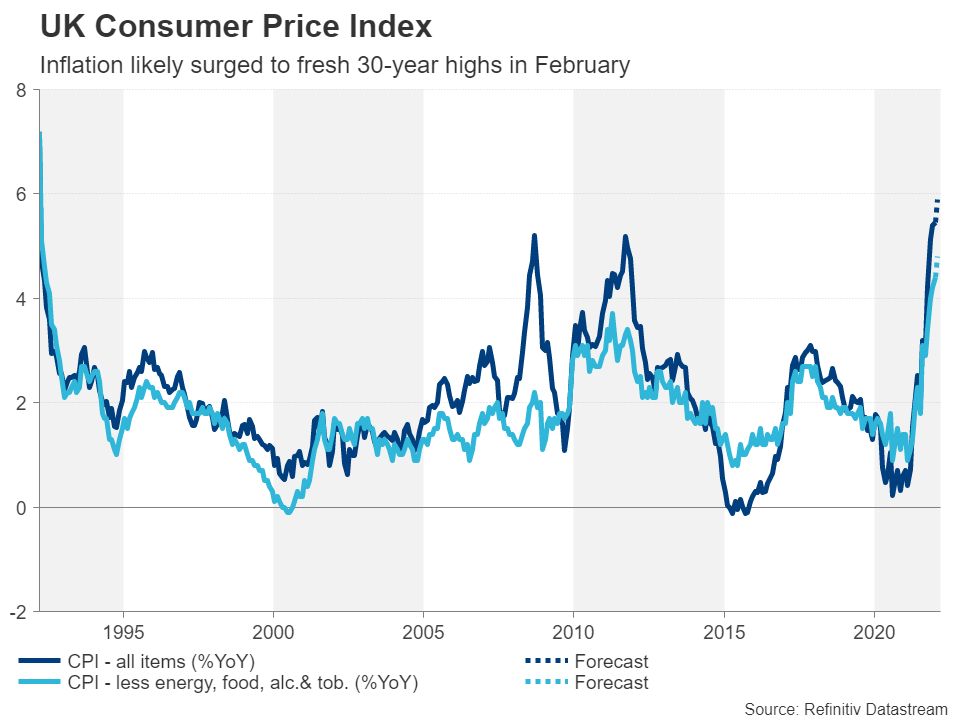
But despite the spiralling prices, it seems that some policymakers have already started getting cold feet about further tightening amidst the Ukraine crisis, as there was a surprise dissent in the BoE vote.
Sterling is now at risk of revisiting the recent 16-month low just below $1.30 unless Chancellor Rishi Sunak comes up with a plan to help households and small businesses with the surge in fuel prices when he makes his Spring Budget Statement on Wednesday.
Sunak is under pressure to provide additional relief than the measures he had announced back in February and should he deliver, the pound could claw back some lost ground.
Ukraine headlines may dictate dollar’s direction
Unlike the BoE, the hawkish signals emanating from the Fed at its March meeting couldn’t have been louder. Yet, the dollar slipped after the decision, suggesting that rate hike expectations have been fully baked in by now. It’s hard to see how next week’s second-tier data might put the wind back in the dollar’s sails.
New home sales for February will be the first major release on Wednesday, followed by durable goods orders for the same month and the final Q4 GDP estimate on Thursday. The flash PMIs are out too on Thursday. Although these aren’t as closely watched in the US as the ISM PMIs, investors will nonetheless be keeping an eye on them for clues as to whether input and output price inflation are close to peaking and if growth momentum remained strong in the first half of March. Pending home sales will wrap things up on Friday.
In a crucial month for central bank meetings, monetary policy stole the limelight somewhat from the war headlines in the last couple of weeks. But with the ECB, Fed, BoE and BoJ decision now out of the way, geopolitics will likely take full helm again.
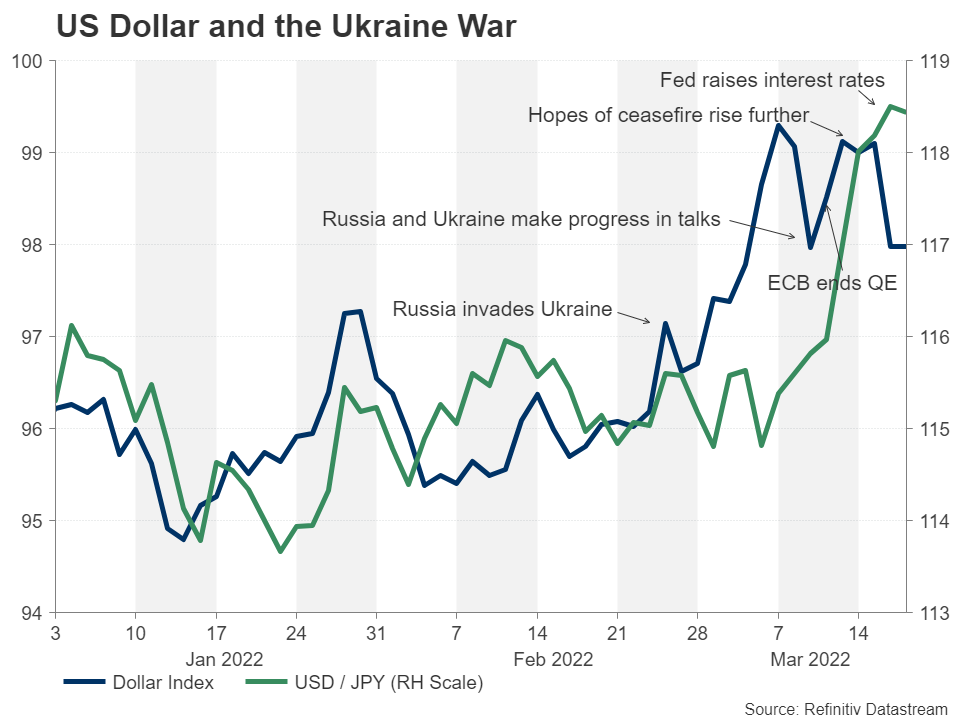
Should the efforts for a ceasefire between Russia and Ukraine falter, the dollar could resume its uptrend, pressuring its main rivals, the euro and pound.
The Japanese yen also stands to gain from any renewed risk aversion, having tumbled sharply since signs of progress from the peace talks first started to emerge as well as from the Bank of Japan not joining its global peers in withdrawing stimulus. Japanese PMIs due Thursday are unlikely to attract much attention for the yen.