Sample Category Title
USD/JPY Mid-Day Outlook
Daily Pivots: (S1) 118.30; (P) 118.67; (R1) 118.96; More...
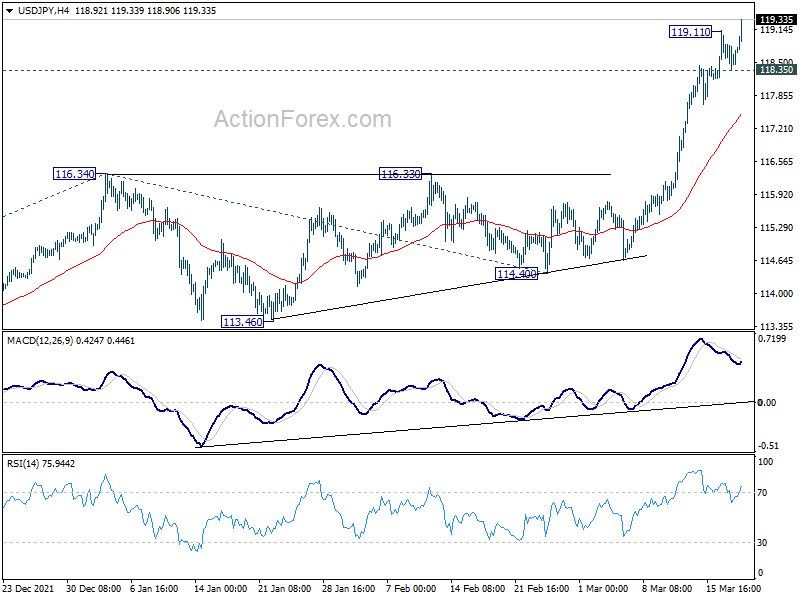
USD/JPY's rally resumes after brief consolidations and intraday bias is back on the upside. Current up trend should target 100% projection of 109.11 to 116.34 from 114.40 at 121.63 next. On the downside, below 118.35 will turn intraday bias neutral again and bring retreat. But downside should be contained above 116.34 resistance turned support to bring another rally.
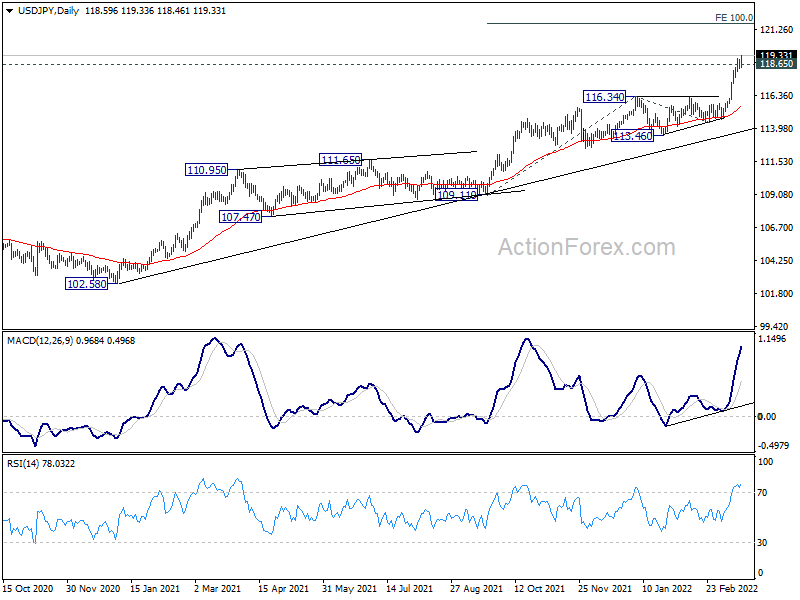
In the bigger picture, no change in the view that rise from 102.58 is the third leg of the up trend from 101.18 (2020 low). Sustained break of 118.65 (2016 high) will pave the way to 125.85 (2015 high) and raise the chance of long term up trend resumption. This will remain the favored case as long as 113.46 support holds, even in case of deep pull back.
Euro Reverses ahead of Weekend, USD/JPY Resumes Rally
The tide seems to be turning just ahead of the weekend. Swiss Franc is rebounding notably while Dollar is also firmer up. On the other, Euro reverses earlier gain and trades broadly lower. Nevertheless, Yen's weakness persists and it's extending recent decline against the greenback. Commodity currencies are steady, however, while Canadian Dollar has no reaction to stronger than expected retail sales.
Technically, EUR/USD once again fails to stand above 1.1120 minor resistance and dips. Near term outlook stays bearish downside breakout still in favor. A focus before close is whether EUR/AUD would break through 1.4920 minor support. If happens that would mark the end of the rebound from 1.4561 and should set the stage to resume larger down trend next week.
In Europe, at the time of writing, FTSE is down -0.60%. DAX is down -1.09%. CAC is down -1.11%. Germany 10-year yield is down -0.021 at 0.367. Earlier in Asia, Nikkei rose 0.65%. Hong Kong HSI dropped -0.41%. China Shanghai SSE rose 1.12%. Singapore Strait Times rose 0.24%. Japan 10-year JGB yield rose 0.0046 to 0.208.
Canada retail sales rose 3.2% mom in Jan, but to drop -0.5% mom in Feb
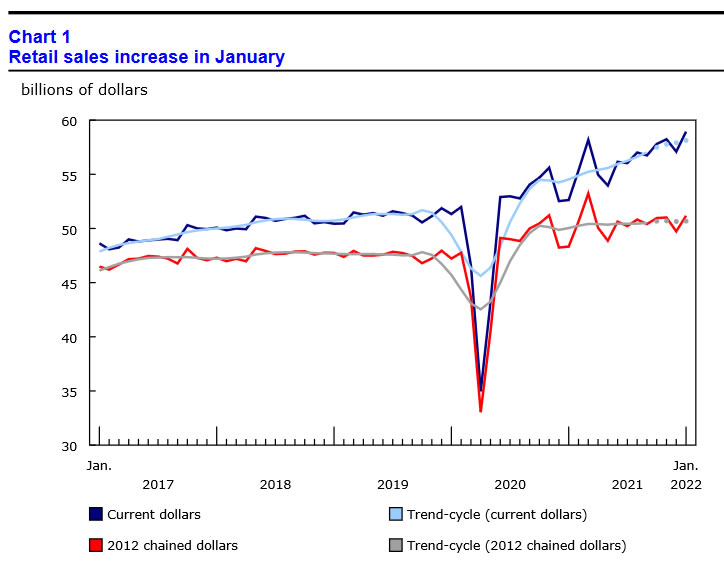
Canada retail dales rose 3.2% mom to CAD 58.9B in January, better than expectation of 2.4% mom. The increase was led by higher sales at motor vehicle and parts dealers (+5.3%), as sales at new car dealers (+5.5%) rebounded.
Sales were up in 9 of 11 subsectors, representing 85.5% of retail trade. Core retail sales—which exclude gasoline stations and motor vehicle and parts dealers—increased 2.9%.
In the advance estimate, retail sales dropped -0.5% mom in February.
Fed Bullard explains voting for 50bps hike this week
In a statement, St. Louis Fed President James Bullard explained by he voted for a 50bps rate hike on March 16 FOMC meeting, instead of 25bps. Additional, in the Summary of Economic Projections, he penciled in more rate hikes to 3% this year.
"The combination of strong real economic performance and unexpectedly high inflation means that the Committee's policy rate is currently far too low to prudently manage the U.S. macroeconomic situation," he said. "Moreover, U.S. monetary policy has been unwittingly easing further because inflation has risen sharply while the policy rate has remained very low, pushing short-term real interest rates lower. The Committee will have to move quickly to address this situation or risk losing credibility on its inflation target."
Bullard also compared to what Fed did back in 1994 and 1995, where FOMC "made a similar discrete adjustment to the policy rate to better align it with the macroeconomic circumstances at that time". And, the results were excellent".
Eurozone exports rose 18.9% yoy in Jan, imports rose 44.3% yoy
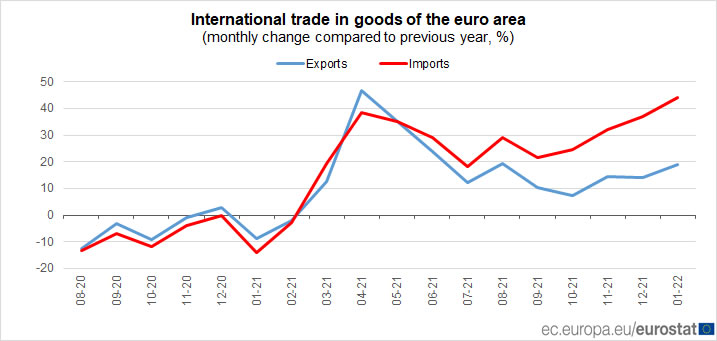
Eurozone goods exports rose 18.9% yoy to EUR 199.5B in January. Imports rose 44.3% yoy to EUR 226.7B. Trade deficit reached EUR -27.2B. Intra Eurozone trade rose 24.2% yoy to EUR 192.3B.
In seasonally adjusted terms, exports rose 3.4% mom to EUR 220.3B. Imports rose 2.3% mom to 228.0B. Trade deficit narrowed from EUR -9.7B to EUR -7.7B. Intra-Eurozone trade dropped from EUR 202.0B to EUR 198.7B.
BoJ stands pat, extremely high uncertainties surrounding impact from Ukraine
BoJ kept monetary policy unchanged as widely expected today. Under the yield curve control frame work, short-term policy interest rate is held at -0.10%. As for long-term interest rate, BoJ will continue to purchases JGBs, without upper limit, to maintain 10-year JGB yield at around 0%. The decision was made by 8-1 vote, with Goushi Kataoka dissented again, preferring to strength monetary easing.
In the accompany statement, BoJ said the "economy has picked up as a trend, although some weakness has been seen in part". Exports and industrial production "have continued to increase as a trend, despite the remaining effects of supply-side constraints."
Core inflation is "likely to increase clearly in positive territory for the time being due to a significant rise in energy prices, a pass-through of raw material cost increases, and dissipation of the effects of the reduction in mobile phone charges".
BoJ also said, "there are extremely high uncertainties over how the situation surrounding Ukraine will affect Japan's economic activity and prices, mainly through developments in global financial and capital markets, commodity prices, and overseas economies."
USD/JPY Mid-Day Outlook
Daily Pivots: (S1) 118.30; (P) 118.67; (R1) 118.96; More...
USD/JPY's rally resumes after brief consolidations and intraday bias is back on the upside. Current up trend should target 100% projection of 109.11 to 116.34 from 114.40 at 121.63 next. On the downside, below 118.35 will turn intraday bias neutral again and bring retreat. But downside should be contained above 116.34 resistance turned support to bring another rally.
In the bigger picture, no change in the view that rise from 102.58 is the third leg of the up trend from 101.18 (2020 low). Sustained break of 118.65 (2016 high) will pave the way to 125.85 (2015 high) and raise the chance of long term up trend resumption. This will remain the favored case as long as 113.46 support holds, even in case of deep pull back.
Economic Indicators Update
| GMT | Ccy | Events | Actual | Forecast | Previous | Revised |
|---|---|---|---|---|---|---|
| 23:30 | JPY | National CPI Core Y/Y Feb | 0.60% | 0.60% | 0.20% | |
| 03:00 | JPY | BoJ Interest Rate Decision | -0.10% | -0.10% | -0.10% | |
| 04:30 | JPY | Tertiary Industry Index M/M Jan | -0.70% | -1.00% | 0.40% | |
| 09:00 | EUR | Italy Trade Balance (EUR) Jan | -5.05B | 3.05B | 1.10B | |
| 10:00 | EUR | Eurozone Trade Balance(EUR) Jan | -7.7B | -4.6B | -9.7B | |
| 12:30 | CAD | Retail Sales M/M Jan | 3.20% | 2.40% | -1.80% | |
| 12:30 | CAD | Retail Sales ex Autos M/M Jan | 2.50% | 2.30% | -2.50% | |
| 13:30 | CAD | New Housing Price Index M/M Feb | 1.10% | 0.60% | 0.90% | |
| 15:00 | USD | Existing Home Sales Feb | 6.18M | 6.50M |
Canada retail sales rose 3.2% mom in Jan, but to drop -0.5% mom in Feb
Canada retail sales rose 3.2% mom to CAD 58.9B in January, better than expectation of 2.4% mom. The increase was led by higher sales at motor vehicle and parts dealers (+5.3%), as sales at new car dealers (+5.5%) rebounded.
Sales were up in 9 of 11 subsectors, representing 85.5% of retail trade. Core retail sales—which exclude gasoline stations and motor vehicle and parts dealers—increased 2.9%.
In the advance estimate, retail sales dropped -0.5% mom in February.
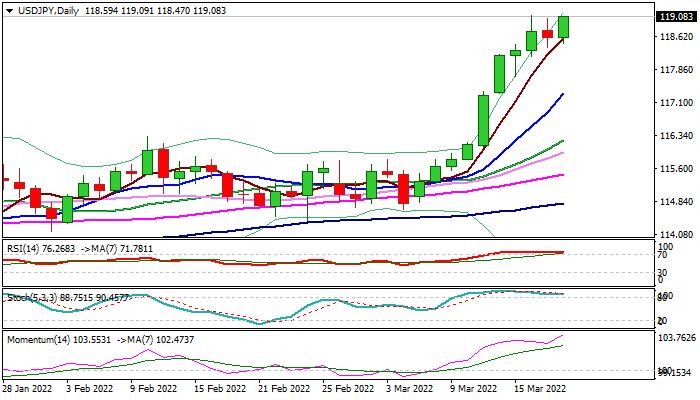
USD/JPY Outlook: Bulls Tighten Grip as Pessimism Over Ukraine War Dominates, Risk of 120+ Acceleration
The USDJPY regained traction and probes again above 119.00 barrier, driven by fresh safe-haven buying on renewed pessimism over the crisis in Ukraine, while yen was deflated by dovish BOJ.
The Japanese central bank kept rates unchanged and maintained massive stimulus due to very high uncertainty over Ukraine that warns of growth risk.
Break of the target at 118.66 /60 (tops of Dec 2016 / Jan 2017) exposed Fibo barrier at 119.50 (76.4% of 125.84/98.99), violation of which would risk acceleration above psychological 120 resistance.
The pair is on track for the second strong weekly rally, with studies on both, daily and weekly chart, maintaining strong bullish momentum and supporting the action.
Bulls so far ignore overbought conditions on daily chart, but some corrective action could be expected in coming days.
Broken pivots at 118.66/60 reverted to solid supports, with deeper dips to find footstep above rising 10DMA (117.30) and keep larger bulls intact.
Res: 118.45; 118.66; 119.00; 119.50.
Sup: 118.66; 118.36; 117.70; 117.30.
Fed Bullard explains voting for 50bps hike this week
In a statement, St. Louis Fed President James Bullard explained by he voted for a 50bps rate hike on March 16 FOMC meeting, instead of 25bps. Additional, in the Summary of Economic Projections, he penciled in more rate hikes to 3% this year.
"The combination of strong real economic performance and unexpectedly high inflation means that the Committee's policy rate is currently far too low to prudently manage the U.S. macroeconomic situation," he said. "Moreover, U.S. monetary policy has been unwittingly easing further because inflation has risen sharply while the policy rate has remained very low, pushing short-term real interest rates lower. The Committee will have to move quickly to address this situation or risk losing credibility on its inflation target."
Bullard also compared to what Fed did back in 1994 and 1995, where FOMC "made a similar discrete adjustment to the policy rate to better align it with the macroeconomic circumstances at that time". And, the results were excellent".
Eurozone exports rose 18.9% yoy in Jan, imports rose 44.3% yoy
Eurozone goods exports rose 18.9% yoy to EUR 199.5B in January. Imports rose 44.3% yoy to EUR 226.7B. Trade deficit reached EUR -27.2B. Intra Eurozone trade rose 24.2% yoy to EUR 192.3B.
In seasonally adjusted terms, exports rose 3.4% mom to EUR 220.3B. Imports rose 2.3% mom to 228.0B. Trade deficit narrowed from EUR -9.7B to EUR -7.7B. Intra-Eurozone trade dropped from EUR 202.0B to EUR 198.7B.
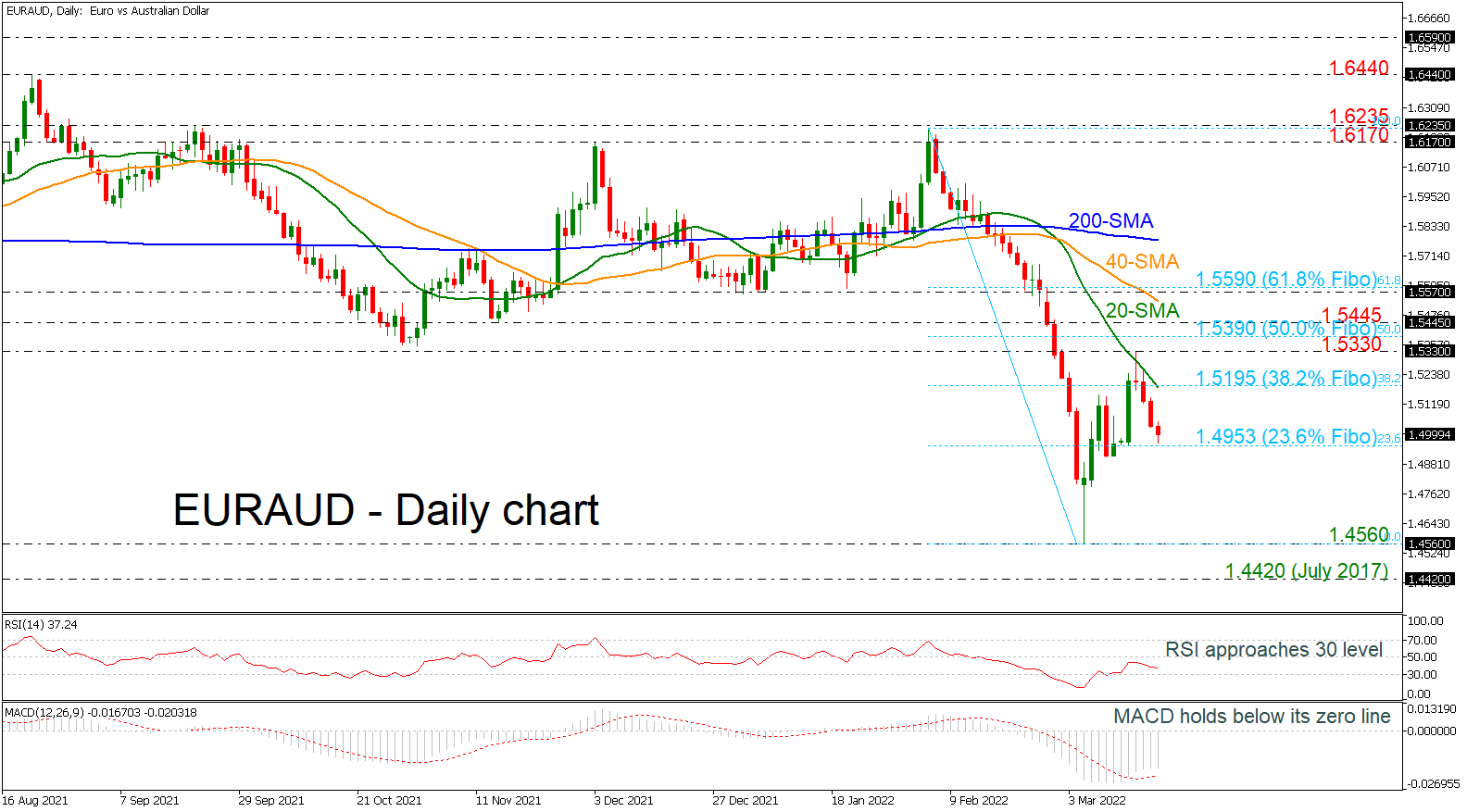
EURAUD Plunges Below 1.5000, Pausing its Move Near 23.6% Fibo
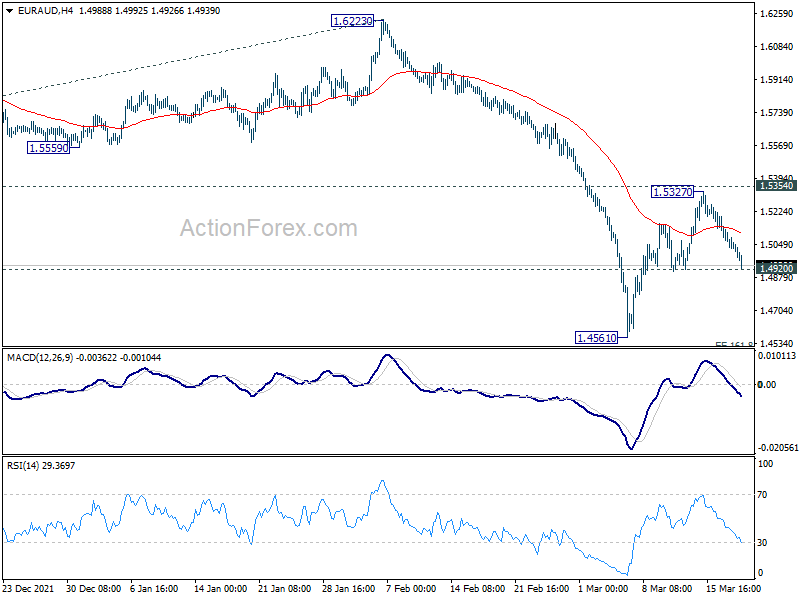
EURAUD found strong resistance level at the 1.5330 barrier, which acted as a turning point to the price, holding the pair beneath the 20-day simple moving average (SMA) as well. Currently, the price is testing the 23.6% Fibonacci retracement level of the down leg from 1.6235 to 1.4560 at 1.4953 and any falls below it would endorse the short- and medium-term bearish outlook.
The RSI indicator is falling further in the negative territory, while the MACD successfully surpassed above its trigger line, but it remains below the zero line, both suggesting more losses.
Should bearish dynamics dominate, the market might revisit the 1.4560 bottom before meeting the 1.4420 low in July 2017. Below that, the area around 1.3620, which halted downside corrections on February 2017 could another potential barrier in focus.
Alternatively, if the price manages to rebound above 1.4353, the 38.2% Fibonacci of 1.5195, which overlaps with the 20-day SMA could come next. A violation of this point may shift the attention towards the 1.5330 resistance and the 50.0% Fibonacci of 1.5390 ahead of 1.5445. A decisive close above the latter and hence above the 40-day SMA would increase speculation of a retest of the 61.8% Fibonacci of 1.5590.
In the medium-term picture, the downfall from 1.6235 is still active and hence the outlook remains negative. The 20-day SMA has further increased distance below the 40-day SMA, hinting that the downward pattern might hold for longer.
To summarize, EURAUD’s bias looks negative both in the short and the medium term.
Canadian Dollar Eyes Retail Sales
The Canadian dollar continues to rally and has gained over 1% this week. We’ll get a look at Canadian retail sales later in the day.
Retail sales predicted to bounce back
After a rough start to the week, the Canadian dollar has reversed directions and posted three winning days, as the US dollar has retreated against the majors. The war in Ukraine has sapped risk appetite, which has weighed on the Canadian dollar. However, this has been largely mitigated by the surge in oil and other commodities prices, as Canada is a major exporter of commodities.
The Canadian currency’s upswing could well continue on Friday if retail sales for January perform as expected. Both the headline and core readings are expected to climb 2.4% MoM. In December, Retail Sales fell by -1.8% and Core Retail Sales plunged -2.5%, as holiday shopping was hampered by the Omicron virus.
The Federal Reserve finally pressed the lift-off button for a rate-tightening cycle, and the Bank of Canada is expected to follow suit. Both central banks are under pressure to relieve sizzling inflation, which has hit 40-year highs in Canada and the US. The markets have priced in up to six more hikes this year, as the BoC will have to be aggressive in order to wrestle inflation back to its target range of one-to-three per cent. The quandary for Bank policymakers is that inflation is not being fed by economic growth, and fears of stagflation means that the BoC will have to be cautious to avoid choking off growth due to sharp rises in interest rates.
With the FOMC meeting out of the day, the markets are refocused on the war raging in Ukraine. Russia continues its assault even while negotiating, but the markets are hoping that this time the talks will lead to a breakthrough that will end the fighting. We’ve seen these hopes dashed before, but the optimism has renewed risk appetite and pushed the US dollar lower. Any signs of progress in the talks will likely extend the US dollar’s downswing.
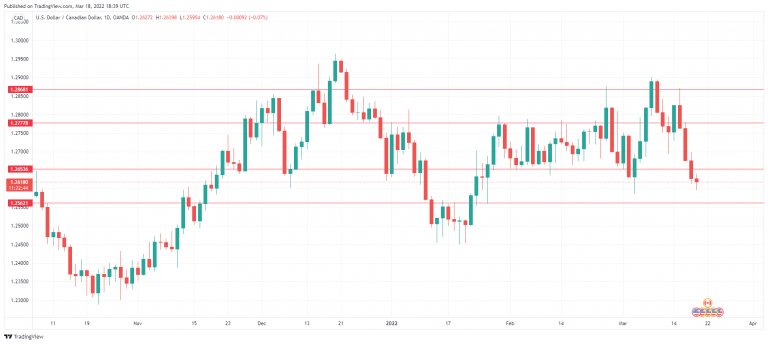
USD/CAD Technical
- USD/CAD faces resistance at 1.2653 and 1.2777
- There is support at 1.2562 and 1.2438
GBPUSD Bias Improves But the Overall Outlook Remains Bearish
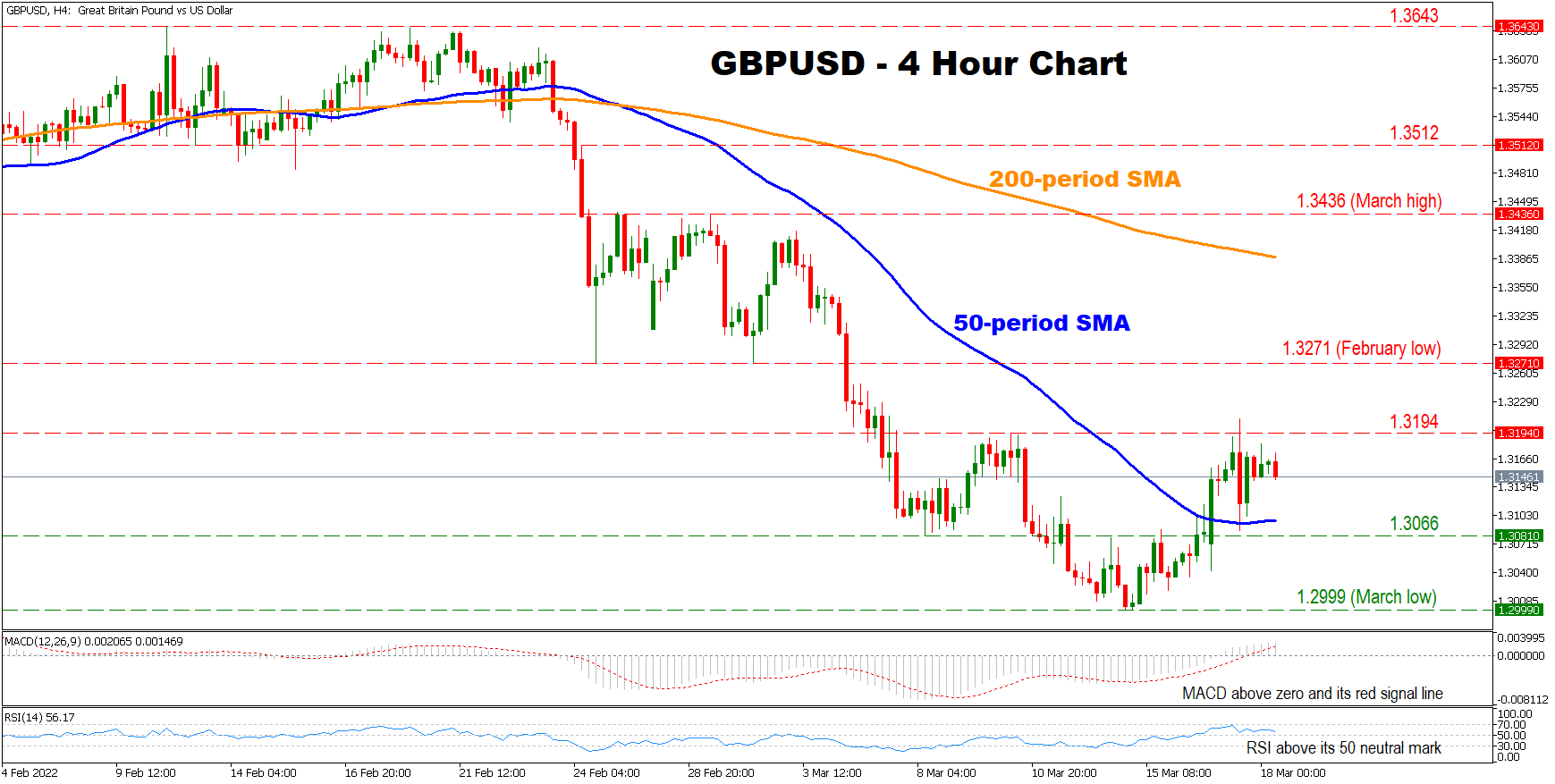
GBPUSD has bounced back from its March low of 1.2999, crossing above its 50-period simple moving average (SMA) as positive momentum resurfaced. However, the pair is currently trading well below its 200-period SMA and hasn’t yet broken its series of successive lower lows, reinforcing an overall bearish outlook.
Short-term momentum oscillators reflect a positive bias as the RSI is located above its 50 neutral mark. Also, the MACD is found above zero and its red signal line, which indicates that the positive momentum in the price might be gaining further ground.
Should the bulls manage to gain a tight grip, initial resistance might be found at the 1.3194 obstacle, before buyers eye the February low at 1.3271. Crossing above the latter could increase positive momentum, paving the way towards the 200-period SMA currently at 1.3389.
On the flip side, if sellers regain full control, the 50-period SMA currently at 1.3098 might act as the first line of defence. Crossing below this point, the bears might then target the 1.3066 hurdle before taking aim at the March low of 1.2999.
In brief, despite the recent uptick from the March lows and the improved bias, the overall outlook for the pair remains cautiously bearish. For sentiment to change, the series of successive lower lows in the price must stop.
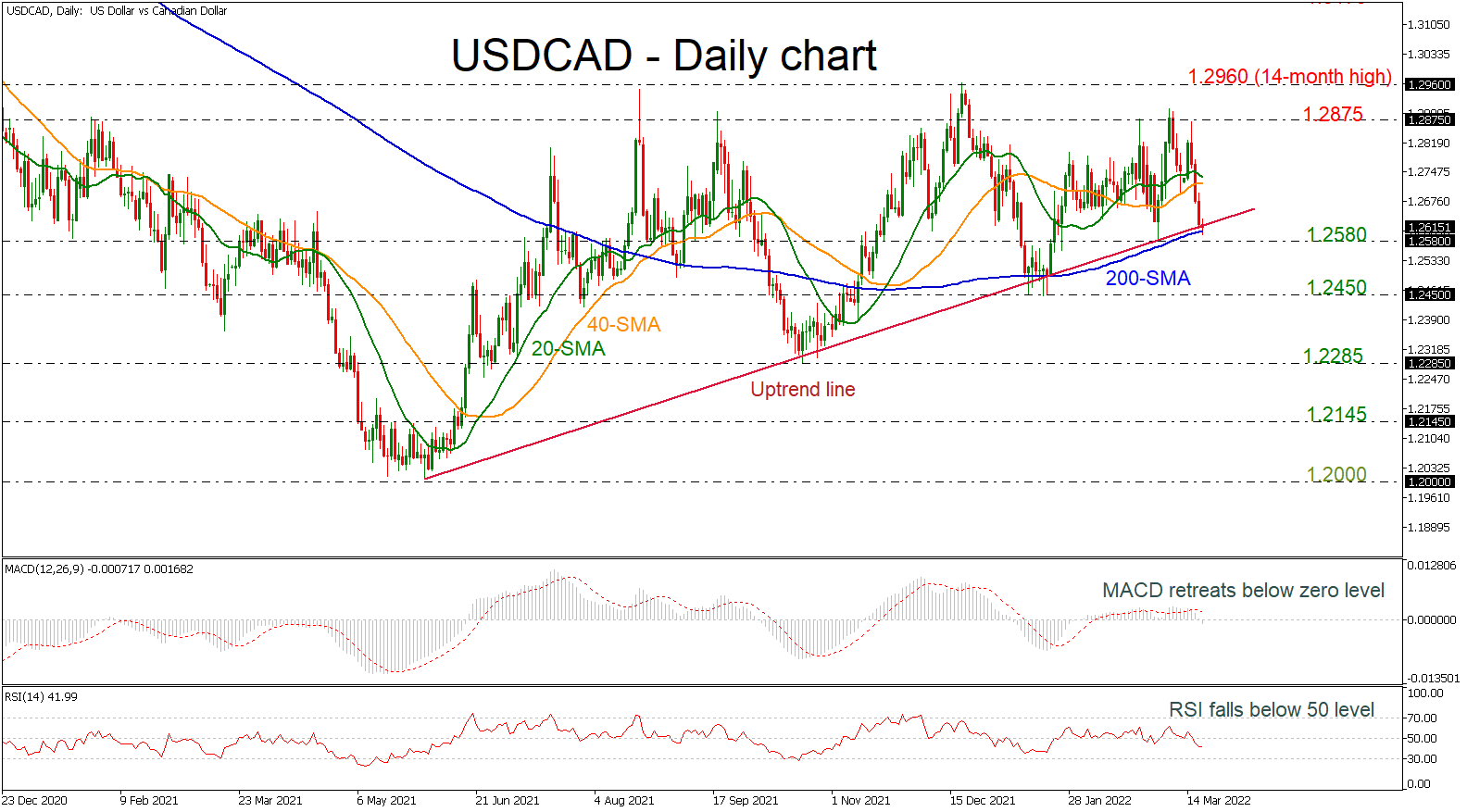
USDCAD Slips Near 200-day SMA and Uptrend Line at 1.2600
USDCAD is currently challenging the long-term ascending trend line and the 200-day simple moving average (SMA) around the 1.2600 psychological mark. The price is showing some signs that it would be a penetration of the diagonal line, suggesting the start of a neutral outlook.
According to the technical indicators, the MACD oscillator dived beneath its zero line, strengthening its momentum below trigger line, while the RSI is falling below the neutral threshold of 50. The 20- and 40-day SMAs are ready for a bearish crossover, confirming the recent move.
In case the pair changes its direction to the downside, the bears will probably challenge the previous bottom at 1.2580. A break lower, could last until 1.2450 before moving lower towards the 1.2285 support, taken from the low in October 2021.
Alternatively, a rebound off the uptrend line may drive the price towards the 20- and 40-day SMAs at 1.2730. Above the latter, the 1.2875 resistance, which rejected the market’s actions recently could be another level in focus ahead of the 14-month high of 1.2960.
Summarizing, USDCAD maintains a bearish phase in the short-term picture, and if there is a successful drop beneath the rising trend line it could change the long-term outlook to negative as well.