

Sample Category Title
AUD/USD Daily Report
Daily Pivots: (S1) 0.7309; (P) 0.7339; (R1) 0.7389; More...
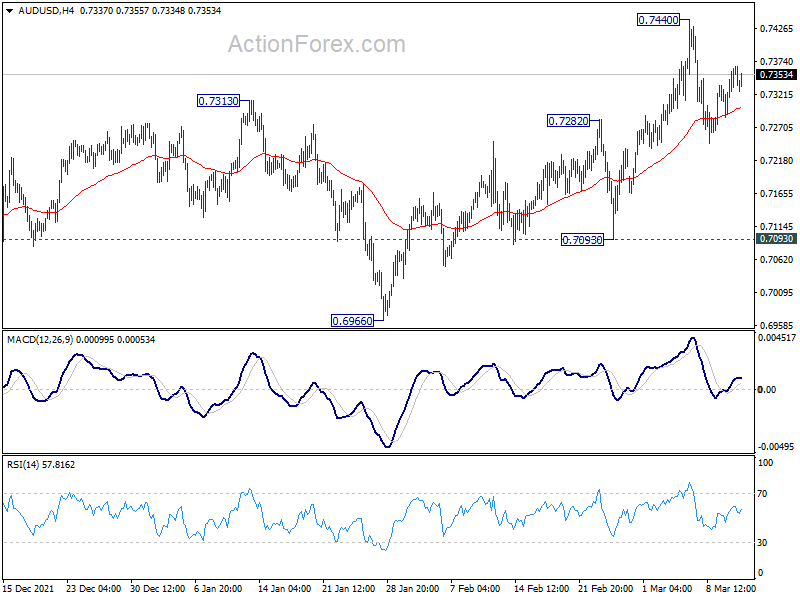
Intraday bias in AUD/USD remains neutral as consolidation from 0.7440 is still in progress. Another fall cannot be ruled out. But overall, further rally will remain in favor as long as 0.7093 support holds. As noted before, larger decline from 0.8006 might have completed at 0.6966 already. Above 0.7440 will resume the rise from 0.6966 for 0.7555 resistance next.
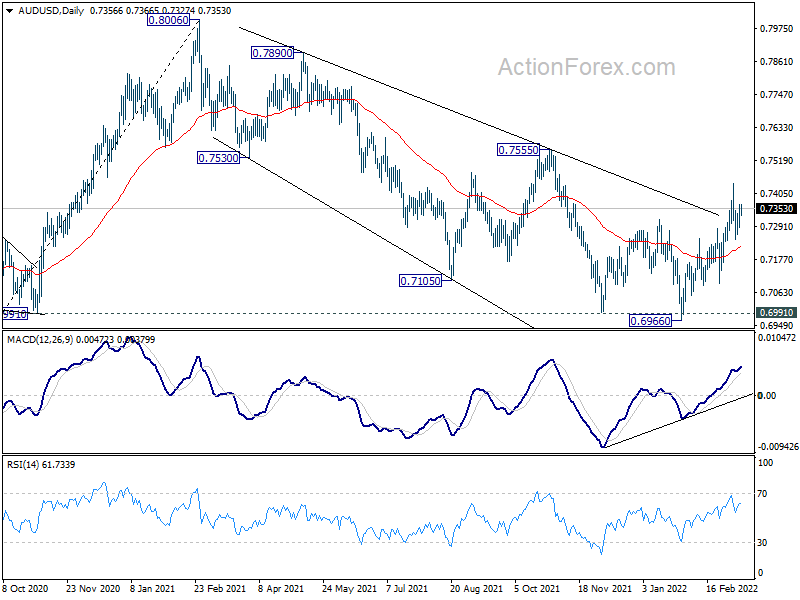
In the bigger picture, focus remains on 0.6991 key structural support. Sustained break there will argue that the whole up trend from 0.5506 might be finished at 0.8006, after rejection by 0.8135 long term resistance. Deeper decline would then be seen back to 61.8% retracement of 0.5506 to 0.8006 at 0.6461. Meanwhile, strong rebound from 0.6991 will retain medium term bullishness. That is, whole up trend from 0.5506 is still in progress for another rise through 0.8006 at a later stage.
EUR/USD Daily Outlook
Daily Pivots: (S1) 1.0936; (P) 1.1028; (R1) 1.1081; More...
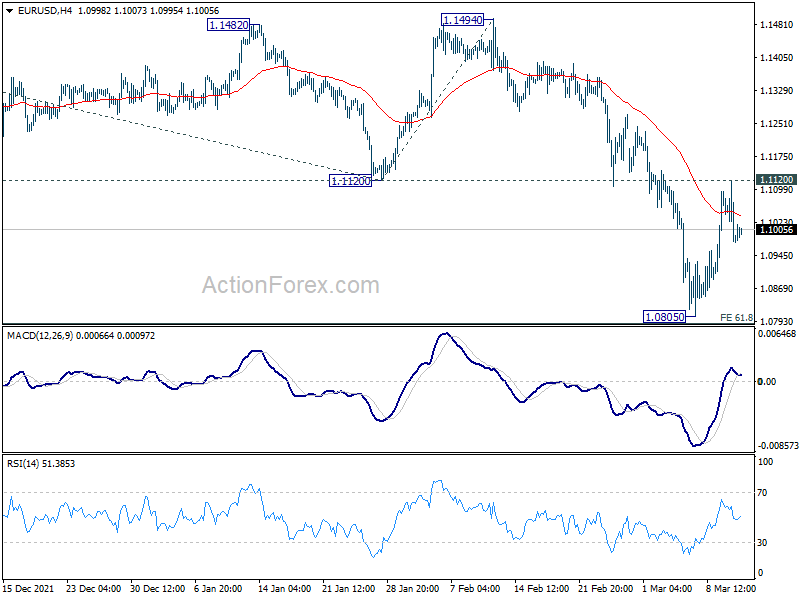
Intraday bias in EUR/USD remains neutral and outlook is unchanged. As long as 1.1120 support turned resistance holds, larger down trend from 1.1494 is still expected to continue. On the downside, firm break of 61.8% projection of 1.2265 to 1.1120 from 1.1494 at 1.0786 will pave they way to 100% projection at 1.0349 next. However, strong break of 1.1120 will confirm short term bottoming, at least, and bring stronger rebound back towards 1.1494 structural resistance instead.
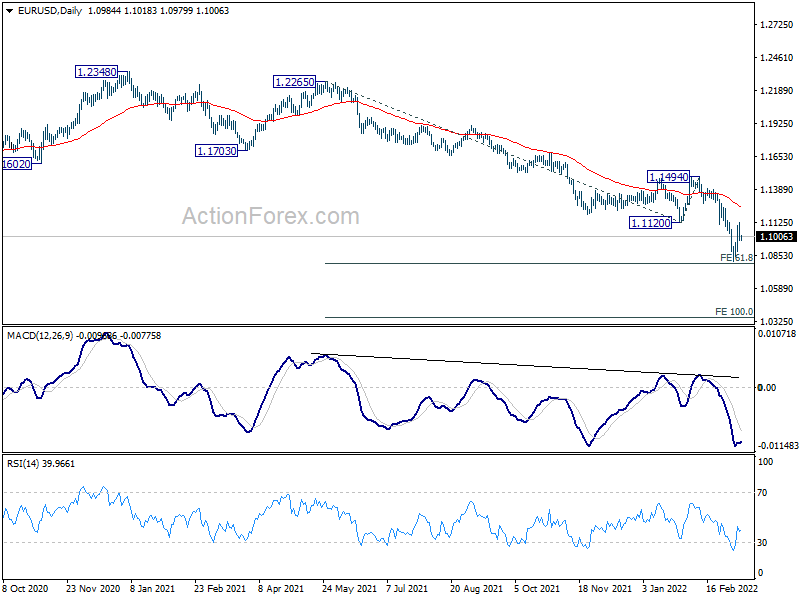
In the bigger picture, the decline from 1.2348 (2021 high) is expected to continue as long as 1.1494 resistance holds. Firm break of 1.0635 (2020 low) will raise the chance of long term down trend resumption and target a retest on 1.0339 (2017 low) next. Nevertheless, break of 1.1494 will maintain medium term neutral outlook, and extend range trading first.
GBP/USD Daily Outlook
Daily Pivots: (S1) 1.3045; (P) 1.3119; (R1) 1.3157; More...
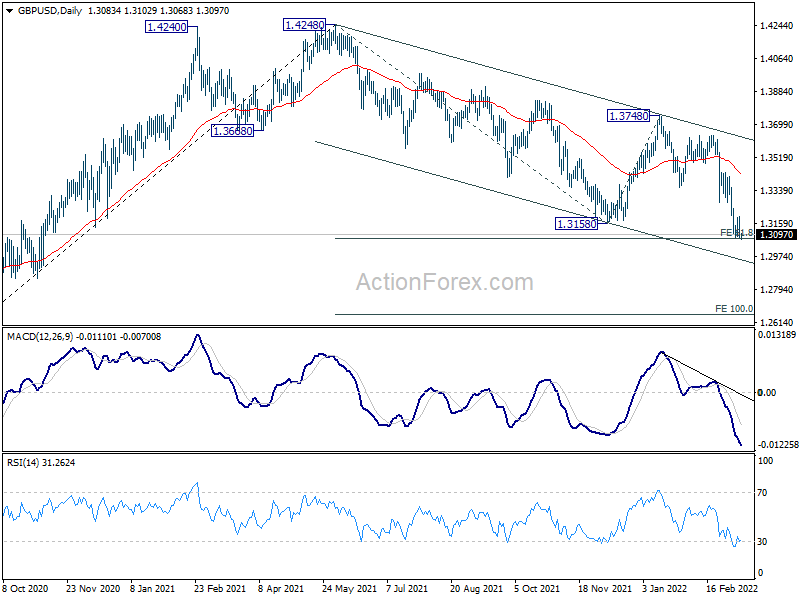
Intraday bias in GBP/USD is back on the downside with break of 1.3080 temporary low. Sustained break of 61.8% projection of 1.4248 to 1.3158 from 1.3748 at 1.3074 will extend the down trend from 1.4248 to 100% projection at 1.2658. In any case, outlook will remain bearish as long as 1.3270 support turned resistance holds, in case of another recovery.
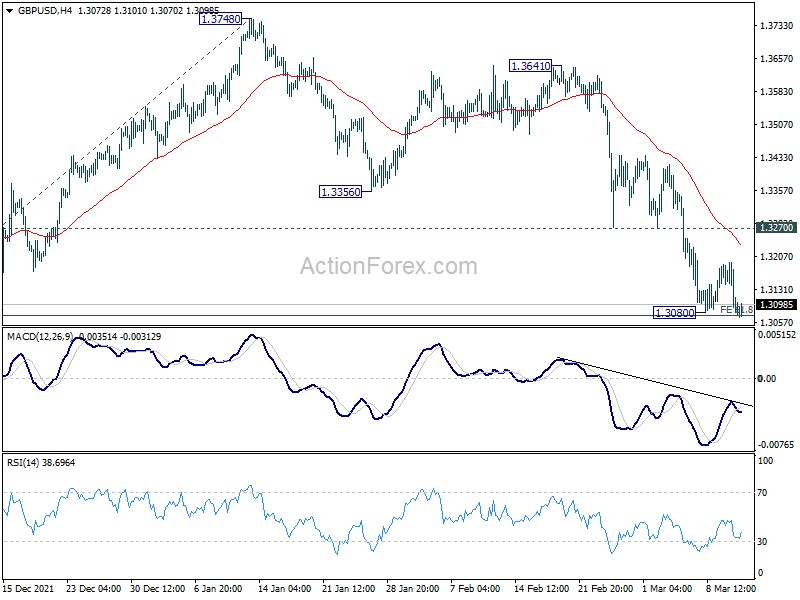
In the bigger picture, current development suggests that the up trend from 1.1409 (2020 low) has completed at 1.4248. Decline from 1.4248 could still be a corrective move, or it could be the start of a long term down trend. In either case, deeper decline would now be seen back to 61.8% retracement of 2.1161 to 1.1409 at 1.2493. In case, break of 1.3748 resistance is needed to indicate medium term bottoming, or outlook will stay bearish.
USD/CHF Daily Outlook
Daily Pivots: (S1) 0.9269; (P) 0.9289; (R1) 0.9323; More....
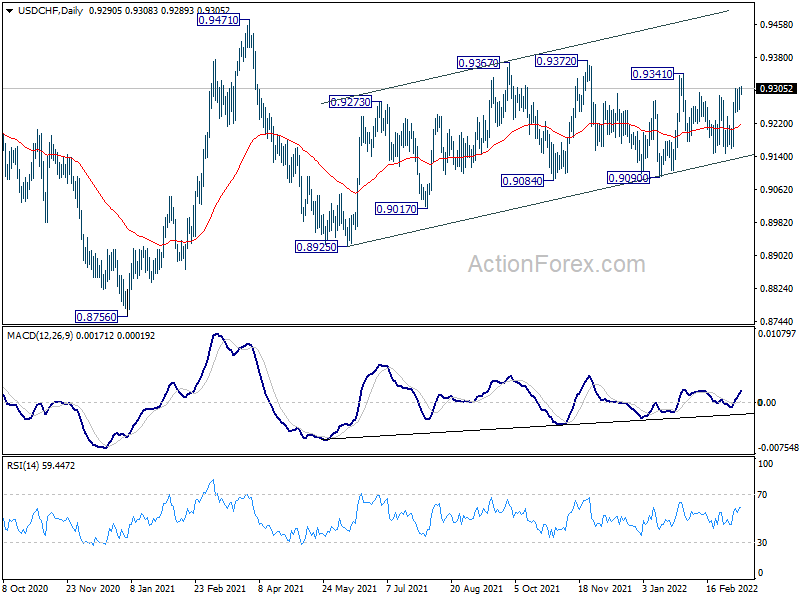
Range trading continues in USD/CHF and intraday bias remains neutral for the moment. Choppy rise from 0.8925 would still be in favor to extend higher as long as 0.9090 support holds. Break of 0.9341 will target 0.9372 resistance and then 0.9471. On the downside, however, break of 0.9090 will bring deeper fall back to 0.8925 support.
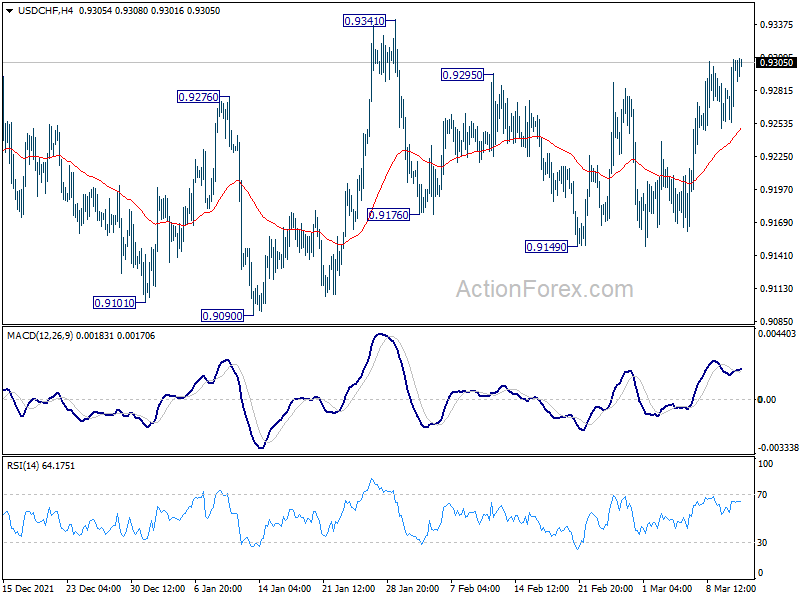
In the bigger picture, medium term outlook will be neutral at best as long as 0.9471 resistance holds. Larger down trend could still extend through 0.8756 (2021 low). However, firm break of 0.9471 will argue that the trend has already reversed and rebound the rally from 0.8756 with another impulsive move.
USD/JPY Daily Outlook
Daily Pivots: (S1) 115.91; (P) 116.05; (R1) 116.29; More...
USD/JPY's break of 116.34 resistance confirms up trend resumption. Intraday bias is back on the upside. Current rally should now target next long term resistance at 118.65. On the downside, below 115.80 minor support will turn intraday bias neutral first. But outlook will remain bullish as long as 114.40 support holds, in case of retreat.
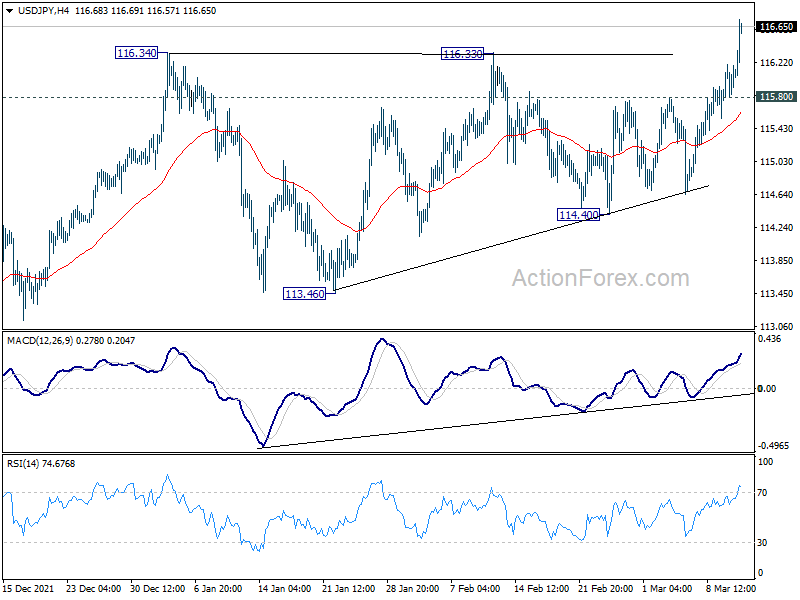
In the bigger picture, no change in the view that rise from 102.58 is the third leg of the up trend from 101.18 (2020 low). Such rally should target a test on 118.65 (2016 high). Sustained break there will pave the way to 120.85 (2015 high) and raise the chance of long term up trend resumption. This will remain the favored case as long as 55 week EMA (now at 111.75) holds.
Yen Under Pressure on Rate Outlook and Rising Yield, USD/JPY Breakout
Yen is under some broad based pressure in Asia session despite some mild risk aversion sentiment. BoJ is clear to lag behind other major central bank in raising interest rates, due to the still underperforming inflation. Rally in global treasury yields is also weighing on the Japanese currency. Euro is maintaining this week's recovery, but is apparently struggling to extend rebound as Russia invasion of Ukraine drags on. Dollar is firm and the upside breakout against Yen is a positive sign.
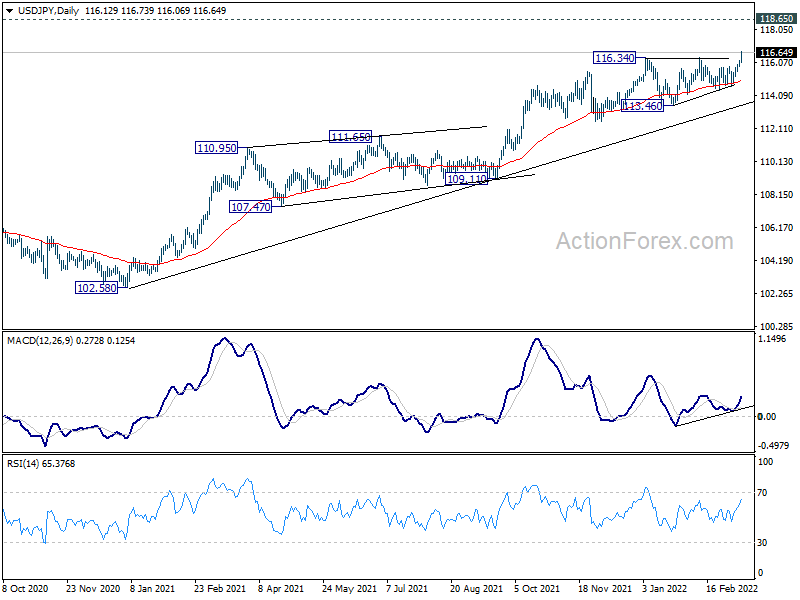
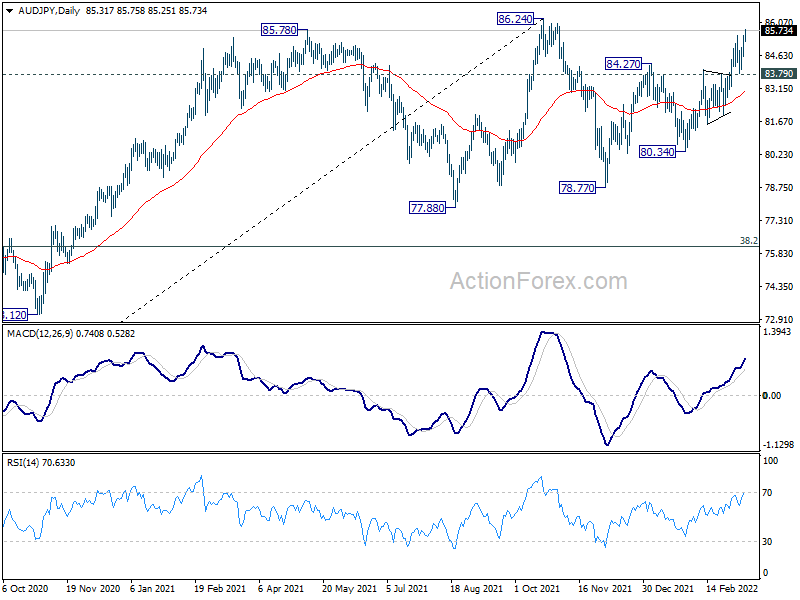
Technically, USD/JPY finally breaks through 116.34 resistance to resume medium term up trend. Next target is long term resistance level at 118.65. At the same time, AUD/JPY is also marching towards 86.24 high. Firm break there will resume medium term up trend too and would add to the case of more broad based Yen selloff. Though, break of 83.79 support will suggest rejection by 86.24 and bring near term reversal.
In Asia, Nikkei closed down -2.05%. Hong Kong HSI is down -1.69%. China Shanghai SSE is down -0.22%. Singapore Strait Times is up 0.22%. Japan 10-year JGB yield is down -0.0078. Overnight, DOW dropped -0.34%. S&P 500 dropped -0.43%. NASDAQ dropped -0.95%. 10-year yield rose 0.063 to 2.011 (but it's retreating in Asia).
IMF Georgieva: Global growth forecast to be downgraded, but remains in positive territory
IMF Managing Director Kristalina Georgieva told CNBC yesterday, "we think that we would be downgrading our growth projections as a result of the crisis (in Ukraine), but we still expect the world to be in positive growth territory."
In the January outlook IMF projected global growth of 4.4% in 2022. For now, it's unsure how the global economy would be affected by Russia invasion on Ukraine. "Obviously, how long this war goes is the main uncertainty factor we face," Georgieva said.
Separately, Georgieva also said, sanctions on Russia for its invasion of Ukraine would cause an abrupt contraction of the Russian economy. Russia is facing a "deep recession" this year, and sovereign debt default is no longer seen as "improbable".
RBA Lowe: It's prudent to plan for an interest rate increase
RBA Governor Philip Lowe said it's "plausible" for interest to be lifted from the current 0.1% this year. "It would be prudent to plan for an increase," he added. "For many borrowers that's going to come as quite an unwelcome development, although I know from the letters that I get every day when I turn up at work that many depositors have a different view,"
Meanwhile, he said "I don't feel mounting pressure," on raising rates. "We do what we think is the right thing at each of our meetings, so the pressure, it's great for media stories, but I don't feel that myself."
New Zealand BNZ manufacturing rose to 53.6, next result may see fallout from Russia/Ukraine conflict
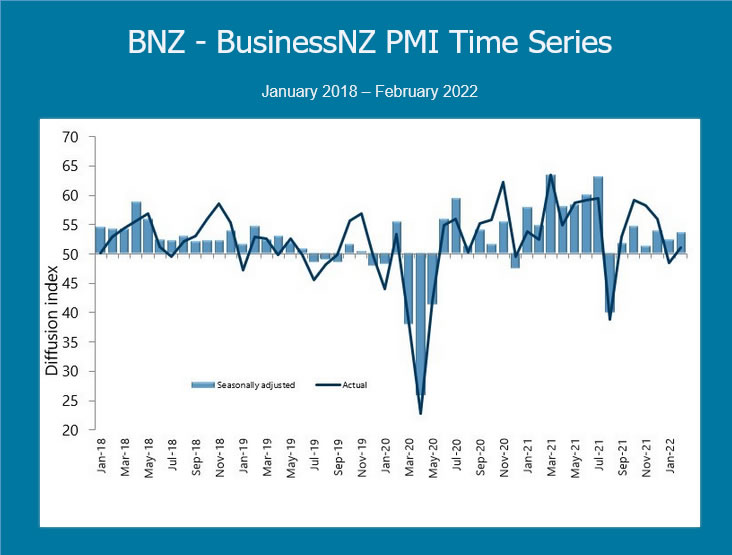
New Zealand BNZ Performance of Manufacturing Index rose from 52.3 to 53.6 in February. Looking at some details, Production rose from 51.1 to 52.1. Employment rose from 49.5 to 51.7. New Orders rose from 53.6 to 58.2. Finished stocks dropped from 52.5 to 50.0. Deliveries dropped from 54.0 to 53.5.
BNZ Senior Economist, Craig Ebert stated that "underlying unease will certainly be piqued by the sustained high COVID case numbers as we go into March. The next PMI result may also see fallout from the Russia/Ukraine conflict, whose global impacts will be felt far and wide."
Elsewhere
Japan overall household spending rose 6.9% yoy in January, above expectation of 3.6% yoy. BSI large manufacturing condition dropped sharply from 8.2 to -7.6 in Q1.
UK GDP, production and trade balance are the major focuses in European session. Germany will release CPI final. Later in the day, Canada employment data will take center stage. US will release U of Michigan consumer sentiment.
USD/JPY Daily Outlook
Daily Pivots: (S1) 115.91; (P) 116.05; (R1) 116.29; More...
USD/JPY's break of 116.34 resistance confirms up trend resumption. Intraday bias is back on the upside. Current rally should now target next long term resistance at 118.65. On the downside, below 115.80 minor support will turn intraday bias neutral first. But outlook will remain bullish as long as 114.40 support holds, in case of retreat.
In the bigger picture, no change in the view that rise from 102.58 is the third leg of the up trend from 101.18 (2020 low). Such rally should target a test on 118.65 (2016 high). Sustained break there will pave the way to 120.85 (2015 high) and raise the chance of long term up trend resumption. This will remain the favored case as long as 55 week EMA (now at 111.75) holds.
Economic Indicators Update
| GMT | Ccy | Events | Actual | Forecast | Previous | Revised |
|---|---|---|---|---|---|---|
| 21:30 | NZD | Business NZ PMI Feb | 53.6 | 52.1 | 52.3 | |
| 23:30 | JPY | Overall Household Spending Y/Y Jan | 6.90% | 3.60% | -0.20% | |
| 23:50 | JPY | BSI Large Manufacturing Conditions Index Q1 | -7.6 | 8.2 | 7.9 | |
| 07:00 | EUR | Germany CPI M/M Feb F | 0.90% | 0.90% | ||
| 07:00 | EUR | Germany CPI Y/Y Feb F | 5.10% | 5.10% | ||
| 07:00 | GBP | GDP M/M Jan | 0.20% | -0.20% | ||
| 07:00 | GBP | Index of Services 3M/3M Jan | 1.20% | 1.20% | ||
| 07:00 | GBP | Industrial Production M/M Jan | 0.30% | 0.30% | ||
| 07:00 | GBP | Industrial Production Y/Y Jan | 0.20% | 0.40% | ||
| 07:00 | GBP | Manufacturing Production M/M Jan | 0.20% | 0.20% | ||
| 07:00 | GBP | Manufacturing Production Y/Y Jan | 3.10% | 1.30% | ||
| 07:00 | GBP | Goods Trade Balance (GBP) Jan | -12.6B | -12.4B | ||
| 13:30 | CAD | Net Change in Employment Feb | 123.0K | -200.1K | ||
| 13:30 | CAD | Unemployment Rate Feb | 6.20% | 6.50% | ||
| 15:00 | USD | Michigan Consumer Sentiment Index Mar P | 61.3 | 62.8 | ||
| 15:00 | GBP | NIESR GDP Estimate (3M) Feb | 1.10% | 0.90% |
New Zealand BNZ manufacturing rose to 53.6, next result may see fallout from Russia/Ukraine conflict
New Zealand BNZ Performance of Manufacturing Index rose from 52.3 to 53.6 in February. Looking at some details, Production rose from 51.1 to 52.1. Employment rose from 49.5 to 51.7. New Orders rose from 53.6 to 58.2. Finished stocks dropped from 52.5 to 50.0. Deliveries dropped from 54.0 to 53.5.
BNZ Senior Economist, Craig Ebert stated that "underlying unease will certainly be piqued by the sustained high COVID case numbers as we go into March. The next PMI result may also see fallout from the Russia/Ukraine conflict, whose global impacts will be felt far and wide."
RBA Lowe: It’s prudent to plan for an interest rate increase
RBA Governor Philip Lowe said it's "plausible" for interest to be lifted from the current 0.1% this year. "It would be prudent to plan for an increase," he added. "For many borrowers that's going to come as quite an unwelcome development, although I know from the letters that I get every day when I turn up at work that many depositors have a different view,"
Meanwhile, he said "I don't feel mounting pressure," on raising rates. "We do what we think is the right thing at each of our meetings, so the pressure, it's great for media stories, but I don't feel that myself."
IMF Georgieva: Global growth forecast to be downgraded, but remains in positive territory
IMF Managing Director Kristalina Georgieva told CNBC yesterday, "we think that we would be downgrading our growth projections as a result of the crisis (in Ukraine), but we still expect the world to be in positive growth territory."
In the January outlook IMF projected global growth of 4.4% in 2022. For now, it's unsure how the global economy would be affected by Russia invasion on Ukraine. "Obviously, how long this war goes is the main uncertainty factor we face," Georgieva said.
Separately, Georgieva also said, sanctions on Russia for its invasion of Ukraine would cause an abrupt contraction of the Russian economy. Russia is facing a "deep recession" this year, and sovereign debt default is no longer seen as "improbable".
Surge in Commodity Prices Boosts Forecasts and Outlook for AUD
The horrific developments in Ukraine have turbo-charged commodity prices, a key driver of the AUD.
We have made significant changes to our commodity price forecasts. These forecasts are set out the Westpac Market Outlook which has been released today. Our working assumption is that almost all the surge in the oil price is behind us. Russia's crude exports have been largely eliminated from global supply as official sanctions, voluntary sanctions and shipping disruptions have already severely curtailed supply.
From this point we expect there will be some slow responses on the supply side, from other producers, while some demand will be dented by high prices. We are assuming an oil price of US$100/bbl through to end 2022. Other key commodity prices for Australia – coal and base metals – are also expected to hold at extremely high levels through to year's end.
Given our new commodity price forecasts, fair value AUD models that do not include a subjective proxy for risk are screaming that it is heavily undervalued. But our expectation of ongoing elevated commodity prices is also coinciding with a period in which high risk aversion is dominating markets.
The Australian dollar is a 'risk on' currency so we have been quite cautious with near term upward revisions to our currency forecasts. Our June target has been lifted from USD0.70 to USD0.73, bearing in mind that by this time we also expect the FOMC to have raised the federal funds rate by 75bps, in three quick tranches.
One potential factor that may offset Australia's traditional position in markets as a 'risk on' asset is its remoteness from Ukraine and Russia. But nervous investors might also view our geographic position as vulnerable insofar as the current conflict plays into China's stated plans for Taiwan.
As risk concerns gradually ease through the second half of 2022, and the RBA begins its own tightening cycle by August, the boost to the AUD from the elevated commodity prices can be more sustained. Accordingly we have lifted our AUD forecast by end 2022 from USD0.73 to USD0.76 – above its long term average.
Risk fears will be further contained through 2023 as markets accept that inflation can slow and central banks can navigate soft landings for their economies. A more 'risk on' sentiment in markets from late 2022 will further embolden the AUD and, with relatively high (although easing) commodity prices through 2023 the Australian dollar is expected to move back to USD0.80.
A genuine risk to this strong AUD scenario in 2023 will be that markets are likely to need to reassess the peak in the RBA's tightening cycle. We expect a peak of 1.75% by the first quarter of 2024 whereas markets are currently priced for a peak of around 2.4%. However we expect that the risk on/high commodity price profile will more than compensate for the interest rate disappointment.
The persistence of risk aversion in 2022 will favour safehaven investments like US Treasuries (USTs) and gold. We acknowledge that inflation pressures and persistent rate hikes from the FOMC will still mean higher US bond rates. The inflation component of USTs has already lifted to around 2.75% (implying unrealistically negative real yields). We also expect five FOMC rate hikes over 2022. However we have slightly lowered our 10yr rate profile by end 2022, from 2.4% to 2.3%, to account for this increased safe-haven demand.
Risk aversion does not favour Australian Government Securities (AGSs) in global markets, given Australia's 'high risk' label. Current spreads between AGSs and USTs are likely to remain wide but, nevertheless, contract to around 20bps from the current recent historical extremes of 40bps.
We have lifted our forecast peak in Australia's headline inflation in 2022 from 4.2% to 5.0%, capturing both the direct and indirect effects of the higher oil price profile.
That has only slightly impacted our forecast for underlying inflation with the peak increasing from 3.5% to 3.7%. Consequently our profile for the RBA – first hike in August to be followed by a second in October – remains intact. Higher headline inflation has raised some genuine concerns for the RBA around inflation expectations (available measures are benign but have tended to be quite erratic and unreliable). However, the spectre of significant risk and lower global growth, particularly in Europe, should see the RBA remaining patient over the next few months.
Our view is that the RBA will respond to the expected Q1 CPI prints on April 27 – annual headline at 4.4% and underlying at 3.1% – with a decision that the 'patient' rhetoric needs to moderated through June/July, with a clear tightening bias emerging.
The Q2 CPI prints on July 27 – annual headline at 5.0% and underlying at 3.6% – are expected to be enough to signal 'lift off' at the August 2 Board meeting.