Sample Category Title
NZD/USD Consolidates Gains
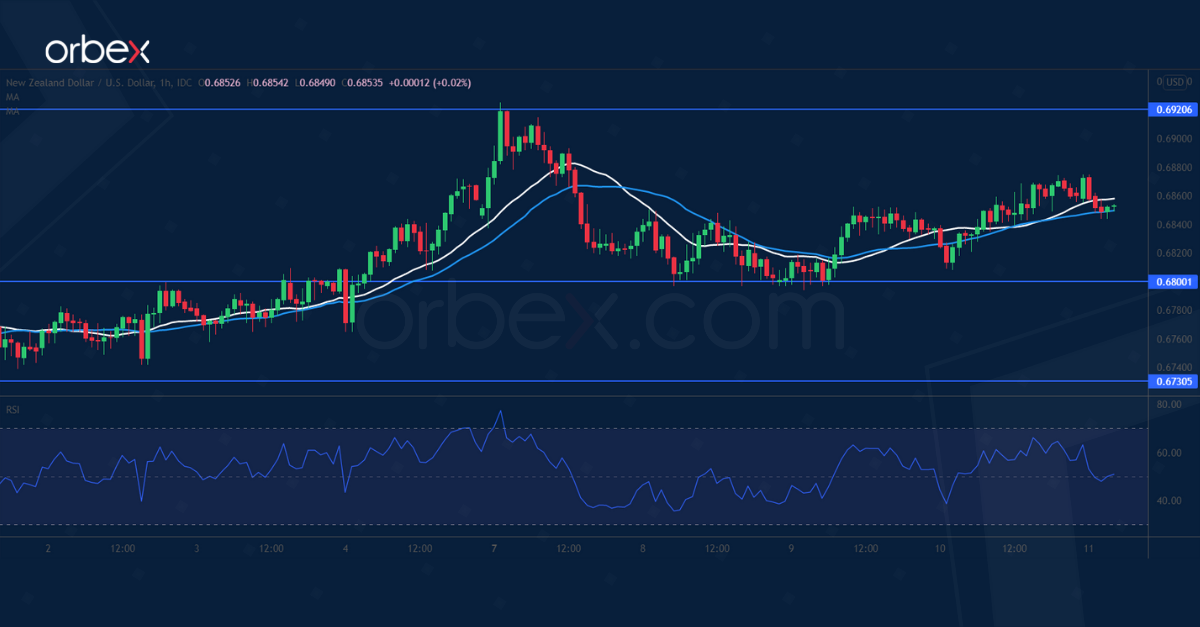
The New Zealand dollar inched higher supported by roaring commodity prices. A break above the daily resistance at 0.6890 has put the kiwi back on track in the medium term.
A bullish MA cross on the daily chart suggests an acceleration to the upside. As sentiment improves, the bulls may see the current consolidation as an opportunity to accumulate.
A close above 0.6920 would extend the rally to 0.7050. 0.6800 is the first support and 0.6730 over the 30-day moving average a key demand zone.
Rising Inflation Risks Outweigh Growth Slowdown for ECB
Market movers today
The war in Ukraine continues to be the main focus with ebbs and flows in the prospect of a peace deal driving markets. EU leaders will meet for their summit in Versailles to discuss the economic fall-out from the Ukraine war and coordinate possible additional fiscal support measures.
On the data front we have US consumer confidence where both sentiment and inflation expectations will be key. With inflation continuing to rise the risk of a further rise in inflation expectations is clearly moving higher.
UK releases monthly GDP and we may also get Chinese credit data. But there is no firm date on the release so it might also come next week instead.
The 60 second overview
War in Ukraine: Earlier optimism about a possible agreement between Ukrainian and Russian governments faded, as the meeting between the countries' foreign ministers yielded no results. Russian aggression continues as there is still no ceasefire or humanitarian corridors in Mariupol and the military column, which has been approaching Kyiv, is now being dispersed to new locations around the capital city. Oil and gas prices continued to moderate yesterday, as it seems that EU will not put on similar sanctions on Russian energy as US and UK. European natural gas futures declined to 126 EUR/MWh, or roughly half of earlier levels, while Brent has fallen below 110 USD/bbl. We remain sceptical that a diplomatic solution could be found in the near-term, and hence also expect that energy prices will continue to trade at elevated levels, see our latest scenarios in Research Russia-Ukraine - Updated scenarios and implications for commodity markets, 9 March. Yesterday some EU leaders, including Dutch PM Rutte and French president Macron also noted that Ukraine will not be allowed to fast-track the process of joining EU. Overnight, US is reportedly considering ending normal trade relations with Russia to set up even further sanctions, while the Senate yesterday approved USD13.6bn of military and humanitarian support for Ukraine.
ECB: European Central Bank surprised the markets yesterday by setting an end-date to the APP net purchases despite the uncertainty arising from the war in Ukraine. It was clear that the upside risks to inflation outweigh the downside risks to economic growth, although Lagarde emphasized high uncertainty and flexible decision-making going forward. The APP net purchases will be phased out, from EUR40bn in April, to EUR30bn in May to EUR20bn in June. Q3 purchase pace will depend on the economic and financial conditions at the time, but we expect ECB to halt the net purchases already in July. While Lagarde did not give hints about the timing of rate hakes, we still look for the first hike in December. Read more about the market reaction in the FI section below, and our more in-depth take in Flash: ECB Review - ECB never pre-commits, but stays data dependent, 10 March.
US CPI: US inflation continued accelerating in February, even though the figures do not even take into account the most recent spike in oil prices. CPI growth picked up to 7.9% y/y, driven largely by energy prices, but core inflation also remained brisk at 0.5% m/m and 6.4% y/y. Given the continuing broad-based inflation pressures we expect that Fed will have to tighten its monetary policy significantly this year despite the ongoing uncertainty.
FI: ECB took centre stage yesterday by surprising market consensus with an end date to the APP programme. The accelerated taper was in line with our expectations and left the periphery vulnerable where the BTPs-Bund spreads widened 16bp, which is the most since March 2020 when COVID broke out in Europe. Yesterday's repricing in the BTPs-Bund spread marks a reversal of the positive sentiment after the media stories on the a potential new EU initiative for common funding earlier this week. We saw a significant bearish flattening with 10s30s EUR swap flattened 3bp to -15.8bp, but also the shorter-dated bonds selling off (Schatz +11bp). Front end repriced 9bp to 45bp for the Dec22 €STR. Seen over the day as a whole the Bund-ASW-spread ended virtually unchanged after recent weeks of elevated volatility.
FX: EUR/USD briefly bounced to 1.11 yesterday, where ECB came out slightly more hawkish than expected by the market. SEK has staged a comeback in recent days, which saw EUR/SEK drop towards 10.60 yesterday. Energy prices have stabilised albeit still at elevated levels.
Credit: Following a few days of cash bonds underperforming CDS indices, roles reversed yesterday. CDS indices closed in red, with iTraxx Xover and Main 14.5bp and 2.5bp wider, respectively, while HY bonds tightened 12bp and IG 2bp.
Shine Again
Gains in equities reversed on Thursday, but industrial metals traded south, and crude oil cheapened despite a tense geopolitical environment, as the worries that such a spike in energy and commodity prices would certainly curb the economic growth and slow the global demand took over the worries of a tighter supply.
As a result, the price action in US crude gave us an important insight this week: the levels above the $130pb mark may be unsustainable for a further rally.
The upside risks remain of course, and the tight supply conditions, the war and the OPEC countries’ malicious pleasure seeing the prices trend higher should throw a floor under the downside correction near the $100pb. But the speculations and the likelihood of an advance to the $200 mark will likely, and hopefully ease from here.
The reverse ‘whatever it takes’
The central banks are increasingly concerned about inflation, and the major ones start giving out signals that they won’t let inflation run too hot, even if it means a slower growth. That’s the case of the European Central Bank (ECB).
Christine Lagarde announced on Thursday that the ECB is ready to take ‘whatever action is needed to pursue price stability and to safeguard financial stability’ in Europe.
The bank will end the pandemic emergency purchases in March as planned and reduce the APP purchases to 40 billion euro in March, to 30 billion euro in April and to 20 billion euro in June. And if inflation continues going higher – which probably will happen, as buying less bonds still means growing the balance sheet – the ECB will stop purchases by the third quarter, altogether.
The German 10-year yield advanced after the decision, but the EURUSD fell, as the hawkish shift in ECB expectations was already priced in and ‘buying the rumour’ prior to the meeting resulted in some profit taking. I still believe that the upside potential in the EURUSD has grown with the ECB clarifying the price stability as its top priority.
Inflation in US will exceed 8%
Inflation in the US advanced to 7.9% in February as expected. It is now a mathematical certainty that the next read will surpass the 8% mark given that inflation increased at the rate of 8.4% over the past three months, and that doesn’t even take into account the latest surge in energy and commodity prices due to the Ukrainian war.
Gold rush
The upside potential in gold is more than just a safe haven hedge, as the rising geopolitical tensions and the latest sanctions imposed on the Russian central bank will bring the central banks around the world to reconsider their FX holdings, and start shifting towards a nationless gold.
This could particularly be the case of China, which appears to be backing Russia in the Ukrainian war, and which doesn’t necessarily have positive diplomatic relations with the US, and which is also pointed with the tragedy going on in its Xinjiang region, and the pressure it’s imposing to other Asian nations in the South China Sea.
Goldman says that they expect the gold demand from the central banks to reach its historical high, as central banks globally have ‘strong diversification and geopolitical reasons to shift reserves into gold’. And with inflation expectations building stronger, gold certainly has potential to extend its latest rally to fresh all-time-high levels and beyond.
The price of an ounce eased below the $2000 mark, yet the price pullbacks could be seen as interesting buying opportunities for those who bet that it’s time for gold to shine again.
GBP/JPY Daily Outlook
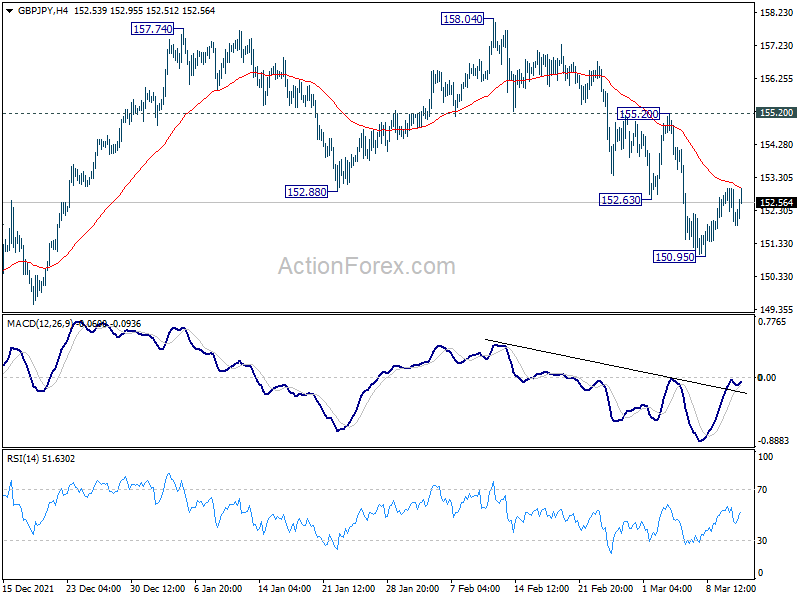
Daily Pivots: (S1) 151.55; (P) 152.27; (R1) 152.67; More...
Intraday bias in GBP/JPY stays neutral as consolidation from 150.95 is still extending. Further decline is still expected as long as 155.20 resistance holds. On the downside, break of 150.95 will resume the fall from 158.04, as the the third leg of the consolidation pattern from 158.19, to 148.94 support.
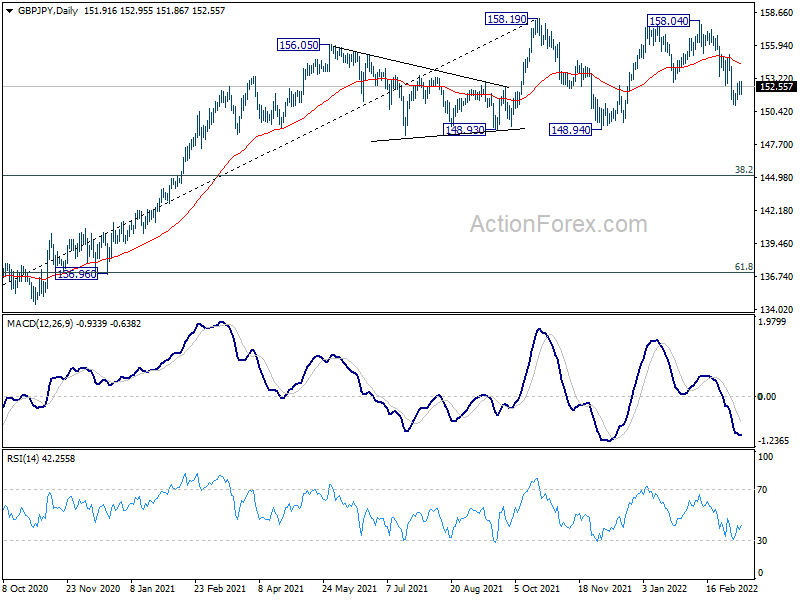
In the bigger picture, price actions from 158.19 are seen as developing into a consolidation pattern to up trend from 123.94 (2020 low). Downside should be contained by 38.2% retracement of 123.94 to 158.19 at 145.10 to bring rebound. Firm break of 158.19 will resume the up trend to long term fibonacci level at 167.93. However, sustained break of 145.10 will raise the chance of trend reversal and target 61.8% retracement at 137.02.
EUR/JPY Daily Outlook
Daily Pivots: (S1) 127.07; (P) 127.97; (R1) 128.51; More....
Intraday bias in EUR/JPY remains mildly on the upside at this point. Fall from 133.13 could have completed at 124.37 already. Further rise would be seen to 130.27 resistance. Break there will target 133.13 structural resistance next. On the downside, break of 126.28 minor support will revive near term bearishness and target 124.37 low again.
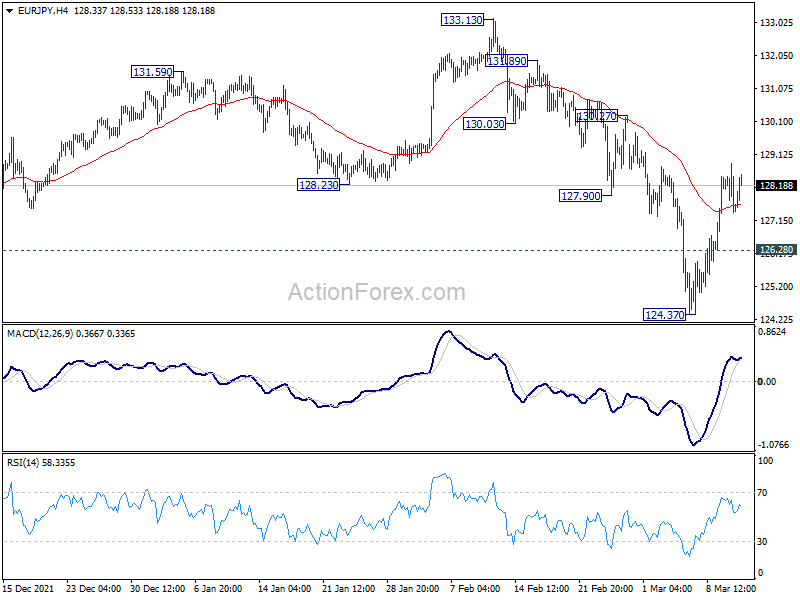
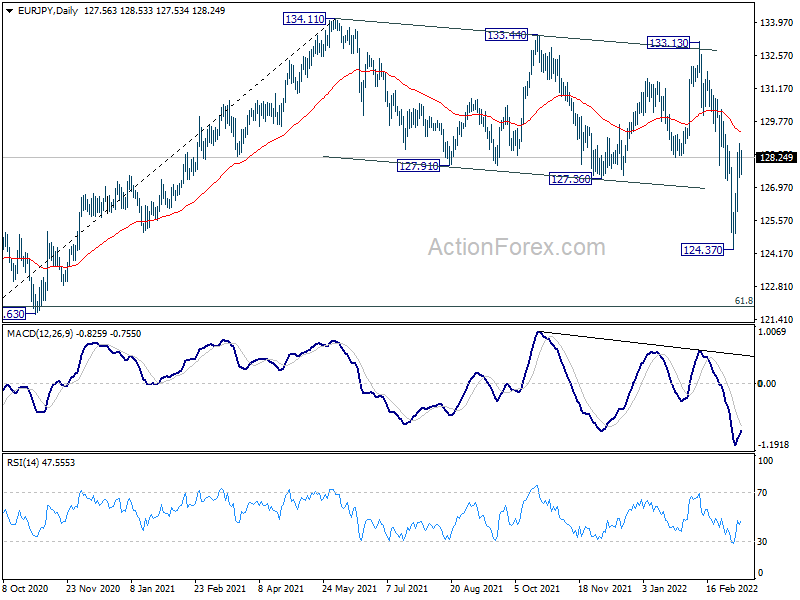
In the bigger picture, the break of 127.36 support turned resistance mixed up the medium term outlook. But still, outlook is neutral at best for now until there is clear sign of up trend resumption. Corrective pattern from 134.11 could still extend further, sideway or downward. Break of 124.37 will target 61.8% retracement of 114.42 to 134.11 at 121.94.
EUR/GBP Daily Outlook
Daily Pivots: (S1) 0.8366; (P) 0.8401; (R1) 0.8433; More...
Intraday bias in EUR/GBP remains mildly on the upside for 0.8476 key structural resistance Firm break there will carry larger bullish implication. On the downside, break of 0.8315 minor support will retain near term bearishness, and bring retest of 0.8201 low.
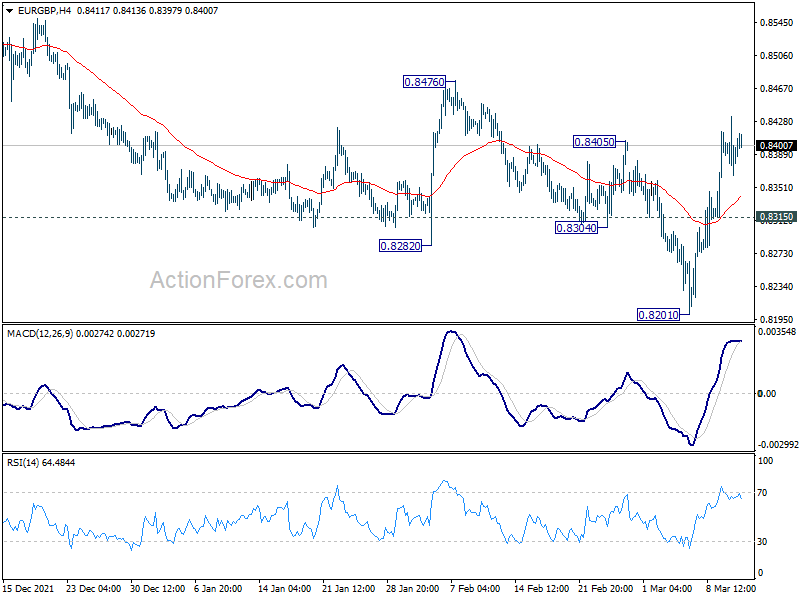
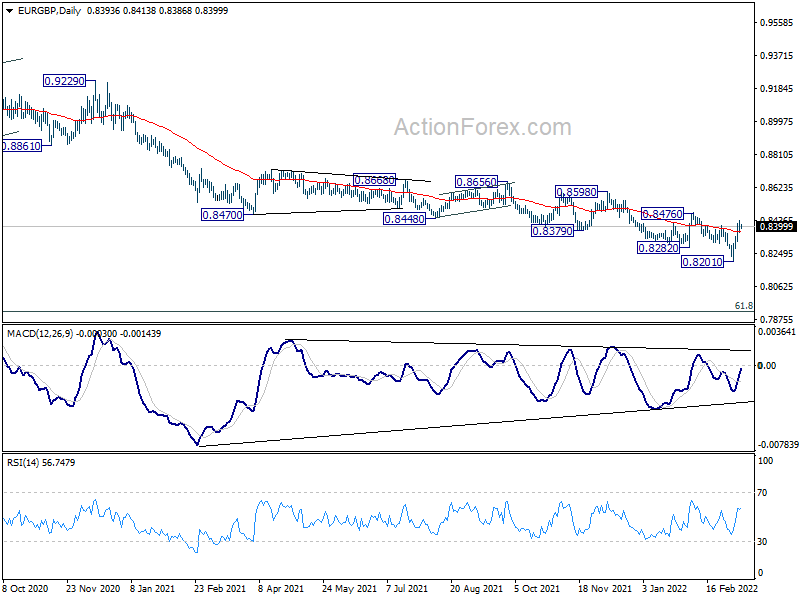
In the bigger picture, the down trend from 0.9499 is expected to continue as long as 0.8476 resistance holds. Sustained trading below 0.8276 support will argue that the whole up trend from 0.6935 (2015 low) has reversed. Deeper fall should be seen to 61.8% retracement of 0.6935 to 0.9499 at 0.7917 next. However, firm break of 0.8476 will indicate medium term bottoming at least. Focus will be back on 55 week EMA (now at 0.8534) for more evidence of bullish reversal.
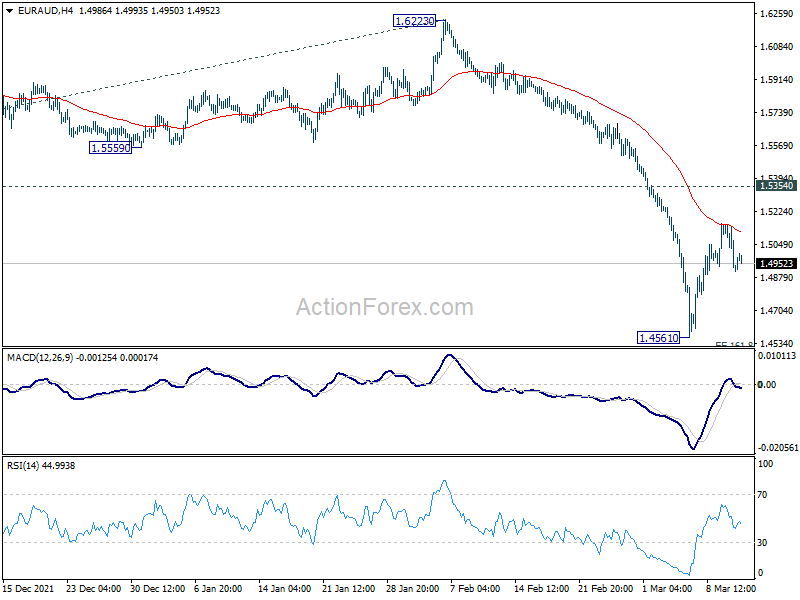
EUR/AUD Daily Outlook
Daily Pivots: (S1) 1.4845; (P) 1.4999; (R1) 1.5086; More...
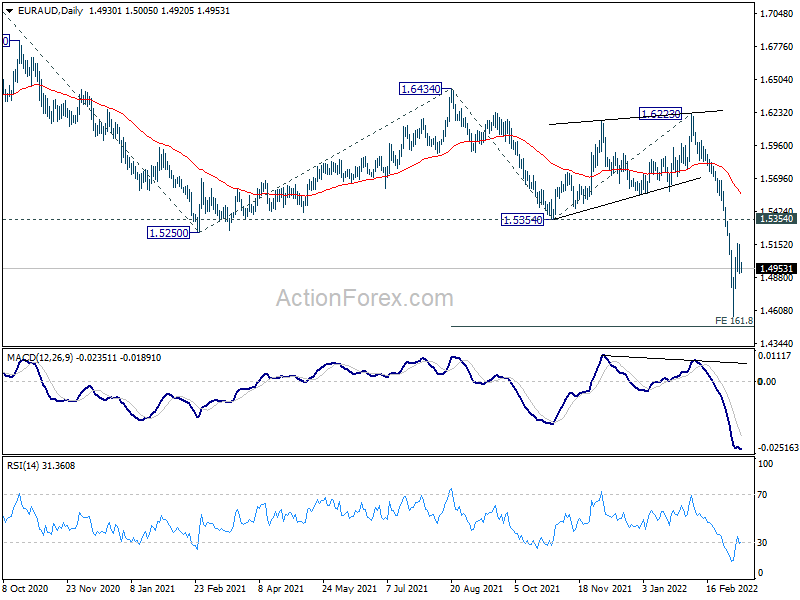
Intraday bias in EUR/AUD remains neutral and outlook is unchanged. Further decline is still expected as long as 1.5354 support turned resistance holds. On the downside, break of 1.4561 will resume larger down trend to 161.8% projection of 1.6343 to 1.5354 from 1.6223 at 1.4476. Sustained break there will pave the way to 1.3624 long term target zone. However, sustained break of 1.5354 will bring further rise back towards 1.6623 resistance.
In the bigger picture, fall from 1.9799 is seen as a long term impulsive move. Next target is 61.8% projection of 1.9799 to 61.8% projection of 1.9799 to 1.5250 from 1.6434 at 1.3623, which is close to 1.3624 long term support (2017 low). Some support could be seen there to bring interim rebound. But overall, break of 1.5354 support turned resistance is needed to be the first sign of medium term bottoming. Otherwise, outlook will stay bearish in case of recovery.
EUR/CHF Daily Outlook
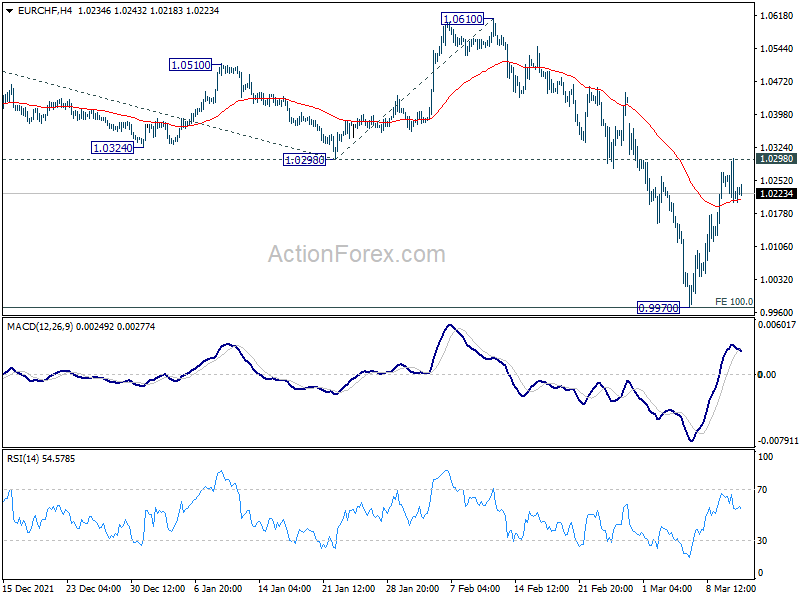
Daily Pivots: (S1) 1.0184; (P) 1.0244; (R1) 1.0281; More....
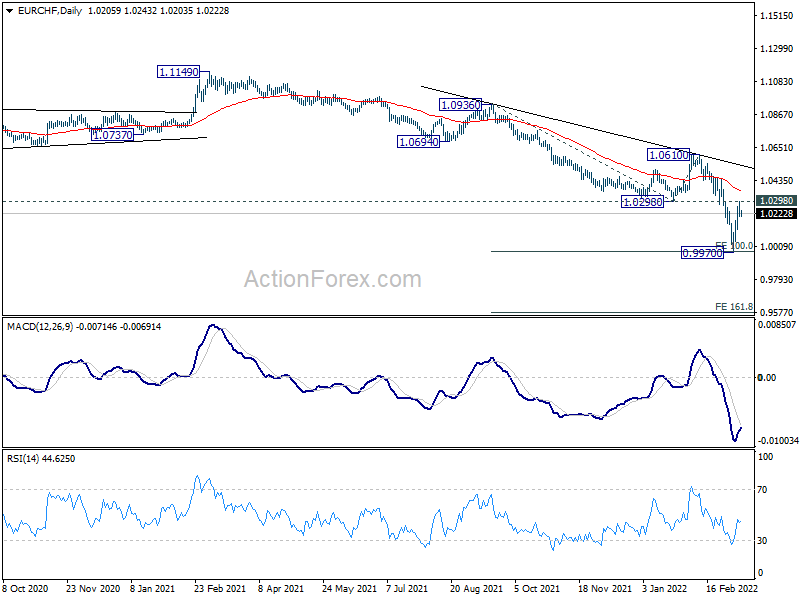
Intraday bias in EUR/CHF remains neutral and outlook is unchanged. As long as 1.0298 support turned resistance holds, larger decline from 1.1149 is still in favor to continue. On the downside, firm break of 0.9970 will target 161.8% projection of 1.0936 to 1.0298 from 1.0610 at 0.9578. However, sustained break of 1.0298 will bring stronger rebound towards 1.0610 structural resistance instead.
In the bigger picture, long term down trend from 1.2004 (2018 high) is still in progress. Next target is 100% projection of 1.2004 to 1.0505 to 1.1149 at 0.9650. Firm break there will target 100% projection at 0.9650. In any case, break of 1.0505 support turned resistance is needed to be the first sign of medium term bottoming. Otherwise, outlook will remain bearish.
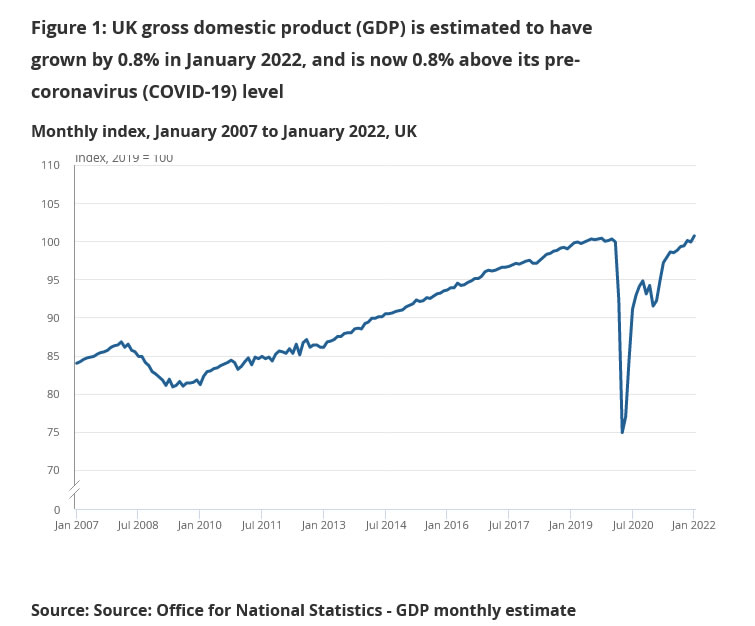
UK GDP grew 0.8% mom in Jan, all sectors were up
UK GDP grew 0.8% mom in January, well above expectation of 0.2% mom. All sectors grew in the month, with services up 0.8% mom, production up 0.7% mom, and construction up 1.1% mom.
GDP is now 0.8% above pre-conronavirus level in February 2020. Services is 1.3% above the pre-coronavirus level, construction 1.4% above. But production remains -2.0% below the level.
Also released, industrial production rose 0.7% mom, 2.3% yoy in January, versus expectation of 0.3% mom, 1.9% yoy. Manufacturing production rose 0.8% mom, 3.6% yoy, versus expectation of 0.2% mom, 3.1% yoy. Goods trade deficit widened to GBP -26.5B, versus expectation of GBP -12.6B.
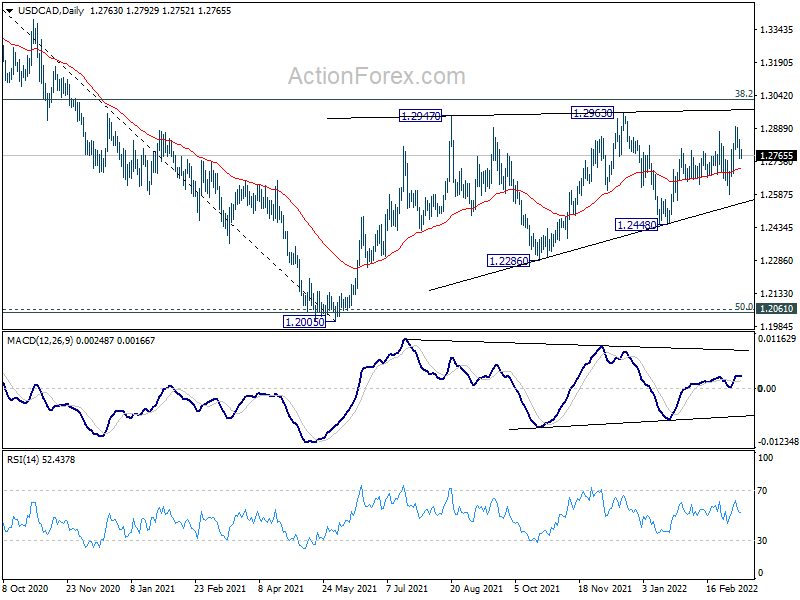
USD/CAD Daily Outlook
Daily Pivots: (S1) 1.2733; (P) 1.2788; (R1) 1.2824; More...
Intraday bias in USD/CAD remains neutral with mixed outlook. On the upside, break of 1.2899 will target 1.2963 resistance first. Break there will target key long term fibonacci level at 1.3022. However, break of 1.2586 will bring retest of 1.2448 support instead.
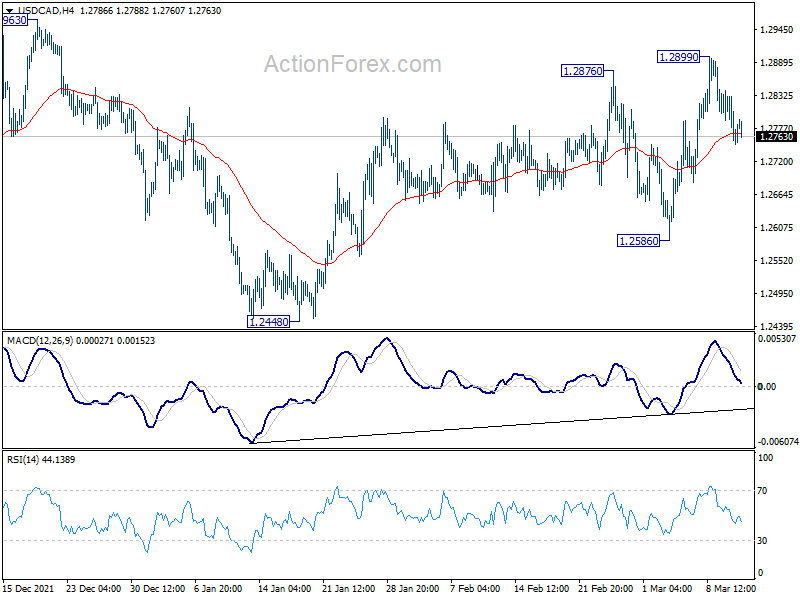
In the bigger picture, focus stays on 38.2% retracement of 1.4667 (2020 high) to 1.2005 (2021 low) at 1.3022. Sustained break there should confirm that the down trend from 1.4667 has completed after defending 1.2061 long term cluster support. Further rise would then be seen towards 61.8% retracement at 1.3650. However, rejection by 1.3022 will maintain medium term bearishness. Break of 1.2005 will resume the down trend from 1.4667 and that carries larger bearish implications too.