Sample Category Title
Forward Guidance: Gasoline Price Surge to Push Inflation Rates Higher
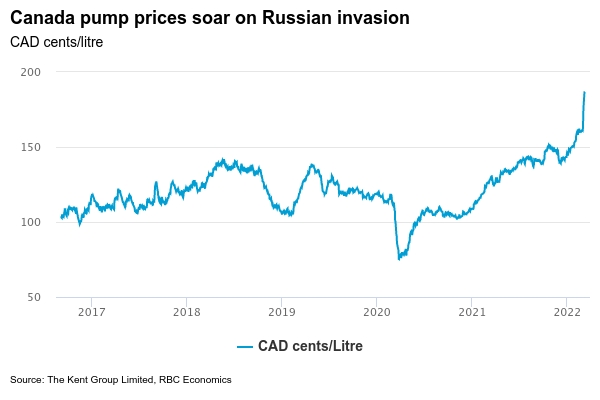
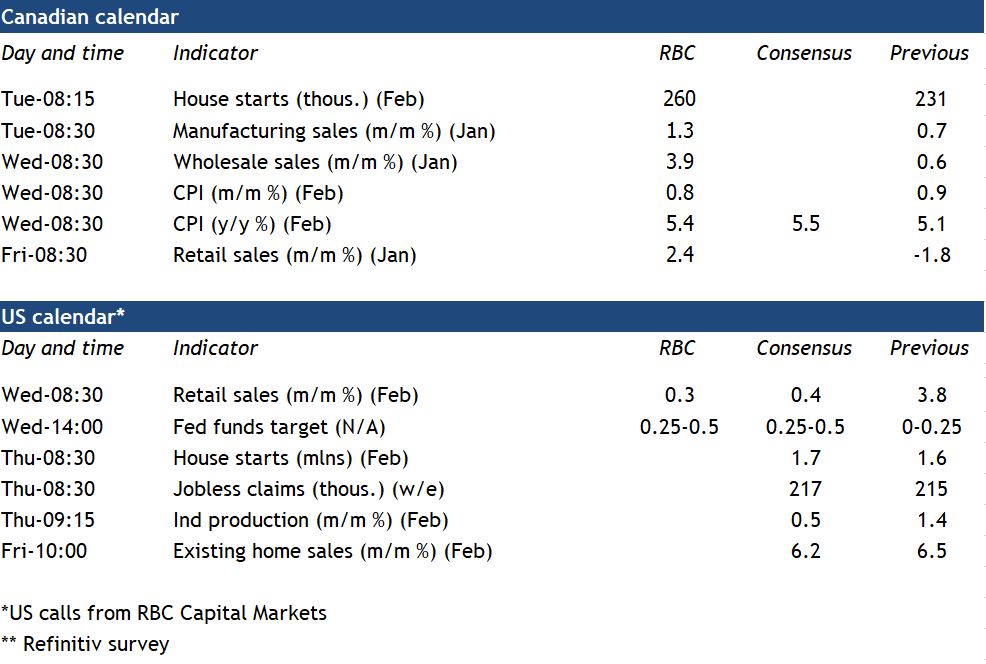
Canada’s CPI report for February is expected to show a firm 5.4% year-over-year increase. It will likely rise closer to 6% in March on the back of surging pump prices. In the first week of March alone, gas prices soared 16%—to 46% above year ago levels—as the Russian invasion of Ukraine sent global oil prices surging. Commodity prices for products including wheat and metals have risen sharply too, and are expected to dominate the near-term inflation outlook. Broadening price pressures across a widening array of products was already a big concern for central banks. Our forecast for CPI in February is again expected to have been widely-based, as even more goods and services see faster price appreciation. That trend mirrors what’s happening in the US, which saw inflation rising to 7.9% in February. We expect the U.S. Fed to follow the Bank of Canada’s rate hike from earlier this month with their own 25 basis point increase next week.
Despite rising inflation and intensifying geopolitical risks, domestic economic data is expected to look firm. Early estimates for January manufacturing and wholesale sales were surprisingly strong given a large drop in hours worked tied to the rapid spread of Omicron during that month. The preliminary estimate for retail sales in January was up 2.4%. And our own tracking of card spending is pointing to another firm reading for February alongside a sharp rebound in travel and hospitality spending as pandemic restrictions eased.
Week ahead data watch:
We expect Canadian housing starts to rise to 260,000 in February, up from 231,000 in January. Permit issuance has been substantially stronger, averaging 300,000 over the last three months ending in January. But labour shortages remain a significant issue, and that may be lengthening the time between permit issuance and actual house starts.
Policymakers at the U.S. Federal Reserve are expected to hike the Fed funds target range by 25 basis points—the first increase since 2019 as very low unemployment and firming inflation pressures offset increased geopolitical headwinds tied to the Russian invasion of Ukraine. We expect another four (equal-sized) hikes in 2022 to push the target range to 1.25% to 1.50% by end of year.
Week Ahead – Fed and BoE Meet as Inflation Fears Intensify
Global markets descended into turmoil after Russian forces rolled into Ukraine. Commodity prices have gone through the roof and traders are betting this shock will keep the inflationary fire burning for some time. The Fed and the Bank of England are set to raise interest rates next week to combat spiraling prices, although the most crucial variable for their respective currencies may be whether there’s a ceasefire in the war.
One big trade
Ever since the Russian invasion, financial markets have turned into one massive war trade. Most assets are being driven entirely by this theme, rising and falling with war headlines. Stock markets, the British pound, and the euro suffer whenever sanctions escalate, while the US dollar, the yen, and commodities tend to benefit.
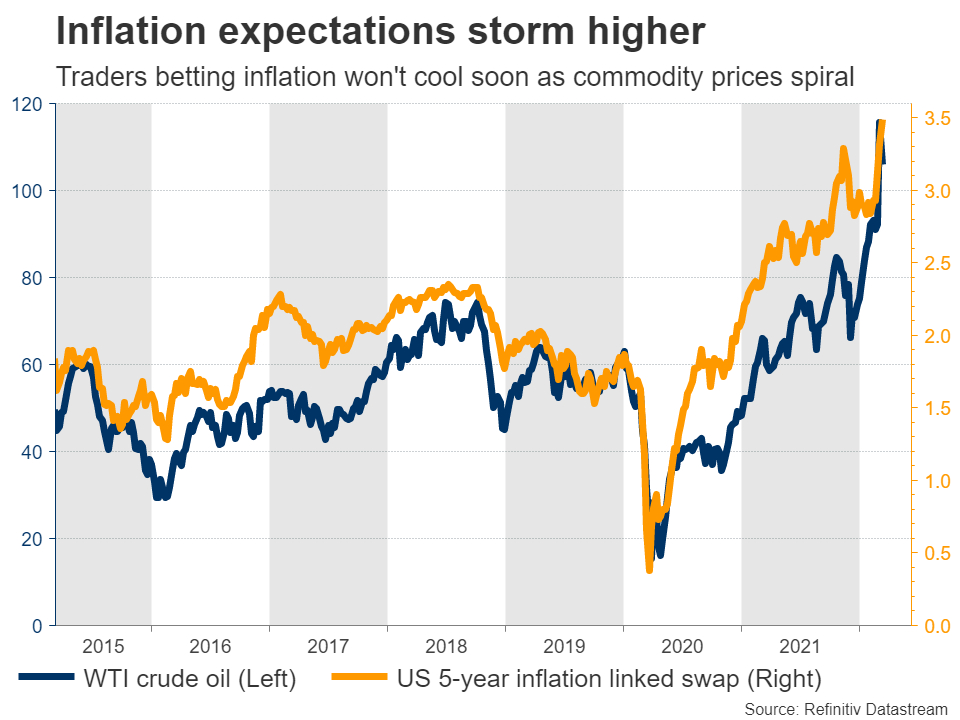
In the commodity sphere, the crippling sanctions on Moscow will limit the supply of various metals, food, and energy products. This translates into higher raw material prices, so traders are betting inflation won’t cool anytime soon. Market-based measures of inflation expectations have stormed higher, creating a headache for central bankers.
But it’s a very different headache for different central banks. For the Fed, this is only an inflationary shock. America is energy independent and its banks have almost no exposure to collapsing Russian assets, so this won’t derail the economy. But for Europe, it’s a stagflationary shock. Consumers will get squeezed by higher living costs and the banking sector will take a serious hit, which could be a nightmare for growth.
This means that while the Fed can respond with powerful rate increases to fight inflation, the ECB doesn’t really have that luxury as tightening into a slowing economy would raise the risk of a recession to uncomfortable levels. In other words, this war has changed the game for relative Fed/ECB policy, something also reflected by the demolition in euro/dollar.
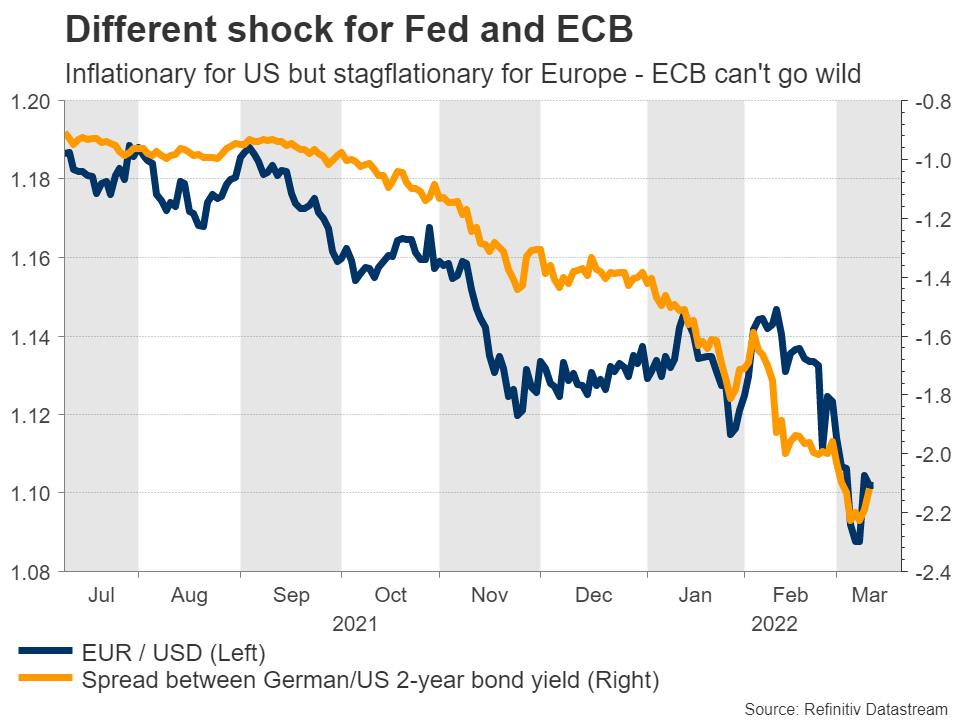
Moving forward, how the war unfolds will be the most important element. Markets seem priced for a worst-case scenario at this point, which implies that a ceasefire could spark serious reversals in the ‘Ukraine trade’. This may be only a matter of time as President Zelensky seems willing to compromise, for instance by keeping Ukraine out of NATO.
Fed - all about the dots
The main event will be the Fed meeting on Wednesday. A quarter-point rate increase is fully priced in, so the market reaction will depend mainly on what Chairman Powell says during his press conference and the interest rate projections in the updated ‘dot plot’.
The latest dots in December pointed to only three rate increases for this year but market pricing currently implies six and a half. Hence, it’s a safe bet the dots will be revised higher - the question is exactly how much higher. Will the officials signal four, five, or six hikes?
There’s a solid argument it might be six, which would probably be the most bullish outcome for the dollar. The labor market is tight, wages are firing up, consumption is solid, and inflation is scorching hot. The latest CPI print clocked in at 7.9% in yearly terms and considering the latest spike in energy prices, the next one could be even hotter.
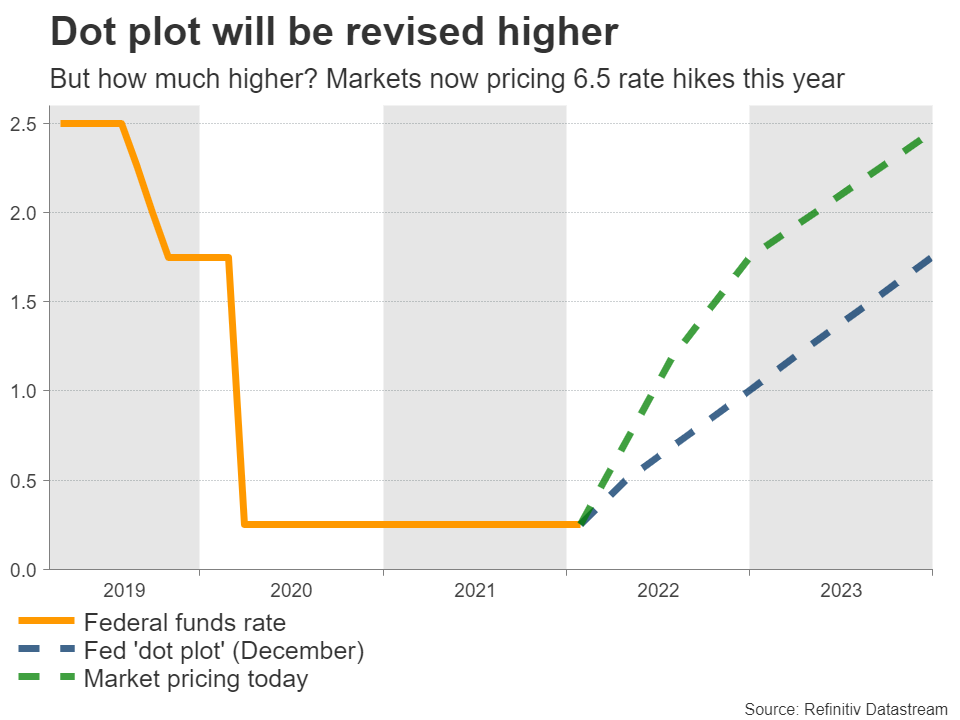
Another argument is that the Fed wants a stronger dollar at this stage. A stronger currency can help cool inflationary forces faster, without the need to tighten too much. In this sense, talk is both cheap and advantageous. This also provides Chairman Powell with an incentive to strike a more hawkish tone.
On the data front, the latest edition of retail sales will be released a few hours ahead of the FOMC decision.
BoE - rolling out the big guns?
The Bank of England will conclude its own meeting on Thursday. With the labor market firing on all cylinders, inflationary pressures heating up, and the latest business surveys pointing to an acceleration in growth, investors are convinced another rate increase is on the menu.
A regular 25 basis points (bps) rate hike is already priced in and money markets imply a 15% probability for a 50 bps move. This begs the question - how aggressive does the BoE want to be?
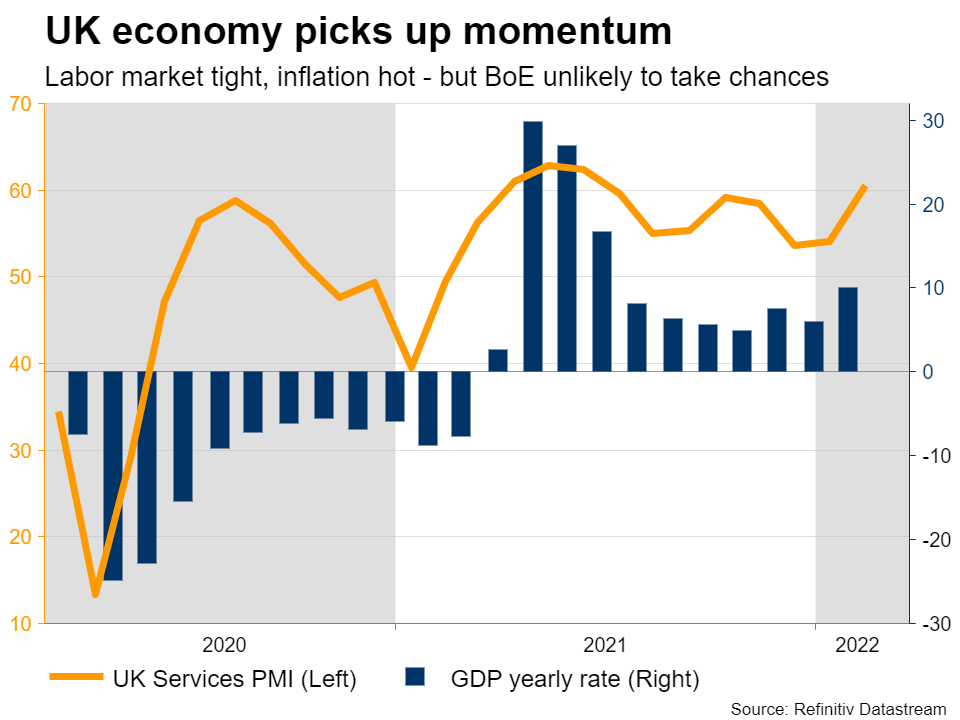
The pound has been devastated by the Ukraine crisis and the BoE is unlikely to change this dynamic, unless it surprises markets with a ‘double’ rate hike. However, that’s highly unlikely. Raising rates with reckless abandon doesn’t make sense from a risk management perspective when the economy is already headed for a slowdown.
Overall, markets seem to have gotten too aggressive with BoE hikes. A total of 100bps is priced in by June. There are only 3 meetings until then, which means traders have already priced in a ‘double’ hike over the next few months. This leaves scope for disappointment if the BoE hesitates to roll out the big guns. For sterling to enjoy a relief rally, a truce in Ukraine is needed.
BoJ unlikely to join the party
The Bank of Japan will also meet on Friday, but don’t expect much. The world’s third-largest economy has barely escaped deflation, wages aren’t rising, and consumers will get squeezed considering the nation’s reliance on energy imports.
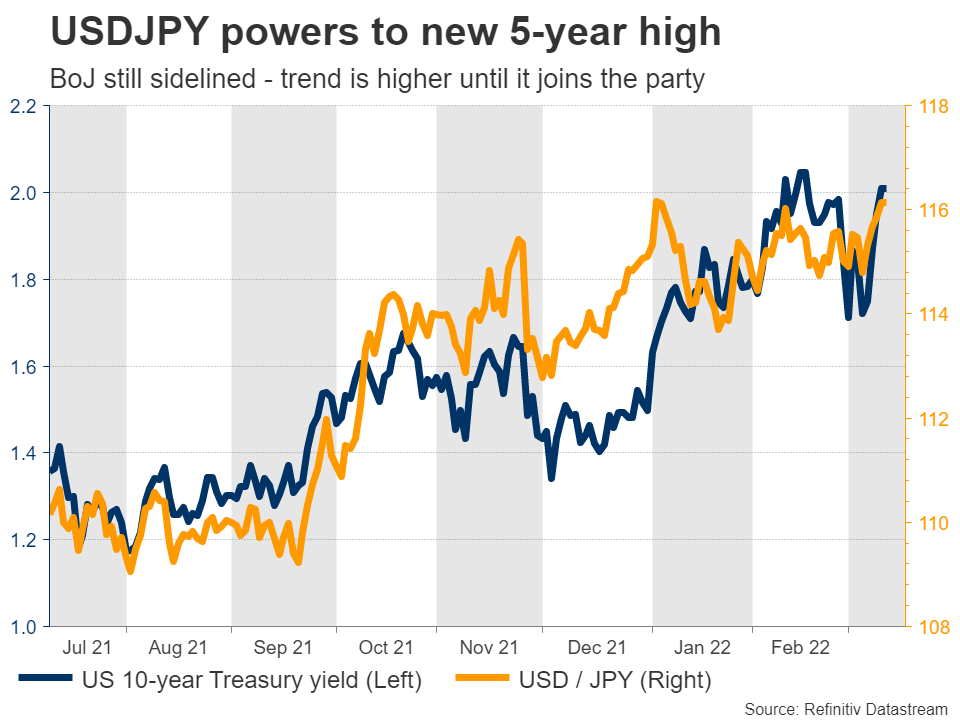
Hence, while the BoJ wants to signal an exit from decades of easy money policies, it is difficult to do so with inflationary dynamics still muted. The next step in the normalization process would be to widen the range in which Japanese yields are allowed to trade, essentially raising the ceiling for yields.
As for the yen, with the BoJ still sidelined, its fate is linked to risk sentiment. However, the dollar - which also benefits from haven flows - may be an exception. Dollar/yen has skyrocketed as yield differentials widened lately and it’s difficult to see this trend turning around until the BoJ executes its own U-turn.
Commodity currencies in focus
The Australian and New Zealand dollars typically trade in lockstep with risk appetite but this relationship has broken down lately, with both currencies defying the gloom in equity markets to focus on the relentless rally in commodity prices instead.
Next week will bring crucial releases from both economies. Australia’s latest jobs numbers are out early on Thursday, ahead of New Zealand’s GDP stats for Q4 later that day. There is also the monthly data barrage from China on Tuesday.
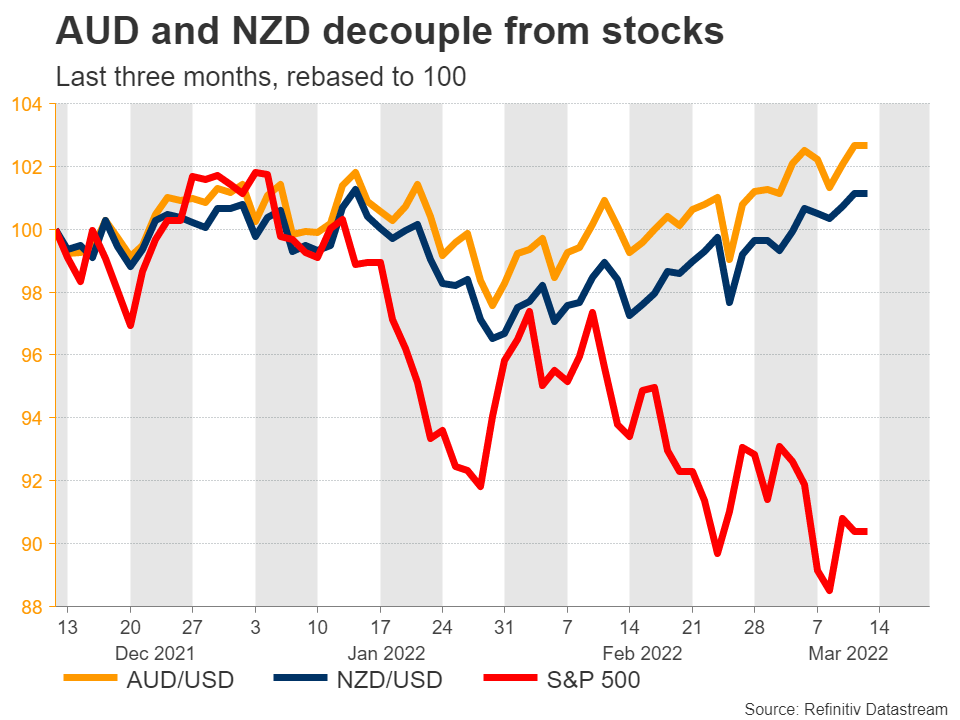
Finally in Canada, the latest inflation report will hit the markets on Wednesday ahead of retail sales on Friday. In contrast to its commodity currency cousins, the loonie has not managed to capitalize on the boom in commodities, which is a bad sign.
The stars have aligned lately with soaring oil prices, a strong domestic economy, and markets pricing in aggressive rate increases by the Bank of Canada. If the loonie couldn’t rally under these conditions, will it rally at all?
Weekly Focus – All ECB Meetings are ‘Live’ from Now
The stand-off between the west and Russia over Ukraine intensified further this week. The US and UK announced an oil-embargo toward Russia. Russia retaliated by banning exports of telecoms, medical, vehicle, agricultural, and electrical equipment, as well as some forestry products such as timber. The end-game for the conflict is highly uncertain, but our base-case is that some level of conflict is likely to remain in Ukraine despite a potential truce, and uncertainty will prevail, but the war will not spread to other countries in Europe. In any case, we do not expect sanctions against Russia to be removed any time soon (for more details on our updated scenarios see here).
The war in Ukraine has led to huge swings in commodity prices. Brent oil briefly hit USD130 this week before falling back to USD109, as both Middle Eastern producers pointed to a possible rise in output amid the higher oil prices and Russian president Putin said Russia would stand-by its oil contracts with even "un-friendly" countries. Similarly the spike in European natural gas prices to EUR335 MWh at the start of the week reversed to EUR140 at the end of the week. The EU outlined a plan to reduce dependence on Russian gas by two-thirds this year, which seeks to tap new supplies and rely on efficiency gains.
The crisis and higher commodity prices have raised concerns about the global economic outlook, especially in Europe, which has closer economic ties to Russia. At its meeting this week, the ECB lowered its GDP forecast for 2022 to 3.7% from 4.2%. We share the view about headwinds to growth, which raises the risk of a global recession (read more in Research Global - Rising recession risk as yet another supply shock hits, 9 March).
The higher commodity prices put central banks in a tight spot. The ECB this week was no exception. Inflation was already high going into the crisis. Despite the possible hit to economic activity from the war in Ukraine, ECB decided to announce an end to its APP programme in Q3 and removed the "or lower" from its forward guidance. Going forward ECB will stay data dependent (especially regarding inflation prints), with optionality and flexibility in its monetary policy calibration, as all meetings from here will be 'live'.
The mood in financial markets followed the swings in commodity prices closely. At the beginning of the week, risk sentiment took a big hit but sentiment later recovered with the fall in commodity prices. The EUR/USD also went on a rollercoaster, dropping sharply in the beginning of the week, but recovered along with global risk sentiment, ECBs mild hawkish signals and drop in commodity prices.
Next week, the Fed meeting will be the key focus for financial markets. We expect it to raise its policy rate by 25 bps given the strong inflation pressures, which are likely to be further enhanced by the rise in oil prices. We had previously expected a 50 bps hike, but the uncertainty from the war in Ukraine will make the Fed a tad more cautious in our view. BOE is similarly expected to raise its policy rate by 25bps next week. In contrast, the Chinese central bank is expected to lower its policy rate amid economic weakness. Other things in focus are war developments in Ukraine and response in commodity prices. In Germany, the ZEW will give a glimpse on the economic hit to confidence from the Ukraine-Russia war and we will likely see a marked dip.
Sunset Market Commentary
Markets
In a session devoid of important data in the US and Europe, aside from further headlines on the developments in the Russian-Ukraine conflict, investors could take a closer look at the consequences of the ECB finally returning to its core business: inflation management. Comments from ECB members Villeroy and Rehn reiterated that ‘gaining optionality’ was an important consideration for yesterday’s ECB decision to run down APP faster than expected and at the same time guiding that rates could be raised ‘some time after’ the end of APP. At least today, markets still tend to conclude that upside inflation risks will mostly like lead to the ‘option’ tilting to a rather soon & maybe also a more protracted normalization than envisaged until recently. The technical picture on swap market suggests that the EMU interest rate market is entering a new era. The 2-y swap (0.29%) broke above the key 0.25% resistance. Regaining 0.35% (Aug 2014 top) would confirm the view that the era of negative EMU interest rates is expected to definitively come to an end. The 10-y swap also again attacks the symbolic reference of 1.0%. Today’s uptrend in yields was complemented by a resumption of the risk-on rebound. Markets drew some additional comfort from headlines (around noon) that Russian president saw ‘positive developments’ in the talks with Ukraine. Even as the comments contained few specifics, European equity markets jumped higher with some indices gaining op to 3%. US markets opened with gains of 0.5%-1.0%. The easing of the safe have bid and post-ECB repositioning are (modestly) lifting German yields up to 3.5 bps for the 5-y (was more intraday). Intra-EMU spreads are reversing a (limited) part of yesterday’s widening (10-y Italian spread vs Germany -5 bps). US yields rise between 3.5 bps (2-y) and 1.5 bps (30-y). A relative calm is also returning to (parts of) the commodity market with brent oil ‘stabilizing’ near $109 p/b.
FX markets also reached some kind of ST equilibrium with EUR/USD hovering near the 1.10 pivot (1.099). DXY hovers around 98.50. USD/JPY cross rate is a notable is exception. The yen recently didn’t profit much from Ukraine-related uncertainty. Today, the combination of a better sentiment and higher core yields still is a good enough reason to trigger further yen losses with USD/JPY testing the 117 barrier for the first time since early 2017. EUR/GBP is holding near the 0.84 big figure. Sterling doesn’t profit from decent January production data supporting the case for further BoE tightening next week. Among the smaller currencies, the Swedish crown this week succeeded a comeback after being captured in a protracted downtrend (uptrend EUR/SEK) since mid-January. Risk-on the main part of this story. Or will the ECB U-turn gradually also influence Riksbank thinking? EUR/SEK currently trades near 10.64, compared to a peak near 10.90 early this week.News Headlines
The Canadian labour market had a bumper month in February. Job growth more than recovered from the Omicron dip in January, printing at 336.6 k vs 127.5k expected. The unemployment rate fell a full percentage point to 5.5%. Unemployment was lower just one time in the series history (May 2019, 5.4%). The steep drop came even as the participation rate rose to a higher-than-anticipated 65.4%. The data solidify market expectations of (more than) 6 additional rate hikes by the Bank of Canada this year. The BoC kicked off the normalization cycle earlier this month with a first rate hike to 0.5% and didn’t rule out a half-point move in the future. It will most likely be complemented by a passive balance sheet roll-off from April on. The Canadian dollar gains vs the euro and dollar are limited. USD/CAD declines from 1.277 to 1.272, EUR/CAD is testing the 1.40 big figure.
Argentina’s parliament approved a bill that backs the government’s $45bn debt restructuring agreement with the IMF, avoiding a March 22 default ($2.8bn payment). The original support package only dates back to 2018 ($57bn bailout). Debt repayments will now be delayed to 2026 in exchange for a government pledge to reduce the budget deficit over three years and curb central bank money printing. Especially subsidies on electricity and gas will be drastically reduced. The bill passed Argentina’s lower house with opposition support (202 of 257 votes) after the government dropped a clause stating that congress would support government economic policy.
No Need to Fear the Death Cross in the S&P500
The US S&P500 closed Thursday with a 0.4% drop, but the sustained downward trend since the beginning of the year has formed a “death cross”, a bearish signal of Tech analysis when the 50-day Moving Average crosses down the 200-day one.
It is widely considered as a downtrend confirmation, followed by a further and faster market decline. However, this time the situation might be more optimistic, and there are several other indications, both from technical analysis and the news background.
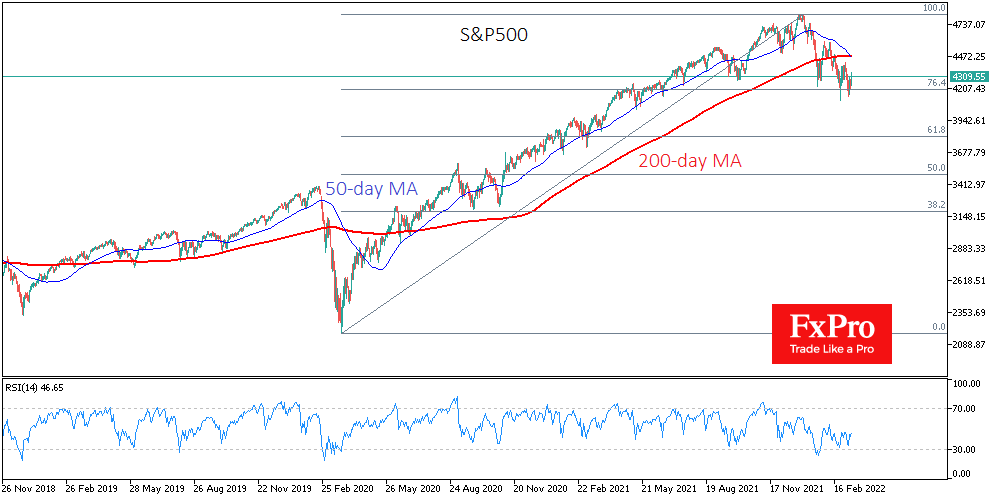
The history of the past ten years makes us wary of any signal that follows from a crossover of these averages. The “death cross” was most clearly triggered in August 2015 and December 2018, when this signal was followed by 12% and 16% drawdowns in the index in the following couple of weeks. The difference between those episodes and the current one is that back then, the market was stalling for a long time, with no strength for growth.
This crossover has now taken place after a three-month correction. This trend brings the situation closer to 2020 when the market collapsed on the pandemic – the “black swan”. The war between Russia and Ukraine is the same black swan that accelerated and intensified the correction. In March 2020, and again almost two years later, the “cross” came after an impulsive decline and away from local lows.
On the daily timeframes, another indicator, the Relative Strength Index, shows a waning of the downward momentum, as the new lows of the S&P500 index met the RSI at higher local lows. The broad market index found solid support at 76.4% Fibonacci in March from the rally from the pandemic bottom to the peaks of January.
There are some fundamentally positive developments for the market. President Putin of Russia rather unexpectedly noted progress in the negotiations with Ukraine, while outside observers the day before stated the opposite. Also, Fed rhetoric has become much softer over the last month, and US lawmakers are more likely to agree on stimulus packages, supporting the demand for risky assets.
USDCHF Ascends Above Cloud, Moves Beyond 0.93 Mark
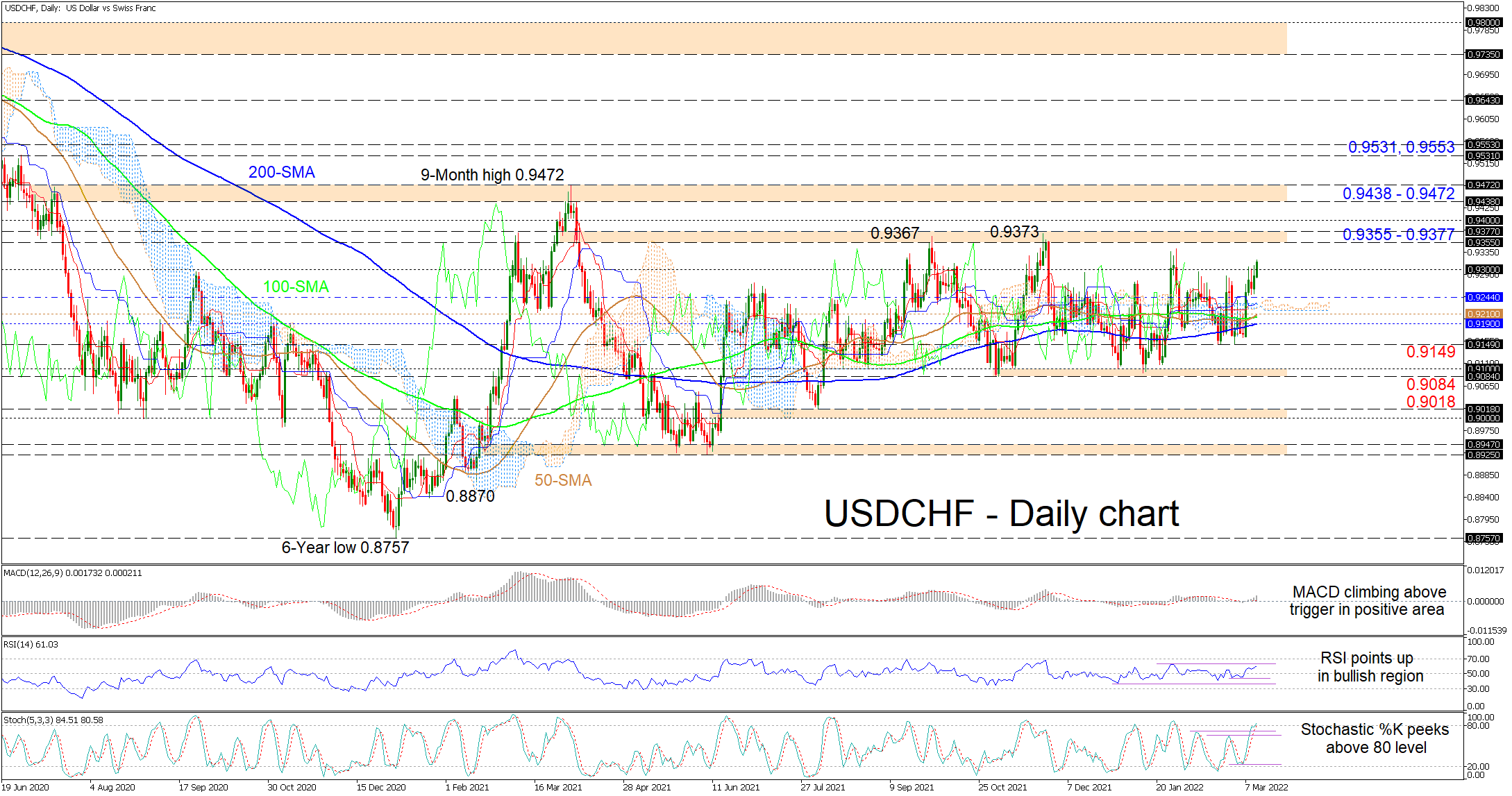
USDCHF has climbed above the 0.9300 handle, extending the latest surge in upward forces, and is now eyeing the 0.9355-0.9377 resistance barrier, which includes the September and November 2021 highs. The minor upturn in the simple moving averages (SMAs) confirm no clear trend in the pair but do imply the positive impetus is growing.
The neutral Ichimoku cloud and lines indicate that driving forces in the pair are currently feeble, while the short-term oscillators are skewed to the upside. The MACD, slightly north of the zero mark, is strengthening above its red signal line, while the RSI is steering higher in the bullish zone. The stochastic lines are marginally in overbought territory with the %K line rising, hinting that the pair’s positive bearing is still intact.
If the pair manages to preserve its current trajectory, preliminary upside limitations could arise at the 0.9355-0.9377 resistance boundary. However, if buyers overcome this tough obstacle, the 0.9400 level overhead may impede additional progress in the pair from challenging the 0.9438-0.9472 resistance section, which has opposed advances since July 2020. Should a more profound upward thrust stretch beyond the nine-month high of 0.9472 from April 2021, the 0.9531 and the 0.9553 highs identified in June 2020 may come under attack.
Meanwhile, if the positive drive wanes considerably, sellers could face a hardened buffer zone from the 0.9244 level until the 200-day SMA at 0.9190. Should buyers fail to find footing off any of the multiple support barriers within this region, sellers may then confront the 0.9149 lows. If negative forces amplify, the 0.9084-0.9100 base could draw focus before the bears pursue the 0.9000-0.9018 support band.
Summarizing, USDCHF is sustaining a neutral-to-bullish tone above the cloud and the 0.9149 trough. A price retreat below the 0.9084-0.9100 foundation may spark worries about negative tendencies, while a jump above the 0.9355-0.9377 obstacle would nourish the bullish outlook.
WTI Oil on Track for Strong Weekly Drop on Improved Sentiment
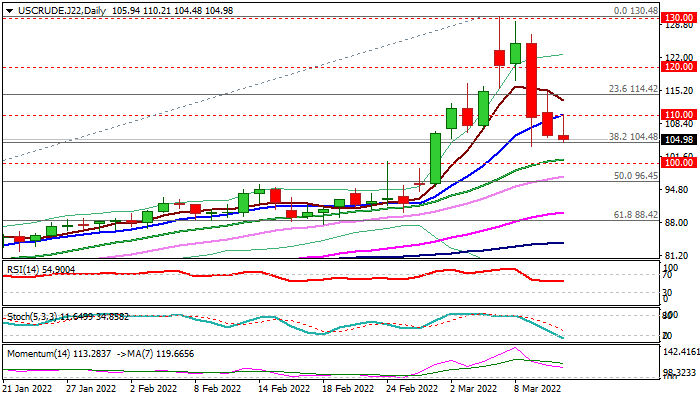
WTI oil price edged higher on Friday but remains below $110 per barrel for now, after falling sharply in past two days on optimism of de-escalation of the conflict in Ukraine and easing concerns about stronger disruption of global oil supply.
Oil prices surged to the highest since 2008 earlier this week after the US banned Russian oil imports and markets feared further bans of imports from the world’s top oil exporter would strongly impact oil market.
Although markets remain highly alerted on possible fresh escalation that would quickly lift oil prices, fresh optimism continues to prevail, with oil on track for weekly close in red and the weekly fall of over 12%.
Friday’s close below $110 level would add to signals for deeper pullback as daily studies show fading bullish momentum, however, bears need a clear break of cracked pivotal Fibo support at 104.48 (38.2% of $62.42/$130.48 upleg) to confirm signal and expose psychological $100 support.
Caution on failure to break 104.48 pivot that would signal that near-term bears are running out of steam, but near-term action is expected to remain biased lower while holding below $110 level. Only sustained break above $110 would ease downside risk and generate initial signal of the bottom.
Res: 106.80; 108.96; 110.00; 112.88.
Sup: 104.47; 103.67; 100.49; 100.00.
Canada’s Economy Bounces Back Huge in February
The Canadian labour market gained 337k positions in February, more than offsetting January's loss of 200k. Full-time (122k) and part-time (215k) employment both rose strongly on the month.
The unemployment rate dropped massively, by one percentage point, to 5.5%. The participation rate also rose by 0.4 percentage points, to 65.4%.
By industry, services-producing employment rose 293k, with food services leading the way, up 114k. Meanwhile, employment increased in the goods-producing sector (44k), with the construction industry (37k) once again driving the gains.
Employment was up in eight provinces, led by Ontario (194k) and Quebec (82k) as these two provinces were most impacted by the paring back of public health restrictions.
Lastly, total hours worked rose 3.6% month-on-month to a new record high and wage growth accelerated to 3.1% year-on-year (from 2.4% in January).
Key Implications
What a report! With this jobs report, the unemployment rate is now below the level from February 2020, leaving little doubt that the economy is at full employment.
It wasn't just the job gains. More Canadians entered the labour force, the number of hours worked increased, and wages picked up. The strength of the Canadian labour market cannot be denied.
The incredible resiliency of the Canadian economy sets up the Bank of Canada to continue raising rates at its upcoming meetings. Bond markets have moved to reflect this, with yields rising significantly over the last few trading sessions. With inflation the main concern for the Bank, the path to higher rates has been cleared.
EUR/USD Mid-Day Outlook
Daily Pivots: (S1) 1.0936; (P) 1.1028; (R1) 1.1081; More...
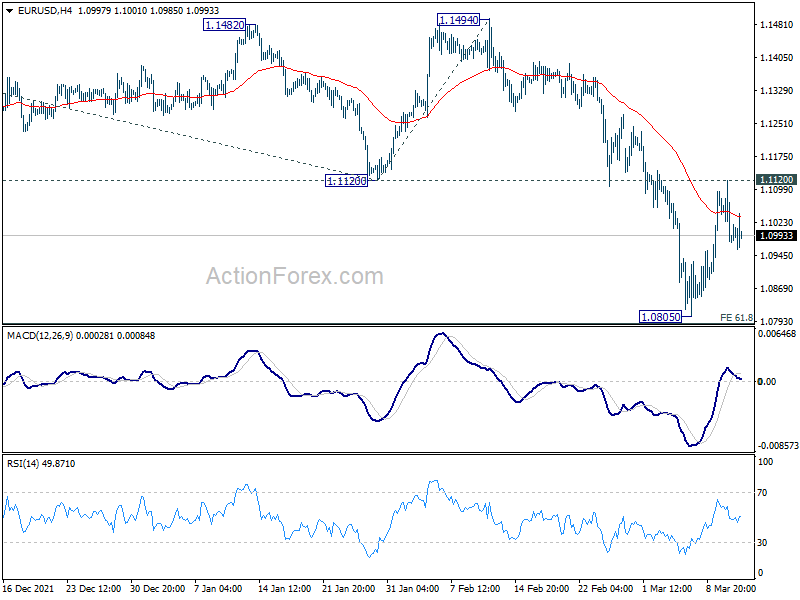
Outlook in EUR/USD remains unchanged and intraday bias stays neutral. As long as 1.1120 support turned resistance holds, larger down trend from 1.1494 is still expected to continue. On the downside, firm break of 61.8% projection of 1.2265 to 1.1120 from 1.1494 at 1.0786 will pave they way to 100% projection at 1.0349 next. However, strong break of 1.1120 will confirm short term bottoming, at least, and bring stronger rebound back towards 1.1494 structural resistance instead.
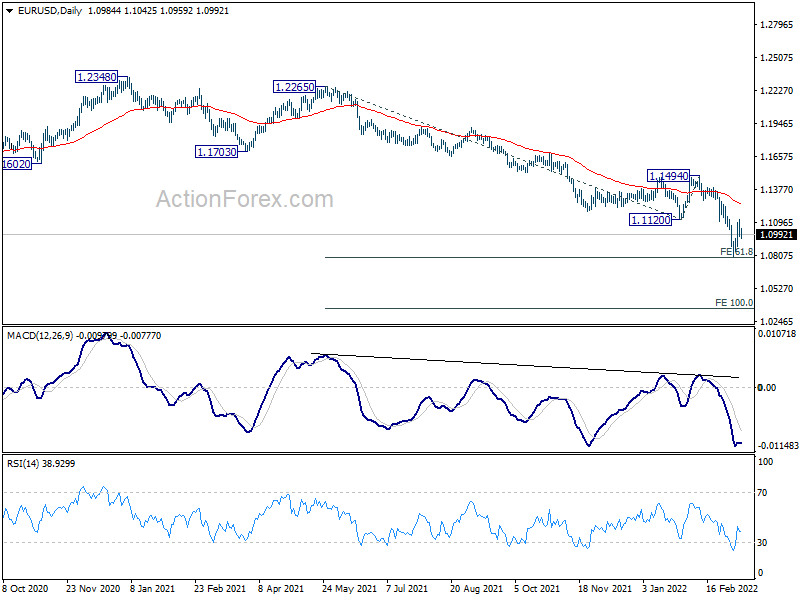
In the bigger picture, the decline from 1.2348 (2021 high) is expected to continue as long as 1.1494 resistance holds. Firm break of 1.0635 (2020 low) will raise the chance of long term down trend resumption and target a retest on 1.0339 (2017 low) next. Nevertheless, break of 1.1494 will maintain medium term neutral outlook, and extend range trading first.
GBP/USD Mid-Day Outlook
Daily Pivots: (S1) 1.3045; (P) 1.3119; (R1) 1.3157; More...
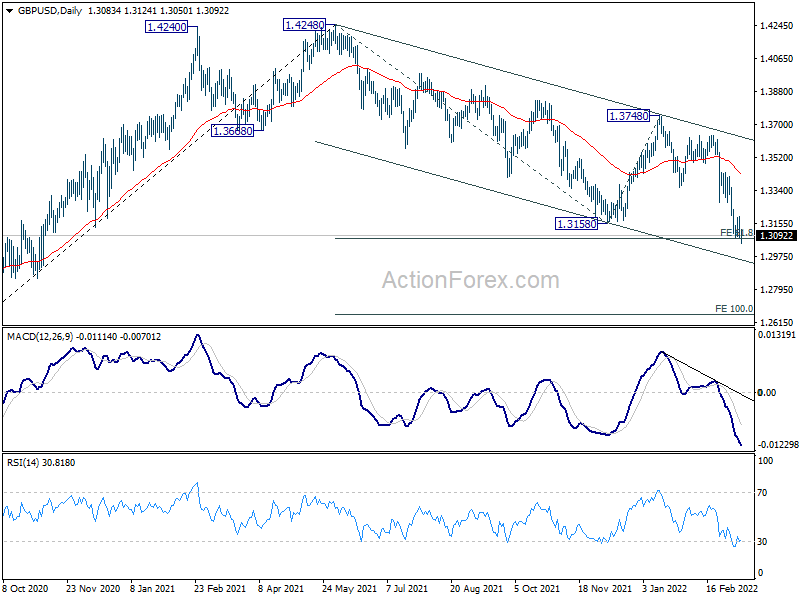
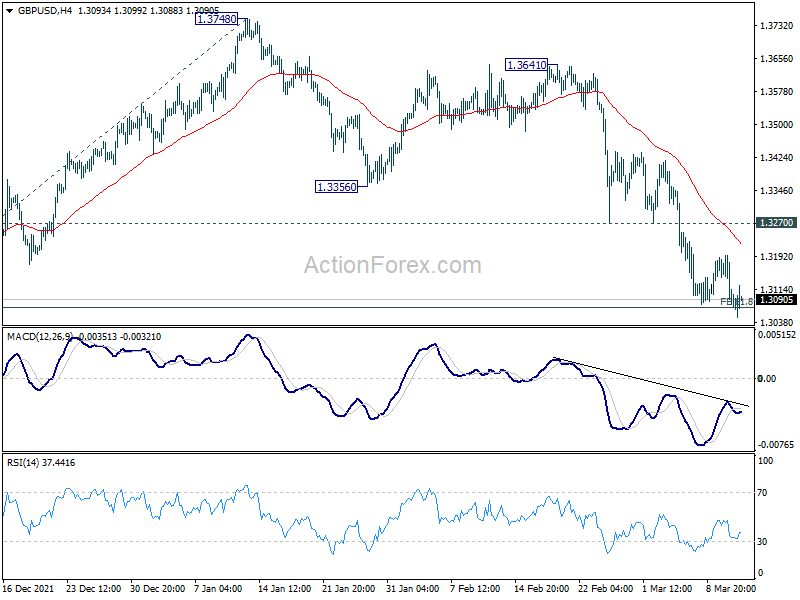
Intraday bias in GBP/USD stays on the downside at this point. Sustained break of 61.8% projection of 1.4248 to 1.3158 from 1.3748 at 1.3074 will extend the down trend from 1.4248 to 100% projection at 1.2658. In any case, outlook will remain bearish as long as 1.3270 support turned resistance holds, in case of another recovery.
In the bigger picture, current development suggests that the up trend from 1.1409 (2020 low) has completed at 1.4248. Decline from 1.4248 could still be a corrective move, or it could be the start of a long term down trend. In either case, deeper decline would now be seen back to 61.8% retracement of 2.1161 to 1.1409 at 1.2493. In case, break of 1.3748 resistance is needed to indicate medium term bottoming, or outlook will stay bearish.