

Sample Category Title
GBP/JPY Weekly Outlook
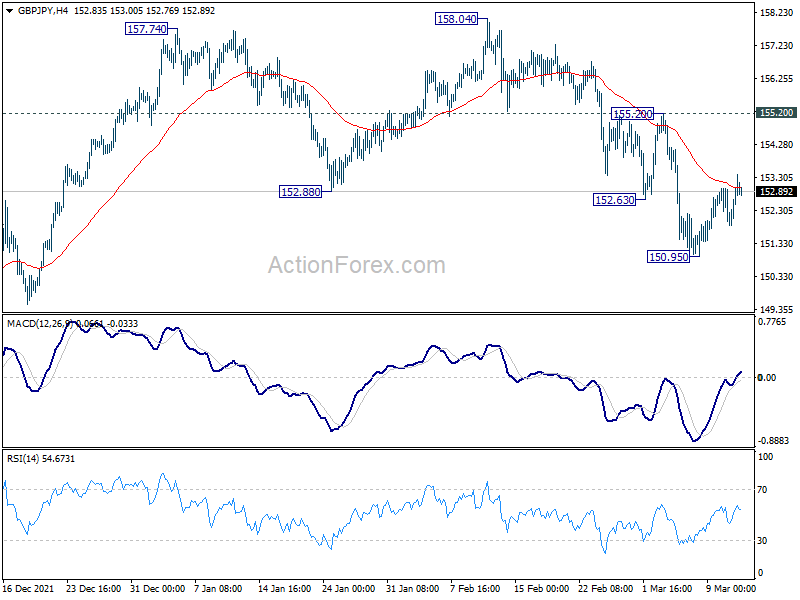
GBP/JPY recovered after dipping to 150.95, but upside is held well below 155.20 resistance. Initial bias remains neutral this week and further fall is expected. On the downside, break of 150.95 will resume the fall from 158.04, as the the third leg of the consolidation pattern from 158.19, to 148.94 support.
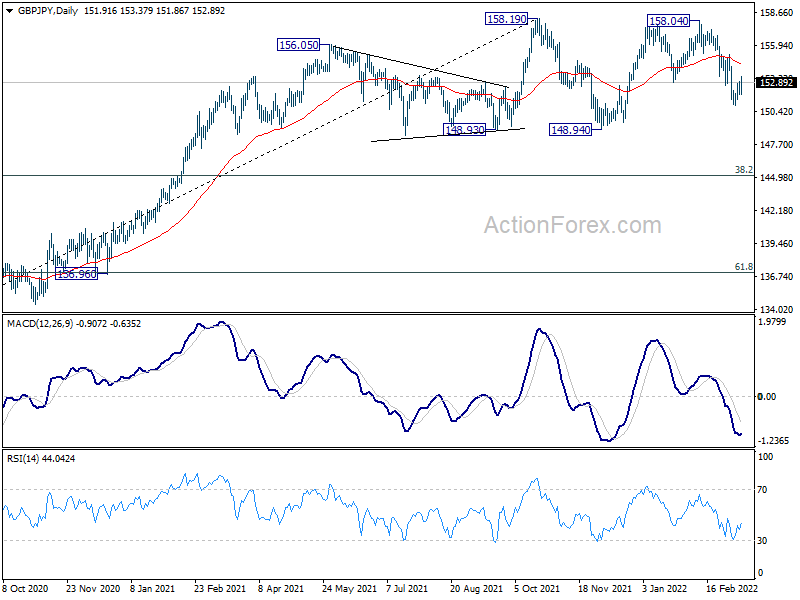
In the bigger picture, price actions from 158.19 are seen as developing into a consolidation pattern to up trend from 123.94 (2020 low). Downside should be contained by 38.2% retracement of 123.94 to 158.19 at 145.10 to bring rebound. Firm break of 158.19 will resume the up trend to long term fibonacci level at 167.93. However, sustained break of 145.10 will raise the chance of trend reversal and target 61.8% retracement at 137.02.
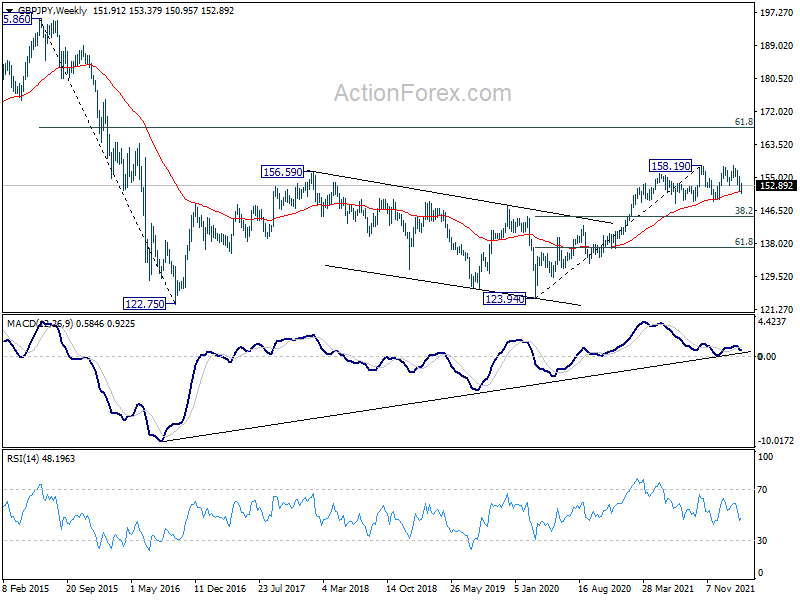
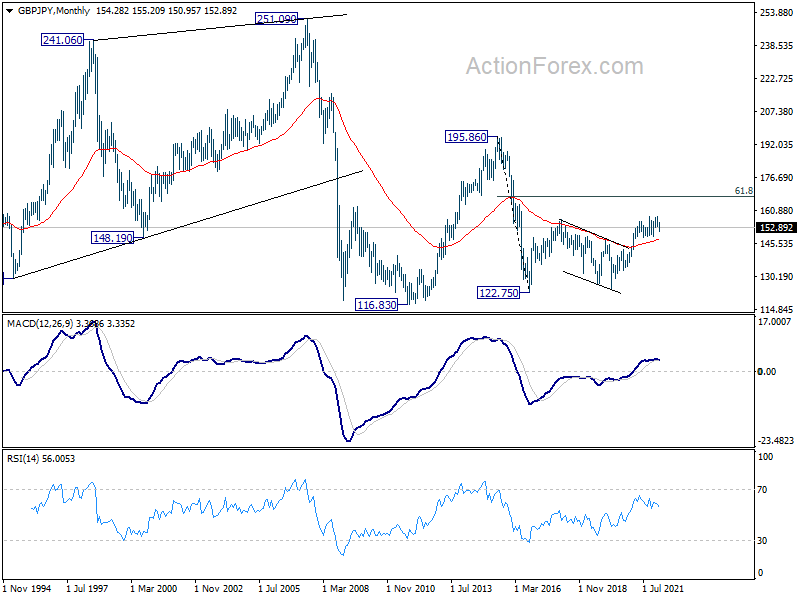
In the longer term picture, as long as 55 month EMA (now at 147.27) holds, we'd still favor more rally to 61.8% retracement of 195.86 to 122.75 at 167.93. But sustained trading below 55 month EMA will at least neutralize medium term bullishness and re-open the chance of revisiting 122.75 low (2016 low).
EUR/JPY Weekly Outlook
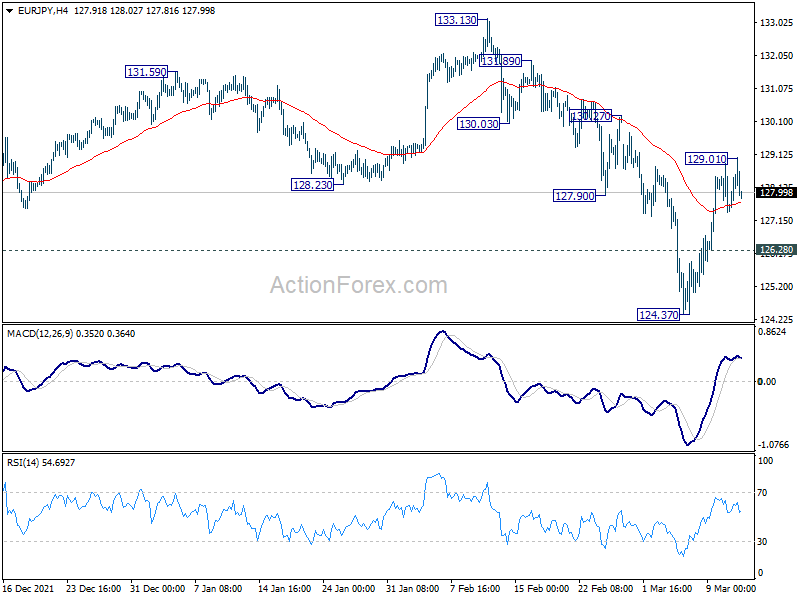
EUR/JPY rebounded strongly after edging lower to 124.37. But as a temporary top was formed at 129.01, initial bias is neutral this week first. On the upside, sustained trading above 55 day EMA (now at 129.30) will argue that correction from 134.11 has completed, and bring stronger rally to retest this high. On the downside, though, below 126.28 minor support will turn bias back to the downside for 124.37 support.
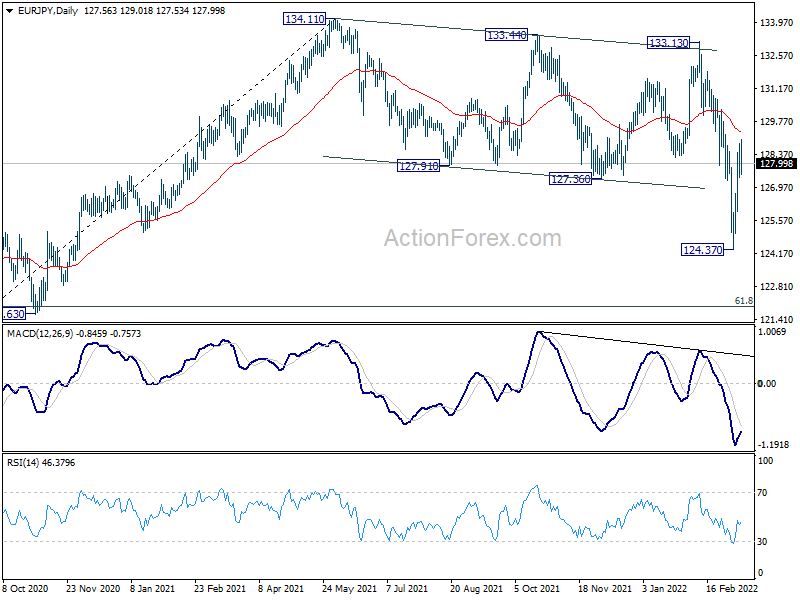
In the bigger picture, outlook is neutral at best for now until there is clear sign of up trend resumption. Corrective pattern from 134.11 could still extend further, sideway or downward. Break of 124.37 will target 61.8% retracement of 114.42 to 134.11 at 121.94.
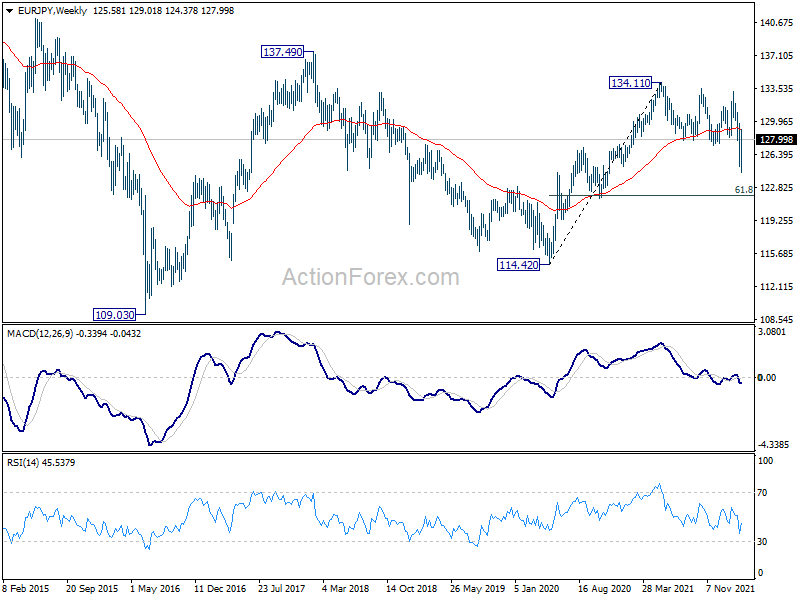
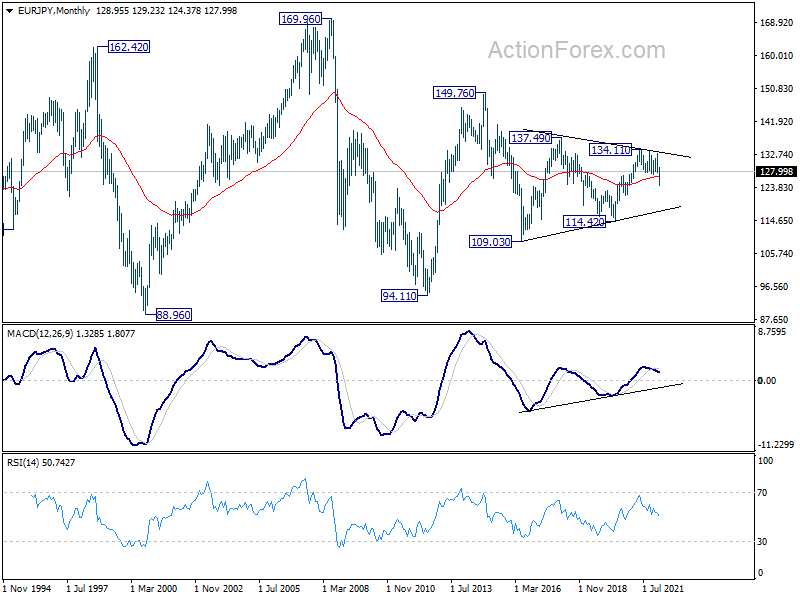
In the long term picture, EUR/JPY is staying in long term sideway pattern, established since 2000. Long term outlook will remain neutral until breakout from the range of 109.03/137.49.
EUR/GBP Weekly Outlook
EUR/GBP rebounded strongly after hitting 0.8201 last week. But a temporary top was formed at 0.8434 and initial bias is neutral this week first. On the upside, above 0.8434 will target 0.8476 structural resistance first. Firm break there will carry larger bullish implication and target 0.8598 resistance next. On the downside, break of 0.8315 minor support will retain near term bearishness, and bring retest of 0.8201 low.
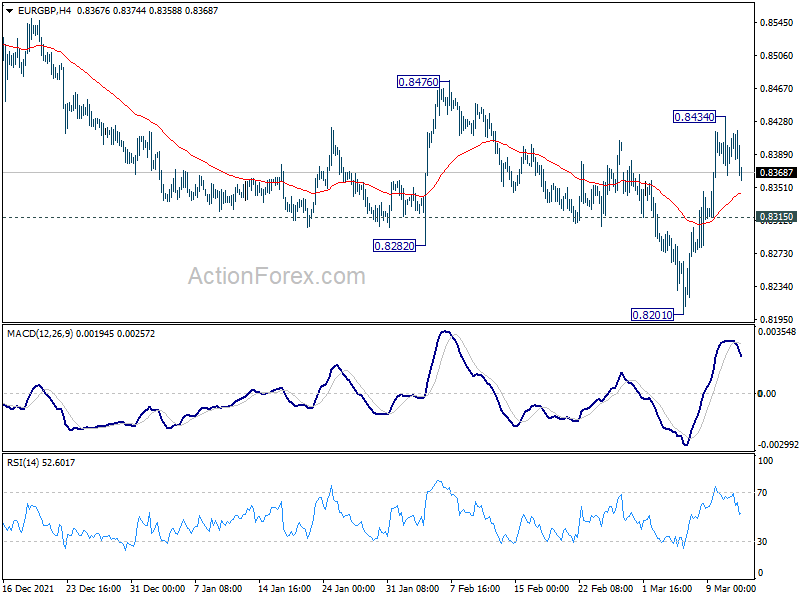
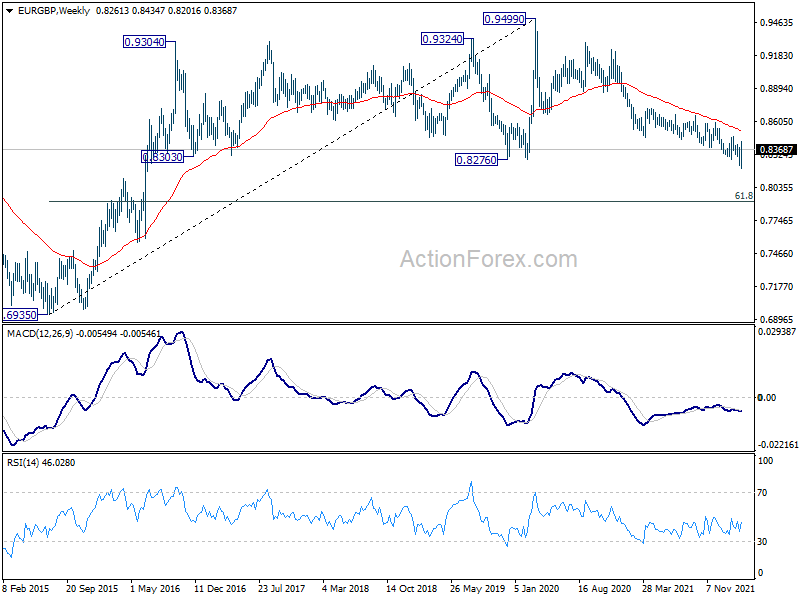
In the bigger picture, the down trend from 0.9499 is expected to continue as long as 0.8476 resistance holds. Sustained trading below 0.8276 support will argue that the whole up trend from 0.6935 (2015 low) has reversed. Deeper fall should be seen to 61.8% retracement of 0.6935 to 0.9499 at 0.7917 next. However, firm break of 0.8476 will indicate medium term bottoming at least. Focus will be back on 55 week EMA (now at 0.8534) for more evidence of bullish reversal.
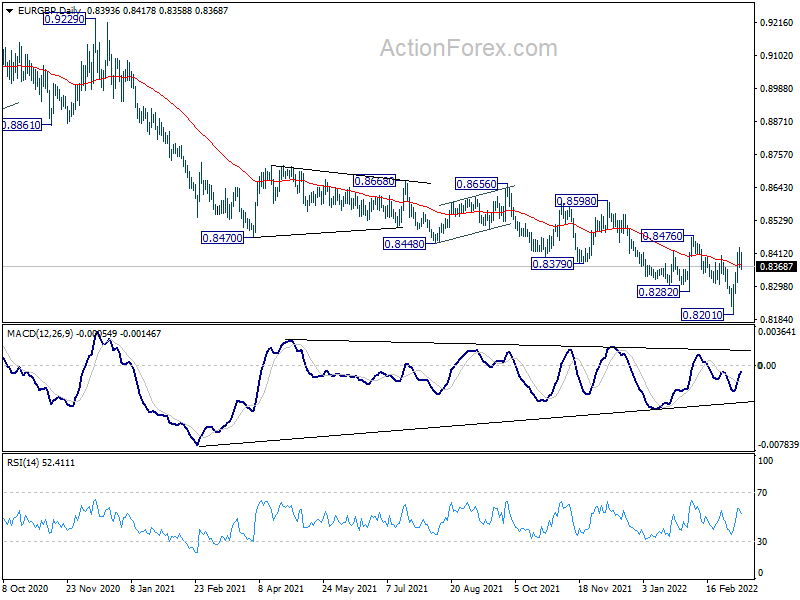
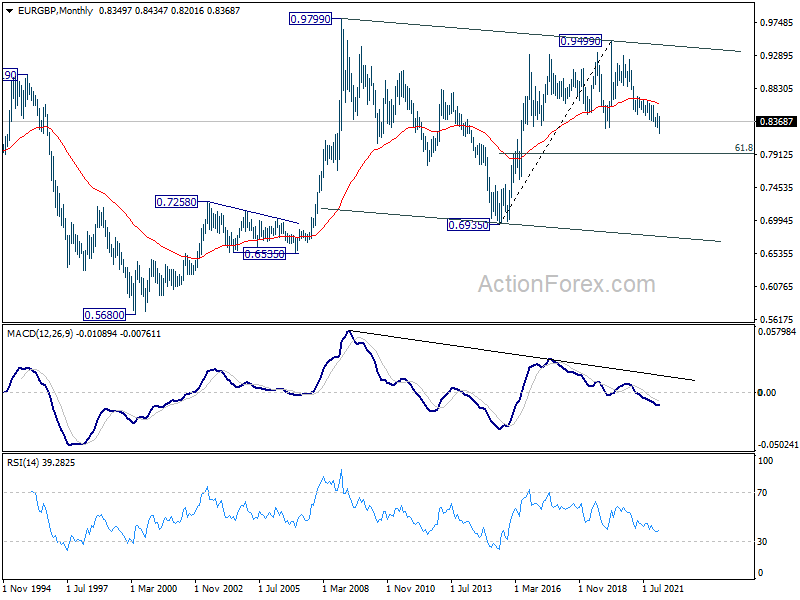
In the long term picture, current development argues that fall from 0.9499 is probably the third leg of the pattern from 0.9799 (2008 high). Sustained break of 61.8% retracement of 0.6935 to 0.9499 at 0.7917 will pave the way back to 0.6935 (2015 low) and probably below.
EUR/AUD Weekly Outlook
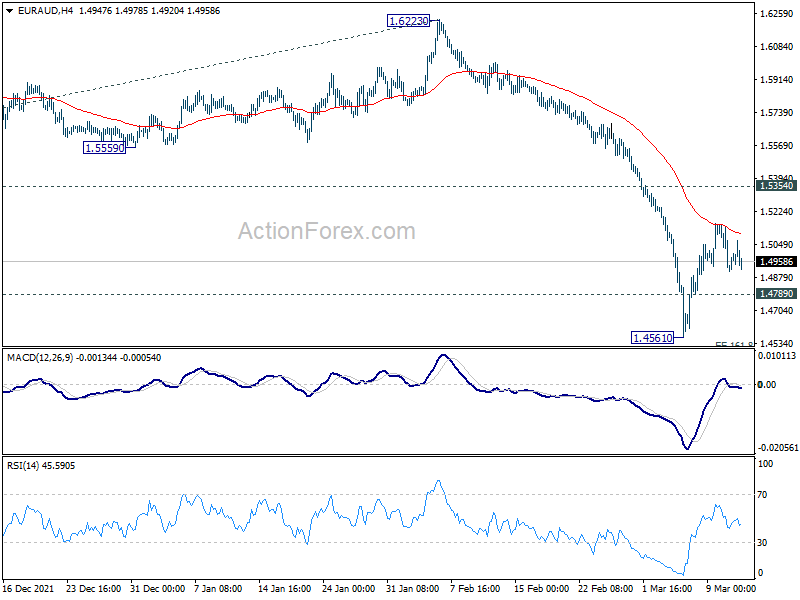
EUR/AUD rebounded strongly after dipping to 1.4561, but upside is limited below 1.5354 support turned resistance. Initial bias remains neutral this week and further fall is still expected. On the downside, below 1.4789 minor support will turn intraday bias back to the downside for 161.8% projection of 1.6343 to 1.5354 from 1.6223 at 1.4476. However, sustained break of 1.5354 will bring further rise back towards 1.6623 resistance.
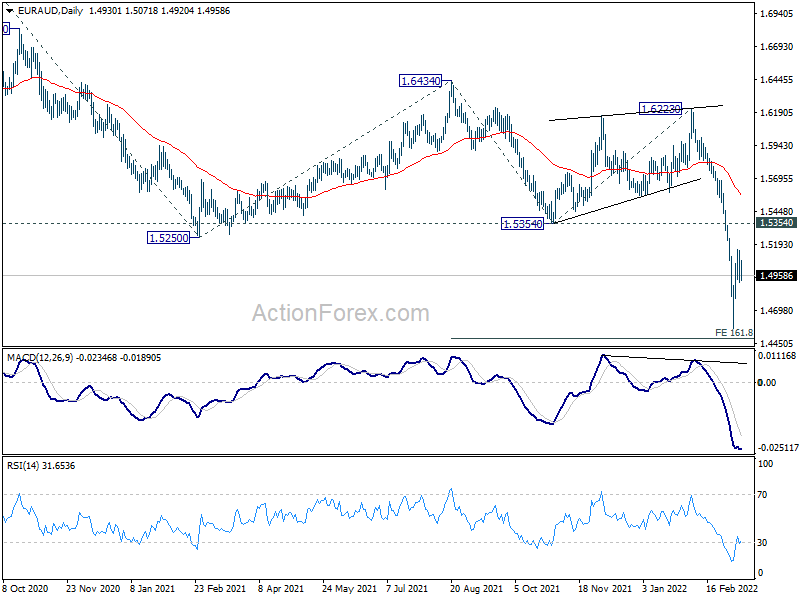
In the bigger picture, fall from 1.9799 is seen as a long term impulsive move. Next target is 61.8% projection of 1.9799 to 61.8% projection of 1.9799 to 1.5250 from 1.6434 at 1.3623, which is close to 1.3624 long term support (2017 low). Some support could be seen there to bring interim rebound. But overall, break of 1.5354 support turned resistance is needed to be the first sign of medium term bottoming. Otherwise, outlook will stay bearish in case of recovery.
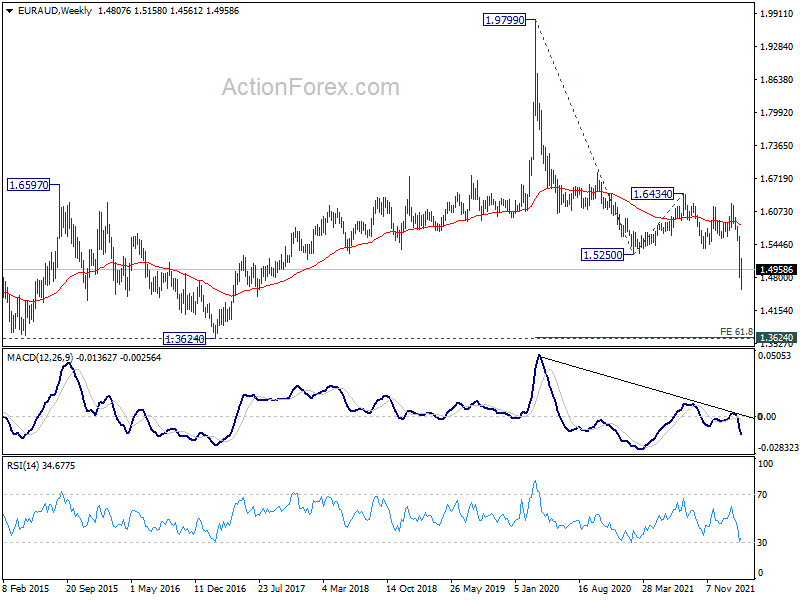
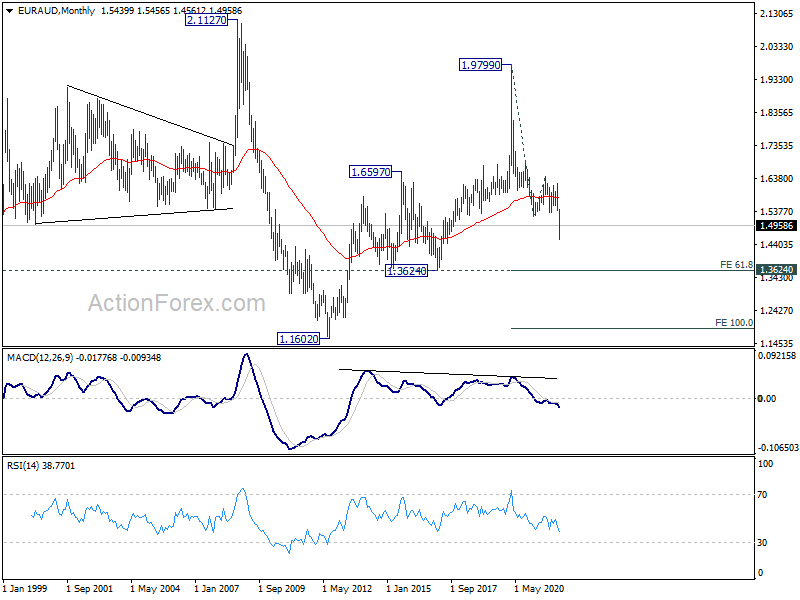
In the longer term picture, fall from 1.9799 (2020 high) is seen as the third leg of the pattern from 2.1127 (2008 high. Deeper fall should be seen to 1.3624 support. Decisive break there would pave the way back to 1.1602 (2012 low).
EUR/CHF Weekly Outlook
EUR/CHF rebounded strongly last week after hitting 100% projection of 1.0936 to 1.0298 from 1.0610 at 0.9972. But upside is limited by 1.0298 support turned resistance. Initial bias remains neutral this week and further decline remains in favor. On the downside, below 1.0131 minor support will bring retest of 0.9970 low first. On the upside, however, sustained break of 1.0298 will bring stronger rebound towards 1.0610 structural resistance instead.
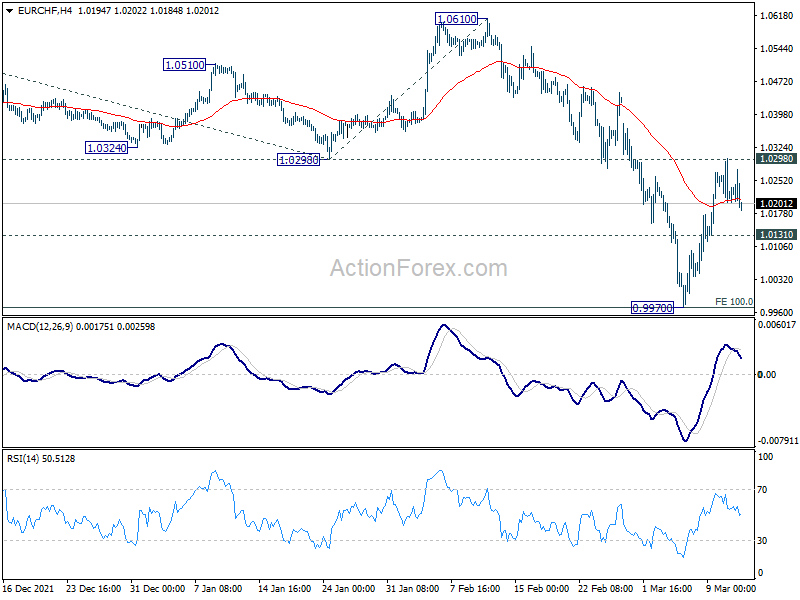
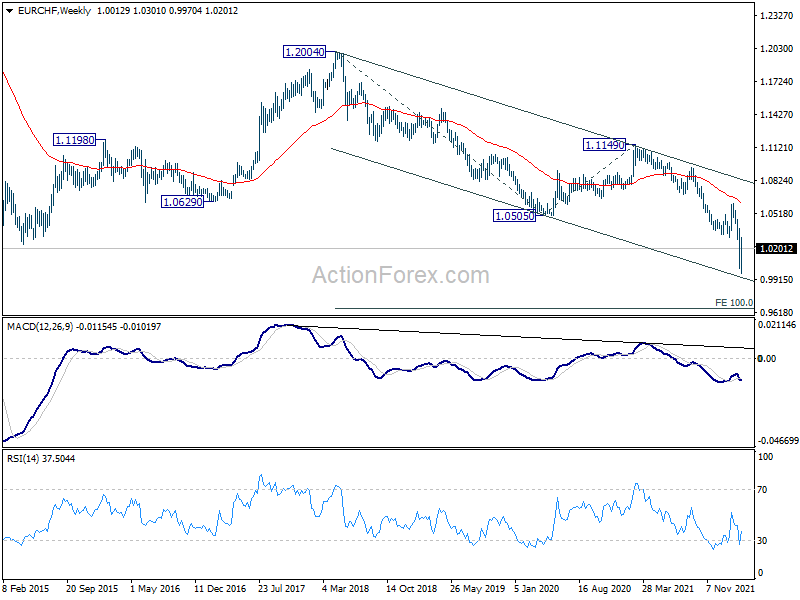
In the bigger picture, long term down trend from 1.2004 (2018 high) is still in progress. Next target is 100% projection of 1.2004 to 1.0505 to 1.1149 at 0.9650. Firm break there will target 100% projection at 0.9650. In any case, break of 1.0505 support turned resistance is needed to be the first sign of medium term bottoming. Otherwise, outlook will remain bearish.
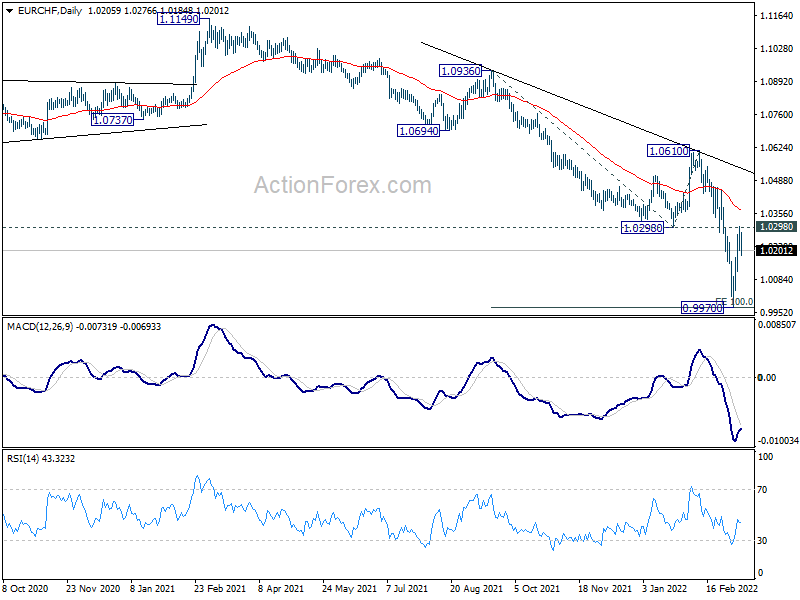
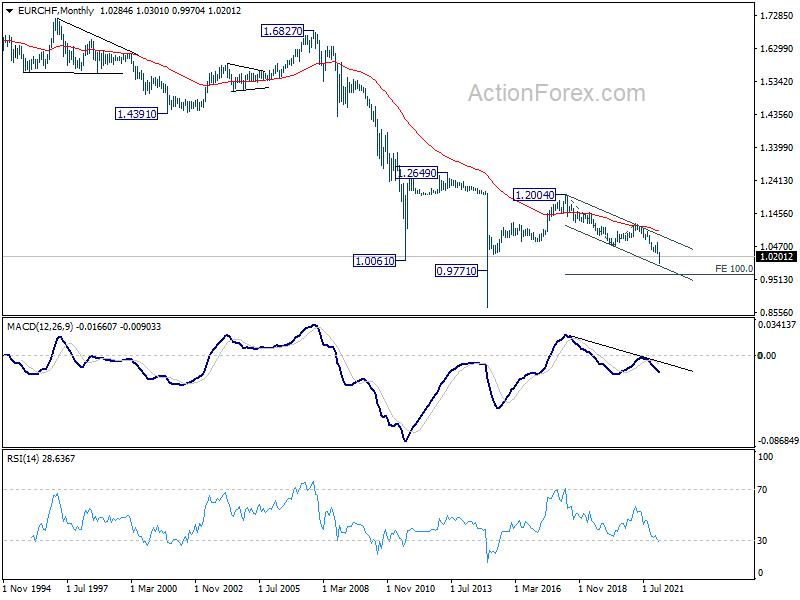
In the long term picture, capped below 55 month EMA, EUR/CHF is seen as extending the multi-decade down trend. There is no prospect of a bullish reversal until some sustained trading above the 55 month EMA (now at 1.0909).
First Climax Reactions to Russia Invasion Done, USD/JPY Upside Breakout
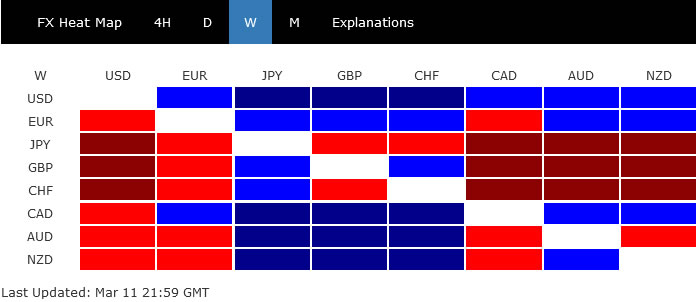
The financial markets should have completed the first climax reaction to Russia to Ukraine. Both oil prices and gold spiked higher initially last week but pulled back since then. Stocks, in particular major European indexes, also staged a strong rebound after initial dive. Global benchmark treasury yields also rebounded.
In the currency markets, Euro also attempted for a rebound, but was apparently capped. The common currency has indeed closed lower again Dollar and Canadian, which were the strongest two. The greenback was lifted by rise in yields, risk aversion, and expectation of Fed hike. Loonie was strongly support by stellar job data which reinforces BoC's tightening. On the other hand, Yen closed as the weakest one on divergence in monetary policy with others. Swiss Franc was the second weakest, but Sterling was not too far away.
With upside breakout in USD/JPY, there is prospect of more rally in Dollar and selloff in Yen ahead. Meanwhile, European majors would likely stay under pressure, with a question on whether the tide of Swiss Franc is turning. Aussie and Loonie could be mixed overall until there is drastic moves in commodity prices again.
S&P 500 still in medium term correction, 10-year yield rebounded
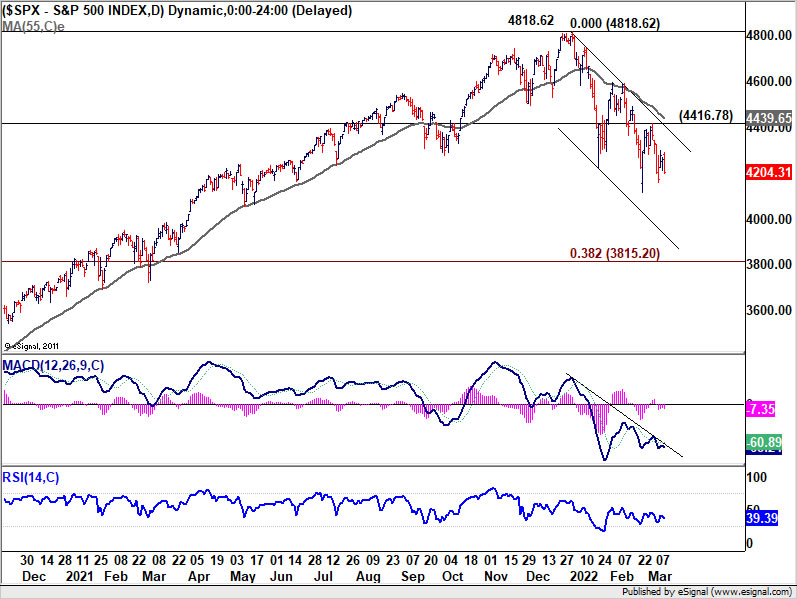
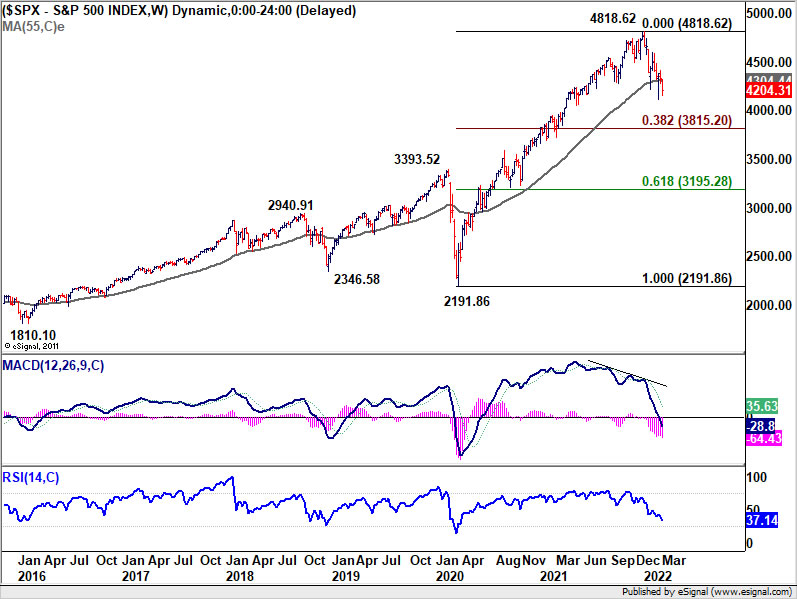
S&P 500 gyrated lower last week but there was so far no pick-up in downside momentum. Still, as long as 4416.78 resistance holds, the medium term corrective fall from 4818.62 will more likely extend lower than not. Such decline would target 38.2% retracement of 2191.86 to 4818.62 at 3815.20 before completion.
Nevertheless, firm break of 4416.78 (corresponding level at 34719.07 in DOW and 13837.58 in NASDAQ), SPX should stage an interim rebound as the second leg of the corrective pattern from 4818.62. It should then be followed by another falling leg to completion the pattern.
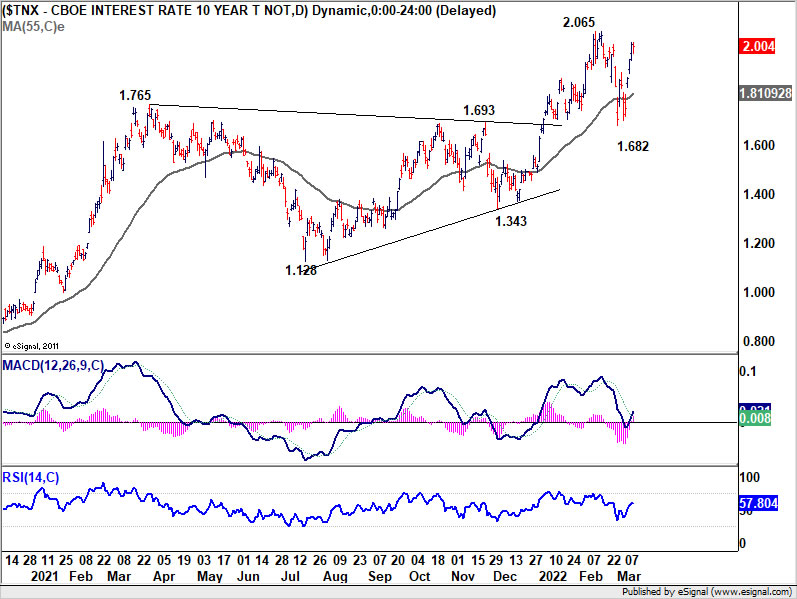
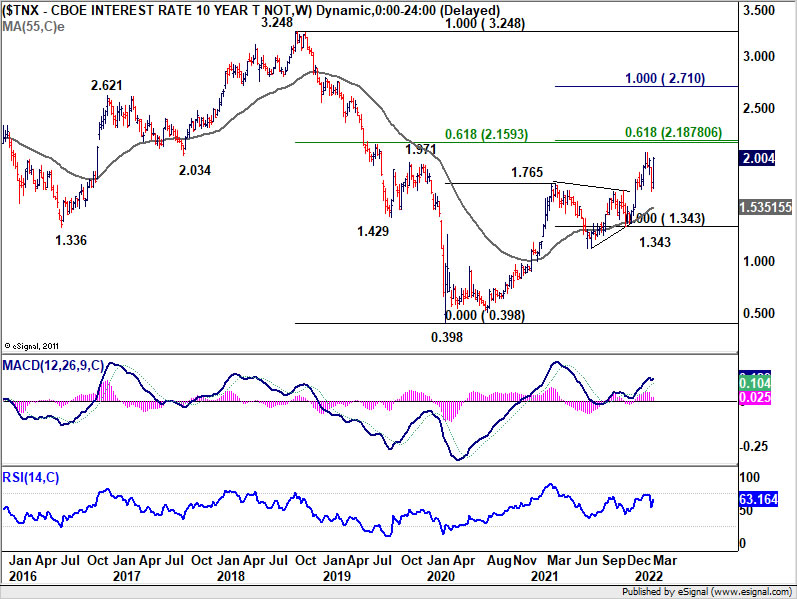
10-year yield's strong rebound last week suggests that pull back from 2.065, while slightly deeper than expected, has completed at 1.682. The development keeps near term outlook bullish. 2.065 resistance will be in focus very soon and firm break there will resume larger up trend from 0.398.
Next target is cluster resistance level at 2.159/2.187 (61.8% retracement of 3.248 to 0.398 at 2.159, 61.8% projection of 0.398 to 1.765 to 1.343 at 2.187). Current upside momentum doesn't warrant a strong break of this cluster level yet. This, strong resistance will likely be seen there to set the top of the range of a medium term consolidation.
However, strong break of 2.159/2.187 will suggest some dramatic underlying development. In such case, coupled with extending risk aversion, the greenback could be given a strong, sustainable boost.
Fed to hike 25bps only, Dollar index maintains bullish tone
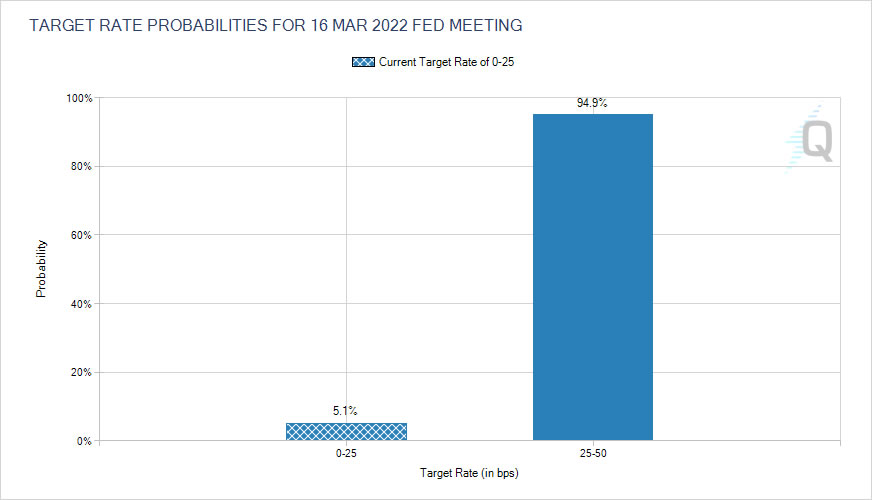
Talking about Dollar, the next focus will be FOMC rate decision. Traders are now pretty sure that there will only be a 25bps hike in federal funds rate to 0.25%-0.50% this week. Fed funds futures are pricing in 94.9% chance of that, with the 5.1% chance for Fed to be on hold.
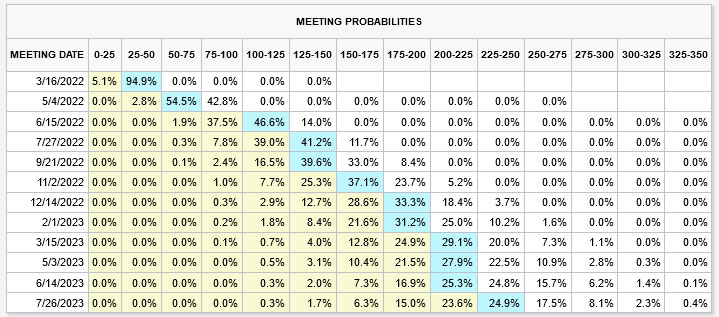
After that, there is 57.6% chance of rate ending up at 0.50%-0.75% in May, and 60.6% chance of rate ending up at 1.00-1.25% in June. That is, markets are expecting to stay cautious with another 25bps hike in May, and catch up with 50bps hike in June. But of course the pricing could change notably after the new economic projections accompanying this week's rate decision.
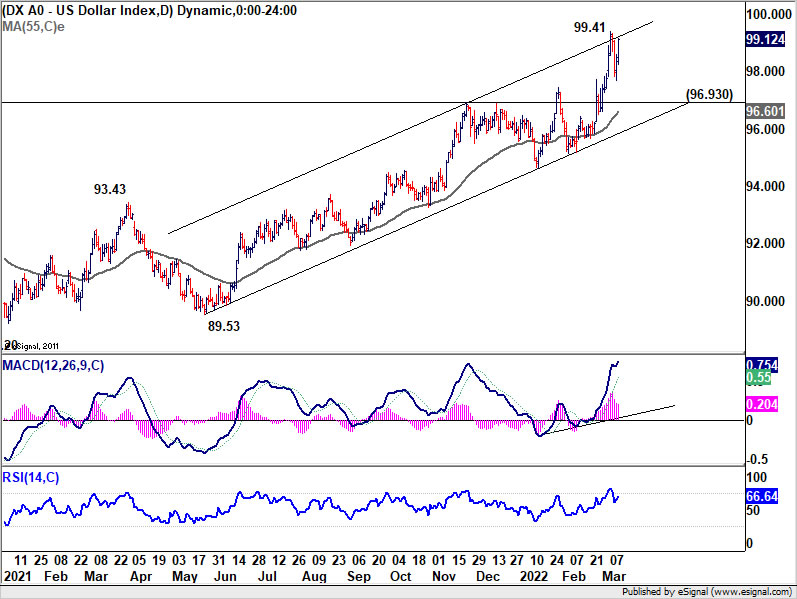
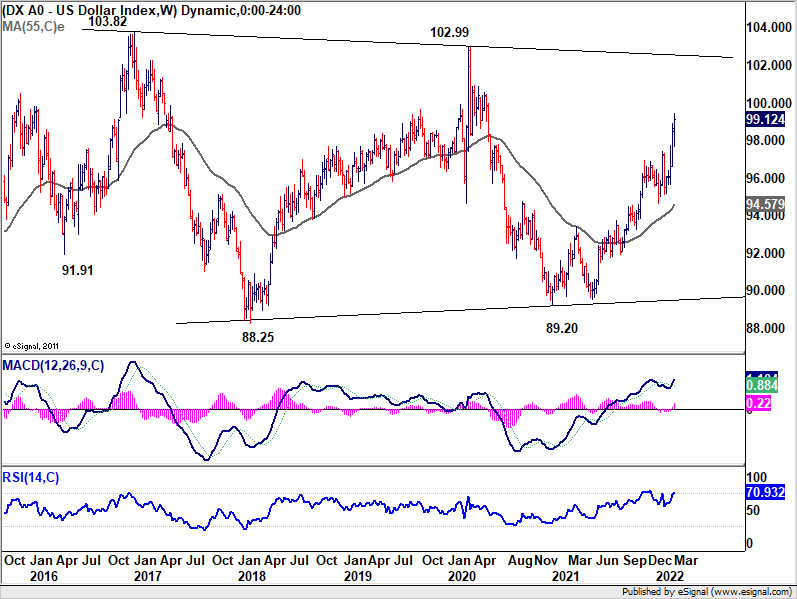
Dollar index retreated after hitting 99.41 last week, but stayed well above 96.93 resistance turned support. Near term outlook remains clearly bullish for further rally. In a less long term bullish case, DXY's rise from 89.20 is just a leg inside the sideway pattern from 103.82 (2017 high). Further rise should be seen to test 102.99 resistance before topping.
Overall, the power of the next rally through 99.41 would depend on a couple of inter-related factors, including risk sentiment, treasury yields, and Fed's new economic projections.
GBP/AUD staying bearish despite expectation of BoE hike
Talking about rate hikes, BoE is also expected to raise interest rate again by 25bps to 0.75% this week. However, such expectation, together with recent strong data, provided little boost to Sterling. The Pound is apparently still weighed heavily down by uncertainty over Russia invasion of Ukraine.
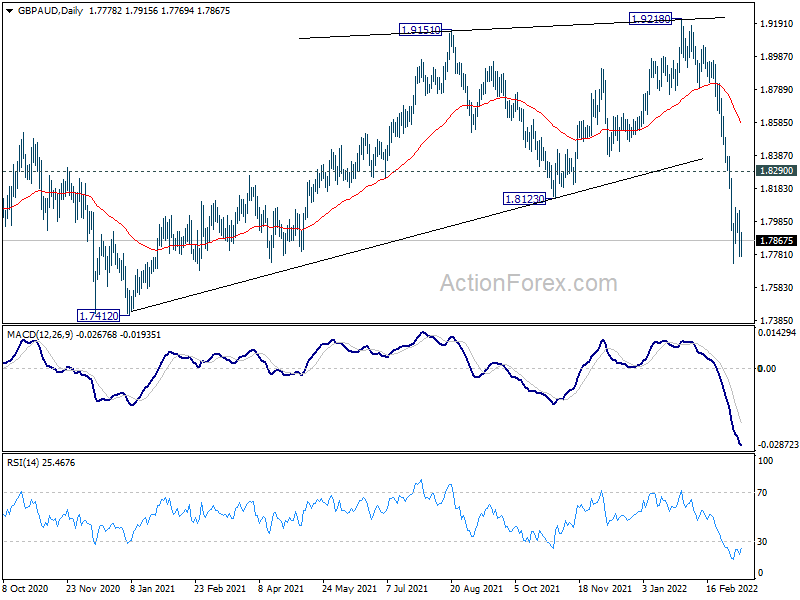
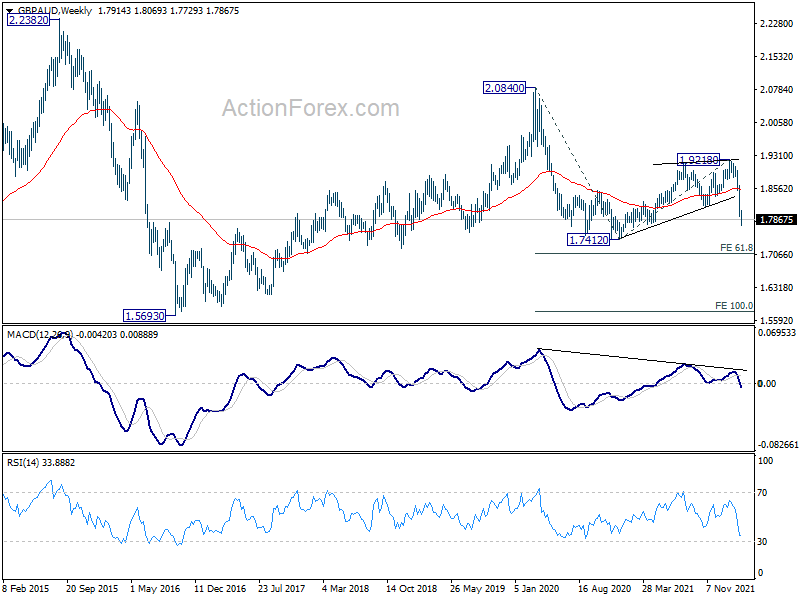
GBP/AUD turned sideway last week after hitting 1.7729 but recovery had be very weak. Overall outlook remains bearish as long as 1.8290 minor resistance holds. Corrective rise from 1.7421 should have completed with three waves up to 1.9218. Fall from there is possibly resuming the whole down trend from 2.0840 (2020 high). Retest of 1.7412 should be seen next. Firm break there will target 61.8% projection of 2.0840 to 1.7412 from 1.9218 at 1.7099.
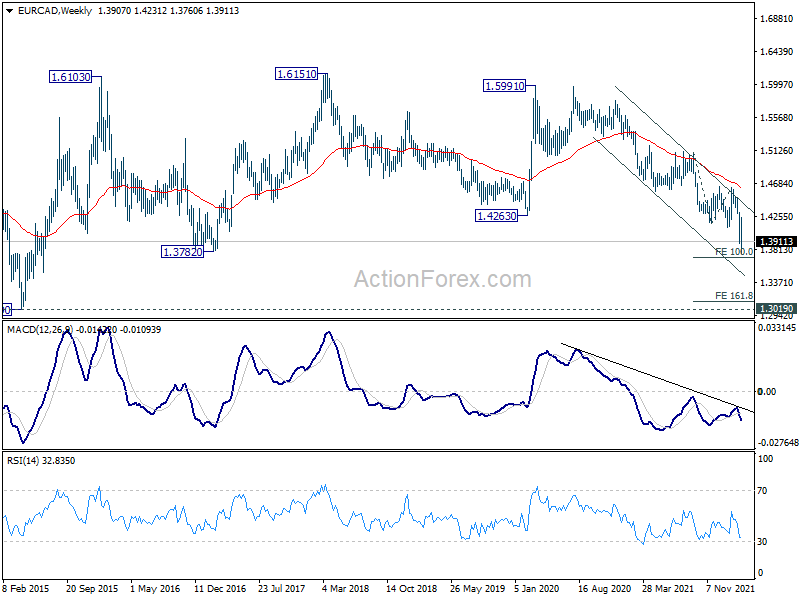
EUR/CAD staying bearish with CAD supported by strong job data
Euro attempted a rebound last week but quickly faltered despite a hawkish shift in ECB. On the other hand, Canadian Dollar was boosted by stellar job report which solidify more tightening from BoC ahead.
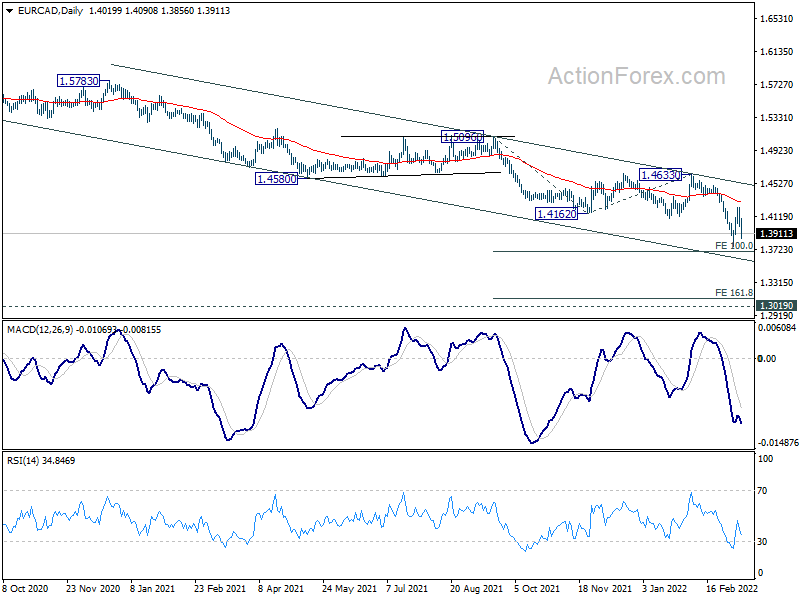
While EUR/CAD's rebound from 1.3760 was stronger than expected, there is no change in the near term bearish outlook. Focus could quickly be back on 61.8% projection of 1.5096 to 1.4162 from 1.4633 at 1.3699. Firm break there will pave the way to 161.8% projection at 1.3122, as part of the down trend from 1.5991. Nevertheless, break of last week's high at 1.4231 will open up the case for strong rebound back to 1.4633 resistance
WTI oil and Gold in near term pull back after spikes
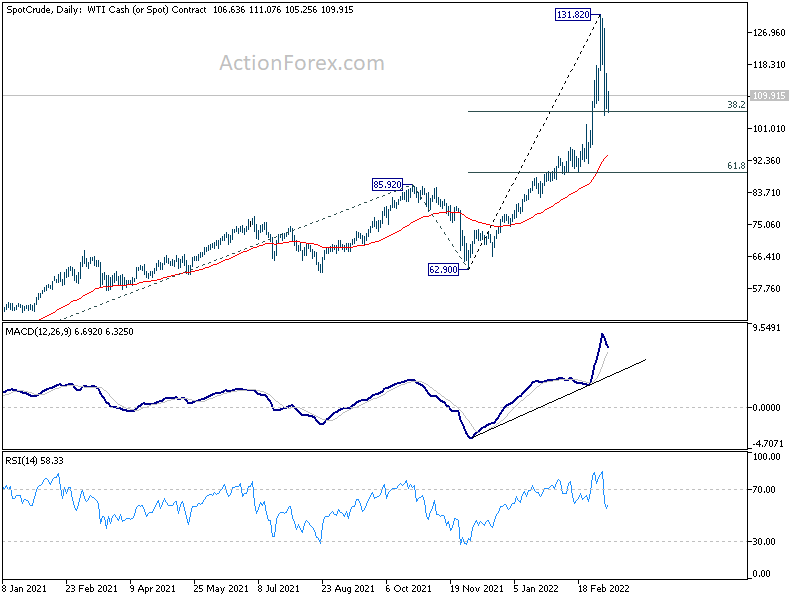
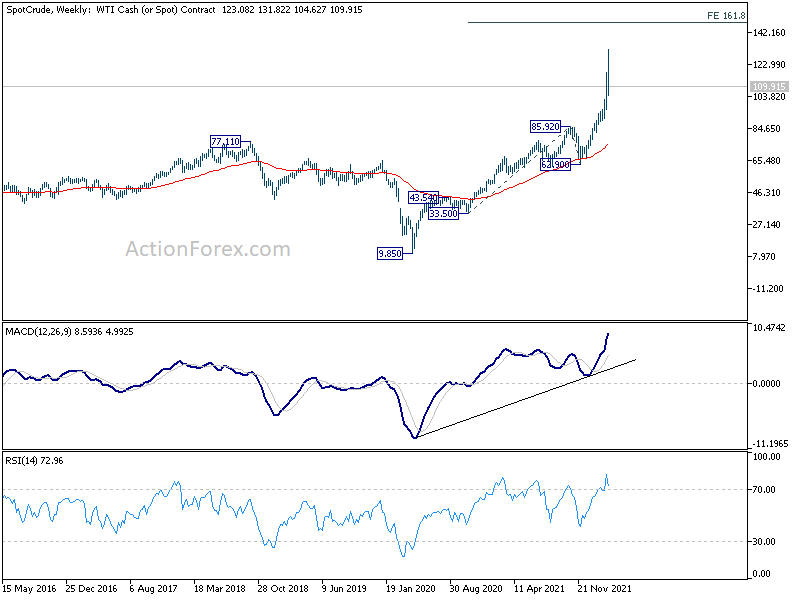
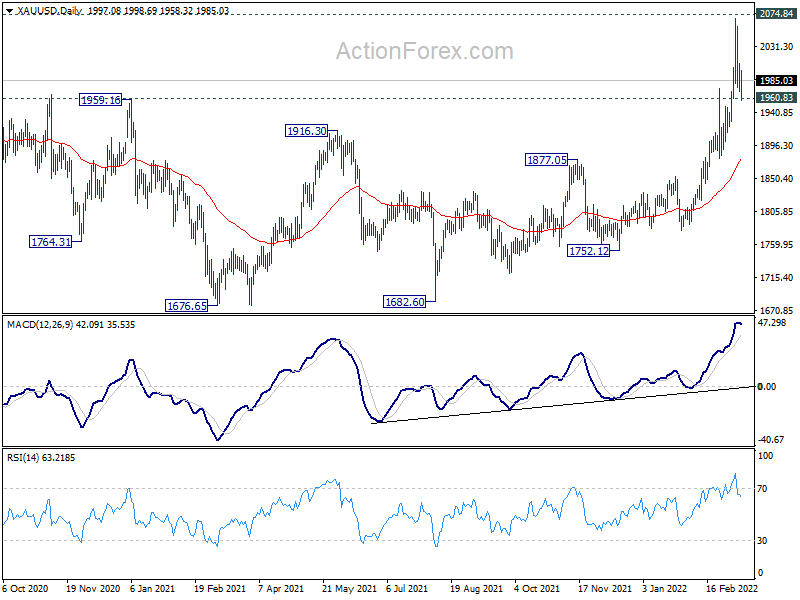
Finally, both WTI crude oil and Gold retreated notably after initial spikes last week. Such pull-backs are so far seen as knee-jerk reaction after passing initial buying climax. The stages for sizeable correction are not set yet.
As for WTI, as long 38.2% retracement of 62.90 to 131.82 at 105.49 holds, up trend should resume sooner rather than later to 161.8% projection of 33.50 to 85.92 from 62.90 at 147.71, which is close to record high made in 2008. But sustained break of 105.49 will formally start a medium term correction targeting 55 day EMA (now at 93.95).
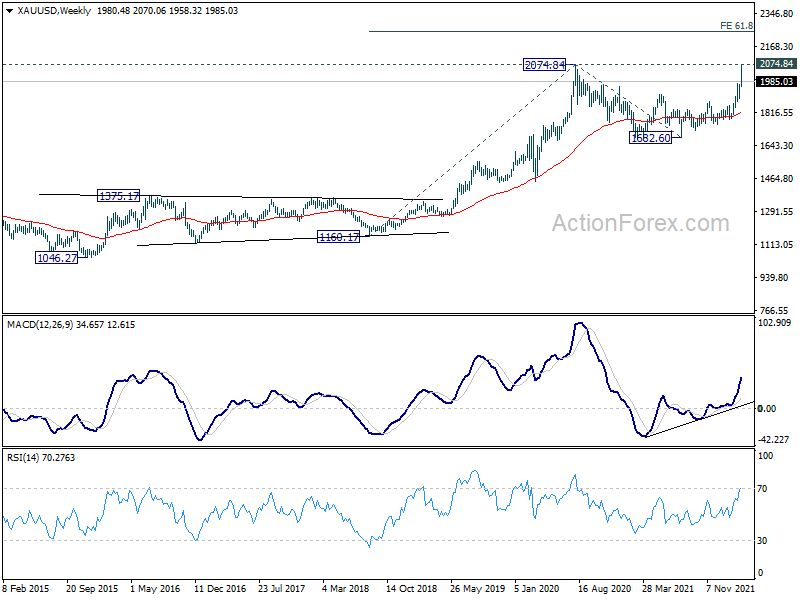
As for Gold, as long as 1960.83 minor support holds, further rally is expected. Decisive break of 2074.84 will resume long term up trend to 61.8% projection of 1160.17 to 2074.84 from 1682.60 at 2247.86. However, sustained break of 1960.83 will indicate rejection by 2074.85, and bring deeper pull back to 55 day EMA (now at 1877.76) and possibly below.
USD/JPY Weekly Outlook
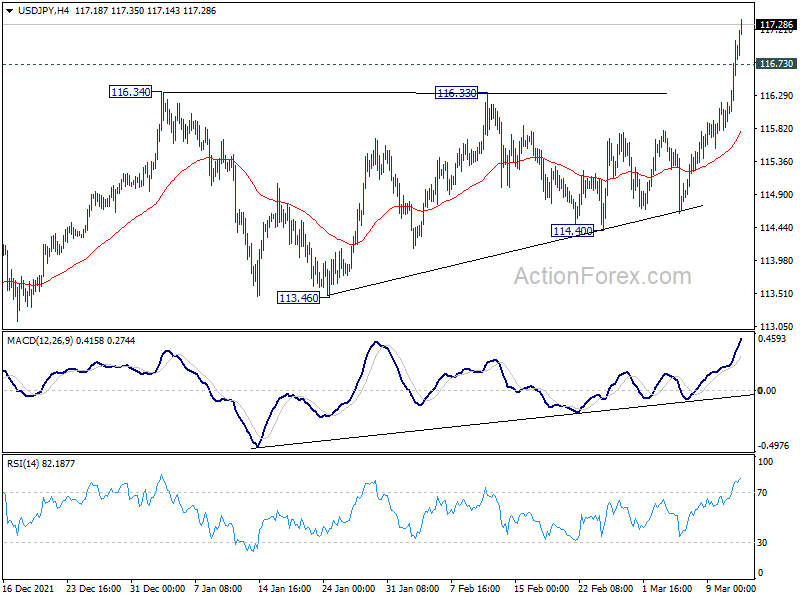
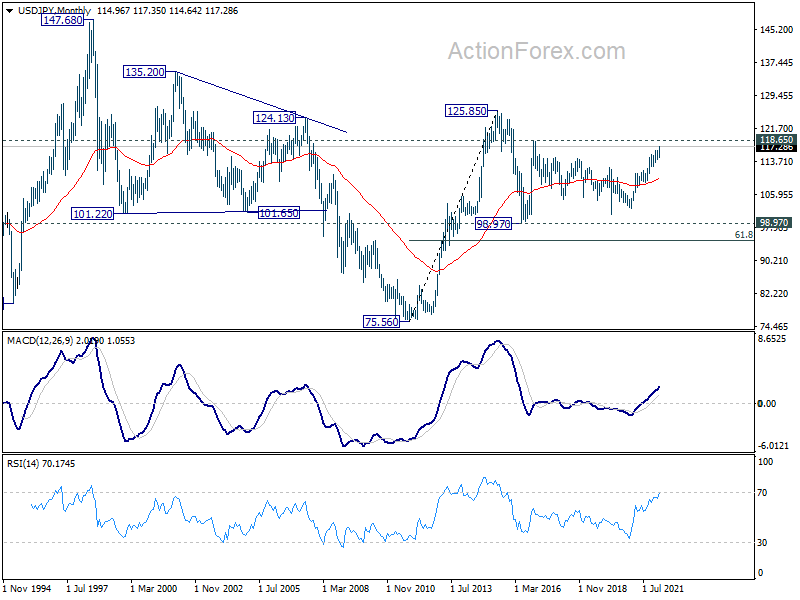
USD/JPY's strong break of 116.34 resistance confirms resumption of whole up trend from 102.58. Initial bias stays on the upside this week. Next target is 118.65 long term resistance. On the downside, below 116.73 minor support will turn intraday bias neutral and bring consolidation first, before staging another rally.
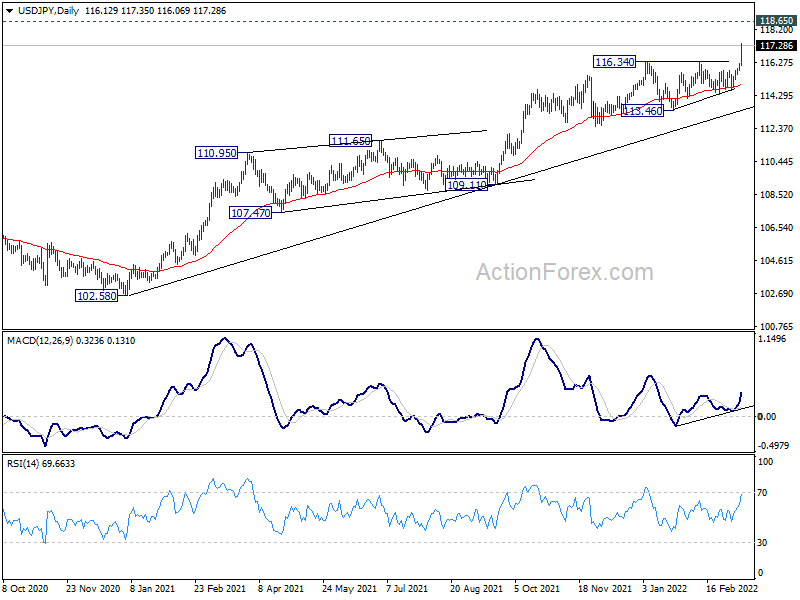
In the bigger picture, no change in the view that rise from 102.58 is the third leg of the up trend from 101.18 (2020 low). Such rally should target a test on 118.65 (2016 high). Sustained break there will pave the way to 120.85 (2015 high) and raise the chance of long term up trend resumption. This will remain the favored case as long as 113.46 support holds.
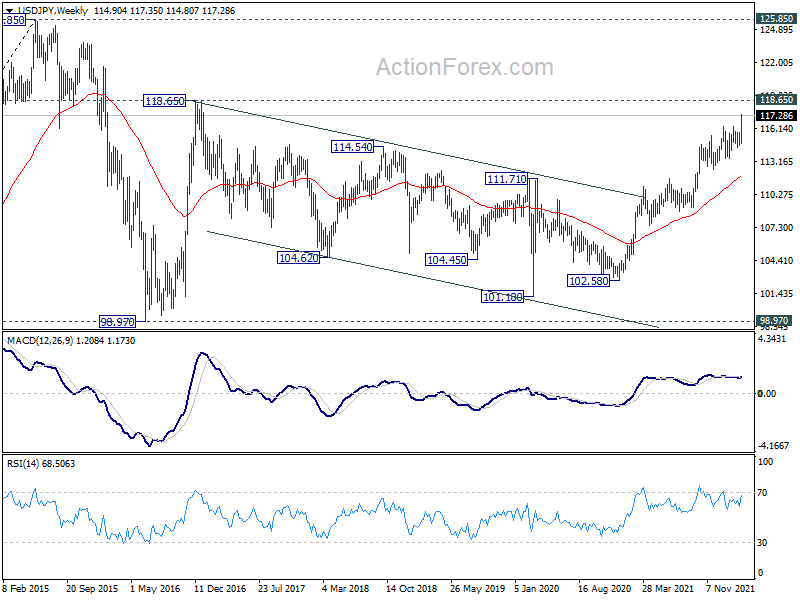
In the long term picture, the rise from 75.56 (2011 low) long term bottom to 125.85 (2015 high) is viewed as an impulsive move, no change in this view. Price actions from 125.85 are seen as a corrective pattern which could still extend. In case of deeper fall, downside should be contained by 61.8% retracement of 75.56 to 125.85 at 94.77. Up trend from 75.56 is expected to resume at a later stage for above 135.20/147.68 resistance zone.
Summary 3/14 – 3/18
Monday, Mar 14, 2022
[php_everywhere instance="1"]
Tuesday, Mar 15, 2022
[php_everywhere instance="2"]
Wednesday, Mar 16, 2022
[php_everywhere instance="3"]
Thursday, Mar 17, 2022
[php_everywhere instance="4"]
Friday, Mar 18, 2022
[php_everywhere instance="5"]
Weekly Economic & Financial Commentary: Let the Tightening Cycle Commence
Summary
United States: Intensifying War Pours Some Gas on Price Growth
- Russia's invasion of Ukraine continues to loom large as the war has intensified. Most data released this week, however, do not capture the market volatility felt since the invasion has taken center stage. The U.S. trade deficit widened to a record $89.7B in January, while job openings remained elevated and consumer prices continued their string of white-hot gains in February.
- Next week: Retail Sales (Thu), Industrial Production (Thu), Existing Home Sales (Fri)
International: European Central Bank Signals a Faster Tapering of Bond Purchases
- The European Central Bank (ECB) sprung something of a surprise at this week's monetary policy announcement, announcing an accelerated tapering of its bond purchases despite uncertainty surrounding the Ukraine conflict. While the ECB took a more hawkish stance on tapering, it did not make significant changes regarding the timing of interest rate increases, in our view. We still believe the ECB is on pace to lift its Deposit Rate 25 bps at its December 2022 meeting.
- Next week: China Activity (Wed), Australia Employment (Thu), BoE Policy Announcement (Thu)
Interest Rate Watch: Let the Tightening Cycle Commence
- Despite the uncertainty arising from the Russian invasion of Ukraine, we expect the FOMC to commence monetary tightening with a 25-bp rate hike at next week's meeting. We expect to see a total of 225 bps of tightening between now and the end of 2023.
Credit Market Insights: Households Are Wealthy, But Drop in Revolving Credit is an Enigma
- Data this week showed household net worth climbed above $150T for the first time in Q4 due to attractive opportunities in the stock market and real estate in the pandemic era. In a separate release, January's drop in revolving credit led to a lower-than-expected increase in consumer credit, despite strong spending that month.
Topic of the Week: Childcare Issues Impact Working Women
- In celebration of International Women's Day, March 8th, we examined the industry most central to working women: childcare. Childcare is not only the most female-dominated industry but also the one keeping parents with young children, particularly women, out of the workforce.
The Weekly Bottom Line: Looking Through the Turmoil, Ready for Lift-off
U.S. Highlights
- It was another volatile week across global financial markets as the recent surge in commodity prices stoked fears of an inflationary spiral. Sentiment improved through the latter half of the week, allowing global equities to pare losses.
- Oil remained a focal point, with WTI briefly touching $128 per-barrel on Tuesday following President Biden’s announcement to ban the import of Russian oil. Gains were later reversed on the hopes of increased OPEC production.
- February CPI data showed a further acceleration in consumer prices, with both headline (+7.9% y/y/) and core (+6.4% y/y) inflation rising to new 40-year highs. With price pressures likely to continue to mount over the coming months, the FOMC is certain to raise rates next week.
Canadian Highlights
- Easing public health restrictions led to a strong rebound in hiring in February. The labour market added 336k jobs, pushing the employment rate down 1 percentage point to 5.5%.
- The Russia-Ukraine war continued to reverberate through financial markets this week. The economic fallout from the conflict is being felt far outside its borders via surging prices of oil and other commodities.
- Next week’s CPI report is expected to show another leg up in consumer prices in February.
U.S. - Looking Through the Turmoil, Ready for Lift-off
Despite Fed officials entering a ‘quiet week’ ahead of next Thursday’s FOMC meeting, it was anything but across global financial markets. New economic sanctions and fears of a prolonged Ukraine-Russia conflict have pushed commodity prices significantly higher in recent weeks, stoking fears of an inflationary spiral that could trigger a recession across Europe. The risk-off sentiment abated through the latter half of this week, allowing global equites to pare losses. At the time of writing, the S&P 500 was still lower by about 1.5%. Yields rose through much of the week, as intensifying price pressures pushed the US 10-year higher by 25 basis points to just over 2%.
Across the commodity space, oil remained a focal point. On Tuesday, both WTI and Brent briefly touched levels not seen since 2008, hitting $128 and $133 per-barrel, respectively. The sharp gains followed President Biden’s announcement that the U.S. will immediately ban imports of Russian oil. The UK made a similar commitment, agreeing to phase-out imports of Russian oil by year-end. Gains, however, were reversed from their intraweek highs on hopes that OPEC members would boost production to help make up for some of the shortfall. At the time of writing, WTI is currently down 7% on the week, trading at $108 per-barrel (Chart 1).
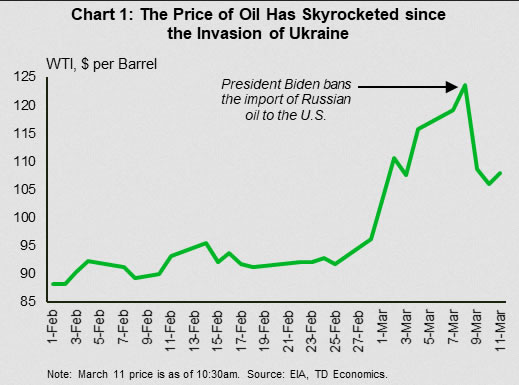
Inflation also remained a key theme for the week, as Thursday’s release of February CPI data showed a further acceleration in consumer prices. Headline CPI rose 0.8% month-on-month (m/m), which drove the year-on-year measure to 7.9% (Chart 2). Core inflation was up a softer 0.5% m/m – a slight deceleration from January – though still enough to push the annual reading to a new 40-year high of 6.4%. Higher fuel prices (6.4% m/m), food (1.0% m/m) and shelter costs (0.5% m/m) were the biggest contributors to February’s price gain. Also noteworthy was the modest cooling in used vehicle prices (-0.2% m/m), which came after four consecutive months of strong gains. New vehicle prices were still higher in February, though even here we have seen a meaningful deceleration in price growth in recent months, suggesting consumer’s may be nearing a ceiling of what they’re willing to spend for a new vehicle.
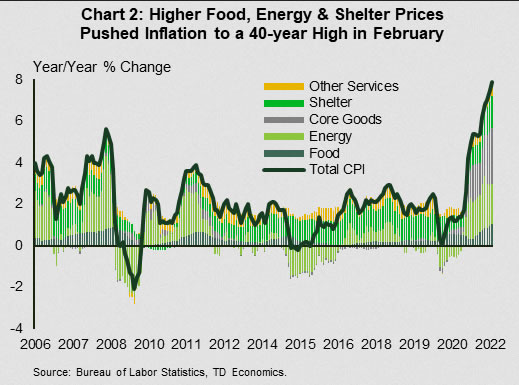
Unfortunately, inflationary pressures are likely to continue to move higher over the coming months, as the recent surge in commodity prices will continue to filter through to higher prices both at the pump and grocery stores. Even if gasoline prices hung at today’s level of $4.32 per-gallon for the rest of the month, that alone would lift headline CPI for March by an additional 0.9 percentage points.
The pinch on consumer’s wallets could lead to slightly weaker discretionary spending over the near-term, but this is unlikely to dissuade Fed officials from raising rates at next week’s meeting. Inflationary pressures are running too hot, and the labor market has become as tight as it has ever been. Failing to move on rates runs the risk of the Fed falling even further behind the curve, which would erode its credibility and jeopardize the economic recovery. Expect the FOMC to acknowledge the recent tightening in financial market conditions, but maintain its hawkish tone, setting the stage for what will be a series of rate hikes over the remainder of the year.
Canada - Labour Market Resilience Clears the Path for Further Rate Hikes
The impact of the war in Ukraine and the subsequent sanctions on Russia continued to reverberate through financial markets this week, with equities and commodities feeling the biggest impact. The already-high crude prices shot up even further this week, briefly hitting $128 per barrel on Tuesday following the announcement of the U.S. ban on Russian crude and oil products. While oil prices eased through the latter half of the week, it would appear that oil prices will remain above the $100 mark for a second week in a row. Equity markets remained volatile but the S&P/TSX ultimately ended the week slightly higher supported by energy stocks.
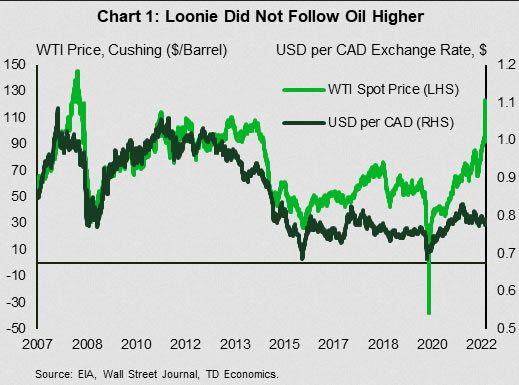
The economic fallout from the conflict will be felt far away from its borders, exacerbating current inflationary pressures and putting additional strain on supply chains. Consumers in Canada and around the world will feel the pinch of higher gas prices at the pump, which in Canada were already up 32% in January from the year prior. But the ball will not stop there, as businesses are expected to pass higher energy costs to consumers. It is also notable that the Canadian dollar has so far not benefitted that much from soaring oil prices (Chart 1). While this will be helpful for exports, it could lead to an even greater increase in prices via higher cost of imported goods.
High inflation is not the only headwind confronting households this year. With the Bank of Canada on a mission to bring inflation lower, interest rates will also rise and debt servicing costs will follow suit. The Bank set that process in motion last week, increasing the overnight rate by 25 basis points. It is not going to stop there despite the heightened geopolitical risks and is expected to deliver four additional quarter point hikes this year.
On the upside, households are facing those headwinds at the time when the labour market is tight and job vacancies are plentiful. This bodes well for job seekers as well as workers looking to boost their income. Rising employment and wages will partially mitigate the impact of higher prices and debt servicing costs. Indeed, the Canadian labour market rebounded with fervor in February, gaining 337k positions and more than offsetting January's loss of 200k (Chart 2). The unemployment rate dropped by one percentage point to 5.5%, below the level from February 2020. Last but not least, wage growth also accelerated to 3.1% (year-over-year) up noticeably from 2.4% in January.
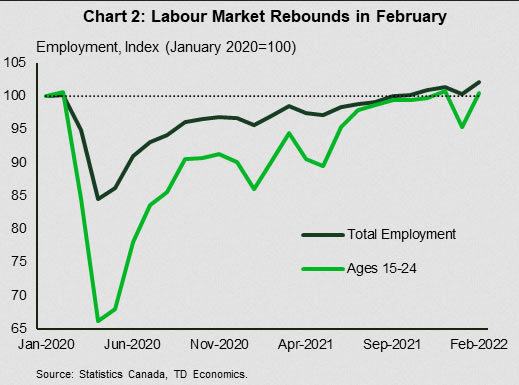
The incredible resiliency of the Canadian labour market sets up the Bank of Canada to continue raising rates at its upcoming meetings. Bond markets have moved in tandem to reflect this, with yields rising significantly over the last few trading sessions. With inflation as a main concern for the Bank, the path to higher rates has been cleared.
Week Ahead – Central Banks
Rate hikes expected as inflation keeps rising
It’s been another volatile week in financial markets with events in and around Ukraine continuing to dominate. Sentiment is still very headline-driven and an enormous amount of uncertainty remains around the outcome of talks between Ukraine and Russia and the sanctions being imposed on the latter by the West.
This in turn creates huge uncertainty around the global economic outlook, with soaring commodity prices a massive downside risk for growth and upside risk for inflation. Central banks were already between a rock and a hard place prior to the invasion as they sought to control inflation without negatively impacting the recovery from the pandemic. Soon they may be forced to choose between inflation and recession.
The ECB opted to proceed as planned and announced a tapering of asset purchases which could lay the groundwork for rate hikes later this year or next. The Fed and BoE are expected to do the same with rate hikes from both expected next week. The CBRT is expected to leave rates unchanged again, while the CBR is far more unclear after opting to more than double its key rate to 20% in response to Western sanctions a couple of weeks ago.
US
The Fed is expected to finally start fighting inflation by ending QE and delivering a quarter-point rate hike next week. Given the impact of the war in Ukraine, expectations are high that inflation will continue to heat up over the next couple of months and that should keep the pressure on the Fed to raise rates.
Investors will pay close attention to the February retail sales report that should show the consumer is still handling the current price surges.
EU
Russian forces are intensifying their attacks on Ukraine even as negotiations continue between the two countries and Putin reports that progress is being made. The invasion remains the greatest risk to the economic outlook for the region, as the ECB alluded to this week.
It will start tapering its asset purchases though in order to get to grips with record levels of inflation. Markets are still pricing in 30-40 basis points of hikes this year. We’ll get an update on inflation next week as the final HICP data is released on Thursday.
UK
The Bank of England is widely expected to raise interest rates again on Thursday – the third consecutive 25 basis point increase – and will probably pave the way for at least one more at the following meeting. The risks to the outlook are clearly tilted to the downside but inflationary pressures are strong and the central bank is determined to get to grips with domestic forces before it’s too late.
Labour market data will also be released on Tuesday, with the earnings component probably the most important aspect given the central banks’ concerns about domestically generated inflation.
Russia
The CBR raised interest rates to 20% a couple of weeks ago, up from 9.5%, in response to the severe sanctions imposed by the West. Since then, the currency has continued to struggle and isn’t too far from its lows. The sanctions keep coming for Russia and the central bank may be left with little choice but to raise rates again, either next week or at any point in between meetings depending on how the situation evolves.
Putin has indicated that talks are moving in the right direction but attacks are being intensified so we can take his words with a pinch of salt.
South Africa
The rand has recovered some of its declines over recent days in line with reversals in risk appetite. It remains vulnerable to sharp dips again though, with events in and around Ukraine remaining a dominant force for the currency. Unemployment and retail sales data in focus next week.
Turkey
The lira has been sensitive to risk appetite in the markets in recent weeks, with soaring commodity prices against the backdrop of already sky-high inflation naturally a major concern. It’s trading at its lowest level since mid-December against the dollar.
Next week the central bank decision will be the highlight. The CBRT obviously won’t reverse course and the direction of travel next will ultimately depend on its monetary policy review. Rates are expected to remain at 14% this month.
China
Chinese equities are under pressure as US-listed ADRs fall dramatically on US delisting fears and more regulatory headwinds at home. Complicating the picture is the huge jump in commodity and energy prices with the government urging state-owned refiners to halt April exports to preserve domestic supplies. With risk sentiment also challenged because of Ukraine, slowing economic activity, and a slow property market, Chinese equities remain vulnerable to further sell-off.
USD/CNY has remained anchored around 6.33 with authorities seemingly happy with yuan strength, perhaps with one eye on China’s soaring import bills.
China releases fixed asset investment, retail sales, and industrial production on Tuesday with soft data lifting negativity around a Chinese slowdown once again.
Watch also China’s Covid-19 caseload which has crept up to 1,000 cases a day. More big lockdowns could be on the way as it maintains Covid-zero.
India
India’s inflation rate due Monday has upside risks, and Tuesday’s balance of trade has downside risks as the Ukraine-induced turmoil in commodity markets threatens India’s recovery.
With Chinese equities sagging, it appears that the hot money has rotated into Indian equities once again, supporting both the stock and currency markets this past week.
The short-term market direction will be dominated by headlines from the Russia-Ukraine conflict.
Australia
The Australian dollar has held most of its gains recently, despite choppy trading, thanks to the huge jump in commodity prices. Sentiment flows have taken a back seat to the lucky country’s natural resources. Australia releases employment data on Thursday which is always good for some intraday volatility for AUD.
Apart from resources, equities remain at the mercy of the ebb and flow of Eastern Europe headlines.
New Zealand
New Zealand releases Q4 GDP and current account this week, but both are old news in the context of market developments.
NZD has, like AUD, endured choppy trading but is maintaining its gains as a commodity currency, albeit only agricultural ones. It remains more vulnerable than AUD to sentiment swings as a result.
Japan
Japan releases the Reuters Tankan, machinery orders, and inflation this week, but none will materially impact markets, with BOJ officials signalling that the conditions in the economy are not yet at the point where monetary stimulus can be reduced. That leaves USD/JPY at the mercy of the US/Japan rate differential which has widened sharply in the past week, pushing USD/JPY above 116.00.
Japanese equities, dominated by fast money retail flows, have had an ugly week, coat-tailing the direction of US markets almost exactly. They remain entirely at the mercy of sentiment swings, although fears of an import price recession would temper any gains anyway.
Economic Calendar
Monday, March 14
Economic Data/Events
- India CPI
- France trade
- Russia trade
- New Zealand home sales, net migration
- India wholesale prices
- BP’s annual energy outlook
Tuesday, March 15
Economic Data/Events
- China industrial production, liquidity operations
- Poland CPI
- France CPI
- Eurozone industrial production
- India trade data
- UK unemployment rate
- South Africa unemployment rate
- Canada existing home sales, housing starts
- New Zealand performance services index
- Australia consumer confidence, house price index
- China property investment, retail sales YTD, surveyed jobless
- Germany ZEW survey expectations
- Mexico international reserves
- U.S. cross-border investment, empire manufacturing, PPI
Wednesday, March 16
Economic Data/Events
- FOMC Decision: Expected to raise interest rates by 25bps
- US Retail Sales, business inventories
- Release of RBA minutes
- Canada CPI
- UK Chancellor Sunak takes questions from MPs
- Italy CPI
- South Africa retail sales
- New Zealand BoP
- Australia leading index
- China new home prices
- Extraordinary meeting of NATO defence ministers
- UK Treasury updates forecasts for the economy
- Japan capacity utilisation, industrial production, trade, department store sales
- EIA crude oil inventory Report
Thursday, March 17
Economic Data/Events
- US housing starts, initial jobless claims, industrial production
- Eurozone CPI
- BOE Rate Decision: Expected to raise rates by 25bps to 0.75%
- Turkey Central Bank (CBRT) Rate Decision: Expected to keep rates steady at 14.00%
- Eurozone new car registrations
- Australia unemployment
- New Zealand GDP
- Singapore electronic exports, non-oil domestic exports
- Japan machinery orders, Bloomberg economic survey
- Spain trade
- ECB President Lagarde, Executive Board member Schnabel, Governing Council member Visco and Chief Economist Lane speak at Goethe University’s “ECB and Its Watchers” conference in Frankfurt.
Friday, March 18
Economic Data/Events
- BOJ rate decision: Expected to keep policy unchanged
- Russian Central Bank (CBR) is scheduled to meet: Expected to keep rates steady
- US Conference Board leading index, existing home sales
- Fed’s Barkin speaks at the Maryland Bankers Association First Friday Economic Outlook Forum
- UK PM Johnson speaks at Conservative Party’s two-day spring conference
- The US National Weather Service issues its spring flood assessment
- Italy Trade
- Canada retail sales
- Japan tertiary index, CPI
- Thailand forward contracts, foreign reserves, car sales
Sovereign Rating Updates
- – Belgium (Fitch)
- – Belgium (S&P)
- – Spain (S&P)
- – European Union (Moody’s)
- – Greece (Moody’s)
- – Greece, (DBRS)