Sample Category Title
Sunset Market Commentary
Markets
The developments in Ukraine still were the main driver for global trading. However, with EMU inflation data, the OPEC+ decision on production hikes, the US ADP labour market report and Fed Powell’s testimony before the House of representatives there was a lot to pay attention to. For now, Russia’s attempt to occupy several Ukrainian cities continues and there is little perspective on how and when this might end. Persistent uncertainty on the development of the conflict and fears for other supply bottlenecks propelled Brent oil north of the $110 p/b handle (currently 112). Even so, European equities gradually were looking for some kind of equilibrium after the sell-off over the previous days. After some hesitation the Eurostoxx50 gains 1%+. US equities also open with gains of about 1.0%. In line with recent data evidence from individual member countries, the preliminary EMU February CPI also surpassed market expectations. Headline CPI accelerated 0.9% M/M and 5.8% Y/Y (a record high) from 0.3% M/M and 5.1% in January. Core CPI also jumped from 2.3% to 2.7%. The immediate reaction of EMU interest rate markets to the data was modest. Yields already moved away from yesterday’s lows before the release and this process continued afterwards. German yields are rising between 10.5/9.0 bps (5-y & 2-y) and 2.5 bps (30 -year). The German 10-y yield is gain nearing the 0.0% level. Money markets currently again embrace the idea of a 25 bps ECB rate hike by the end of the year. The rise in EMU swaps is more modest than in bund yields, admittedly after a big widening of the spread of late. The safe haven bid for US Treasuries also eased with the US curve bear flattening. The 10-y yield gains 8 bps. The 30-y rises 4.5 bps. Regarding the data, we have to mention a very strong ADP labour report with February private job gains of 475K and an impressive January upward revision from minus 301k to + 509k! This at least confirms that the US labour market up until now remained in good shape. In published notes of Powell’s appearance before the House, the Fed Chair as expected confirmed that it is appropriate to raise rates at the March meeting and that the Fed intends to reduce the balance sheet in a predictable way, mainly via runoff.
On FX markets, a milder risk-off sentiment and markets again raising chances for higher ECB rates at the end of the year doesn’t help the euro much. The pair tested the 1.106 area and struggles to regain the 1.11 level. The dollar retains the benefit of the doubt with the DXY index trading in the 97.60 area. The yen weakens further (USD/JPY 115.45). The rally of the Swiss franc (EUR/CHF 1.0215) slows after the pair touched to lowest level since early 2015. CE currencies remain under pressure with the Czech koruna (EUR/CZK 25.78) and the forint (EUR/HUF 382.75, new record low for the forint) underperforming. The decline of the zloty (EUR/PLN 4.76) slows as the government said it will sell its foreign currency via the market. Even so, the picture remains fragile.
News Headlines
OPEC+ didn’t really discuss the matter of thwarted Russian oil production, Mexico’s Energy Minister said after the monthly meeting concluded. Instead, they stuck to normalize output further with 400 000 barrels a day for next month. It’s a drop on a hot plate amid soaring demand, especially against the background of many OPEC countries grappling with capacity constraints. The group in January pumped almost one million barrels a day less than its target, the OPEC Joint Technical Committee showed yesterday. In addition, there’s growing reluctance of traders and shipowners to handle Russian oil. Russia’s Urals crude oil yesterday carried a record discount during the sale but found no bidders. Oil prices extend their recent surge with another 7% to $112.4 (Brent crude).
European Commissioner for Economy Gentiloni said the need to deactivate the General Escape Clause, currently planned for in 2023, would have to be reassessed. He essentially leaves the door open to extend the current suspension of the Stability and Growth pact which limits countries racking up deficits beyond 3% of GDP. The pivot comes the Russian invasion of Ukraine triggers more spending (eg. Germany in the defense sector) and clouds the economic outlook.
Fed Evans: We need to alter policy towards a neutral stance
Chicago Fed President Charles Evans said "inflation is quite a risk to economic growth. And Fed needs to "alter monetary policy so it is moving towards a neutral stance." He added, if inflation accelerates, "we can hike rates even faster."
"We need to go above a zero rate by quite a bit, and we are going to get a move on," Evan's noted.
He expects headline inflation to stay above 3% level by the end of this year, before dropping to 2.5% in 2023. It will take until 2024 to get inflation back to the 2% target.
Fed Powell to Congress: Appropriate to raise interest rate later this month
In the semiannual testimony to Congress, Fed Chair Jerome Powell said,"with inflation well above 2 percent and a strong labor market, we expect it will be appropriate to raise the target range for the federal funds rate at our meeting later this month."
He reiterated that "federal funds rate is our primary means of adjusting the stance of monetary policy". And, "reducing our balance sheet will commence after the process of raising interest rates has begun, and will proceed in a predictable manner primarily through adjustments to reinvestments.
Powell also said, "the near-term effects on the U.S. economy of the invasion of Ukraine, the ongoing war, the sanctions, and of events to come, remain highly uncertain. Making appropriate monetary policy in this environment requires a recognition that the economy evolves in unexpected ways. We will need to be nimble in responding to incoming data and the evolving outlook."
BoC raise rate to 0.50%, refrains from QT for now
BoC raises overnight rate by 25bps to 0.50% as widely expected. The Bank Rate and the deposit rate now stand at 0.75% and 0.50% respectively. The policy rate is the "primary monetary policy instrument". It added, "as the economy continues to expand and inflation pressures remain elevated, the Governing Council expects interest rates will need to rise further."
BoC also said it's "continuing its reinvestment phase" of QE, and keep its overall holdings of government bonds "roughly constant". The timing of rate hike and quantitative tightening will be "guided by the Bank's ongoing assessment of the economy and its commitment to achieving the 2% inflation target."
(BOC) Bank of Canada increases policy interest rate
The Bank of Canada today increased its target for the overnight rate to ½ %, with the Bank Rate at ¾ % and the deposit rate at ½ %. The Bank is continuing its reinvestment phase, keeping its overall holdings of Government of Canada bonds on its balance sheet roughly constant until such time as it becomes appropriate to allow the size of its balance sheet to decline.
The unprovoked invasion of Ukraine by Russia is a major new source of uncertainty. Prices for oil and other commodities have risen sharply. This will add to inflation around the world, and negative impacts on confidence and new supply disruptions could weigh on global growth. Financial market volatility has increased. The situation remains fluid and we are following events closely.
Global economic data has come in broadly in line with projections in the Bank's January Monetary Policy Report (MPR). Economies are emerging from the impact of the Omicron variant of COVID-19 more quickly than expected, although the virus continues to circulate and the possibility of new variants remains a concern. Demand is robust, particularly in the United States. Global supply bottlenecks remain challenging, although there are indications that some constraints have eased.
Economic growth in Canada was very strong in the fourth quarter of last year at 6.7%. This is stronger than the Bank's projection and confirms its view that economic slack has been absorbed. Both exports and imports have picked up, consistent with solid global demand. In January, the recovery in Canada's labour market suffered a setback due to the Omicron variant, with temporary layoffs in service sectors and elevated employee absenteeism. However, the rebound from Omicron now appears to be well in train: household spending is proving resilient and should strengthen further with the lifting of public health restrictions. Housing market activity is more elevated, adding further pressure to house prices. Overall, first-quarter growth is now looking more solid than previously projected.
CPI inflation is currently at 5.1%, as expected in January, and remains well above the Bank's target range. Price increases have become more pervasive, and measures of core inflation have all risen. Poor harvests and higher transportation costs have pushed up food prices. The invasion of Ukraine is putting further upward pressure on prices for both energy and food-related commodities. All told, inflation is now expected to be higher in the near term than projected in January. Persistently elevated inflation is increasing the risk that longer-run inflation expectations could drift upwards. The Bank will use its monetary policy tools to return inflation to the 2% target and keep inflation expectations well-anchored.
The policy rate is the Bank's primary monetary policy instrument. As the economy continues to expand and inflation pressures remain elevated, the Governing Council expects interest rates will need to rise further. The Governing Council will also be considering when to end the reinvestment phase and allow its holdings of Government of Canada bonds to begin to shrink. The resulting quantitative tightening (QT) would complement increases in the policy interest rate. The timing and pace of further increases in the policy rate, and the start of QT, will be guided by the Bank's ongoing assessment of the economy and its commitment to achieving the 2% inflation target.
Information note
The next scheduled date for announcing the overnight rate target is April 13, 2022. The Bank will publish its next full outlook for the economy and inflation, including risks to the projection, in the MPR at the same time.
US 500 remains volatile; overall bearish outlook
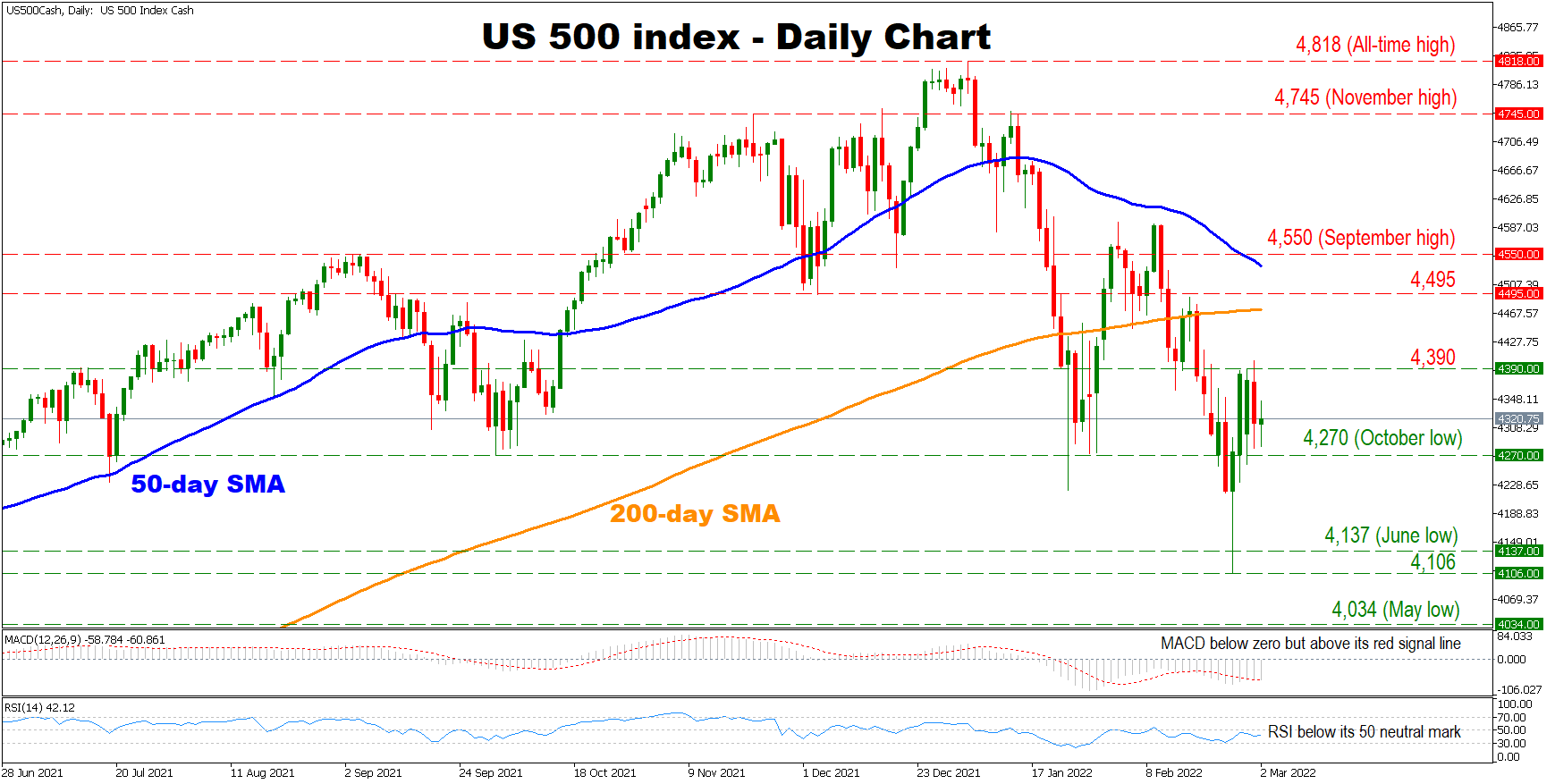
The US 500 cash index has quickly bounced above its 9-month low at 4,106 touched last week. However, the elevated negative pressures are still troubling the index, which is currently trading well below its 50- and 200-day simple moving averages (SMAs), reflecting an overall bearish outlook.
The short-term momentum indicators are painting a mixed picture as the RSI steady below its 50 neutral mark. On the country, the MACD is found below zero but above its red signal line, which indicates that the negative momentum in the price might be fading.
Should the bears maintain control, the October low at 4,270 might act as the first line of support, before sellers target the June low at 4,137. A break below this point could pave the way towards the 4,106 hurdle. Breaching below this point could intensify selling pressures, opening the door towards the May low at 4,034.
On the flip side, if the bulls resurface, initial resistance might be found at the 4,390 level before buyers take aim at the consecutive hurdles of the 200-day SMA currently at 4,473 and the 4,495 obstacle. A break above the latter could send the price towards the region which includes the 50-day SMA currently at 4,534 and the 4,550 barrier. Moving above this region could turn the fortunes around for the index, opening the door towards the November high of 4,745.
In brief, the overall outlook for the pair remains bearish. For sentiment to change, buyers would need to break above the 50-day SMA.
EURAUD Hits 2021 Bottom after Brutal Decline
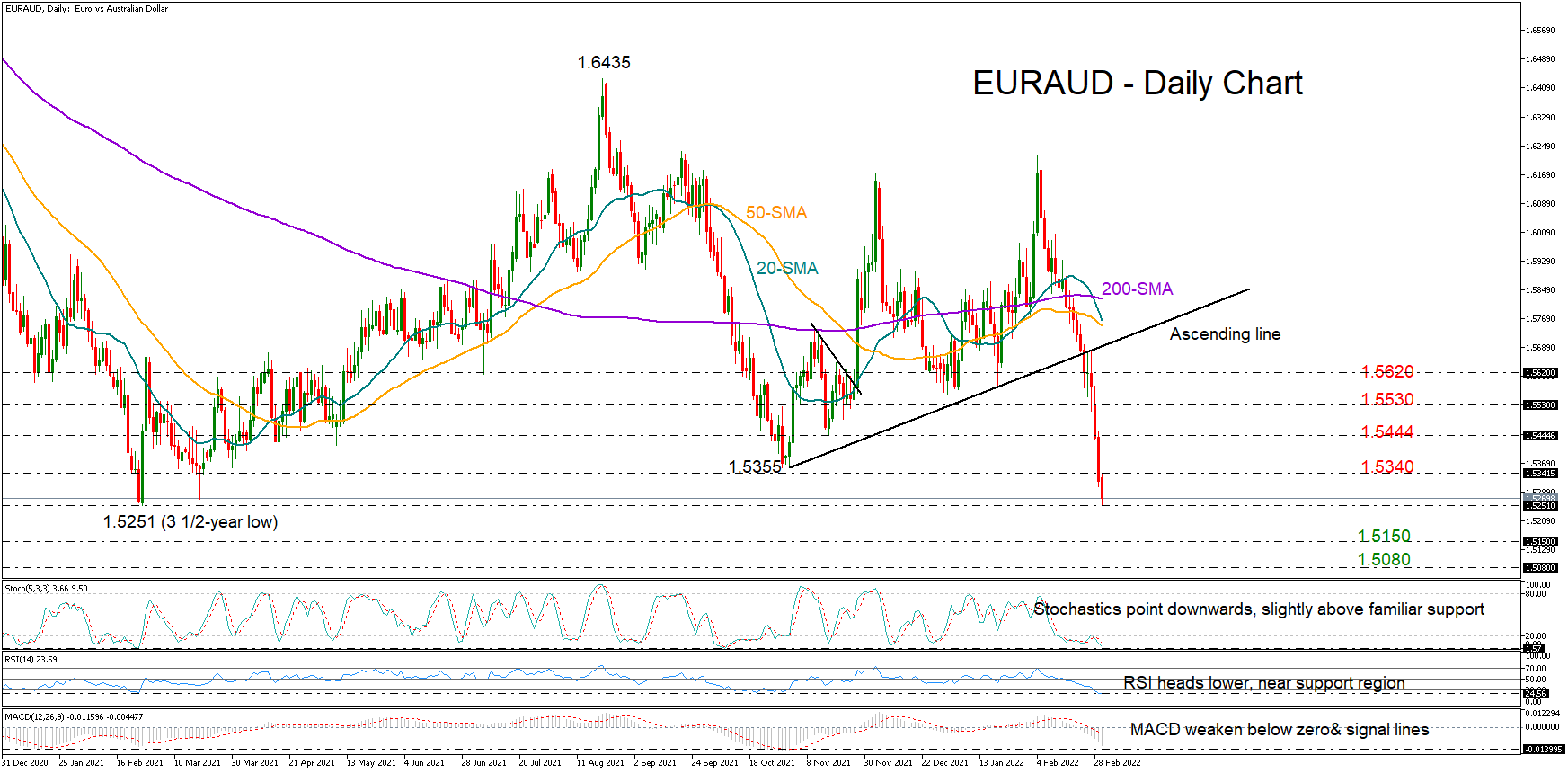
EURAUD has been in the red since the start of February, falling rapidly all the way down to meet the 2021 low of 1.5251 after last week’s bullish attempts hit a wall around the broken ascending trendline at 1.5680.
The market is trading in oversold territory according to the Stochastics and the RSI, though the former is still some distance above its former support region, which preceded the upside price reversals in February and October 2021. The RSI has already touched its previous bottom line, though it needs to show some stabilization before it raises a bullish flag for the market. Likewise, the MACD remains negatively charged below its red signal line and above its 2021 lows.
In the event the 1.5250 floor collapses, the sell-off could stretch towards the 2018 trough of 1.5150. Deeper, the spotlight will fall to the 2017 key barrier of 1.5080.
Should the bulls take control, the first blockage could emerge near 1.5340. Crawling higher, the price could test the 1.5444 barrier before heading for the 1.5530 number. Additional gains from here may drive the pair up to the key 1.5620 resistance.
Summarizing, EURAUD is clearly bearish in the short-term picture, though some recovery cannot be ruled out as technical indicators warn of oversold conditions.
USD/JPY Mid-Day Outlook
Daily Pivots: (S1) 114.64; (P) 114.96; (R1) 115.23; More...
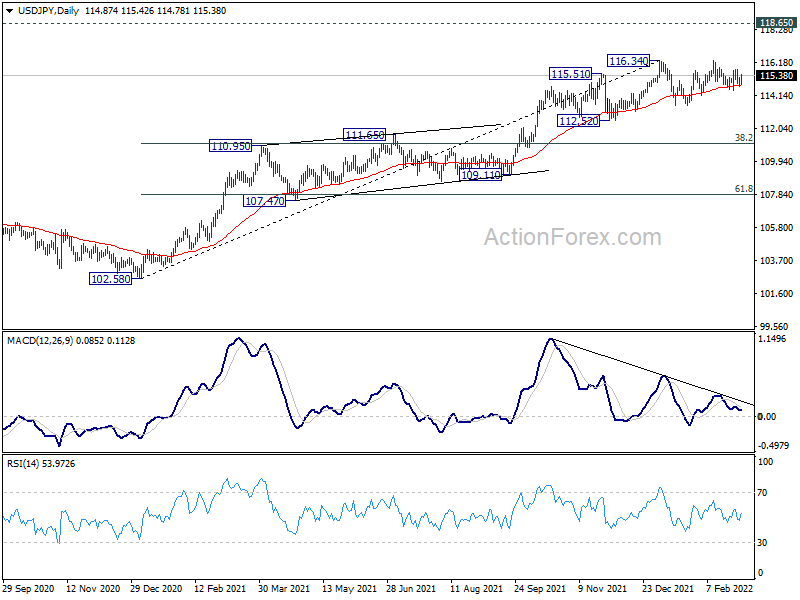
Intraday bias in USD/JPY remains neutral and outlook is unchanged. More sideway trading could be seen. On the upside, firm break of 116.34 will resume larger up trend from 102.58 to 118.65 long term resistance next. On the downside, though, break of 114.40 will continue the corrective pattern from 116.34 with another fall to 113.46 support.
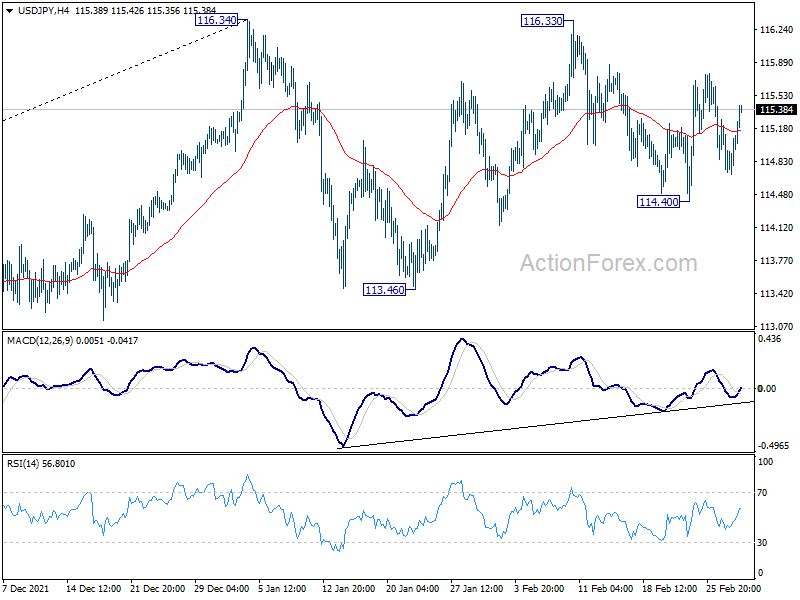
In the bigger picture, no change in the view that rise from 102.58 is the third leg of the up trend from 101.18 (2020 low). Such rally should target a test on 118.65 (2016 high). Sustained break there will pave the way to 120.85 (2015 high) and raise the chance of long term up trend resumption. This will remain the favored case as long as 55 week EMA (now at 111.64) holds.
USD/CHF Mid-Day Outlook
Daily Pivots: (S1) 0.9158; (P) 0.9181; (R1) 0.9213; More....
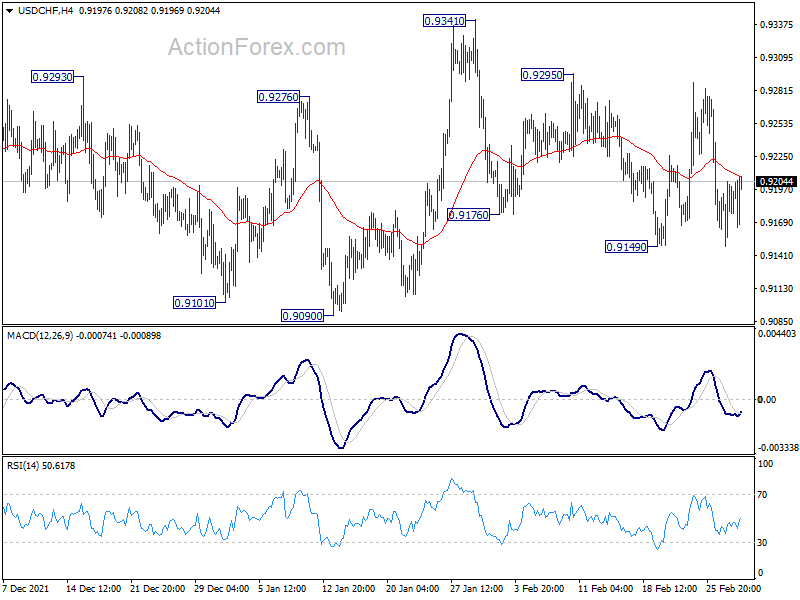
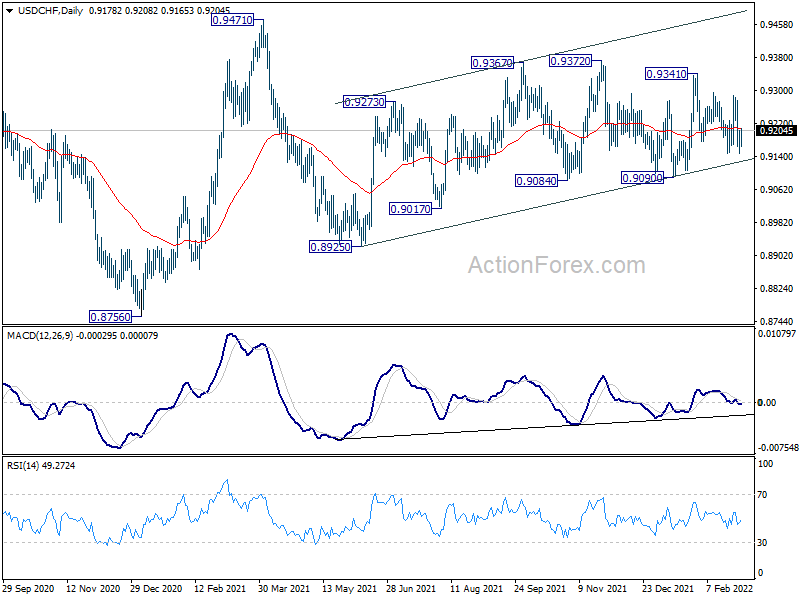
Intraday bias in USD/CHF remains neutral and outlook is unchanged. More sideway trading could be seen. Choppy rise from 0.8925 would still be in favor to extend higher as long as 0.9090 support holds. Break of 0.9341 will target 0.9372 resistance and then 0.9471. On the downside, however, break of 0.9090 will bring deeper fall back to 0.8925 support.
In the bigger picture, medium term outlook will be neutral at best as long as 0.9471 resistance holds. Larger down trend could still extend through 0.8756 (2021 low). However, firm break of 0.9471 will argue that the trend has already reversed and rebound the rally from 0.8756 with another impulsive move.
GBP/USD Mid-Day Outlook
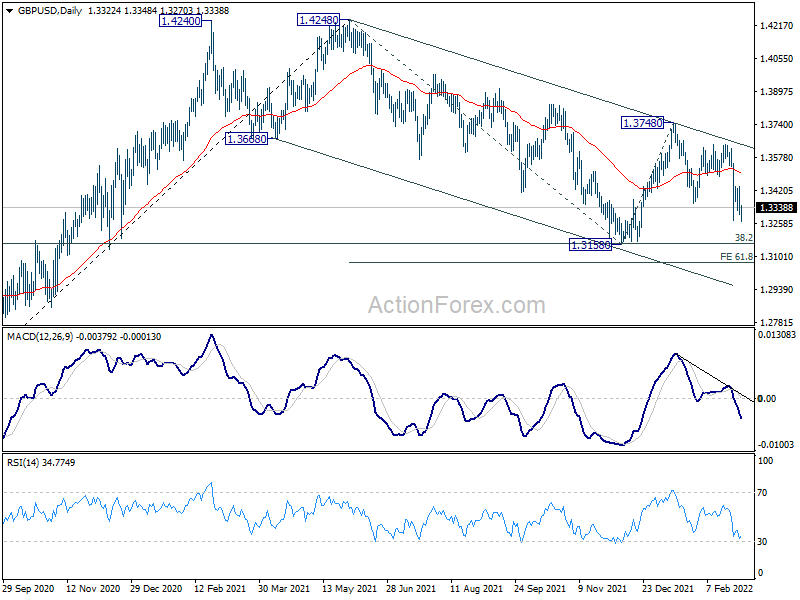
Daily Pivots: (S1) 1.3272; (P) 1.3355; (R1) 1.3407; More...
Intraday bias in GBP/USD remains neutral and outlook is unchanged. Further decline is expected with 1.3485 support turned resistance intact. On the downside, break of 1.3272 will target 1.3158 low. Further break there will resume larger down trend from 1.4248. However, firm break of 1.3485 will dampen this bearish view and turn bias back to the upside for 1.3641 resistance.
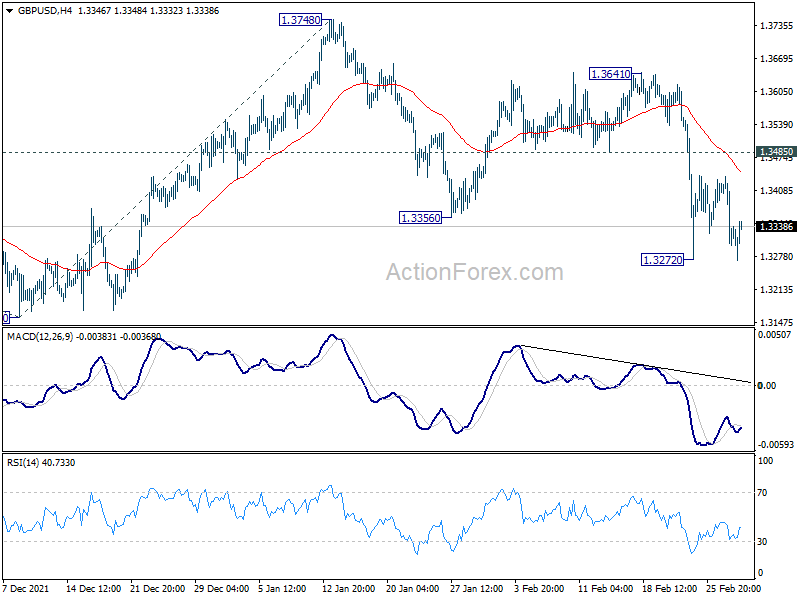
In the bigger picture, as long as 38.2% retracement of 1.1409 to 1.4248 at 1.3164 holds, up trend from 1.1409 (2020 low) is still in progress. On resumption, next target will be 38.2% retracement of 2.1161 to 1.1409 at 1.5134. Nevertheless sustained break of 1.3164 will argue that whole rise from 1.1409 has completed and bring deeper fall to 61.8% retracement at 1.2493.