

Sample Category Title
EUR/USD Mid-Day Outlook
Daily Pivots: (S1) 1.1065; (P) 1.1149; (R1) 1.1208; More...
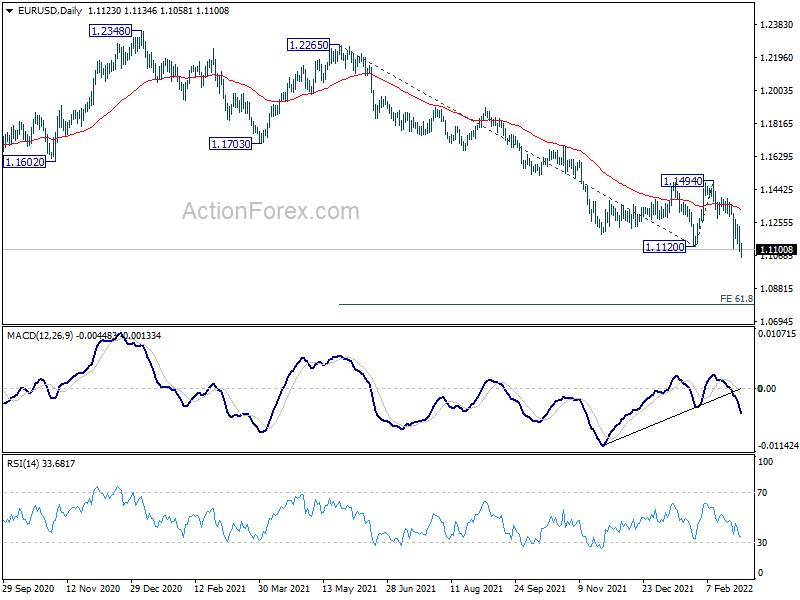
Intraday bias in EUR/USD remains on the downside at this point. Current fall is part of the down trend from 1.2348. Next target is 61.8% projection of 1.2265 to 1.1120 from 1.1494 at 1.0786. On the upside, break of 1.1273 resistance is needed to be the first sign of bottoming. Otherwise, outlook stays bearish in case of recovery.
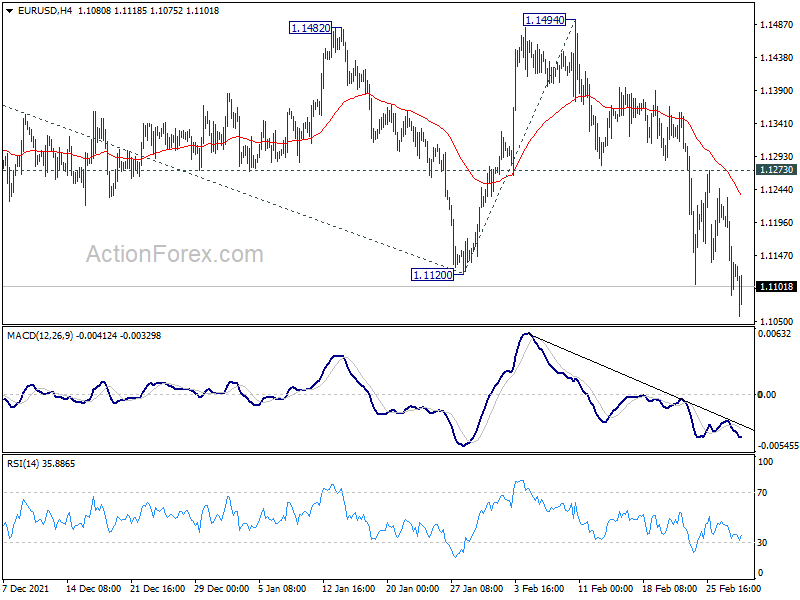
In the bigger picture, the decline from 1.2348 (2021 high) is expected to continue as long as 1.1494 resistance holds. Firm break of 1.0635 (2020 low) will raise the chance of long term down trend resumption and target a retest on 1.0339 (2017 low) next. Nevertheless, break of 1.1494 will maintain medium term neutral outlook, and extend range trading first.
Sentiment Stabilized Somewhat But Euro Remains Pressured
Market sentiment stabilized a bit on reports that Russia a suggests to hold another round of peace talks with Ukraine, while Vladimir Putin's forces continue to shell multiple crowded Ukrainian cities. Stocks are recovery but remain vulnerable to more selloff. In the currency markets, Swiss Franc is paring some gains but remains the strongest one for the week. Euro is staying under tremendous pressure. Canadian Dollar is mixed, awaiting BoC rate hike. In other markets, Gold is dipping mildly after rally stalled at around 1950. WTI crude oil continues to march higher towards 115 handle.
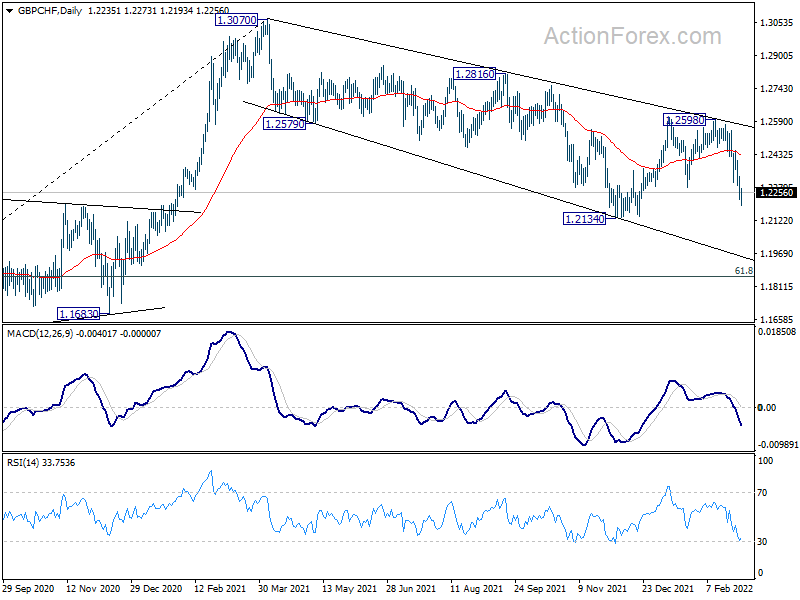
Technically, Sterling is not performing much better than Euro. GBP/CHF's fall from 1.2598 is accelerating towards 1.2134 support. Break there will resume larger down trend from 1.3070. That, if happens, could be accompanied by a break of 1.3158 low in GBP/USD and 148.94 support in GBP/JPY.
In Europe, at the time of writing, FTSE is up 0.67%. DAX is up 0.11%. CAC is up 0.47%. Germany 10-year yield is up 0.0058 at -0.015. Earlier in Asia, Nikkei dropped -1.68%. Hong Kong HSI dropped -1.84%. China Shanghai SSE dropped -0.13%. Singapore Strait Times dropped -1.04%. Japan 10-year JGB yield dropped -0.0474 to 0.134.
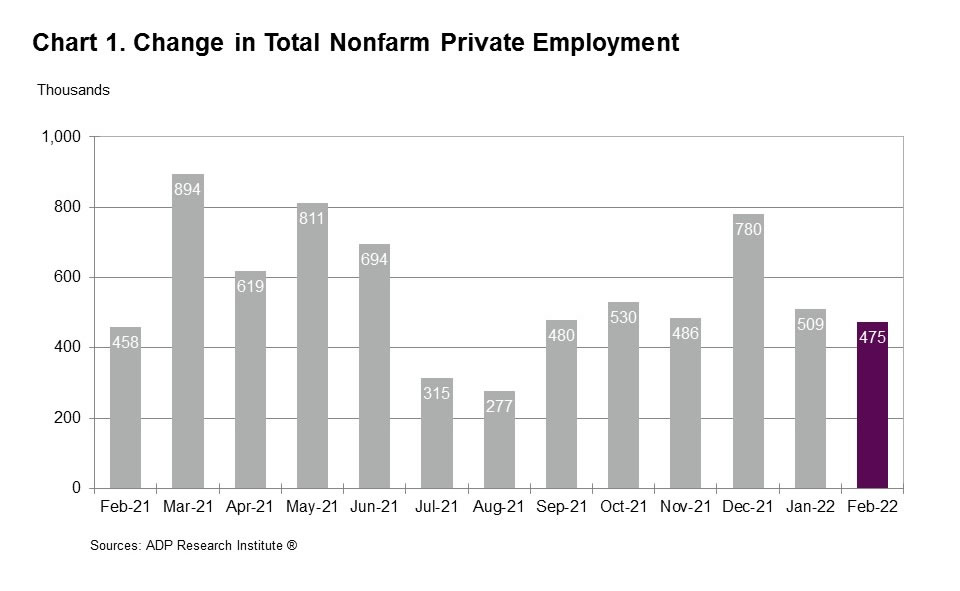
US ADP jobs grew 475k in Feb, hiring remains robust but capped up labor supply
US ADP private employment grew 475k in February, above expectation of 320k. By company size, small businesses lost -96k jobs, medium added 18k while large businesses added 522k. By sector goods-producing jobs rose 57k and service-providing jobs rose 417k.
"Hiring remains robust but capped by reduced labor supply post-pandemic. Last month large companies showed they are well-poised to compete with higher wages and benefit offerings, and posted the strongest reading since the early days of the pandemic recovery," said Nela Richardson, chief economist, ADP. "Small companies lost ground as they continue to struggle to keep pace with the wages and benefits needed to attract a limited pool of qualified workers."
ECB de Guindos: Global financial exposure to Russia somewhat limited
European Central Bank (ECB) Vice President Luis de Guindos said, "invasion of Ukraine by Russia will have an impact on the economy in the eurozone, will also have an impact on inflation."
"Global financial exposure to Russia is somewhat limited," he said. "Most significant risks are energy shocks."
De Guindos also said the Eurozone inflation data in February has been a "negative surprise".
Eurozone CPI rose to new record 5.8% yoy in Feb
Eurozone CPI accelerated from 5.1% yoy to 5.8% yoy in February, well above expectation of 5.3% yoy. That's also a new record high. Core CPI also rose from 2.3% yoy to 2.7% yoy, above expectation of 2.5% yoy.
Energy is expected to have the highest annual rate in February (31.7%, compared with 28.8% in January), followed by food, alcohol & tobacco (4.1%, compared with 3.5% in January), non-energy industrial goods (3.0%, compared with 2.1% in January) and services (2.5%, compared with 2.3% in January).
Australia GDP grew 3.4% qoq in Q4, no material impact from Omicron
Australia GDP grew 3.4% qoq in Q4, above expectation of 2.9% qoq. Real net national disposable income rose 1.7%. Terms of trade fell -5.1%. GDP in the December quarter 2021 was 3.4% above December 2019 pre-pandemic levels. The emergence of the Omicron variant over the second half of December 2021 did not have a material impact on activity this quarter.
From New Zealand, terms of trade index dropped -1.0% in Q4, below expectation of 0.9%. building permits dropped -9.2% mom in January.
From Japan, capital spending rose 4.3% in Q4, above expectation of 2.9%. Monetary base rose 7.6% yoy in February, below expectation of 8.6% yoy.
EUR/USD Mid-Day Outlook
Daily Pivots: (S1) 1.1065; (P) 1.1149; (R1) 1.1208; More...
Intraday bias in EUR/USD remains on the downside at this point. Current fall is part of the down trend from 1.2348. Next target is 61.8% projection of 1.2265 to 1.1120 from 1.1494 at 1.0786. On the upside, break of 1.1273 resistance is needed to be the first sign of bottoming. Otherwise, outlook stays bearish in case of recovery.
In the bigger picture, the decline from 1.2348 (2021 high) is expected to continue as long as 1.1494 resistance holds. Firm break of 1.0635 (2020 low) will raise the chance of long term down trend resumption and target a retest on 1.0339 (2017 low) next. Nevertheless, break of 1.1494 will maintain medium term neutral outlook, and extend range trading first.
Economic Indicators Update
| GMT | Ccy | Events | Actual | Forecast | Previous | Revised |
|---|---|---|---|---|---|---|
| 21:45 | NZD | Building Permits M/M Jan | -9.20% | 0.60% | 0.40% | |
| 21:45 | NZD | Terms of Trade Index Q4 | -1.00% | 0.90% | 0.70% | 0.40% |
| 23:50 | JPY | Capital Spending Q4 | 4.30% | 2.90% | 1.20% | |
| 23:50 | JPY | Monetary Base Y/Y Feb | 7.60% | 8.60% | 8.40% | |
| 00:01 | GBP | BRC Shop Price Index Y/Y Jan | 1.80% | 1.50% | ||
| 00:30 | AUD | GDP Q/Q Q4 | 3.40% | 2.90% | -1.90% | |
| 08:55 | EUR | Germany Unemployment Change Feb | -33K | -23K | -48K | |
| 08:55 | EUR | Germany Unemployment Rate Feb | 5.00% | 5.10% | 5.10% | |
| 10:00 | EUR | Eurozone CPI Feb P | 5.80% | 5.30% | 5.10% | |
| 10:00 | EUR | Eurozone CPI Core Feb P | 2.70% | 2.50% | 2.30% | |
| 13:15 | USD | ADP Employment Change Feb | 475K | 320K | -301K | |
| 15:00 | CAD | BoC Interest Rate Decision | 0.50% | 0.25% | ||
| 15:30 | USD | Crude Oil Inventories | 2.5M | 4.5M | ||
| 19:00 | USD | Fed's Beige Book |
US ADP jobs grew 475k in Feb, hiring remains robust but capped up labor supply
US ADP private employment grew 475k in February, above expectation of 320k. By company size, small businesses lost -96k jobs, medium added 18k while large businesses added 522k. By sector goods-producing jobs rose 57k and service-providing jobs rose 417k.
"Hiring remains robust but capped by reduced labor supply post-pandemic. Last month large companies showed they are well-poised to compete with higher wages and benefit offerings, and posted the strongest reading since the early days of the pandemic recovery," said Nela Richardson, chief economist, ADP. "Small companies lost ground as they continue to struggle to keep pace with the wages and benefits needed to attract a limited pool of qualified workers."
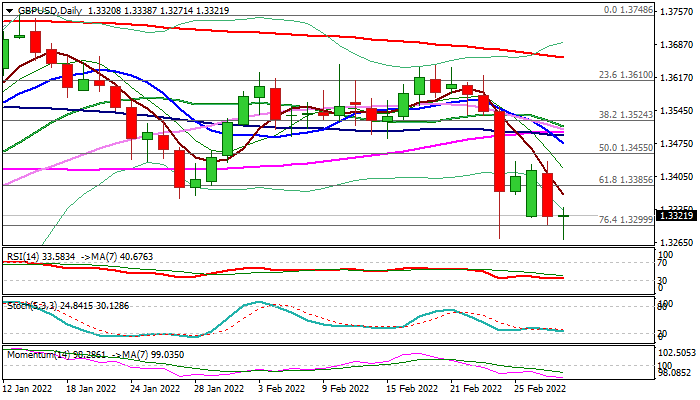
GBP/USD Outlook: Remains in Negative Mode and Cracks 1.33 Fibo Support
Cable probed below 1.33 mark and cracked 2022 low (1.3272) posted on Feb 24 when war in Ukraine started but failed to sustain break and holding above pivotal 1.33 level (Fibo 76.4% of 1.3161/1.3748) so far.
Near-term outlook remains grim, as conflict resumes, keeping in play strong risk aversion that lifts the dollar.
Technical studies also point to the downside, as Tuesday’s large bearish daily candle weighs, adding to strengthening negative momentum and moving averages in full bearish on daily chart.
Firm break of 1.33 handle would generate fresh bearish signal and open way for test of Dec 8 low at 1.3161.
Failure to clear 1.33 level would signal extended consolidation but bias will remain with bears while the tops of past three days (1.3435 zone) cap.
Res: 1.3338; 1.3385; 1.3435; 1.3455.
Sup: 1.3300; 1.3271; 1.3240; 1.3197.
ECB de Guindos: Global financial exposure to Russia somewhat limited
European Central Bank (ECB) Vice President Luis de Guindos said, "invasion of Ukraine by Russia will have an impact on the economy in the eurozone, will also have an impact on inflation."
"Global financial exposure to Russia is somewhat limited," he said. "Most significant risks are energy shocks."
De Guindos also said the Eurozone inflation data in February has been a "negative surprise".
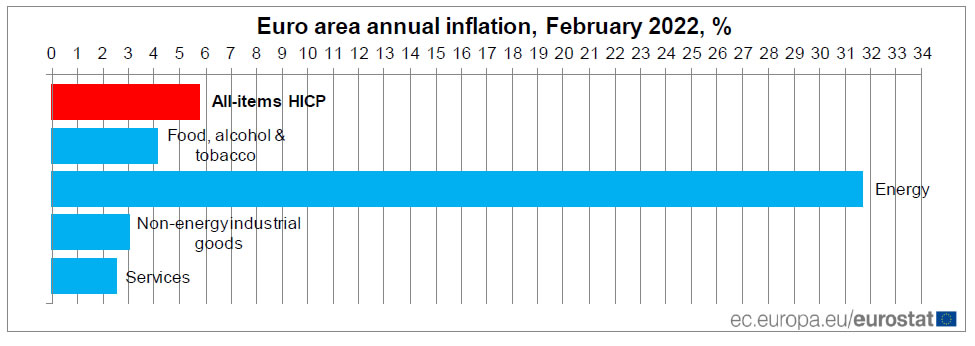
Eurozone CPI rose to new record 5.8% yoy in Feb
Eurozone CPI accelerated from 5.1% yoy to 5.8% yoy in February, well above expectation of 5.3% yoy. That's also a new record high. Core CPI also rose from 2.3% yoy to 2.7% yoy, above expectation of 2.5% yoy.
Energy is expected to have the highest annual rate in February (31.7%, compared with 28.8% in January), followed by food, alcohol & tobacco (4.1%, compared with 3.5% in January), non-energy industrial goods (3.0%, compared with 2.1% in January) and services (2.5%, compared with 2.3% in January).
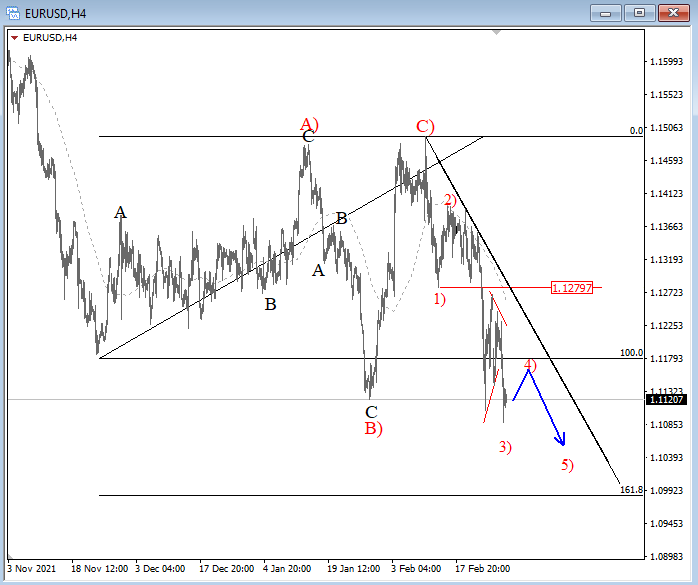
EUR/USD Slides to a New Low: Elliott Wave Analysis
US stocks were stable yesterday while equities in Europe came down as the situation in Ukraine is not better. However, negotiations between Russia and Ukraine will reportedly still take place soon. So there can be some hope for price stabilization.
EURUSD is coming sharply down due to the situation in Ukraine, currently already accelerating so it seems that the pair is in impulsive sell-off headed back to a new low, thus more weakness can follow after rallies until it fully completes a five-wave bearish cycle.
EUR/USD 4h Elliott Wave analysis
Slumping Euro Drops Below 1.11
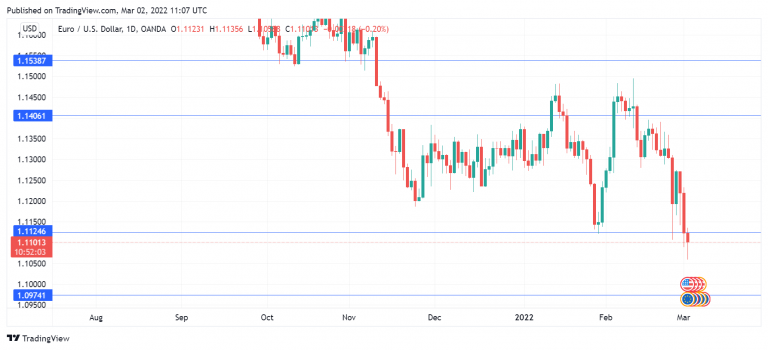
The euro has fallen for three straight days and continues to lose ground on Wednesday. EUR/USD has dropped below the 1.11 line for the first time since May 2020, at the height of the first wave of Covid-19. It is looking ugly for the euro, which has sank 1.62% so far this week.
The intensified fighting which is raging in Ukraine has taken its toll on the euro. The eurozone is geographically close to the crisis and fears over shortages of gas and oil supplies due to a dependence on Russian supplies are weighing heavily on the currency. The US dollar is benefitting from the flight to safety by panicked investors, and the significant fall in US yields has also boosted the greenback.
Eurozone CPI jumps
Inflation in the eurozone continues to accelerate, much to the concern of the ECB. German CPI for February climbed 5.1% YoY, up from 4.9% a month earlier and matching the forecast. Eurozone CPI for February accelerated to 5.8%, above the estimate of 5.3% and ahead of the 5.1% gain in January.
The ECB holds a policy meeting on March 10th, but based on the most recent comments from ECB policy makers, the central bank will not tighten policy. These ECB members have been saying that the ECB should refrain from any significant shift in policy while the Ukraine crisis is unfolding. Germany’s 10-year bonds have fallen sharply, an indication that the markets expect central banks to be cautious and raise rates at a slower pace than had been expected before the Ukraine crisis.
The problem for central banks, especially the Fed and the BoE, is that inflation is red-hot and is unlikely to ease without higher rates to curb inflationary pressures. When it comes to monetary policy, the ECB will be walking a fine line between higher inflation and a full-blown military conflict in its backyard.
EUR/USD Technical
- There is resistance at 1.1406 and 1.1538
- EUR/USD is testing a major support level at 1.1100. Below, there is support at 1.0974
The US Dollar Index Hits Multi-Year Highs
The escalating conflict in the Ukraine, less-than-dovish Fed speakers, and solid US manufacturing survey data pushed the US dollar index (DXY) to a multi-year high of 97.80 on Wednesday. Investors scrambled to buy US dollars for a second consecutive day as they weighed up increasingly more punitive sanctions on Russia and intensified fighting in the Ukraine.
Markets are volatile, and the US dollar, as the ultimate safe-haven asset, is fully mixed up with the Ukraine conflict. As we pointed out in early February, the DXY had more-or-less been trading within a range of 96.940 and 95.495 since December last year. Short breaks to the upside and downside of that range had occurred in the past but failed on the retest.
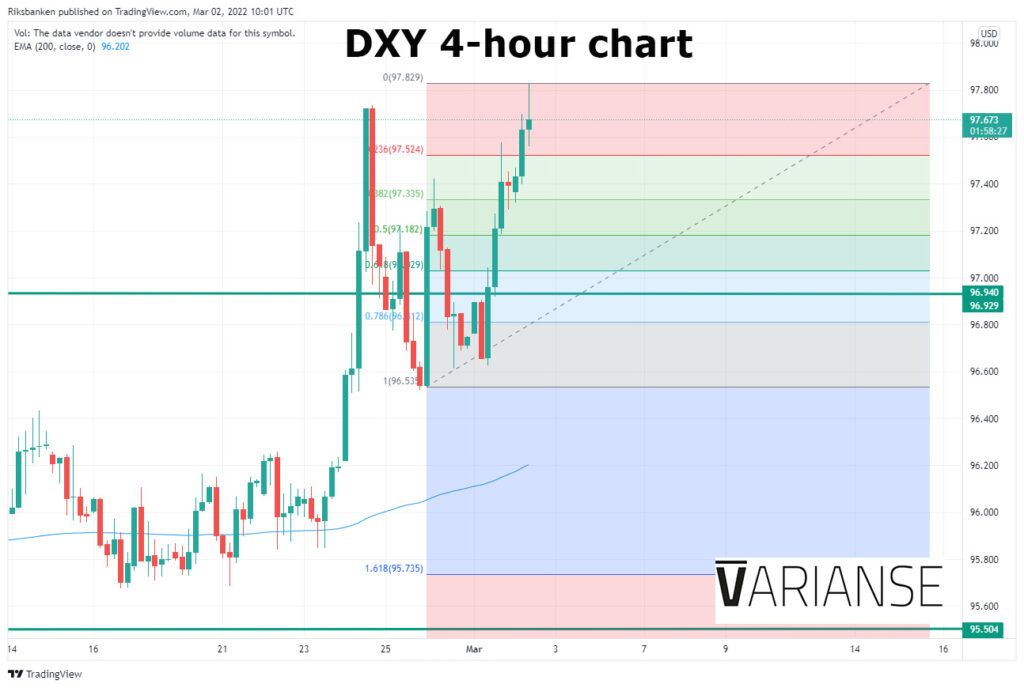
This time around, however, the DXY has broke above its range, retested, and then continued to new highs. Furthermore, the DXY has suddenly moved further away from its 4-hour 200 EMA. Whilst much of the recent move is driven by geopolitical risk concerns that can easily ebb and flow, the latest shift higher in the DXY is not insignificant.
Crypto Whales Are Aggressively Buying Bitcoin
BTC has risen in price by 1.9% over the day to $44,100. Ethereum has grown by 2.5%, approaching $3,000. Other leading altcoins from the top ten add with maximum momentum such as Solana (+6.7%) and Terra (+5.2%)
After coming close to $45K, ИЕСГЫВ fell slightly during the American session along with stock indices. BTC showed resilience despite the decline in other risky assets and the growth of the dollar.
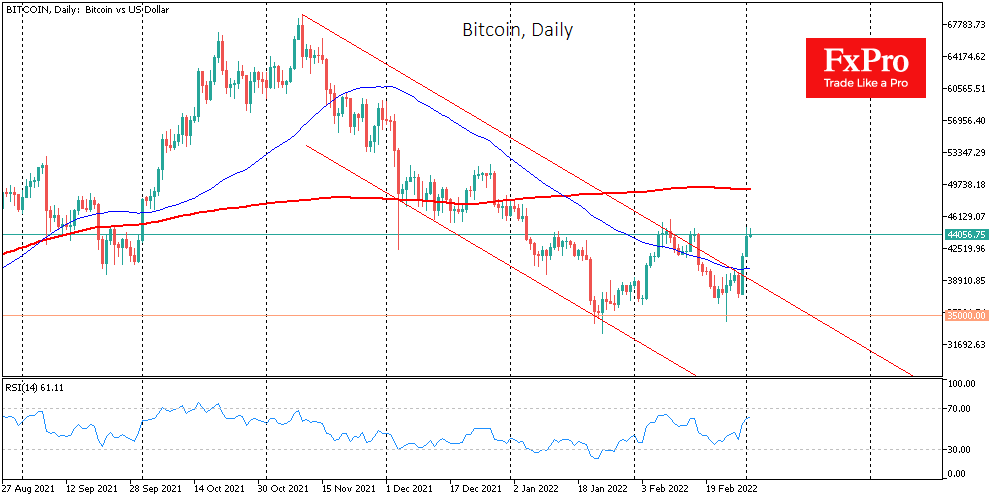
On the Binance exchange, the volume of trading in ruble pairs with BTC and USDT has increased significantly.
Crypto funds recorded $36 million in net asset inflows during the week, up from $239 million over the past five weeks, according to CoinShares. Institutions are also looking for alternative vehicles amid mounting military tensions and government capital controls.
According to Glassnode, crypto whales have been aggressively buying bitcoin over the past few weeks, which could signal a local bottom has been reached. The last time such a situation was observed was in May last year, when, after a two-month consolidation, the market resumed growth at the end of July.
The total capitalization of the crypto market, according to CoinMarketCap, grew by 2% over the day, to $1.94 trillion. The Bitcoin Dominance Index is hovering around 43%.