Sample Category Title
USD/CAD Daily Outlook
Daily Pivots: (S1) 1.2681; (P) 1.2715; (R1) 1.2777; More...
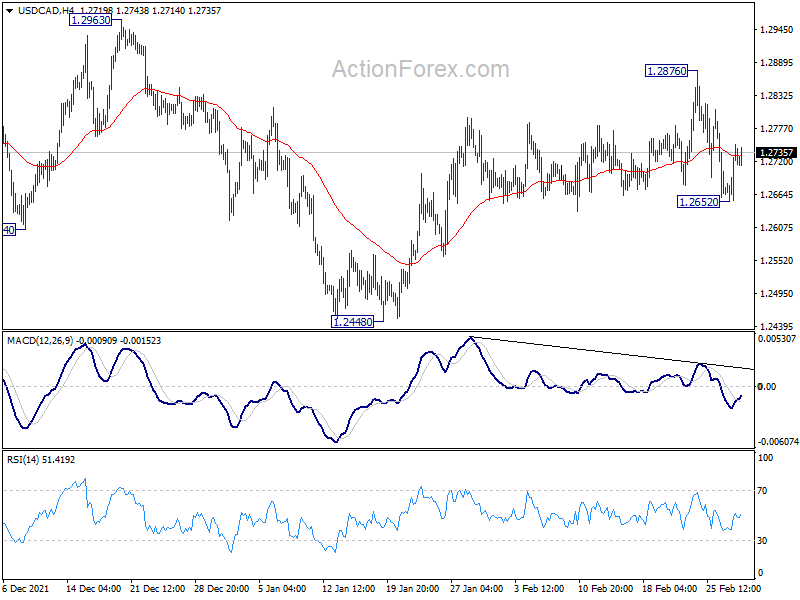
Intraday bias in USD/CAD is turned neutral with current recovery. On the downside, break of 1.2652 will revive the case that rebound from 1.2448 has completed at 1.2876. Deeper fall should be seen back to retest 1.2448 low. However, break of 1.2876 will resume the rise from 1.2448 to 1.2963 instead.
In the bigger picture, focus stays on 38.2% retracement of 1.4667 (2020 high) to 1.2005 (2021 low) at 1.3022. Sustained break there should confirm that the down trend from 1.4667 has completed after defending 1.2061 long term cluster support. Further rise would then be seen towards 61.8% retracement at 1.3650. However, rejection by 1.3022 will maintain medium term bearishness. Break of 1.2005 will resume the down trend from 1.4667 and that carries larger bearish implications too.
EUR/CHF Daily Outlook
Daily Pivots: (S1) 1.0182; (P) 1.0240; (R1) 1.0280; More....
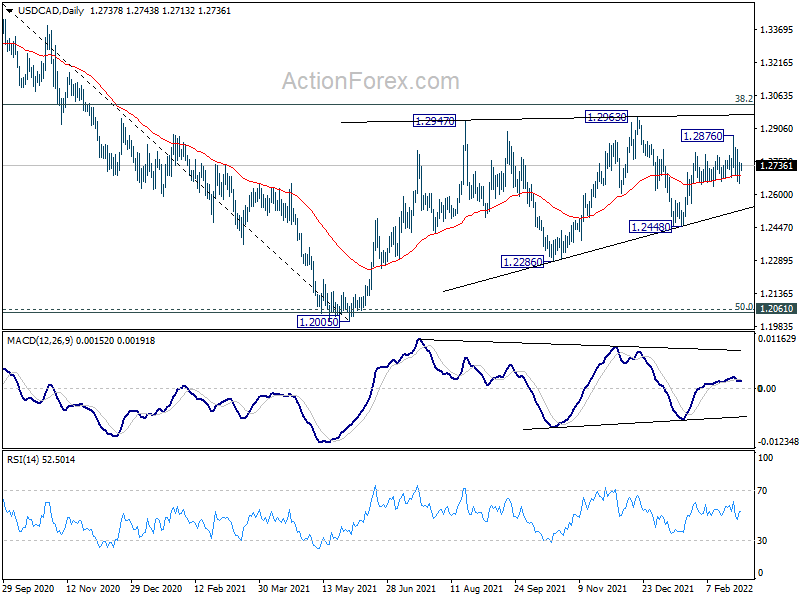
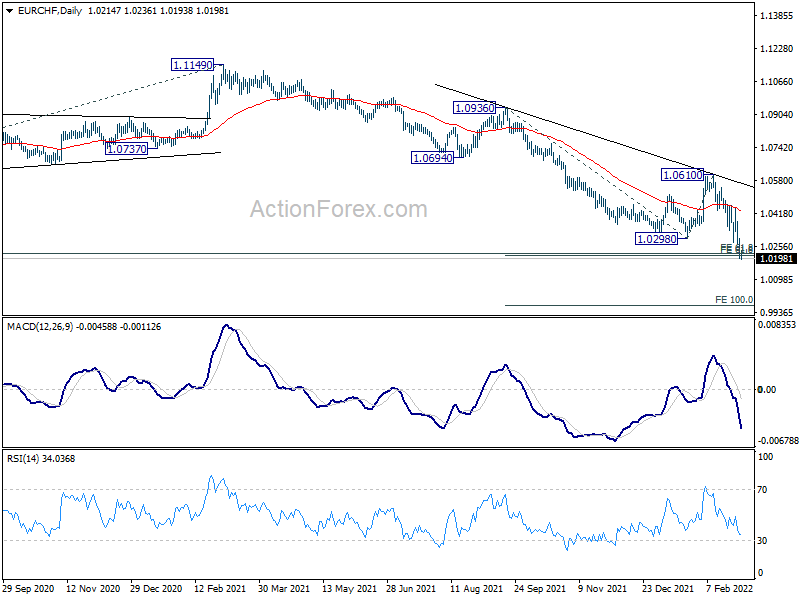
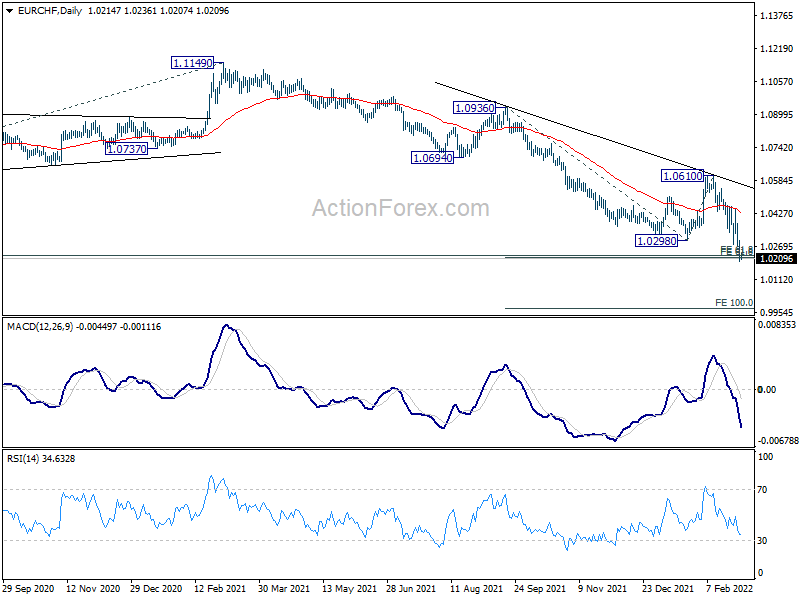
EUR/CHF's fall is still in progress and intraday bias stays on the downside. Sustained break of 61.8% projection of 1.0936 to 1.0298 from 1.0610 at 1.0216 will pave the way to 100% projection at 0.9972. On the upside, break of 1.0336 resistance is needed to indicate short term bottoming. Otherwise, outlook will stay bearish in case of recovery.
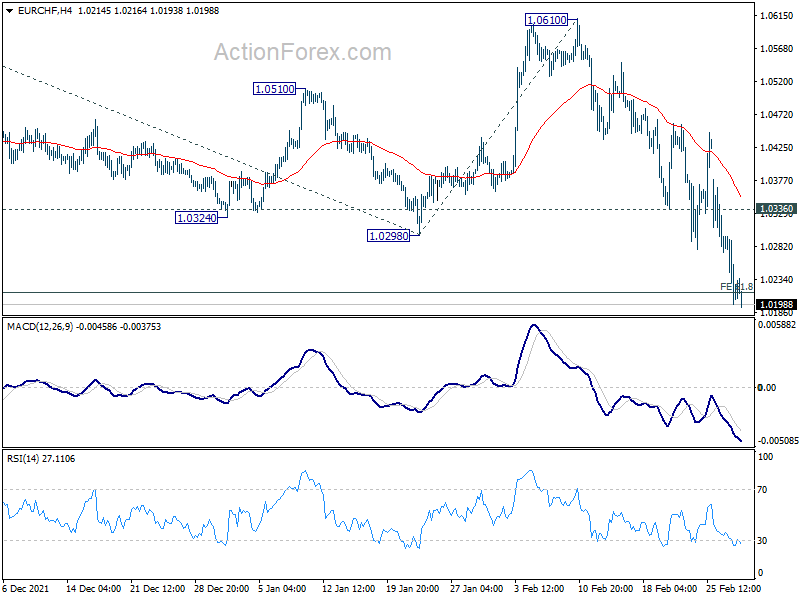
In the bigger picture, long term down trend from 1.2004 (2018 high) is still in progress. Firm break of 61.8% projection of 1.2004 to 1.0505 to 1.1149 at 1.0223 will pave the way to 100% projection at 0.9650. In any case, break of 1.0610 resistance is needed to be the first sign of bottoming. Otherwise, outlook will remain bearish.
EUR/GBP Daily Outlook
Daily Pivots: (S1) 0.8320; (P) 0.8344; (R1) 0.8372; More...
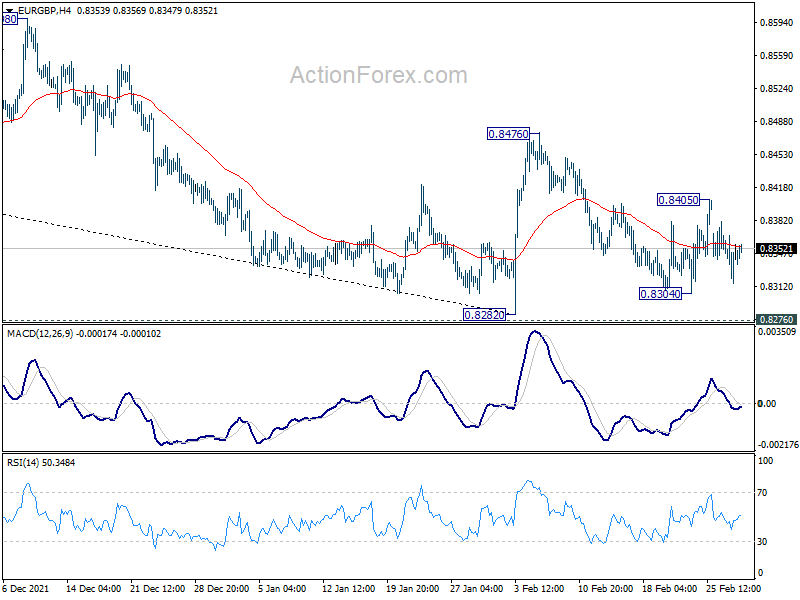
Range trading continues in EUR/GBP and intraday bias remains neutral first. On the upside, above 0.8405 will target 0.8476 resistance first. Break there will resume the rebound from 0.8282 to 0.8598 key resistance level. On the downside, though, break of 0.8304 will turn bias back to the downside for 0.8282 low again.
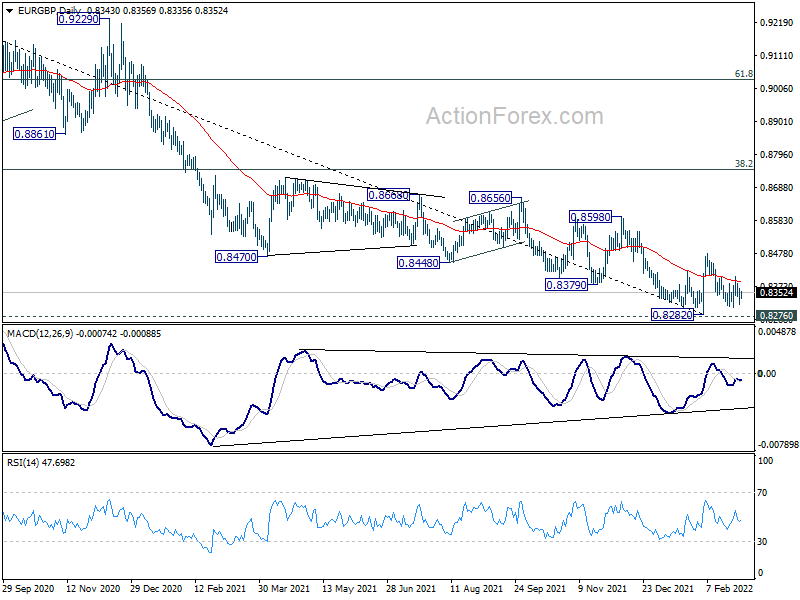
In the bigger picture, price actions from 0.9499 (2020 high) are still seen a corrective pattern that should be contained by 0.8276 long term support (2019 low). Sustained trading above 38.2% retracement of 0.9499 to 0.8282 at 0.8747 will affirm this bullish case. However, sustained break of 0.8276 will argue that the long term trend has reversed. Deeper decline would be seen to 61.8% retracement of 0.6935 to 0.9499 at 0.7917.
EUR/AUD Daily Outlook
Daily Pivots: (S1) 1.5274; (P) 1.5366; (R1) 1.5428; More...
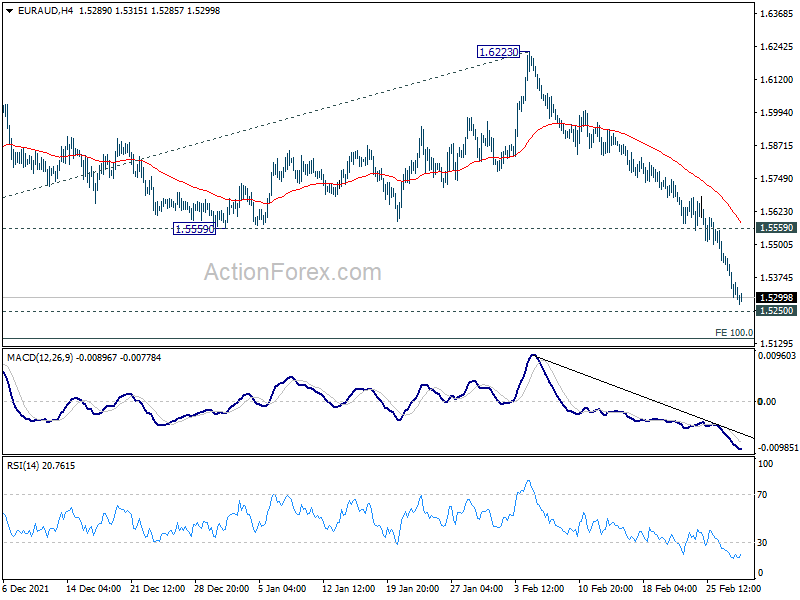
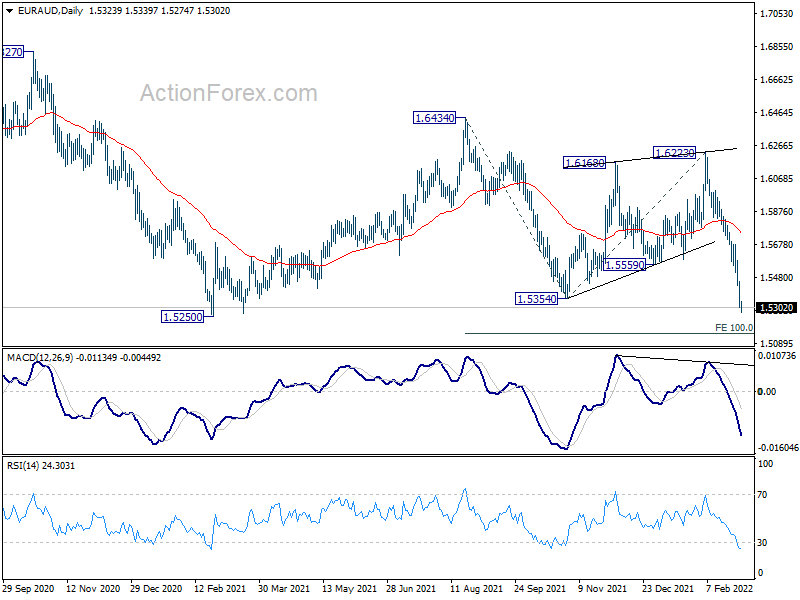
Intraday bias in EUR/AUD remains on the downside for 1.5250 low. Decisive break there will resume larger down trend from 1.9799. Next near term target will be 100% projection of 1.6343 to 1.5354 from 1.6223 at 1.5143. On the upside, break of 1.5559 support turned resistance is needed to indicate short term bottoming. Otherwise, outlook stays bearish in case of recovery.
In the bigger picture, price actions from 1.5250 low are seen as a corrective pattern. Further extension could be seen and another rise cannot be ruled out. But strong resistance should be seen at 38.2% retracement of 1.9799 to 1.5250 at 1.6988. Larger down trend from 1.9799 (2020 high) is in favor to extend through 1.5250 at a later stage. Next target is 61.8% retracement of 1.1602 (2012 low) to 1.9799 at 1.4733
EUR/JPY Daily Outlook
Daily Pivots: (S1) 128.32; (P) 129.05; (R1) 129.72; More....
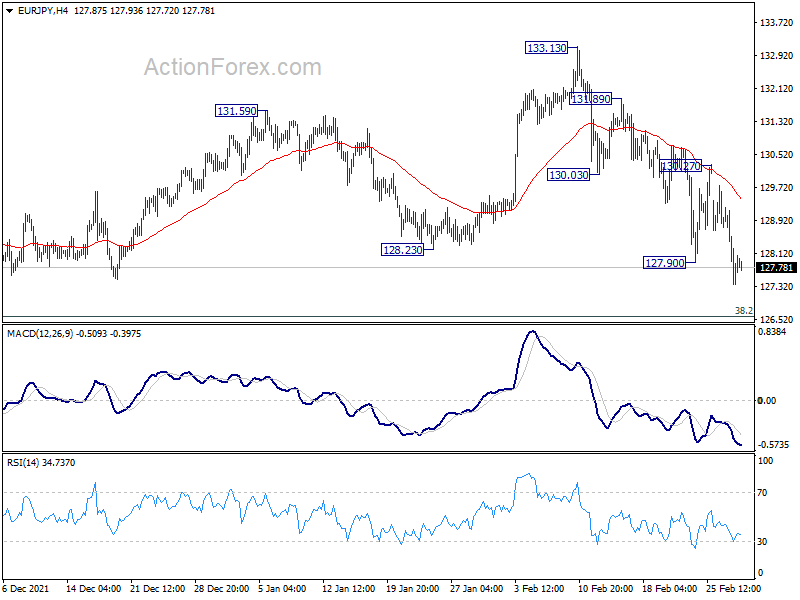
EUR/JPY's fall resumed by breaking through 127.90 and intraday bias is back on the downside. Decline from 133.13, as another falling leg of the corrective pattern from 134.11, should target 126.58 fibonacci level next. For now, risk will remain on the downside as long as 130.27 minor resistance holds, in case of recovery.
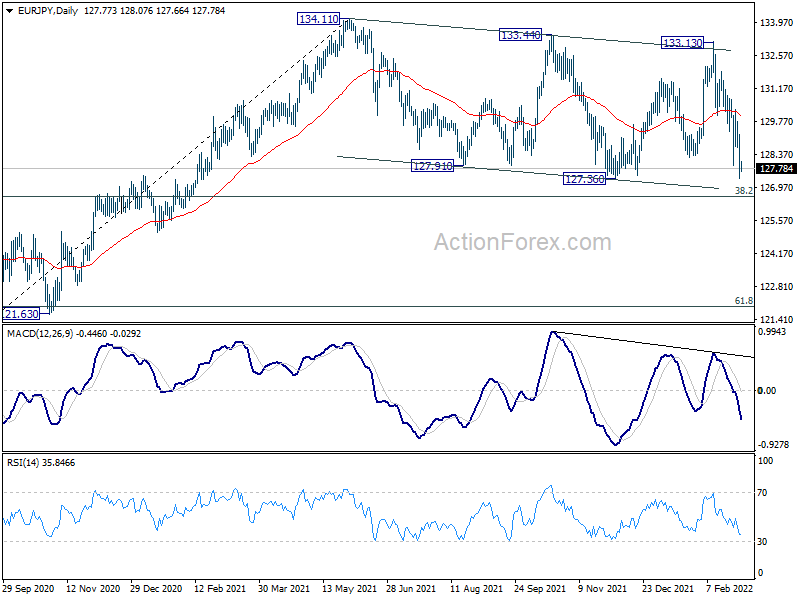
In the bigger picture, price actions from 134.11 are currently seen as a consolidation pattern only. As long as 38.2% retracement of 114.42 (2020 low) to 134.11 at 126.58 holds, up trend from 114.42 is still in favor to continue. Break of 134.11 will target long term resistance at 137.49 (2018 high). However, sustained break of 126.58 will raise the chance of bearish reversal. In this case, deeper decline would be seen to 61.8% retracement at 121.94, and possibly below.
GBP/JPY Daily Outlook
Daily Pivots: (S1) 152.28; (P) 153.48; (R1) 154.31; More...
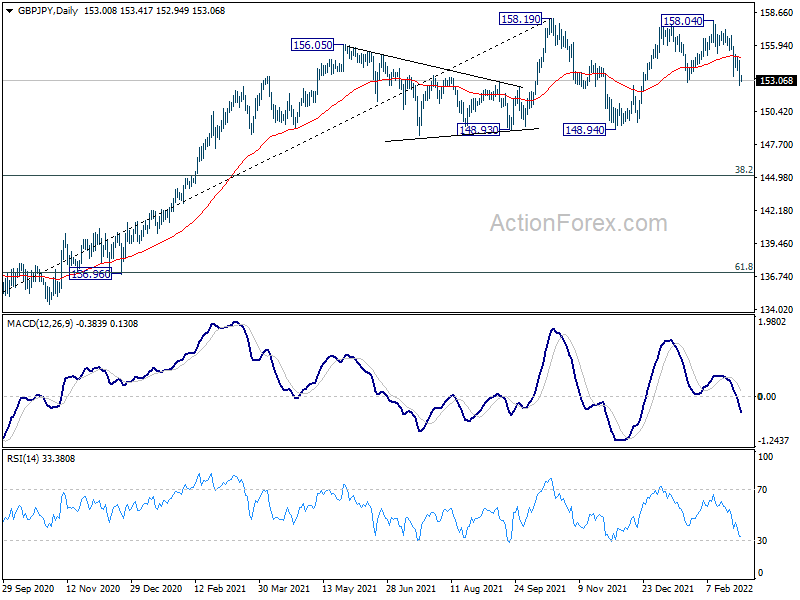
GBP/JPY's fall resumes by taking out 153.34 temporary low and intraday bias is back on the downside. Fall from 158.04 is seen as the third leg of the corrective pattern from 158.19. Break of 152.88 will target 148.94 support next. Risk will remain on the downside as long as 155.16 resistance holds, in case of recovery.
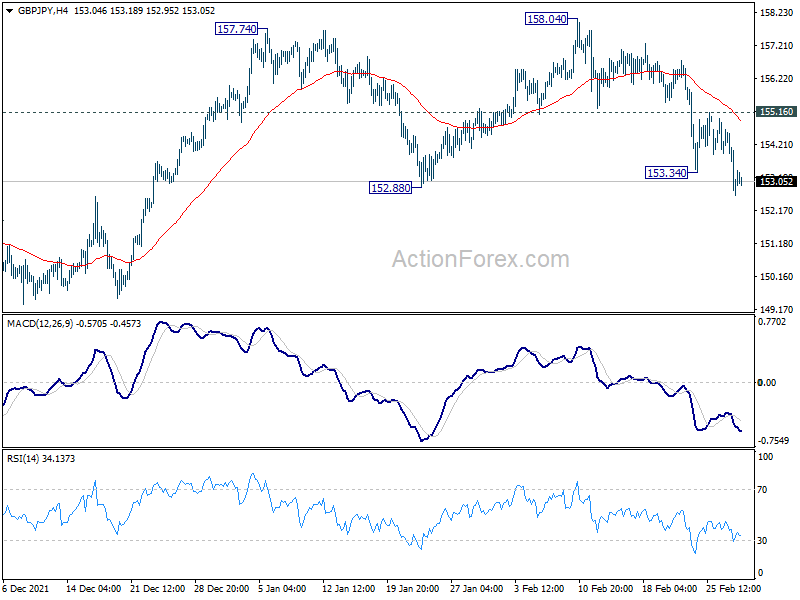
In the bigger picture, price actions from 158.19 are seen as developing into a consolidation pattern to up trend from 123.94 (2020 low). Downside should be contained by 38.2% retracement of 123.94 to 158.19 at 145.10 to bring rebound. Firm break of 158.19 will resume the up trend to long term fibonacci level at 167.93. However, sustained break of 145.10 will raise the chance of trend reversal and target 61.8% retracement at 137.02.
EUR Weak, Oil Surges, CAD Awaits BoC
Russia's invasion of Ukraine remain the dominant theme in the markets, and Euro and Sterling stay pressured as a result. Swiss Franc is the biggest winner for now on safe haven flow, but Aussie and Yen are also supported. On the other hand, Dollar is dragged down by the steep fall in treasury yield overnight. Canadian Dollar is mixed and BoC rate hike is unlikely to give it much boost. In other markets, WTI crude oil surged again and breached 110 handle. Gold is staying firm above 1900 for now, but still lacks follow through buying. Asian stocks are weak, following the selloff in US overnight.
Technically, EUR/CHF is now pressing 61.8% projection of 1.0936 to 1.0298 from 1.0610 at 1.0216. Sustained break of this level could prompt downside acceleration to 100% projection at 0.9972, i.e. below parity. If that happens, the selloff could easily be spread to some other pairs, including EUR/USD, EUR/JPY, EUR/CAD and EUR/AUD.
In Asia, Nikkei closed down -1.68%. Hong Kong HSI is down -1.23%. China Shanghai SSE is down -0.21%. Singapore Strait Times is down -0.58%. Japan 10-year JGB yield is down -0.0431 at 0.138. Overnight, DOW dropped -1.76%. S&P 500 dropped -1.55%. NASDAQ dropped -1.59%. 10-year yield dropped -0.132 to 1.707.
WTI oil breaks 110 on upside acceleration, heading to 147?
Oil price surged to highest level since 2014 on concern of supply disruptions related to Russia invasion of Ukraine. The International Energy Agency's 31 member countries have just agreed to release 60 million barrels of oil from their strategic reserves. But that's apparently not enough to calm the markets.
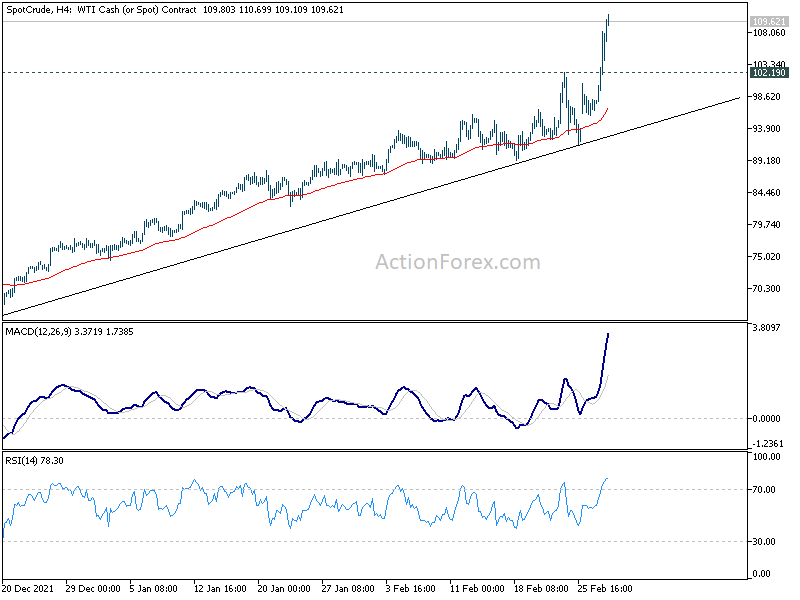
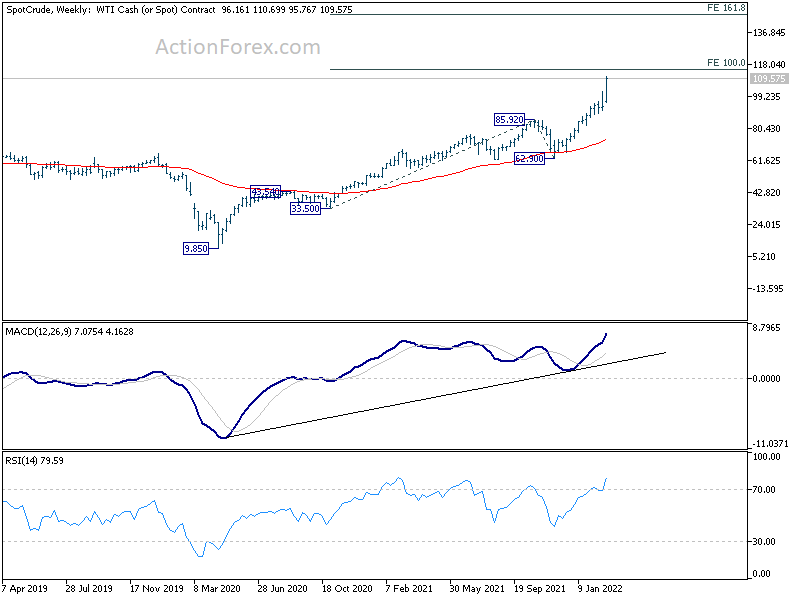
WTI crude oil accelerated sharply to as high as 110.69 so far. Technically, further rise is expected as long as 102.19 resistance turned support holds. Next target is 100% projection of 33.50 to 85.92 from 62.90 at 115.32.
It's still early to say. But is should be noted that fear driven moves in commodity markets could be extremely powerful. Just remember oil price was negative less than two years ago. So, decisive break of 115.32 could easily prompt more acceleration to 161.8% projection at 147.71, in rather quick manner.
Fed Mester: Russia invasion adding upside risk to inflation, downside risk to growth
Cleveland Fed President Loretta Mester said yesterday that Russia's invasion of Ukraine could push inflation up higher. "The unfolding event has implications for the economic outlook, adding upside risk to inflation even as it puts downside risks to the growth forecast," she said.
"The challenge facing Fed policymakers is how to recalibrate monetary policy, reducing the accommodation from the emergency levels needed earlier in the pandemic in order now to get inflation under control and at the same time sustain the expansion and maintain healthy labor markets," Mester added.
BoE Saunders prefers to move rates quite quickly towards neutral
BoE MPC member Michael Saunders said yesterday, "the economy is in significant excess demand, and inflation expectations are not as well anchored as I would like."
"My preference is to move quite quickly towards a more neutral stance in order to prevent the recent trend of higher inflation expectations and rising pay growth from becoming more firmly embedded," he said.
However, he emphasized that his vote for 50bps hike in February "does not necessarily imply that I would vote for a 50 basis-point hike in the event that further tightening is required."
" All else equal, the case for policy to move in a larger step probably is greater when Bank Rate is clearly further away from the approximate level that, if maintained, would return inflation to target and keep it there," he added.
BoE Mann: Embedded inflation becomes a domestic problem
BoE MPC member Catherine Mann said yesterday, "we already have very rapid increase in oil prices... In the U.K., that it becomes embedded by virtue of the institution mechanism of the price cap" on domestic energy bills.
"That embeddedness becomes a domestic inflationary problem that we have to deal with on the monetary policy stage," she said.
"You only get inflation if businesses raise their prices. That's where it comes from. It doesn't come from wage settlements. It comes from businesses' capacity to raise their prices in a systematic way and sustain demand," she said.
SNB Zurbruegg: Important to keep rate differential to avoid excessive Franc appreciation
SNB Vice Chairman Fritz Zurbruegg said in a l'agefi interview, "Switzerland has always had lower rates than others since the financial crisis. It is very important for us to keep this differential to avoid an excessive appreciation of the Swiss franc."
"As soon as the situation requires it, we'll raise our interest rate," he said. But, "we'll keep this ability to intervene in foreign exchange markets if needed to ensure price stability."
"Experience has shown that having some leeway within the range we associate with price stability has worked well in the past in Switzerland," he added. "We are a small, open economy with capital flows linked to our safe-haven status. We cannot always achieve a precise target and inflation can fluctuate in the short term because we aim for the medium term."
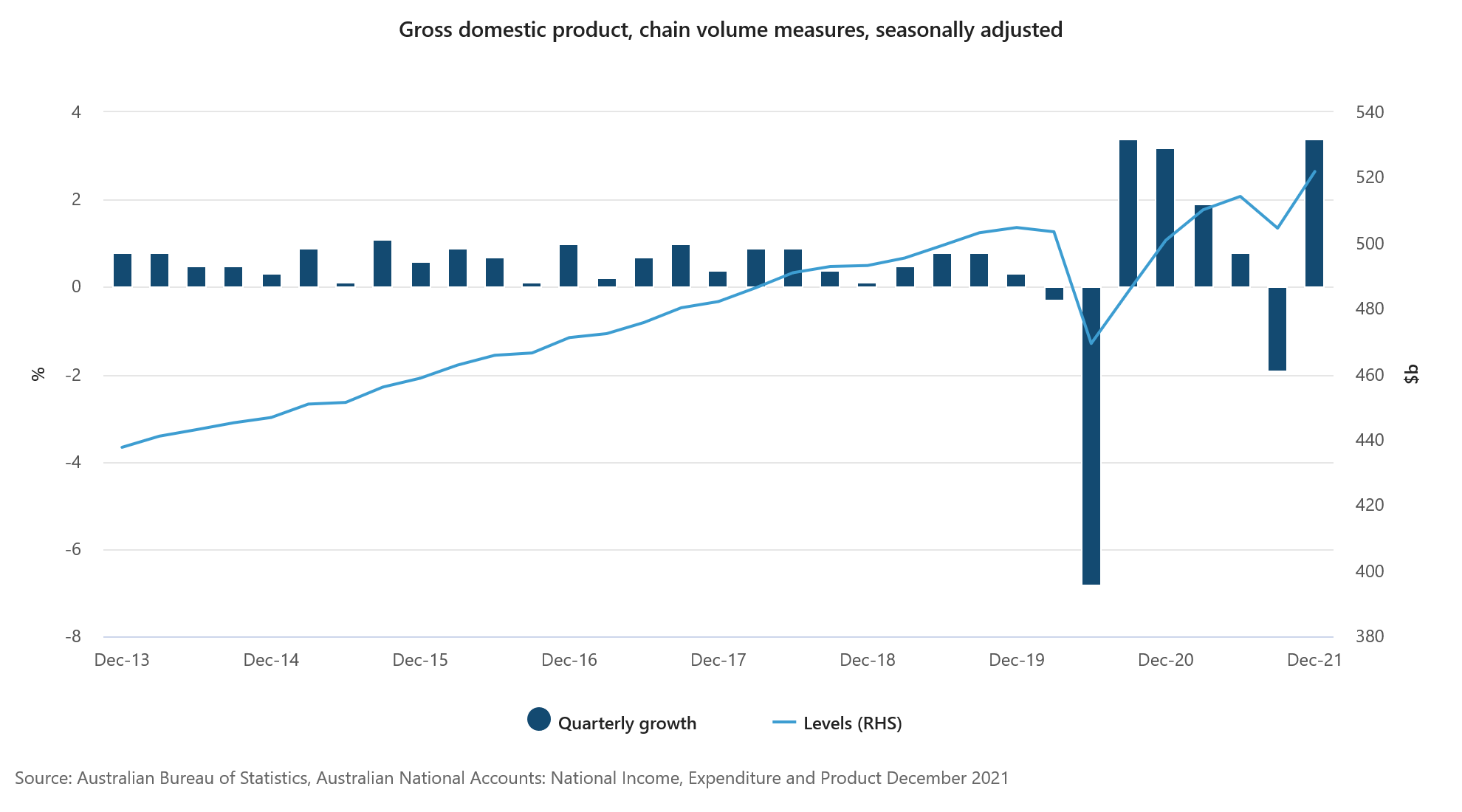
Australia GDP grew 3.4% qoq in Q4, no material impact from Omicron
Australia GDP grew 3.4% qoq in Q4, above expectation of 2.9% qoq. Real net national disposable income rose 1.7%. Terms of trade fell -5.1%. GDP in the December quarter 2021 was 3.4% above December 2019 pre-pandemic levels. The emergence of the Omicron variant over the second half of December 2021 did not have a material impact on activity this quarter.
From New Zealand, terms of trade index dropped -1.0% in Q4, below expectation of 0.9%. building permits dropped -9.2% mom in January.
From Japan, capital spending rose 4.3% in Q4, above expectation of 2.9%. Monetary base rose 7.6% yoy in February, below expectation of 8.6% yoy.
BoC to hike, EUR/CAD breaking to the downside
BoC is widely expected to raise interest rate by 25bps to 0.50% today to kick start the tightening cycle. The central bank might also announce the plan to shrink its balance sheet. Overall tone of the statement should remain hawkish, setting the stages for more rate hikes ahead. Some analysts are expecting the policy rate to hit 1.25% by the end of the year.
Some previews on BoC
- Bank of Canada to start rate hike cycle
- BOC Preview: Will the Bank of Canada be the Next Central Bank to Liftoff?
- Currency Pair of the Week: USD/CAD
- Bank of Canada Rate Hike Expected Despite Geopolitical Turbulence
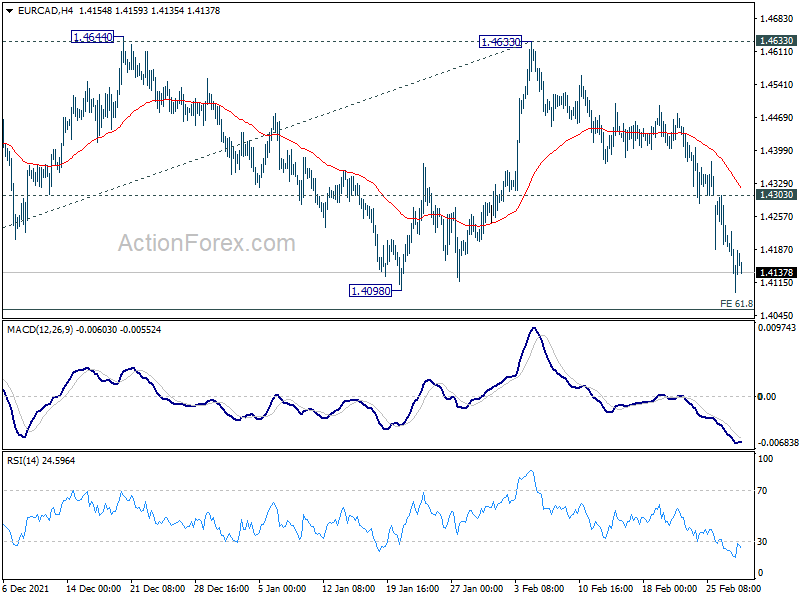
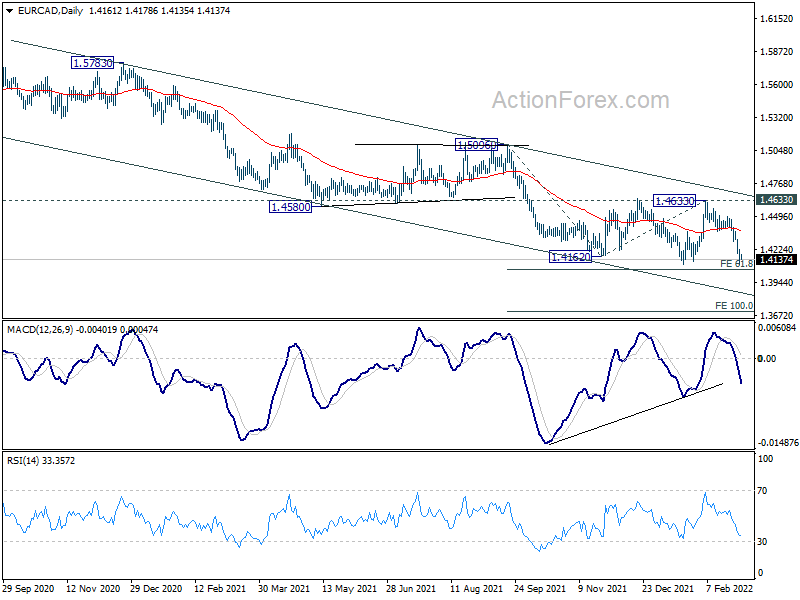
EUR/CAD's down trend is trying to resume by breaking through 1.4098 low. But that's more due to Euro's broad based selloff than Canadian's strength. Key level lies in 61.8% projection of 1.5096 to 1.4162 from 1.4633 at 1.4056. Sustained break there could prompt downside acceleration to 100% projection at 1.3699.
Above 1.4303 minor resistance will delay the bearish case and bring some consolidations. But outlook will remain bearish as long as 1.4633 resistance holds.
Looking ahead
Germany unemployment and Eurozone CPI flash will be featured in European session. In addition to BoC rate decision, US will release ADP employment and Fed's Beige Book report.
GBP/JPY Daily Outlook
Daily Pivots: (S1) 152.28; (P) 153.48; (R1) 154.31; More...
GBP/JPY's fall resumes by taking out 153.34 temporary low and intraday bias is back on the downside. Fall from 158.04 is seen as the third leg of the corrective pattern from 158.19. Break of 152.88 will target 148.94 support next. Risk will remain on the downside as long as 155.16 resistance holds, in case of recovery.
In the bigger picture, price actions from 158.19 are seen as developing into a consolidation pattern to up trend from 123.94 (2020 low). Downside should be contained by 38.2% retracement of 123.94 to 158.19 at 145.10 to bring rebound. Firm break of 158.19 will resume the up trend to long term fibonacci level at 167.93. However, sustained break of 145.10 will raise the chance of trend reversal and target 61.8% retracement at 137.02.
Economic Indicators Update
| GMT | Ccy | Events | Actual | Forecast | Previous | Revised |
|---|---|---|---|---|---|---|
| 21:45 | NZD | Building Permits M/M Jan | -9.20% | 0.60% | 0.40% | |
| 21:45 | NZD | Terms of Trade Index Q4 | -1.00% | 0.90% | 0.70% | 0.40% |
| 23:50 | JPY | Capital Spending Q4 | 4.30% | 2.90% | 1.20% | |
| 23:50 | JPY | Monetary Base Y/Y Feb | 7.60% | 8.60% | 8.40% | |
| 00:01 | GBP | BRC Shop Price Index Y/Y Jan | 1.80% | 1.50% | ||
| 00:30 | AUD | GDP Q/Q Q4 | 3.40% | 2.90% | -1.90% | |
| 08:55 | EUR | Germany Unemployment Change Feb | -23K | -48K | ||
| 08:55 | EUR | Germany Unemployment Rate Feb | 5.10% | 5.10% | ||
| 10:00 | EUR | Eurozone CPI Feb P | 5.30% | 5.10% | ||
| 10:00 | EUR | Eurozone CPI Core Feb P | 2.50% | 2.30% | ||
| 13:15 | USD | ADP Employment Change Feb | 320K | -301K | ||
| 15:00 | CAD | BoC Interest Rate Decision | 0.50% | 0.25% | ||
| 15:30 | USD | Crude Oil Inventories | 2.5M | 4.5M | ||
| 19:00 | USD | Fed's Beige Book |
BoC to hike, EUR/CAD breaking to the downside
BoC is widely expected to raise interest rate by 25bps to 0.50% today to kick start the tightening cycle. The central bank might also announce the plan to shrink its balance sheet. Overall tone of the statement should remain hawkish, setting the stages for more rate hikes ahead. Some analysts are expecting the policy rate to hit 1.25% by the end of the year.
Some previews on BoC
- Bank of Canada to start rate hike cycle
- BOC Preview: Will the Bank of Canada be the Next Central Bank to Liftoff?
- Currency Pair of the Week: USD/CAD
- Bank of Canada Rate Hike Expected Despite Geopolitical Turbulence
EUR/CAD's down trend is trying to resume by breaking through 1.4098 low. But that's more due to Euro's broad based selloff than Canadian's strength. Key level lies in 61.8% projection of 1.5096 to 1.4162 from 1.4633 at 1.4056. Sustained break there could prompt downside acceleration to 100% projection at 1.3699.
Above 1.4303 minor resistance will delay the bearish case and bring some consolidations. But outlook will remain bearish as long as 1.4633 resistance holds.
WTI oil breaks 110 on upside acceleration, heading to 147?
Oil price surged to highest level since 2014 on concern of supply disruptions related to Russia invasion of Ukraine. The International Energy Agency's 31 member countries have just agreed to release 60 million barrels of oil from their strategic reserves . But that's apparently not enough to calm the markets.
WTI crude oil accelerated sharply to as high as 110.69 so far. Technically, further rise is expected as long as 102.19 resistance turned support holds. Next target is 100% projection of 33.50 to 85.92 from 62.90 at 115.32.
It's still early to say. But is should be noted that fear driven moves in commodity markets could be extremely powerful. Just remember oil price was negative less than two years ago. So, decisive break of 115.32 could easily prompt more acceleration to 161.8% projection at 147.71, in rather quick manner.
Australia GDP grew 3.4% qoq in Q4, no material impact from Omicron
Australia GDP grew 3.4% qoq in Q4, above expectation of 2.9% qoq. Real net national disposable income rose 1.7%. Terms of trade fell -5.1%. GDP in the December quarter 2021 was 3.4% above December 2019 pre-pandemic levels. The emergence of the Omicron variant over the second half of December 2021 did not have a material impact on activity this quarter.