Sample Category Title
Is Bitcoin a New Detour?
Russia may turn to cryptocurrency when it is banned from the SWIFT payment system. Analysts warn that if Russia is able to use crypto to circumvent sanctions, “political support for crypto in the US will fall and regulatory risks will increase.”
What happened with Bitcoin?
Bitcoin defied the stock market plunge on Monday, climbing 9.3% amid what analysts said was increased demand from buyers in Russia and Ukraine. The cryptocurrency is trading at around $43,000, according to CoinDesk data. Ethereum gained about 11% over the past 24 hours, trading at approximately $2,900.
Is Bitcoin a new Detour?
During the last five days, when the Russian invasion began, transactions on centralized Bitcoin exchanges in both the Russian ruble and the Ukrainian hryvnia have surged to their highest levels in months, according to crypto data company Kaiko. Since Sunday, total cryptocurrency donations to the Ukrainian government and non-governmental organizations supporting the military stood was about $16.7 million.
Russians are aware of the volatility of their currency, and the financial system may see Bitcoin as a way to protect their savings. On Monday, Bitcoin traded on some Russian exchanges for $46,000, about $5,000 more than its US price. There is usually no difference between the Russian and US price of bitcoin because there are arbitrage possibilities; it indicates that such a jump in the price of Bitcoin is caused by buying in Russia.
Can crypto exchanges block Russian users?
However, when Ukraine’s vice prime minister Mykhailo Fedorov urged crypto exchanges on Sunday to block Russian users, Binance, KuCoin and other major crypto exchanges refused.
“We are not going to unilaterally freeze millions of innocent users’ accounts,” a spokesperson for Binance told CNBC. “Crypto is meant to provide greater financial freedom for people across the globe. To unilaterally decide to ban people’s access to their crypto would fly in the face of the reason why crypto exists.”
Why can Russia use it?
Now, it’s supposed that Russia can decide to use cryptocurrencies in commodities deals. However, most of the world trading is still dollar-dominated. As a result, it will be difficult for Russia to use crypto to evade SWIFT.
However, if Russia fails to use the cryptocurrency to bypass sanctions, this could increase the viability of the cryptocurrency in the eyes of regulators. Either way, the future looks interesting for Bitcoin and Co because the events can push crypto to occupy a more visible place in the global financial system.
What’s next for Bitcoin price?
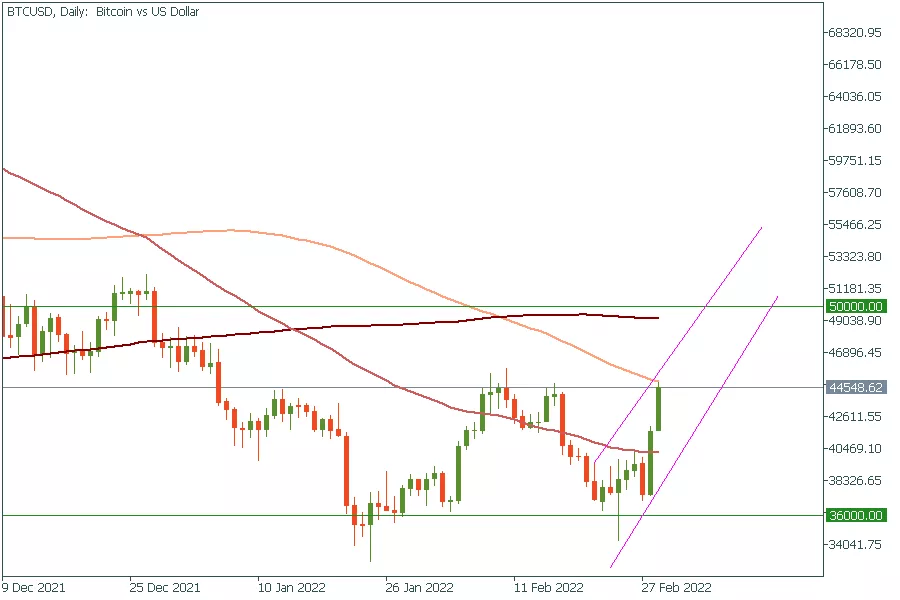
As BTC/USD rebounded from $33,500 and is trying to form a ‘double bottom’, some analysts have started to expect the advance to $50,000 and $51,000. That would be the middle of the range, in which Bitcoin has been trading since the start of 2021. Given the things we’ve outlines in this article, we consider such a scenario quite realistic. Support for BTC/USD is located at $36,000/$35,000.
Eco Data 3/2/22
[php_everywhere instance="1"]
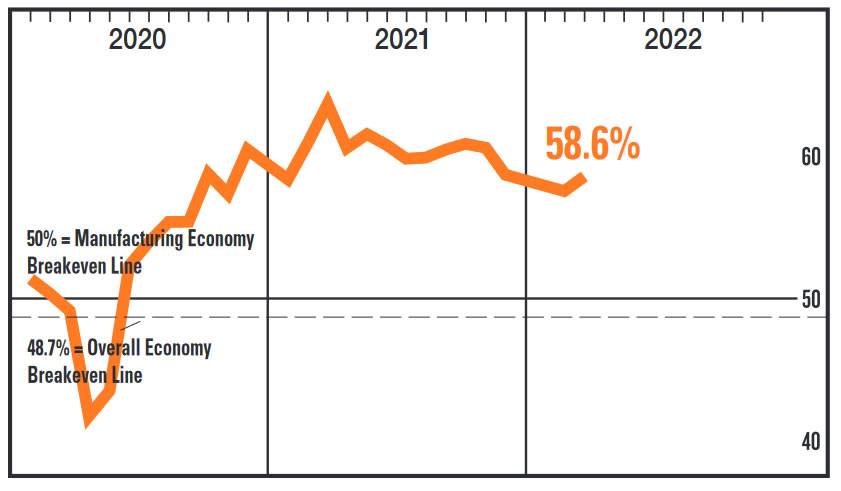
US ISM manufacturing rose to 58.6, corresponds to 3.5% annualized GDP growth
US ISM Manufacturing index rose from 57.6 to 58.6 in February, above expectation of 57.9. Looking at some details, production rose from 57.8 to 58.5. New orders rose from 57.9 to 61.7. Employment dropped from 54.5 to 52.9. Prices dropped from 76.1 to 75.6.
ISM said: "The past relationship between the Manufacturing PMI and the overall economy indicates that the Manufacturing PMI for February (58.6 percent) corresponds to a 3.5-percent increase in real gross domestic product (GDP) on an annualized basis."
Sunset Market Commentary
Markets
Risk aversion this week for the first time really translated in a safe haven bid towards core bonds. Markets decided to take the foot somewhat off the throttle with regards to the early 2022 aggressive repositioning towards fast and bold tightening cycles. It’s not that they completely retrace on their steps, on the contrary. However, especially in Europe the timing of the next ECB meeting comes at an awkward time. The ECB remains in a tough catch-22 position as the Ukrainian conflict aggravates an already worsening inflation problem. Tomorrow, we’ll see another record EMU CPI figure for February (5.6% Y/Y consensus from 5.1% in January). National data beat consensus in France (4.1% Y/Y), Spain (7.5% Y/Y), Belgium (8.04% Y/Y) and today Italy (6.2% Y/Y) and Germany (5.5% Y/Y). On the one hand, the deteriorating inflation situation warrants a continuation of the ECB’s strategic policy U-turn which Lagarde started verbally early February. Back then, she acknowledged upside inflation risks while no longer ruling out the possibility of a 2022 rate hike. On the other hand, it might make sense to delay the official U-turn until April of June for once dust settles in Ukraine. It would still keep the ECB on track to end net asset purchases by the end of Q3 as some ECB governors suggested to enable a Q4 rate hike. Simultaneously, the ECB avoids in the short run to add another layer of uncertainty over already fragile and volatile markets. The jury is still out, but the interest rate action of the past two days at least opens the possibility for some delay. European swap yields since last Friday lost 12 bps (20-yr) to 24 bps (5-yr). Both the EU 2y, 5y and 10y swap rates lost first support at respectively 0.1%, 0.5% and 0.77%. German yields decline by 23 bps (10-yr) to 33 bps (5-yr) over that same time period. The 3-month forward Euribor curve now discounts an end of 2022 rate of -0.15%, down from +0.02% with the end of 2023 market prognosis declining from 0.68% to 0.49%.
The daily recap furthermore shows new losses for European stock markets (2%), rising commodity prices (eg Brent crude > $104/b) and a slightly firmer dollar. EUR/USD relatively easily holds above the important 1.1106/21 support zone. Central-European currencies remain underperformers. EUR/HUF spiked from 370 to new record high of 380 before retracing to 375 after the central bank showed readiness to intervene to ensure stability. EUR/PLN in a similar move spiked to 4.8 before returning lower after MPC Sura said that the NBP would support PLN strengthening. EUR/CZK spiked to 25.50 with the CNB noting that a weaker koruna boosts inflation risks. News Headlines
The reference contract for Wheat on the Chicago Board of trade today jumped about 5.0% to the highest level since March 2008 as investors fear that the conflict between Russia and Ukraine will cause severe and prolonged disruptions in the supplies of the commodity due to the conflict in the region. The disruptions might take the form of a halt of shipments from Ukraine ports over the inability to finish/finance deals with parties in the two countries. The contract trades about 27% higher compared to the start of the year. The war might also complicate planting of crops for the likes of Corn. Corn futures also trade at the highest level since July last year, recording a gain of about 20% for this year.
Growth in Canada in Q4 accelerated from an annualized rate of 5.5% to 6.7% (1.6% Q/Q) according to data published by statistics Canada today. For the 2021 as a whole, real growth posted a strong 4.6% growth after declining 5.2% due to the pandemic in 2020. In Q4, gross fixed capital formation was an important driver for growth (1.9%), both due to residential and non-residential structures. Inventory building also added substantially to growth. Household consumption only rose a modest 0.2% Q/Q. The Bank of Canada will hold a regular policy meeting tomorrow. It is expected to start a rate hike cycle with a 0.25bps hike to 0.50% as the economy is eliminating spare capacity. The loonie today gains a few ticks to trade at USD/CAD 1.267.
Canada’s Economy Closes the Year on a High Note
The Canadian economy expanded by 6.7% q/q annualized in the final quarter of 2021, leaving real GDP for 2021 at a robust 4.6%.
A big driver of growth was the accumulation of business inventories (easing of supply chains), which grew by $11 billion (adding 4.2 percentage points to annualized growth).
International trade also grew at a decent clip, with exports up 13.4% (annualized) and imports rising by 14.4%. This was driven by increased motor vehicle production.
Household consumption came in at a disappointing 1% (annualized), as Canadians reduced spending on goods in favour of services.
Business investment grew at 7.9%, with residential structures up 10.2% and machinery and equipment up 4.7%.
Key Implications
The Canadian economy ended 2021 on a high note, with real GDP sitting just above pre-pandemic levels.
Strong growth at the end of the year provided a solid handoff to the new year, but the start to 2022 has been less than ideal. With the Omicron wave and subsequent lockdowns, we are tracking 2022 Q1 at just above zero growth. That said, the economy is bouncing back as restrictions have been eased. This should set up Canada to outperform over the remainder of 2022.
For the Bank of Canada, this report justifies its view that the economy has fully recovered the slack caused by the pandemic. The Bank will have this report in its back pocket as it prepares to lift the overnight rate tomorrow in spite of ongoing geopolitical risks.
Russia off from SWIFT will have a positive impact on crypto
Bitcoin made a powerful leap up after assurances from the owners of the largest crypto exchanges, Binance, Kraken, KuCoin and AAX, that they do not intend to block the funds of individual Russians. However, the head of Kraken warned that they would abide by the regulator’s decision if it comes.
Overnight, the United States noted that they would stop attempts to use cryptocurrencies to circumvent personal sanctions. So, retail clients of large crypto exchanges are not yet afraid for their funds. This probably explains the latest growth momentum.
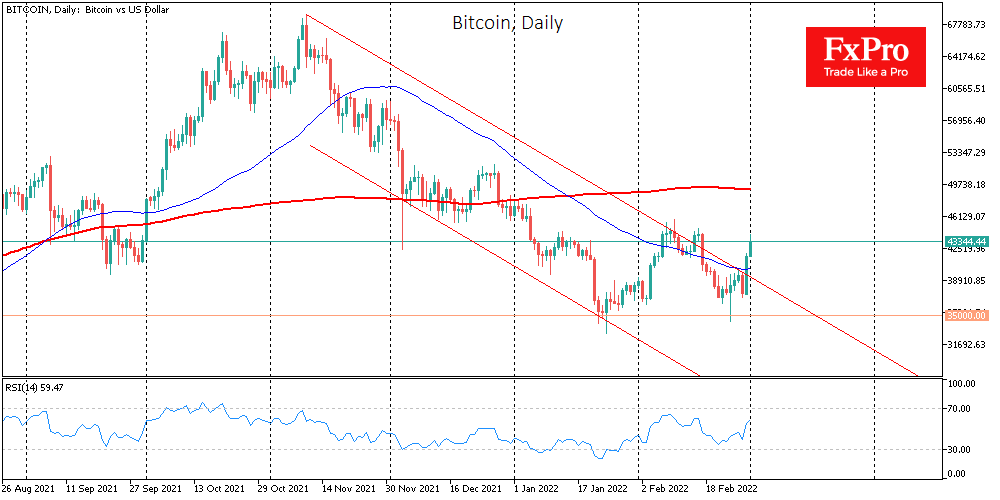
Technically, Bitcoin broke through the upper limit of the four-month descending channel at the close of the month. Moderate optimism of Asian and US indices is also on the side of buyers.
February was confirmed to be a growing month for bitcoin. However, March is not so favourable. Over the past 11 years, BTC ended this month with growth only in two cases.
Disabling Russia from SWIFT will have a positive impact on the cryptocurrency market, says Jiang Zhuer, CEO of the BTC.TOP pool. In his opinion, Russia can use various methods to circumvent restrictions, including digital assets, to make payments.
Bank of America does not see the prerequisites for a large-scale crypto winter, as evidenced by the dynamics of the movement of cryptocurrencies between private and exchange wallets. The level of acceptance of crypto assets by users is also growing, as well as the activity of developers.
Bitcoin jumped 10.8% on Monday to $41,600, the highest gain in five months. On Tuesday morning, the momentum continued with a jump to $44,000 at the start of the day. At the time of writing, prices have stabilized around $43,200. Ethereum added 7.9%, while other top-ten altcoins rose from 6.3% (XRP) to 15.3 % (Terra).
The total capitalization of the crypto market, according to CoinMarketCap, grew by 11% over the day, to $1.9 trillion. The Bitcoin dominance index has risen to 43% due to the smaller strengthening of altcoins.
The crypto-currency fear and greed index soared 31 points to 51 on the day, moving out of fear into neutral territory.
Although Bitcoin showed negative dynamics for most of the month, the shocking growth at the end of it allowed BTC to end February with strengthening (+8.6%) after three months of decline.
Ukraine Resolution Fails, and Putin Intensifies Attacks
Risk-off mood returns, US ISM manufacturing ahead
It seems the next weeks will be pivotal for volatility as Russia declared it would continue its attacks until its goals were met. The retreat in US stock futures is signalling a risk-off mood, and the USD/JPY pair is also expressing some risk-off tendencies, slipping to 114.80.
That said, the dollar index is holding above the 97.00 mark and should risk appetite continue to wane, it appears the way up for the greenback is likely, especially if investors remain drawn to its haven appeal. The euro is testing the $1.1140 level, but the pound is faring better against the greenback, hovering just beneath the $1.3400 mark.
President Putin appears to be unphased by the sanctions from the West and has taken steps of his own in response. The time cycle of these geopolitical risks is unclear, but for now the Russian President has banned all foreign currency transfers abroad, applied capital controls and kept the stock exchange closed.
The latter is feeding the risk that Russia’s stocks and bonds could be kicked out of major investment benchmarks should trading access remain limited.
Nonetheless, US ISM Manufacturing PMI data is due at 15:00 GMT today and is expected to come in at 58.0 versus the January’s figure of 57.6. The ISM employment and prices components could paint a clearer picture, which were at 54.5 and 76.1 in January. Construction spending is also key and is expected at 0.2% m/m.
Commodity price pressures and trade, RBA holds
The Australian Industry Group performance of manufacturing index came in at 53.2, suggesting an industry expansion down under, despite supply chain problems, shipping constraints and surges in freight costs, which are still affecting trade.
Meanwhile, petrol prices are at record highs and the conflict in Ukraine is adding to uncertainty in markets, inflation being one of them, which has further underpinned many commodity prices. Australia’s export earnings are highly reliant on commodity prices.
Nonetheless, with inflation expectations now around 5.3%, the RBA has kept the cash rate target at 10 basis points, commenting that they will not increase the rate until inflation is sustainable within their 2-3% target range. The emphasis was directed to worries about how persistent elevated inflation will be due to changes in global energy markets and supply issues. The aussie has gained strength and is flirting with the February 23 high of 0.7283.
Chinese manufacturing and service PMI data for February showed renewed improvement in business conditions with the gauges for both output and total new orders returning modestly into expansionary territory. Total sales in China rose despite the decline in new export business linked to the pandemic and difficulties in shipping. However, a pickup in demand conditions has aided output in February despite inflationary pressures in both input prices and output charges.
Australia exports heavily to China, and with demand expectations in China improving, there may be some risk in terms of whether the country delays purchase of commodities should prices remain elevated or run higher due to price pressures. This could seem far-fetched, but it may be one aspect to consider for the aussie failing to sustain strength, along with negative developments from Ukraine and further flows into the safe-haven dollar.
Gold is sustaining its shine, currently trading around $1,925/oz and should the Ukraine conflict drag out, the precious metal may reel in the $1,950/oz price zone. If US 10-year yields slip lower again, this could support the move.
Canadian GDP and the black liquid
In January the BoC held off from hiking its interest rate as officials were wary of the Omicron strain, but the bank highlighted that the slack in the economy was overturned and reiterated that this triggered a policy shift towards rates moving higher. Canada’s Q4 GDP data today was essentially unchanged in December 2021, resisting a 0.1% forecast as growth in services-producing industries by 0.1% was nullified by a drop in goods-producing industries by 0.1%. That said, the seasonally adjusted annual rate beat expectations of 6.5%, coming in at 6.7%. Its February Manufacturing PMI is due at 14:45 GMT. However, this is unlikely to alter the expected 25 basis points hike expected in tomorrow’s meeting. The loonie is currently around C$1.2670.
WTI oil futures have creeped back to the $100.00 per barrel mark and the picture for oil seems to remain a bullish one, with consumers looking to feel the brunt of high fuel prices and inflation as the Ukraine crisis prolongs.
UK’s MPC Member Saunders is due to speak at 18:30 GMT followed by Member Mann at 19:00 GMT.
EUR/USD Mid-Day Outlook
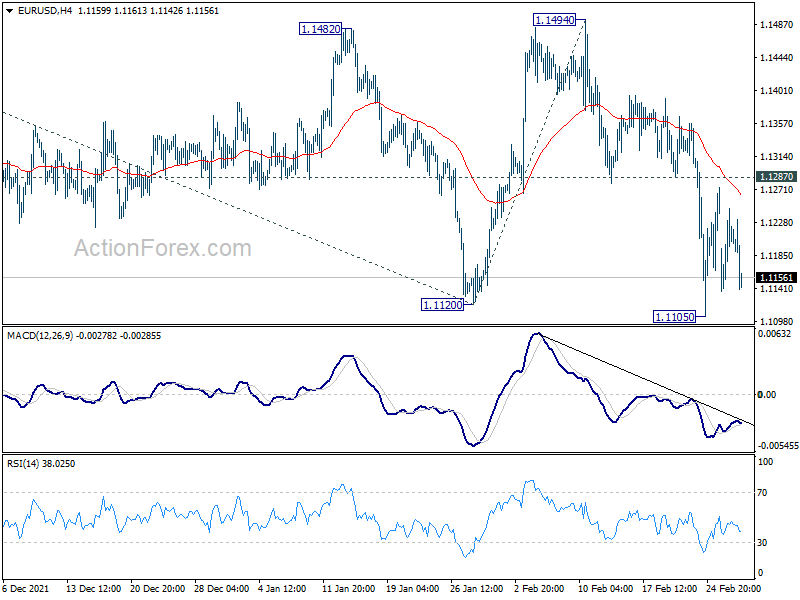
Daily Pivots: (S1) 1.1149; (P) 1.1197; (R1) 1.1269; More...
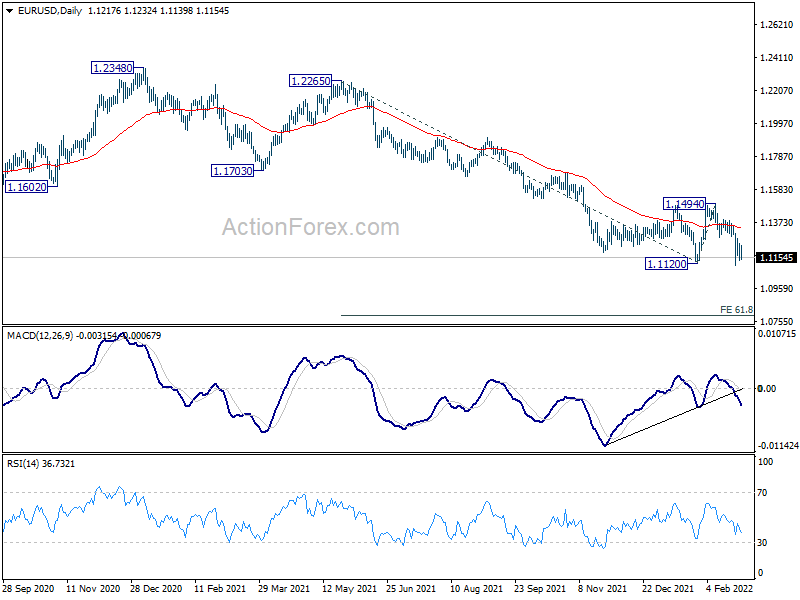
EUR/USD is staying in consolidation from 1.1105 and intraday bias remains neutral first. Further fall is expected with 1.1287 resistance intact. On the downside, sustained break of 1.1120 will confirm resumption of larger down trend from 1.2348. Next target is 61.8% projection of 1.2265 to 1.1120 from 1.1494 at 1.0786. However, firm break of 1.1287 will dampen this bearish view and turn bias back to the upside for 1.1494 resistance.
In the bigger picture, the decline from 1.2348 (2021 high) is seen as a leg inside the range pattern from 1.2555 (2018 high). Sustained trading above 55 week EMA (now at 1.1582) will argue that it has completed and stronger rise would be seen back towards top of the range between 1.2348 and 1.2555. However, firm break of 1.0635 (2020 low) will raise the chance of long term down trend resumption and target a retest on 1.0339 (2017 low) next.
GBP/USD Mid-Day Outlook
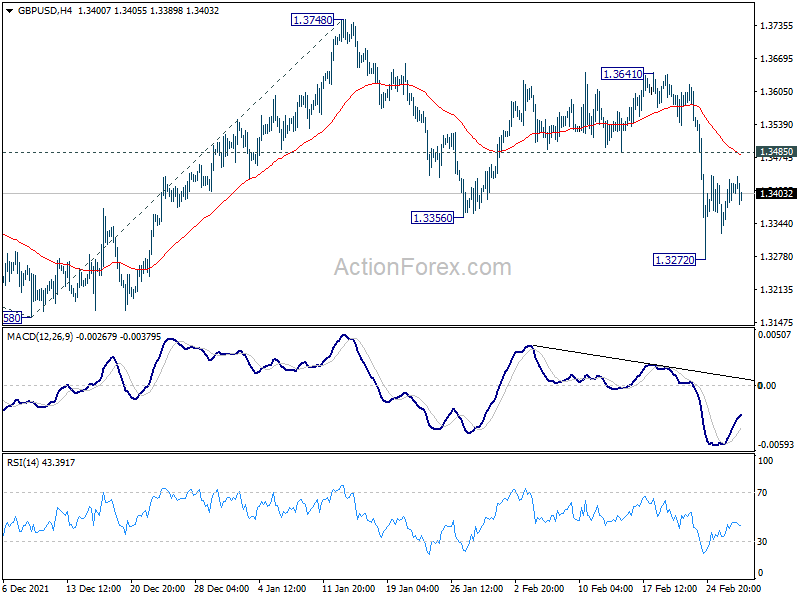
Daily Pivots: (S1) 1.3349; (P) 1.3390; (R1) 1.3464; More...
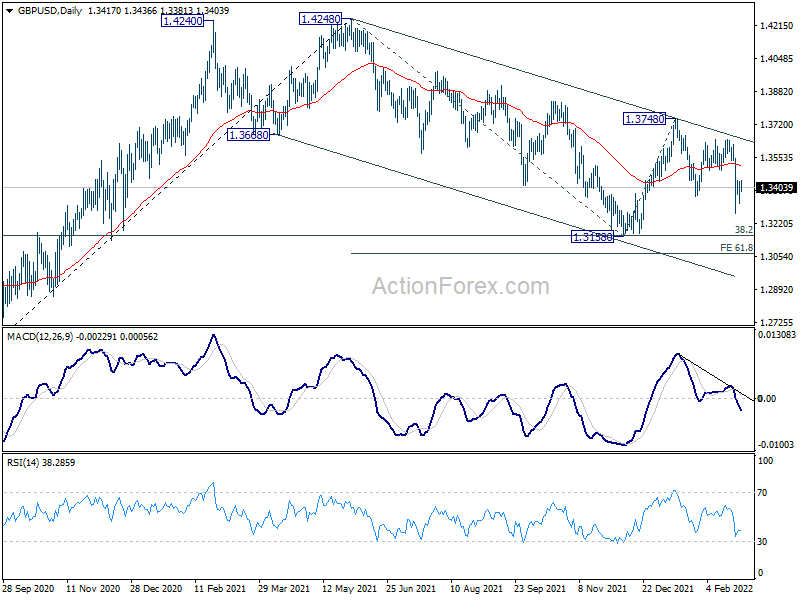
Intraday bias in GBP/USD remains neutral as consolidation from 1.3272 is still extending. Further fall is expected as long as 1.3485 support turned resistance holds. On the downside, break of 1.3272 will target 1.3158 low. However, firm break of 1.3485 will dampen this bearish view and turn bias back to the upside for 1.3641 resistance.
In the bigger picture, as long as 38.2% retracement of 1.1409 to 1.4248 at 1.3164 holds, up trend from 1.1409 (2020 low) is still in progress. On resumption, next target will be 38.2% retracement of 2.1161 to 1.1409 at 1.5134. Nevertheless sustained break of 1.3164 will argue that whole rise from 1.1409 has completed and bring deeper fall to 61.8% retracement at 1.2493.
USD/JPY Mid-Day Outlook
Daily Pivots: (S1) 114.63; (P) 115.20; (R1) 115.54; More...
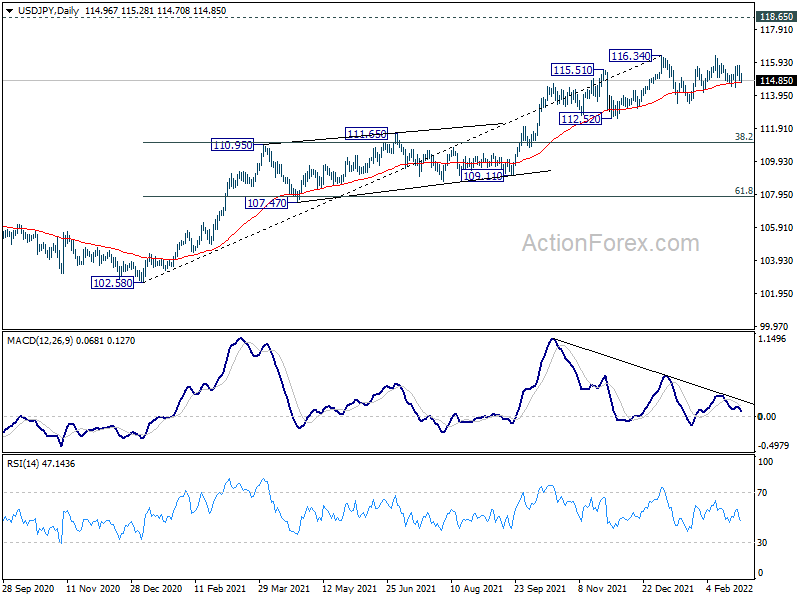
Range trading continues in USD/JPY and intraday bias remains neutral. On the upside, firm break of 116.34 will resume larger up trend from 102.58 to 118.65 long term resistance next. On the downside, though, break of 114.40 will continue the corrective pattern from 116.34 with another fall to 113.46 support.
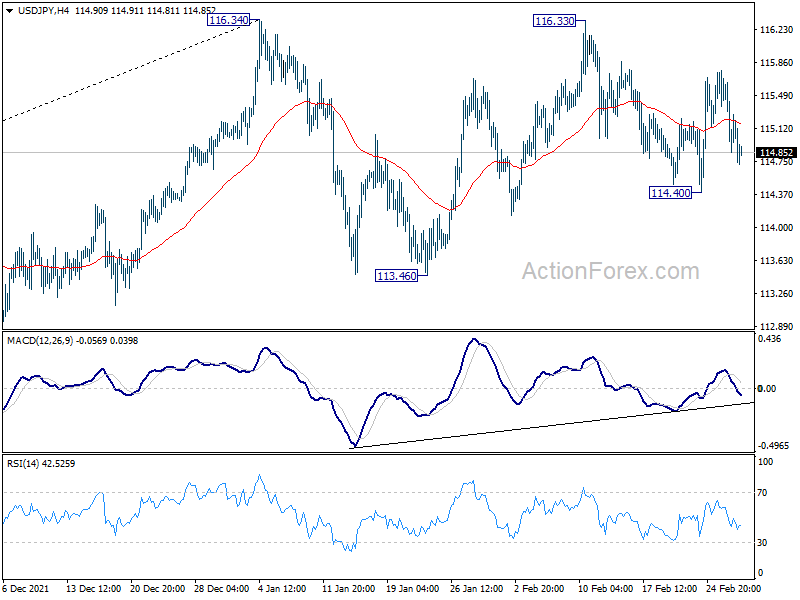
In the bigger picture, no change in the view that rise from 102.58 is the third leg of the up trend from 101.18 (2020 low). Such rally should target a test on 118.65 (2016 high). Sustained break there will pave the way to 120.85 (2015 high) and raise the chance of long term up trend resumption. This will remain the favored case as long as 55 week EMA (now at 111.64) holds.