Sample Category Title
Cryptocurrencies Rebound as Investors Embrace Risk-on Sentiment
American stocks retreated modestly on Monday as the tensions in Russia rose. The Dow Jones fell by more than 400 points while the S&P 500 fell by more than 20 points. The Nasdaq 100 index turned higher as the market went on. Investors are anticipating that the world economy will see elevated risks going forward as energy prices soar and supply chain problems remain. Therefore, there is a likelihood that central banks will embrace a more hawkish stance even as the risks to global growth remain.
Cryptocurrencies bounced back as investors continued to buy the dips. Bitcoin moved above the $40,000 mark while Ethereum is above $2,800. In the past few days, there have been regulatory talk about these currencies. For example, in Europe, the ECB head has called for regulators to start toughening cryptocurrency regulations considering the ongoing sanctions. On Monday, several cryptocurrency exchanges like Binance announced that they will lock accounts of sanctioned Russians from their platforms.
The economic calendar will have a number of important events today. Earlier, the Reserve Bank of Australia (RBA) delivered its interest rate decision. It left interest rates unchanged and warned that inflation will remain at elevated levels for a while. Markit will publish the latest manufacturing PMI numbers from around the world. Other key economic numbers to watch today will be the latest UK home price index data from Nationwide and Canadian GDP data.
EURUSD
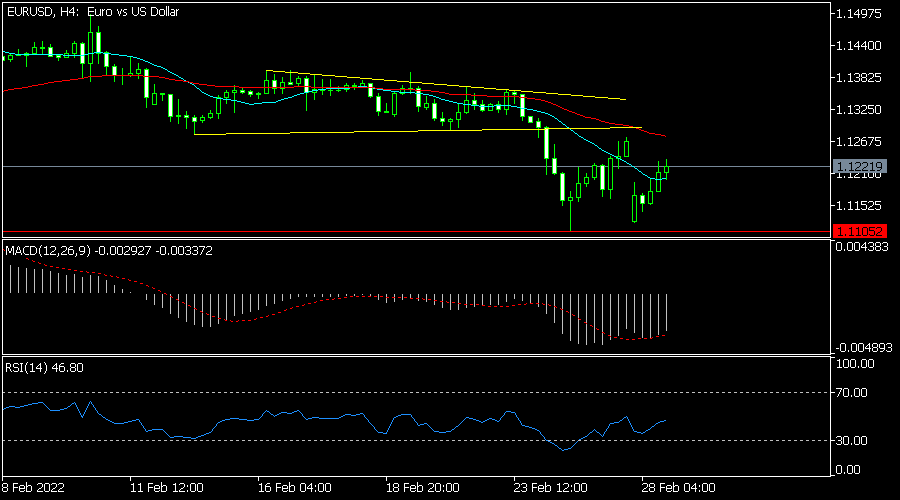
The EURUSD pair tilted upwards in the overnight session. It rose to 1.1220, which was slightly above Monday’s low of 1.1123. The pair has also moved slightly above the 25-day moving average while the Relative Strength Index has tilted upwards. The MACD has also started moving higher. Therefore, the pair will likely continue rising as investors assess the risks posed by an ongoing war.
GBPUSD
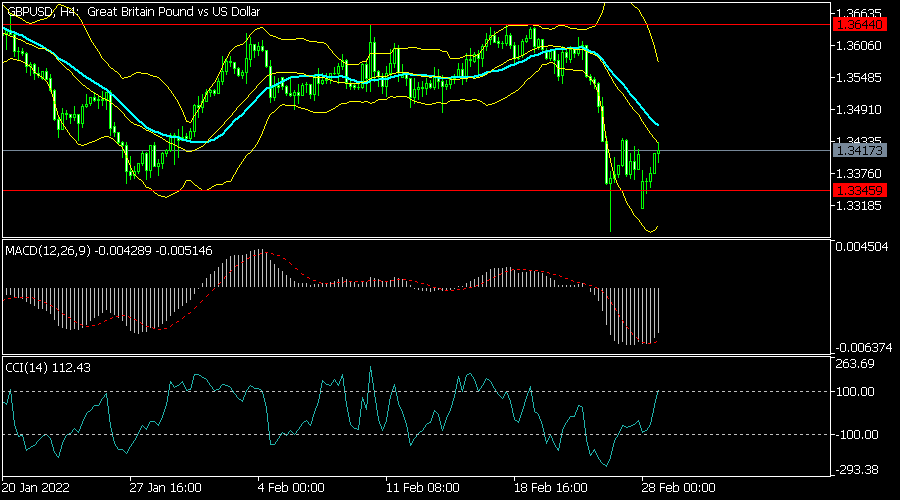
The GBPUSD pair has made a strong recovery after falling to the lowest point in three days on Monday. It is trading at 1.3415, which is higher than this week’s low of 1.3312. It has moved slightly above the 61.8% Fibonacci retracement level. It has also moved to the middle line of the Bollinger Bands while the Commodity Channel Index (CCI) has moved upwards. The pair will likely keep rising today.
NZDUSD
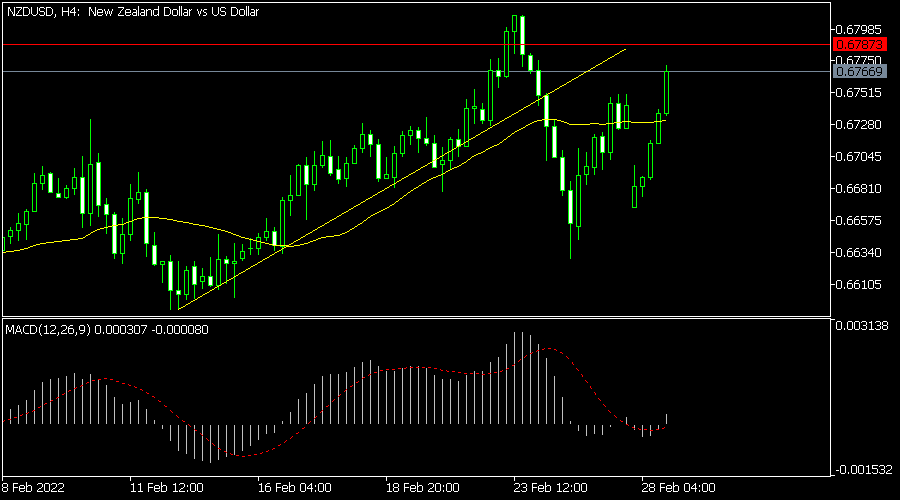
The NZDUSD pair rose sharply as investors embraced a risk-off sentiment. It rose to a high of 0.6766, which was the highest level since Thursday last week. The pair managed to move above the 25-day moving average and the 61.8% Fibonacci retracement level. The RSI and the MACD are also pointing upwards. Therefore, there is a likelihood that the pair will keep rising later today.
RBA Governor Broadens Measure of Wages Growth in Policy Decision Statement
The Governor has formally released himself from the guideline in 2021 that rates would not rise until the Wage Price Index lifts by 3%. He is now referring to a broader measure of labour costs which have no specific numerical trigger. The tragedy in the Ukraine has added uncertainty and supported the “patience” theme”.
As expected, the Reserve Bank Board decided to maintain the cash rate at 10 basis points.
Two interesting points came out of the Governor’s Policy Statement.
Firstly, he widened the measure of employment costs from “wages growth at the aggregate level” to “labour costs.”
Secondly, he included some assessment of the impact on the economy of the war in Ukraine.
In the final key paragraph, the condition around wages is “it is likely to be some time before growth in labour costs is at a rate consistent with inflation being sustainably at target.”
Compare that with the February Statement, “it is likely to be some time yet before aggregate wages growth is at a rate consistent with inflation being sustainably at target.”
“Aggregate wages growth” is the term used by the RBA for the Wage Price Index. Through 2021, in a number of speeches, the Governor referred to the need for the Wage Price Index growth rate to reach 3%+ before he would increase the cash rate.
We have argued that due to the high inertia in the WPI (held back by enterprise bargaining and award wages which are both set for extended periods with lags) the WPI does not capture the momentum in wages in a timely fashion.
The annual rate of growth in the WPI is also impacted by base effects since the growth in the Index in the June quarter last year was only 0.4%. That drag o the annual rate will persist until the June quarter 2022 which is released on August 24.
We forecast that the March quarter WPI will increase by 0.8% lifting the annual rate to 2.5% but we have argued that the last two prints (0.7% and 0.8%) indicate a six month annualised pace of 3.0% and, complemented by other measures such as bonuses, overtime, business surveys, RBA liaison; turnover and the decade low unemployment rate there will be sufficient evidence to begin the tightening cycle on August 2.
The explicit guidance in the Statement today, where the necessary signals around wages that are broader than the WPI, strengthen our case for August lift off.
We continue to downplay any earlier moves given the persistent “patient” theme and the Governor’s preference (appearance before the House of Representatives Standing Committee, February 12.) to see two more CPI’s.
That “patience” theme is consistent with the Governor’s assessment of the tragedy in the Ukraine. He notes that “the war in the Ukraine is a major new source of uncertainty”, and “how long it takes to resolve the disruptions to supply chains is an important source of uncertainty regarding the inflation outlook, as are developments in global energy markets.”
Those issues are key to the RBA’s forecast that underlying inflation declines to 2.75% over 2023 taking some pressure off monetary policy.
Conclusion
We remain comfortable with our view that the first rate increase will be at the August Board meeting.
In today’s statement the Governor has released himself from the constraint that the cash rate will only rise when annual growth in the Wage Price Index prints 3%+.
There is also that air of caution around the war in the Ukraine which feeds neatly into the “patience” concept which the Governor confirms.
“The Board is prepared to be patient as it monitors how the various factors affecting inflation in Australia evolve.”
A Cautious Investor Mood Probably Will Persist
Markets
The ongoing military action by Russia in Ukraine and markets assessing the consequences of reciprocal sanctions between Russian and the West caused an outright risk-off start for the week. Sentiment stayed nervous throughout the day, but equities gradually rebounded off intra-day lows. US equities closed mixed with the Dow losing -0.49% but Nasdaq gaining 0.41%. The EuroStoxx50 lost 1.17%.
Until now, the Ukraine crisis didn’t change expectations on Fed or ECB policy in any profound way. The jury is still out, but yesterday (part of the interest rate) markets showed some cracks as investors pondered the potential impact on growth. However, some end of month positioning maybe was also in play.
The US yield curve bull flattened with yields declining between 14.75/13.75 bps (5 & 2 y) and 11.25 bps (30-y). The 10-y real yield almost lost 20 bps. Inflation expectations rose 6.3 bps. A similar move occurred in Europe with German yields declining between 16 bps (5-y) and 5.9 bps (30-y). This time, EMU swaps also joined the decline with especially the 5-y losing 16 bps.
Fed comments still fully support the case to start policy normalization in March. ECB speakers (e.g. Panetta, Centeno) understandably advocated a gradual approach but we didn’t see a U-turn from the ‘guidance’ of ECB’s Lagarde since the February meeting. EMU inflation data (published tomorrow, risks to the upside after country data) will be key to shape market expectations in the run-up to the March ECB meeting.
Currencies followed the intra-day swings in risk sentiment. The dollar opened strong but lost gains later. EUR/USD tested the 1.1121 previous support area, but closed at 1.1219. DXY finished at 96.70, only marginally stronger from Friday. Yen gains remain modest after all (USD/JPY close 114.99). The Swiss franc closed below the EUR/CHF 1.03 handle. Oil returned to the $100 p/b area after opening near 104/5 in Asia. USD/RUB closed near 105 even as the CBR raised the policy rate to 20%. In the CE region, the zloty (EUR/PLN 4.70) and the forint (EURHUF 371) continue to trade at levels that don’t fit the CB’s anti-inflation policy.This morning, Asian markets found some kind of short-term equilibrium with regional markets mostly gaining 0.5%/1.0% +. China PMI’s printed slightly stronger than expected and at 50+ levels. US yields regain 3-4 bps across the curve. The dollar (DXY 96.84, EUR/USD 1.1205) and oil 99.9 are trading with a tentative upward bias.
Usually, US (and EMU) data take center stage at the start of a new month. However, the US ISM (expected marginally stronger at 58.0) probably won’t be a major driver for trading. German CPI (expected 0.7% M/M, 5.4% Y/Y HICP) might be get some more attention after upward surprises in other countries. Even so, with the war in Ukraine ongoing (Kyiv) a cautious investor mood probably will persist. We especially keep a close eye at the 5-y sector of the European (and also US) curve after yesterday’s break lower.
On the FX markets, the dollar retains a small advantage but at the same time isn’t able to break key resistance levels (DXY 97.44/73, USD/JPY 116.34, EUR/USD 1.1120/1.1192. EUR/GBP also holds a directionless trading pattern between 0.83 & 0.84.
News Headlines
The Reserve Bank of Australia as expected didn’t change its 0.10% policy rate at the meeting today. Inflation is high and has increased due to rising energy prices and supply chain bottlenecks at a time of strong demand which has picked up again after the Omicron setback. The war in Ukraine has pushed many commodity prices higher as well. The RBA expects underlying inflation to ease from 3.25% later this year to 2.75% over 2023. But inflation has to durably reach the 2-3% target before the RBA considers rate hikes and there is much uncertainty about that currently. For this to happen the still-modest wage growth has to pick up. The strong labour market will help achieve that over time. The Aussie dollar barely budges this morning. AUD/USD hovers near opening levels around 0.726.Pressure on UK Chancellor Sunak to abandon the planned payroll tax increase continues the grow. Make UK, one of the country’s biggest (manufacturing) employer groups, said it is “illogical and ill-timed”, echoing similar calls from CBI and the Federation of Small Businesses. It would aggravate the cost of living crisis, they said. A survey by Make UK found that 60% of its 282 members will cut back recruitment as a result of the tax while 71.5% would pass the cost on to customers, further increasing inflation.
War Boosts Demand in Bitcoin and Green Stocks
Just a week ago, we were living in a united world, where there were tensions. But now, the world is divided between the Russians and the rest. The economic implications are as severe as the real world impacts and the risk appetite is limited.
Yesterday’s talks in Belarus between the Ukrainian and Russian committees were overshadowed by the intensifying military fight in Ukraine. Putin, who seems frustrated with the Ukrainian resistance, and the Westerns sanctions imposed sanctions to the West on his turn by closing its airspace to 36 countries and banning its residents from transferring hard currency abroad.
The direct implication of Russin sanctions was a surge in cryptocurrency prices, and especially Bitcoin. The coin, which was moving along with the risk assets less than a couple of days ago is now The Asset that Russians and Ukrainians rely on to get their funds out of the traditional system which has become very hostile to them. It is reported that Bitcoin purchases using Rubles and Hryvnias soared as Russia imposed sanctions on its citizens.
How safe?
Being able to transact value in Bitcoin also helps Russian oligarchs go around the Western sanctions. It may also help Russian companies and even the Russian central bank to move funds as these entities can no longer access US dollars, and most of the Russian banks are no longer part of the SWIFT system.
If there is no policy response from the West to the Bitcoin adoption from Russia, the positive trend could further develop and make Bitcoin the number one safe haven asset in the war setup. Yet, how much the West would tolerate the Bitcoin interference to its political decisions is a major question, that increases the regulatory risks for cryptocurrencies.
For Russians though, the cryptocurrency risk is definitively worth be taken.
Ruble
Ruble lost more than 30% in Monday and the Russian central bank more than doubled its bank rate to 20% to stop the bleeding. The Russian stock exchange on the other hand remains closed to avoid a bloodbath. It will open once the Russians have taken enough measures to temper the catastrophe that’s about to hit the Russian stocks. The Russian shares plunged in London and Deutsche Börse suspended trading in shares of sixteen Russian companies, including Aeroflot, Rosneft, Sberbank, VTB and VEB Finance.
Divesting
BP shares dived near 7% on decision to get rid of 20% stake in Russian Rosneft and closed the session near 4% lower. Shell announced that it will end its alliance with Gazprom as well, turning all eyes to other oil giants like TotalEnergies and Exxon, which haven’t yet disclosed what they will do. Exxon for example has 30% stake in a huge offshore crude development and the pressure for action is obviously mounting. The shares gained 0.75% yesterday as oil jumped on intensifying war in Ukraine. But we could see a certain selloff in Exxon shares if the company announced sanctions against its Russian teammates as well, that’s the price to pay to show some dignity.
Swiss comply
Switzerland on the other hand took a major step in its history of neutrality and decided to adopt the full range of Western sanctions imposed on Russia. As such, the country announced to freeze the assets of 363 Russian individuals and 4 entities. The Swiss banks will be under some more pressure, after being hit by the Swiss Secrets scandal last week, but that’s the price to pay, as well, for avoiding a harmful isolation and save the reputation of the country.
Green migration
The commodity trading in Geneva remained mostly intact as the industry has not yet been sanctioned by Europe. Yet, the ultimate step in Western penalties would be to sanction energy and commodities – which has the power to change the face of the world, especially when it comes to our addiction to the fossil fuel energy.
The barrel of US crude hit $100 then eased as the US said to consider using 30 million barrels from the Strategic Petroleum Reserve, with an equivalent amount from a group of other countries. That should ease the positive pressure for some time, but it won’t resolve the problem of heavy oil dependency. Even less, as OPEC confirmed its commitment to the OPEC+ deal with Russia and is not expected to raise the oil production despite the worsening energy crisis.
The fuel pressure has apparently gotten too much for Germany which announced yesterday that it aims for 100% energy from renewable sources by 2035. won’t only ease the country’s heavy addition to oil - that anyway should come from someone else’s land if not Russia - but it will also help fighting the climate change.
Renewable energy stocks took a ride to the north yesterday. The biggest gainer of the S&P500 yesterday was SolarEdge. The shares rallied near 15% in a single session, while the other green darlings including Enphase, Sun Power and First Solar joined the party.
Rising energy and commodity prices put a further pressure on the global inflation and leave the central banks in a difficult position to readjust their post-Covid policies. The RBA maintained its policy rate unchanged at today’s meeting for the 15th month in a row as expected, citing that the war in Ukraine is a new major source of uncertainty. The Aussie-dollar consolidated gains just below the 73 cents mark as the surging iron ore prices give a decent support to the Aussie these days, even with a quite strong safe haven demand for the greenback.
In the stock markets, the European stock indices remain under a decent negative pressure due to the war, but the US indices erased early session gains yesterday and Nasdaq even managed to close the session in the positive.
The US futures are flat this morning, and we are now counting down to the death cross formation in Nasdaq, which, along with the tighter Fed expectations and the war pressure may not extend gains sustainably.
EUR/USD Daily Outlook
Daily Pivots: (S1) 1.1149; (P) 1.1197; (R1) 1.1269; More...
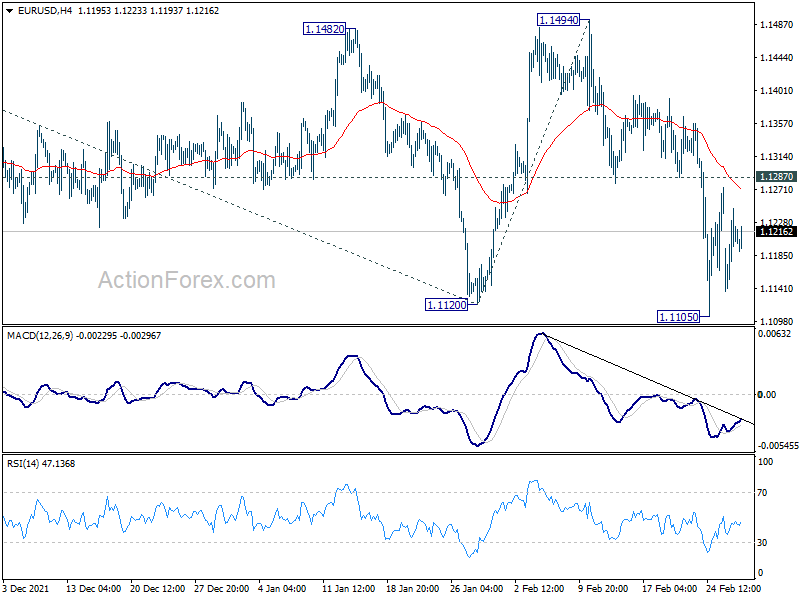
Intraday bias in EUR/USD remains neutral for consolidation above 1.1105. Further fall is expected with 1.1287 resistance intact. On the downside, sustained break of 1.1120 will confirm resumption of larger down trend from 1.2348. Next target is 61.8% projection of 1.2265 to 1.1120 from 1.1494 at 1.0786. However, firm break of 1.1287 will dampen this bearish view and turn bias back to the upside for 1.1494 resistance.
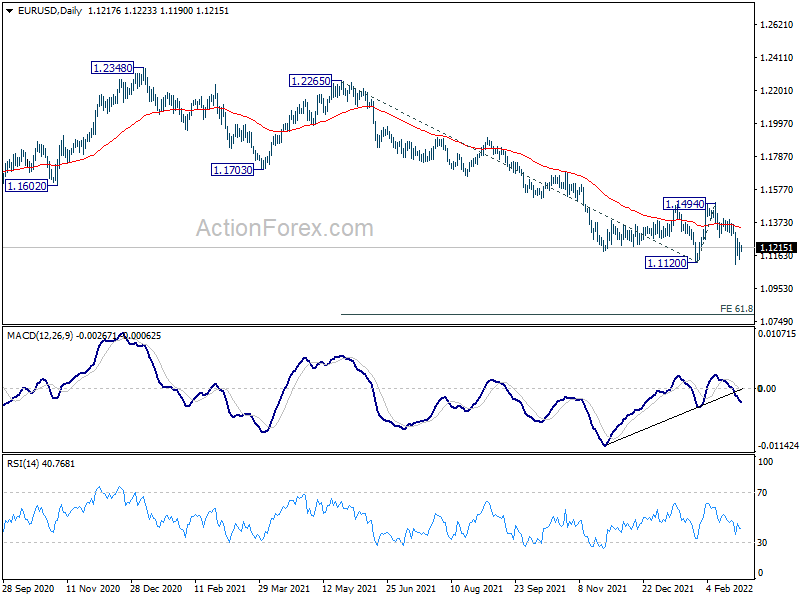
In the bigger picture, the decline from 1.2348 (2021 high) is seen as a leg inside the range pattern from 1.2555 (2018 high). Sustained trading above 55 week EMA (now at 1.1582) will argue that it has completed and stronger rise would be seen back towards top of the range between 1.2348 and 1.2555. However, firm break of 1.0635 (2020 low) will raise the chance of long term down trend resumption and target a retest on 1.0339 (2017 low) next.
GBP/USD Daily Outlook
Daily Pivots: (S1) 1.3349; (P) 1.3390; (R1) 1.3464; More...
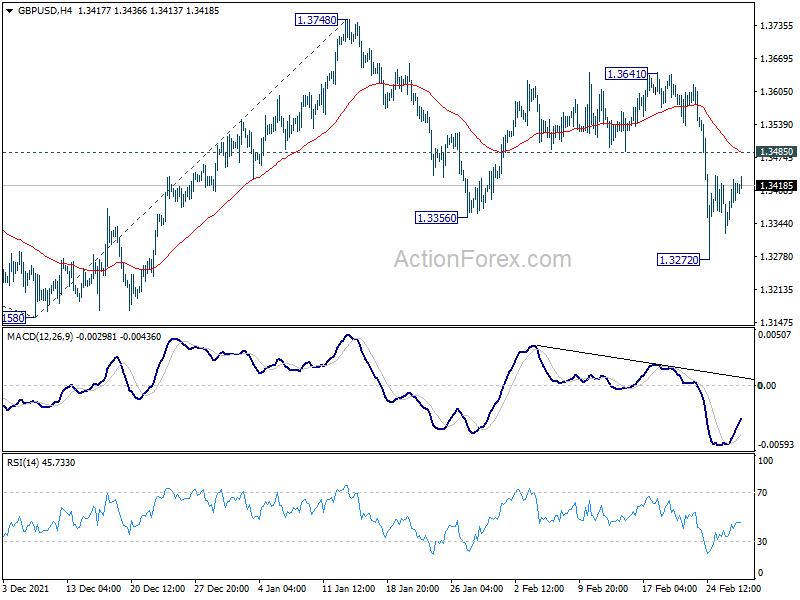
Intraday bias in GBP/USD remains neutral for the moment, as consolidation from 1.3272 could extend. Further fall is expected as long as 1.3485 support turned resistance holds. On the downside, break of 1.3272 will target 1.3158 low. However, firm break of 1.3485 will dampen this bearish view and turn bias back to the upside for 1.3641 resistance.
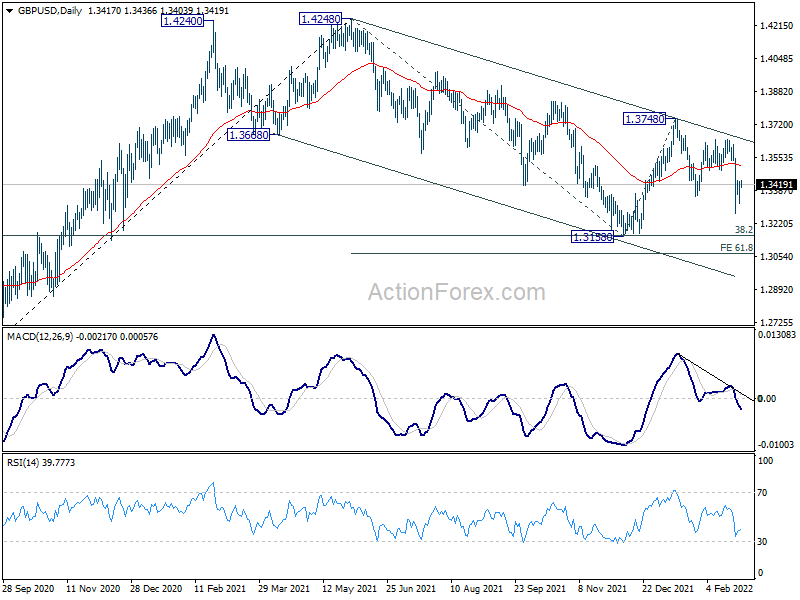
In the bigger picture, as long as 38.2% retracement of 1.1409 to 1.4248 at 1.3164 holds, up trend from 1.1409 (2020 low) is still in progress. On resumption, next target will be 38.2% retracement of 2.1161 to 1.1409 at 1.5134. Nevertheless sustained break of 1.3164 will argue that whole rise from 1.1409 has completed and bring deeper fall to 61.8% retracement at 1.2493.
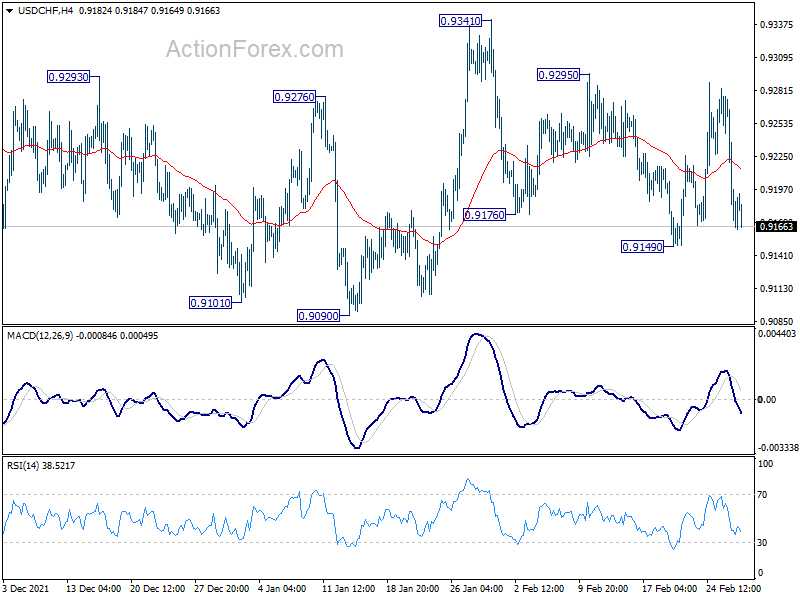
USD/CHF Daily Outlook
Daily Pivots: (S1) 0.9130; (P) 0.9205; (R1) 0.9242; More....
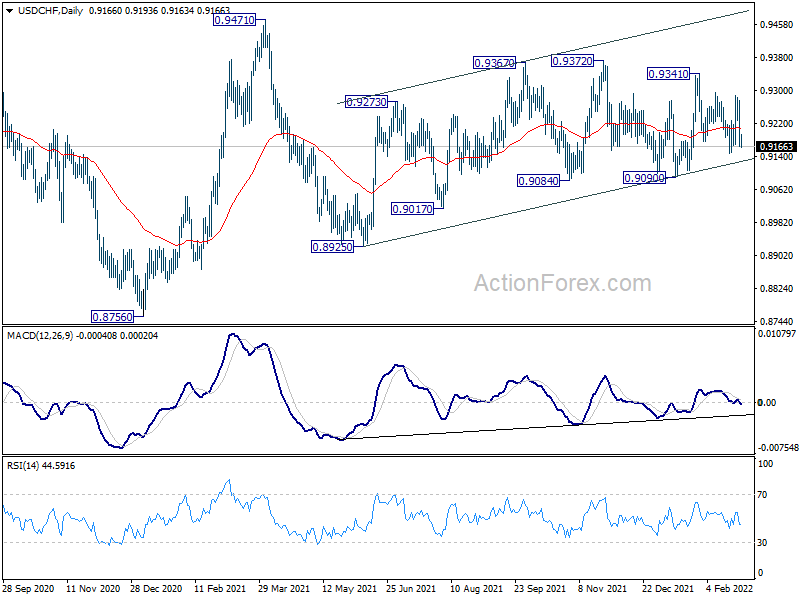
Intraday bias in USD/CHF remains neutral for the moment. Choppy rise from 0.8925 would still be in favor to extend higher as long as 0.9090 support holds. Break of 0.9341 will target 0.9372 resistance and then 0.9471. On the downside, however, break of 0.9090 will bring deeper fall back to 0.8925 support.
In the bigger picture, medium term outlook will be neutral at best as long as 0.9471 resistance holds. Larger down trend could still extend through 0.8756 (2021 low). However, firm break of 0.9471 will argue that the trend has already reversed and rebound the rally from 0.8756 with another impulsive move.
USD/JPY Daily Outlook
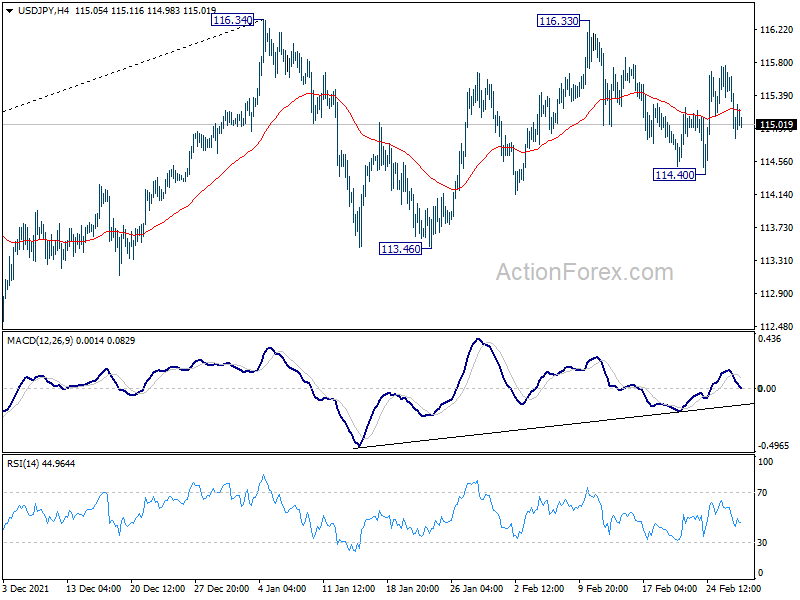
Daily Pivots: (S1) 114.63; (P) 115.20; (R1) 115.54; More...
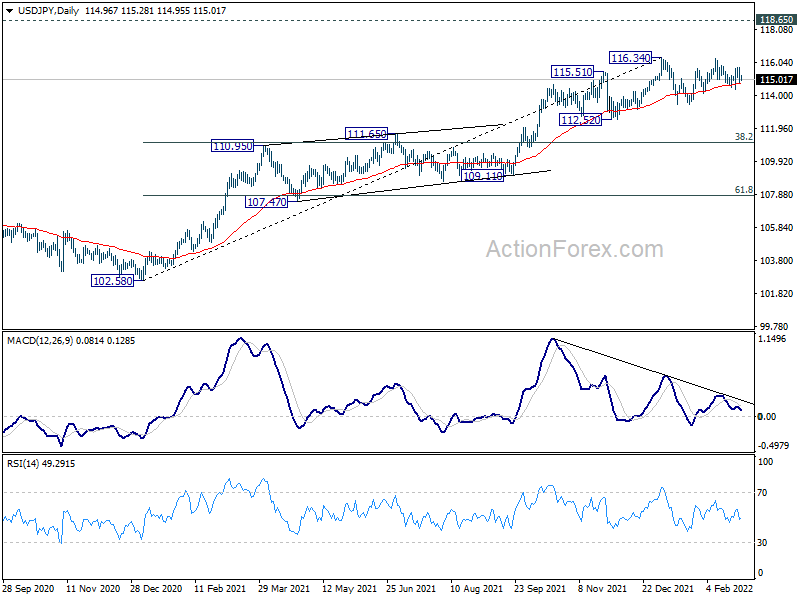
Intraday bias in USD/JPY remains neutral as sideway trading continues. On the upside, firm break of 116.34 will resume larger up trend from 102.58 to 118.65 long term resistance next. On the downside, though, break of 114.40 will continue the corrective pattern from 116.34 with another fall to 113.46 support.
In the bigger picture, no change in the view that rise from 102.58 is the third leg of the up trend from 101.18 (2020 low). Such rally should target a test on 118.65 (2016 high). Sustained break there will pave the way to 120.85 (2015 high) and raise the chance of long term up trend resumption. This will remain the favored case as long as 55 week EMA (now at 111.64) holds.
AUD/USD Daily Report
Daily Pivots: (S1) 0.7197; (P) 0.7232; (R1) 0.7299; More...
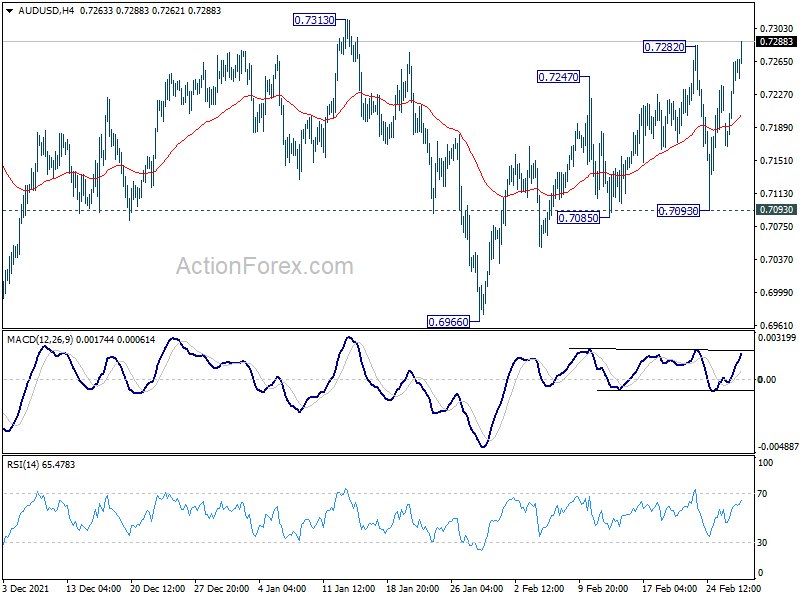
AUD/USD's rise from 0.6966 resumed by breaking 0.7282 and intraday bias is back on the upside. Decisive break of 0.7313 resistance will argue that correction from 0.8006 has completed at 0.6966, after hitting 0.6991 key support. Outlook will be turned bullish for 0.7555 resistance next. On the downside, break of 0.7093 will bring retest of 0.6966 support low instead.
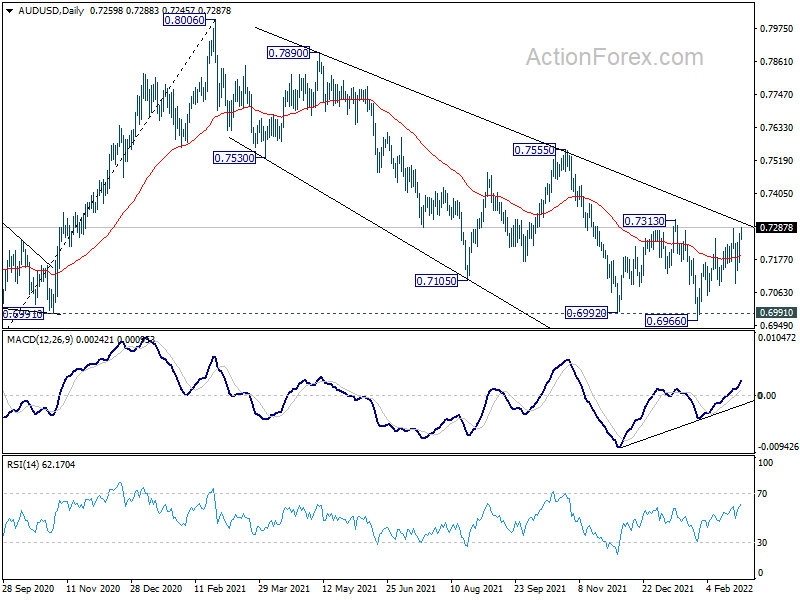
In the bigger picture, focus remains on 0.6991 key structural support. Sustained break there will argue that the whole up trend from 0.5506 might be finished at 0.8006, after rejection by 0.8135 long term resistance. Deeper decline would then be seen back to 61.8% retracement of 0.5506 to 0.8006 at 0.6461. Meanwhile, strong rebound from 0.6991 will retain medium term bullishness. That is, whole up trend from 0.5506 is still in progress.
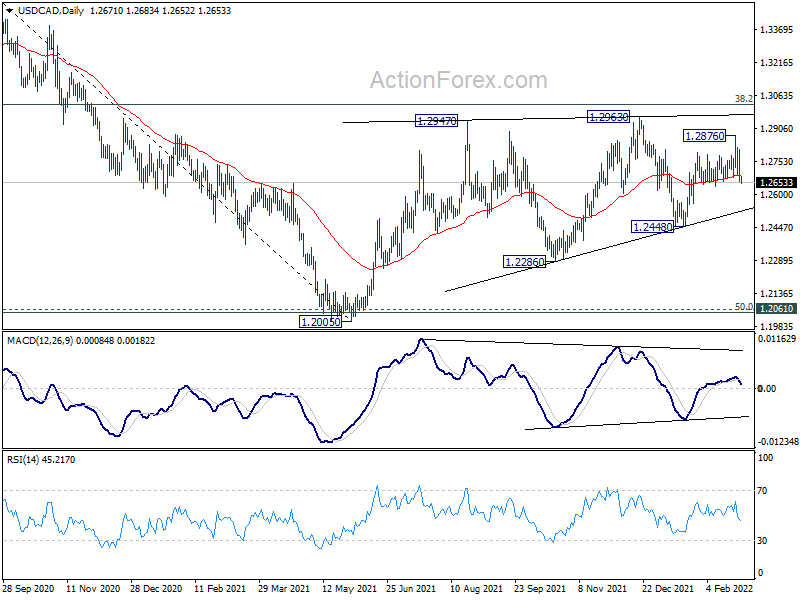
USD/CAD Daily Outlook
Daily Pivots: (S1) 1.2619; (P) 1.2714; (R1) 1.2769; More...
USD/CAD's break of 1.2680 support suggests that rebound from 1.2448 has completed at 1.2876. Intraday bias is back on the downside for 1.2448 support. For now, risk will stay mildly on the downside as long as 1.2876 resistance holds, in case of recovery.
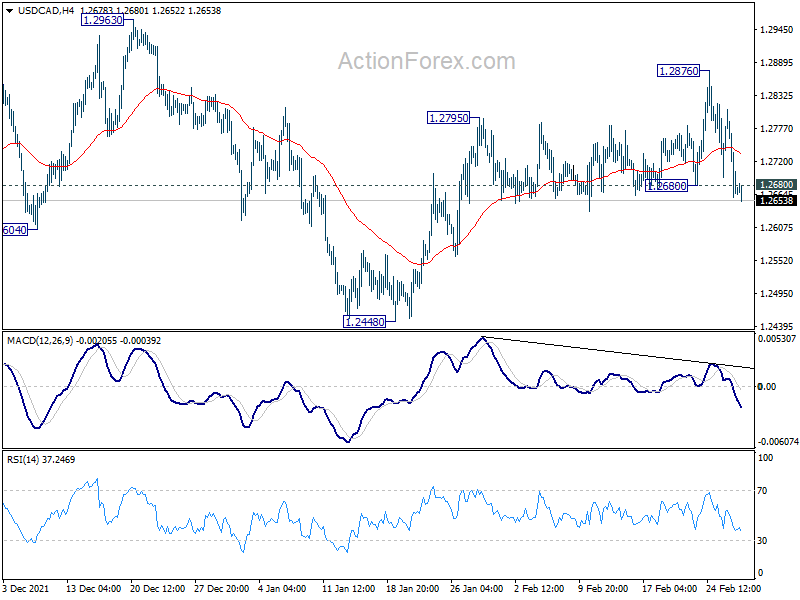
In the bigger picture, focus stays on 38.2% retracement of 1.4667 (2020 high) to 1.2005 (2021 low) at 1.3022. Sustained break there should confirm that the down trend from 1.4667 has completed after defending 1.2061 long term cluster support. Further rise would then be seen towards 61.8% retracement at 1.3650. However, rejection by 1.3022 will maintain medium term bearishness. Break of 1.2005 will resume the down trend from 1.4667 and that carries larger bearish implications too.