

Sample Category Title
GBP/JPY Daily Outlook
Daily Pivots: (S1) 153.77; (P) 154.39; (R1) 154.92; More...
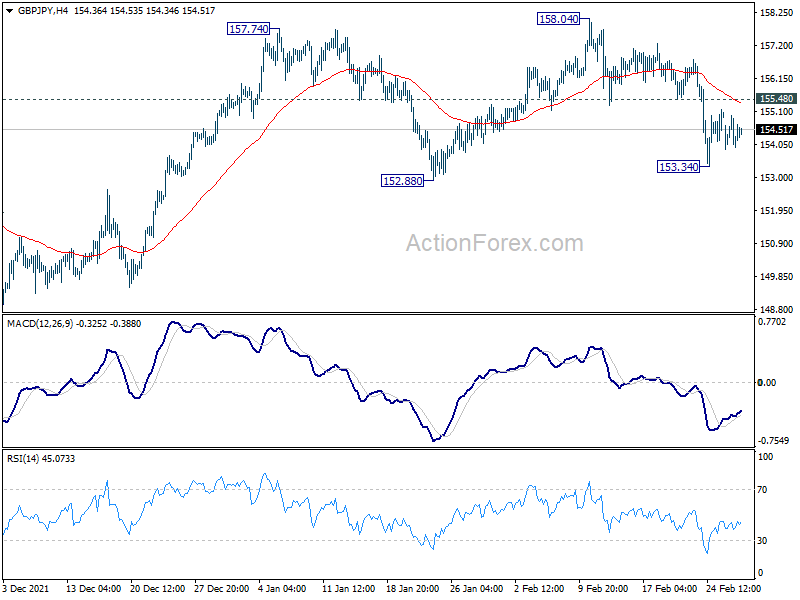
Intraday bias in GBP/JPY remains neutral at this point, and further further decline is expected with 155.48 resistance intact. Fall from 158.04 is seen as the third leg of the corrective pattern from 158.19. Break of 152.88 will target 148.94 support next. However, firm break of 155.48 will dampen this view and turn bias back to the upside for 158.04 resistance instead.
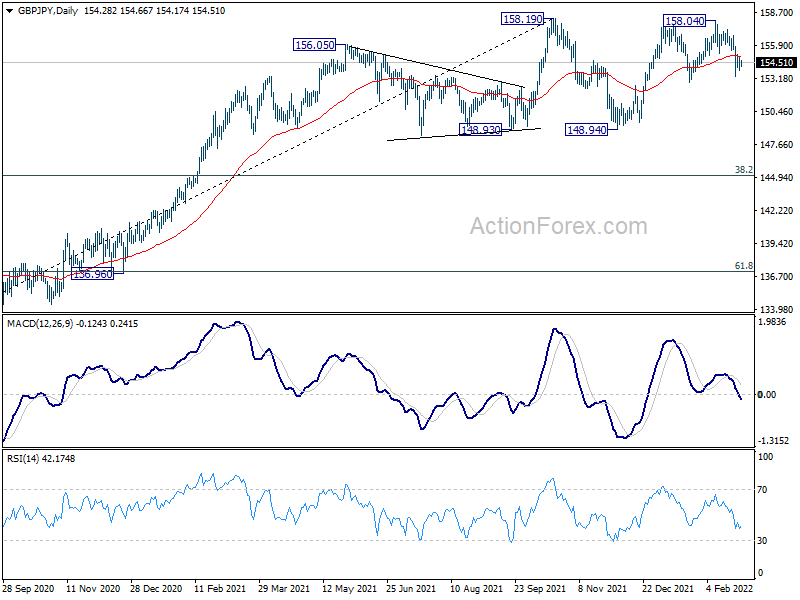
In the bigger picture, price actions from 158.19 are seen as developing into a consolidation pattern to up trend from 123.94 (2020 low). Downside should be contained by 38.2% retracement of 123.94 to 158.19 at 145.10 to bring rebound. Firm break of 158.19 will resume the up trend to long term fibonacci level at 167.93. However, sustained break of 145.10 will raise the chance of trend reversal and target 61.8% retracement at 137.02.
EUR/JPY Daily Outlook
Daily Pivots: (S1) 128.32; (P) 129.05; (R1) 129.72; More....
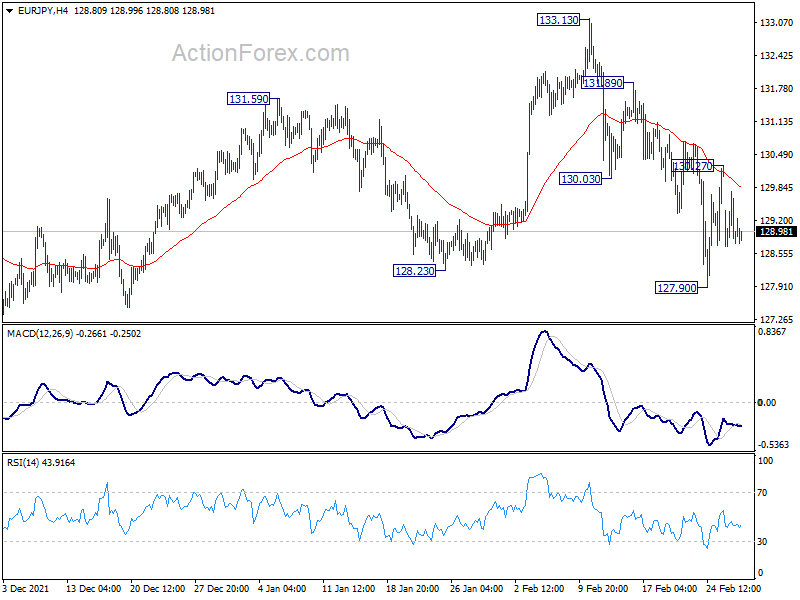
Intraday bias in EUR/JPY remains neutral at this point. On the downside, break of 127.90 will resume the decline from 133.13, as another falling leg of the corrective pattern from 134.11, through 127.36 support to 126.58 fibonacci level. For now, risk will remain on the downside as long as 130.27 minor resistance holds.
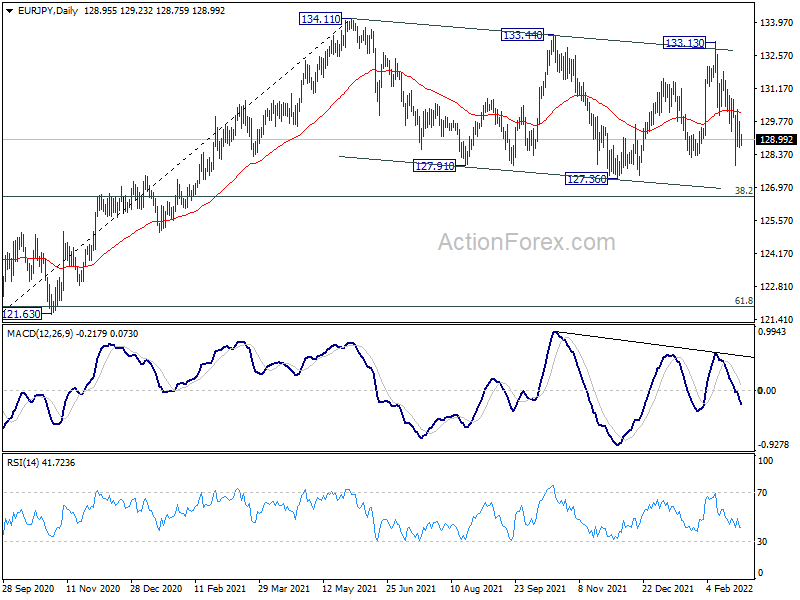
In the bigger picture, price actions from 134.11 are currently seen as a consolidation pattern only. As long as 38.2% retracement of 114.42 (2020 low) to 134.11 at 126.58 holds, up trend from 114.42 is still in favor to continue. Break of 134.11 will target long term resistance at 137.49 (2018 high). However, sustained break of 126.58 will raise the chance of bearish reversal. In this case, deeper decline would be seen to 61.8% retracement at 121.94, and possibly below.
EUR/GBP Daily Outlook
Daily Pivots: (S1) 0.8340; (P) 0.8361; (R1) 0.8381; More...
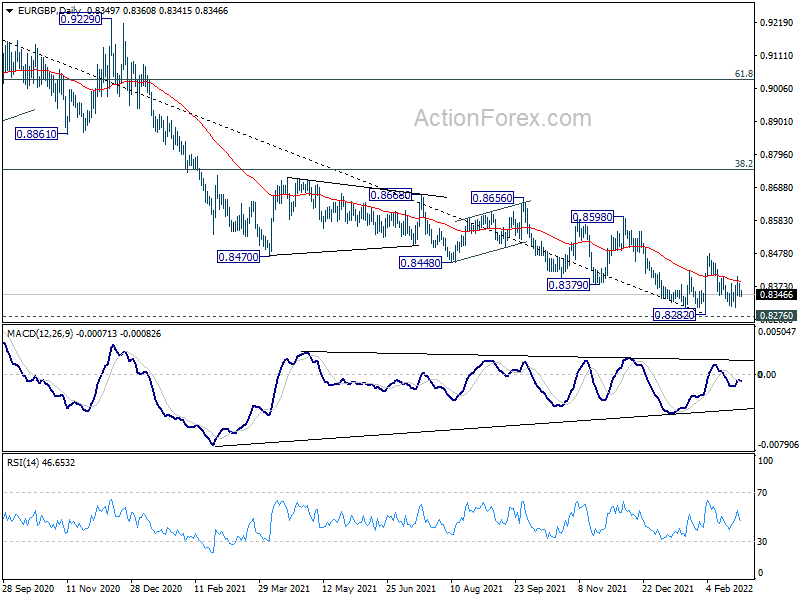
Intraday bias in EUR/GBP remains neutral for the moment. On the upside, above 0.8405 will target 0.8476 resistance first. Break there will resume the rebound from 0.8282 to 0.8598 key resistance level. On the downside, though, break of 0.8304 will turn bias back to the downside for 0.8282 low again.
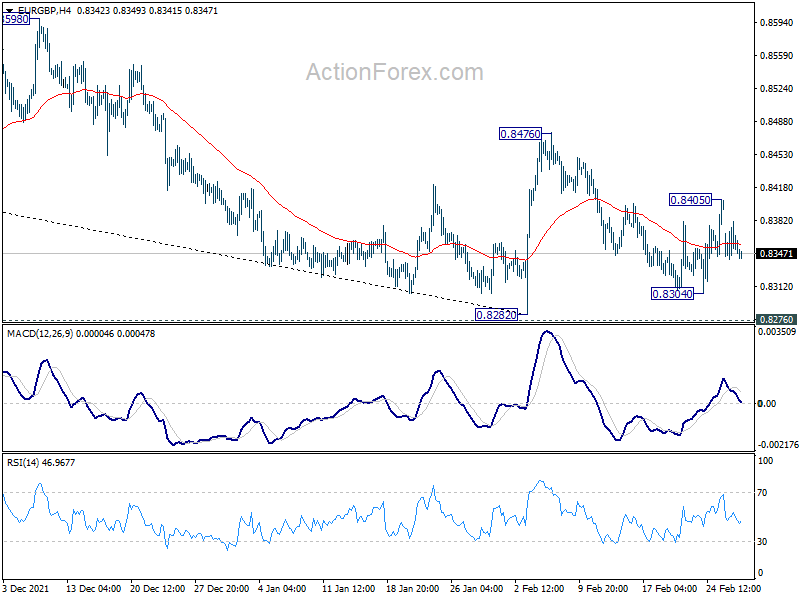
In the bigger picture, price actions from 0.9499 (2020 high) are still seen a corrective pattern that should be contained by 0.8276 long term support (2019 low). Sustained trading above 38.2% retracement of 0.9499 to 0.8282 at 0.8747 will affirm this bullish case. However, sustained break of 0.8276 will argue that the long term trend has reversed. Deeper decline would be seen to 61.8% retracement of 0.6935 to 0.9499 at 0.7917.
EUR/AUD Daily Outlook
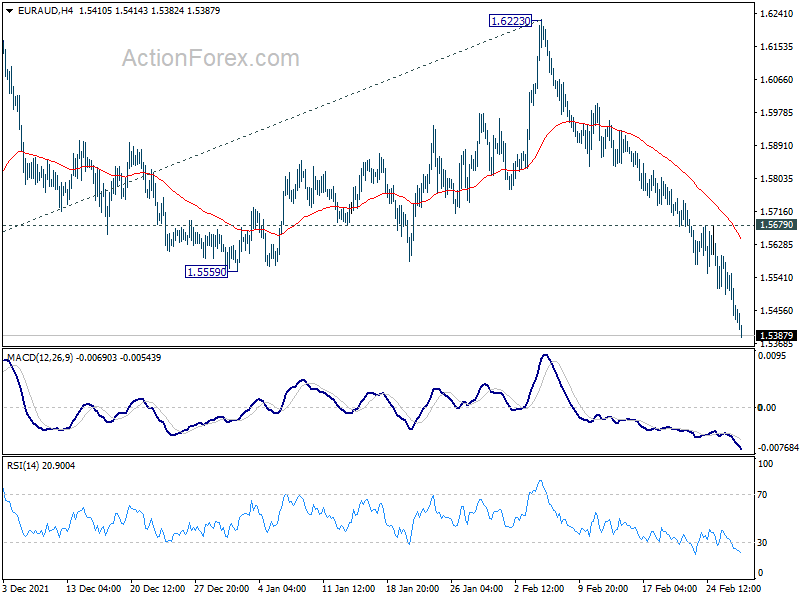
Daily Pivots: (S1) 1.5390; (P) 1.5487; (R1) 1.5539; More...
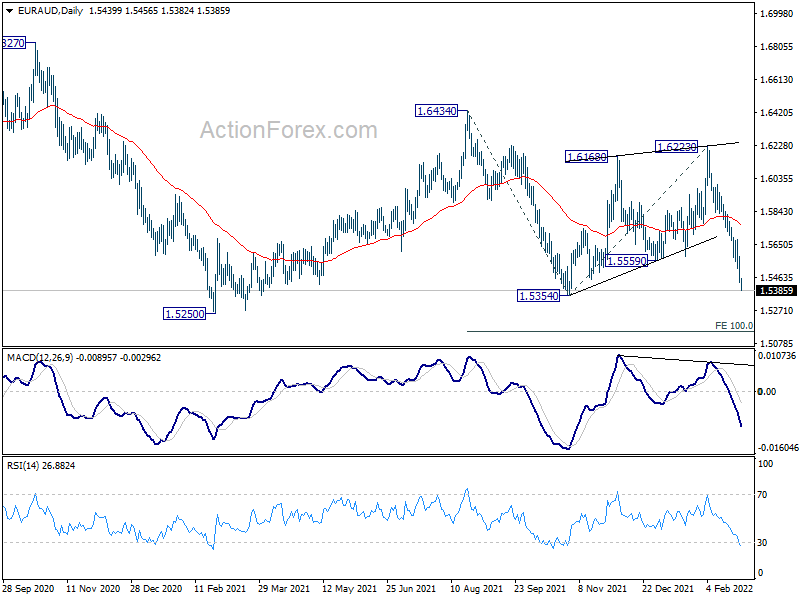
EUR/AUD's decline continues today and hits as low as 1.5382 so far. Intraday bias stays on the downside for 1.5250/5354 support zone. Decisive break there will resume larger down trend from 1.9799. Next near term target will be 100% projection of 1.6343 to 1.5354 from 1.6223 at 1.5143. On the upside, break of 1.5679 resistance is needed to indicate short term bottoming. Otherwise, outlook stays bearish in case of recovery.
In the bigger picture, price actions from 1.5250 low are seen as a corrective pattern. Further extension could be seen and another rise cannot be ruled out. But strong resistance should be seen at 38.2% retracement of 1.9799 to 1.5250 at 1.6988. Larger down trend from 1.9799 (2020 high) is in favor to extend through 1.5250 at a later stage. Next target is 61.8% retracement of 1.1602 (2012 low) to 1.9799 at 1.4733
EUR/CHF Daily Outlook
Daily Pivots: (S1) 1.0248; (P) 1.0314; (R1) 1.0352; More....
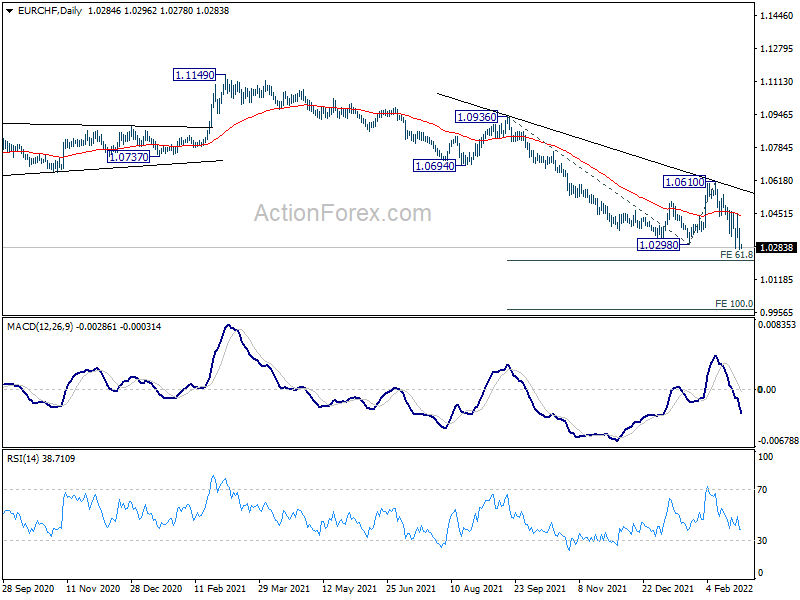
EUR/CHF's breach of 1.0277 suggests resumption of recent decline and intraday bias is back on the downside. Sustained trading below 1.0298 will extend larger down trend and target 61.8% projection of 1.0936 to 1.0298 from 1.0610 at 1.0216. On the upside, above 1.0366 minor resistance will delay the bearish case and turn intraday bias neutral first. But overall outlook will stay bearish as long as 1.0610 resistance holds.
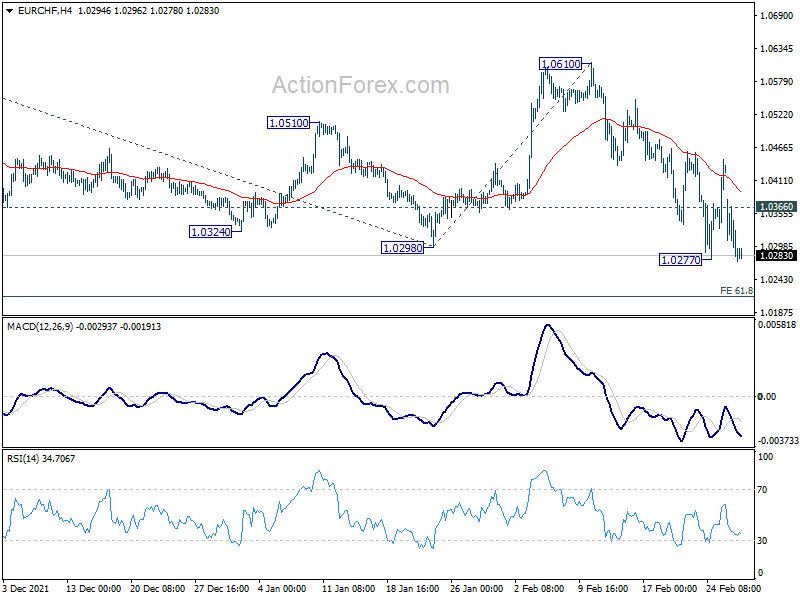
In the bigger picture, long term down trend from 1.2004 (2018 high) is still in progress. Next target is 61.8% projection of 1.2004 to 1.0505 to 1.1149 at 1.0223. Sustained break there will target 100% projection at 0.9650. In any case, break of 1.0610 resistance is needed to be the first sign of bottoming. Otherwise, outlook will remain bearish.
Aussie Firm after RBA, Euro and Sterling Look Vulnerable
Overall, the financial markets are steady in Asian session today. Russian invasion of Ukraine continues after the talks between two leaders yielded no breakthrough. Ukraine is holding on defending while isolation of Russia from the West intensified. In the currency markets, commodity currencies are attempting to break out from range. Aussie stays firm after non-eventful RBA while Loonie is awaiting tomorrow's BoC hike. Euro and Sterling remain the weakest ones, and look vulnerable. Dollar turned softer with falling treasury yields. But Yen and Swiss Franc are holding on to gains.
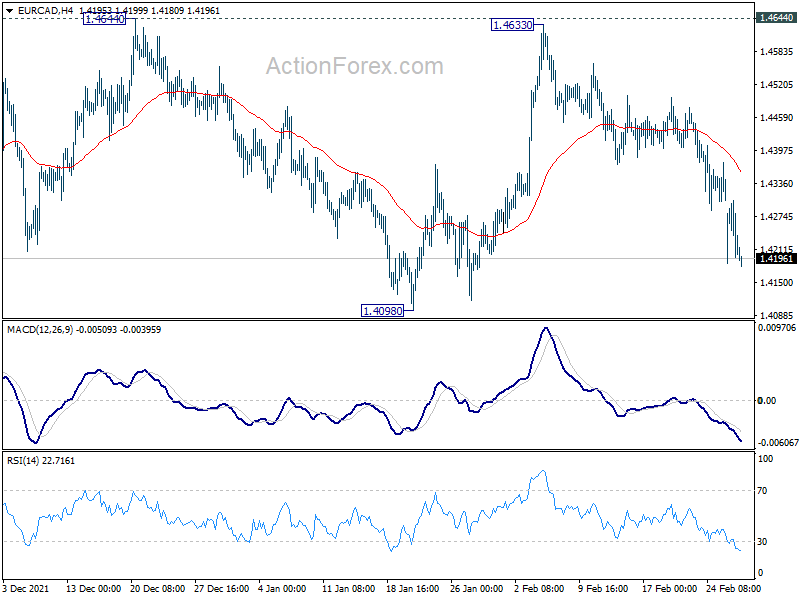
Technically, a focus today is on whether selloff in Euro and Sterling against commodity currencies would pick up momentum. EUR/AUD is going to take on 1.5250/5354 medium term support zone soon and break will resume later down trend. EUR/CAD is also heading back to 1.4098 low. Meanwhile, GBP/CAD and GBP/AUD are both heading back to 1.6964 and 1.8123 supports respectively. Firm break of these levels will solidify near term bearishness.
In Asia, at the time of writing, Nikkei is up 1.48%. Hong Kong HSI is down -0.37%. China Shanghai SSE is up 0.22%. Singapore Strait Times is up 0.88%. Japan 10-year JGB yield is down -0.006 at 0.179. Overnight, DOW dropped -0.49%. S&P 500 dropped -0.24%. NASDAQ rose 0.41%. 10-year yield dropped 0.147 to 1.839.
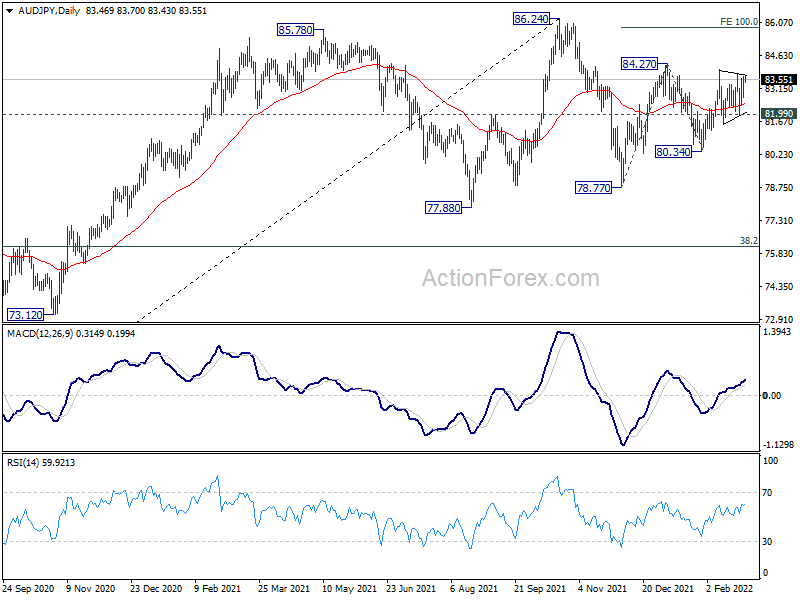
RBA stands pat and be patient, AUD/JPY range-bound
RBA left cash rate target unchanged at 0.10% as widely expected. The board maintained that it "will not increase the cash rate until actual inflation is sustainably within the 2 to 3 per cent target range.". For now, it is "too early to conclude that it is sustainably within the target range", and RBA is "prepared to be patient".
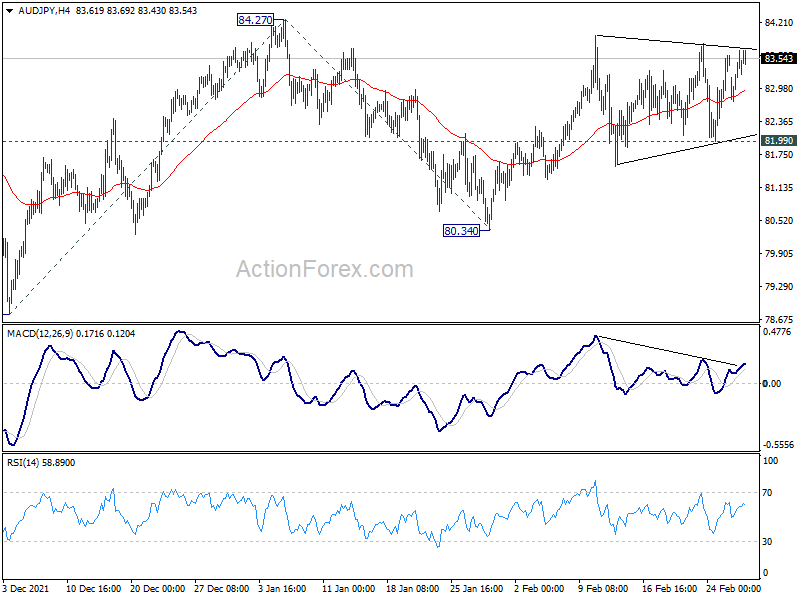
AUD/JPY is staying established after the release. Price action from 86.24 high are seen as developing into a sideway corrective pattern, with rise fro 78.77 as the second leg. That is, further rally is in favor as long as 81.99 support holds. Break of 84.27 will target 100% projection of 78.77 to 84.27 from 80.34 at 85.84. However, even in this case, upside should be limited by 86.24 high to bring another falling leg to complete the three-wave corrective pattern.
Meanwhile, break of 81.99 support will argue that it's developing into a deeper correction, instead of a sideway pattern. Deeper fall should then be seen through 80.34 to 78.77 and below.
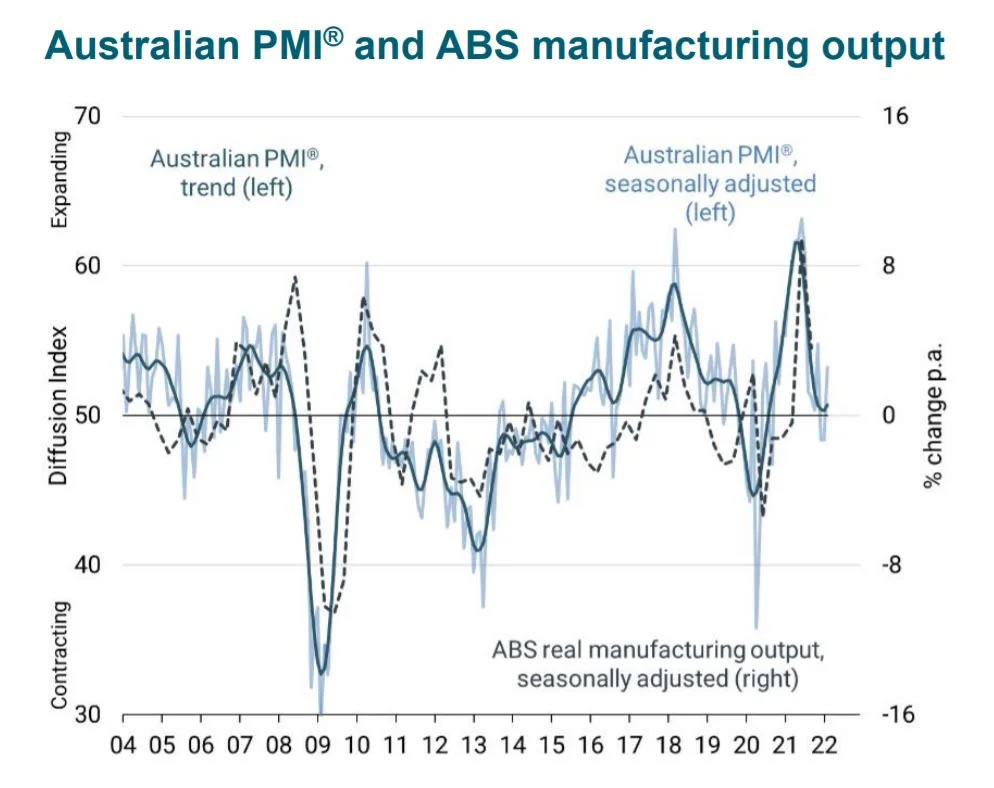
Australia AiG manufacturing rose to 53.2, edged back into expansion
Australia AiG Performance of Manufacturing Index rose 4.8 pts to 53.2 in February. Production rose 2.7 to 54.6. Employment dropped -1.9 to 43.5. Average wages rose 1.4 to 64.9. Input prices dropped -6.7 to 75.6. But selling prices rose 1.4 to 64.9.
Innes Willox, Chief Executive of Ai Group said: "Australia's manufacturing sector edged back into expansion during February following the sharp labour and supply chain disruptions of the December-January period. Price and wage pressures continued in February with some easing in the pace of increase in input prices. At the same time, selling prices accelerated suggesting further recovery of earlier cost increases."
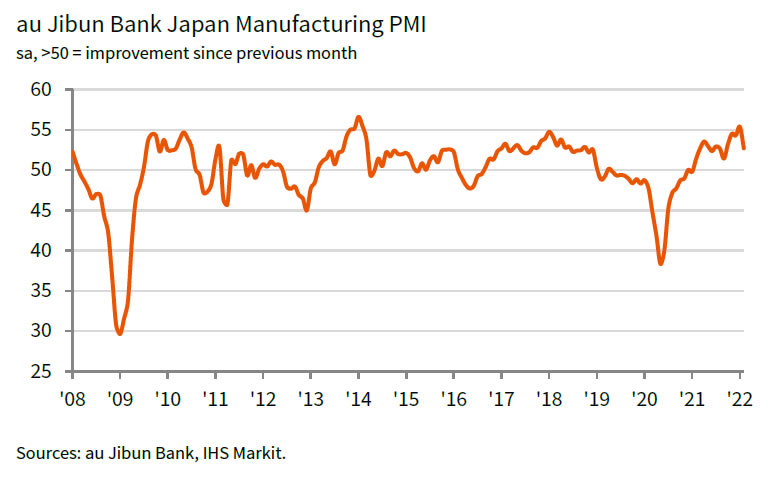
Japan PMI manufacturing finalized at 52.7, new orders stagnates and input prices rose
Japan PMI Manufacturing was finalized at 52.7 in February, down from January's 55.4. Markit said there was renewed fall in output amid near-stagnation in new orders. Input prices rose at sharpest pace since August 2008. Stocks of purchases had survey-record increase amid delays and shortages.
Usamah Bhatti, Economist at IHS Markit, said: "February PMI data pointed to a softer expansion in the Japanese manufacturing sector. The rate of growth eased to a five-month low, however, amid a renewed reduction in production levels and a broad stagnation in new orders... input price pressures intensified further, with average cost burdens rising at the sharpest pace in thirteen-and-a-half years... manufacturers commented that the degree of optimism regarding the 12-month outlook for output eased to a six-month low in February... This is broadly in line with the IHS Markit prediction for industrial production to grow 5.9% in 2022."
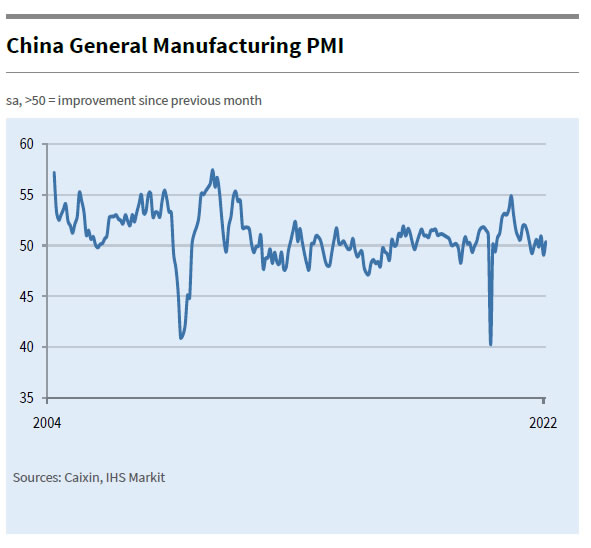
China Caixin PMI manufacturing rose to 49.1 in Feb, returned to growth
China Caixin PMI Manufacturing rose from 49.1 to 50.4 in February, above expectation of 49.5. Caixin said output returned to growth amid quickest rate in new work for eight months. Pandemic continued to weigh on export sales. Business confidence picked up to the highest since last June.
Wang Zhe, Senior Economist at Caixin Insight Group said: "Overall, manufacturing activity expanded in February. Supply recovered, while demand more clearly improved. The level of optimism about the future business outlook increased further. However, the job market remained under high pressure. And we still need to keep an eye on inflationary pressure.
Looking ahead
Germany retail sales and CPI flash will be released in European session. Eurozone will release PMI manufacturing final. UK will also release PMI manufacturing final, mortgage approvals and M4 money supply. Later in the day, Canada will release GDP while US will release ISM manufacturing and construction spending.
EUR/CHF Daily Outlook
Daily Pivots: (S1) 1.0248; (P) 1.0314; (R1) 1.0352; More....
EUR/CHF's breach of 1.0277 suggests resumption of recent decline and intraday bias is back on the downside. Sustained trading below 1.0298 will extend larger down trend and target 61.8% projection of 1.0936 to 1.0298 from 1.0610 at 1.0216. On the upside, above 1.0366 minor resistance will delay the bearish case and turn intraday bias neutral first. But overall outlook will stay bearish as long as 1.0610 resistance holds.
In the bigger picture, long term down trend from 1.2004 (2018 high) is still in progress. Next target is 61.8% projection of 1.2004 to 1.0505 to 1.1149 at 1.0223. Sustained break there will target 100% projection at 0.9650. In any case, break of 1.0610 resistance is needed to be the first sign of bottoming. Otherwise, outlook will remain bearish.
Economic Indicators Update
| GMT | Ccy | Events | Actual | Forecast | Previous | Revised |
|---|---|---|---|---|---|---|
| 21:30 | AUD | AiG Performance of Mfg Index Feb | 53.2 | 48.4 | ||
| 00:30 | AUD | Current Account (AUD) Q4 | 12.7B | 14.3B | 23.9B | 22.0B |
| 00:30 | JPY | Manufacturing PMI Feb F | 52.7 | 52.9 | 52.9 | |
| 01:00 | CNY | Manufacturing PMI Feb | 50.2 | 49.9 | 50.1 | |
| 01:00 | CNY | Non-Manufacturing PMI Feb | 51.6 | 50.9 | 51.1 | |
| 01:45 | CNY | Caixin Manufacturing PMI Feb | 50.4 | 49.5 | 49.1 | |
| 03:30 | AUD | RBA Interest Rate Decision | 0.10% | 0.10% | 0.10% | |
| 07:00 | EUR | Germany Retail Sales M/M Jan | 1.80% | -5.50% | ||
| 08:30 | CHF | SVME PMI Feb | 64.7 | 63.8 | ||
| 08:45 | EUR | Italy Manufacturing PMI Feb | 59.2 | 58.3 | ||
| 08:50 | EUR | France Manufacturing PMI Feb F | 57.6 | 57.6 | ||
| 08:55 | EUR | Germany Manufacturing PMI Feb F | 58.5 | 58.5 | ||
| 09:00 | EUR | Eurozone Manufacturing PMI Feb F | 58.4 | 58.4 | ||
| 09:30 | GBP | Manufacturing PMI Feb F | 57.3 | 57.3 | ||
| 09:30 | GBP | Mortgage Approvals Jan | 72K | 71K | ||
| 09:30 | GBP | M4 Money Supply M/M Jan | 0.40% | 0.10% | ||
| 13:00 | EUR | Germany CPI M/M Feb P | 0.90% | 0.40% | ||
| 13:00 | EUR | Germany CPI Y/Y Feb P | 5.10% | 4.90% | ||
| 13:30 | CAD | GDP M/M Dec | 0.00% | 0.60% | ||
| 14:30 | CAD | Manufacturing PMI Feb | 56.2 | |||
| 14:45 | USD | Manufacturing PMI Feb F | 57.5 | 57.5 | ||
| 15:00 | USD | ISM Manufacturing PMI Feb | 57.9 | 57.6 | ||
| 15:00 | USD | ISM Manufacturing Prices Paid Feb | 77.5 | 76.1 | ||
| 15:00 | USD | ISM Manufacturing Employment Index Feb | 54.5 | |||
| 15:00 | USD | Construction Spending M/M Jan | -0.50% | 0.20% |
China Caixin PMI manufacturing rose to 49.1 in Feb, returned to growth
China Caixin PMI Manufacturing rose from 49.1 to 50.4 in February, above expectation of 49.5. Caixin said output returned to growth amid quickest rate in new work for eight months. Pandemic continued to weigh on export sales. Business confidence picked up to the highest since last June.
Wang Zhe, Senior Economist at Caixin Insight Group said: "Overall, manufacturing activity expanded in February. Supply recovered, while demand more clearly improved. The level of optimism about the future business outlook increased further. However, the job market remained under high pressure. And we still need to keep an eye on inflationary pressure.
Japan PMI manufacturing finalized at 52.7, new orders stagnates and input prices rose
Japan PMI Manufacturing was finalized at 52.7 in February, down from January's 55.4. Markit said there was renewed fall in output amid near-stagnation in new orders. Input prices rose at sharpest pace since August 2008. Stocks of purchases had survey-record increase amid delays and shortages.
Usamah Bhatti, Economist at IHS Markit, said: "February PMI data pointed to a softer expansion in the Japanese manufacturing sector. The rate of growth eased to a five-month low, however, amid a renewed reduction in production levels and a broad stagnation in new orders... input price pressures intensified further, with average cost burdens rising at the sharpest pace in thirteen-and-a-half years... manufacturers commented that the degree of optimism regarding the 12-month outlook for output eased to a six-month low in February... This is broadly in line with the IHS Markit prediction for industrial production to grow 5.9% in 2022."
Australia AiG manufacturing rose to 53.2, edged back into expansion
Australia AiG Performance of Manufacturing Index rose 4.8 pts to 53.2 in February. Production rose 2.7 to 54.6. Employment dropped -1.9 to 43.5. Average wages rose 1.4 to 64.9. Input prices dropped -6.7 to 75.6. But selling prices rose 1.4 to 64.9.
Innes Willox, Chief Executive of Ai Group said: "Australia's manufacturing sector edged back into expansion during February following the sharp labour and supply chain disruptions of the December-January period. Price and wage pressures continued in February with some easing in the pace of increase in input prices. At the same time, selling prices accelerated suggesting further recovery of earlier cost increases."
RBA stands pat and be patient, AUD/JPY range-bound
RBA left cash rate target unchanged at 0.10% as widely expected. The board maintained that it "will not increase the cash rate until actual inflation is sustainably within the 2 to 3 per cent target range.". For now, it is "too early to conclude that it is sustainably within the target range", and RBA is "prepared to be patient".
AUD/JPY is staying established after the release. Price action from 86.24 high are seen as developing into a sideway corrective pattern, with rise fro 78.77 as the second leg. That is, further rally is in favor as long as 81.99 support holds. Break of 84.27 will target 100% projection of 78.77 to 84.27 from 80.34 at 85.84. However, even in this case, upside should be limited by 86.24 high to bring another falling leg to complete the three-wave corrective pattern.
Meanwhile, break of 81.99 support will argue that it's developing into a deeper correction, instead of a sideway pattern. Deeper fall should then be seen through 80.34 to 78.77 and below.