Sample Category Title
EUR/USD Mid-Day Outlook
Daily Pivots: (S1) 1.1201; (P) 1.1238; (R1) 1.1309; More...
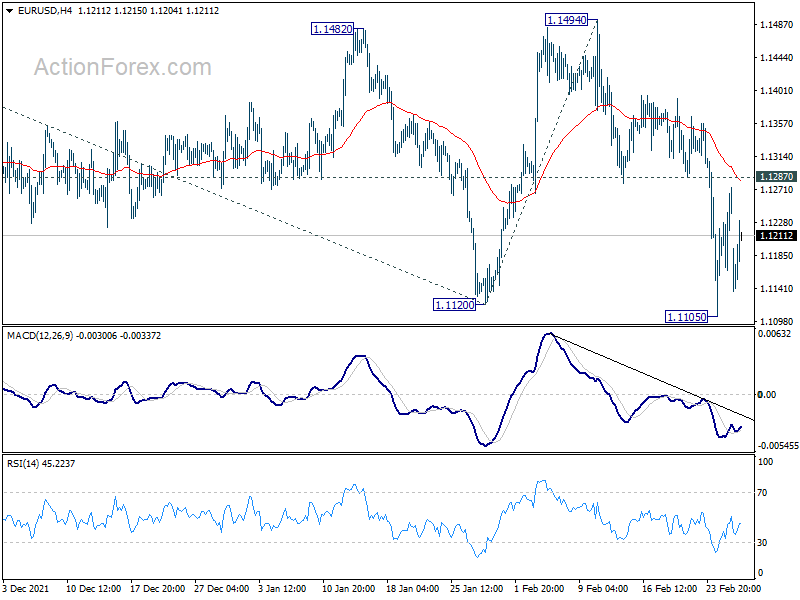
EUR/USD is staying in consolidation above 1.1105 and intraday bias remains neutral at this point. On the downside, sustained break of 1.1120 will confirm resumption of larger down trend from 1.2348. Next target is 61.8% projection of 1.2265 to 1.1120 from 1.1494 at 1.0786. However, firm break of 1.1287 will dampen this bearish view and turn bias back to the upside for 1.1494 resistance.
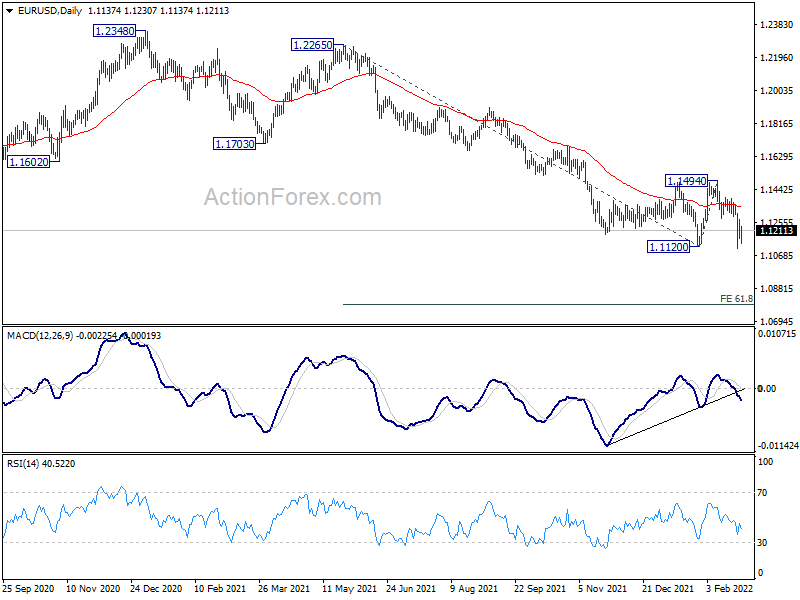
In the bigger picture, the decline from 1.2348 (2021 high) is seen as a leg inside the range pattern from 1.2555 (2018 high). Sustained trading above 55 week EMA (now at 1.1582) will argue that it has completed and stronger rise would be seen back towards top of the range between 1.2348 and 1.2555. However, firm break of 1.0635 (2020 low) will raise the chance of long term down trend resumption and target a retest on 1.0339 (2017 low) next.
Stock Markets Dive Further, But Others Steady
Markets are staying in risk aversion today with heavy selling in stocks. Expectations on the negotiation between Ukrainian President Volodymyr Zelenskyy and Russian President Vladimir Putin are low. Meanwhile, other markets are relatively steady. In forex, Swiss Franc, Yen and Dollar are still the stronger ones ,while Euro is the weakest. But still, most pairs and crosses are staying inside last week's range.
Technically, commodity currencies are rather resilient in the risk aversion environment. If sentiment improves, there are prospects of further rally. Attention will be on 0.7282 temporary top in AUD/USD and 1.2680 support in USD/CAD. Break of these levels could trigger more buying in Aussie and Loonie.
In Europe, at the time of writing, FTSE is down -1.48%. DAX is down -2.31%. CAC is down -2.95%. Germany 10-year yield is down -0.052 at 0.178. Earlier in Asia, Nikkei rose 0.19%. Hong Kong HSI dropped -0.24%. China Shanghai SSE rose 0.32%. Singapore Strait Times dropped -1.59%. Japan 10-year JGB yield dropped -0.023 at 0.185.
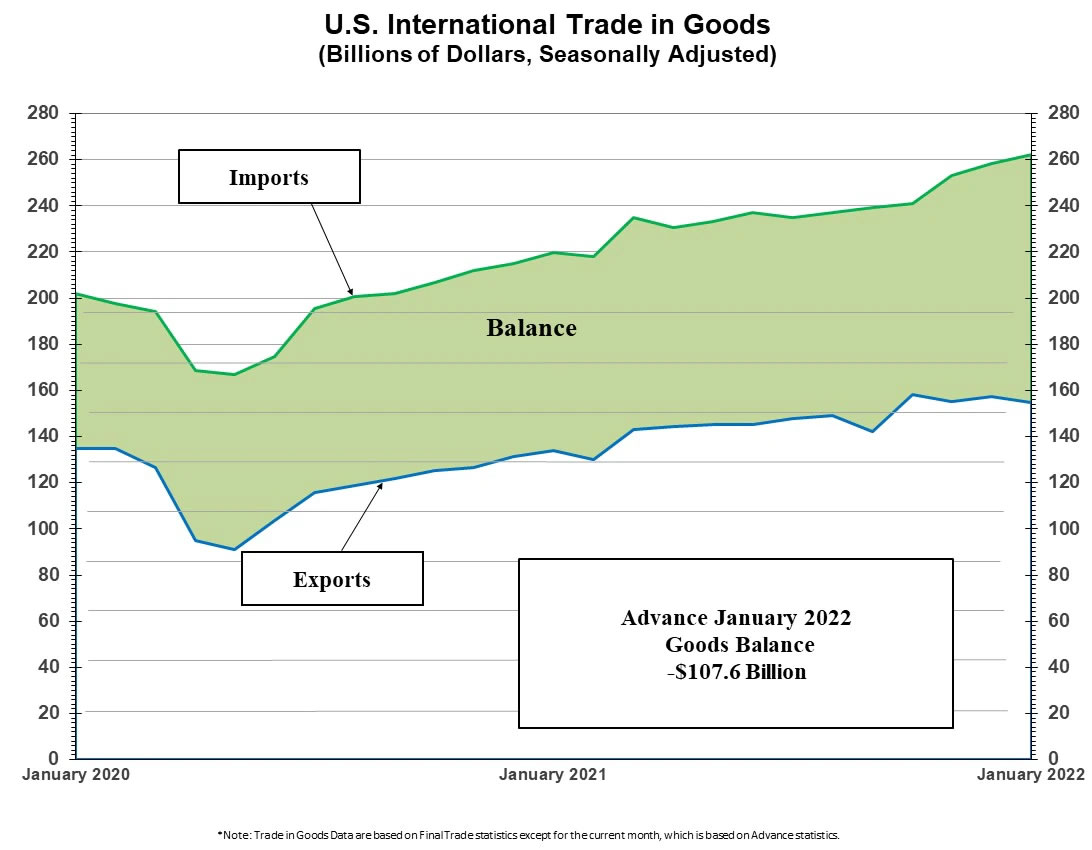
US goods trade deficit widened to USD 107.6B in Jan
US goods exports dropped USD -2.8B to USD 154.8B in January. Goods imports rose USD 4.4B to USD 262.5B. Trade deficit widened by USD -7.2B to USD -107.6B, larger than expectation of USD -98.5B. Wholesale inventories rose 0.8% mom to USD 798.2B. Retail inventories rose 1.9% mom to USD 658.1B.
From Canada, current account balance turned into CAD -0.8B in Q4. IPPI rose 3.0% mom in January while RMPI rose 6.5% mom.
ECB Panetta: The world becomes darker, our steps should be smaller
ECB Executive Board member Fabio Panetta said, "we should adjust policy carefully and recalibrate it as we see the effects of our decisions, so as to avoid suffocating the recovery," he said.
Talking about Russia invasion, he said, "this terrible event has made the need for prudence even greater. The world has become darker, and our steps should be smaller still."
"The most important thing right now is for us to be ready and available to preserve financial stability," he added.
ECB Centeno: Stagflation risks increased with Russia invasion of Ukraine
ECB Governing Council member Mario Centeno "I am convinced that the traction of growth that the economy was following will prevail." But, "a scenario close to stagflation is not out of the possibilities that we can face. So we need to adjust our policies to that."
He added that policymakers had already considered the threat of stagflation before. "After the invasion these risks have only increased," he said. Russian's invasion of Ukraine has the possibility of "a positive impact on inflation, a few decimal points, and a negative impact on growth."
Swiss KOF dropped to 105 in Feb, primarily on manufacturing
Swiss KOF Economic Barometer dropped from 107.2 to 105 in February, below expectation of 108.5. KOF said, "the indicators from the manufacturing sector are primarily responsible for the decline, followed by those from the financial sector. The signals for the Swiss exporters are somewhat more favourable than before. "
Also released, retail sales rose 5.1% yoy in January, versus expectation of 0.4% yoy. GDP grew 0.3% qoq in Q4, below expectation of 0.4% qoq.
Japan industrial production dropped -1.3% mom in Jan, retail sales rose 1.6% yoy
Japan industrial production dropped -1.3% mom in January, worse than expectation of -0.7% mom. Output declined for the second month, after the -1.0% mom contraction in December. Production of cars and other motor parts slumped -17.2% mom, falling for the first time in four months.
Nevertheless according to survey by the Ministry of Economy, Trade and Industry (METI), output is expected to bounce back by 5.7% mom in February and 0.1% mom in March. But the forecasts were taken before Russia's invasion of Ukraine, which impact is still unknown.
Retail sales rose 1.6% yoy, above expectation of 1.1% yoy, fourth consecutive month of expansion.
Australia retail sales rose 1.8% mom in Jan, above expectation
Australia retail sales rose 1.8% mom in January, above expectation of 0.4% mom.
Director of Quarterly Economy Wide Statistics, Ben James said: "The emergence of the Omicron variant and rising COVID-19 case numbers, combined with an absence of mandated lockdowns has resulted in a range of different consumer behaviours. We have seen the type of spending previously associated with lockdowns occurring simultaneously with those associated with the easing of lockdown conditions."
"This had led to variations across the industries with Food retailing recording a rise in sales consistent with previous COVID-19 outbreaks as consumers exercise caution amidst surging case numbers. However, the absence of lockdowns meant that other discretionary industries which would usually see a fall during the pandemic have recorded mixed results."
Also released, private sector credit rose 0.6% mom, versus expectation of 0.7% mom.
New Zealand ANZ business confidence dropped to -51.8, a challenging year in 2022
New Zealand ANZ business confidence dropped to -51.8 in February, down from December's -23.2. Own activity outlook dropped from 11.8 to -2.2. Export intentions dropped from 8.8 to 0.9. Investment intentions dropped from 11.4 to 4.5. Employment intentions dropped from 10.5 to 2.3. Cost expectations rose from 88.2 to 92.0. Profit expectations dropped from -13.1 to -32.7. Pricing intentions rose from 63.6 to 74.1. Inflation expectations rose from 4.42 to 5.29.
ANZ said, "All up, 2022 is shaping up to be a challenging year economically, and getting on top of super-charged inflation without an outright recession is looking increasingly difficult. But with CPI inflation heading well over 6% the RBNZ has no choice but keep right on hiking. And now global geopolitical developments threaten yet more imported inflation via energy markets. Buckle up."
EUR/USD Mid-Day Outlook
Daily Pivots: (S1) 1.1201; (P) 1.1238; (R1) 1.1309; More...
EUR/USD is staying in consolidation above 1.1105 and intraday bias remains neutral at this point. On the downside, sustained break of 1.1120 will confirm resumption of larger down trend from 1.2348. Next target is 61.8% projection of 1.2265 to 1.1120 from 1.1494 at 1.0786. However, firm break of 1.1287 will dampen this bearish view and turn bias back to the upside for 1.1494 resistance.
In the bigger picture, the decline from 1.2348 (2021 high) is seen as a leg inside the range pattern from 1.2555 (2018 high). Sustained trading above 55 week EMA (now at 1.1582) will argue that it has completed and stronger rise would be seen back towards top of the range between 1.2348 and 1.2555. However, firm break of 1.0635 (2020 low) will raise the chance of long term down trend resumption and target a retest on 1.0339 (2017 low) next.
Economic Indicators Update
| GMT | Ccy | Events | Actual | Forecast | Previous | Revised |
|---|---|---|---|---|---|---|
| 23:50 | JPY | Industrial Production M/M Jan P | -1.30% | -0.70% | -1.00% | |
| 23:50 | JPY | Retail Trade Y/Y Jan | 1.60% | 1.10% | 1.40% | 1.20% |
| 00:00 | NZD | ANZ Business Confidence Feb F | -51.8 | -23.2 | ||
| 00:00 | AUD | TD Securities Inflation M/M Feb | 0.50% | 0.40% | ||
| 00:30 | AUD | Private Sector Credit M/M Jan | 0.60% | 0.70% | 0.80% | |
| 00:30 | AUD | Retail Sales M/M Jan | 1.80% | 0.40% | -4.40% | |
| 05:00 | JPY | Housing Starts Y/Y Jan | 2.10% | 2.60% | 4.20% | |
| 07:30 | CHF | Real Retail Sales Y/Y Jan | 5.10% | 0.40% | -0.40% | -0.50% |
| 08:00 | CHF | KOF Economic Barometer Feb | 105 | 108.5 | 107.8 | 107.2 |
| 08:00 | CHF | GDP Q/Q Q4 | 0.30% | 0.40% | 1.70% | |
| 13:30 | CAD | Industrial Product Price M/M Jan | 3.00% | 0.40% | 0.70% | |
| 13:30 | CAD | Raw Material Price Index M/M Jan | 6.50% | -0.20% | -2.90% | |
| 13:30 | CAD | Current Account (CAD) Q4 | -0.8B | 2.2B | 1.4B | |
| 13:30 | USD | Goods Trade Balance (USD) Jan P | -107.6B | -98.5B | -101.0B | -100.5B |
| 13:30 | USD | Wholesale Inventories Jan P | 0.80% | 0.90% | 2.20% | |
| 14:45 | USD | Chicago PMI Feb | 63.9 | 65.2 |
NZ Dollar Dips as Business Confidence Slides
New Zealand business confidence plunges
The week started on a sour note, as ANZ New Zealand Business Confidence plunged in January, with a reading of -51.8. This was a sharp drop from the December read of -23.2. Business confidence remained in negative territory for an eighth straight month and the January release indicated that over 50% of businesses are pessimistic about economic conditions in the next 12 months. The primary drivers hurting confidence are an upsurge in Covid infections and shortages of materials and workers, which have jacked up operating costs. With oil prices climbing above 100 dollars a barrel last week, businesses will continue to struggle with higher costs.
The financial markets remain focused on Ukraine, where the Russian invasion has slowed and fierce fighting is reported, but details are sketchy. Russian and Ukrainian officials are currently meeting on the Belarus-Ukraine border to discuss a cease-fire, although expectations for a breakthrough are low. Still, if there are any positive developments from the meeting, we could see risk appetite return and push the US dollar lower. In the meantime, the dollar remains strong, as jittery investors have snapped up the safe-haven dollar. US Treasury yields have been on an upswing and the dollar index has risen 96.95, up 0.34%.
The Ukraine crisis has led to significant volatility in the market, which has increased after the US and Western Europe imposed stronger sanctions against Moscow on the weekend. The EU is financing and delivering weapons to Ukraine and Germany has promised weapons as well. The West has also cut off some Russian banks from SWIFT, the global fund transfer system, although it has not targeted transfers related to energy. Russia is already feeling the sanctions bite, as the ruble fell sharply on the weekend and the Russian central bank responded by raising interest rates from 9.5% to 20% to boost the Russian currency. I expect more volatility in the forex markets during the week, based on developments in the Ukraine crisis.
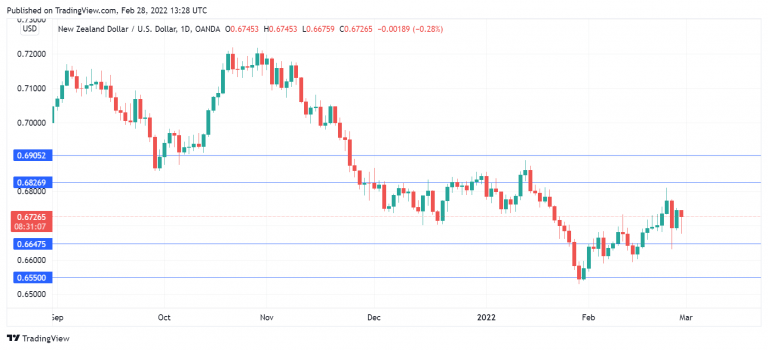
NZD/USD Technical
- There is resistance at 0.6826. Above there is resistance at 0.6908
- 0.6647 is providing support, followed by 0.6550
US goods trade deficit widened to USD 107.6B in Jan
US goods exports dropped USD -2.8B to USD 154.8B in January. Goods imports rose USD 4.4B to USD 262.5B. Trade deficit widened by USD -7.2B to USD -107.6B, larger than expectation of USD -98.5B.
Wholesale inventories rose 0.8% mom to USD 798.2B. Retail inventories rose 1.9% mom to USD 658.1B.
EURUSD is Plunging
On Monday 28 February, the major currency pair is falling and trading at 1.1169. Market players are now interested in the “safe” USD as it often happens during global market fluctuations.
Investors are not so focused on statistics as before due to inflamed geopolitical tensions in the world. However, there will be some interesting reports that shouldn’t be overlooked.
For example, the US labour market data for February, which is usually published early in a month. The Unemployment Rate is expected to drop to 3.8-3.9% after being 4.0% the month before. The Non-Farm Payroll may increase due to the removal of anti-coronavirus restrictions. This is good news for the “greenback”.
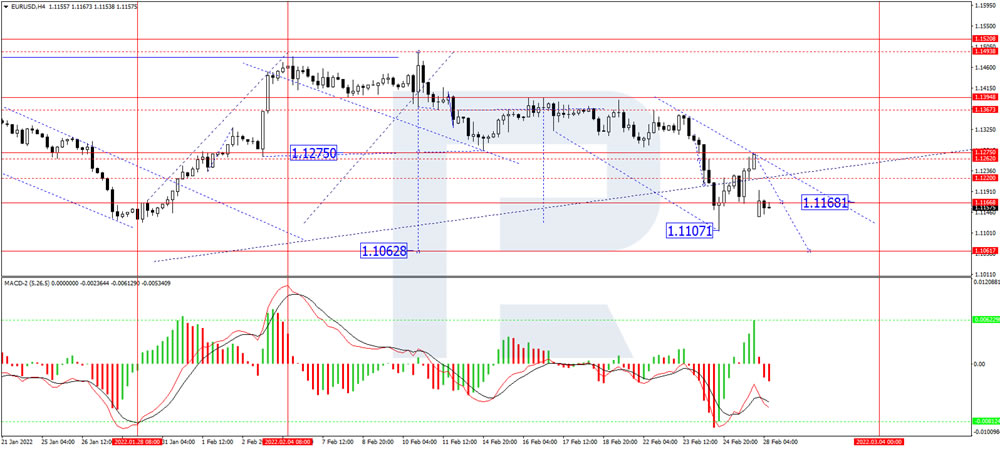
In the H4 chart, having finished another correctional wave at 1.1270 along with the descending structure towards 1.1168, EUR/USD is consolidating around the latter level. If later the price breaks this range to the downside, the market may resume falling with the target at 1.1060 and then grow to reach 1.1400; if to the upside – start another growth towards 1.1230 and then form a new descending structure to reach the above-mentioned target. From the technical point of view, this scenario is confirmed by MACD Oscillator: its signal line is falling towards new lows.
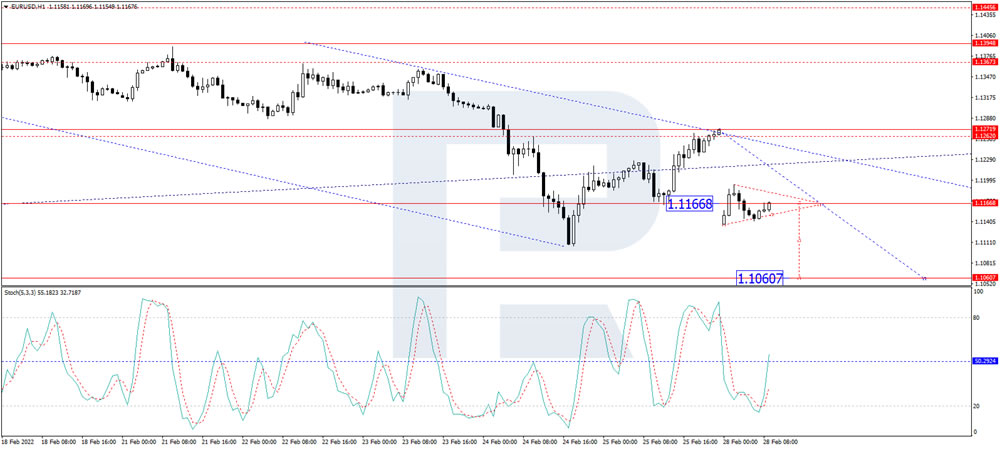
As we can see in the H1 chart, after rebounding from 1.1270, EUR/USD is forming a new descending impulse and has already reached 1.1160; right now, it is consolidating around the latter level. Possibly, the pair may correct towards 1.1200 and then start a new decline to reach 1.1070. Later, the market may grow to test 1.1170 from below and then resume trading downwards with the target at 1.1060. From the technical point of view, this idea is confirmed by the Stochastic Oscillator: its signal line is moving above 20 and may continue growing to reach 50. Later, the line may rebound from 20 and start a new decline to return to 20.
ECB Panetta: The world becomes darker, our steps should be smaller
ECB Executive Board member Fabio Panetta said, "we should adjust policy carefully and recalibrate it as we see the effects of our decisions, so as to avoid suffocating the recovery," he said.
Talking about Russia invasion, he said, "this terrible event has made the need for prudence even greater. The world has become darker, and our steps should be smaller still."
"The most important thing right now is for us to be ready and available to preserve financial stability," he added.
ECB Centeno: Stagflation risks increased with Russia invasion of Ukraine
ECB Governing Council member Mario Centeno "I am convinced that the traction of growth that the economy was following will prevail." But, "a scenario close to stagflation is not out of the possibilities that we can face. So we need to adjust our policies to that."
He added that policymakers had already considered the threat of stagflation before. "After the invasion these risks have only increased," he said. Russian's invasion of Ukraine has the possibility of "a positive impact on inflation, a few decimal points, and a negative impact on growth."
EUR/USD Holding Up Well Despite Ukraine Conflict
If there were ever an opportunity for the euro to reach parity with the US dollar, it would have been now. But EUR/USD has held up better than most would have expected given the severity of the Ukraine conflict.
Granted, at the time of writing, the pair is down by some 1.2% since the beginning of last week, but it tested and failed to make a sustained break below the 1.11224-1.11166 region. Had it done so, all eyes would have been on a continuation of the downtrend started in the final quarter of last year.
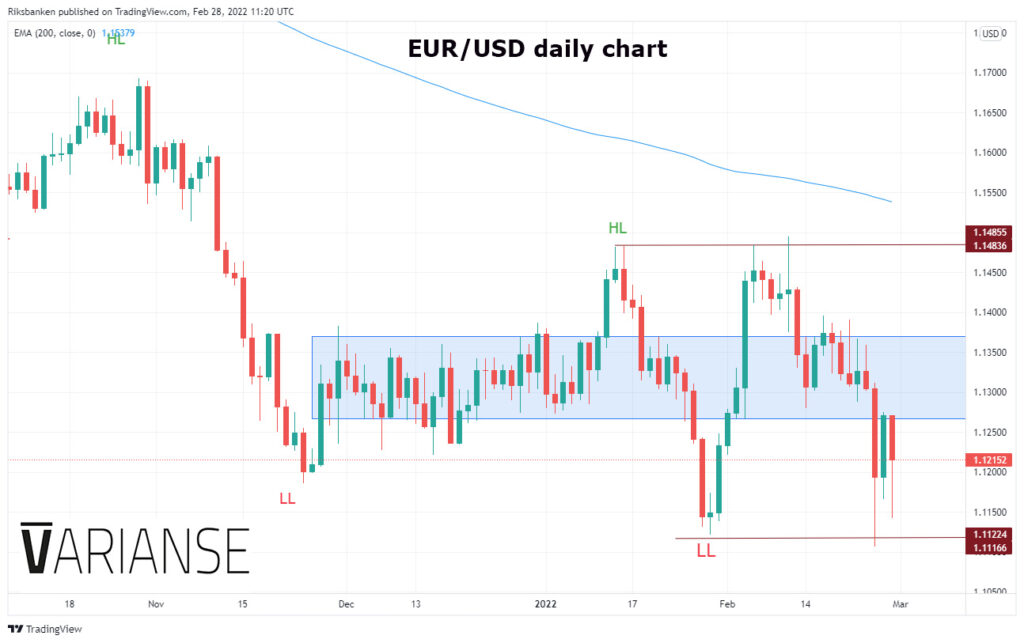
Instead, EUR/USD, like Ukrainian defence efforts, has faced decent support in the face of severe adversity. Furthermore, there is quite a bit of price congestion/buy zone support for EUR/USD in the 1.08090-1.03529 region.
For the moment, EUR/USD has formed a range between 1.14836 and 1.11224. But recent price congestion points to moves above 1.3700 and below 1.12600 as giving a degree of confidence of potential direction.
Western Sanctions Decimate the Russian Economy
- America and Europe hit Russia with suffocating economic sanctions
- Russian central bank raises interest rates but cannot defend currency
- Stocks retreat, US dollar and oil advance as traders reduce risk
Capital flees Russia
The invasion of Ukraine has sent markets into a tailspin. Europe and America finally took off the gloves and announced a new round of crippling economic sanctions against Russia. These include the expulsion of several Russian banks from the SWIFT international payments system and freezing most of the FX reserves held by the central bank.
This is essentially a one-two punch from the West. It will deal a heavy blow to Russia’s financial institutions and perhaps spark a recession, while also leaving the central bank powerless to defend its currency by preventing access to its own war chest. The Russian central bank raised interest rates to 20% today in a last-ditch attempt to fight currency depreciation, but the rouble still collapsed to a new record low.
Capital is fleeing the country and Russian assets are on fire sale. Many large players have announced they will divest their Russian holdings, people are queuing up for cash machines, and soft capital controls have already been introduced by ‘prohibiting’ foreigners from selling securities on the Moscow Exchange.
Markets react
Pricing geopolitical risk into financial markets is notoriously difficult. There is no exact formula for how to protect a portfolio against potentially catastrophic events, so oftentimes investors tend to overreact by dramatically slashing their risk exposure and deleveraging.
Crude oil has been the best barometer of market concerns around this conflict. The prospect of sanctions constraining Russian supply has turbocharged energy prices, although Western powers have been careful not to target the sector explicitly, fearful of the collateral damage on the European economy from soaring fuel prices.
This is also why the euro is under pressure. The sanctions could come back to bite Europe by squeezing consumers and restraining the banking sector in countries with high exposure to Russian money, so currency traders are taking cover in the safety of the US dollar.
What now?
Stock markets were hit by a powerful wave of selling as well. European markets are down almost 2% while futures point to a similar loss when Wall Street opens today. ‘Cut risk first, ask questions later’ seems to be the strategy among money managers.
The one piece that doesn’t fit the puzzle is gold. Bullion opened higher for the week but has already surrendered those gains, which is strange considering that Treasury yields are also sinking. It could be that the Russian central bank is dumping gold on the open market to shore up its devastated currency, since most of its FX reserves have been frozen.
Looking ahead, markets will remain hostage to incoming headlines. Russian forces have encircled Ukraine’s capital, Vladimir Putin has put his nuclear arsenal on high alert, and the European Union has pledged to deliver arms to Ukraine, including fighter jets. Hence, the situation is very unpredictable.
One ray of hope comes from the peace talks that will be held between Ukrainian and Russian officials today. While the negotiations might not stop the war, they might be enough to lift risk sentiment. A lot of the negativity has already been priced in and everyone is hedged at this point, so any piece of good news could have a tremendous impact in terms of calming the markets.
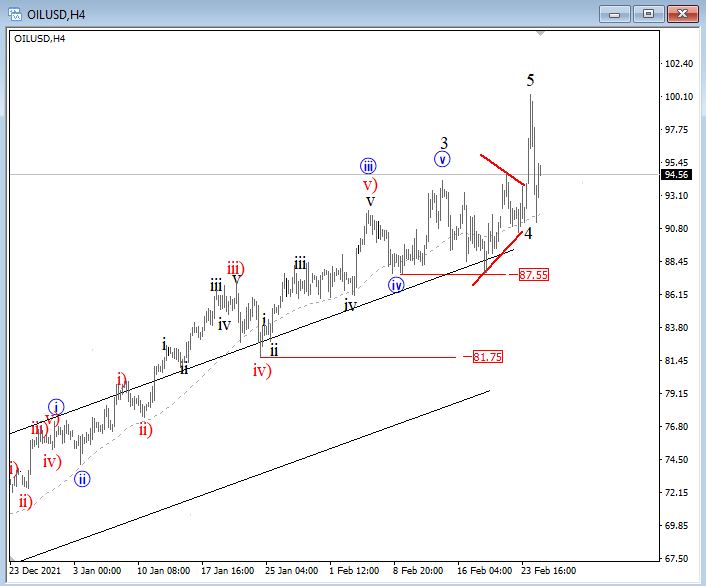
Crude Oil Finds Temporary Top: Elliott Wave Analysis
Crude is sharply down in the 4-hour chart after reaching 100 level for the 5th wave, so smells like a temporary top and we will now have to be aware now of a bigger, higher degree slow down, especially if the price drops back below 87.55 level.
Crude oil 4h Elliott Wave analysis