Sample Category Title
USD/CHF Mid-Day Outlook
Daily Pivots: (S1) 0.9130; (P) 0.9205; (R1) 0.9242; More....
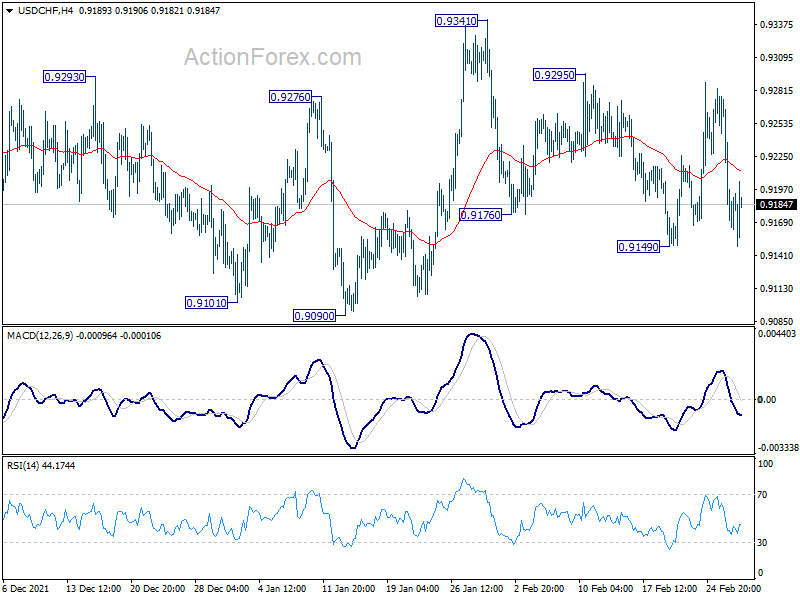
Range trading continues in USD/CHF and intraday bias remains neutral. Choppy rise from 0.8925 would still be in favor to extend higher as long as 0.9090 support holds. Break of 0.9341 will target 0.9372 resistance and then 0.9471. On the downside, however, break of 0.9090 will bring deeper fall back to 0.8925 support.
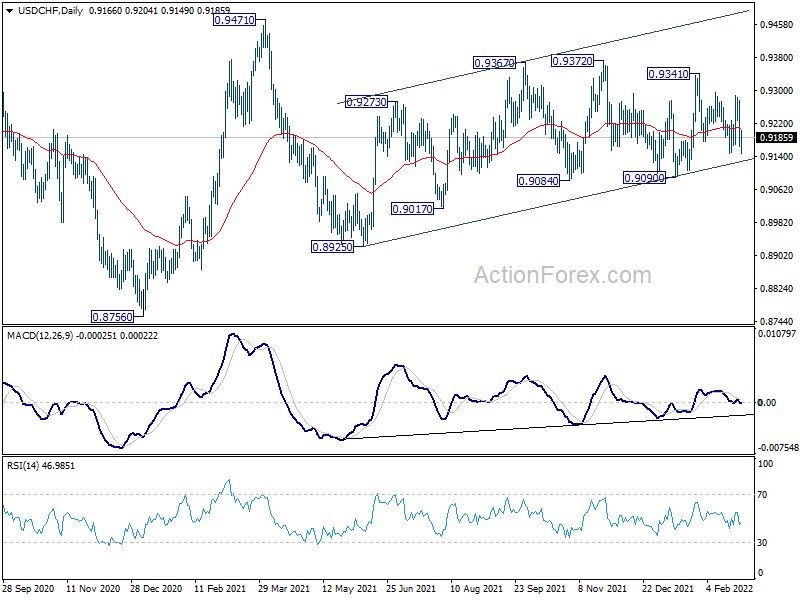
In the bigger picture, medium term outlook will be neutral at best as long as 0.9471 resistance holds. Larger down trend could still extend through 0.8756 (2021 low). However, firm break of 0.9471 will argue that the trend has already reversed and rebound the rally from 0.8756 with another impulsive move.
EUR/CHF Mid-Day Outlook
Daily Pivots: (S1) 1.0248; (P) 1.0314; (R1) 1.0352; More....
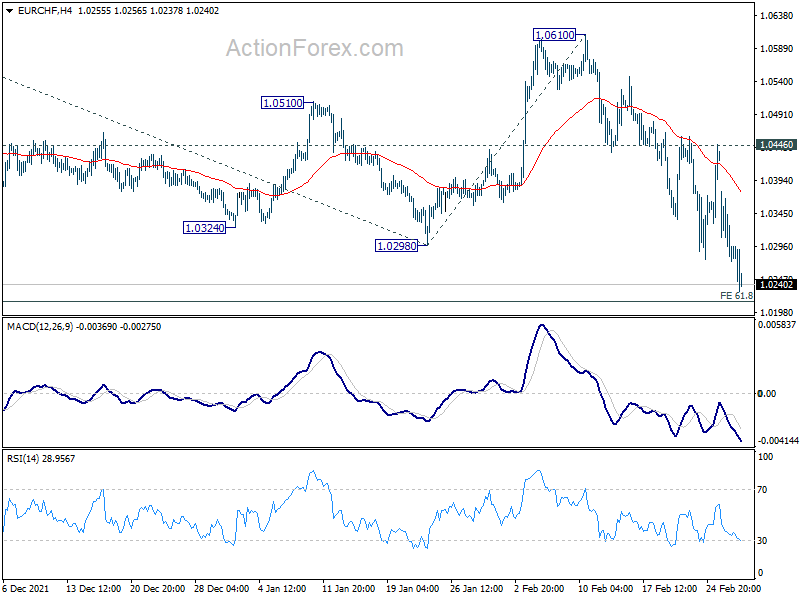
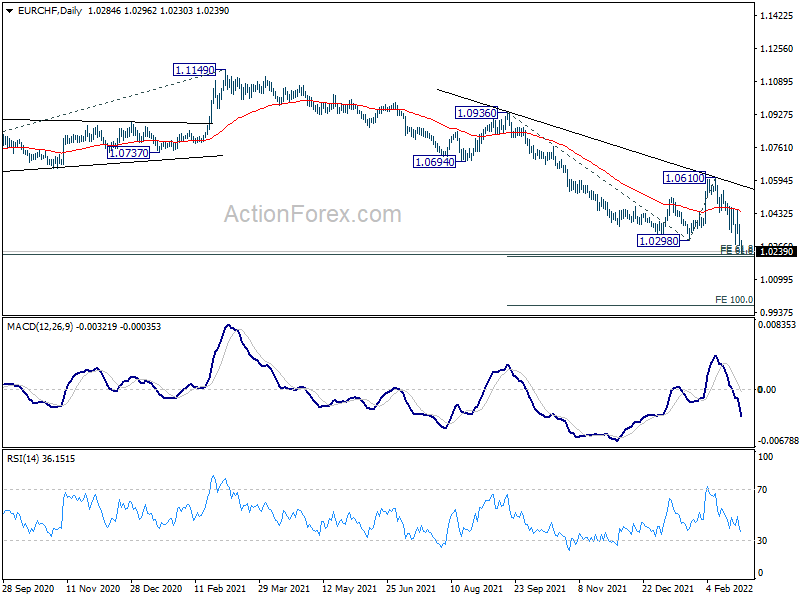
Intraday bias in EUR/CHF remains on the downside for 61.8% projection of 1.0936 to 1.0298 from 1.0610 at 1.0216. Firm break there will target 100% projection at 0.9972. On the upside, break of 1.0446 resistance is needed to indicate short term bottoming. Otherwise, outlook will stay bearish in case of recovery.
In the bigger picture, long term down trend from 1.2004 (2018 high) is still in progress. Next target is 61.8% projection of 1.2004 to 1.0505 to 1.1149 at 1.0223. Sustained break there will target 100% projection at 0.9650. In any case, break of 1.0610 resistance is needed to be the first sign of bottoming. Otherwise, outlook will remain bearish.
EUR/AUD Mid-Day Outlook
Daily Pivots: (S1) 1.5390; (P) 1.5487; (R1) 1.5539; More...
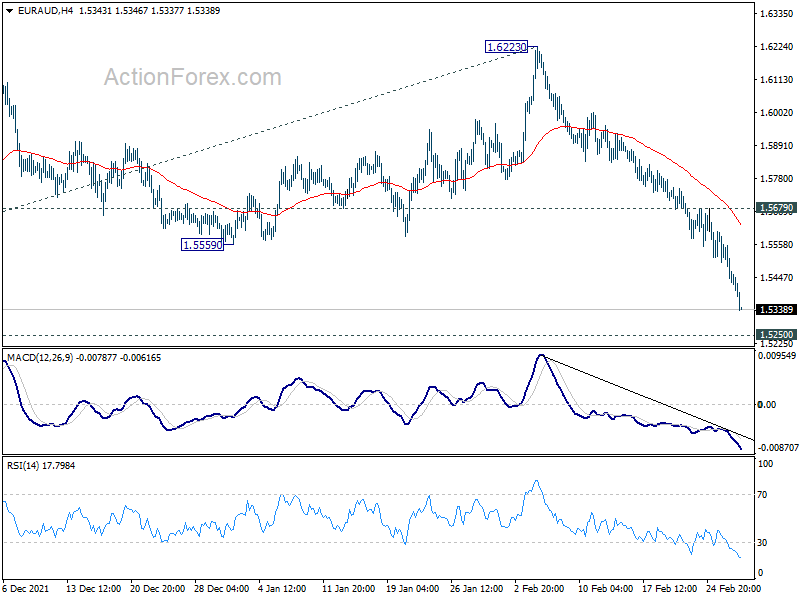
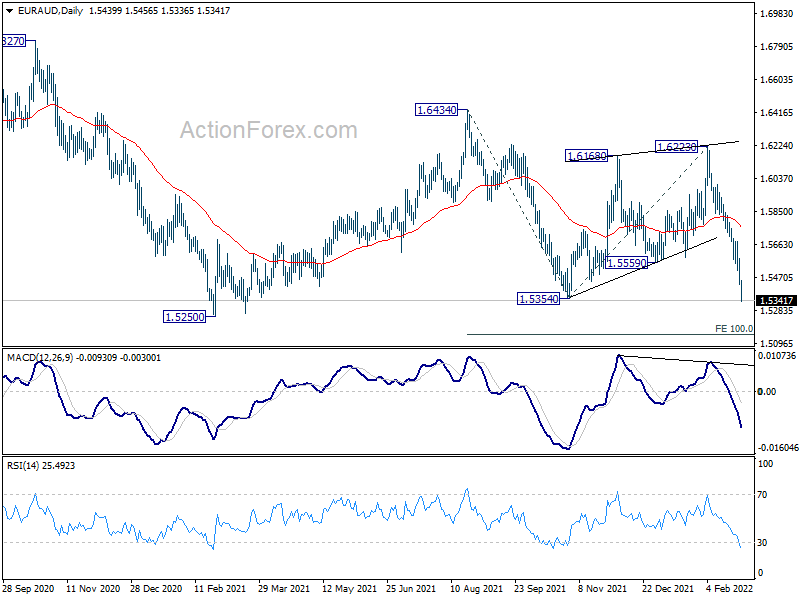
EUR/AUD drops to as low as 1.5336 so far and intraday bias remains on the downside. Break of 1.5354 support should now pave the way to 1.5250 low. Decisive break there will resume larger down trend from 1.9799. Next near term target will be 100% projection of 1.6343 to 1.5354 from 1.6223 at 1.5143. On the upside, break of 1.5679 resistance is needed to indicate short term bottoming. Otherwise, outlook stays bearish in case of recovery.
In the bigger picture, price actions from 1.5250 low are seen as a corrective pattern. Further extension could be seen and another rise cannot be ruled out. But strong resistance should be seen at 38.2% retracement of 1.9799 to 1.5250 at 1.6988. Larger down trend from 1.9799 (2020 high) is in favor to extend through 1.5250 at a later stage. Next target is 61.8% retracement of 1.1602 (2012 low) to 1.9799 at 1.4733
Stocks and Yields Fall, Euro Staying Pressured
Euro's broad based selloff continues today, even though it's still holding in range against Dollar and Sterling. But overall, European majors are weak. The greenback is somewhat capped by falling benchmark treasury yield. Yen is firm on risk-off sentiment but it's slightly out-performed by Aussie. In other markets, stocks are generally pressured in Europe while US futures are down. Gold is back above 1900 handle but lacks follow through buy yet. WTI crude oil resumes recent rally with new wave of buying.
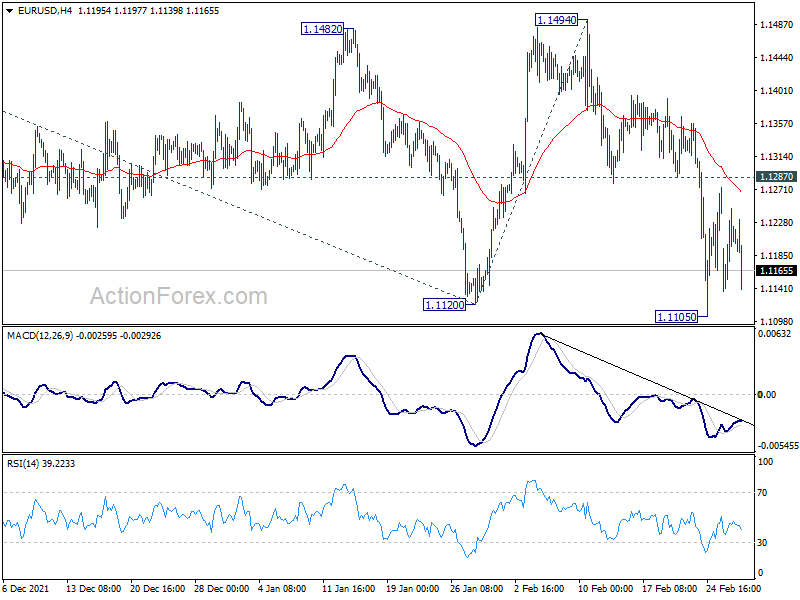
Technically, Euro's weakness will remain a focus. EUR/CHF's decline extends below 1.0277 temporary low. EUR/AUD's break of 1.5354 support suggests that larger down trend is ready to resume through 1.5250 low. A question is when EUR/USD will join the party and break through 1.1105 temporary low.
In Europe, at the time of writing, FTSE is down -0.78%. DAX is down -2.26%. CAC is down -2.32%. Germany 10-year yield is down -0.095 at 0.038. Earlier in Asia, Nikkei rose 1.20%. Hong Kong HSI rose 0.77%. China Shanghai SSE rose 0.77%. Singapore Strait Times rose 1.12%. Japan 10-year JGB yield dropped -0.0040 to 0.181.
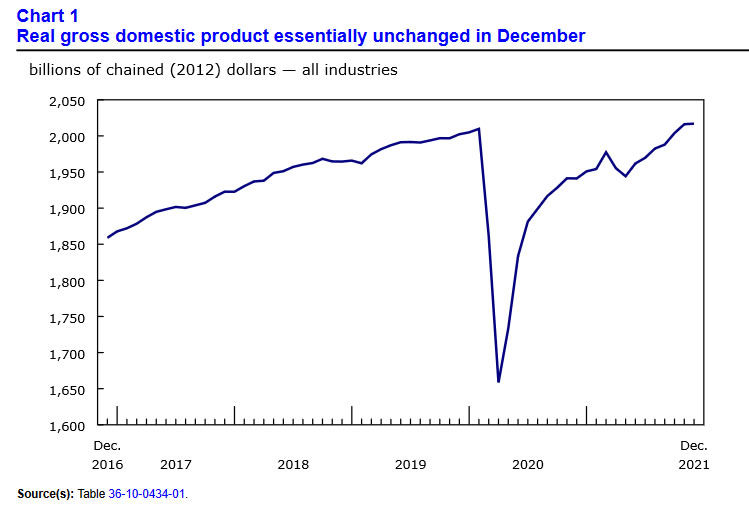
Canada GDP flat in Dec, grew 0.2% in Jan
Canada GDP was flat in December, matched expectation of 0.0% mom. The 0.1% mom growth in services-producing industry was offset by the -0.1% mom decline in goods-producing industries. 14 of 20 industrial sectors grew.
Advance information indicates a 0.2% mom growth in real GDP in January, led by retail, construction, finance and insurance as well as the professional, scientific and technical services sector.
UK PMI manufacturing finalized at 58 in Feb, production and new orders both accelerate
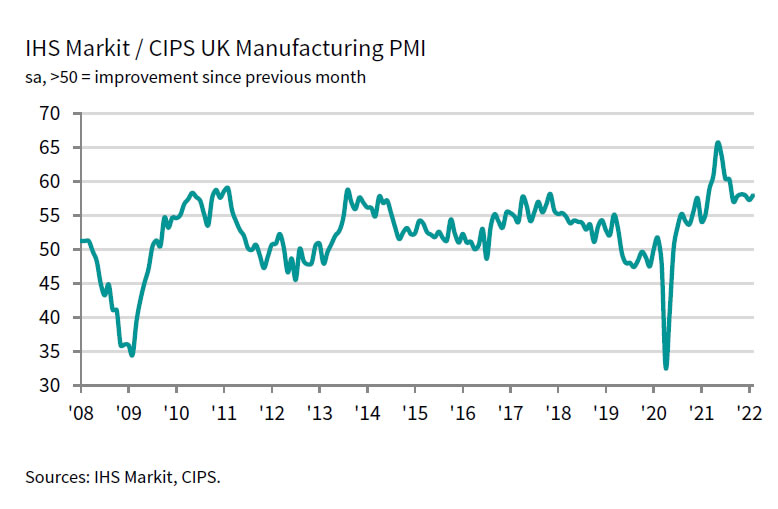
UK PMI Manufacturing was finalized at three-month high of 58.0 in February, up from 57.3 in January. Markit said output and new orders expanded at quicker rates. New export orders decreased. Input price inflation remained elevated.
Rob Dobson, Director at IHS Markit, said: "February saw rates of expansion in UK manufacturing production and new orders both accelerate. Growth was boosted by stronger domestic demand and by firms catching up on delayed work as material shortages and supply chain disruptions started to dissipate.... However, the trend in new export orders is less positive, slipping back into contraction after January's short-lived uptick....
"Inflationary pressure also remained elevated across the manufacturing sector... That said, rates of inflation for input costs and output charges eased further. Although this easing may have provided some temporary respite, signs that energy and oil prices may stay high is a further cause for concern."
Eurozone PMI manufacturing finalized at 58.2 in Feb, a largely positive month
Eurozone PMI Manufacturing was finalized at 58.2 in February, down slightly from January's 58.7. Markit said demand for Eurozone goods rose at fastest rate since last August. Supplier delivery times lengthened to weakest extent for over a year, but inflation remained steep.
Looking at some member states, the Netherlands rose to 3-month high at 60.6. Germany dropped to 58.4 while Austria dropped to 58.4. Italy was unchanged at 58.3. Ireland dropped to 11-month low at 57.8. Greece dropped to 7-month low at 57.8. France rose to 6-month high at 57.2. Spain rose to 3-month high at 56.9.
Joe Hayes, Senior Economist at IHS Markit said: "Don't let the drop in the headline PMI distract from what should be viewed as a largely positive month for the euro area manufacturing sector in February. Demand for goods is trending higher, with the rate of expansion accelerating to a six-month high. Underlying sales conditions are clearly strengthening as Europe overcomes the Omicron wave of COVID-19 and businesses step up their recovery efforts."
Germany PMI Manufacturing was finalized at 58.4 in February, down from January's 59.8. Markit said there were sharp rise in backlogs as growth in the new orders outstripped output. Factory cost inflation slipped further from recent highs. Incidence of supply delays was lowest since November 2020.
France PMI Manufacturing was finalized at six-month high of 57.2 in February, up from January's 55.5. Markit said manufacturing output increased at fastest rate since last July. Demand for goods improved despite steep output price inflation. Capacity pressures intensified as supply issues persisted.
RBA stands pat and be patient
RBA left cash rate target unchanged at 0.10% as widely expected. The board maintained that it "will not increase the cash rate until actual inflation is sustainably within the 2 to 3 per cent target range.". For now, it is "too early to conclude that it is sustainably within the target range", and RBA is "prepared to be patient".
Australia AiG manufacturing rose to 53.2, edged back into expansion
Australia AiG Performance of Manufacturing Index rose 4.8 pts to 53.2 in February. Production rose 2.7 to 54.6. Employment dropped -1.9 to 43.5. Average wages rose 1.4 to 64.9. Input prices dropped -6.7 to 75.6. But selling prices rose 1.4 to 64.9.
Innes Willox, Chief Executive of Ai Group said: "Australia's manufacturing sector edged back into expansion during February following the sharp labour and supply chain disruptions of the December-January period. Price and wage pressures continued in February with some easing in the pace of increase in input prices. At the same time, selling prices accelerated suggesting further recovery of earlier cost increases."
Japan PMI manufacturing finalized at 52.7, new orders stagnates and input prices rose
Japan PMI Manufacturing was finalized at 52.7 in February, down from January's 55.4. Markit said there was renewed fall in output amid near-stagnation in new orders. Input prices rose at sharpest pace since August 2008. Stocks of purchases had survey-record increase amid delays and shortages.
Usamah Bhatti, Economist at IHS Markit, said: "February PMI data pointed to a softer expansion in the Japanese manufacturing sector. The rate of growth eased to a five-month low, however, amid a renewed reduction in production levels and a broad stagnation in new orders... input price pressures intensified further, with average cost burdens rising at the sharpest pace in thirteen-and-a-half years... manufacturers commented that the degree of optimism regarding the 12-month outlook for output eased to a six-month low in February... This is broadly in line with the IHS Markit prediction for industrial production to grow 5.9% in 2022."
China Caixin PMI manufacturing rose to 49.1 in Feb, returned to growth
China Caixin PMI Manufacturing rose from 49.1 to 50.4 in February, above expectation of 49.5. Caixin said output returned to growth amid quickest rate in new work for eight months. Pandemic continued to weigh on export sales. Business confidence picked up to the highest since last June.
Wang Zhe, Senior Economist at Caixin Insight Group said: "Overall, manufacturing activity expanded in February. Supply recovered, while demand more clearly improved. The level of optimism about the future business outlook increased further. However, the job market remained under high pressure. And we still need to keep an eye on inflationary pressure.
EUR/AUD Mid-Day Outlook
Daily Pivots: (S1) 1.5390; (P) 1.5487; (R1) 1.5539; More...
EUR/AUD drops to as low as 1.5336 so far and intraday bias remains on the downside. Break of 1.5354 support should now pave the way to 1.5250 low. Decisive break there will resume larger down trend from 1.9799. Next near term target will be 100% projection of 1.6343 to 1.5354 from 1.6223 at 1.5143. On the upside, break of 1.5679 resistance is needed to indicate short term bottoming. Otherwise, outlook stays bearish in case of recovery.
In the bigger picture, price actions from 1.5250 low are seen as a corrective pattern. Further extension could be seen and another rise cannot be ruled out. But strong resistance should be seen at 38.2% retracement of 1.9799 to 1.5250 at 1.6988. Larger down trend from 1.9799 (2020 high) is in favor to extend through 1.5250 at a later stage. Next target is 61.8% retracement of 1.1602 (2012 low) to 1.9799 at 1.4733
Economic Indicators Update
| GMT | Ccy | Events | Actual | Forecast | Previous | Revised |
|---|---|---|---|---|---|---|
| 21:30 | AUD | AiG Performance of Mfg Index Feb | 53.2 | 48.4 | ||
| 00:30 | AUD | Current Account (AUD) Q4 | 12.7B | 14.3B | 23.9B | 22.0B |
| 00:30 | JPY | Manufacturing PMI Feb F | 52.7 | 52.9 | 52.9 | |
| 01:00 | CNY | Manufacturing PMI Feb | 50.2 | 49.9 | 50.1 | |
| 01:00 | CNY | Non-Manufacturing PMI Feb | 51.6 | 50.9 | 51.1 | |
| 01:45 | CNY | Caixin Manufacturing PMI Feb | 50.4 | 49.5 | 49.1 | |
| 03:30 | AUD | RBA Interest Rate Decision | 0.10% | 0.10% | 0.10% | |
| 08:30 | CHF | SVME PMI Feb | 62.6 | 64.7 | 63.8 | |
| 08:45 | EUR | Italy Manufacturing PMI Feb | 58.3 | 59.2 | 58.3 | |
| 08:50 | EUR | France Manufacturing PMI Feb F | 57.2 | 57.6 | 57.6 | |
| 08:55 | EUR | Germany Manufacturing PMI Feb F | 58.4 | 58.5 | 58.5 | |
| 09:00 | EUR | Eurozone Manufacturing PMI Feb F | 58.2 | 58.4 | 58.4 | |
| 09:30 | GBP | Manufacturing PMI Feb F | 58 | 57.3 | 57.3 | |
| 09:30 | GBP | Mortgage Approvals Jan | 74K | 72K | 71K | |
| 09:30 | GBP | M4 Money Supply M/M Jan | 0.10% | 0.40% | 0.10% | |
| 13:00 | EUR | Germany CPI M/M Feb P | 0.90% | 0.90% | 0.40% | |
| 13:00 | EUR | Germany CPI Y/Y Feb P | 5.10% | 5.10% | 4.90% | |
| 13:30 | CAD | GDP M/M Dec | 0.00% | 0.00% | 0.60% | |
| 14:30 | CAD | Manufacturing PMI Feb | 56.2 | |||
| 14:45 | USD | Manufacturing PMI Feb F | 57.5 | 57.5 | ||
| 15:00 | USD | ISM Manufacturing PMI Feb | 57.9 | 57.6 | ||
| 15:00 | USD | ISM Manufacturing Prices Paid Feb | 77.5 | 76.1 | ||
| 15:00 | USD | ISM Manufacturing Employment Index Feb | 54.5 | |||
| 15:00 | USD | Construction Spending M/M Jan | -0.50% | 0.20% |
Canada GDP flat in Dec, grew 0.2% in Jan
Canada GDP was flat in December, matched expectation of 0.0% mom. The 0.1% mom growth in services-producing industry was offset by the -0.1% mom decline in goods-producing industries. 14 of 20 industrial sectors grew.
Advance information indicates a 0.2% mom growth in real GDP in January, led by retail, construction, finance and insurance as well as the professional, scientific and technical services sector.
Aussie Steady as RBA Holds Pat
As expected the RBA maintained its cash rate at a record low 0.10% on Tuesday. In the rate statement, Governor Philip Lowe said that the global economy continued to improve, but noted that the war in Ukraine was “a major new source of uncertainty”. Lowe warned that inflation would continue to rise, and that the RBA was projecting inflation to hit 3.25% in the coming quarters. This is significant because it indicates that the central bank expects inflation to rise above the bank’s 2-3% target band.
In the financial markets, risk appetite remains subdued, but there appears to be less pessimism and panic in the markets compared to the past few days. This could be based on the notion that investors feel that the bulk of the West’s sanctions against Moscow has already been announced, so “the worst is behind us”. This could quickly change of course, based on developments on the ground in Ukraine. As well, Russia will not take these sanctions lying down, and its response could dampen risk sentiment. Investors remain glued to the crisis, which has been the driver of the direction of the markets and is overshadowing economic releases.
AUD/USD Technical
- There is resistance at 0.7313 and 0.7393
- AUD/USD has support at 0.7124 and 0.7015
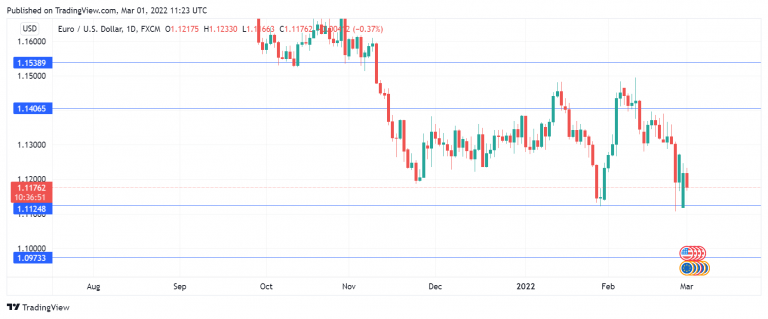
Euro Weakens on Ukraine Fighting
The euro has lost ground on Tuesday and fallen below the 1.12 level. In the European session, EUR/USD is trading at 1.1173, down 0.40% on the day.
The fighting has intensified in Ukraine, with a Russian armored column stretching for miles slowly winding its way towards the capital Kyiv. Russian forces have been shelling major cities, as defiant Ukrainians brace for the fighting to intensify. The US dollar has been flat today against the majors, with the dollar index up slightly to 96.99. EUR/USD actually showed gains in the Asian session but has since reversed directions.
Risk appetite remains subdued, but there appears to be less pessimism and panic in the markets compared to the past few days. This could be based on the notion that investors feel that the bulk of the West’s sanctions against Moscow has already been announced, so “the worst is behind us”. This could quickly change of course, based on developments on the ground in Ukraine. As well, Russia will not take these sanctions lying down, and its response could dampen risk sentiment. Investors remain glued to the crisis, which has been the driver of the direction of the markets and is overshadowing economic releases.
German CPI expected to accelerate
On the economic calendar, German CPI, which will be released later today, is a key event. The ECB is keeping a watchful eye on rising inflation and some ECB members want the central bank to take a more hawkish stance in order to contain inflationary pressures. German CPI is expected to rise 0.9% m/m in February, up sharply from 0.4% in January. On an annual basis, CPI is projected to hit 5.1%, up from 4.9% beforehand. The ECB holds a policy meeting on March 10th, and a jump in German inflation will put pressure on ECB President Lagarde to tighten policy.
EUR/USD Technical
- There is resistance at 1.1406 and 1.1538
- There is major support at 1.1100. Below, there is support at 1.0974
WTI Futures Shows Improvement Near 99.00
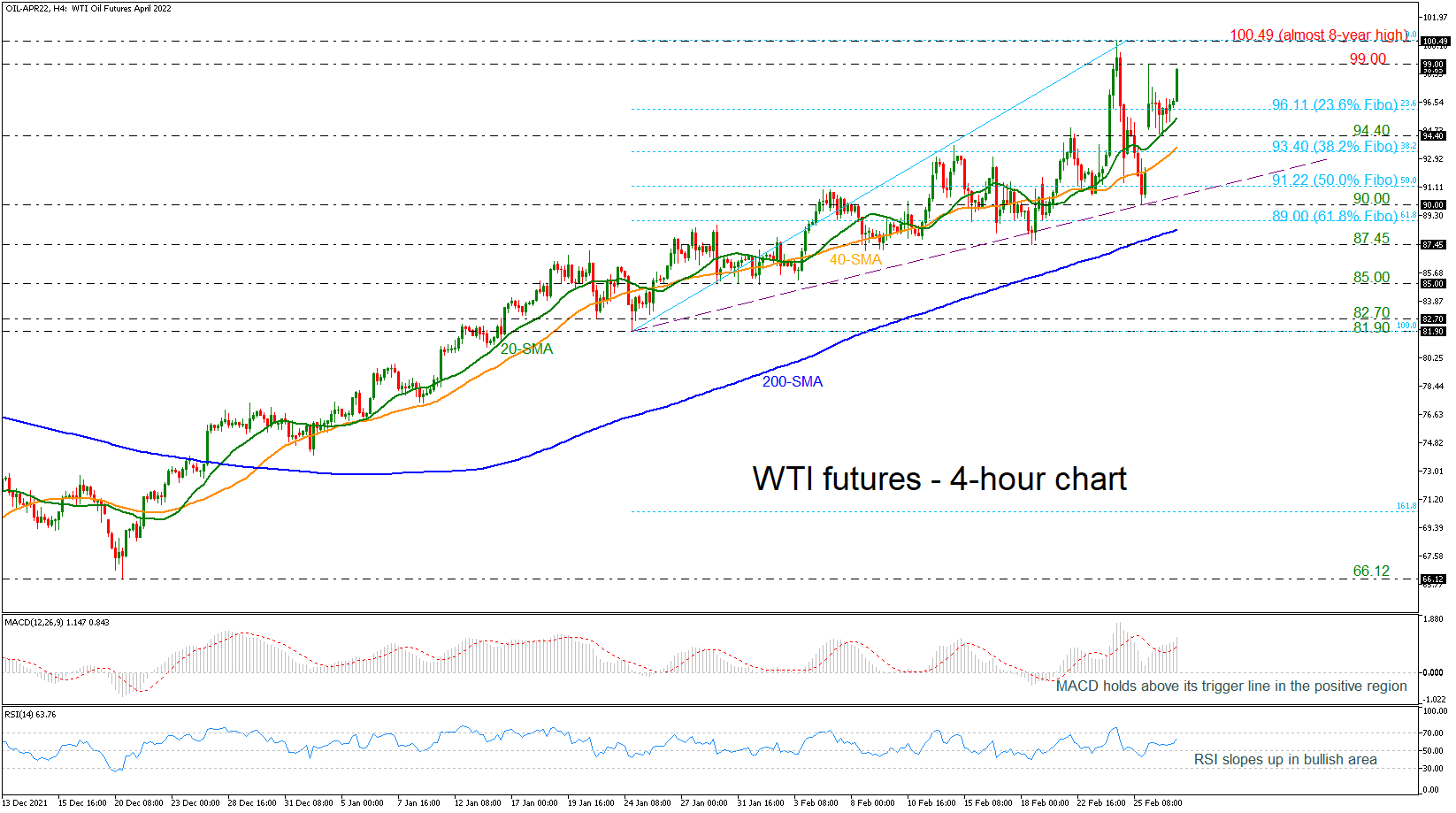
WTI crude oil futures are posting notable gains around the 99.00 mark, remaining well above the short-term simple moving averages (SMAs) and the uptrend line. The MACD continues to strengthen to the upside and above its red signal line while the RSI is sloping north in the bullish area, supporting the current view as well.
Another step higher may reach a key resistance at 99.00, where the price stopped in the previous sessions. Should this prove a weak obstacle, the selling could pick up speed until the almost eight-year high of 100.49, where any violation would bring more pressure to the market with the price probably stretching further up to test the 107.62 barrier, registered in June 2014.
Alternatively, immediate support could come from the 23.6% Fibonacci retracement level of the up leg from 81.90 to 100.49 at 96.11 before the focus shifts to the 20-period SMA at 95.48 and the 94.40 level. Lower, the 40-period SMA at 93.74 and the 38.2% Fibonacci at 93.40 could also restrict bearish movements. Though, only a close below the ascending trend line would confirm the start of a sideways move.
In the medium-term picture the pair is still increasingly bullish as long as it holds well above the uptrend line and more importantly above the 200-period SMA, which is still rising.
AUDUSD Rally Eyes Longer-Term Descending Trend Lines
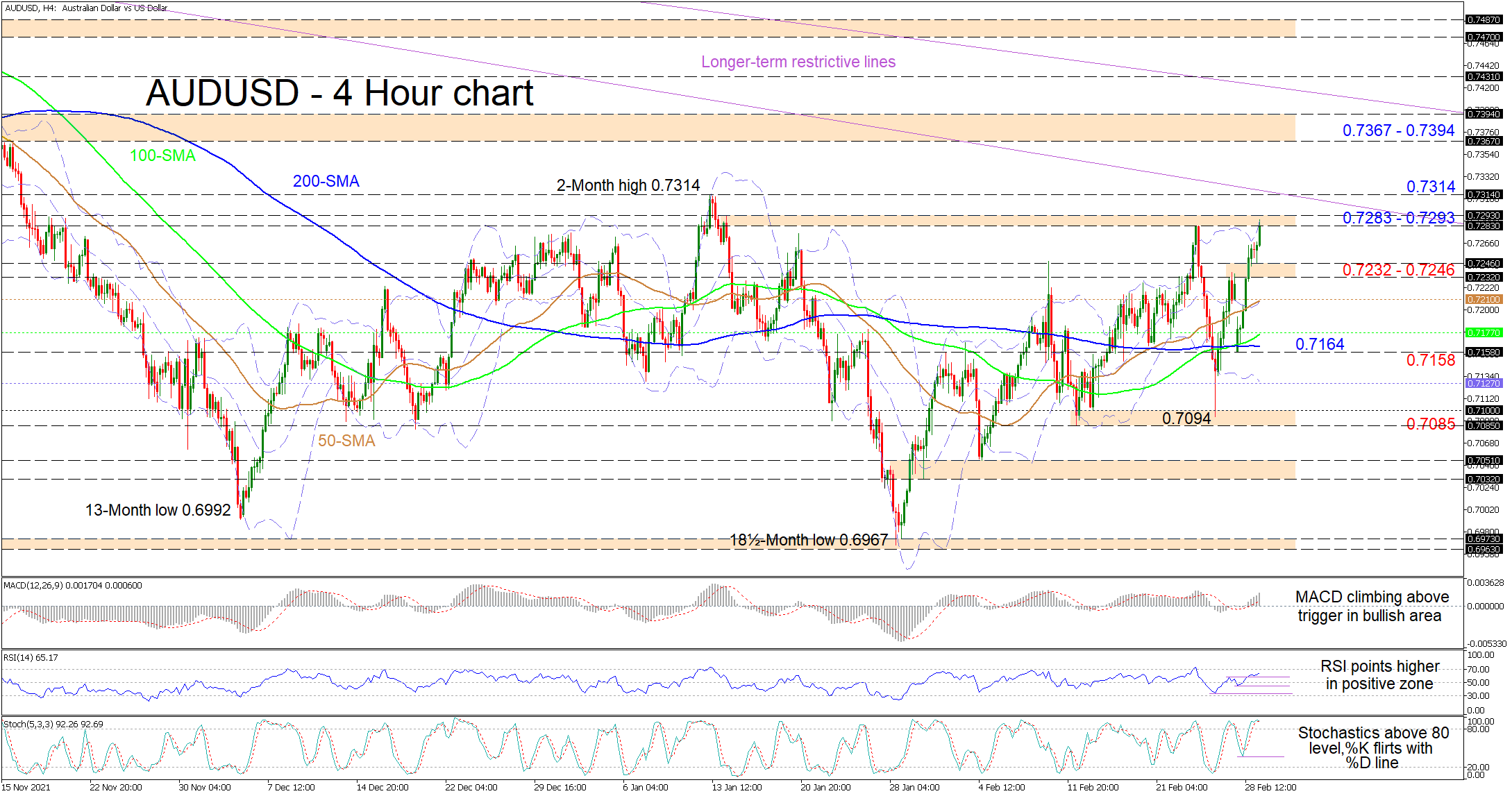
AUDUSD is testing the 0.7283-0.7293 resistance barrier after extending yesterday’s intense rally, which filled a recorded gap in the pair and reinstated the one-month bullish mood that began from the 18½-month low of 0.6967. The rising 50- and 100-period simple moving averages (SMAs) are sponsoring improvements in the pair.
The short-term oscillators are skewed to the upside, reflecting growing positive momentum. The MACD, north of the zero line, is soaring above its red trigger line, while the RSI is improving in the bullish region. The stochastic lines are in overbought territory, and the %K line has yet to hint of any clear fading in bullish forces.
In the positive scenario, buyers are currently tackling the 0.7283-0.7293 obstacle, the former being the February 23 high from where the price collapsed after tensions in Ukraine were reported. In the event the price pierces above this barrier, the bulls may then challenge the 0.7314 nearby high, coupled with the intersecting longer-term restrictive trend line, drawn from the 0.7890 high. Should the bulls overwhelm these resistances too, the price could then propel for the 0.7367-0.7394 resistance zone that extends back to the early part of November 2021, and the second longer-term diagonal line pulled from the 0.8006 peak.
Alternatively, if upside momentum starts to wane around the upper Bollinger band, initial support could transpire from the 0.7232-0.7246 area, before sellers meet the mid-Bollinger band and 50-period SMA, both residing around 0.7210. Fading further, the price could then encounter tough downside constraints in the section between the 100-period SMA at 0.7177 and the 0.7158 trough. From here, should a downward trajectory intensify, sellers may seek out the lower Bollinger band at 0.7127 before pursuing the 0.7085-0.7100 support base.
Summarizing, AUDUSD exhibits a persisting bullish bias in the very short-term and a climb beyond the longer-term diagonal barriers could put pressure on the one-year broader bearish structure. For negative forces to start to clearly regain strength, the price would need to retreat below the 0.7085-0.7100 boundary.
UK PMI manufacturing finalized at 58 in Feb, production and new orders both accelerate
UK PMI Manufacturing was finalized at three-month high of 58.0 in February, up from 57.3 in January. Markit said output and new orders expanded at quicker rates. New export orders decreased. Input price inflation remained elevated.
Rob Dobson, Director at IHS Markit, said:
"February saw rates of expansion in UK manufacturing production and new orders both accelerate. Growth was boosted by stronger domestic demand and by firms catching up on delayed work as material shortages and supply chain disruptions started to dissipate. Consumer goods output in particular also benefitted from increased sales due to a further easing of COVID restrictions. However, the trend in new export orders is less positive, slipping back into contraction after January's short-lived uptick. While companies maintain a positive outlook for the year ahead, rising headwinds, especially the intensifying geopolitical backdrop, are ratcheting up near-term risks to demand and confidence.
"Inflationary pressure also remained elevated across the manufacturing sector in February. Companies were hit hard by rising transportation, energy and commodity prices, leading to further increases in selling prices. That said, rates of inflation for input costs and output charges eased further. Although this easing may have provided some temporary respite, signs that energy and oil prices may stay high is a further cause for concern."