

Sample Category Title
GBP/USD Mid-Day Outlook
Daily Pivots: (S1) 1.3548; (P) 1.3577; (R1) 1.3614; More...
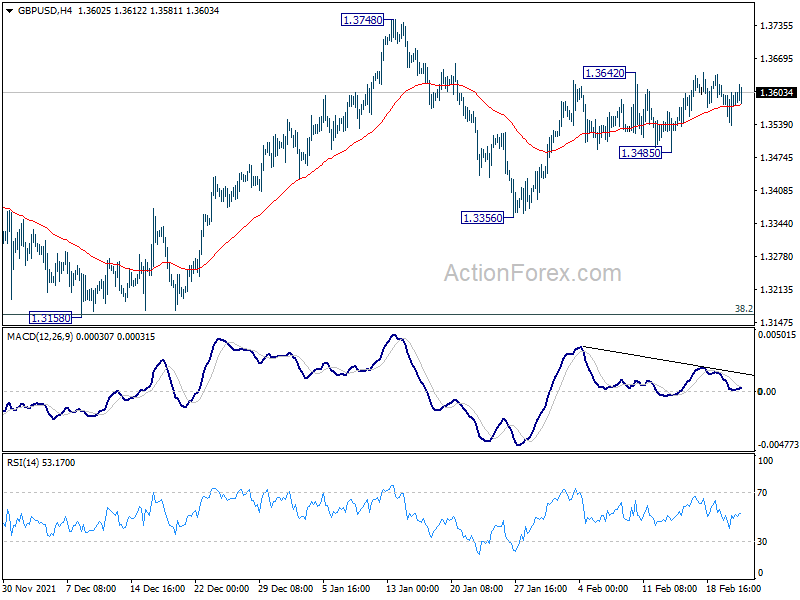
Intraday bias in GBP/USD remains neutral as range trading continues. On the upside, break of 1.3642 will resume the rebound from 1.3356 to 1.3748 resistance. Firm break there will revive the bullish case that correction from 1.4248 has completed with three waves down to 1.3158. Further rally should then be seen to retest 1.4248 high. On the downside, though, break of 1.3485 will turn bias to the downside for 1.3356 support instead.
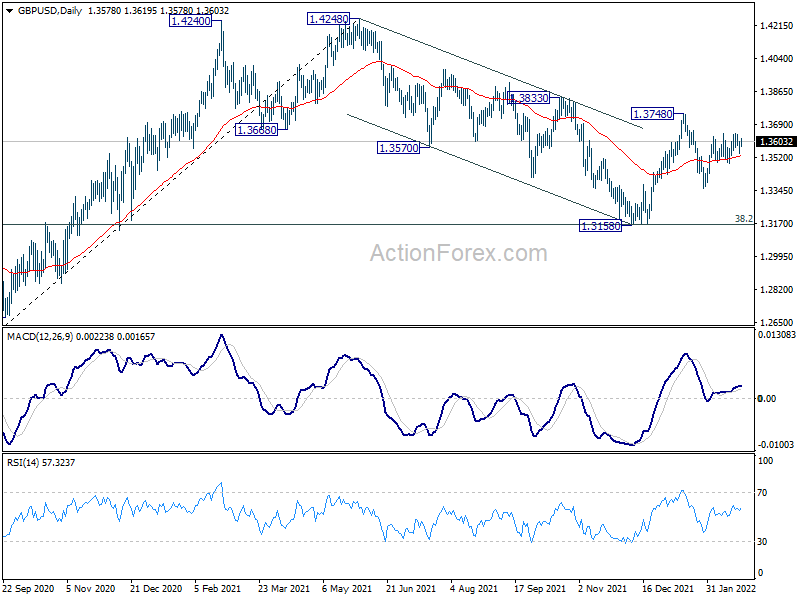
In the bigger picture, as long as 38.2% retracement of 1.1409 to 1.4248 at 1.3164 holds, up trend from 1.1409 (2020 low) is still in progress. On resumption, next target will be 38.2% retracement of 2.1161 to 1.1409 at 1.5134. Nevertheless sustained break of 1.3164 will argue that whole rise from 1.1409 has completed and bring deeper fall to 61.8% retracement at 1.2493.
USD/CHF Mid-Day Outlook
Daily Pivots: (S1) 0.9170; (P) 0.9199; (R1) 0.9246; More....
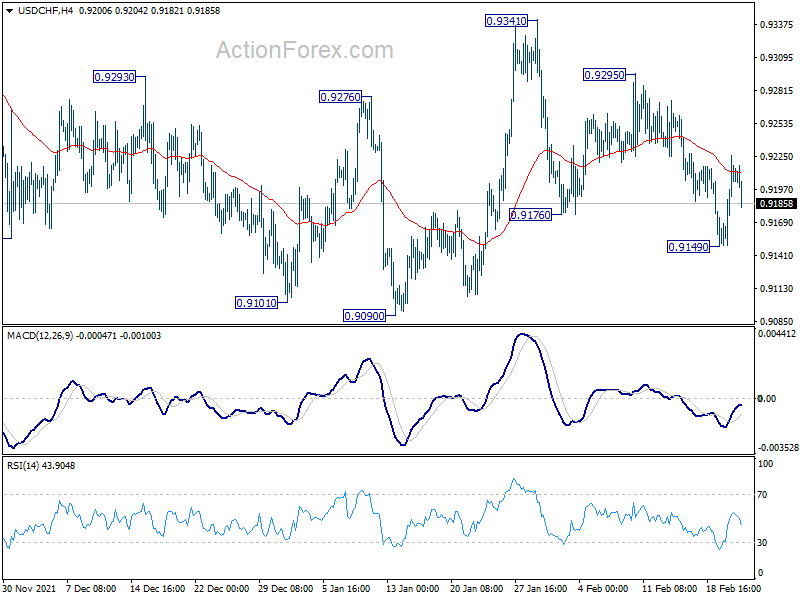
Intraday bias in USD/CHF remains neutral for the moment and sideway trading could continue. Choppy rise from 0.8925 would still be in favor to extend higher as long as 0.9090 support holds. Break of 0.9341 will target 0.9372 resistance and then 0.9471. On the downside, however, break of 0.9090 will bring deeper fall back to 0.8925 support.
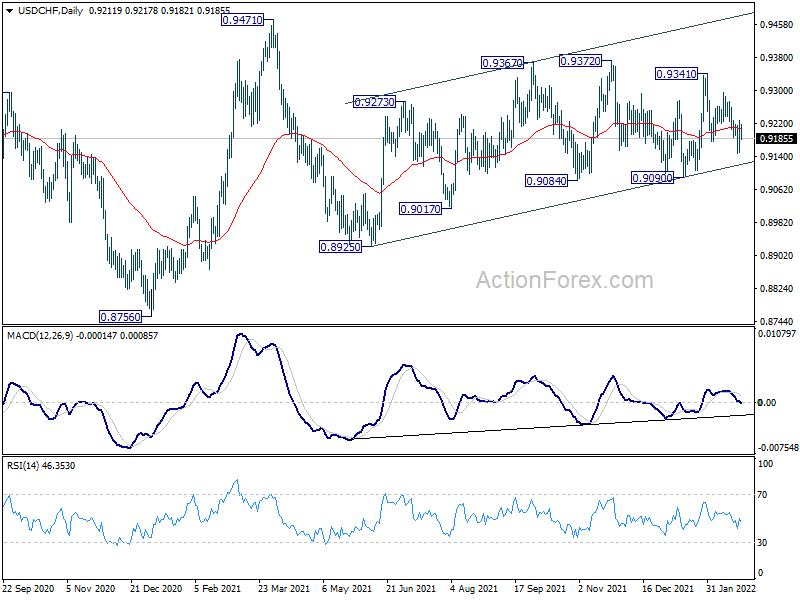
In the bigger picture, medium term outlook will be neutral at best as long as 0.9471 resistance holds. Larger down trend could still extend through 0.8756 (2021 low). However, firm break of 0.9471 will argue that the trend has already reversed and rebound the rally from 0.8756 with another impulsive move.
USD/JPY Mid-Day Outlook
Daily Pivots: (S1) 114.63; (P) 114.94; (R1) 115.37; More...
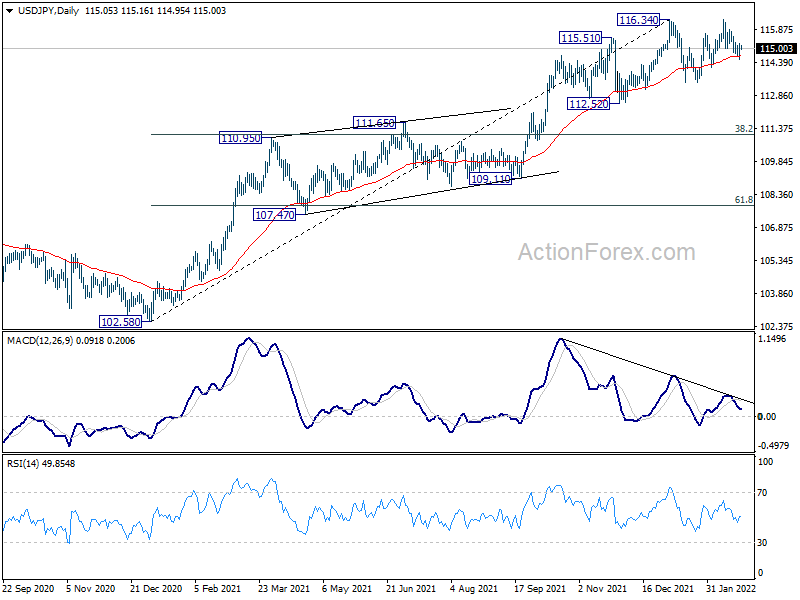
Intraday bias in USD/JPY remains neutral for the moment. On the downside, break of 114.49 will resume the decline from 116.33, as the third leg of the corrective pattern from 116.34. Further break of 114.14 and will target 113.46 support and below. On the upside, firm break of 116.34 will resume larger up trend.
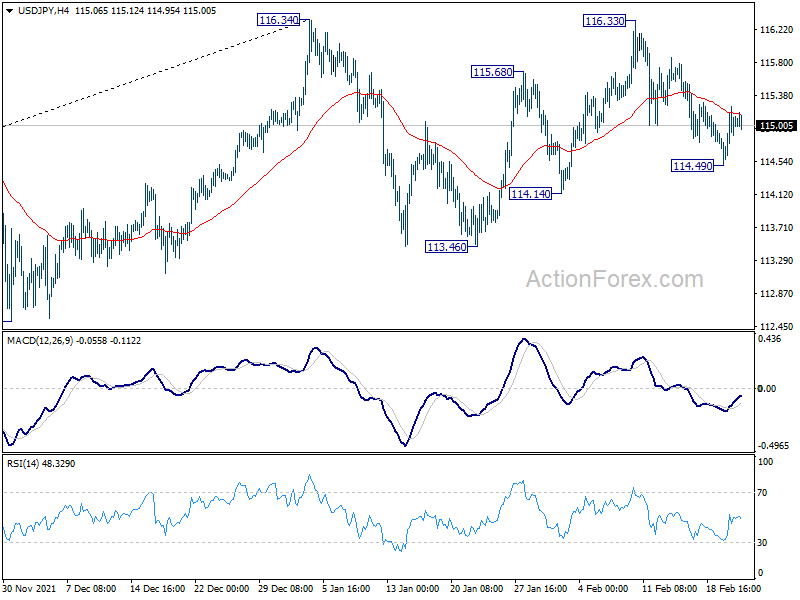
In the bigger picture, no change in the view that rise from 102.58 is the third leg of the up trend from 101.18 (2020 low). Such rally should target a test on 118.65 (2016 high). Sustained break there will pave the way to 120.85 (2015 high) and raise the chance of long term up trend resumption. This will remain the favored case as long as 55 week EMA (now at 111.61) holds.
AUD/USD Mid-Day Report
Daily Pivots: (S1) 0.7182; (P) 0.7208; (R1) 0.7243; More...
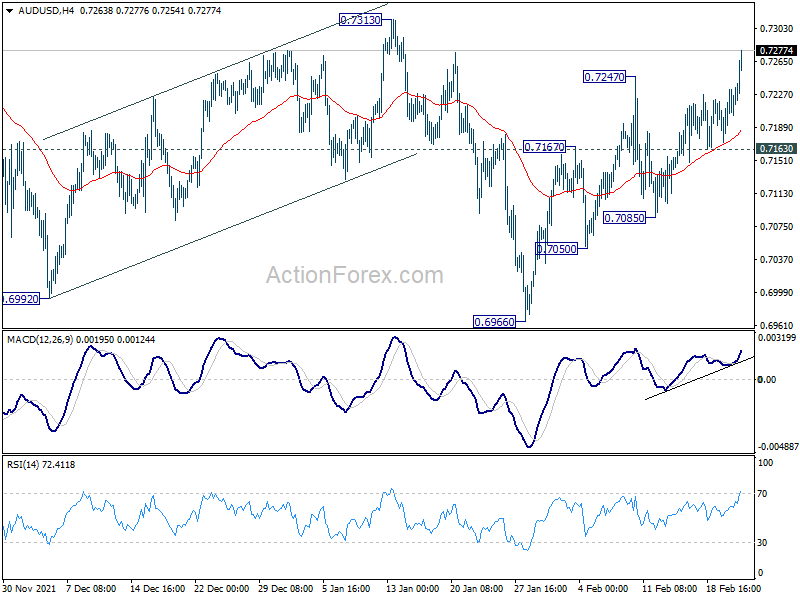
AUD/USD's rise from 0.6966 resumes by breaking through 0.7247, and intraday bias is back on the upside for 0.7313 resistance. Decisive break there argue that correction from 0.8006 has completed at 0.6966, after hitting 0.6991 key support. Outlook will be turned bullish for 0.7555 resistance next. On the downside, break of 0.7163 minor support will mix up the outlook again and turn intraday bias neutral.
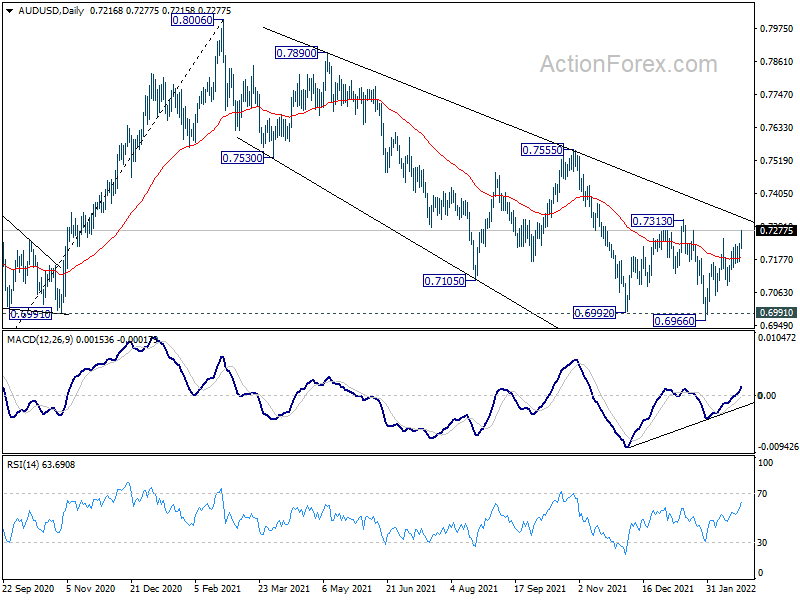
In the bigger picture, focus remains on 0.6991 key structural support. Sustained break there will argue that the whole up trend from 0.5506 might be finished at 0.8006, after rejection by 0.8135 long term resistance. Deeper decline would then be seen back to 61.8% retracement of 0.5506 to 0.8006 at 0.6461. Meanwhile, strong rebound from 0.6991 will retain medium term bullishness. That is, whole up trend from 0.5506 is still in progress.
Aussie Surges as Risk Sentiment Improves, Euro and Sterling Shrugs Hawkish Comments
The markets are generally trading in risk-on mode today. New Zealand Dollar is leading commodity currencies higher, with additional boost from hawkish RBNZ rate hike. Australian Dollar is following closely, then Canadian Dollar. on the other hand, Yen and Dollar are under some selling pressure. Euro and Sterling are mixed despite hawkish comments from ECB and BoE officials.
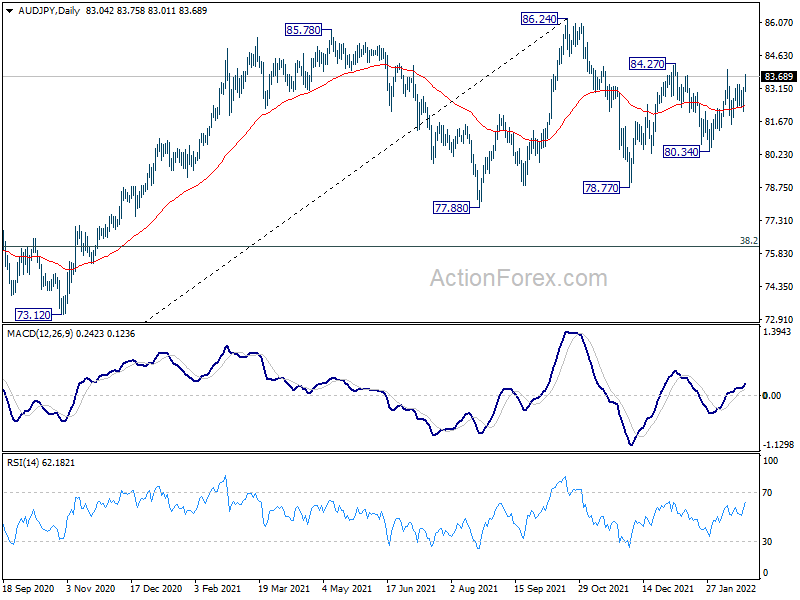
Technically, AUD/USD's break of 0.7247 resistance reaffirmed near term bullishness and resume rise form 0.6966. Further break of 0.7313 will add to the case of bullish trend reversal. At the same time, EUR/AUD 's diving to 1.5559 support and bring will pave the way back to 1.5250 low. Break of 84.27 resistance in AUD/JPY will also resume the whole rise from 78.77 to retest 86.24. Attention will be paid to these levels to confirm underlying strength of Aussie.
In Europe, at the time of writing, FTSE is up 0.68%. DAX is up 1.07%. CAC is up 1.37%. Germany 10-year yield is down -0.001 at 0.244. Earlier in Asia, Hong Kong HSI rose 0.60%. China Shanghai SSE rose 0.93%. Singapore Strait Times dropped -0.06%. Japan was on holiday.
BoE Bailey sees very clear risk of high inflation coming through second-round effects
In the UK parliament's Treasury Committee hearing, BoE Governor Andrew Bailey said, there was "very clearly an upside risk" inflation that "comes through from the second-round effects".
"The second-round effects are a real concern. If we get the second-round effects... of course we would need to react to that with higher interest rates... ," he warned. "And the consequence of that... is that it would of course slow activity in the economy and it would increase unemployment"
On off-loading the balance sheet, Bailey said, "what we said last August was that if and when Bank Rate reaches 1%, and the words are important here, we will begin to consider active sales. It's not the same sort of quasi automatic process that we had with the ceasing reinvestment. So the 1% is a necessary but not sufficient thing. We would want to conduct QT at times when its impact on monetary policy was least."
ECB de Guindos: We will readjust asset purchases if needed
ECB Vice President Luis de Guindos said asset purchases need to be completed before interest rates can rise. However, "we will look at the data, the projections and then we will readjust asset purchases if needed and will see when an interest rate hike can take place."
Governing Council member Bostjan Vasle said the Eurofi Magazine, "The time seems right for our monetary policy to move out of crisis mode and start the process of gradual normalisation."
"With the return of economic activity to the pre-crisis level, looming labour shortages and in part structural pressures on energy prices, our monetary policy needs to start rebuilding its space to be ready to respond to the next business cycle," Vasle added.
ECB Holzmann favors first hike in summer, second by year end
ECB Governing Council member Robert Holzmann told Swiss newspaper NZZ, "When it comes to the interest rate outlook, the ECB has always signalled that an interest rate hike should not take place until shortly after the bond purchases have ended."
"But it would also be possible to take a first interest rate step in the summer before the end of the purchases and a second at the end of the year. I would favour that."
Also, Holzmann said and exit from negative interest rate would be an "important signal" to the society and markets. He would likely to see two rate hikes by the end of this year or early 2023. But, "some of my colleagues would perhaps be even more progressive here, while others would be more cautious," he added.
"I think that a key interest rate of very roughly 1.5% in 2024 could be realistic, although that may well shift forward or backward somewhat," he said, adding that 1.5% would be a benchmark for neutral monetary policy.
Eurozone CPI finalized at 5.1% yoy in Jan, EU at 5.6% yoy
Eurozone CPI was finalized at 5.1% yoy in January, up from December's 5.0% yoy. The highest contribution to the annual euro area inflation rate came from energy (+2.80%), followed by services (+0.98%), food, alcohol & tobacco (+0.77%) and non-energy industrial goods (+0.56%).
EU CPI was finalized at 5.6% yoy, up from December's 5.3% yoy. The lowest annual rates were registered in France (3.3%), Portugal (3.4%) and Sweden (3.9%). The highest annual rates were recorded in Lithuania (12.3%), Estonia (11.0%) and Czechia (8.8%). Compared with December, annual inflation fell in eight Member States and rose in nineteen.
German Gfk consumer sentiment dropped to -8.1, expectations of easing inflation shattered
Germany Gfk consumer sentiment for March dropped from -6.7 to -8.1, below expectation of -6.2. In February, economic expectations rose from 22.8 to 24.1. Income expectations dropped from 16.9 to 3.9, lowest since January 2021. Propensity to buy dropped from 5.2 to 1.4.
"Above all, expectations of a significant easing in price trends at the beginning of the year have been shattered for the time being, as inflation rates continue to hover at a high level," explains Rolf Bürkl, GfK consumer expert.
"Nevertheless, the outlook for the coming months is quite positive: Only recently it was decided to lift profound pandemic restrictions. This gives cause for hope that consumer spending will also return as a result. If this were to be supported by moderate price inflation, consumer sentiment could finally recover in the long term as well."
RBNZ hikes rate to 1%, starts managed bond sales, raised OCR peak forecast
RBNZ raised OCR by 25bps to 1.00% as widely expected. Additionally, it will start to start reduction of the bond holdings under the Large Scale Asset Purchase program through "both bond maturities and managed sales.
The central bank also said "further removal of monetary policy stimulus is expected over time given the medium-term outlook for growth and employment, and the upside risks to inflation."
In the minutes, it's noted, "when deciding whether to move the OCR up by 25 or 50 basis points, many members saw this as a finely balanced decision."
However, firstly, the active sales of bond holdings may "put some upward pressure on longer-term interest rates". Also, the OCR is expected to "peak at a higher level than assumed" at the November MPC. The OCR peak was raised to around 3.4% in 2024, compared to 2.6% in November review.
Hence, the Committee came to a consensus of a 25bps hike, but "affirmed that it was willing to move the OCR in larger increments if required over coming quarters."
AUD/USD Mid-Day Report
Daily Pivots: (S1) 0.7182; (P) 0.7208; (R1) 0.7243; More...
AUD/USD's rise from 0.6966 resumes by breaking through 0.7247, and intraday bias is back on the upside for 0.7313 resistance. Decisive break there argue that correction from 0.8006 has completed at 0.6966, after hitting 0.6991 key support. Outlook will be turned bullish for 0.7555 resistance next. On the downside, break of 0.7163 minor support will mix up the outlook again and turn intraday bias neutral.
In the bigger picture, focus remains on 0.6991 key structural support. Sustained break there will argue that the whole up trend from 0.5506 might be finished at 0.8006, after rejection by 0.8135 long term resistance. Deeper decline would then be seen back to 61.8% retracement of 0.5506 to 0.8006 at 0.6461. Meanwhile, strong rebound from 0.6991 will retain medium term bullishness. That is, whole up trend from 0.5506 is still in progress.
Economic Indicators Update
| GMT | Ccy | Events | Actual | Forecast | Previous | Revised |
|---|---|---|---|---|---|---|
| 00:30 | AUD | Wage Price Index Q/Q Q4 | 0.70% | 0.70% | 0.60% | |
| 00:30 | AUD | Construction Work Done Q4 | -0.40% | 2.10% | -0.30% | -1.20% |
| 01:00 | NZD | RBNZ Interest Rate Decision | 1.00% | 1.00% | 0.75% | |
| 02:00 | NZD | RBNZ Press Conference | ||||
| 07:00 | EUR | Germany Gfk Consumer Confidence Mar | -8.1 | -6.2 | -6.7 | |
| 09:00 | CHF | ZEW Expectations Feb | 9 | 9.5 | ||
| 10:00 | EUR | Eurozone CPI Y/Y Jan F | 5.10% | 5.10% | 5.10% | |
| 10:00 | EUR | Eurozone CPI Core Y/Y Jan F | 2.30% | 2.30% | 2.30% |
ECB de Guindos: We will readjust asset purchases if needed
ECB Vice President Luis de Guindos said asset purchases need to be completed before interest rates can rise. However, "we will look at the data, the projections and then we will readjust asset purchases if needed and will see when an interest rate hike can take place."
Governing Council member Bostjan Vasle said the Eurofi Magazine, "The time seems right for our monetary policy to move out of crisis mode and start the process of gradual normalisation."
"With the return of economic activity to the pre-crisis level, looming labour shortages and in part structural pressures on energy prices, our monetary policy needs to start rebuilding its space to be ready to respond to the next business cycle," Vasle added.
NZD Flies as Risk Appetite Returns
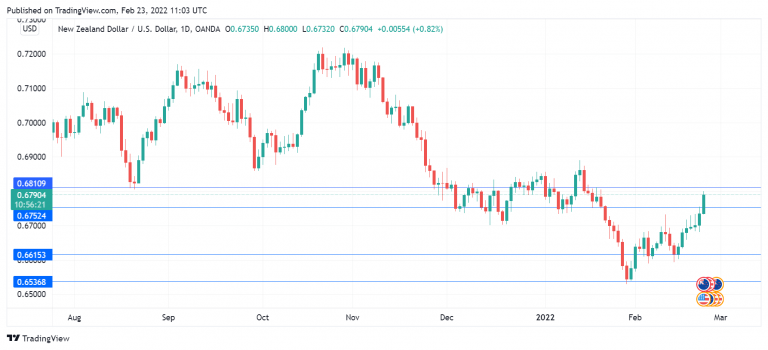
The New Zealand dollar has accelerated its rally, and is up 0.86% on the day, as NZD/USD trades just shy of the 0.68 level.
Sanctions softer than expected
The US and other western nations have slapped further sanctions on Russia, after Moscow sent troops to two breakaway regions in eastern Ukraine. Still, the financial markets breathed a sigh of relief as the sanctions were less severe than expected. Perhaps the most notable response was from Germany, which has suspended the Nord Stream 2 pipeline, which is intended to deliver Russian natural gas to Europe.
The US has canceled a meeting between the US Secretary of State and the Russian Foreign Minister, and a Biden-Putin summit will not take place, given the volatile situation in Ukraine. Nonetheless, the US response leaves Putin with a possibility of climbing down the tree and risk appetite has improved, at least for now. That has boosted risk-sensitive currencies such as the New Zealand dollar, which has climbed to a 1-month high.
Closer to home, the RBNZ raised rates today as was widely expected. This marks a third straight hike of 0.25%, bringing the cash rate to 1.00%. The central bank is committed to lowering inflation, which has been buoyed by surging energy prices and a red-hot housing market. The rate statement was hawkish, with the RBNZ stating it would start quantitative tightening by reducing its balance sheet. This is another step in the normalization of monetary policy by the RBNZ.
How far will the RBNZ go with its tightening cycle? There is a divergence of opinion from economists as to what will be the peak of the cash rate, with a range of 2.50%-3%. The RBNZ will be the first to admit that inflation and the tightness in the labor market have surprised to the upside. Inflation has hit 5.9%, almost double the upper limit of the bank’s inflation target of 3%. The outlook does not appear favorable for inflation easing anytime soon, with oil poised to break the USD 100 barrier and a weak New Zealand dollar. This means we can expect the central bank to be aggressive in its rate policy this year and in 2023.
NZD/USD Technical
- NZD/USD is testing resistance at 0.6752 and closing in on resistance at 0.6810. Above, there is resistance at 0.6889
- 0.6615 is providing support, followed by 0.6536
Aussie Rises to One-Month High on Fresh Risk Mode, Solid Australian Data
The Australian dollar surges to one-month high on Wednesday, lifted by fresh risk demand and growth of Australian wages in Q4.
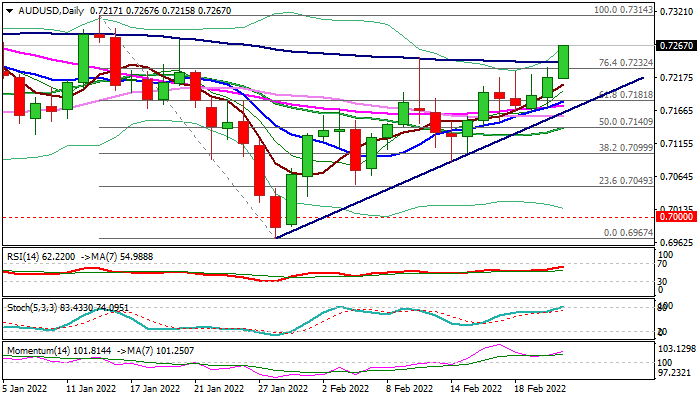
The pair extends advance into third consecutive day, with today’s break of pivotal barriers at 0.7232 (Fibo 76.4% of 0.7314/0.6967) and 0.7240 (100DMA) generating strong bullish signal.
Close above these levels will confirm signal and open way for final push towards key resistances at 0.7314/39 (2022 high of Jan 13 / falling 200DMA).
Fresh positive momentum on daily chart and multiple moving averages’ bull-crosses underpin the action.
Solid supports at 0.7248/40/34 (Feb 10 spike high / broken 100DMA / broken Fibo 76.4%) should ideally contain and keep the downside protected.
Res: 0.7276; 0.7293; 0.7314; 0.7339
Sup: 0.7240; 0.7215; 0.7180; 0.7165
Gold Eases Below 20-Period SMA, Creating Bearish Correction
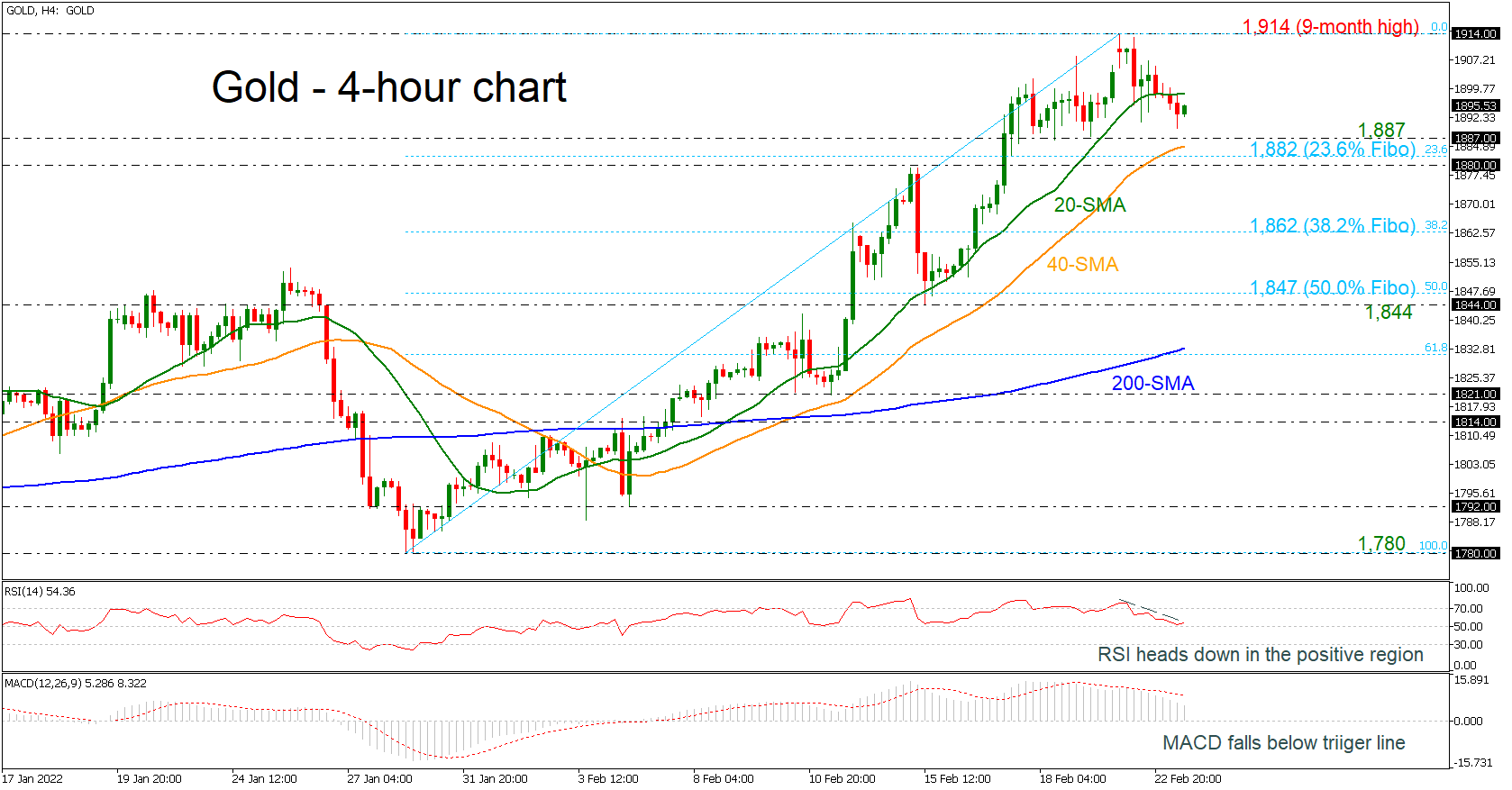
Gold prices are in a declining mode after the bounce off the nine-month high of 1,914. The price fell beneath the 20-period simple moving average (SMA) with the technical indicators suggesting a bearish correction. The RSI is holding below a descending line in the positive region, while the MACD oscillator is losing momentum below its trigger line in the bullish area.
A reversal to the downside could stall at the 1,887 support ahead of the 40-period simple moving average (SMA) at 1,884 and the 23.6% Fibonacci retracement level of the upward wave from 1,780 to 1,914 at 1,882. Slightly lower the 1,880 inside swing high from February 15 may halt bearish actions. Further below, the 38.2% Fibonacci of 1,862 could also provide support.
Alternatively, a successful climb above the 20-period SMA could add some optimism for a retest of the nine-month high of 1,914. Even higher, the 1,965 resistance taken from the peak on November 2020 may come into spotlight.
All in all, the yellow metal is printing a negative correction in the very short-term but in the broader outlook is strongly positive.
BoE Bailey sees very clear risk of high inflation coming through second-round effects
In the UK parliament's Treasury Committee hearing, BoE Governor Andrew Bailey said, there was "very clearly an upside risk" inflation that "comes through from the second-round effects".
"The second-round effects are a real concern. If we get the second-round effects... of course we would need to react to that with higher interest rates... ," he warned. "And the consequence of that... is that it would of course slow activity in the economy and it would increase unemployment"
On off-loading the balance sheet, Bailey said, "what we said last August was that if and when Bank Rate reaches 1%, and the words are important here, we will begin to consider active sales. It's not the same sort of quasi automatic process that we had with the ceasing reinvestment. So the 1% is a necessary but not sufficient thing. We would want to conduct QT at times when its impact on monetary policy was least."