Sample Category Title
USD/JPY Daily Outlook
Daily Pivots: (S1) 115.20; (P) 115.41; (R1) 115.77; More...
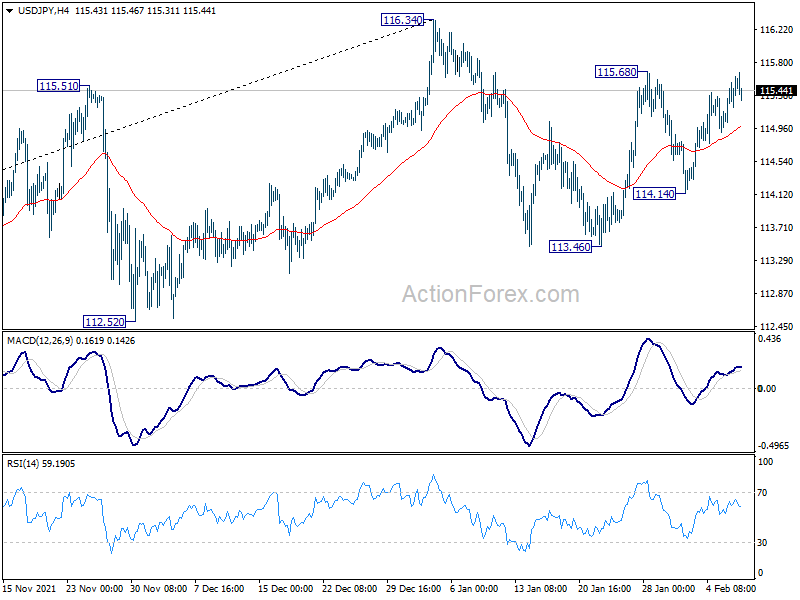
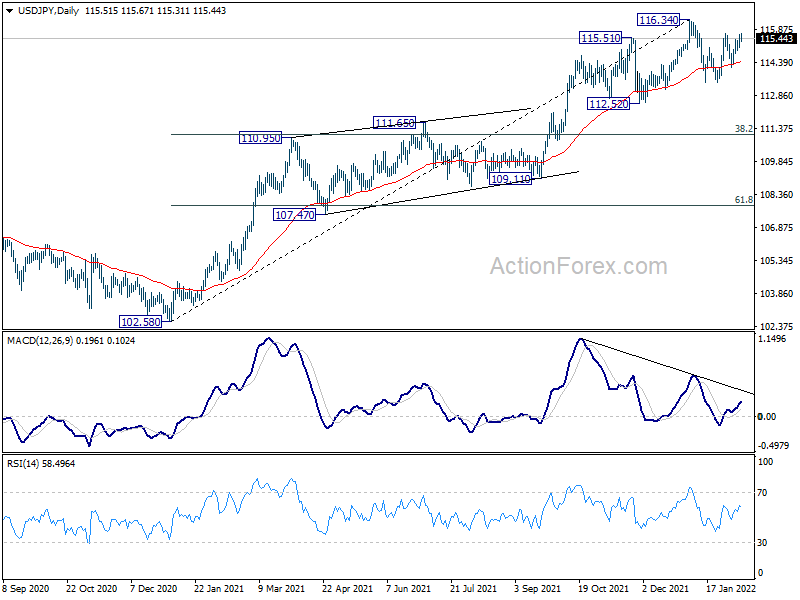
Intraday bias in USD/JPY remains neutral and outlook is unchanged. Overall, consolidation pattern from 116.34 is still extending. On the upside, break of 115.68 will resume the rebound from 113.46 to retest 116.34 high first. On the downside, break of 114.14 should extend the consolidation with another falling leg through 113.46 support.
In the bigger picture, no change in the view that rise from 102.58 is the third leg of the up trend from 101.18 (2020 low). Such rally should target a test on 118.65 (2016 high). Sustained break there will pave the way to 120.85 (2015 high) and raise the chance of long term up trend resumption. This will remain the favored case as long as 55 week EMA (now at 111.21) holds.
USD/CAD Daily Outlook
Daily Pivots: (S1) 1.2672; (P) 1.2697; (R1) 1.2728; More...
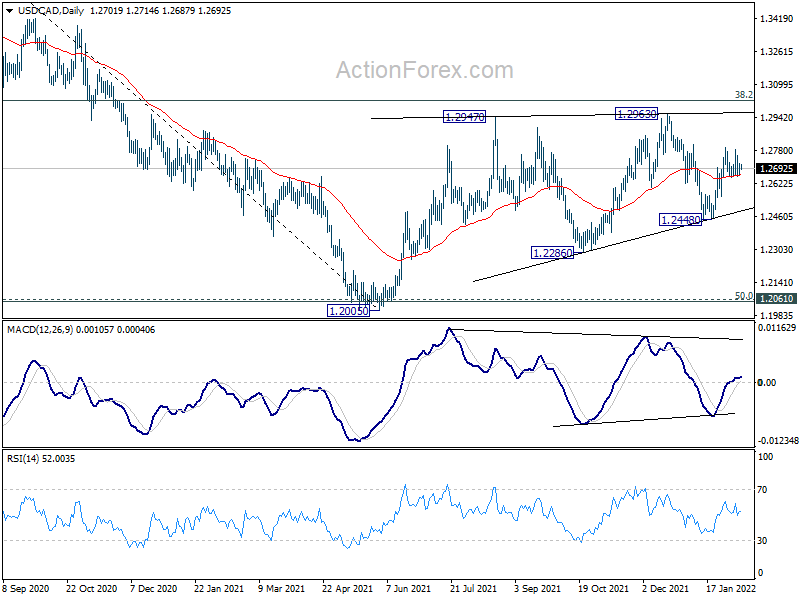
Intraday bias in USD/CAD stays neutral at this point as range trading continues. With 1.2648 minor support intact, further rise is mildly in favor. On the upside, break of 1.2795 will resume the rally from 1.2448 to 1.2963 resistance next. However, break of 1.2648 will turn bias back to the downside for 1.2448 support instead.
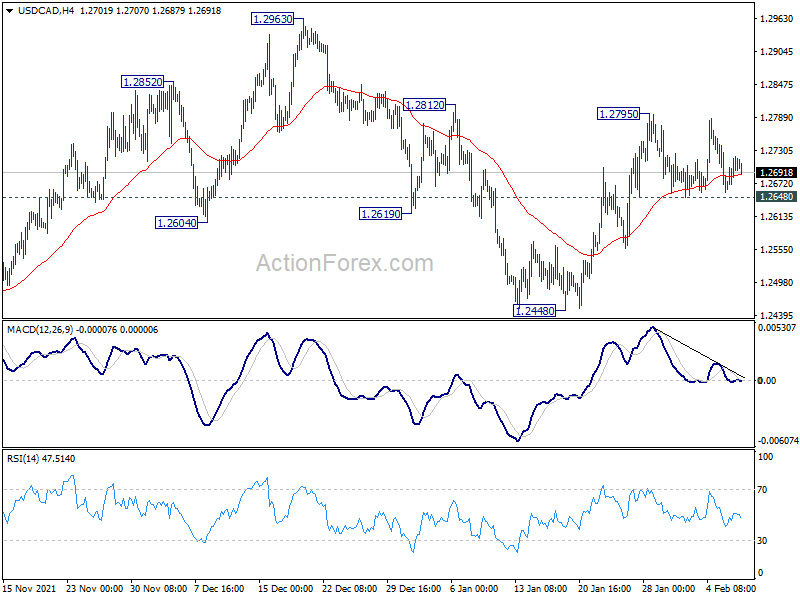
In the bigger picture, focus stays on 38.2% retracement of 1.4667 (2020 high) to 1.2005 (2021 low) at 1.3022. Sustained break there should confirm that the down trend from 1.4667 has completed after defending 1.2061 long term cluster support. Further rise would then be seen towards 61.8% retracement at 1.3650. However, rejection by 1.3022 will maintain medium term bearishness. Break of 1.2005 will resume the down trend from 1.4667 and that carries larger bearish implications too.
AUD/USD Daily Report
Daily Pivots: (S1) 0.7120; (P) 0.7134; (R1) 0.7160; More...
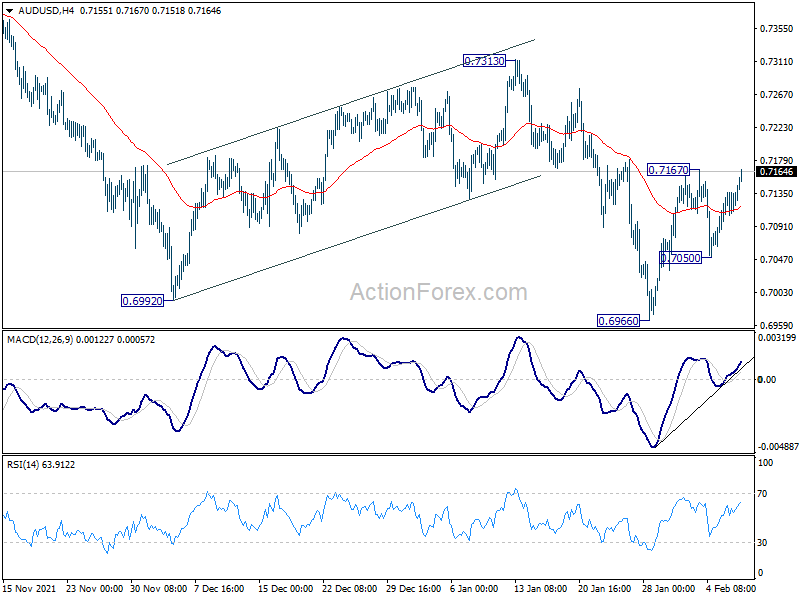
Intraday bias in AUD/USD remains neutral first. On the upside, break of 0.7167 will resume the rebound from 0.6966 and target 0.7313 resistance. Decisive break there argue that correction form 0.8006 has completed at 0.6966, after hitting 0.6991 key support. Outlook will be turned bullish for 0.7555 resistance next. On the downside, below 0.7050 minor support will bring retest of 0.6966 low.
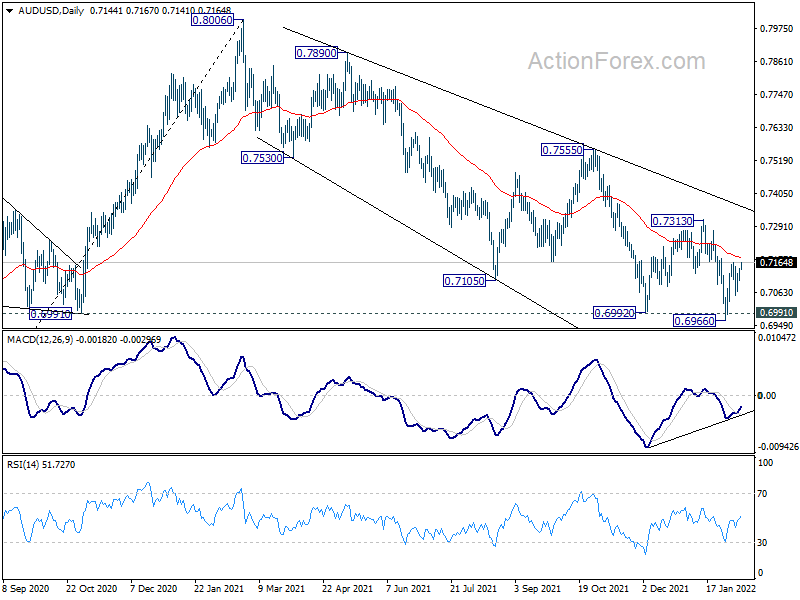
In the bigger picture, focus remains on 0.6991 key structural support. Sustained break there will argue that the whole up trend from 0.5506 might be finished at 0.8006, after rejection by 0.8135 long term resistance. Deeper decline would then be seen back to 61.8% retracement of 0.5506 to 0.8006 at 0.6461. Meanwhile, strong rebound from 0.6991 will retain medium term bullishness. That is, whole up trend from 0.5506 is still in progress.
Aussie Rises on Risk-on Sentiment, Dollar Soft Despite Rising Yields
Australian Dollar rises further again with help from risk-on sentiments in the US and Asia. On the other hand, Dollar turns soft despite rising treasury yields. Canadian Dollar is dragged down slightly by oil prices. Other parts of the forex markets are mixed. Euro is still in consolidation against, and cautious comments from ECB officials are unlikely to give it another lift. The big moves in the markets could only come after US consumer inflation data tomorrow.
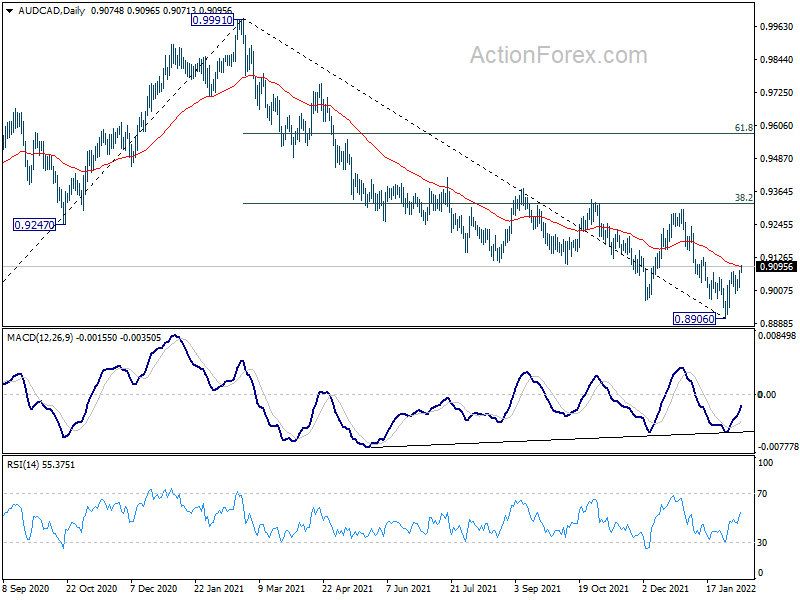
Technically, AUD/CAD's rebound from 0.8906 resumed by breaking through 0.9076 temporary top this week. It's too early to call for a trend reversal. But bullish convergence condition in daily MACD is at least supporting a rebound. Sustained trading above 55 day EMA (now at 0.9095) will pave the way to key resistance level at around 38.2% retracement of 0.9991 to 0.8906 at 0.9320. Similarly, AUD/USD could also be resuming the rebound from 0.6966 towards 0.7313 resistance.
In Asia, at the time of writing, Nikkei is up 1.10%. Hong Kong HSI is up 1.97%. China Shanghai SSE is up 0.40%. Singapore Strait Times is up 0.14%. Japan 10-year JGB yield is up 0.0080 at 0.216. Overnight, DOW rose 1.06%. S&P 500 rose 0.84%. NASDAQ rose 1.28%. 10-year yield rose 0.038 to 1.954.
ECB Villeroy: Policy normalization won't go beyond neutral orientation
ECB Governing Council member Francois Villeroy de Galhau said market reactions to the central bank's recent comments were "very high and too high in recent days."
He told the French National Assembly that ECB has the optionally on the pace on moving between different stages of policy normalization, which starts with end of asset purchases before rate hikes. And, the normalization process would not constitute monetary tightening as it would not go beyond a "neutral orientation".
"We are exiting a period of exceptionally accommodative monetary policy -- that is what it is a question of reducing very gradually and in an adapted way," Villeroy said.
Fed Daly against overly aggressive rate hikes
San Francisco Fed President Mary Daly told CNN yesterday that "we could have it (inflation) be worse before it gets better but it is definitely going to get better. She didn't expect inflation to fall back to 2% by the end of the year.
Daly supports starting interest rate in March. However, she added that Fed should do neither too little nor be "overly aggressive", as Fed alone couldn't solve the inflation problem largely caused by the pandemic disruptions.
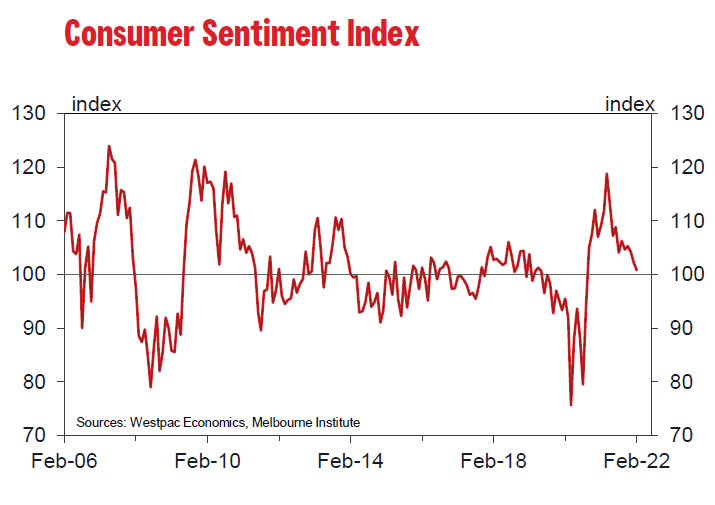
Australia Westpac consumer sentiment dropped to 100.8, elevated pressures on finances
Australia Westpac-Melbourne Institute consumer sentiment dropped -1.3% to 100.8 in February, down from 102.2. The "economy, next 12 months" sub-index increased by 2.4% and the "economy, next 5 years" sub-index was up by 1.5%.
However, the "finances vs a year ago" sub-index slumped by -9.2% (more than reversing the surprise 7.5% lift in January) while the "finances, next 12 months" sub-index fell by -1.5% to be down by -4.3% since December.
Westpac said, "the most likely explanations for these elevated pressures on finances relate to: Omicron-related disruptions to activity and earnings at the start of the year; the rising cost of living; and the prospect of rising interest rates."
Also, Westpac does not expect the first rate hike by the RBA until August and it will be very interesting to observe how resilient this surprising recovery in confidence will be in the lead up to the first move."
Looking ahead
Germany trade balance and Italy industrial production will be released in European session. US will release Wholesale inventories final later in the day.
AUD/USD Daily Report
Daily Pivots: (S1) 0.7120; (P) 0.7134; (R1) 0.7160; More...
Intraday bias in AUD/USD remains neutral first. On the upside, break of 0.7167 will resume the rebound from 0.6966 and target 0.7313 resistance. Decisive break there argue that correction form 0.8006 has completed at 0.6966, after hitting 0.6991 key support. Outlook will be turned bullish for 0.7555 resistance next. On the downside, below 0.7050 minor support will bring retest of 0.6966 low.
In the bigger picture, focus remains on 0.6991 key structural support. Sustained break there will argue that the whole up trend from 0.5506 might be finished at 0.8006, after rejection by 0.8135 long term resistance. Deeper decline would then be seen back to 61.8% retracement of 0.5506 to 0.8006 at 0.6461. Meanwhile, strong rebound from 0.6991 will retain medium term bullishness. That is, whole up trend from 0.5506 is still in progress.
Economic Indicators Update
| GMT | Ccy | Events | Actual | Forecast | Previous | Revised |
|---|---|---|---|---|---|---|
| 23:30 | AUD | Westpac Consumer Confidence Feb | -1.30% | -2% | ||
| 23:50 | JPY | Money Supply M2+CD Y/Y Jan | 3.60% | 3.50% | 3.70% | |
| 07:00 | EUR | Germany Trade Balance (EUR) Dec | 11.3B | 10.9B | ||
| 09:00 | EUR | Italy Industrial Output M/M Dec | 1.70% | 1.90% | ||
| 15:00 | USD | Wholesale Inventories Dec F | 2.00% | 2.10% | ||
| 15:30 | USD | Crude Oil Inventories | 1.5M | -1.0M |
Australia Westpac consumer sentiment dropped to 100.8, elevated pressures on finances
Australia Westpac-Melbourne Institute consumer sentiment dropped -1.3% to 100.8 in February, down from 102.2. The "economy, next 12 months" sub-index increased by 2.4% and the "economy, next 5 years" sub-index was up by 1.5%.
However, the "finances vs a year ago" sub-index slumped by -9.2% (more than reversing the surprise 7.5% lift in January) while the "finances, next 12 months" sub-index fell by -1.5% to be down by -4.3% since December.
Westpac said, "the most likely explanations for these elevated pressures on finances relate to: Omicron-related disruptions to activity and earnings at the start of the year; the rising cost of living; and the prospect of rising interest rates."
Also, "Westpac does not expect the first rate hike by the RBA until August and it will be very interesting to observe how resilient this surprising recovery in confidence will be in the lead up to the first move."
Fed Daly against overly aggressive rate hikes
San Francisco Fed President Mary Daly told CNN yesterday that "we could have it (inflation) be worse before it gets better but it is definitely going to get better. She didn't expect inflation to fall back to 2% by the end of the year.
Daly supports starting interest rate in March. However, she added that Fed should do neither too little nor be "overly aggressive", as Fed alone couldn't solve the inflation problem largely caused by the pandemic disruptions.
ECB Villeroy: Policy normalization won’t go beyond neutral orientation
ECB Governing Council member Francois Villeroy de Galhau said market reactions to the central bank's recent comments were "very high and too high in recent days."
He told the French National Assembly that ECB has the optionally on the pace on moving between different stages of policy normalization, which starts with end of asset purchases before rate hikes. And, the normalization process would not constitute monetary tightening as it would not go beyond a "neutral orientation".
"We are exiting a period of exceptionally accommodative monetary policy -- that is what it is a question of reducing very gradually and in an adapted way," Villeroy said.
Gold Price Could Revisit $1,850 If It Breaks This Resistance
Key Highlights
- Gold price is gaining pace above the $1,810 and $1,812 resistance levels.
- A connecting bullish trend line is forming with support near $1,807 on the 4-hours chart.
- EUR/USD started a downside correction from the 1.1480 zone.
- GBP/USD is consolidating below the 1.3600 resistance zone.
Gold Price Technical Analysis
After a strong decline, gold price found support near the $1,780 level against the US Dollar. The price started a fresh increase above the $1,788 and $1,800 resistance levels.
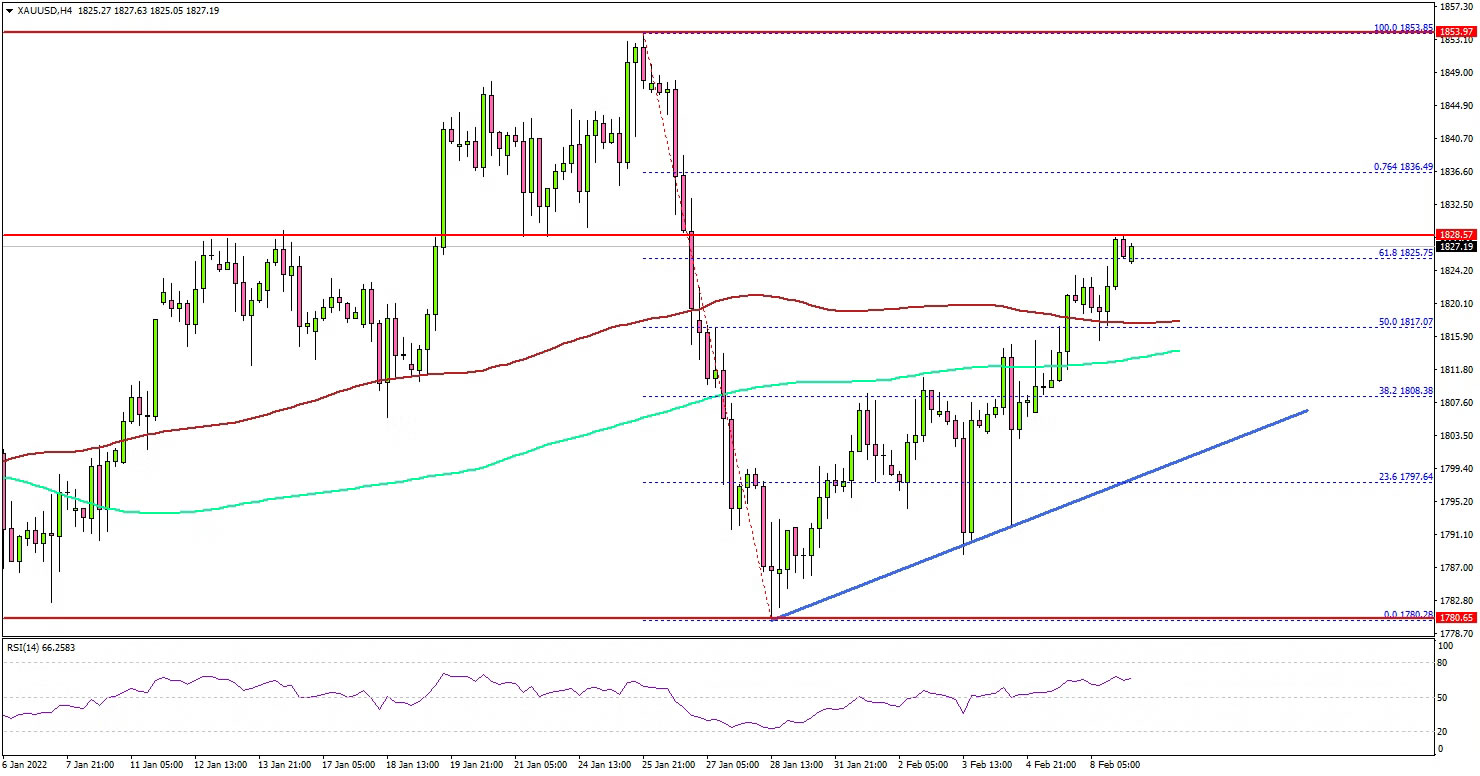
The 4-hours chart of XAU/USD indicates that the price was able to climb above the $1,810 resistance, the 100 simple moving average (red, 4-hours) and the 200 simple moving average (green, 4-hours).
There was a clear move above the 50% Fib retracement level of the downward move from the $1,853 swing high to $1,780 low. It is now facing resistance near the $1,828 and $1,830 levels. The next key resistance is near the $1,836 level.
It is near the 76.4% Fib retracement level of the downward move from the $1,853 swing high to $1,780 low. A clear move above the $1,836 level might send the price towards the $1,850 resistance zone.
If not, the price might correct lower and trade below the $1,812 level. The next major support is near $1,808 and a connecting bullish trend line on the same chart. Any more losses might send the price towards $1,780.
Looking at EUR/USD, the pair is showing a few negative signs below 1.1480 and 1.1450. Similarly, GBP/USD must surpass 1.3600 to continue higher in the near term.
Economic Releases to Watch Today
- US Wholesale Inventories for Dec 2021 – Forecast +2.1%, versus 2.1% previous.
Gold Gains Despite Higher Yields
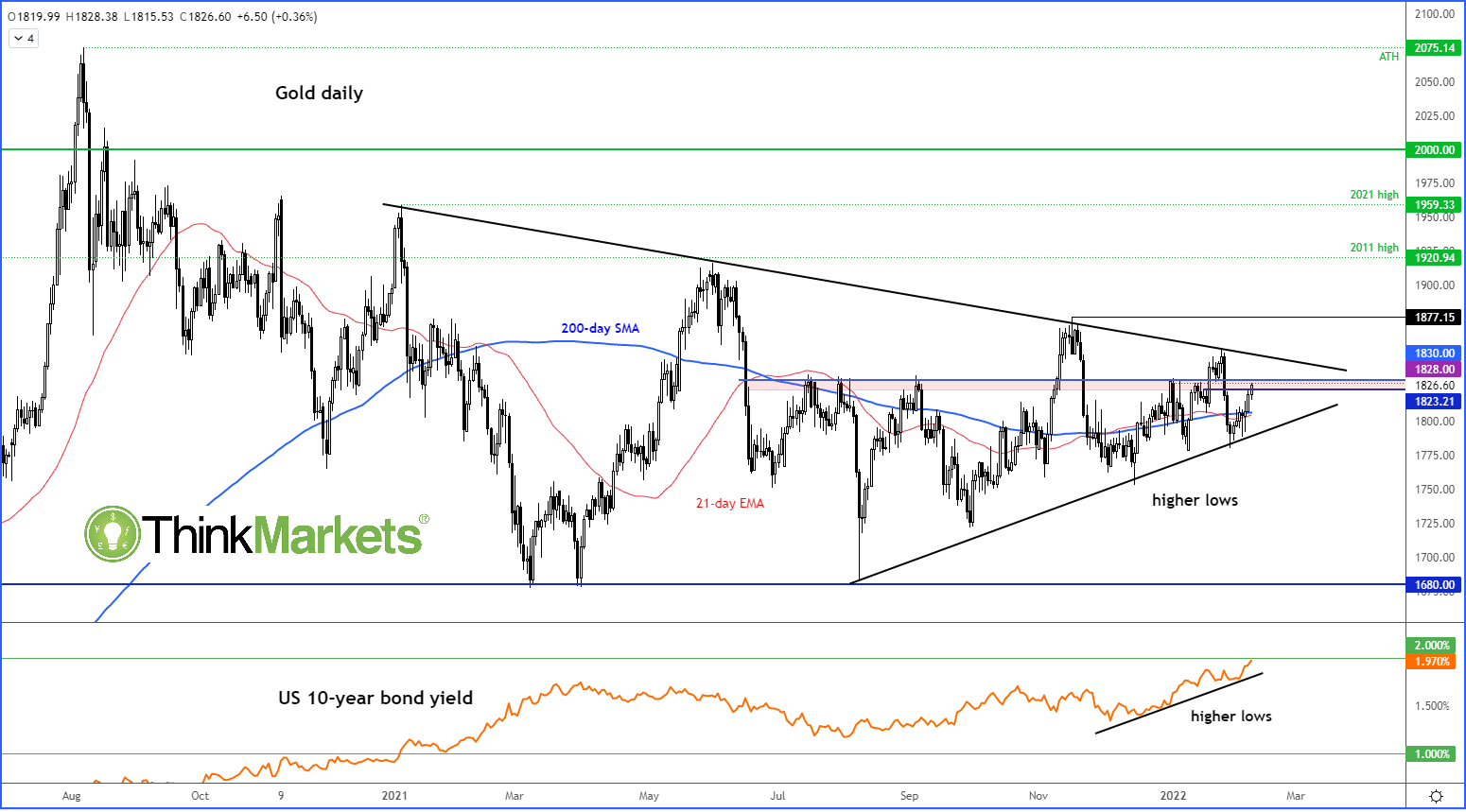
Interestingly, gold investors continued to ignore rising yields – and the dollar. The yellow precious metal broke to a fresh weekly high above $1825, even as the 10-year yield closed in on the 2.000% level. It looks like investors happy to pile into gold, a non-interest-bearing asset, as they seek to protect their wealth against the impact of soaring inflation. Rising prices are eroding the value of fiat currencies around the world, making gold an appealing investment for many.
Bond yields rise across the board
Indeed, it is all about bond yields this week. They are rising left, right and centre. At the time of writing, the Us 10y yield was trading at 1.9668%, thus further closing in on the 2.000% levels. The German 10-year yields, which a few days ago were below zero, climbed to above the 2019 high of 0.273%. In the UK, the equivalent maturing bonds climbed above 1.50% for the first time since October 2018.
Yields have been on the ascendancy because of rising expectations over monetary policy tightening from major central banks.
Gold testing key resistance
Gold still needs to break decisively above the $1830 resistance level in order to attract technical momentum-chasing speculators. For now, price action continues to remain inside the existing ranges. But the metal’s performance – despite rising yields and the dollar – is commanding, and points to a possible breakout.
Gold Traders on the Lookout for US Inflation Rates
Gold prices seem to remain elevated so far in February, finishing in green territory in the past week and trading higher in the current. As we head into a week with limited economic releases but of significant importance, geopolitical tensions, international economic monitoring, and central bank developments continue to be among the most decisive subjects for the Gold market. The closing of this report will consist of a technical analysis that will accompany our fundamental points.
What has happened in the past days?
During the most recent sessions Gold’s volatility increased after the release of the US employment report for January. With a substantial increase in jobs created which reached 444K, Gold’s price initially dropped upon release of the figures. However, Gold’s price quickly rebounded and by the end of the session on Friday had recovered most of the ground lost. This may have been due to the slight increase of the unemployment rate to 4.0% even though the jobs created surpassed expectations. Moreover, as Monday’s session commenced, Gold prices maintained their steady upsurge and fully recovered the ground lost, while in the US session moved even higher. Monday’s session overall favored the Gold market without the support of economic releases.
China’s economic slowdown
Looking at the global economy, analysts are currently considering the impact of the Chinese slowdown that seems to be becoming more evident recently. In January, both Chinese Manufacturing and Services PMI figures were lower compared to previous readings. Even though the Chinese slowdown may be a consequence of the substantial growth observed at the beginning of the pandemic, it may be creating problems to the international scene. China has been dealing with a red hot real estate market and power supply shortages, along with the Omicron variant destabilizing operations in some provinces. On the other hand, Western countries may be depending on Chinese trade in order to be able to cover for their own products and operations. The uncertainty over Chinese global economic contribution can be supporting Gold’s price in the short term, as it could be limiting output in other countries including Europe or Asia. On the contrary, the US is currently in a strong economic position that could perhaps counter the Chinese slowdown. Yet, we may be observing a rather prolonged Chinese slowdown as some challenges already noted seem to persist.
Economic releases in the current week
Turning to the economic calendar of the current week, Gold traders will be mainly focusing on the January US Inflation data to be released on Thursday the 10th of February in the early US session. In the past, Inflation data has been strongly related to Gold price volatility. Higher inflation rates are positively correlated to higher Gold prices, as the precious metal can cover for higher good prices. At the moment, the expectations are for the Yearly CPI rate to increase further reaching 7.3% from current 7.0%. Once again, if this figure was to materialize we could see the Gold market turning bullish. For the rest of the week we note the weekly Initial Jobless claims figure to be released also on the 10th of February, while the Preliminary University of Michigan figure for February will be released on Friday the 11th.
The Russia-Ukraine concerns
As a final note we must stress the important Russia-Ukraine concerns that are carefully being monitored by traders. We would suggest Gold traders keep their attention fixed to the matter, as it can lift Gold prices much higher if military actions were taken. On the opposite, if the issue would be resolved we could see Gold prices retreating. For the time being, talks between Nation leaders seem to be taking focus off the actual developments on the Ukraine Border which could possibly be intensifying.
Technical Analysis
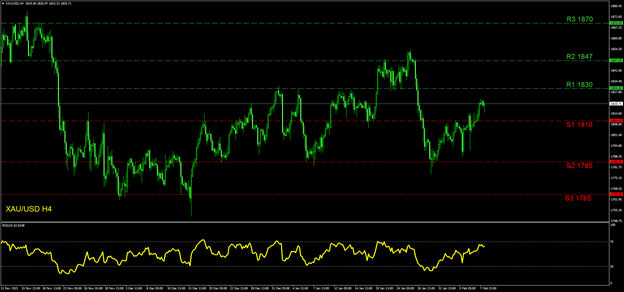
At the moment, Gold is trading nearby 1820 which is just between our 1830 resistance level and our 1810 support level. Since the 28th of January, when Gold last tested the (S2) 1785 level, an upward trend line has formed even though some short lived corrections have also contributed in the trend. Our final support level stands at (S3) 1765 which was last tested in the final months of 2021. If the precious metal continues to move higher in the following days, a breach above the (R1) 1830 can possibly create some expectation for the (R2) 1847 resistance to come into play. This was January’s high point and traders can possibly monitor the price action nearby that line. At the top, the (R3) 1870 resistance hurdle stands firm, which is a 2.5 month high level. So far in 2022, the price action has been rolled between the (R2) 1847 resistance and the (S2) 1785 support level making this range critical for traders to watch. The RSI indicator has been lifted to the 66 level so far, yet some stabilization is also evident possibly pointing out that bullish tendencies persist but not in an aggressive manner.