Sample Category Title
EUR/USD Mid-Day Outlook
Daily Pivots: (S1) 1.1414; (P) 1.1440; (R1) 1.1465; More...
Intraday bias in EUR/USD remains neutral at this point. A medium term bottom could be in place at 1.1120, on bullish convergence condition in daily MACD. Break of 1.1482 resistance will target 38.2% retracement of 1.2348 to 1.1120 at 1.1589 next. Sustained break there will argue that whole fall from 1.2348 has completed too and target 61.8% retracement at 1.1879. On the down, however, break of 1.1265 support will dampen this bullish view and bring retest of 1.1120 low instead.
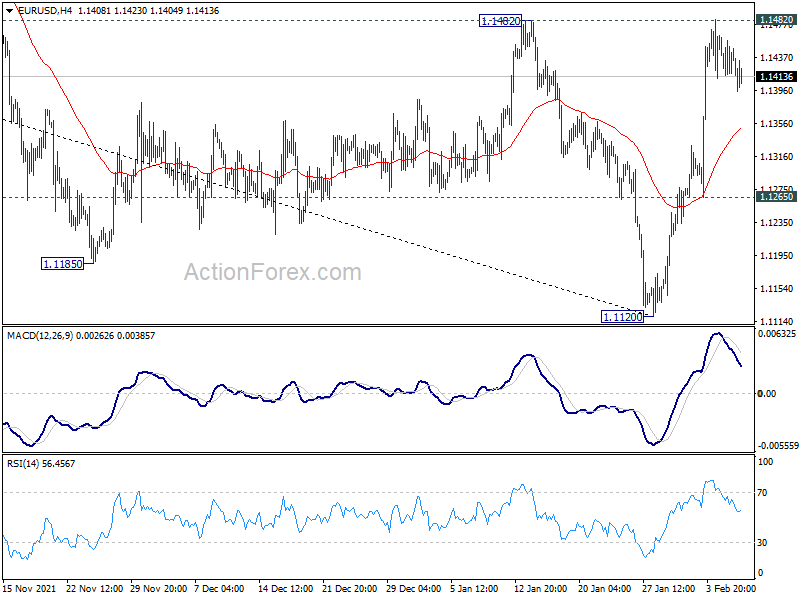
In the bigger picture, the decline from 1.2348 (2021 high) is seen as a leg inside the range pattern from 1.2555 (2018 high). Sustained trading above 55 week EMA (now at 1.1613) will argue that it has completed and stronger rise would be seen back towards top of the range between 1.2348 and 1.2555. However, firm break of 1.0635 (2020 low) will raise the chance of long term down trend resumption and target a retest on 1.0339 (2017 low) next.
GBP/USD Mid-Day Outlook
Daily Pivots: (S1) 1.3499; (P) 1.3527; (R1) 1.3564; More...
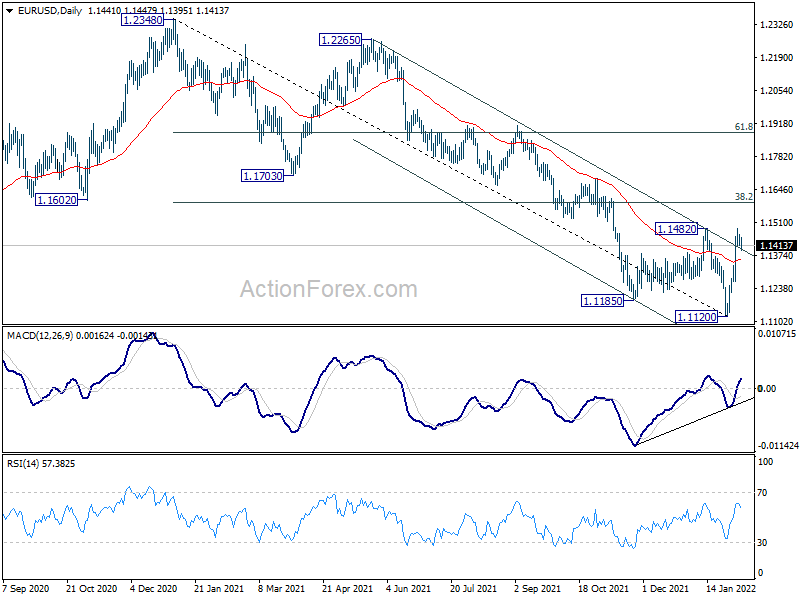
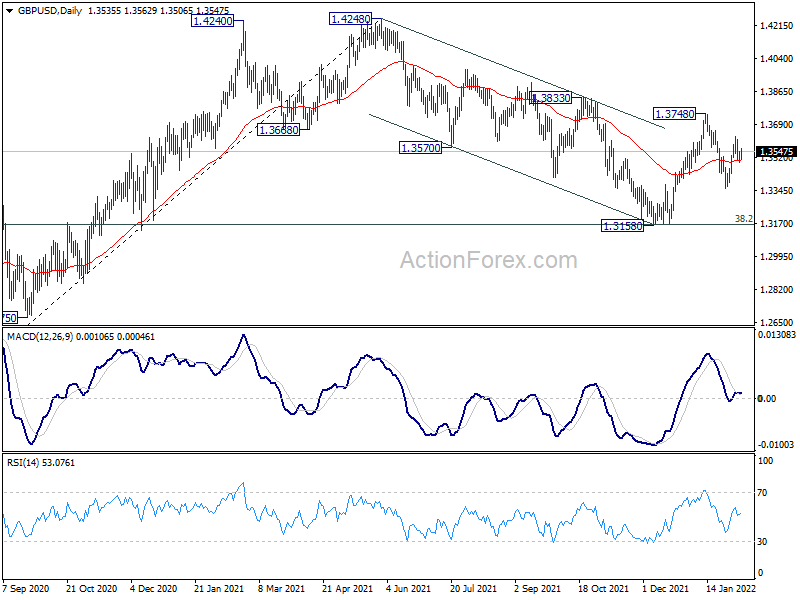
Intraday bias in GBP/USD remains neutral and outlook is unchanged. On the upside, break of 1.3627 will resume the rebound to 1.3748 resistance. Firm break there will revive the bullish case that correction from 1.4248 has completed with three waves down to 1.3158. Further rally should then be seen to retest 1.4248 high. On the downside, however, break of 1.3356 will bring retest of 1.3158 low.
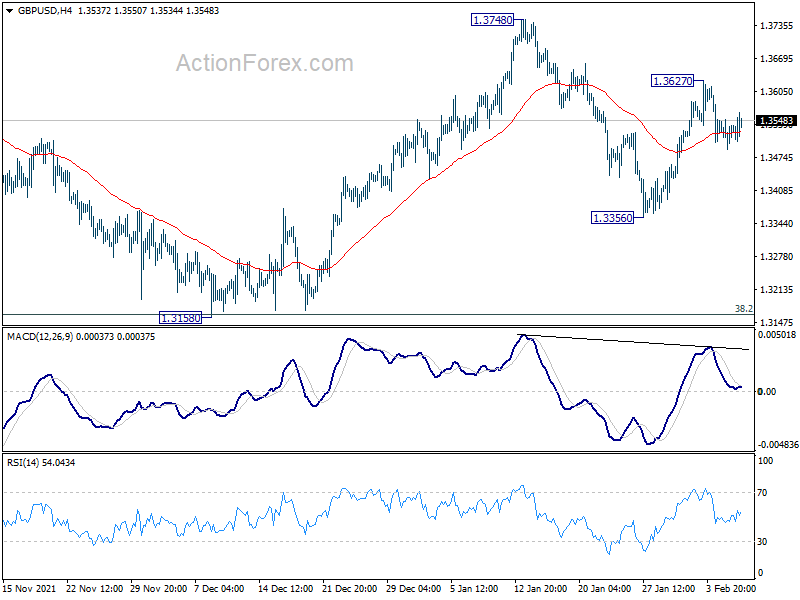
In the bigger picture, as long as 38.2% retracement of 1.1409 to 1.4248 at 1.3164 holds, up trend from 1.1409 (2020 low) is still in progress. On resumption, next target will be 38.2% retracement of 2.1161 to 1.1409 at 1.5134. Nevertheless sustained break of 1.3164 will argue that whole rise from 1.1409 has completed and bring deeper fall to 61.8% retracement at 1.2493.
USD/CHF Mid-Day Outlook
Daily Pivots: (S1) 0.9218; (P) 0.9240; (R1) 0.9258; More....
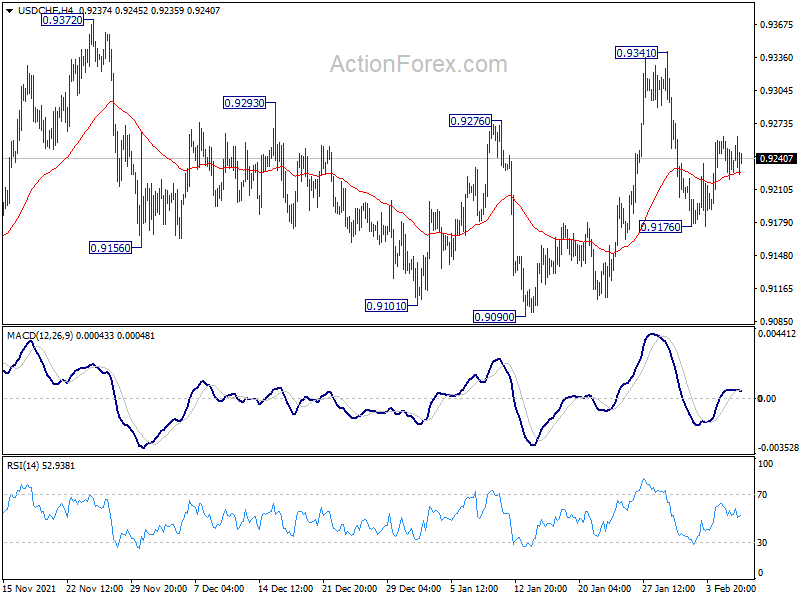
Intraday bias in USD/CHF remains neutral and outlook is unchanged. Further rise will remain mildly in favor as long as 0.9090 support holds. break of 0.9372 will resume the choppy rally from 0.8925 to 0.9471 high. However, break of 0.9090 will turn bias back to the downside for 0.8925 support instead.
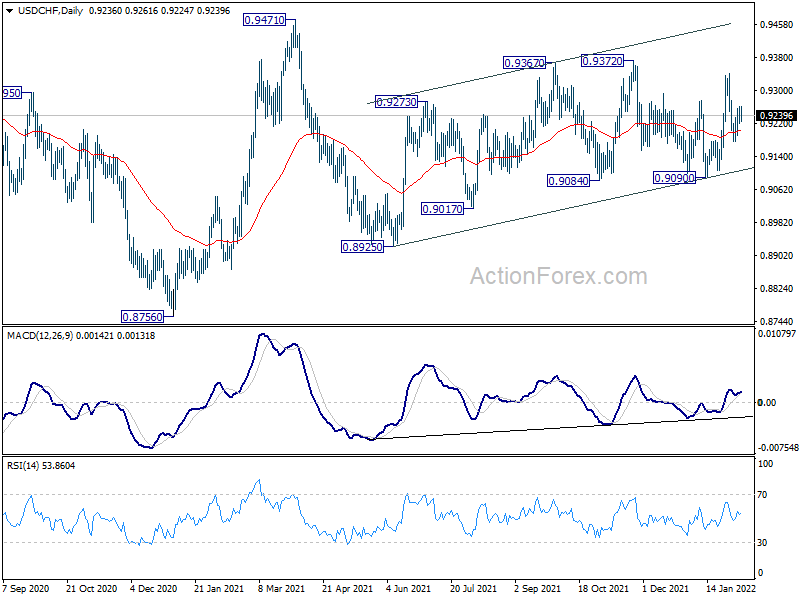
In the bigger picture, medium term outlook will be neutral at best as long as 0.9471 resistance holds. Larger down trend could still extend through 0.8756 (2021 low). However, firm break of 0.9471 will argue that the trend has already reversed and rebound the rally from 0.8756 with another impulsive move.
USD/JPY Mid-Day Outlook
Daily Pivots: (S1) 114.89; (P) 115.13; (R1) 115.35; More...
Intraday bias in USD/JPY remains neutral for the moment as range trading continues. Overall, consolidation pattern from 116.34 is still extending. On the upside, break of 115.68 will resume the rebound from 113.46 to retest 116.34 high first. On the downside, break of 114.14 should extend the consolidation with another falling leg through 113.46 support.

In the bigger picture, no change in the view that rise from 102.58 is the third leg of the up trend from 101.18 (2020 low). Such rally should target a test on 118.65 (2016 high). Sustained break there will pave the way to 120.85 (2015 high) and raise the chance of long term up trend resumption. This will remain the favored case as long as 55 week EMA (now at 111.21) holds.

USD/CAD Mid-Day Outlook
Daily Pivots: (S1) 1.2633; (P) 1.2694; (R1) 1.2731; More...
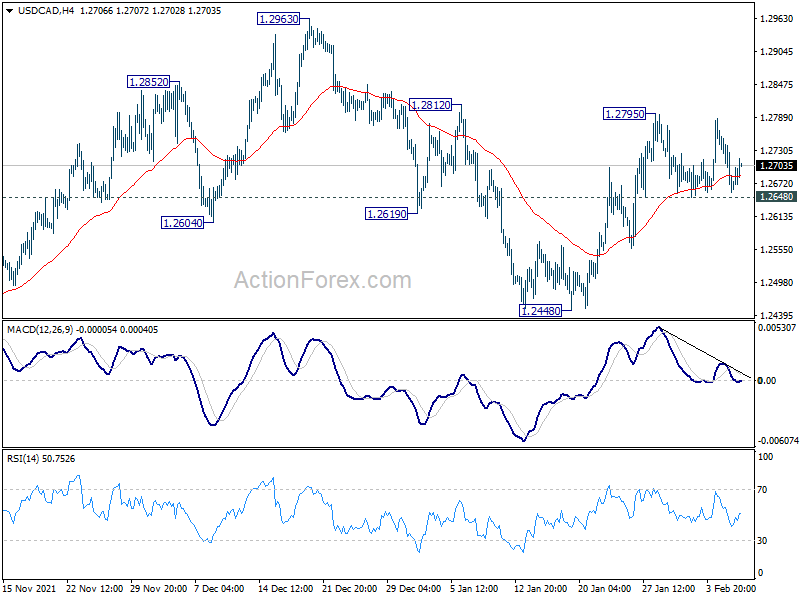
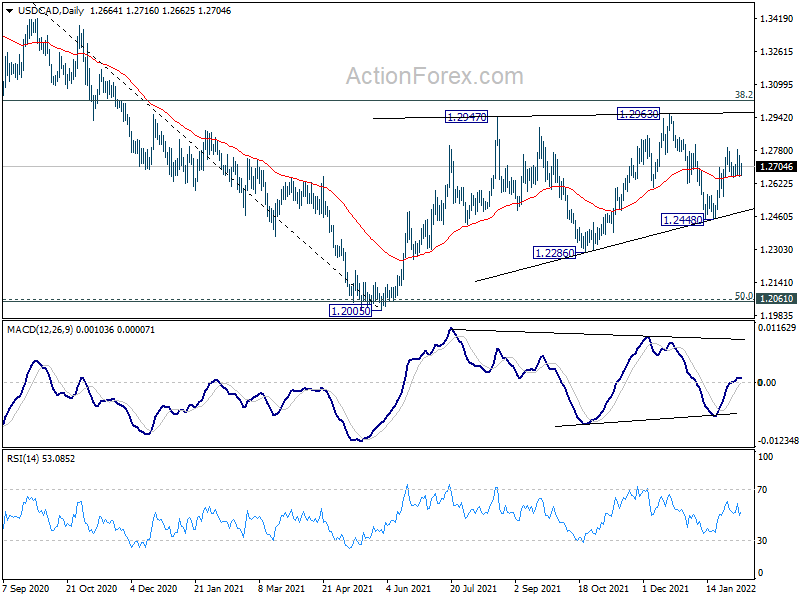
USD/CAD recovers mildly but stays in range of 1.2648/2795. Intraday bias remains neutral for the moment. With 1.2648 minor support intact, further rise is mildly in favor. On the upside, break of 1.2795 will resume the rally from 1.2448 to 1.2963 resistance next. However, break of 1.2648 will turn bias back to the downside for 1.2448 support instead.
In the bigger picture, focus stays on 38.2% retracement of 1.4667 (2020 high) to 1.2005 (2021 low) at 1.3022. Sustained break there should confirm that the down trend from 1.4667 has completed after defending 1.2061 long term cluster support. Further rise would then be seen towards 61.8% retracement at 1.3650. However, rejection by 1.3022 will maintain medium term bearishness. Break of 1.2005 will resume the down trend from 1.4667 and that carries larger bearish implications too.
Canadian Dollar Dips With Oil Prices, Dollar Mildly Firmer
Canadian Dollar is currently the weakest one for today, following the pull back in oil prices. Japanese Yen is following as European and US yields are apparently trying to outpace benchmark JGB yield again. On the other hand, Aussie is trading slightly firmer, together with Kiwi and Dollar. Euro is paring some of the post-ECB gains, but the retreats are relatively shallow so far.
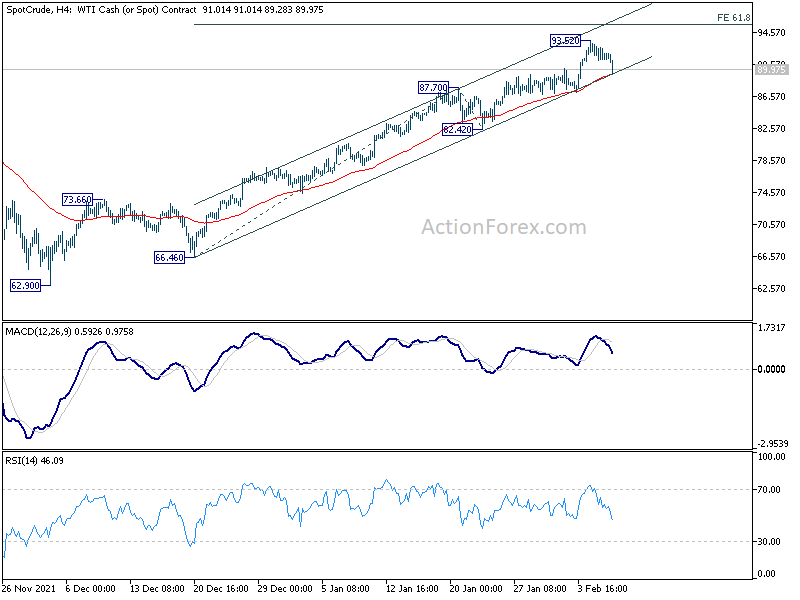
Technically, WTI crude oil is now pressing 4 hour 55 EMA (now at 89.20), which is close to the short term channel support. Sustained break there will argue that it's already in correction to rise from 66.46 or even that from 62.90. In such case, deeper pull back would be seen back to 82.42/87.70 to set up the base for rebound. If happens, Canadian Dollar could be dragged further down.
In Europe, at the time of writing, FTSE is up 0.10%. DAX is down -0.03%. CAC is up 0.23%. Germany 10-year yield is up 0.022 at 0.249. Earlier in Asia, Nikkei rose 0.13%. Hong Kong HSI dropped -1.02%. China Shanghai SSE rose 0.67%. Singapore Strait Times rose 1.05%. Japan 10-year JGB yield rose 0.0079 to 0.208.
US trade deficit up slightly to USD 80.7B, deficit with China widened
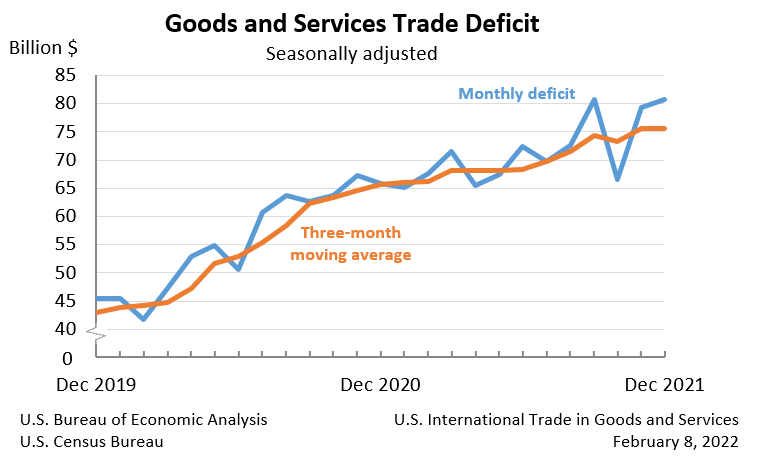
US exports of goods and services rose 1.5% to USD 228.1B in December. Imports rose 1.6% mom to USD 308.9B. Trade deficit came in at USD 80.7B, smaller than expectation of USD 83.0B.
The deficit with China increased USD 6.0B to USD 34.1B. Exports decreased USD 2.2B to USD 11.8B and imports increased USD 3.8B to USD 45.9B.
The deficit with the European Union decreased USD 3.0B to USD 16.3 B in December. Exports increased USD 0.7B to USD 25.1B and imports decreased USD 2.4B to USD 41.4B.
Canada imports rose 3.7% in December while exports dropped -0.9%. Merchandise trade balance returned to a deficit position of CAD 137m.
ECB de Cos: Uncertainty around inflation very high due to geopolitical risks
ECB Governing Council member Pablo Hernandez de Cos said "risks to inflation are tilted to the upside in the short term." Recent data on Recent data on inflation has shown surprising upwards trends both in headline inflation and core inflation. He added, that the level of uncertainty around inflation is very high also due to geopolitical risks.
De Cos emphasized that more than ever it is necessary to keep all options open on monetary policy. But for now, ECB policymakers are sticking to the sequencing, starting first with tapering, before raising interest rate.
He added, that the next move on monetary policy is clear but will be gradual and depend on data.
Australia NAB business confidence rose to 3 in Jan, strong recovery expected
Australia NAB business confidence rose from -12 to 3 in January, turned positive. Business conditions, however, dropped from 8 to 3. Looking at some details, trading conditions dropped from 14 to 7. Profitability conditions dropped from 10 to 2. Employment conditions dropped from 2 to -1 and turned negative.
"Overall, the January survey shows significant disruption to business activity from the spread of the Omicron variant, albeit impacts on businesses were less severe than in past outbreaks,"said NAB Group Chief Economist Alan Oster. "However, we continue to expect a strong recovery as case numbers come down."
RBNZ Orr: An innovative approach needed to support a more efficient and resilient cash system
RBNZ is currently commencing Central Bank Digital Currency (CBDC) proof-of-concept design work, which is a "multi-stage and multi-year effort". The consultation on an issues paper Future of Money – Cash System Redesign, which closes on March 7, received 190 submissions so far.
Governor Adrian Orr said in a speech, "we must decide how best to use of digital technology to modernize central bank money, while we continue to ensure cash remains an option for those who need it. An innovative approach is needed to support a more efficient and resilient cash system, and the changes required are potentially far reaching".
"The technology exists now to implement a CBDC, but it needs to be well designed. At a basic hygiene level, a CBDC must be user-friendly, resilient to cyber and other operational risks, and enable privacy. These features promote widespread trust and use."
USD/CAD Mid-Day Outlook
Daily Pivots: (S1) 1.2633; (P) 1.2694; (R1) 1.2731; More...
USD/CAD recovers mildly but stays in range of 1.2648/2795. Intraday bias remains neutral for the moment. With 1.2648 minor support intact, further rise is mildly in favor. On the upside, break of 1.2795 will resume the rally from 1.2448 to 1.2963 resistance next. However, break of 1.2648 will turn bias back to the downside for 1.2448 support instead.
In the bigger picture, focus stays on 38.2% retracement of 1.4667 (2020 high) to 1.2005 (2021 low) at 1.3022. Sustained break there should confirm that the down trend from 1.4667 has completed after defending 1.2061 long term cluster support. Further rise would then be seen towards 61.8% retracement at 1.3650. However, rejection by 1.3022 will maintain medium term bearishness. Break of 1.2005 will resume the down trend from 1.4667 and that carries larger bearish implications too.
Economic Indicators Update
| GMT | Ccy | Events | Actual | Forecast | Previous | Revised |
|---|---|---|---|---|---|---|
| 23:30 | JPY | Labor Cash Earnings Y/Y Dec | -0.20% | 0.90% | 0.80% | |
| 23:30 | JPY | Household Spending Y/Y Dec | -0.20% | 0.30% | -1.30% | |
| 23:50 | JPY | Bank Lending Y/Y Jan | 0.60% | 0.80% | 0.60% | |
| 23:50 | JPY | Current Account (JPY) Dec | 0.79T | 1.16T | 1.37T | |
| 00:30 | AUD | NAB Business Confidence Jan | 3 | -12 | ||
| 00:30 | AUD | NAB Business Conditions Jan | 3 | 8 | ||
| 05:00 | JPY | Eco Watchers Survey: Current Jan | 37.9 | 49.3 | 56.4 | |
| 07:45 | EUR | France Trade Balance (EUR) Dec | -11.3B | -9.1B | -9.7B | -9.8B |
| 09:00 | EUR | Italy Retail Sales M/M Dec | 0.90% | 0.30% | -0.40% | |
| 11:00 | USD | NFIB Business Optimism Index Jan | 97.1 | 97.7 | 98.9 | |
| 13:30 | USD | Trade Balance (USD) Dec | -80.7B | -83.0B | -80.2B | -79.3B |
| 13:30 | CAD | Trade Balance (CAD) Dec | -0.1B | 3.6B | 3.1B |
US trade deficit up slightly to USD 80.7B, deficit with China widened
US exports of goods and services rose 1.5% to USD 228.1B in December. Imports rose 1.6% mom to USD 308.9B. Trade deficit came in at USD 80.7B, smaller than expectation of USD 83.0B.
The deficit with China increased USD 6.0B to USD 34.1B. Exports decreased USD 2.2B to USD 11.8B and imports increased USD 3.8B to USD 45.9B.
The deficit with the European Union decreased USD 3.0B to USD 16.3 B in December. Exports increased USD 0.7B to USD 25.1B and imports decreased USD 2.4B to USD 41.4B.
Yields Elevated But Dollar Struggles to Hold on to Minor Gains
US stock futures shaky and hawkish ECB’s Lagarde backtracks
Market nerves are lingering at the start of this week as long echoed components like supply disruptions, inevitable hot employment and wage growth, are clearly revealing strong developments in price pressures, which has had global central bank action shift up a gear in one way or another.
The market feeling is that central banks have been nudged on to the wagon of, be vigilant, flexible and ready to pounce on inflation if it starts to seriously run away, especially if persistent baby steps in economies continue to unfold.
Although the dollar index ticked slightly higher in the Asian session, the greenback’s dominance in the forex arena is just not there with the dollar index currently at 95.50 after struggling to hold onto earlier traction, while the US stock futures, which are dipping a tad, are suggesting sentiment remains sluggish.
The US 2-year yield is at 1.315% and the longer-term 10-year is standing at a whopping 1.93% but were unable to prod the reserve currency beyond its intraday high.
Nonetheless, in spite of expectations that the Fed will bring tighter policy against soaring inflation, market drivers remain scarce ahead of US CPI data on Thursday, where a hot inflation result is expected to fuel fresh volatility in the markets.
Across the Atlantic
ECB President Lagarde may have kept dollar gains muted after the surprise hawkish tone of comments in last week’s meeting. ECB’s Lagarde mentioned that the pace of net asset purchases will be discussed and decided in the March meeting and that the ECB will refrain from hiking until net bond purchases end.
The unexpected hawkish tone came about after the governing council reiterated concern about high inflation data, which has, to a degree fuelled tightening and elevated pricing odds of a hike in 2022, despite softening attempts from ECB’s Lagarde, throwing in the old narrative that energy costs are still part of why inflation is hot.
Yesterday, President Lagarde before the European Parliament’s Economic and Monetary Affairs Committee said inflation remains elevated, but it will not force them to act quickly. Another attempt to soften the ripples from last week failed to convince markets, which continue to price in more aggressive policy shifts that may keep the euro buoyant moving ahead. The euro is now retesting the $1.1400 handle after recouping around 70% of its intraday range. However, the euro is likely to remain supported as ECB tightening expectations remain high.
Nonetheless, the aftershocks from last week as we said may still be weighing slightly on the dollar ahead of Thursdays US inflation data. The pound is neutral at $1.3535, back to levels where its Asian session began after a minor push higher to $1.3563. Thus, the EURGBP pair bounced back to 0.8437 sterling per euro, recapturing more than 50% of previous losses from the Eastern trading start.
Oil falls below $90 while global demand remains high
WTI oil futures recent pullback from the more than 7-year high of $93.15 has tested the $89.00 per barrel mark and appears to exhibit a bearish outlook today after a calmer tone about the Ukraine tensions situation.
The Canadian dollar has weakened along with the dive in oil prices. The loonie is at C$1.2710 after bouncing from a key support at $1.2650.
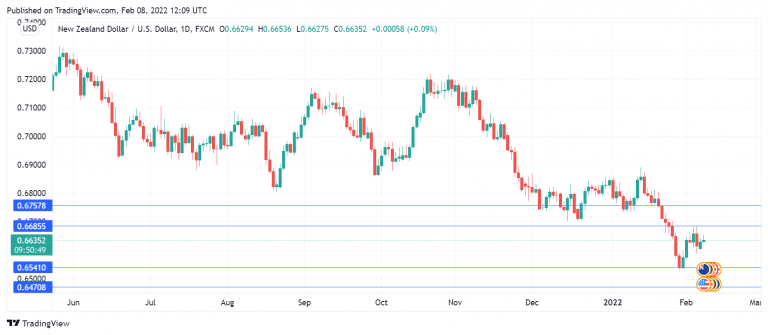
The antipodeans are bearish but are fighting back, holding near yesterday highs. The aussie is at $0.7115 and the kiwi is at $0.6629.
At 02:00 GMT New Zealand’s inflation expectations for the first quarter will be released.
Bitcoin’s Bullish Pattern
On Monday, Bitcoin rose 5.5%, ending the day around $44,100. Ethereum added 5%, and other leading altcoins from the top ten also showed growing dynamics: from 4% (Solana) to 18.5% (XRP).
The total capitalization of the crypto market increased by 5.5% over the day to $2.10 trillion. The Bitcoin dominance index has not changed, remaining at 39.2%. The Bitcoin chart continues to paint a bullish picture. With the price at $45K on Tuesday morning, BTCUSD is trading above the 50-day moving average just above the mid-January pivot area and above the down channel resistance level. At the same time, the RSI on the daily charts has not yet entered the overbought area, leaving room for further growth.
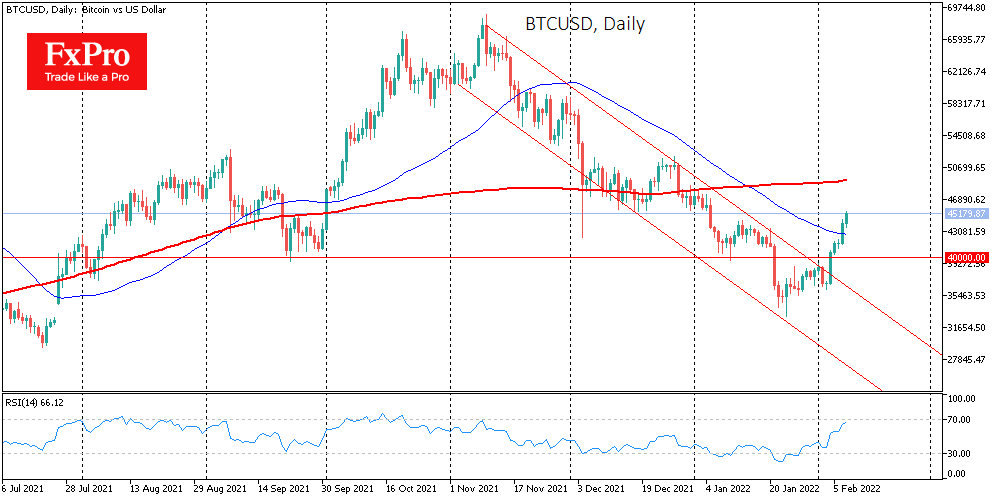
The same can be said about the entire cryptocurrency market, where the fear and greed index has reached a neutral point of 48 and is still far from the greed area. The next target for the bulls looks to be $48K, the December support area in December. Further targets are $49-50K, where the 200-day moving average and significant round level are concentrated.
The XRP token soared amid reports of a significant approach to the resolution of Ripple’s legal dispute with the US Securities and Exchange Commission (SEC).
Cryptocurrencies briefly stopped responding to movements in US stock indices, which started the week with a decline. The purchases probably included retail investors, who were driven by the desire not to miss the beginning of the market growth (FOMO). However, their buying potential is unlikely to be enough if stock indicators intensify their decline and large institutional investors come into play, wishing to resume profit-taking.
KPMG, one of the world’s largest auditors, has added Bitcoin and Ethereum to its Canadian division’s corporate reserves. This is the firm’s first direct investment in cryptocurrencies.
Meanwhile, at the end of 2021, Tesla received a loss of $ 101 million from a decrease in the cost of previously purchased bitcoins, which it spent $ 1.5 billion on. Previously, Elon Musk called the decision to acquire BTC as a reserve asset quite risky.
NZD Flat ahead of Inflation Expectations
It has been a quiet start to the week for the New Zealand dollar. This week’s economic calendar is light, with no New Zealand data on Tuesday. We could see NZD/USD show some movement on Wednesday, with the release of New Zealand Inflation Expectations on Wednesday.
New Zealand could face wage inflation spiral
New Zealand is experiencing surging inflation, which has hit 30-year highs. CPI climbed 1.4% q/q in Q4 2021, which put inflation at 5.9% y/y, its highest level since 1990. This is causing a headache for the government, and Prime Minister Ardern meekly argued that “we are not alone in experiencing high rates of inflation”.
That may be factually correct, but it won’t impress consumers who are seeing the cost of living jump. While wages have gone up, they are lagging behind the pace of inflation, which will likely lead to workers pushing for higher wages and salaries, which will set in motion a wage inflation spiral.
New Zealand Inflation Expectations has been steadily rising. The Q2 2020 release came in at 1.24%, but more than doubled in Q4 2021, to 2.96%, and likely will push above 3% for Q1 2022. The RBNZ closely monitors this event, as inflation expectations can manifest into real inflation.
High inflation remains a primary concern for the RBNZ, which will have to keep raising rates to combat high inflation. The central bank implemented back-to-back rate hikes of 0.25% over the past two meetings and is widely expected to raise by another 0.25% at the February 23rd meeting, which would raise the Cash Rate to 1.00%. The RBNZ is planning to raise rates incrementally into 2023 but will have to monitor economic data to ensure that the economy can withstand higher rates.
NZD/USD Technical
- NZD/USD has support at 0.6472 and 0.6402
- 0.6670 is a weak resistance line, followed by 0.6798