Sample Category Title
Dollar Digests Gains after PCE Inflation Data, Aussie Broadly Lower
Dollar retreats mildly today after PCE inflation data posted no surprises. While there is some profit taking, the greenback remains the strongest one for the week by some distance. Selling focus has turned from Euro to commodity currencies today, as lead by Aussie. The overall close would still depend on development in risk sentiment, which has been very volatile recently.
In Europe, at the time of writing, FTSE is down -1.42%. DAX is down -1.97%. CAC is down -1.79%. Germany 10-year yield is up 0.0395, still negative at -0.016. Earlier in Asia, Nikkei rose 2.09%. Hong Kong HSI dropped -1.08%. China Shanghai SSE dropped -0.97%. Singapore Strait Times dropped -0.42%. Japan 10-year JGB yield rose 0.0094 to 0.169.
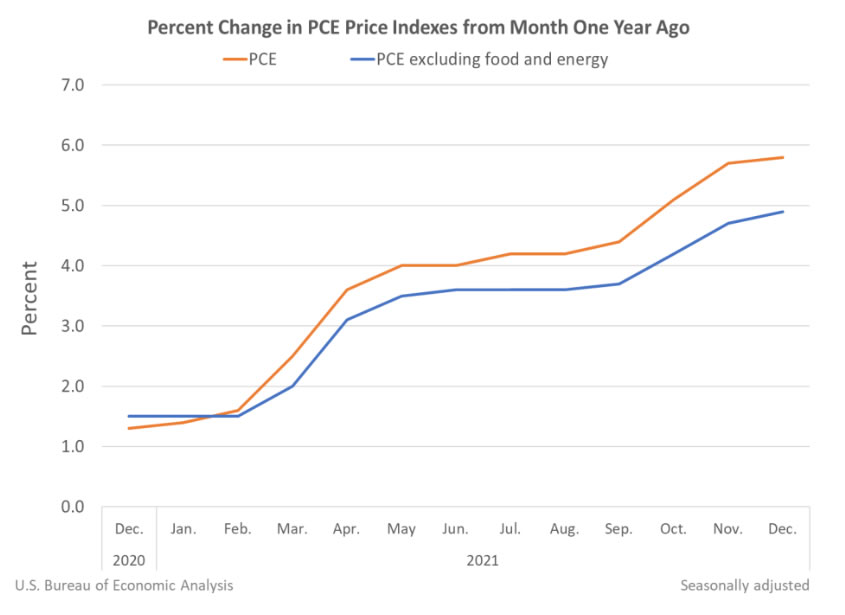
US PCE price index rose to 5.8% yoy, core PCE rose to 4.9% yoy
US personal income rose 0.3% mom, or USD 70.7B in December, below expectation of 0.5% mom. Spending dropped -0.6% mom, or USD -95.2B, matched expectations.
PCE price index accelerated slightly from 5.7% yoy to 5.8% yoy, below expectation of 6.1% yoy. Core PCE price index jumped from 4.7% yoy to 4.9% yoy, above expectation of 4.8% yoy.
Eurozone economic sentiment indicator dropped to 112.7, EU down to 111.6
Eurozone Economic Sentiment Indicator dropped from 113.8 to 112.7 in January. Industry confidence dropped from 14.6 to 13.9. Services confidence dropped from 10.9 to 9.1. Consumer confidence dropped from -8.4 to -8.5. Retail trade confidence rose from 1.1 to 3.8. Construction confidence dropped from 10.1 to 8.1. Employment Expectations Indicator dropped from 113.5 to 113.3.
EU ESI dropped from 113.0 to 111.6. EEI dropped from 113.6 to 113.1. Amongst the largest EU economies, the ESI rose in Germany (+0.8) and Spain (+0.6) while it worsened in Italy (-6.1), Poland (-4.2), France (-2.8) and the Netherlands (-1.3).
Germany GDP contracted -0.7% qoq in Q4, still -1.5% lower than pre-pandemic level
Germany GDP dropped -0.7% qoq in Q4, worse than expectation of -0.2% qoq. GDP was still -1.5% lower than pre-pandemic level in Q4, 2021. For whole of 2021, GDP grew 2.8%.
Destatis said, "after economic output grew again in the summer despite increasing supply and material bottlenecks, the recovery of the German economy was halted by the fourth corona wave and renewed tightening of corona protection measures at the end of the year."
"Private consumption in particular decreased in the fourth quarter of 2021 compared to the previous quarter, while government consumer spending increased. Construction investments fell compared to the third quarter of 2021."
France GDP grew 0.7% in Q4, up 7% in 2021
France GDP grew 0.7% qoq in Q4, above expectation of 0.5% qoq. On average over 2021, GDP increased by 7.0% after -8.0% in 2020. GDP was 0.9% above pre-pandemic level in Q4 2019. But the average level of GDP in 2021 was still -1.6% below its average level in 2019.
Looking at some details, final domestic demand (excluding inventories) contributed to +0.5 points. In particular, the growth rate of household consumption expenditure (+0.4%) was similar to that of gross fixed capital formation (GFCF, +0.5%). Contribution of foreign trade to GDP growth was slightly negative this quarter at -0.2 points. contribution of inventory changes to GDP growth was positive this quarter (+0.4%).
Swiss KOF economic barometer rose to 107.8, various subgroups developing unevenly
Swiss KOF Economic Barometer rose from 107.2 to 107.8 in January, above expectation of 106.0. KOF said the " various subgroups of the barometer are developing unevenly."
Outlook has improved for consumer spending and for financial and insurance service providers. The outlook also tends to brighten for the accommodation and food service activities. However, in the goods production sector (manufacturing and construction), indicators for almost all sub-aspects of business activity are weakening, especially for profit development, production activity and capacity utilisation.
IMF: BoJ's commitment to prolonged monetary accommodation appropriate
IMF said in a report that BoJ's commitment to maintaining prolonged monetary accommodation remains "appropriate". It expects that a "prolonged period of monetary policy accommodation, flexible fiscal policy, and inclusive growth-oriented reforms will be required to durably lift inflation expectations and inflation to the target."
Further measures could be considered for making monetary support "more sustainable". On option could be to "steepen the yield curve by shifting the yield target from the 10-year to a shorter maturity". This could help "mitigate the impact of prolonged monetary accommodation on financial institutions' profitability". If underlying inflation momentum remains weak, "cutting the policy rate should be the first option".
AUD/USD Mid-Day Report
Daily Pivots: (S1) 0.6998; (P) 0.7060; (R1) 0.7095; More...
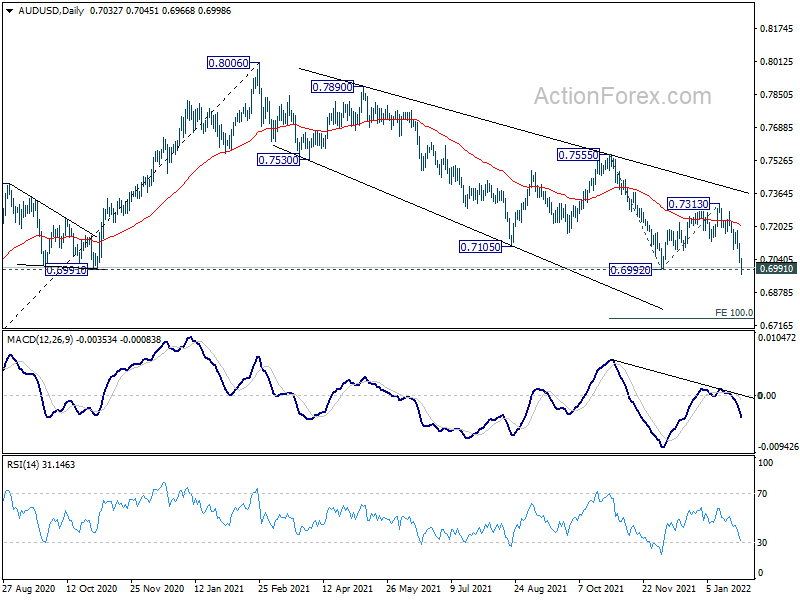
AUD/USD drops further to as low as 0.6966 so far today and intraday bias remains on the downside. Sustained break of 0.6991/2 support will confirm resumption of larger down trend from 0.8006, and carries larger bearish implication. Next target will be 100% projection of 0.7555 to 0.6992 from 0.7313 at 0.6750. On the upside, break of 0.7089 minor resistance will mix up the near term outlook and turn intraday bias neutral first.
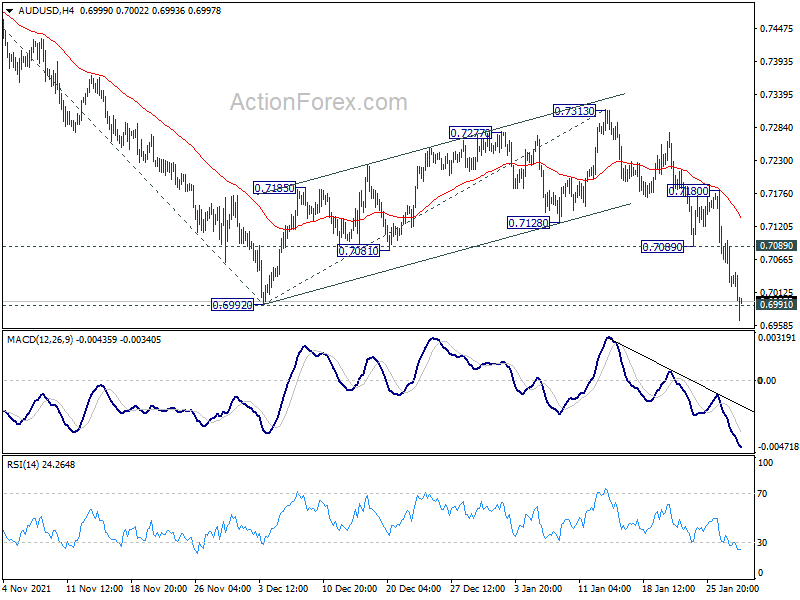
In the bigger picture, focus remains on 0.6991 key structural support. Sustained break there will argue that the whole up trend from 0.5506 might be finished at 0.8006, after rejection by 0.8135 long term resistance. Deeper decline would then be seen back to 61.8% retracement of 0.5506 to 0.8006 at 0.6461. Meanwhile, strong rebound from 0.6991 will retain medium term bullishness. That is, whole up trend from 0.5506 is still in progress.
Economic Indicators Update
| GMT | Ccy | Events | Actual | Forecast | Previous | Revised |
|---|---|---|---|---|---|---|
| 23:30 | JPY | Tokyo CPI Core Y/Y Jan | 0.20% | 0.30% | 0.50% | |
| 00:30 | AUD | PPI Q/Q Q4 | 1.30% | 0.90% | 1.10% | |
| 00:30 | AUD | PPI Y/Y Q4 | 3.70% | 2.70% | 2.90% | |
| 06:30 | EUR | France Consumer Spending M/M Dec | 0.20% | 0.20% | 0.80% | 0.90% |
| 06:30 | EUR | France GDP Q/Q Q4 P | 0.70% | 0.50% | 3.00% | |
| 07:00 | EUR | Germany Import Price Index M/M Dec | 0.10% | 1.80% | 3.00% | |
| 08:00 | CHF | KOF Economic Barometer Jan | 107.8 | 106 | 107 | 107.2 |
| 09:00 | EUR | Germany GDP Q/Q Q4 P | -0.70% | -0.20% | 1.70% | |
| 09:00 | EUR | Eurozone M3 Money Supply Y/Y Dec | 6.90% | 6.90% | 7.30% | |
| 10:00 | EUR | Eurozone Economic Sentiment Indicator Jan | 112.7 | 114.5 | 115.3 | 113.8 |
| 10:00 | EUR | Eurozone Services Sentiment Jan | 9.1 | 14.9 | 11.2 | 10.9 |
| 10:00 | EUR | Eurozone Industrial Confidence Jan | 13.9 | 15 | 14.9 | 14.6 |
| 10:00 | EUR | Eurozone Consumer Confidence Jan F | -8.5 | -8.5 | -8.4 | |
| 13:30 | USD | Personal Income M/M Dec | 0.30% | 0.50% | 0.40% | 0.50% |
| 13:30 | USD | Personal Spending Dec | -0.60% | -0.60% | 0.60% | 0.40% |
| 13:30 | USD | PCE Price Index M/M Dec | 0.40% | 0.50% | 0.60% | |
| 13:30 | USD | PCE Price Index Y/Y Dec | 5.80% | 6.10% | 5.70% | |
| 13:30 | USD | Core PCE Price Index M/M Dec | 0.50% | 0.50% | 0.50% | |
| 13:30 | USD | Core PCE Price Index Y/Y Dec | 4.90% | 4.80% | 4.70% | |
| 13:30 | USD | Employment Cost Index Q4 | 1.00% | 1.20% | 1.30% | |
| 15:00 | USD | Michigan Consumer Sentiment Index Jan F | 68.6 | 68.8 |
Market in a Volatile Day; Dollar Surges to More than 1 ½ -Year High
PCE price index ticks up; Rates in US rise
December’s PCE data came into focus today from investors. The core PCE price index rose from 4.8% to 4.9% year-on-year. Currently, it is the highest since September 1983 and well above the Fed's 2% goal rate. Personal income and spending also came in at 0.3% and -0.6% m/m respectively. Because of the widespread distribution of the omicron variety, retail sales and consumption decreased in December of last year.
Rates in the United States are rising, which is supporting the dollar. For the first time since January 19, the two-year yield is trading at 1.22%, while the 10-year yield is trading at 1.84% and is nearing the 1.90% cycle high. A fifth rate increase this year is already priced in. In spite of this, the terminal Fed Funds rate is projected to fall short of 2% when the market should probably be looking at 2.5% or more.
ECB rate decision next week
The European Central Bank (ECB) is scheduled to meet on Thursday, and the expectation is a dovish hold on interest rates. After confirming that PEPP is over in March, the bank is expected to forcefully resist market expectations of tightening. At a time when the Eurozone economy has numerous challenges and is obviously faltering, stricter monetary policies are the last thing that the region needs right now. Next Wednesday the release of January's CPI numbers are on cards, which are projected to show a headline rate of 4.3% y/y compared to December's 5.0% and a core rate of 1.9% y/y compared to December's 2.6%.
FX news
In the currency markets, the US dollar index is continuing the upside rally, recording a fresh 19-month high of 97.40 supported by the rally in the two-year Treasury yield after the Fed’s relatively hawkish policy meeting. Dollar/yen is maintaining its upswing, jumping to 115.60, while euro/dollar is plunging to a 20-month low of 1.1120. US index futures suggest another negative session. However, pound/dollar’s volatility is weak, holding around 1.3400 at the moment.
In commodity currencies, dollar/loonie is advancing from the third consecutive day, while the aussie and the kiwi are tumbling to 18- and 17-month lows respectively, versus the dollar.
Elsewhere, oil prices are flattening around the previous highs, while gold prices plummeted below $1,800/per ounce again with strong momentum, with the next target coming near $1,760/per ounce.
US PCE price index rose to 5.8% yoy, core PCE rose to 4.9% yoy
US personal income rose 0.3% mom, or USD 70.7B in December, below expectation of 0.5% mom. Spending dropped -0.6% mom, or USD -95.2B, matched expectations.
PCE price index accelerated slightly from 5.7% yoy to 5.8% yoy, below expectation of 6.1% yoy. Core PCE price index jumped from 4.7% yoy to 4.9% yoy, above expectation of 4.8% yoy.
NZ Dollar Extends Slide – How Low Will it Go?
New Zealand dollar slides to 4-month low
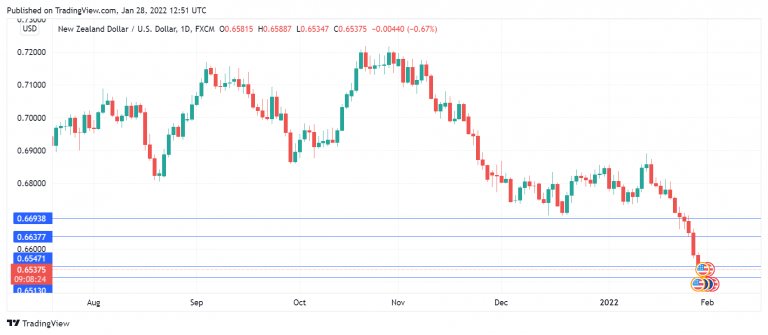
The New Zealand dollar is in trouble. NZD/USD is down 0.57% on Friday, after posting losses for six consecutive days. The pair has plunged 2.56% this week and is at its lowest level since mid-September.
The US dollar has powered higher this week, with impressive gains against the major currencies. The New Zealand dollar, along with other risk currencies such as the Australian and Canadian dollars, have been hit particularly hard. The drivers behind the US dollar rally are the hawkish Federal Reserve meeting and a stellar US GDP report which beat expectations.
The Fed didn’t provide a timeline for rate hikes at the meeting, but lift-off is widely expected in March. How aggressive will the Fed be in 2022? The pace of rate hikes will depend to a great extent on the strength of the economy. At a minimum, we are looking at four rate hikes, with a strong possibility of more, especially if inflation, which hit 7% in December, persists at high levels.
The US recovery is looking strong, as Advanced GDP for Q4, the first and most important GDP release, accelerated to 6.9% y/y, above the consensus of 5.5%. This was another indication that the US economy no longer requires stimulus from the Fed, which plans to wind up its asset purchase programme in March.
The week wraps up with some important US data for December, highlighted by the Fed’s preferred inflation indicator, the core PCE Price Index. The consensus is that the index inched higher to 4.8% y/y, up from 4.7% beforehand. This would indicate that inflationary pressures are yet to peak. We’ll also get a look at US Personal Income and US Personal Spending, which are expected to show that consumption may have slowed down in December. As well, UoM Consumer Sentiment is projected to have de-accelerated in December.
New Zealand consumer inflation surged to 5.9% in Q4, up from 4.9% in the third quarter. Much of the sharp jump in CPI can be attributed to higher gasoline prices, as well as supply chain disruptions which have led to shortages in supermarkets and elsewhere. The surge in inflation will put additional pressure on the central bank to continue raising rates. The markets have priced in about 1.5% in rate hikes in 2022, with a hike expected at the bank’s policy meeting next month.
NZD/USD Technical
- NZD/USD continues to break below support levels. The pair is testing 0.6547. Close by, there is support at 0.6513
- There is resistance at 0.6637 and 0.6693
Eurozone economic sentiment indicator dropped to 112.7, EU down to 111.6
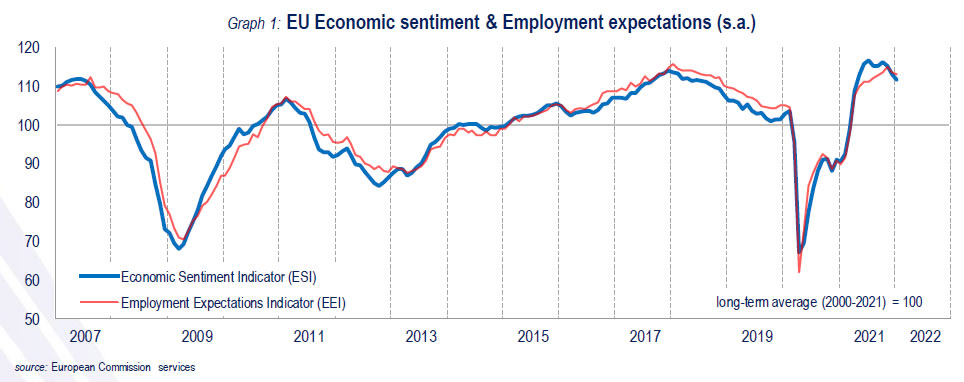
Eurozone Economic Sentiment Indicator dropped from 113.8 to 112.7 in January. Industry confidence dropped from 14.6 to 13.9. Services confidence dropped from 10.9 to 9.1. Consumer confidence dropped from -8.4 to -8.5. Retail trade confidence rose from 1.1 to 3.8. Construction confidence dropped from 10.1 to 8.1. Employment Expectations Indicator dropped from 113.5 to 113.3.
EU ESI dropped from 113.0 to 111.6. EEI dropped from 113.6 to 113.1. Amongst the largest EU economies, the ESI rose in Germany (+0.8) and Spain (+0.6) while it worsened in Italy (-6.1), Poland (-4.2), France (-2.8) and the Netherlands (-1.3).
USDCAD Rockets Off 200-MA, Fuelling Upward Trajectory
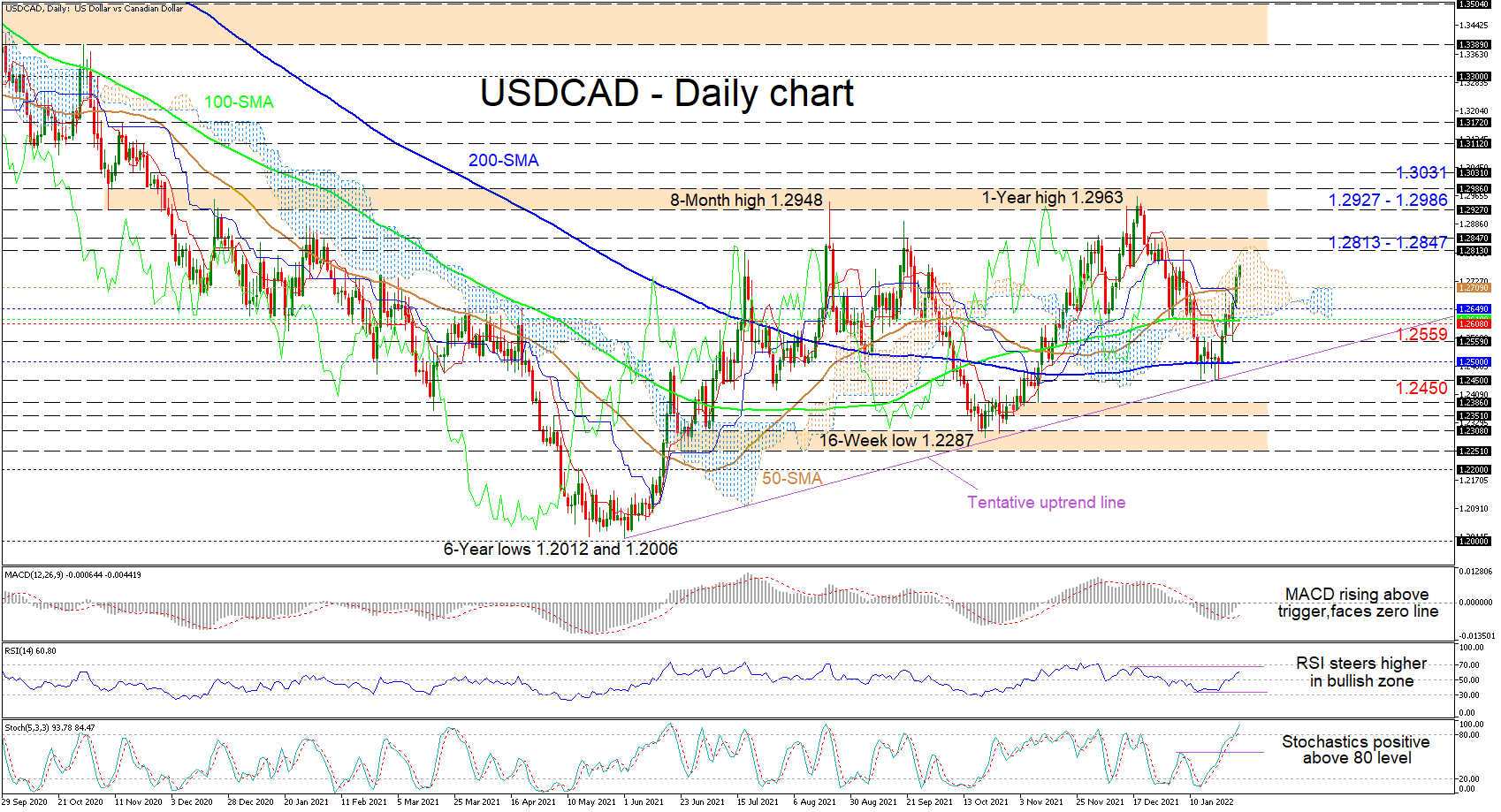
USDCAD remains positively energized aiming for the Ichimoku cloud’s upper band around the 1.2813 high, after taking flight from the 200-day simple moving average (SMA) around the 1.2500 mark. The longer-term SMAs are suggesting an overall neutral trend in the pair, while the marginal incline in the 50-day SMA is sponsoring the recent rally from the 1.2500 level.
Currently, the Ichimoku lines are converging, failing to indicate a leading directional force, while the short-term oscillators are skewed to the upside. The MACD, above the red trigger line, is tackling the zero threshold, while the RSI is improving in bullish regions. The stochastic oscillator is exhibiting a strong bullish charge, promoting bullish price action.
If the pair continues to push higher, initial upside deterrence could occur at the 1.2813-1.2847 zone, where the upper band of the cloud currently resides. Overcoming this barrier, the bulls may then challenge the critical 1.2927-1.2986 resistance barricade that has hindered advances since December 2020. Successfully conquering this acting ceiling and extending past the nearby 1.3031 resistance border, upside momentum in the pair may then intensify.
Otherwise, if positive forces abate ahead of the 1.2813-1.2847 barrier, preliminary support could arise around the 50-day SMA at 1.2709. Sliding lower, an obstructing zone between the Ichimoku lines, which encapsulates the 100-day SMA at 1.2619 and the cloud’s floor, could step into the spotlight. Sinking further, the 1.2559 low could delay the test of the tentative uptrend line, pulled from the 1.2006 trough, and the acting base between the 200-day SMa at 1.2500 and the 1.2450 lows.
Summarizing, USDCAD is sustaining a positive bearing, strengthening a bullish tone above the SMAs and the ascending trend line.
US Dollar Pummelling Swissie
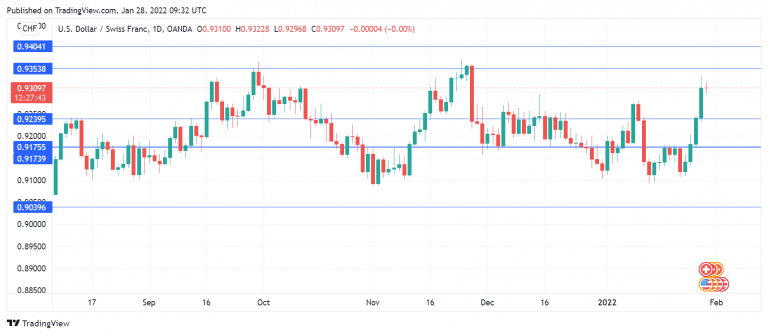
The US dollar is running roughshod over the Swiss franc this week. USD/CHF has shot up 2.16% this week, rising to its highest level since November. In the European session, the Swiss franc is trading slightly above the 0.93 level.
Swiss economic outlook remains favourable
The KoF Economic Barometer, a key indicator, rose to 107.8 in January, up slightly from 107.2 beforehand. The economy continues to be above average (with readings above 100), but the index did point to problems in the manufacturing production activity, which is consistent with what is being reported in the major economies.
The main driver behind the Swiss franc’s tumble is the Federal Reserve decision, as the Fed signalled that it would raise interest rates in March. Fed Chair Powell sounded hawkish after the meeting, saying that inflation could move even higher and that the Fed was prepared to raise rates throughout the year in order to push inflation lower. Powell didn’t provide a timeline on rate increases but did not rule out raising rates at every meeting.
How aggressive will the Fed be in 2022? That depends, of course, on the strength of the economy. At a minimum, we are looking at four rate hikes, with a strong possibility of more, especially if inflation, which hit 7% in December, persists at high levels.
The US dollar also received a boost on Thursday from a stellar GDP report. Advanced GDP for Q4, the first and most important GDP release, accelerated to 6.9% y/y, well above the consensus of 5.5%. This was another reminder that the US economy no longer needs stimulus from the Fed, which plans to wind up its asset purchase programme in March.
The markets will be keeping a close eye today on December US personal income and spending, which may show that growth slowed towards the end of the fourth quarter. The core PCE Price Index, which is the Fed’s favorite inflation metric, is expected to have ticked higher to 4.8% y/y, up from 4.7%.
USD/CHF Technical
- USD/CHF has support at 0.9238 and 0.9174
- There is resistance at 0.9403 and 0.9354
EUR/USD and NZD/USD Elliott Wave Analysis: Be Aware of More Weakness
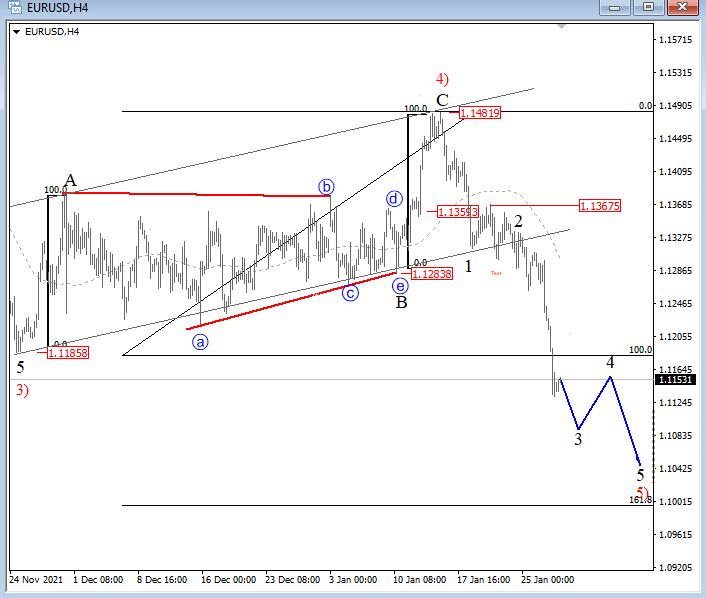
While USD is extending its rally, we can see EURUSD even lower, but still trading in the middle of wave 3, so be aware of more downside pressure in upcoming days, just watch out for a intraday pullback.
EUR/USD 4h Elliott Wave analysis
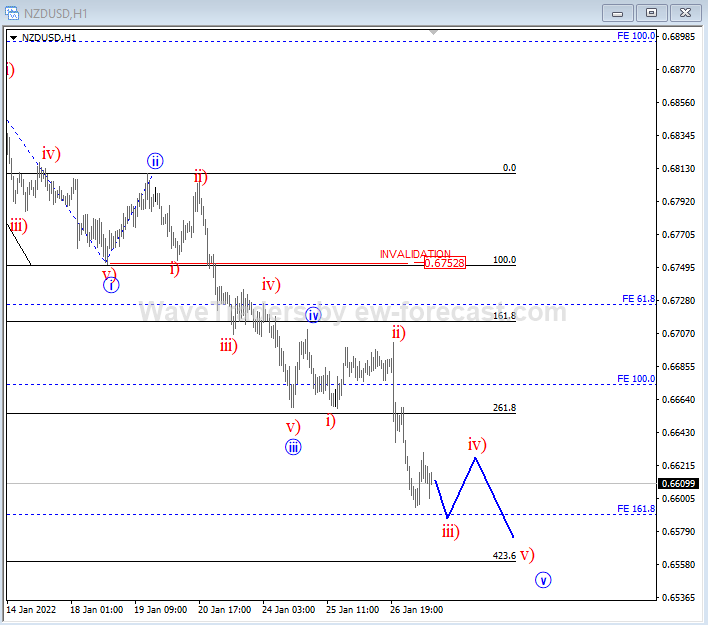
The kiwi remains nicely bearish after a correction in wave »iv«, we can now see it lower for wave »v«. However, we want to see a completed five-wave cycle, which can send it even lower into 0.65x area before it finds the support, so be aware of more weakness after a pullback in sub wave iv).
NZD/USD 1h Elliott Wave analysis
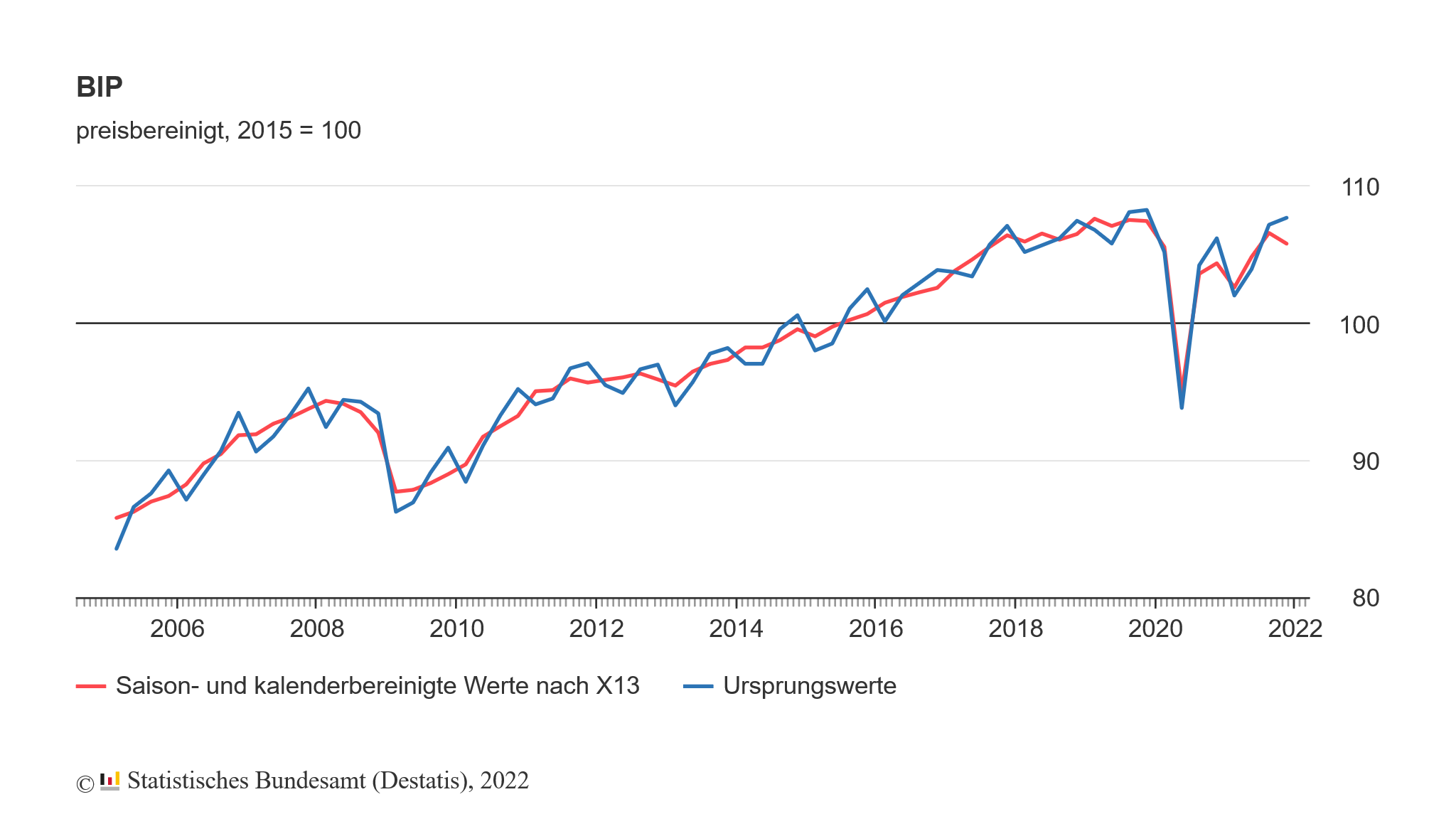
Germany GDP contracted -0.7% qoq in Q4, still -1.5% lower than pre-pandemic level
Germany GDP dropped -0.7% qoq in Q4, worse than expectation of -0.2% qoq. GDP was still -1.5% lower than pre-pandemic level in Q4, 2021. For whole of 2021, GDP grew 2.8%.
Destatis said, "after economic output grew again in the summer despite increasing supply and material bottlenecks, the recovery of the German economy was halted by the fourth corona wave and renewed tightening of corona protection measures at the end of the year."
"Private consumption in particular decreased in the fourth quarter of 2021 compared to the previous quarter, while government consumer spending increased. Construction investments fell compared to the third quarter of 2021."
GBPJPY Chases Soft Gains; Short-Term Outlook Somewhat Gloomy
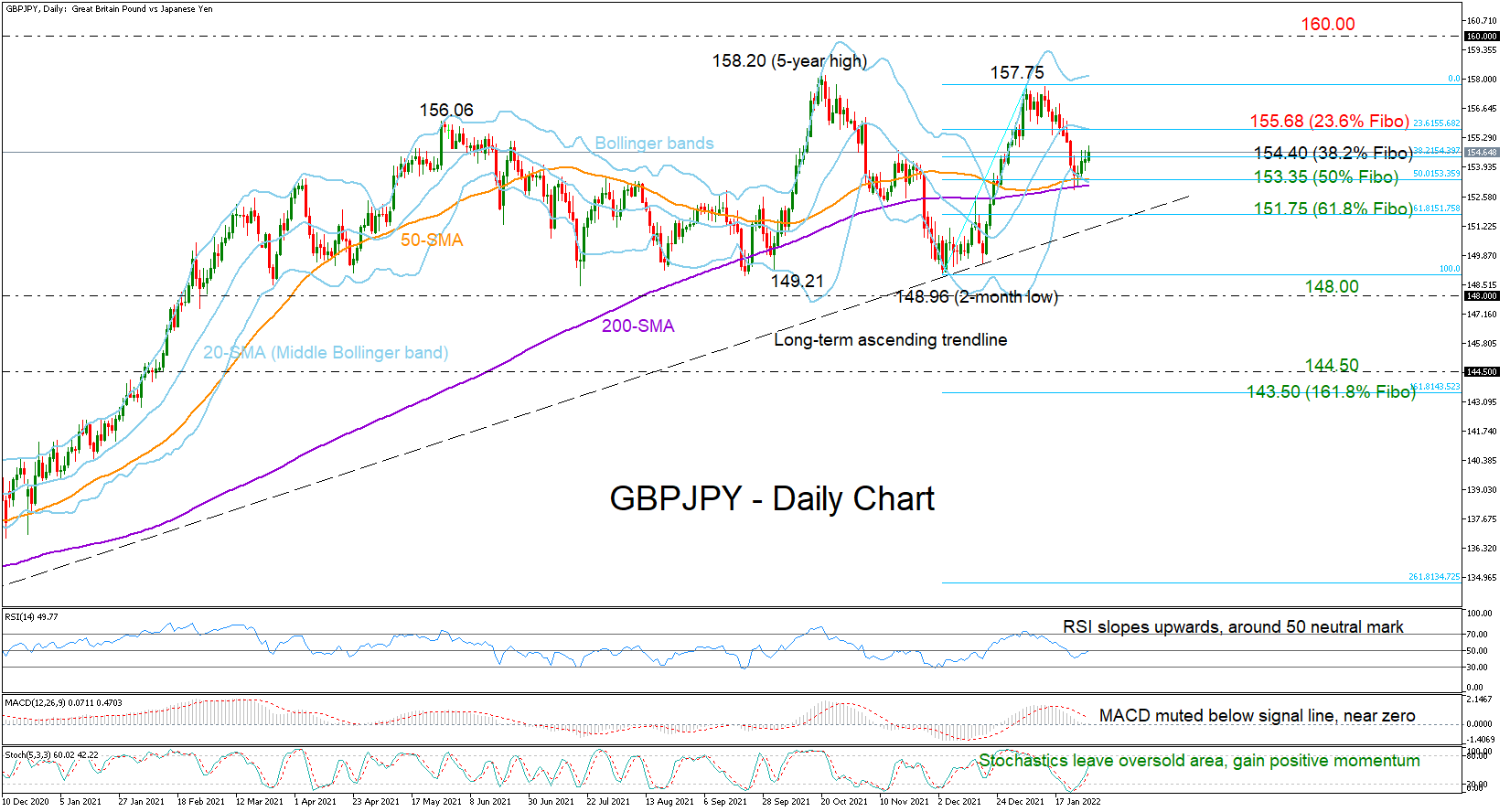
GBPJPY found strong footing around its longer-term 50- and 200-day simple moving averages (SMAs) this week, but the price could only gradually strengthen to 154.80 since then, unable to recoup January's losses.
While the 50- and 200-day SMAs have escaped a bearish crossover, feeding speculation that the broad uptrend has not finished yet, the short-term outlook is still looking cloudy. Despite today’s buying appetite, the price continues to trade below its 20-day SMA at 155.68 and within the lower bearish Bollinger area. Moreover, the RSI has yet to climb above its 50 neutral mark despite its ongoing positive momentum, whilst the MACD remains muted below its signal line and around zero.
The 38.2% Fibonacci retracement of the 148.96 – 157.75 up leg has been capping upside movements the past two days at 154.40. Should the pair sustain its positive momentum above it, the 20-day SMA (middle Bollinger band) and the 23.6% Fibonacci of 155.68 could immediately constrain the bullish action. If not, the rebound could stretch towards the uptrend’s top surface of 157.75 – 158.20. The 160.00 psychological mark, last seen in 2016, could be the next target.
On the downside, a step below the longer-term SMAs and the 50% Fibonacci both at 153.35, would shift all eyes towards the strict ascending trendline, which connects the 2020 lows with December’s trough of 148.96 and intersects the 61.8% Fibonacci of 151.75. A close lower from here could easily drive the price towards the 148.96 bottom. A step beneath 148.00 could activate a steeper decline towards the 144.50 region and the 161.8% Fibonacci extension of 143.52.
To summarize, GBPJPY is fighting for a soft positive weekly close as downside risks keep lingering in the background. An extension above 155.68 could eliminate any anxiety.