

Sample Category Title
EUR/GBP Weekly Outlook
EUR/GBP's decline last week suggests that rebound form 0.8304 has completed at 0.8421 after rejection by 55 day EMA. Initial bias stays on the downside this week. Break of 0.8304 will resume larger down trend to 0.8276 key support. On the upside, above 0.8366 minor resistance will turn bias back to the upside for 0.8421 resistance first.
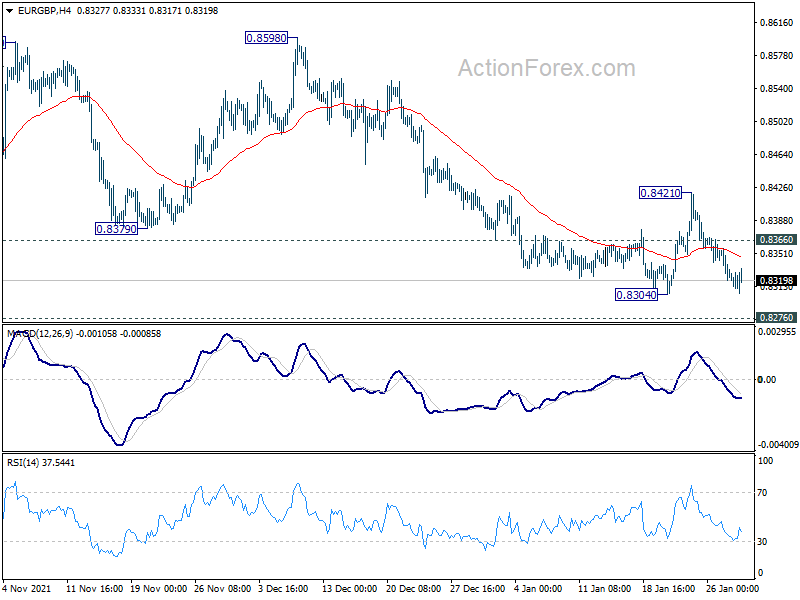
In the bigger picture, price actions from 0.9499 (2020 high) are still seen as developing into a corrective pattern. Deeper fall could be seen as long as 0.8598 resistance holds, towards long term support at 0.8276. We'd look for bottoming signal around there to bring reversal. Meanwhile, firm break of 0.8598 will now be an early sign of medium term bottoming and bring stronger rebound. However, sustained break of 0.8276 will argue that the long term trend has reversed.
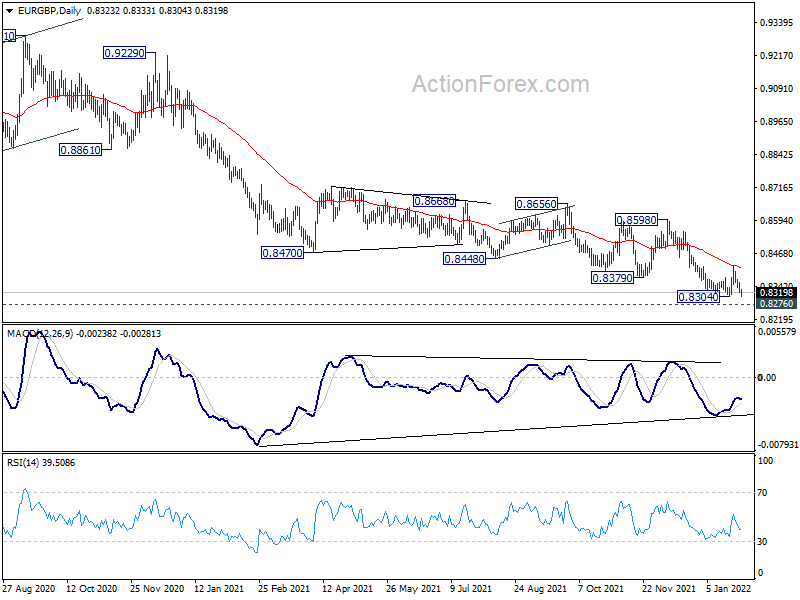
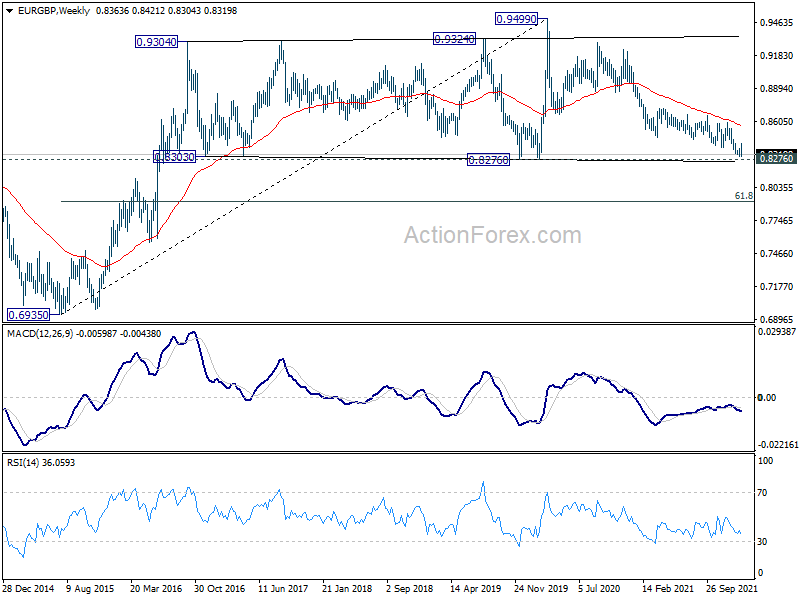
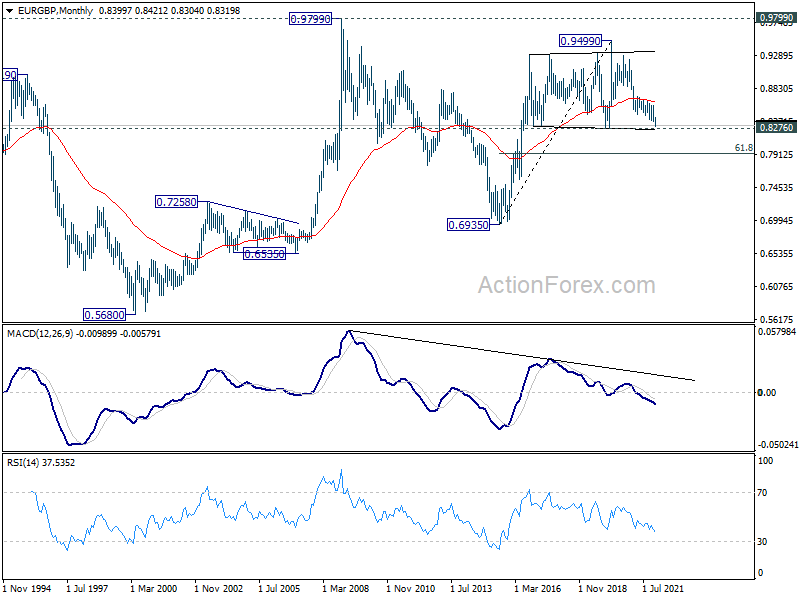
In the long term picture, outlook will stay bullish as long as 0.8276 support holds. Break of 0.9499 is in favor at a later stage, to resume the up trend from 0.6935 (2015 low). However, sustained break of 0.8276 will indicate long term trend reversal, and target 61.8% retracement of 0.6935 to 0.9499 at 0.7917, and possibly below.
EUR/AUD Weekly Outlook
EUR/AUD's choppy rise from 1.5559 resumed last week. Initial bias is now mildly on the upside this week for retesting 1.6168 resistance. Break there will resume the rise from 1.5354 to 1.6434 resistance. On the downside, though, break of 1.5712 support will turn bias back to the downside for 1.5559 support instead.
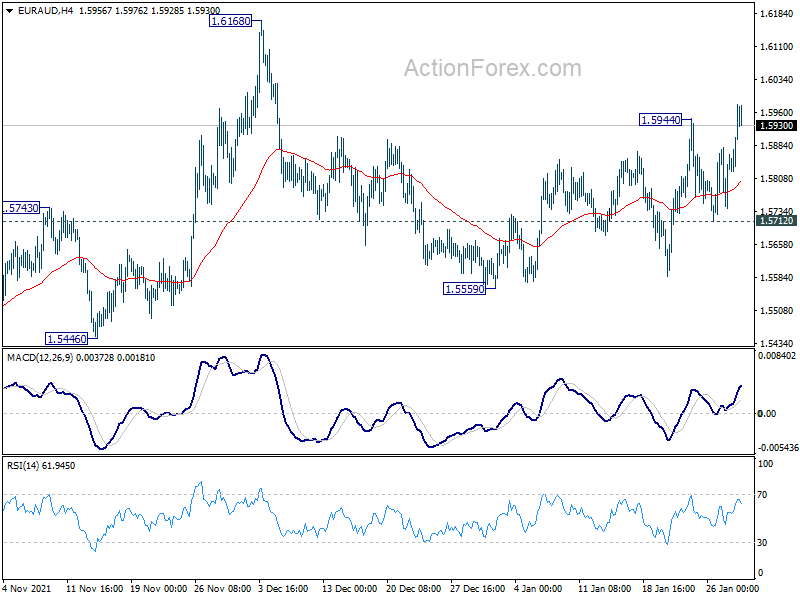
In the bigger picture, rise from 1.5354 is seen as the third leg of the corrective pattern from 1.5250 low. Further rise cannot be ruled out, but even in that case, strong resistance should be seen at 38.2% retracement of 1.9799 to 1.5250 at 1.6988. Larger down trend from 1.9799 is in favor to extend through 1.5250 at a later stage.
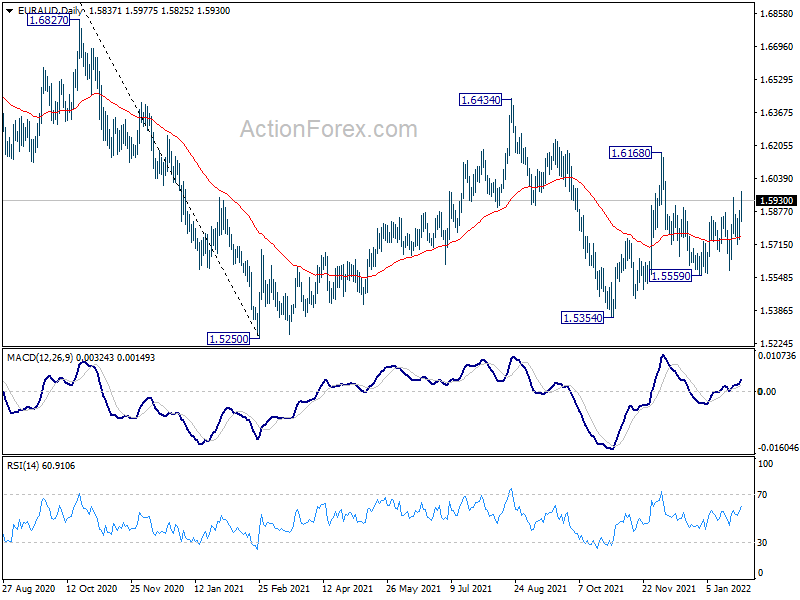
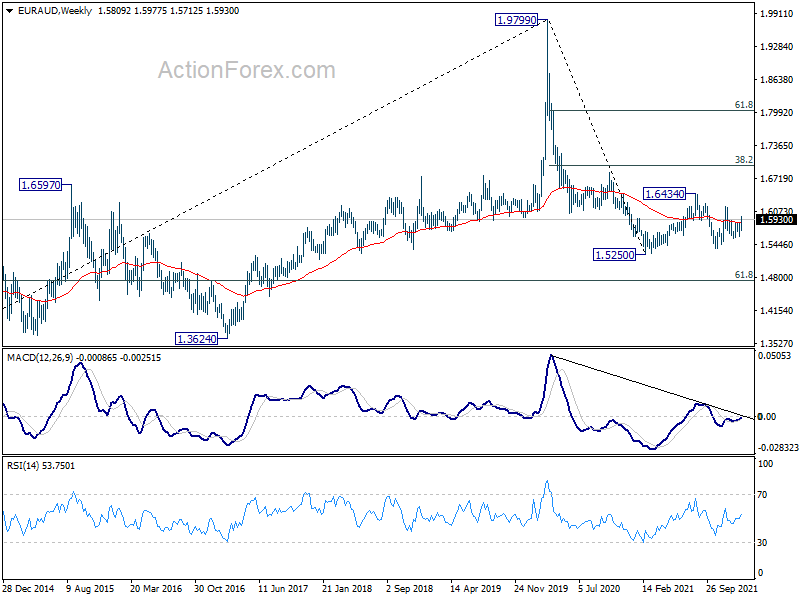
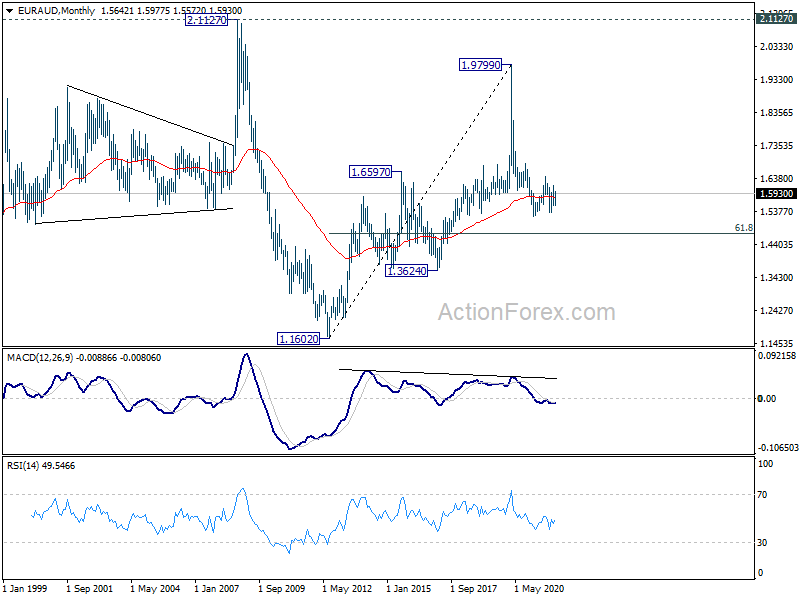
In the longer term picture, fall from 1.9799 (2020 high) is seen as a long term down trend. Further decline will remain in favor as long as 38.2% retracement of 1.9799 to 1.5250 at 1.6988 holds. Break of 1.5250 will target 61.8 retracement of 1.1602 (2012 low) to 1.9799 at 1.4733
EUR/CHF Weekly Outlook
EUR/CHF's down trend resumed last week and dipped to 1.0298, but quickly recovered. Initial bias is neutral this week first. While stronger recovery cannot be ruled out, upside should be limited well below 1.0510 resistance. On the downside, break of 1.0298 will extend the down trend from 1.1149 to 161.8% projection of 1.1149 to 1.0694 from 1.0936 at 1.0200 next.
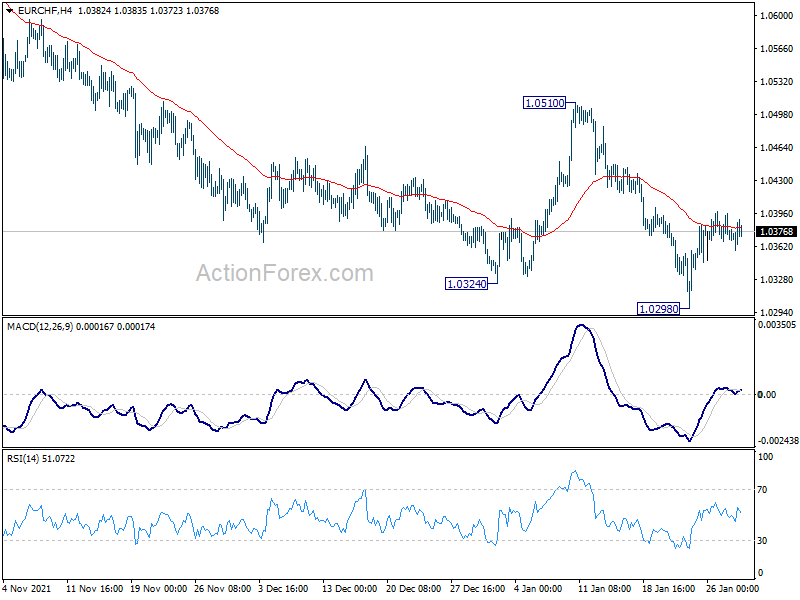
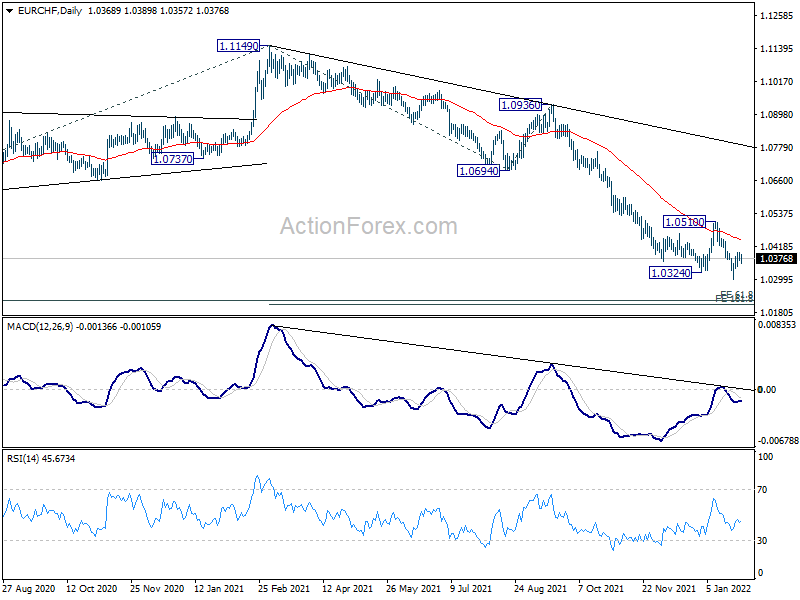
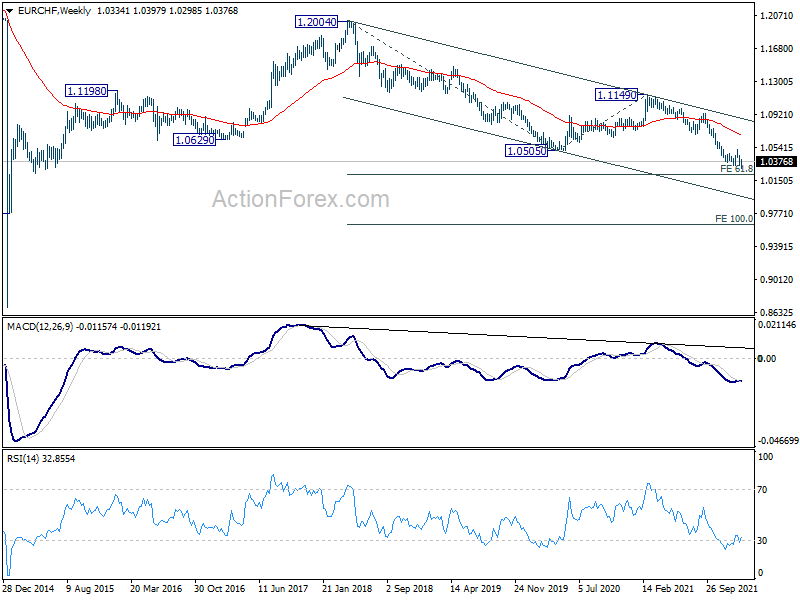
In the bigger picture, long term down trend from 1.2004 (2018 high) is still in progress. Next target is 61.8% projection of 1.2004 to 1.0505 to 1.1149 at 1.0223. On the upside, firm break of 1.0505 support turned resistance is needed to be the first sign of medium term bottoming. Otherwise, outlook will remain bearish even in case of rebound.
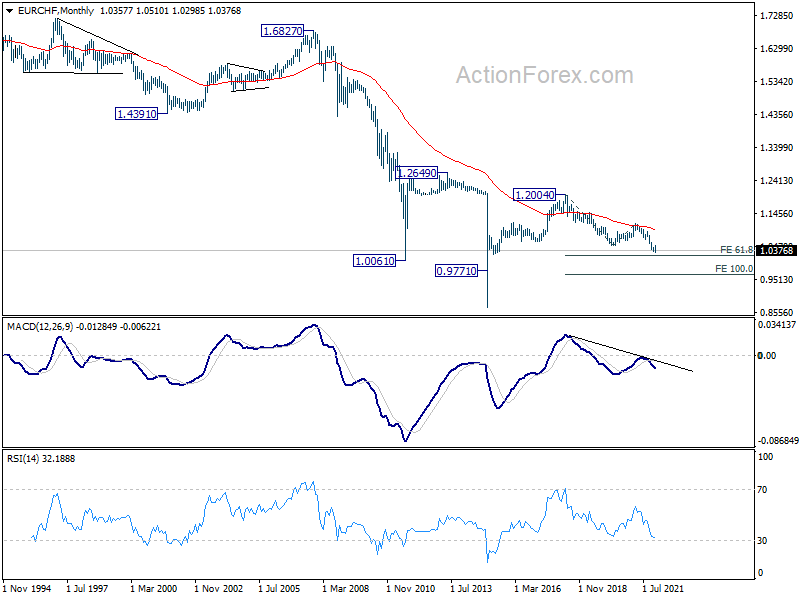
In the long term picture, prior rejection by 55 month EMA (now at 1.0967) maintains long term bearishness. Down trend from 1.2004 is now in progress for 61.8% projection of 1.2004 to 1.0505 to 1.1149 at 1.0223. Firm break there will target 100% projection at 0.9650.
Dollar Skyrockets on Hawkish Fed, Sterling Trailing Behind
The FOMC meeting turned out to me more hawkish than expected and markets are now pricing in four to five hikes this year, instead of three. Dollar was given a strong boost and surged broadly to end as the strongest one. Nevertheless, reactions in the stock markets, while wild, were not pessimistic. Sterling followed as the second strongest, as inflation outlook is going to push BoE for a hike again this week.
Australian Dollar was the worst performing one as RBA is clearly lagging behind Fed on tightening, followed by New Zealand Dollar. Both were also weighed down by risk aversion in Asia, in particular in China and Hong Kong markets. Euro and Swiss Franc were mixed together with Canadian, but the latter was support by persistent strength in oil price.
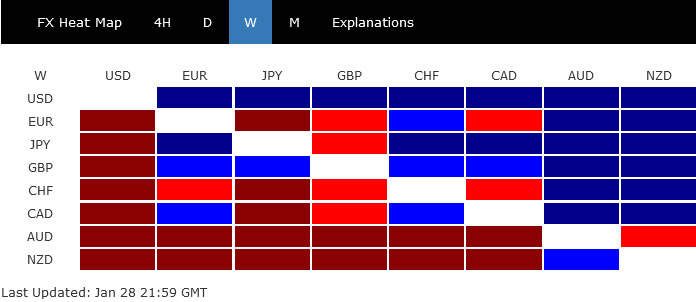
Fed to deliver four or five hikes this year, starting March
The FOMC meeting last week came out more hawkish than expected. A March rate hike is pretty much confirmed as Fed said " it will soon be appropriate to raise the target range for the federal funds rate." Also, Chair Jerome Powell didn't rule out 50bps rate hikes, and indicated that every meeting is "live".
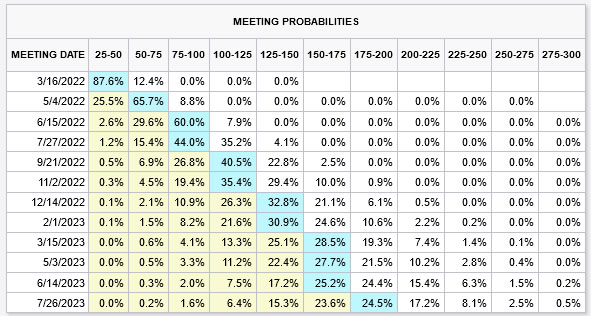
Based on latest fed fund futures pricing, a 25bps hike is fully priced in for March meeting. There is 74% chance of another rate hike in May. The third 25bps hike would come in June or July (more likely). The fourth 25bps hike would come in September or November (more likely). There could be a fifth hike in December or next January (more likely).
The more aggressive scenario could see five rate hikes in March, May, June, September, December. The less aggressive scenario could se four rate hikes in March, May, July, November. But then, every meeting is "live" and depends on preceding developments.
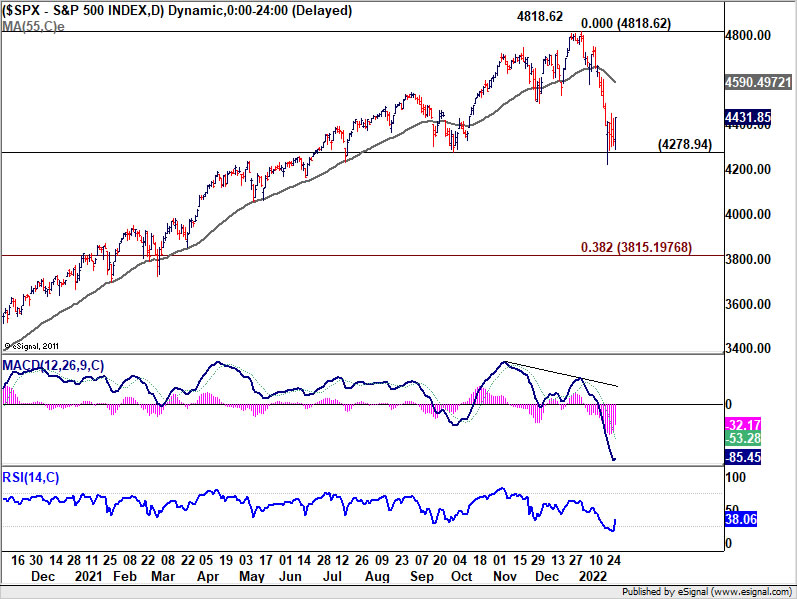
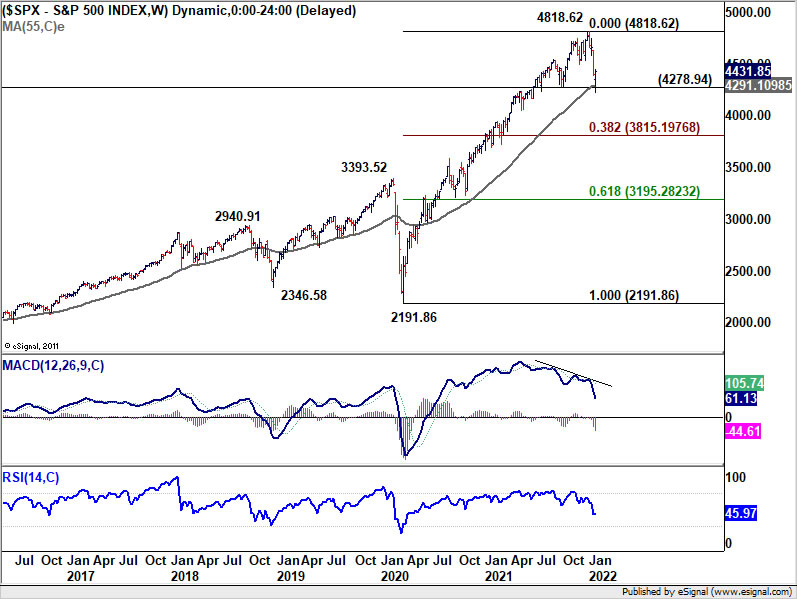
S&P 500 closed the week with gain, but correction not ended yet
The stock markets were indeed very resilient despite the massive volatility seen. S&P 500 dived to 4222.62 but rebounded to close at 4431.85, up 33.9 pts. Initial support was seen from 4278.94 structural level and 55 week EMA (now at 4291.10). But overall, 4818.62 is seen as a medium term top, on bearish divergence condition in daily and week MACD. Hence, the corrective pattern from there is not expected to end that soon.
Price actions from 4818.62 are seen as correcting the whole up trend from 2191.86 (2020 low). Hence, while more recovery could be seen in the near term, upside should be limited by 55 day EMA (now at 4590.49). There would be another decline through 4222.62 to 38.2% retracement of 2191.86 to 4818.62 at 3815.19 before the correction completes. Nevertheless, sustained break of 55 EMA will argue that it's unfolding as as sideway consolidation pattern, rather than a deep correction.
10-year yield failing to extend up trend, consolidation continues
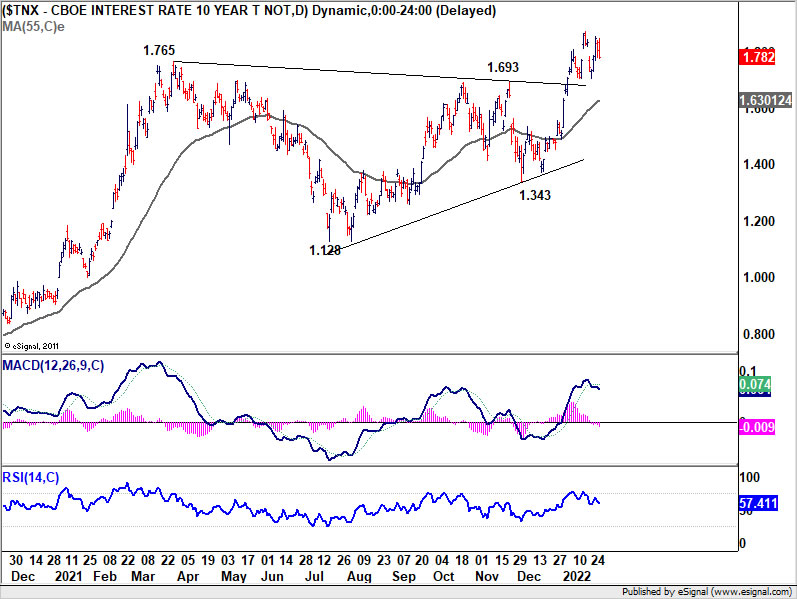
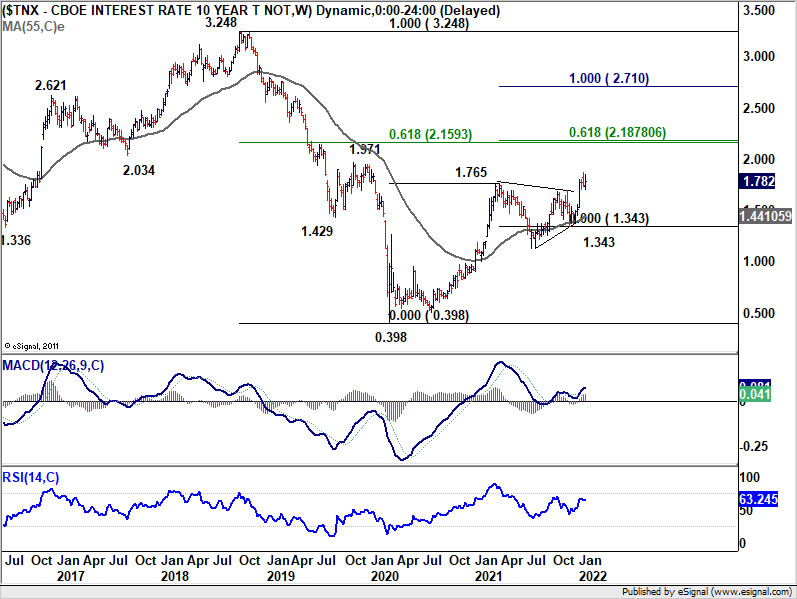
10-year yield failed to break through prior week's high at 1.874 and extended near term sideway consolidations. Any pull back should be contained by 55 day EMA (now at 1.630). Current up trend should extend to 2.159/87 cluster level. This represents 61.8% retracement of 3.248 to 0.398 at 2.159, and 61.8% projection of 0.398 to 1.765 from 1.343 at 2.187. This is where the real test lies, and no break is expected until some dramatic underlying developments.
Dollar index extending up trend, 99/100 as next target
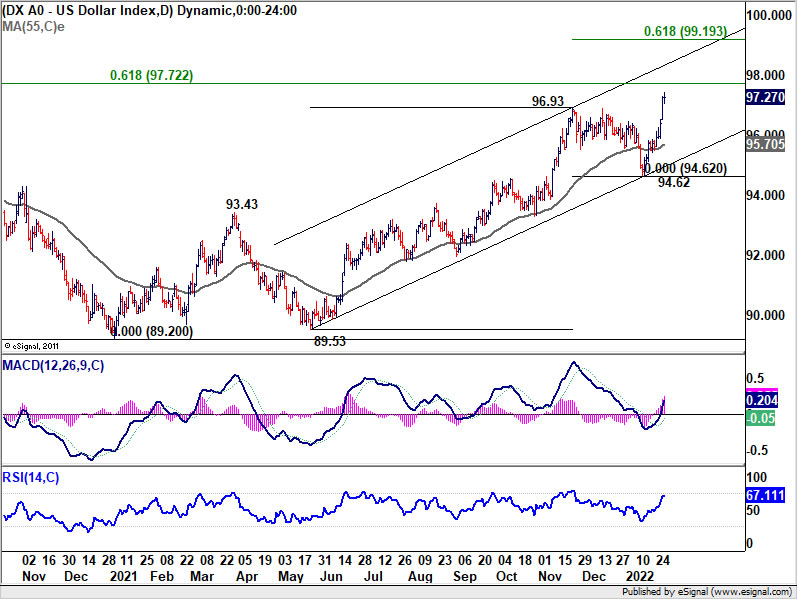
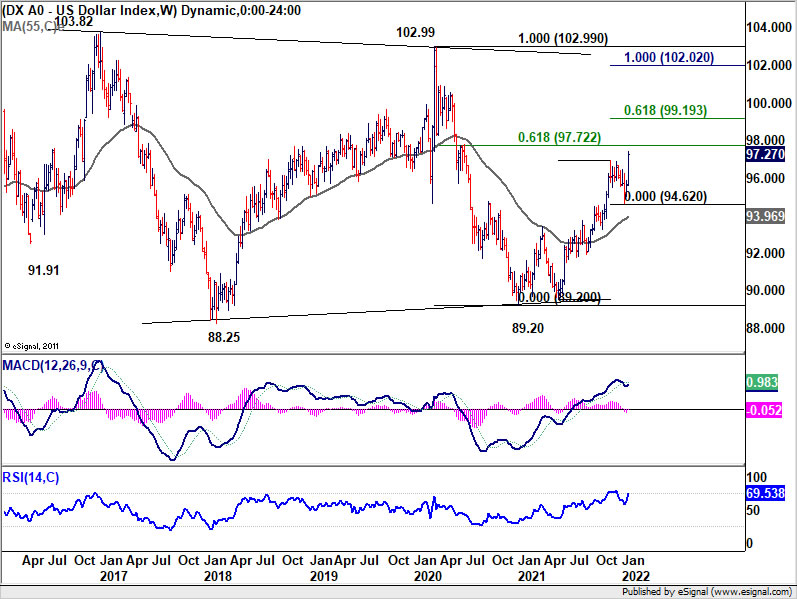
Dollar index resumed near term up trend by powering through 96.93 resistance and hit as high as 97.44. Based on current development the long term fibonacci level of 61.8% of 102.99 to 89.20 at 97.22 should be taken out with relative ease. The bigger test lies in 61.8% projection of 89.53 to 96.93 from 94.62 at 99.19, which is close to 100 psychological level. Sustained break there would open up the case for further rise back to 102.99/103.82 range top. In any case, outlook will stay bullish as long as 94.62 support holds, even in case of deep pull back.
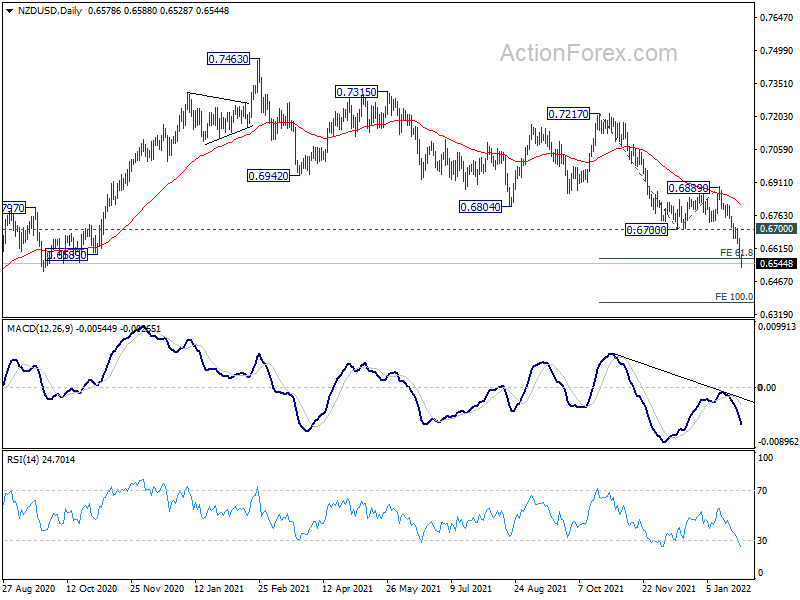
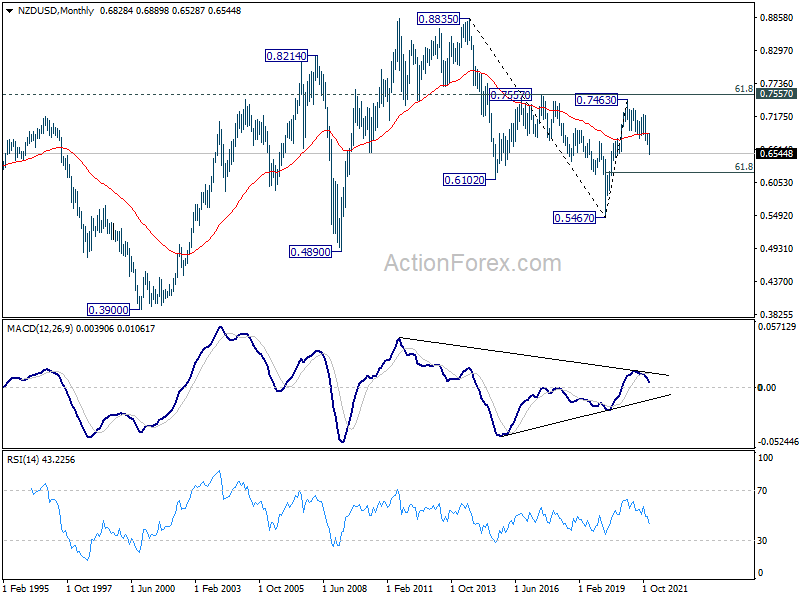
NZD/USD resumed down trend to target 0.6372 projection level next
NZD/USD was the biggest mover last week, losing -2.61%. The strong break of 0.6700 support confirms resumption of larger down trend from 0.7463. Outlook will now stay bearish as long as 0.6700 holds. As 61.8% projection of 0.7217 to 0.6700 from 0.6889 at 0.6569 was taken out already, next target is 100% projection at 0.6372.
It should be noted that NZD/USD was rejected by a key long term cluster resistance level at 0.7557, with 61.8% retracement of 0.8835 to 0.5467 at 0.7548. It also had a strong break below 55 month EMA. Both developments are rather bearish from long term perspective. Fall from 0.7463 could in the end turn out to be resuming the down trend from 0.8835 high. But it's of course too early tell. Reactions to 61.8% retracement of 0.5467 to 0.7463 at 61.8% retracement of 0.5467 to 0.7463 at 0.6229 could reveal the long term trend.
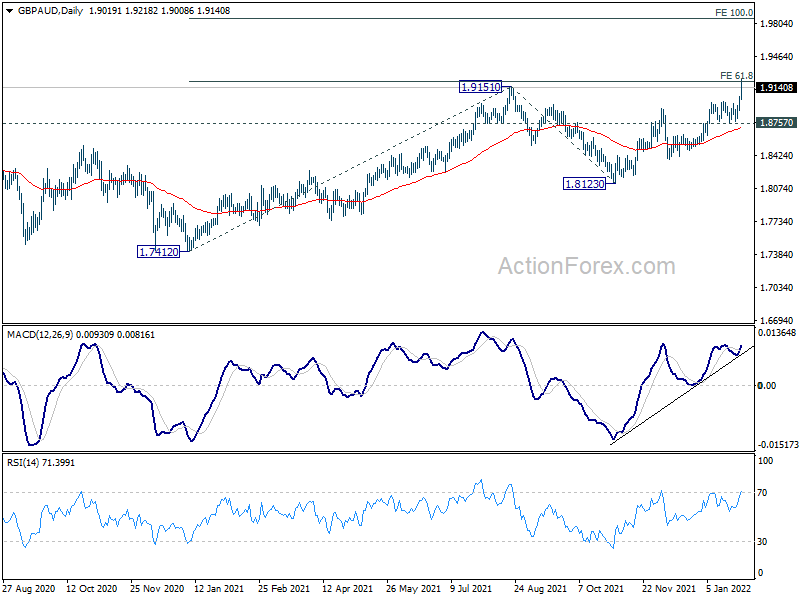
GBP/AUD facing projection resistance as it tries to resume up trend
GBP/AUD surged through 1.9151 high last week and resumed the up trend from 1.7412. But it's no immediately facing 61.8% projection of 1.7412 to 1.9151 from 1.8123 at 1.9198. Sustained break of this level will but a strong affirmation to the underlying medium term bullish momentum. GBP/AUD could then target 100% projection at 1.9862. However, rejection by 1.9198, followed by break of 1.8757 support, will keep medium term outlook neutral and bring more range trading.
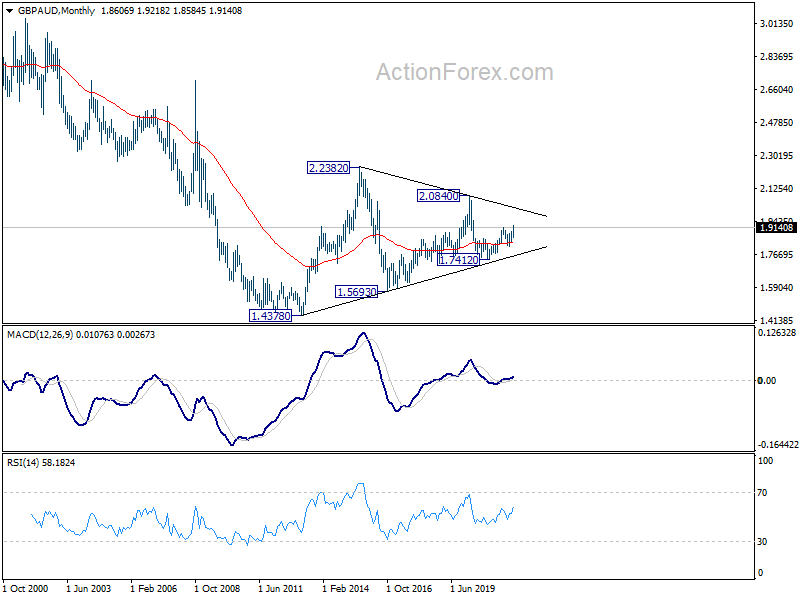
Meanwhile, the break of 55 month EMA, with monthly MACD turning positive, is promising for the long term outlook. GBP/AUD might on on track to head back to 2.084 high, as part of the long term range pattern. Yet, it will have to overcome the above mentioned 1.9198 level with some conviction first.
EUR/USD Weekly Outlook
EUR/USD's down trend from 1.2348 finally resumed last week by breaking through 1.1185 and hit as low as 1.1120. Initial bias stays on the downside this week. Next target is 61.8% projection of 1.1908 to 1.1185 from 1.1482 at 1.1035. Break will target 100% projection at 1.0759. On the upside, above 1.1243 minor resistance will turn intraday bias neutral first. But recovery should be limited well below 1.1482 resistance to bring down trend resumption.
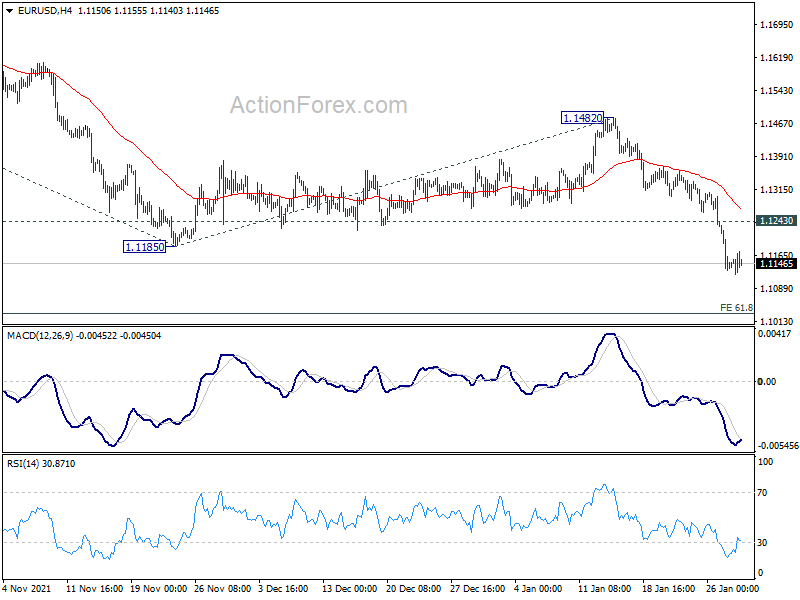
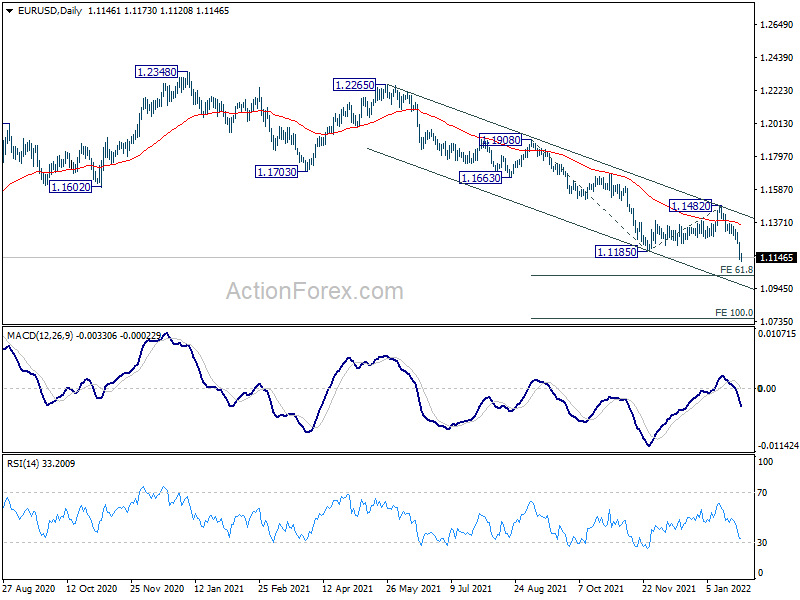
In the bigger picture, the strength of the the decline from 1.2348 (2021 high) suggests that it's not a corrective move. But still, it could be the fourth leg of a sideway pattern from 1.0339 (2017 low), or resuming long term down trend. In any case, outlook will now stay bearish as long as 1.1482 resistance holds. Next target would be 1.0635 low.
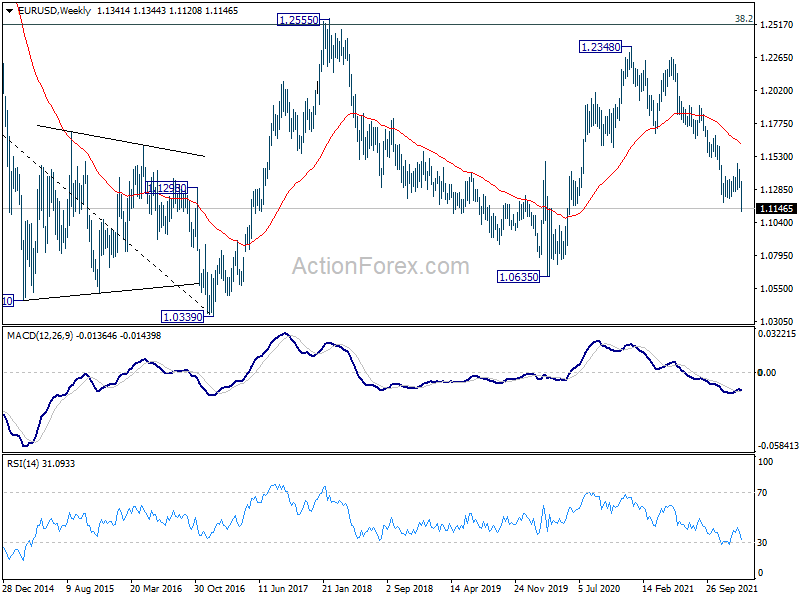
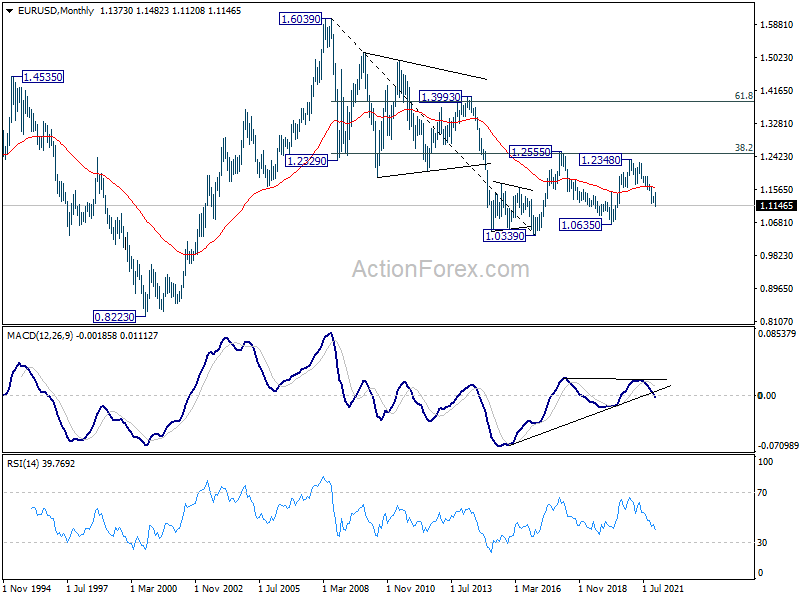
In the long term picture, EUR/USD should have failed 1.2555 cluster resistance (38.2% retracement of 1.6039 to 1.0339 at 1.2516) again. The break below a flat 55 month EMA is keeping long term outlook bearish. That is, the down trend from 1.6039 (2008 high) is still in progress. Break of 1.0339 will open up further decline towards 0.8223 (2000 low).
Summary 1/31 – 2/4
Monday, Jan 31, 2022
[php_everywhere instance="1"]
Tuesday, Feb 1, 2022
[php_everywhere instance="2"]
Wednesday, Feb 2, 2022
[php_everywhere instance="3"]
Thursday, Feb 3, 2022
[php_everywhere instance="4"]
Friday, Feb 4, 2022
[php_everywhere instance="5"]
Weekly Economic & Financial Commentary: The Hawks in Full Control at the Fed
Summary
United States: Moderating Growth and a More Aggressive Fed
- The economy had the wind at its back in 2021 with generous fiscal policy and an accommodative Fed. Inflation and supply chains were the key obstacles. In light of a more hawkish stance at this week's FOMC meeting, we now expect the Fed to hike rates 125 bps this year and that a balance sheet reduction will be announced at the July 27 FOMC meeting.
- That said, our updated forecast is more about base effects from the Q4 GDP report rather than a major change in our outlook due to a more aggressive Fed. We'll provide a more full-fledged forecast update in our U.S. Monthly after we get January's nonfarm payroll release.
- Next week: Construction Spending (Tues), ISM Manuf. & Services (Tues/Thurs), Employment (Fri)
International: European Economic Growth Sputters Around the Turn of the Year
- This week's news from Europe offered further confirmation of an economic soft patch. The Eurozone January services PMI fell more than expected, while Germany saw GDP contract in Q4. In the U.K., the manufacturing and services PMIs fell further in January. Elsewhere, the Bank of Canada held its policy rate steady this week, but signaled that rate hikes would be coming soon.
- Next week: Eurozone CPI (Wed), Brazil Selic Rate (Wed), BoE Policy Announcement (Thu)
Interest Rate Watch: The Hawks in Full Control at the Fed
- We forecast that the FOMC will raise its target range for FFR 125 bps between March and the end of the year. We continue to expect the Committee to raise rates 75 bps more over the course of 2023 with 25 bp rate hikes in the first, second and third quarters of the year.
Credit Market Insights: Consumers Are on a Spending Spree, Can It Last?
- Major players in the credit card business reported attractive Q4-21 earnings this week. But the revival in credit card spending conflicts with a time when consumers wallets are feeling a little lighter, as inflation and dwindling stimulus encroach on real income. Is such growth sustainable, or are consumers biting off more than they can chew when it comes to taking on credit card debt?
Topic of the Week: Build Back Better Still Stuck in Neutral
- A little over a month ago, we published a report that made the case that Democrats' efforts to pass their Build Back Better plan largely had stalled. One month into 2022 and not much has changed.
The Weekly Bottom Line: Fed Sets the Stage for Rates to Liftoff Soon
U.S. Highlights
- The Fed left the policy rate unchanged at this week’s FOMC meeting but signaled that a rate hike was imminent come March. Uncertainty on the pace of hikes post March remains elevated, contributing to stock market volatility this week.
- The U.S. economy grew at 6.9% (annualized) in the final quarter of 2021 – a notable acceleration from the 2.3% pace in the in the quarter prior. Powering growth was a buildup of inventories.
- Consumer spending ended the year on a soft note, with real spending down 1.0% (m/m) in December. Pending home sales also ended the year on weak footing, falling 3.8% last month.
Canadian Highlights
- The Bank of Canada held their policy rate steady this week, surprising markets. Still, the overall messaging was hawkish, as was Governor Macklem’s press conference, paring the dovish market reaction.
- The Bank of Canada emphasized that economic slack has been absorbed, all but teeing up a rate hike in early March. They will also initiate balance sheet roll-off, but only after the policy rate starts to move higher.
- The outlook for interest rates is highly dependent on inflation. Should it prove tougher to tame, the Bank could hike more aggressively.
U.S. - Fed Sets the Stage for Rates to Liftoff Soon
The last week of January was rich on data reports, but the FOMC meeting absorbed much of the limelight. While the Fed left its policy rate unchanged, it delivered its clearest warning yet of imminent rate hikes. A March rate hike is now almost guaranteed, with market odds currently pegged at over 95%. That is likely just the start in what is sure to be a sequence of hikes. Concerns about future monetary tightening contributed to stock market volatility this week. Ultimately, the pace of rate hikes will depend on the pandemic, global supply chains and how aggregate demand reacts to higher rates.
The economy ended last year on a solid note, with a 6.9% annualized jump in fourth quarter real GDP. The acceleration in growth was powered by substantial inventory restocking. Inventories contributed 4.9 percentage points to the headline tally – accounting for over 70% of growth in the quarter (Chart 1). The inventory buildup was led by the retail and wholesale trade industries, with retail auto inventories leading the charge. Business investment (+2% annualized) and consumer spending (+3.3%) also contributed to growth, while a decline in government spending (-2.9%) was a small detractor.
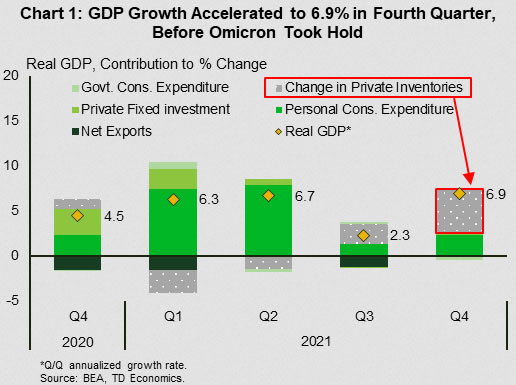
Last quarter’s strong showing largely reflects activity before the Omicron infection wave took hold. Other data this week also pointed to slowing economic momentum at the turn of the year. December’s personal income and spending report showed that real spending fell 1.0% on the month, due primarily to a pullback in goods spending. Services spending remained in positive territory, but spending at restaurants and bars declined, likely reflecting consumer caution due to the rapid increase in COVID-19 infections. Close-contact services are likely to see further weakness in January as high-frequency indicators point to softening in things like air travel.
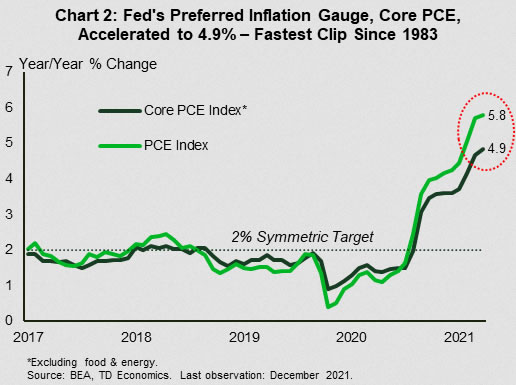
Inflation is adding to consumer woes. Echoing the acceleration in the Consumer Price Index, inflation as measured by the personal consumption expenditures (PCE) price index rose to 5.8% year-on-year (y/y) in December. Meanwhile, core PCE – the Fed’s preferred inflation gauge – accelerated to 4.9% y/y, moving further away from Fed’s target (Chart 2).
Second-tier data reports also point to slower near-term growth. Pending home sales fell 3.8% in December, marking the second consecutive monthly decline for the series. Pending sales lead actual (closed) sales by 1-2 months, with the recent weakness pointing to a soft start to the new year. A dearth of housing inventory is a key factor behind the weaker year-end trend. Looking at the start of this year, higher mortgage rates and uneasiness among prospective buyers during a surge in COVID-19 infections, are also likely to weigh on activity.
The good news is that the Omicron wave is likely to prove a temporary hurdle to economic activity. New infections in the U.S. appear to have crested. As the economy clears this hurdle, growth should rebound from a modest sub-2% pace this quarter to a much faster clip come spring. Inflation, however, is likely to remain elevated through 2022, even as it decelerates from the current highs (see here).
Canada - Marching to a Hike
To the surprise of many, the Bank of Canada opted to hold its policy rate steady in this Wednesday's hotly anticipated interest rate decision. In the accompanying press conference, Governor Macklem noted the on-going (but improving) situation with Omicron and the Bank's preference to adequately prepare the public for higher interest rates as factors staying the Bank's hand. The desire to formally wrap up forward guidance, and the fact that the next meeting is only five short weeks away likely helped too.
All that said, this was the definition of a hawkish hold. The Bank emphasized in the statement and accompanying Monetary Policy Report (MPR) that economic slack is now absorbed, teeing up a hike at its next meeting in early March. What's more, the Bank left the door open for a rapid transition to balance sheet roll-off (i.e., quantitative tightening). While this is likely not in play for the March meeting, the Governor noted that the central bank will be "considering" that step once interest rates start to rise.
Critics of the decision note that a rate hike would have been entirely consistent with the Bank's forward guidance that it would not raise the overnight rate until economic slack was eliminated. However, the high degree of uncertainty around that estimate – the MPR put a range on its measure of the output gap of between -0.75% (positive slack) and +0.25% (negative slack) – made the case for some advanced warning. Omicron looks to have added to the caution as restrictions resulted in a downgrade to first quarter growth expectations to just 2%.
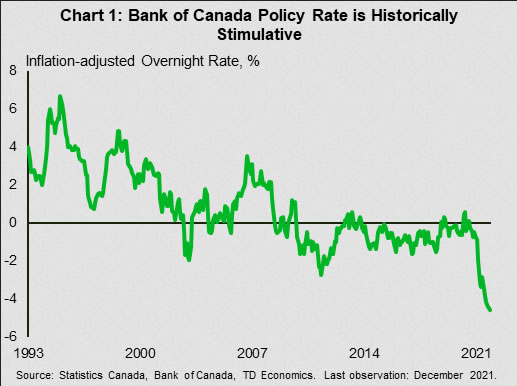
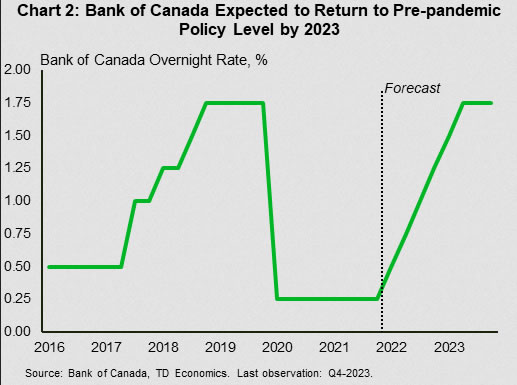
We know that the Bank will be taking rates higher soon, but how rapidly and how far will depend on the outlook for inflation. It is safe to say that with Omicron worsening supply disruptions, it will remain well above target over the foreseeable future, enough to justify beginning to reverse a deeply negative, emergency level, inflation-adjusted policy rate (Chart 1). We anticipate at least two moves over the next three meetings. If all goes well, a rate hike roughly every second meeting continuing through 2023 will bring the overnight rate back to its pre-pandemic level (Chart 2).
A slower cadence is also possible. After an initial round of moves, policymakers could very well opt to sit back for a few months and assess the balance of supply and demand. There is precedent for this. In 2017, the Bank hiked twice in the third quarter of the year and paused in the fourth before picking back up in early 2018.
However, should inflation prove more stubborn, the Bank is likely to take a more aggressive approach. We have become accustomed to policy increasing in 25 basis point increments (the last time the Bank raised more than this in a single meeting was May 2000), but this has been an environment of relatively low and stable price growth. At the same time, the Bank could simply raise interest rates for longer, ultimately taking the overnight above its estimated "neutral" rate. With inflation the highest in thirty years, drastic times may call for drastic measures.
Week Ahead – RBA, BOE, ECB, OPEC+, and NFP in Focus
After a rollercoaster January, Wall Street is now expecting the Fed to aggressively raise interest rates over the course of the year as they scramble to control inflation. The US dollar is once again king as most economists are now expecting the Fed to deliver anywhere between 3-7 rate hikes this year.
The upcoming week is filled with a few big rate decisions from the RBA, BOE, and ECB. The RBA may end its bond purchase program and could bring forward rate hike expectations, given the stronger-than-expected acceleration in inflation. The BOE is expected to deliver a follow-up rate increase and possibly signal a couple more are coming. The ECB will try to stick to the script that it is unlikely they will hike in 2022, which surprisingly has not been tested despite eurozone inflation increasing at a record pace. Financial markets don’t expect the ECB to move until September 2023, but that could shift as all the major central banks enter tightening mode.
After a sixth straight weekly gain, oil traders will pay close attention to the upcoming OPEC+ meeting that should not disrupt how tight this energy market has become. Crude demand is outpacing whatever supply is coming from OPEC+ as they have been falling well short of their commitments. Expectations are for the cartel to rubber stamp the 400,000 bpd increase in March, but no one expects them to actually reach those levels.
On Friday, the January US nonfarm payroll report will show that labor market recovery took a hit from omicron, while average hourly earnings continue to rise. Wage pressures are not going away and that should support optimism for the outlook for the US consumer.
US
Hot inflation may be public enemy No.1 for triggering the Fed’s hawkish turn, but investors are still keeping a close eye on the whether slower job growth could complicate the Fed’s aggressive tightening strategy. The January nonfarm payroll report will show the labor market recovery continues to moderate as the Omicron variant disrupted hiring. The consensus estimate for jobs created in January is 178,000, which would be a decrease from the 199,000 gain in December. Labor supply is still very tight and that may continue to be the driver behind average hourly earnings increases.
On Monday, Qatar’s emir will meet President Biden to discuss several issues, primarily focusing on the global energy crisis and security. Thursday is a big day for Biden’s Fed nominees as Raskin, Cook, and Jefferson as they will appear before the Senate. If confirmed, this will represent a landmark demographic overhaul of the Fed.
Wall Street will also pay close attention to a busy earnings season week as several European banks, technology, car manufacturers and industrials will report results.
EU
A lot of economic data to come from Europe next week, with every day offering a selection of important readings that could influence the currency markets.
But there’s no doubt what the headlines will be, with flash CPI readings coming a day before the ECB meeting. The central bank is one of the few remaining in camp transitory and they are expected to persist, something that will be helped by a softer inflation number the day before.
Markets are ahead of the curve once more with at least one 10 basis point hike priced in by October and maybe another by the end of the year. Christine Lagarde pushed back to no avail last time, a similar outcome could be on the cards if the CPI data isn’t kind to them.
Developments in Ukraine appeared to hit European markets harder than the US on Monday so we could see similar sensitivity should the situation continue to deteriorate.
UK
Next week is all about the BoE meeting, with markets pricing in a more than 90% chance of a second consecutive rate hike, taking the base rate to 0.5%. With up to three more priced in this year, there is scope for the central bank to follow the Fed in leading investors further down the hawkish path.
An unusual side note, the Prime Minister’s job looks far from safe as the Sue Gray investigation has turned into a full blown police inquiry into numerous alleged parties during lockdown. Boris can survive the embarrassment but will he survive an inquiry? The timing of the Sue Gray report remains unknown but could make life very difficult for the PM. Perhaps the oddest thing is how little markets seem to care (for now).
Russia
The ruble has had a rough time the last couple of weeks as tensions between Russia and the West have intensified. It’s down around 5% since the start of the year after a recovery on Thursday, with a diplomatic response still being sought, despite the wide gap that still seemingly exists. There remains the risk of invasion which could punish the ruble as the country gets hit with sanctions.
South Africa
The SARB raised interest rates for the second consecutive meeting, taking the repo rate to 4%. This comes as inflation was running at the upper end of its 3-6% target range and despite growth falling short of previous expectations last year. Growth is still expected to be 1.7% this year, with inflation at 4.9%, up from 4.3% previously.
No major events next week.
Turkey
The quarterly inflation report showed little sign of a change of course for the CBRT, with the central bank remaining bullish on the direction of the economy despite dramatically raising inflation forecasts for 2022 to 23.2%; driven by the lira, food prices, labour costs, and administered prices.
Next week we’ll get PPI and CPI data on Thursday which will offer some more insight into price pressures. Not that it will have an impact on the direction of travel for the enemy of interest rates. The lira remains stable, as it has for most of the year so far but when it comes to the currency, you can never expect it to last.
China
The trading week kicks off early in the weekend with China Manufacturing and Services PMIs for January. The PMIs are expected to show that China’s economy slowed down slightly at the start of the year and that manufacturing and services showed no growth in January.
Manufacturing had to deal with seasonal factors and the services sector was dragged down due to the government’s zero-Covid policy, which has meant strict lockdowns. China will likely continue to increase spending to support the economy.
Chinese markets will be closed for most of the week due to the Lunar New Year holiday.
A big focal point will be the start of the Winter Olympics in Beijing on February 4th. President Xi is expected to meet President Putin at the opening ceremony.
India
India will continue to try to foster a recovery with modest fiscal consolidation in the annual budget for FY 2022-2023 on Tuesday. The country has been hit hard by Covid-19 and the recovery remains fragile. Tax revenues in FY 2021-2022 were higher than expected and the government is expected to use the windfall to fund Covid-19 programmes as well as reduce the ballooning deficit so as to cut borrowing costs.
Australia
The RBA policy meeting on Tuesday could be significant, as the central bank is expected to announce the winding up of its asset purchase program. Governor Philip Lowe has stated repeatedly that he will not raise rates before wages rise to 3%, so a rate hike is not happening until much later in the year. However, if the RBA announces that it is bringing forward the timing on eventual hikes, the Australian dollar could receive a boost.
New Zealand
New Zealand releases Q4 2021 employment data on Wednesday. The economy continues to improve despite the Omicron wave, and there are expectations for a slight increase in employment. The unemployment rate fell to a 14-year low in Q3 to 3.4%, and is expected to remain unchanged. The labour market remains tight, which could lead to acceleration in wage growth.
Japan
A decent amount of economic releases will include industrial production, labor, and housing data, but nothing that should move the needle for the Bank of Japan.
Markets
Energy
Natural gas prices have been a rollercoaster ride after a short squeeze on Thursday, and now a major snowstorm for the East Coast could pump up prices again. The Ukraine situation may see a short period of calm as diplomacy is entertained.
Crude prices have been on fire, rising for a sixth straight week as the demand outlook improves and over geopolitical fears could lead to severe disruptions. The supply side continues to support a tight market as OPEC+ is expected to stick to their plan of increasing output by 400,000 bpd in March, even though their compliance last month only hit 60% of plan.
Gold
Gold’s pain may last a little longer until the Fed’s aggressive pivot with tackling inflation is fully priced in. The $1,800 level was a key support level for gold, so momentum selling has the potential to make this an interesting trade. If it gets ugly quick and $1760 breaks, gold may not see much support until $1720.
Bitcoin
Bitcoin looks like it is stabilizing but many investors are still concerned about a crypto winter which could mean the current rebound might not last. The biggest risk right now is if Bitcoin mining continues to lose key hubs as more countries battle surging energy costs.
The cryptoverse is eagerly waiting for President Biden’s executive action that will begin regulation of cryptocurrencies as a matter of national security. This could be done in the coming weeks and could have an impact on stablecoins, NFTs and cryptos.
Key Economic Events
Sunday, Jan. 30
- Portugal holds an early general election after PM Costa‘s 4-year term ended early
Economic Data/Events:
- China Jan Manufacturing PMI: 50.0e v 50.3 prior; non-manufacturing PMI: 51.0e v 52.7 prior, Caixin manufacturing PMI: 50.0e v 50.9 prior
Monday, Jan. 31
Economic Data/Events:
- Qatari Emir Sheikh Tamim bin Hamad Al Thani meets with US President Biden to discuss global energy crisis.
- Informal meeting of EU ministers for industry and for the Internet market in Lens, France.
- Germany CPI
- Eurozone GDP
- Italy GDP
- Mexico GDP
- Poland GDP
- India GDP
- South Africa Trade data
- Turkey Trade data
- Japan Unemployment Rate
- Australia inflation gauge, private sector credit
- Singapore money supply
- Thailand capacity utilization, BoP
- India fiscal deficit, eight infrastructure industries
- Japan industrial production, retail sales, housing starts, consumer confidence index
- Norway credit indicator, foreign exchange purchases
Tuesday, Feb. 1
Economic Data/Events:
- US construction spending, ISM Manufacturing, light vehicle sales
- UK Nationwide house prices, mortgage approvals
- RBA Rate Decision: Expected to keep Cash Rate unchanged at 0.10%
- Australia retail sales, house prices, home loans, consumer confidence
- Hungary PM Orban meets Russian President Putin in Moscow as his government stresses the importance of maintaining close economic ties, even amid the tensions of the Ukraine crisis.
- Sweden Financial stability hearing with Riksbank, FSA in Parliament.
- India budget presentation
- Euro zone Manufacturing PMI, Unemployment
- Germany Manufacturing PMI, Unemployment
- India Manufacturing PMI
- UK Manufacturing PMI
- Australia Manufacturing PMI
- Thailand Manufacturing PMI
- Switzerland Manufacturing PMI
- New Zealand Trade, Unemployment, house prices
- Czech Republic GDP
- Japan jobless, PMI, vehicle sales
- Thailand business sentiment index
- Mexico international reserves
- Switzerland consumer confidence, retail sales
- South Africa PMI
Wednesday, Feb. 2
Economic Data/Events:
- OPEC+ meeting on output
- Eurozone CPI
- RBA Governor Lowe addresses the National Press Club.
- New Zealand unemployment
- Japan monetary base
- Russia industrial production
- Denmark foreign reserves
- EIA Crude Oil Inventory Report
Thursday, Feb. 3
Economic Data/Events:
-
- US factory orders, initial jobless claims, durable goods
- Fed Board of Governors confirmation hearing
- ECB Rate decision: No changes expected on rates, but Lagarde could provide guidance on when rate hikes could happen
- BOE Rate decision: Expected to raise Bank Rate by 25bps to 0.50%
- Eurozone Services PMI, PPI
- German Services PMI
- UK Services PMI
- Australia Services PMI
- India Services PMI
- Turkey PPI
- Turkey CPI
- Singapore PMI, electronics sector index
- Australia trade balance, building approvals, private sector houses, business confidence
- Switzerland total sight deposits, UBS real estate bubble index
- Amazon reports earnings reports after the close
Friday, Feb. 4
Economic Data/Events:
- US Jan Change in Nonfarm payrolls: 178Ke v 199K prior; Unemployment Rate: 3.9%e v 3.9% prior
- President Putin meets President Xi at Beijing Winter Olympics opening ceremony
- Canada Employment Report
- France industrial production, manufacturing production, wages
- Germany factory orders
- Switzerland CPI
- UK new car registrations
- Eurozone ECB survey of professional forecasters, Retail Sales
- Singapore Retail sales
- New Zealand building permits
- Thailand CPI, forward contracts, foreign reserves, consumer confidence
- Turkey effective exchange rate
Sovereign Rating Updates:
- Norway (Fitch)
- EFSF (S&P)
- ESM (S&P)
- Sweden (S&P)
- Russia (Moody’s)
- Czech Republic (Moody’s)
- Sweden (DBRS)
Week Ahead: 31 January 2022
- Central Banks: RBA, BoE and ECB
- Earnings: GOOGL, AMZN and FB
- Data: Eurozone GDP and CPI, and US NFP
Following the previous week’s big drop in US stock markets, we saw some very volatile price action as dip buyers initially took advantage of downbeat stock prices, before being overpowered by the bears once again. As we got closer to the end of the week, the major indices were holding deep in the negative territory. Even strong earnings result from Apple couldn’t help to lift sentiment, as inflation and tightening concerns exacerbated by surging oil prices and a hawkish Federal Reserve. Investors are starting to look ahead to the first week of February, when the economic calendar is filled with top-tier macro data, including US nonfarm payrolls, a couple of central bank meetings – namely the ECB and BoE – and plenty more US earnings, featuring the likes of Alphabet, Amazon and Meta. A week-long spring festival in China means the markets will be closed there.
Tech stocks to remain in focus
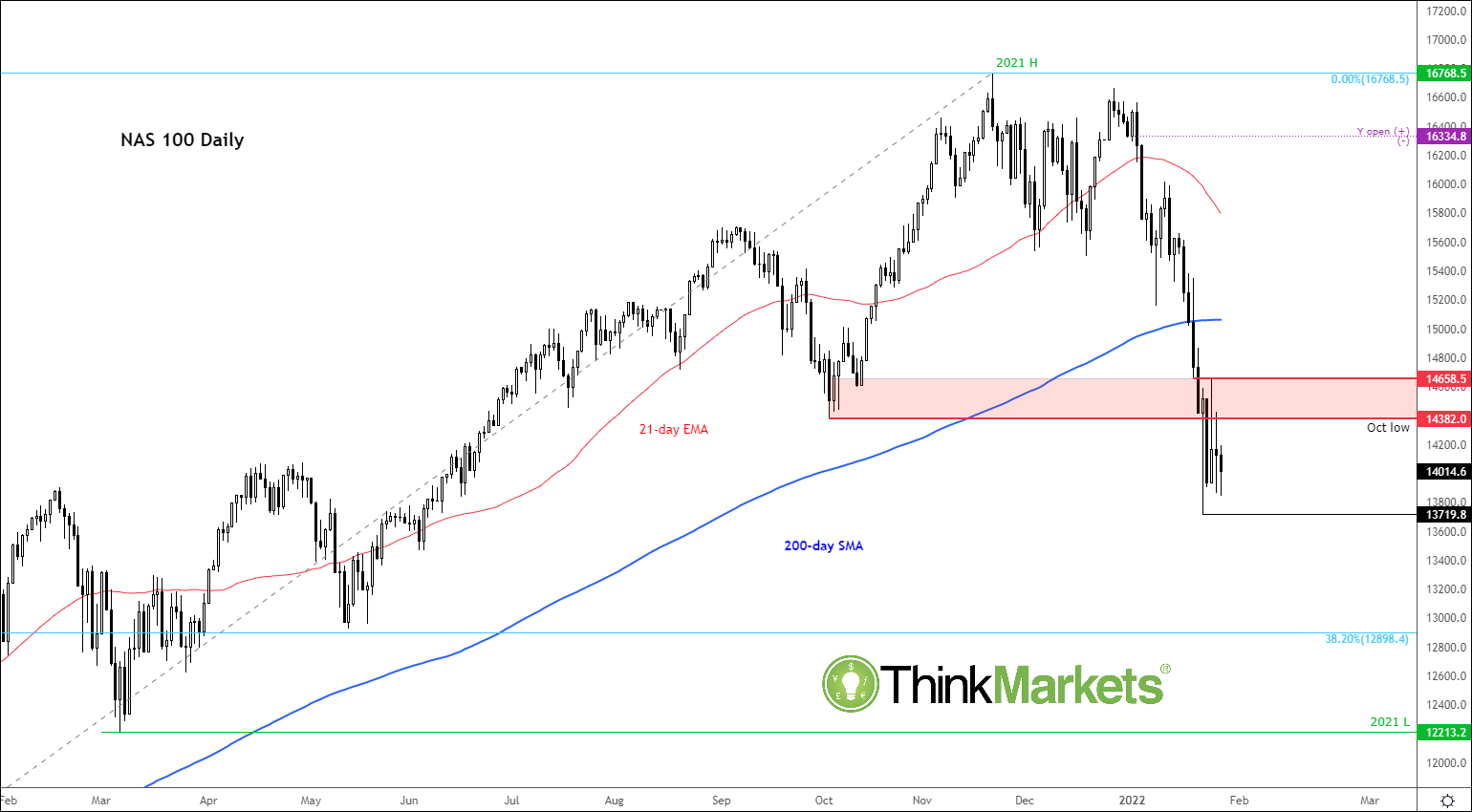
Source: ThinkMarkets and TradingView.com
The focus will clearly remain on the stock market, especially the still-expensive technology sector. Powell has already admitted the Fed has been behind the curve and now must get its act together to get inflation to more acceptable levels. If that means upsetting financial markets, then so be it. So, expect to see further volatility for technology stocks in the week ahead, if incoming data points to a sustained period of high inflation and/or stronger growth. If we assume that stimulus and low rates were among the major reasons behind the protracted bull run, then that support is no longer there or at least not in the same way. Value stocks – those in the financial sector and industrials – must now do the heavy lifting. But if those big tech stocks continue to struggle – and we have plenty more earnings to come in the week ahead from the tech sector – then it is hard to imagine the S&P 500 remaining at current levels for too long. The correction could extend further, and we might be in for more volatile price action in February.
Busy week for FX traders
As far as the US dollar is concerned, well it is likely to remain supported against commodity currencies for as long as risk sentiment remains sour. There is an outside chance that the Japanese yen might come back strongly if the stock market turmoil continues, amid haven demand. In the week ahead, we will get policy updates from the likes of RBA, BoE and ECB. We will also have the latest monthly employment reports from the US, Canada and NZ. So, there are lots to look forward to for FX traders.
BoE set to raise rates to 0.5%
While the ECB and RBA are unlikely to make policy changes, the Bank of England is expected to hike interest rates 25 basis points on Thursday, as it looks to tighten policy for the second time in less than two months. The BoE, like many other central banks, has started to reverse more of its pandemic
Economic and data highlights for the week ahead
Monday
- Chinese PMIs; Eurozone GDP, German retail sales and CPI estimates
- Monday also marks end of January, so watch out for some month-end flows and portfolio rebalancing
Tuesday
- Data: RBA policy decision
- German unemployment among second-tier European data dump
- US ISM manufacturing PMI
- Earnings: Alphabet, AMD, PayPal, Starbucks and Exxon Mobil, among others
Wednesday
- NZ employment report
- Eurozone CPI
- OPEC+ meeting
- ADP US private payrolls
- Earnings: Meta Platforms (FB), Alibaba and Just Eat
Thursday
- Bank of England and European Central Bank meetings
- US ISM services PMI
- Earnings: Amazon, Snap and Ford
Friday
- German factory orders, Eurozone retail sales among handful of Eurozone data
- US non-farm payrolls report and Canadian jobs report
Week Ahead – Three Central Banks Meet ahead of US Jobs Report
A busy week lies ahead. The Bank of England is widely expected to raise rates, the European Central Bank is unlikely to signal anything new, but the Reserve Bank of Australia could try to dampen rate hike bets. Over in America, markets have almost fully priced in five Fed rate increases for this year, so the latest edition of nonfarm payrolls could determine whether the dollar still has some miles left in the tank.
BoE set for action
The Bank of England will likely forge ahead with tightening monetary policy when it concludes its meeting on Thursday. Inflation is scorching hot, the labor market is strong, and the Omicron wave didn’t leave any scars on the economy according to the latest business surveys.
Therefore, markets have almost fully priced in a quarter-point rate increase, which would lift the Bank Rate to 0.5%. That’s the level which policymakers previously indicated as the threshold to begin shrinking the balance sheet. This means the BoE will no longer reinvest the bonds it holds when they mature, essentially draining liquidity out of the market.
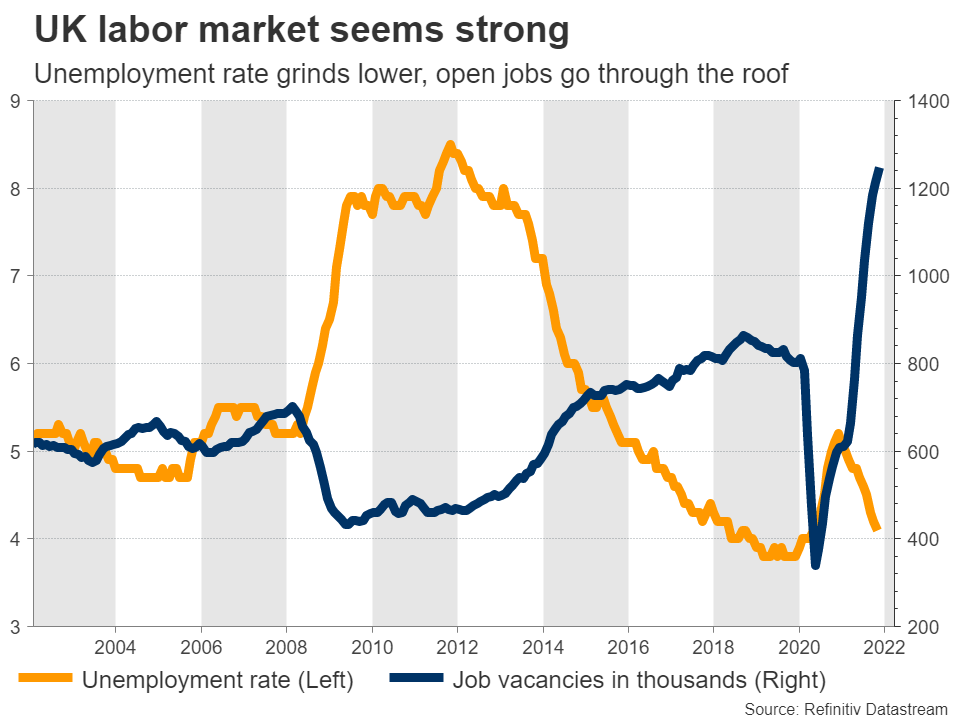
That would be great news for sterling as such a move argues for higher yields over time, widening rate differentials in its favor. Hence, if policymakers pull the trigger on balance sheet normalization and raise rates, the pound could enjoy the benefits. The updated inflation forecasts will also attract attention.
Turbocharged dollar awaits NFP
Across the Atlantic, there is a heavy barrage of economic data out of the US. The show will get rolling with the ISM manufacturing survey on Tuesday, before the services print on Thursday, and the all-important employment report on Friday.
Nonfarm payrolls are expected to clock in at 233k in January. That seems low compared to the more impressive prints last year, but a slowdown in jobs growth is natural as the economy approaches full employment. In fact, nonfarm payrolls might even be overshadowed by wage growth.
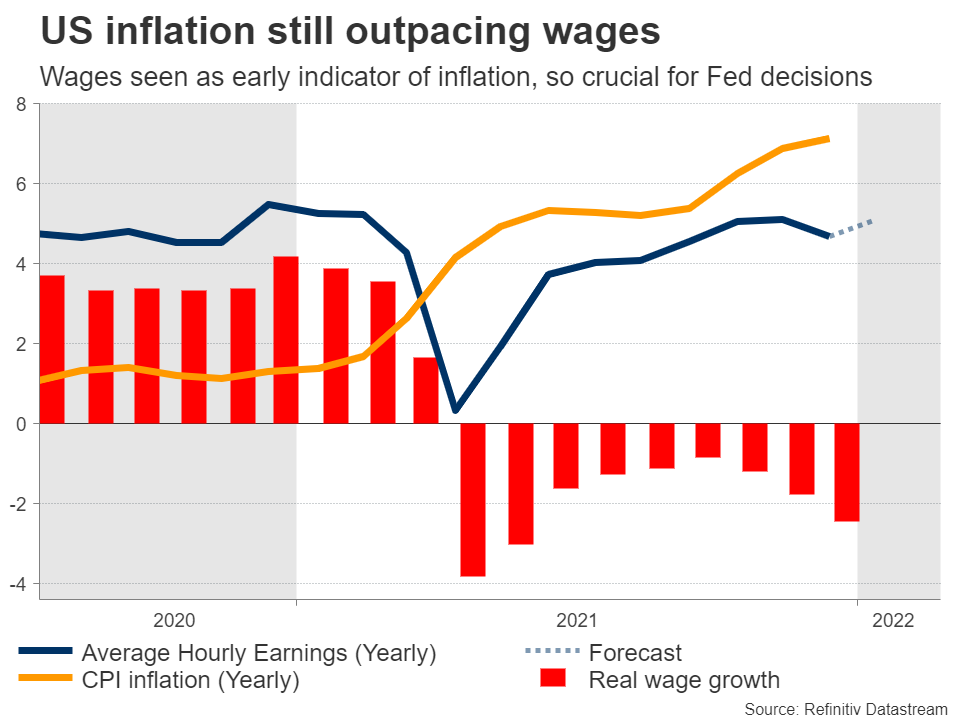
Fed officials worry that the economy could enter a vicious wage-price spiral that keeps feeding inflationary pressures, reminiscent of the 1980s. Hence, wage growth is seen as an early indicator of inflation, elevating its importance at this stage of the cycle.
Markets have almost fully priced in five rate increases for this year and a solid jobs report could add the finishing touches, keeping the wind in the dollar’s sails.
ECB - All about wages
The European Central Bank is not expected to signal anything new when it wraps up its own meeting on Thursday. Economic growth is stuck in slow gear and the labor market is still far from full employment, keeping wages subdued and therefore downplaying concerns of persistent inflation.
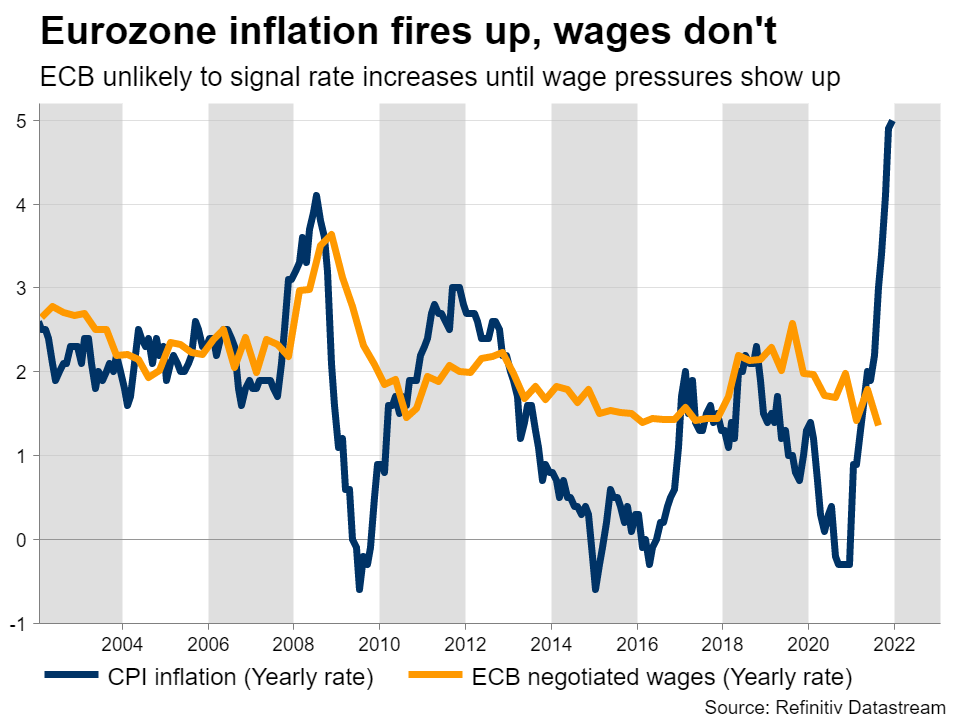
The ECB knows that even though inflation is elevated right now, it won’t stay that way unless wage growth fires up. There have been some encouraging signs lately with business surveys pointing to increasing wages, but nothing that would convince the central bank a paradigm shift is underway.
Even President Lagarde acknowledged this, saying ‘the cycle of economic recovery in the US is ahead of that in Europe, so we have every reason not to act as quickly and ruthlessly as one might imagine with the Fed’. This suggests the ECB will lag behind other major central banks in raising rates.
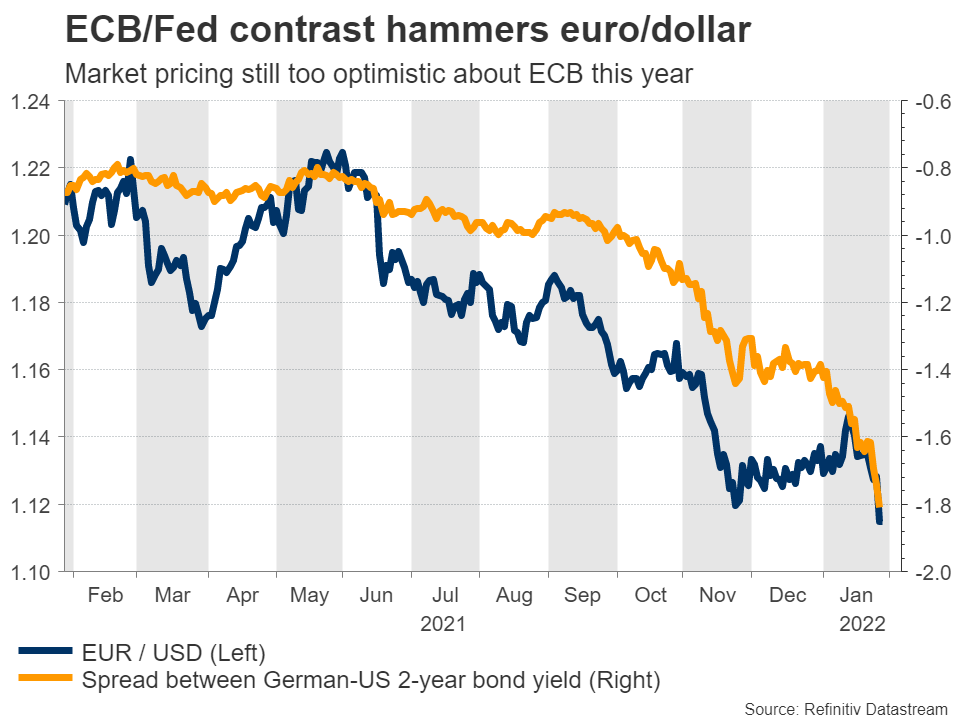
As such, the outlook for the euro remains negative. Money markets are still pricing in 20 basis points of rate hikes this year, which seems unrealistic and allows scope for disappointment. Political risk is back on the radar too. The possibility of early elections in Italy is growing, the French presidential election is approaching, and geopolitical tensions in Eastern Europe don’t seem to be cooling.
Ahead of the ECB meeting, there is a flurry of data releases, including preliminary GDP numbers for Q4 on Monday and the latest inflation stats on Wednesday.
RBA could ‘massage’ rate bets
The Australian economy has enjoyed a strong spell of growth in recent months, after the strict lockdowns were lifted. The labor market is now stronger than it was pre-pandemic, consumption has been solid, and inflationary pressures seem to be intensifying.
However, not everything is rosy. The latest PMIs suggest the Omicron outbreak restrained economic growth in January, and there’s a risk that the slowdown in China spills over into Australia given their close trading relationship.
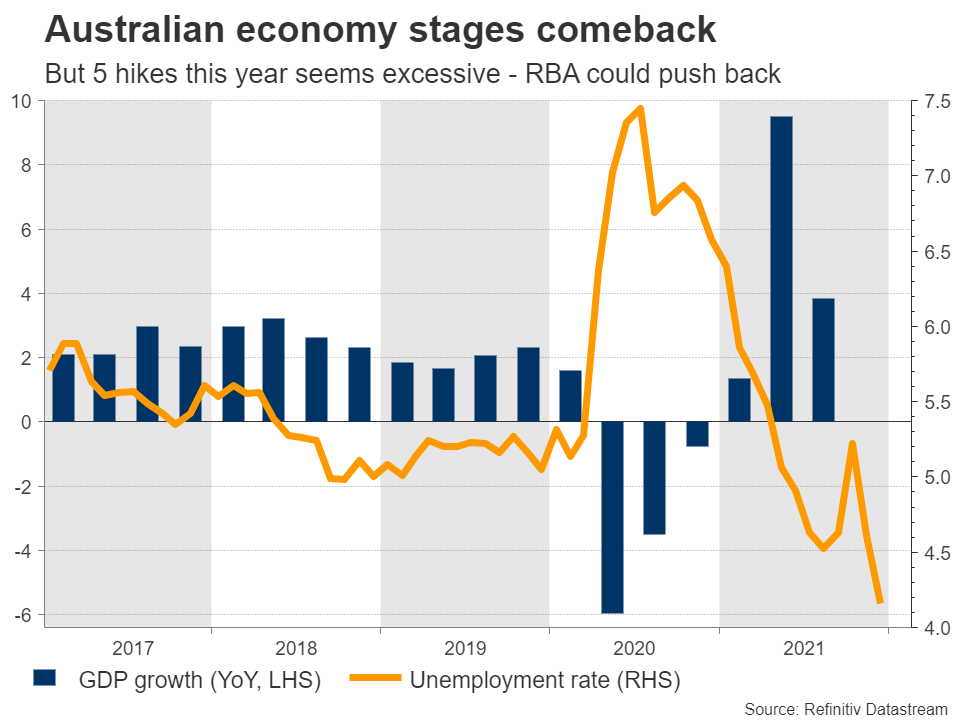
Therefore, the RBA will have to pull off a tough balancing act on Tuesday, signaling that the improvements in the economy suggest rates will likely rise this year, but also warning that the five rate hikes priced into markets are excessive. If they successfully push back against market pricing, the aussie could take another hit.
In neighboring New Zealand, the jobs report for Q4 will also be released on Tuesday. Meanwhile, China’s latest PMI surveys will be released over the weekend and could be crucial for both the aussie and kiwi. Chinese markets will remain closed for the entire week in celebration of the Lunar New Year.
Loonie awaits data and OPEC
Finally in Canada, GDP data for November will be released on Tuesday ahead of the employment report for January, scheduled for Friday. The loonie took a sharp hit this week after the Bank of Canada refrained from raising interest rates, disappointing market expectations.
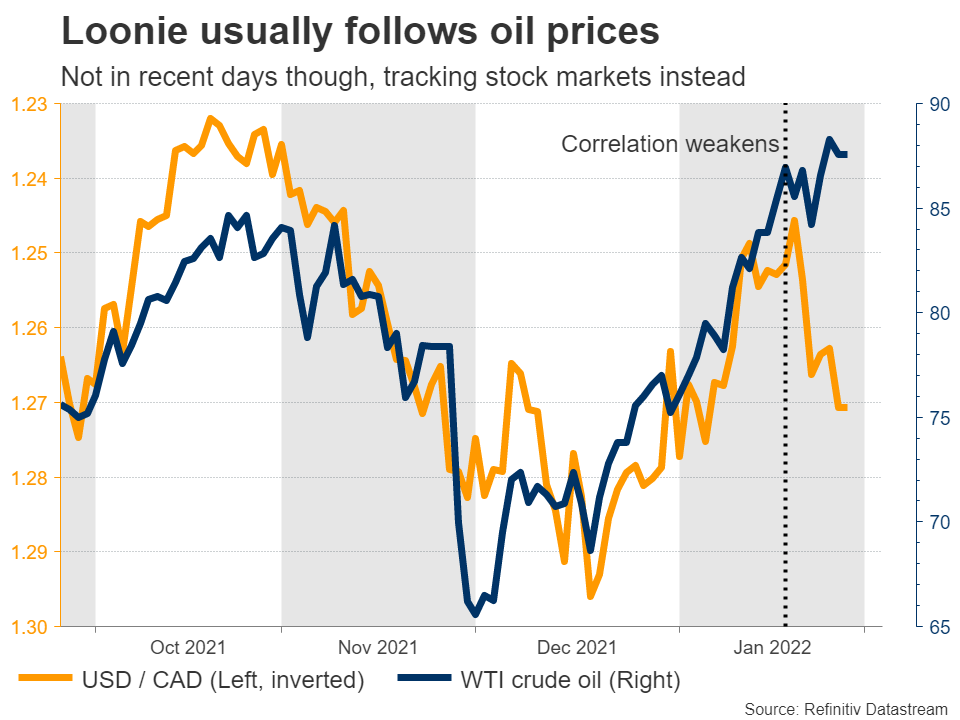
Yet the economy is booming and the central bank all but confirmed that rates will be raised with some force this year. At the moment, the loonie is driven entirely by risk sentiment, suffering alongside equity markets. But over time, it will likely realign itself with Canada’s strong economic fundamentals and roaring oil prices.
OPEC will meet on Wednesday and is expected to stick to its plan of gradual production increases, something that could give oil prices the green light to keep grinding higher.