Sample Category Title
Omicron to Tame Employment Growth in Canada – Temporarily
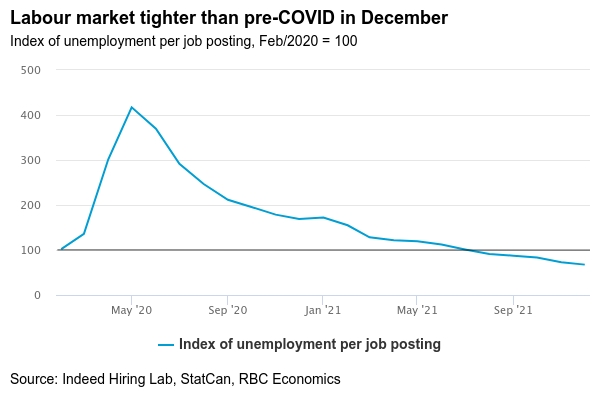
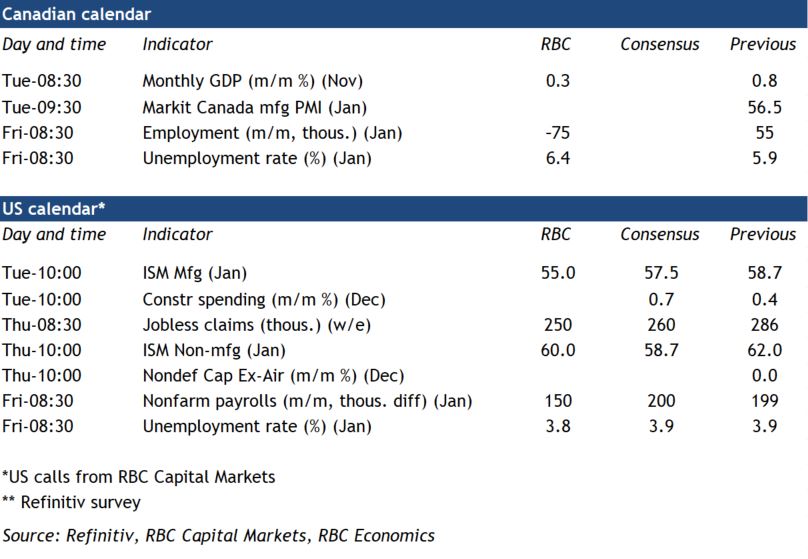
Canadian labour market data for January is expected to weaken substantially. We’re eyeing a 75,000 drop in employment and an uptick in the unemployment rate to 6.4% after COVID-19 restrictions prompted business closures in large parts of the country. Businesses in virtually all industries were reporting acute labour shortages just ahead of the Omicron surge, and are expected to be hesitant to let workers go as quickly as in past virus waves. For sectors unaffected by closures, high rates of absenteeism due to illness and self-isolation will weigh on total hours worked, if not official employment counts. Still, the number of available unemployed workers relative to the number of job postings is already very low—and that will likely still be the case once restrictions are lifted. Health experts are cautiously optimistic about the trajectory of infections in Canada. Overall we do not expect Omicron disruptions to extend significantly beyond the first quarter of 2022.
Coming alongside the employment report will be a somewhat outdated November GDP release. We expect StatCan’s preliminary estimate of a 0.3% increase to be confirmed. Manufacturing, wholesale and retail sales all ticked up in November, with auto production bouncing back at least temporarily from earlier supply chain disruptions. But this strength was partially offset by significant disruptions to transportation activities due to severe flooding in B.C. We expect the early estimate of December GDP growth to be similar to November’s. Our tracking of card transactions showed a large pullback in travel spending due to Omicron in December, but hours worked inched 0.6% higher and the ‘flash’ manufacturing sales estimate showed a 0.8% increase. Overall that should cap off Q4 growth at around 6% annualized, and leave output in 2021 4.6% higher on average than the year before similar to the Bank of Canada’s latest estimate in January.
Week ahead data watch:
- US payroll employment in January is expect to rise another 150,000 and the unemployment rate to edge down to 3.8%. The spread of the Omicron variant is not expected to have a significant impact on employment, but could lower hours worked with rapid spread meaning large numbers of work were likely off sick.
Weekly Focus – Stressed Markets as Fed Prepares for Hiking Cycle
It was risk off mood in markets this week as a cocktail of Russia-Ukraine tensions and the outlook for a hawkish Fed drove the VIX volatility gauge to one-year highs. The USD has strengthened significantly; a move that was further amplified when Fed chair Powell in fact took a hawkish stance at the Fed meeting on Wednesday. It implies a hint that the Fed will hike for the first time in March. The Fed needs to tighten financial conditions further to put an end to high inflation and we now expect five rate hikes this year with risks tilted towards even more rate hikes. The market reacted by driving EUR/USD to the lowest level since spring 2020, short dated US yields higher and flattening the curve. The outlook for higher rates implied a tough week for equities, particularly Wall Street, with indices plummeting on a global scale. A hawkish Fed and strong USD was not enough to stop the trend higher in commodities in general and oil markets in particular as Brent oil traded above USD90/bbl.
The euro area economy has shrug off Omicron in the beginning of the new year as composite PMI remained in expansionary territory at 52.4. The service sector shows resilience to the pandemic although growth slowed, while the manufacturing sector accelerated again amid easing supply chain delays. Inflation remains a concern as prices charged for goods and services rose at a record rate in January. Also German Ifo figures were quite uplifting as headline improved amid a significant improvement in expectations for the coming six months. The assessment of the current business only declined slightly.
Also the US economy proved in good shape with Q4 GDP-growth of 1.7% qoq, beating expectations. Some was driven by inventory rebuilding, but private consumption remained strong. That said, GDP remains below the pre-COVID growth path and thus the figures are another testimony to the fact that potential GDP has declined permanently in the US.
Next week will be busy in the euro area. The economic recovery has slowed significantly and we expect Q4 GDP-growth at 0.4%. January inflation likely dipped as German VAT effect falls out but energy will continue to keep inflation elevated for some time. We expect headline inflation at 4.3%. We expect no changes from the ECB on Thursday, but the meeting has certainly become more interesting in the light of the hawkish Fed and we will look out for changes in the inflation assessment.
In the US, Fed speeches will be particularly interesting, as we might get more details about the likely policy path. We expect the jobs report will show jobs growth around the current level of 200,000. Employment growth is unlikely to pick up pace until more people return back to the labour force.
We expect a small decline in Chinese PMIs, but there will be some noise from the Chinese New Year so the number should be interpreted with caution. The Reserve Bank of Australia (RBA) is widely expected to end QE purchases on Tuesday. We do, however, think RBA is unlikely to take as hawkish stance as markets are currently pricing. We will also keep a close eye on a potential new meeting between Russia and the US. If such a meeting will indeed be set up, it will be hard to imagine a Russian move into Ukraine near-term.
Brace for a More Aggressive Fed: Adding More Monetary Tightening to Our Forecast
Summary
- The FOMC made it crystal clear on Wednesday that rate hikes are imminent, and Chair Powell embraced a hawkish tone in his post-meeting press conference. In that regard, Powell left open the possibility of sequential rate hikes.
- We now think it is likely that the Committee will hike rates by 25 bps at the March 16, May 4 and June 15 policy meetings. Previously, we had anticipated that the FOMC would pause in May.
- Along with 25 bp rate hikes in September and December, we now forecast that the FOMC will raise its target range for the federal funds rate by 125 bps over the course of 2022. We continue to look for 75 bps more of additional rate hikes next year.
- The Committee is still discussing the steps it will take to reduce the size of the Fed's balance sheet. But we think it is likely that it will pull forward balance sheet reduction relative to what we had previously anticipated. Specifically, we look for the Committee to announce balance sheet runoff at the July meeting. Previously, we had expected the announcement to be made in September.
- Powell noted that the economy is in a much different place today than when the last tightening cycle commenced in December 2015. Consequently, a more rapid pace of monetary tightening relative to the last cycle seems to be appropriate today.
Fed Tees Up a Rate Hike in March With More to Come
In the statement that the Federal Open Market Committee (FOMC) released at the conclusion of its policy meeting on Wednesday, it was crystal clear that monetary tightening is imminent. Specifically, the statement said "with inflation well above 2 percent and a strong labor market, the Committee expects it will soon be appropriate to raise the target range for the federal funds rate." We wrote in a report on Wednesday that "unless the economy comes completely off the rails between now and the next FOMC meeting on March 16, we think the Committee will announce a 25 bp hike in its target range for the fed fund rate at that meeting." We continue to stand by that statement.
But what really struck us was a number of comments that Chair Powell made in his post-meeting press conference. For starters, Powell said that there was "very strong support" on the Committee for moving soon. In other words, it appears that a rate hike in March is all but assured. A reporter noted that market participants more or less expect the FOMC to hike rates at every other meeting this year, and then questioned whether the Committee could move faster. Powell did not rule out the possibility that the FOMC could potentially tighten policy at a faster pace. Of course, Fed officials are hesitant to pre-commit to policy changes. But we think it is telling that Powell not only left open the possibility of sequential rate hikes, but made a pointed effort to emphasize how different the economy is today compared to the past cycle when the FOMC raised rates no more than 25 bps per quarter, and that "these differences are likely to have important implications for the appropriate pace of policy adjustment." Another reporter noted that there was not a Summary of Economic Projections (SEP) released after the meeting—the FOMC publishes its forecasts only in March, June, September and December—and questioned whether committee members may have revised their forecasts had a SEP been published. Powell replied that he likely would have raised his inflation forecast for 2022.
In light of this hawkish rhetoric from the Fed Chairman, who was speaking on behalf of the entire Committee and not just for himself, we have made some adjustments to our monetary policy outlook. Specifically, we now believe it is likely that the FOMC will hike rates by 25 bps at the March 16, May 4 and June 15 policy meetings (Figure 1). Previously, we thought that the Committee would stand pat in May. We think the Committee will take a breather on raising the fed funds rate at the July 27 meeting although, as we discuss below, we expect it will announce the start of balance sheet runoff at that meeting. We look for another 25 bp rate hike at the September 21 meeting before the Committee pauses again at the November 2 meeting ahead of the midterm elections. We then look for one more 25 bp increase in 2022 on December 14. We expect the more gradual pace of rate hikes in the second half of the year to be warranted by deceleration in spending and in some slowing in the rate of inflation, as well as by balance sheet runoff getting up to full speed.
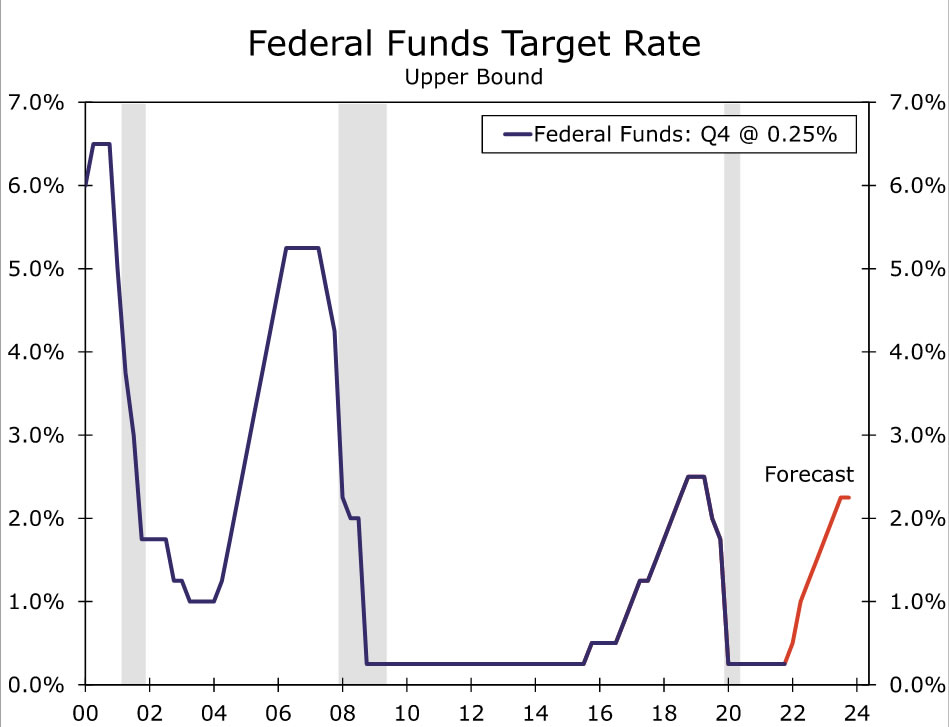
In sum, we forecast that the FOMC will raise its target range for federal funds rate by 125 bps between March and the end of the year. Previously, we had looked for 100 bps of tightening this year. We continue to expect that the Committee will raise rates by 75 bps more over the course of 2023 with 25 bp rate hikes in the first, second and third quarters of the year.
Bringing Forward Balance Sheet Reduction
When the Chairman was asked about steps to reduce the size of the Fed's balance sheet, he said that discussions were ongoing but that no decisions had been made yet. Furthermore, he said a number of times that the Committee will continue its discussions about balance sheet reduction in the next "couple" or "few" meetings. In other words, it does not seem likely that the Committee will initiate balance sheet runoff at its next meeting on March 16, but the Committee is clearly working to formulate a plan. We recently wrote a report in which we discussed our views regarding the pace of balance sheet reduction. Specifically, we thought the FOMC would announce its plans for balance sheet runoff at the September 21 meeting. We expected that the Federal Reserve would allow $20 billion of Treasury securities and $5 billion of mortgage-backed securities (MBS) to roll off its balance sheet in October. Then every month thereafter we anticipated that the Fed would increase the amount of the caps by $10 billion and $5 billion, respectively. At that pace, the central bank would allow up to $70 billion worth of Treasury securities and up to $30 billion worth of MBS to roll off its balance sheet in March 2023, and we thought the Fed would maintain that pace of balance sheet reduction through the end of 2024.
In light of Wednesday's developments, we now think that the Committee will bring forward its announcement of balance sheet reduction to the July 27 meeting with commencement in August. As noted previously, we expect the FOMC will take a pass on a rate hike at that meeting, but the beginning of balance sheet reduction will also be another form of monetary policy tightening. If, as we currently anticipate, the Federal Reserve follows the same monthly schedule that was detailed above, then it will reach its monthly caps of $70 billion of Treasury securities and $30 billion of MBS in January 2023 rather than in March, as we previously forecasted (Figure 2).
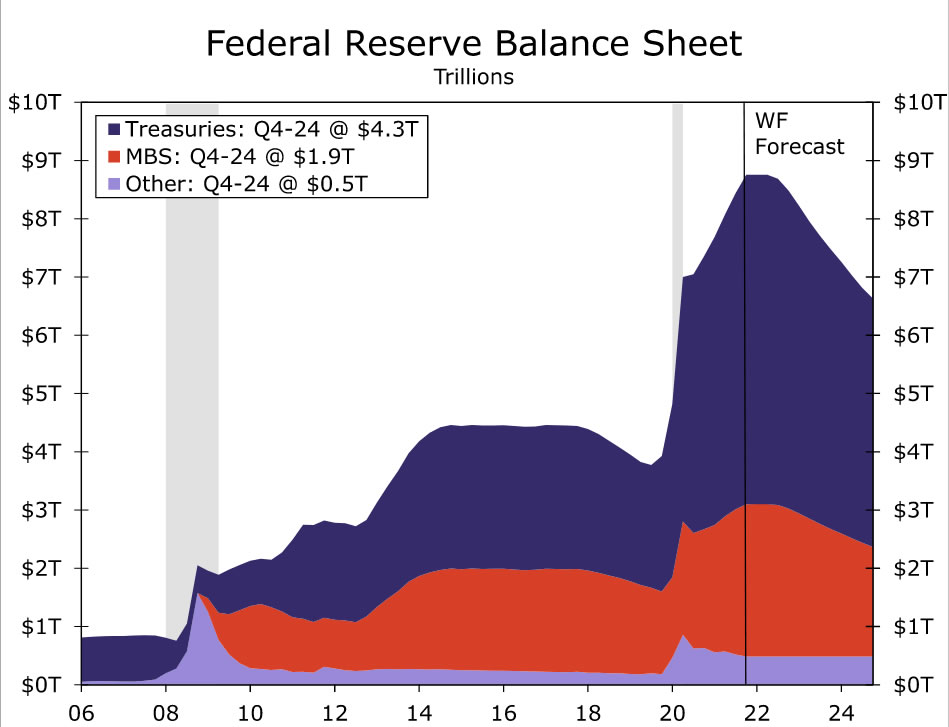
As noted above, Chair Powell said on Wednesday that the economy is in a different place today than when the last tightening cycle commenced in December 2015. The unemployment rate stood at 5.0% at the end of 2015, and the core rate of PCE inflation was roughly 1%. Today, the jobless rate is 3.9% and the core rate of PCE inflation is nearing 5%. Consequently, a more rapid pace of monetary tightening relative to the last cycle seems to be appropriate today. The steps we outlined above clearly would be more aggressive than what we thought would transpire prior to Wednesday's FOMC meeting, let alone the steps the FOMC took during the last tightening cycle.
Sunset Market Commentary
Markets
Risk sentiment remains shaky with main European indices losing up to 2%. The EuroStoxx 50 does hold above the lows from the start of the week (4035) and the incoming mild uptrend line / neckline multiple top formation (4051). Losing those levels would be disastrous from a technical point of view and introduce the start of a new selling wave. We understand investor caution going into the weekend given the instability in the Russia/Ukraine conflict and following this week’s hawkish Fed message. US equity futures turned Apple-led gains into losses and face a key session as well. The same reasoning holds as for European indices: stay above the lows from the start of the week or risk a new selling wave. The dollar initially eked out additional gains with a new recovery high for DXY at 97.44 and for EUR/USD at 1.1121, but started losing momentum going into the US eco data releases. The move coincided with rebound action higher in short term US Treasuries. December PCE deflators were roughly in line with expectations, but this shouldn’t surprise after yesterday’s Q4 GDP print. Income-related figures disappointed. The employment cost index slowed from 1.3% Q/Q in Q3 to 1% Q/Q in Q4. Personal income rose by 0.3% M/M in December, down from 0.5% and vs 0.5% expected. Personal spending declined by 1% M/M. The US yield curve currently bear steepens with yields adding 0.3 bps (2-yr) to 2.6 bps (30-yr) across the curve. German yields rise by 1.5 bps to 4 bps with the belly of the curve underperforming the wings. A weak German Q4 GDP print (-0.7% Q/Q) didn’t meet with haven buying as it was already flagged by the statistics office. European bond markets continue repositioning in the direction that the ECB will one day or another finally give in to building inflationary pressures. A taper acceleration and 2022 rate hike both feature in such scenario. 10-yr yield spreads vs Germany are broadly unchanged. The fifth attempt to elect an Italian president failed as well. There will be an extra voting round later today. Next week’s eco calendar features the key US eco data at the start of the month (ISM’s, ADP & payrolls) and several central bank meetings. The ECB meets on Thursday, but for now is expected to keep a blind eye to the inflation problem. The March meetings, including new forecasts, is probably the better fit to make a U-turn. The Bank of England is expected to deliver back-to-back rate hikes for the first time since 2004. Lifting the policy rate to 0.5% will simultaneously initiate the natural roll-off of the balance sheet. The Czech National Bank is number three to convene on Thursday and will likely deliver another 75 bps rate hike to 4.5%. The CNB has one the most aggressive tightening cycles amongst developed nations for now. Based on current forecasts, it could be the last or second-to-last rate hike with the CNB policy rate peak probably being somewhere between 4.5% and 5%. The Australian central bank (RBA) on Tuesday could decide to abruptly end net asset purchases and perhaps open the window for rate hikes later this year, something money markets are already discounting.
News Headlines
Belgian GDP grew 0.5% q/q in the final quarter of last year, preliminary data by the NBB showed. Compared to the same period one year earlier, GDP was 5.6% bigger and 6.1% on an annual basis. The industry pulled the economy, growing 3.3% q/q in value added, followed by the services industry at a distance (0.3% q/q). Construction declined 0.6% q/q. Inflation in Belgium meanwhile soared in the first month of 2022. Prices rose a stunning 2.23%, the largest m/m increase since March 1951, to bring the yearly figure a near four-decade high of 7.59% (vs 5.71% in December). 4.97 ppt comes from surging energy alone. Core inflation however also rose, from 2.53% y/y to 2.98%. Services inflation accelerated from 2.82% to 3.35%.
The cost of insuring sub-IG corporate bonds via credit default swaps hit the highest level since November 2020 in Europe and the US. Spreads with investment grade CDSs reach a similar milestone. Insurance costs have been on the rise since the start of the year with markets becoming wary of the potential impact of (US) monetary policy normalization on the corporate life.
US: Income Growth Softer, Consumption Declines in Line with Estimates
Personal income rose 0.3% m/m in December, slightly below the consensus forecast for 0.5% m/m. November growth was revised up from 0.4% m/m to 0.5% m/m. Compensation of employees (+0.6% m/m) was the primary driver of higher income, but it was partially offset by a decrease in proprietors' income (-1.4% m/m).
Removing the effect of price changes and taxes, real personal disposable income was down 0.2% in December, while November's decline held steady at -0.2%.
Nominal personal spending slid by 0.6% month-on-month in December, bang on with the consensus estimate. The November reading was revised down from 0.6% to 0.4% m/m
- Goods spending declined by 2.6% m/m from a downwardly revised decline of 0.2% in November (originally +0.1%). The weakness is largely attributed to a pull-back in consumption of durables goods, which declined by 4.1% m/m. Non-durables spending also contracted by 1.7% m/m .
- Services spending held up with 0.5% m/m growth in December, but the November reading was revised down to +0.7% m/m (from 0.9% m/m originally). The gain was largely attributed to spending on health care.
In real terms, spending growth was down 1.0%, a tick stronger than market expectations (-1.1% m/m).
The PCE price deflator rose by 0.4% m/m in December, which translated into 5.8% in year-over-year (y/y) terms (as expected). Excluding food and energy, core PCE inflation was up 0.5% m/m and 4.9% y/y (vs. 4.8% expected).
The personal saving rate was higher at 7.9% in December, reflecting growing income and the pull-back in consumption.
Key Implications
Put off by rising prices and limited inventories, American households pulled back on spending in December. It is hard to pin the pullback on Omicron, as demand for high-contact services managed to stay relatively strong, offsetting some the losses in goods spending. Still, in real terms, services spending has a way to go. It ended the year 0.7% below its pre-pandemic level.
Inflation is top of mind for many, including central bankers. The Fed's preferred measure of inflation – core PCE deflator – came in stronger than expected and well above the central bank's 2% target. This week, Federal Reserve Chairman Jerome Powell stressed that "there is quite a bit of room to raise interest rates," essentially committing to a rate hike at the next FOMC meeting in March. We think that three more rate hikes will follow.
In the meantime, Omicron has likely weighed on January spending. The services sector remains particularly vulnerable as the impact from weaker contact-sensitive demand is exacerbated by capacity constraints and worker absenteeism. Still, solid income growth and some $2 trillion in excess saving, make the case for a rebound in consumption growth as the virus ebbs.
EUR/USD Mid-Day Outlook
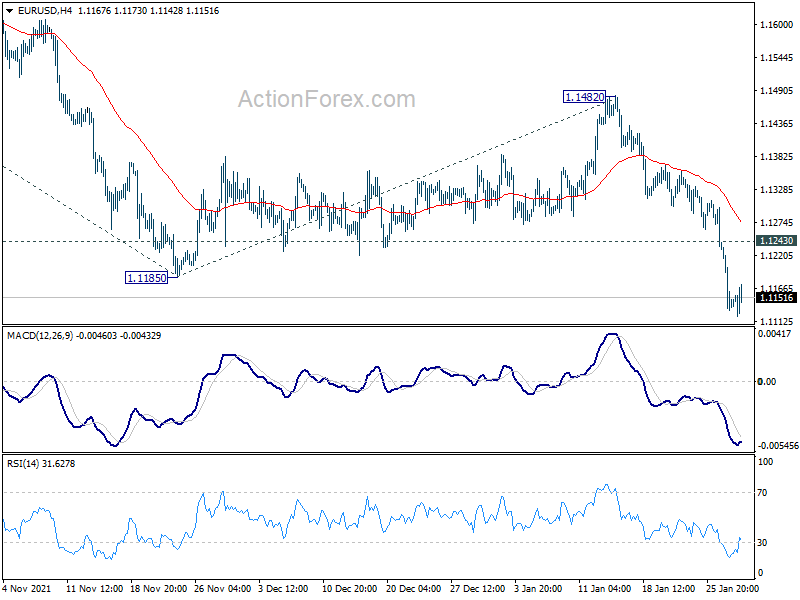
Daily Pivots: (S1) 1.1103; (P) 1.1173; (R1) 1.1214; More...
EUR/USD's decline is still in progress and intraday bias remains on the downside. Larger down trend from 1.238 has just resumed. Deeper fall should be seen to 61.8% projection of 1.1908 to 1.1185 from 1.1482 at 1.1035. Break will target 100% projection at 1.0759. On the upside, above 1.1243 minor resistance will turn intraday bias neutral first. but recovery should be limited well below 1.1482 resistance to bring down trend resumption.
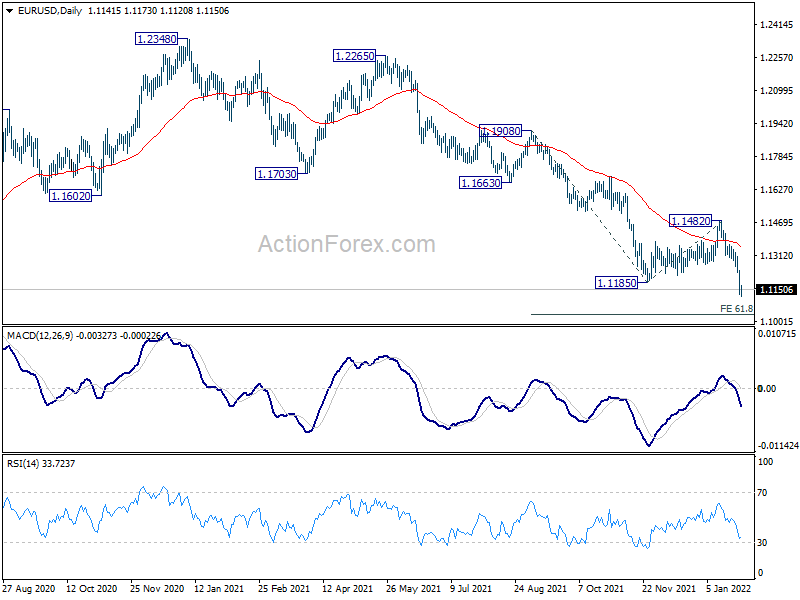
In the bigger picture, there are various ways of interpreting the fall from 1.2348 (2021 high). It could be a correction to rise from 1.0635 (2020 low), the fourth leg of a sideway pattern from 1.0339 (2017 low), or resuming long term down trend. In any case, outlook will now stay bearish as long as 1.1482 resistance holds. Next target would be 1.0635 low.
GBP/USD Mid-Day Outlook
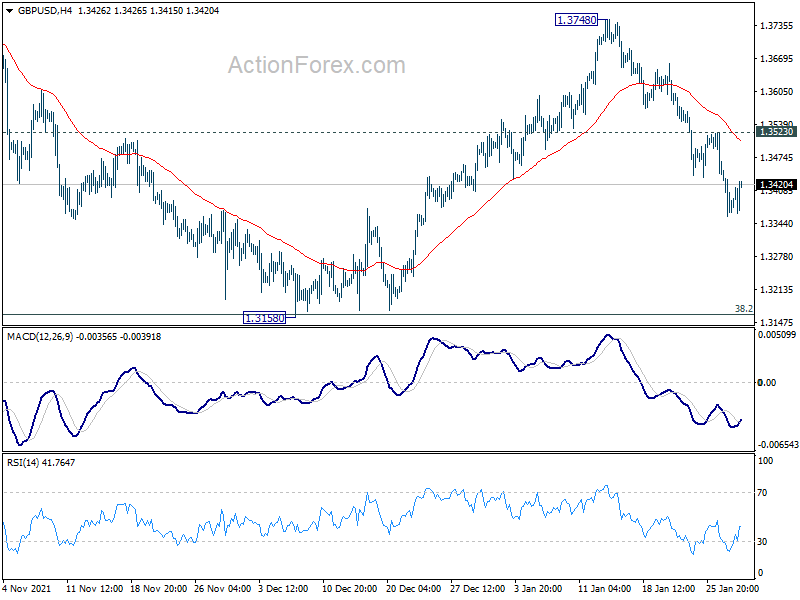
Daily Pivots: (S1) 1.3337; (P) 1.3403; (R1) 1.3447; More...
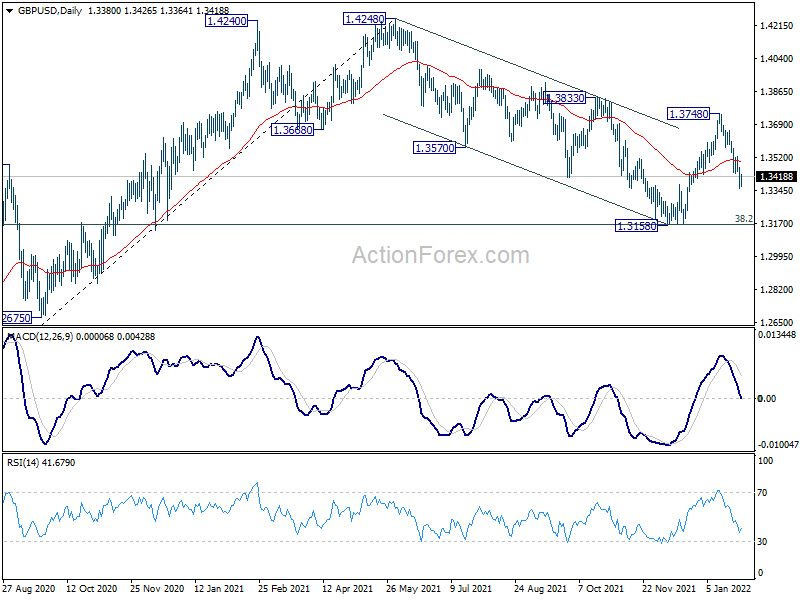
Intraday bias in GBP/USD remains on the downside, as fall from 1.3748 is still in progress for retesting 1.3158 low first. Break there will resume larger down trend from 1.4248. On the upside, though, above 1.3523 minor resistance will turn bias back to the upside for retesting 1.3748.
In the bigger picture, strong support was seen from 38.2% retracement of 1.1409 to 1.4248 at 1.3164. The development suggests that up trend from 1.1409 (2020 low) is still in progress. On resumption, next target will be 38.2% retracement of 2.1161 to 1.1409 at 1.5134. Nevertheless sustained break of 1.3164 will argue that whole rise from 1.1409 has completed and bring deeper fall to 61.8% retracement at 1.2493.
USD/CHF Mid-Day Outlook
Daily Pivots: (S1) 0.9194; (P) 0.9220; (R1) 0.9268; More....
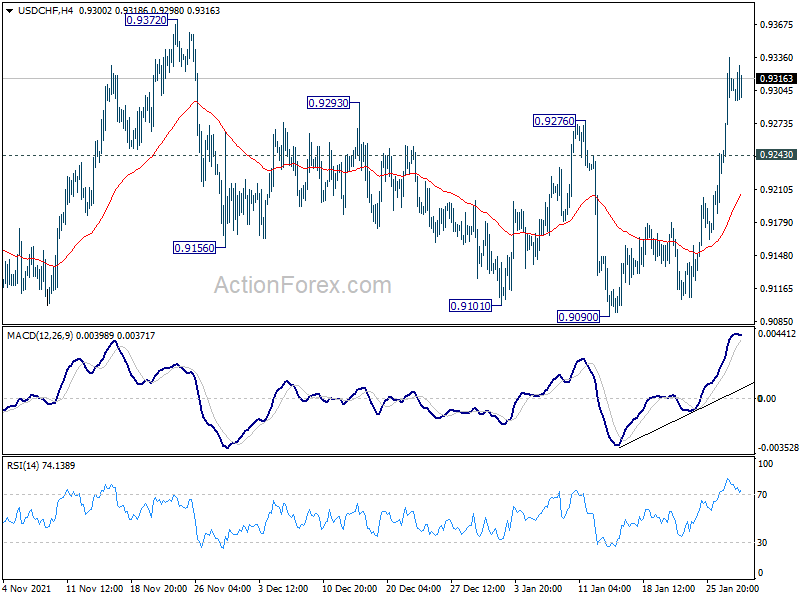
Intraday bias in USD/CHF stays on the upside, as rise from 0.9090 is in progress for retesting 0.9372 resistance first. Firm break there will target 0.9471 resistance next. On the downside, below 0.9243 minor support will turn intraday bias neutral first. Overall, choppy rise from 0.8925 would still extend higher as long as 0.9090 support holds, even in case of deep retreat.
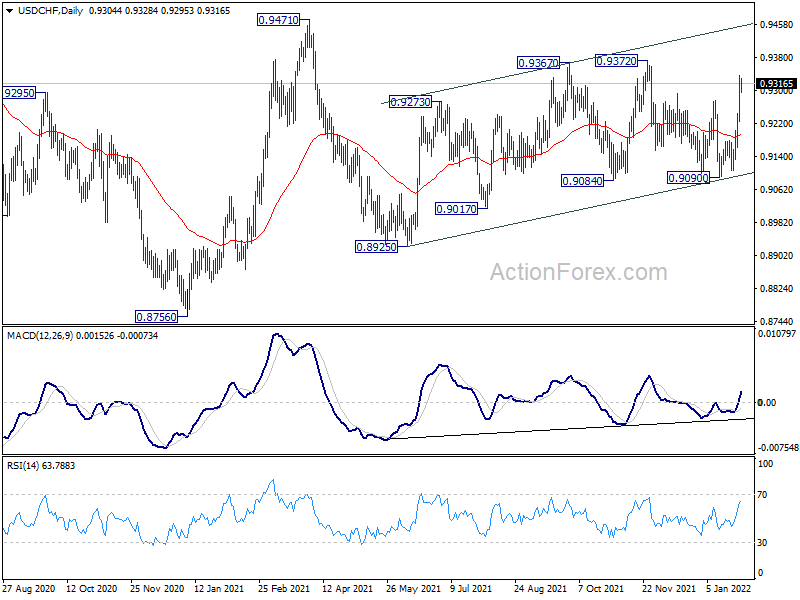
In the bigger picture, the corrective structure of the rebound from 0.8925 argues that fall from 0.9471 is not complete yet. It could either be the second leg of pattern from 0.8756 (2021 low), or resuming larger down trend from 1.0237 (2018 high). We'd pay attention to the downside momentum and assess the odds later. But for now, medium term outlook will be neutral at best as long as 0.9471 resistance holds.
USD/JPY Mid-Day Outlook
Daily Pivots: (S1) 114.74; (P) 115.11; (R1) 115.75; More...
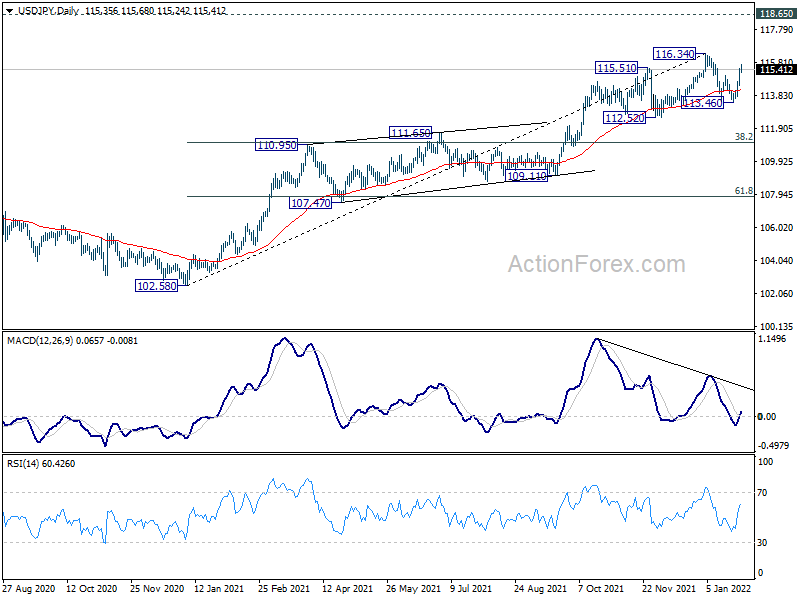
Intraday bias in USD/JPY stays on the upside as rise from 113.46 is in progress for retesting 116.34 high. Decisive break there will resume larger up trend for 118.65 long term resistance next. On the downside, below 114.46 minor support will mix up the near term outlook and turn intraday bias neutral again.
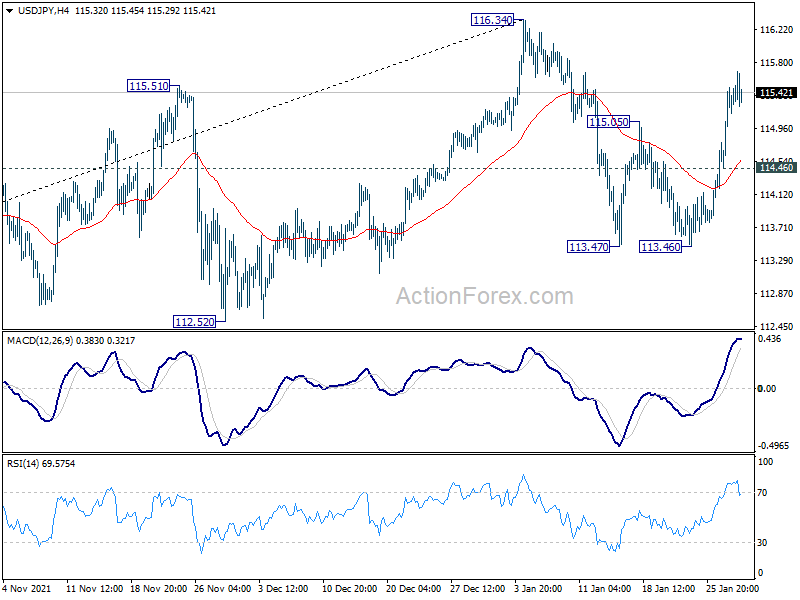
In the bigger picture, no change in the view that rise from 102.58 is the third leg of the up trend from 101.18 (2020 low). Such rally should target a test on 118.65 (2016 high). Sustained break there will pave the way to 120.85 (2015 high) and raise the chance of long term up trend resumption. This will remain the favored case as long as 55 week EMA (now at 110.91) holds.
AUD/USD Mid-Day Report
Daily Pivots: (S1) 0.6998; (P) 0.7060; (R1) 0.7095; More...
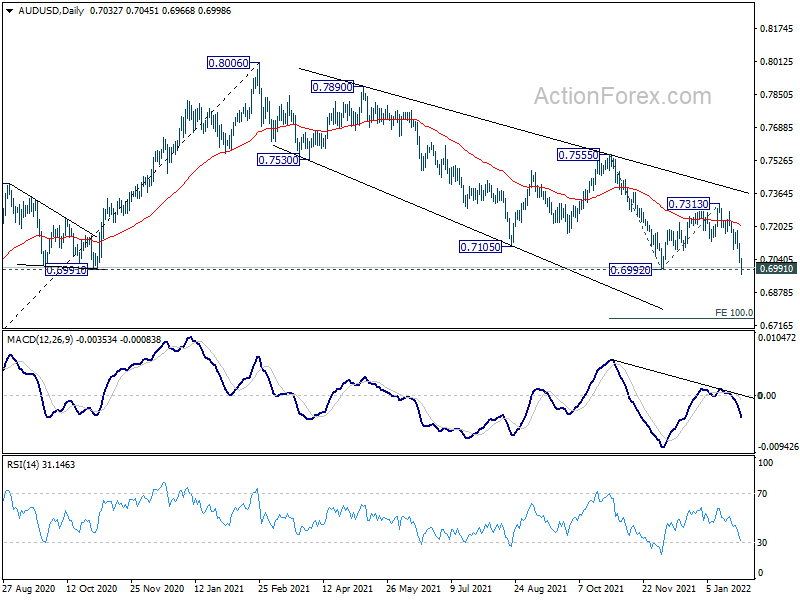
AUD/USD drops further to as low as 0.6966 so far today and intraday bias remains on the downside. Sustained break of 0.6991/2 support will confirm resumption of larger down trend from 0.8006, and carries larger bearish implication. Next target will be 100% projection of 0.7555 to 0.6992 from 0.7313 at 0.6750. On the upside, break of 0.7089 minor resistance will mix up the near term outlook and turn intraday bias neutral first.
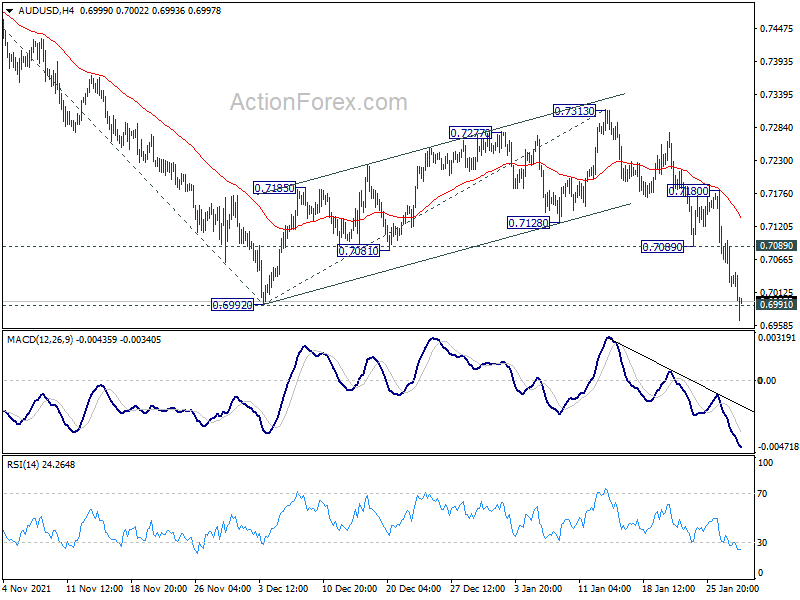
In the bigger picture, focus remains on 0.6991 key structural support. Sustained break there will argue that the whole up trend from 0.5506 might be finished at 0.8006, after rejection by 0.8135 long term resistance. Deeper decline would then be seen back to 61.8% retracement of 0.5506 to 0.8006 at 0.6461. Meanwhile, strong rebound from 0.6991 will retain medium term bullishness. That is, whole up trend from 0.5506 is still in progress.