

Sample Category Title
Eco Data 1/3/22
[php_everywhere instance="1"]
Leading Banks Forecast for 2022: JPY, GBP, CAD, AUD, CHF, SEK, CNH
We talked a week ago about what experts from the world's leading banks and agencies think about the behavior of the EUR/USD pair in the coming 2022. And the fact that we paid attention to it in the first place is quite logical: after all, this pair is the most traded on the Forex market, and the European currency itself leads by a huge margin in the formation of the US Dollar Index DXY, with 57.6%.
Recall that DXY was developed by the US Federal Reserve in 1973 and shows the ratio of the US dollar to a basket of 6 major world currencies. This basket includes euro (57.6%), Japanese yen (13.6%), British pound (11.9%), Canadian dollar (9.1%), Swedish krona (4.2%) and Swiss franc (3.6%).
In our opinion, the economic situation in the world has changed quite a lot over the past almost half a century since the inception of DXY. And at least the Chinese yuan should have appeared in the basket. Therefore, below we will look at the prospects for both the currency pairs that form the dollar index: USD/JPY, GBP/USD, USD/CAD, USD/SEK, USD/CHF, and some other, AUD/USD, NZD/USD, EUR/GBP and USD/CNH.
USD/JPY: Japan Needs a Weak Yen
It is known that inflation, along with the recovery of the labor market, is one of the two main factors that central banks focus on in their monetary policy.
The positive GDP gap is also called the inflation gap, because it indicates that the growth of aggregate demand outstrips the growth of aggregate supply and accelerates inflation. This, according to the IMF, will be observed in the United States (+ 3.3%) and Canada (+ 0.8%) in 2022. And regulators will have to take active steps to tighten their monetary policy in order to contain inflation. And this, according to experts from the Dutch banking ING Group (Internationale Nederlanden Groep), will give the currencies of these countries, primarily the USD, an advantage over the currencies of those countries where GDP has negative gap. It is also called recessionary, since the excess of supply over demand is the path to deflation.
The recession gap has been observed since 2008 in Japan and is likely to repeat in 2022. That is why the policy of the Bank of Japan is one of the most dovish among the central banks of other countries, and the interest rate on the yen has been held at a negative level for a long time, minus 0.1%.
The head of the Bank of Japan, Haruhiko Kuroda, has recently said that a weak yen would rather help the country's economy than harm it. According to the senior official, if the yen falls, it will support exports and corporate profits.
ING Group believes that such a differentiation between the approaches of the US Federal Reserve and the Japanese regulator will strengthen the dollar's position against the yen. Their quarterly forecast for USD/JPY for this year is as follows: Q1 - 114.00, Q2 - 115.00, Q3 - 118.00 and Q4 - 120.00.
The French financial conglomerate Societe Generale estimates the probability that the pair will rise to 116.00 in the Q2 at 50%, and up to 118.00 - 25%. Experts bet the remaining 25% on a bearish scenario and the fall of the pair to 110.00.
Analysts from other leading global banks also prefer the dollar. However, unlike their colleagues from ING, a number of forecasts has the peak not at the end, but in the middle of the year. Barclays Bank's forecast looks like this: Q1 - 115.00, Q2 - 116.00, Q3 - 116.00 and Q4 - 115.00. The CIBC (Canadian Imperial Bank of Commerce) forecast paints a similar picture: Q1 - 115.00, Q2 - 116.00, Q3 - 115.00, Q4 - 114.00.
Reuters interviewed the largest banks represented on Wall Street and published the opinion of their experts regarding the values of the USD/JPY pair in the second half - late 2022. For the most part, forecasts point to a strengthening dollar: JP Morgan Q3 - 114.00, Amundi Q4 - 116.00, Morgan Stanley Q4 - 118.00. On the contrary, Goldman Sachs believes that the pair will fall to 111.00 in 2023.
GBP/USD: At the Crossroads of Three Roads
Regarding the future of the British currency, British investment Barclays Bank has taken a very patriotic stance. His strategists consider the pound to be highly undervalued and predict that the GBP/USD pair will return to the 2021 highs and rise to 1.4200 by the end of the year.
Unlike most investment banks, Barclays believes that the policy of the US Federal Reserve does not provide strong support for the US currency at all, and this will lead to its moderate depreciation. The Bank expects other central banks to take a more aggressive stance than the Fed, with higher interest rates, thereby limiting the attractiveness of the dollar. First of all, of course, we are talking here about the Bank of England.
As for the short-term outlook for the pound, Barclays' analysts are more cautious here, as the impact of high inflation will neutralize the potential support from a slight increase in interest rates. In addition, concerns about the new wave of COVID-19 and the difficulties with the EU due to Brexit need to be considered. As a result, Barclays' quarterly forecast is as follows: Q1 - 1.3300, Q2 - 1.3700, Q3 - 1.4000 and Q4 - 1.4200.
Capital Economics, one of the leading independent research centers in the UK, took the opposite position. Its specialists, on the contrary, expect the pound to weaken, and refer to a combination of 1) weak economic growth, 2) slowdown in inflation and 3) slowness of the Bank of England. These three factors may lead to the fact that the regulator of the United Kingdom may raise the rate to only 0.5% in the coming months instead of 1.0%, and thus disappoint the markets.
But, in addition to the growth and fall of the British currency, there is a third scenario. ING Group analysts predict that the pound will be somewhere in the middle of a triangle of a stronger US dollar, stable commodity currencies and weaker low-yielding currencies. Therefore, according to their scenario, the GBP/USD pair will move in a sideways trend: Q1-1.3300, Q2-1.3400, Q3-1.3400 and Q4-1.3400.
Other Currency Pairs
If Barclays Bank believes in its national currency, CIBC (Canadian Imperial Bank of Commerce) specialists are quite pessimistic about the future. In their opinion, the Canadian dollar may become weaker this year. "Markets overestimated the possible actions of the Bank of Canada in 2022," says CIBC, "and underestimated the Fed in 2022. Recalibration will leave CAD out of favor with investors." The bank's forecast for the USD/CAD pair is as follows: Q1-1.2800, Q2-1.2900, Q3-1.3000 and Q4-1.3000.
Experts at HSBC (Hongkong and Shanghai Banking Corporation) believe that some currencies will still be able to hold their ground against the stronger US dollar, including the Australian dollar. HSBC believes that the Reserve Bank of Australia may take a more hawkish position, given the rather strong macroeconomic data.
ING strategists do not exclude that the Australian dollar may benefit from undervaluation and being oversold either. However, taking long positions on the AUD/USD pair, in their opinion, still carries a high risk.
In addition, according to ING experts, together with the euro (EUR/USD) and the Japanese yen (USD/JPY), the Swiss franc will also lag significantly behind the dollar (USD/CHF) in 2022 as well as Swedish Krona (USD/SEK).
Barclays Bank's forecast for other currency pairs included in the palette of trading instruments of the brokerage company NordFX is as follows: EUR/GBP : Q1 - 0.87, Q2 - 0.86, Q3 - 0.85, Q4 - 0.84 | USD/CHF : Q1 - 0.91, Q2 - 0.90, Q3 - 0.90, Q4 - 0.90 | AUD/USD : Q1 - 0.75, Q2 - 0.76, Q3 - 0.77, Q4 - 0.78 | NZD/USD : Q1 - 0.73, Q2 - 0.73, Q3 - 0.73, Q4 - 0.73 | USD/CAD : Q1 - 1.23, Q2 - 1.22, Q3 - 1.21, Q4 - 1.21 | USD/CNH : Q1 - 6.35, Q2 - 6.30, Q3 - 6.40, Q4 - 6.50.
Summary 1/3 – 1/7
Monday, Jan 3, 2022
[php_everywhere instance="1"]
Tuesday, Jan 4, 2022
[php_everywhere instance="2"]
Wednesday, Jan 5, 2022
[php_everywhere instance="3"]
Thursday, Jan 6, 2022
[php_everywhere instance="4"]
Friday, Jan 7, 2022
[php_everywhere instance="5"]
Market Morning Briefing: Dollar-Yen Has Paused Below 115
STOCKS
Dow and Dax have risen sharply today and can test 37000 and 16200 on the upside respectively. Nikkei and Shanghai have come down, but have supports at current levels which if holds can produce a bounce towards 29500 & 3650/3700 in the coming sessions, else a fall to 28000 & 3550 is possible respectively. Nifty needs to rise above 17400 to test 17800 else can fall back to 17000. Sensex can rise towards 58000-59000 in the coming sessions.
Dow (36398.20, +95.83, +0.26%) has risen again today. The index tested a high of 36527.26 before coming down. The view is bullish to see a test of 37000 on the upside while above 36000.
DAX (15963.70, +128.45, +0.81%) has risen again today. The index has room to rise towards 16200 before we see a fall down to 15200 is seen.
Nikkei (28809.86, -259.30, -0.89%) has come down after reaching a high of 29106.28. The index needs a sustained break above 29000 to test 29500. While below 29000 a fall back to 28500/28000 is possible.
Shanghai (3604.8, -25.53, -0.70%) has come down today. The index has a good support at 3600 which if broken can take the index down towards 3550-3500. A bounce from the support at 3600, if seen can take index up towards 3700 in the coming sessions.
Nifty (17233.25, +147.00, +0.86%) rose sharply yesterday. The 17400 level is a good resistance, which broken can take the index up towards 17800, else a fall to 17000 will be on the cards.
Sensex (57897.48, 477.24, +0.83%) has risen yesterday. The view is bullish to see s rise towards 58000 and 59000 eventually while the index holds well above 57000.
COMMODITIES
Crude prices continue to rise towards expected resistances before a decline is seen. Gold has also dipped while below 1820 keeping the 1820-1760 range intact for now. Silver needs to sustain above 23 to move up. Copper has scope to rise to 4.60/65 on a break above 4.45/50.
Brent (78.97) and WTI (75.92) continue to trade higher and could test 81-83 and 79-80 respectively before we see a fall in the medium term. Immediate view is bullish for the near term.
Gold (1805.60) has dipped further today not able to rise to test 1815/20 as expected indicating that the resistance is holding strong. While below 1820, we continue to look at a range of 1760-1820 to continue.
Silver (23.04) is stable near levels seen yesterday. The price needs to sustain above 23 to rise higher slowly towards 24-24.50 on the upside.
Copper (4.4235) has dipped slightly. While above 4.38/40, there is scope for a rise towards 4.50 which needs to break in order to head higher towards 4.60/65. Watch price action near 4.45/50 for now.
FOREX
Dollar index is trading along the trend support near 96, unable to decide which way to move to. A break below 96 can drag it lower to 95.50-95 before a rise is again seen. Euro is holding below 1.1350 and can test 1.1250-1.12 if 1.1350 holds strong. EURJPY trades below 130.50 and can fall to 129. Aussie and Pound are stable just now. USDINR can rise from 74.60 towards 75-75.20/25 else can fall to 74.20-74.00. Watch price action near 74.60 today. USDCNY and USDJPY are stable just now.
Dollar Index (96.158) is trading above 96 unable to break lower just now although it is trying to attempt over the last few sessions. While below 96.50, there can be scope of a an eventual break below 96 to head lower towards 95.50-95.00 before a sharp reversal is seen. Watch closely for a break below 96
Euro (1.1306) has fallen from levels seen yesterday indicating that the 1.1350 resistance seems to be holding for now. While below 1.1350, we may expect a dip back to 1.1250-1.12 on the downside.
EURJPY (129.88) has dipped from 130.22 and while the fall sustains, it can fall to 129.50-129.30 in the near term. Only a sustained break above 130.50 if seen will be bullish for the cross for the medium term. Till then a range of 129-130.50 may hold.
Aussie (0.7224) has dipped. We may expect immediate range of 0.72-0.7250/70 to hold for now.
Pound (1.3436) has risen well and can continue to rise towards 1.35-1.3550 on the upside before declining from there.
Dollar-Yen (114.83) has paused below 115 and may reamin in a sideways narrow range of 115-114.70/50 for the near term. A break above 115 is needed to trigger a possible rise towards 117/118 in the longer run. For now, watch price action near 115.
USDCNY (6.3712) is stable and may continue to trade within 6.3732-6.3646 region for the near term.
{USDINR (74.6450) can bounce from 74.60 to head towards 75.0-75.20/25 on the upside. Failure to hold above 74.60 can take it down towards 74.20-74.00 on the downside in the coming 2-4 weeks. Watch price action near 74.60 today.
INTEREST RATES
The US Treasury yields broadly remain stable across tenors. We expect the yields at the far-end to break above their near-term resistances and move up within their broad expected sideways range. The German yields sustain higher and remain stable. The view is bullish to see a further rise from here. The 10Yr has risen contrary to our expectation to see a fall. It has room to move up further and then come down again. The 5Yr GoI has also risen and can move up in the near-term before reversing lower again.
The US 2Yr (0.74%), 5Yr (1.24%) and the 10Yr (1.47%) Treasury yields remain stable while the 30Yr (1.90%) has inched up slightly. We expect the yields at the far-end can rise to 1.6%-1.65% (10Yr) and 2% (30Yr) in the coming weeks. A break above 1.53% (10Yr) and 1.93% (30Yr) can accelerate the rally. Overall, we reiterate that 1.3%-1.65% (10Yr) and 1. 7%-2% (30Yr) will be the range of trade for some time.
The German 2Yr (-0.66%), 5Yr (-0.50%), 10Yr (-0.24%) and 30Yr (0.10%) continues to remain higher and stable. We retain our bullish view of seeing a rise to -0.1%/-0.05% (10Yr) and 0.25% (30Yr) in the coming days.
The Indian 10Yr (6.4901%) GoI has risen breaking above 6.48%. This has negated the fall to 6.44%-6.4% that we have been mentioning over the last few days. The 10Yr GoI can now test 6.55% in the near-term and then reverse lower again to 6.5% and maybe even lower thereafter.
The 5Yr (5.8397%) GoI has also risen above 5.82% and can now test 5.85%-5.86% on the upside before reversing lower again. A fall below 5.8% will be needed to drag it down to 5.74%.
Euro Hovers At 1.13 Line
On the final day of 2021, the major pairs are stuck in tight ranges. The euro is trading quietly at 1.1310 in the European session.
This holiday week was characterized by a dearth of economic releases and illiquid markets. That left the markets vulnerable to volatility due to market-movement headlines, but in the end, the currency markets had a generally quiet week.
The Omicron wave has caused a massive rise in infections, with the US setting an all-time daily record earlier this week. Still, the markets have been calm and collected about Omicron, relying on reports that show that the newest Covid variant is extremely contagious but causes less severe illness than previous Covid variants which caused tremendous economic damage. On Thursday, US chief medical advisor said that we could see a peak in the US in late January. This means that Omicron isn’t going away anytime soon, and the infection numbers will continue to be sky-high into the new year. The critical question for the markets is how sick are those people who are infected with Omicron – if we don’t see a huge spike in hospitalisations, then market sentiment should not be weighed down by Omicron.
The markets haven’t let Omicron ruin the positive mood, with the S&P 500 and Dow Jones posting record highs and a movement in the currency markets away from the safe-haven dollar. This upbeat mood was reinforced this week by a larger than expected decline in US crude oil inventories and an unemployment claims release of 198 thousand, which was better than expected. This suggests that the US economy continues to perform well, even with the explosion in Omicron cases.
EUR/USD Technical
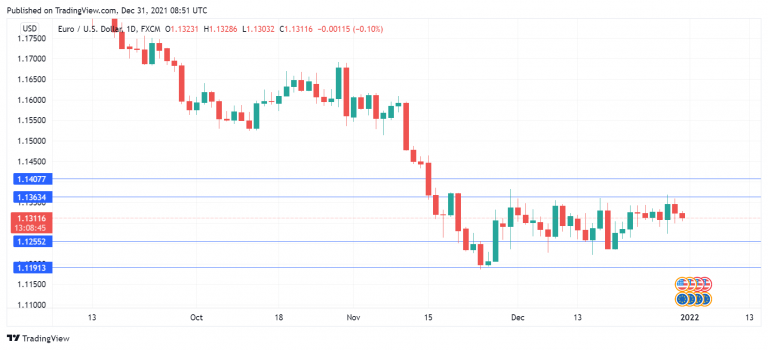
- EUR/USD has support at 1.1255. Below, there is support at 1.1190
- There is resistance at 1.1364 and 1.1408
Daily Technical Analysis
EUR/USD
Current level - 1.1323
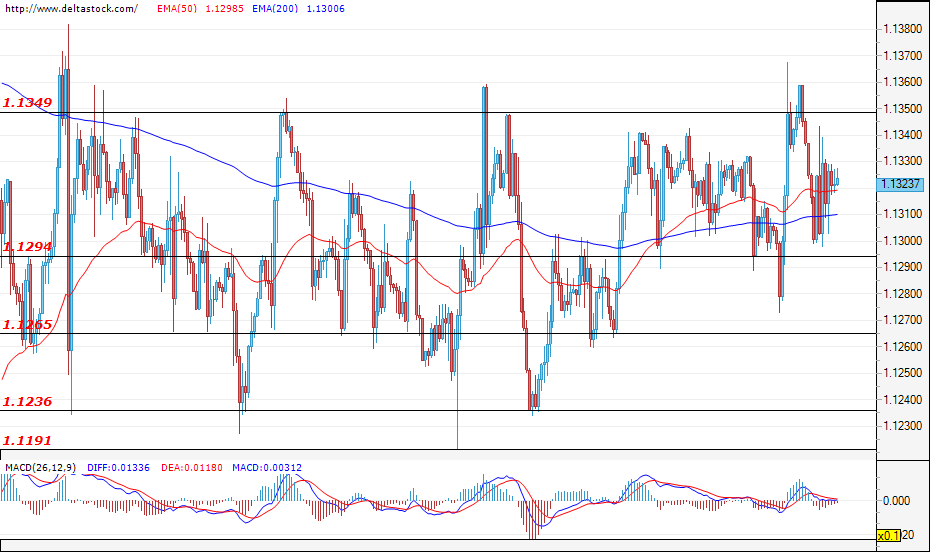
In the last couple of days, the currency pair has been trading in the range of 1.1294 – 1.1349 and neither the bulls nor the bears have so far managed to take control. A confirmed breach of either of the borders of the range would set the future direction for the EUR/USD. At the time of writing the analysis, the most likely scenario is for the pair to test the resistance level of 1.1349 and head towards the next resistance zone at 1.1460. An unsuccessful breach of the mentioned level would most likely lead to a price reduction towards the support zone at 1.1294. This, in turn, could strengthen the bearish mood and pave the way for the currency pair towards the next zone from the higher time frames at 1.1236.
| Resistance | Support | ||
| intraday | intraweek | intraday | intraweek |
| 1.1350 | 1.1460 | 1.1294 | 1.1235 |
| 1.1460 | 1.1500 | 1.1265 | 1.1190 |
USD/JPY
Current level - 115.03
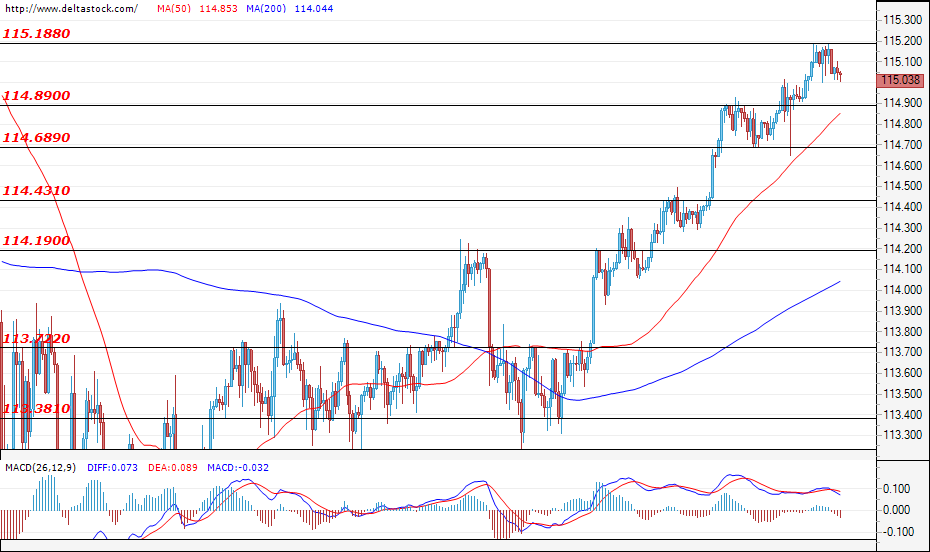
The pair failed to violate the resistance at 115.18 and, in the early hours of today, activity is rather low. However, the positive sentiment for an appreciation of the U.S. dollar against the yen still remains. If the bulls manage to overcome the resistance zone at 115.18, then this would probably lead to an appreciation of the U.S. dollar and the next target for the bulls would be the resistance at 115.44. In the opposite direction, if the mentioned resistance crumbles to the bullish pressure, then the pair may head towards a test of the support at 114.89.
| Resistance | Support | ||
| intraday | intraweek | intraday | intraweek |
| 115.20 | 115.44 | 114.89 | 114.43 |
| 115.44 | 116.00 | 114.68 | 114.20 |
GBP/USD
Current level - 1.3500
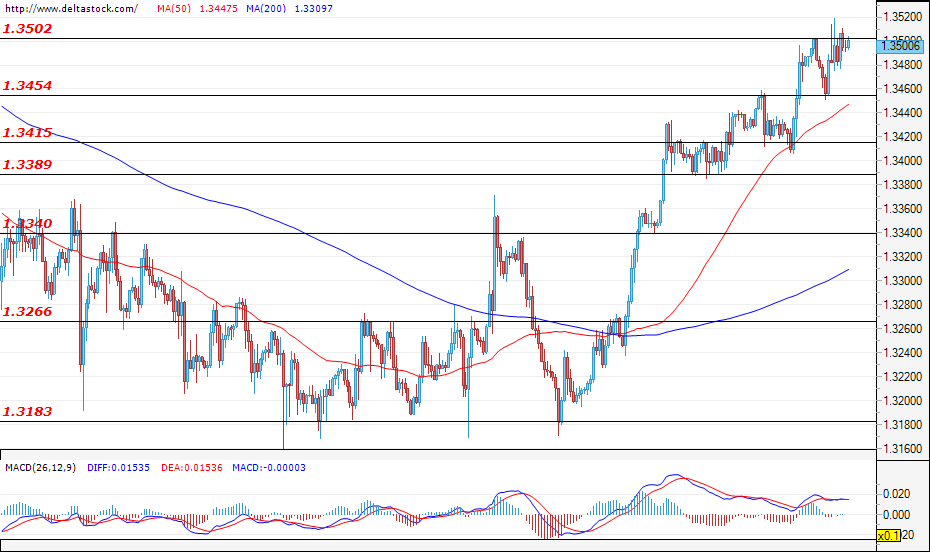
Yesterday’s test of the resistance zone at 1.3500 was unsuccessful and, at the time of writing, the sterling is trying to violate this level. If it is successfully breached, then this would head the pair towards a test of the next resistance at 1.3580. If the pair stays below the mentioned level, then the most likely scenario would be for the Cable to head towards the support at 1.3454.
| Resistance | Support | ||
| intraday | intraweek | intraday | intraweek |
| 1.3500 | 1.3580 | 1.3454 | 1.3389 |
| 1.3580 | 1.3603 | 1.3415 | 1.3340 |
Hang Seng Outperforms, HK TECH Index Bounces After Tough Year
General trend
- Generally quiet FX session seen; USD/JPY remains above ¥115.
- WTI Crude trades modestly lower.
- US equity FUTS extend declines in Asia.
- Hang Seng pared gain but ended higher by 1.2% [TECH index rose by over 3.5%]; HSI ended 2021 down > 14%, TECH index declined by 33%; China South City Holdings [property developer] to receive equity investment from state-owned co.
- Shanghai Composite ended morning trading higher [Property index outperformed]; the index has risen by ~6% in 2021.
- S&P ASX 200 extended decline [Financials and Consumer indices declined]; the index rose by ~12% in 2021.
- Tesla raised prices in China.
- LIBOR transition in focus [On March 5, 2021, the United Kingdom Financial Conduct Authority (FCA) and Intercontinental Exchange (ICE) Benchmark Administration (IBA) announced that the one-week and two-month U.S. dollar (USD) LIBOR settings will cease to be published immediately after December 31, 2021. The publication of overnight and one-, three-, six-, and 12-month USD LIBOR settings will be extended through June 30, 2023].
Headlines/Economic Data
Australia/New Zealand
- ASX 200 opened flat, closed -0.7%.
Japan
- Nikkei 225 closed for holiday.
Korea
- Kospi closed for holiday.
- (KR) SOUTH KOREA DEC CPI M/M: 0.2% V 0.0%E; Y/Y: 3.7% V 3.7%E [highest annualized pace in ~10 years].
- (KR) Bank of Korea (BOK) Gov Lee: Reiterates timing of policy change depends on economy; reiterates will continue adjusting policy.
- (KR) South Korea Nov Department Store Sales Y/Y: 9.6% v 21.0% prior; Discount Store Sales Y/Y: -10.3% v +1.4% prior.
- (KR) South Korea Govt extends social distancing rules for an additional 2-weeks - Yonhap.
- (KR) South Korea Fin Min Hong: South Korea Will seek macro policy mix to help exports and consumption; To manage economy and risk factors in 2022.
China/Hong Kong
- Hang Seng opened +1.9%, closed +1.2%; Shanghai Composite opened +0.2%.
- (CN) CHINA DEC MANUFACTURING PMI (GOVT OFFICIAL): 50.3 V 50.0E [highest since Jul].
- (CN) China Agriculture Ministry said the end of Nov sow herd at ~43.0M heads, +4.7% y/y and -1.2% m/m - financial press.
- (CN) China State Planner (NDRC): Urging quicker application of infrastructure REITs.
- (CN) China PBOC Open Market Operation (OMO): Sells CNY10 0B in 7-day reverse repos v CNY100B prior; Net inject: CNY90B v CNY90B prior.
- (CN) China PBOC sets Yuan reference rate: 6.3757 v 6.3674 prior.
- (CN) China PBOC Advisor Liu Shijin: China should look to adjust structure of economy to achieve faster growth over short term macro policies.
- (CN) During the China Spring Festival railway passenger trips are seen at 280M, +29% y/y - Xinhua.
- Huawei: Q4 Rev seen at CNY178.2B, -19% y/y; 2021 Rev seen at CNY634B, down ~30% y/y - US financial press.
- (CN) China President Xi to deliver New Year speech on Fri [Dec 31st] at 7pm local time [11 am GMT] - Xinhua.
North America
- (US) WEEKLY EIA NATURAL GAS INVENTORIES: -136 BCF VS. -118 BCF TO -115 BCF INDICATED RANGE.
- (US) DEC CHICAGO PURCHASING MANAGERS INDEX (PMI): 63.1 V 62.0E.
- (US) INITIAL JOBLESS CLAIMS: 198K V 206KE; CONTINUING CLAIMS: 1.72M V 1.87ME.
- (US) Reported that hundreds of homes have been destroyed in Boulder County Colorado - Press.
- (US) California Gov Newsom announces state of emergency in several counties [relates to the recent winter storms].
Europe/Middle East
- (RU) ChemRar Group announces the Russian Avifavir drug is effective against variants of COVID-19, including Delta and Omicro.
- (RU) Kremlin spokesperson: Russia is happy with outcome of Putin-Biden talks; US side showed willingness to tackle core Russian concerns; Discussed Russia's desired security guarantees.
- Hunter Douglas [HDG.NL] 3G Capital to buy a 75% controlling stake in company at €175/shr; the total deal worth $7.1B.
Levels as of 00:20 ET
- Nikkei 225, closed, ASX 200 -0.9% , Hang Seng +1.2%; Shanghai Composite +0.4% ; Kospi closed.
- Equity S&P500 Futures: -0.2%; Nasdaq100 -0.2%, Dax closed; FTSE100 -0.5%.
- EUR 1.1328-1.1314 ; JPY 115.12-115.02 ; AUD 0.7267-0.7243 ;NZD 0.6849-0.6820.
- Gold +0.3% at $1,818/oz; Crude Oil -0.6% at $76.58/brl; Copper flat at $4.3908/lb.
Elliott Wave View: Natural Gas (NG) Near The End Of Correction
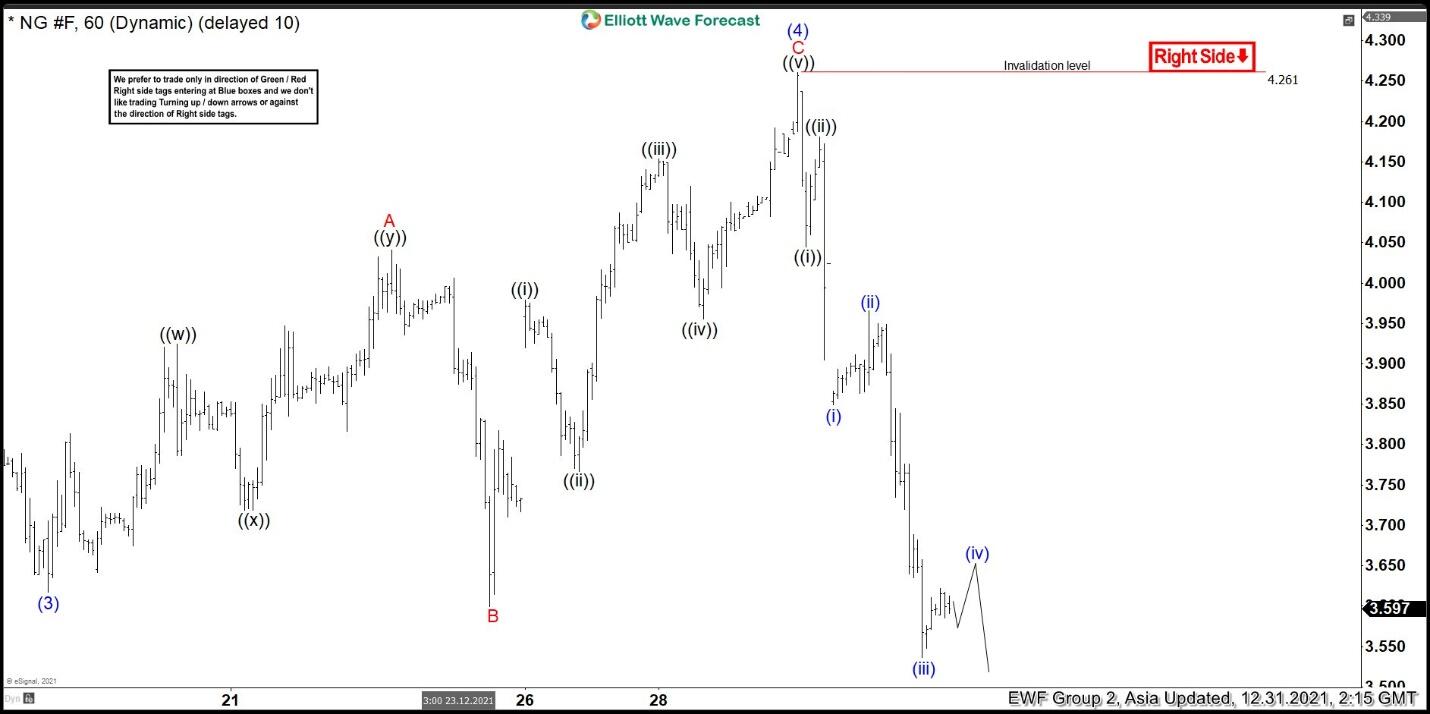
Elliott Wave View in Natural Gas (NG) suggests it is correcting cycle from June 22, 2020 low in larger degree 3, 7, or 11 swing. The decline is unfolding as a flat elliott wave structure. Down from October 6, 2021 peak (6.47), wave ((A)) ended at 4.825 and rally in wave ((B)) ended at 6.291. Wave ((C)) lower is in progress as a 5 waves impulse. The 1 hour chart below shows wave (3) of ((C)) ended at 3.617. Wave (4) of ((C)) bounce ended at 4.261 as an expanded flat structure.
Up from wave (3), wave A ended at 4.041, and pullback in wave B ended at 3.599. Wave C higher ended at 4.261 which also completed wave (4). The commodity has extended lower in wave (5) with internal subdivision as an impulse. Down from wave (4), wave ((i)) ended at 4.045 and wave ((ii)) ended at 4.181. Near term, expect rally to fail in 3, 7, or 11 swing as far as pivot at 4.261 high stays intact for further downside. Once the 5 waves down from wave (4) high is complete, it could either complete wave 1 of (5), or it could end the entire wave (5).
Natural Gas 1 Hour Elliott Wave Chart
Eco Data 12/31/21
[php_everywhere instance="1"]
Week Ahead – NFP Report to Kick Off New Year, Inject Life into Muted FX Market
Markets have been dead quiet during the holiday period but the upcoming week is guaranteed to bring increased volatility. The nonfarm payrolls report along with the FOMC minutes and a host of other US data are bound to wake markets up, while employment and inflation numbers out of Canada and the Eurozone, respectively, should also liven things a little. Although several major pairs have been rebounding against the US dollar and Wall Street has been notching up one record high after another, the incremental moves have been modest. That could all change in the next few days.
NFP and FOMC minutes could roil the dollar
It’s going to be a gradual return to business as usual in most countries except in the United States where it’s set to be a full-on week. The ISM manufacturing PMI is the first top-tier data to greet 2022 on Tuesday. The closely watched manufacturing activity gauge is expected to point to an easing in the PMI from 61.1 to 60.2 in December. If the decline is led by a fall in the priced paid component, that may not be such a bad thing. On the other hand, weaker new orders and a still elevated priced paid index could worry investors.
The JOLTS job openings for November on Tuesday and the ADP private payrolls print due Wednesday will keep traders guessing about the labour market ahead of the all-important jobs report on Friday. Factory orders and the ISM non-manufacturing PMI out on Thursday will be the other key data to be watched prior to Friday.
But of course, all eyes will on the NFP figures, especially after November’s surprise miss and the swelling of Covid-19 cases in recent weeks. Analysts are forecasting an increase of 400k jobs in December and for the unemployment rate do tick lower to 4.1%. Average hourly earnings are expected to have eased from 4.8% to 4.1% year-on-year.
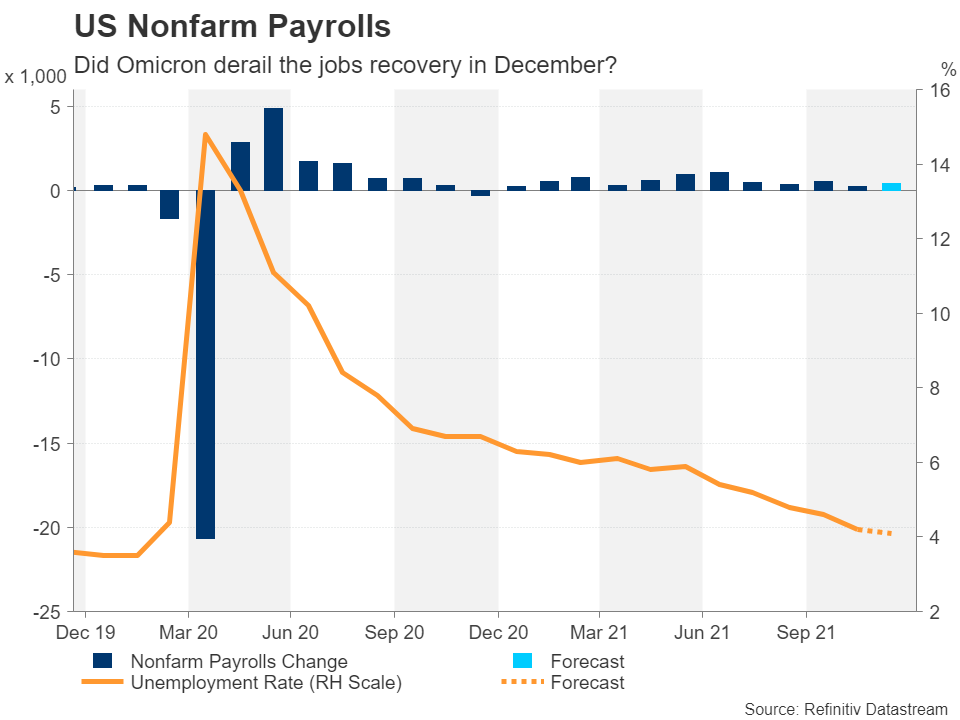
How markets respond to the jobs numbers will probably depend on what tone the FOMC minutes set. The Fed will publish its December meeting minutes on Wednesday and although it’s unlikely to reveal much more than what Chair Powell briefed reporters after the meeting, there could be some clues in the timing of the first rate hike.
The dollar index has been ranging sideways since late November so any shocks from either the minutes or the NFP data could easily trigger a breakout.
Sluggish loonie hoping for OPEC and employment boost
One of the currencies that has barely made any inroads during the greenback’s latest bout of softness is the Canadian dollar. The loonie’s underperformance comes even as oil prices have posted a solid rebound from the early December lows.
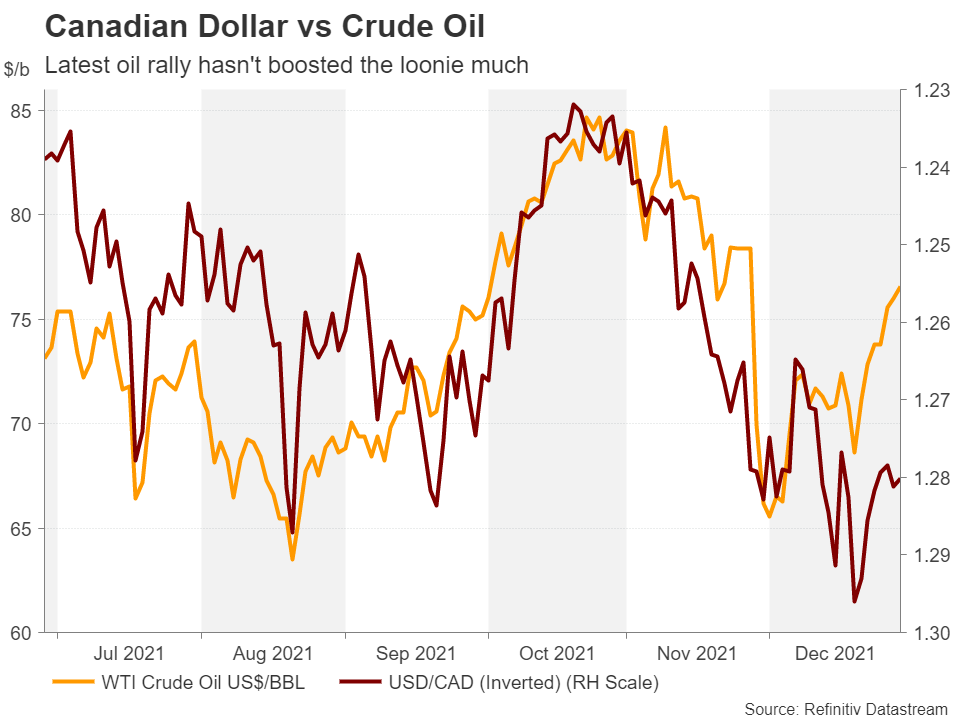
OPEC and its allies meet on Tuesday for their monthly output setting decision. The alliance will probably stick to its existing plan of adding 400,000 bpd each month. Although Omicron has cast a shadow over the demand outlook heading into 2022, the disruptions to air travel from surging virus cases is expected to be temporary and many countries are still facing an energy crunch.
The loonie could gain if OPEC+ sound upbeat about the demand picture but also important will be Friday’s employment figures for Canada. The Canadian economy added an impressive 153.7k jobs in November but December could have been a more difficult month for the labour market as Omicron swept the country.
In other releases, the Ivey PMI is also due on Friday.
Risky currencies on Omicron alert
It’s going to be extremely quiet for the other commodity-linked currencies as there’s no major data out of Australia and New Zealand. But with investors somewhat undecided about how much of an impact Omicron will have on the global economy, any headlines about fresh restrictions could hurt the riskier currencies, including the pound.
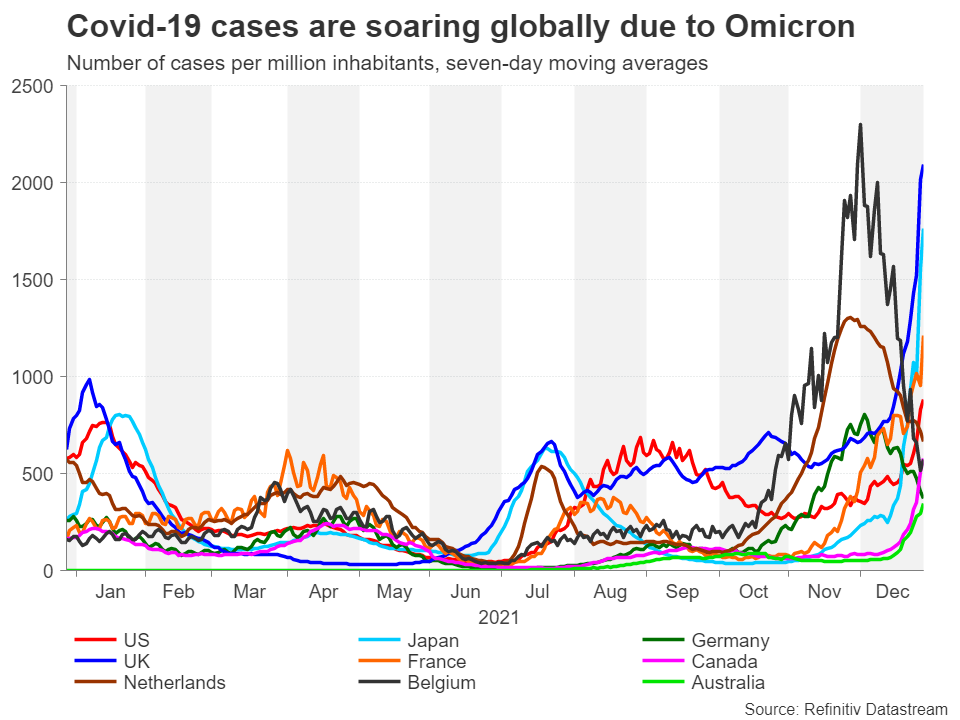
China worries have also been hanging over the markets and the December Caixin manufacturing PMI on Tuesday will likely be monitored for any signs of easing in the economic slowdown.
Meanwhile, over in the UK, investors shouldn’t get overcomplacent about no new virus curbs for England, as Boris Johnson could yet surprise by announcing tighter rules soon after the New Year amid rising hospital admissions from Covid.
The pound would be at risk of suffering a major blow from any such announcement.
The broad relief about Omicron having reduced severity has been negative for the safe-haven Japanese yen. Should risk sentiment sour from escalating infections and possibly tighter restrictions, the yen could enjoy a bit of a revival. In the meantime, Japanese data on household spending, wage growth and inflation in the Tokyo region on Friday will struggle to attract much attention.
Will Eurozone inflation surge again?
Finally, in the euro area, flash CPI for December will be the highlight amid some doubts lately about the European Central Bank’s relaxed stance on soaring inflation. ECB policymakers have been hinting that QE could end in 2022 and rates could start to rise in 2023, though, investors haven’t been buying into this optimism and the euro remains stuck near its 2021 lows.
Eurozone inflation jumped to 4.9% y/y in November and is forecast to have moderated to 4.7% in December. This could take the pressure off the ECB if in the short term. But inflation isn’t the ECB’s only problem as the Eurozone growth outlook has taken a hit from the Omicron wave that’s led to several European governments to impose tougher virus measures.
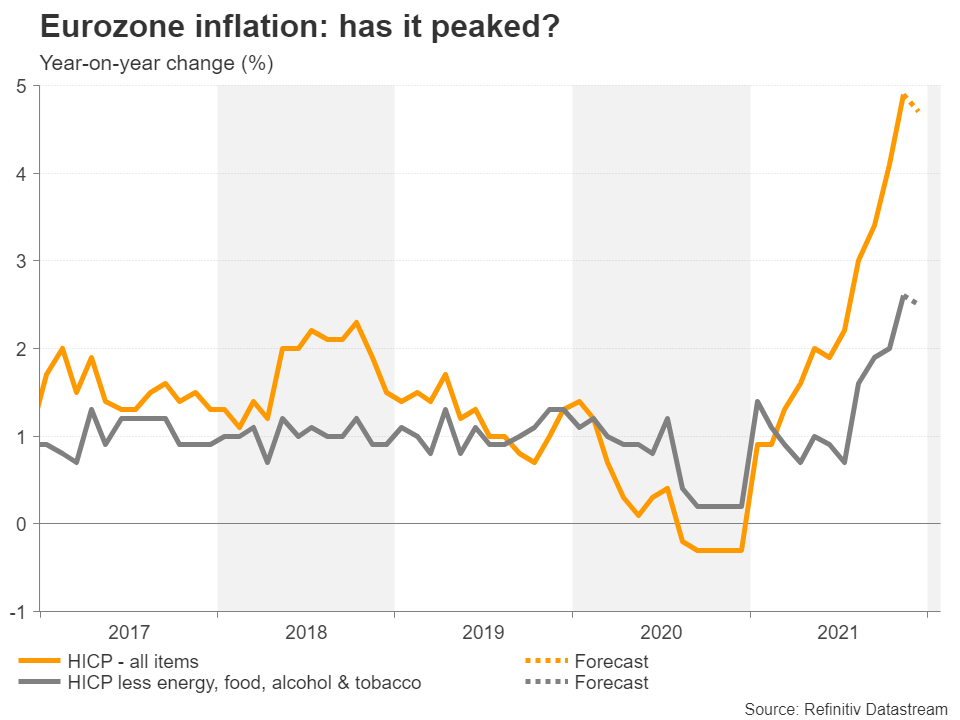
Most don’t think the ECB will be in a position to hike rates anytime soon, hence, why the euro hasn’t been able to make much progress against the dollar.
But there will be plenty of other releases next week to shed some light on the Eurozone economy, including the final manufacturing PMI on Monday, followed by the final services print on Wednesday. German industrial orders are out on Thursday, with the production figures coming up on Friday. Also rounding things up on Friday will be the economic sentiment indicator and retail sales for the bloc.