

Sample Category Title
Euro Slips Below 1.13 But Recovers
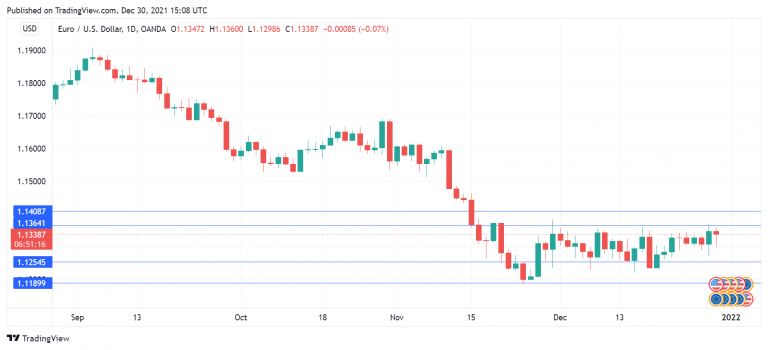
The euro lost ground earlier on Thursday but has recovered most of these losses. EUR/USD is currently trading at 1.1337, down 0.08% on the day.
Risk appetite boosts euro
With a very light economic calendar this week, the markets are being driven by sentiment, which essentially means the latest Omicron headlines. The markets remain fairly upbeat, despite the explosion in Omicron infections. France and the US posted all-time record highs for the number of new cases, but that hasn’t made a dint in investor sentiment. The equity markets are humming, with the S&P 500 and Dow Jones posting record highs, while the safe-haven dollar is broadly lower as risk tolerance remains elevated. This upbeat mood was reinforced by a larger than expected decline in US crude oil inventories and an unemployment claims release of 198 thousand, which was better than expected. This suggests that the US economy continues to perform well, even with the newest Covid wave.
ECB President Christine Lagarde has been rather dismissive of inflationary pressures, even with eurozone inflation hitting a record 4.9% y/y in November. The ECB this month projected that inflation will fall to 1.8% after 2022, but this view is by no means unanimous. In an interview published on Thursday, ECB member Klaas Knot said that eurozone CPI could well remain above the bank’s 2% target for years and that the bank’s forecast “could prove to be too rosy”. The ECB has no plans to change its accommodative policy, and plans to continue QE even while winding up its emergency pandemic programme (PEPP) in March 2022.
Spain’s Flash CPI for December is estimated at 6.7%, much higher than the 5.5% gain in November. If eurozone CPI releases in early January also show an uptick, we could see additional ECB members echo Knot’s view that inflation could stay above the bank’s 2% target in the coming years.
EUR/USD Technical
- EUR/USD has support at 1.1255. Below, there is support at 1.1190
- There is resistance at 1.1364 and 1.1408
Stocks at Highs and Dollar Ticks Slightly Lower
Dollar heavy as sentiment remains positive; US jobless claims send positive messages
Major US stock futures have managed to remain near record highs, while trading volumes have narrowed, and liquidity is drying up as the trading doors near closure for 2021. The question at year end is what effects will the rapidly spreading Omicron variant rollover into the new year, especially as infections have been hot. Also, how will economies start to fare in the new year with an environment where stimulus is diminishing, while inflation remains elevated and supply chains are still hurting the recovery.
The 10-year yield at 1.53% has failed to provide the reserve currency with a final evident boost on the last day of the year.
Today’s key event being the weekly US unemployment claims have dropped beneath the 200K mark, with new claims falling by 8K to 198K in the week ending December 25 and below the expectations and the previous week of 206K. The jobless claim four-week average dropped to 199.25K from previously at 206.50K, signalling that the labour market remains strong.
The reserve currency’s power has waned as of late with the dollar index having ticked back below the 96.00 level.
Stronger yearly inflation of 6.7% in Spain, beating the forecast of 5.6% may have boosted the euro, which sustained its buoyancy around $1.1344 also due to the latest dollar weakness. The pound is showing to be more resilient surging towards $1.3515.
The yen is barely holding above the 115.00 per dollar handle, while the swissie holding at 0.9136 per dollar has recouped today’s shortfalls caused by dollar strength earlier on in Asia.
Oil dips as China cuts import amounts, commodity currencies overpower
WTI oil futures have dipped slightly to $76.12 per barrel after struggling around the $77.00 per barrel mark, following a $10 dollar appreciation in the final week of the year. The slight dip in the commodity may have been assisted by decreases in oil quotas from the largest crude importer China.
Nonetheless, with concerns around the Omicron variant having somewhat toned-down, it will be interesting to see whether the appreciation in the commodity perseveres into the first weeks of 2022, especially as rising Omicron infections have been the topic in the holiday season.
Keep in mind too that OPEC+ will meet on January 4 to contemplate whether to keep on restoring production halted during the pandemic.
Commodity currencies like the aussie and the kiwi have outperformed their peers in the forex arena appreciating to new monthly highs and recouping earlier losses in the Asian sessions. Currently the aussie is at $0.7270 and kiwi at $0.6848. The Canadian dollar regained its strength steering the USD/CAD pair back down to the $1.2770 Asian session lows.
Gold is oscillating around the $1,800/oz significant level but is currently holding a tad above it.
At 14:45 GMT, the Chicago area’s PMI numbers for December will be released, while at 15:30 GMT the figures for natural gas storage in the US are due.
Later, at 01:00 GMT China’s manufacturing PMIs are scheduled.
Yen Weakness Still the Main Theme as US Stocks Might Extend Record Run
Overall outlook in the markets are unchanged, with US futures pointing to slightly higher open. DOW and S&P 500 could continue their record runs. Selloff in Yen remains the main theme while Sterling is strong together with Aussie and Kiwi. Euro and Dollar are both soft and bounded in range against each other.
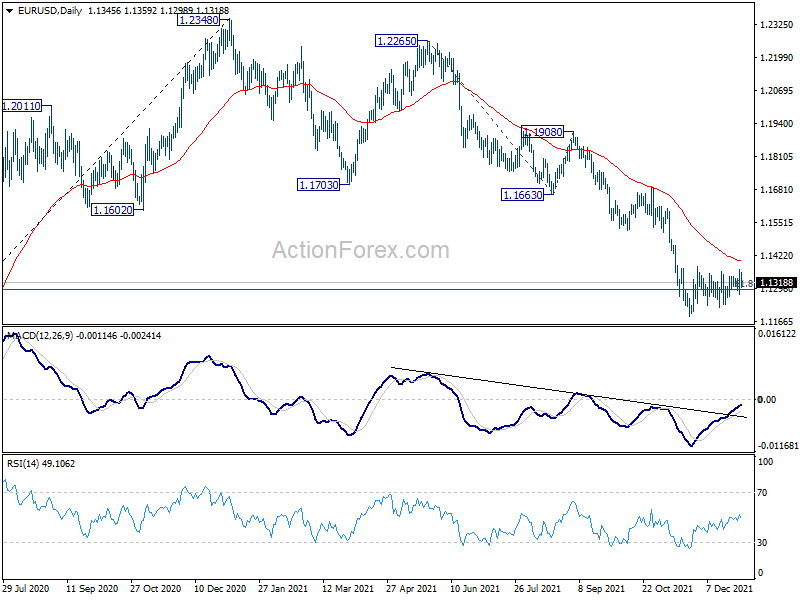
Technically, a range breakout in EUR/USD is long overdue. But we'd probably wait till 2022 to happen. It's rather hard to predict which side the breakout would be. Pure on EUR/USD's technically, the down trend from 1.2348 should continue. This is in line with the outlook in EUR/GBP, EUR/CHF and even EUR/AUD. We'll see.
In Europe, at the time of writing, FTSE is up 0.05%. DAX is up 0.21%. CAC is up 0.29%. Germany 10-year yield is down -0.0188 at -0.202. Earlier in Asia, Nikkei dropped -0.40%. Hong Kong HSI rose 0.11%. China Shanghai SSE rose 0.62%. Singapore Strait Times dropped -0.36%. Japan 10-year JGB yield rose 0.012 to 0.072.
Happy new year our readers. We'll be back on Jan 4.
US initial jobless claims dropped to 198k, lowest since 1969
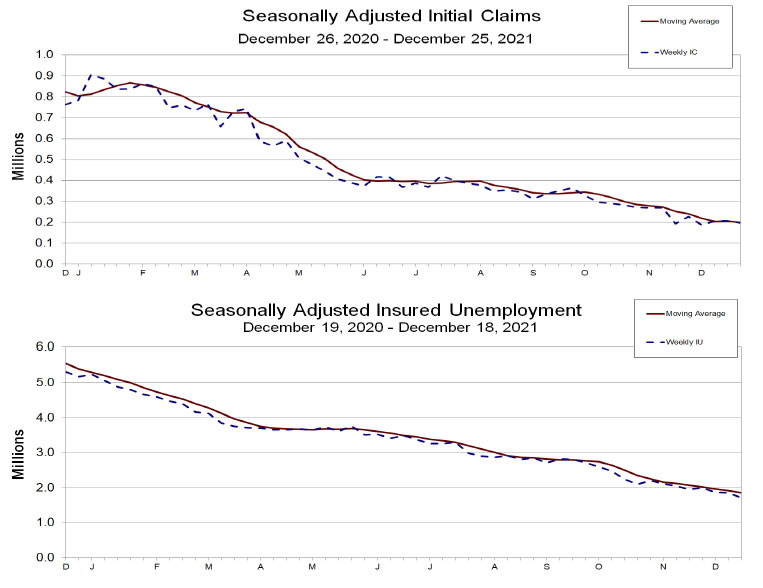
US initial jobless claims dropped -8k to 198k in the week ending December 25, better than expectation of 205k. Four-week moving average of initial claims dropped -7k to 199k, lowest since October 25, 1969.
Continuing claims dropped -140k to 1716k in the week ending December 18, lowest since March 7, 2020. Four-week moving average of continuing claims dropped -60k to 1850k, lowest since March 14, 2020.
Swiss KOF dropped to 107 in Dec, economy to develop positively at 2022 start
Swiss KOF Economic Barometer dropped slightly from 107.5 to 107.0 in December. "The barometer remains above its long-term average," KOF said. "The Swiss economy should thus continue to develop positively at the beginning of 2022, if the economic activity is not impaired by the renewed spread of the virus."
"This month, the barometer is mostly influenced by indicators covering private consumption, which are slightly negative. Another slight negative contribution is sent by bundles of indicators from the finance and insurance sector. In contrast, indicators for foreign demand are contributing positively."
ECB Knot and Visco doubt if inflation falls below 2% after 2022
ECB Governing Council member Klaas Knot said he had a "different view" to ECB's projection that inflation will fall back to 1.8% after 2022. He said, "I think the chance we remain stuck above 2% is just as big. Not far above 2%, but still."
Separately, another governing council member Ignazio Visco said, "(Inflation) forecasts below 2% in 2023-24 are of course subject to both downside and upside risks.
GBP/USD Daily Outlook
Daily Pivots: (S1) 1.3431; (P) 1.3465; (R1) 1.3521; More...
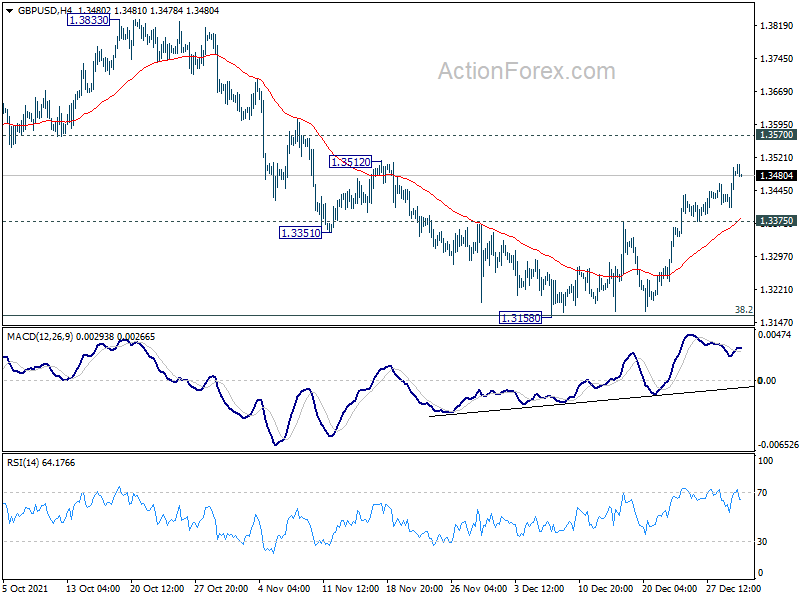
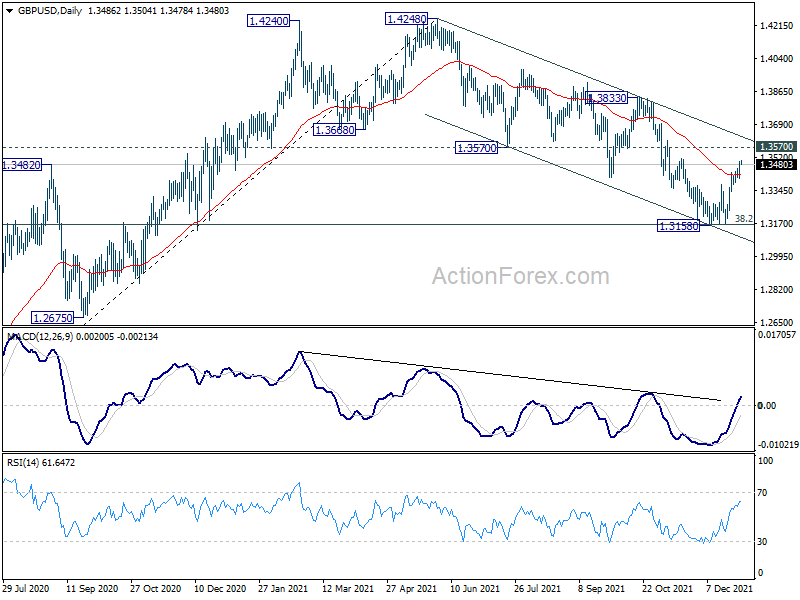
Intraday bias in GBP/USD remains on the upside for the moment. Current development suggests that corrective fall from 1.4248 has completed with three waves down to 1.3158, after hitting 1.3164 medium term fibonacci level. Further rise should be seen to 1.3570 support turned resistance. Sustained break there will further affirm this bullish case and target 1.3833 resistance next. On the downside, break of 1.3375 minor support will turn intraday bias neutral first.
In the bigger picture, focus remains on 38.2% retracement of 1.1409 to 1.4248 at 1.3164. Sustained break there will argue that whole rise from 1.1409 has completed at 1.4248, after rejection by 1.4376 long term resistance. That will revive some medium term bearishness and and target 61.8% retracement at 1.2493. However, strong rebound from current level will revive argue that up trend from 1.1409 is still in progress, and probably ready to resume.
Economic Indicators Update
| GMT | Ccy | Events | Actual | Forecast | Previous | Revised |
|---|---|---|---|---|---|---|
| 08:00 | CHF | KOF Economic Barometer Dec | 107 | 106.4 | 108.5 | 107.5 |
| 13:30 | USD | Initial Jobless Claims (Dec 24) | 198K | 205K | 205K | 206K |
| 14:45 | USD | Chicago PMI Dec | 61.5 | 61.8 | ||
| 15:30 | USD | Natural Gas Storage | -128B | -55B |
US initial jobless claims dropped to 198k, lowest since 1969
US initial jobless claims dropped -8k to 198k in the week ending December 25, better than expectation of 205k. Four-week moving average of initial claims dropped -7k to 199k, lowest since October 25, 1969.
Continuing claims dropped -140k to 1716k in the week ending December 18, lowest since March 7, 2020. Four-week moving average of continuing claims dropped -60k to 1850k, lowest since March 14, 2020.
Dollar-Yen Recaptures 115
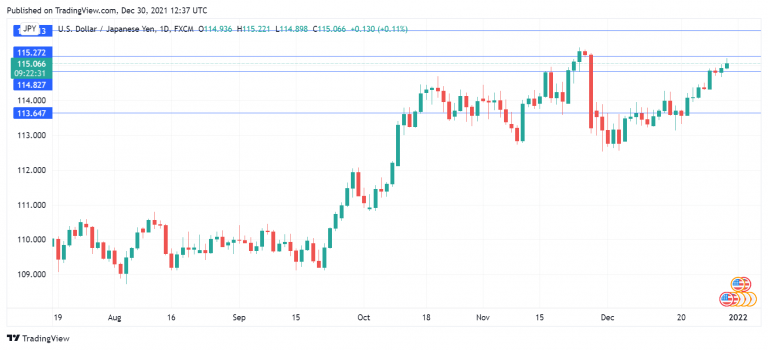
The US dollar has again pushed Japanese yen above the 115 line, after breaking through the symbolic level on Wednesday.
US yields, Omicron weigh on yen
The US dollar has been showing broad weakness, but has managed to push the yen back above the 115 line. Earlier in the day, USD/JPY rose to 115.22, marking a 5-week high. There are two reasons why the yen hasn’t been able to take advantage of a weaker dollar. First, the pair is extremely sensitive to the yield differential, and a disappointing seven-year Treasury auction resulted in 10-year yields rising to a 3-week high, boosting USD/JPY. As well, we continue to see elevated risk appetite in the markets despite the explosion in Omicron cases. Governments are scrambling to deal with this newest Covid wave, as hospitals could be overrun by unvaccinated persons becoming infected. The markets, however, continue to rely on reports that Omicron is much less severe than Delta and will not cause the economic damage that we saw with Delta, despite the new all-time highs in cases in the US, France and elsewhere.
Inflation is on the rise in Japan. Although the numbers pale in comparison to those in the US or the UK, this is a significant development, considering that Japan has grappled with deflation for years. Earlier in the week, BoJ Core CPI, the bank’s preferred inflation gauge, rose 0.8% in November, its highest level since February 2018. This beat the consensus of 0.5%. The uptick we are seeing in inflation will be welcome news at the Bank of Japan and should ease policy makers’ concerns about deflation. The bank’s inflation target of 2% remains a long way off, but inflation could move higher if the Omicron wave does not derail economic activity.
USD/JPY Technical
- USD/JPY continues to put pressure on resistance at 114.83. Above, there is resistance at 115.26
- There is support at 112.90 and 112.47
WTI Futures’ Rally Stalls Above 77 Mark
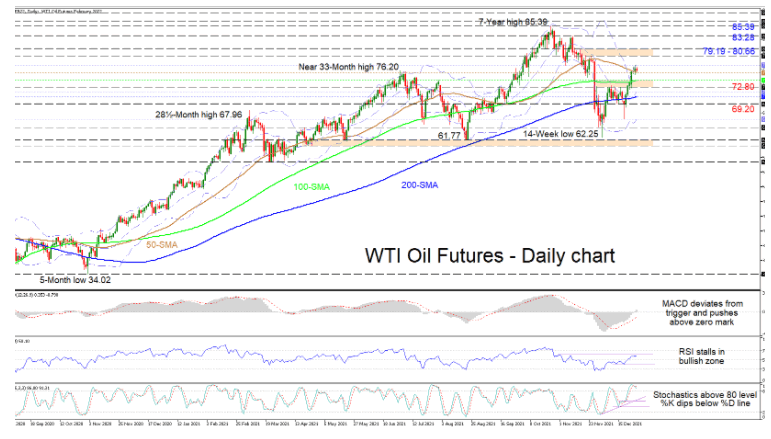
WTI oil futures have stretched towards 77.35 and are sitting above the 50-day simple moving average (SMA) at 75.71 after an upward surge from around the 66.00 mark. The positive incline in the SMAs has faded recently. However, they have yet to confirm that the trend has shifted to the downside.
The short-term oscillators are transmitting conflicting messages in directional impetus. The MACD is improving over the zero line signalling that bullish forces are still present, while the stochastic lines are dropping in overbought territory, indicating that upside momentum may be struggling. The stalling of the RSI in the bullish zone is also portraying some weakness in the upward drive.
If buying interest strengthens, the nearby upper Bollinger band could try to impede advances from testing the 79.19-80.66 resistance zone. Overcoming this barrier may encourage the bulls to then shoot for the 83.28 border before aiming to revisit the 7-year high of 85.39.
Alternatively, if the positive impetus continues to fade, immediate support could occur at the 50-day SMA at 75.71. Otherwise, the area from the 100-day SMA at 74.19 until the 72.80 barrier may prove to be the first upside defence. Sliding further, the mid-Bollinger band at 71.81 and the approaching 200-day SMA from beneath at 70.89 could act as another support obstacle ahead of the 69.20 level.
Summarizing, WTI futures are exhibiting a bullish tone, which has somewhat paused after pushing above the SMAs. Yet, downside risks could endure for a while longer should the price fail to pilot above the 79.19-80.66 resistance.
Oil Rises Slightly, Gold Falls But Recovers
Oil edges higher
Oil prices edged higher overnight thanks to larger than expected falls in US crude and gasoline inventories and receding virus nerves. Brent crude tested USD 80.00 a barrel intraday but finished the session 0.25% higher at USD 79.35. Crude inventories pushed WTI 0.75% higher to USD 76.60 a barrel. Asia has been modestly positive, lifting Brent and WTI 0.30% higher to USD 79.50 and USD 76.80 a barrel, respectively.
Brent crude has support at USD 78.15 and then USD 77.30 a barrel, its 100-day moving average (DMA). It has resistance at USD 80.00 a barrel, where it failed once again overnight. WTI has support at USD 75.40 and then USD 74.45, its 100-DMA. It has resistance at USD 77.50 a barrel, near to its overnight high.
Gold flops and recovers
Gold showed, once again, how frail bullish sentiment is as recent long positions were stopped out overnight, gold falling 26 dollars an ounce intraday to USD 1789.50 before a weaker US dollar led to an incipient recovery to USD 1801.00 in Asia today.
Gold’s attempts to stage a meaningful recovery remain unconvincing, with traders cutting long positions at the very first sign of trouble intra-day. It cleared the double top around the USD 1815.00 region but stalled just above at USD 1820.00. It faces resistance also at USD 1840.00 an ounce. Support lies at USD 1790.00, followed by USD 1780.00 an ounce. USD 1790.00 to USD 1815.00 continues to be my call for the range for the week.
With the US dollar looking more vulnerable to positive virus sentiment now, gold could potentially move higher throughout this week, but I still doubt it could sustain those gains. Traders should stay nimble.
US Dollar Fall Resumes
Dollar dips as Omicron concerns ease
After trading sideways for a few sessions, receding omicron concerns amongst investors saw the US dollar resume its gentle retreat overnight as traders moved out of defensive positioning. The dollar index fell by 0.28% to 95.89, before rising to 95.95 in listless Asian trading. Support at 95.85 remains marginally intact, and a daily close below 95.80 should signal further losses to 95.50.
Major currencies continue to build modest gains with EUR/USD rising to 1.1345, and GBP/USD jumping to 1.3485 as omicron hospitalisations remain controllable, even as infection numbers surge. USD/JPY has added 20 points to recapture 115.00 as defensive long-yen positioning continues to be unwound. AUD/USD has risen slightly to 0.7250, NZD/USD to 0.6845, and USD/CAD has eased to 1.2790 as investor risk appetite continues to improve.
Asian currencies have performed well this week, backstopped by a stubbornly firm Chinese yuan, despite weaker PBOC fixings. One would have to say that the renewed risk appetite from international investors is being most strongly expressed in regional Asian currencies at the moment.
Spanish CPI Hits A Three Decade Highs
Notes/Observations
- Omicron variant continued to spread but fears continue to ease aided by low hospitalizations. Improved sentiment bolstered as govt resist imposing new, widespread lockdowns.
- Spain Dec CPI hots its highest annual pace since 1989.
- Several ECB members hint of the need for normalization soon while others stress continued need for generous financing.
Asia
- South Korea Nov Industrial Production M/M: 5.1% v 2.5%e; Y/Y: 5.9% v 3.4%e.
- Various markets will be closed for holiday on Fri (Japan and South Korea); Australia and Hong Kong to close early.
Americas
- US President Biden and Russia President Putin to hold a phone call on Thursday (15:30 ET/20:30 GMT) on Ukraine. Biden would make clear to Putin that a diplomatic path remains open but must be conducted in “a context of de-escalation rather than escalation (Note: Call was requested by Russian officials.
Energy
- Saudi King Salman: Oil market stability and balance is a pillar of Saudi energy policy, important that all producers comply with OPEC+ agreement, its essential to market stability.
Speakers/Fixed income/FX/Commodities/Erratum
Equities
- Indices [Stoxx600 +0.31% at 489.50, FTSE +0.07% at 7,425.70, DAX +0.12% at 15,871.00, CAC-40 +0.30% at 7,182.94, IBEX-35 +0.09% at 8,681.41, FTSE MIB +0.19% at 27,396.00, SMI +0.31% at 12,966.60, S&P 500 Futures +0.12%].
- Market Focal Points/Key Themes: European indices open generally higher (notable exception IBEX following CPI numbers) but later slipped to trade mixed; trading light in the last full day of open markets for the year; better performing sectors include financials and materials; while laggards include industrials and consumer discretionary; Iren takes take in Alega; Norsk Hydro further curtails aluminum production due to high electricity prices; no major earnings expected during the upcoming US session.
Equities
- Consumer discretionary: Hugo Boss [BOSS.DE] +2% (press interview).
- Energy: Gazprom [GAZP.RU] -1% (Has not booked gas transit capacity for exports via the Yamal-Europe pipeline for 10th day in a row).
- Industrials: Skanska [SKAB.SE] +1% (contract award).
Speakers
- ECB’s Visco (Italy) stated that he expected inflation to average 3.0% for 2022, then to gradually slow to just below 2.0% target. ECB would not taper before 2023 and to maintain very favorable financing conditions. ECB Staff Projection that inflation to be below 2% in 2023/24 period was exposed to both upside and downside risks.
- ECB's Holzmann (Austria) stated that inflation to peak around turn of year and then slowly ease. ECB should initiate abandoning negative rates in 2022.
- ECB's Knot (Netherlands) noted that the Omicron virus variant to have little impact on prices in 2022. He added that if the impact was bigger than ECB was ready to change its policy faster.
- Russia Fin Min Siluanov stated that 2021 GDP growth was seen at 4.5%.
- China PBoC official Zou Lan: Structural adjustments of property market via M&A to help companies lower debt.
- China Q4 GDP growth seen at 3.2% (record low) amid resurgence of the Covid-19 pandemic. Stabilizing economic policies seen taking effect in the following quarter. Possibilities of another requirement reserve ratio cut in the first quarter, as well as a loan prime rate decrease, and slashed interest rates for open market operations.
Currencies/Fixed Income
- Continued unwinding of safe-haven flows weakened the JPY currency (Yen) and USD during Asia. The recent improved in sentiment aided as many governments resisted imposing new, widespread lockdowns despite the Omicron variant recent surge in infections.The greenback was trying to regain its composure as the EU session progresses.
- EUR/USD drifted lower to retest the 1.13 area as various ECB members provided contracting view on policy. ECB Visco putting the usual dovish tilt on the need to maintain accommodative financing while Northern ECB members Holtamann and Knot hinted of the need for normalization.
- USD/JPY holding above the 115 level in the session.
- The TRY currency (Lira) weakened for a 4th session to test beyond the 13.40 against the USD. Economists focued on FX Reserve data for Turkey and estimated that the government might have intervened heavily in foreign-exchange markets to buy TRY currency (Lira) to counter the currency's downward spiral.(Turkey end-Nov Gross Foreign Reserves were at $85.0B with Net Reserves at $22.5B. Analysts had noted that FX intervention cost the central bank at least $5.5B in foreign-exchange assets in the days around the unveiling of the deposit plan.
Economic data
- (NL) Netherlands Dec Producer Confidence Index: 10.2 v 12.7 prior.
- (FI) Finland Nov House Price Index M/M: 0.2% v 0.8% prior; Y/Y: 3.6% v 3.5% prior.
- (RU) Russia Dec PMI Services: 49.5 v 48.8e (3rd straight contraction); PMI Composite: 50.2 v 48.4 prior.
- (UK) Dec Nationwide House Price Index M/M: 1.0% v 0.5%e; Y/Y: 10.4% v 9.4%e.
- (TR) Turkey Dec Economic Confidence: 97.6 v 99.3 prior.
- (TH) Thailand Nov Current Account Balance: +$0.3B v -$0.9Be; Overall Balance of Payment (BOP): -$2.2B v +$1.2B prior; Trade Account Balance: $4.3B v $3.8B prior; Exports Y/Y: 23.7% v 17.0% prior; Imports Y/Y: 13.5% v 20.1% prior.
- (ES) Spain Dec Preliminary CPI M/M: 1.3% v 0.3%e; Y/Y: 6.7% v 5.6%e (highest annual pace since 1989).
- (ES) Spain Dec Preliminary CPI EU Harmonized M/M: 1.2% v 0.4%e; Y/Y: 6.7% v 5.7%e.
- (CH) Swiss Dec KOF Leading Indicator: 107.0 v 106.3e.
- (AT) Austria Nov PPI M/M: 1.5% v 3.2% prior; Y/Y: 15.3% v 14.0% prior.
- (HU) Hungary Central Bank raised its One Week Deposit Rate by 20bps to 4.00% (7th straight weekly increase).
- (ES) Spain Oct Current Account Balance: €2.1B v €1.2B prior.
- (NO) Norway Central Bank (Norges) Jan Daily FX Purchases (NOK): -250M v 0Me (**Insight: Norway to buy NOK1.7B per day on behalf of govt).
Fixed income Issuance
- None seen.
Looking ahead
- (EG) Egypt Q3 GDP Constant Q/Q: No est v 1.9% prior.
- (MX) Mexico Nov YTD Budget Balance (MXN): No est v -351.0B prior.
- (AR) Argentina Dec Consumer Confidence Index: No est v 39.7 prior.
- 05:25 (EU) Daily ECB Liquidity Stats.
- 05:30 (HU) Hungary Debt Agency (AKK) to sell bonds.
- 06:00 (CZ) Czech Republic to sell CZK5.0B in 1-month Bills.
- 06:00 (IL) Israel Nov Chain Store Sales M/M: No est v 0.1% prior.
- 06:00 (PT) Portugal Nov Industrial Production M/M: No est v 0.5% prior; Y/Y: No est v -6.7% prior.
- 06:00 (HU) Hungary Central Bank FX Swap Tender.
- 07:00 (ZA) South Africa Nov Monthly Budget Balance (ZAR) -10.3Be v -36.8B prior.
- 07:30 (BR) Brazil Nov Primary Budget Balance (BRL): 7.5Be v 35.4B prior; Nominal Budget Balance: -34.2Be v -25.0B prior; Net Debt to GDP Ratio: 57.9%e v 57.6% prior.
- 08:00 (RU) Russia Q3 Final Current Account Balance: No est v $40.8B prelim.
- 08:00 (RU) Russia Gold and Forex Reserve w/e Dec 24th: No est v $626.3B prior.
- 08:00 (UK) No Daily Baltic Dry Bulk Index this week.
- 08:30 (US) Initial Jobless Claims: 207Ke v 205K prior; Continuing Claims: 1.88Me v 1.859M prior.
- 08:30 (US) Weekly USDA Net Export Sales.
- 09:45 (US) Dec Chicago Purchasing Managers Index (PMI): 62.0e v 61.8 prior.
- 10:00 (CO) Colombia Nov National Unemployment Rate: No est v 11.8% prior; Urban Unemployment Rate: 11.7%e v 12.3% prior.
- 10:30 (US) Weekly EIA Natural Gas Inventories.
- 13:00 (US) Treasury to sell 4-Week and 8-week Bills.
- 18:00 (KR) South Korea Dec CPI M/M: -0.2%e v +0.4% prior; Y/Y: 3.6%e v 3.7% prior; CPI Core Y/Y: No est v 2.3% prior.
- 19:30 (AU) Australia Nov Private Sector Credit M/M: 0.5%e v 0.5% prior; Y/Y: No est v 5.7% prior.
- 20:00 (CN) China Dec Manufacturing PMI (Govt official): 50.0e v 50.1 prior; Non-manufacturing PMI: 52.0e v 52.3 prior; Composite PMI: No est v 52.2 prior.
- 21:00 (SG) Singapore Nov M2 Money Supply Y/Y: No est v 2.2% prior; M1 Money Supply Y/Y: No est v 9.1% prior.
Asian Equities Are Mixed
Record closes on Wall Street, Asia cautious
Wall Street rose modestly overnight as receding omicron fears continued attracting buyers out of cover and back into equities, with the S&P 500 and Dow Jones having record closes. The S&P 500 rose by 0.14%, the Nasdaq eased by just 0.10%, and the Dow Jones rose by 0.25%. Most price action needs to be taken with a grain of salt at this time of the year, but the omicron rear-view mirror trade appears to be favouring value overgrowth right now. In Asia, some long-covering has appeared, pushing futures on all three slightly lower by 0.05%.
Asia is having a mixed day in contrast, and it appears that some pre-New-Year’s-Eve book squaring is weighing on some markets. Japan’s Nikkei 225 has fallen by 0.35%, with South Korea’s Kospi down by 0.40%. Mainland China is enjoying a firm session, helped by dovish MoF comments earlier this morning that China would guide interest rates lower for 2022 government bond issuance. The Shanghai Composite is 0.80% higher, while the CSI 300 has jumped by 1.05%. Hong Kong is just 0.30% higher, a successful SenseTime IPO balanced by a slump in Evergrande stock after the company once again missed two offshore bond payments on Tuesday, totalling around USD 220 million
Singapore has eased by 0.30%, while Taipei and Jakarta are just 0.05% lower, and Kuala Lumpur is down 0.10%. Bangkok is 0.05% higher with Manila closed for a public holiday. Similarly, Australian markets are also subdued ahead of New Year, the ASX 200 and All Ordinaries edging 0.10% lower. Asia, ex-China, looks to have closed their books for the year.