Sample Category Title
FX Year Ahead 2022: Brace for Volatility
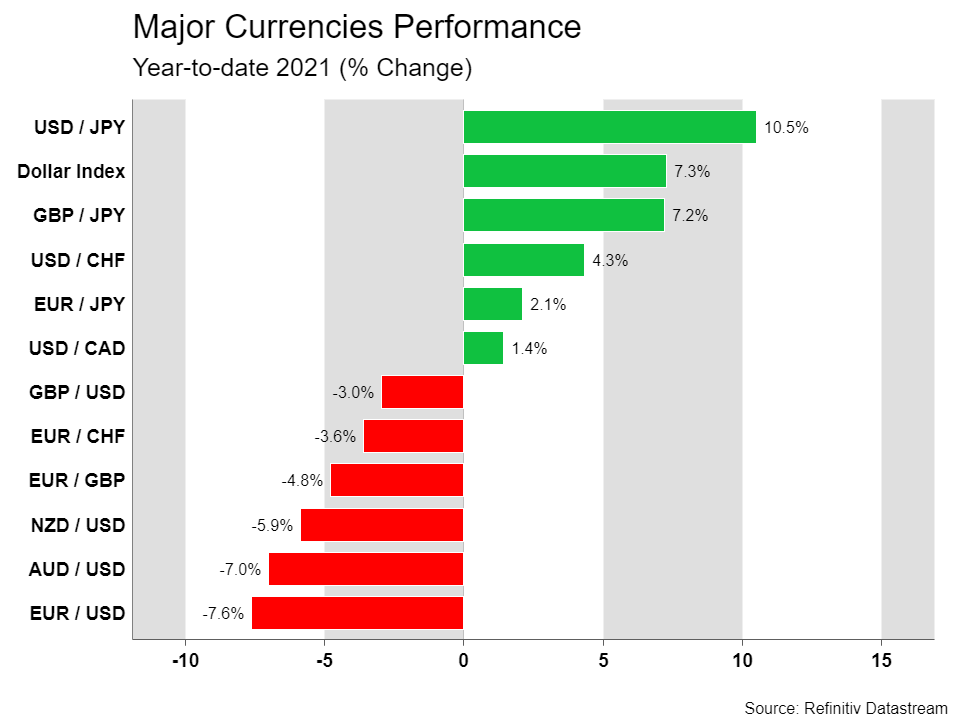
It has been an exceptional year for the US dollar, which defied all the doom and gloom predictions to gain more than 10% against the Japanese yen. The resurgence of inflation has turned the tables with many central banks hitting the brakes, and this theme will likely persist into 2022. The dollar could continue to perform well as the Fed tightens and global growth cools, although inflation is a wild card. Politics will also return to the spotlight, with the French presidential election and the US midterms coming up.
King dollar reclaims throne
How quickly narratives can turn around. This year started with the assumption that the major central banks were nowhere close to normalization as the global economy was still licking its wounds from the lockdown shock. The overwhelming consensus was that the dollar would continue to crumble under the weight of fading safe haven demand and a patient Fed.
All that fell apart once inflation fired up. The dollar sliced through its competitors as traders priced in several rate increases by the Fed to cool inflationary pressures, pushing US bond yields higher. Looking into 2022, relative monetary policy will likely remain the most dominant theme for FX performance.
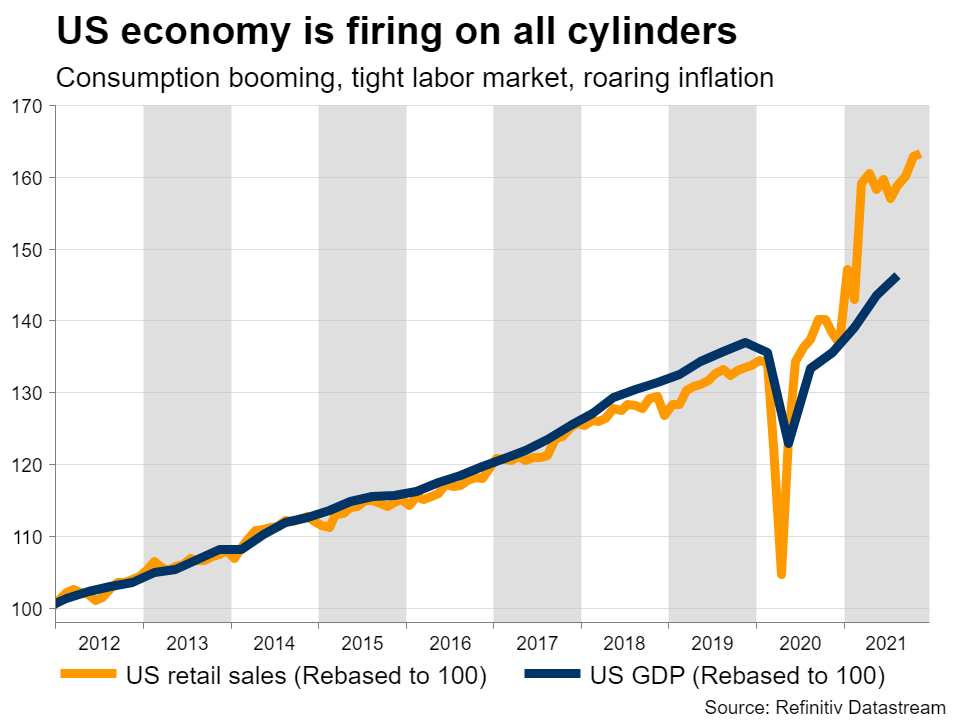
In that sense, the dollar could continue to shine for now. The US economy is booming, with the labor market tight by several measures and inflation roaring, enabling the Fed to raise rates with some force. There’s also the prospect of global growth slowing now that government spending is fading, which typically favors the greenback.
But the dollar’s spectacular performance from 2021 is unlikely to be repeated. Instead, any future gains may be concentrated mostly against the currencies whose central banks won’t be raising rates. Those are mainly the euro, the Japanese yen, and the Swiss franc. With carry trades coming back into fashion, these low-yielding currencies seem the most vulnerable.
That said, there are a couple of ‘known unknowns’ that could clip the dollar’s wings later in the year. The first is a sharp slowdown in inflation that leads markets to dial back bets for powerful Fed tightening. A combination of cooling energy prices, supply chains coming back online, and tougher year-over-year comparisons from April onwards could do the trick.
The second is the Democrats losing both chambers of Congress at the midterm elections in November. Opinion polls currently suggest that’s a very strong possibility, setting the stage for two years of political deadlock. Government spending would essentially be limited to only bare necessities, helping to cool US yields and by extension curb the dollar’s rate advantage.
Euro rollercoaster?
The euro had a horrible year, suffering at the hands of a fragile economy and a central bank that will lag behind in this tightening cycle. Pandemic restrictions have returned in several countries to hamstring economic growth and there isn’t much political appetite left for massive spending packages.
Wage growth also remains muted, so ‘organic’ inflationary pressures are not that strong. As a result, the European Central Bank will almost certainly continue asset purchases through 2022 and is highly unlikely to raise rates during the year, in contrast to market pricing that currently points to a minor rate hike in December.
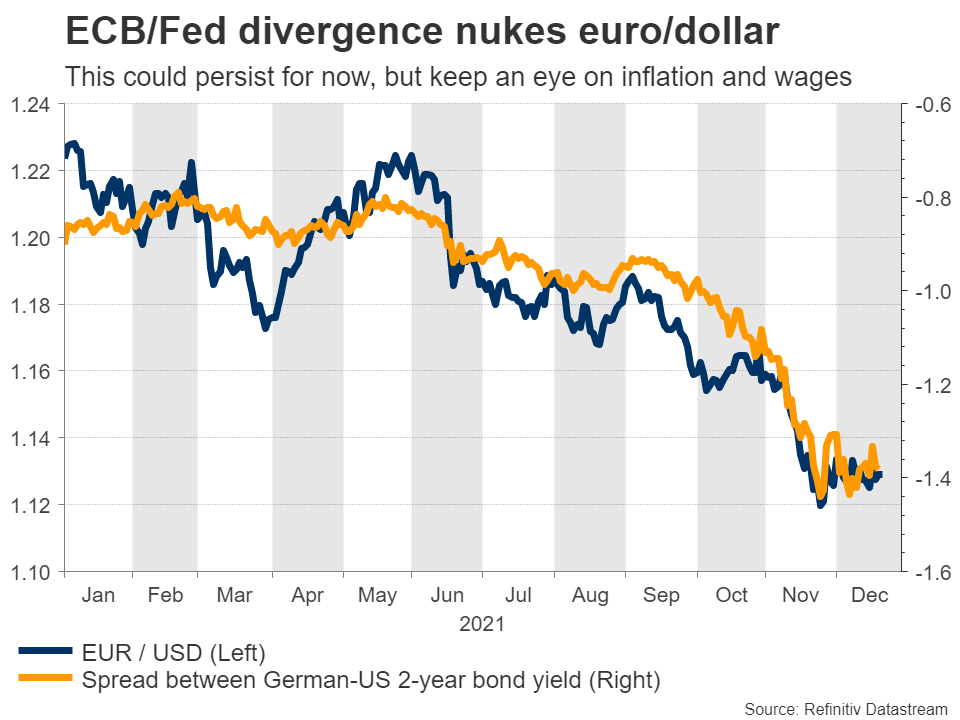
This implies that relative monetary policy could continue to work against the euro, at least early in the year. Beyond that, there’s scope for a rebound. If the European labor market eventually gets rolling, the second half of the year could see speculation for ECB rate increases in 2023. If that also coincides with ‘peak inflation’ in the US, it may be enough for euro/dollar to recover.
Politics will be another crucial element. French voters will go to the ballots in April and while opinion polls currently favor President Macron, the next three most serious challengers are all skeptical of further EU integration. It’s too early to predict the outcome, but some political risk premium could be priced into French bonds and the euro itself heading into the event.
Sterling at the mercy of risk sentiment
The British pound stood firm this year, losing ground against the mighty dollar but outperforming both the euro and yen. Much of that boils down to the Bank of England, which has already started to raise interest rates to tame soaring inflation. The UK economy is quite strong, although the latest covid restrictions suggest growth could cool off in the coming months.
Looking into next year, money markets are pricing around three hikes from the central bank, which seems realistic given the economy’s resilience. Therefore, interest rates may not be the most crucial element for the pound. Instead, the currency’s fate may be linked to global risk sentiment.
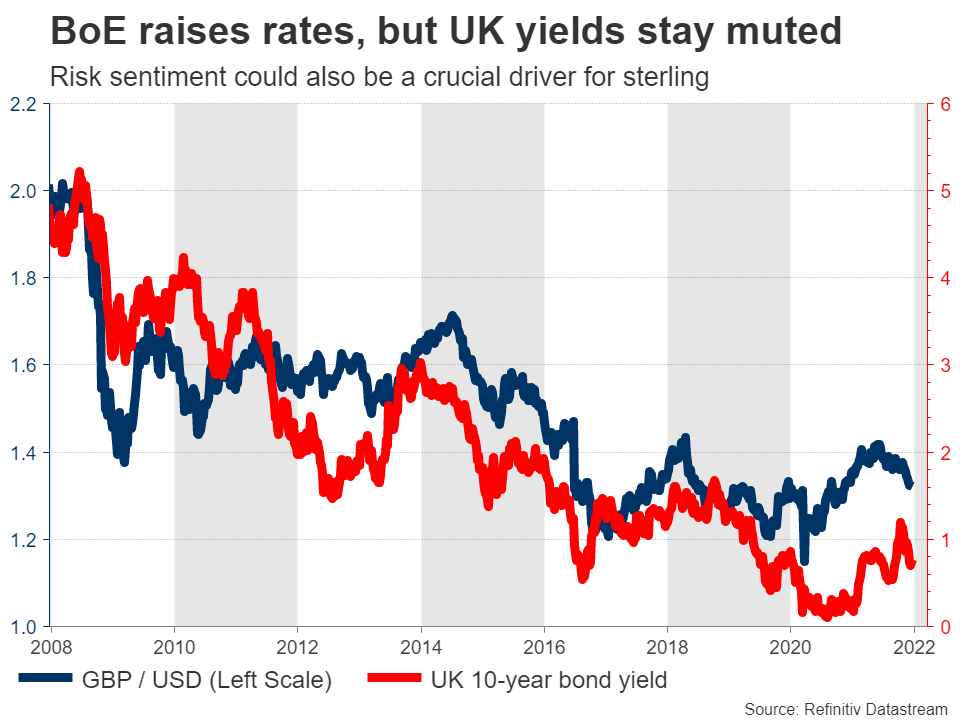
This relationship between sterling and the mood in markets has been on full display throughout the pandemic. It is likely explained by the UK’s twin deficits and its role as a global investment hub. Hence, the path for stock markets could be crucial for the pound.
In this sense, the outlook isn’t especially bright. With both monetary and fiscal policy losing its punch next year while asset valuations are so high, it could be a shaky environment for risk sentiment. The spectacular performances of recent years are unlikely to be repeated, so the pound may be looking at a neutral phase.
Yen - Down but not out
A macro environment characterized by central banks raising interest rates and governments rolling back spending is typically anathema for the yen. This is mainly because the Bank of Japan keeps a ceiling on Japanese bond yields, so rate differentials mechanically widen against the yen when foreign yields move higher.
With the Bank of Japan staying committed to its yield curve control strategy and the nation’s government preparing a powerful spending package, both monetary and fiscal authorities are set to keep their foot on the stimulus gas - in sharp contrast to many other countries.
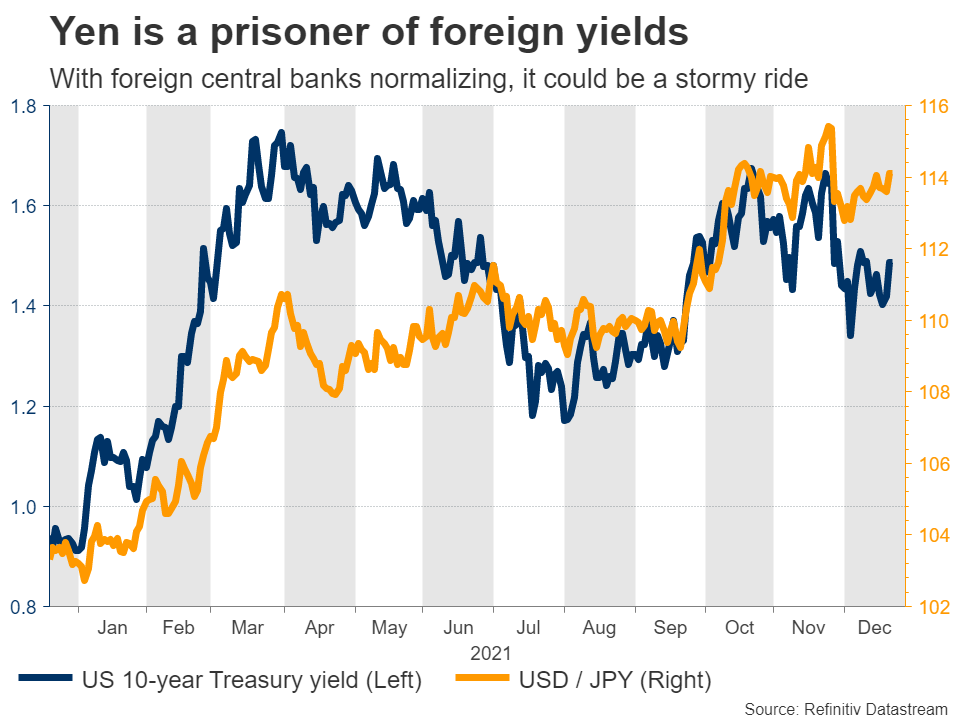
As such, the outlook for the yen seems gloomy against the currencies that will be enjoying higher rates. That said, the yen is unlikely to suffer as much as it did this year, thanks to its safe-haven qualities. With liquidity being withdrawn from the global financial system, volatility episodes that benefit the currency could become more frequent. Hence, while the trend may be negative, it could be a violent ride.
Commodity FX is all about growth
Admittedly, the strongest economies right now are those of New Zealand and Canada. Both have seen their labor markets recover completely and with inflation raging, their central banks have already started to normalize policy. Markets are currently pricing in five rate increases from both the Reserve Bank of New Zealand and the Bank of Canada next year.
In isolation, this would imply that their currencies should shine as carry trades power up. But as we have seen lately, global growth trends and commodity prices are far more important drivers. As such, while relative rate differentials favor the kiwi and the loonie, much of their performance will depend on risk sentiment.
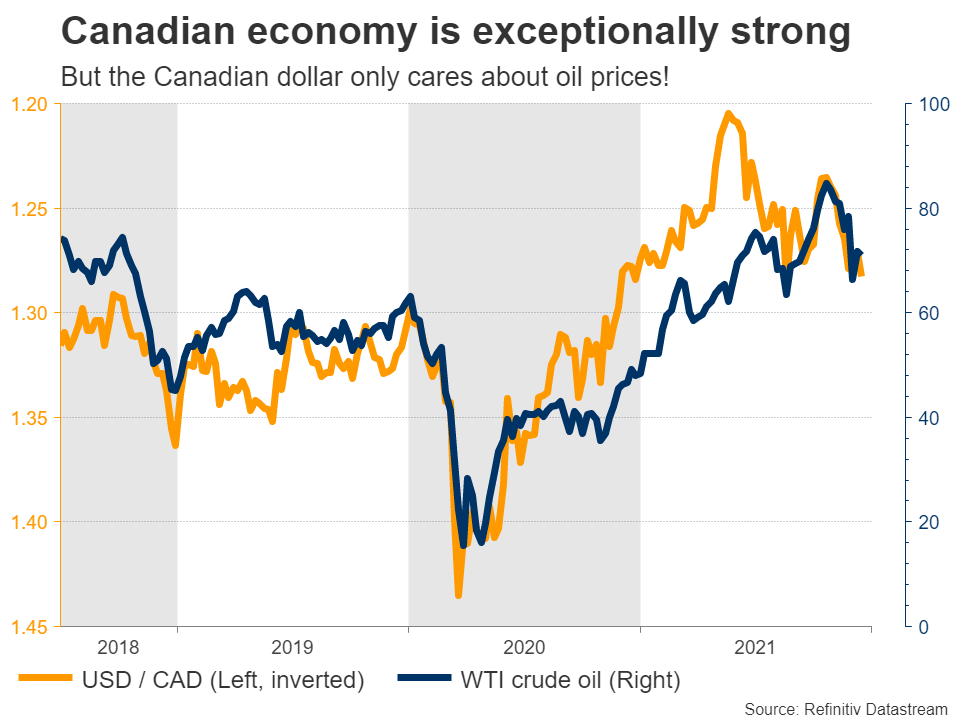
That said, the Australian dollar seems vulnerable. The Australian economy hasn’t recovered so spectacularly, so the three rate increases that markets are currently pricing seem like a bridge too far for the Reserve Bank. This allows scope for disappointment, especially with the Chinese property sector in trouble. A national election scheduled for May could also be crucial for the aussie.
All told, it seems like it might be a year of two halves, with moves in inflation driving shifts in monetary policy and politics adding some spice to the mix. This is a recipe for higher volatility, so get ready for some turbulence.
Dollar Cools Off, Riskier Currencies Shine
Safe haven currencies slip amid waning Omicron jitters; cyclical currencies shine
Overnight, President Joe Biden's statement that there is a significant chance that he strikes a deal with Democrat Senator Joe Manchin to pass his $2 trillion stimulus package through Congress, has been the driving force behind the soaring risk-on sentiment in markets. In addition, optimistic news from the pandemic front alongside statements from major countries' government officials ensuring that financing aid will be provided in case new Covid-19 restrictions are imposed, further ignited risk appetite earlier today. However, the Omicron repercussions are still in play, partially offsetting the risk-on sentiment.
As a result, the US dollar is giving up ground, also being pressured by the retreating long-term Treasury yields. Moreover, the Swiss franc and Japanese yen are also getting hammered in the current session as the improving risk tone poses a threat to their safe haven demand.
On the other hand, the commodity-linked currencies such as the aussie, loonie and kiwi are the relative winners in the forex spectrum today, capitalizing on surging commodity prices. Furthermore, the euro is also stronger on the day without any major headlines behind this uptick, while the British pound is in the green today after the government announced that there will be no further restrictions for the Christmas holiday period.
The Turkish lira has bounced back from its peak of $18.36 and keeps recouping more of its losses, trading at $12.10 at the time of writing, but the upside potential for the currency seems limited due to the country's severe macroeconomic weaknesses.
Stock markets retreat as markets grapple with Omicron fears
Wall Street is set to open lower today despite yesterday's rally, with e-mini futures for the major US indexes dipping in premarket trade. More specifically, Dow Jones, S&P 500 and Nasdaq futures are 0.3%, 0.25% and 0.10% down respectively. Moreover, most major European indices quickly pared their morning gains as Omicron fears re-emerged.
Oil marginally lower; gold and natural gas surge
Oil prices surrendered their early-session gains as lingering concerns over the Omicron variant continue to undermine investors' risk appetite. Alternatively, gold is appreciating today, capitalizing on the falling long-term US Treasury yields and the softer dollar. Moreover, European gas prices continue to climb as flows from a key Russian pipeline stopped due to extreme weather conditions.
Japanese Yen Falls to 4-Week Low
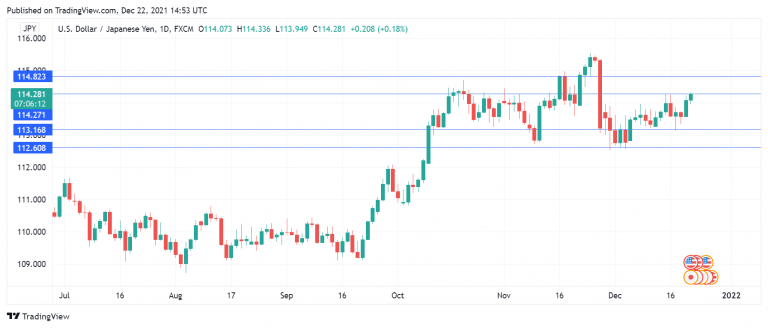
The Japanese yen is drifting on Wednesday. Earlier in the day, USD/JPY rose to 114.33, its highest level since November 26th.
BoJ says monetary easing to continue: minutes
The BoJ released the minutes of its October policy meeting, and unsurprisingly, the yen yawned in response. Some members noted that inflation remains subdued despite higher input costs and the weak yen, and called for monetary easing to be maintained. Inflation has been high on the agenda of many of the major central banks, including the Federal Reserve and the Bank of England, which have tightened policy in response. This trend has not extended to Japan, as the economy continues to struggle with supply constraints and the spread of Covid.
Japanese companies have been hit with higher costs, as energy and raw material prices have surged. However, firms remain reluctant to pass on rising costs to consumers, which has kept consumer inflationary prices in check. The discrepancy in wholesale and consumer prices was massive in October – Core CPI rose a negligible 0.1% y/y, while wholesale prices soared 8.0% y/y, the sharpest rise since in over 40 years. Even with the jump in wholesale prices, the BoJ’s inflation target of 2% remains far off and this is unlikely to change in the near future. As one member stated in the minutes, the BoJ has no reason to normalize monetary policy until inflation reaches the bank’s inflation target is reached.
At last week’s policy meeting, the BoJ maintained policy rates as well as the 10-year JGB yield target of 0.0%. At the same time, the bank said it would scale back its emergency pandemic programme in 2022. The BoJ signalled that it would maintain its ultra-accommodative policy, with BoJ Governor Kuroda stressing that the cutting back of the emergency funding would not be followed by the withdrawal of QE.
USD/JPY Technical
- USD/JPY is testing resistance at 114.27. The next resistance line is 114.82
- There is support at 113.16 and 112.60
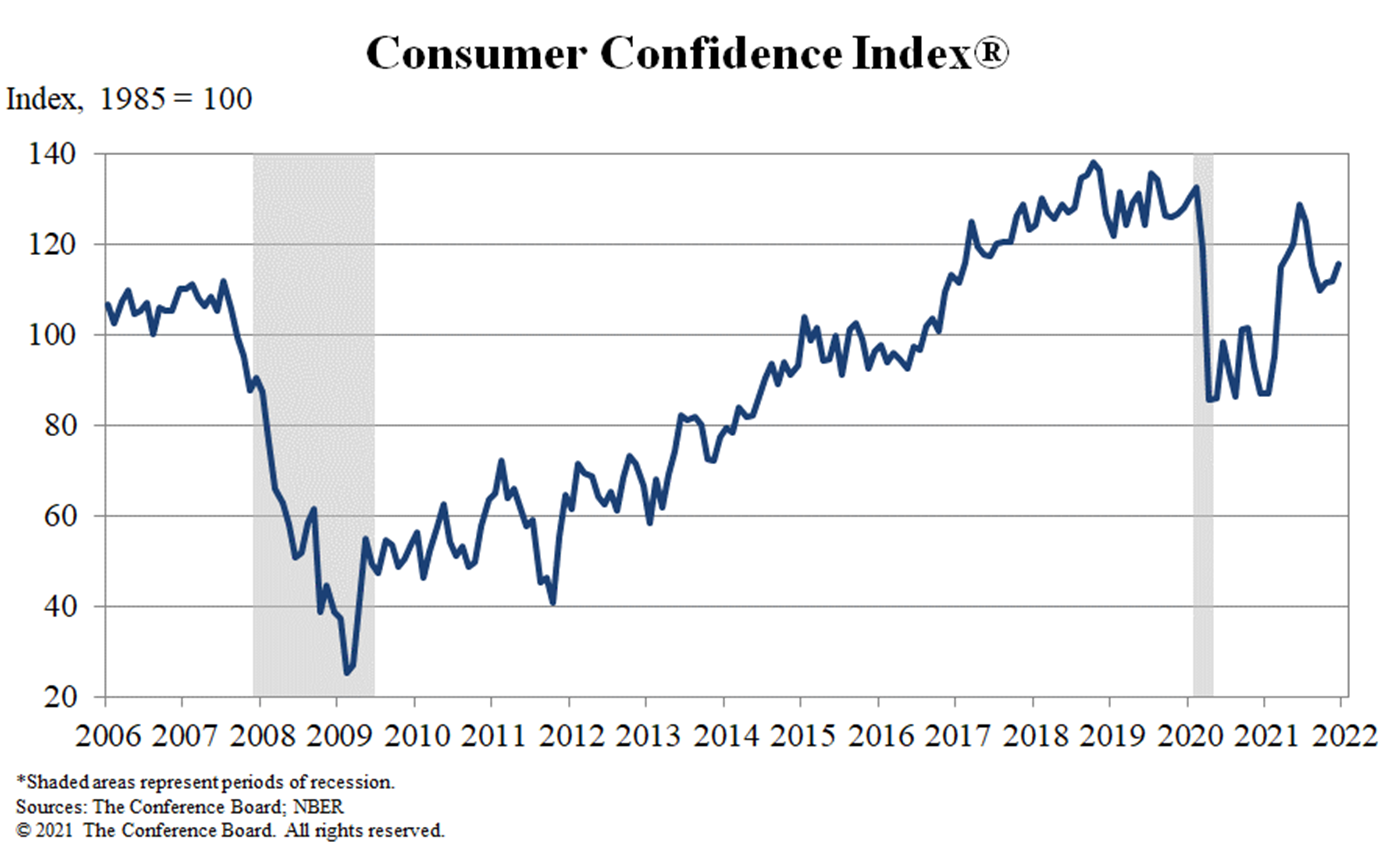
US consumer confidence rose to 115.8, expectations jumped
US Conference Board Consumer Confidence rose from 111.9 to 115.8 in December, above expectation of 111.1. Present Situation Index dropped from 144.4 to 144.1. Expectations Index rose from 90.2 to 96.9.
"Consumer confidence improved further in December, following a very modest gain in November," said Lynn Franco, Senior Director of Economic Indicators at The Conference Board. "The Present Situation Index dipped slightly but remains very high, suggesting the economy has maintained its momentum in the final month of 2021. Expectations about short-term growth prospects improved, setting the stage for continued growth in early 2022. The proportion of consumers planning to purchase homes, automobiles, major appliances, and vacations over the next six months all increased."
"Meanwhile, concerns about inflation declined after hitting a 13-year high last month as did concerns about COVID-19, despite reports of continued price increases and the emergence of the Omicron variant. Looking ahead to 2022, both confidence and consumer spending will continue to face headwinds from rising prices and an expected winter surge of the pandemic."
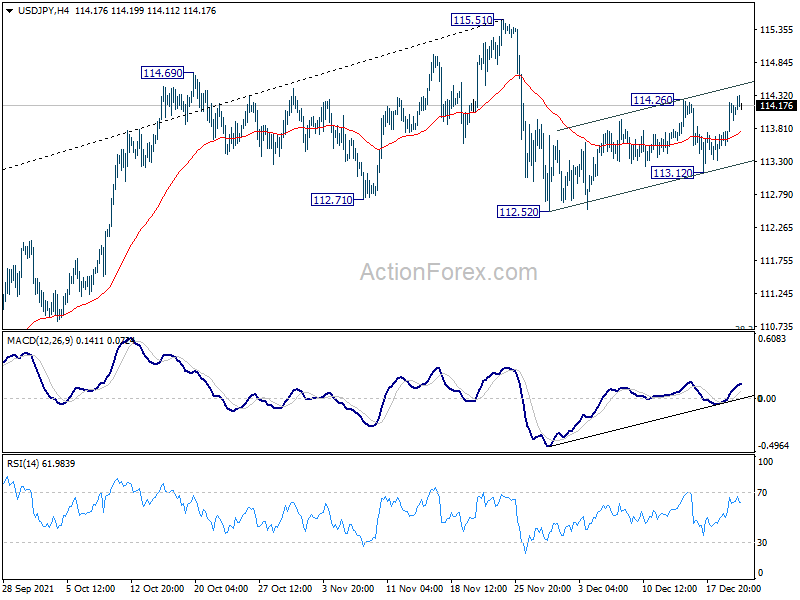
USD/JPY Mid-Day Outlook
Daily Pivots: (S1) 113.69; (P) 113.96; (R1) 114.36; More...
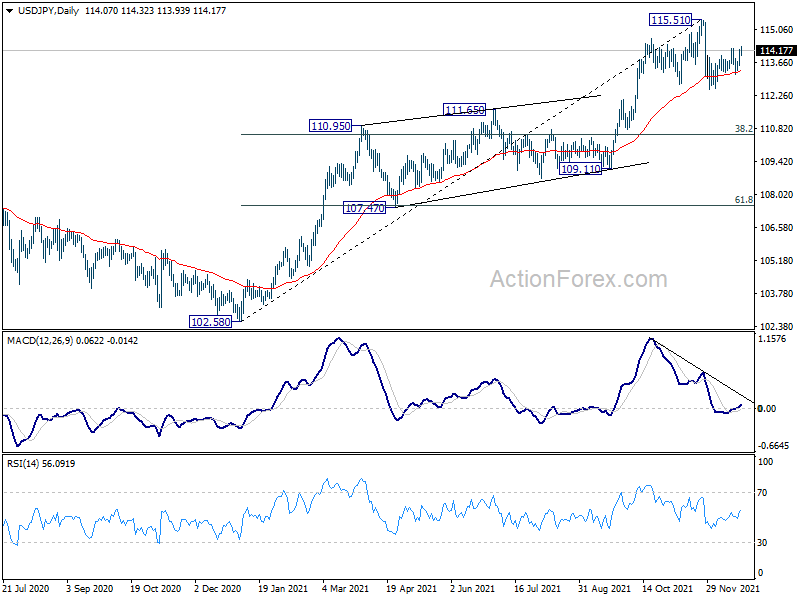
USD/JPY's rebound from 122.52 resumed by breaking 114.26 resistance. Intraday bias is back on the upside for retesting 115.51 high. On the downside, break of 113.12 will turn bias to the downside, and resume the correction from 115.51 through 112.52 support.
In the bigger picture, no change in the view that rise from 102.58 is the third leg of the up trend from 101.18 (2020 low). Such rally should target a test on 118.65 (2016 high) on resumption. However, firm break of 109.11 structural support will argue that the trend might have reversed and bring deeper fall to 107.47 support and possibly below.
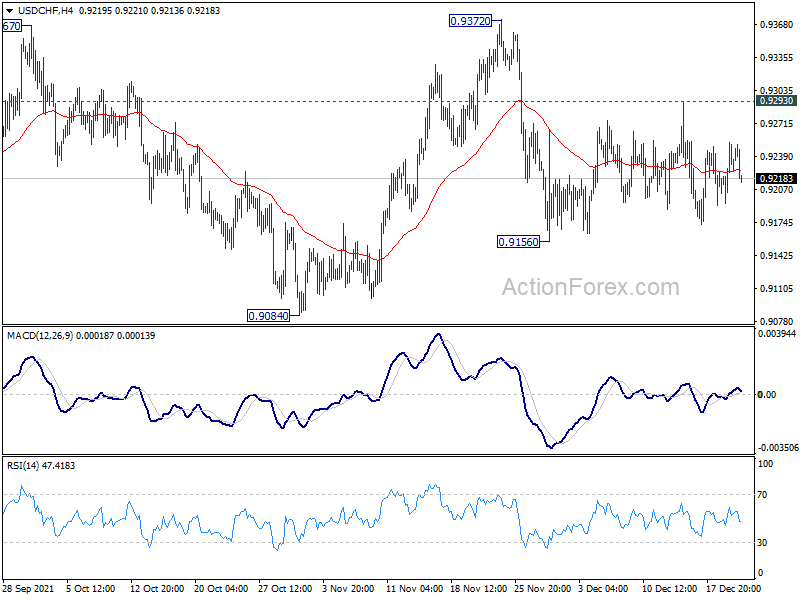
USD/CHF Mid-Day Outlook
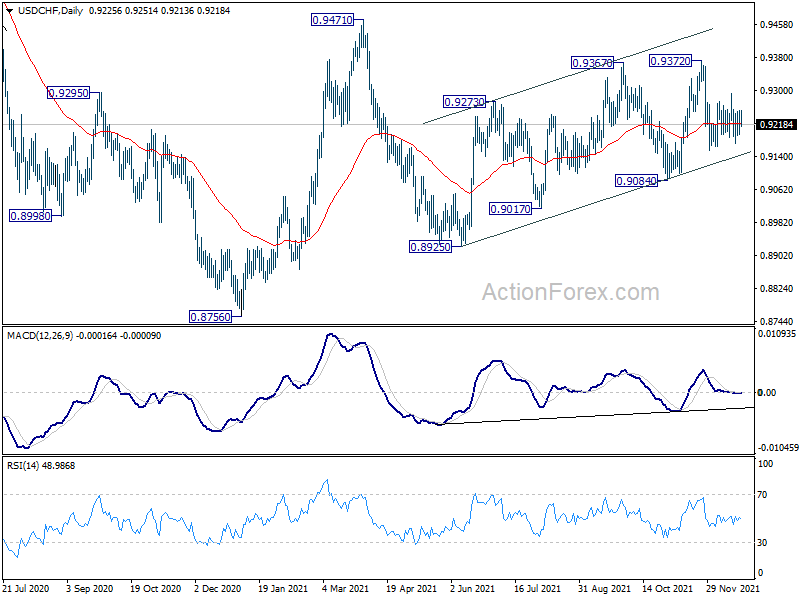
Daily Pivots: (S1) 0.9203; (P) 0.9229; (R1) 0.9262; More....
Intraday bias in USD/CHF remains neutral first. On the downside, below 0.9156 will target 0.9084 support. Firm break there should confirm that choppy rise from 0.8925 has completed, and suggests that fall from 0.9471 is resuming. Deeper decline would be seen through 0.8925. On the upside, break of 0.9293 will suggest that the pull back from 0.9372 is finished. Intraday bias will be turned back to the upside for 0.9372.
In the bigger picture, the corrective structure of the rebound from 0.8925 argues that fall from 0.9471 is not complete yet. It could either be the second leg of pattern from 0.8756 (2021 low), or resuming larger down trend from 1.0237 (2018 high). We'd pay attention to the downside momentum and assess the odds later. But for now, medium term outlook will be neutral at best as long as 0.9471 resistance holds.
EUR/USD Mid-Day Outlook
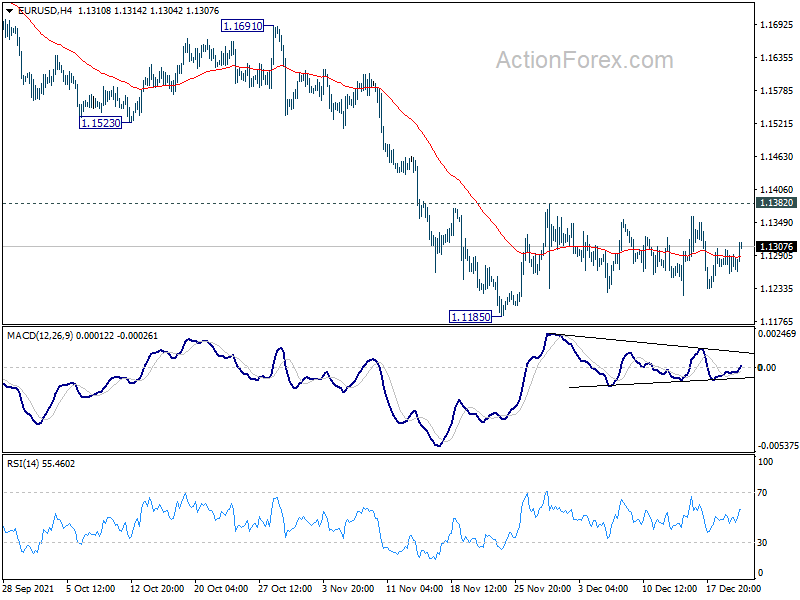
Daily Pivots: (S1) 1.1260; (P) 1.1282; (R1) 1.1302; More...
Intraday bias in EUR/USD stays neutral and outlook is unchanged. Further decline is still expected as long as 1.1382 resistance holds. Break of 1.1185 will resume larger decline from 1.2348. Next target is 161.8% projection of 1.2265 to 1.1663 from 1.1908 at 1.0934. On the upside, firm break of 1.1382 resistance should confirm short term bottoming at 1.1186. Intraday bias will be turned back to the upside for 55 day EMA (now at 1.1416) and above.
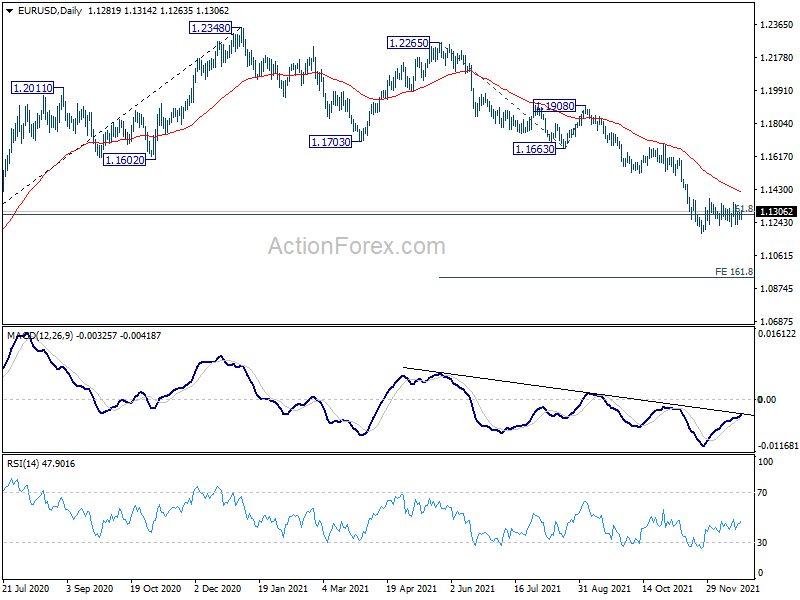
In the bigger picture, there are various ways of interpreting the fall from 1.2348 (2021 high). It could be a correction to rise from 1.0635 (2020 low), the fourth leg of a sideway pattern from 1.0339 (2017 low), or resuming long term down trend. In any case, outlook will now stay bearish as long as 1.1703 support turned resistance holds. Sustained break of 61.8% retracement of 1.0635 to 1.2348 at 1.1289 would pave the way back to 1.0635.
GBP/USD Mid-Day Outlook
Daily Pivots: (S1) 1.3221; (P) 1.3246; (R1) 1.3294; More...
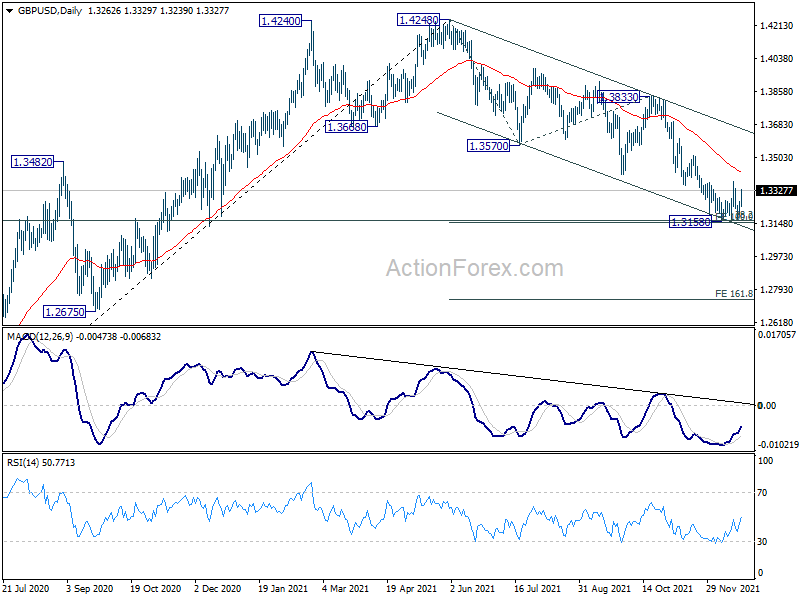
GBP/USD rebounds strongly today but stays below 1.3373 resistance. Intraday bias remains neutral at this point. On the upside, break of 1.3373 will resume the rebound from 1.3158 to to 55 day EMA (now at 1.3423). Sustained break there will be an early sign of bullish reversal and target 1.3570 support turned resistance next. On the downside, however, firm break of 1.3164 medium term fibonacci level will carry larger bearish implication. Fall from 1.4248 should resume and target 161.8% projection of 1.4248 to 1.3570 from 1.3833 at 1.2736.
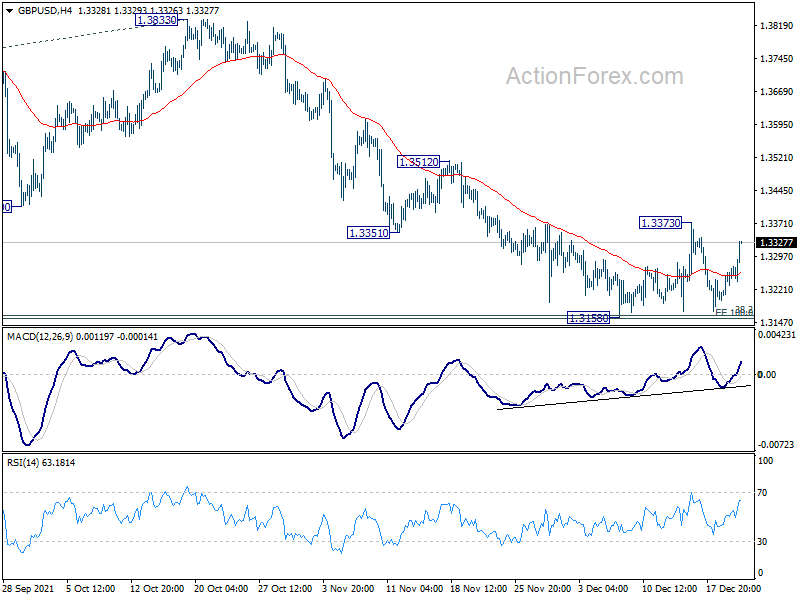
In the bigger picture, focus remains on 38.2% retracement of 1.1409 to 1.4248 at 1.3164. Sustained break there will argue that whole rise from 1.1409 has completed at 1.4248, after rejection by 1.4376 long term resistance. That will revive some medium term bearishness and and target 61.8% retracement at 1.2493. However, strong rebound from current level will revive argue that up trend from 1.1409 is still in progress, and probably ready to resume.
Sterling Surges, Loonie Dives in Quiet Markets
Sterling and Euro are trading broadly higher today, together with Aussie. On the other hand, Yen and Dollar are both under some selling pressure. Rebound in Europe yield is a factor in driving the markets. We'll see if there is further rally in stocks before holidays that could push Dollar and Yen further lower.
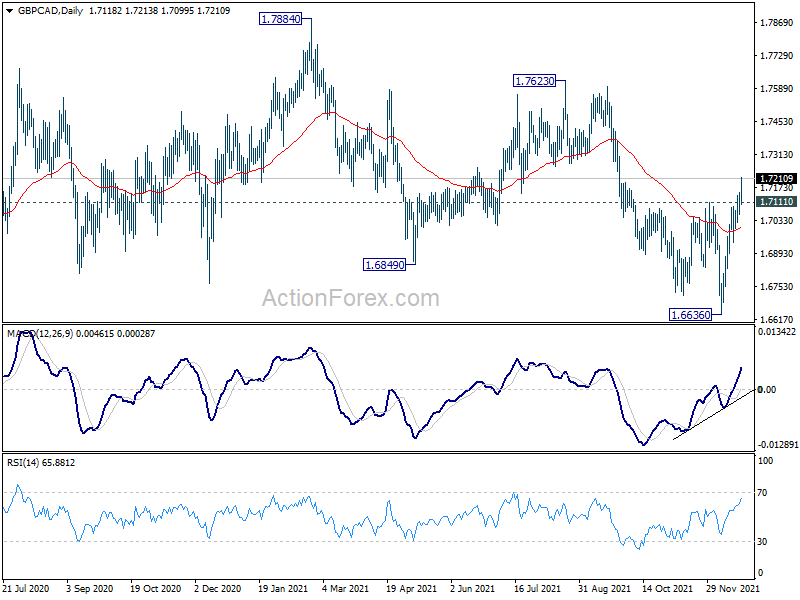
Technically, GBP/CAD's rally today should confirm that 1.7111 resistance is firmly taken out. Whole fall from 1.7884 has completed with three waves down to 1.6636. Further rally should be seen to 1.7623 resistance first, and possibly further to retest 1.7884. We'll see if GBP/USD would follow and break through 1.3373 resistance.
In Europe, at the time of writing, FTSE is down -0.02%. DAX is down -0.05%. CAC is up 0.04%. Germany 10-year yield is up 0.0144 at -0.291. Earlier in Asia, Nikkei rose 0.16%. Hong Kong HSI rose 0.57%. China Shanghai SSE dropped -0.07%. Singapore Strait Times rose 0.08%. Japan 10-year JGB yield rose 0.0079 to 0.063.
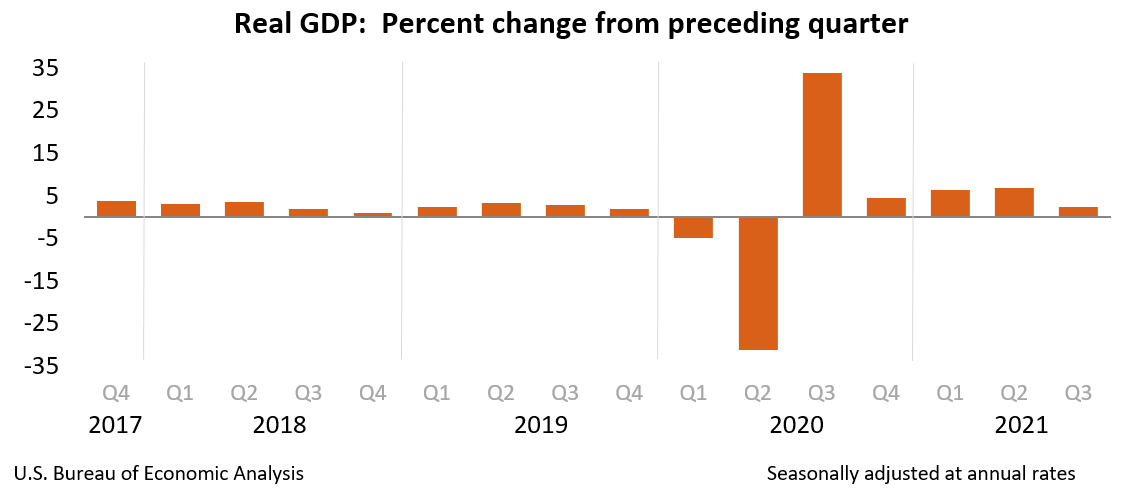
US Q3 GDP growth finalized at 2.3% annualized
US Q3 GDP growth rate was finalized at 2.3% annualized, revised up from 2.1%. The update primarily reflects upward revisions to personal consumption expenditures (PCE) and private inventory investment that were partly offset by a downward revision to exports. Imports, which are a subtraction in the calculation of GDP, were revised down.
UK GDP growth finalized at 1.1% qoq in Q3
UK Q3 GDP growth was finalized at 1.1% qoq, revised down from first estimate of 1.3% increased. The level of GDP remained -1.5% below pre-coronavirus level in Q4 2019. Annual GDP in 2020 is now estimated to have fallen by -9.4%. Net borrowing position with the rest of the world lowered to -4.3% of GDP from Q2's -2.4%.
ECB Schnabel: A week Q4 to spillover to beginning of next year
ECB Executive Board member Isabel Schnabel said in an interview, "in general, I think the recovery continues". But due to new wave of infections, "we are seeing headwinds in the short term". ECB is looking at a "weaker fourth quarter" which is "likely to spill over to the beginning of next year". But she expected "a strong rebound thereafter". So, "we see the recovery as being delayed rather than derailed."
She added that the factors that pushed up inflation are "likely to either reverse or at least become less pronounced over the coming year", including supply bottlenecks, energy prices and base effects. Inflation is going to "decline over the course of next year", but ECB is "less certain about how fast and how strong the decline will be".
Schnabel also said ECB is taking a "step-by-step approach to normalization" of monetary policy". The pace can be adjusted to the incoming data. And, "we need to retain optionality to make sure that we sustainably reach our 2% target."
BoJ minutes: members discussed impact of Yen's depreciation
In the minutes of October 27-28 meeting, BoJ said "yen had depreciated somewhat significantly against both the U.S. dollar and the euro, mainly due to rises in U.S. and European interest rates". Members have discussed the impact of the yen's depreciation.
Some members said, "the depreciation had positively affected Japan's economy as a whole through an increase in profits from business conducted overseas and a rise in stock prices, although its effect of pushing up exports had declined."
One member said, "the effect of the depreciation on each economic entity was uneven, depending on industry and size". Another member noted, "while prices had increased recently, triggered mainly by the yen's depreciation, it was unlikely at present that heightened inflationary pressure would reduce the economic welfare of Japan as a whole."
Australia Westpac leading index rose to -0.2%, Omicron not derailing recovery
The six month annualized growth rate in Westpac-Melbourne Institute Leading Index rose from -0.5% to -0.2% in November. The index has been in negative territory for three consecutive months, partly reflecting the lockdowns in New South Wales and Victoria. Nevertheless, reopening rebounds should eventually lift growth back above trend.
Westpac said both itself and the RBA "currently believe that Omicron will not derail the recovery although the next month will determine the extent of the delay and uncertainty."
GBP/USD Mid-Day Outlook
Daily Pivots: (S1) 1.3221; (P) 1.3246; (R1) 1.3294; More...
GBP/USD rebounds strongly today but stays below 1.3373 resistance. Intraday bias remains neutral at this point. On the upside, break of 1.3373 will resume the rebound from 1.3158 to to 55 day EMA (now at 1.3423). Sustained break there will be an early sign of bullish reversal and target 1.3570 support turned resistance next. On the downside, however, firm break of 1.3164 medium term fibonacci level will carry larger bearish implication. Fall from 1.4248 should resume and target 161.8% projection of 1.4248 to 1.3570 from 1.3833 at 1.2736.
In the bigger picture, focus remains on 38.2% retracement of 1.1409 to 1.4248 at 1.3164. Sustained break there will argue that whole rise from 1.1409 has completed at 1.4248, after rejection by 1.4376 long term resistance. That will revive some medium term bearishness and and target 61.8% retracement at 1.2493. However, strong rebound from current level will revive argue that up trend from 1.1409 is still in progress, and probably ready to resume.
Economic Indicators Update
| GMT | Ccy | Events | Actual | Forecast | Previous | Revised |
|---|---|---|---|---|---|---|
| 23:30 | AUD | Westpac Leading Index M/MNov | 0.10% | 0.20% | 0.30% | |
| 23:50 | JPY | BoJ Minutes | ||||
| 07:00 | GBP | GDP Q/Q Q3 F | 1.10% | 1.30% | 1.30% | |
| 07:00 | GBP | Current Account (GBP) Q3 | -24.4B | -15.6B | -8.6B | |
| 13:30 | USD | GDP Annualized Q3 F | 2.30% | 2.10% | 2.10% | |
| 13:30 | USD | GDP Price Index Q3 F | 6.00% | 5.90% | 5.90% | |
| 14:00 | CHF | SNB Quarterly Bulletin Q4 | ||||
| 15:00 | USD | Existing Home Sales M/M Nov | 6.5M | 6.34M | ||
| 15:00 | USD | Consumer Confidence Dec | 111.1 | 109.5 | ||
| 15:30 | USD | Crude Oil Inventories | -2.4M | -4.6M |
US Q3 GDP growth finalized at 2.3% annualized
US Q3 GDP growth rate was finalized at 2.3% annualized, revised up from 2.1%. The update primarily reflects upward revisions to personal consumption expenditures (PCE) and private inventory investment that were partly offset by a downward revision to exports. Imports, which are a subtraction in the calculation of GDP, were revised down.