Sample Category Title
World Stock Indices Are Growing Amid Renewed Investors’ Appetite For Risk
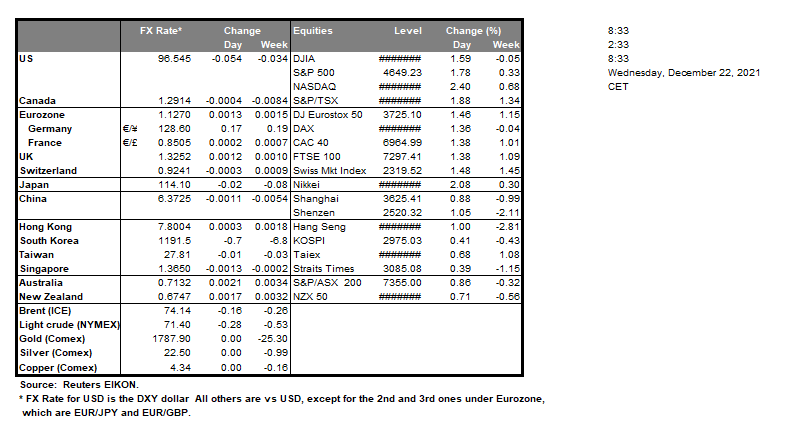
The US stock indices closed with strong growth yesterday. The rebound was observed in almost all sectors except Healthcare and Consumer Defensive. Separately, it should be noted about the confidence increase in the companies of the tourist industry. By the end of the trading day, the Dow Jones index (US30) gained 1.6%, S&P 500 (US500) added 1.78%, while Nasdaq (US100) jumped by 2.4%.
Micron shares led to the gain among chipmakers, jumping by 10.5%. The company reported better-than-forecast quarterly results. The earnings forecast for the current quarter also beats Wall Street expectations. The companies' positive reports help ease some of the investors' concerns about broader supply chain constraints in the face of high inflation.
On Tuesday, US President Joe Biden said that he does not intend to impose a national quarantine, emphasizing testing and vaccinations. Starting next month, the White House will make 500 million tests available to everyone for free. Military doctors and nurses may be involved to help overcrowded hospitals cope with the winter surge.
European stock indices also closed in the green area yesterday. The British FTSE 100 (UK100), German DAX (DE30), and French CAC 40 (FR40) increased by 1.4%. Spanish IBEX 35 (ES35) jumped by 1.8%. The market was supported by reducing concerns about the Omicron variant, as future vaccines will be effective against the new strain. The price of gas in Europe for the first time exceeded $2,000.
Meanwhile, the price of natural gas futures, on the contrary, has been decreasing for three weeks. However, the reason for the rise in gas prices in Europe is due to the stoppage of Gazprom's key pipeline, as well as a drop in temperatures in the region. The UK GDP increased by 1.1% in Q3; a 1.3% growth was expected.
The Turkish lira strengthened sharply amid government support measures to protect local currency savings from exchange rate fluctuations. On Tuesday, Turkey's central bank said it would support the conversion of foreign-currency deposit accounts into lira deposits. Resident individuals who already have a foreign currency deposit account will be eligible for benefits if they convert their accounts into Turkish lira term deposit accounts. At the moment, more than half of the savings of local residents are in foreign currencies and gold due to the loss of confidence in the lira after a sharp depreciation. Over the past two days, the Turkish currency increased by 30%.
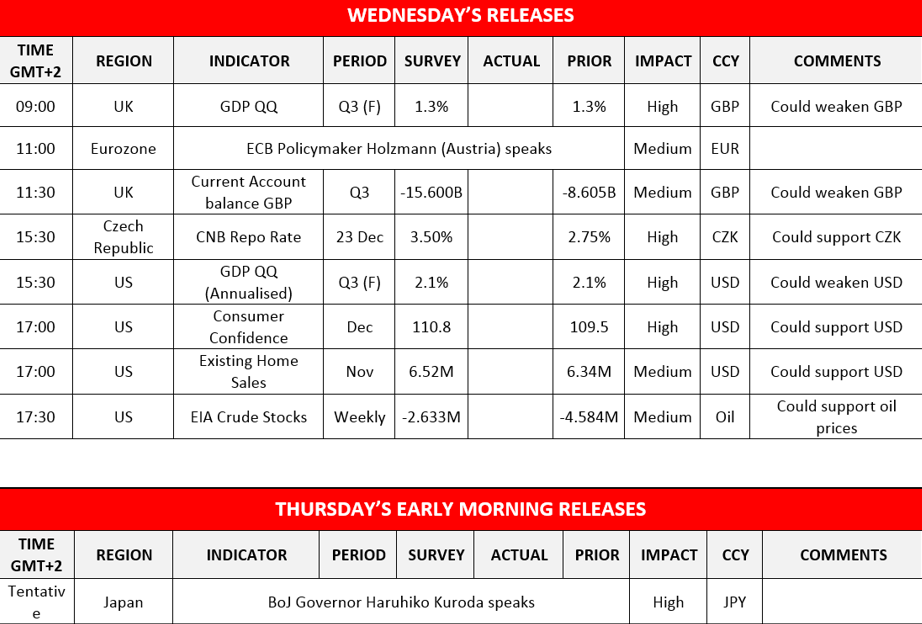
Crude oil prices also rose yesterday as risk appetite returned to the markets, helped by easing concerns over the Omicron strain. Crude oil inventories data will be released today. Analysts believe the government data will show a 2.6 million barrel drop in crude oil inventories from the previous week. The supply shortage may cause oil prices to rise further.
The Asian stock indices supported the overall growth dynamics yesterday. At the same time, the indices continued to rise at the opening of trading today. Japan's Nikkei stock index (JP225) increased by 1.6% yesterday. News of Monday's enactment of an extra budget to fund the Japanese government's economic stimulus package aimed at mitigating the effects of Covid-19 also seemed to support the domestic stock market. Hong Kong's Hang Seng Index (HK5) increased by 0.2%. Hong Kong's consumer price index rose to 1.8% on an annualized basis. Compared to the previous month, the increase was 0.1%. Hong Hao, a head of research at BOCOM International, said that Chinese investors were more focused on potential supply chain problems caused by COVID outbreaks than on inflation indicators. One major Chinese port was closed as a result of the Omicron outbreak yesterday.
Main market quotes:
- S&P 500 (F) (US500) 4,649.23 +81.21 (+1.78%)
- Dow Jones (US30) 35,492.70 +560.54 (+1.60%)
- DAX (DE40) 15,447.44 +207.77 (+1.36%)
- FTSE 100 (UK100) 7,297.41 +99.38 (+1.38%)
- USD Index 96.59 +0.10 (+0.10%)
Important events for today:
- Japan BoJ Monetary Policy Statement at 01:50 (GMT+2);
- UK GDP (q/q) at 09:00 (GMT+2);
- US GDP (q/q) at 15:30 (GMT+2);
- US CB Consumer Confidence (m/m) at 17:00 (GMT+2);
- US Existing Home Sales (m/m) at 17:00 (GMT+2);
- US Crude Oil Inventories (m/m) at 17:30 (GMT+2).
Dollar Traders Await Interesting Day Ahead
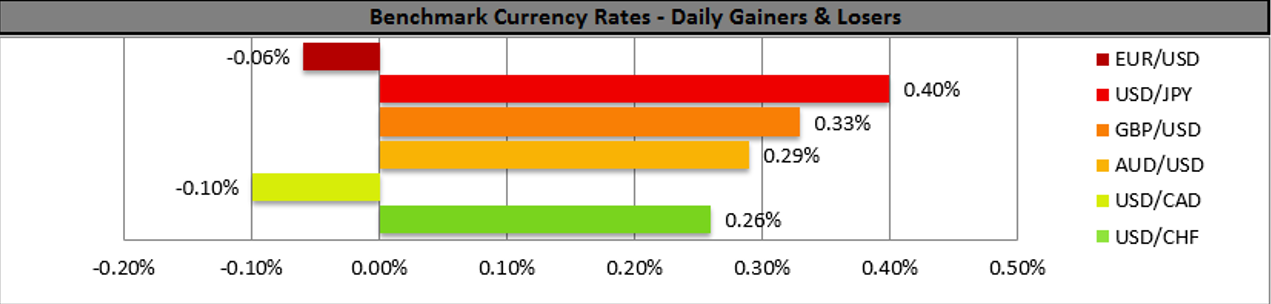
The greenback enjoyed a rather positive session on Tuesday along with the US major stock markets that also moved in green territory. The USD dominated the scene against major counterparts like the JPY, AUD and the CHF. The market’s concerns continue to be dominated by the spread of the Omicron variant globally, which may have created a risk on sentiment. Some analysts suggest that the recent most notable rise in Omicron cases can perhaps extend the global supply-chain disruptions subsequently prolonging higher inflation levels. On the bright side however, despite the uncertainty remaining elevated, traders seem enticed to actively participate in the equities markets.
On a separate note, the benchmark 10-year Treasury note moved higher on Tuesday putting further emphasis on the US economy. On Wednesday Dollar traders could possibly have their hands full with a number of important US economic data to be released. The release of the final GDP rate for Q3, as well as the number of existing home sales for November could provide some support for the USD, should they improve. Yet, we highlight the US consumer confidence indicator for December which is the most relevant reading to the present moment.
In the past four hour sessions USD/JPY has tested the (R1) 114.20 resistance level yet was unable to breach above it. If the upward momentum is to continue then the (R2) 114.70 could become the next target for the bulls, while even higher the (R3) 115.35 resistance remains the highest level for this analysis and could be used in a prolonged buying strategy.
If the currency pair returns to lower grounds we suggest the (S1) 113.80 could be met first, while a move even lower could bring the (S2) 113.25 level into focus. Finally the (S3) 112.75 level could be met in an extensive bearish interest scenario, as it was last tested in the beginning of December. The RSI indicator below our chart has stabilized below the 70 level possibly implying the buying interest may have fizzled out for the time being. With the current price action by the pair, our personal view is for a sideways motion.
CZK in focus as CNB’s Interest rate decision is expected
Today CZK trades are expected to keep a close eye on CNB’s interest rate decision. The bank is widely expected to hike rates by 75 basis points raising the 2-week repo rate from 2.75% to 3.50%. At the moment, CZK OIS imply that the market has fully priced in such a scenario materializing. High inflationary pressures in the Czech economy also tend to advise further tightening of the bank’s monetary policy. Previously CNB raised its interest rate 4 times in 2021 which was mostly aimed at bringing inflation near its 2% target.
If the bank actually proceeds with a rate hike as forecasted, we may see CZK getting support, while a smaller rate hike may disappoint traders as could a more cautious stance, instigating a selling of the Koruna.
EUR/CZK continues to be in a selling momentum which is highlighted by the yellow descending line on our chart. At the moment the currency pair continues to be moving nearby the (S1) 24.850 support level but has been unable to break below it so far. If the selling persists we see the price action moving towards the (S2) 24.815 line while even lower the (S3) 24.780 is also imminent. If the currency pair moves upwards then the (R1) 24.920 could be met first as it was in the past days. Higher we have noted the (R2) 24.960 resistance line as the next possible stop for the bulls, while at the top the (R3) 25.000 which was met for the last time on the 17th of December can also be retested. Please note if the price action moves above the yellow descending line then we would change our bearish outlook to a sideways one.
GBP eyed as UK GDP rates are to be released
The pound was stronger than both the EUR and the USD on Tuesday even though the UK continues to face increased difficulties with the variant spread. However, the pound may have been supported after Rishi Sunak Chancellor of the Exchequer, announced an amount exceeding £1bn in support for companies across the UK hit hardest by the pre-Christmas surge in cases of the Omicron coronavirus variant. This may have come as a surprise to investors as previously the Chancellor seemed reluctant to provide further economic support other than the one that was already in place. Businesses that will benefit the most from the new announcement are said to be the hospitality and leisure sectors which saw a wave of cancellations recently. Moreover, on Wednesday we note the release of UK’s GDP final rates for Q3 and the UK Current Account balance for Q3 later on.
Other highlights for today
Today in the European session we get the UK’s GDP rates for Q3 while a later on we also receive the UK Current Account figure for Q3. In the European afternoon we get the CNB Repo Rate while at the same time we get the US GDP rates for Q3. Sometime later we get the US Consumer Confidence for December and the US Existing Home Sales for November. Finally we get the weekly EIA Crude Oil stockpiles figure.
USD/JPY H4 Chart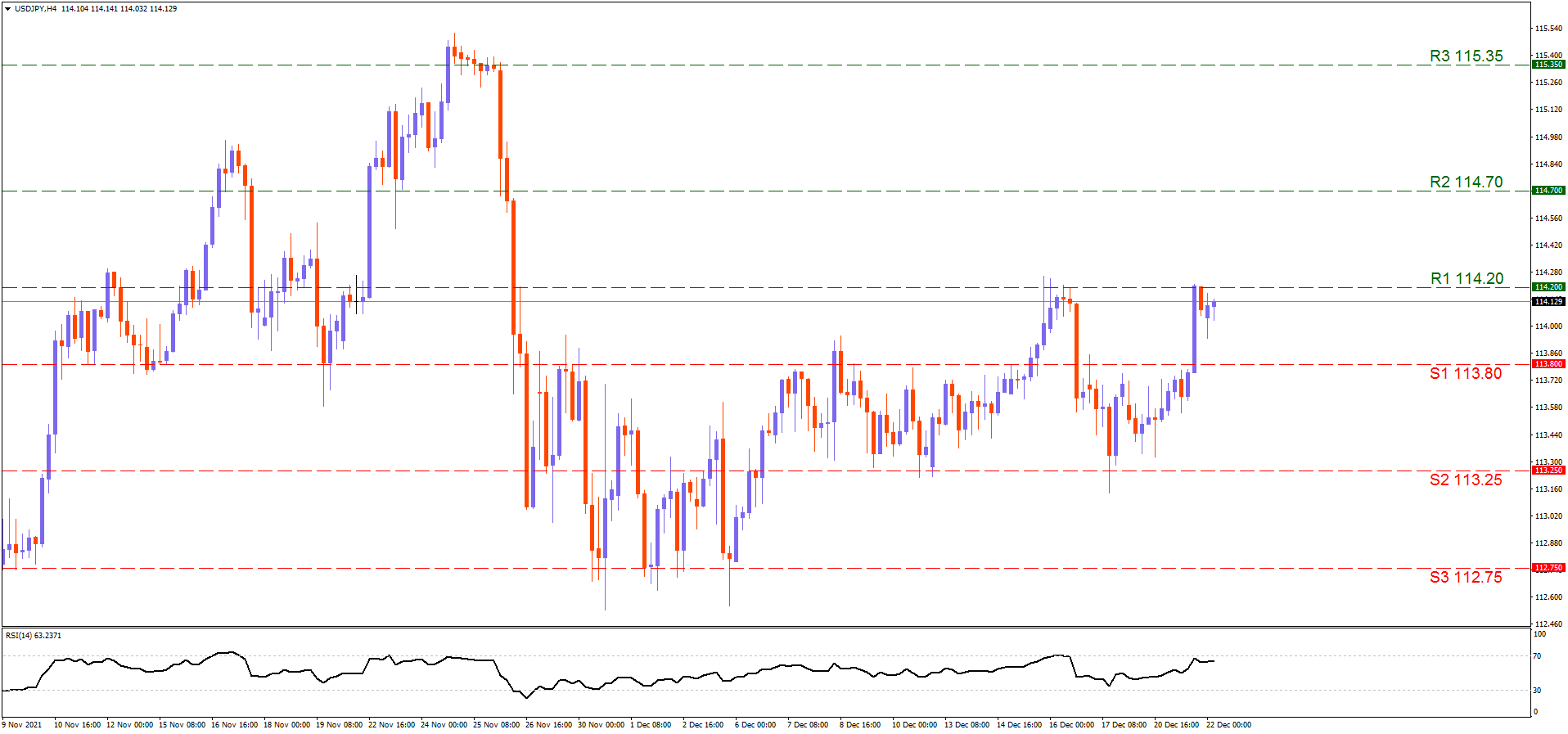
Support: 113.80 (S1), 113.25 (S2), 112.75 (S3)
Resistance: 114.20 (R1), 114.70 (R2), 115.35 (R3)
EUR/CZK H4 Chart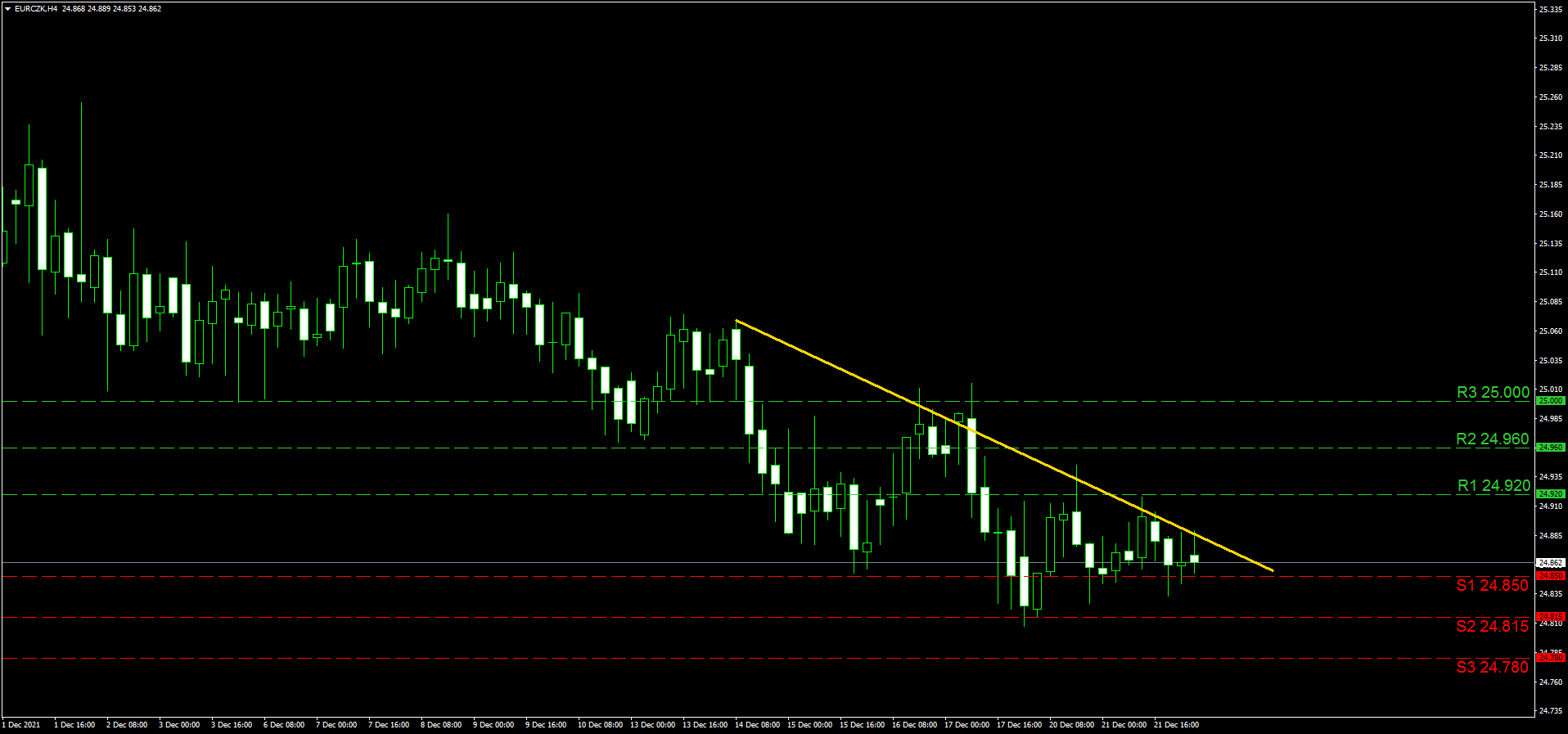
Support: 24.850 (S1), 24.815 (S2), 24.780 (S3)
Resistance: 24.920 (R1), 24.960 (R2), 25.000 (R3)
US 500 Rebounds After Sharp Sell-Off, Bullish Bias Arises
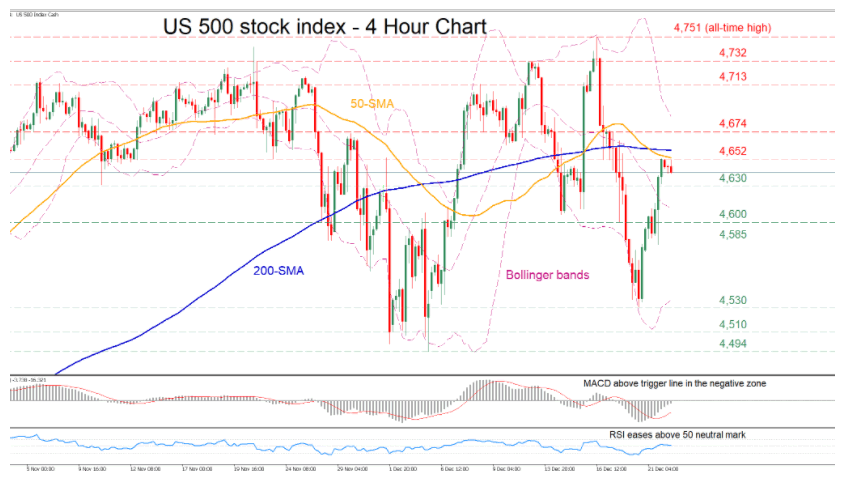
The US 500 stock index (cash) is trying to stage a full rebound after its short-term downtrend ceased at the 4,530 level in the four-hour chart. Although the index has already recouped half of its recent losses, its upside move is meeting some resistance near the 50-period simple moving average (SMA).
The index’s recent recovery is likely to resume as the momentum indicators reinforce the positive near-term picture. Specifically, the MACD histogram is found well above its red signal line in the negative area, while the RSI has flatlined above its 50-neutral mark.
Should the bullish momentum intensify further, immediate resistance could be encountered at the recent high of 4,652, which overlaps with the 50-period simple moving average (SMA). Overcoming this barrier, the price might ascend towards the 4,674 region. Conquering this barricade, buyers could send the price to challenge 4,713 or higher to test the 4,732 obstacle.
On the flipside, bearish actions could meet initial support at the recent low of 4,630. Piercing through this level, the price may decline towards the 4,600 psychological mark. If that barrier fails as well, the spotlight might turn to 4,585 before 4,530 appears on the radar.
Overall, the US 500 index is on recovery mode and only a profound dip beneath 4,530 would alter its short-term outlook back to negative.
Oil Takes Wild Ride, Gold Yawns
Another wild day for oil
The headless chickens populating oil markets had another day in the sun overnight, sending oil prices rocketing higher after a lower US API Crude Inventory figure, and riding the wave of diminishing virus caution as the news tickers stayed relatively quiet. Tonight’s official US Crude Inventories are expected to fall by 2.5 million barrels. Assuming omicron stays away from its Bad Santa role, a lower number could be the excuse needed in the chicken run to propel prices higher once again.
OPEC+, of course, continues to lurk in the background, and their free option on quickly reigning in production to support prices from the last meeting open should continue to be a warning to overenthusiastic bears. If Brent crude heads towards USD 65.00 a barrel, I wouldn’t discount OPEC+ stepping in. Given that compliance is over 100%, this would process would be easy to achieve.
Brent crude rose by 2.70% to USD 74.00 a barrel overnight, climbing slightly to USD 74.10 in Asia. Brent crude has resistance at USD 74.40 and then USD 76.00 a barrel, with support at USD 73.25, the 200-DMA. WTI rocketed 3.0% higher to USD 71.25 a barrel overnight, adding 10 cents to USD 71.35 in Asia. It has resistance at USD 73.00 a barrel, with support at USD 70.55, its 200-DMA. Trading in Asia is reflecting the same cautious approach seen in Asian equity markets today. Headless chickens can run in any direction randomly.
Gold is sleepless in Singapore
Gold probed USD 1800.00 an ounce overnight but quickly retreated as US yields rose, finishing almost unchanged at USD 1789.00 an ounce. Asian trading is moribund, gold edging slightly lower to USD 1788.50 an ounce as regional markets move into holiday mode.
Gold’s attempts to stage a meaningful recovery continue to disappoint, with traders cutting long positions at the very first sign of trouble intra-day. Gold lacks the momentum, one way or another, to sustain a directional move up or down. Likely, gold will remain a forgotten asset class and face another week of choppy range trading.
Gold has formed a rough double top around the USD 1815.00 region which will present a formidable barrier at $1840.00. Support lies at USD 1790.00, followed by USD 1780.00 an ounce. USD 1790.00 to USD 1815.00 could well be the range for the week.
US Dollar Holds Steady
US dollar maintains ground
The US dollar held steady via the dollar index overnight, although the surge in positive sentiment in equity markets saw gains in the Canadian, Australian and New Zealand dollar risk barometers. The dollar index held steady at 96.48 and I continue waiting for a break or either 96.00 or 97.00 to signal the US dollar’s next directional move.
EUR/USD remains steady at 1.1270 today with risks still skewed lower thanks to omicron and energy prices. Failure of 1.1200 signalling a test of 1.1000. Sterling has risen by 0.45% to 1.3250 as the UK PM ruled out pre-Christmas restrictions overnight. USD/JPY has edged higher to 114.10 as US bond yields rose overnight.
The three risk-sentiment amigos, the CAD, AUD, and NZD all staged modest rallies overnight, but still remain near 2021 lows. The omicron flavour of the day will continue to dictate directional moves through the holiday period.
Asian currencies are steady as USD/CNY remains near-unchanged at 6.3725. The firm Chinese yuan and diminishing holiday season liquidity are dampening activity in the regional Asia FX space, and I expect range trading to dominate over the rest of the week.
An interesting story is making the rounds this morning, suggesting that researchers at the Walter Reed Army Institute of Research have made substantive progress in developing a compound that protects against multiple coronaviruses, including Covid-19. US equities have risen in response, while the US dollar continues to hold steady. If the report of a super-vaccine is confirmed, it would be a game-changer in the battle against Covid and would likely send risk appetite soaring, which would hurt the US dollar.
Asian Equities Don’t Buy The US Hype
Asian markets cautious despite Wall Street frenzy
US markets were on fire overnight as a slowdown in omicron headlines irresistibly led the fast-money herd into a buy-the-dip frenzy. With pre-holiday season liquidity heightening ranges, US markets soared with the S&P 500 jumping by 1.78%. That was overshadowed by the Nasdaq, which soared 2.40% higher, as the Dow Jones gained an impressive 1.59%. The first sign that this rally is built on eggshells is coming from US futures today though. The S&P 500 and Dow Jones futures have eased by 0.10%, while Nasdaq futures have already given back 0.35%.
With no follow-through on US index futures, Asian markets have rightly adopted a wait-and-see cautious approach today, perhaps tired of the relentless whip-saw price action emanating from New York. Asian markets are mostly higher, but only very moderately so. Even the Nasdaq directional slaves of Tokyo are taking a break today, the Nikkei 225 rising just 0.10%. The South Korean Kospi climbing just 0.15%.
In mainland China, activity is similarly quiet, the Shanghai Composite is unchanged, while the CSI 300 is just 0.10% higher. Hong Kong has put on a better show, rising by 0.60% thus far.
Singapore has just announced a dialling back of its vaccinated travel lane policies due to omicron, and I have a feeling we will see more in the days ahead. That is likely to weigh on sentiment with the STI now up just 0.10%. By contrast, Kuala Lumpur has risen by 0.40%, thanks to oil's rally overnight, while Taipei is 0.20% higher. Jakarta has gained 0.25% with Bangkok rising 0.45% and Manila unchanged. Australian markets are in Christmas mode, the All Ordinaries edging 0.20% higher, with the ASX 200 up just 0.10%.
The price action in Asia suggests that European and UK markets are unlikely to follow New York's lead with the UK Prime Minister apparently due to announce a decision on a post-Christmas circuit breaker decision in the next 48 hours. Surging energy prices in Europe, as well as the evolution of omicron across the Eurozone, will weigh limit gains on the continent.
USD/JPY Pair Is Now Correcting Lower From The 114.20 High
The US Dollar started a fresh increase from the 113.10 zone against the Japanese Yen. The USD/JPY pair broke the key 113.40 resistance zone to move into a positive zone.
The pair even broke the 113.65 resistance and settled above the 50 hourly simple moving average. A high was formed near 114.20 and it is now correcting lower. An immediate resistance is near the 114.20 level.
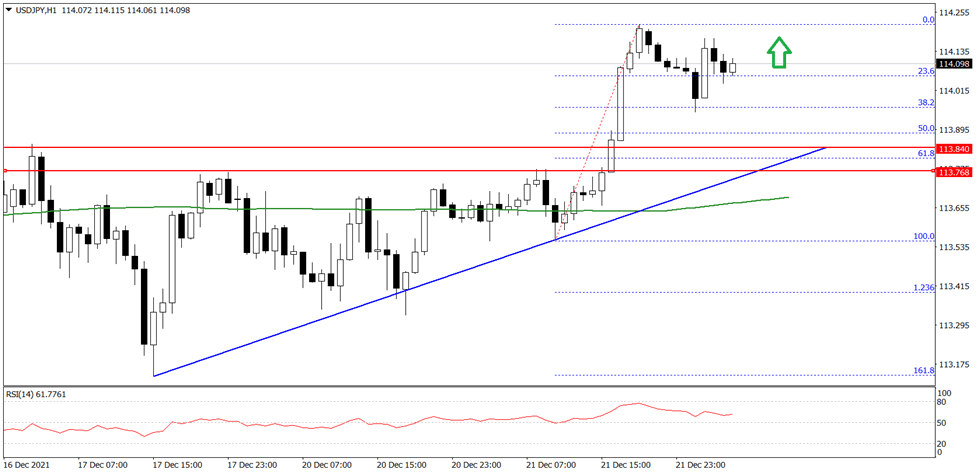
The first major resistance is near the 114.40 level, above which the pair could rise steadily. The next major resistance is near the 114.80 level.
An initial support on the downside is near 114.00 on FXOpen. There is also a key bullish trend line forming with support near 113.85 on the hourly chart, below which USD/JPY might drop towards the 113.50 support zone. The next major support sits near the 113.20 level.
USDJPY Surpasses Short-Term SMAs, Weak Momentum
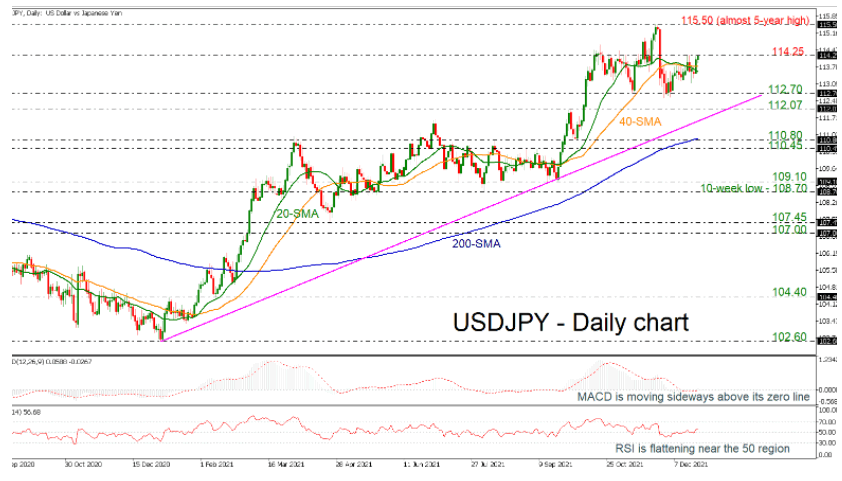
USDJPY is advancing above the 20- and 40-day simple moving averages (SMAs) after a month but the outlook is still neutral. The MACD oscillator is holding above its trigger and zero lines, but the momentum is very weak, while the RSI is flattening above the neutral threshold of 50, both mirroring the sideways move in the short-term.
If the price successfully overcomes the 114.25 immediate resistance, the next stop could come from the almost five-year high of 115.50. Rising above this level, the 118.60 barrier, registered in January 2017 may pause the upward move.
On the flip side, a decline below the near-term SMAs could take the bears towards the 112.70 support and the inside swing high from September 30 at 112.07. Slipping below this level, the long-term ascending trend line may halt the bearish move at 111.60, while even lower the 200-day SMA around 110.80 is acting as strong support.
All in all, any moves beneath the 200-day SMA could switch the current outlook to bearish, though a climb beyond the five-year high could endorse the long-term bullish trend.
USD/CAD Decline Reveals Pattern
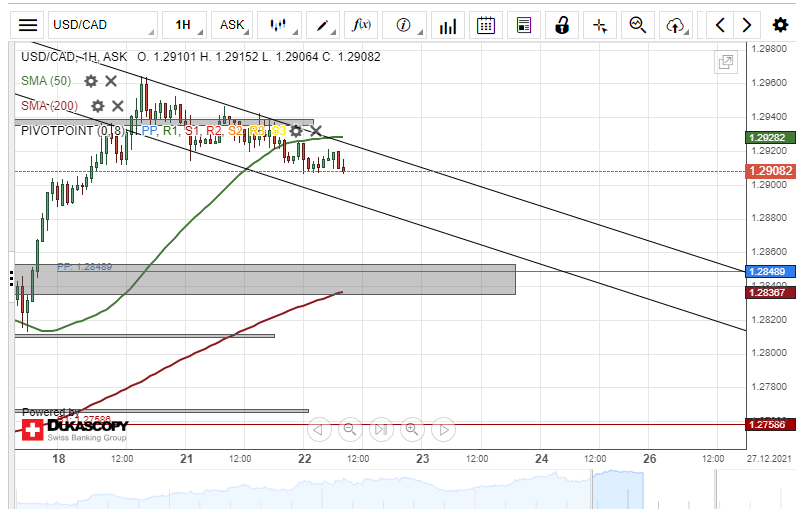
In general, the USD/CAD continues to decline from the 1.2960 mark, as simultaneously the pair continues to find short term support and resistance in round exchange rate levels like the 1.2920, 1.2940 and 1.2910. In the meantime, the currency pair has revealed a channel down pattern, which has been capturing the rate's moves throughout this week.
If the pair continues to decline, support could be found in the 1.2900 mark. A move below the 1.2900 level, is expected to be slowed down by the lower trend line of the channel down pattern. Meanwhile, note that, except the mentioned levels, there is no support as low as 1.2850.
On the other hand, a recovery of the US Dollar against the Canadian Dollar is expected to find resistance in the combination of the 1.2920 level, the upper trend line of the channel pattern and the 50-hour simple moving average. Above these levels, resistance could once again be provided by 1.2940 and 1.2960 levels.
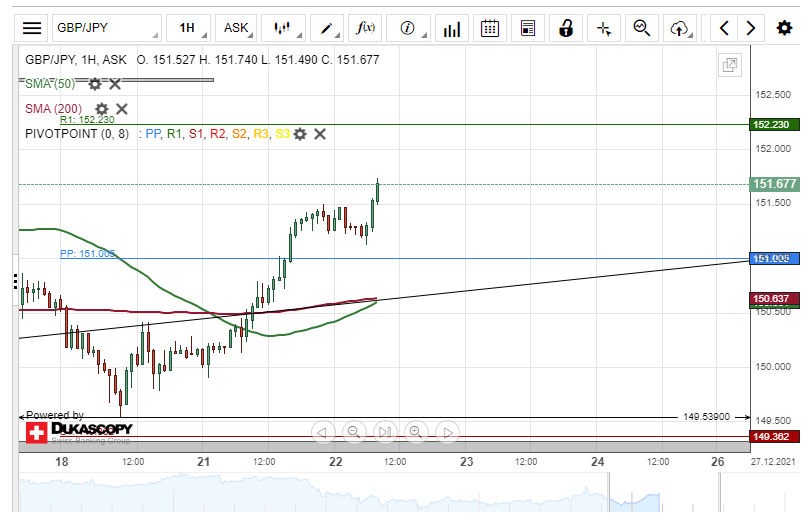
GBP/JPY Reaches 151.50 Mark
The GBP/JPY has once by one passed technical resistance levels and reached the 151.50 mark. In general, each technical resistance level managed to hold no longer than two hours before being passed. On Wednesday morning, the 151.50 level provided resistance and forced the rate into fluctuating sideways.
In the case that the rate passes the 151.50 mark, a potential target would be the 152.23 level, where the weekly R1 simple pivot point was located at. However, the 152.00 mark might act as resistance.
Meanwhile, a proper decline could look for support in the weekly simple pivot point at 151.01 and the 151.00 mark. Below the 151.00 level, the combination of the 50 and 200-hour SMAs might act as support near 150.60.