

Sample Category Title
Risk Sentiment Flip-Flops, Canadian Dollar Shrugs Retail Sales
Risk sentiment continues to flip-flop in pre-holiday markets. Major European indexes and US futures are trading slightly higher. Swiss Franc, Yen and Dollar are all trading generally lower, while Kiwi and Aussie are trading higher with Sterling. Canadian Dollar appears to be getting little support from better than expected retail sales data.
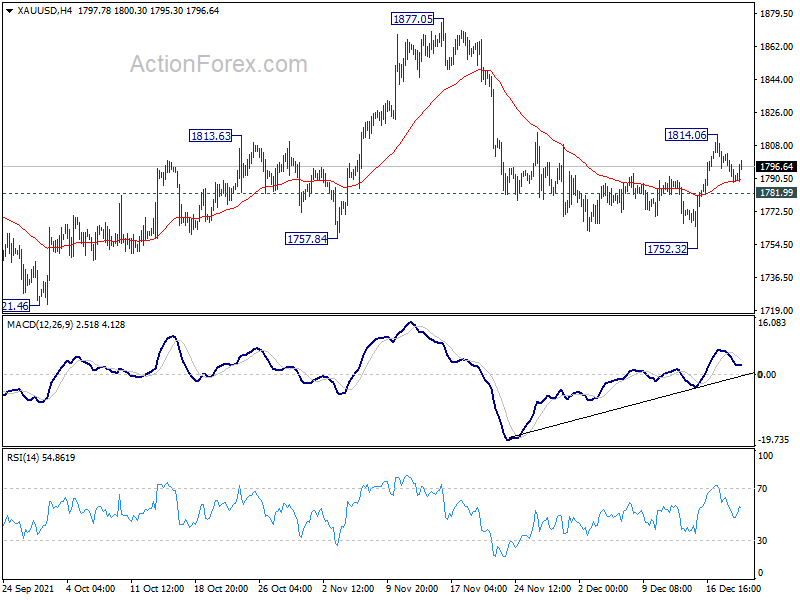
Technically, gold appears to be supported by 4 hour 55 EMA and recovers. It has yet recaptured 1800 handle yet. For now, further rise is in favor as long as 1781.99 minor support holds. Break of 1814.06 will target 1877.05 resistance. However, below 1781.99 will bring retest of 1752.32 support instead.
In Europe, at the time of writing, FTSE is up 0.99%. DAX is up 1.14%. CAC is up 1.06%. Germany 10-year yield is up 0.0462 at -0.320. Earlier in Asia, Nikkei rose 2.08%. Hong Kong HSI rose 1.0%. China Shanghai SSE rose 0.88%. Singapore Strait Times rose 0.39%. Japan 10-year JGB yield rose 0.0163 to 0.055.
Canada retail sales rose 1.6% mom in Oct, to rise further 1.2% in Nov
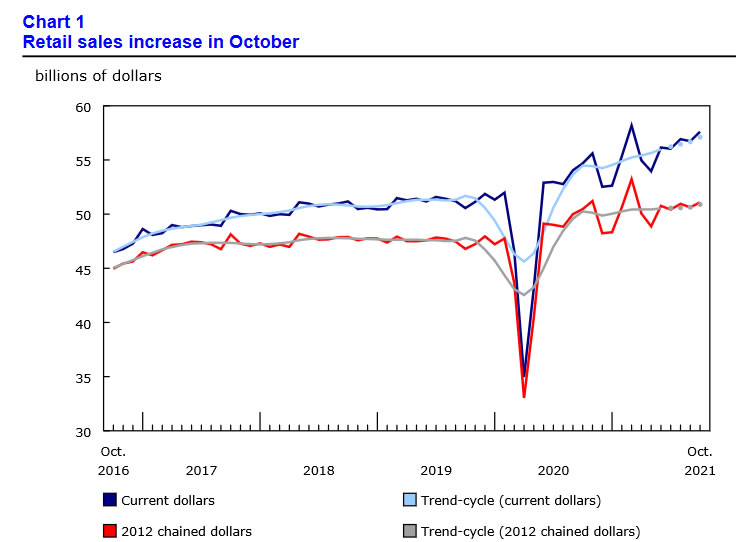
Canada retail sales rose 1.6% mom to CAD 57.6B in October, above expectation of 1.2% mom. Growth was led by higher sales at motor vehicle and parts dealers (+2.2%), as new car dealer sales (+2.8%) rebounded. Sales increased in 7 of 11 subsectors, representing 59.9% of retail trade. Core retail sales, excluding gasoline stations and motor vehicle and parts dealers, rose 1.5% mom.
According to advance estimate, retail sales rose 1.2% mom in November.
Germany Gfk consumer confidence dropped to -6.8, down on Omicron and prices
Germany Gfk consumer confidence for January dropped sharply from -1.8 to -6.8. In December, economic expectations dropped from 31.0 to 17.1, lowest since April. Income expectations dropped from 12.9 to 6.9. Propensity to buy dropped from 9.7 to 0.8.
Rolf Bürkl, GfK consumer expert said: "Consumer sentiment continues to be under a lot of pressure from two sides as the year draws to a close. High case numbers due to the fourth wave of the Corona pandemic with further restrictions, as well as significantly increased prices, are putting more and more pressure on consumer sentiment.... The outlook for the beginning of next year is also muted against the backdrop of the rapid spread of the Omicron variant."
Also releaesd in Europaen session, Swiss trade surplus widened to CHF 6.16B in November, versus expectation of CHF 5.43B. UK public sector net borrowing rose to GBP 16.6B in November, versus expectation of GBP 12.0B.
Japan government: economy shows movements of picking up
In the latest Monthly Economic Report, Japan's Cabinet Office upgraded economic assessment for the first time in 17 months. It said, "the Japanese economy shows movements of picking up recently as the severe situation due to the Novel Coronavirus is gradually easing." Back in November, it said the economy "continues to show weakness in picking up".
Private consumption is "picking up", dropping "while some weakness remains". However, business investments "appears to be pausing for picking up". Exports are "almost flat". Industrial production continues to appear to be "pausing for picking up". Corporate profits are "picking up". Employment situations shows "picking up in some components", comparing to November's "shows steady movement". Consumer prices continues to "show steady movements.
RBA minutes laid three options on QE, patient on rates
In the minutes of December 21 meeting, RBA reiterated that decision about the bond purchases program will be made in February. The criteria to consider include "progress towards the Board's goals for employment and inflation, the actions of other central banks and the functioning of the Australian bond market." Information include December CPI, December and January labor market data, and overall impact of Omicron.
Three possible options were also discussed.
- The first option was to reduce the pace of purchases from mid February with an expectation of a likely end point in May 2022. This option is consistent with November forecasts for employment and inflation.
- The second option was to reduce the pace of purchases and review it again in May 2022. This option is stronger if progress was slower than expected.
- The third option was to cease purchases altogether in mid February. In case of better-than-expected progress, the third option would become more appropriate.
Regarding interest rate, "the Board will not increase the cash rate until actual inflation is sustainably within the 2 to 3 per cent target range." And, "this is likely to take some time and the Board is prepared to be patient."
USD/CHF Mid-Day Outlook
Daily Pivots: (S1) 0.9188; (P) 0.9220; (R1) 0.9246; More....
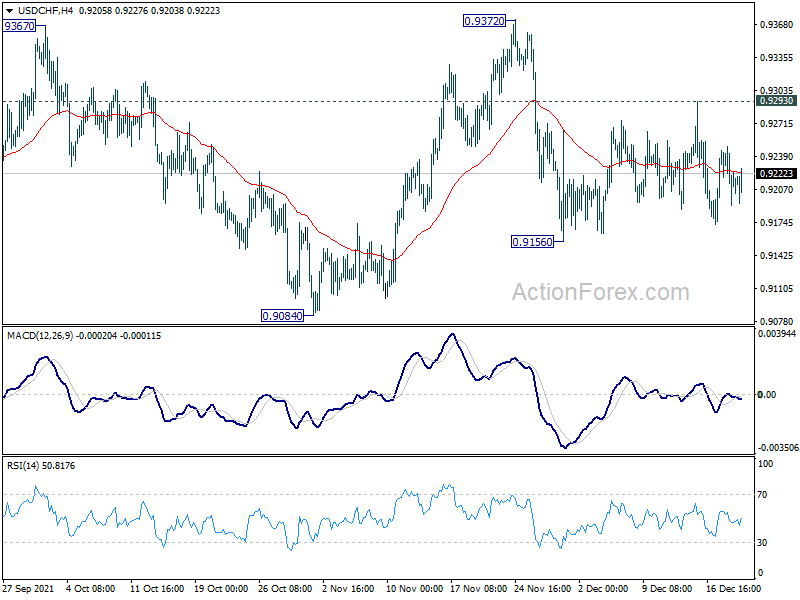
USD/CHF is still bounded in range trading above 0.9156 and intraday bias remains neutral. On the downside, below 0.9156 will target 0.9084 support. Firm break there should confirm that choppy rise from 0.8925 has completed, and suggests that fall from 0.9471 is resuming. Deeper decline would be seen through 0.8925. On the upside, break of 0.9293 will suggest that the pull back from 0.9372 is finished. Intraday bias will be turned back to the upside for 0.9372.
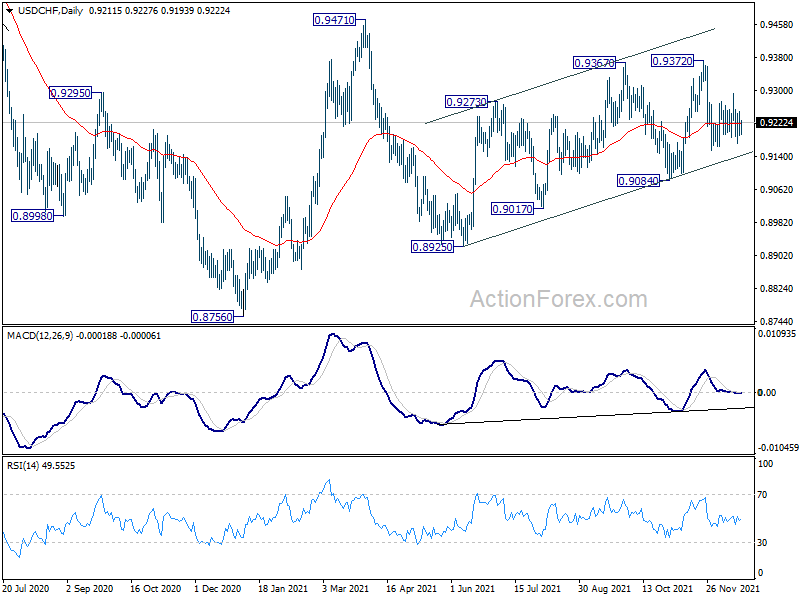
In the bigger picture, the corrective structure of the rebound from 0.8925 argues that fall from 0.9471 is not complete yet. It could either be the second leg of pattern from 0.8756 (2021 low), or resuming larger down trend from 1.0237 (2018 high). We'd pay attention to the downside momentum and assess the odds later. But for now, medium term outlook will be neutral at best as long as 0.9471 resistance holds.
Economic Indicators Update
| GMT | Ccy | Events | Actual | Forecast | Previous | Revised |
|---|---|---|---|---|---|---|
| 00:30 | AUD | RBA Minutes | ||||
| 07:00 | EUR | Germany Gfk Consumer Confidence Jan | -6.8 | -2.5 | -1.6 | -1.8 |
| 07:00 | CHF | Trade Balance (CHF) Nov | 6.16B | 5.43B | 5.65B | |
| 07:00 | GBP | Public Sector Net Borrowing (GBP) Nov | 16.6B | 12.0B | 18.0B | 11.6B |
| 13:30 | USD | Current Account (USD) Q3 | -215B | -204B | -190B | |
| 13:30 | CAD | Retail Sales M/M Oct | 1.60% | 1.20% | -0.60% | |
| 13:30 | CAD | Retail Sales ex Autos M/M Oct | 1.30% | 0.80% | -0.20% | |
| 15:00 | EUR | Eurozone Consumer Confidence Dec P | -8 | -7 |
Canada retail sales rose 1.6% mom in Oct, to rise further 1.2% in Nov
Canada retail sales rose 1.6% mom to CAD 57.6B in October, above expectation of 1.2% mom. Growth was led by higher sales at motor vehicle and parts dealers (+2.2%), as new car dealer sales (+2.8%) rebounded. Sales increased in 7 of 11 subsectors, representing 59.9% of retail trade. Core retail sales, excluding gasoline stations and motor vehicle and parts dealers, rose 1.5% mom.
According to advance estimate, retail sales rose 1.2% mom in November.
Aussie Edges Up After RBA Minutes
RBA cautiously optimistic about Omicron
The RBA minutes from the December meeting were cautious but optimistic at the same time. Investors reacted to the minutes, which stated that the bank did not expect the Omicron variant to derail the economic recovery. Still, the bank noted that Omicron “posed additional uncertainty for the near-term outlook.” Given the disparity between RBA guidance and the markets’ expectations for a rate hike, this language is a signal that the bank has no intention of raising interest rates anytime soon.
The minutes reiterated that the bank would not hike rates until “actual inflation is sustainably within the 2 to 3 per cent target range.” The word “sustainably” is key, since underlying inflation has already reached 2%, but the bank can argue that inflation is not yet sustainably above 2%. Of course, it is the RBA that is the sole decisor of what constitutes “sustainable” inflation, which gives the bank plenty of leeway.
Investors were also encouraged by what the RBA had to say about QE. The minutes noted that the RBA would consider winding up its QE programme in February rather than May if economic conditions improved. This stance fits in nicely with the minute’s observation that the economy was rapidly recovering after the downturn due to Delta. If the recovery accelerates, we can expect the bank to bring forward its timeline on winding up QE, which will then shift market focus on a lift-off date for a rate hike.
The month of December is all about volatility, and the Australian dollar has already delivered on that front. Earlier in December, the Aussie gained a whopping 2.49% in just one week, its best weekly performance in 2021. Liquidity will be thin as we head towards the New Year, so markets participants should be prepared for further volatility from the Australian dollar. The markets have been jumping on every bit of news with regard to Omicron, and it will only take a headline about Covid to trigger a sharp reaction from the Australian dollar.
AUD/USD Technical
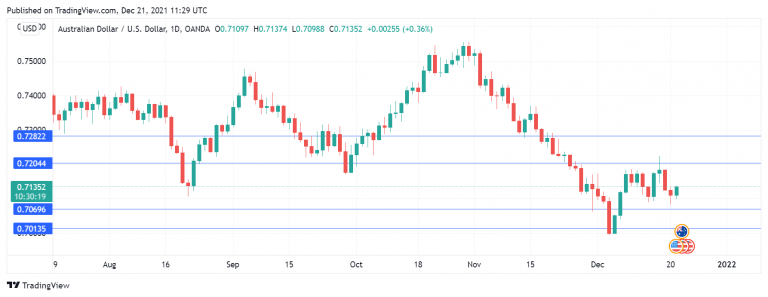
- There are support levels at 0.7069 and 0.7013
- AUD/USD faces resistance at 0.7203. The next resistance line is at 0.7281
EUR/USD Finds Support In Pivot Point
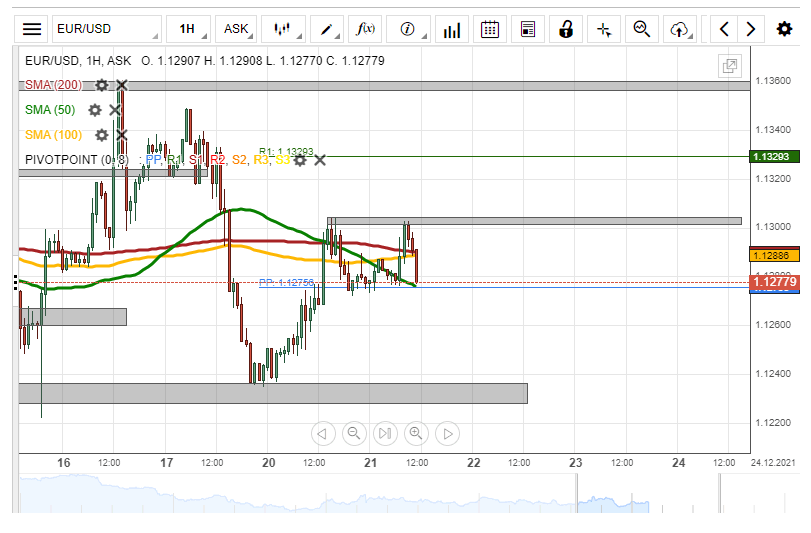
Since mid-Monday, the EUR/USD has been fluctuating between the support of the weekly simple pivot point at 1.1276 and the resistance of the 1.1302/1.1305 zone.
In the case that the rate drops below the weekly simple pivot point at 1.1276, a potential decline would have no support as low as the December low level zone at 1.1228/1.1236.
However, if the Euro surges against the US Dollar, a move above the 1.1302/1.1305 zone could aim at the weekly R1 simple pivot point at 1.1329. Higher above, note the December high level zone below 1.1360.
PBOC Cut Policy Rate as Economic Recovery Hampered by Pandemic and Power Shortage
China is going against the global tide of normalization of monetary policy. The PBOC announced to cut the one-year loan prime rate (LPR) by -5 bps to 3.8%, first time April 2020. This, together with the reduction in RRR and increase RRR on foreign currencies earlier this month, indicates that the country’s economic recovery is at risk. China’s economic fragility should be attributed to the government’s policy miscalculation, from coronavirus management to the crackdown of major industries.
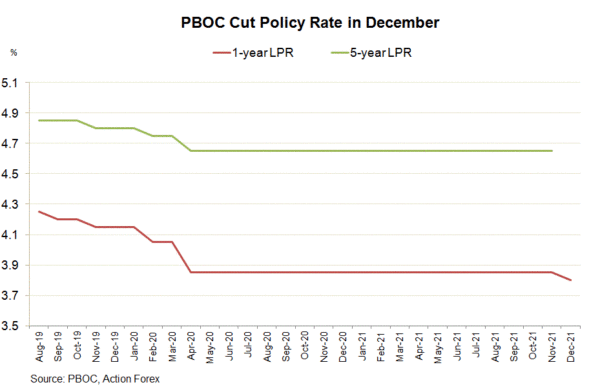
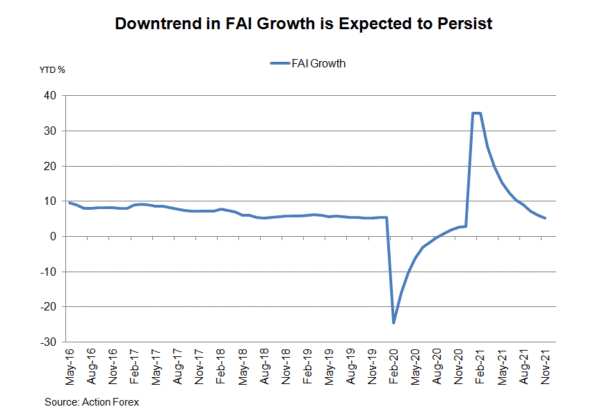
While the one-year LPR was educed, the 5-year rate stayed unchanged. Before the rate cut, the central bank had already lowered the reserve requirement ratio (RRR) by -50 bps, and raised the foreign exchange RRR by +200 bps to 9% from 7% on December 15. The aims are to increase liquidity in the market and prevent capital outflow, respectively. Economic data has been disappointing. Retail sales expanded +3.9% y/y in November, much weaker than consensus of +4.7% and October’s +4.9%. In the first 11 months of the year, retail sales grew +13.7% y/y, compared with +14.9% in the first 10 months. Industrial production rose +3.8%, slightly better than consensus of +3.7% and +3.5% in October. However, the year-to-date reading gained +10.1%, compared with +10.9% in the first 10 months. Urban fixed asset investment remained weak. The year-to-date growth of +5.2% y/y was a deceleration from the +6.1% expansion in the first 10 months of the year.
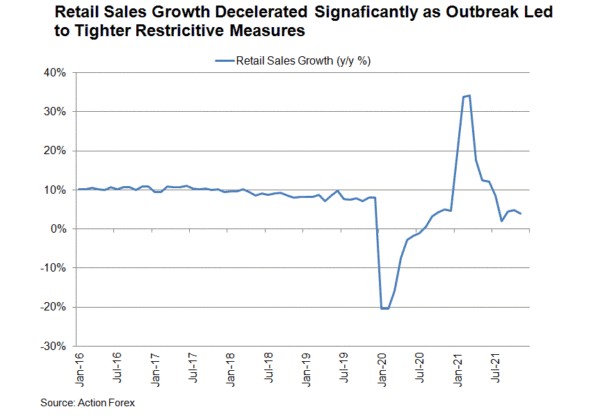
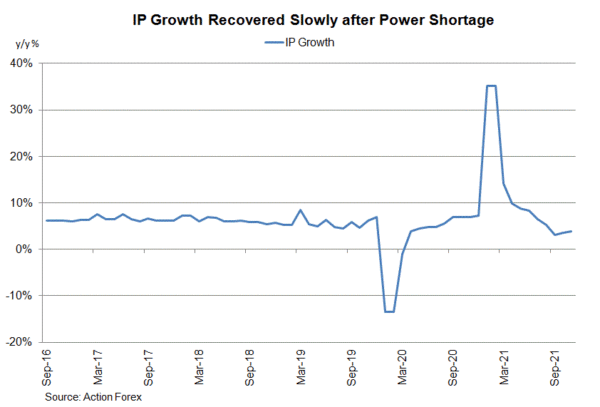
 The resurgence of the pandemic in China has resulted in more stringent restrictive measures, thanks to the government’s obsession in COVID-zero. This clearly has weighed on consumer activity (evidenced in retail sales). The labor market also suffered as the sectors affected most seriously by the restrictions are usually the labor-intensive ones such as catering and factories. Power shortage leading to closure of factories lingered despite improvement from situation in September/October. One of the key reasons for the power shortage is the pricing problem in China’s power industry. As China’s electricity prices have been controlled by the government, grid firms (suppliers) find themselves worse off amid a global surge in commodity prices. Their restricted supply of electricity to the market is a cause of the recent power shortage in China.
PBOC’s rate cut is contrary to the trend of monetary policy normalization in global major central banks. The policy divergence could lead to weakness in renminbi. While it might be of the interest of the China’s government ib t he near-term, it could be detrimental to investors’ confidence in the currency and economic situation in the country in the longer-term.
Relief Rally Lifts Asian Equities
Asian markets ignore US sell-off
Asian equities are mostly higher today, thanks to a wave of short-covering sharply lifting US index futures in ever thinner liquidity. Nothing has changed in the world, but the pull of buy-the-dip is stronger than anything the Sackler’s made but should also be approached with caution.
Overnight US equities followed the Asian sell-off from early Monday, finishing deeply in the red. The S&P 500 dropped by 1.11%, while the Nasdaq and Dow Jones retreated by 1.23%. In Asian trading, futures on all three have staged a sharp rally, though. S&P 500 futures are 0.60% higher, while Nasdaq futures have jumped by 0.80% and Dow Jones futures have climbed by 0.50%.
That has been enough to sucker the fast-money FOMO gnomes in Asia into action, nowhere more evident than Japan’s Nikkei 225, which has leapt 2.05% higher, whereas South Korea’s Kospi is up only 0.20%, with mainland China’s Shanghai Composite and CSI 300 unchanged. The press is suggesting that more clampdowns could be on the way, which should be a surprise to precisely nobody. Hong Kong has rallied modestly, rising 0.30%.
Singapore has risen by 0.60% with Taipei climbing by 0.55%, while Kuala Lumpur and Jakarta remain stubbornly unchanged. Manila is 0.35% lower, but Bangkok has added 0.60%. Australian markets have also joined in some pre-Christmas cheer, the ASX 200 rising 0.55%, and the All Ordinaries by 0.65%.
European investors may cautiously dip their toes back in the water, assuming US index futures maintain their gains. However, with the omicron situation darkening in the UK and on the continent by the day, I am not expecting much of a rally, if any.
The data calendar in Asia is light this week. The action will be in the US tomorrow with some old news Q3 GDP and PCE Prices, followed by the far more relevant US Personal Income/Spending and Durable Goods for November, plus the weekly Jobless Claims, on Thursday.
Risk Sentiment Recovers
Notes/Observations
- Risk appetite finding some support.
- EU confidence data showed that the most recent surge in virus cases was hitting sentiment in the region.
Asia
- RBA Dec Minutes reiterated stance that was committed to highly supportive monetary condition. Emergence of omicron virus variant was a new source of uncertainty and the risk to recovery would be more clear in Feb 2022. Reiterated forward guidance that would not increase rates until CPI was sustainably within 2-3% range.
- Japan Govt said to be considering raising FY22 real GDP Forecast from 2.2% to at least 3.0% citing the expected impact of the extra budget.
- Japan Cabinet Office (Govt) Dec Economic Report raised its overall economic assessment for the 1st time in 17 months. It now saw the domestic economy picking up as severe conditions due to the coronavirus were gradually easing.
Coronavirus
- CDC: The omicron variant makes up almost 75% of US C-19 cases. Texas Health officials announced they’ve recorded their first death associated with the omicron variant.
- President Biden to announce Covid measures in a speech on Tuesday (Dec 21st). The speech said not to be about locking the country down but focusing on the unvaccinated and setting up testing sites across the country.
- China Dongxing Port suspends customs Ops due to coronavirus.
Europe
- ECB's De Guindos (Spain): Inflation in the Euro Zone has been not as temporary as we expected.
- UK PM Johnson not preparing to announce any more Covid restrictions before Christmas. To wait until the data was clearer before taking further action.
- Turkey President Erdogan announced new tools in free market economy rules to ease volatility in FX rate. The new financial alternatives to citizens would not have to convert TRY currency (Lira) savings into FX due to volatility. Withholding tax on Turkey govt bonds to be cancelled (Note: TRY currency moved away from record lows of 18.36 to test below 11.20 level on Erdogan Rescue Plan which would compensate holders of lira in banks in the event of further currency depreciation).
Americas
- Biden-Manchin talks on Sunday reportedly, 'ended with a sense negotiations on BBB would continue in some form next year. Manchin (D-WV) reportedly made an offer last week to support a $1.8T 'Build Back Better' bill that included universal pre-K and climate spending, but excluded expanding child tax credit. Biden did not agree to proposal due to lack of child tax credit.
Speakers/Fixed income/FX/Commodities/Erratum
Equities
- Indices [Stoxx600 +0.67% at 470.48, FTSE +0.72% at 7,250.20, DAX +0.42% at 15,303.89, CAC-40 +0.32% at 6,891.88, IBEX-35 +0.80% at 8,308.06, FTSE MIB +0.50% at 26,308.00, SMI +0.37% at 12,635.90, S&P 500 Futures +0.53%].
- Market Focal Points/Key Themes: European indices open higher across the board but moderated some of their gains through the morning’s trading; all sectors start the day in the green as better risk sentiment is attributed to developents in medication against the new covid variant; sectors among those leading to the upside are materials and energy; while slower to rise sectors include health care and utilities; Irish government to initiate sale of part of their stake in AIB; UK’s CMA looks for deeper probe into Veolia/Suez deal; Zardoaya receives increased offer from Otis; Schroders confirms to take stake in Greencoat Capital; Fiskars sells it’s NA watering unit; earnings expected during the upcoming US session include General Mills, Blackberry and Rite Aid.
Equities
- Consumer discretionary: Tomtom [TOM2.NL] +5% (partnership with Volkswagen).
- Financials: Allied Irish Bank [ALBK.IE] -1% (Irish govt to sell part of its stake).
- Healthcare: Zur Rose Group [ROSE.CH] -7% (German digital prescriptions rule).
- Industrials: Zardoya Otis [ZOT.ES] +2% (increased offer), Manz AG [M5Z.DE] +10% (order).
- Technology: Infineon [IFX.DE] +1.5% (Micron earnings).
Speakers
- ECB's Kazimir (Slovakia) stated that there was a risk that elevated inflation could stay for longer time. Reiterated Council stance that ECB is not preparing to raise rates in the near future but would have to act if the inflation outlook changed in the 2023/24 period. Reiterated view that not seeing signs of wage-price spiral at this time but could increase if high inflation persisted.
- UK Govt official Barclay noted that Chancellor Sunak to say more on covid economic package for the hospitality industry in the near future.
- Greece Debt Agency (PDMA) debt 2022 issuance said to be looking to raise €12B and tap the bond market at least 4 times during year. To issue at least one note per quarter with financing program to be front-loaded.
- Israel Fin Min Liberman stated that there was no need for additional pandemic measures at this time.
- Thailand Finance Ministry saw 2022 GDP growth at 4.0% as economy reopens from pandemic.
- President Biden to outline steps to combat the Omicron virus variant in an upcoming speech. US planning to mail-out 500M testing kits free-at-home COVID-19 tests from Jan 2022 and prepared to deploy Federal medical personnel to hospitals.
Currencies/Fixed Income
- Risk appetite was trying to find fresh legs and this is providing some retracement in the USD and JPY related pairs. Session rebuffing some of the EU confidence data that showed that the most recent surge in virus cases was hitting sentiment in the region.
- EUR/USD hovering around the 1.13 area and well contained within its recent range.
- GBP/USD inching higher at 1.3255 by mid-session.
- TRY currency (Lira) moved away from recent record lows of 18.36 to test 11.15 level on Erdogan Rescue Plan for its biggest gain since 1983. Erdogan announced measures to compensate holders of lira in banks in the event of further currency depreciation.
Economic data
- (NL) Netherlands Dec Consumer Confidence Index: -25 v -19 prior.
- (NL) Netherlands Oct Consumer Spending Y/Y: 8.5% v 4.6% prior.
- (FI) Finland Nov Unemployment Rate: 6.0% v 6.0% prior.
- (DE) Germany Jan GfK Consumer Confidence Index: # v -2.7e.
- (UK) Nov Public Finances (PSNCR): £37.0B v £61.6B prior; PSNB (ex-banking groups): £17.4B v £16.0Be; Net Borrowing: £16.6B v £15.3Be; Central Government NCR: £13.1B v £2.6B prior.
- (CH) Swiss Nov Trade Balance (CHF): 6.2B v 5.5B prior; Real Exports M/M: +1.6% v -2.1% prior; Real Imports M/M: +4.3% v -4.5% prior; Watch Exports Y/Y: 11.9% v 12.5% prior.
- (DK) Denmark Nov Retail Sales M/M: -0.3% v +1.3% prior; Y/Y: +1.5% v -2.5% prior.
- (DK) Denmark Dec Consumer Confidence: -2.1 v -2.0 prior.
- (TR) Turkey Dec Consumer Confidence: 68.9 v 71.1 prior.
- (HU) Hungary Q3 Current Account: -€2.3B v -€1.9Be.
- (SE) Sweden Dec Consumer Confidence: 98.7 v 99.0e; Manufacturing Confidence: 127.3 v 126.3 prior; Economic Tendency Survey: 117.1 v 117.6 prior.
- (CH) Swiss Nov M3 Money Supply Y/Y: 1.9% v 2.5% prior.
- (HK) Hong Kong Nov CPI Composite Y/Y: 1.8% v 1.8%e.
- (IS) Iceland Dec CPI M/M: 0.5% v 0.4% prior; Y/Y: 5.1% v 4.8% prior.
- (IS) Iceland Nov Wage Index M/M: 0.3% v 0.5% prior; Y/Y: 7.5% v 7.6% prior.
- (IT) Italy Oct Industrial Sales M/M: 2.8% v 0.2% prior; Y/Y: 16.9% v 15.1% prior.
- (PL) Poland Nov Real Retail Sales M/M: -1.0% v -3.1%e; Y/Y: 12.1% v 8.6%e; Retail Sales Y/Y: 21.2% v 16.1%e.
- (PL) Poland Nov Construction Output Y/Y: 12.7% v 5.1%e.
- (IT) Italy Nov PPI M/M: 1.3% v 9.4% prior; Y/Y: 27.1% v 25.3% prior.
Fixed income Issuance
- None seen.
Looking ahead
- (IL) Israel Dec 12-month CPI Forecast: No ets v 1.8% prior.
- (MX) Citibanamex Survey of Economists.
- 05:25 (EU) Daily ECB Liquidity Stats.
- 05:30 (HU) Hungary Debt Agency (AKK) to sell 3-Month Bills.
- 05:30 (EU) ECB allotment in 7-Day Main Refinancing Tender (MRO).
- 06:00 (UK) Dec CBI Retailing Reported Sales: 25e v 39 prior; Total Distribution Reported Sales: No est v 43 prior.
- 06:45 (US) Daily Libor Fixing.
- 07:00 (TR) Turkey to sell Bonds.
- 07:00 (MX) Mexico Q3 Aggregate Supply and Demand: 9.5%e v 23.3% prior.
- 08:00 (UK) Daily Baltic Dry Bulk Index.
- 08:00 (RU) Russia announcement on upcoming OFZ bond issuance (held on Wed).
- 08:30 (US) Q3 Current Account Balance: -$205.0Be v -$190.3B prior.
- 08:30 (CA) Canada Oct Retail Sales M/M: +1.0%e v -0.6% prior; Retail Sales (ex-auto) M/M: +1.5%e v -0.2% prior.
- 08:55 (US) Weekly Redbook LFL Sales data.
- 09:00 (EU) Weekly ECB Forex Reserves.
- 09:00 (EU) ECB weekly QE bond buying update.
- 10:00 (EU) Euro Zone Dec Advance Consumer Confidence: -8.1e v -6.8 prior.
- 10:00 (MX) Mexico Weekly International Reserves.
- 12:30 (BR) Brazil Nov Tax Collections (BRL): 157.3Be v 178.7B prior.
- 14:00 (AR) Argentina Q3 Unemployment Rate: No est v 9.6% prior.
- 14:00 (AR) Argentina Q3 Current Account Balance: No est v $2.8B prior.
- 16:00 (NZ) New Zealand Dec Consumer Confidence Index: No est v 96.6 prior.
- 16:30 (US) Weekly API Oil Inventories.
- 17:00 (CO) Colombia Central Bank Dec Minutes.
- 18:01 (NL) Netherlands Nov House Price Index M/M: No est v 1.0% prior; Y/Y: No est v 18.3% prior.
- 18:30 (AU) Australia Nov Leading Index M/M: No est v 0.2% prior.
Oil In Choppy Waters, Gold Range Trades
Headless chickens rule oil markets
Brent crude and WTI finished on moderately lower overnight, but that belied the aggressive intraday price action with both contracts falling over USD 3.00 a barrel intraday. The intraday capitulation reversed leaving Brent crude 1.20% lower at USD 72.10, and WTI 1.60% lower at USD 69.20 a barrel. In Asia, the slight rebound in sentiment has seen both contracts add 10 cents a barrel.
Although the short-term outlook for oil is being sunk by negative virus and US legislative sentiment, we should not discount OPEC+ from the equation. OPEC+ left their last meeting open precisely to manage this type of situation. If Brent crude continues to head south from here, I wouldn’t discount OPEC+ stepping in to roll back their recent production increases. Given that compliance is over 100%, this would process would be easy to achieve right now.
Brent crude has resistance at USD 72.50 and then the 200-DMA at USD 73.20 a barrel. Support is at USD 69.00 a barrel. WTI has resistance at USD 69.40 and then the 200-DMA at USD 70.50 a barrel. Support lies at USD 66.00 a barrel.
Gold range trade continues
Gold edged lower overnight as momentum once again faded, leaving the yellow metal 0.40% lower at USD 1790.50 an ounce. In Asia, the recovery in sentiment has lifted it 0.10% higher to USD 1792.30 an ounce.
Gold’s attempts to stage a meaningful recovery continue to disappoint, with traders cutting long positions at the very first sign of trouble intra-day. Gold lacks the momentum, one way or another, to sustain a directional move up or down. Likely, gold will remain a forgotten asset class and face another week of choppy range trading.
Gold has formed a rough double top around the USD 1815.00 region which will present a formidable barrier at USD 1840.00. Support lies at USD 1790.00, followed by USD 1780.00 an ounce. USD 1790.00 to USD 1815.00 could well be the range for the week.
US Dollar Is Modestly Lower
US dollar pauses after rally
The dollar index fell slightly overnight as some profit-taking of Friday’s monster US dollar rally set in as the new wires stayed relatively quiet. The dollar index fell 0.17% to 96.50, edging lower to 96.46 in sedate Asian trading. I expect the chop-fest to continue, with a move through either 96.00 or 97.00 indicating the US dollar’s next directional move.
EUR/USD staged a modest technical recovery, rising to 1.1285 by this morning, with 1.1200 to 1.1350 likely to contain this week. GBP/USD has continued falling to 1.3215 today as its virus situation and political turmoil weigh. Failure of 1.3150 will signal a potential test of 1.3000. With US yields hardly moved overnight, USD/JPY remains marooned at 113.70 – bring a good book to read.
Notably, the risk-sentiment three amigos, the CAD, AUD and NZD, didn’t rally at all on US dollar weakness overnight elsewhere and remain near year lows That suggests that markets remain vulnerable to more virus headlines and that dips in the US dollar may be shallow.
Asian currencies have had another mixed performance. The yuan continues to strengthen despite weaker fixes from the PBOC. The Indian rupee, notably, gained some respite on US dollar weakness. The firm Chinese yuan and diminishing holiday season liquidity are dampening activity in the regional Asia FX space, and I expect range trading to dominate over the rest of the week.
Looking ahead, this week’s US events could have a significant impact on the movement of the dollar. On Wednesday, there is some old news from Q3 GDP and PCE Prices, followed by the far more relevant US Personal Income/Spending and Durable Goods for November, plus the weekly Jobless Claims, on Thursday. There is also a swath of minor inflation data released from around the world that will probably only be interesting if it shows large falls that aren’t due to baseline effects. Otherwise, US politics and virus headlines will continue to dominate proceedings.
Asia Sees A Modest Relief Rally
Asia equity markets edge higher
The Omicron/Build Back Better (BBB) sell-off seen yesterday morning in Asia, continued throughout the day, sweeping into Europe and US markets. However, in line with my view that tail-chasing range-trading will dominate December, Asian equity markets are rising sharply today. With no news of note hitting the wires, it appears that short-covering in US index futures has been enough to attract the fast money back into local markets in a classic follow-the-leader move.
Similarly, the US dollar retreated slightly overnight as well as traders booked short-term profits on long positions, while oil, which looked to be suffering some ugly stop-loss price action in thin markets overnight, recovered to finish only slightly down. Notably, the risk-sentiment three amigos, the CAD, AUD and NZD, didn’t rally at all and remain near year lows. That is as good a warning to the fast-money FOMO gnomes as any, that sentiment remains exceedingly fragile, complicated by rapidly thinning liquidity in asset classes ahead of the holiday season and year-end.
We are one headline away, be it omicron or something else, from normal service resuming. I’ll say it again, December is about V for Volatility and not directional market trends. Searching for conspiracies or rays of hope on every intraday move is a fool’s errand. A case in point is the Turkish lira which had the mother of all rallies overnight, falling 11.0% intraday, but finishing the overnight session over 20% higher after President Erdogan announced new policy measures to protect the lira savings from currency depreciation. A look through the new measures left me scratching my head about how they would ever be enacted and executed, especially in a short time. USD/TRY is already 2.40% higher in Asia and all I can say to President Erdogan is thanks for the dip.
The data calendar in Asia is threadbare once again, yesterday’s China Loan Prime Rate announcements being the highlight of the week for the region. The action will be in the US tomorrow with some old news Q3 GDP and PCE Prices, followed by the far more relevant US Personal Income/Spending and Durable Goods for November, plus the weekly Jobless Claims, on Thursday. There is also a swath of minor inflation data released from around the world that will probably only be interesting if it shows large falls that aren’t due to baseline effects. Otherwise, US politics and virus headlines will continue to dominate proceedings.