Sample Category Title
Fed, Omicron Weigh On Asia Markets
Omicron and US politics send Asia stocks lower
As outlined above, a combination of increasing omicron nerves, particularly in the UK and Europe, and the failure of President Biden’s spending plan to pass muster with Senator Manchin has seen Asian equities head directly south in sympathy with Wall Street’s Friday finish. The China LPR cut rally lasted just minutes in mainland China, highlighting the path of least resistance in Asia today.
On Friday, hawkish comments from Fed officials and omicron nerves sent Wall Street lower. The S&P 500 fall by 1.03%, with the Nasdaq holding its own, edging just 0.07% lower. Value took a bashing on Friday, the Dow Jones tumbling by 1.48% as the schizophrenic tail-chasing of the FOMO-gnomes showed no sign of waning this month. The Build Back Better failure has torpedoed US index futures today. S&P 500 futures are 1.0% lower, Nasdaq futures have plummeted by 1.15%, while Dow futures have fallen by 0.80%.
That sees Japan’s Nikkei 225 tumbling by 1.85% with South Korea’s Kospi lower by 1.50%. Mainland China’s LPR rally lasted minutes before risk aversion internationally, and fears of more government clampdowns domestically sent equities sharply lower. The Shanghai Composite is just 0.40% lower now, but the CSI 300 is down by 1.0%. China’s “national team” may be “stabilising” today. Hong Kong, by contrast, has recovered some early losses, but is still looking fragile, down 1.10% thus far.
Regional markets look no better. Singapore has fallen by 1.05%, complicated by Singtel losing a taxation case in Australia. Taipei has fallen by 0.85% while Kuala Lumpur is 0.40% lower, and Jakarta has retreated by 0.65%. Manila is 1.30%, also suffering a typhoon discount today after the weekend’s landfall, with Bangkok 1.10% in the red. By contrast, Australian markets are holding their own, helped perhaps by a lower Australian dollar. The ASX 200 is just 0.15% lower, while the All Ordinaries has fallen a relatively modest 0.35%.
China Trims Loan Prime Rate
China cuts lending benchmark
China appears to be blinking in the face of slowing growth next year, trimming 5 basis points of its 1-year Loan Prime Rate (LPR) to 3.80%, while leaving the 5-year LPR unchanged. Far more loans are based on the 1-year LPR than the 5-year, so the move is a concrete signal that China is moving into supportive monetary policy. That was reinforced by yet another notably weaker than expected yuan fixing versus the US dollar this morning.
Over the weekend S&P moved Evergrande into default joining Fitch, and along with Kaisa, this story, and the wider property sector are not going away anytime soon. Additionally, officials in China said that more work was required on monopolistic behaviour by corporate China, and online brokerages are apparently next in their sights. So, the “shared prosperity” policies are also still fully in play as expected. News that China’s Sinovac vaccine appears to be ineffective against the omicron variant means that China’s Covid-zero policy will keep the gates closed to the outside world for all of 2022.
With all of that in mind, it is no real surprise that China is moving quickly to a targeted supportive monetary policy setting. Challenges remain though and the deluge of articles in the press saying that many China equities are at bargain levels is as big a warning sign of trouble ahead as any. They won’t look so cheap in three months’ time if they’re half of what they are today. In this context, it is unsurprising that the rally in mainland stocks after the LPR cut ran out of steam within minutes, as they joined the rest of Asia in the red.
The weekend has been a steady stream of negative headlines, with the Grinch who stole Christmas probably thinking he won’t be needed this year. Omicron dominated the headlines with a UK study suggesting it was no less vicious than delta. Exploding case numbers in the UK and Western Europe had governments on the continent tightening entry restrictions and the Netherlands has gone into full lockdown. Similar warnings about impending case numbers were made by US officials as well.
If that wasn’t enough, Democrat Senator Joe Manchin appears to have blindsided the White House and his own Congressional caucus by announcing he won’t support President Biden’s USD 2 trillion Build Back Better spending programme. That effectively leaves it dead in the water now and the Biden legislative agenda in disarray. Goldman Sachs has already trimmed next year’s US growth forecast in response.
Of course, a positive headline regarding omicron could hit the wires and temporarily hand-brake turn sentiment once again. With the holidays nearly upon us, liquidity will sharply reduce anyway, exacerbating intra-day moves. Markets this week and next will be for day traders with steely nerves and deep pockets, not for trend followers. As I have repeatedly said, the winner in December is V for Volatility, nothing has changed on that front. Be careful out there.
Risk Assets Plunge as Omicron Spurs New Lockdowns
Asian equity markets and futures across Europe and the US dropped heavily on the first trading day of the week as surging Omicron Covid-19 cases led to new strict measures in many European nations and threatened to curb year-end celebrations. The Netherlands was first to go into lockdown on Sunday, Ireland imposed new Covid-19 restrictions, and the UK could tighten measures before Christmas. The trend is now clearly heading towards tighter borders in Europe and many other countries just when we thought fears over Covid were over.
Not only is the economic growth outlook now being clouded by the new variant, but inflation has also become the big elephant in the room. Given that new strict measures will likely further impact supply chains expect prices to continue to rise. Central banks led by the Federal Reserve are no longer ignoring inflation pressures, which makes it different from previous chapters of the pandemic.
It will be interesting to see if dip buyers will emerge as we head into the year-end. Over the past 18 months, buying the dips was an extremely profitable strategy, and this time Santa may come to the rescue. However, neither fiscal nor monetary policies support a Santa Clause rally that calls for a positive performance in the last five trading days of the year and the first two trading days of 2022. US President Joe Biden may see his signature $1.75 trillion social spending bill crushed as a key Democratic senator Joe Manchin made it clear he will vote against the legislation.
Another fact troubling investors is the lack of market breadth. Less than a third of the Nasdaq composite index constituents are trading above their 200-days moving average, suggesting that only a few big names are driving the rally. The narrower this group of gainers becomes, the more volatility you expect going forward. However, given the few available alternatives, and the high cash allocations, the narrowing breadth may continue to hold for an extended period without leading to a big crash in benchmark indexes.
Oil is today’s biggest loser so far, slumping more than 3% in Asian trade. Unless OPEC decides to surprise with a special announcement, prices will continue to be driven by Omicron headlines. Meanwhile, the dollar continues to attract demand as the fear of the unknown drives traders into the safe haven.
US Dollar Holds Steady As European Omicron Worries Persist
The euro declined against the US dollar as worries over the Omicron variant continued. During the weekend, more countries in the European Union continued to record a sharp increase in the number of cases. As a result, the Netherlands became the first country in the bloc to re-enter a strict nationwide lockdown as the number of cases jumped. The country will lead to closures of all bars, restaurants, and other non-essential businesses until at least January 14th. Homes will only be allowed to invite a maximum of four people during the Christmas holiday. At the same time, Germany announced that it will restrict UK travelers. They will need a negative test and quarantine for about 14 days.
The British pound also declined as the number of Covid cases reportedly continued rising. The country is recording thousands of new cases, pushing experts to recommend new restrictions. These restrictions could lead to significantly higher inflation and a slowdown of the UK economy. At the same time, the sterling is also declining because of the ongoing political crisis in the UK. During the weekend, it was reported that Lord Frost, the Brexit minister, had announced his resignation from Boris Johnson’s administration. Other ministers are expected to resign.
The economic calendar will not have any major events today. Earlier today, New Zealand published strong export and import numbers. These numbers signal that the country’s economy is doing relatively well. There will be no other data that will be published today. Therefore, investors will focus on the rising number of Covid-19 cases and last week’s interest rate decisions. The Fed hinted that it will hike interest rates three times next year. The ECB hinted that it will be a bit cautious in the coming meetings, while the Bank of England hiked rates by 0.25%.
EURUSD
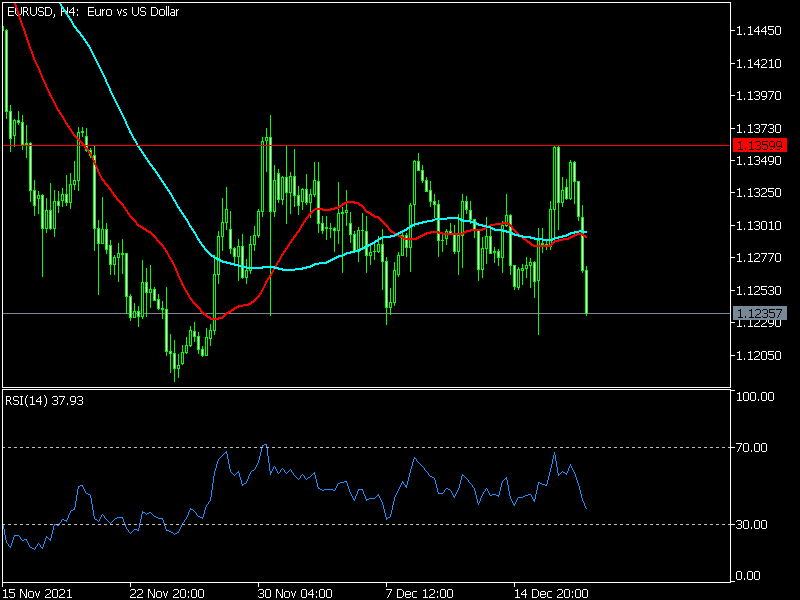
The four-hour chart shows that the EUR/USD pair found a strong resistance level at 1.3560. The pair struggled to move above that level several times last week. It has now moved below the 25-day and 50-day moving average as the sell-off intensifies. Its oscillators like the Relative Strength Index (RSI) and the MACD have declined. Therefore, the pair will likely keep falling as bears target the key support level at 1.1185.
USDCHF
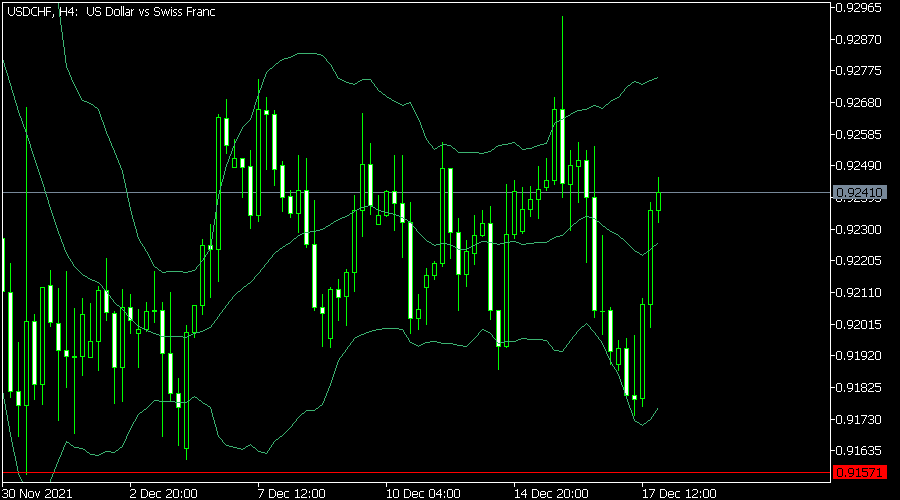
The USDCHF pair jumped sharply as investors reflected on the interest rate decisions by the Fed and the Swiss National Bank. The pair rose to a high of 0.9241, which was the highest level since Wednesday last week. It moved above the key support level at 0.9157. It also moved above the 25-day moving average and is along the upper line of the Bollinger Bands. Therefore, the pair will likely keep rising today.
GBPUSD
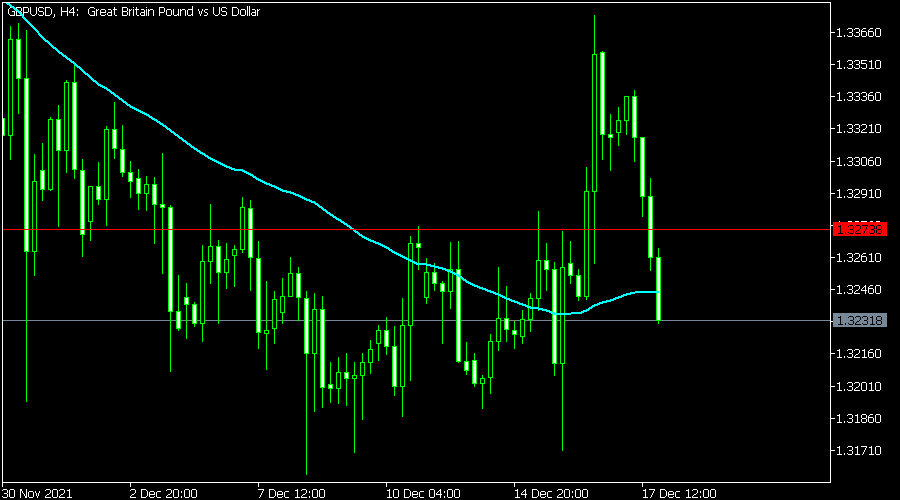
The GBPUSD pair retreated on Monday, continuing the losses that started on Friday. The pair declined to a low of 1.3230, which was significantly lower than last week’s high of 1.3375. On the four-hour chart, the pair moved below the key support level at 1.3273, which was the highest point since December 13th. It also moved below the 25-day moving average. Therefore, the pair will likely keep falling as bears target the key support at 1.3150.
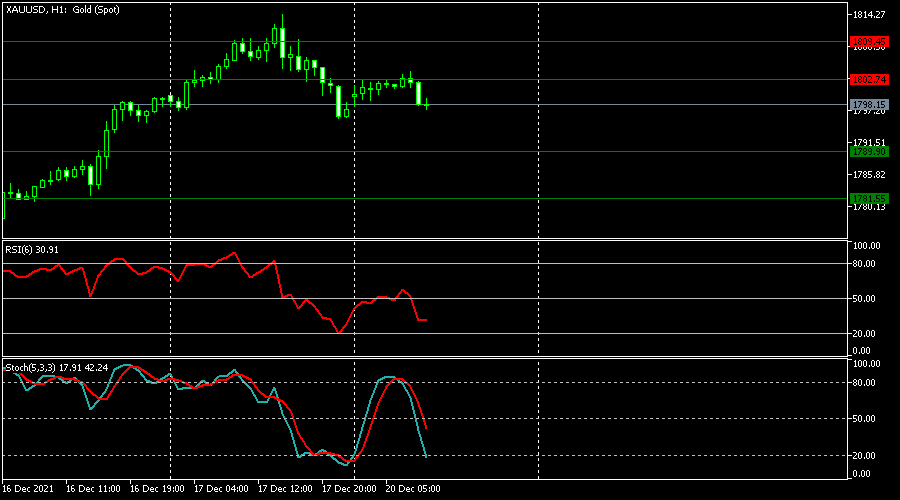
XAUUSD Is Possibly Bearish
Technical analysis
The RSI is below level 50.
The Stochastics is below level 50.
Most likely scenario – SELL
Target prices: 1,789.90 1,781.55
Alternative scenario – BUY
Target prices: 1,802.74 1,809.45
Key levels
Support 1,789.90 1,781.55
Resistance 1,802.74 1,809.45
Daily Technical Analysis
EUR/USD
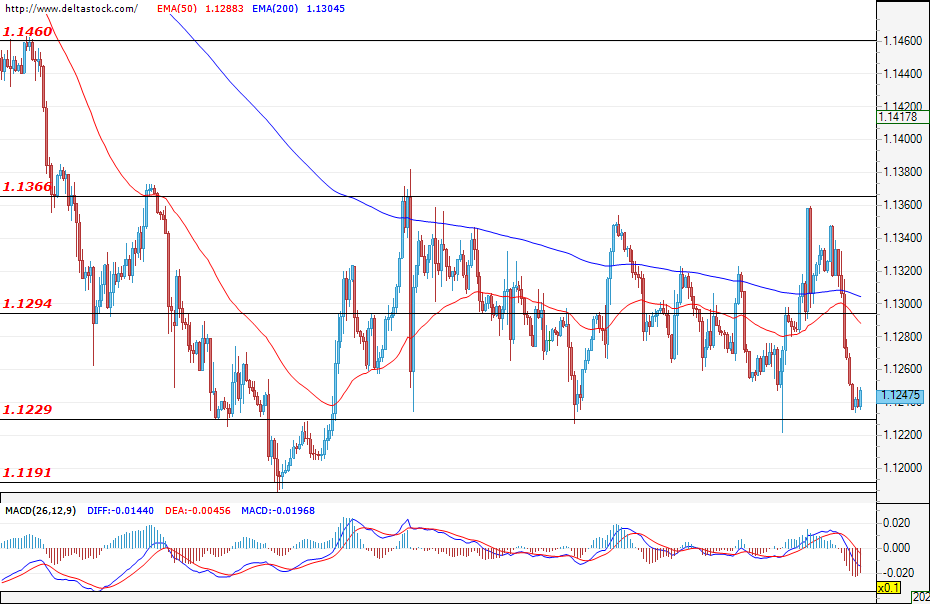
Current level - 1.1247
The single European currency continues to lose value against the U.S. dollar and, at the time of writing the analysis, the market is facing a test of the support zone at 1.1229. If the bears manage to establish themselves on the market and the breach of the mentioned support is successful, a deepening of the sell-off towards the next significant level at 1.1190 may follow. On the other hand, if the bulls manage to thwart the bears' plans, the most likely scenario would be for a preservation of the range move between 1.1229 - 1.1366. There is no planned economic news for this week that are expected to affect the market’s volatility.
| Resistance | Support | ||
| intraday | intraweek | intraday | intraweek |
| 1.1294 | 1.1460 | 1.1230 | 1.1190 |
| 1.1360 | 1.1510 | 1.1230 | 1.1100 |
USD/JPY
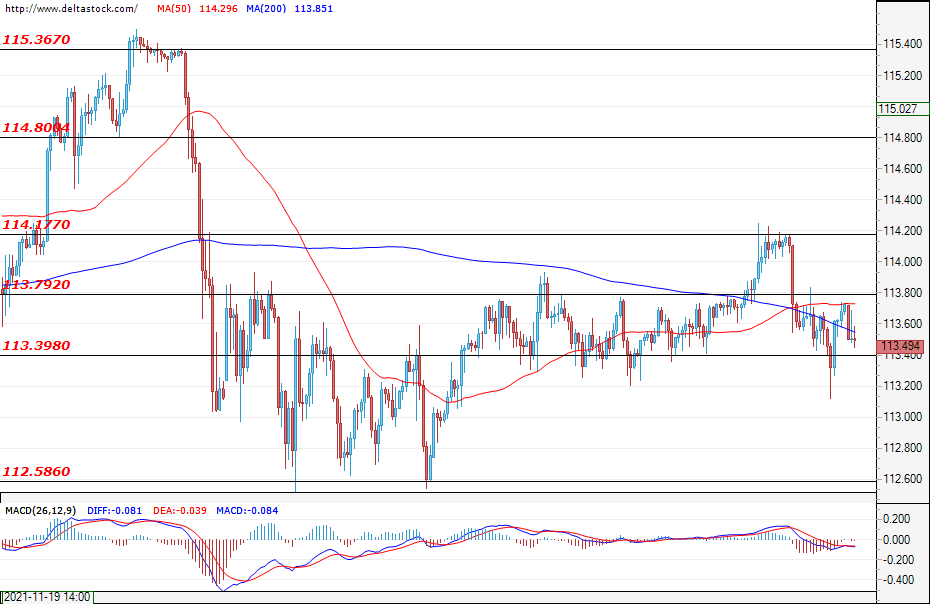
Current level - 113.49
The situation with the Ninja remains unchanged, except that we witnessed an unconfirmed breach of the support area at 113.39 during the last trading session for the past week. The subsequent rise in the price of the U.S. dollar against the yen remained limited below the 113.79 resistance. The sentiment at the moment is rather neutral – to maintain the range move during the following days in view of the upcoming holidays and the lack of planned economic news that could affect the volatility of the currency pair.
| Resistance | Support | ||
| intraday | intraweek | intraday | intraweek |
| 113.80 | 115.37 | 113.40 | 112.58 |
| 114.17 | 115.37 | 112.58 | 110.80 |
GBP/USD
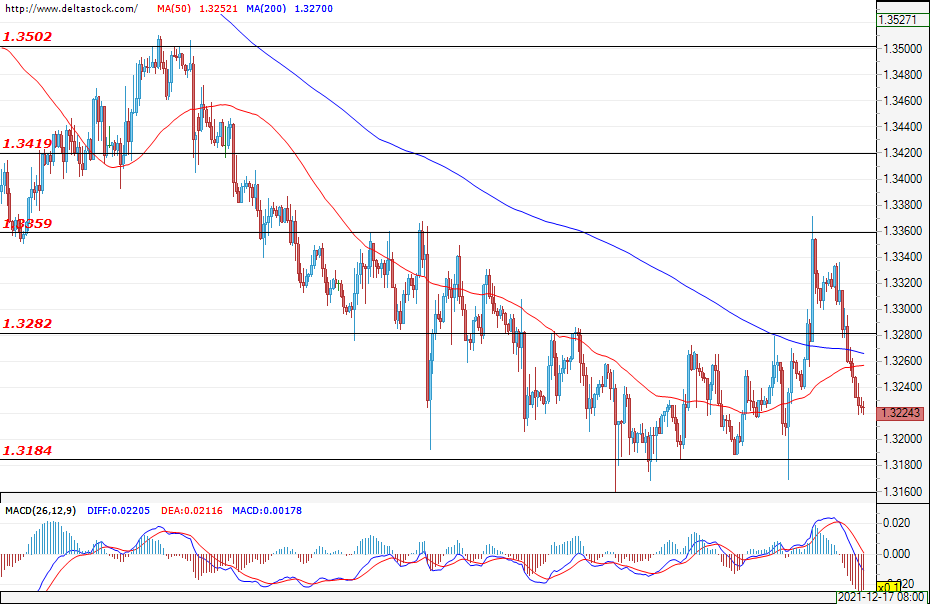
Current level - 1.3224
The surprising rate hike by the Bank of England from last week and the following test of the 1.3359 resistance area were not enough to reverse investors' sentiment. The subsequent reduction in the price continues at the beginning of this week, as at the time of writing, the sterling has focused on testing the support zone at 1.3184. According to the higher time frames, a successful breach of the mentioned level could deepen the sell-off towards the next significant level at 1.2880.
| Resistance | Support | ||
| intraday | intraweek | intraday | intraweek |
| 1.3282 | 1.3360 | 1.3180 | 1.3000 |
| 1.3360 | 1.3500 | 1.3100 | 1.2900 |
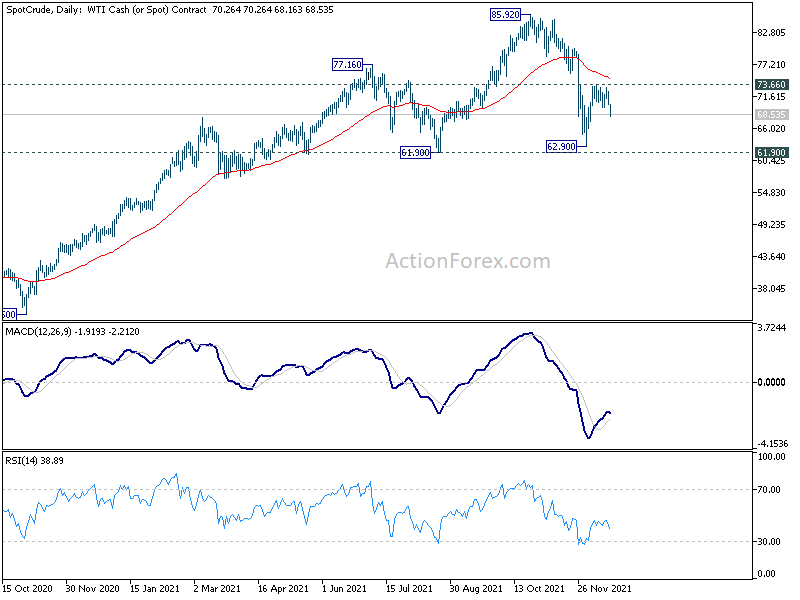
WTI oil dips below 70 as Omicron spreads quickly
Oil prices dip today on concern that the rapid spread of Omicron would push more countries back into restrictions, and hurt demand at least in the near future. That's also in-line with overall risk-off sentiment in the markets.
WTI's recovery from 62.90 was choked off after hitting 73.66 and it's back below 69. For now, unless there will be any disastrous development, we're seeing price actions from 85.92 high as development into a sideway consolidation pattern, in form a a three-wave flat, or a five-wave triangle. The range should be set inside 61.90/85.92.
In other words, we're not expecting a break of 61.90 support even in case of further selloff. Break of 73.66 resistance will extend the rebound from 62.90. And even in this case, we're not expecting a break of 85.92 high too.
CN And HK Markets Drop After Small Rate Cut
General trend
- Hawkish Fed speak also in focus, Waller spoke on Fri.
- PBOC again uses 14-day reverse repo ahead of year-end.
- WTI Crude FUTs extended drop after moving below $70/bbl.
- 10-yr UST yields also declined; USD/JPY trades slightly lower.
- EUR/GBP rises amid the Frost news.
- TRY continues to drop.
- Equity markets have generally extended drops.
- Nikkei 225 has declined by over 2%;Toyota announced additional production disruptions.
- Hang Seng dropped by >1% during the morning session; Property index declines [Kaisa Group, Sunac and Chinese Estates have been in the headlines].
- Shanghai Composite also ended morning trading lower (-0.8%).
- S&P ASX 200 pared decline.
- RBA Dec Minutes due on Tues (Dec 21st).
Headlines/Economic Data
Australia/New Zealand
- ASX 200 opened -0.1%.
- (NZ) New Zealand Nov Trade Balance (NZ$): -0.9B v -1.3B prior.
- RIO.AU Appoints Canadian ambassador to China, Dominic Barton chairman, effective on May 5th.
- (AU) Reserve Bank of Australia (RBA) offers to buy A$800M in Semi Govt Bonds v A$800M prior.
- (AU) Reserve Bank of Australia (RBA) Offers to buy A$1.60B in Govt bonds v A$1.60B prior.
- MFG.AU Notes impact of St James place mandate being terminated, not material to interim results.
- CIM.AU Responds to ASX query: Actively working with Middle East ops acquirer to ensure BICC meets commitments to employees, which is currently A$7.0M outstanding.
Japan
- Nikkei 225 opened -0.8%.
- (JP) Bank of Japan (BOJ) Gov Kuroda: Not time to think about normalization; will seek appropriate policy as well as fiscal health; Increase in BOJ holdings does not impact policy.
- (JP) Bank of Japan Flow of Funds report: Q3 Household assets ¥1,999T, +5.7% y/y.
- 7203.JP To suspend ops in Jan at 5 factories due to supply chains, chip shortages, and due to coronavirus pandemic; Affirms 9.0M production guidance.
Korea
- Kospi opened -0.5%.
- 052690.KR Freezes electricity prices in Q1 [in line] – Yonhap.
- (KR) North Korea leader Kim's sister makes appearance at event, after not being seen for over 60 days.
- (KR) South Korea markets to be closed Dec 31 (Fri) and resume trading Jan 3rd; ex-dividend date is Dec 29th (Wed).
China/Hong Kong
- Hang Seng opened -0.5%; Shanghai Composite opened -0.3%.
- (CN) CHINA PBOC MONTHLY LOAN PRIME RATE (LPR) SETTING: CUTS 1-YEAR RATE 5BPS TO 3.80%, MAINTAINS 5-YEAR RATE UNCHANGED.
- (CN) China Senior Diplomat Wang: China does not fear confrontation with the US; To promote steady progress in ties with US in 2022.
- (CN) China PBOC Open Market Operation (OMO): Sells CNY10B in 7-day reverse repos v CNY10B prior and CNY10B in 14-day reverse repos v CNY0B prior; Net inject CNY10B v Net CNY0B prior.
- (CN) Hong Kong Legislative Council elections saw just 30.2% of voter turnout (lowest on record), all candidates picked by China Communist Party and election under new rules.
- (CN) China regulators should not allow capital to have 'wild' growth - China press commentary.
- (CN) China PBOC sets Yuan reference rate: 6.3933 v 6.3651 prior.
- (CN) China PBOC Newspaper: China encourages property project purchases.
- (HK) China issues a paper related to Hong Kong Political development: Notes foreign forces disrupt democracy development.
Other
- (CL) Chile names Left wing candidate Boric as president elect, to meet with Pinera Monday, Dec 20th.
North America
- (US) Sen Manchin (D-VW) says he will not support Biden's "Build Back Better" legislation.
- CERN Expected to announce it will be acquired by Oracle Monday at mid $90d/shr cash – press.
- PFE New Zealand notes death of a 26yo man may be linked to COVID vaccine, coroner is conducting investigations - press.
Europe
- (UK) UK Brexit Min Frost resigns, saying he is confident that Brexit was secure, but has concerns about the government's direction – press.
- (ES) Spain PM Sanchez to meet with regional leaders due to steep increase in COVID cases.
Levels as of 00:15ET
- Hang Seng -1.2%; Shanghai Composite -0.6%; Kospi -1.6%; Nikkei225 -2.1%; ASX 200 -0.2%.
- Equity Futures: S&P500 -0.9%; Nasdaq100 -1.1%, Dax -1.4%; FTSE100 -0.9%.
- EUR 1.1252-1.1235; JPY 113.73-113.46; AUD 0.7134-0.7106; NZD 0.6747-0.6721.
- Commodity Futures: Gold -0.1% at $1,802/oz; Crude Oil -3.5% at $68.39/brl; Copper -0.9% at $4.26/lb.
EUR/USD Daily Outlook
Daily Pivots: (S1) 1.1198; (P) 1.1274; (R1) 1.1312; More...
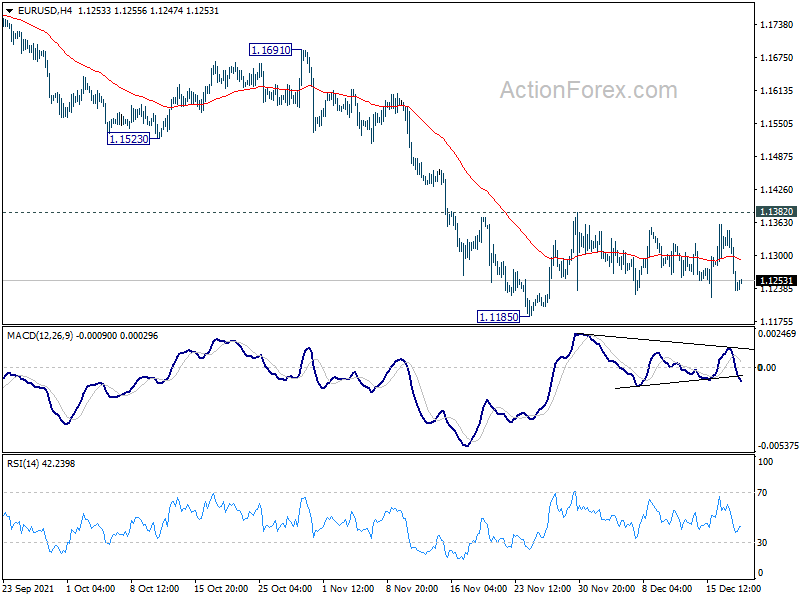
Intraday bias in EUR/USD remains neutral as consolidation from 1.1185 is still extending. Further decline will remain in favor as long as 1.1382 resistance holds. Break of 1.1185 will resume larger decline from 1.2348. Next target is 161.8% projection of 1.2265 to 1.1663 from 1.1908 at 1.0934. On the upside, firm break of 1.1382 resistance should confirm short term bottoming at 1.1186. Intraday bias will be turned back to the upside for 55 day EMA (now at 1.1426).
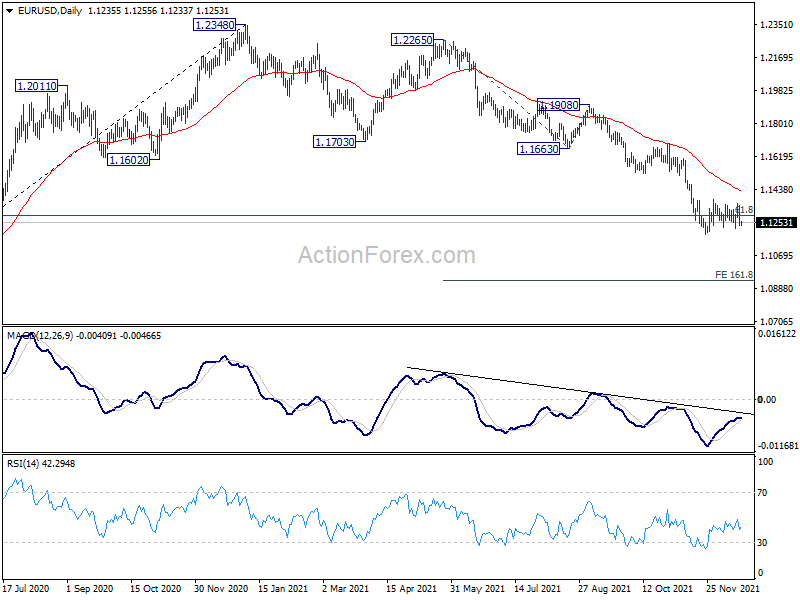
In the bigger picture, there are various ways of interpreting the fall from 1.2348 (2021 high). It could be a correction to rise from 1.0635 (2020 low), the fourth leg of a sideway pattern from 1.0339 (2017 low), or resuming long term down trend. In any case, outlook will now stay bearish as long as 1.1703 support turned resistance holds. Sustained break of 61.8% retracement of 1.0635 to 1.2348 at 1.1289 would pave the way back to 1.0635.
GBP/USD Daily Outlook
Daily Pivots: (S1) 1.3199; (P) 1.3269; (R1) 1.3306; More...
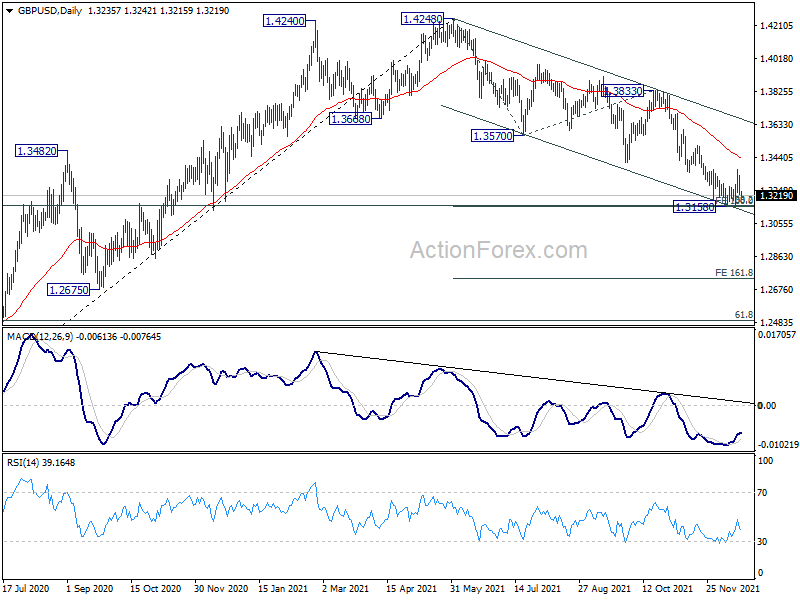
Intraday bias in GBP/USD remains neutral first. On the downside, firm break of 1.3164 medium term fibonacci level will carry larger bearish implication. Fall from 1.4248 should resume and target 161.8% projection of 1.4248 to 1.3570 from 1.3833 at 1.2736. On the upside, , break of 1.3372 will resume the rise from 1.3158 to 55 day EMA (now at 1.3436).
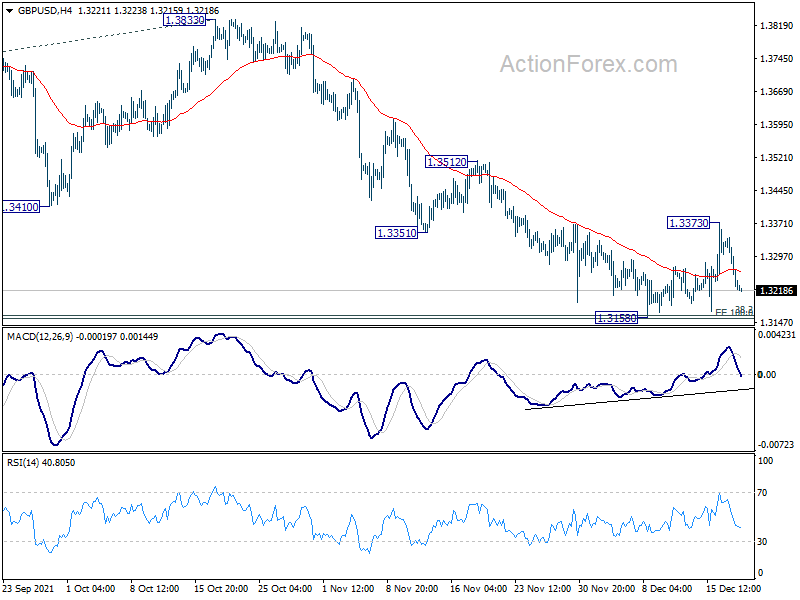
In the bigger picture, focus remains on 38.2% retracement of 1.1409 to 1.4248 at 1.3164. Sustained break there will argue that whole rise from 1.1409 has completed at 1.4248, after rejection by 1.4376 long term resistance. That will revive some medium term bearishness and and target 61.8% retracement at 1.2493. However, strong rebound from current level will revive argue that up trend from 1.1409 is still in progress, and probably ready to resume.