Sample Category Title
USD/CHF Mid-Day Outlook
Daily Pivots: (S1) 0.9197; (P) 0.9221; (R1) 0.9268; More....
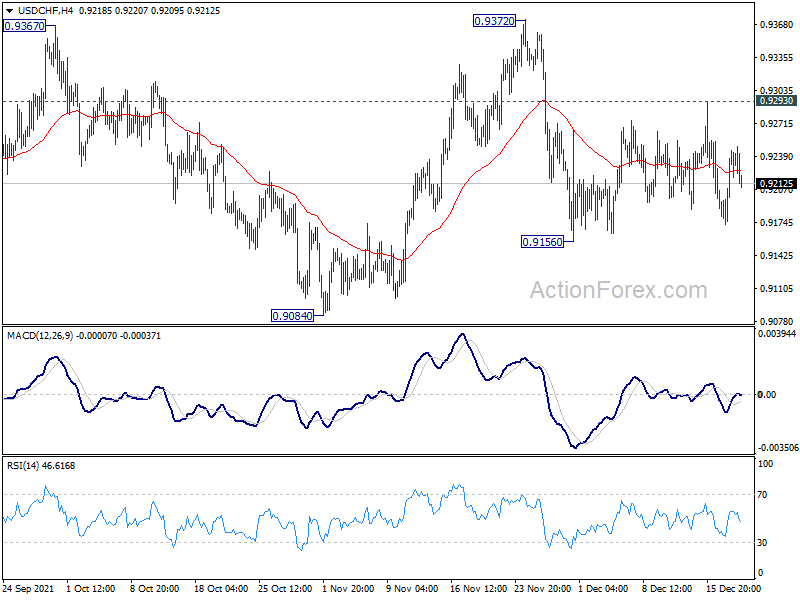
Outlook in USD/CHF is unchanged and intraday bias stays neutral first. On the downside, below 0.9156 will target 0.9084 support. Firm break there should confirm that choppy rise from 0.8925 has completed, and suggests that fall from 0.9471 is resuming. Deeper decline would be seen through 0.8925. On the upside, break of 0.9293 will suggest that the pull back from 0.9372 is finished. Intraday bias will be turned back to the upside for 0.9372.
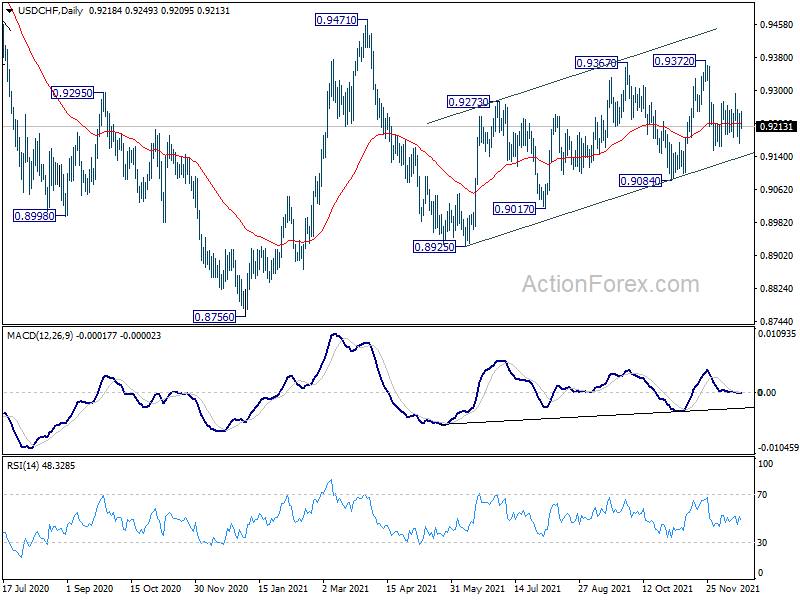
In the bigger picture, the corrective structure of the rebound from 0.8925 argues that fall from 0.9471 is not complete yet. It could either be the second leg of pattern from 0.8756 (2021 low), or resuming larger down trend from 1.0237 (2018 high). We'd pay attention to the downside momentum and assess the odds later. But for now, medium term outlook will be neutral at best as long as 0.9471 resistance holds.
USD/JPY Mid-Day Outlook
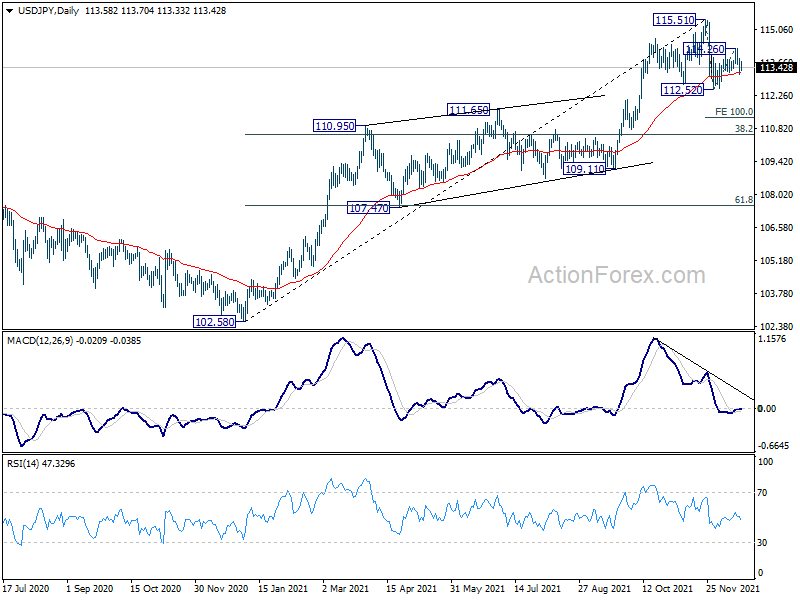
Daily Pivots: (S1) 113.30; (P) 113.57; (R1) 114.00; More...
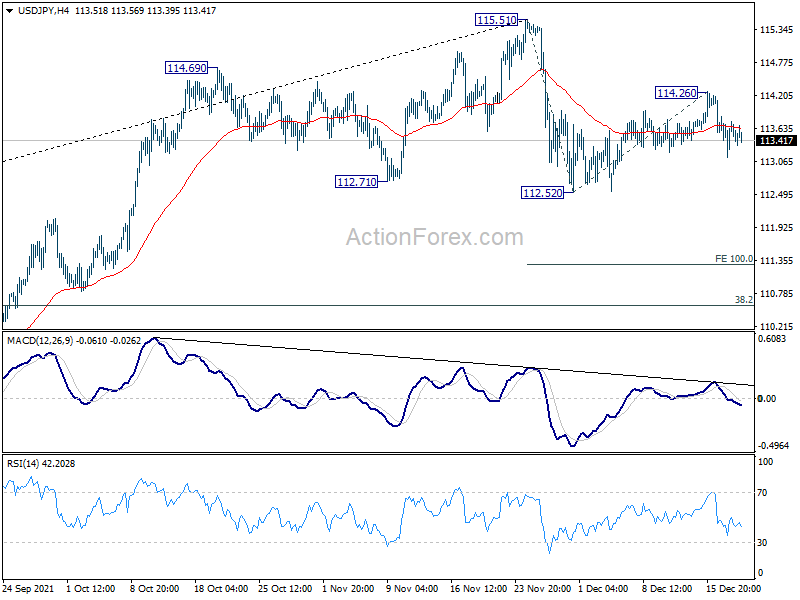
No change in USD/JPY's outlook and intraday bias remains neutral. On the downside, break of 112.52 will resume the fall from 115.51, as a correction to up trend from 102.57, and target 100% projection of 115.51 to 112.52 from 114.26 at 111.27. On the upside, above 114.26 will target a test on 115.51 high instead.
In the bigger picture, no change in the view that rise from 102.58 is the third leg of the up trend from 101.18 (2020 low). Such rally should target a test on 118.65 (2016 high) on resumption. However, firm break of 109.11 structural support will argue that the trend might have reversed and bring deeper fall to 107.47 support and possibly below.
Stocks Go Downhill as Omicron Bears Bite; Dollar, Euro Resilient
Omicron plays with investors’ nerves as stimulus vanishes
Stock markets were in a sea of red during mid-European trading hours as omicron concerns and tighter curbs in Europe reminded investors that the pandemic is far from over and Covid could still swamp global demand after two years of limbo.
The pan-European STOXX 600 and the British FTSE 100 index followed their Asian counterparts deeply lower, with energy shares, basic materials, and consumer cyclicals driving the bulk of losses, plunging by 2-3%. Wall street is currently joining the bearish camp, with the S&P 500, Nasdaq 100 and Dow Jones retreating by more than 1.0%.
With major central banks setting the roadmap for a tighter monetary policy in order to put inflation on a leash and governments showing no interest to open their liquidity taps once again, the year ahead could be challenging for businesses, especially if supply constraints persist and vaccines’ efficacy diminishes.
Even Biden’s build back better $2 trillion package is in question now as Senator Joe Manchin pulled his support for the bill on Sunday after months of drafting and revising. The legislation promises to subsidize childcare costs, lower prescription-drug costs, and provide tax discounts for carbon emission reductions, but Manchin’s objection could imperil Democrats’ efforts to bring together their thin congressional majority.
That said, stock markets have proved to be quite resilient against lockdowns, quickly resuming their record rally despite the shard declines. Hence, as stock indices tank once again, investors may look to buy the dips.
Risk-sensitive currencies tumble to recent lows; US dollar, euro find some footing
In the FX space, the cautious mood brought some damage to risk-sensitive currencies such as the antipodeans and the commodity-dependent loonie. Likewise, the pound could not sustain the Bank of England’s rate hike boost, drifting lower to test its 2021 bottom of 1.3160 against the US dollar as Boris Johnson is expected to say that all possible restrictions will remain on the table when the Cabinet gathers today at 14:00 GMT.
On the other hand, the emerging containment measures in several European countries did not scare the euro much. Euro/pound shined brightly, rising as high as 0.8544 before easing a bit. Euro/yen and euro/dollar rebounded to a smaller extent following Friday’s tumble after the German Finance Minister provided assurances that social activity should remain and hard lockdowns should be avoided.
Meanwhile in the US, the rising omicron infections in New York are not threatening any lockdowns yet, but the bond market, which is considered a shelter for funds during times of market turbulence, could still attract some demand, sending the 10-year Treasury yield closer to its recent lows.
While falling yields tend to negatively affect the US dollar, this time the greenback managed to hold afloat against a basket of major currencies. Dollar/yen stood flat around 113.53, while the battered loonie, which got punched from melting oil prices, helped the dollar to crawl up to last week’s high of 1.2935.
Noteworthy is also the dollar’s rally against the Turkish lira, which extended its record rally to uncharted waters, peaking at 17.83 today.
Gold keeps stubbornly testing the $1,800/oz resistance after its quick bounce from a two-month low.
RBA meeting minutes next on the calendar
The calendar will be light of key data releases in the coming sessions. Therefore, developments around the omicron variant and lockdown announcements could be the only market moving factors just before the holiday season starts.
Minutes from the RBA’s December policy meeting will be the only highlight in central bank events early on Tuesday at 00:30 GMT, with traders looking for a more detailed reasoning behind its upbeat economic prospects.
Aussie/dollar was last seen marginally lower at 0.7115 after a flash drop to 0.7080.
Australian Dollar Dips Below 71 Line
Risk sentiment has cooled down, which has meant losses for the Australian dollar and other currencies which are key risk barometers. The Aussie was down 0.84% on Friday and dropped below the 71 level earlier today after some negative headlines on the weekend. First, the Omicron variant is exploding in Europe, leading to a lockdown in the Netherlands and tighter health restrictions in other European countries. Omicron has also reached the US and could surge there as well.
Adding to investor jitters, President Biden’s Build Back Better spending package is dead in the water after Democratic Senator Joe Manchin surprised the White House when he announced that he could not support the USD 2 trillion package, a key part of Biden’s agenda. The Democrats had trimmed the programme in order to gain Manchin’s support and Biden had hoped to pass the bill before the Christmas break. Now, Biden will have to wait until after the New Year, depriving him of a badly needed legislative victory.
The RBA will release the minutes of its last policy meeting on Tuesday. I don’t expect anything new from the bank, which is likely to stick with its accommodative policy, even with last week’s monster employment report of 366 thousand new jobs. The stellar numbers were a result of the lifting of the lockdowns in New South Wales and Victoria. The RBA can point out that the employment report did not show any indication of wage growth, which is a key metric for the RBA as far as rate policy. The central bank has stated that it wants to see wage growth at around 3% before it will consider further reducing QE and doesn’t see a rate hike before 2022. The markets have been much more hawkish, pricing in several rate hikes next year.
AUD/USD Technical
- There are support levels at 0.7069 and 0.7013
- AUD/USD faces resistance at 0.7203. The next resistance line is at 0.7281

USD/CAD Mid-Day Outlook
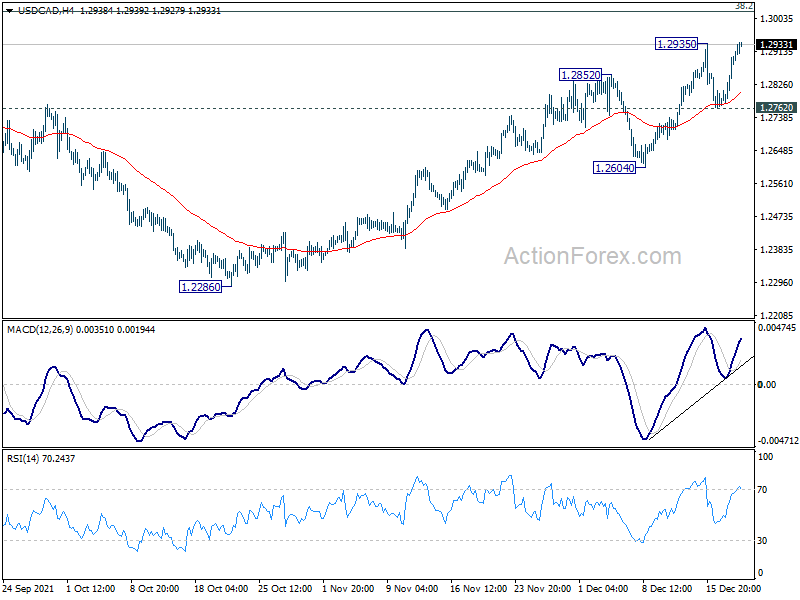
Daily Pivots: (S1) 1.2812; (P) 1.2857; (R1) 1.2941; More...
USD/CAD's breach of 1.2935 suggests resumption of 1.2286. Intraday bias is back on the upside for 1.2947 resistance, and then 1.3022 key medium term fibonacci level. Sustained break of 1.3022 will carry larger bullish implications. On the downside, break of 1.2762 support is needed to indicate short term topping. Otherwise, outlook will stay bullish in case of retreat.
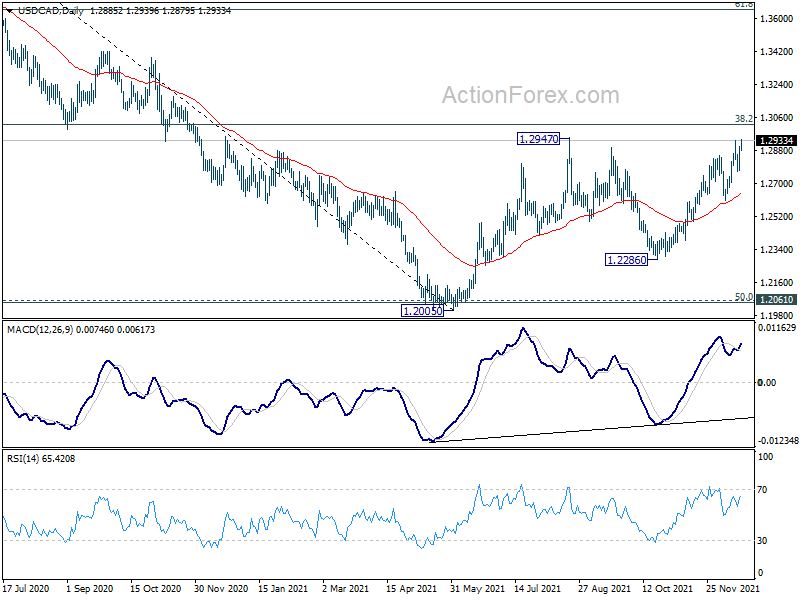
In the bigger picture, focus will be on 38.2% retracement of 1.4667 (2020 high) to 1.2005 (2021 low) at 1.3022. Sustained break there should confirm that the down trend from 1.4667 has completed after defending 1.2061 long term cluster support. Further rise would then be seen towards 61.8% retracement at 1.3650. On the downside, however, break of 1.2286 will turn focus back to 1.2005 low again.
Risk Aversion Continues, Canadian Dollar Follows Oil Lower
Commodity currencies are under broad-based pressure today, as markets are trading in risk-off mode on the spread of Omicron. Canadian Dollar is leading the way lower as WTI oil tumbles below 70. But Euro and Swiss Franc are currently the main beneficiaries, followed by Yen. Dollar and Sterling are mixed.
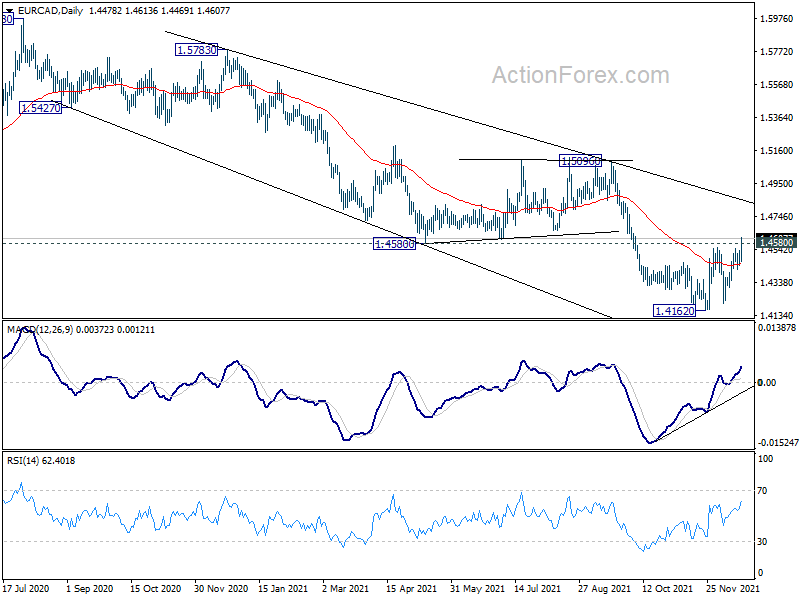
Technically, EUR/CAD's break of 1.4580 support turned resistance now suggests short term bottoming after 1.4162. Stronger rise would now be seen back towards 1.5096 resistance. At the same time, CAD/JPY is pressing 9768 support and break will resume whole decline from 93.00. USD/CAD's rise from 1.2286 is also resuming by breaking 1.2935 resistance. We'll see if Canadian Dollar's selloff would pick up momentum again.
In Europe, at the time of writing, FTSE is down -1.04%. DAX is down -1.93%. CAC is down -1.11%. Germany 10-year yield is up 0.0222 at -0.356. Earlier in Asia, Nikkei dropped -2.13%. Hong Kong HSI dropped -1.93%. China Shanghai SSE dropped -1.07%. Singapore Strait Times dropped -1.24%. Japan 10-year JGB yield dropped -0.0114 to 0.039.
WTI oil dips below 70 as Omicron spreads quickly
Oil prices dip today on concern that the rapid spread of Omicron would push more countries back into restrictions, and hurt demand at least in the near future. That's also in-line with overall risk-off sentiment in the markets.
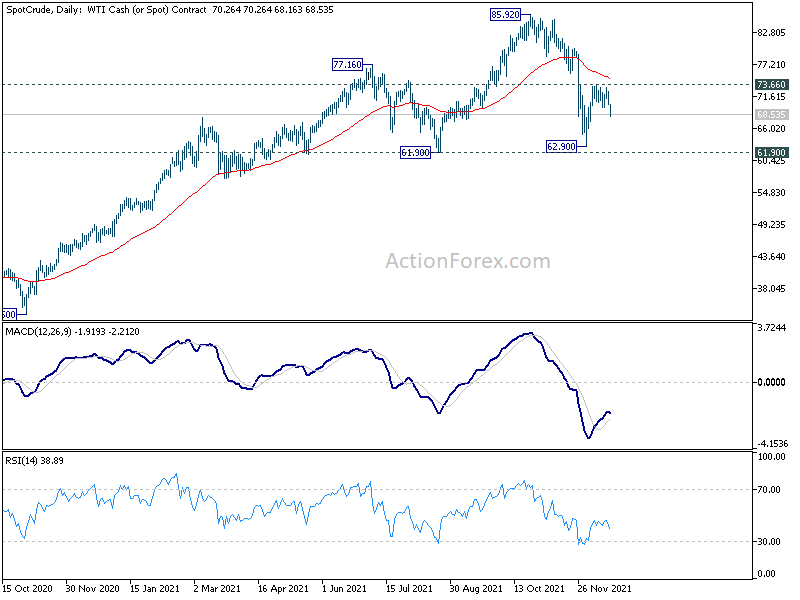
WTI's recovery from 62.90 was choked off after hitting 73.66 and it's back below 69. For now, unless there will be any disastrous development, we're seeing price actions from 85.92 high as development into a sideway consolidation pattern, in form a a three-wave flat, or a five-wave triangle. The range should be set inside 61.90/85.92.
In other words, we're not expecting a break of 61.90 support even in case of further selloff. Break of 73.66 resistance will extend the rebound from 62.90. And even in this case, we're not expecting a break of 85.92 high too.
Joachim Nagel named as new Bundesbank president
German Finance Minister Christian Lindner said said today that he and Federal Chancellor Olaf Scholz proposed Joachim Nagel as the new Bundesbank President. Nagel, a former Bundesbank board member, is expected to take over on January 1 from Jens Weidmann.
Linder said on twitter, "In view of inflation risks, the importance of a stability-oriented monetary policy is growing. He is an experienced personality who ensures the continuity of #Bundesbank".
"Nagel can be trusted to continue the German Bundesbank tradition in the debates in the ECB," Friedrich Heinemann, an expert at the ZEW economic research institute hailed. "He has extensive monetary policy and financial expertise, which is essential for today's complex monetary policy decisions."
BoJ Kuroda: Too early to consider normalizing policy
BoJ Governor Haruhiko Kuroda said today, "there's quite a distance from the 2% inflation target. It is still too early now to consider normalizing policy." "Unlike the Western countries, inflation is extremely low and inflation expectations remain very low," he added. "We're in a phase to patiently continue large-scale monetary easing."
BoJ's balance sheet has grown the equivalent of 135% of GDO . But Kuroda said "I don't think expansion of the BoJ's assets will affect our ability to keep monetary policy and financial system stable." Though, he added it's important for the government market confidence on the country's fiscal health in the medium- to long-term.
New Zealand goods exports rose 13% yoy in Nov, imports rose 37% yoy
New Zealand goods exports rose 13% yoy to NZD 5.9B in November. Goods imports rose 37% yoy to NZD 6.7B. Monthly trade balance was a deficit of NZD -864m, versus expectation of NZD -1867m.
China led rises in monthly exports across all top destinations, up 13% yoy. Exports to Australia were up 21% yoy, to USA up 5.5% yoy, to EU up 8.6% yoy, to Japan up 38% yoy.
Imports from all tot partners were also up, with China up 45% yoy, EU up 38% yoy, Australia up 28%, USA up 43%, Japan up 7.9% yoy.
USD/CAD Mid-Day Outlook
Daily Pivots: (S1) 1.2812; (P) 1.2857; (R1) 1.2941; More...
USD/CAD's breach of 1.2935 suggests resumption of 1.2286. Intraday bias is back on the upside for 1.2947 resistance, and then 1.3022 key medium term fibonacci level. Sustained break of 1.3022 will carry larger bullish implications. On the downside, break of 1.2762 support is needed to indicate short term topping. Otherwise, outlook will stay bullish in case of retreat.
In the bigger picture, focus will be on 38.2% retracement of 1.4667 (2020 high) to 1.2005 (2021 low) at 1.3022. Sustained break there should confirm that the down trend from 1.4667 has completed after defending 1.2061 long term cluster support. Further rise would then be seen towards 61.8% retracement at 1.3650. On the downside, however, break of 1.2286 will turn focus back to 1.2005 low again.
Economic Indicators Update
| GMT | Ccy | Events | Actual | Forecast | Previous | Revised |
|---|---|---|---|---|---|---|
| 21:45 | NZD | Trade Balance (NZD) Nov | -864M | -1867M | -1286M | -1302M |
| 9:00 | EUR | Eurozone Current Account (EUR) | 18.1B | 20.3B | 18.7B | 17.6B |
| 11:00 | GBP | CBI Industrial Order Expectations | 24 | 20 | 26 |
AUDUSD Ticks Up after Finding Support at 0.7090
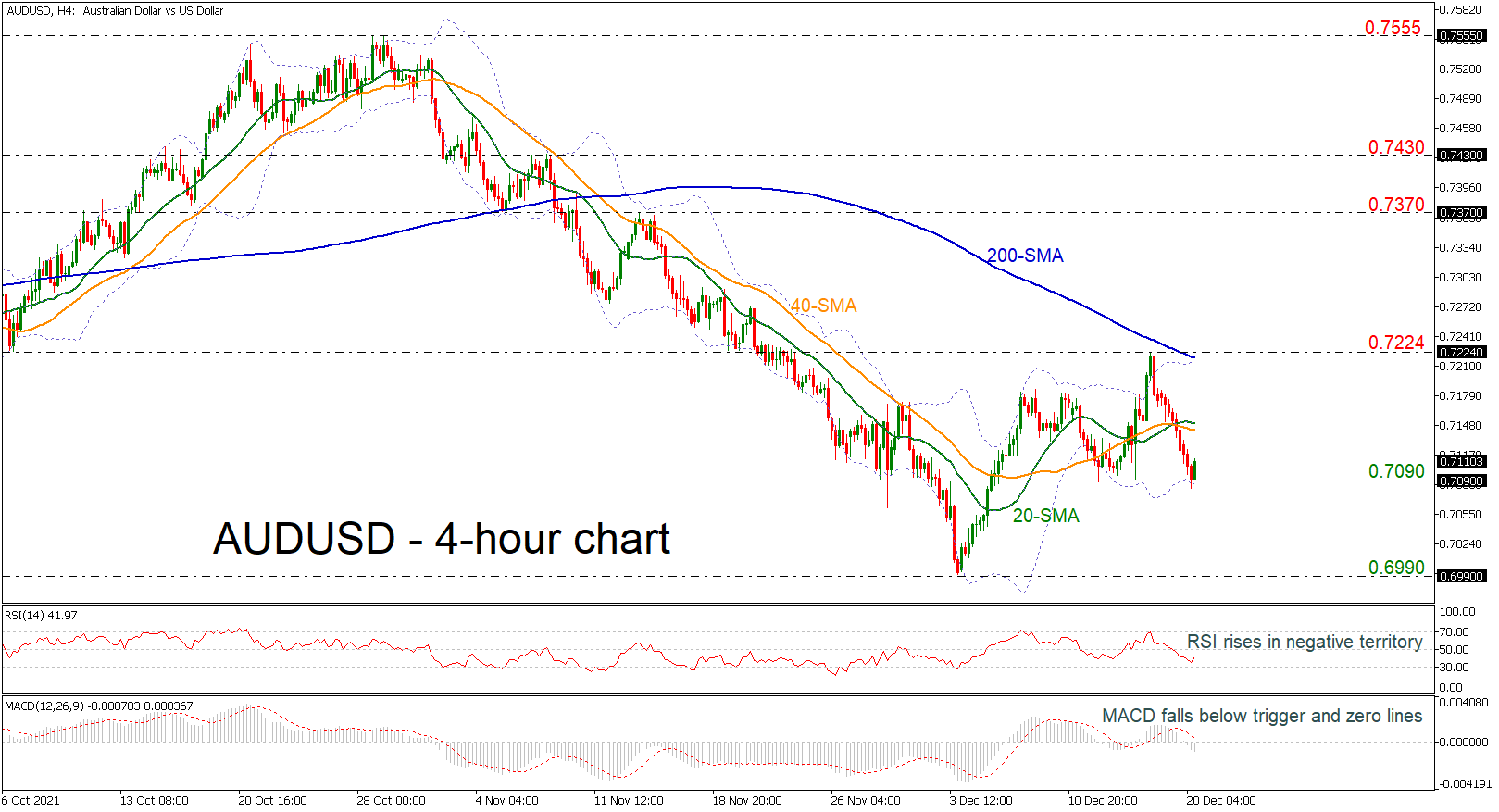
AUDUSD found strong support at the 0.7090 barrier after several red sessions. The RSI is also pointing upwards in the negative territory, while the MACD is still falling below its trigger and zero lines. The 20- and 40-period simple moving averages (SMAs) are flattening around 0.7150 and are acting as strong obstacles.
Immediate resistance hurdles are the short-term SMAs at 0.7150 ahead of the 200-period SMA at 0.7215 and the 0.7224 barrier. A successful break above these hurdles could drive the bulls until the 0.7370 level.
On the flip side, a decline underneath the 0.7090 support could endorse the selling interest until the 0.6990 line, registered on December 3.
All in all, AUDUSD has been in a descending move since October 28 and a decisive close above the 200-period SMA may switch the outlook to neutral.
NZD Falls as Consumer Confidence Slows
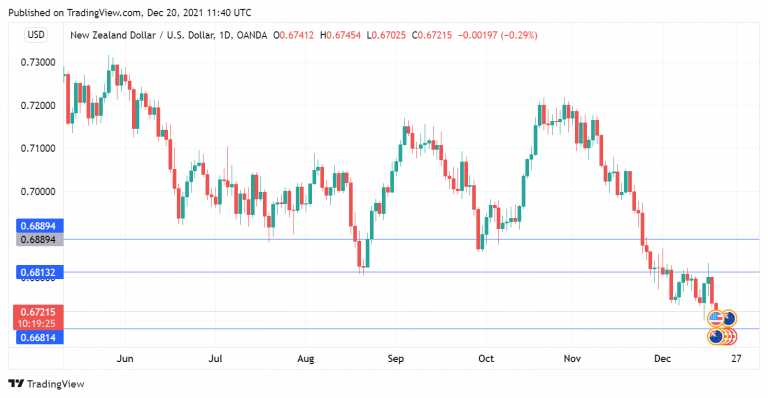
The New Zealand dollar continues to lose ground. In the European session, NZD/USD is trading at 0.6715, down 0.39% on the day. The currency ended last week on a sour note, falling 0.89%.
New Zealand consumers pessimistic
There is a lack of holiday cheer amongst New Zealanders, according to the Westpac Consumer Sentiment index for Q4. The index slowed for a second successive quarter, dropping to 99.1, down from 102.7 beforehand. The decline is significant because confidence has fallen below the 100-level, which indicates that more people are pessimistic than optimistic about the economy. Westpac noted that households were worried about the economy, higher interest rates and the newest Covid variant, Omicron. The lockdowns have also taken a toll on consumer confidence, as consumer prices have risen rapidly and reduced consumers’ purchasing power.
The New Zealand economy contracted in Q3 by 3.7%. The sharp decline didn’t send the kiwi tumbling, as investors may have been relieved that the release wasn’t as grim as the RBNZ projection of a -7% plunge. Recent economic indicators have been solid, such as employment data and consumer spending. Even with negative growth in Q4, the Fitch ratings agency has projected that the economy will grow by 5.3% this year. However, Fitch expects growth to moderate to 3.8% in 2022, in part a result of tighter monetary policy. The RBNZ has embarked on a series of rate hikes which are to extend into 2022, but the bank will have to steer the economy and ensure that higher rates do not choke off economic growth.
New Zealand continues to post trade deficits. In November, trade balance came in at NZD -864 million. Still, this was better than expected and a smaller deficit than the October reading of -1302 million.
NZD/USD Technical
- There is resistance at 0.6813. Closely above is resistance at 0.6889
- NZD/USD has weak support at 0.6681. Below, there is support at 0.6625
EUR/USD Got Under Pressure
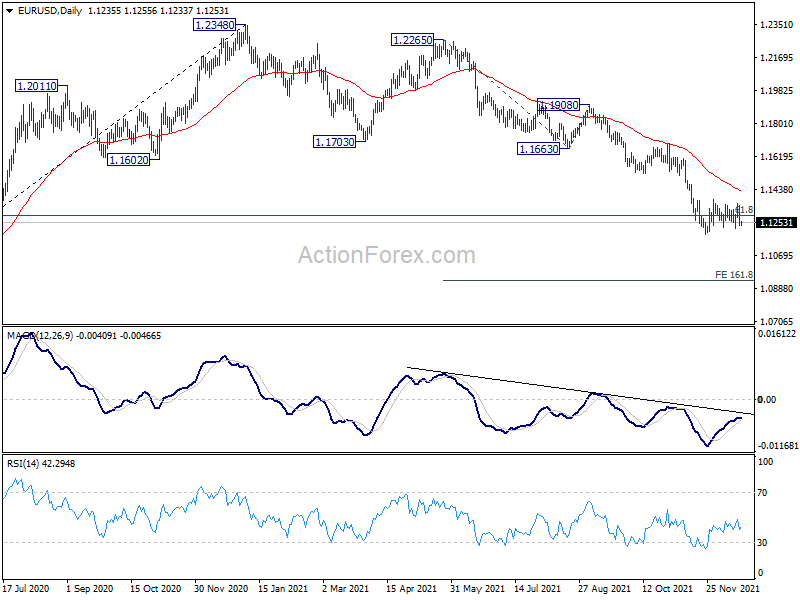
The major currency dropped and is currently trading at 1.1260. The currency market is taking a huge interest in “safe haven” assets and that’s a perfect reason for the “greenback” to rise.
Coronavirus-related fears are once again ruling the world. After Bloomberg reported a possibility of new anti-COVID restrictions in Europe, the Netherlands-style, many investors rushed off to “safe haven” assets to avoid risks.
Is Europe likely to introduce more lockdowns? No one should exclude this possibility and this fact provides the “greenback” with huge support, keeping the demand for the American currency quite high.
Another thing in favour of the USD is the Fed’s intention to quickly taper the QE programme and start discussing the rate hike as early as June 2022.
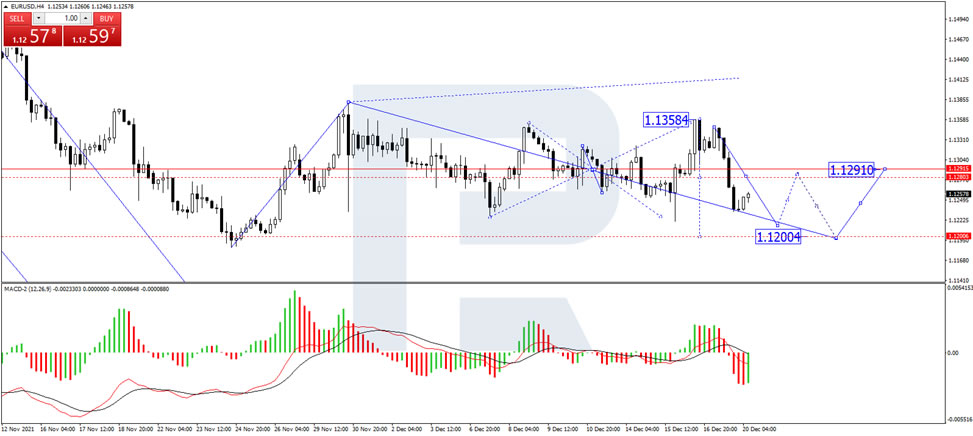
In the H4 chart, EUR/USD is correcting downwards to reach 1.1200 and may later consolidate there. If the price breaks the range to the upside, the market may start a new growth with the target at 1.1291. From the technical point of view, this scenario is confirmed by MACD Oscillator: its signal line is moving below 0 and may later continue falling towards new lows.
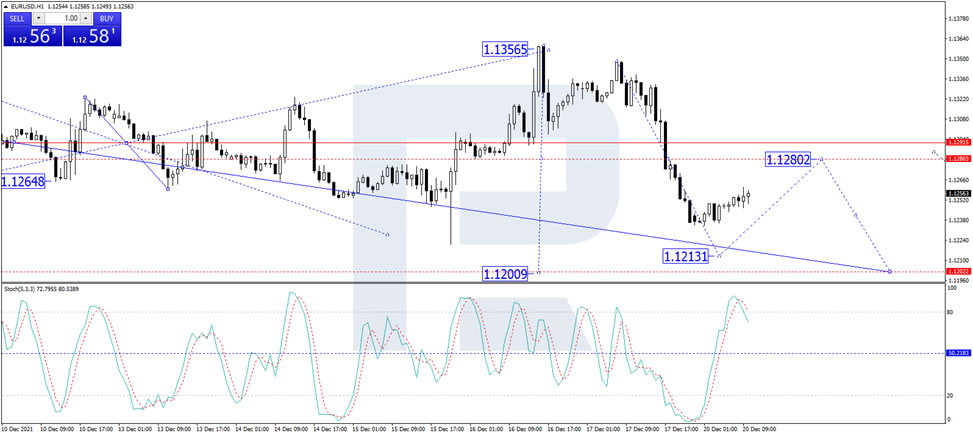
As we can see in the H1 chart, EUR/USD is forming another descending structure with the short-term at 1.1213 and may later start a new correction towards 1.1280. After that, the instrument may resume falling and finish this descending wave at 1.1200. From the technical point of view, this idea is confirmed by the Stochastic Oscillator: its signal line is moving above 80, which means that the asset may complete the ascending structure soon and the line may continue its movement to reach new lows.
USD/CAD Returns To High Level
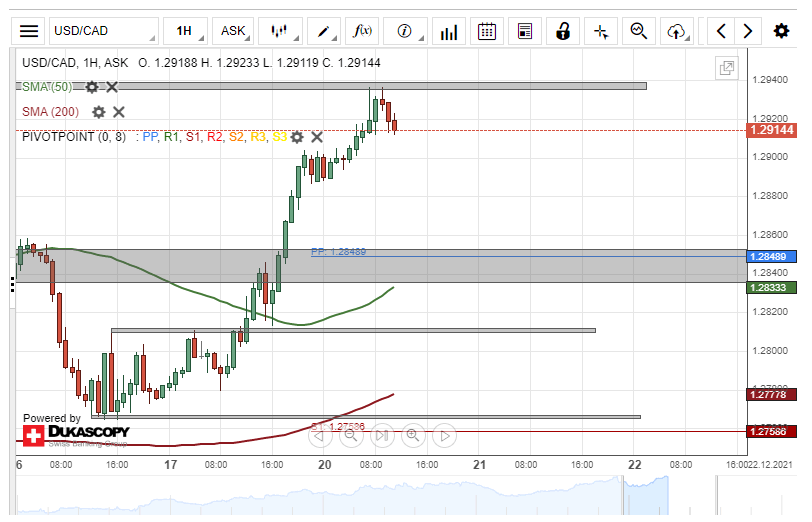
On Monday, the USD/CAD returned to trade at the 1.2938 level, which is the previous December high level.
A move higher could find resistance in the weekly R1 simple pivot point at 1.2991. Above the pivot point, the 1.3000 mark might stop a surge.
On the other hand, a decline of the USD against the CAD might look for support in the combination of the weekly simple pivot point at 1.2849, the 50-hour simple moving average near 1.2835 and the previous high level zone at 1.2835/1.2853.