

Sample Category Title
USD/JPY Daily Outlook
Daily Pivots: (S1) 113.40; (P) 113.56; (R1) 113.80; More...
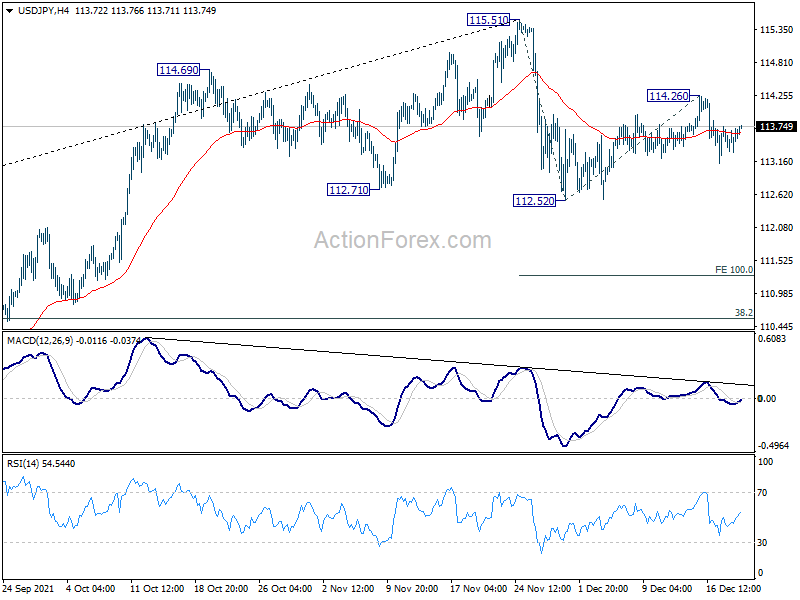
Intraday bias in USD/JPY remains neutral for the moment. On the downside, break of 112.52 will resume the fall from 115.51, as a correction to up trend from 102.57, and target 100% projection of 115.51 to 112.52 from 114.26 at 111.27. On the upside, above 114.26 will target a test on 115.51 high instead.
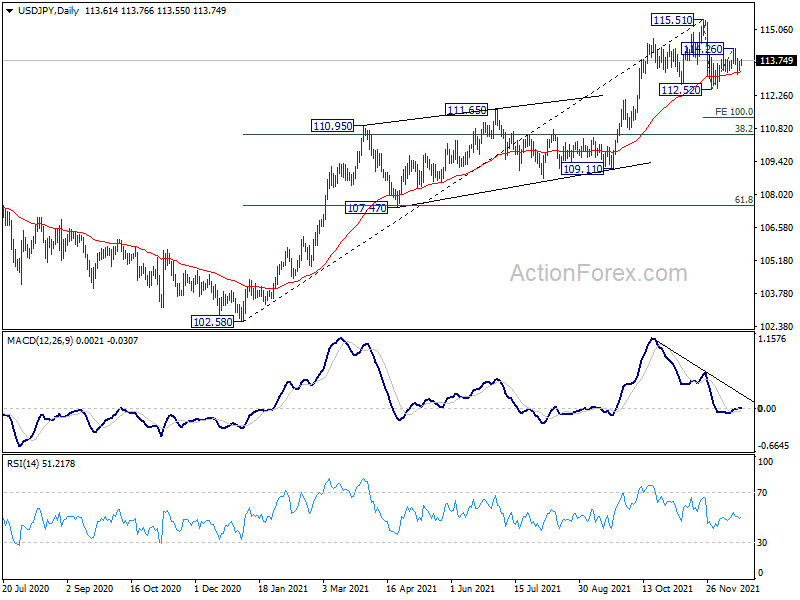
In the bigger picture, no change in the view that rise from 102.58 is the third leg of the up trend from 101.18 (2020 low). Such rally should target a test on 118.65 (2016 high) on resumption. However, firm break of 109.11 structural support will argue that the trend might have reversed and bring deeper fall to 107.47 support and possibly below.
AUD/USD Daily Report
Daily Pivots: (S1) 0.7084; (P) 0.7109; (R1) 0.7134; More...
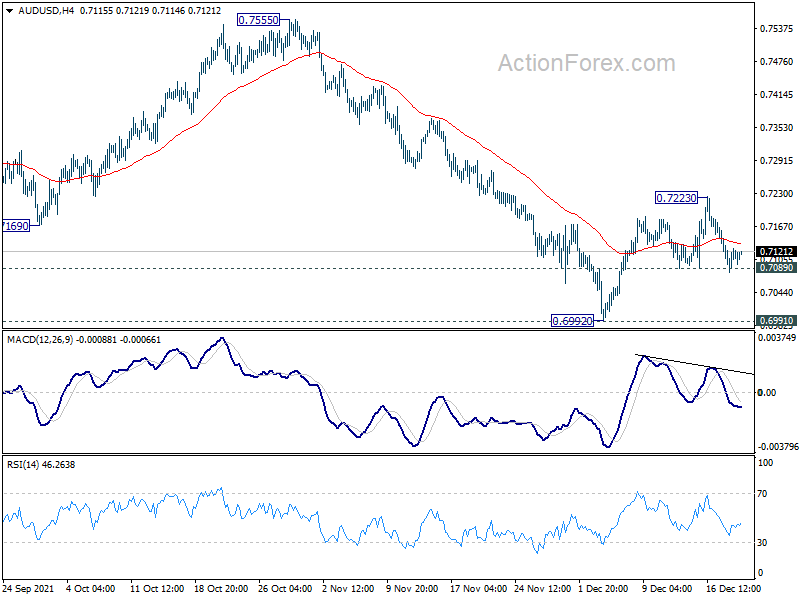
Intraday bias in AUD/USD remains neutral for the moment. Sustained break there will carry larger bearish implication, and resume larger down trend from 0.8006. On the upside, above 0.7223 and sustained trading above 55 day EMA (now at 0.7239) will be the first sign of major bottoming and bring stronger rise to 0.7555 resistance.
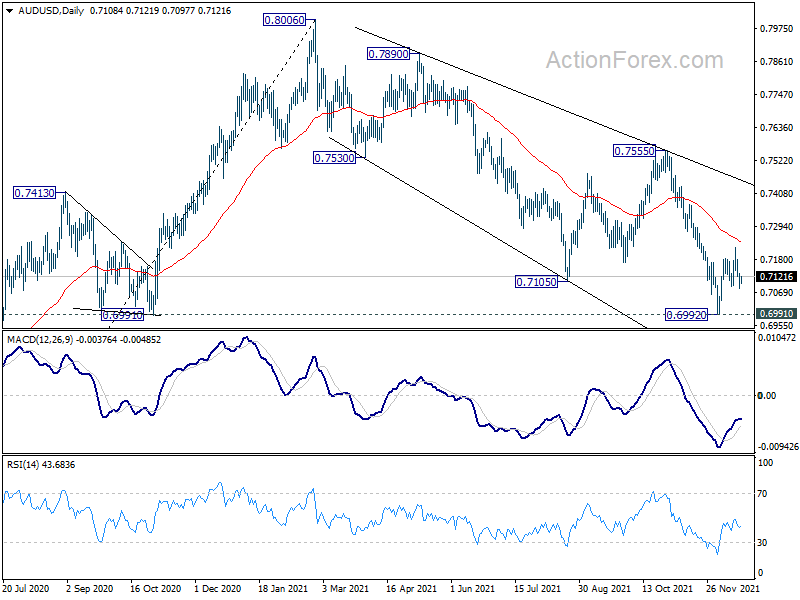
In the bigger picture, strong rebound from 0.6991 key structural support will retain medium term bullishness. That is, whole up trend from 0.5506 is still in progress. Firm break of 0.7555 resistance will target 0.8006 high and above. However, sustained break of 0.6991 will argue that the whole up trend from 0.5506 might be finished at 0.8006, after rejection by 0.8135 long term resistance. Deeper decline would then be seen back to 61.8% retracement of 0.5506 to 0.8006 at 0.6461.
Santa To Take Back The Reins
The US markets kicked off the week on a negative note. All three major US indices slumped yesterday, and both the S&P500 and Nasdaq fell close to their 100-DMA and the lower end of their medium-term ascending channel base.
The major responsibility for the bad mood was not necessarily the omicron's worries but rather seeing Biden’s $2 trillion Build Back Better project rejected by Manchin. That’s a $2 trillion that won’t hit the market so soon and help companies boost business at a time when the Federal Reserve (Fed) will be throwing less money onto the financial markets.
And the kneejerk reaction was strong. Goldman, for example, cut its US Q1 GDP forecast to 2% from 3% after the announcement. That’s a tough sentence; $2 trillion is a big amount taken off the table and could bring investors to reposition for worse, but not today!
US index futures recorded a strong rebound in the Asian session, with Nasdaq futures up by as much as 1%. With the rising volatility, we could see Santa taking back the reins from Manchin for the next couple of sessions. Low trading volumes could help exacerbate any rebound.^
Improved risk appetite will certainly not help gold clearing the $1800 per ounce resistance.
US crude rebounded after falling to $66 per barrel at yesterday’s selloff. The $70 resistance could be hard to clear as the omicron worries, and predictions of an increased global glut next year will continue weighing on the sentiment. As such, price advances are now seen as interesting top selling opportunities for those willing to strengthen their short positions for the coming months.
P.S. The growing headache in the Chinese property market will certainly not dent the mood meaningfully, as there is a strong belief that China will deploy all measures to contain the crisis from getting too big, and too far. And they have the means to do so.
The lira
Turkey went from tears to laughter within a single trading session yesterday, as first, the lira tanked to a fresh all-time low as President Erdogan said he won’t cut the rates because it is against Islam. Then, by night, Turkey announced new economic measures to deal with the actual crisis, and the measures sent the dollar-try from above 18 to 11 this morning. That’s a wild ride.
Now, the measures announce by Turkey are bold and unprecedented. They are very much unusual compared with usual market practices and the positive impact may not last long if there is not a rate readjustment that comes along. But the positive market reaction is a good start.
What’s responsible for most of the rally is the relief on capital controls, a fear that was adding an enormous pressure on the lira. ‘Turkey has no intention or the need to take the slightest step back from the free-market economy and the FX regime’. It’s a fundamental plus, that should help giving some support to the lira in the coming weeks. Second, the lower withholding taxes for the lira notes issued by the government should have a certain material impact.
However, one of the most mediatized measures which include the government’s guarantee to compensate for the loss of interest due to the lira depreciation should be taken with a pinch of salt, as the latter will hardly convince investors to take the risk of sitting on the shaky lira, and will inevitably weigh on the budget.
Moving forward: Inflation is key. Turkey will reveal an unavoidably jump in inflation to 25-30% levels in the next months, meanwhile the central bank will do everything to keep interest rates low. Market’s tolerance for the low-rate policy won't be infinite, and the wind could rapidly change direction.
The Turkish Lira Rebounds
Market movers today
- Today, consumer confidence data will be released for the euro area and Sweden. While euro area consumers have remained fairly optimistic over the past months, consensus is looking for a decline amid the rising Omicron-worries.
- In Sweden consumer confidence is released with the NIER survey, which also comprises industrial confidence. We look for a setback in both (see below).
- Otherwise focus continues to be on Omicron, the Turkish Lira, the Russia-Ukraine crisis and prospects for US President Biden's Build Back Better plan.
The 60 second overview
Risk sentiment: Stocks, bond yields and oil prices are higher overnight as risk appetite has recovered somewhat from the hit seen in the past two days.
Turkey: As the currency-crisis continued in Turkey, USD/TRY dropped from nearly 18.50 to 12.5 during yesterday (stronger TRY), settling at some 13.40 and hence spot dropped some 30% in a matter of hours. The drop is reportedly due to Erdogan effectively offering to floor TRY-deposits at zero percent returns against some other currency. Details, if any, appear very sparse in international media and we are quite doubtful this is the end to the current Lira story. We speculate the extreme (even for TRY) move in Lira should be viewed on the back of two channels 1) this is the first time that official policy makers (Erdogan) is indicating that some sort of political pain-threshold has been reached and 2) that stop-losses were hit on the way, substantially amplifying volatility. The key to determining when TRY is done dropping some 5% daily is to determine where/when the political winds change.
Covid: In the US, Omicron has become the dominant variant with 73% of new cases up from 3% last week. In New York the share is 92% and cases are at new highs during the pandemic. In South Africa new cases have started to move lower, but hospitalisation and deaths rise. UK Prime Minister Boris Johnson has kicked the can a bit further down the road before deciding if new restrictions are needed over the Christmas holidays. It follows a week where new cases have leaped higher to 90k, which is 50% higher than the previous peak in January.
China stimulus: This morning we published a short paper with an overview of China's stimulus measures, see Research China - Stimulus picks up ahead of CPC Congress in '22. Stability is the name of the game in 2022 for China and a range of stimulus measures will aim at achieving just that. It will underpin a moderate recovery in 2022 following the sharp downturn during this year. On January 26 we will host a webinar on the 2022 economic and political outlook for China in cooperation with Danish-Chinese Business Forum.
Equities: Equities fell yesterday as Omicron cases are rising sharply and the Build Back Better plan in the US is facing headwinds. Worth mentioning that markets ended far off day lows and futures have regained most of the losses today. The sell-off was relatively broad based, though defensive, large cap, value, min vol stocks continue to outperform. VIX in another move higher finished north of 22. In US Dow -1.2%, S&P 500 -1.1%, Nasdaq -1.2% and Russell 2000 -1.6%. Asian equities rebounding this morning along with European and US futures.
FI: Yesterday, the global yield curves bear-steepened with long end yields rising in Europe and US on the back of the uncertainty regarding the negative impact from Omicron as well as whether the fiscal stimulus package from President Biden can be voted through congress.
FX: EUR/USD is in the hands of terms-of-trade. TRY rose roughly 30% as Erdogan showed some very tentative but first signs of concern.
Credit: Along with other risk assets, most corners of credit markets took some beating yesterday. iTraxx Xover widened 6bp and Main 0.8bp. While HY bonds widened almost 3bp, IG bonds closed the day 1bp tighter.
Nordic macro
The latest Covid-19 developments and the sharp rise in electricity prices are hurting the economy at many levels. In the NIER survey (09:00) we would expect to see a negative impact on both business and consumer sentiment. We might also see a price plans (businesses) and inflation expectations (households) pick up.
Biden And Manchin Fiscal Talks Might Continue In 2022
General trend
- Aussie yield curve tracks the recent steepening in the US; RBA Minutes were generally in line with last week’s comments from Lowe.
- Quiet session seen for USTs in Asia.
- WTI Crude rises after prior drop.
- US corporate earnings have been in focus: Micron and Nike rose after results/guidance.
- Nikkei 225 has extended gain.
- Hang Seng has remained modestly higher.
- Shanghai Composite traded slightly higher during the morning session (+0.4%); Property index rose by over 3% [Fantasia reached an agreement to extend the maturity of a CNY-denominated bond].
- S&P ASX 200 rises despite the slightly lower open; Energy index gains after prior drop.
- South Korean chipmakers rise after figures from Micron.
- (US) President Biden to make speech Tuesday [at 2:30 PM ET] on Omicron spread and new measures being taken to help those in need.
- Companies due to report during the NY morning include General Mills, Rite Aid.
Headlines/Economic data
Australia/New Zealand
- ASX 200 opened 0.0%.
- (AU) Australia Treasury: Commenced a review of the A$2B Australian Business Securitisation Fund (ABSF) facility.
- (AU) RESERVE BANK OF AUSTRALIA (RBA) DEC MEETING MINUTES: REITERATES BOARD COMMITTED TO MAINTAINING HIGHLY SUPPORTIVE MONETARY CONDITIONS, WILL BE PATIENT, Commenting on bond purchases, the first option was to reduce the pace of purchases from mid February with an expectation of a likely end point in May 2022.
Japan
- Nikkei 225 opened +1.3%.
- 4507.JP New oral drug, currently in Phase 2/3 trials, shown to have high antivirual effect on omicron variant - press.
- (JP) Japan and US agree to ¥1.06T 5-year deal to host US military, avg yearly cost ¥211B, +¥10B/yr from prior agreement.
- (JP) Japan Cabinet Office Releases Dec Monthly Report: Raises overall economic assessment [1st time in 17 months]: Raises view on private consumption, business outlook, and job market.
- (JP) Japan Govt to enact ¥36T supplementary budget to partially finance economic stimulus, also expected to raises 2022 GDP outlook - Nikkei.
Korea
- Kospi opened +0.6%.
- (KR) South Korea Nov PPI M/M: 0.5% v 0.8% prior; Y/Y: 9.6% v 9.1% prior (13th consecutive month of growth).
- (KR) South Korea Dec 1-20 Exports y/y: 20.0% v 27.6% prior; Imports y/y: 42.1% v 41.9% prior; Chip Exports y/y: 27.5% v 32.5% prior.
China/Hong Kong
- Hang Seng opened +0.2%; Shanghai Composite opened -0.1%.
- (CN) China PBOC Open Market Operation (OMO): Sells CNY10B in 7-day reverse repos v CNY10B prior and CNY10B in 14-day reverse repos v CNY10B prior; Net inject CNY10B v Net CNY10B prior.
- (CN) China LPR is expected to be cut further in 2022, RRR cut is also expected in H1 – Chinese press.
- (CN) China needs to better regulate live streaming industry and crackdown on tax evasion; Note this commentary follows a top influencer being fined $210M – Xinhua.
- (CN) China PBOC sets Yuan reference rate: 6.3729 v 6.3933 prior.
- DIDI Looking at listing in Hong Kong by way of introduction - Caixin.
- (CN) China PBOC sells CNY5.0B in 2.5% 6-month bills, bid to cover 4.4x.
Other
- 2303.TW To raise prices by up to 10% for wafers starting in Mar - Taiwan Press.
North America
- (US) US reports first death from Omicron variant in Texas (unvaccinated man in his 50s with underlying health conditions) - press.
- NKE Reports Q2 $0.83 v $0.63e, Rev $11.4B v $11.2Be; Sees Q3 Rev to rise low single digits y/y (v +2%e); Affirms FY22 Rev to grow mid single digits - earnings call comments.
- (US) SEMI Nov North America-based Manufacturers of Semi Equipment Billings: $3.93B (record high), +5.0% m/m and +50.6% y/y.
Europe
- (UK) Dec Lloyds Business Barometer: 40 v 40 prior. Businesses face into a number of headwinds and challenging trading conditions, including higher interest rates, as we move into 2022, but many remain resilient and hopeful that acute downside risks are not realized.
Levels as of 00:15ET
- Hang Seng +0.6%; Shanghai Composite +0.4%; Kospi +0.7%; Nikkei225 +2.0%; ASX 200 +0.8%.
- Equity Futures: S&P500 +0.7%; Nasdaq100 +1.0%, Dax +0.0%; FTSE100 +1.0%.
- EUR 1.1287-1.1273; JPY 113.71-113.56; AUD 0.7121-0.7099; NZD 0.6730-0.6704.
- Commodity Futures: Gold -0.1% at $1,792/oz; Crude Oil +1.0% at $69.32/brl; Copper +0.2% at $4.31/lb.
USD/CAD Daily Outlook
Daily Pivots: (S1) 1.2899; (P) 1.2931; (R1) 1.2978; More...
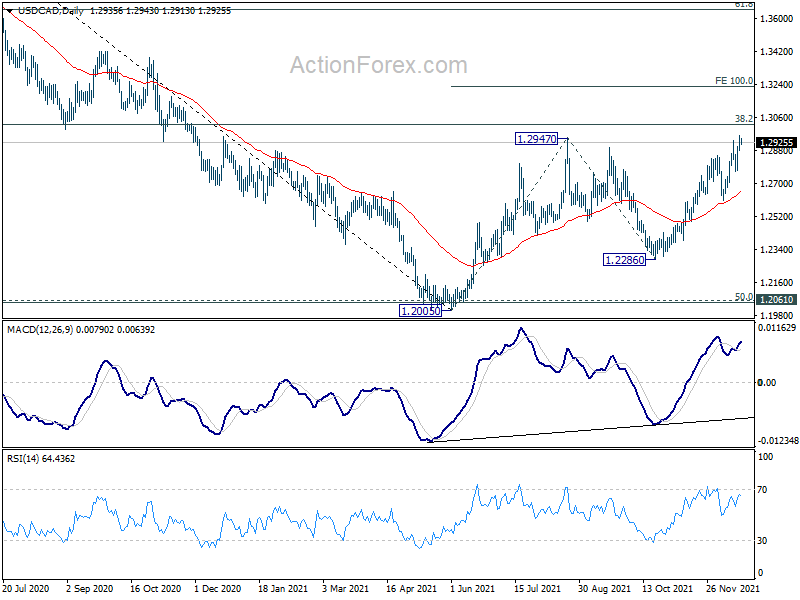
Intraday bias in USD/CAD remains on the upside at this point. Current rise from 1.2286 should target 1.3022 key medium term fibonacci level. Sustained break of 1.3022 will carry larger bullish implications. Next target will be 100% projection of 1.2005 to 1.2947 from 1.2286 at 1.3228. ON the downside, break of 1.2762 support is needed to indicate short term topping. Otherwise, outlook will stay bullish in case of retreat.
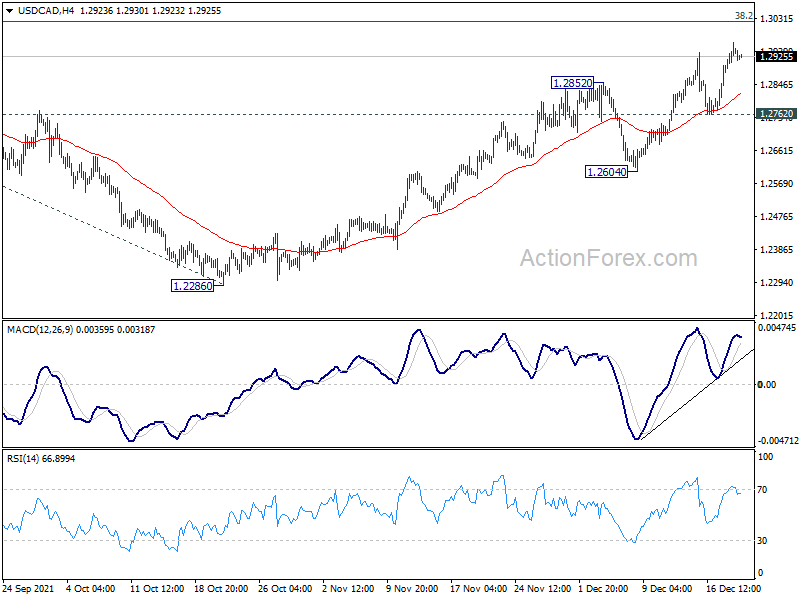
In the bigger picture, focus will be on 38.2% retracement of 1.4667 (2020 high) to 1.2005 (2021 low) at 1.3022. Sustained break there should confirm that the down trend from 1.4667 has completed after defending 1.2061 long term cluster support. Further rise would then be seen towards 61.8% retracement at 1.3650. On the downside, however, break of 1.2286 will turn focus back to 1.2005 low again.
Yen Mildly Lower as Asia Rebounds, Canadian Dollar in Weak Recovery
Yen trades mildly lower today, as Asian markets recover despite the steep fall in US overnight. Swiss Franc and Dollar are also soft. On the other hand, commodity currencies are all recovering mildly, but momentum is weak. Overall, the forex markets are still hesitating to break out from recent range, with the exception of Canadian Dollar. The Loonie will now look ahead to retail sales for the next movement.
Technically, we're continue to wait for breakouts in some Dollar and Yen pairs patiently. The levels to watch include 1.1185/1382 in EUR/USD, 1.3158/3373 in GBP/USD, 0.9156/9293 in USD/CHF, 127.36/129.82 in EUR/JPY and 148.94/152.60 in GBP/JPY.
In Asia, Nikkei closed up 2.08%. Hong Kong HSI is up 1.03%. China Shanghai SSE is up 0.88%. Singapore Strait Times is up 0.47%. Japan 10-year JGB yield is up 0.0157 at 0.055. Overnight, DOW dropped -1.23%. S&P 500 dropped -1.14%. NASDAQ dropped -1.24%. 10-year yield rose 0.017 to 1.419.
Japan government: economy shows movements of picking up
In the latest Monthly Economic Report, Japan's Cabinet Office upgraded economic assessment for the first time in 17 months. It said, "the Japanese economy shows movements of picking up recently as the severe situation due to the Novel Coronavirus is gradually easing." Back in November, it said the economy "continues to show weakness in picking up".
Private consumption is "picking up", dropping "while some weakness remains". However, business investments "appears to be pausing for picking up". Exports are "almost flat". Industrial production continues to appear to be "pausing for picking up". Corporate profits are "picking up". Employment situations shows "picking up in some components", comparing to November's "shows steady movement". Consumer prices continues to "show steady movements.
RBA minutes laid three options on QE, patient on rates
In the minutes of December 21 meeting, RBA reiterated that decision about the bond purchases program will be made in February. The criteria to consider include "progress towards the Board's goals for employment and inflation, the actions of other central banks and the functioning of the Australian bond market." Information include December CPI, December and January labor market data, and overall impact of Omicron.
Three possible options were also discussed.
- The first option was to reduce the pace of purchases from mid February with an expectation of a likely end point in May 2022. This option is consistent with November forecasts for employment and inflation.
- The second option was to reduce the pace of purchases and review it again in May 2022. This option is stronger if progress was slower than expected.
- The third option was to cease purchases altogether in mid February. In case of better-than-expected progress, the third option would become more appropriate.
Regarding interest rate, "the Board will not increase the cash rate until actual inflation is sustainably within the 2 to 3 per cent target range." And, "this is likely to take some time and the Board is prepared to be patient."
AUD/CAD in rebound, but no major bottoming yet
AUD/CAD is a pair worth watching today, after having sluggish response to RBA minutes. But Canada retail sales featured today could trigger some volatility. There is prospect of major bottoming at 0.8969 considering bullish convergence condition in daily MACD. Also, it's so far staying above 55 day EMA, which is a positive sign.
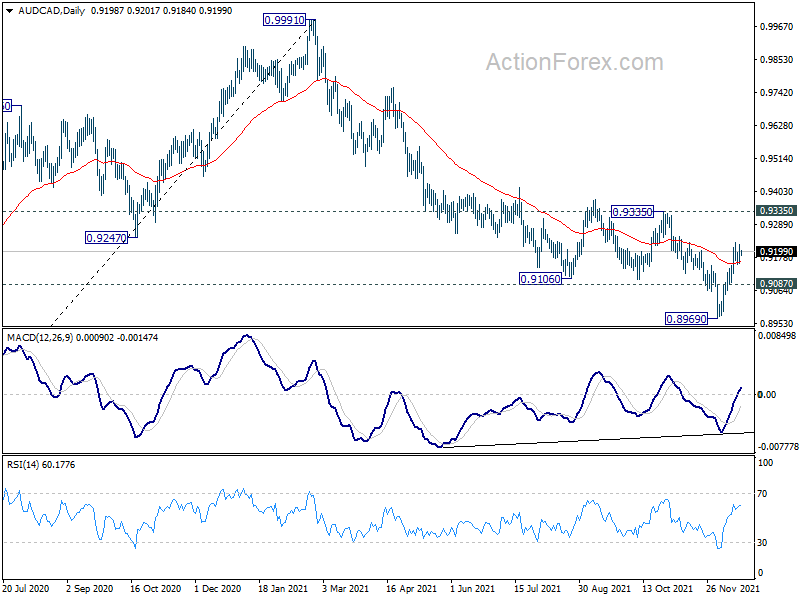
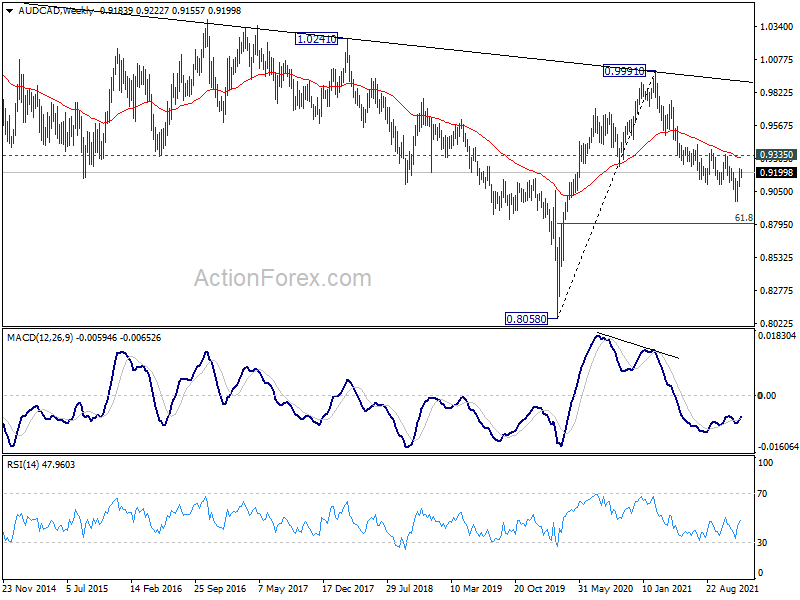
However, AUD/CAD will need to firmly take out 0.9335 resistance to indicate completion of the fall from 0.9991 high. Other wise, another fall would remain mildly in favor. On the downside, break of 0.9087 minor support will bring deeper fall to retest 0.8969 low. Break will resume the fall from 0.9991 to 61.8% retracement of 0.8058 to 0.9991 at 0.8796.
Looking ahead
Germany Gfk consumer confidence, Swiss trade balance and UK public sector net borrowing will be released in European session. Canada retail sales and US current account will be featured later in the day.
USD/CAD Daily Outlook
Daily Pivots: (S1) 1.2899; (P) 1.2931; (R1) 1.2978; More...
Intraday bias in USD/CAD remains on the upside at this point. Current rise from 1.2286 should target 1.3022 key medium term fibonacci level. Sustained break of 1.3022 will carry larger bullish implications. Next target will be 100% projection of 1.2005 to 1.2947 from 1.2286 at 1.3228. ON the downside, break of 1.2762 support is needed to indicate short term topping. Otherwise, outlook will stay bullish in case of retreat.
In the bigger picture, focus will be on 38.2% retracement of 1.4667 (2020 high) to 1.2005 (2021 low) at 1.3022. Sustained break there should confirm that the down trend from 1.4667 has completed after defending 1.2061 long term cluster support. Further rise would then be seen towards 61.8% retracement at 1.3650. On the downside, however, break of 1.2286 will turn focus back to 1.2005 low again.
Economic Indicators Update
| GMT | Ccy | Events | Actual | Forecast | Previous | Revised |
|---|---|---|---|---|---|---|
| 00:30 | AUD | RBA Minutes | ||||
| 07:00 | EUR | Germany Gfk Consumer Confidence Jan | -2.5 | -1.6 | ||
| 07:00 | CHF | Trade Balance (CHF) Nov | 5.43B | 5.65B | ||
| 07:00 | GBP | Public Sector Net Borrowing (GBP) Nov | 12.0B | 18.0B | ||
| 13:30 | USD | Current Account (USD) Q3 | -204B | -190B | ||
| 13:30 | CAD | Retail Sales M/M Oct | 1.20% | -0.60% | ||
| 13:30 | CAD | Retail Sales ex Autos M/M Oct | 0.80% | -0.20% | ||
| 15:00 | EUR | Eurozone Consumer Confidence Dec P | -8 | -7 |
Japan government: economy shows movements of picking up
In the latest Monthly Economic Report, Japan's Cabinet Office upgraded economic assessment for the first time in 17 months. It said, "the Japanese economy shows movements of picking up recently as the severe situation due to the Novel Coronavirus is gradually easing." Back in November, it said the economy "continues to show weakness in picking up".
Private consumption is "picking up", dropping "while some weakness remains". However, business investments "appears to be pausing for picking up". Exports are "almost flat". Industrial production continues to appear to be "pausing for picking up". Corporate profits are "picking up". Employment situations shows "picking up in some components", comparing to November's "shows steady movement". Consumer prices continues to "show steady movements.
AUD/CAD in rebound, but no major bottoming yet
AUD/CAD is a pair worth watching today, after having sluggish response to RBA minutes. But Canada retail sales featured today could trigger some volatility. There is prospect of major bottoming at 0.8969 considering bullish convergence condition in daily MACD. Also, it's so far staying above 55 day EMA, which is a positive sign.
However, AUD/CAD will need to firmly take out 0.9335 resistance to indicate completion of the fall from 0.9991 high. Other wise, another fall would remain mildly in favor. On the downside, break of 0.9087 minor support will bring deeper fall to retest 0.8969 low. Break will resume the fall from 0.9991 to 61.8% retracement of 0.8058 to 0.9991 at 0.8796.
RBA Minutes of December Board Meeting
The Board Minutes set out the options for the February call on QE; highlight the differences between Australia and US/UK; and a detailed background behind the Board’s current thinking on wages.
The points of interest in the Minutes of the December RBA Board meeting covered three issues: detailed analysis of the case for the QE decision in February; some insights, including from the Bank’s own liaison work, into prospects for wages growth; and a comparison between Australia and other countries with respect to wages and inflation.
The decisions on the timing of the first rate hike will hinge on those developments.
Two main differences between Australia and those countries experiencing high inflation at the moment stood out. Firstly, Australia had not experienced sharp increases in electricity or gas prices. But most importantly “In economies where participation had been slow to recover and case numbers in the pandemic had been high, such as the United States and United Kingdom, nominal wages growth was running at its fastest pace for years. However, similar to the Australian experience, nominal wages growth had remained subdued in the euro area and in Canada.”
Still, Westpac believes that the RBA’s current forecast of 2.25% for underlying inflation in 2022 is too low – we are currently at 2.8%.
However, the fate of rate policy will be highly dependent on wages growth in 2022. The Governor has indicated on a number of occasions that he would look through higher inflation as not being sustainable unless wages growth was printing 3%. His ideal steady state configuration would be 2.5% inflation; 4% wages growth, supported by 1.5% productivity growth.
The Minutes provide considerable insights into the factors behind the Bank’s thinking on wages. It was noted that “firms in the Bank’s liaison program continued to report difficulties finding workers for certain roles, including in construction, professional services, agriculture, and hospitality sectors”.
These shortages line up closely with the impact of the closed borders where skilled workers (professionals and construction); “back packers” (agriculture; hospitality; construction) and foreign students (hospitality and professionals) are all critical to those sectors.
The Minutes also noted that more workers felt encouraged by strong labour market conditions to change jobs - but on a micro basis only the highly skilled professionals showed a marked increase whereas “mobility rates in other sectors had remained in line with historical averages”- that was in stark contrast with the US where resignation rates across the spectrum were at historically high levels.
While wages growth had lifted in the September quarter it was only back to pre-pandemic levels, with only professional services back to 3%. Individual agreements showed faster increases but, as the Governor pointed out in a recent speech, there is likely to be considerable inertia in enterprise agreements (2- 3 years in duration) and the minimum wage setting which occurs annually. These two categories cover more than 50% of workers.
Surprisingly the Bank’s liaison program suggested that firms were generally expecting wage increases over the coming year of around 2.5%, which is broadly in line with their assessments of unions’ expectations.
Understandably the outlook is conditional on the impact of the Omicron variant. Although as with the Bank’s assessment of Delta some months ago it is “a new source of uncertainty, but was not expected to derail the recovery.”
Last week, in his final speech for the year, the Governor outlined the details of a discussion at the Board meeting about the decision on the Quantitative Easing program that will be made at the February 1 Board meeting.
The Minutes outline the same details.
Three options were discussed: to taper in February and cease purchases in May; to taper in February and review in May; to cease purchases altogether in mid-February.
The three conditions - the actions of other central banks; the functioning of the Australian bond market; and progress towards the goals of full employment and inflation would be relevant.
The Minutes noted that the forecasts in November were consistent with the first option.
It has been Westpac’s forecast that the Bank would adopt the first option but the Governor points out that if the revised forecasts at the February meeting show more progress than expected in November the Board would be prepared to cease the program altogether.
The key forecasts in November were: underlying inflation to print 2.25% in 2022; wages growth at 2.5%; and the unemployment rate at 4.25% by end 2022.
We expect that the December quarter underlying inflation rate will print 0.6% pushing the annual rate to 2.3%, compared to the November forecast of 2.25%. That might be sufficient to push the 2022 forecast to 2.5% (forecasts are always calibrated in 0.25% increments), given that the 6 month annualised rate would be 2.6%.
The unemployment rate is currently 4.6% to November which is below the forecast in November of 4.75%, so there is a possibility that the February forecast for end 2022 might be reduced from 4.25% to 4.0%, the December employment report which will print on January 20th will be important here. Given that it fell sharply in November from 5.2% in October there may be room for a statistical correction pushing the rate to move into line with the November forecast.
It seems unlikely, given the discussion at the December Board around wages, that the 2.5% forecast for wages growth would be adjusted.
But the uncertainty around the impact of Omicron over the next six weeks warrants caution with respect to that February decision.
At this stage we remain comfortable with our long standing option 1 forecast.
We do accept, however, that whereas it was reasonable to anticipate that the Board would take a steady approach to QE, in line with the Bank of Canada that scaled from $4 billion to $2 billion earlier in the year and Chair Powell’s response in the Q and A session when he noted the FED’s previous experience with a sudden large tapering to justify the recently announced staged taper the Governor’s bold promotion of option 3 signals that the Board is not concerned with any impact of a sudden cessation of purchases on the market.
Finally, as we saw with the Governor’s Statement following the December meeting, no date was used for the timing when conditions for a rate hike will be achieved compared with “end 2023” in November and “2024” in previous minutes. At least we did not see the “not next year” that figured in the Governor’s recent speech, although the progression of the rhetoric is fairly clear.
Conclusion:
The Minutes provide useful insights into the Bank’s assessment of the outlook for wages growth while providing more detail on the differences between Australia and the US/UK.
They provide appropriate respect for the uncertainty around Omicron although use the Delta rhetoric of “will not derail the recovery”.
While markets and commentators have shown more than usual volatility around the forecasts, Westpac has stuck with its “February 2023” date for the first hike in this cycle which we released as far back as June 18.
We continue to monitor developments with the key issues being Omicron; the sustainability of the current inflation surge; and the inertia of wages growth.
In the near term these issues will also determine the Bank’s approach to its QE decision in February, where option 1 remains our call.