Sample Category Title
Market Morning Briefing: Aussie Has Bounced Slightly From 0.7082
STOCKS
Dow Jones has fallen sharply and the view is further bearish to see a test of 34000. Dax has room to test 15500/600 now. Nikkei can test 29000-29500 while above 28500. Shanghai looks bearish towards 3550-3500. Nifty can test 16800 today before we see a dip towards 16200 eventually. Sensex can also rise in a corrective bounce today before we see a dip again.
Dow (34932.16, -433.28, -1.23%) has fallen sharply again today. The view is now bearish to see a fall towards 34000 before we see a bounce from there.
DAX (15239.67, -292.02, -1.88%) has bounced slightly today after testing a low of 15083.54. While above 15000, a test of 15500/15600 is possible in the coming sessions.
Nikkei (28496.83, +559.02, +2%) has risen back sharply today. While above 27750, the view is bullish to see a test of 29000-29500 over the next 1-week.
Shanghai (3609.28, +15.68, +0.42%) has risen slightly today after testing the low of 3589.36 yesterday. The view is bearish while below 3625 to see a test of 3550-3500.
Nifty (16614.20, -371, -2.18%) made a low of 16410.20 before bouncing back and closing at 16614.20. The index can test 16800 today before we see a dip again. A dip below 16200, if seen would confirm a possible fall towards June-July’21 lows of 15400. A break above 16800 would reduce chances of the mentioned fall. We would wait and watch price action for more clarity.
Sensex (55822.01, -1189.73, -2.09%) could not manage to bounce back from the crucial support at 57000 and fell sharply to test the low at 55132.68. A small corrective bounce towards 56000/56500 is possible today before we see a bounce again.
COMMODITIES
Crude prices have risen after a sharp fall seen yesterday. The next 3-4 sessions might see a rise in crude prices before a reversal is seen again. Gold has held well below resistance at 1820 and continues to trade within 1820-1760 for now. Silver may trade within 22-23 both being immediate support and resistance levels. Copper has bounced well from above 4.20 and can rise to 4.35 and 4.45/50 soon.
Brent (72.23) and WTI (69.43) have both risen today after seeing a sharp fall yesterday. The recovery might take prices to 73-74 and 71-72 respectively before a fall back to 70 and 67 is seen in the medium term again. The next 3-4 sessions can be bullish for crude prices.
Gold (1791.30) is holding well below resistance at 1820 and while that holds, a fall to 1770/60 looks possible before a bounce is seen. We continue to look at a broad range of 1760-1820 unless a break on either side is seen.
Silver (22.23) fell sharply from 22.43. Support is seen at 22 below current levels which of holds can produce a rise to 23 soon. Immediate range of 22-23 may hold for the next few sessions.
Copper (4.3135) made an intra-day low of 4.23 yesterday but managed to bounce back sharply from there to trade higher just now. While above 4.20/25, there is scope for a rise to 4.45/50 on the upside. Interim resistance is seen near 4.35. Watch price action while Copper attempts to move up slowly.
FOREX
Sideways consolidation is seen in most currency pairs with lack of further directional clarity from here unless we see a clear break on either side of the range for confirmation. Dollar Index and Euro can range within 97-95.50 and 1.12-1.1350 while USDCNY is ranged within 6.3830-6.36. USDJPY, Pound and Aussie can trade within 113.35-114.50, 1.3375-1.3150 and 0.72-0.71 respectively. EURJPY too is trading within 129.50-127.50 and may continue for the near term. USDINR needs to bounce from support at 75.80/60 to again rise back to 76+ levels else may trigger a fresh fall on a confirmed break below 75.60.
Dollar Index (96.46) is falling from 96.68 and while below 97, a fall to 96-95.50 looks possible. We continue to look at a broad range of 97-95.50 in the near term.
Euro (1.1284) continues to rise and is headed towards 1.1350 before we see a dip from there again towards 1.1230-1.1200. Immediate view is to see continued sideways range.
EURJPY (128.26) is rising within the 127.50-129.50 range and needs to break on either side to give more clarity on further direction from here. Till then we may expect the range to hold.
Aussie (0.7113) has bounced slightly from 0.7082 and can rise to 0.7150 before falling from there. Broad range of 0.72-0.71 may hold for now.
Pound (1.3211) is ranged within 1.3375/80-1.3150 region and may hold for the next few sessions. A bounce from 1.3150 may take it to the higher end of the mentioned range.
Dollar-Yen (113.68) has managed to bounce from 113.32 yesterday and is slowly inching up along the support trend line. Immediate support is seen near 113.35/40 which can hold and produce a bounce towards 114.50 on the upside. Immediate range of 113.35-114.50 looks possible for the near term unless a break below 113.35 is seen over the next couple of sessions.
USDCNY (6.3741) is holding well as 6.3830 is acting as a decent resistance for the near term. While below 6.3830, we continue to look for a fall to 6.36. View is bearish for the near term.
{USDINR (75.91) traded above 76 for the first half of the session yesterday testing 76.1575 on the upside but later came off to test 75.83 to close below 76. We need to see if it tests 75.80/60 today and bounces back from there to levels above 76 again or manages to sustain at lower levels. There is lack of clarity just now on immediate view from current levels. Hence we would wait and watch for directional confirmation.
INTEREST RATES
The US Treasury yields have risen back sharply at the far-end thereby reducing the chances of dipping towards the lower end of their range. An upmove one day and a downmove the other day leaves the near-term outlook mixed. Broadly, the expected sideways range is intact and the yields can continue to oscillate within it in the coming weeks. The German yields have inched up slightly at the far-end. The view is bearish with key resistance ahead and a further fall is possible in the coming days. The 10Yr and 5Yr GoI have risen further to test their crucial resistances. While the resistances hold, the yields can fall-back in the coming days. Needs a close watch in the coming days.
The US 2Yr (0.63%) Treasury yield continues to remain stable while the 5Yr (1.17%), 10Yr (1.43%) and the 30Yr (1.86%) have risen back sharply. The 10Yr and 30Yr have risen back above 1.4% and 1.8% respectively thereby reducing the chances of seeing 1.3% (10Yr) and 1.7% (30Yr) on the downside. While this bounce sustains, the yields can move up towards the upper end of their expected 1.3%-1.65% (10Yr) and 1.7%-2% (30Yr) range.
The German 2Yr (-0.74%) and 5Yr (-0.62%) yields remain lower and stable while the 10Yr (-0.38%) and 30Yr (-0.02%) have inched up slightly. The view is bearish. The 10Yr can fall to -0.45% / -0.5% and the 30Yr can test -0.1% / -0.2% on the downside. Resistance at -0.25% (10Yr) and 0.05% (30Yr) will cap the upside incase of any intermediate bounce.
The Indian 10Yr (6.4351%) and 5Yr (5.7602%) GoI rose further to test their crucial 6.45% and 5.78% resistances respectively. The price action in the coming days will need a close watch to see if these resistances hold and trigger a pull-back move to 6.35%-6.3% (10Yr) and 5.7%-5.65% (5Yr) going forward. A further sharp rise will be very bullish and negate the above mentioned pull back move.
GBP/USD Shows Bearish Signs Below 1.3300
Key Highlights
- GBP/USD started a fresh decline from the 1.3375 level.
- It is trading below a major support at 1.3280 on the 4-hours chart.
- EUR/USD could make another attempt to clear 1.1350.
- Crude oil price extended decline below the $70.00 support.
GBP/USD Technical Analysis
The British Pound failed to stay above 1.3350 against the US Dollar. GBP/USD started a fresh decline below the 1.3300 support zone.
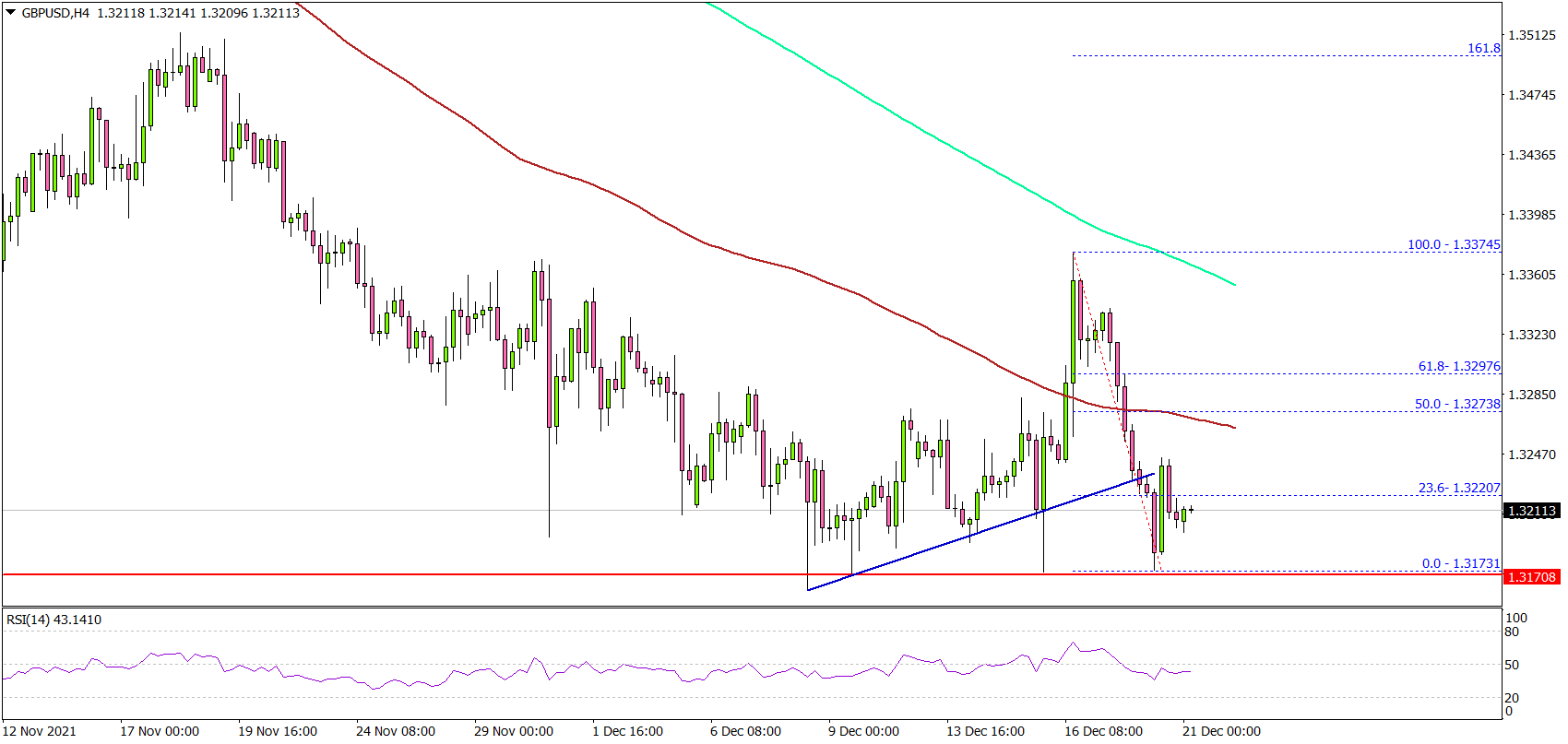
Looking at the 4-hours chart, the pair traded below the 1.3280 and 1.3250 support levels. Besides, there was a clear move below a bullish trend line at 1.3235. The pair traded below 1.3200 and settled below the 100 simple moving average (red, 4-hours) and the 200 simple moving average (green, 4-hours).
The pair found support near 1.3175 and started consolidating loses. An immediate support is near the 1.3175 level. The next key support is 1.3150, below which the pair could dive towards the 1.3100 level.
A close below 1.3100 could open the doors for a move towards 1.3000. On the upside, the first key resistance is near the 1.3280 level. The next key resistance is near the 1.3300 level. A successful daily close above 1.3300 could open the doors for a steady increase. The next stop for the bulls might be 1.3375.
Looking at EUR/USD, the pair found support near 1.1220, but it could face a strong resistance near the 1.1350 zone.
Economic Releases
- Canadian Retail Sales for Oct 2021 (MoM) – Forecast 1%, versus -0.6% previous.
- Canadian Retail Sales ex Autos for Oct 2021 (MoM) – Forecast +0.8%, versus -0.2% previous.
RBA minutes laid three options on QE, patient on rates
In the minutes of December 21 meeting, RBA reiterated that decision about the bond purchases program will be made in February. The criteria to consider include "progress towards the Board's goals for employment and inflation, the actions of other central banks and the functioning of the Australian bond market." Information include December CPI, December and January labor market data, and overall impact of Omicron.
Three possible options were also discussed.
- The first option was to reduce the pace of purchases from mid February with an expectation of a likely end point in May 2022. This option is consistent with November forecasts for employment and inflation.
- The second option was to reduce the pace of purchases and review it again in May 2022. This option is stronger if progress was slower than expected.
- The third option was to cease purchases altogether in mid February. In case of better-than-expected progress, the third option would become more appropriate.
Regarding interest rate, "the Board will not increase the cash rate until actual inflation is sustainably within the 2 to 3 per cent target range." And, "this is likely to take some time and the Board is prepared to be patient."
(RBA) Minutes of the Monetary Policy Meeting of the Reserve Bank Board
Hybrid – 7 December 2021
Members present
Philip Lowe (Governor and Chair), Guy Debelle (Deputy Governor), Mark Barnaba AM, Wendy Craik AM, Ian Harper AO, Steven Kennedy PSM, Carol Schwartz AO, Alison Watkins
Members granted leave of absence to Carolyn Hewson AO in accordance with section 18A of the Reserve Bank Act 1959.
Others participating
Luci Ellis (Assistant Governor, Economic), Christopher Kent (Assistant Governor, Financial Markets)
Anthony Dickman (Secretary), Penelope Smith (Deputy Secretary)
Alexandra Heath (Head, International Department), Bradley Jones (Head, Economic Analysis Department), Marion Kohler (Head, Domestic Markets Department)
International economic developments
Members commenced their discussion of international economic developments by noting that the global economy had continued to recover, supported by expansionary monetary and fiscal policy settings and increased vaccination coverage. Conditions were in place for a sustained expansion, although the new Omicron variant of COVID-19 posed additional uncertainty for the near-term outlook. The recent increase in cases of the Delta variant in some countries had led to a moderate rise in hospital admissions and a tightening of restrictions on activity. So far, however, the economic effects had generally been limited. In the United States, another large fiscal support package had been passed by Congress. In China, economic activity stabilised early in the December quarter following an earlier period of regulatory tightening. Domestic demand elsewhere in Asia had started to rebound after COVID-19 outbreaks and associated lockdowns in the June and September quarters had restrained activity.
Members noted that the recovery in household consumption had been strong in advanced economies. Consumption of services had rebounded, supported by an easing in restrictions following high vaccination coverage, and spending on goods remained at high levels. Growing COVID-19 case numbers had prompted some European countries to reimpose restrictions on mobility in recent weeks, but across the continent as a whole the effect on population mobility and the consumption of services had so far been limited. In east Asia, measures of domestic mobility had returned to pre-pandemic levels as case numbers declined and restrictions were eased; this was expected to support a recovery in the consumption of services.
Ongoing strength in the global demand for goods continued to exert pressure on supply chains. Capacity constraints in global goods markets had been more persistent than initially envisaged and bottlenecks were holding back sales of some goods, especially motor vehicles. Alongside a run-up in energy prices, these capacity constraints had contributed to the upswing in inflation in major advanced economies over recent months. Nevertheless, some timely indicators of price pressures in global supply chains, including shipping costs and prices for key intermediate inputs, had shown signs of stabilising of late.
Members noted that core inflation had increased to its fastest pace in many years in North America, the euro area and the United Kingdom. Together with a sharp increase in goods and energy price inflation, services price inflation had increased to a little above pre-pandemic rates in major advanced economies; a rise in housing-related costs had contributed to this. In contrast to the pick-up in inflation in major advanced economies, goods price inflation remained low in high-income east Asian economies, where fiscal support had been targeted more at firms than households.
Members discussed the continuing improvement in labour market conditions in advanced economies. Employment growth remained strong and unemployment rates had continued to decline. However, participation rates and wages growth continued to vary widely across countries. In economies where participation had been slow to recover and case numbers during the pandemic had been high, such as in the United States and the United Kingdom, nominal wages growth was running at its fastest pace in some years. However, similar to the Australian experience, nominal wages growth had remained subdued in the euro area and in Canada.
Domestic economic developments
Turning to the domestic economy, members noted that activity was rebounding strongly from the setback in the September quarter induced by the Delta variant of COVID-19 and associated lockdowns. Timely indicators suggested that economic activity, particularly household consumption, was recovering strongly in parts of the country where restrictions had eased over the preceding two months or so. In states that had avoided extended lockdowns, activity had continued to expand at a solid pace. Business sentiment had also improved. Non-mining firms had upgraded their investment intentions over prior months, and the Bank's liaison program suggested that firms' investment intentions were at, or above, average levels for most industries. International border restrictions had been eased for vaccinated Australians and for some inbound travel, but the Omicron variant had led to some delays in a further reopening of the international border.
Members noted that the contraction in economic activity in the September quarter had been significant, although the decline in domestic demand had been smaller than expected. As in earlier lockdowns, household consumption accounted for most of the decline in GDP because spending opportunities had been reduced in large parts of the country; in states that were unaffected by extended lockdowns, consumption had increased. Spending on services remained well below pre-pandemic levels, suggesting there remained considerable scope for the consumption of services to increase in the period ahead. Household income in the September quarter had been boosted by a substantial increase in social assistance (including COVID-19 disaster payments) and higher labour income in states that were largely free of lockdowns. This, combined with reduced opportunities for consumption, saw the household saving ratio increase sharply to a historically high level of around 20 per cent. This added further to the large amount of savings accumulated since the onset of the pandemic.
Private and public investment activity had been surprisingly resilient in the September quarter, particularly in Victoria. Restrictions on construction activity had been less disruptive than envisaged. Dwelling investment had been steady in the quarter and non-mining non-residential construction had increased. Members noted that the outlook for construction activity was strong, with the value of work in the pipeline at a high level for both residential and non-residential building activity; in the case of residential construction, the outlook for detached housing and alterations and additions remained positive, even after the Homebuilder application period ended earlier in the year. Public investment and consumption had risen further in the September quarter; very strong growth in public consumption had been supported by pandemic-related spending.
In the established housing market, conditions had been somewhat mixed. Growth in housing prices had eased a little in Sydney and Melbourne, alongside an increase in new listings to above-average levels. Elsewhere, housing prices had been largely unchanged in Perth over the preceding two months, while growth in housing prices had remained strong in Brisbane, Adelaide and regional Australia. Housing turnover had remained high in most parts of the country. Advertised rents had continued to increase in the capital cities and regional Australia, but at a slightly slower pace than the preceding six months. Rental vacancy rates had declined in Sydney and Melbourne, but were still above their longer-run averages, while the vacancy rates in other cities and some regional areas had remained low.
Turning to the labour market, members noted that hours worked had stabilised in October and forward-looking indicators suggested employment would rebound strongly in the period ahead. While measured employment had declined further and the unemployment rate had increased in October, the labour force survey for that month had been conducted prior to the lifting of lockdowns in New South Wales and Victoria. Leading indicators of labour demand pointed to a strong recovery in labour market conditions in coming months, with job advertisements rising to a historically high level. Firms in the Bank's liaison program continued to report difficulties finding workers for certain roles, including in the construction, professional services, agricultural and hospitality sectors.
Members discussed the increase in job mobility over prior months following a sharp decline at the onset of the pandemic. Part of this increase reflected workers catching up on planned job changes that had been put on hold, as well as more workers feeling encouraged by strong labour market conditions to change jobs. It also reflected labour market adjustments to the uneven effects of the pandemic on labour demand. High-skilled jobs in professional and other business services sectors had experienced particularly sharp increases in job mobility, while job mobility rates in other sectors had remained in line with historical averages. The higher rates of voluntary job turnover in some sectors, especially in a tight labour market, could in time lead employers to offer higher wages to retain their workers. However, members noted that the experience in Australia had been different from that in the United States, where job resignation rates were at historically high levels and were coming at a time when labour force participation and employment remained considerably below pre-pandemic levels.
Members noted that private sector wages growth had increased in the September quarter, but only to around its pre-pandemic level. Only professional services had recorded wages growth in excess of 3 per cent. Public sector wages growth remained subdued. Wages growth was increasing more quickly for workers on individual agreements compared with other pay-setting arrangements. Information from the Bank's liaison program suggested that firms were generally expecting wage increases over the coming year of around 2½ per cent, broadly in line with surveys of unions' expectations; the distribution of firms' expectations for wages growth was also similar to the pre-pandemic pattern.
Members concluded their discussion of the domestic economy by noting that the staged reopening of the international border would support trade in services in the period ahead. The outlook for travel and education exports had improved somewhat on account of the international border reopening earlier than previously assumed. Education exports were expected to contribute to GDP growth over the coming years. However, the near-term outlook for travel services had been clouded by the emergence of the Omicron variant of COVID-19, as there was some risk that it would give rise to renewed restrictions or travel hesitancy.
International financial markets
Members commenced their discussion of international financial markets by noting that bond yields and equity prices had declined globally and become more volatile, as the identification of the Omicron variant of COVID-19 saw some renewed restrictions and increased uncertainty about the global economic outlook. However, inflation pressures and expectations about future central bank policy actions in many advanced economies meant that sovereign bond yields remained well above their levels of a few months earlier.
Some central banks – including the Reserve Bank of New Zealand, the Bank of Korea and Norges Bank – had increased their policy rates. Others, including the Bank of England and the Bank of Canada, were expected to withdraw some monetary stimulus over the coming year, as their labour markets tightened and their economic recoveries continued. Members observed that the US Federal Reserve had begun to taper asset purchases as announced in November and there was a possibility that net purchases would cease sooner than previously planned. This would be considered at the next meeting of the Federal Open Market Committee in December. In contrast, the European Central Bank was expected to continue asset purchases for some time and had emphasised that it was very unlikely to increase its policy rate in 2022 given muted wage pressures.
Corporate financing conditions remained favourable internationally and in Australia, although credit spreads had risen from their recent lows. Prior to the recent declines, equity prices had risen, supported by strong profit results related to the recovery in demand.
The US dollar had appreciated against a broad range of currencies as short-term US bond yields had risen relative to those of most other advanced economies. Members noted that this had contributed to a depreciation of the Australian dollar, which had declined to around its lowest level in 2021 in US dollar and TWI terms, notwithstanding a rise in commodity prices and interest rates in Australia relative to other large advanced economies over the year to date.
In China, some property developers had remained under stress. Members noted that spillovers to wider financial conditions had been limited and actions had been taken to manage the risks of disorderly defaults among stressed property developers. The People's Bank of China had reduced required reserve ratios by 50 basis points to provide additional modest support to growth.
Domestic financial markets
In Australia, expectations for the cash rate implied by market prices had been little changed over the preceding month after increasing in late October following the release of the September quarter Consumer Price Index (CPI) and market participants' increased expectations of the removal of the yield target. Current market pricing implied the cash rate was expected to be close to 1 per cent by the end of 2022, before rising to a little below 1¾ per cent by the end of 2023.
Members observed that, after rising sharply in October, yields had declined earlier in November after the Board's decision to discontinue the yield target and communication by the Bank that an increase in the cash rate in 2022 was not warranted on the basis of the Bank's central scenario for the inflation outlook. In the second half of the month, yields on Australian Government bonds had declined further alongside those internationally. The spread to US treasuries had declined over the preceding month from around 50 basis points at the end of October to around 20 basis points.
Members noted that overall funding costs for banks remained historically low, despite yields on bank bonds having risen in recent months. Much of banks' funding costs are ultimately linked to the three-month bank bill swap rate, which remained very low and close to the cash rate. The rise in longer-term swap rates in recent months had flowed through to higher fixed rates for new housing loans, but at the same time banks had offered increased discounts on some variable rate housing loans.
Overall, the monthly pace of credit growth had eased a little in prior months. Commitments for new business and housing loans remained at high levels, although they had declined for owner-occupiers, including first home buyers. The higher serviceability assessment rate for new housing loans, which was announced by the Australian Prudential Regulation Authority in early October, had been scheduled to be used by banks since early November.
Considerations for monetary policy
In considering the policy decision, members observed that the Australian economy was rapidly recovering after the interruption to growth caused by the outbreak of the Delta variant of COVID-19. High rates of vaccination and substantial policy support continued to underpin the recovery. The emergence of the Omicron variant was a new source of uncertainty, but it was not expected to derail the recovery.
In the domestic economy, hours worked had stabilised and forward-looking indicators of labour demand were consistent with strong employment growth over coming months. The unemployment rate was expected to trend lower to be around 4 per cent by the end of 2023. Wages growth had picked up, but only to the low rates prevailing prior to the onset of the pandemic. A further gradual pick-up in wages growth was expected as the labour market tightens. Members noted the uncertainty about the behaviour of wages as the unemployment rate declines to historically low levels.
Members observed that inflation had increased, but remained low in underlying terms. Underlying inflation had picked up to a little above 2 per cent for the first time in six years. Members noted that inflation pressures in Australia were lower than in many other countries, owing to a range of factors, including differences in energy markets and modest wages growth in Australia. A further, but only gradual, pick-up in underlying inflation was expected. The central forecast was for underlying inflation to reach 2½ per cent over 2023.
Members noted that financial conditions in Australia were still highly accommodative, with most lending rates at record lows. Globally, bond yields had declined over the preceding month because of concerns about the Omicron variant of COVID-19. The Australian dollar exchange rate had depreciated and was around its lows of the preceding year.
Housing prices had risen strongly over the prior year, although the rate of increase had eased. Housing credit growth had stopped increasing, and the value of housing loan commitments had recently declined, but it remained at a high level. Members continued to emphasise the importance of maintaining lending standards at a time of historically low interest rates.
The Board had previously announced that it would make a decision about the bond purchase program in February 2022. Members discussed the bond purchase program ahead of that decision. They noted that the program was providing ongoing support to the economy, by lowering funding costs, supporting asset values and leading to a lower exchange rate than would otherwise have been the case. At the time of the meeting, the Bank held 34 per cent of outstanding Australian Government Securities and 17 per cent of outstanding securities issued by the states and territories. Members noted that the stimulus associated with the stock of bonds already purchased would provide significant support to the economy for some time.
Members reaffirmed that the decision in February 2022 would depend on the criteria the Board had previously agreed to – namely, progress towards the Board's goals for employment and inflation, the actions of other central banks and the functioning of the Australian bond market. Members noted that more information on these criteria would be available by the time of the February meeting. This included information on the December quarter CPI and how the labour market had performed over December and January. The risk to the recovery posed by the Omicron variant would also be more apparent by that time.
Three possible options for the bond purchase program were discussed. The first option was to reduce the pace of purchases from mid February with an expectation of a likely end point in May 2022. The second option was to reduce the pace of purchases and review it again in May 2022. The third option was to cease purchases altogether in mid February. These options reflected the expectation that the economy would continue to bounce back from the disruption of the outbreak of the Delta variant.
The first option (i.e. to reduce the pace of purchases from mid February with an expectation of a likely end point in May 2022) was consistent with the Bank's November forecasts for employment and inflation. If better-than-expected progress towards the Board's goals was made, then the third option (i.e. to cease bond purchases in mid February) would become more appropriate. Alternatively, if progress was slower than expected, or if the outlook became more uncertain, the case for the second option (i.e. to reduce the pace of purchases and then review it again in May 2022) would be stronger. Members agreed these options constituted the most plausible alternatives. If there were another serious economic setback, a different set of options would need to be considered.
Turning to the decision for the cash rate, the Board remained committed to maintaining highly supportive monetary conditions to achieve its objectives of a return to full employment and inflation consistent with the target. As previously determined, the Board will not increase the cash rate until actual inflation is sustainably within the 2 to 3 per cent target range. This will require the labour market to be tight enough to generate wages growth that is materially higher than it is currently. This is likely to take some time and the Board is prepared to be patient.
The decision
The Board decided upon the following policy settings:
- maintain the cash rate target at 10 basis points and the interest rate on Exchange Settlement balances at zero per cent
- continue to purchase government securities at the rate of $4 billion a week until at least mid February 2022.
Eco Data 12/21/21
[php_everywhere instance="1"]
Canadian Dollar Keeps Falling
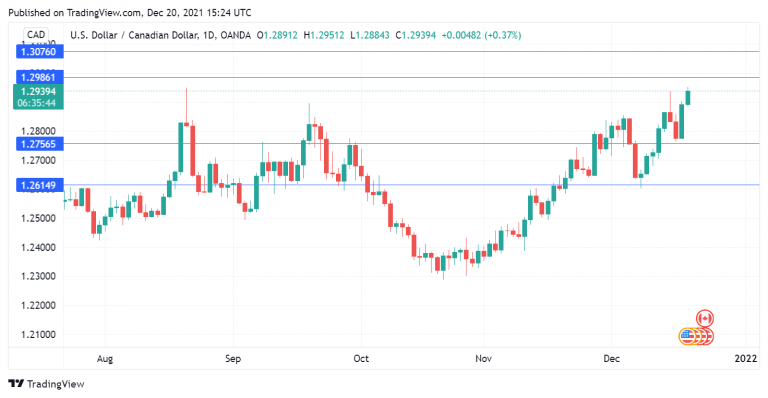
The US dollar is flexing some muscle as USD/CAD has started the week with considerable gains and is trading around 1.2950. The Canadian dollar had a rough week, losing 1.29%. USD/CAD is closing in on the symbolic 1.30 line, which was last breached in November 2020.
Risk aversion weighs on loonie
The Canadian dollar is a bellwether of risk sentiment, and the currency’s slide is an indication that risk appetite has fallen sharply. First, the Omicron variant is exploding in Europe, leading to a lockdown in the Netherlands and tighter health restrictions in other European countries. Omicron has also reached the US and we could see a spike in cases there also.
Another factor which has soured risk appetite was the news on the weekend that Democratic Senator Joe Manchin will not support President Biden’s Build Back Better spending package. Without Manchin’s support, the massive spending bill has no chance of being passed. Biden had been counting on passage of the bill by Christmas, as he is desperate for something to show voters who are frustrated over high gas prices and rising inflation and could take out their anger on the Democrats at next year’s mid-term elections. Now the Democrats will have to retreat and redraft a new bill that Manchin will accept.
Canada releases Retail Sales, the primary gauge of consumer spending. The markets are forecasting strong numbers for October, with a consensus of 1.0% for headline retail sales and 1.5% for core retail sales. This follows small declines in September. If the retail sales reports are within expectations, the Canadian dollar could break its current slide and recover some ground against the US dollar.
USD/CAD Technical
- USD/CAD has support at 1.2756. Below, there is support at 1.2615
- There is resistance at 1.2987. Above, there is resistance at 1.3077
Santa Eluding Markets This Year
A feast of negative headlines over the weekend is dampening sentiment at the start of the week as equity markets slide between one and two percent in Europe.
The US isn’t looking any better, with the open seen piling further misery on Friday’s performance. It’s hard to read too much into the moves at the moment, despite the clear dip in sentiment over the last couple of days.
Is this really omicron nerves as Europe imposes further domestic and travel restrictions, even embracing lockdown in the case of the Netherlands? Or a negative response to the hawkish shift from central banks around the world which was expected before and initially received a positive response?
Or is it disappointment at President Biden’s Build Back Better plan collapsing in a heap after Senator Joe Manchin withdrew his support for the USD 2 trillion package? That will certainly shave a little off growth next year and is a hammer blow to the Democrats ahead of the midterms.
Or is it more simple than that? The festive season is upon us; perhaps traders are turning the laptops off, traveling, spending time with family, and binging on treats and the usual array of Christmas films. The Santa rally may elude us this year after an impressive pre-Christmas rebound following the initial omicron shock. Given the amount of downside risks going into the new year, it’s hardly surprising to see investors adopting a more cautious approach as they log off for the holidays.
Erdogan doubles down again on interest rates sending lira down another 7%
Turkish President Erdogan continues to pile further misery on the lira and those that rely on it as he remained committed to cutting interest rates over the weekend, despite the currency plunging to new lows on an almost daily basis. His total disregard for the pain it’s going to cause is astonishing and he’s clearly in no mood to even assess the damage, let alone pull back. Nor is he even pretending there’s a line between fiscal and monetary policy anymore which is really disturbing.
Another volatile year but 2022 likely to be another exciting year for bitcoin
Bitcoin is continuing to edge lower as we approach the end of another impressive year for the cryptocurrency space. It’s made enormous strides over the course of 2021 which will leave many excited about what 2022 holds. But with speculation still playing an enormous role in the bitcoin space, it’s no surprise to see it more than 50% up this year and simultaneously more than 30% off its highs. With the recent trajectory, you wouldn’t be surprised to see both of those numbers end the year a little closer together.
Oil suffers ahead of difficult Q1 for the global economy
Oil prices are getting pummelled again as sentiment turns south and countries ponder deepening restrictions and lockdowns. There’s certainly a feel here in the UK that households and businesses are preparing for more severe measures and that the government is desperately trying to hold out until after the holidays. Perhaps that feeling is being shared elsewhere and January is shaping up to be a global reset.
None of this bodes well for crude demand in the first quarter of the year. It’s just a question of whether OPEC+ will hold out until the January meeting to pull the trigger or pile further pain on the global economy this year. A pile of coal under the tree for households battling high inflation, higher interest rates, and soaring energy costs. Throw in record pump prices and the growth outlook next year is severely hampered.
Can gold break the range?
Gold’s resurgence last week was short-lived and to be fair, it appeared to be built on pretty shaky foundations. Central banks raising rates to rein in inflation and the dollar attracting haven flows is hardly the recipe for a sustainable rally in the yellow metal. Still, risk aversion at the end of the year could offer some support if it is maintained.
It’s interesting that last week’s heavy calendar didn’t really see gold propel out of its recent ranges. There was some upside momentum but as we saw Friday, there’s still plenty of uncertainty around the upper end of the range and more than enough sellers interested at those levels. Perhaps we’ll see further consolidation into the end of the year unless we can see it build on last week’s momentum and break USD 1,820.
EUR/USD Outlook: Near-Term Action Extends Sideways Mode but Larger Picture Remains Bearish
The Euro bounces on Monday, reversing over 50% of Friday’s 0.85% drop and bringing the price to the middle of the range that extends into a fifth straight week.
Fresh strength partially offsets negative signal from last week’s bearish close following a triple weekly Dojis which signaled strong indecision, as larger bears took an extended breather.
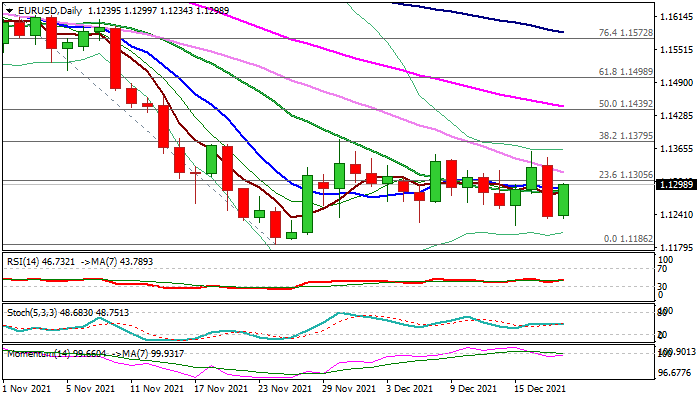
Near-term tone is expected to remain neutral while the price moves around converged and sideways-moving 10&20DMA’s and holds within larger 1.1380/1.1186 range.
But larger picture is bearish and warns that the downtrend is likely resume after prolonged consolidation, as the pair has eventually registered a weekly close below key Fibo support at 1.1290 (61.8% of 1.0635/1.2349 ascend).
Fundamentals also do not work in favor of euro, as surging Omicron cases boost expectations for fresh restrictive measures in Europe and dent risk sentiment, while soft tones from the ECB and more than expected hawkish Fed, add pressure on the single currency.
Larger bears look for fresh negative signals on repeated weekly close below 1.1290 Fibo level that would open way towards targets at 1.1040/1.1000 (Fibo 76.4%/psychological).
Falling 30 DMA (1.1319) offers solid resistance, guarding upper pivot at 1.1380 (range top / Fibo 38.2% of 1.1692/1.1186), break of which would sideline bears.
Res: 1.1319; 1.1360; 1.1380; 1.1439.
Sup: 1.1234; 1.1204; 1.1186; 1.1100.
EUR/USD Mid-Day Outlook
Daily Pivots: (S1) 1.1198; (P) 1.1274; (R1) 1.1312; More...
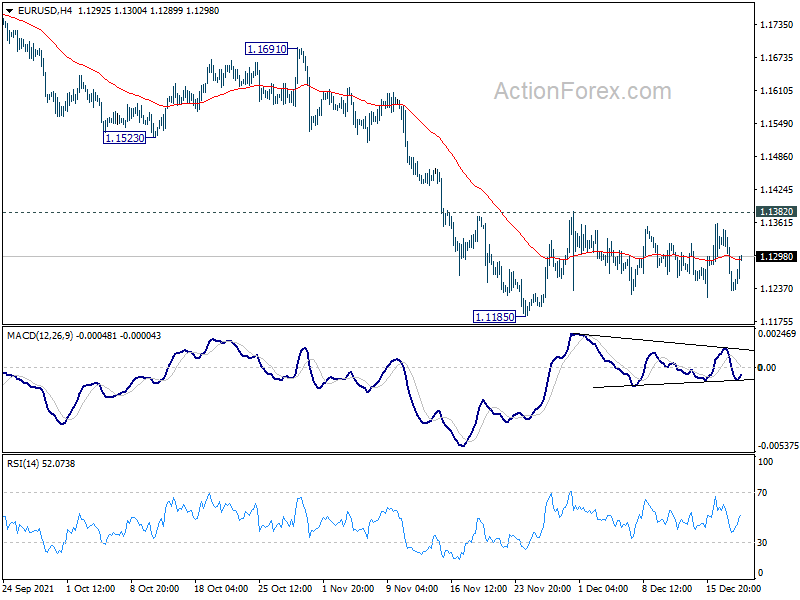
Outlook in EUR/USD remains unchanged and intraday bias remains neutral. Further decline will remain in favor as long as 1.1382 resistance holds. Break of 1.1185 will resume larger decline from 1.2348. Next target is 161.8% projection of 1.2265 to 1.1663 from 1.1908 at 1.0934. On the upside, firm break of 1.1382 resistance should confirm short term bottoming at 1.1186. Intraday bias will be turned back to the upside for 55 day EMA (now at 1.1426).
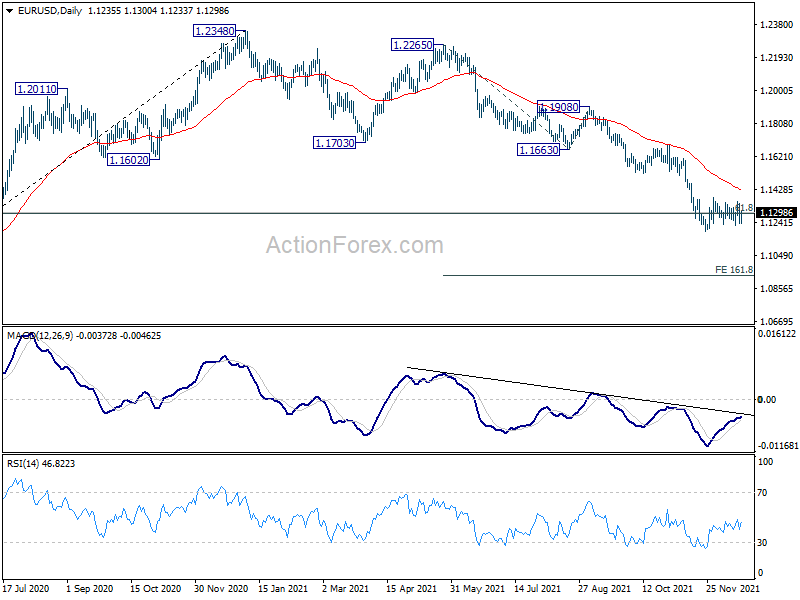
In the bigger picture, there are various ways of interpreting the fall from 1.2348 (2021 high). It could be a correction to rise from 1.0635 (2020 low), the fourth leg of a sideway pattern from 1.0339 (2017 low), or resuming long term down trend. In any case, outlook will now stay bearish as long as 1.1703 support turned resistance holds. Sustained break of 61.8% retracement of 1.0635 to 1.2348 at 1.1289 would pave the way back to 1.0635.
GBP/USD Mid-Day Outlook
Daily Pivots: (S1) 1.3199; (P) 1.3269; (R1) 1.3306; More...
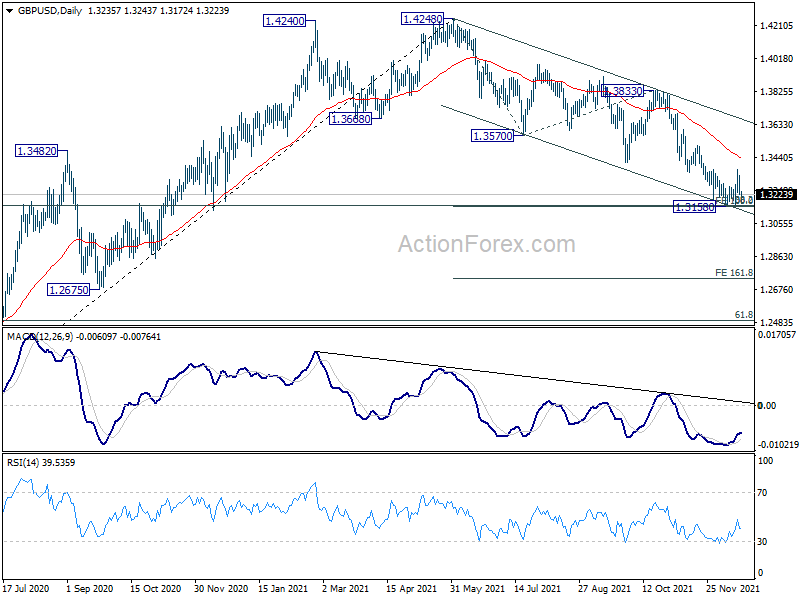
Outlook is unchanged in GBP/USD and intraday bias remains neutral. On the downside, firm break of 1.3164 medium term fibonacci level will carry larger bearish implication. Fall from 1.4248 should resume and target 161.8% projection of 1.4248 to 1.3570 from 1.3833 at 1.2736. On the upside, , break of 1.3372 will resume the rise from 1.3158 to 55 day EMA (now at 1.3436).
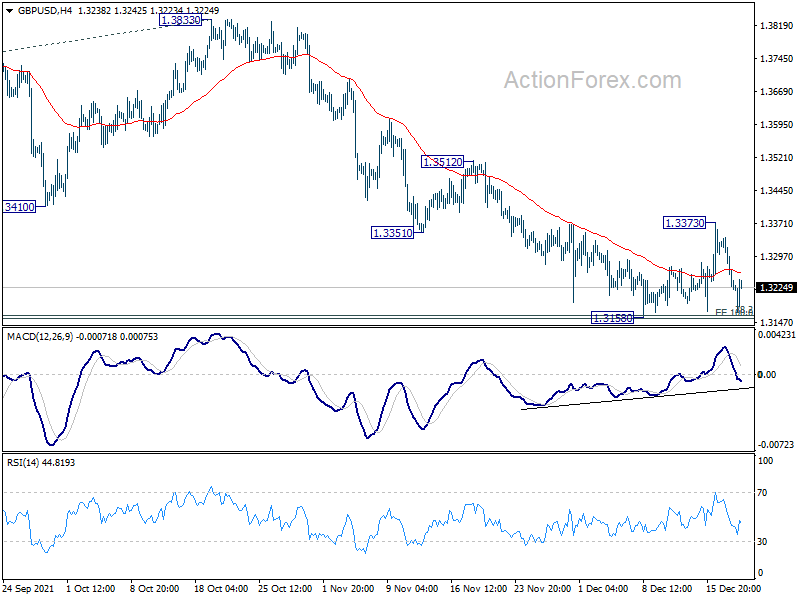
In the bigger picture, focus remains on 38.2% retracement of 1.1409 to 1.4248 at 1.3164. Sustained break there will argue that whole rise from 1.1409 has completed at 1.4248, after rejection by 1.4376 long term resistance. That will revive some medium term bearishness and and target 61.8% retracement at 1.2493. However, strong rebound from current level will revive argue that up trend from 1.1409 is still in progress, and probably ready to resume.