Sample Category Title
EUR/USD Got Under Pressure
The major currency dropped and is currently trading at 1.1260. The currency market is taking a huge interest in “safe haven” assets and that’s a perfect reason for the “greenback” to rise.
Coronavirus-related fears are once again ruling the world. After Bloomberg reported a possibility of new anti-COVID restrictions in Europe, the Netherlands-style, many investors rushed off to “safe haven” assets to avoid risks.
Is Europe likely to introduce more lockdowns? No one should exclude this possibility and this fact provides the “greenback” with huge support, keeping the demand for the American currency quite high.
Another thing in favour of the USD is the Fed’s intention to quickly taper the QE programme and start discussing the rate hike as early as June 2022.
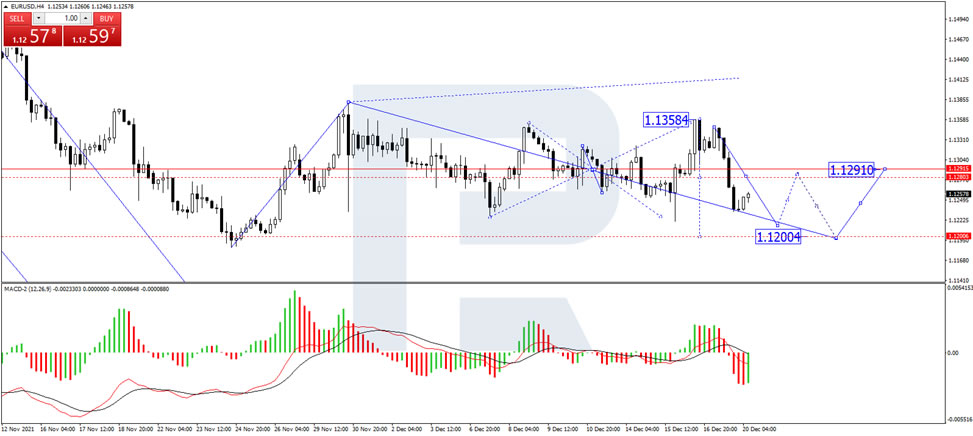
In the H4 chart, EUR/USD is correcting downwards to reach 1.1200 and may later consolidate there. If the price breaks the range to the upside, the market may start a new growth with the target at 1.1291. From the technical point of view, this scenario is confirmed by MACD Oscillator: its signal line is moving below 0 and may later continue falling towards new lows.
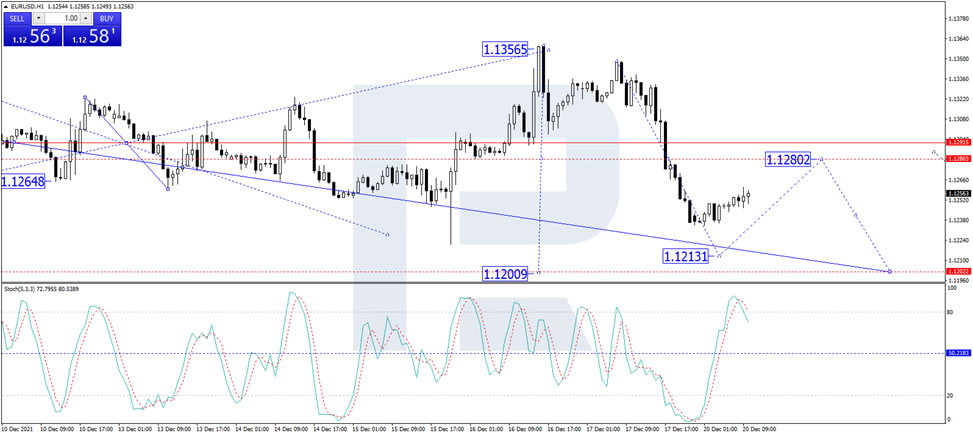
As we can see in the H1 chart, EUR/USD is forming another descending structure with the short-term at 1.1213 and may later start a new correction towards 1.1280. After that, the instrument may resume falling and finish this descending wave at 1.1200. From the technical point of view, this idea is confirmed by the Stochastic Oscillator: its signal line is moving above 80, which means that the asset may complete the ascending structure soon and the line may continue its movement to reach new lows.
USD/CAD Returns To High Level
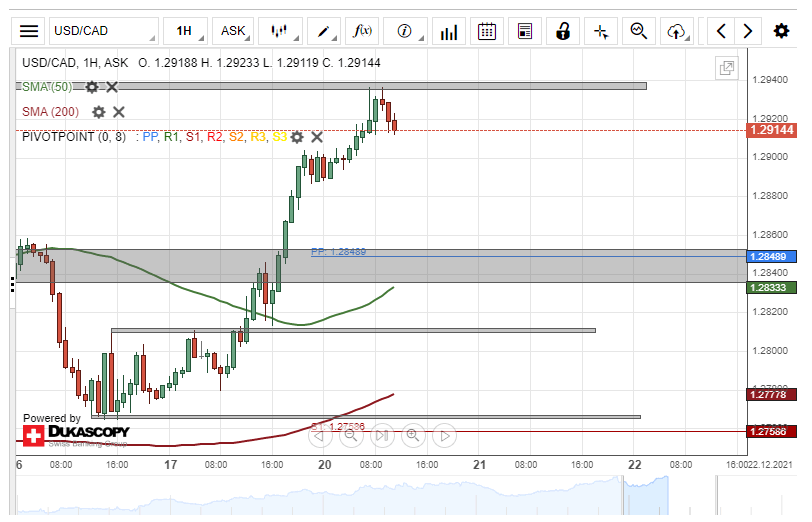
On Monday, the USD/CAD returned to trade at the 1.2938 level, which is the previous December high level.
A move higher could find resistance in the weekly R1 simple pivot point at 1.2991. Above the pivot point, the 1.3000 mark might stop a surge.
On the other hand, a decline of the USD against the CAD might look for support in the combination of the weekly simple pivot point at 1.2849, the 50-hour simple moving average near 1.2835 and the previous high level zone at 1.2835/1.2853.
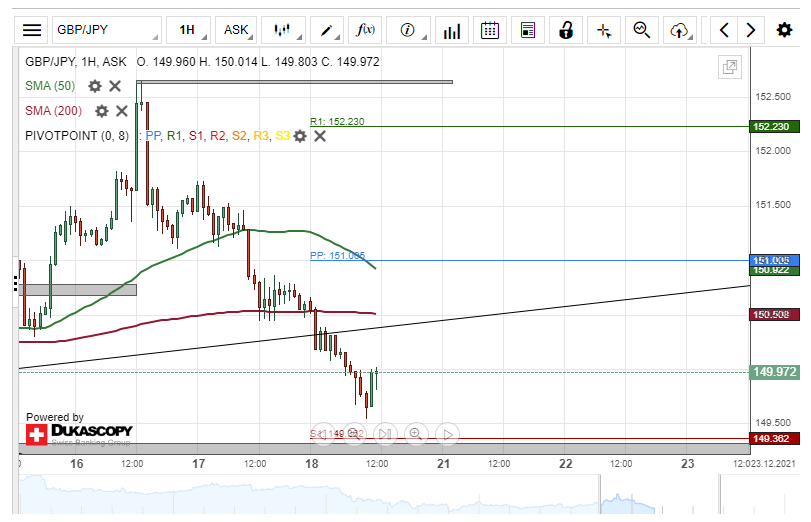
GBP/JPY Reaches Below 150.00
The GBP/JPY pair has sharply declined, as by the middle of Monday's trading the rate had passed various support levels and reached below the 150.00 level.
A continuation of the decline of the pair might find support in the weekly S1 simple pivot point at 149.36. However, take into account the 2021 low level zone at 148.50/149.35.
Meanwhile, a recovery might find resistance in the 150.00 mark. A passing of the 150.00 mark could find resistance in the 200 and 50-hour simple moving averages near 150.50 and 150.90.
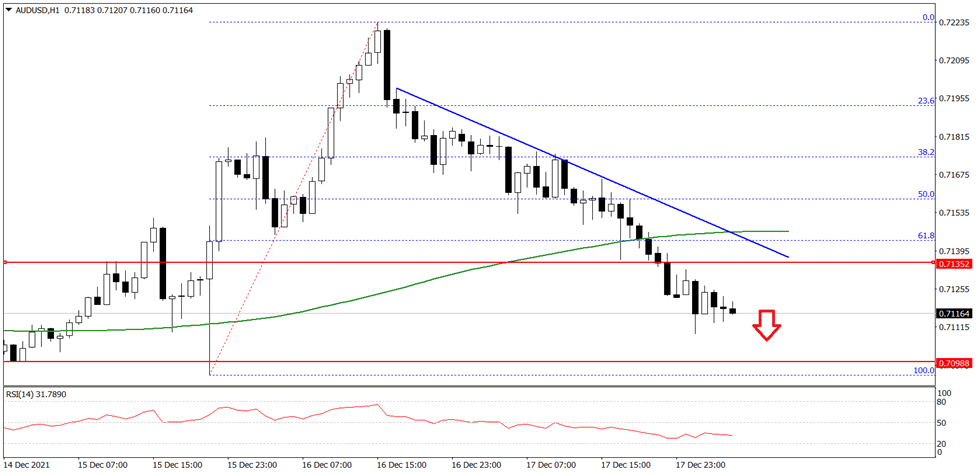
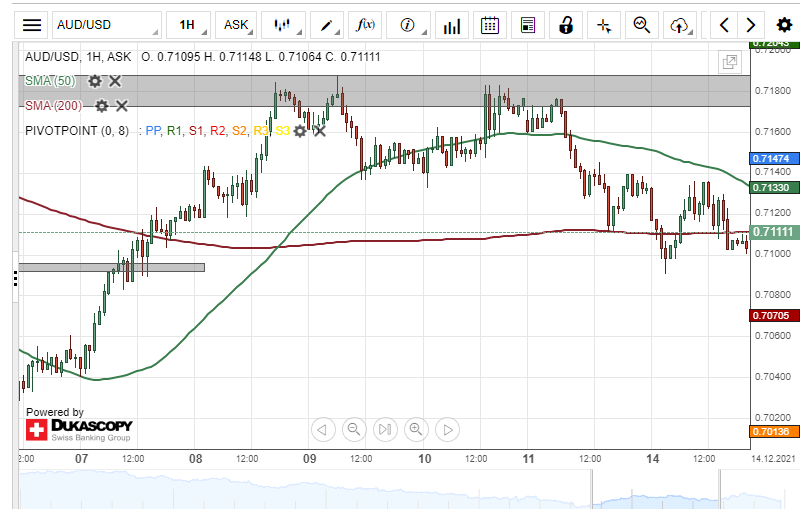
AUD/USD Recahes Below 0.7100
On Monday morning, the AUD/USD currency exchange rate reached below the 0.7100 level. However, after shortly trading below 0.7100, the rate recovered.
By the middle of the day's trading, the pair had no resistance as high as the 0.7140 level, where a resistance zone was located at. Above the zone, the 50 and 200-hour simple moving averages and the weekly simple pivot point are located near 0.7150.
Meanwhile, a decline of the pair is most likely going to find support in the weekly S1 simple pivot point at 0.7070.
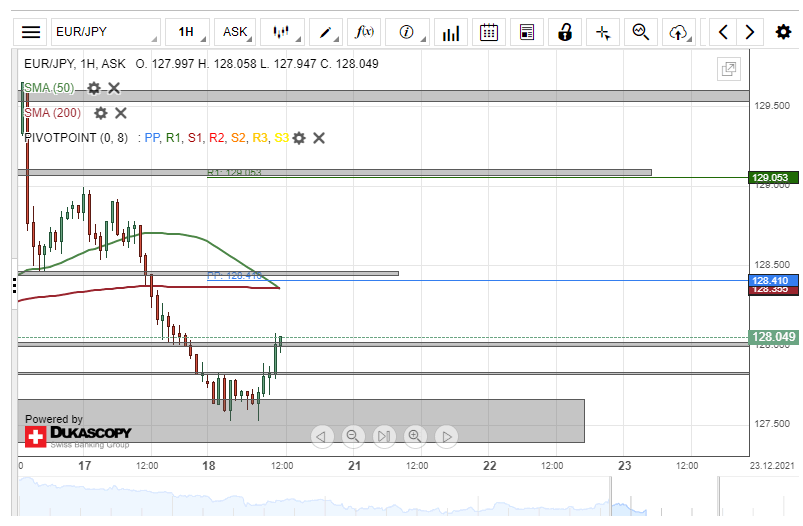
EUR/JPY Reaches Low Level Zone
The EUR/JPY currency exchange rate has reached the December low level zone at 127.40/127.65. The zone provided enough support for a recovery to start. By the middle of Monday's trading hours, the pair had reached the 128.00 mark.
If the rate continues to surge, resistance could be met at the 128.40 level, where the 50 and 200-hour simple moving averages, the weekly simple pivot point and a previous low level zone are located at. Higher above, the 129.00 mark might act as resistance.
On the other hand, a potential decline of the Euro against the Japanese Yen might once again look for support in the 127.40/127.65 zone, before reaching the weekly S1 simple pivot point at 127.18.
WTI Oil Outlook: Oil Prices Extend Weakness As Surge Of Omicron Cases Warns Of New Restrictions
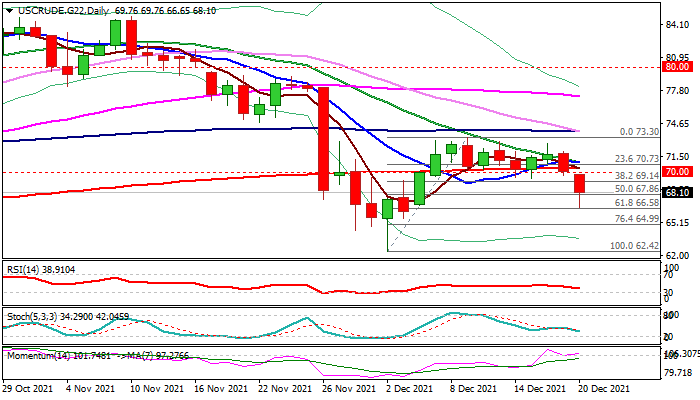
WTI oil opened with a gap and below $70 level on Monday and fell over 4% in Asia and early Europe, extending last Friday’s drop, pressured by rising concerns over global fuel demand, as surging cases of Omicron variant in the Europe and the United States threaten of new restrictive measures to combat spread of virus.
Fresh weakness eventually broke below the floor of nine-day congestion at $70 zone (after recovery from Dec 2 low at 62.42 lost traction), retracing so far almost 61.8% of $62.42/$73.30 upleg and signaling that corrective phase might be over.
Today’s close below $70 level (now reverted to solid resistance) would confirm initial negative signal and keep fresh bears in play for renewed attack at $66.58 pivot (Fibo 61.8% of $62.42/$73.30), break of which to confirm reversal and increase risk of retest of $62.42 low.
Res: 69.14, 70.00, 70.41, 70.73.
Sup: 67.86, 66.58, 64.99, 64.42.
Joachim Nagel named as new Bundesbank president
German Finance Minister Christian Lindner said said today that he and Federal Chancellor Olaf Scholz proposed Joachim Nagel as the new Bundesbank President. Nagel, a former Bundesbank board member, is expected to take over on January 1 from Jens Weidmann.
Linder said on twitter, "In view of inflation risks, the importance of a stability-oriented monetary policy is growing. He is an experienced personality who ensures the continuity of #Bundesbank".
"Nagel can be trusted to continue the German Bundesbank tradition in the debates in the ECB," Friedrich Heinemann, an expert at the ZEW economic research institute hailed. "He has extensive monetary policy and financial expertise, which is essential for today's complex monetary policy decisions."
EUR/USD Looks To Break Down
It's a Christmas holiday week, so markets can be very volatile and unidirectional due to position adjustments with the end of the year flows. However, markets seem to be trading quite sharply for the start of the week, with risk-off moves as a continuation after the Friday close. The reason can be the CB policy actions and of -course, also the protests against mandatory vaccination that is spreading very fast, globally.
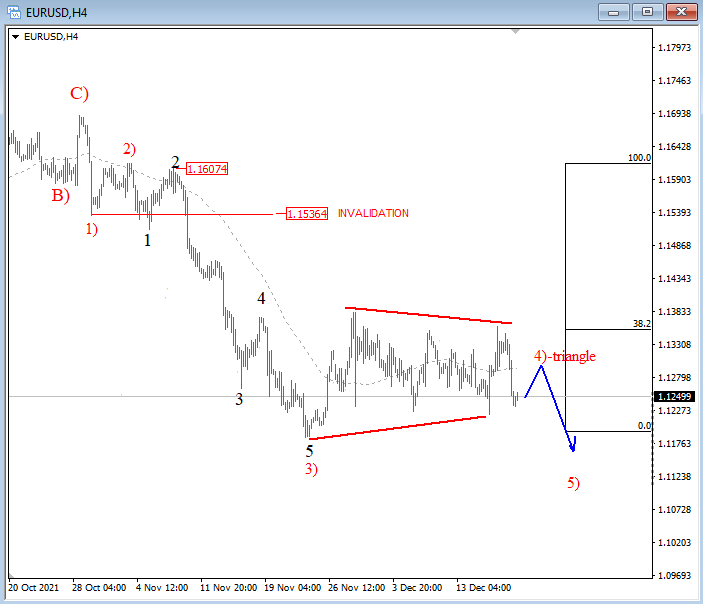
JPY and USD are currently very strong and look like there is more weakness possible vs EUR which has very strong resistance in place as ECB once again repeated that they do not see higher rates in 2022. Technically we see pair in bearish mode, with EURUSD showing a triangle pattern, with subwave E still missing. Nice technical resistance is at 1.1280 triangle pivot and then at the upper side of a range; at 1.1320-1.1350 area. Be aware of a breakdown.
EUR/USD 4h Elliott Wave analysis
Omicron Fears Grip Markets As Stimulus Hopes Fade
- Omicron restrictions and stimulus withdrawal haunt markets
- Global stocks, crude oil, and riskier currencies take a sharp hit
- Dollar shines amid flight to safety, Turkish lira capitulates
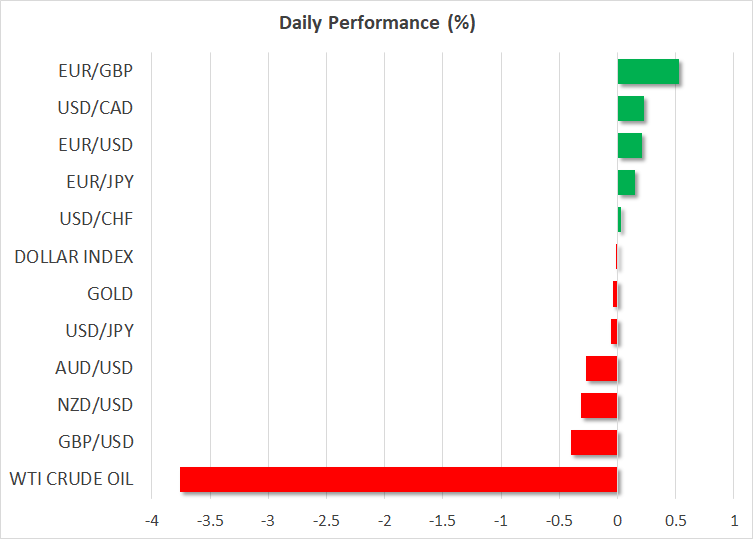
Markets suffer a triple whammy
Global markets are taking fire from multiple directions as the new week gets underway. With Omicron spreading like wildfire through Europe, countries like the Netherlands have gone back into full lockdown while Germany and the UK are considering new measures, which could hamper economic growth.
The playbook throughout the pandemic has been that financial markets can absorb restrictions without even a scratch. However, the twist is that policymakers can’t ride to the rescue this time. Central banks have their hands tied by roaring inflation while most governments have lost the appetite for enormous spending packages now that debt levels have ballooned.
President Biden’s $2 trillion economic agenda is dead in the water after Senator Manchin said he won’t support it after all, while senior Fed officials are openly warning that interest rates could be raised by March if needed. This hawkish signal by Fed Board Governor Waller caused the yield curve to flatten further, indicating that bond traders are becoming increasingly concerned about a recession.
In other words, the underlying forces behind the ‘buy any dip’ mentality are slowly fading away, even if many traders are still conditioned to it. Volatility episodes could become a more frequent theme next year as some liquidity is withdrawn and markets learn to drive without support wheels.
Stocks and commodity currencies get hit
With the outlook for economic growth looking gloomier and little prospect of more stimulus to counter the slowdown, risk aversion is the name of the game on Monday. Stock markets across the world are submerged in a sea of red, while crude oil prices and riskier currencies have suffered serious injuries.
Thin liquidity conditions are likely amplifying these moves as many big players have closed their books for the year already, leaving the market emptier and hence more vulnerable to sharp swings.
Many charts are now flirting with crucial support levels. The S&P 500 is approaching its 100-day moving average, a barrier that has acted like a trampoline for the index in the past. Meanwhile, Cable has erased all the gains it posted after the Bank of England raised rates and is now threatening a breakout.
Dollar and yen shine, Turkish lira implodes
The US dollar and the Japanese yen have been the biggest beneficiaries of the flight to safety, which has also spilled over into the bond market as traders load up on protective hedges. There isn’t much on the economic calendar this week, so any news around the spread of Omicron will likely remain front and center in driving sentiment.
Elsewhere, the Turkish lira has been smashed to smithereens after President Erdogan repeated that markets shouldn’t expect anything other than rate cuts from the central bank. The pace of depreciation in the lira is truly staggering, with the currency losing more than 40% of its value against the US dollar over the last two months alone.
With FX reserves depleted and rate increases out of the question, it seems like a matter of time until either capital controls are imposed or currency depreciation feeds into political instability. The silver lining is that with the sell-off so stretched, even the smallest hint of a change in this landscape could ignite a massive comeback, even if only briefly.
USD/TRY Outlook: Turkish Lira Accelerates Fall After President Erdogan Confirmed His Commitment
USDTRY rose further on Monday, hitting new all-time high above 17.50, with fresh lira’s weakness being sparked by comments of Turkish President Erdogan over the weekend, as his boosted his unorthodox interest rate policy by referring to Islamic usury doctrine, in which high interest is avoided.
The lira extends its steep fall into the fourth consecutive month, slashed by Erdogan’s push for a 500 basis points cut of interest rates since September, being down nearly 30% only in three weeks of December.
The pair continues to run deeply into the uncharted territory, eyeing Fibonacci expansion targets at 18.3730 (FE 338.2%) and 19.1699 (FE 361.8%) with psychological 20 level coming in focus and expected not to provide strong headwinds since the 10 level was quickly taken out and the overall negative sentiment is unlikely to improve.
Res: 17.6000, 18.0000, 18.3730, 19.1699.
Sup: 17.0664, 16.5545, 16.0000, 15.6050.