Sample Category Title
The US Stock Market Is Selling Off Again. The Bank Of England Unecpectedly Raised Its Key Interest Rate
The US stock indices ended Thursday's trading in the red zone. The technology sector saw a strong sell-off, which negatively affected the entire market. The S&P 500 (US500) decreased by 0.9%, the Dow Jones (US30) decreased by 0.1%, and the Nasdaq (US100) lost 2.5%. Meanwhile, the financial sector was the best performing, as investors believe that US Treasury yields will rise in the coming months after the Fed meeting.
European stock indices, on the other hand, looked green yesterday. French CAC 40 (FR40) gained 1.12%, German DAX (DE30) added 1.03%, Spanish IBEX (ES35) increased by 1.27%, while British FTSE 100 jumped by 1.25%. The Bank of England unexpectedly raised its key rate to 0.25% from 0.1%. At the same time, the central bank left the volume of the government bond-buying program at the level of 875 billion pounds.
The main theses from the head of the Bank of England Andrew Bailey:
- inflation could reach 6% in the coming months;
- inflation is also on the rise due to tensions with Russia;
- Omicron will undoubtedly have a significant impact on economic activity;
- the labor market is currently very tight.
On Thursday, the European Central Bank raised its inflation forecasts and lowered expectations for economic growth in 2022 because of the impact of the coronavirus pandemic and supply chain problems. The ECB expectedly kept its prime rate at zero level, while the deposit rate was left at minus 0.5%. The ECB will end its PEPP program in March 2022. The ECB can also extend PEPP reinvestment until at least the end of 2024. With a high probability, investors should not expect the ECB to raise interest rates in 2022. The ECB's inflation forecasts are 2.6% (revised from 2.2%) for 2021, 3.2% (revised from 1.7%) for 2022, 1.8% (revised from 1.5%) for 2023, and 1.8% for 2024.
On Thursday, the Swiss National Bank (SNB) remained its ultra-soft monetary policy, deviating from the tightening course that a growing number of central banks are following. The SNB said its current policy, which combines the world's lowest interest rates with intervention in the foreign exchange market, remains appropriate, despite the Swiss franc's rise to six-and-a-half-year highs. As expected, Norway's central bank raised its benchmark interest rate on Thursday and predicts more hikes to follow next year.
Germany's regulator doesn't expect Nord Stream 2 to start in the 1st half of 2022.
The Turkish lira fell to another record low as Turkey's central bank cut interest rates from another 100 bps to 14%. The Turkish central bank cut its benchmark rate for the 4th consecutive quarter despite a sharp rise in inflation and the lira falling to record lows. The lira lost 51% against the dollar since the beginning of the year.
The ECB's oil price forecast: $71.8 per barrel for 2021, $77.5 per barrel for 2022, $72.3 per barrel for 2023, and $69.4 per barrel for 2024. On Thursday, oil prices increased as an indicator of consumer demand for gasoline in the US rising to a record high. Also, the price increase affects a sharp decline in crude oil reserves, which was published on Wednesday.
Stock markets in the Asia-Pacific region ended Thursday trading on the green territory, except for the Australian stock index. Hong Kong's Hang Seng (HK50) increased by 0.2%, Japan's Nikkei index (JP225) added 2.1%. Australia's S&P/ASX 200 (AU200) decreased by 0.4%. Japan has seen a significant increase in exports. It was driven by strong demand from Japanese companies ahead of the holiday season and some easing of supply chain problems.
Stock markets in the Asia-Pacific region ended Thursday trading on the green territory, except for the Australian stock index. Hong Kong's Hang Seng (HK50) increased by 0.2%, Japan's Nikkei index (JP225) added 2.1%. Australia's S&P/ASX 200 (AU200) decreased by 0.4%. Japan has seen a significant increase in exports. It was driven by strong demand from Japanese companies ahead of the holiday season and some easing of supply chain problems.
The Bank of Japan made no changes to its ultra-soft monetary policy as it monitors the impact of a new variant of the Omicron coronavirus. At the same time, the Bank of Japan decided to cut its funding support program due to the effects of COVID-19 as financing conditions for large companies improve. The interest rate remained unchanged.
Main market quotes:
- S&P 500 (F) (US500) 4,668.67 −41.18 (−0.87%)
- Dow Jones (US30) 35,897.64 −29.79 (−0.083%)
- DAX (DE40) 15,636.40 +160.05 (+1.03%)
- FTSE 100 (UK100) 7,260.61 +89.86 (+1.25%)
- USD Index 95.98 −0.53 (−0.55%)
Important events for today:
- Japan BoJ Interest Rate Decision at 04:30 (GMT+2);
- Japan BoJ Monetary Policy Statement at 04:30 (GMT+2);
- UK Retail Sales (m/m) at 09:00 (GMT+2);
- Germany IFO Business Climate Index (m/m) at 11:00 (GMT+2);
- Eurozone Consumer Price Index (m/m) at 12:00 (GMT+2);
- US FOMC Member Wallers’ speech at 20:00 (GMT+2).
German IFO Survey Falls For The 6th Straight Month
Notes/Observations
- UK Nov Retail Sales beat consensus aid by Black Friday discounts bringing consumers back into shops.
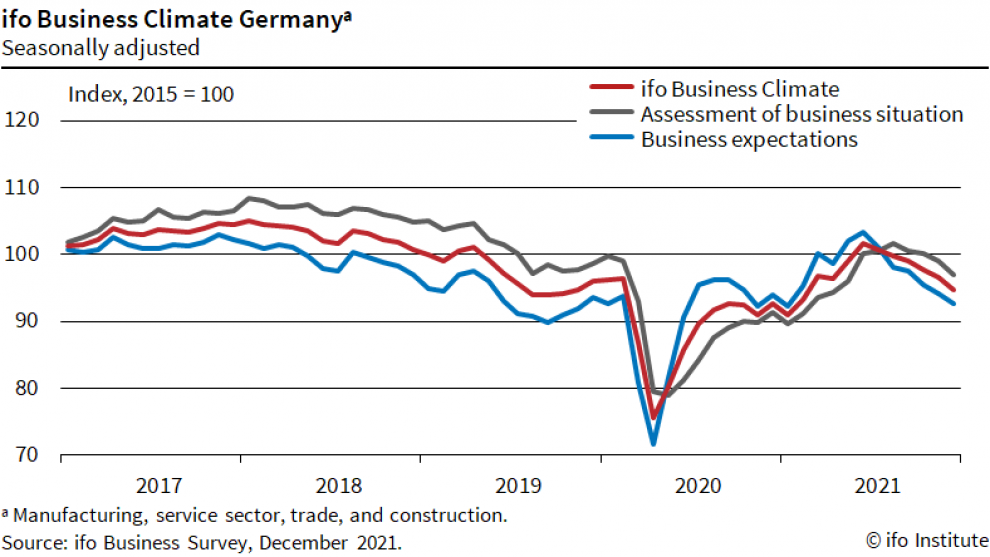
- German Dec IFO Survey registered its 6th straight monthly decline (Business Climate Survey: 94.7 v 95.3e).
- German Bundesbank Semi-annual economic forecasts put its inflation above the ECB target for for 2023 and 2024.
- ECB’s Villeroy noted that the region was not coming back to the pre-Covid regime of very weak inflation.
Asia
- BOJ left Interest Rate on Excess Reserves (IOER) unchanged at -0.10% and maintain 10-year Yield Target (YCC): at 0.00% (as expected); BOJ noted it would end their purchases of corporate bonds and commercial paper at the end of March (as scheduled) To also reduce the 1-year interest-free loans to banks aiding pandemic-hit businesses (ending those for large corporations at the end of March, while extending those for small businesses by six months).
Coronavirus
- President Biden stated that the US was looking at a winter of severe illness and death for people who were unvaccinated; Omicron variant was here and would begin spreading more rapidly.
- France President Macron noted that would be assessing hospital capacity, not just case numbers, in making Covis-19 restriction decisions.
Europe
- ECB members said to have disagreed on inflation outlook and some pointed to the upside risks to new forecast.
- UK Brexit Min Frost to meet with EU’s Sefcovic on Friday (Dec 17th) and expected to drop the demand to remove the ECJ as the ultimate arbiter of trade rules in Northern Ireland.
- UK Chancellor Sunak said to hold talks with business leaders about a new support package for the hospitality sector.
- Liberal Democrats won the North Shropshire seat by defeating the UK Conservatives in special election.
Americas
- US Senate passed a bill that would ban goods from China’s Xinjiang region unless companies prove they were not made with forced labor, the bill now goes to President Biden to sign.
Speakers/Fixed income/FX/Commodities/Erratum
Equities
- Indices [Stoxx600 -+0.55% at 473.96, FTSE +0.25% at 7,278.70, DAX -0.53% at 15,552.77, CAC-40 -0.55% at 6,966.82, IBEX-35 -0.57% at 8,332.87, FTSE MIB -0.80% at 26,567.00, SMI -0.55% at 12,719.95, S&P 500 Futures -0.17%].
- Market Focal Points/Key Themes: European indices open modestly lower (FTSE notable exception following better retail sales data) and stayed under pressure as the session wore on; abatement in risk sentiment seen as a correction following performance yesterday; better performing sectors include real estate and utilities; while sectors leading to the downside include industrials and technology; EssilorLuxottica and GrandVision reach agreement to divest Vision stores; Johnson Matthey sells its health unit to Altaris; Stellantis enters agreements with three European banks for revamping its financial arm; reportedly Commerzbank to sell its Hungarian unit to ErsteBank; earnings expected in the upcoming US session include Winnebago and Darden Restaurants.
Equities
- Consumer discretionary: Deutsche Post DHL [DPW.DE] -1% (Fedex earnings).
- Financials: CNP Assurances [CNP.FR] +1% (stake sale), Permanent TSB Group Holdings [ILOA.IE] +4% (acquisition).
- Healthcare: GENFIT [GNFT.FR] +45% (licensing agreement), DiaSorin [DIA.IT] -11% (strategic plan).
Speakers
- ECB's Villeroy (France): reiterates Council that inflation hump lasting longer than expected but probably close to the peak. Not coming back to the pre-Covid regime of very weak inflation but similar to one seen before the financial crisis.
- ECB’s Rehn (Finland stated that there was considerable uncertainty about the path which inflation would take.
- ECB's Weidmann (Germany) stated that ECB must not ignore upside risks to price growth.
- ECB's Simkus (Lithuania) stated that there was upside risks to inflation.
- BOE’s Pill (chief economist) stated that inflation and rising wages were looking more persistent and that more rate hikes could come. Inflationary pressures needed to be addressed and saw the time had come to take away stimulus. BOE did signal back in Nov that rate hike could come due to tight labor market and added that be believed that labor market could tighten further.
- German Bundesbank Semi-annual economic forecasts raised the 2022 CPI EU Harmonized (HICP) from 1.8% to 3.6% and also raised the 2023 inflation outlook from 1.7% to 2.2% (**Note: ECB Staff projections at 1.8%). Pandemic restrictions and supply bottlenecks to stall growth in both Q4 and Q1 but did see significant momentum in spring 2022.
- German IFO Economists :noted that the retail sector was seeing an impact from the pandemic resulting in fewer shoppers.
- Poland Central Bank member Kochalski stated MPC to rate rates by 50bps but in less frequency; not signaling FX intervention.
- Hungary Central Bank member Kandracs: To continue with monthly rate hikes; will do what is needed to contain inflation.
- Hungary Fin Min Varga stated that 2022 GDP growth seen around 5.0%; budget deficit to GDP ratio of 4.9%. To curb back on fiscal stimulus.
- Sweden govt said to reintroduce some covid support measures for companies.
- BOJ Gov Kuroda post rate decision press conference reiterated stance that would not hesitate to add to easing if necessary; uncertainties remained high over spread of Omicron virus variant. Weak JPY currency (Yen) had been positive for the economy so far; supports exports and corporate profits. Rate hikes by other G7 members would not necessary weaken the yen. BOJ would continue to act if Repo Rate jumped higher; spike was not desirable.
Currencies/Fixed Income
- USD was steady after some softness exhibited since the FOMC decision mid-week. Dealers noted that interest-rate differentials were moving further in greenback’s favor and the dollar should remain firm in the coming weeks.
- GBP/USD around 1.3330 area and holding onto the bulk of the post BOE rate hike gains. BOE was expected to continue with rate hikes at the Feb meeting (market see 3 rate hikes in 2022).
- EUR/USD holding above the 1.1330 area after dealers noted that the ECB was not as dovish as anticipated at yesterday’s meeting.
- TRY currency (Lira) weakened to fresh record lows asapproached the 17.00 agaisnt the USD.
Economic data
- (EU) EU27 Nov New Car Registrations: -20.5% v -30.3% prior.
- (DE) Germany Nov PPI M/M: 0.8% v 1.4%e; Y/Y: 19.2% v 20.0%e.
- (UK) Nov Retail Sales (ex-auto/fuel) M/M: 1.1% v 0.8%e; Y/Y: 2.7% v 2.3%e.
- (UK) Nov Retail Sales (including auto/fuel) M/M: 1.4% v 0.8%e; Y/Y: 4.7% v 4.2%e.
- (CN) Weekly Shanghai copper inventories (SHFE):34.6K v 41.4K tons prior.
- (AT) Austria Nov Final CPI M/M: 0.7% v 0.7% prelim; Y/Y: 4.3% v 4.3% prelim.
- (ES) Spain Q3 Labour Costs Y/Y: 4.9% v 13.2% prior.
- (RU) Russia Narrow Money Supply w/e Dec 10th (RUB): 14.31 v 14.23T prior.
- (ES) Spain Oct Trade Balance: -€3.4B v -€2.4B prior.
- (DE) Germany Dec IFO Business Climate Survey: 94.7 v 95.3e (6th straight monthly decline); Current Assessment Survey: 96.9 v 97.5e; Expectations Survey: 92.6 v 93.6e.
- (NO) Norway Dec Unemployment Rate: 2.2% v 2.2%e.
- (PL) Poland Nov Employment M/M: 0.2% v 0.1%e; Y/Y: 0.7% v 0.5%e.
- (PL) Poland Nov Average Gross Wages M/M: 1.8% v 0.9%e; Y/Y: 9.8% v 8.9%e.
- (EU) Euro Zone Nov Final CPI Y/Y: 4.9% v 4.9% advance; CPI Core Y/Y: 2.6% v 2.5% advance.
- (EU) Euro Zone Oct Construction Output M/M: 1.6% v 1.0% prior; Y/Y: % v 2.0% prior.
Fixed income Issuance
- (IN) India sold total INR240B vs. INR240B indicated in 2031, 2034 and 2061 bonds.
- (ZA) South Africa sold total ZAR1.2B vs. ZAR1.2B indicated in I/L 2033, 2046 and 2050 Bonds.
Looking ahead
- 05:25 (EU) Daily ECB Liquidity Stats.
- 05:30 (RU) Russia Central Bank (CBR) Interest Rate Decision: Expected to raise Key 1-Week Auction Rate by 100bps to 8.50%.
- 06:00 (BE) Belgium Debt Agency (BDA) to sell OLOBonds.
- 06:00 (UK) DMO to sell £2.0B in 1-month, 3-month and 6-month bills (£0.5B, £0.5B and £1.0B respectively).
- 06:30 (IN) India Weekly Forex Reserve w/e Dec 10th: No est v $635.9B prior.
- 06:45 (US) Daily Libor Fixing.
- 07:00 (IN) India announces upcoming bill issuance (held on Wed).
- 08:00 (UK) Daily Baltic Dry Bulk Index.
- 08:30 (CA) Canada Oct Int'l Securities Transactions (CAD): No est v 20.0B prior.
- 10:00 (MX) Mexico Central Bank Economist Survey.
- 11:00 (CO) Colombia Oct Economic Activity Index (Monthly GDP) Y/Y: 10.5%e v 12.9% prior.
- 11:00 (EU) Potential sovereign ratings after European close )Moody’s on Luxembourg and Slovakia sovereign ratings).
- 13:00 (CO) Colombia Central Bank Interest Rate Decision: expected to raise Overnight Lending Rate by 50bps to 3.00%.
- 13:00 (US) Fed's Waller.
- 13:00 (US) Weekly Baker Hughes Rig Count.
BoE Pill: More rate hikes to come if inflation persists
Asked on CNBC television if there would be "a lot more rate hikes to come," if inflation remained at its current level, BoE Chief Economist Huw Pill replied, "well I think that's true."
He added, "underlying, more domestically generated inflation here in the UK, probably centered around wage pressures in a tightening labour market, are going to prove more persistent through time."
Germany Ifo business climate dropped to 94.7 in Dec, sentiment clouded over for Christmas
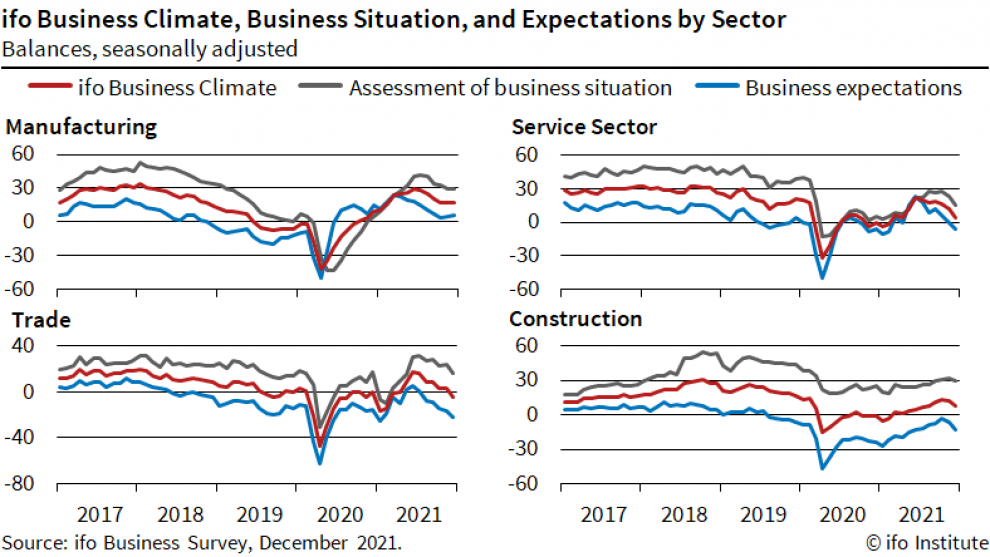
Germany Ifo Business Climate dropped from 96.6 to 94.7 in December, below expectation of 95.4. Current Assessment index dropped from 99.0 to 96.9, below expectation of 97.5. Expectations index dropped from 94.2 to 92.6, below expectation of 93.3. Looking at some more details, manufacturing rose from 16.7 to 17.3. Services dropped from 11.6 to 4.5. Trade dropped from 2.7 to -4.1. Construction dropped from 11.7 to 7.4.
Ifo said: "Sentiment at German companies has clouded over for Christmas. The deteriorating pandemic situation is hitting consumer-related service providers and retailers hard. The ifo Business Climate Index fell from 96.6 points in November to 94.7 points in December. Companies assessed their current business situation as less positive. Pessimism regarding the first half of 2022 also increased. The German economy isn't getting any presents this year."
NZDUSD Tiptoes Across 76.4% Fibonacci But Downside Risks Remain
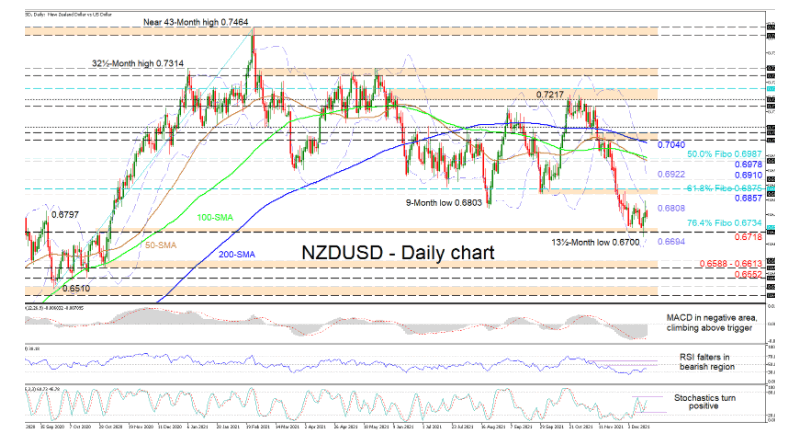
NZDUSD has established a foothold consolidating around the 0.6734 level, which is the 76.4% Fibonacci retracement of the up leg from 0.6510 until 0.7464, after a five-week decline from the 0.7217 high. The simple moving averages (SMAs) are starting to fall, hinting that the neutral-to-bearish tone is securing an advantage.
That said, the short-term oscillators are transmitting mixed signals in directional impetus. The MACD, some distance beneath the zero mark, is indicating that negative momentum is fading as it continues to rise above its red trigger line. The positively charged stochastic oscillator is promoting bullish price action, while the RSI is struggling to push higher in the bearish region.
If buyers re-emerge and overstep the mid-Bollinger band at 0.6808, upside limitations could then commence at the resistance band formed between the 0.6857 barrier and the 61.8% Fibo of 0.6875. Pushing higher, the price may meet the 0.6910 obstacle. From here, if the bulls retain command, the approaching upper Bollinger band at 0.6922 could delay the test of the reinforced resistance zone, moulded between the 0.6978 border and the 50.0% Fibo of 0.6987.
In a negative scenario, sellers may encounter initial support by revisiting the 0.6718-0.6734 boundary. Should selling interest intensify and drive the price past the 13½-month low of 0.6700 as well as the lower Bollinger band, the bears could then dive towards the 0.6588-0.6613 border, developed by the troughs from the beginning of November 2020. Breaching this too, the price may sink towards the 0.6552 mark, increasing worries about the negative picture gaining pace.
Summarizing, NZDUSD is sustaining a negative bearing beneath the 0.6857-0.6875 border. That said, a break below the 0.6487-0.6520 boundary would trigger concerns about the broader positive structure, while a climb above the 0.7100 handle could reinforce the bullish outlook.
BoE Raises Rates, ECB Raises Forecasts
- Bank of England catches markets sleeping with rate increase
- European Central Bank slashes asset purchases, raises forecasts
- But stock markets fall back, taking the shine off sterling and euro
BoE delivers surprise hike
The Bank of England raised interest rates by 15 basis points yesterday in a move that caught investors sleeping on the wheel. While the British economy can certainly handle higher rates given the strength of the labor market and broadening inflationary pressures, the ferocious covid wave that is rampaging through the nation was expected to keep the BoE sidelined until next year.
Instead, inflation worries dominated and policymakers judged that immediate action was more prudent from a risk management perspective. The vote was 8-1 in favor of a hike, which was also striking considering that just two weeks ago some officials were saying it is premature to talk about the timing of rate hikes, and then voted for one.
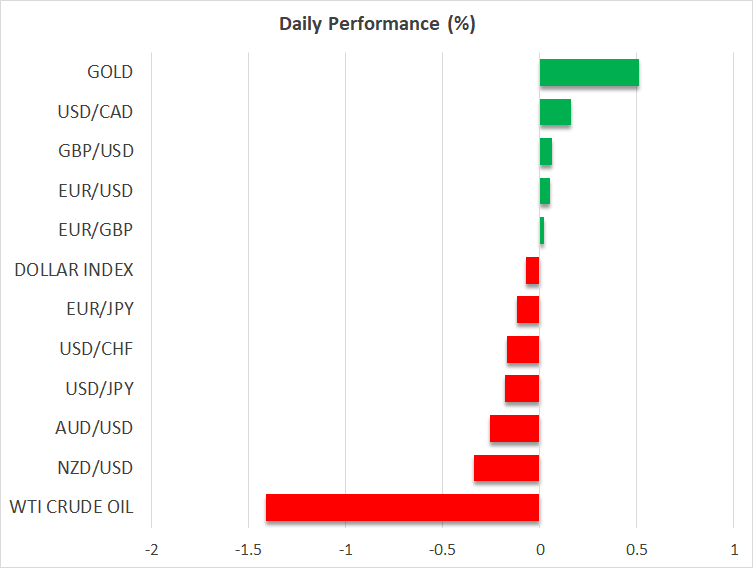
The pound soared on the surprise decision but surrendered many of its gains in the following hours as risk appetite soured. This highlights sterling’s sensitivity to swings in risk sentiment, a relationship that has been on full display throughout the pandemic thanks to the UK’s twin deficits and its role as a global investment powerhouse.
Looking into next year, this correlation with risk appetite could be the dominant driver for sterling, as market pricing around the Bank of England for three rate increases seems relatively fair given the strength of the economy.
ECB outlines taper path, euro smiles
Meanwhile, the European Central Bank announced a ‘shadow tapering’ and revised its economic forecasts sharply higher, delivering a dose of optimism to the euro. Asset purchases will be reduced sequentially over the next quarters until they reach EUR 20 billion in the final quarter of next year, where they will remain indefinitely.
This was a slightly faster wind-down than expected and coupled with upgraded economic forecasts showing inflation only a couple of ticks below target in 2023, the ECB seems to be charting a course away from cheap money policies. Of course, speed matters in this regard and the ECB will only move at a snail’s pace, wary of not shocking a bond market that has become dependent on QE ‘medicine’.
The euro jumped initially but lost its vigor relatively soon, with euro/yen closing the session virtually unchanged. Euro/dollar ended higher though, as the greenback couldn’t muster any strength with US yields falling.
Equities back under pressure, gold climbs
The relief in the stock markets didn’t last long, with tech shares coming back under fire to erase their post-Fed gains on Thursday. There wasn’t any clear catalyst for the sudden reversal, although the fact that bond yields also came under pressure suggests the culprit wasn’t central banks stepping on the brakes.
With both monetary and fiscal policy losing its punch next year while valuations are so high, earnings growth will need to do the heavy lifting and the investing landscape could become much shakier as a result. The spectacular performances of the last couple of years are unlikely to be repeated.
Finally, gold has reawakened from its slumber, charging higher yesterday as real US yields retreated a shade, putting the shine back into non-interest bearing assets. Heading into 2022, the most crucial question for gold will be whether real yields move higher as inflation fears ultimately calm down and the Fed stops buying inflation-protected bonds. If so, it could be another tough year for the precious metal.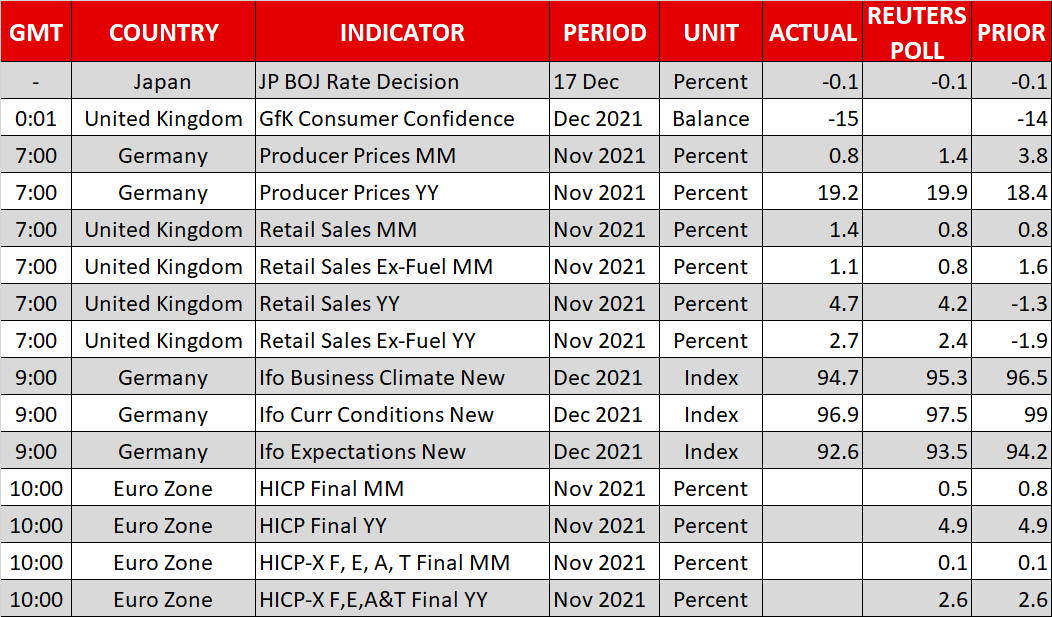
USDCAD Halts Pullback, But Bearish Jitters Still In Play
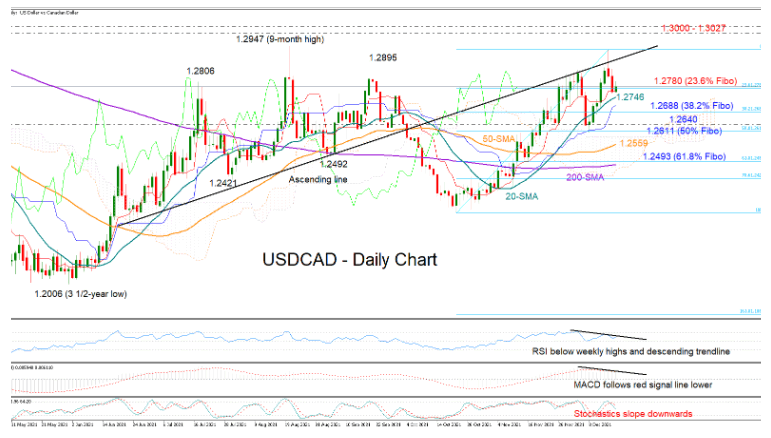
USDCAD attempted to touch its nine-month high of 1.2947 from August earlier this week, but its efforts proved fruitless, with the price drifting lower to find support around the 1.2770 level and the red Tenkan-sen line.
Signals from momentum indicators are currently discouraging. The MACD is losing steam along its red signal line in the positive territory, the Stochastics are sloping southwards, while the RSI is still below its weekly highs despite pushing for some recovery today. Of note, the RSI and the MACD have been moving against the market direction over the start of the month, making lower highs. This reminds of a bearish divergence – a warning that the bulls are running out of fuel.
Nevertheless, if the pair manages to set a strong foothold around the 1.2770 support, the bulls may try to push above the restrictive ascending line at 1.2895 with scope to reach the nine-month high of 1.2947. Breaching that top, the next challenge could occur within the 1.3000 – 1.3027 zone, where the 38.2% Fibonacci retracement of the 2020 freefall (1.4667 – 1.2006) is also placed.
The 23.6% Fibonacci level of the short-term upleg is currently offsetting bullish pressures around 1.2782. Should it stand firm, with the price retreating below the 20-day simple moving average (SMA) at 1.2746, the 38.2% Fibonacci of 1.2688 could next come to the rescue. Failure to rebound here could open the door for the key 1.2640 number and the 50% Fibonacci of 1.2611, while deeper, the 50-day MA may delay any declines towards the 61.8% Fibonacci of 1.2493.
Summarizing, the short-term outlook for USDCAD is looking cloudy at the moment. Unless the price corrects above 1.2895 and the ascending line, sellers could keep the upper hand.
The Analytical Overview Of The Main Currency Pairs
The EUR/USD currency pair
Technical indicators of the currency pair:
Prev Open: 1.1287
Prev Close: 1.1330
% chg. over the last day: +0.38%
The ECB expectedly kept the base interest rate at zero level, while the deposit rate was left at minus 0.5%. The ECB will end its PEPP program in March 2022. The ECB can also extend PEPP reinvestment until at least the end of 2024. With a high probability, investors should not expect the ECB to raise interest rates in 2022. Eurozone inflation data will be released today.
Trading recommendations
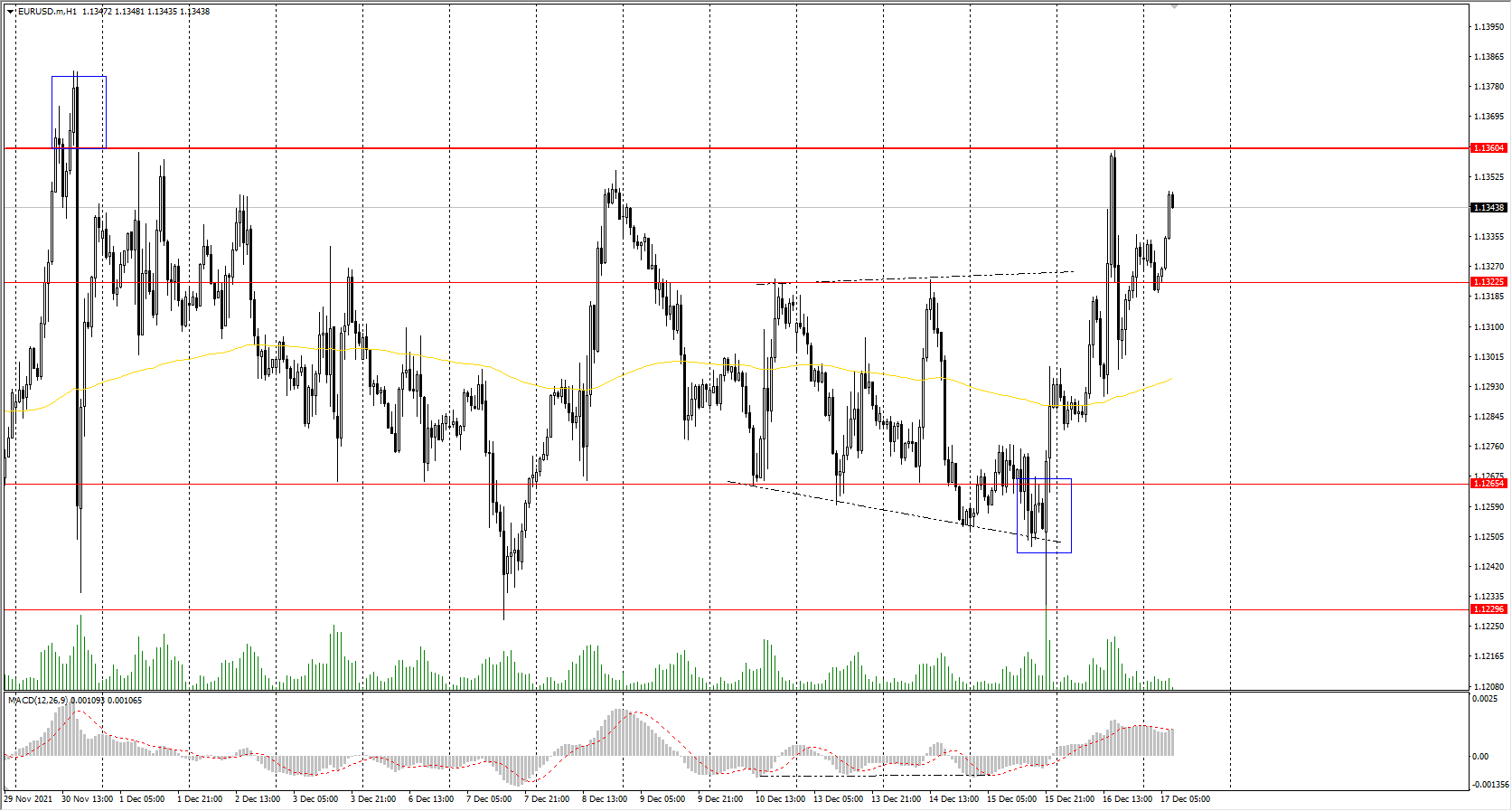
Support levels: 1.1323, 1.1265, 1.1230, 1.1168
Resistance levels: 1.1360, 1.1436, 1.1535, 1.1613, 1.1667, 1.1717
From a technical point of view, the EUR/USD on the hour time frame is still bearish. The price is trading in a wide corridor. Yesterday, there was an attempt to break out through the priority change level, but the sellers were stronger. The MACD indicator became positive, and the buyers' pressure is still strong. Under such market conditions, traders should consider sell positions from the priority change level, but with additional confirmation. Buy trades can be considered after a true breakout of the priority change level.
Alternative scenario: if the price breaks out through the 1.1360 resistance level and fixes above, the mid-term uptrend will likely resume.
News feed for 2021.12.17:
- Germany IFO Business Climate Index (m/m) at 11:00 (GMT+2);
- Eurozone Consumer Price Index (m/m) at 12:00 (GMT+2);
- US FOMC Member Wallers’ speech at 20:00 (GMT+2).
The GBP/USD currency pair
Technical indicators of the currency pair:
Prev Open: 1.3256
Prev Close: 1.3324
% chg. over the last day: +0.52%
The Bank of England unexpectedly raised its key interest rate to 0.25% from 0.1%. At the same time, the central bank left the volume of the government bond-buying program at 875 billion pounds. According to the Bank of England forecasts, inflation may reach 6% in the coming months.
Trading recommendations
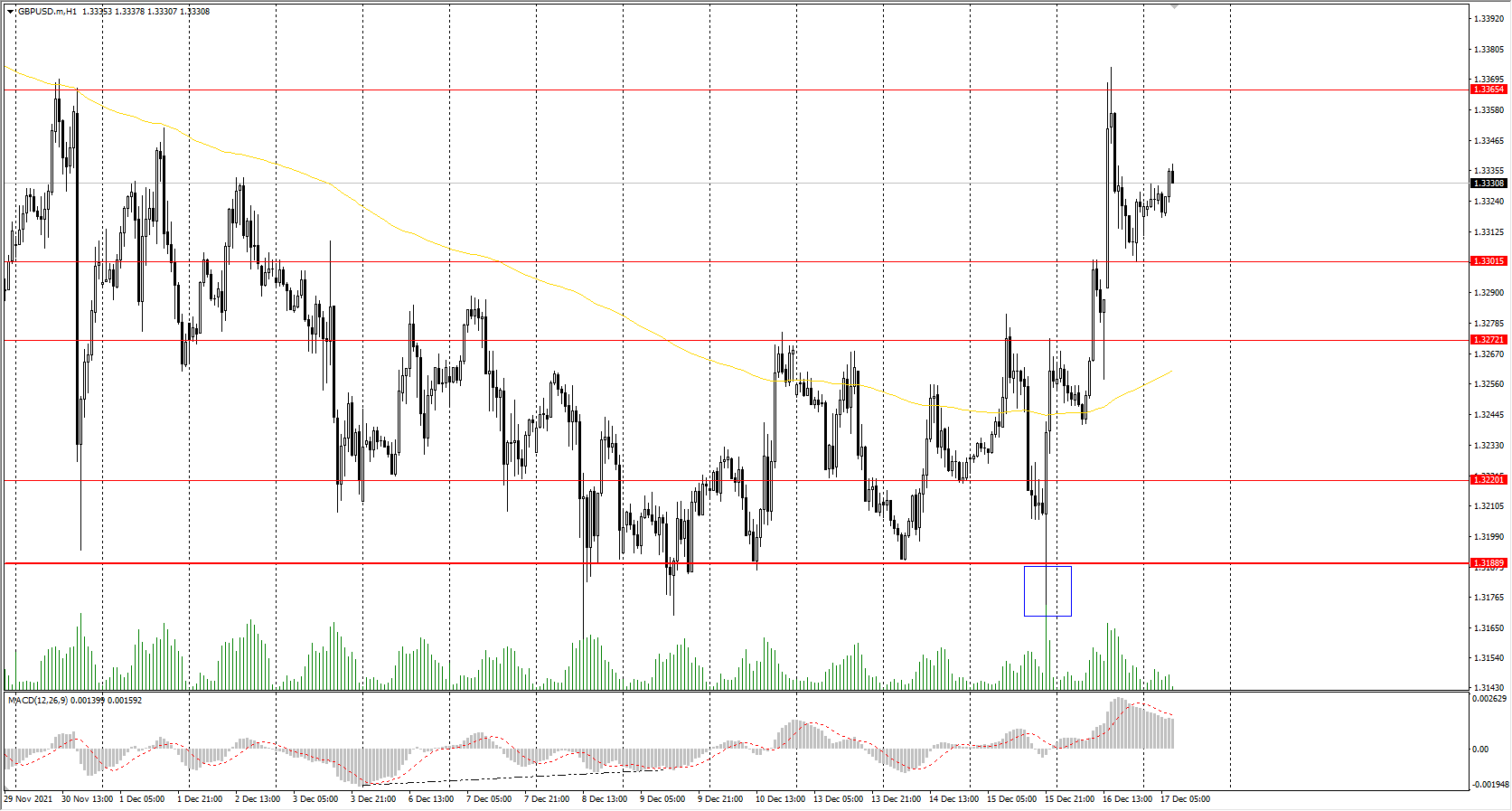
Support levels: 1.3301, 1.3272, 1.3220, 1.3189
Resistance levels: 1.3365, 1.3434, 1.3507, 1.3575, 1.3685
On the hourly time frame, the trend on GBP/USD has changed to bullish. An interest rate hike from the central bank played a key role. The price broke through the priority change level and closed higher. The MACD indicator became positive. Under such market conditions, traders should consider buy positions from the support levels near the moving average. Sell trades can be considered from the resistance levels of the higher time frame, but only with additional confirmation; as an option - to sell after a false breakout of the 1.3365 level.
Alternative scenario: if the price breaks down through the 1.3189 support level and consolidates below, the bearish scenario will likely resume.
News feed for 2021.12.17:
- UK Retail Sales (m/m) at 09:00 (GMT+2).
The USD/JPY currency pair
Technical indicators of the currency pair:
Prev Open: 113.98
Prev Close: 113.69
% chg. over the last day: -0.26%
The Bank of Japan has made no changes to its ultra-soft monetary policy as it monitors the impact of the new variant of the Omicron coronavirus. At the same time, the Bank of Japan decided to cut its funding support program from the effects of COVID-19 as financing conditions for large companies improved. The interest rate remained unchanged.
Trading recommendations
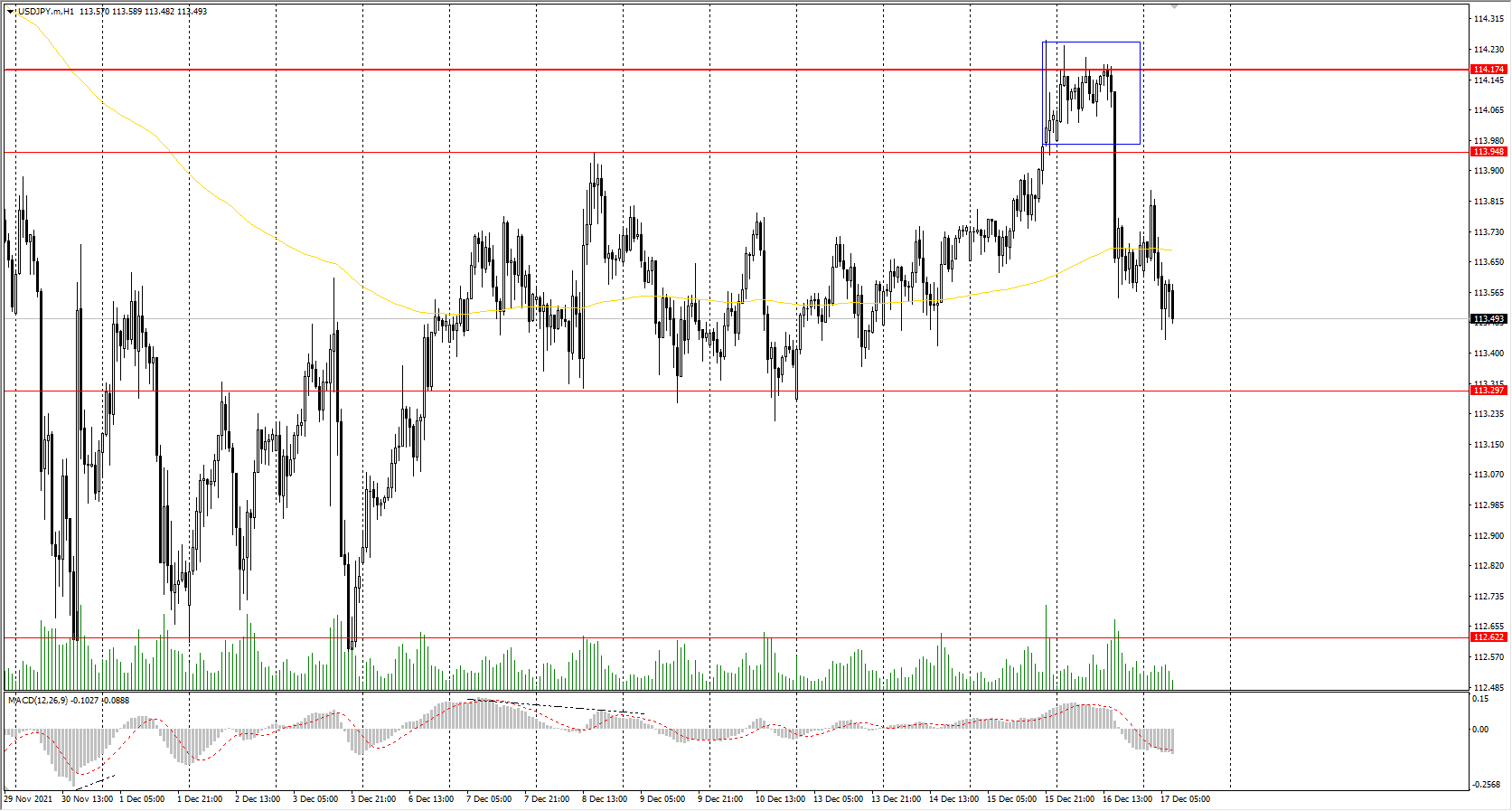
Support levels: 113.30, 112.62, 112.30
Resistance levels: 113.95, 114.17, 115.15, 115.50
The global trend on the USD/JPY currency pair is bearish. Yesterday, the price tried to break out through the priority change level, but the sellers managed to protect the level. Today, on the news from the Bank of Japan, the yen strengthened against the dollar, as the Bank of Japan began to take the first steps to tighten its policy. Under such market conditions, traders can look for sell positions from the 113.95 resistance level but with additional confirmation. Buy positions should be considered from the 113.30 support level, but with additional confirmation in the form of a buyers' initiative or after the price breakout the priority change level.
Alternative scenario: if the price rises above 114.17, the uptrend will likely resume.
News feed for 2021.12.17:
- Japan BoJ Interest Rate Decision at 04:30 (GMT+2);
- Japan BoJ Monetary Policy Statement at 04:30 (GMT+2).
The USD/CAD currency pair
Technical indicators of the currency pair:
Prev Open: 1.2831
Prev Close: 1.2774
% chg. over the last day: -0.44%
The USD/CAD quotes are declining again amid rising oil prices and a decline in the dollar index. The Canadian dollar is a commodity currency, so it is highly correlated with these instruments. The tightening of the monetary policy from the US Federal Reserve will stimulate the dollar index to grow, while oil prices will depend on the demand for fuel.
Trading recommendations
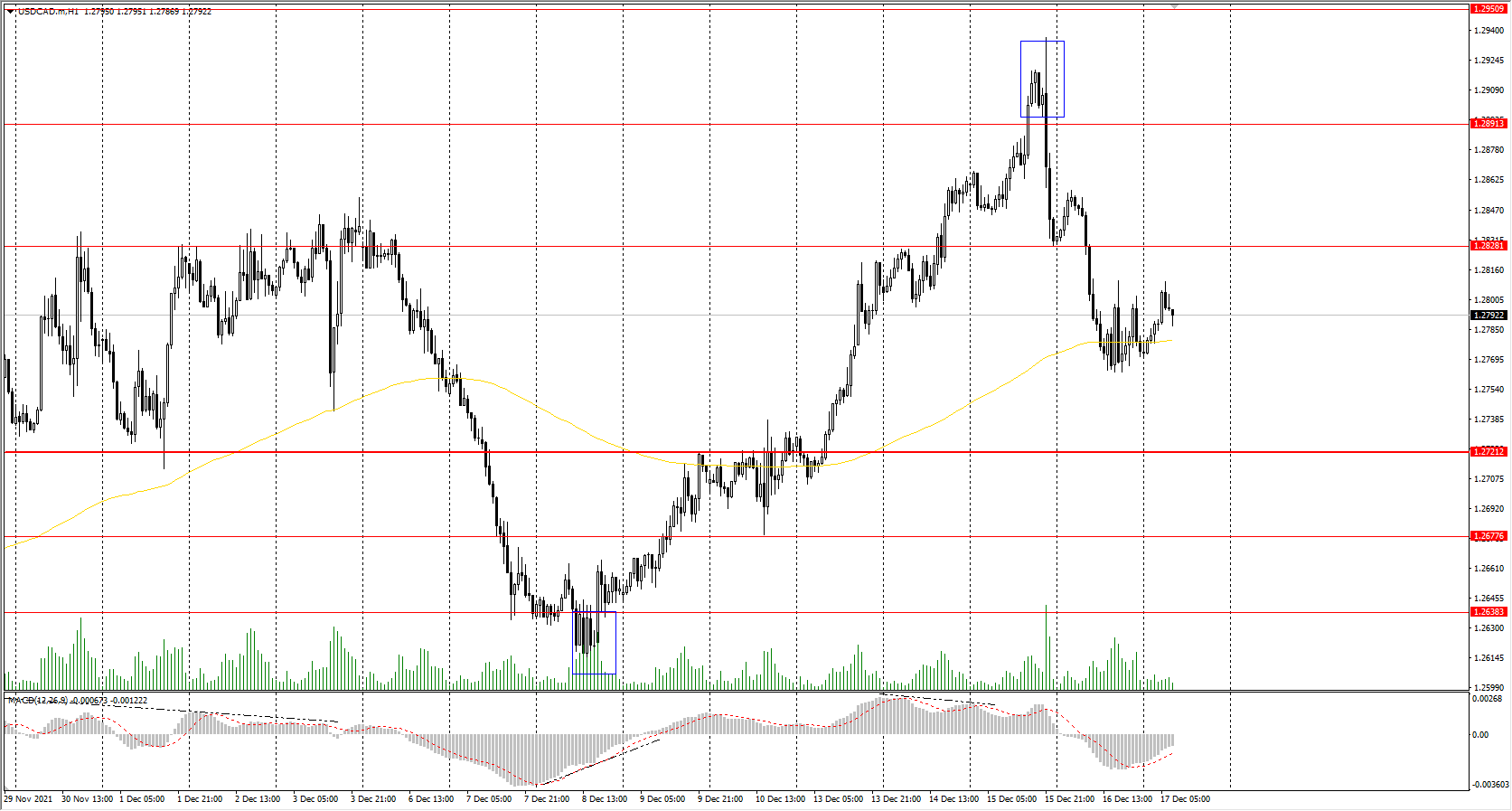
Support levels: 1.2721, 1.2677, 1.2638
Resistance levels: 1.2828, 1.2891, 1.2951
From a technical point of view, the USD/CAD currency pair trend is bullish. The MACD became negative; the price corrected the dynamic moving average level. Under such market conditions, it is better to look for buy deals from the support levels near the moving average on the lower time frames. It is best to look for sell deals from the false breakout area, but with additional confirmation.
Alternative scenario: if the price breaks down through the 1.2721 support level and fixes below, the downtrend will likely resume.
EUR/USD Outlook: Euro Is Firmer But Still Moving Within Extended Range
The Euro is consolidating under two-week high after being dragged by stronger pound after BoE surprise rate hike and inflated by weaker dollar post-Fed.
Near-term action remains within a consolidation range above new 2021 low (1.1186) and lacking clearer direction signal, as daily studies are still mixed.
Violation of key near-term barrier at 1.1379 (Fibo 38.2% of 1.1692/1.1186) would generate positive signal for continuation of stalled recovery from 1.1186 low, while repeated close within the range would keep the pair in directionless mode.
Three consecutive weekly Dojis add to neutral scenario, with focus on this week’s close which would provide more evidence whether bulls eventually regained traction or range-trading will extend into fifth week.
Res: 1.1360, 1.1379, 1.1400, 1.1439.
Sup: 1.1305, 1.1288, 1.1221, 1.1186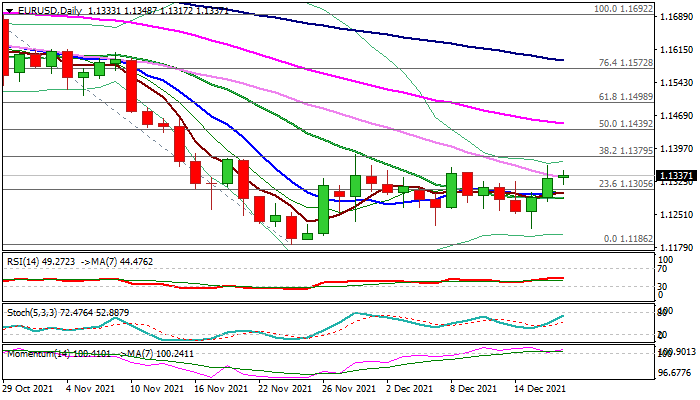
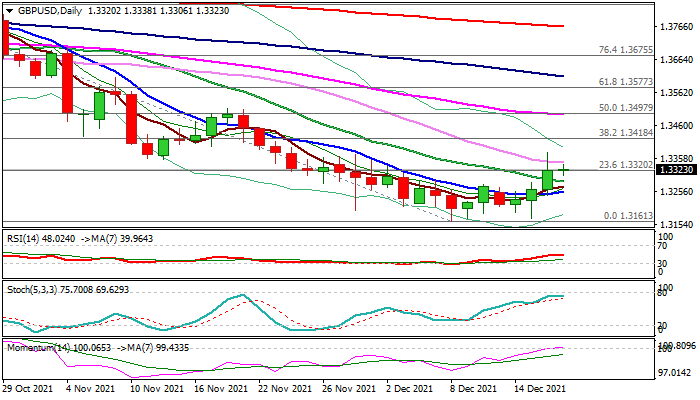
GBP/USD Outlook: Upbeat UK Retail Sales Data Add To Positive Post-BoE Tone
Cable is holding positive tone in early Friday following Thursday’s rally to 1.3374 (three-week high) after surprise BoE rate hike.
Upbeat UK retail sales data (Nov 1.4% m/m from 1.1% in Oct and vs 0.8% f/c) provide additional support to sterling, along with UK Liberal Democrats winning a seat from PM Johnson’s party.
On the other side, record highs of new Covid cases in Britain weigh and partially offset positive impact after BoE.
Technical studies are improving on daily chart, as momentum is breaking into positive territory and action rose and closed above 20DMA on Thursday.
Fresh bulls eye next pivotal barrier at 1.3418 (Fibo 38.2% of 1.3834/1.3161 fall), break of which would further strengthen near-term structure and generate initial reversal signal, after larger fall was contained by 200WMA).
Repeated close above 200DMA (1.3286) to keep bullish bias.
Res: 1.3337, 1.3374, 1.3418, 1.3469.
Sup: 1.3306, 1.3286, 1.3255, 1.3190.