

Sample Category Title
Dollar Flattens after Busy Week; Lira Plummets
FX market in the spotlight
After a very busy week with numerous central bank meetings, the week is ending with a bearish mode. The dollar index continues its sideways movement around 96, while dollar/yen is heading south approaching the 113.00 round number. The euro rally peaked near $1.1350 and is now trading near $1.1300, while sterling has given up much of its post-BoE gains and is trading below $1.33. US futures are suggesting a negative open today.
Central banks sum up
The Fed's shift to a more hawkish stance hasn't yet fully permeated the markets. Today's speech by Fed Governor Waller is expected to shed more light on the Fed's likely route towards a rate rise. Despite the FOMC's decision, interest rates and rate expectations have actually decreased.
As expected, the ECB held rates steady. However, the bank made the announcement that PEPP would come to an end in March. But the ECB will increase its longstanding APP program to a monthly rate of EUR40 billion in Q2 from EUR20 billion now to try to soften the shock. Even if PEPP purchases have been on the rise recently, this still amounts to an monthly reduction of EUR40 billion in purchases.
The BoJ's two-day meeting finished with a hold decision that was dovish. Despite the decision to keep interest rates unchanged, the bank plans to progressively reduce its holdings of corporate bonds and commercial paper beginning in April.
As evidenced by the recent rate hike, the BoE is more concerned about inflation than Omicron concerns. The labor market is under more pressure. Business lunches must have increased in price and this has grabbed everyone's attention it seems. Pill stated in November that "if the job market continues to be solid, interest rates will need to gradually climb in the coming months".
The CBRT actually lowered interest rates on Wednesday, despite the fact that other central banks are considering or implementing rate increases in an effort to manage inflation. The Turkish lira plummeted to $17.1158, creating a notable move again.
Commodities and commodity currencies
In other markets, gold prices climbed above the $1,800/per ounce, creating the third consecutive green day. WTI crude oil price is struggling within a narrow range over the last days, failing to surpass $73.00/per barrel. Commodity currencies have been in a slight bearish move today.
EUR/USD Mid-Day Outlook
Daily Pivots: (S1) 1.1289; (P) 1.1324; (R1) 1.1368; More...
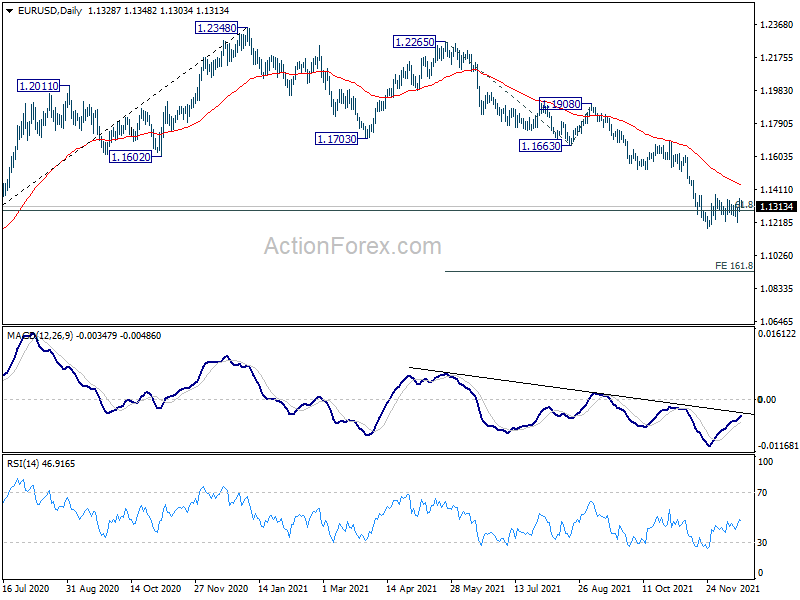
Intraday bias in EUR/USD remains neutral as range trading continues. On the upside, firm break of 1.1382 resistance should confirm short term bottoming at 1.1186. Intraday bias will be turned back to the upside for 55 day EMA (now at 1.1436). Sustained break there will be a sign of larger bullish reversal. On the downside, break of 1.1185 will resume larger fall from 1.2348. Next target is 161.8% projection of 1.2265 to 1.1663 from 1.1908 at 1.0934.
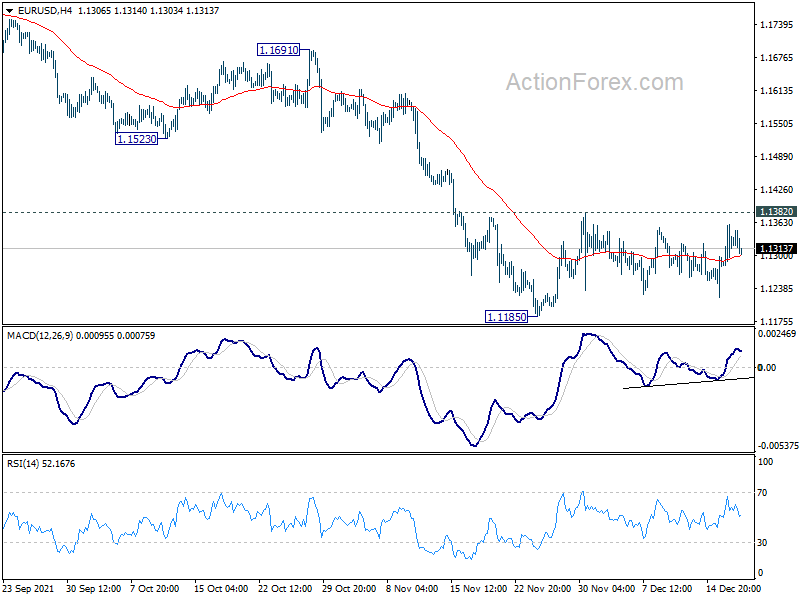
In the bigger picture, there are various ways of interpreting the fall from 1.2348 (2021 high). It could be a correction to rise from 1.0635 (2020 low), the fourth leg of a sideway pattern from 1.0339 (2017 low), or resuming long term down trend. In any case, outlook will now stay bearish as long as 1.1703 support turned resistance holds. Sustained break of 61.8% retracement of 1.0635 to 1.2348 at 1.1289 would pave the way back to 1.0635.
GBP/USD Mid-Day Outlook
Daily Pivots: (S1) 1.3252; (P) 1.3313; (R1) 1.3384; More...
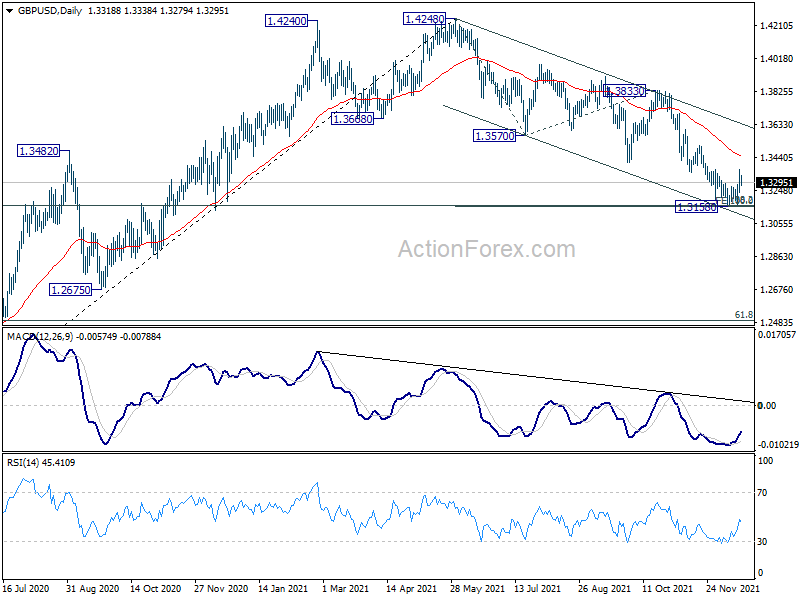
Further rise is still expected in GBP/USD for the moment. A short term bottom should be formed after defending 1.3164 key medium term fibonacci level. Further rise would be seen to 1.3570 support turned resistance first. Firm break there will affirm the case that whole correction from 1.4248 has completed. On the downside, however, sustained break of 1.3164 will carry larger bearish implications.
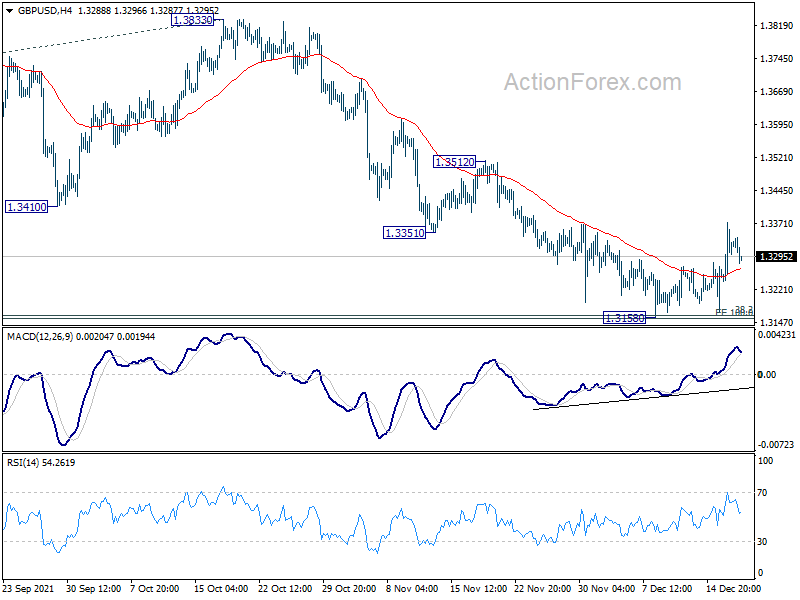
In the bigger picture, immediate focus is now on 38.2% retracement of 1.1409 to 1.4248 at 1.3164. Sustained break there will argue that whole rise from 1.1409 has completed at 1.4248, after rejection by 1.4376 long term resistance. That will revive some medium term bearishness and and target 61.8% retracement at 1.2493. However, strong rebound from current level will revive that case and up trend from 1.1409 is still in progress, and probably ready to resume.
USD/CHF Mid-Day Outlook
Daily Pivots: (S1) 0.9170; (P) 0.9214; (R1) 0.9237; More....
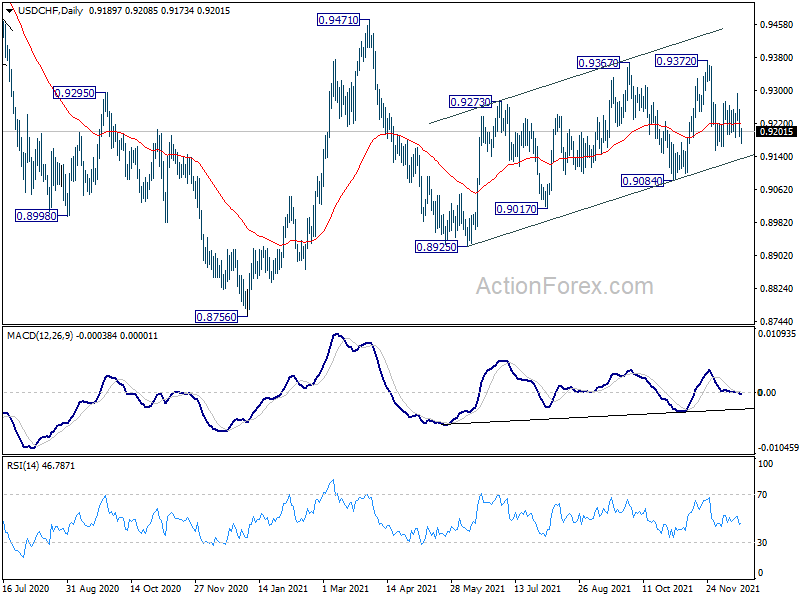
Outlook in USD/CHF remains unchanged and intraday bias stays neutral for the moment. On the downside, below 0.9156 will target 0.9084 support. Firm break there should confirm that choppy rise from 0.8925 has completed, and suggests that fall from 0.9471 is resuming. Deeper decline would be seen through 0.8925. On the upside, break of 0.9293 will suggest that the pull back from 0.9372 is finished. Intraday bias will be turned back to the upside for 0.9372.
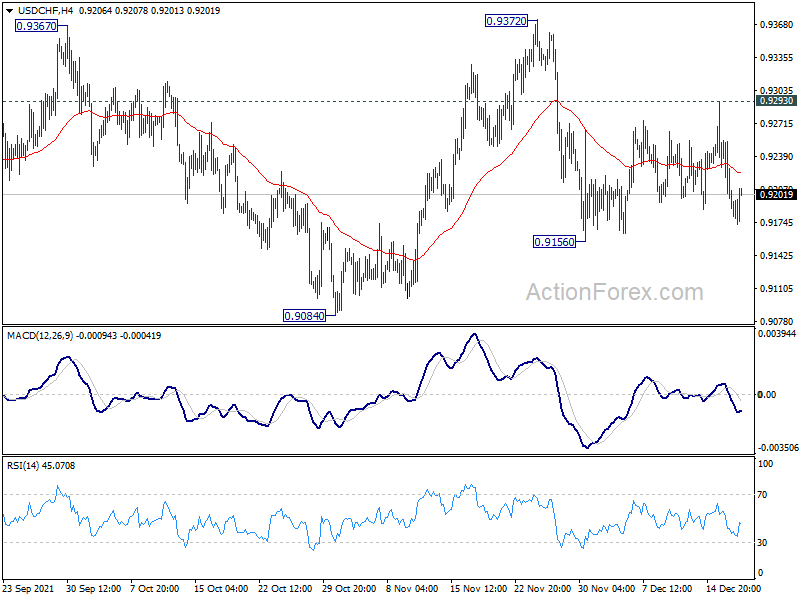
In the bigger picture, the corrective structure of the rebound from 0.8925 argues that fall from 0.9471 is not complete yet. It could either be the second leg of pattern from 0.8756 (2021 low), or resuming larger down trend from 1.0237 (2018 high). We'd pay attention to the downside momentum and assess the odds later. But for now, medium term outlook will be neutral at best as long as 0.9471 resistance holds.
USD/JPY Mid-Day Outlook
Daily Pivots: (S1) 113.42; (P) 113.83; (R1) 114.11; More...
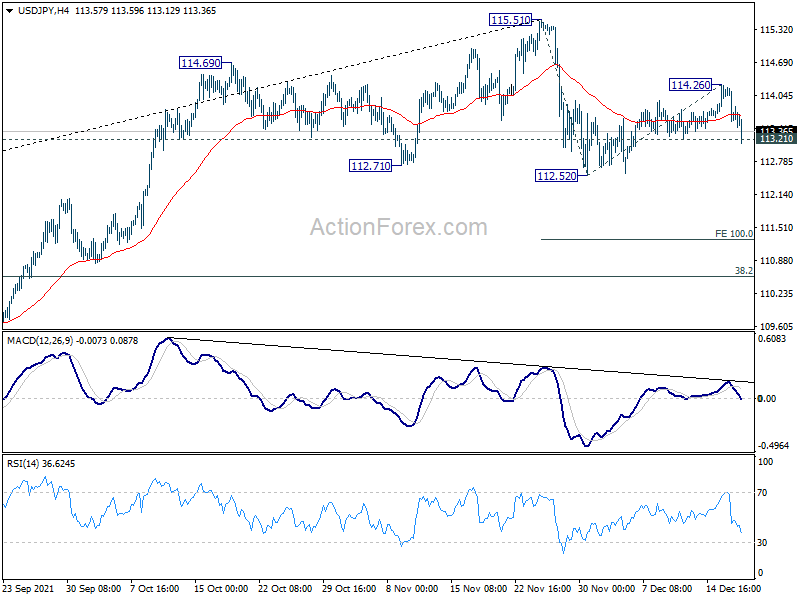
USD/JPY's breach of 113.21 minor support suggests that recovery from 112.52 has completed at 114.26. Corrective fall from 115.51 might be ready to resume. Intraday bias is back on the downside for 112.52 first. Break will confirm this case and target 100% projection of 115.51 to 112.52 from 114.26 at 111.27. Nevertheless, break of 114.26 will resume the rebound from 112.52 to retest 115.51 high.
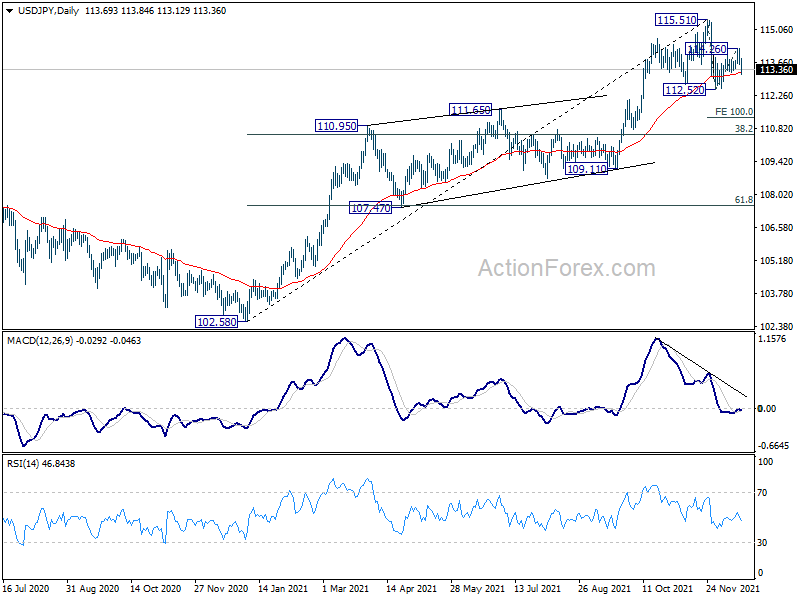
In the bigger picture, no change in the view that rise from 102.58 is the third leg of the up trend from 101.18 (2020 low). Such rally should target a test on 118.65 (2016 high) on resumption. However, firm break of 109.11 structural support will argue that the trend might have reversed and bring deeper fall to 107.47 support and possibly below.
Yen Rises as Investors Back in Risk Averse Mode
Investors are back in risk-off mode after a week of volatility. Yen is rising broadly, followed by Swiss Franc and Dollar. On the other hand, commodity currencies are back under some pressure. Euro and Sterling are both mixed. The question is whether pre-weekend selloff in stocks would intensify and push Yen and Franc to end as the strongest ones.
Technically, USD/JPY's breach of 113.21 minor support is a sign that it's resuming the corrective fall from 115.51. We'll see if it would close below 112.52 support to set up for more decline next week. At the same time, we'll also monitor if USD/CHF would break through 0.9156 support to align with the outlook too.
In Europe, at the time of writing, FTSE is up 0.04%. DAX is down -1.05%. CAC is down -1.27%. Germany 10-year yield is down -0.030 at -0.378. Earlier in Asia, Nikkei dropped -1.79%. Hong Kong HSI dropped -1.20%. China Shanghai SSE dropped -1.16%. Singapore Strait Times dropped -0.55%. Japan 10-year JGB yield rose 0.0058 to 0.050.
Germany Ifo business climate dropped to 94.7 in Dec, sentiment clouded over for Christmas
Germany Ifo Business Climate dropped from 96.6 to 94.7 in December, below expectation of 95.4. Current Assessment index dropped from 99.0 to 96.9, below expectation of 97.5. Expectations index dropped from 94.2 to 92.6, below expectation of 93.3. Looking at some more details, manufacturing rose from 16.7 to 17.3. Services dropped from 11.6 to 4.5. Trade dropped from 2.7 to -4.1. Construction dropped from 11.7 to 7.4.
Ifo said: "Sentiment at German companies has clouded over for Christmas. The deteriorating pandemic situation is hitting consumer-related service providers and retailers hard. The ifo Business Climate Index fell from 96.6 points in November to 94.7 points in December. Companies assessed their current business situation as less positive. Pessimism regarding the first half of 2022 also increased. The German economy isn't getting any presents this year."
Eurozone CPI finalized at 4.9% in Nov, EU at 5.2%
Eurozone CPI was finalized at 4.9% yoy in November, up from October's 4.1%. The highest contribution came from energy (+2.57%), followed by services (+1.16%), non-energy industrial goods (+0.64%) and food, alcohol & tobacco (+0.49%).
EU CPI was finalized at 5.2%, up from October's 4.4%. The lowest annual rates were registered in Malta (2.4%), Portugal (2.6%) and France (3.4%). The highest annual rates were recorded in Lithuania (9.3%), Estonia (8.6%) and Hungary (7.5%). Compared with October, annual inflation remained stable in one Member State and rose in twenty-six.
BoE Pill: More rate hikes to come if inflation persists
Asked on CNBC television if there would be "a lot more rate hikes to come," if inflation remained at its current level, BoE Chief Economist Huw Pill replied, "well I think that's true."
He added, "underlying, more domestically generated inflation here in the UK, probably centered around wage pressures in a tightening labour market, are going to prove more persistent through time."
UK retail sales rose 1.4% mom in Nov, ex-fuel sales rose 1.1% mom
UK retail sales rose 1.4% mom in November, above expectation of 0.8% mom. Sales were 7.2% higher than their pre-coronavirus February 2020 levels. Ex-automotive fuel sales rose 1.1% mom. For the 12 month period, headline sales rose 4.7% yoy while ex-automotive fuel sales rose 2.7% yoy.
Over the three months to November 2021, however, sales fell by -0.6% when compared with the previous three months.
UK Gfk consumer confidence dropped to -14, slightly depressed end of year
UK Gfk consumer confidence dropped from -14 to -15 in December. Personal financial situation over the next 12 months dropped from 2 to 1. General economic situation over the next 12 months dropped from -23 to -24. Major purchase index also dropped from -3 to -6.
Joe Staton, Client Strategy Director, GfK says: "News about the Omicron variant could not have arrived at a worse time for festive celebrations... We end 2021 on a slightly depressed note and it looks like it will be a bleak midwinter for UK consumer confidence possibly with new COVID curbs and little likelihood of any real uplift in the first months of 2022."
BoJ keeps interest rates unchanged, scales back emergency funding
Under the yield curve control, BoJ kept short-term policy interest rate unchanged at -0.10%, and 10-year JGB target at around 0% without upper limit to purchases. It will continue to buy ETFs and J-REITs with upper limits of JPY 12T and JPY 180B respectively on annual paces.
The Special Program to Support Financing in Response to the Novel Coronavirus is extended in part by six months until the end of September 2022. The additional purchases of commercial paper and corporate bonds will be complete at the end of March 2022 as scheduled with outstanding amounts gradually drop back to pre-pandemic levels.
BoJ said, "Japan's economy is projected to continue growing at a pace, albeit slower, above its potential growth rate." Core CPI is "likely to increase moderately in positive territory in the short run," and "projected to increase gradually as a trend".
The course of COVID-19 continues to warrant attention". There are "high uncertainties over whether the resumption of economic activity can progress smoothly". Attentions should also be paid to risk that "effects of supply-side constraints seen in some areas will be amplified or prolonged."
New Zealand ANZ business confidence dropped to -23.2, inflation expectations rose further
New Zealand ANZ business confidence dropped further to -23.2 in December, down from November's -16.4. Own activity outlook dropped from 15.0 to 11.8. Export intentions dropped from 9.5 to 8.8. Investment intentions dropped from 16.3 to 11.4. Employment intentions dropped from 15.8 to 10.5. Pricing intentions dropped from 66.5 to 63.6. Inflation expectations rose further from 4.24% to 4.42%.
ANZ said: "Unfortunately the cloud of uncertainty that hangs over 2022 is not a great deal smaller, nor fluffier... Labour shortages and cost pressures rank high in firms' list of concerns, and freight disruptions are getting worse... But having trouble meeting demand is probably a better problem to have than not having enough demand.
USD/JPY Mid-Day Outlook
Daily Pivots: (S1) 113.42; (P) 113.83; (R1) 114.11; More...
USD/JPY's breach of 113.21 minor support suggests that recovery from 112.52 has completed at 114.26. Corrective fall from 115.51 might be ready to resume. Intraday bias is back on the downside for 112.52 first. Break will confirm this case and target 100% projection of 115.51 to 112.52 from 114.26 at 111.27. Nevertheless, break of 114.26 will resume the rebound from 112.52 to retest 115.51 high.
In the bigger picture, no change in the view that rise from 102.58 is the third leg of the up trend from 101.18 (2020 low). Such rally should target a test on 118.65 (2016 high) on resumption. However, firm break of 109.11 structural support will argue that the trend might have reversed and bring deeper fall to 107.47 support and possibly below.
Economic Indicators Update
| GMT | Ccy | Events | Actual | Forecast | Previous | Revised |
|---|---|---|---|---|---|---|
| 00:01 | GBP | GfK Consumer Confidence Dec | -15 | -14 | ||
| 03:00 | JPY | BoJ Interest Rate Decision | -0.10% | -0.10% | -0.10% | |
| 07:00 | EUR | Germany PPI M/M Nov | 0.80% | 1.40% | 3.80% | |
| 07:00 | EUR | Germany PPI Y/Y Nov | 19.20% | 19.80% | 18.40% | |
| 09:00 | EUR | Germany IFO Business Climate Dec | 94.7 | 95.4 | 96.5 | 96.6 |
| 09:00 | EUR | Germany IFO Current Assessment Dec | 96.9 | 97.5 | 99 | |
| 09:00 | EUR | Germany IFO Expectations Dec | 92.6 | 93.3 | 94.2 | |
| 10:00 | EUR | Eurozone CPI Y/Y Nov F | 4.90% | 4.90% | 4.90% | |
| 10:00 | EUR | Eurozone CPI Core Y/Y Nov F | 2.60% | 2.60% | 2.60% | |
| 13:30 | CAD | Foreign Securities Purchases (CAD) Oct | 23.92B | 18.50B | 20.02B | 19.78B |
Japanese Yen Calm after BoJ Meeting
The Japanese yen is showing little movement on Friday. In the European session, USD/JPY is trading at 113.44, down 0.13% on the day.
It was a dramatic week, with central banks in the spotlight. There were significant announcements on both sides of the pond. The Federal Reserve announced that it would double the pace of its tapering and released a forecast showing up to three rate hikes in 2022. The Bank of England meeting was even more dramatic, as the BoE shocked the markets when it raised rates. Although the hike was only 15 bps, the move is significant in that it marks the first rate hike by a major central bank during the corona pandemic.
BOJ maintains accommodative policy
Over in Japan, the BoJ meeting was a tame affair, which is usually the case with the BoJ. The central bank maintained policy rates as well as the 10-year JGB yield target of 0.0%. At the same time, the bank said it would scale back its emergency pandemic programme in 2022. The BoJ signalled that it is maintaining its ultra-accommodative policy, with BoJ Governor Kuroda stressing that the cutting back of the emergency funding would not be followed by the withdrawal of QE. The cautious stance of the BoJ is more in line with the ECB, which announced that it would wind up its emergency pandemic programme while temporarily increasing QE through its Asset Purchase Programme (APP).
The Japanese yen had a muted reaction to the policy meeting. This should not come as a surprise, given that the key factor driving the yen has been the US/Japan yield differential rather than any policy decisions by the central bank.
USD/JPY Technical
- USD/JPY faces resistance at 113.95. The next resistance line is 114.50
- 113.35 is under pressure in support. Below, there is support at 112.84
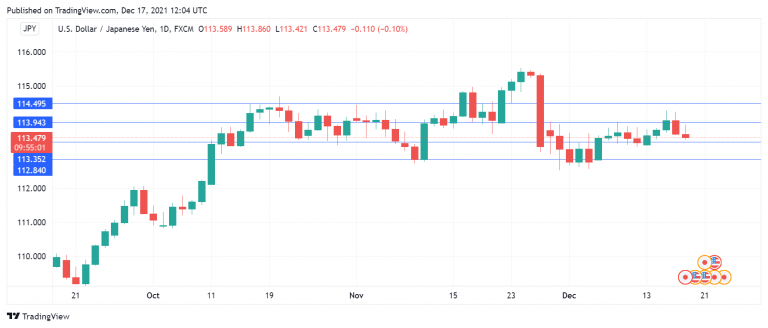
Eurozone CPI finalized at 4.9% in Nov, EU at 5.2%
Eurozone CPI was finalized at 4.9% yoy in November, up from October's 4.1%. The highest contribution came from energy (+2.57%), followed by services (+1.16%), non-energy industrial goods (+0.64%) and food, alcohol & tobacco (+0.49%).
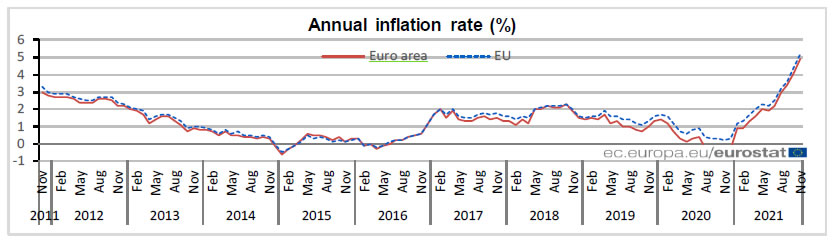
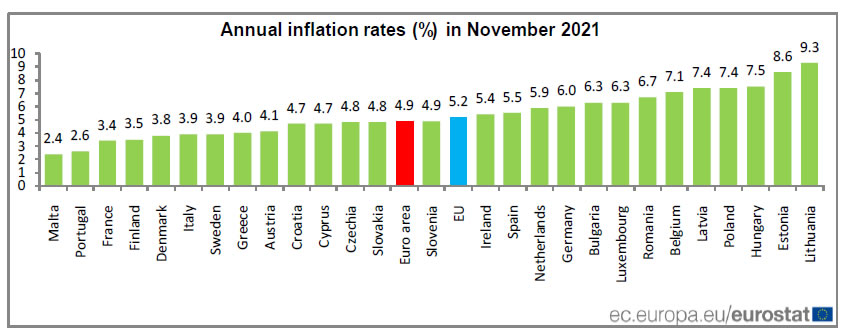
EU CPI was finalized at 5.2%, up from October's 4.4%. The lowest annual rates were registered in Malta (2.4%), Portugal (2.6%) and France (3.4%). The highest annual rates were recorded in Lithuania (9.3%), Estonia (8.6%) and Hungary (7.5%). Compared with October, annual inflation remained stable in one Member State and rose in twenty-six.
Euro Yawns As German Business Climate Slows
The euro is almost unchanged on Friday, after posting considerable gains a day earlier. In the European session, EUR/USD is trading at 1.1323, down 0.06% on the day.
ECB taketh and giveth
The ECB confirmed that its emergency Covid support programme (PEPP) will end as scheduled, in March 2022. This was essentially old news. The burning question ahead of Thursday’s policy meeting was whether the bank would increase bond purchases under its Asset Purchase Programme (APP), which currently runs at a clip of EUR 20 billion/month. There was sharp dissension within the ECB what to do with the APP – hawkish members wanted to maintain the current pace, while dovish members were urging a doubling of the pace to EUR 40 billion/month, in order to cushion the economies of the poorer members of the bloc after PEPP runs out. In the end, we saw a classic ECB compromise, where nobody got exactly what they wanted. Under the plan, APP will increase to 40 billion after PEPP winds up, but this will be reduced to 30 billion in Q3, and fall back to 20 billion in October 2022 for “as long as necessary”.
In a press conference after the meeting, ECB President Christine Lagarde said that there was a broad majority for this QE package, adding that a rate hike was unlikely in 2022. The ECB has given itself plenty of flexibility after PEPP with the use of APP, in order to avoid any market turbulence when PEPP is wound up.
The ECB’s cautious position stands in sharp contrast to the hawkish moves we saw from the Federal Reserve and the Bank of England this week. The Fed accelerated its taper of its bond purchase scheme, while the BoE surprised the market with a rate hike, the first such move by a major central bank during the Covid pandemic. In the words of one analyst, the Fed and BoE are from Mars, while the ECB is from Venus. The ECB has not had to contend with red-hot inflation like the Fed and BoE, but if inflation accelerates in the eurozone, the ECB may have to take a hawkish pivot and follow in the footsteps of its Anglo-Saxon counterparts.
EUR/USD Technical
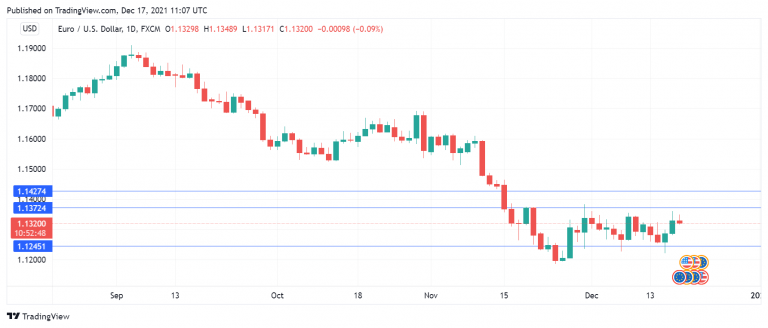
- The next support level is at 1.1245. Below, there is support at 1.1173
- There is resistance at 1.1372 and 1.1427
Surprise! BoE Does It Again
The British pound is flat on Friday, after posting gains a day earlier on the BoE rate hike.
BoE surprises with rate hike
I’m not sure if BoE Governor Andrew Bailey is chuckling this morning, as he reads the financial section of his favorite newspaper with hot tea in hand. Bailey has done it again, catching the market off-guard after a BoE rate decision. In November, Bailey had signalled that ‘now was the time to act’ in order to contain surging inflation. Market participants had duly priced in a rate hike but had egg on their face when not only did the BoE refrain from a hike, but Bailey voted with the majority against raising rates. The markets were warier this time around, even though inflation continued to head higher and the labor market showed improvement. These were strong reasons in favor of a hike, but uncertainty over Omicron, which has sent infection rates in the UK skyrocketing, seemed reason enough for the BoE to wait until it had a better handle on the threat posed by Omicron.
In the end, the BoE surprised the markets yet again, raising rates from 0.10% to 0.25%. The vote was near-unanimous, with 8-1 in favor. The bank’s statement noted that it had to act due to inflation as well as the employment situation, with an upside risk of wages moving higher.
Although the size of the rate was small, the move is nonetheless significant, since it marks the first rate hike by a major central bank during the Covid pandemic. This is a clear signal from the BoE that it will no longer ignore inflation, echoing the message sent by the Federal Reserve just a day earlier. The pound gained 0.43% on Wednesday, courtesy of the BoE move.
GBP/USD Technical Analysis
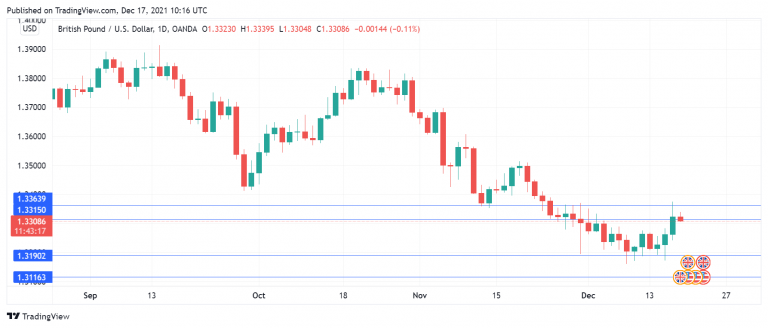
- GBP/USD has support at 1.3190 and 1.3116
- There is resistance at 1.3314 and 1.3364