

Sample Category Title
EUR/CHF Weekly Outlook
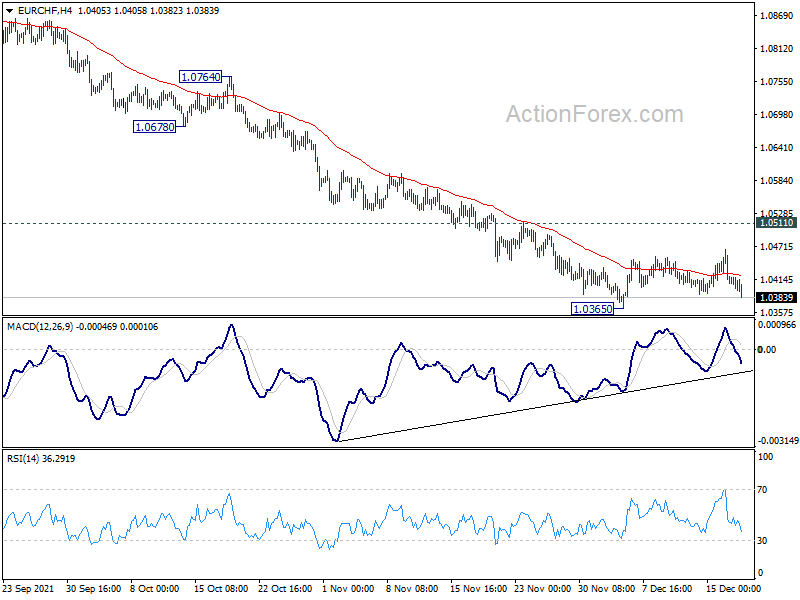
EUR/CHF stayed in sideway consolidation from 1.0365 last week and outlook is unchanged. Initial bias remains neutral this week first. But further decline is expected as long as 1.0511 resistance holds. On the downside, break of 1.0365 will resume larger down trend from 1.1149 to 161.8% projection of 1.1149 to 1.0694 from 1.0936 at 1.0200 next.
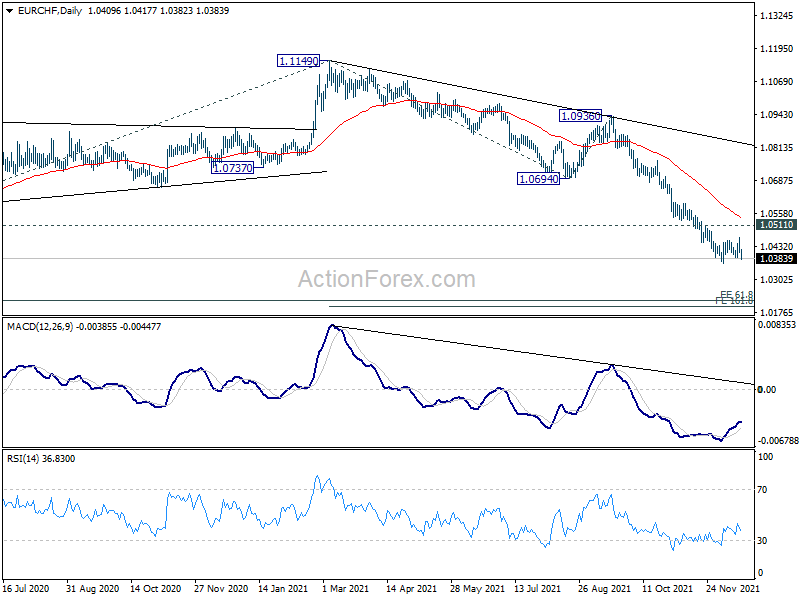
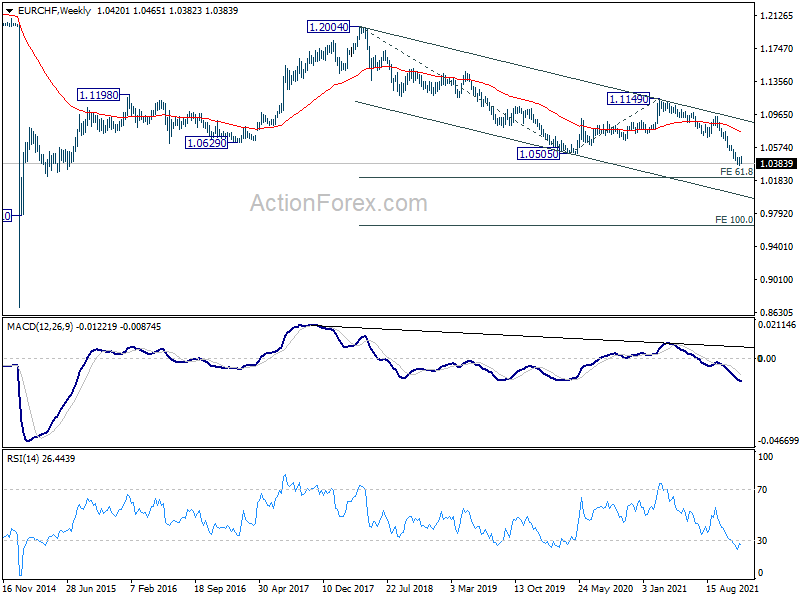
In the bigger picture, long term down trend from 1.2004 (2018 high) is now extending. Next target is 61.8% projection of 1.2004 to 1.0505 to 1.1149 at 1.0223. On the upside, break of 1.0694 support turned resistance is needed to be the first sign of medium term bottoming. Otherwise, outlook will remain bearish even in case of rebound.
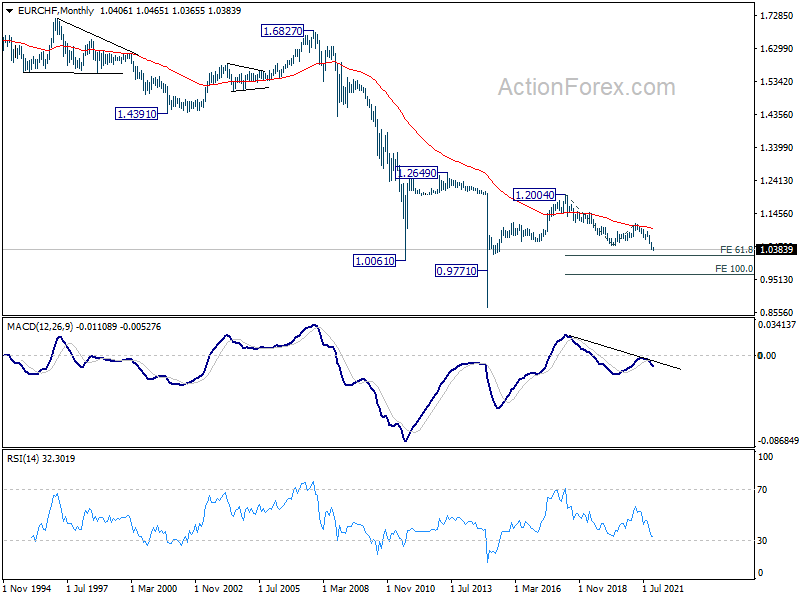
In the long term picture, rejection by 55 month EMA (now at 1.1015) maintains long term bearishness. Down trend from 1.2004 is now in progress for 61.8% projection of 1.2004 to 1.0505 to 1.1149 at 1.0223. Firm break there will target 100% projection at 0.9650.
Dollar Stands Tall after A Week of Central Bank Surprises
It was a very volatile week full of central bank surprises. Fed indicated that there would be as many as three rate hikes next year. BoE surprised by raising the Bank Rate. Even ECB turned out to be less dovish as expected. But in the end, if was the late selloff in the stock markets that finalized that over tone.
We would like to point out that in the background, there were still some worries over the fast spread of Omicron. Risk of return to tougher restrictions, prolonged supply bottlenecks and more persistent high inflation are realistically there. At the same time, major central banks are clearly turning more hawkish on inflation. Hence, the stock markets were indeed rather resilient in this context. Friday's selloff was probably more because of "quadruple witching". But we'll have to see how it goes in January.
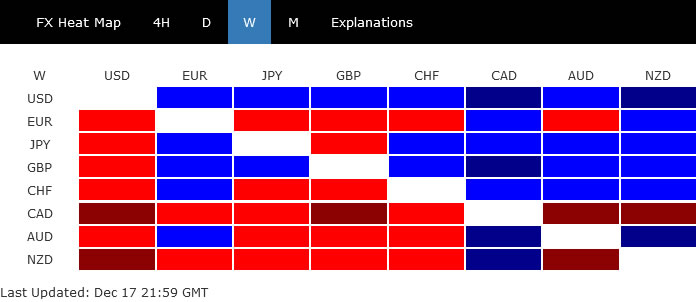
In the currency markets, Dollar ended as the strongest one, followed by Sterling and Yen. Canadian Dollar was the worst performer, followed by Kiwi and then Euro.
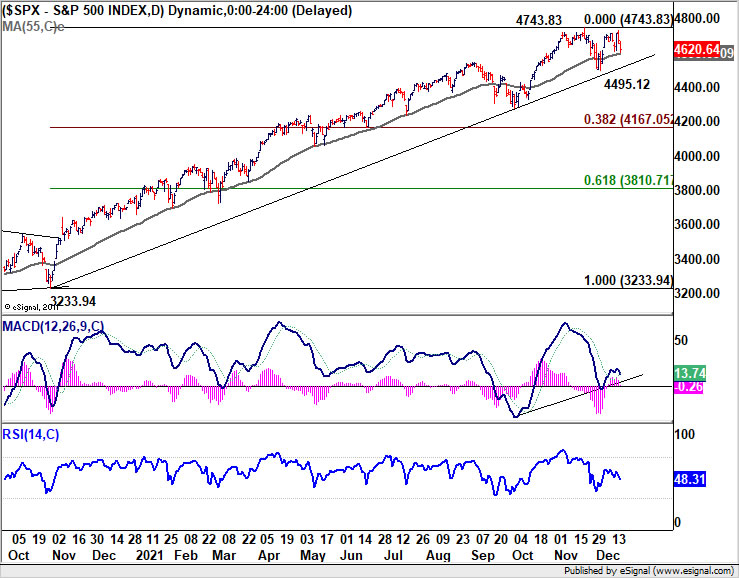
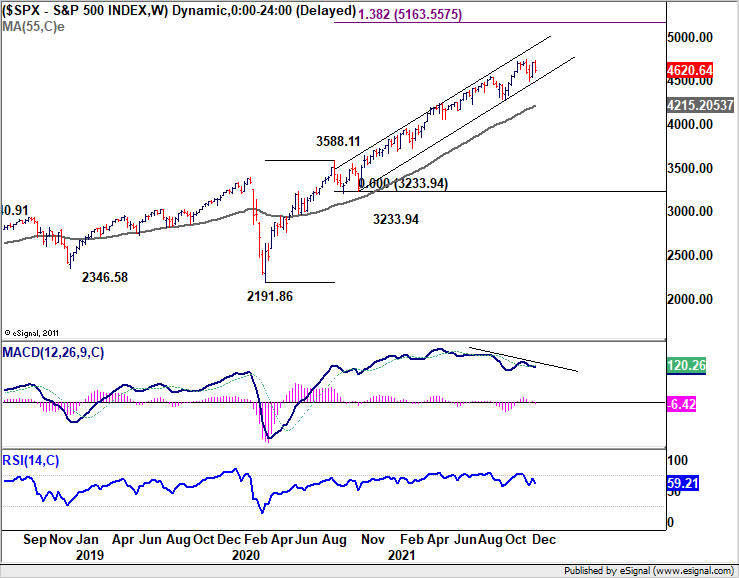
S&P 500 extending the corrective pattern from 4743.83
S&P 500 failed to break through 4743.83 high last week and has indeed closed lower. The development wasn't a surprise, as we're envisage that the corrective move from 4743.83 would be unfolded as a three wave pattern. Deeper fall is now mildly in favor for the near term to 4495.12 support.
The main question is whether the SPX is indeed correcting whole up trend from 3233.94. Firm break of 4495.12 would favor this case and bring deeper fall to 38.2% retracement of 3233.94 to 4743.83 at 4167.05 before completing the correction. But keeping 4495.12 intact would maintain the chance of extending the record run before forming a medium term top.
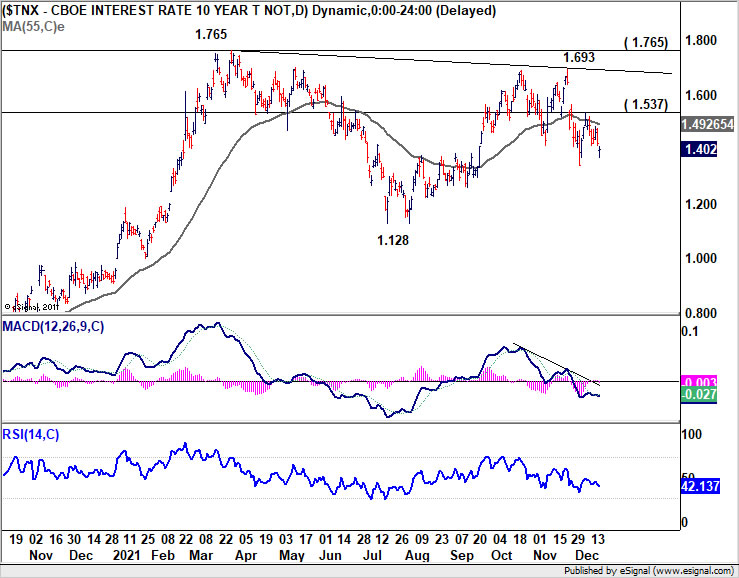
10-year yield's near term outlook mixed
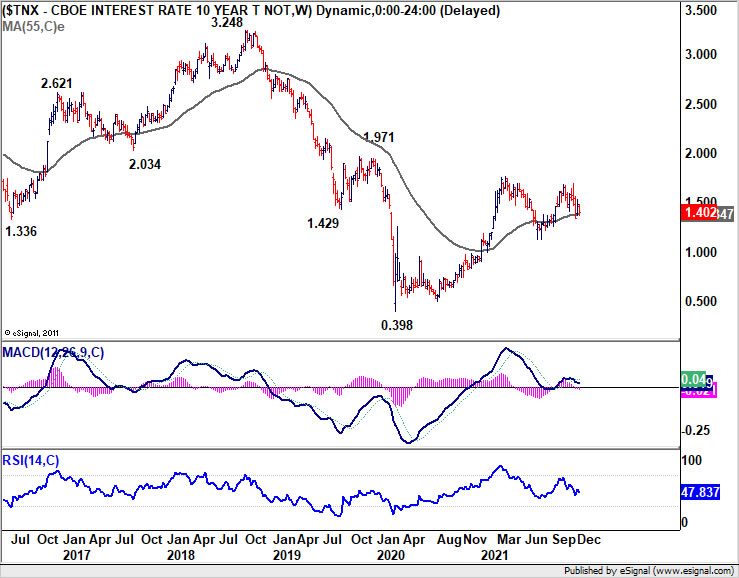
Outlook is 10-year yield is unchanged that it's seen as being in the third leg of the corrective pattern from 1.765. Last week's decline and prior rejection by 55 day EMA are both suggesting more downside for the near term. Yet, at the same time, TNX is also trying to draw support from 55 week EMA (now at 1.381). So, the near term outlook is relatively mixed.
On the upside, break of 1.537 resistance will argue that the fall from 1.693 is finished and bring stronger rebound. But firm break of 55 week EMA could open up deeper fall to 1.128 support. The next move in TNX will be a certain impact on USD/JPY.
Dollar index extending near term consolidation with bullish bias
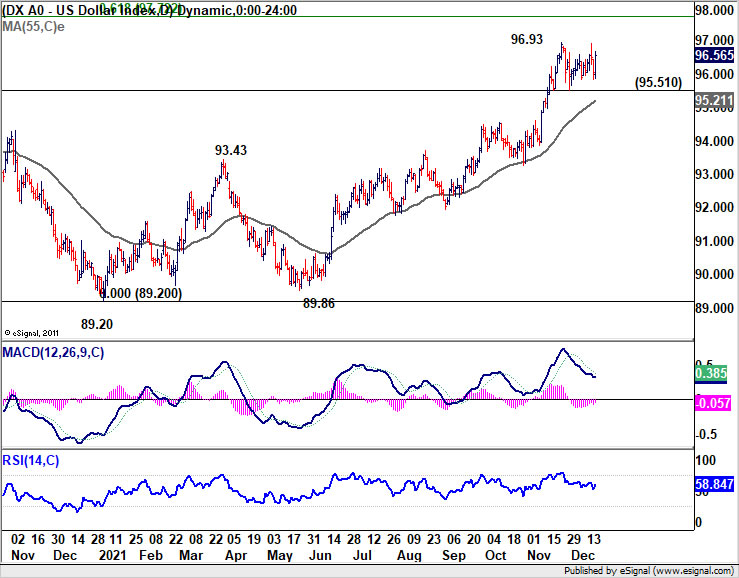
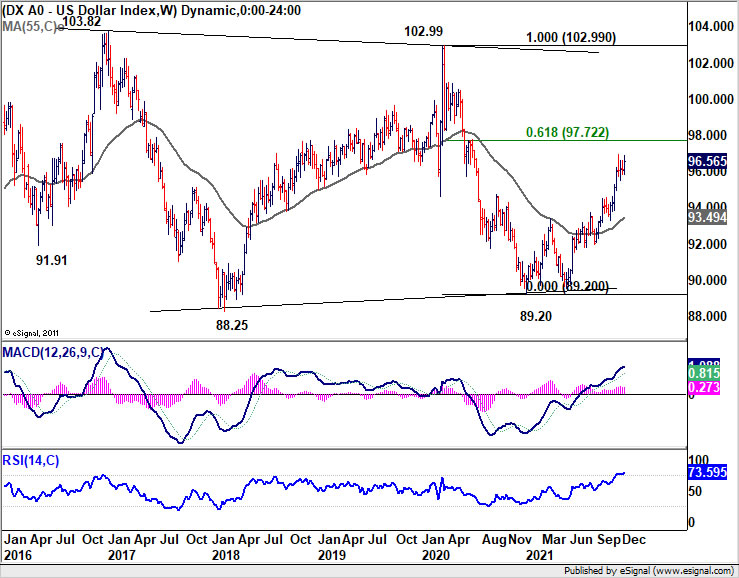
Dollar index is still bounded in a sideway pattern after a few weeks of volatility. Near term outlook remains bullish with 95.51 support intact. Rise from 89.20 is still in favor to continue to 61.8% retracement of 102.99 to 89.20 at 97.72. However, break of 95.51 will open up the chance for deeper correction to 55 week EMA (now at 93.49) before bottoming.
Gold rebounded strongly but couldn't stay above 1800
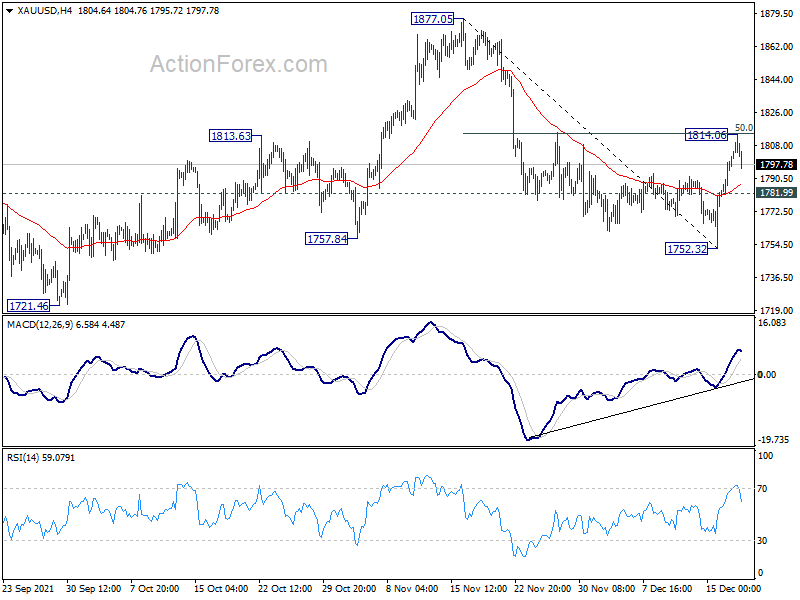
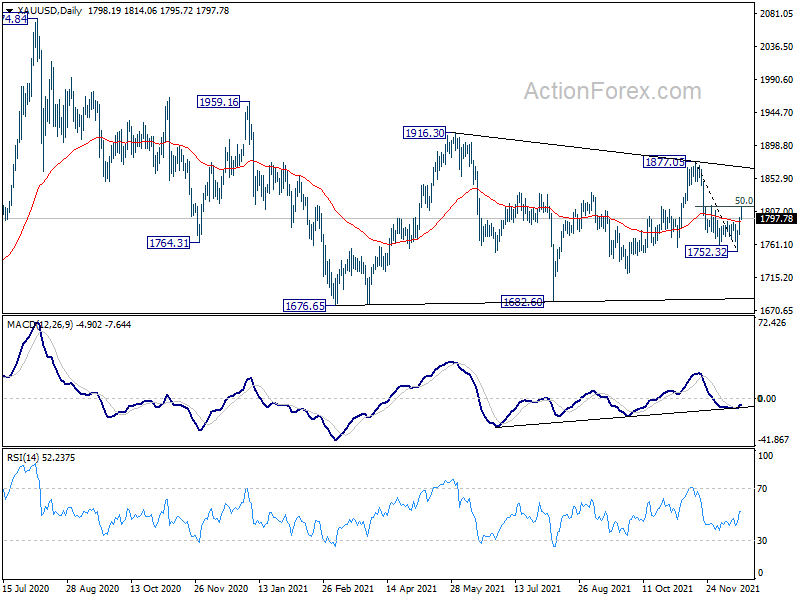
Gold staged impressive rebound to as high as 1814.06 last week. But it's disappointing that it could close above 1800 handle. Further rise is mildly in favor for the near term as long as 1781.99 minor support holds. Break of 1814.06 will target 1877.05 resistance next. However, break of 1781.99 will argue that fall from 1877.05 is still not complete as another leg inside the larger sideway pattern from 1676.65. Deeper fall could be seen through 1752.32 to 1721.46 support and below. We'd continue to use gold to help confirm Dollar's next move.
GBP/CAD eyeing 1.7111 resistance as bullish case builds up
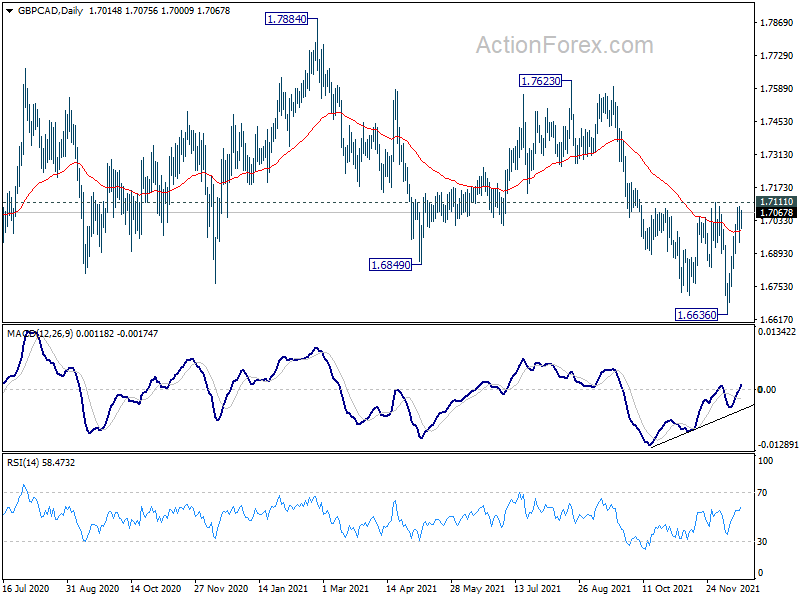
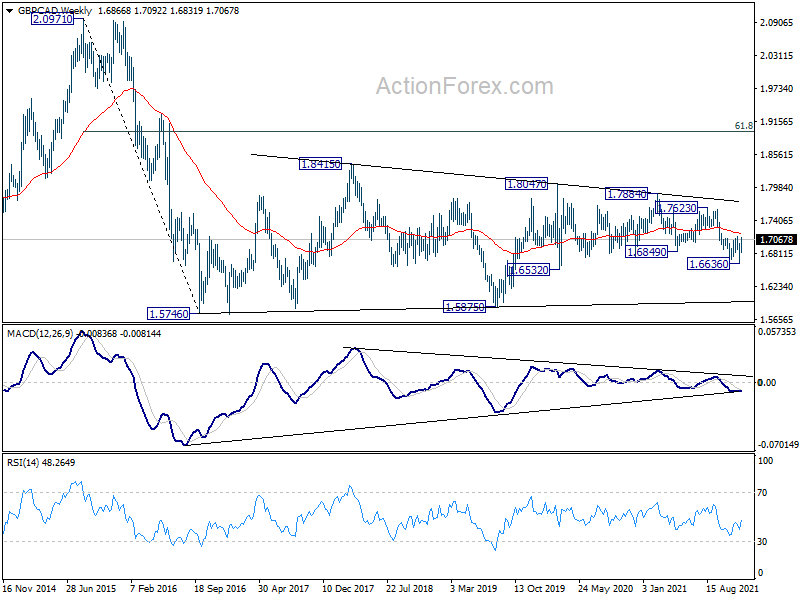
GBP/CAD was among the top movers last week as rebounded from 1.6636 extended. The chance of near term bullish reversal is increasing considering bullish convergence condition in daily MACD. But this is not confirmed yet as GBP/CAD would still need to break through 1.7111 resistance decisively to confirm. If happens, such development would also argue that whole decline from 1.7884, as a falling leg inside the long term range pattern, has completed with three waves down to 1.6636. Further rise would be seen towards 1.7623 resistance next. However, rejection by 1.7111 will retain near term bearishness for another fall through 1.6636 at a later stage.
NZD/JPY ready to resume fall from 82.49 after brief recovery
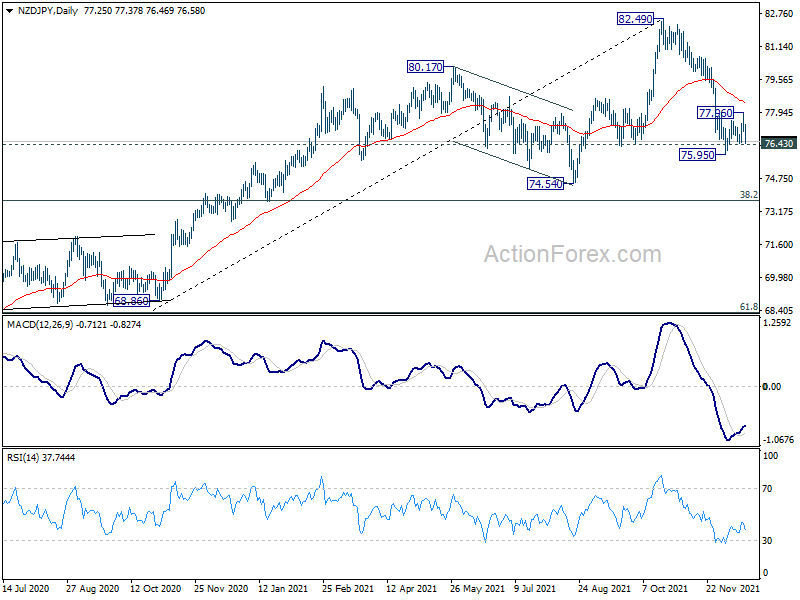
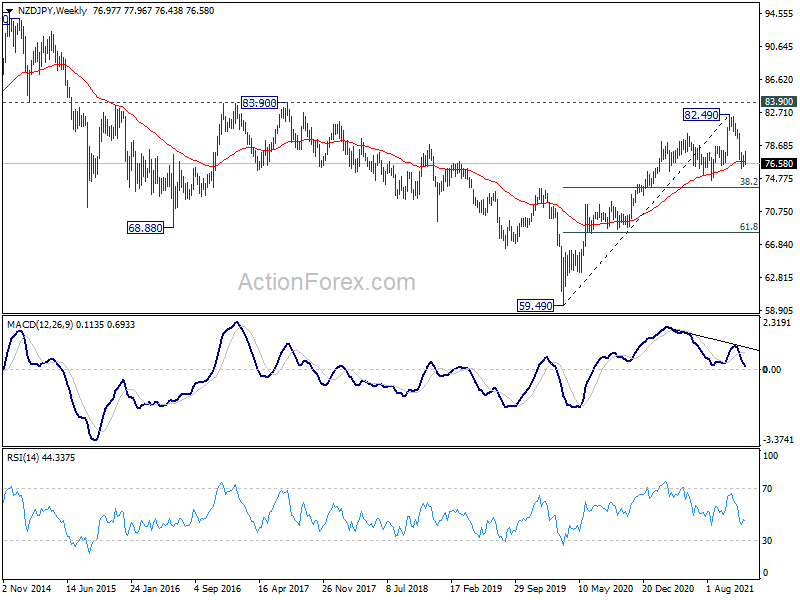
Despite recovering further 77.96 last week, subsequent sharp fall in NZD/JPY suggests that near term outlook is staying bearish. Break of 76.43 minor support will argue that fall from 82.49 is ready to resume through 75.95. Such decline is seen as a correction to whole up trend from 59.49. Break of 75.95 will target 38.2% retracement of 59.49 to 82.49 at 73.70. Though, break above 77.96 will extend the recovery pattern from 75.95 first before staging another decline.
EUR/USD Weekly Outlook
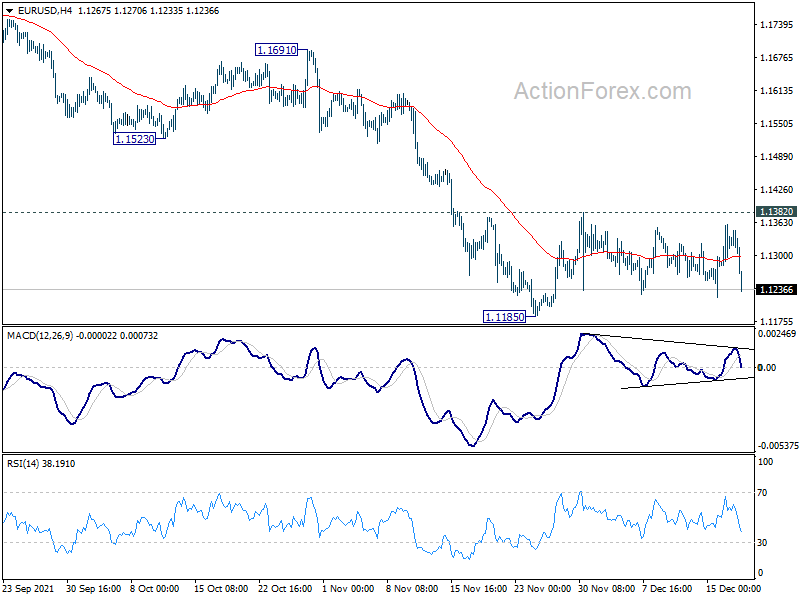
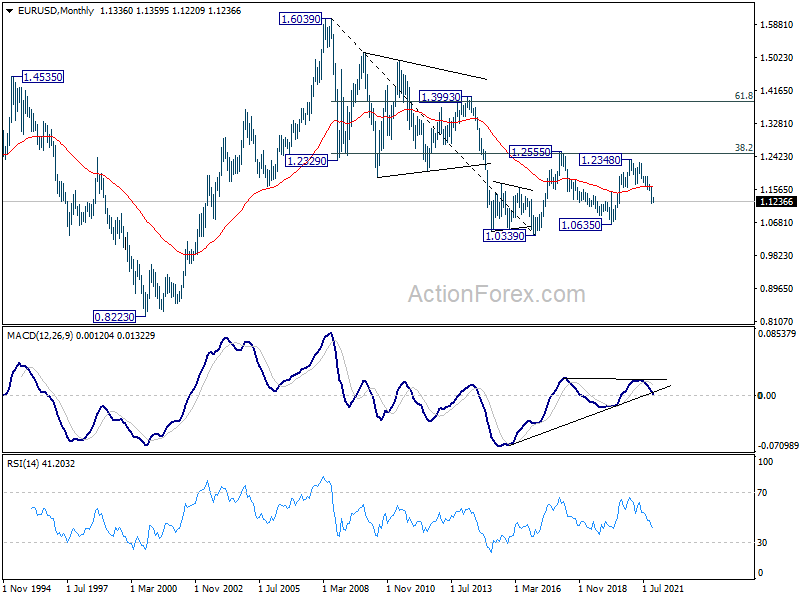
EUR/USD stayed in consolidation between 1.1185/1382 last week and outlook is unchanged. Further decline will remain in favor as long as 1.1382 resistance holds. Break of 1.1185 will resume larger decline from 1.2348. Next target is 161.8% projection of 1.2265 to 1.1663 from 1.1908 at 1.0934. On the upside, firm break of 1.1382 resistance should confirm short term bottoming at 1.1186. Intraday bias will be turned back to the upside for 55 day EMA (now at 1.1432).
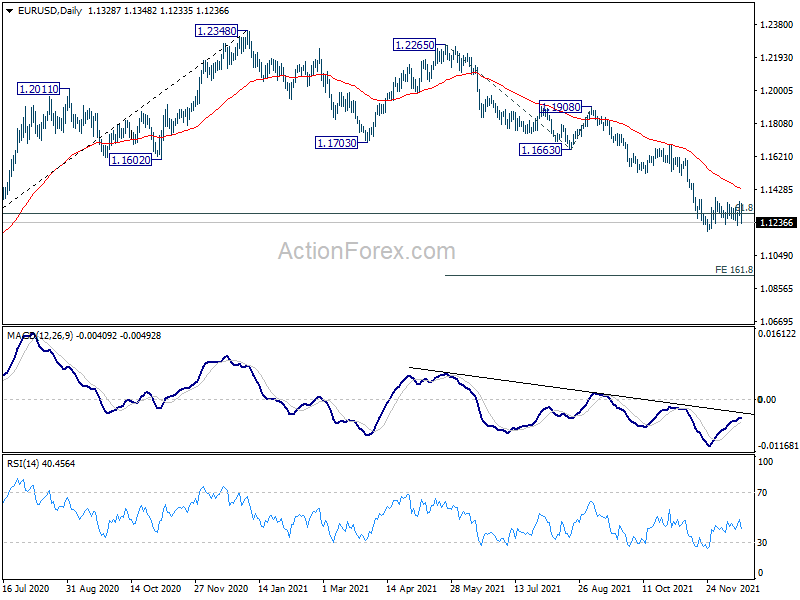
In the bigger picture, there are various ways of interpreting the fall from 1.2348 (2021 high). It could be a correction to rise from 1.0635 (2020 low), the fourth leg of a sideway pattern from 1.0339 (2017 low), or resuming long term down trend. In any case, outlook will now stay bearish as long as 1.1703 support turned resistance holds. Sustained break of 61.8% retracement of 1.0635 to 1.2348 at 1.1289 would pave the way back to 1.0635.
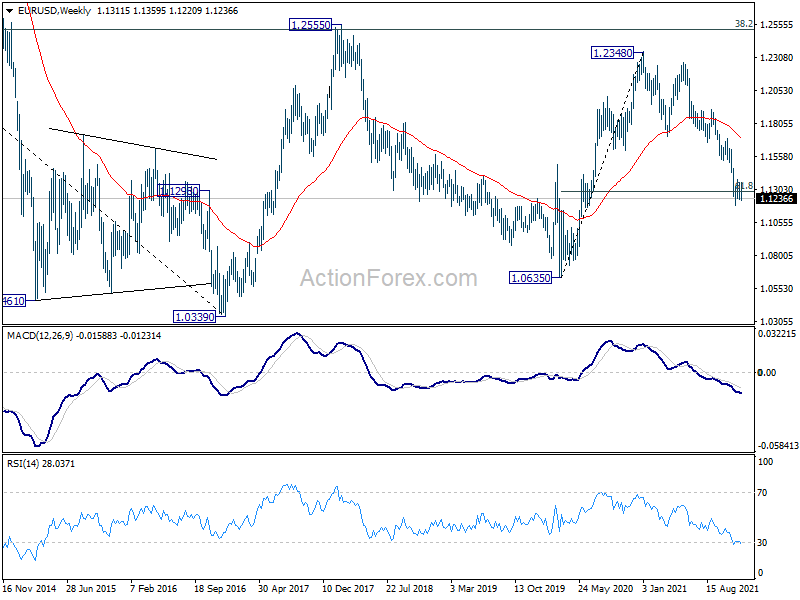
In the long term picture, EUR/USD has possibly failed 1.2555 cluster resistance (38.2% retracement of 1.6039 to 1.0339 at 1.2516) again. Long term outlook will remain neutral as sideway pattern from 1.0339 (2017 low) is extending with another medium term fall. For now, we'd hold back from assessing the chance of downside breakout, and monitor the momentum of the decline from 1.2348 first.
Summary 12/20 – 12/24
Monday, Dec 20, 2021
[php_everywhere instance="1"]
Tuesday, Dec 21, 2021
[php_everywhere instance="2"]
Wednesday, Dec 22, 2021
[php_everywhere instance="3"]
Thursday, Dec 23, 2021
[php_everywhere instance="4"]
Friday, Dec 24, 2021
[php_everywhere instance="5"]
Weekly Economic & Financial Commentary: Hawkish Fed Steals the Show
Summary
United States: Hawkish Fed Steals the Show, but Supply Issues Persist Behind the Scenes
- The more hawkish tone coming out of the Fed's latest policy meeting was the main event grasping markets' attention this week. But in other news, retail sales data disappointed as higher prices factor into spending and industrial activity continued to recover but remains beset by supply issues. Continued supply side challenges also extended to the housing sector, where the number of homes under construction reached its highest level since 2007.
- Next week: Existing Home Sales (Wed), Personal Income (Thurs), Durable Goods (Thurs)
International: Europe's Central Banks in Focus
- It was a busy week for central banks across Europe. The Bank of England surprised market participants with a 15-bp policy rate hike to 0.25%, whereas the 25-bp policy rate hike to 0.50% from Norway's central bank was widely expected. The European Central Bank confirmed it would end its emergency bond purchase program in March, but also signaled plans to continue with its regular asset purchase program for at least several months thereafter.
- Next week: Japan CPI (Thurs), Canada GDP (Thurs)
Interest Rate Watch: An Inflation Inflection
- The FOMC doubled the pace of asset purchasing tapering at Wednesday's policy meeting and indicated an earlier liftoff to rate hikes than previously expected. The Fed's latest Summary of Economic Projections indicate the committee expects inflation to run above target and the labor market to make steady progress toward full employment over the next year.
Credit Market Insights: Municipalities Seek Savings Before the New Year
- The demand for tax-exempt bonds has remained strong, as rates have stayed near record lows despite a slight lift in the yield curve across all maturities this year. With rates set to rise next year, we still may see more issuance, trying to take advantage of still low rates.
Topic of the Week: Congress Finishes Up for the Year
- Congress faced a slew of December deadlines when it returned to session after Thanksgiving, and many of these “hard” deadlines have been met. However, the “soft” deadline for passing Democrats' Build Back Better plan by year-end appears likely to be missed.
Week Ahead – The Festive Season is Upon Us
Will markets coast into the new year?
Last week was action-packed, dominated by major central bank announcements that in many cases represented a change of direction as we head into 2022.
From supporting the economy through the pandemic to reining in inflation that has become more intense and widespread than policymakers anticipated earlier this year. Getting it under control will be the primary focus next year.
With policymakers now in holiday mode, and many in the markets likely also, the calendar is looking a little thin. But omicron is continuing to spread at a phenomenal pace which could put investors on edge into the end of the year.
US
Now that the Fed hawkish reset is complete, whoever is left working on Wall Street will have to focus on several economic data points that will show if the US consumer remains strong. The latest personal spending should show a decline while incomes maintain modest growth. Another round of housing data should show existing home and new home sales remain hot. The Fed’s preferred inflation gauge will show pricing pressures continued to surge in November.
The Fed is done with speaking appearances for the year, so thin trading conditions should settle in once we get past Thursday’s economic data. The biggest risk to the short-term outlook remains Covid and if this omicron wave leads to significant school closures and cancellation of holiday travel plans.
EU
The ECB meeting on Thursday effectively marked the end of the year as far as the euro area is concerned, with the final couple of weeks offering very little of note. The central bank is poised to end new purchases under PEPP in March at which point the APP will be doubled before being pared back to €20 billion again in the fourth quarter.
This modest tightening and phasing out of pandemic era stimulus is all that was deemed necessary by the committee at the moment, with inflation seen returning below target in the forecast horizon. That could change and Christine Lagarde did give the impression that inflation risks are tilted to the upside.
UK
Omicron infections are surging with Covid cases now hitting new highs and not slowing up. Light touch restrictions have been imposed so far but they could become more severe if the healthcare system comes under pressure in the coming weeks.
The Bank of England has started the tightening cycle with a 15 basis point rate hike, the smallest since the late ’80s. Three more rate hikes are now priced in for next year.
Tier three data only next week, with revised GDP the only release with any potential to cause a stir.
Russia
With inflation (8.4%) running at more than double its target (4%) and well above the upper end of the range it predicted for the end of the year, the CBR raised interest rates by 1% on Friday to 8.5%. They signaled that more could follow but multiple hikes were less likely than at the last meeting.
The ruble continues to be well supported by the actions of the CBR this year and high oil prices. Geopolitical risk is a big downside risk though, with the US and Europe threatening sanctions in response to troops building up on the Ukrainian border. The risk of an invasion remains significant.
The central bank appears to be moving closer to a blanket ban on investment in cryptocurrencies, it’s been reported this week. They have long opposed them and appear to be keen to follow in the footsteps of China.
South Africa
Fitch upgraded the country’s outlook to stable this week, with the credit rating remaining at BB-, three notches below investment grade. The move was spurred by a faster than expected recovery and strong fiscal performance this year.
There are no data releases or economic events scheduled for next week.
Turkey
The CBRT took its rate cuts since September to 5% this week as it cut by another 100 basis points on Thursday. The central bank is making a mockery of monetary policy and the lira is continuing to get pummelled as a result, with USDTRY rising over 17 for the first time ever, a little over a month after it hit 10 for the first time.
Five interventions in the currency markets have done nothing to slow the decline and the central bank and government will only get more desperate. More interventions, perhaps even capital controls could follow as the currency spirals out of control.
Thankfully, President Erdogan has the answer. A 50% increase in the minimum wage next year. What could go wrong?
The central bank indicated that it will now pause rate cuts in the first quarter to assess the impact they’ve had but no one would be surprised if they fell further, especially if Erdogan continues to push for more.
China
China headlines continue to be dominated by the property sector, with more payments still due into the last week of the year. Along with the slump in technology stocks in Hong Kong, China equities will find it hard to sustain a rally next week. One potentially bullish factor would be if China cuts the one or five-year Loan Prime Rates on Monday, but this is a very outside possibility.
With omicron seemingly immune to the China Sinovac vaccine, and a Covid zero policy in place, any headlines implying wider outbreaks of the variant will have an immediate negative impact on Chinese equities.
India
No significant data this week. Both equity markets and the Rupee are vulnerable to a reversal of hot-money inflows into both markets as year-end books are squared off by international investors.
Australia
The Australian Dollar has staged a modest recovery, alongside risk sentiment globally, post-FOMC. The larger technical picture still looks negative, however, and will become more so if US yields finally start reacting to the reality of the Fed taper.
The data calendar is light with RBA minutes and private sector credit the only releases of note. There should be no surprises in the minutes and credit data should show the economy is rebounding quickly from its Q3 lockdowns.
Australian markets remain vulnerable, like China, to news of spiking virus cases (NSW) raising the possibility of new state restrictions.
New Zealand
The NZD/USD remains near to 2021 lows, underperforming the AUD/USD despite a modest recovery in global investor risk sentiment. Omicron has arrived in New Zealand, and with the country fully reopening domestically, a spike in cases will raise the specter of more government restrictions.
Japan
No change from the Bank of Japan policy meeting and only tinkering with QE programs leave USD/JPY back at the mercy of the US/Japan rate differential. The Nikkei continues to show a high correlation to directional movements on the Nasdaq.
Inflation data will be benign, but the leading economic index should show Japan is recovering from its delta variant slump, in line with recent data.
Key Economic Events
Saturday, Dec. 18
- Greek lawmakers to vote on the 2022 budget.
Sunday, Dec. 19
- Hong Kong holds elections for its Legislative Council.
- European Commission President Von der Leyen speaks in Milan at Catholic University
Monday, Dec. 20
- German Chancellor Scholz visits Rome.
- The EU Environment Council meets in Brussels.
Economic Data/Events
- US Conf. Board leading index
- China loan prime rates
- New Zealand trade, consumer confidence
- Thailand car sales
- Euro area, Italy, Greece current account
Tuesday, Dec. 21
- RBA minutes of its December interest rate meeting.
- Italy’s parliament begins debating budget law.
Economic Data/Events
- Canada retail sales
- Eurozone consumer confidence
- South Korea PPI, exports/imports 20 days
- Australia consumer confidence
- New Zealand credit card spending
- Hong Kong CPI
- Mexico international reserves
Wednesday, Dec. 22
- EU green investment rules for nuclear & gas.
Economic Data/Events
- US Conf. Board consumer confidence, existing home sales, GDP
- Russia Industrial production
- Australia leading index
- New Zealand consumer confidence
- Thailand rate decision
- Malaysia foreign reserves
- UK GDP
- EIA Crude Oil Inventory Report
Thursday, Dec. 23
- Putin annual news conference.
- BOJ Gov Kuroda speaks at the Councillors of Nippon Keidanren.
- US fixed income markets close at 2pm
Economic Data/Events
- US consumer income, new home sales, durable goods, University of Michigan consumer sentiment, initial jobless claims
- Singapore CPI
- China Swift payments
- Thailand trade
- Mexico unemployment
- Japan leading index, department store sales, machine tool orders
- Taiwan industrial production
Friday, Dec. 24
- US markets are closed. European markets close earlier.
Economic Data/Events
- Mexico trade
- Singapore industrial production
- Japan CPI
- Japan housing starts
- Thailand foreign reserves, forward contracts
The Weekly Bottom Line: Slaying the Inflation Dragon
U.S. Highlights
- Evidence of accelerating price pressures continued to trickle in this week. Producer prices accelerated to 9.6% year-on-year in November. This was accompanied by an elevated share of small businesses raising prices (+6 points to 59%).
- After a strong gain of 1.8% in October, U.S. retail sales growth slowed to 0.3% (month-to-month) in November. Excluding the more volatile categories, sales in the “control group” fell 0.1% on the month.
- The Fed left the policy rate unchanged at this week’s FOMC meeting, but accelerated the taper of its Quantitative Easing (QE) program. This puts QE on track to end by March of next year, opening the door for rates to lift off soon after.
Canadian Highlights
- Average home prices soared 20% year-over-year (y/y) in November, offering some pre-holiday cheer for sellers. Next year, we look for positive, but much slower home price growth as interest rates increase.
- In November, consumer price inflation remained as steamy as a Christmas turkey right out of the oven, rising 4.7% y/y. Next year should bring some relief, partly due to easing energy prices.
- The Bank of Canada (BoC) and federal government made headlines this week. The BoC’s updated mandate still has inflation at its center but will allow for some additional flexibility to support full employment. Meanwhile, the government’s deficit and debt picture was better than expected.
U.S. - Slaying the Inflation Dragon
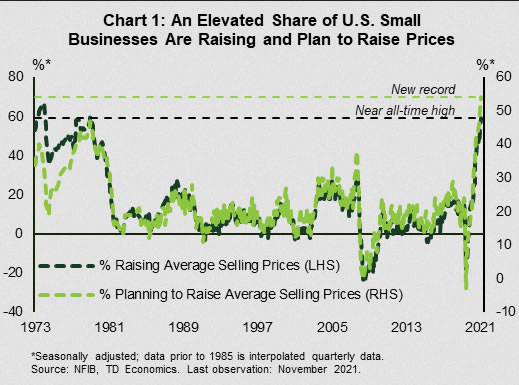
Inflation remained the focus of financial markets this week, with economic data providing continued evidence of accelerating price pressures. Producer prices picked up steam, rising to 9.6% year-on-year in November from 8.8% in the month prior. The acceleration indicates broad-based price pressures throughout the supply chain. Small businesses are also cranking up the pressure. The National Federation of Independent Businesses optimism survey showed that in November, 59% of businesses had raised average selling prices and another 54% plan to raise them further in the months ahead. The former metric is near its all-time high set in the 1970s and the latter is at a new record (Chart 1).
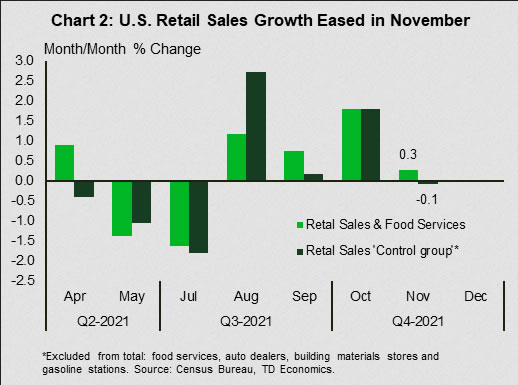
Inflationary pressures also featured prominently in the retail sales report. Sales rose 0.3% in November, below the consensus forecast for a 0.8% print (Chart 2). A strong 1.7% showing in sales at gasoline stations, which reflects hefty energy price gains, helped drive up the headline. Excluding the more volatile categories (including gasoline), sales in the “control group,” used to estimate personal consumption expenditures (PCE), were down 0.1% on the month. The soft November print can be partially explained by some pull-forward in activity, with consumers starting their holiday shopping early given expected shortages and delays. Less generous holiday discounts relative to what consumers may have been accustomed to are also likely to have played a role in last month’s slow-down. A further moderation in activity is likely in December, given the added hurdle of a worsening epidemiological situation.
New COVID-19 infections have risen across much of the country and hospitalizations have followed suit. The infections trend is likely to worsen further with the spread of the much more transmissible Omicron variant, which has been detected in most U.S. states. This is expected to weigh on consumer and tourism-related activities.
The Fed is well aware of the above two competing forces – rising inflationary pressures and a worsening public health situation. Economic projections from this week’s FOMC meeting show that most committee members expect the setback from the latest infection wave to prove short-lived. The median forecast calls for the unemployment rate to fall further, reaching 3.5% by the end of 2022. Another potential obstacle to growth, the country’s debt ceiling, was neutralized with the swipe of the pen on Thursday, with President Biden signing a $2.5T ceiling increase into law.
Continued progress toward maximum employment will allow the Fed to focus its efforts on slaying the inflation dragon. It is already moving in that direction. The Fed left the policy rate unchanged at this week’s FOMC meeting, but accelerated the taper of its Quantitative Easing (QE) program. The Fed will reduce the monthly pace of purchases of Treasuries securities by $20 billion and agency mortgage-back securities by $10 billion. This puts QE on track to end by March of next year, opening the window for rates to lift off soon after. This is in line with our expectations. In our updated forecast published earlier this week, we pulled forward our call for the first rate hike to the second quarter of next year, with two more hikes to follow later in the year. This will still leave monetary policy in an accommodative stance, but should help to stem the inflationary tide.
Canada - πoel, πoel
T'was the month before Christmas, and all through the house, Canadians were stirring, discussing bidding wars with their spouse. Sellers were nestled all warm in their beds, while visions of dollar signs danced in their heads. That holiday inspired prologue aside, this week offered a look at how Canadian housing markets fared in November. Home sales bested October's very healthy level, likely supported by buyers pulling forward purchases ahead of rate hikes set to take place next year.
In a trend that may feel as old to Canadians as Christmas itself, home price growth was steamy again last month (average home prices were up 20% year-on-year). However, the story could be different next year, as rising interest rates play the part of the Grinch for prices. Higher rates are more likely to moderate, rather than reverse, the upward trend in prices, as the economic backdrop should remain healthy (see our latest Quarterly Economic Forecast released this week). There are downside risks to growth as the Omicron variant looms large, forcing a tightening of restrictions across the country this week. For housing, investors have accounted for a rising share of purchases, increasing the sensitivity of home sales to rates.
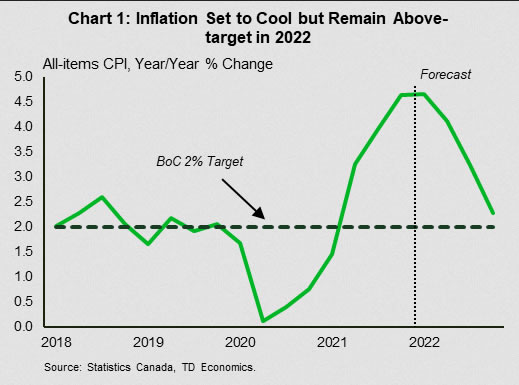
From the frying pan to the fire, so to speak, as this week brought another hot inflation report for November. The Consumer Price Index rose 4.7% year-on-year, and was up 3.1% when eggnog, candy canes (and other food items) alongside energy are excluded. While the year-on-year rate was unchanged, seasonally adjusted price growth slowed to 0.3% on a month-on-month basis, half the pace of the previous two months. Further relief is likely in the cards next year, offering a belated gift to shoppers (Chart 1). Energy prices should be sledding lower, the inflation impulse from economic reopening will likely fade, and supply chain bottlenecks should become less intense. However, plump economic growth will provide some offset to these forces.
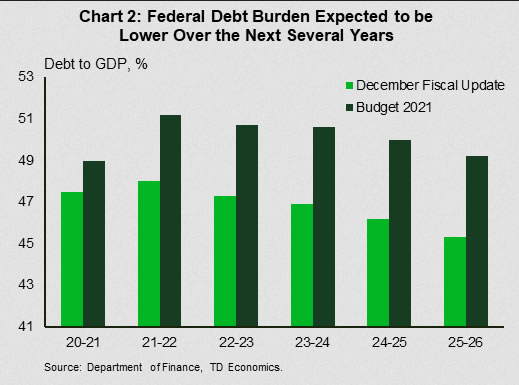
Capping off a tumultuous year, the Bank of Canada and the federal government both made headlines this week. The Bank of Canada renewed its five-year inflation mandate through to 2026, keeping its 2% inflation target and 1 – 3% operating band. However, the Bank now has more flexibility to allow inflation to overshoot in order to achieve maximum sustainable employment. This isn't much of a change, as they'd already operationalized this strategy during the pandemic. For the federal government, solid (nominal) economic growth has been a blessing, helping improve their fiscal position. Indeed, in their fall fiscal update, the government now projects its shortfall to be $38.5 billion lower in FY 2021/22 than the April budget. They've used this room to dole out around $70 billion in new spending through the next several years, mostly to First Nations children and to reform the child-welfare system. This won't stop the government's debt burden from improving (Chart 2), and, in a rising rate environment, that might be the best gift of all for policymakers.
Weekly Focus – Central Banks Choose the Hawkish Path
Central banks were in the spotlight this week, and the general outcome was on the hawkish side. The Federal Reserve brought its forward guidance more in line with what markets and analysts had already been expecting, signalling an end to the QE purchases already by March and the updated 'dots' pointing towards three rate hikes in 2022. Powell highlighted that the decline in labour force has proven more persistent than expected, and tight labour market conditions warrant tightening even if some of the inflation pressures will moderate next year. The overall message was in line with our views, but we now think the first hike is likely to materialize already in May. Read our more in-depth take in Fed Research - Review: Catching up to reality - first rate hike likely in May, 15 December.
The ECB's message was more mixed, though still to the hawkish side of expectations. PEPP net purchases will end by March and the APP purchases will be temporarily increased to EUR40bn/month in Q2 and EUR30bn/month in Q3 in order to smooth out the PEPP ending. ECB still left the APP open-ended, and the purchases will continue from Q4 2022 at a pace of EUR20bn/month, until 'shortly before' the first rate hike. While we do not look for rate hikes in 2022-2023, we cannot rule out a hike in 2023, and the market continues to price in the first 10bp hike in December 2022. PEPP reinvestments will also continue one year longer than previously communicated (until the end of 2024), as ECB emphasized flexibility ahead of still high uncertainty. ECB did clearly raise its inflation forecasts, although it still sees inflation falling below their target to 1.8 % in 2023-2024. Read more in Flash: ECB Review - Data dependent means flexibility and optionality, 16 December.
Bank of England delivered perhaps the most hawkish surprise of the week, hiking rates by 15bp as inflation pressures have continued to rise. BoE pointed towards a gradual hiking cycle, which we agree on, but continue to see market's pricing as too hawkish. Norges Bank faced a similar uncertainty following renewed pandemic restrictions in Norway, but decided to stick with the expected 25bp hike. Importantly, Norges Bank still expects to continue normalizing monetary policy going forward, the rate path points towards the next hike in March and the end of the path was even lifted slightly. Read our review in Reading the Markets Norway: NB hikes policy rates and maintains firm tightening bias, 16 December. On the other end of the spectrum, the Central Bank of Turkey continued cutting rates by 100bp to 14% despite the rising inflation. Communication from Erdogan shows no signs of policy turnaround, which is reflected in the ever depreciating lira.
Over the next three weeks, we will keep an eye on US PCE and Capex data next Thursday for signs of continuing rise in private goods demand and capital investment, as well as the Jobs report on 7 January. The focus will be on labour force participation, where we only expect a gradual recovery. Euro area consumer confidence, due next Tuesday, could fall from the current high levels on the back of the Omicron. Euro area December HICP, due for release 7 January, is likely to come slightly down from November peak, both in terms of headline and core inflation. Core goods and recently elevated natural gas prices pose upside risks. As a next step in the renewed Chinese easing, we see a 50-50 risk of a Loan Prime Rate cut on Monday. Growth-wise, we are likely near the bottom, which should also be reflected in PMIs near year, with the December figures released around New Year.
Week Ahead – With the Central Bank Mayhem Out of the Day, the Festive Wind Down Begins
After a super exciting week, things will wind down significantly in the run up to the Christmas weekend, with the biggest risk for traders likely being suffering from post-central bank blues. Out of all the meetings, the Fed’s announcement undoubtedly had the largest bearing on the markets, whipsawing the dollar. But the bumpy times may not be over just yet for the greenback as the US agenda is the busiest in an otherwise quiet week. Meanwhile, stocks could get an end-of-year boost if China’s central bank heeds calls to cut rates.
Can the aussie, kiwi and loonie find some love?
It’s been a surprisingly dismal year for the major commodity-linked currencies. The Australian and New Zealand dollars started 2021 with gains but slipped into losses as unexpected lockdowns and the resiliency of their US counterpart undermined their appeal. The Canadian dollar has fared somewhat better and could finish the year mostly flat.
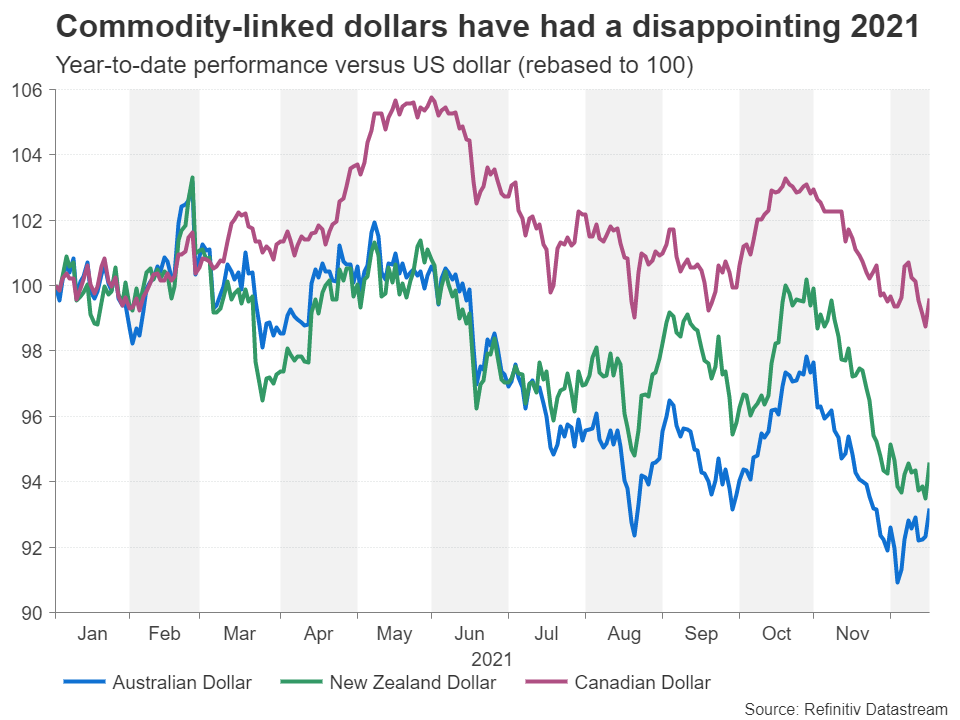
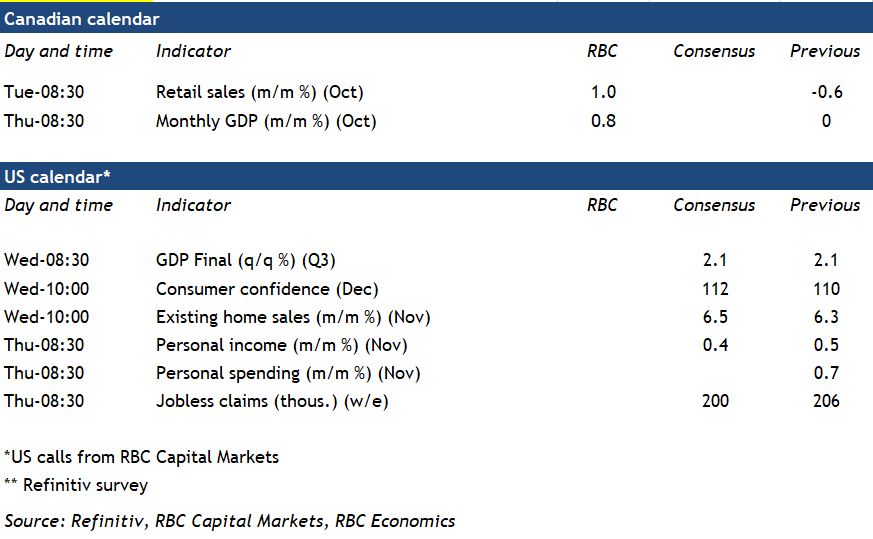
After the Fed’s hawkish pivot, the Bank of Canada will probably feel more comfortable to hike rates sooner than expected amid a robust bounce back in Canada’s labour market. Retail sales figures on Tuesday and the monthly GDP print for October due on Thursday might further bolster the case for earlier tightening.
Australia’s jobless rare is also falling fast following the easing of virus restrictions. But even though markets are not convinced by the RBA’s dovish front, the aussie has not been able to advance much on the back of the growing expectations that policymakers will begin to raise rates in mid-2022.
The minutes of the RBA’s December meeting will be published on Tuesday and could reveal whether there was any discussion about ending bond purchases in February, which would pave the way for earlier rate hikes.
In New Zealand, November trade numbers will kick off the week on Monday but are unlikely to attract much attention for the kiwi.
The PBOC might slash rates
In fact, a more important announcement for the kiwi and its risky rivals will be that of China’s central bank. The PBOC is to decide on Monday whether to cut rates amid stuttering growth in China. Pressure has been growing on Chinese policymakers lately to do more to stimulate the economy. After all, consumer inflation remains manageable for now even though producer prices are soaring, and following the recent reduction in the reserve requirement ratio, there’s been talk that the next move will be a cut in the one- and five-year loan prime rates, which have been on hold since April 2020.
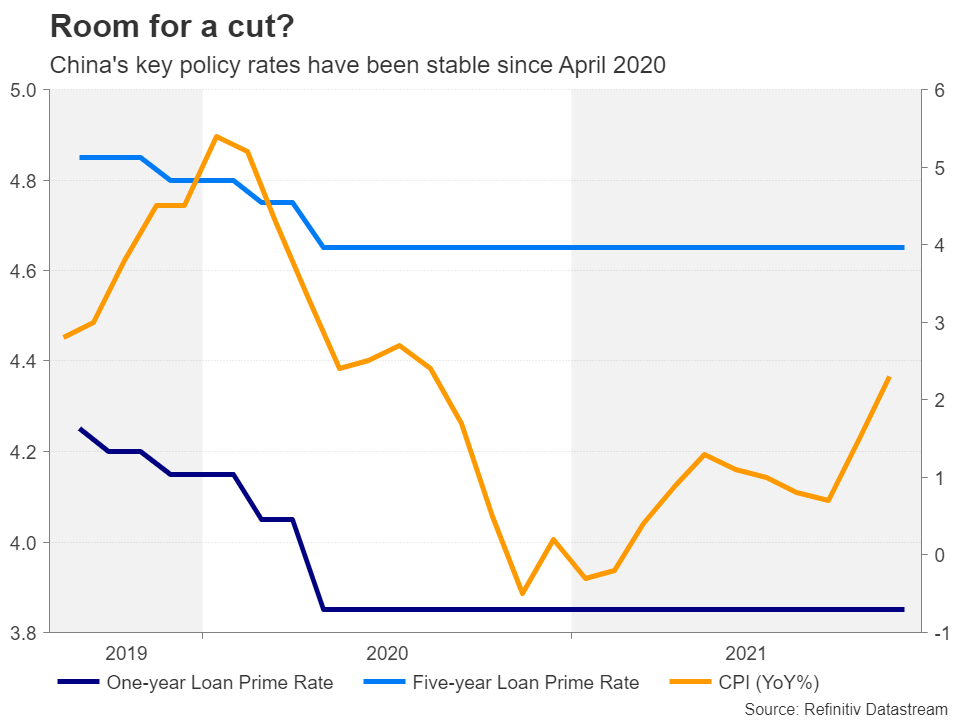
If the key lending rates are lowered by a significant margin, there should be a sizeable boost for Asian equity markets as well as for the China-sensitive aussie and broader risk assets.
China’s property crisis is almost certain to drag on well into 2022, and with the global supply chain chaos further choking growth, a rate cut could go some way in easing the current pessimism.
Inflation is creeping higher in Japan
Another country where consumer prices have yet to skyrocket is Japan. Core CPI was just 0.2% y/y in October. The November readings will be released on Friday and are expected to show an uptick to 0.4%. The upward trend will probably accelerate in 2022 as a big manufacturing nation like Japan that relies on imports for energy and raw materials is unlikely to dodge the inflation surge indefinitely.
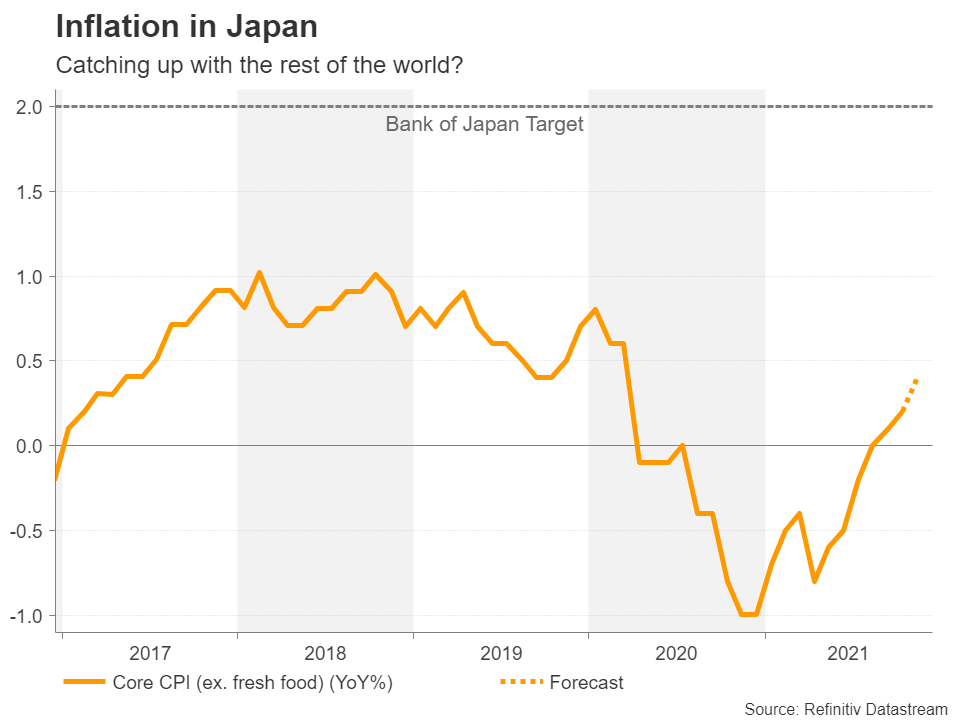
Yet, even with higher inflation, the Bank of Japan is the least likely to tighten policy over the coming year as the country could actually benefit from prices running hot for a while after years of deflation.
Hence, any positive surprise in the CPI data is not expected to provide much of a boost to the Japanese yen.
Euro and pound rebound on shaky ground
Over in Europe, it will be even quieter, and despite plenty of policy signals in the last few days, the euro and pound may still struggle for direction.
The ECB just indicated that it thinks inflation will fall back below 2% by 2023 so there is no need to raise interest rates prematurely, while the Bank of England wrong footed investors for the second meeting in a row, lifting borrowing costs by 15bps.
The BoE clearly is worried about the tight labour market at a time when the supply constraints that are fuelling inflation look set to persist for some time yet. However, the Eurozone has a high unemployment problem so there is less of a risk of elevated inflation becoming entrenched.
But whilst the pound’s positive response to the BoE decision can be justified, the euro’s post-ECB gains are perplexing. Markets have been used to the ECB coming up with dovish twists but in December, policymakers did the least they needed to do to maintain their dovish posture so perhaps this disappointed some traders.
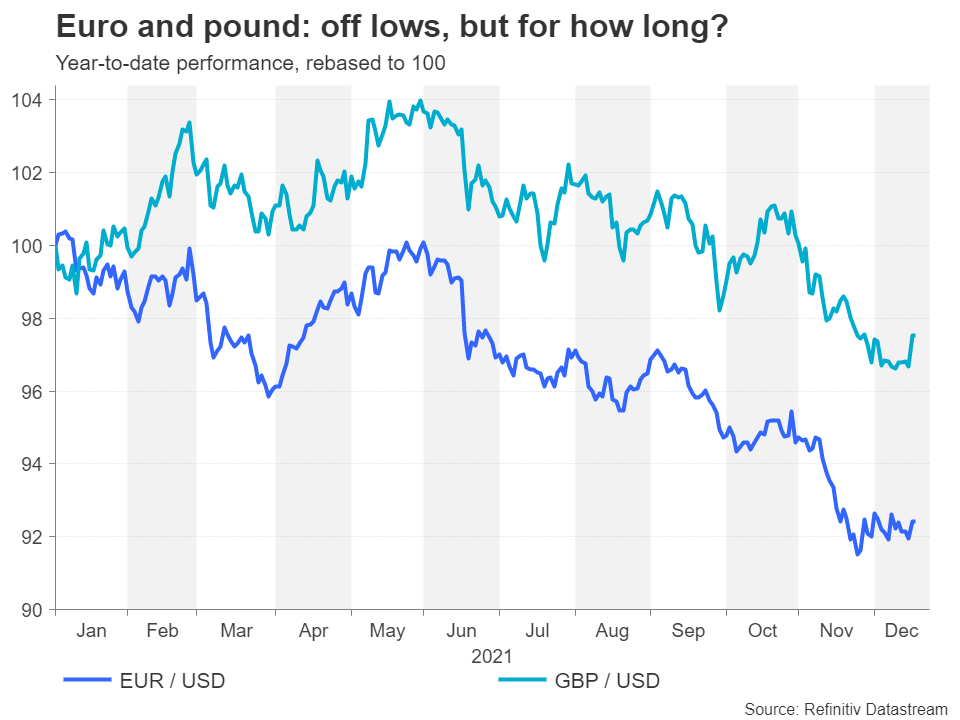
Moreover, although the Fed was quite hawkish, there was relief that Chair Powell didn’t put the FOMC in auto-pilot towards full normalization. All this could be aiding the euro in its efforts to form a stronghold around $1.13. In the meantime, the pound is making progress in reclaiming the $1.33 handle.
Revised UK GDP estimates for the third quarter due Wednesday are unlikely to have much impact on sterling. But US data might ruffle both the pound’s and euro’s feathers.
Dollar bulls eye PCE inflation
The US data dump will begin with the closely watched consumer confidence index and existing home sales on Wednesday. On Thursday, personal income and spending numbers, along with the core PCE price index will be the week’s highlights. Durable goods orders, new home sales and the final reading of the University of Michigan’s consumer sentiment gauge are out Thursday too.
Markets were relaxed about the Fed’s very hawkish turn at the December FOMC. Powell’s clear messaging and willingness to change course if needed probably played a role in staving off panic. But there seems to be a bit of relief too that the Fed wants to bring inflation under control as well as put a stop to all the excess stimulus that some say is to blame for the price spikes.
However, investors may additionally be hoping that acting early means interest rates won’t need to rise by much. But what if the inflation data keeps getting worse? The market calm will be put to the test from the PCE inflation numbers.
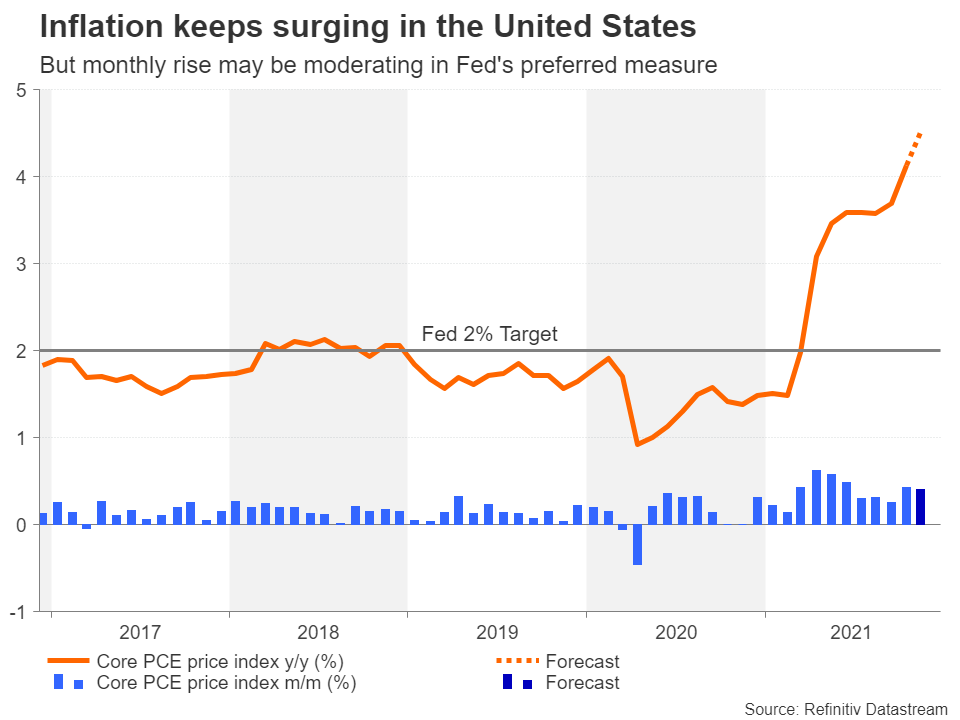
The core PCE price index – the Fed’s preferred price metric – is forecast to have edged up from 4.1% to 4.5% y/y in November. In addition, consumption is expected to have remained strong, rising by 0.6% month-on-month.
The US dollar took a dive after the Fed decision as Treasury yields slid. This could simply have been a case of buy the rumour, sell the news for the greenback. But things could easily switch around again if investors are reminded that it may take a few more months at the very least before the inflation picture improves.
Forward Guidance: Canadian GDP to Post Gains through November
Next week’s GDP data is expected to align with the early official flash estimate that output rose 0.8% between September and October. Supply chain disruptions at least temporarily eased in the auto sector. And motor vehicle manufacturing sales rebounded following a sharp decline in September (though they were still 30% below year-ago levels). Retail and wholesale sales each increased by roughly a percent in October, according to preliminary estimates from StatCan. Outside of those indicators, oil sands extraction in Alberta was up 7% month over month by our count, adding to the list of industries seeing stronger growth.
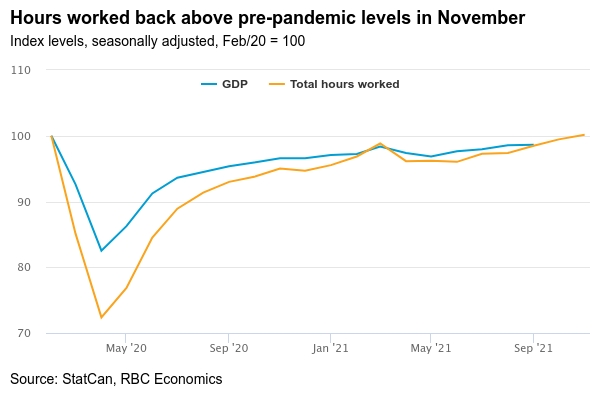
We expect another 0.5% gain in November output, a bit lower than the 0.7% lift in total hours worked in the month. That increase would likely have been larger if it weren’t for significant disruptions caused by flooding in British Columbia during the latter half of the month, which severely impacted local transportation capacity. Our tracking of card transactions pointed to a healthy rebound in travel spending in November. But retail purchases for autos declined, offsetting some of the aforementioned strength. The ebb and flow of global supply chain disruptions will continue to impact the manufacturing sector. But the economy is also getting closer to longer-run production capacity limits, with labour in particular in short supply. That will start to weigh on growth more significantly in 2022 and beyond. We expect GDP growth to slow to 4.3% in 2022 after a 4.7% increase in 2021.
Week ahead data watch:
Canadian October GDP likely rose 0.8% supported by positive retail, wholesale and manufacturing sales data, all tied to a rebound in the auto sector after a particularly sluggish September. Growth is expected to have continued in November with hours worked up another 0.7%.
US personal spending likely edged higher in November with a rise in spending on services and price-led jump purchases at gasoline stations. Retail spending outside of gasoline stations was unchanged in November.
Commodities Outlook: What Does 2022 Hold for Gold and Oil as Virus Still Lingers?
In 2021, optimism about the global economic recovery pressured gold to retreat from its 2020 highs but remain comfortably above its pre-pandemic levels. Next year, in an environment of higher interest rates, rising bond yields and a stronger US dollar, bullion’s prospects seem ominous. On the other hand, growth commodities like oil and industrial metals, whose fortunes are heavily dependent on global economic performance have appreciated in the current year. If the world continues to make progress in keeping the Covid-19 pandemic under control, strong demand will probably boost cyclical commodities further.
Fed policy might spell trouble for gold
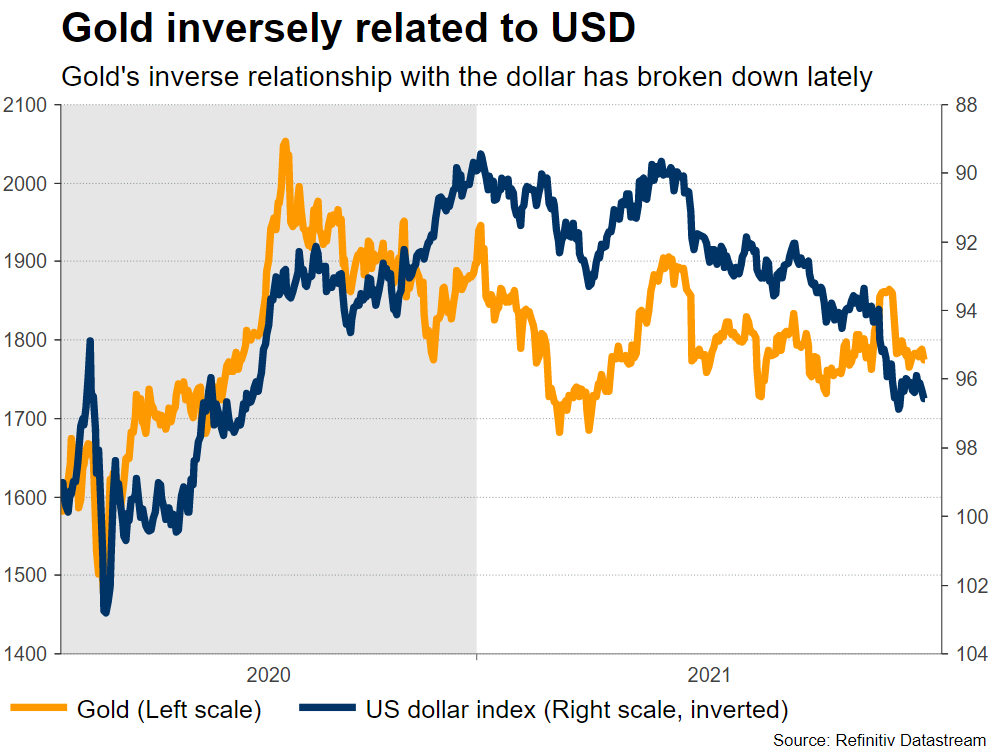
One of the most significant drivers for the price of gold in 2022 will be Fed policy, and primarily its impact on the US dollar. As the US jobs market has been recovering quite strongly in 2021 and surging inflation continues to haunt policymakers, the Fed has set the markets for a faster normalization of policy, accelerating its tapering program and flagging a more aggressive rate hike path.
Fed tightening would make the dollar more appealing relative to currencies bound to relatively looser monetary policies, such as the euro and yen. Since gold is mostly denominated in dollars, the roaring greenback could decrease the purchasing power of other currencies, further curtailing bullion demand.
Real yields remain a key driver
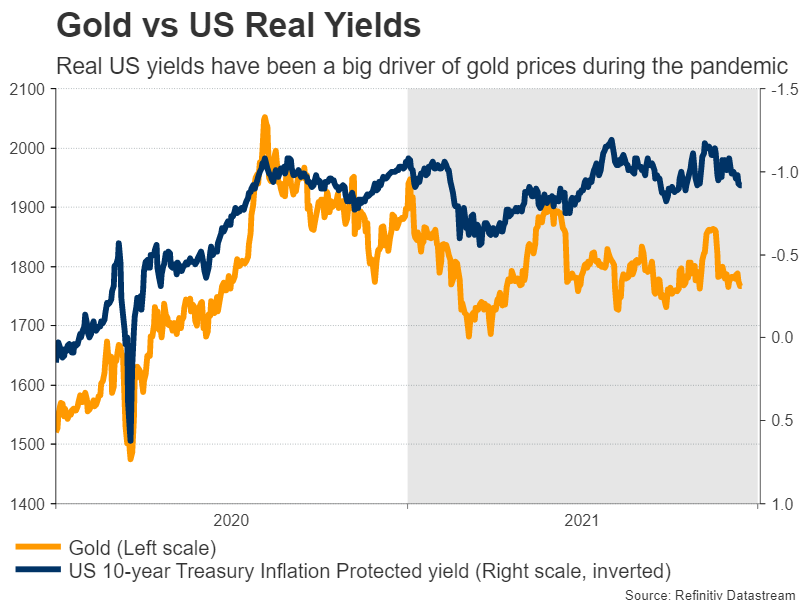
In 2021, government bonds failed to play the role of defensive assets as soaring inflation combined with low interest rates impeded their ability to generate income. However, gold did not manage to capitalize on its inflation hedging attributes in these conditions because investors shifted their focus to Treasury Inflation-Protected Securities (TIPS). In contrast to the yellow metal, TIPS not only provide protection against rising inflation but also pay a coupon that increases as inflation fires up.
In the upcoming year, inflationary pressures are expected to subside, while central banks are anticipated to raise interest rates that tend to push up sovereign bond yields. Should the Fed raise rates and inflation falls back as is being predicted, higher Treasury yields alongside lower inflation could push real yields back to the positive region. This would make government bonds more attractive than gold, which on top of generating zero interest also carries storage costs. Hence, positive or at least increasing real yields would probably cast a shadow over demand for gold.
Geopolitical risks and resurgence of Covid-19 might rescue gold
Geopolitical tensions can often spook global markets, triggering risk-off sentiment and boosting safe haven demand. Although gold has been somewhat unresponsive to geopolitical flare-ups lately, there are several lingering dangers that could explode into something bigger in 2022.
Military tensions are brewing in several hotspots. Russia is lining up troops on the Ukrainian border, with US officials fearing Moscow is preparing for an invasion. China, meanwhile, has been flexing its military muscles near Taiwan, while the US and Iran seem unable to find common ground in their negotiations over Tehran’s nuclear program.
On the virus front, the emergence of the Omicron variant has highlighted how the pandemic is far from over. If the existing vaccines prove ineffective against Omicron or other future variants, the global economic recovery might get derailed. Therefore, should governments impose new restrictions in 2022, risk aversion would soar again, increasing gold’s safe-haven appeal.
Gold levels to watch
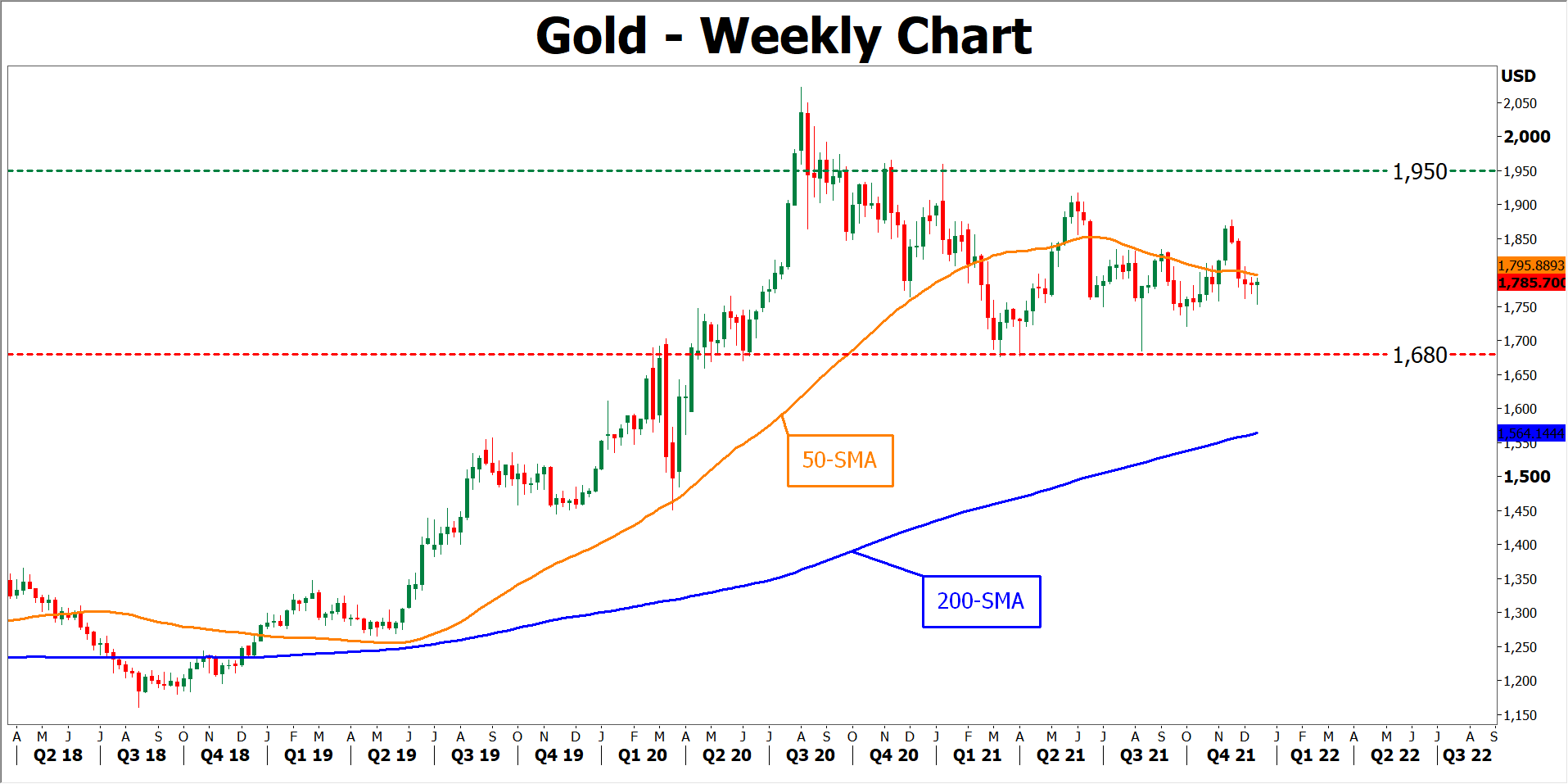
From a technical perspective, gold has been giving up ground in 2021, but the price appears to have adopted a more sideways pattern since June. In the positive scenario, an important upside target price for gold is $1,950. However, given the dollar’s persistent strength and the global trend in rising rates, the downside risks seem greater heading into 2022, putting the spotlight on the $1,680 region.
Oil to enter 2022 on a softer footing
Oil prices rebounded from the pandemic induced lows of April 2020, starting 2021 on more ‘reasonable’ levels. Throughout the year, supply was unable to keep up with increasing demand due to the strong economic upturn that followed the economic shutdowns of the first coronavirus wave. This supply deficit, together with OPEC’s reluctance to increase output, caused oil prices to skyrocket, reaching a seven-year high in October.
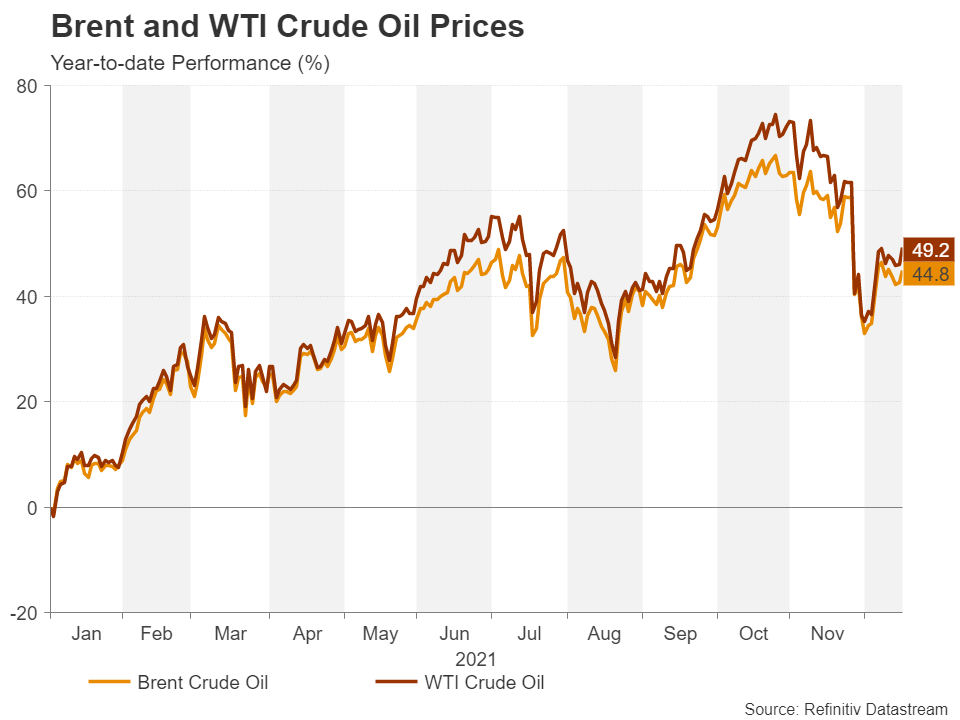
In 2021, WTI crude oil surpassed $80 per barrel at a time when many Covid-19 restrictions were still in place. Heading into the new year, demand for oil is expected to rise further, reaching pre-pandemic levels in the first quarter. But the previously more bullish forecasts have been scaled back following the emergence of the Omicron variant, dimming hopes that 2022 can be another stellar year for ‘black gold’.
Oil prices staged a spectacular pullback in November after Omicron reignited fears of slowing economic growth. Some of the panic has since abated, but until there is more conclusive evidence that this new strain is not as severe as previous variants, the rally is likely to remain on pause.
In the interim, the diminishing prospect of an Iran nuclear deal is supporting the commodity. Talks between Western powers and Iran have not been progressing as well as hoped. Time will tell if the gap between the two sides will close in 2022, as the US piles pressure by tightening the enforcement of existing sanctions.
Depleting inventories to boost demand
Global oil inventories have fallen substantially in 2021, indicating an extremely under-supplied market, setting the stage for higher oil prices for the year to come. In Cushing, Oklahoma, the delivery point for WTI crude futures contracts, oil inventories are currently 50% lower than at the beginning of the year.
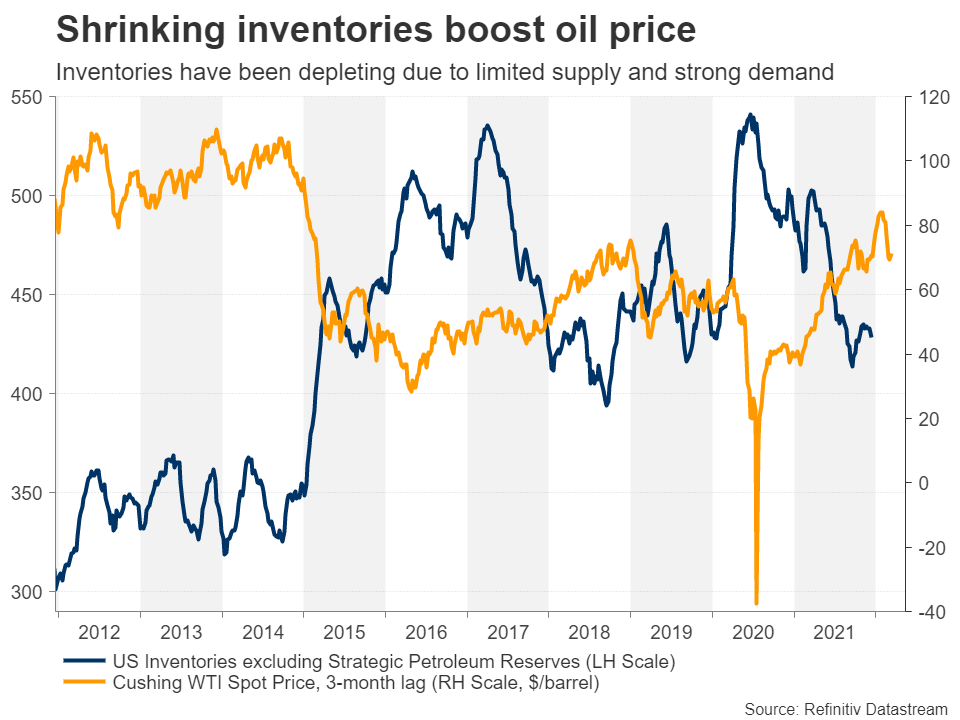
The depleting inventories are also mirrored by the higher price in near-term future contracts compared to longer dated ones, which also reflects market expectations that the shortages will subside within 2022. This difference in future contracts’ prices is known as backwardation, which was historically considered as a bullish sign for oil.
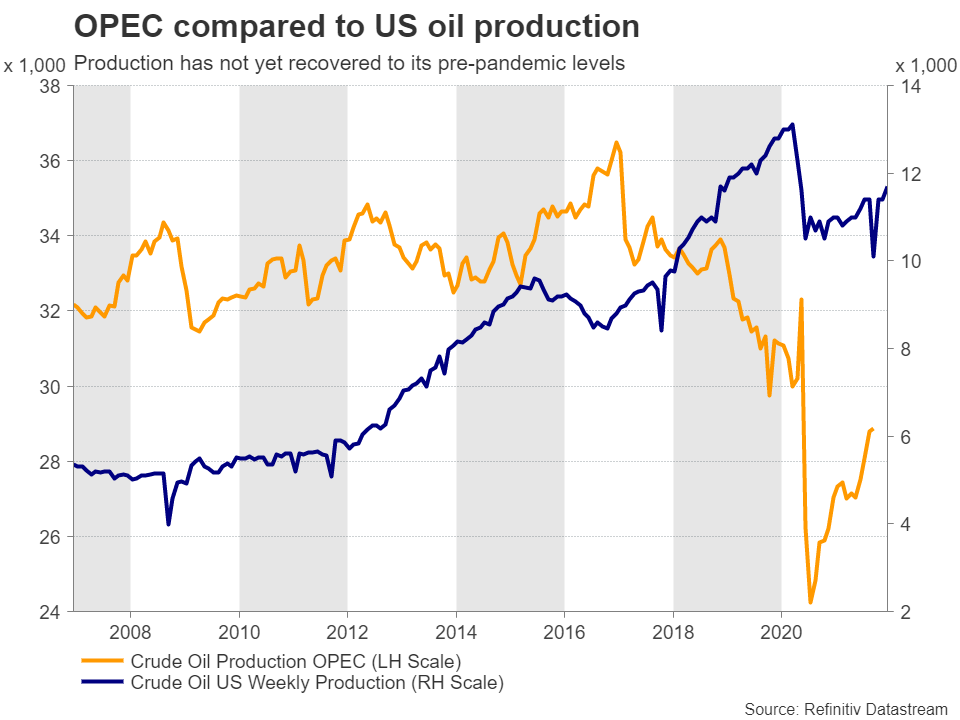
Despite the current deficit, forecasts expect a modest surplus for next year driven by increased production. At its December meeting, the OPEC alliance stuck to its agreement of increasing production by 400,000 barrels of oil per day for each month until September.
Non-OPEC supply in the spotlight
Next year’s surplus expectations are mainly driven by an anticipated increase in production from non-OPEC countries. But how realistic are these output forecasts when the oil industry is under attack due to the global shift towards green energy? The switch towards carbon neutrality by many governments has led to persistent underinvestment in new oil fields, especially in the US, amid fears about peak demand being reached soon, raising doubts about whether non-OPEC nations will be able to boost production sufficiently in 2022 even at current elevated prices.
Can industrial metal prices stage a new rally in 2022?
Industrial metals, led by copper and iron ore, entered 2021 firmly, as the prospects of strong economic growth and the global supply chain disruptions created an imbalance between supply and demand. This caused prices to soar, reaching historic highs during the first half of 2021. However, industrial metal prices headed south in August after the Chinese government cut down steel production amid energy crunches and a struggling property sector.
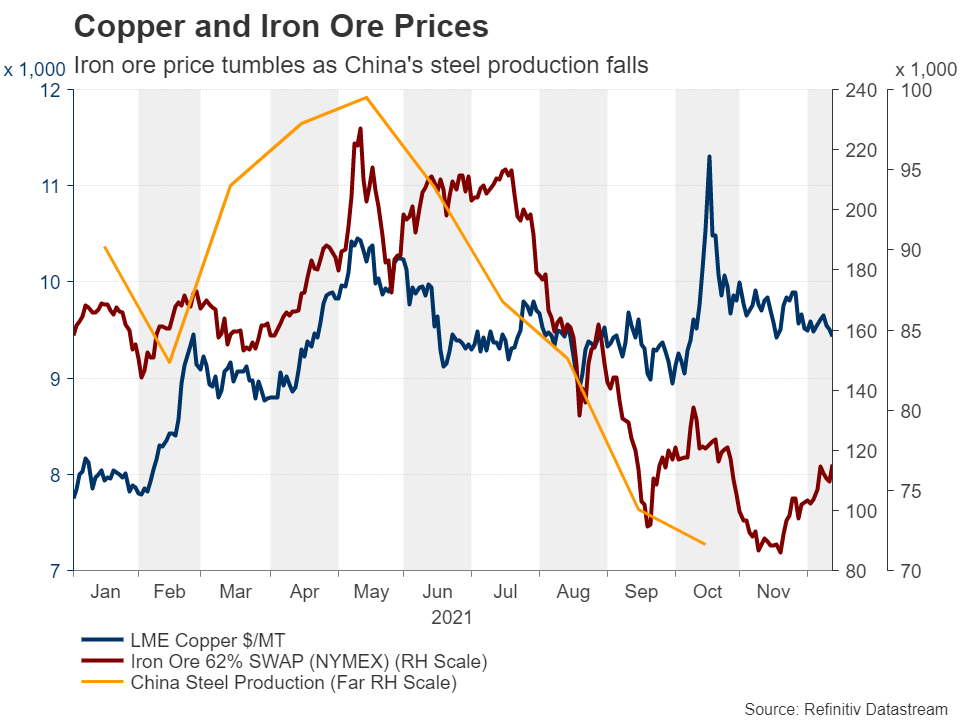
Copper is up about 20% so far this year, while iron ore is down by over 30%. The supply of the latter is expected to outpace demand in 2022 as the world’s largest iron ore miner, Vale, is anticipated to restore supply after the dam collapse in 2019 dented production. This together with weaker demand from China, could set the stage for lower iron ore prices in 2022. In contrast, copper’s outlook remains optimistic for next year amid expectations that demand will remain robust due to its usage in key components such as semiconductors and in renewable energy.
Clouded outlook
The worsening slowdown of the Chinese economy is potentially the biggest risk for industrial metals as well as for broader commodity prices in 2022. Moreover, souring diplomatic and trade relations between China and Australia, as well as persisting tensions with the United States, could generate further volatility in gold, metal and energy prices over the coming year, not to mention the threat of new virus mutations that can evade vaccines.