

Sample Category Title
EUR/CHF Weekly Outlook
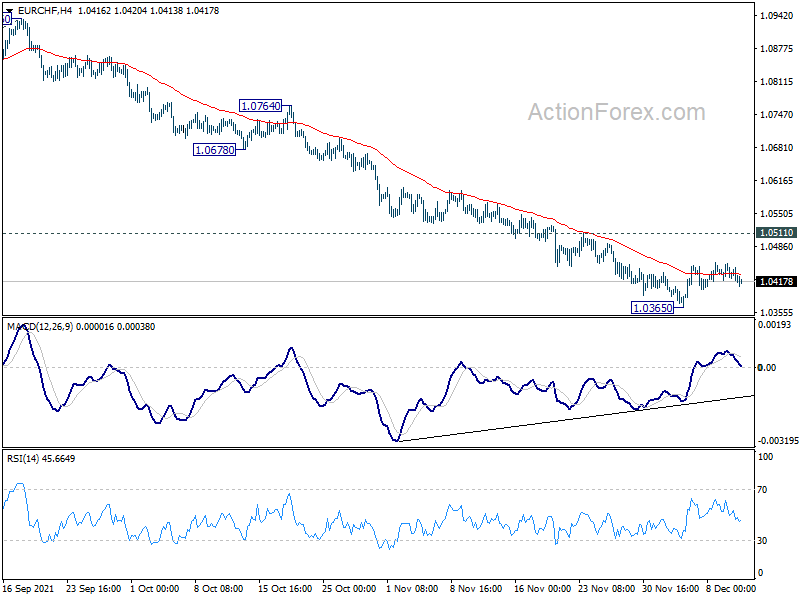
EUR/CHF turned sideway after dipping to 1.0365 last week. Initial bias remains neutral this week for some consolidation first. But further decline is expected as long as 1.0511 resistance holds. On the downside, break of 1.0365 will resume larger down trend from 1.1149 to 161.8% projection of 1.1149 to 1.0694 from 1.0936 at 1.0200 next.
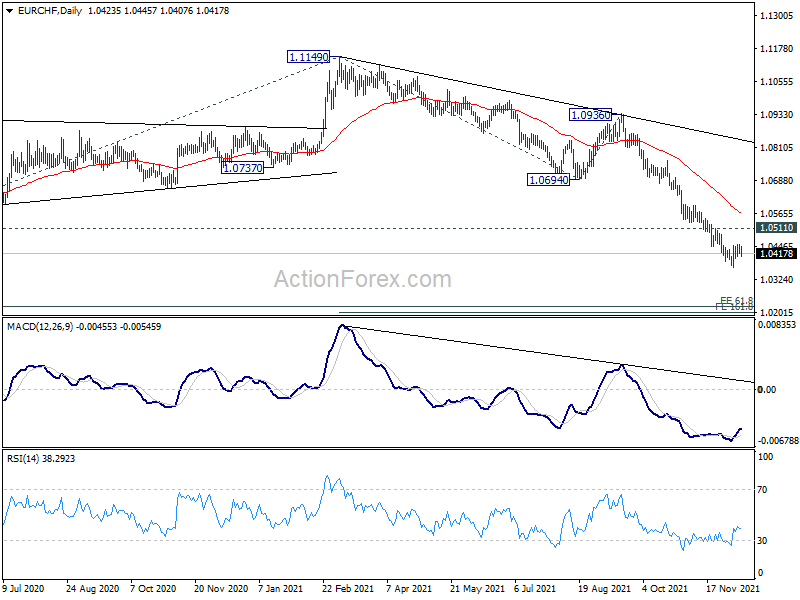
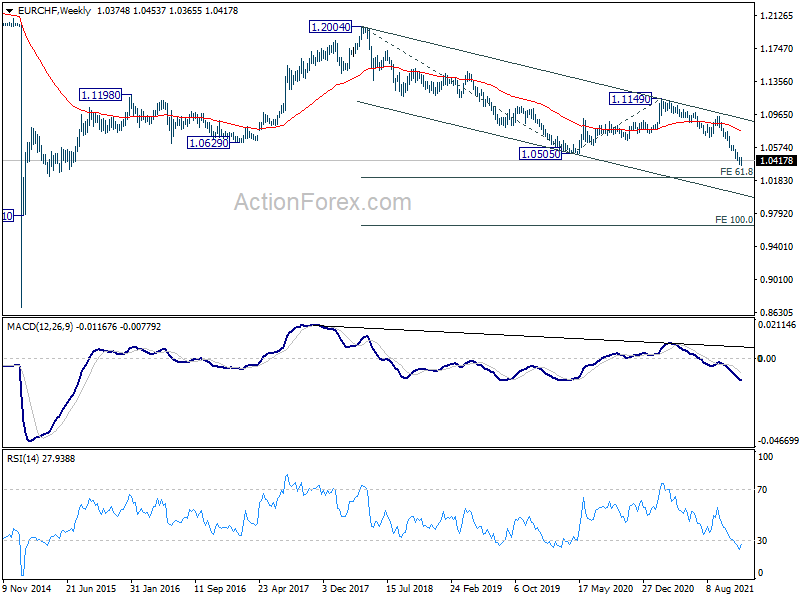
In the bigger picture, long term down trend from 1.2004 (2018 high) is now extending. Next target is 61.8% projection of 1.2004 to 1.0505 to 1.1149 at 1.0223. On the upside, break of 1.0694 support turned resistance is needed to be the first sign of medium term bottoming. Otherwise, outlook will remain bearish even in case of rebound.
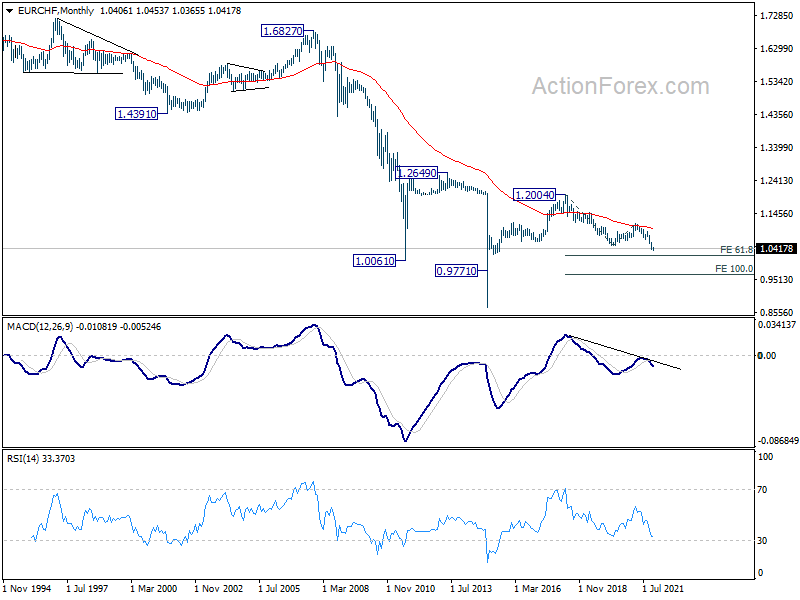
In the long term picture, rejection by 55 month EMA (now at 1.1015) maintains long term bearishness. Down trend from 1.2004 is now in progress for 61.8% projection of 1.2004 to 1.0505 to 1.1149 at 1.0223. Firm break there will target 100% projection at 0.9650.
Markets Back in Risk-on Mode, But Forex Mixed Awaiting Central Bank Meetings
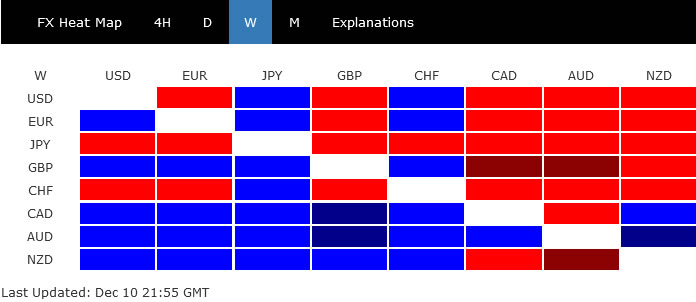
Investors seemed to have already put Omicron risks behind last week, with markets turned back into risk-on mode. But the forex markets were indeed quite mixed. Commodity currencies were the strongest ones, but the rebounds are looking more like corrective. Yen was the worst performer, but the pull-backs were very shallow
Dollar remain stuck in range against European majors and Yen, despite multi-decade high CPI reading. Sterling was pressured for a while on return to pandemic restrictions, but there was no follow through selling. The markets would probably need to see something noticeable from the central bank meetings (Fed, SNB, BoE, ECB, BoJ) this week to set the tone for the rest of the year.
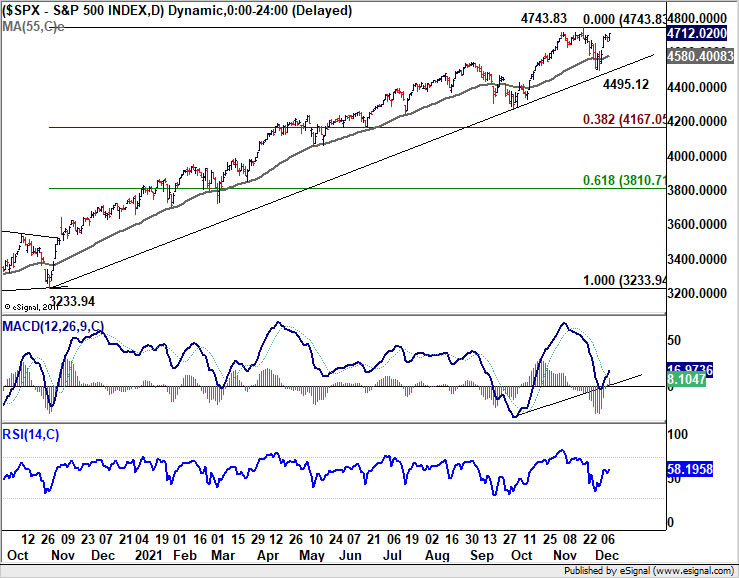
S&P 500 ready to resume up trend after record close?
S&P 500 managed to close at a record high at 4712.02 last week, even though it was short of intraday record at 4743.83. At this point, we're not too convinced that the correction from 4743.83 has completed at 4495.12. Instead, we're expecting another falling leg to complete a three-wave pattern. Break of 4631.97 gap support will bring deeper fall to retest 4495.12 at least.
But admittedly, SPX is holding well above medium term rising trend line. So, an imminent up trend resumption cannot be totally ruled out. Firm break of 4743.83 will pave the way to 138.2% projection of 2191.86 to 3588.11 from 3233.94 at 5163.55.
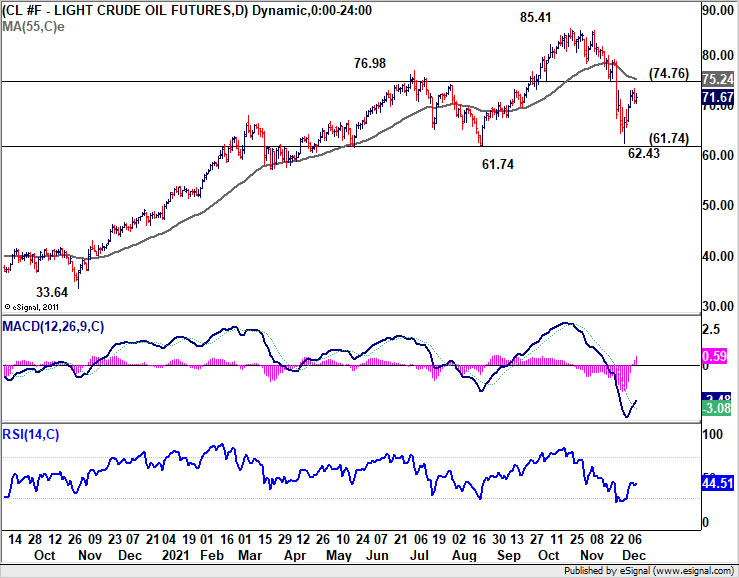
WTI rebounded after defending key support
Positive sentiment was also reflected in the rebound in WTI crude oil. It should have made a short term bottom at 62.43, after defending 61.74 key support level. But it's also too early to say that it's reversing the whole fall from 85.41, rather than correcting it. As long as 55 day EMA (now at 75.24) is limiting the rebound, we'd expect at least one more take on 61.74 support.
Yet, sustained trading above 55 day EMA will pave the way to retest 85.41 high, which will be another sign of positive market sentiment.
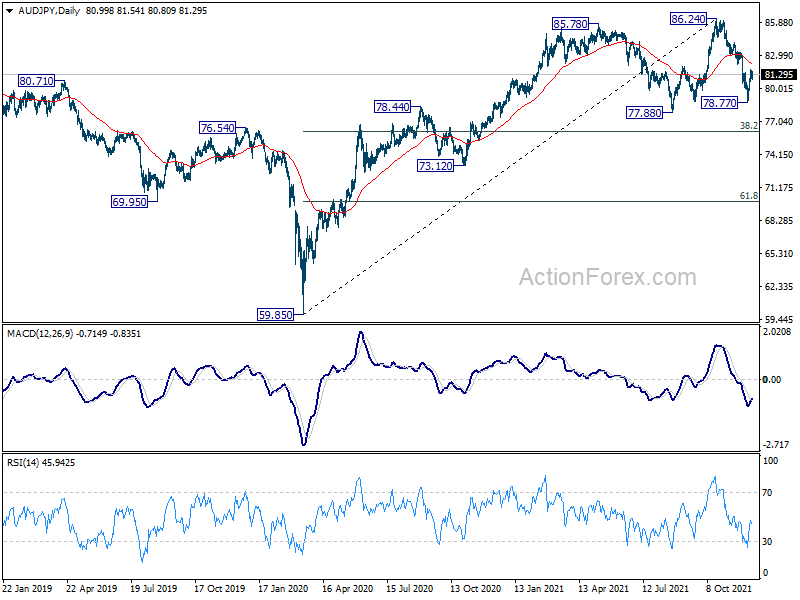
AUD/JPY's correction not finished despite rebound
AUD/JPY's rebound last week suggests that a short term bottom was formed at 78.77. While some more upside is likely for the near term, strong resistance could be seen at around 55 day EMA (now at 82.24), to limit upside.
Break of 78.77 will extend the fall from 86.24, as a correction to whole up trend from 59.85, to 38.2% retracement of 59.85 to 86.24 at 76.15 to complete the correction. That would be in-line with the overall view that risk market up trend is no ready to resume. However, sustained trading above 55 day EMA will dampen this view and bring retest of 86.24 high instead.
EUR/GBP to look into ECB and BoE
EUR/GBP would be an interesting one to watch this week with BoE and ECB featured. In particular, either a rate hike or not, markets could see BoE decision as a surprise.
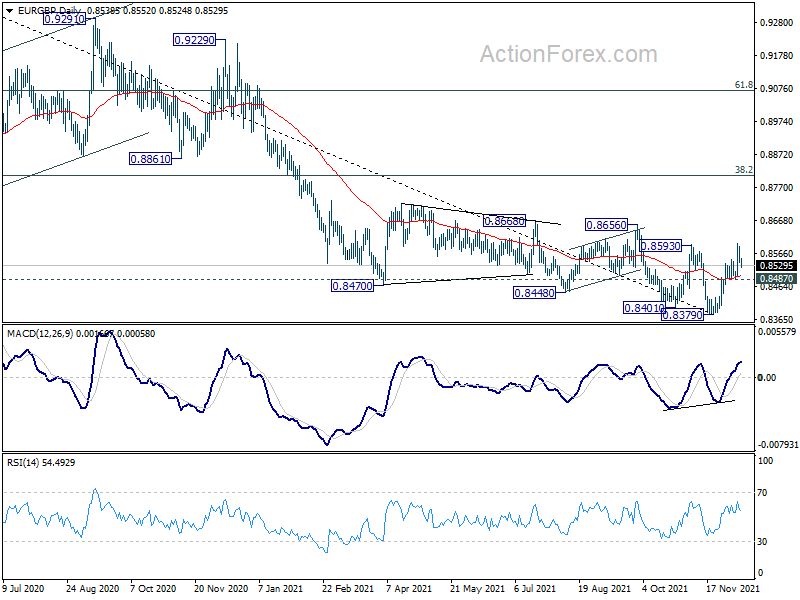
The crossed breached 0.8593 structural resistance last week but couldn't sustain above there. For now, further rise is in favor as long as 0.8487 minor support holds. Break of 0.8598 and sustained trading above 0.8593 will be the first sign that whole down trend from 0.9499 is complete. Such development could open up further rally through 0.8656 resistance to 38.2% retracement of 0.9499 to 0.8379 at 0.8807.
However, break of 0.8487 support will likely extend the down trend from 0.9499 with one more leg through 0.8379 low.
USD/JPY awaits Fed's tapering decision and dot plot
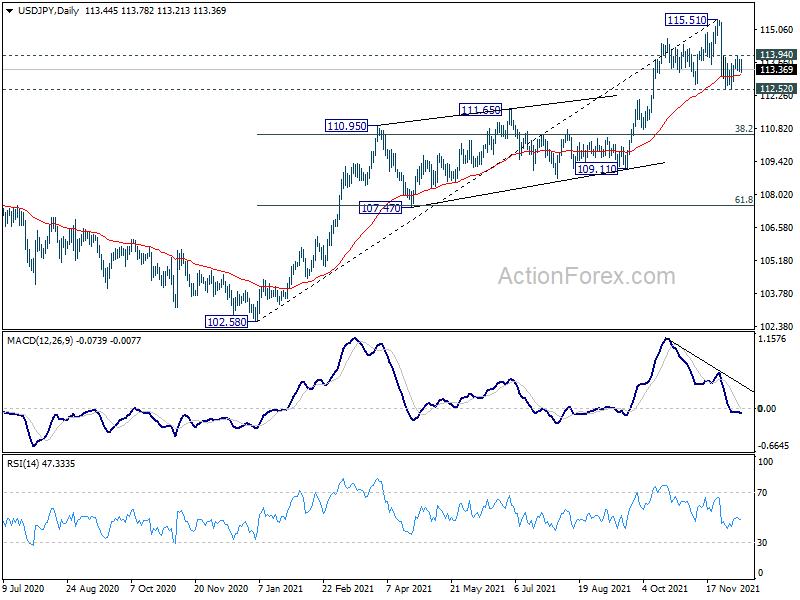
On the other hand, USD/JPY will looking into Fed's decision and projection to guide a range break out (BoJ will likely be a non-event). The question is now much faster Fed would adjust the tapering plan to, and the pace of rate hike as indicated in the new dot plot. And of course, subsequent reactions in risk sentiment.
While break of 113.94 minor resistance will bring retest of 115.51 high, firm break there will need to be accompanied by confirmed up trend resumptions in stocks. On the other hand, break of 112.52 support will extend the correction from 115.51 to 38.2% retracement of 102.58 to 115.51 at 110.57.
USD/CAD Weekly Outlook
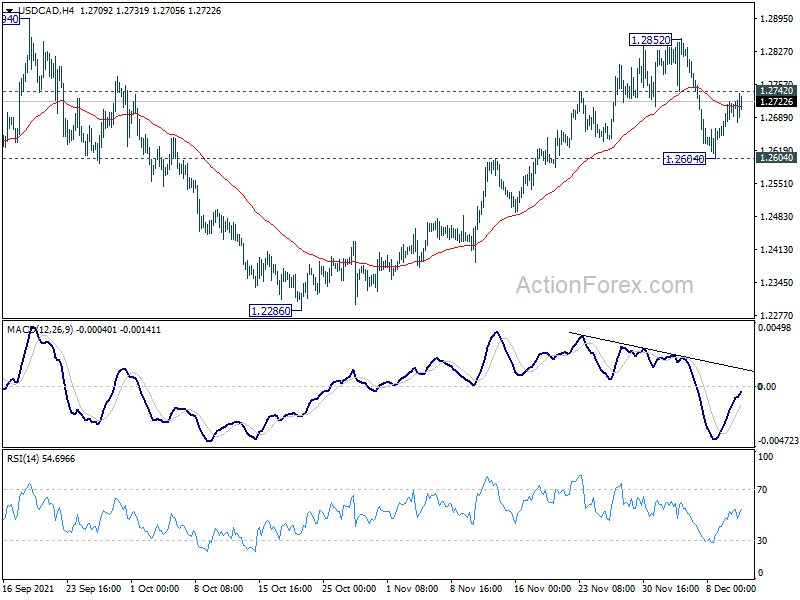
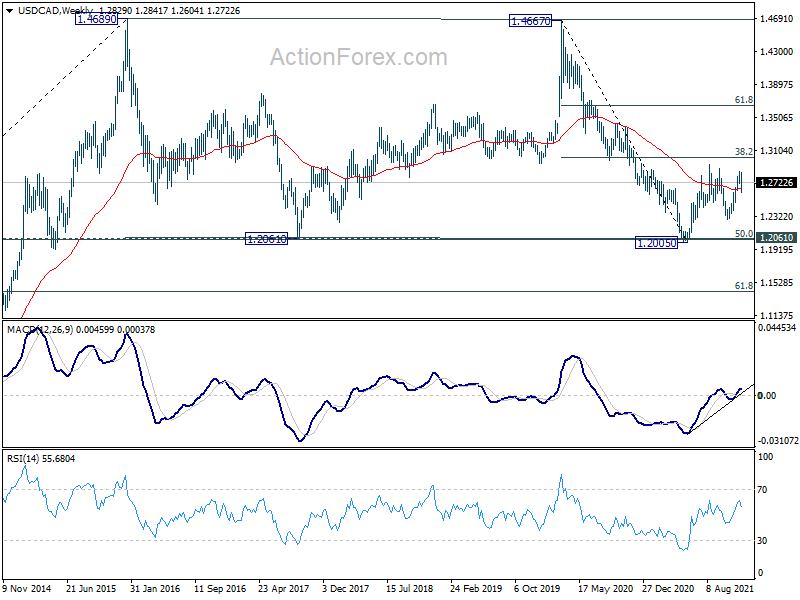
USD/CAD dropped to 1.2604 last week but quickly rebounded. Initial bias remains neutral this week first. On the upside, break of 1.2742 minor resistance will retain near term bullishness and bring retest of 1.2852 first. Break there will resume whole rise from 1.2286 to retest 1.2894/2947 resistance zone. On the downside, however, firm break of 1.2604 will argue that rise from 1.2286 has completed. Deeper fall would be seen back to 1.2286 support.
In the bigger picture, medium term outlook remains neutral for now. The pair drew support from 1.2061 cluster and rebounded. Yet, upside was limited below 38.2% retracement of 1.4667 to 1.2005 at 1.3022. On the upside, firm break of 1.3022 should affirm the case of medium term bullish reversal. However, break of 1.2286 will turn focus back to 1.2005 low again.
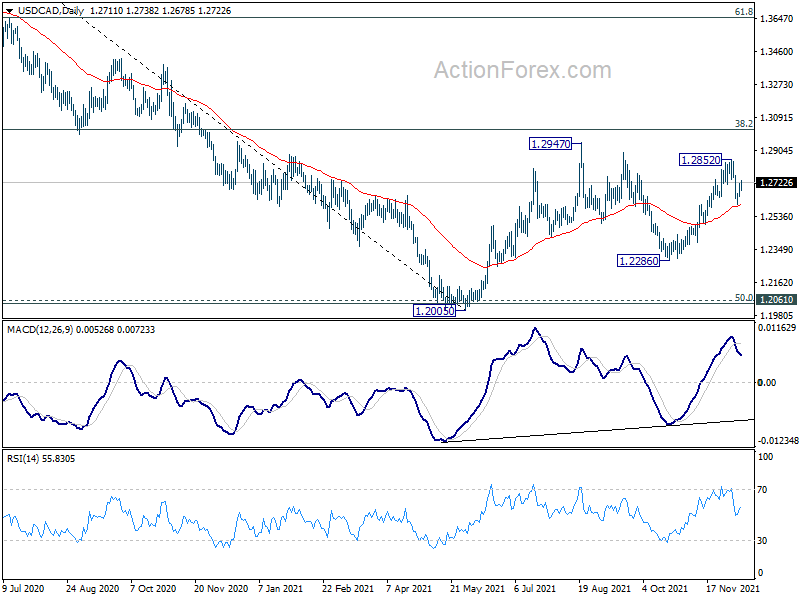
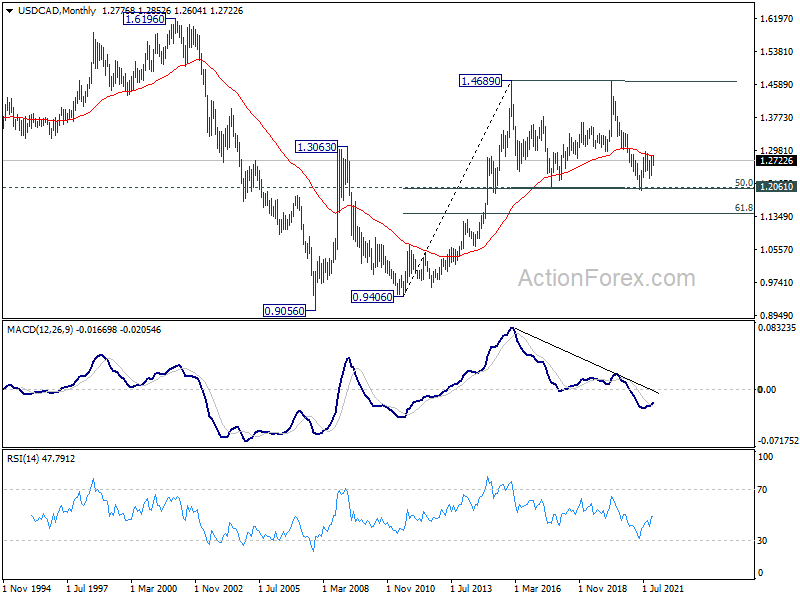
In the longer term picture, we're viewing price actions from 1.4689 as a consolidation pattern. Thus, up trend from 0.9506 (2007 low) is still expected to resume at a later stage. This will remain the favored case as long as 1.2061 support holds, which is close to 50% retracement of 0.9406 to 1.4689 at 1.2048. However, firm break of 1.2061 support will argue that USD/CAD has already started a long term down trend. Next target is 61.8% retracement of 0.9406 to 1.4689 at 1.1424.
CFTC Commitments of Traders – Risky Currencies Recovered Weeks of Selloff
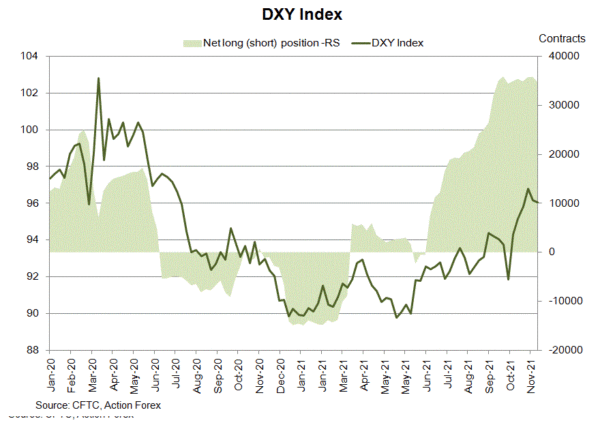
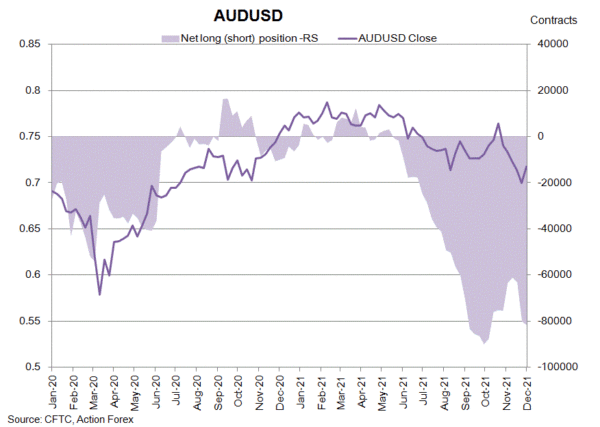
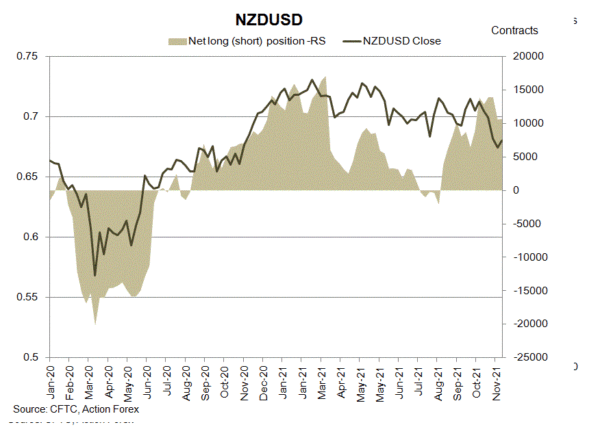
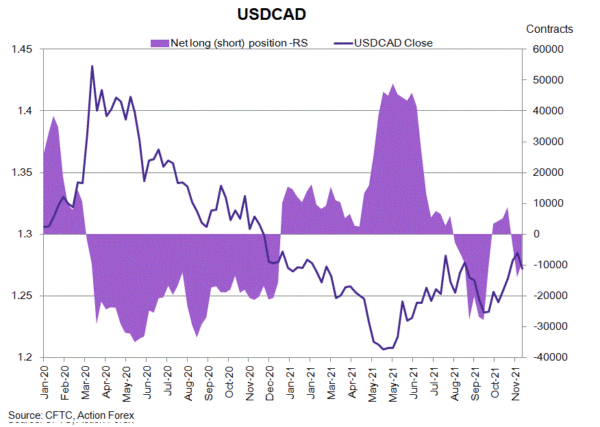
As suggested in the CFTC Commitments of Traders report in the week ended December 3, NET LENGTH of USD index futures fell -1 014 contracts to 34 865. Bets on long and short increased +1 048 contracts and 2 062 contracts, respectively . Concerning European currencies, NET SHORT of EUR futures sank -14 941 contracts to 8 299 while that of GBP futures decreased -622 contracts to 38 277.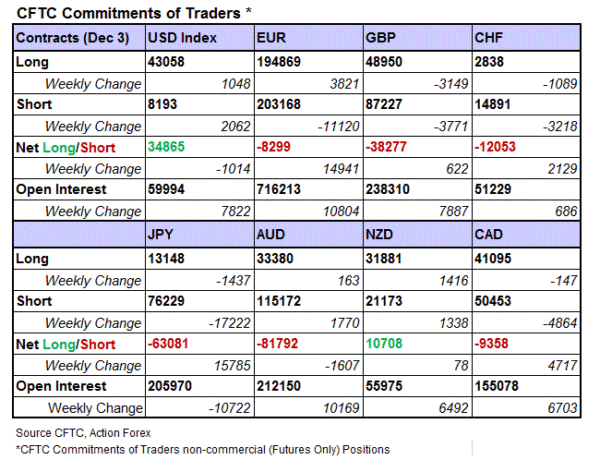
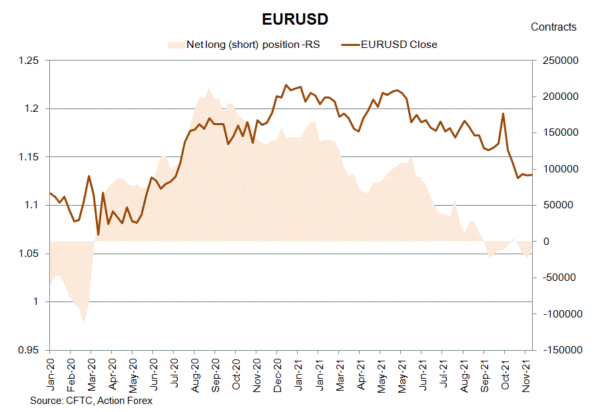
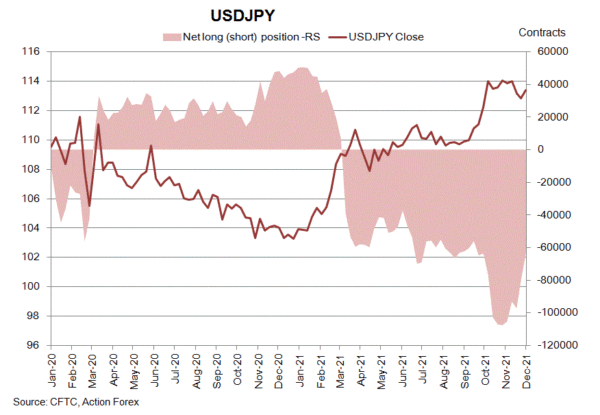
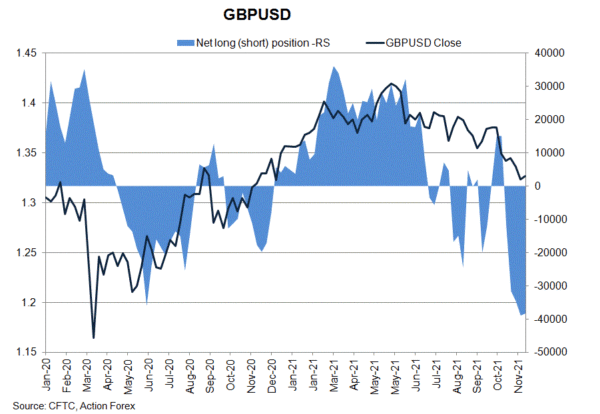 On safe-haven currencies, NET SHORT of CHF futures dropped -2 129 contracts to 12 053 while that of JPY futures soared +15 785 contracts to 63 081. Concerning commodity currencies, NET SHORT of AUD futures added +1 607 contracts to 81 792. NET LENGTH for NZD futures added +78 contracts to 10 708 during the week. NET SHORT of CAD futures slipped -4 717 contracts to 9 358.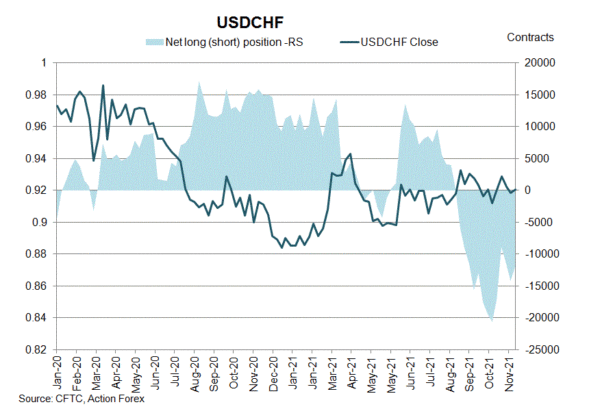
CFTC Commitments of Traders – Traders Trimmed Long Position in Crude Oil. Rebound Triggered Profit-taking
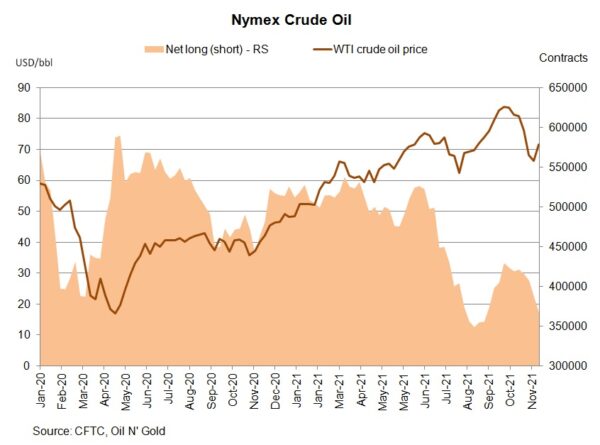
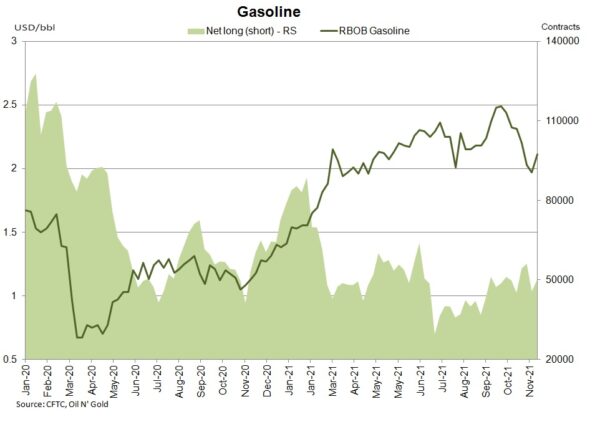
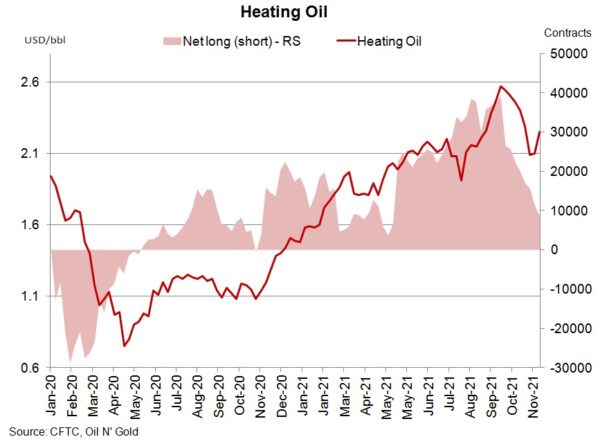
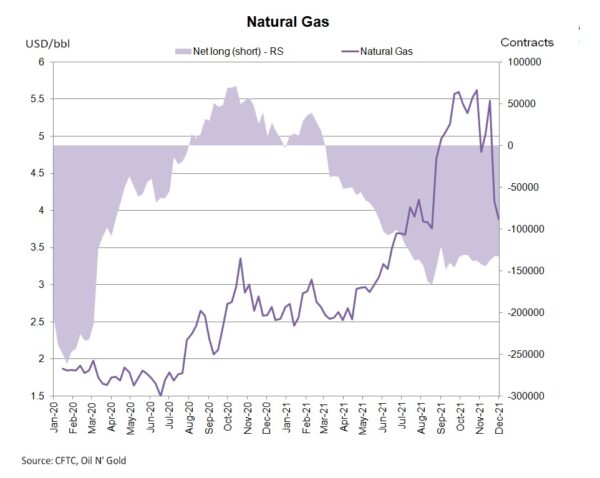
According to the CFTC Commitments of Traders report for the week ended December 7, NET LENGTH of crude oil futures slumped -20 002 contracts to 367 232. Speculative longs declined -19 277 contracts while shorts added +725 contracts. For refined oil products, NET LENGTH for heating oil dropped -2 628 contracts to 8 597, while that for gasoline gained +4 269 contracts to 49 883. NET SHORT of natural gas futures slipped -235 contracts to 132 443 during the week.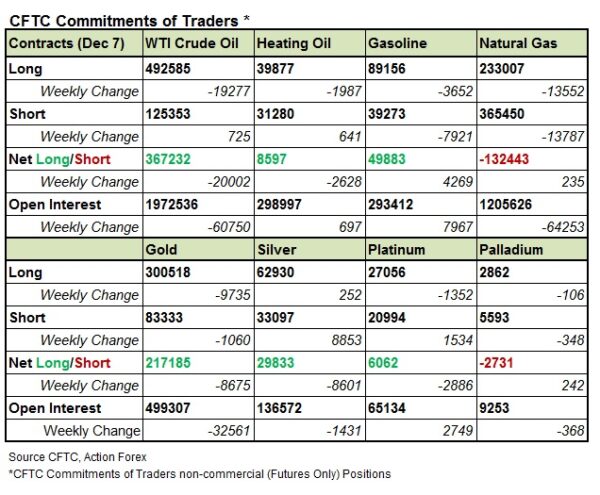
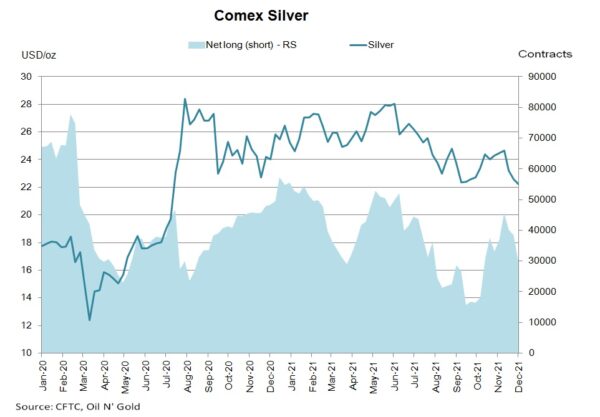
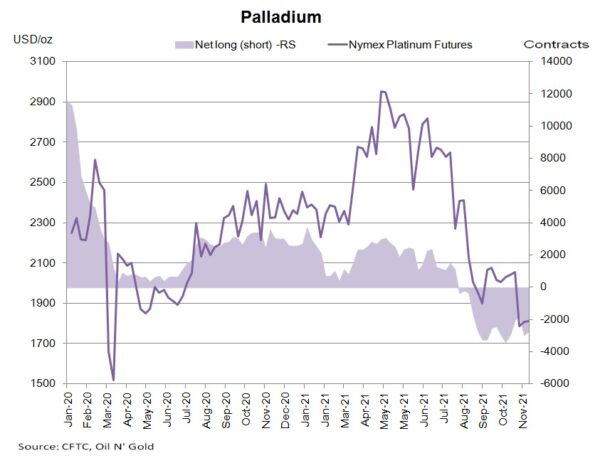
 Gold futures’ NET LENGTH sank -8 675 contracts to 217 185. Silver futures’ NET LENGTH fell -8 601 contracts to 29 833. For PGMs, NET LENGTH of Nymex platinum futures dropped -2 8586 contracts to 6 062, while NET SHORT for palladium futures dipped -242 contracts to 2 731.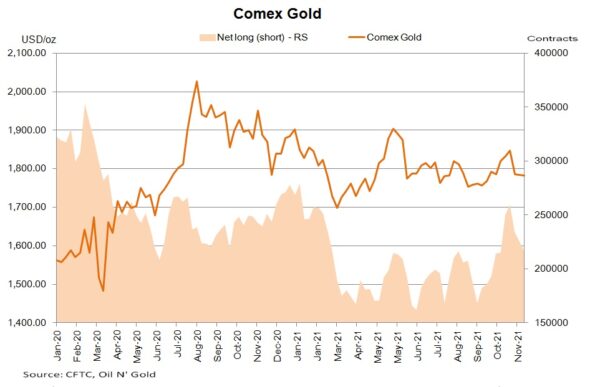
Weekly Economic & Financial Commentary: Restoring Balance in the Post-Pandemic Economy
Summary
United States: Consumer Prices Continue to Climb, Little Reprieve to Supply Issues In Sight
- This week's data continued to demonstrate severe supply problems. The number of unemployed workers per job opening reached a fresh record low of 0.67 in October. Container ships continue to stack up off the San Pedro Bay ports and trade flows are still a ways from normalizing. With little reprieve to supply issues in sight, price pressure will persist into next year. We expect the Fed to announce an acceleration to its wind-down of asset purchases at next week's meeting.
- Next week: Retail Sales (Wed), FOMC Rate Decision (Wed), Industrial Production (Thurs)
International: Subdued Economic News From Europe
- This week's European economic news was soft in tone. U.K. October GDP rose just 0.1% month-over-month, reflecting a steady increase in services activity but a decline in industrial activity. Norway's mainland GDP was also flat for the month of October, a downside surprise. Even with the soft October outcomes we still expect Norway's central bank to raise interest rates at next week's monetary policy meeting, while we lean towards the Bank of England raising interest rates as well.
- Next week: Japan Tankan Survey (Mon), China Retail Sales & Industrial Output (Wed), ECB Monetary Policy Announcement (Thurs)
Interest Rate Watch: Long-Term Interest Rates: What Gives?
- The Federal Reserve has begun tapering its asset purchases and markets are priced for multiple fed funds rate increases in 2022. Despite this, the 10-year Treasury yield remains historically low at 1.48%. Adjusted for the year-over-year pace of inflation, which currently stands at 6.88%, yields are the lowest they have been in decades. So what gives?
Credit Market Insights: Consumer Credit: A Miss or a Step Toward Normalization?
- Consumer credit rose $16.9B in October coming in over $8B short of consensus estimates and dropping off from the September's $28B increase. But the monthly change aligns with non-pandemic prints and was broad based as both revolving and nonrevolving credit came in weaker.
Topic of the Week: Restoring Balance in the Post-Pandemic Economy
- We released our 2022 Annual Outlook this week. The aftershocks of pandemic have led to notable economic imbalances. How do we find balance again?
The Weekly Bottom Line: All About Inflation
U.S. Highlights
- Consumer prices continued to accelerate in November. On year-on-year basis, headline CPI was up 6.8% (from 6.2% previously), the highest in nearly forty years. Core inflation (ex. food and energy) also accelerated, hitting 4.9% (from 4.6% in October).
- This week’s jobs data signaled more tightness with weekly jobless claims dropping to 184,000 and the ratio of unemployed to job openings falling to a new historic low.
Wage pressures are creeping higher. The possibility of faster wage growth become entrenched in prices may motivate the Fed to move even faster.
Canadian Highlights
- The Bank of Canada’s last policy announcement of 2021 was the marquee event this week. A blowout jobs report the week prior had raised expectations that the Bank may move in a more hawkish direction.
- In the event, the Bank kept its cards close to its chest balancing upside and downside risks and leaving its forward guidance for policy liftoff unchanged in the “middle quarters of 2022.”
- The Bank may get one more chance to revise its thinking when it releases its Monetary Policy Report in January. As long as Omicron doesn’t throw the economy off track, the case for moving rates off zero is solid.
U.S. - All About Inflation
It’s inflation week! Anticipation of today’s CPI report created some anxiety in financial markets but ultimately left them back to where they started on Monday. Equity markets appear to have shrugged off Omicron concerns and remains driven by still-solid expectations for earnings. The bond market appears more cautious on the outlook, with long-term yields well below late November levels, even as Fed communication turns more hawkish.
Consumer prices continued to accelerate in November. On a year-on-year basis (y/y), headline CPI was up 6.8% with gasoline prices growing by 58% relative to last year and adding 2.3 percentage points to the headline reading (Chart 1). Food prices remained the second biggest contributor to growth, rising at 6.1% y/y.
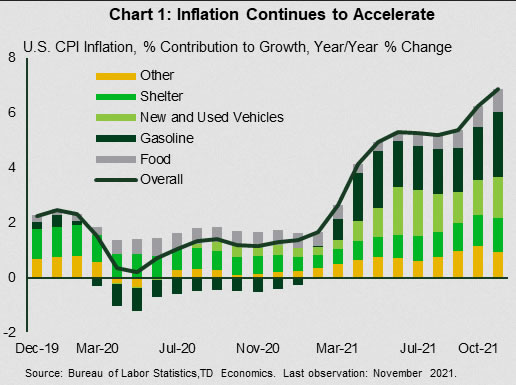
Meanwhile, strong demand for goods amidst ongoing supply shortages, continued to drive core prices (ex. food and energy), which picked up to 4.9% y/y. A key source of core price pressures was new and used vehicle prices, which expanded by 11.1% and 31.4% y/y, respectively. In terms of service prices, the shelter cost component continued to accelerate, rising by 3.8% y/y (up from 3.5%). Market-based home prices of the largest metros suggest that there’s more upside for shelter costs ahead, which could lead to more persistent elevated inflation in 2022.
On the labor side of the Fed’s mandate, this week’s jobs data signaled more tightness, with weekly jobless claims dropping to 184,000 – the lowest level since September 1969. Meanwhile, the Job Opening and Labor Turnover Survey (JOLTS) reported 11 million available jobs in October. This number is close to its record high in July and higher than the 6.9 million of workers who were unemployed that month. In fact, the ratio of the unemployed to job openings dropped to an historical low in the month. Adding marginally attached workers back to the labor force, the ratio of unemployed to job openings is slightly higher, but still in line with the average observed in 2019 when the labor market was the healthiest it had been in fifty years.
Another reason for labor market tightness is an elevated number of people who are quitting jobs. This fell in October to 4.2 million (from 4.4 million in September), but remains well above pre-pandemic norms. The number of quitters was particularly high in leisure & hospitality and retail trade sectors, which collectively accounted for 40% of quits in October. Notably, these sectors are among the lowest paying and experienced the highest growth in real compensation over the period of the pandemic (Chart 2). Considering that workers in these sectors are in close contact with consumers and face the highest health risk, further increases may well be in store in the coming quarters.
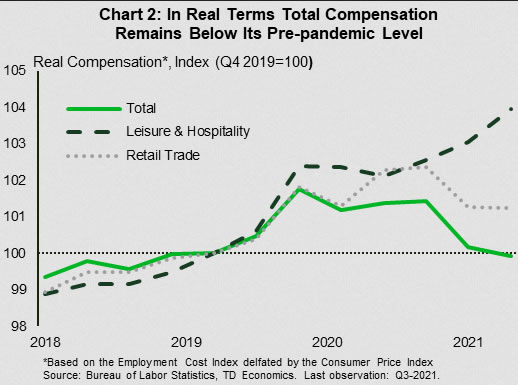
Indeed, inflation is currently rising much faster than wage growth. The story is worse if you consider that total hours are still most depressed at the low end of the wage spectrum, inflating the aggregate reading. The risk of workers demanding higher wages to compensate for the increase in prices (thereby entrenching higher inflation) is becoming a risk the Federal Reserve can no longer ignore and is likely to lead to a faster pace of asset purchase tapering and the start of rate hikes by the second quarter of 2022.
Canada - Bank of Canada Stands Pat
All eyes were on the Bank of Canada this week as it made its last policy announcement of 2021. With a blowout November jobs report last week, anticipation was high that the Bank might hint at an earlier withdrawal of monetary support. In the event, the Bank kept its cards close to its chest. Its statement noted the solid momentum in economic indicators into the final quarter of the year and highlighted the strength in the labour market (Chart 1). It balanced these positive developments against the negative impact of floods in British Columbia and the uncertainty caused by the Omicron variant.
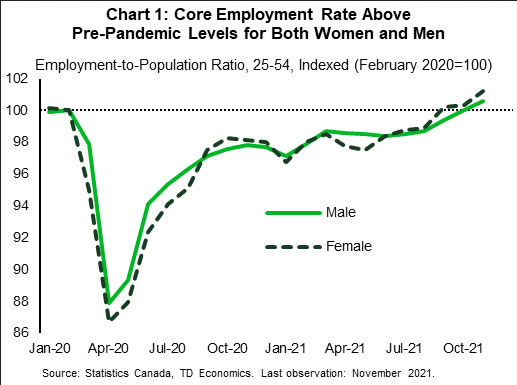
Most important, the Bank left the core of its policy announcement, its 'forward guidance' for the path of future policy unchanged, restating its commitment to "holding the policy rate at the effective lower bound until economic slack is absorbed…sometime in the middle quarters of 2022." Prior to the announcement, financial markets and analysts had brought forward expectations for a hike to as early as January. The bank's statement poured cold water on that notion.
Deputy Governor Toni Gravelle followed up the Bank's statement with a speech on Thursday afternoon. He opened the door at least a crack to the possibility of an earlier rate hike by noting that the Bank will reassess the risks to its inflation outlook in January, "when we update our projection for the economy and inflation." The Bank has, in the past, used its Monetary Policy Report (MPR) to adjust the timing of its forward guidance and could do so again. Since it began adding a date to when it expected slack to be absorbed – back in October 2020 – it has shifted it forward twice. From an original expectation of "sometime in 2023," in April 2021, it upgraded its economic forecasts and moved to the "second half of 2022." Then in October of this year, citing supply chain challenges, it downgraded its estimates of economic potential and pushed its expected date to the "middle quarters of 2022."
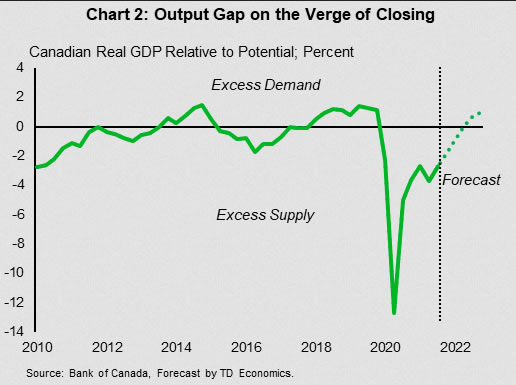
The Bank is running out of runway to move it any further. Economic growth in the fourth quarter could beat expectations on the upside, but the data will not be known until after the Bank's January MPR. It could upgrade its forecast such that the output gap closes in 2022Q1 but even then, assuming January is off the table, that leaves only March to hike rates as this is the next scheduled announcement date of the quarter. It may be easier to wait the extra month and lift off with the release of the April MPR.
In any case, with a healthy labour market and economic momentum heading into the New Year, the case for the Bank of Canada to move off the zero lower bound is solid (Chart 2). As long as Omicron does not throw the economy off course – and the risk cannot be discounted – a rate hike in April seems the most likely outcome. From there, one more before the second quarter is out looks increasingly likely, allowing for a total of four 25 basis point increases in the overnight rate before the end of 2022.
Forward Guidance: Canada’s November Inflation Data in Focus in Week Ahead
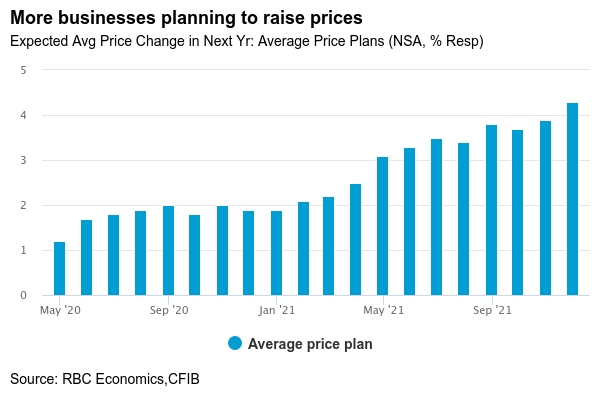
Last month’s year-over-year growth rate in Canadian CPI likely ticked down to 4.5% from 4.7% in October, when it hit a two-decade high. Gas prices have eased from October, but were still up more than 40% from a year ago in November. That accounts for more than a quarter of the growth rate we’re anticipating. Meat prices could pull back from very high levels—wholesale beef prices dropped 18% over September and October, for example. But we expect food price growth to be little changed at close to 4% overall. Annual growth in prices ex-food and energy products will likely stay just above 3%, as tight housing markets keep pressure on housing replacement costs and realtor/broker fees.
Distortions from pandemic base-effects (unusually low year-ago prices) continue to influence the inflation reading and accounted for around 2% of the total 4.7% annual price growth in October. Those anomalies will fade next year, but the share of the consumer price basket growing at a rate above the Bank of Canada’s 2% inflation target has also been edging higher compared to pre-pandemic levels. Barring major disruptions from Omicron, we expect household demand to continue to firm—backstopped by tightening labour markets and a large stockpile of pandemic savings. That will keep a floor under price growth. The Bank of Canada is expected to announce an updated policy mandate on Monday that will reiterate a commitment to the current 2% inflation target. The new mandate will also reportedly include more explicit language around how the central bank is considering labour market conditions in policy decisions. But labour markets have already improved dramatically, and with inflation running hotter, the number of reasons to keep interest rates at emergency low levels is getting very small. We continue to expect the central bank to begin hiking interest rates starting in April.
Week ahead data watch:
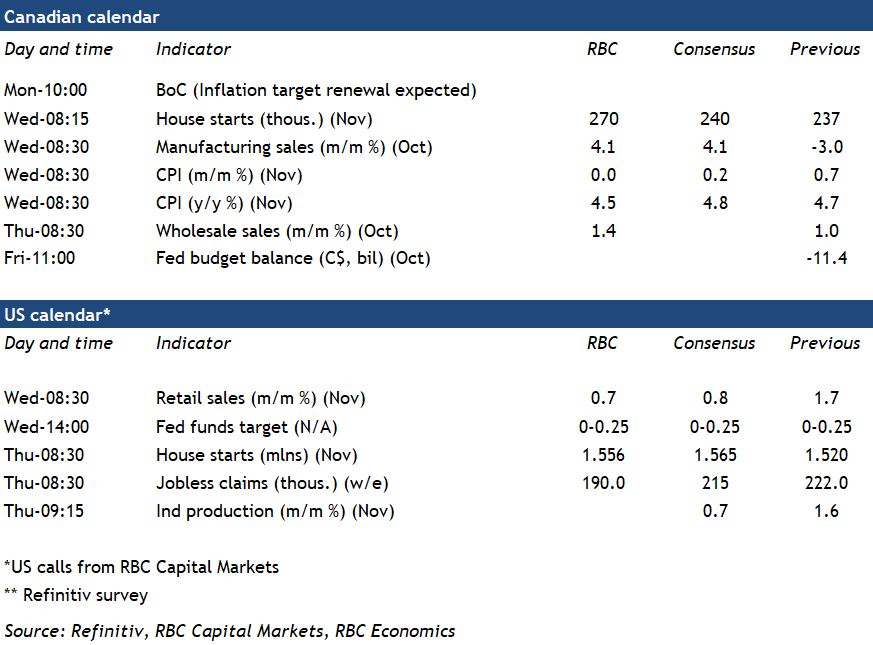
- US FOMC meeting: The Federal Reserve Board will release new economic projections and a rate decision next week. No change in the fed funds target range is expected, but we’ll be watching for any change in the expected timing and pace of future rate hikes.
- Canadian manufacturing sales: preliminary estimates for October manufacturing sales showed a 4.1% increase driven by a rebound in motor vehicle shipments (+61%) from sharply reduced levels in September when the global semiconductor shortage forced factories to temporarily stop production.
- Canadian home resales: early reports out of major regional markets are pointing to rising prices with strong demand for purchases held back by limited supply available.
US retail sales are expected to have ticked up again in November on firm holiday shopping and a jump in gasoline prices that should push gas station receipts higher.
reports.
Week Ahead: Nine Major Rate Decisions with Developed Markets Moving Slow
A huge week of central bank rate decisions will tell a diverging story over how developed markets can afford to hold off on rate hiking cycles while emerging markets continue to tighten monetary policy. The main event on Wall Street will be the FOMC policy decision that was made easier after the latest inflation report that showed consumer prices rose to the fastest annual pace in nearly 40 years. The Fed’s hawkish shift is completely justified and a faster pace of tapering its asset purchases is not only warranted its long overdue.
Nine major central bank decisions will show policymakers are changing course with monetary policy. The ECB may exit its pandemic emergency program while boosting its regular asset purchase program. The BOE will need to raise rates soon but they may hold off until the New Year.
Country
US
Now that the latest inflation report showed inflation remains stubbornly high, the focus shifts completely on the FOMC policy decision. The Fed is expected to recognize inflation has been persistent and announce a faster taper. The hawkish shift will be complete after policymakers bump up their median projection for the central bank’s short-term target rate. Expectations are growing that the Fed will double the pace of its bond purchase taper, but if they only deliver a modest increase, the Fed’s credibility will take a hit.
On Tuesday, the Empire Manufacturing report is expected to show activity cooled in December, while prices paid to US producers could soften from elevated levels. Wednesday is a busy day with retail sales expected to show inflation is impacting consumer spending, followed by Fed tapering fireworks in the afternoon. Thursday is all about housing data that should show housing starts and building permits continue to rise. The last trading day of the week will give an early glimpse on December manufacturing and service PMI data.
EU
The first half of next week is looking a little quiet but the last couple of days is action-packed, with the ECB monetary policy meeting undoubtedly the headline event. Central banks are really under the spotlight at the moment as inflation rises well above target and shows no sign of abating. The ECB is among those that has legitimate reason to believe it will return below target over the medium term and with the PEPP program expiring in March, there is a question of what will replace it, if anything. This question could be answered next week.
PMI and inflation data will also be released on Thursday and Friday which should make for a blockbuster week ahead of the holiday season.
UK
A big week for the UK as we get a raft of economic data including the jobs report, inflation, PMIs and retail sales. But it’s the BoE decision on Thursday that will draw the most attention, with the MPC now expected to hold off on raising rates due to the uncertainty around Omicron. It’s not certain that this will happen, with markets still pricing in around a decent chance of a 15 basis point increase but it’s no longer the most likely outcome.
Russia
The CBR is expected to increase interest rates by 100 basis points on Friday as it continues to push back against rising inflationary pressures. It rose to 8.4% last month, well above its 4% target.
It last raised rates by 75 basis points in October when it said further hikes could be warranted at upcoming meetings if the situation develops in line with baseline forecasts, which had inflation between 7.4% and 7.9% at the end of 2021.
South Africa
The country is continuing to deal with the Omicron outbreak that’s seeing cases surge rapidly, perhaps even 4.2 times faster than delta. With hospitals not yet overwhelmed and symptoms reportedly milder than delta, the government may resist implementing harsh restrictions too soon. Of course, the situation is developing rapidly and as more data is collected, that could change fast.
CPI inflation is the only data release next week.
Turkey
The CBRT meets next week and as always, anything can happen. The central bank has cut interest rates by 400 basis points since September and signaled it could again in December, before assessing its position. This is despite inflation continuing to rise and hitting 21.31% in November.
The central bank is clearly under pressure from President Erdogan – a strong opponent of high interest rates and staunch believer that higher rates stoke inflation – and he has repeatedly defended the CBRTs moves in recent weeks.
Interventions in the currency markets haven’t been particularly beneficial and more unconventional policies like this will be needed if the central bank continues on this dangerous path.
China
Fitch has placed Evergrande and Kaisa in selective default. Restructuring headlines over the weekend will dominate early Monday sentiment. China has responded by cutting the RRR last week and this week, has hiked the foreign reserve requirements of China Banks and has fixed the Yuan sharply lower versus the US Dollar. In totality it suggests that China is nervous about the fallout on the economy of the failure of indebted property developments and has finished with the trend of Yuan strength. Whether the US agrees or not is open to debate.
China releases heavyweight data in the coming week. Wednesday has Industrial Production, Retail Sales, UNemployment and Fixed Asset Investment. Coming before the FOMC decision, the data, if weaker, will weigh heavily on China equities and possibly the Yuan. Not quite the outcomes the government and PBOC want to achieve.
Otherwise, keep an eye on the news ticker for Evergrande developments and further technology company restrictions re overseas listings.
India
The Reserve Bank of India held policy rates and outlook unchanged this week, remaining in dovish mode to support the post-delta recovery at the expense of surging inflation. Local equites and the INR have held steady as the US Dollar weakened.
India releases trade data this week but equities and the currency will be completely at the mercy of the FOMC outcome on Thursday Asian time. Both have been buoyed in recent months by hot money flowing from CHina into the red hot India IPO and tech sector. A hawkish FOMC could see a rapid reverse of both.
Australia
The Australian Dollar continues to bounce around on the daily changes in investor sentiment driven by omicron headlines. Overall, it remains near to its 2021 lows and in the background, nerves are rising over US inflation data and the FOMC meeting. Negative headlines from China over the weekend, or omicron, will put the AUD back under pressure next week. Equities continue to slavishly follow New York markets for direction.
RBA Gov Lowe and Lowe speak midweek, but are unlikely to give policy insight. NAB Biz Confidence, Westpac Cons. Sent. PMIs and Employment fill out a busy data week. Mostly it should show a rapid bounce from the lockdowns of Q3 and is bullish for equities and currency on the periphery. Employment will generate the most intra-day volatility.
New Zealand
The NZD/USD remains near to 2021 lows, underperforming the AUD/USD as negative global investor sentiment pushes both lower, and the cautious RBNZ policy decision continues to haunt the currency.
Watch for New Zealand’s Covid case load as the country almost fully reopens this week. Surging cases will weigh on currency and local stock markets.
New Zealand releases Service PSI, Biz Conf. Consumer Sent. the Current Account and GDP in a busy week. The GDP number presents the greatest volatility point.
Japan
Japan’s Tankan Large Manufacturing Survey on Monday, Trade Balance Thursday, and BOJ Policy Decision Friday, booked the week. The Tankan will generate a negative response in local equities if it is weak, throwing the recovery picture a slower gear. Volatility will be strictly intraday.
The BOJ will remain on hold with no changes, as it has for the last 20 years. The FOMC will have a greater impact with a hawkish tilt almost certainly sending USD/JPY much higher on yield differentials. Japan equities, ex intraday noise, will continue to slavishly track US equities and the Nasdaq in particular.
Markets
Energy
WTI crude seems to be following US stocks more so than stockpile data. This is ending up being a rather good week for crude prices as the crude demand outlook hit from Omicron might be limited. OPEC+ continues to have a firm handle on the direction of prices and can disrupt any selloffs with a quick reverse of their output increase.
Once Europe gets beyond this wave of restrictive movements and the north stops seeing milder weather, the rally in oil prices could easily make a run towards the highs seen last month.
Gold
Gold is slowly getting its mojo back after a hot inflation report mostly matched estimates. A lot of the inflation is stickier than anyone wants and that should keep gold’s medium- and- long-term outlooks bullish. Gold just needs to survive a firm consensus on how many rate hikes the Fed will start off with next year. An accelerated rate hiking cycle is a big risk and could trigger panic selling that could prove troublesome for gold in the short-term, but that still seems unlikely to happen.
Gold’s recent trading range of $1760 and $1800 might continue to hold up leading into next week’s FOMC decision.
Bitcoin
Before the US inflation report, many traders were noticing that Ethereum dominance is settling in. This has been a tough week for cryptos and Ethereum mostly outperformed. The global crypto market cap is around $2.2 trillion and while Bitcoin is still king with 39% dominance, Ethereum has now earned 20%. There is still a lot of motivation for more crypto products to be created and the growth outlook next year should limit whatever selling pressure enters.
Bitcoin prices initially after US inflation hit a 39-year high, but the rally stalled after reaching the $50,000 level. Given what happened last weekend, some leveraged traders are thinking twice about holding positions into this weekend. Some traders are anticipating a sideways market until the FOMC policy decision on Wednesday, so hesitancy to hold over the weekend might grow. Hodlers will likely remain unfazed and feel mostly confident as need for inflation hedges will grow given the widespread rising pricing trends.
Key Economic Events
Saturday, Dec. 11
- Day two of the G-7 foreign ministers meeting in Liverpool
Sunday, Dec. 12
- Saudi Arabia to release budget
- South Korean President Moon Jae-in starts a four-day trip to Australia.
- Austria’s nationwide coronavirus lockdown winds down
Monday, Dec. 13
- V4-France Summit in Budapest. Macron will hold a bilateral meeting with Hungary PM Orban.
- South Korean President Moon Jae-in and Australian PM Morrison hold a joint news conference in Canberra.
- US Secretary of State Blinken travels to Indonesia and will also visit Malaysia and Thailand
Economic Data/Events:
- New Zealand REINZ house sales, net migration, performance services index
- India CPI
- Japan machinery orders
- Hong Kong industrial production, PPI
- China medium-term lending
- Turkey industrial production, current account
Tuesday, Dec. 14
- Canadian Finance Minister Chrystia Freeland presents a budget update.
- FOMC begins its two-day policy meeting.
Economic Data/Events:
- US PPI
- Eurozone industrial production
- Australia consumer confidence
- India wholesale prices
- New Zealand food prices
- Japan industrial production, capacity utilization
- Mexico international reserves
- UK jobless claims, unemployment
Wednesday, Dec. 15
Economic Data/Events:
- FOMC Decision: Fed to accelerate tapering of asset purchases
- US cross-border investment, business inventories, retail sales, empire manufacturing,
- China industrial production, retail sales, property prices, fixed assets, surveyed jobless
- UK CPI
- Canada CPI
- Poland CPI
- South Africa CPI
- Russia GDP
- India Trade
- Australia unemployment, Westpac consumer confidence
- New Zealand BoP, current account GDP ratio
- South Korea jobless rate, money supply
- Japan tertiary index
- Canada housing starts, existing home sales
- EIA Crude Oil Inventory Data
Thursday, Dec. 16
- EU Leader Summit starts in Brussels
Economic Data/Events:
- US housing starts, initial jobless claims, industrial production
- ECB Rate Decision: Rates to stay unchanged; To expand Asset Purchase Program
- Mexico Rate Decision: Expected to raise Overnight Rate 25 bps to 5.25%
- Norway Rate Decision: Expected to raise deposit rates 25 bps to 0.50%
- Switzerland Rate Decision: no change expected to monetary policy
- Turkey Rate Decision: Expected to cut one-week deposit rate by 100 bps to 14.00%
- BOE Rate Decision: no change expected to monetary policy
- Eurozone manufacturing PMI
- Germany manufacturing PMI
- UK manufacturing PMI
- Australia manufacturing PMI, consumer inflation expectations, jobless
- New Zealand GDP
- Japan Trade, Bank PMI
- Singapore Trade
- Hong Kong jobless rate
Friday, Dec. 17
Economic Data/Events:
- BOJ Rate decision: expected to maintain its current monetary policy, while extending the duration of a trimmed Covid aid program
- Russia Rate decision: Expected to raise key rate 100 bps to 8.50%
- Quadruple Witching Day and major US Indices quarterly rebalance effective after markets close
- Eurozone CPI, new car registrations
- Germany IFO business climate
- Spain trade
- Singapore electronic exports
- Japan department store sales
- Thailand foreign reserves, forward contracts
- New Zealand ANZ consumer confidence
Sovereign Rating Updates:
- Lithuania (Fitch)
- Luxembourg (Moody’s)
- Slovakia (Moody’s)
Summary 12/13 – 12/17
Monday, Dec 13, 2021
[php_everywhere instance="1"]
Tuesday, Dec 14, 2021
[php_everywhere instance="2"]
Wednesday, Dec 15, 2021
[php_everywhere instance="3"]
Thursday, Dec 16, 2021
[php_everywhere instance="4"]
Friday, Dec 17, 2021
[php_everywhere instance="5"]
Week Ahead – Fed Kicks Off Central Bank Extravaganza
Global markets will enter the holiday season with a bang, as the upcoming week features five central bank decisions and a heavy barrage of data releases. The Fed will get the show rolling. It will decide whether to accelerate the tempo of tapering, although the dollar may be more interested in the new interest rate projections. The central banks of the Eurozone, United Kingdom, Japan, and Switzerland will meet as well.
Fed heads for the exit
The American economy is in great shape. Consumption is booming, the labor market is tight by several measures, inflation is scorching hot, and the Atlanta Fed GDPNow model points to growth of 8.7% in the final quarter. As such, the Fed has started to rotate away from the emergency policies it enacted last year.
It has already announced a gradual reduction of asset purchases but faced with an onslaught of impressive data lately, several policymakers want to speed up this process. A swifter conclusion would allow the option of raising interest rates earlier to fight inflation.
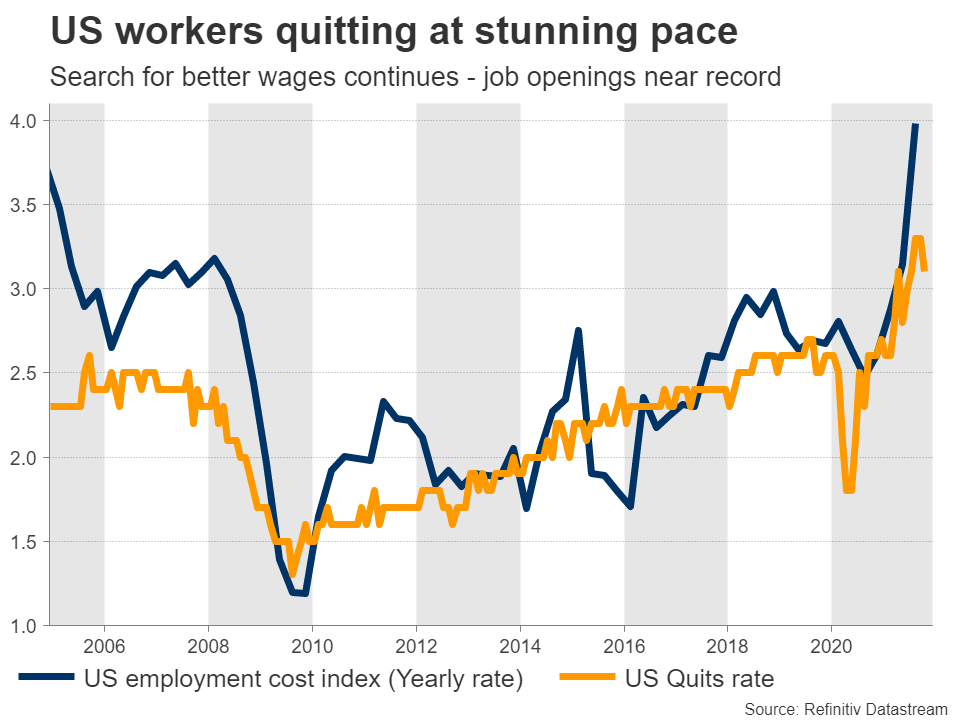
This will be a crucial decision when the Fed meets on Wednesday. Considering how many FOMC officials have voiced their support for accelerating tapering, there is a strong possibility it gets done. Market participants seem to agree, pricing in a 70% probability for a rate increase in May, which would require faster tapering to pull off.
But the most important variable for the dollar might be the updated ‘dot plot’ of interest rate projections. Back in September, the dots signaled equal chances for a single rate increase next year. Markets are currently pricing in three hikes, so the new dots will almost certainly be revised higher. The question is how much higher?
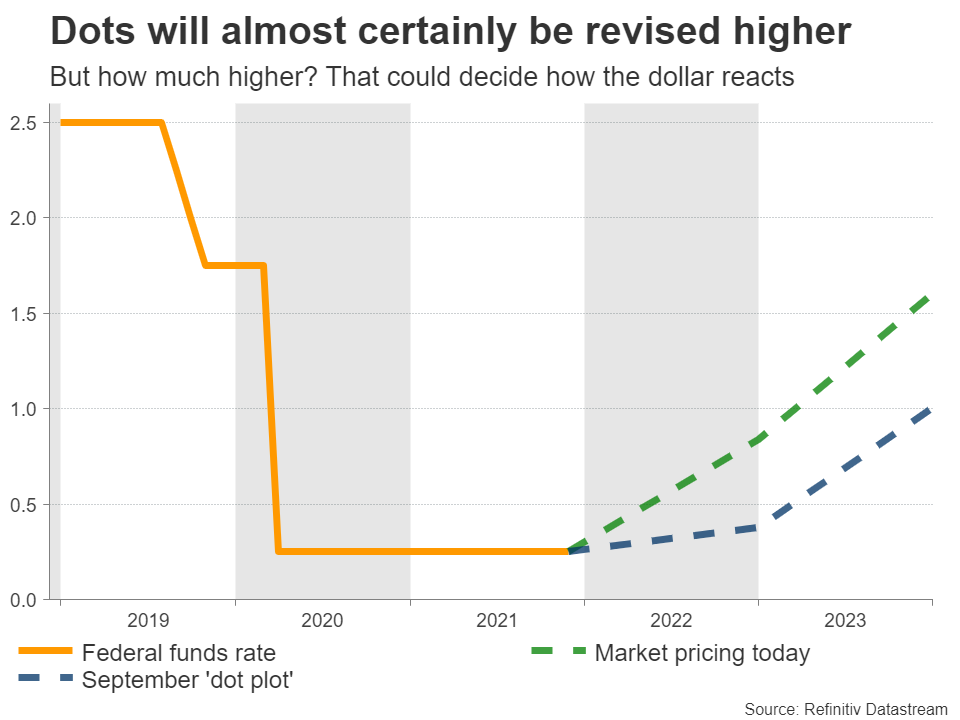
Will they signal one rate hike for next year or two? One would most likely be a disappointment for the dollar, while two could boost the currency by confirming that the Fed is moving closer to markets. It’s a close call, but considering the strength of recent data, a dot plot that points to two rate increases seems more reasonable.
A few hours ahead of the Fed decision, the latest retail sales numbers will be released.
ECB - Striking a compromise
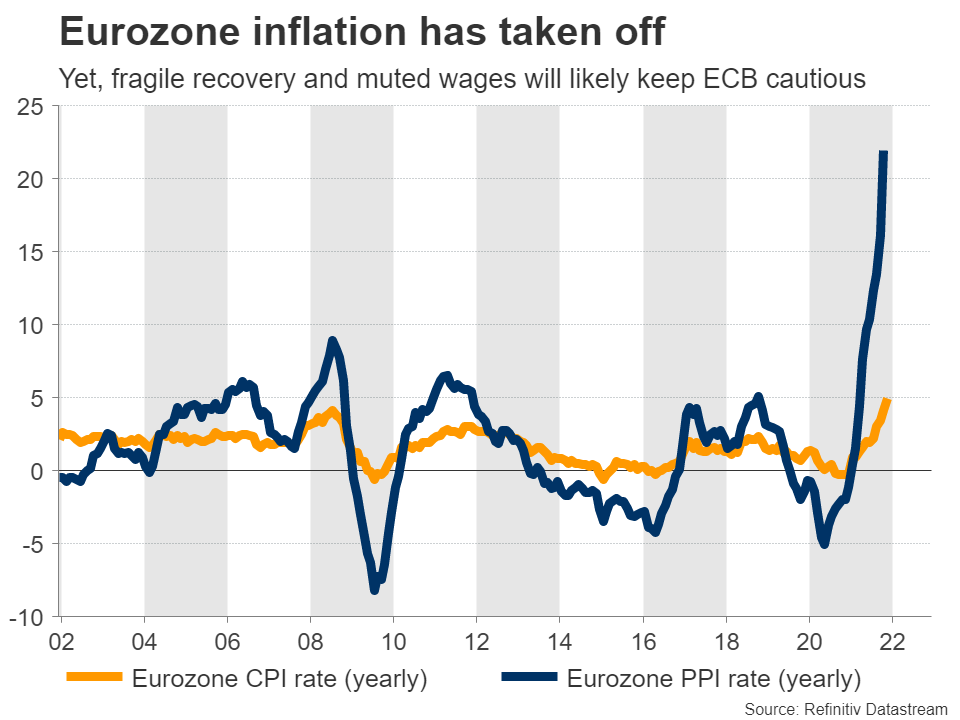
The European Central Bank will also have some tough decisions to make. The economic recovery is still fragile, something exemplified by the latest covid restrictions. Yet inflation has fired up and the hawks are worried it could stick around.
In this light, the central bank will have to decide whether to beef up its regular asset purchases when the emergency purchases end in March. Not doing so would threaten to catapult European bond yields higher, something that even the hawks admit is too risky given the scary debt levels in southern Europe.
Therefore, it will be another battle between doves that want to retain maximum stimulus and the hawks that want to wind it down as far as possible, without shocking the bond market. The compromise could be to expand regular asset purchases but only by a fixed amount.
As for the euro, the picture still seems gloomy. While inflation has soared, growth and wage pressures remain muted, so the ECB will likely continue to suppress European yields for much longer than the Fed for instance. Money markets are still pricing a minor ECB rate increase for next year, which is unrealistic and allows scope for more pain in the euro as the central bank closes the door to that.
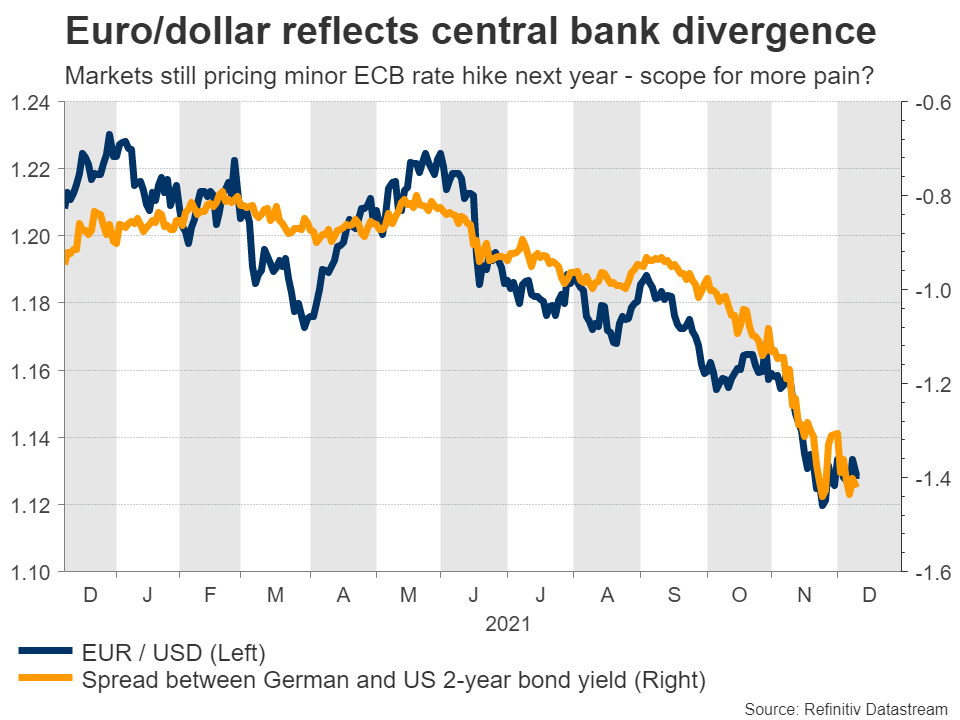
Besides the ECB decision, the latest PMI business surveys will also be released on Thursday.
BoE - No rate hike for Christmas
Traders have been grappling with when the Bank of England will raise rates for months. Policymakers including Governor Bailey initially hyped this prospect, but failed to deliver when the time came. The emergence of Omicron and the recent measures announced in the UK almost ensure the Bank will keep its powder dry this time too.
Even Michael Saunders, who voted for a hike last month, said he wants more details about the new variant before deciding. When hawks turn cautious, that is usually a powerful signal.
Markets have accordingly priced out the prospect of any action on Thursday, baking in just a 25% probability for a rate increase. This spells some downside risks for the pound if policy is kept unchanged, especially if that’s done by a unanimous vote.
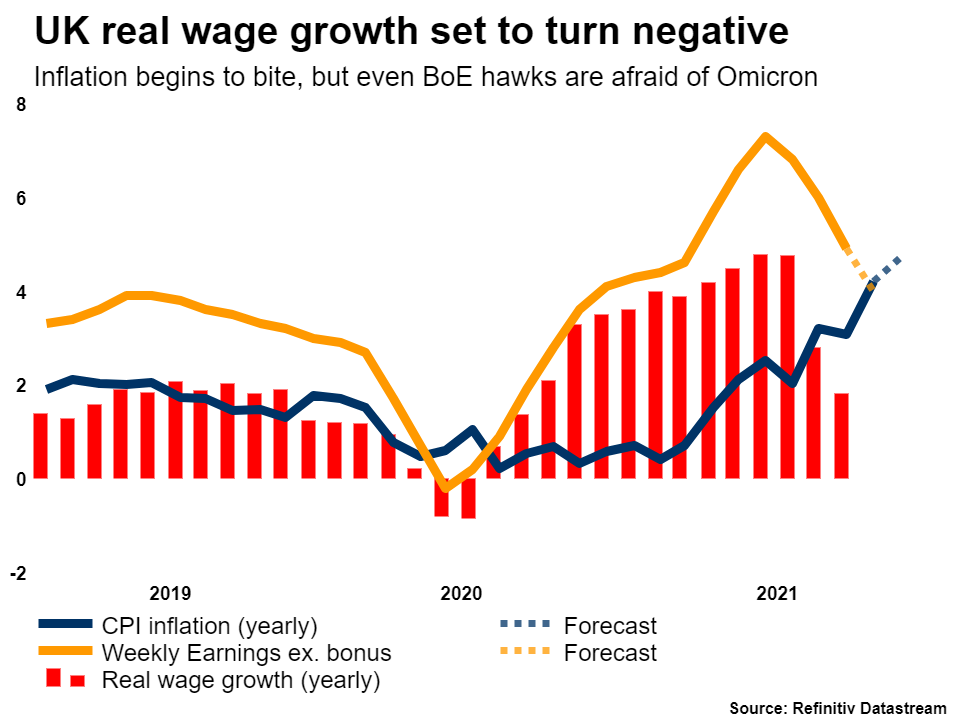
Beyond the initial reaction, sterling’s fortunes will depend on what the BoE signals about future hikes, as investors expect almost four of them next year. Admittedly, that seems like a stretch. The British economy is strong but not that strong.
We’ll find out exactly how resilient the economy is ahead of the BoE meeting. The latest jobs numbers will be released Tuesday, ahead of inflation stats on Wednesday and PMI surveys on Thursday.
BoJ a snoozer, but mind the SNB
Bank of Japan meetings have been a non-event for years now because market participants know that policy changes are not on the cards. The economy contracted in Q3 and has barely escaped deflation, so the BoJ will most likely stick to its yield-curve control strategy when it meets on Friday and be among the last to raise rates this cycle.
Hence, the yen will remain at the mercy of global forces. Specifically, how quickly foreign central banks raise rates and how risk sentiment evolves. In this sense, it’s difficult to be optimistic on the yen. On the data front, the BoJ’s Tankan business survey for Q4 will be released Monday.
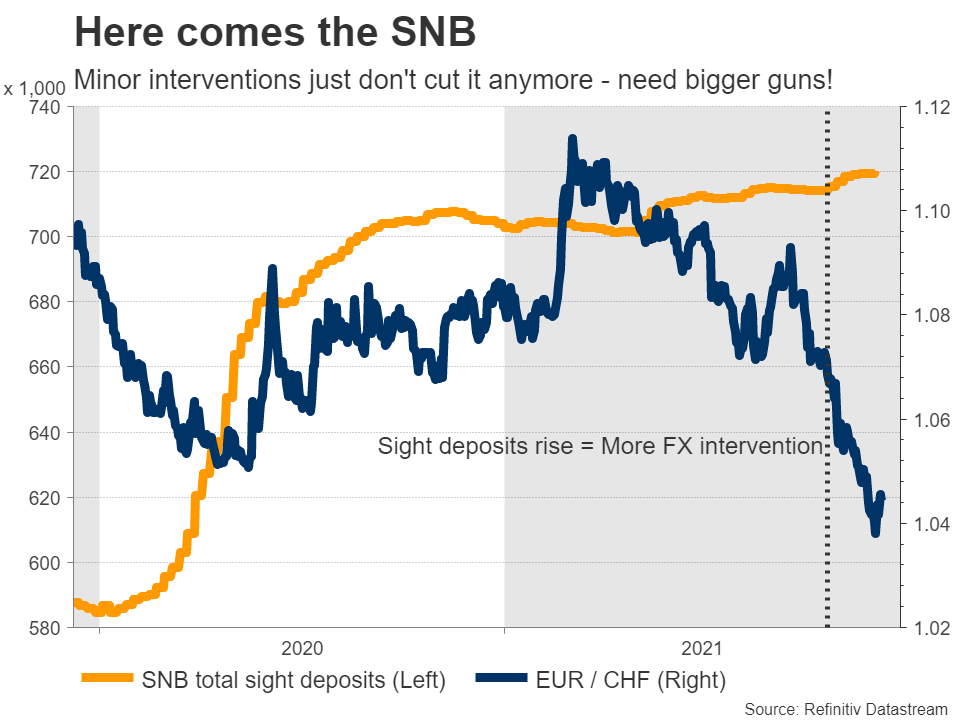
On the contrary, the Swiss National Bank meeting on Thursday could spark some fireworks. With covid restrictions threatening European growth, euro/franc has fallen to lows last seen in 2015, right after the currency peg was abandoned.
That’s a problem for the SNB, which has been fighting franc appreciation by constantly intervening in the FX market. Ergo, if it wants to turn this battle around, it needs to roll out even bigger guns. There isn’t much left in the armory, so policymakers may resort to threats of even stronger intervention to stop euro/franc from heading towards parity.
Data releases in Canada and Australia
Finally, Canada’s latest inflation data will hit the markets on Wednesday. The nation’s economy is running on all cylinders, however, the loonie has been trading entirely like a proxy for oil prices, with the correlation between the two assets being exceptionally strong lately.
In Australia, jobs numbers for November are out on Thursday. The aussie has found some relief from fading Omicron worries and recent stimulus measures in China. That said, pricing for RBA rate hikes remains somewhat excessive.
Speaking of China, the monthly data dump that includes retail sales and industrial production will be released Wednesday.