Sample Category Title
CAD Extends Rally ahead of BoC
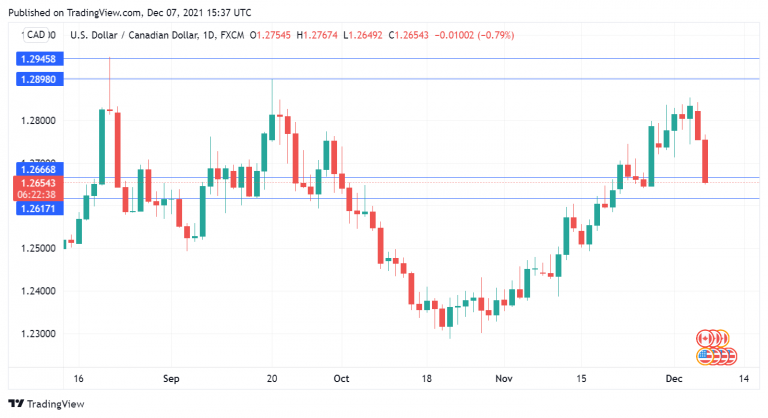
The Canadian dollar continues to head higher this week. In the North American session. USD/CAD is trading at 1.2654, down 0.78% on the day.
Bank of Canada expected to remain cautious
What can we expect from the Bank of Canada policy decision on Wednesday? The bank will likely maintain current policy, which has been accommodative. We can expect the bank to maintain the benchmark rate of 0.25% and to announce that it will continue to reinvest assets as they mature. The bank ended its QE scheme in October, so the focus is currently on the timing of an interest hike. There is a disconnect between market expectations and BoC guidance – the markets are projecting a rate hike in the first quarter, while the BoC is looking at mid-2022.
There are plenty of factors supporting a rate hike. As in the US, inflation has been re-hot and is at its highest level in 30 years. Inflation has pushed above 3%, the upper limit of the bank’s inflation band, and BoC Governor Tiff Macklem has acknowledged that inflation has been more persistent and higher than expected. The labor market is strong, and the November job report came in at 153 thousand, crushing the consensus of 37 thousand. As well, the unemployment rate fell to 6.0%, down sharply from 6.7% and beating the forecast of 6.6%.
The main argument against any tightening in policy is the Omicron variant of Covid. It remains unclear just how much of a threat Omicron is, but fears of a new wave of Covid spooked the markets in late November. Although investors have calmed down, there is concern in the air and any reports of a spike in infections could quickly send the markets south. We will know more about Omicron in a few weeks but in the meantime, the BoC will likely play it safe and avoid any surprises. This should make for an uneventful meeting with minimal impact on the Canadian dollar.
USD/CAD Technical
- USD/CAD continues to fall and break below support levels. The pair is testing support at 1.2666. Below, there is support at 1.2618
- There is resistance at 1.2758 and 1.2898
US: Trade Deficit Narrows in October, as Goods Exports Rise
The U.S. trade deficit narrowed to $67.1 billion in October from $81.4 billion in September. Total exports (goods and services) increased by 8.1% (-3.0% in September), while imports rose 0.9% (+0.6% in September).
Goods exports increased by 11.0% in October (-4.7% in September). The gains were broad based and led by foods, feeds and beverages (+17.1%), other merchandise (+17.0%), automotive vehicles, parts and engines (+14.1%), and industrial supplies and materials (+12.5%). Consumer goods (+8.3%, excluding automotive), and capital goods (+7.3%) also posted solid gains. Accounting for price changes, real goods exports rose by 9.5%.
Goods imports rose by are more modest 0.8% (compared to a 0.9% increase in September). Most product categories registered expansions but industrial supplies and materials (-0.9%) and capital goods (-0.7%, excluding automotive) pulled down the aggregate. Automotive vehicles, parts and engines (+5.7%) led the gainers, while food, feeds, and beverages (+1.9%), consumer goods (+1.5%, excluding automotive), and other merchandise (+1.5%) also posted increases. Excluding price changes, real imports fell 0.1% in October.
Exports of services expanded by 1.6% on the month (+1.0 % in September). Services imports rose at the same rate in October (+0.1% in September).
Key Implications
The trade deficit narrowed in October, touching levels from last spring. Imports are 18.0% above pre-pandemic levels, while exports are now 9.2% higher.
Services imports built on small gains in September and are now 2.2% above pre-pandemic levels, while the improvement in exports brought them to 6.1% below their February 2020 values. However, the prospect of increased travel restrictions in response to the emergence of the Omicron variant does cloud the outlook heading into the new year.
Still, the narrowing in the trade deficit was powered by a sharp increase in goods exports. Looking forward, it appears that the unyielding demand for goods will continue to underpin a historically wide deficit. Moreover, the emergence of yet another variant of concern raises the risk that the consumer rotation into services expenditures is further delayed, keeping the trade balance deep in deficit territory through to early 2022.
Canada’s Merchandise Trade Balance Widens Further in October
Canada recorded an increase in its merchandise trade surplus ($2.1 billion) in October, up from a downwardly revised surplus of $1.4 billion (from $1.9 billion) in September. Merchandise exports (+6.4%) and imports (+5.3%) both increased significantly on the month. In volume terms, the picture was still solid, with both exports and imports up 2.8% and 7%, respectively.
The increase in exports was broad-based, spanning 8 of the 11 industries. Still, the headline increase was largely driven by the motor vehicles and parts (+30.8%) and energy products (+9.8%) industries. Exports of farm, fishing, and intermediate food products (+5.6%) and metal ores and non-metallic minerals (+8.4%) were also notably strong.
Imports were up in 7 of the 11 industries. Imports of motor vehicles and parts were up 27.2%, contributing the most to the headline increase. Imports of energy (+14.9%) and consumer goods (+4.5%) were also strong.
In a separate release, Statistics Canada revealed that services exports were up 2.2% in October, whereas services imports were up 0.4%. Travel services trade continued to rebound, with exports up 8.7% and imports up 9.5%. Similarly, transportation services exports were up 6%, with imports up 5.4%.
Key Implications
This was a solid report. On the exports side, growth was strong and broad-based across most industries. Meanwhile, the surge in imports is a signal of solid domestic demand, though partly skewed by monthly supply-related volatility in the motor vehicles and energy industries. Importantly, the release also points to a strong outturn for manufacturing output and sales in October. And finally, services exports continued to advance, albeit gradually, during the month.
Fundamentals for trade remain on a solid footing, aided by a continued global economic recovery, and importantly, strength in manufacturing sentiment south of the border. But, downside risks should not be ignored. In particular, the near-term trade outlook is susceptible to risks emanating from the devastating floods in B.C, which are impacting trade flows through the Port of Vancouver. Indeed, exports and imports could see a meaningful decline in the November data release.
Sunset Market Commentary
Markets
It’s risk on again today, bells and whistles included. The reason is the same as yesterday’s: relief that the omicron virus strain according to preliminary data is not as sick-making as initially feared. When the Covid variant was first detected, it sparked a strong selling wave across risky assets that still has some room to recover. Bargain hunters gladly fill the remaining gap. The EuroStoxx50 jumps 2.5% higher, testing resistance around 4240. Wall Street opens with gains ranging from 1-2%. Commodities are having a good run as well. Natural gas (in Europe) spearheads the move with talk of sanctions on Russia should it invade Ukraine adding a geopolitical flavour to today’s price rise. It’s easy for Russia to respond by turning the gas taps amidst high demand and low European reserves. Dutch future prices for January are up almost 7%. Brent oil inches 2.4% higher. At $74.8/barrel it’s still some way from the $80+ levels in October and most of November though. The risk-on is also accompanied by higher core bond yields. The US curve bear flattens with changes going from +4.4 bps (2y) over 2.7 bps (10y) to 0.8 bps (30y). The short to middle end thus continues to underperform after Powell’s big turn on inflation. Since he went off-script before Congress on November 30th, the 2y yield moved up 18 bps, followed by half that amount in the 5y and compared to 3-7bps declines in the 10y and 30y. Gains for German yields amount to 2-4 bps in the 2y-10y spectrum. The damage for the German Bund from yesterday’s after-European-close drop in UST’s and Holzmann’s interview thus remains limited. We do notice some fallout of the latter perhaps on European peripheral spreads. Italy (+1 bp) is the notable exception in an otherwise spread narrowing move where Greece (-4 bps) is outperforming.
It’s not unusual these days to see the euro disappoint in a risk-on context but that doesn’t make it less painful to watch. US/EMU yield differentials, even being as marginal as today’s, favour the dollar over the euro. EUR/USD fell below 1.129 support again with technical considerations possibly exacerbating the downward move. At 1.124 the pair is looking for a return to the 2021 lows at 1.12. Even the Japanese yen and Swiss franc are taking the upper hand with EUR/JPY below 128 and EUR/CHF (1.04) erasing more than half of yesterday’s bounce. Commodity-driven currencies including the Canadian and Aussie dollar are ecstatic. EUR/GBP briefly dipped sub 0.85 but the British currency somewhat surprisingly lacks strong enough legs. Maybe next week’s BoE meeting is already nesting in investor’s minds.
News Headlines
Economic activity in South Africa Q3 contracted by a bigger than expected -1.5% Q/Q. Activity was 2.9% higher compared to the same period last year. Agriculture (-13.6%), trade and accommodation (-5.5%), manufacturing (-4.2%) showed the biggest declines. Aside from persistent factors related to the pandemic, riots and political unrest are seen as an important factors behind the Q3 contraction. The economy grew 5.8% YTD but is still 3.0% below the pre-corona level. The rand recently declined to USD/ZAR 16.36 on headlines of the potential negative economic impact of the omicron variant, but entered calmer waters as sentiment improved. The rand today is losing modest ground after the publication, trading near USD/ZAR 16.00.
The government in Poland has clearly changed its assessment on the merits of the ultra-loose monetary as conducted for so long by the National Bank of Poland. Cabinet spokesman Piotr Muller today in an interview said that a further rate hike by the National Bank of Poland at its policy meeting tomorrow won’t be seen as negative. Accelerating price increases are also becoming a political issue in Poland. The NBP is expected raise its policy rate by another 50 bps to 1.75% tomorrow. The NBP’s U-turn on inflation while no longer aiming for a weak, growth-supporting currency either, helped the zloty to rebound from EUR/PLN 4.70+ levels to currently near EUR/PLN 4.60.
Stocks Head North as Omicron Jitters Abate
US dollar drifts higher; safe havens plummet; cyclical currencies appreciate
The dollar gave up some ground early in Tuesday's trading session as investors’ risk appetite soared amid subsiding fears over the impact of the Omicron variant on global economic growth. However, the greenback recovered and stormed higher later in the session supported by surging US Treasury yields.
The Japanese yen and Swiss franc are trading lower today as the rebound in investor sentiment has posed a considerable threat to their safe haven demand. On the other hand, commodity-linked currencies such as the aussie, kiwi and loonie are the absolute winners in the forex spectrum, significantly benefiting from rising commodity prices.
The euro and British pound are in the red today as increasing cases of the Omicron variant in both Europe and the UK overshadowed the broader market optimism. In addition, the dovish rhetoric of both central banks, alongside the Brexit woes over the Northern Ireland protocol seem to be weighing on both currencies.
Wall Street set for a positive open as Omicron fears fade
US stock markets are expected to resume yesterday’s rally, as futures for the major US indexes are edging higher in pre-market trade. Stocks linked to the reopening of economies, such as airlines, are the primary driving force behind this jump, with an increasing number of reports claiming that the new Omicron variant is likely to be less damaging to the global economy than previous strains.
Overnight, the risk-on sentiment pushed major Asian markets much higher, while major European markets are also ramping up in the current session.
Oil surges; gold holds firm
Oil prices extended yesterday’s gains as worries about a hit to oil demand due to the Omicron variant waned. Also, the fading possibility of a supply increase from Iran after talks to revive the nuclear deal stalled on Friday acted as a further tailwind for the commodity. Despite being pressured by rising Treasury yields, the stronger dollar and the improving risk sentiment in the markets, gold is trading marginally higher in today’s session.
Geopolitics
The US and its European allies are weighing sanctions targeting Russia’s major banks in case Russia attempts to invade Ukraine. In response, President Vladimir Putin threatened to cut energy supplies to Europe, if they intervene in what he sees as a vital matter of national security. With the midterm elections approaching in the US, President Joe Biden is under pressure to resolve the issue without any military intervention as it would likely damage his popularity.
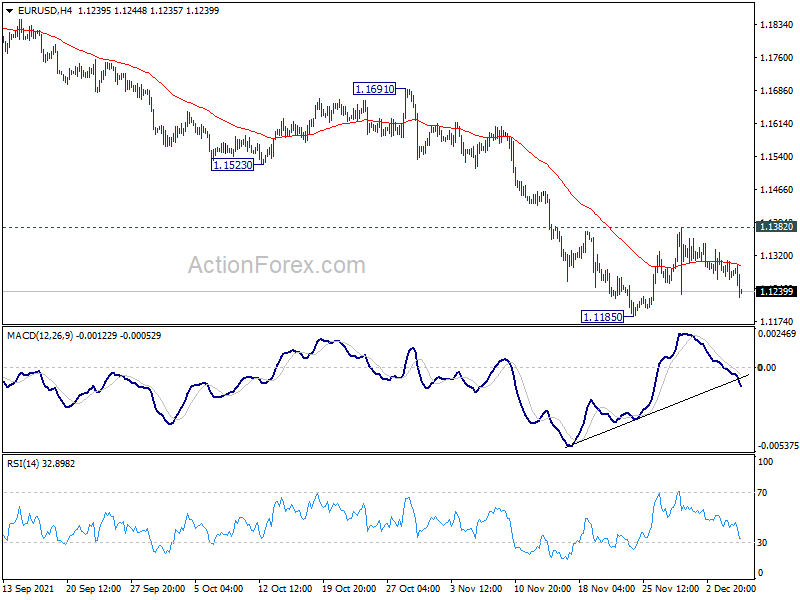
EUR/USD Mid-Day Outlook
Daily Pivots: (S1) 1.1264; (P) 1.1288; (R1) 1.1309; More...
Intraday bias in EUR/USD stays neutral for the moment. On the upside, firm break of 1.1382 resistance should confirm short term bottoming at 1.1186. Intraday bias will be turned back to the upside for 55 day EMA (now at 1.1480). On the downside, break of 1.1185 will resume larger fall from 1.2348.
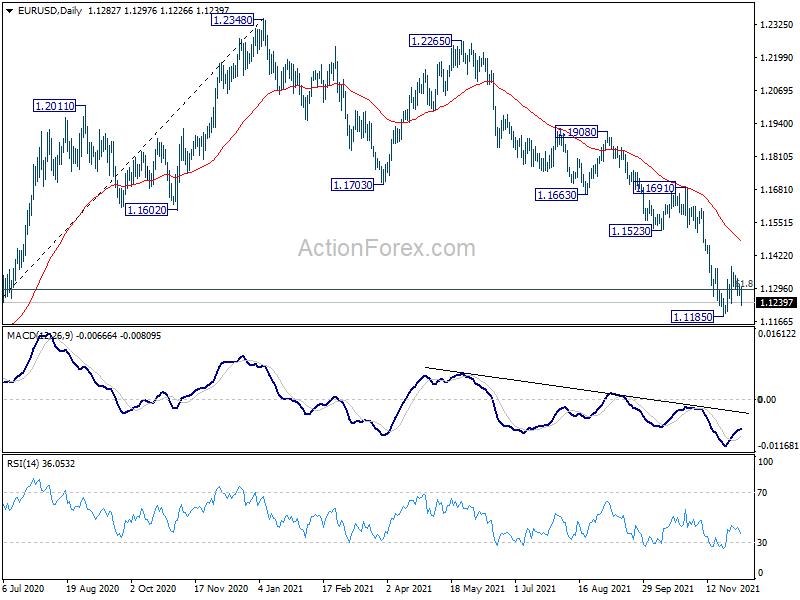
In the bigger picture, there are various ways of interpreting the fall from 1.2348 (2021 high). It could be a correction to rise from 1.0635 (2020 low), the fourth leg of a sideway pattern from 1.0339 (2017 low), or resuming long term down trend. In any case, outlook will now stay bearish as long as 1.1703 support turned resistance holds. Sustained break of 61.8% retracement of 1.0635 to 1.2348 at 1.1289 would pave the way back to 1.0635.
GBP/USD Mid-Day Outlook
Daily Pivots: (S1) 1.3227; (P) 1.3256; (R1) 1.3295; More...
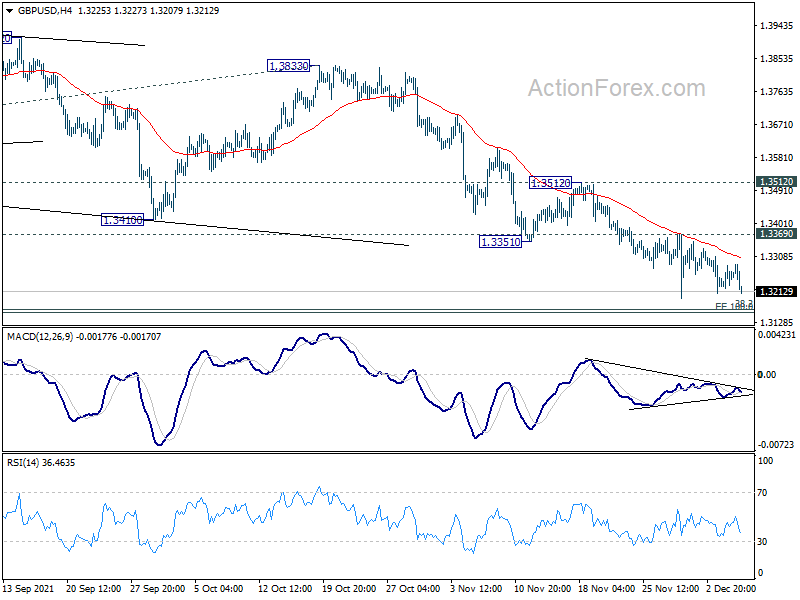
Intraday bias in GBP/USD remains neutral and outlook is unchanged. On the downside, sustained break of 1.3164 medium term fibonacci level will carry larger bearish implication, and target 161.8% projection of 1.4248 to 1.3570 from 1.3833 at 1.2736. Nevertheless, break of 1.3369 minor resistance will turn bias back to the upside for 1.3512 resistance first.
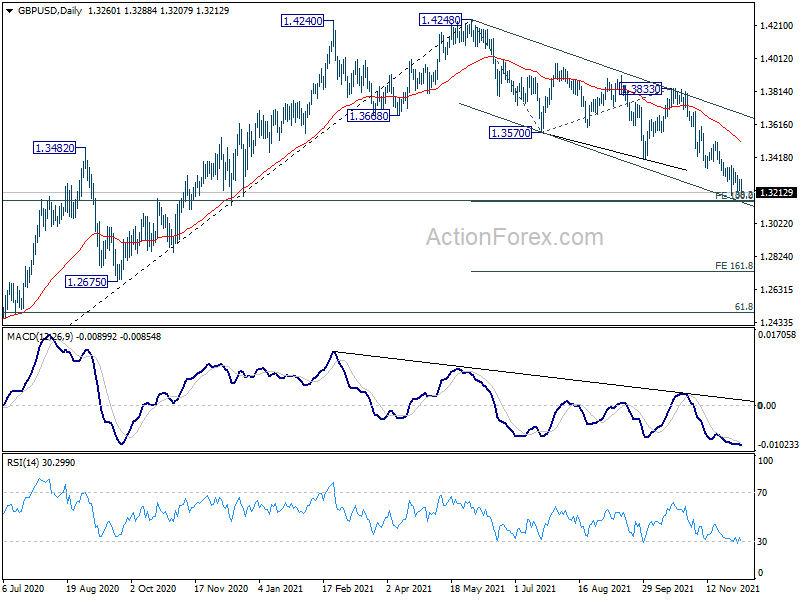
In the bigger picture, immediate focus is now on 38.2% retracement of 1.1409 to 1.4248 at 1.3164. Sustained break there will argue that whole rise from 1.1409 has completed at 1.4248, ahead rejection by 1.4376 long term resistance. That will revive some medium term bearishness and and target 61.8% retracement at 1.2493.
USD/CHF Mid-Day Outlook
Daily Pivots: (S1) 0.9194; (P) 0.9232; (R1) 0.9292; More....
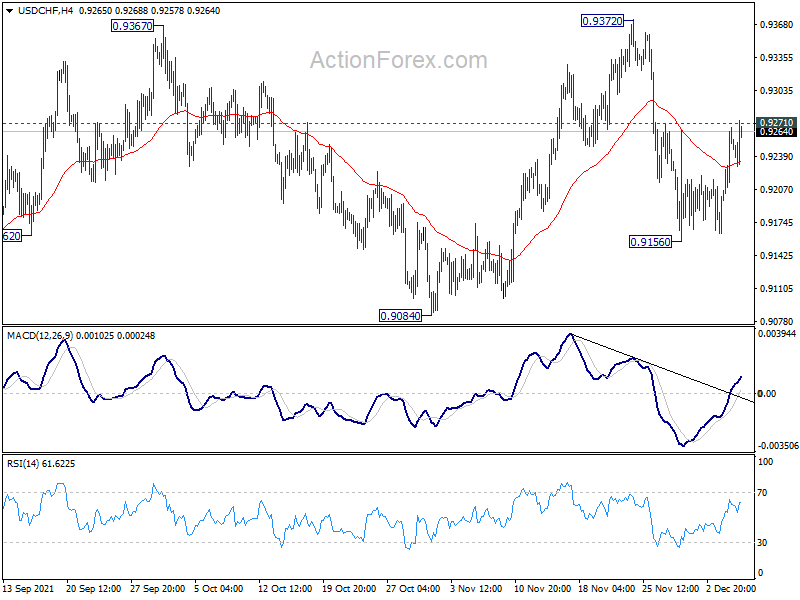
Intraday bias in USD/CHF remains neutral at this point. On the upside, break of 0.9271 minor resistance will suggest that the pull back from 0.9372 is finished. Intraday bias will be turned back to the upside for 0.9372. On the downside, below 0.9156 will target 0.9084 support. Firm break there should confirm that choppy rise from 0.8925 has completed, and suggests that fall from 0.9471 is resuming. Deeper decline would be seen through 0.8925.
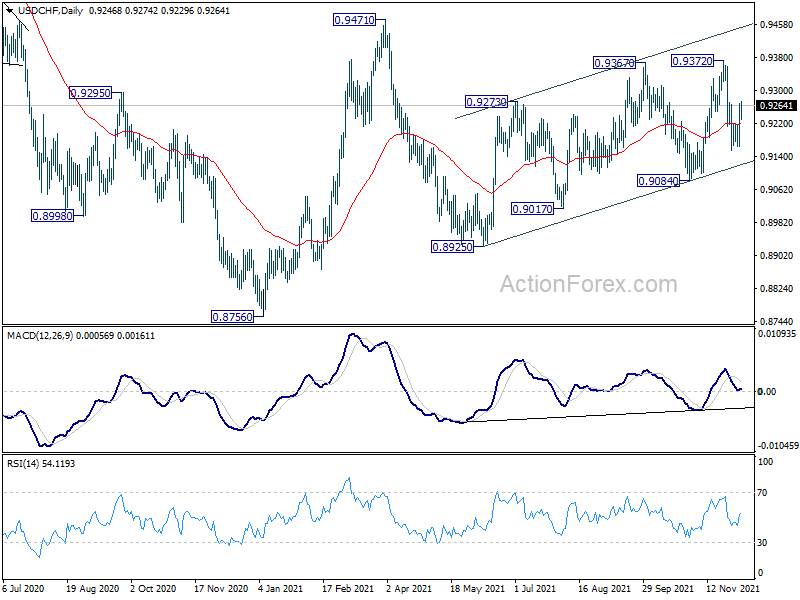
In the bigger picture, the corrective structure of the rebound from 0.8925 argues that fall from 0.9471 is not complete yet. It could either be the second leg of pattern from 0.8756 (2021 low), or resuming larger down trend from 1.0237 (2018 high). We'd pay attention to the downside momentum and assess the odds later. But for now, medium term outlook will be neutral at best as long as 0.9471 resistance holds.
USD/JPY Mid-Day Outlook
Daily Pivots: (S1) 113.04; (P) 113.30; (R1) 113.75; More...
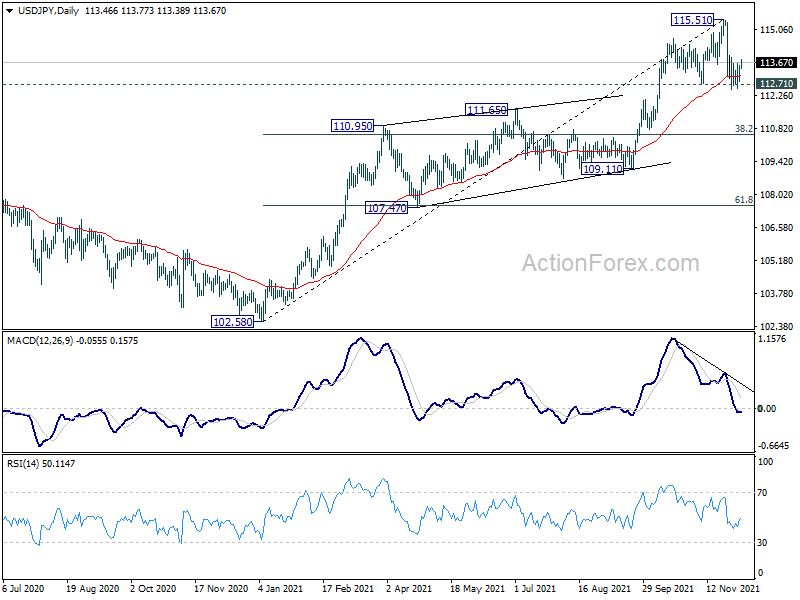
No change in USD/JPY's outlook as range trading continues. Intraday bias remains neutral at this point. On the downside, sustained break of 112.71 will argue that it's already correcting whole rise from 102.58. Deeper fall would be seen to 38.2% retracement of 102.58 to 115.51 at 110.57. On the upside, break of 113.94 minor resistance will turn bias back to the upside for retesting 115.51 high instead.
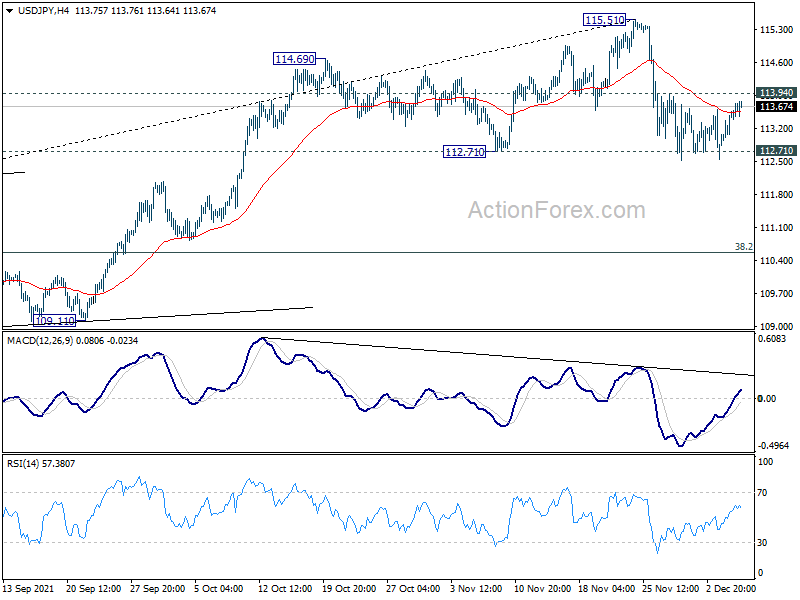
In the bigger picture, no change in the view that rise from 102.58 is the third leg of the up trend from 101.18 (2020 low). Such rally should target a test on 118.65 (2016 high) on resumption. However, firm break of 109.11 structural support will argue that the trend might have reversed and bring deeper fall to 107.47 support and possibly below.
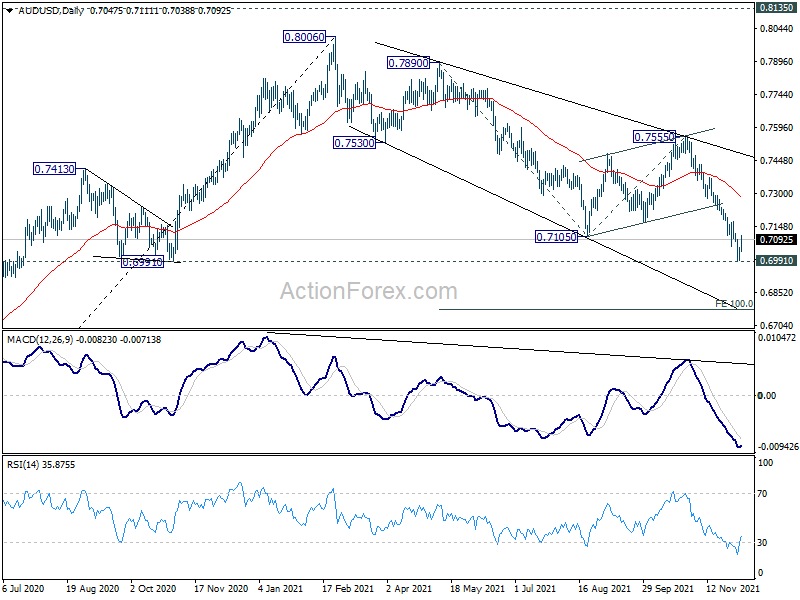
AUD/USD Mid-Day Report
Daily Pivots: (S1) 0.6962; (P) 0.7031; (R1) 0.7068; More...
AUD/USD's rebound from 0.6992 extends higher today but stays below 0.7172 resistance. Intraday bias is turned neutral first. On the upside, firm break of 0.7172 will indicate short term bottoming. Intraday bias will be turned back to the upside for 55 day EMA (now at 0.7281). On the downside, firm break of 0.6991 key structural support will carry larger bearish implication. Next target is 100% projection of 0.7890 to 0.7105 from 0.7555 at 0.6770.
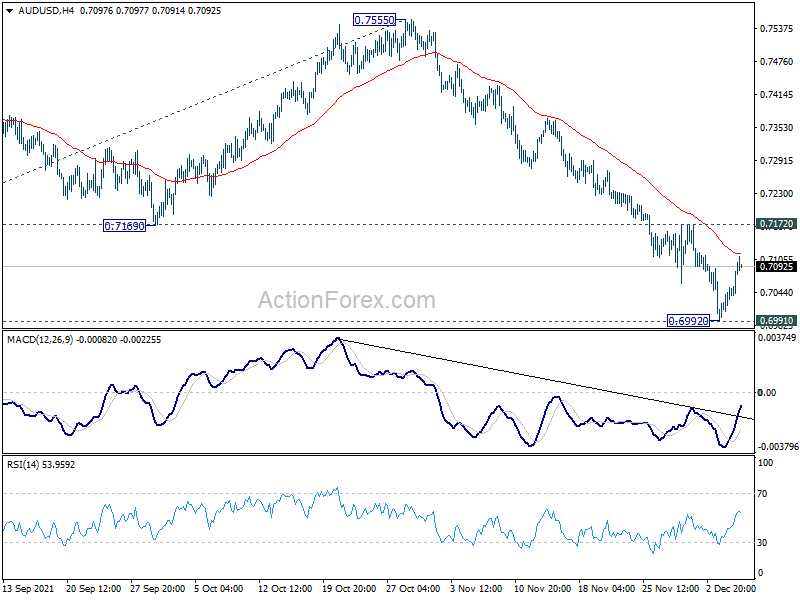
In the bigger picture, sustained break of 0.6991 cluster support will argue that the who up trend from 0.5506 might be finished at 0.8006, after rejection by 0.8135 long term resistance. Deeper decline would then be seen back to 61.8% retracement of 0.5506 to 0.8006 at 0.6461). For now, medium term outlook will stay bearish as long as 0.7555 resistance holds, in case of rebound.