Sample Category Title
Risk-on Sentiment Coming Back, Aussie Extending Rebound
Risk-on sentiment is gather steam today with major European indexes trading broadly higher, while US futures point to higher open. WTI crude oil is also up another 2.5% and is back above 70 handle. In the currency markets, Australian Dollar is leading the rebound in commodity currencies, with help from a slightly more upbeat RBA statement. European majors are the worst performers together with Yen, while Dollar is mixed.
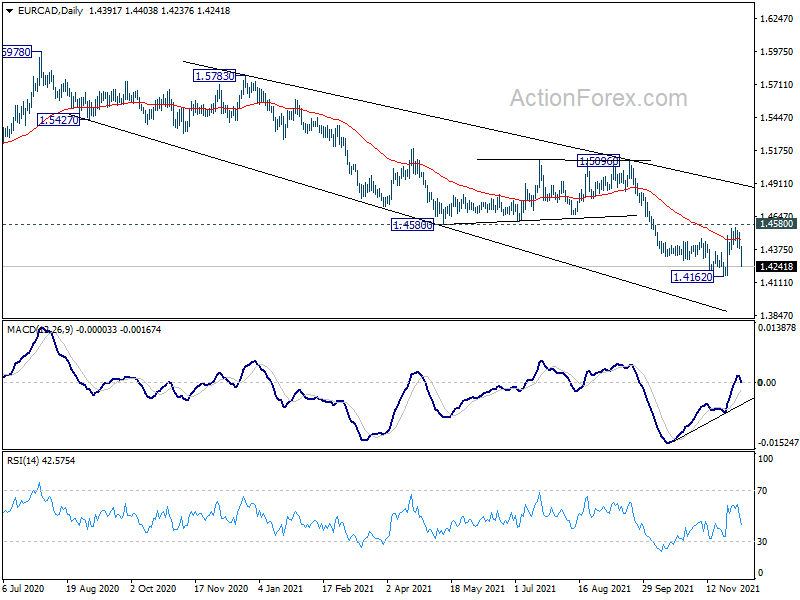
Technically, focus is now on some European-commodity crosses with today's development. In particular, EUR/CAD is heading back to 1.4162 support after earlier rejection by 1.4580 support turned resistance. Break will resume larger down trend and target 100% projection of 1.5783 to 1.4580 from 1.5096 at 1.3893.
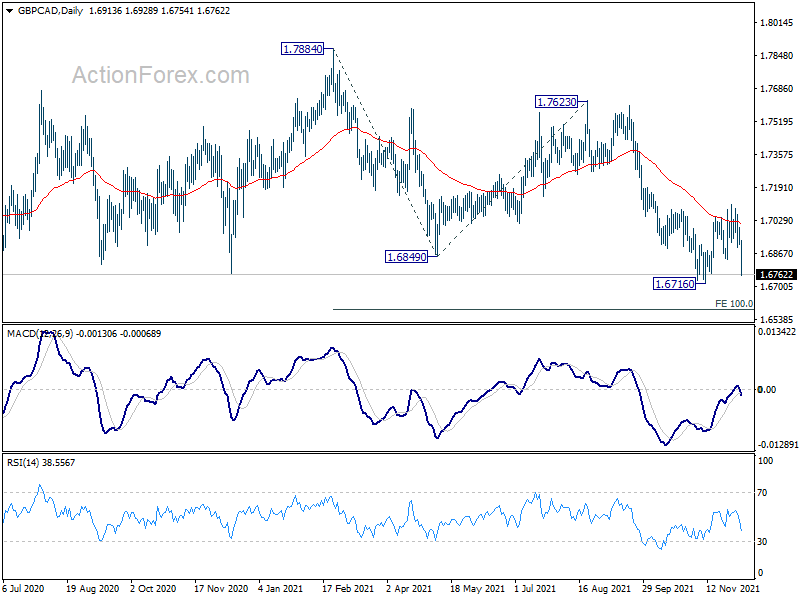
Also, GBP/CAD is diving back to 1.6716 support after rejection by 55 day EMA. Break will resume larger down trend for 100% projection of 1.7884 to 1.6849 from 1.7623 at 1.6588.
In Europe, at the time of writing, FTSE is up 1.19%. DAX is up 2.08%. CAC is up 2.34%. Germany 10-year yield is up 0.0219 at -0.365. Earlier in Asia, Nikkei rose 1.89%. Hong Kong HSI rose 2.72%. China Shanghai SSE rose 0.16%. Singapore Strait Times rose 0.59%. Japan 10-year JGB yield rose 0.139 to 0.055.
US exports rose 8.1% in Oct, import rose 0.9%, trade deficit narrowed
US exports rose 8.1% to USD 223.6B in October. Imports rose 0.9% to USD 290.7B. Trade deficit narrowed to USD -67.1B, from USD -81.4B, but widened than expectation of USD -66.9B. The figure reflected a decrease in goods deficit to USD -83.9B and increased in services surplus to USD 16.8B. Year-to-date, trade deficit increased 29.7% from the same period in 2020.
Canada trade surplus rose to CAD 2.1B in Oct, exports and imports surged to record
Canada exports rose 6.4% to reach a record CAD 56.2B in October. Exports grew in 8 of 11 product sections. The combined gains in exports of motor vehicles and parts and energy products accounted for almost 80% of the total growth.
Imports rose 5.3% to record CAD 54.1B. Gains were observed in 7 of 11 product sections. Motor vehicles and parts responsible for almost two-thirds of the monthly increase.
Trade surplus widened from CAD 1.4B to CAD 2.1B. well above expectation of CAD 1.6B. That's also the largest surplus so far in 2021.
German ZEW dropped to 29.9, suffering noticeably from latest pandemic development
Germany ZEW Economic Sentiment dropped to 29.9 in December, down from 31.7, but beat expectation of 25.3. Current Situation index dropped sharply to -7.4, down from 12.5. That's the first negative reading since June. Inflation Expectations dropped -19.0 pts to -33.3. 56.6% of experts expected inflation rate to decline in the next six months.
Eurozone ZEW Economic Sentiment rose from 25.9 to 26.8, above expectation of 23.5. Current Situation indicator dropped -13.9 pts to -2.3.
"The German economy is suffering noticeably from the latest developments in the COVID-19 pandemic. Persisting supply bottlenecks are weighing on production and retail trade. The decline in economic expectations shows that hopes for much stronger growth in the next six months are fading. Especially the earnings expectations of export-oriented and consumer-related industries are assessed more negatively," comments ZEW President Professor Achim Wambach on current expectations.
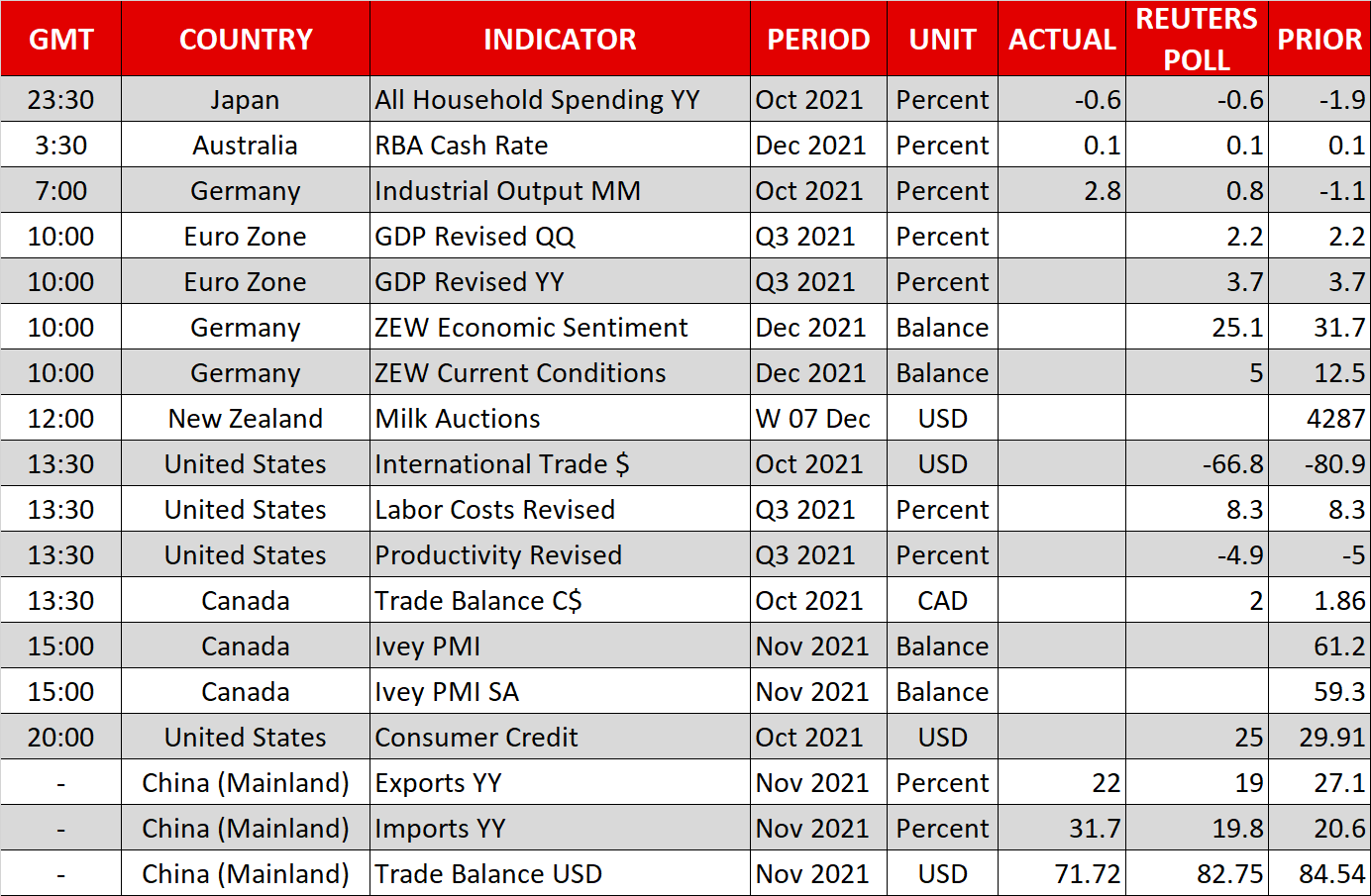
Also from Germany, industrial production rose 2.8% mom in October, well above expectation of 0.8% mom.
France trade deficit widened to EUR -7.5B in October. Swiss unemployment rate dropped to 2.5% in November. Swiss foreign currency reserves rose to CHF 1006B in November.
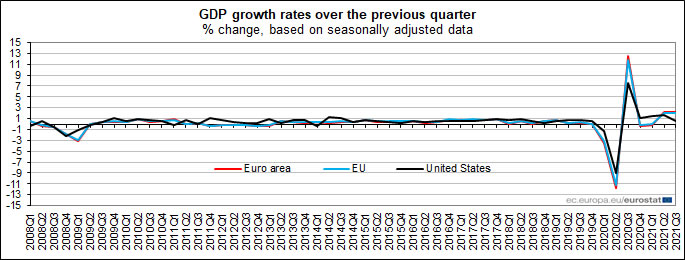
Eurozone GDP growth finalized at 2.2% qoq in Q3, EU at 2.1% qoq
According to the final revised data, Eurozone GDP grew 2.2% qoq 3.0% yoy in Q3. GDP volumes remained -0.3% below pre-pandemic level in Q4 2019. Household consumption rose 4.1%. Government final consumption expenditure rose 0.3%. Gross fixed capital formation dropped -0.9%. Exports rose 1.2%. Imports rose 0.7%.
Household final consumption expenditure in Eurozone rose 2.1%. Government final expenditure rose 0.1%. Gross fixed capital formation dropped -0.2%. The contributions from external balance were positive while change in inventories was slightly negative.
EU GDP grew 2.1% qoq, 4.1% yoy. GDP volumes remained -0.1% below pre-pandemic level in Q4 2019. Austria (+3.8%) recorded the highest increase of GDP compared to the previous quarter, followed by France (+3.0) and Portugal (+2.9%). Lowest growth rates were observed in Romania and Slovakia (+0.4%), while GDP remained stable in Lithuania (0.0%).
RBA keeps cash rate at 0.1%, asset purchase as 4B a week
RBA left monetary policy unchanged as widely expected. The cash rate target is held at 0.10%. It reiterated that "the Board will not increase the cash rate until actual inflation is sustainably within the 2 to 3 per cent target range."
Asset purchases will continue at AUD 4B a week until at least mid-February 2022. The decision on the program in February will be guided by the same three considerations used from the outset: "the actions of other central banks; how the Australian bond market is functioning; and, most importantly, the actual and expected progress towards the goals of full employment and inflation consistent with the target."
More on RBA: RBA Stayed Put, Cautiously Optimistic Over Domestic Economy
Australia AiG services rose to 49.6, underachieving relative to expectations
Australia AiG Performance of Services rose 2.0 pts to 49.6 in November. Sales dropped -1.6 to 53.6. Employment dropped -0.6 to 56.2. New orders rose 8.6 to 47.4. Supplier deliveries rose 0.9 to 40.4. Input prices dropped -8.3 to 65.3. Selling prices dropped -3.5 to 58.2.
Ai Group Chief Executive, Innes Willox, said: "The Australian services sector was broadly stable in November, underachieving relative to expectations of a more convincing recovery after the COVID-19 downturn in recent months."
Also released, house price index rose 5.0% qoq in Q3, slightly below expectation of 5.1% qoq.
RBNZ Hawkesby: A higher currency helps us achieve objectives more quickly
RBNZ Assistant Governor Christian Hawkesby said today that the central bank would take "considered steps" in raising interest rate. He added, "we have more confidence around the fact that the labour market is tight and that's going to build inflation pressures."
Regarding the government's plan to reopen borders from January, Hawkesby said "One risk we are conscious of in the very short term is that even when the borders reopen, that actually becomes easier for more Kiwis to leave the country than it does for foreigners to come in... So there is a potential that the labour market gets tighter before it gets looser".
Also, "at the moment a higher currency in the short term will actually help us achieve our objectives more quickly because a strong currency will feed through a lower tradeables inflation and feed through to lower inflation, and we are managing inflation from the top side."
Separately, outgoing Deputy Governor Geoff Bascand said inflation is "definitely got some persistence to it for the next 12 months". He added, we'll see the CPI moving along at 4 percent over the next year, but we think it will moderate over time, some of those things that have driven it up won't last forever."
Bascand also said, "we will keep reducing stimulus and do our part to stop inflation from getting momentum into it."
China exports rose 22% yoy in Nov, imports rose 31.7% yoy
In November in USD term, China exports rose 22.0% yoy, above expectation of 17.2% yoy. Imports rose 31.7% yoy, versus expectation of 19.5% yoy. Trade surplus narrowed to USD 71.7B, down from USD 84.5B, below expectation of USD 82.2B.
In CNY term, exports rose 16.6% yoy, below expectation of 17.2% yoy. Imports rose 26.0% yoy, above expectation of 9.4% yoy. Trade surplus narrowed to CNY 461B, down from CNY 546B, below expectation of CNY 575B.
From Japan, labor cash earnings rose 0.2% yoy in October, below expectation of 0.4% yoy. Household spending dropped -0.6% yoy, matched expectations.
AUD/USD Mid-Day Report
Daily Pivots: (S1) 0.6962; (P) 0.7031; (R1) 0.7068; More...
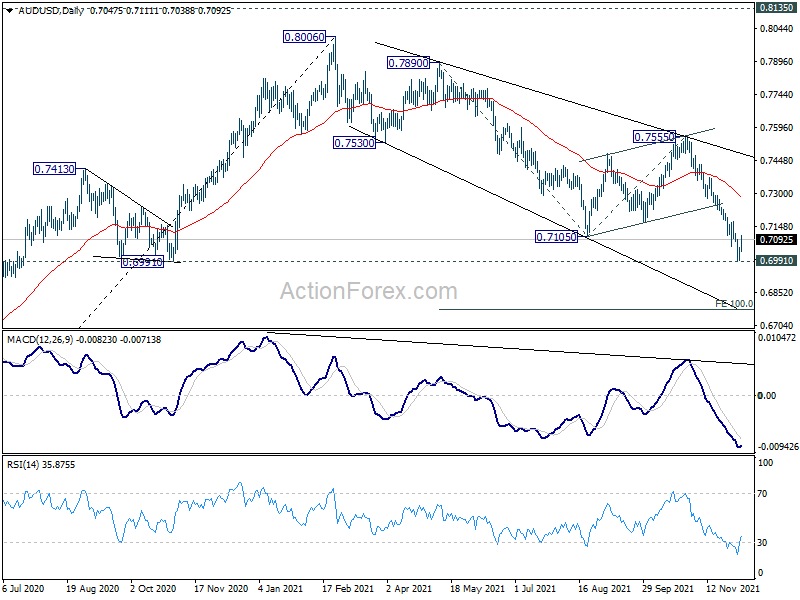
AUD/USD's rebound from 0.6992 extends higher today but stays below 0.7172 resistance. Intraday bias is turned neutral first. On the upside, firm break of 0.7172 will indicate short term bottoming. Intraday bias will be turned back to the upside for 55 day EMA (now at 0.7281). On the downside, firm break of 0.6991 key structural support will carry larger bearish implication. Next target is 100% projection of 0.7890 to 0.7105 from 0.7555 at 0.6770.
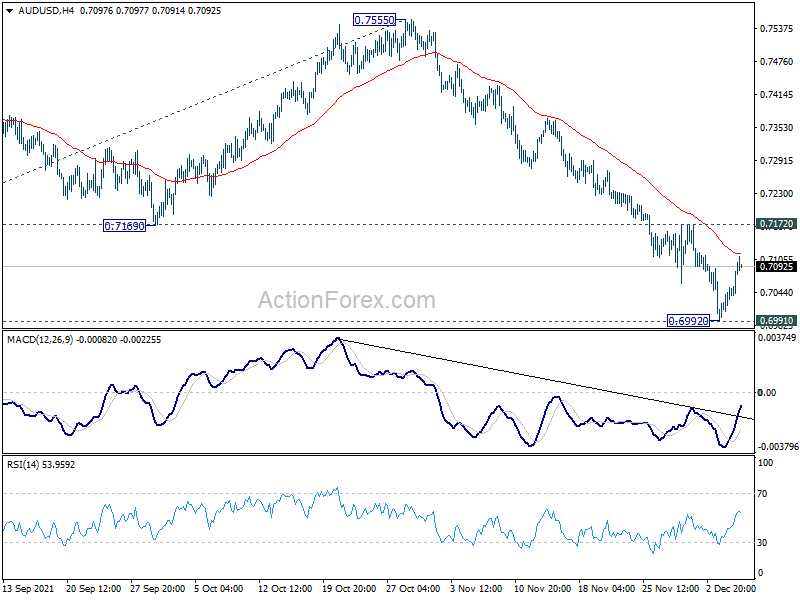
In the bigger picture, sustained break of 0.6991 cluster support will argue that the who up trend from 0.5506 might be finished at 0.8006, after rejection by 0.8135 long term resistance. Deeper decline would then be seen back to 61.8% retracement of 0.5506 to 0.8006 at 0.6461). For now, medium term outlook will stay bearish as long as 0.7555 resistance holds, in case of rebound.
Economic Indicators Update
| GMT | Ccy | Events | Actual | Forecast | Previous | Revised |
|---|---|---|---|---|---|---|
| 21:30 | AUD | AiG Performance of Services Index Nov | 49.6 | 47.6 | ||
| 23:30 | JPY | Labor Cash Earnings Y/Y Oct | 0.20% | 0.40% | 0.20% | |
| 23:30 | JPY | Household Spending Y/Y Oct | -0.60% | -0.60% | -1.90% | |
| 00:01 | GBP | BRC Like-For-Like Retail Sales Y/Y Nov | 1.80% | 0.30% | -0.20% | |
| 00:30 | AUD | House Price Index Q/Q Q3 | 5.00% | 5.10% | 6.70% | |
| 02:00 | CNY | Trade Balance (USD) Nov | 71.7B | 82.2B | 84.5B | |
| 02:00 | CNY | Exports Y/Y Nov | 22.00% | 17.20% | 27.10% | |
| 02:00 | CNY | Imports Y/Y Nov | 31.70% | 19.50% | 20.60% | |
| 02:00 | CNY | Trade Balance (CNY) Nov | 461B | 575B | 546B | |
| 02:00 | CNY | Exports (CNY) Y/Y Nov | 16.60% | 17.20% | 20.30% | |
| 02:00 | CNY | Imports (CNY) Y/Y Nov | 26.00% | 9.40% | 14.50% | |
| 03:30 | AUD | RBA Interest Rate Decision | 0.10% | 0.10% | 0.10% | |
| 05:00 | JPY | Leading Economic Index Oct P | 102.1 | 100.2 | 100.9 | |
| 06:45 | CHF | Unemployment Rate Nov | 2.50% | 2.60% | 2.70% | |
| 07:00 | EUR | Germany Industrial Production M/M Oct | 2.80% | 0.80% | -1.10% | |
| 07:45 | EUR | France Trade Balance (EUR) Oct | -7.5B | -6.2B | -6.8B | -6.9B |
| 08:00 | CHF | Foreign Currency Reserves (CHF) Nov | 1006B | 923B | ||
| 10:00 | EUR | Eurozone GDP Q/Q Q3 | 2.20% | 2.20% | 2.20% | |
| 10:00 | EUR | Eurozone Employment Change Q/Q Q3 F | 0.90% | 0.90% | 0.90% | |
| 10:00 | EUR | Germany ZEW Economic Sentiment Dec | 29.9 | 25.3 | 31.7 | |
| 10:00 | EUR | Germany ZEW Current Situation Dec | -7.4 | 5 | 12.5 | |
| 10:00 | EUR | Eurozone ZEW Economic Sentiment Dec | 26.8 | 23.5 | 25.9 | |
| 13:30 | USD | Trade Balance (USD) Oct | -67.1B | -66.9B | -80.9B | -81.4B |
| 13:30 | USD | Nonfarm Productivity Q3 | -5.20% | -4.90% | -5.00% | |
| 13:30 | USD | Unit Labor Costs Q3 | 9.60% | 8.40% | 8.30% | |
| 13:30 | CAD | Trade Balance (CAD) Oct | 2.1B | 1.6B | 1.9B | 1.4B |
| 15:00 | CAD | Ivey PMI Nov | 60.2 | 59.3 |
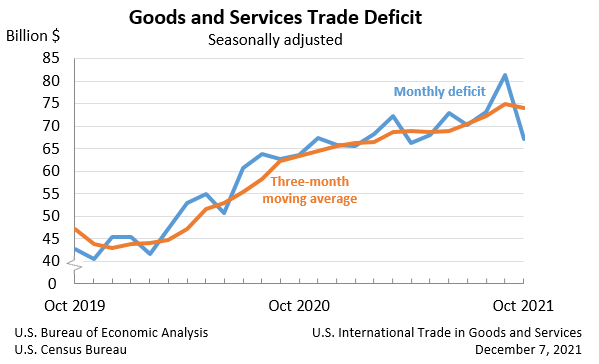
US exports rose 8.1% in Oct, import rose 0.9%, trade deficit narrowed
US exports rose 8.1% to USD 223.6B in October. Imports rose 0.9% to USD 290.7B. Trade deficit narrowed to USD -67.1B, from USD -81.4B, but widened than expectation of USD -66.9B. The figure reflected a decrease in goods deficit to USD -83.9B and increased in services surplus to USD 16.8B. Year-to-date, trade deficit increased 29.7% from the same period in 2020.
Canada trade surplus rose to CAD 2.1B in Oct, exports and imports surged to record
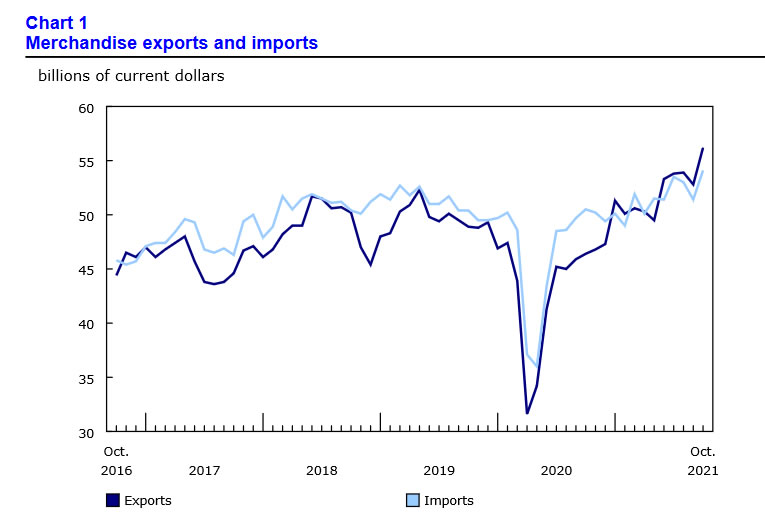
Canada exports rose 6.4% to reach a record CAD 56.2B in October. Exports grew in 8 of 11 product sections. The combined gains in exports of motor vehicles and parts and energy products accounted for almost 80% of the total growth.
Imports rose 5.3% to record CAD 54.1B. Gains were observed in 7 of 11 product sections. Motor vehicles and parts responsible for almost two-thirds of the monthly increase.
Trade surplus widened from CAD 1.4B to CAD 2.1B. well above expectation of CAD 1.6B. That's also the largest surplus so far in 2021.
Australian Dollar Rises after RBA Meet
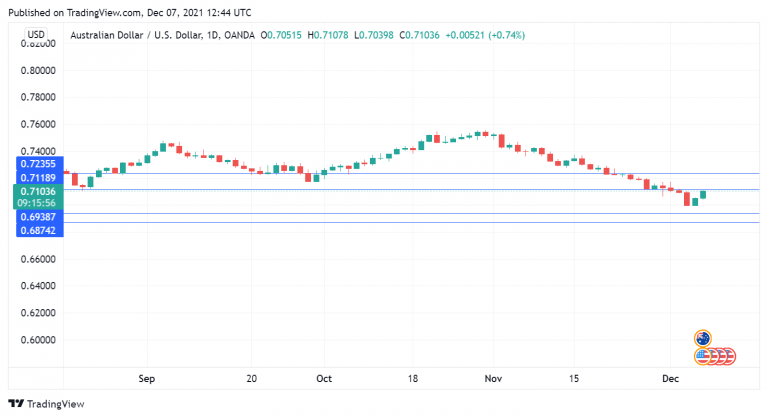
The Australian dollar has extended its rally and is trading at 0.7100. AUD/USD has had an impressive week so far, up 1.44%.
RBA optimistic but cautious
The RBA policy meeting did not contain any surprises and could be summarized as ‘hawkishly dovish’, or ‘mildly hawkish’ if you prefer. As expected, the RBA held the cash rate at a record low of 0.10% and reiterated that it won’t raise rates until inflation is sustainably within the RBA target band of 2-3%. This definition gives the bank a convenient out – even if inflation is within this band, the bank can take its time before hiking, saying that it wants to ensure that inflation remains “sustainable”.
The bank highlighted a lot of positive developments, saying that wage growth, business investment and consumer spending were expected to improve, and that the economy would fully recover from the Covid pandemic in H1 of 2022. Still, the bank remains cautious, citing omicron as a new source of uncertainty. The RBA said it would not consider scaling back its QE programme before the next meeting in February, meaning that no tightening in policy will take place until early next year at the earliest.
This leaves us with a significant disconnect between the RBA and the markets remains with regard to monetary policy – the RBA saying there won’t be a hike before 2023, while the markets have priced in a rate hike as early as July 2022. The markets are also projecting that the bank will wind up QE in February.
The Australian dollar, a bellwether of risk sentiment, has received a boost in the arm this week as Omicron jitters have eased. This follows comments from Anthony Fauci, President Biden’s chief medical advisor, that Omicron could be milder than previous Covid versions. This is a welcome development for the Aussie, but it’s prudent to keep in mind that an Australian downturn is only a negative headline away. With market volatility lurking in the air, it is prudent to remain cautious.
AUD/USD Technical
- There are resistance lines at 0.7118 and 0.7235
- AUD/USD has support at 0.6938. Below, there is support at 0.6875
BOC Preview – Reiterating Rate Hike in First Half 2022 amidst Strong Economic Data
Following a hawkish move in October, we expect the BOC to keep the powder dry this week. Policymakers should acknowledge the strong GDP growth and job market data, while cautioning over the uncertainty of the Omicron variant. They are also expected to reiterate the stance that the rate hike would come once the economic slack is absorbed.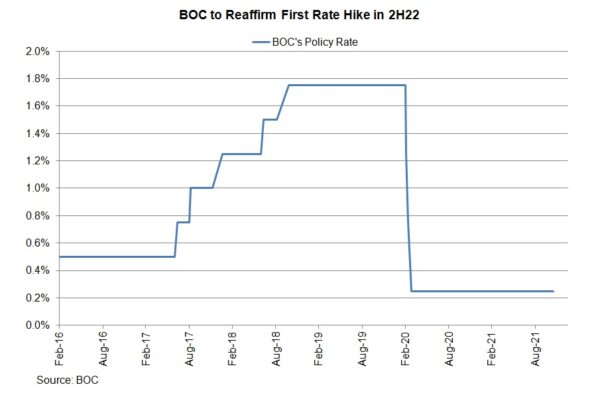
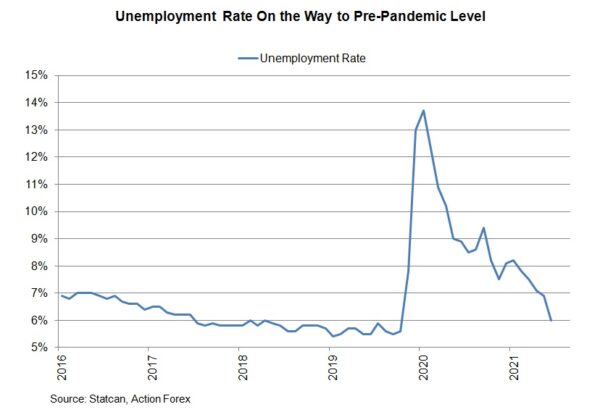
The economy expanded an annualized +5.4% q/q in 3Q21, beating consensus of +3%. The contraction in the second quarter was revised to -3.2% (previously: -1.1%). GDP grew +3.4% y/y in September, after expanding +4.1% in the prior month. The job market remained resilient. The unemployment rate dropped -0.7 ppt to 6% in November, beating consensus of 6.6%. The number of employment increased a lucrative +153.7K, following a +31.2K addition in October. This also came in better than consensus of +35.7K.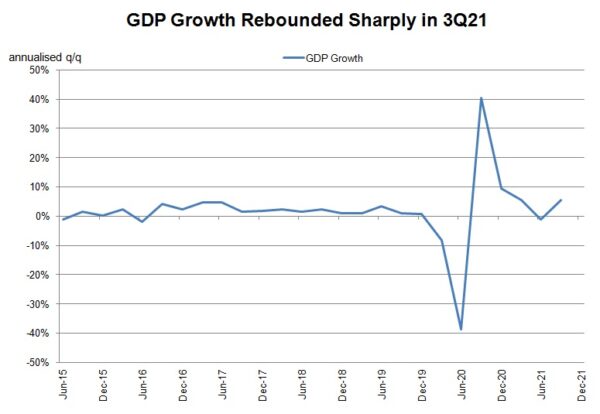
Inflation accelerated further with the headline CPI rising to +4.7% y/y in October, from +4.4% a month ago. BOC’s preferred inflation gauges averaged at 2.7%, unchanged from September. While policymakers did not appear very concerned about inflation, they pledged to monitor the situation closely and got ready to act. Writing for Financial Times in mid-November, Governor Tiff Macklem's indicated that the central bank expected inflationary pressures to ease. He added, however, that “if we end up being wrong about the persistence of inflationary pressures and how much slack remains in the economy, we will adjust. Our framework enables us to do just that”.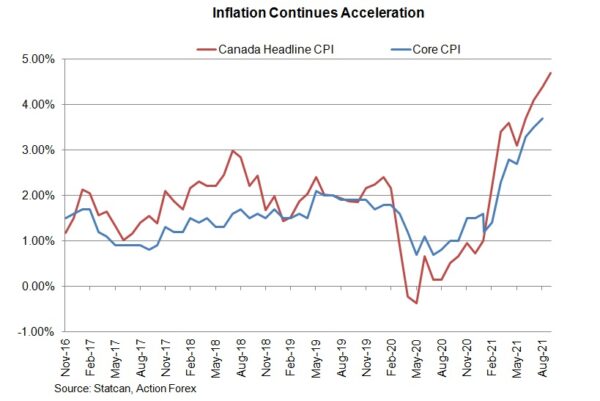
In October, the BOC announced to end the QE program and begin the reinvestment process. While leaving the overnight rate unchanged at the effective lower bound of 0.25%, the central bank also pushed forward the timing for the first rate hike to “sometime in the middle quarters of 2022”, compared with previous estimate of “the second half of 2022”. We expect this, and the forward guidance that a rate hike would not come “until economic slack is absorbed so that the 2% inflation target is sustainably achieved”, to stay intact this month.
RBA Stayed Put, Cautiously Optimistic Over Domestic Economy
The RBA left the cash rate unchanged at 0.1% and the asset purchase program at AUD 4B/week. Policymakers maintained a cautiously optimistic outlook over economic recovery despite Omicron uncertainty. Again, policymakers reiterated that the next meeting (February) would be the time to discuss the pace of QE purchases.
The central bank remained cautiously optimistic over domestic economic developments. As noted in the statement, household consumption was “rebounding strongly” and the outlook for business investment “has improved”. Concerning the new variant Omicron, the central bank suggested that it was “a new source of uncertainty, but it is not expected to derail the recovery“. Policymakers also acknowledged the strong inflation. Yet, they did not appear very concerned about it. According to the statement, “while inflation has picked up, it remains low in underlying terms. Inflation pressures are also less than they are in many other countries, not least because of the only modest wages growth in Australia”. The central forecast for underlying inflation is “+2.5% over 2023.”
On the monetary policy, policymakers reiterated that they would be “patient” in hiking the cash rate from the current 0.1%. They noted that a rate hike would come when “actual inflation is sustainably within the 2 to 3% target range”. Same as the last meeting, they noted that “this will require the labour market to be tight enough to generate wages growth that is materially higher than it is currently”. The central bank also maintained the pace of quantitative easing (QE) at AUD4B/week. Again, the RBA indicated “By mid February, the RBA will hold a total of AUD350B of bonds [...] with these holdings providing significant support to the economy”. It noted three criteria for considering the adjustment: 1) the actions of other central banks; 2) how the Australian bond market is functioning; and 3) the actual and expected progress towards the goals of full employment and inflation consistent with the target.
German ZEW dropped to 29.9, suffering noticeably from latest pandemic development
Germany ZEW Economic Sentiment dropped to 29.9 in December, down from 31.7, but beat expectation of 25.3. Current Situation index dropped sharply to -7.4, down from 12.5. That's the first negative reading since June. Inflation Expectations dropped -19.0 pts to -33.3. 56.6% of experts expected inflation rate to decline in the next six months.
Eurozone ZEW Economic Sentiment rose from 25.9 to 26.8, above expectation of 23.5. Current Situation indicator dropped -13.9 pts to -2.3.
"The German economy is suffering noticeably from the latest developments in the COVID-19 pandemic. Persisting supply bottlenecks are weighing on production and retail trade. The decline in economic expectations shows that hopes for much stronger growth in the next six months are fading. Especially the earnings expectations of export-oriented and consumer-related industries are assessed more negatively," comments ZEW President Professor Achim Wambach on current expectations.
Eurozone GDP growth finalized at 2.2% qoq in Q3, EU at 2.1% qoq
According to the final revised data, Eurozone GDP grew 2.2% qoq, 3.0% yoy in Q3. GDP volumes remained -0.3% below pre-pandemic level in Q4 2019. Household consumption rose 4.1%. Government final consumption expenditure rose 0.3%. Gross fixed capital formation dropped -0.9%. Exports rose 1.2%. Imports rose 0.7%.
Household final consumption expenditure in Eurozone rose 2.1%. Government final expenditure rose 0.1%. Gross fixed capital formation dropped -0.2%. The contributions from external balance were positive while change in inventories was slightly negative.
EU GDP grew 2.1% qoq, 4.1% yoy. GDP volumes remained -0.1% below pre-pandemic level in Q4 2019. Austria (+3.8%) recorded the highest increase of GDP compared to the previous quarter, followed by France (+3.0) and Portugal (+2.9%). Lowest growth rates were observed in Romania and Slovakia (+0.4%), while GDP remained stable in Lithuania (0.0%).
Risk Appetite Getting Fresh Tailwinds As Omicron Fears Seemed Overblown
Notes/Observations
- Risk appetite finds tailwinds as signs Omicron concerns are overdone.
- Germany Oct Industrial Production data beats expectations and offers a glimmer of hope for the country and region.
- Germany Dec ZEW Survey mixed but hope did fade for much stronger growth in next 6 months.
- Euro Zone Q3 Final GDP revised higher.
Asia
- RBA left Cash Rate Target unchanged at 0.10% (as expected). To continue buying govt securities at a rate of A$4B/week until at least mid Feb 2022. Reiterated forward guidance that would not increase the cash rate until actual inflation was sustainably within the 2.0-3.0% target range. Omicron virus strain is a new source of uncertainty, but it is not expected to derail the recovery.
- China Nov Trade Balance: $71.7B v $82.1Be; Exports Y/Y: 22.0% v 19.8%e; Imports Y/Y: 31.7% v 22.0%e.
Europe
- Hungary Central Bank Dep Gov Virag stated that inflation to peak above ~7.0% in Nov, but decline would be slow starting in H2 2022. Determined to defeat inflation, no matter how long the road was ahead.
Americas
- President Biden said to be considering options for potential Russia invasion of Ukraine, including cutting Russia off of SWIFT payment system and restrictions on Russian bond trading.
- Senate Minority Leader McConnell (R-KY): Will probably end up supporting reappointing Jerome Powell as Fed Chair.
- Congressional leaders are contemplating tying the US Defense Authorization Act to increasing the debt ceiling in order to win bipartisan support.
Speakers/Fixed income/FX/Commodities/Erratum
Equities
- Indices [Stoxx600 +1.85% at 477.38, FTSE +1.14% at 7,314.63, DAX +2.05% at 15,695.48, CAC-40 +2.12% at 7,011.26, IBEX-35 +0.95% at 8,519.60, FTSE MIB +1.53% at 26,903.00, SMI +0.84% at 12,479.05, S&P 500 Futures +1.18%].
- Market Focal Points/Key Themes: European indices open higher across the board and advanced further into the green as the session progressed; dwindling concern over omicron cited as source of surge in risk-on sentiment; better performing sectors led by technology and materials; while underperforming sectors include telecom and utilities; oil and gas subsector supported by increased crude prices; UK’s CMA has competition concerns with Veolia-Suez merger; Liontrust buys Majedie; Stellantis announces semiconductor development partnership with Foxconn, to invest in software development in cars; earnings expected during the upcoming US session include Conn’s, Designer Brands and AutoZone.
Equities
- Consumer discretionary: PageGroup [PAGE.UK] +4% (trading update), Greenyard [GREEN.BE] +3% (CMD), Ashtead [AHT.UK] +3% (earnings).
- Consumer staples: British American Tobacco [BATS.UK] +2% (trading update).
- Healthcare: Glaxosmithkline [GSK.UK] +1.5% (antibody cocktail works against Omicron), AstraZeneca [AZN.UK] -2% (agreement with Ionis).
- Industrials: Stellantis [STLA.NL] +2% (CMD), Ferguson [FERG.UK] +5% (earnings).
Speakers
- ECB's Enria (SSM chief) noted that the EU credit risk remained high and would continue to push banking sector to correctly classify loans and timely recognize deteriorating asset quality. MPLs in sectors more vulnerable to impact of pandemic had started to increase. ECB to increase attention to excessive yield search risks.
- Incoming German Chancellor Scholz stated that tackling the pandemic would demand all our strength.
- Austria Chancellor Nehammer stated that would continue lockdown for unvaccinated people after general lockdown ends on Sunday, Dec 12th.
- EU Economic Commissioner Gentiloni (Italy) stated that recovery remained underway but headwinds had been mounting.
- German Health Min Spahn stated that did not expect travel restrictions within the EU. Important that EU treated vaccinated, unvaccinated people differently.
Currencies/Fixed Income
- Risk on appetite helped to push bond yields higher as markets re-evaluated the Omicron variant and now believed the concerns over its economic impact were overdone. The USD was former aided by rising yields.
- EUR/USD drifted to 1-week lows with the pair testing 1.1253 in the session. Germany Dec ZEW Survey was mixed but hope did fade as seen in the ZEW survey for much stronger growth in next 6 months due to the pandemic.
- GBP/USD moved off its recent lows but faced headwinds after various analysts now believed BOE would hold off on raising interest rates at its December 16th meeting. Cable trading at 1.3260 by mid-session.
Economic data
- (NL) Netherlands Nov CPI M/M: 0.9 v 1.3% prior; Y/Y: 5.2 v 3.4% prior.
- (NL) Netherlands Nov CPI EU Harmonized M/M: 0.8 v 1.6% prior; Y/Y: 5.9 v 3.7% prior.
- (ZA) South Africa Nov Gross Reserves: $57.6B v $57.5B prior; Net Reserves: $55.2B v $55.2Be.
- (CH) Swiss Nov Unemployment Rate: 2.5% v 2.6%e; Unemployment Rate (seasonally adj: 2.5% v 2.6%e.
- (UK) Nov Halifax House Price Index M/M: 1.0% v 0.9% prior; Y/Y: 8.2% v 8.1% prior.
- (DE) Germany Oct Industrial Production M/M: 2.8% v 1.0%e; Y/Y: -0.6% v -2.9%e.
- (NO) Norway Oct Industrial Production M/M: -5.3% v +3.3% prior; Y/Y: 6.9% v 7.9% prior.
- (NO) Norway Oct Manufacturing Production M/M: -0.9% v +0.6% prior; Y/Y: 1.9% v 3.6% prior.
- (DK) Denmark Oct Industrial Production M/M: +2.6% v -6.2% prior.
- (RO) Romania Q3 Preliminary GDP Q/Q: 0.4% v 0.3% advance; Y/Y: 7.4% v 7.2% advance.
- (MY) Malaysia end-Nov Foreign Reserves: $116.7B v $116.5B prior.
- (FR) France Oct Trade Balance: -€7.5B v -€6.9Be.
- (FR) France Oct Current Account Balance: -€2.6B v -€2.8B prior.
- (CH) Swiss Nov Foreign Currency Reserves (CHF): 1.006T v 1.012T prior.
- (CZ) Czech Oct National Trade Balance (CZK): -18.2B v -14.5Be.
- (CZ) Czech Oct Industrial Output Y/Y: -7,4% v -6.4%e; Construction Output Y/Y: 3.7% v 3.0% prior.
- (HU) Hungary Oct Industrial Production M/M: +0.3% v -0.3% prior; Y/Y: -2.7% v -2.0%e.
- (TW) Taiwan Nov CPI Y/Y: 2.8% v 2.6%e; CPI Core Y/Y: 1.5% v 1.4%e; WPI Y/Y: 14.2% v 15.1% prior.
- (TW) Taiwan Nov Trade Balance: $5.7B v $5.4Be; Exports Y/Y: 30.2% v 22.8%e; Imports Y/Y: 33.8% v 24.5%e.
- (CN) China Nov Foreign Reserves: $3.224T v $3.205Te.
- (SE) Sweden Oct GDP Indicator M/M: 1.2%% v 0.3%e; Y/Y: 4.8% v 3.3% prior.
- (SE) Sweden Oct Private Sector Production M/M: 1.5% v 1.9% prior; Y/Y: 6.4% v 5.0% prior.
- (SE) Sweden Oct Industrial Orders M/M: +4.9% v -2.1% prior; Y/Y: 6.8% v 1.4% prior.
- (SE) Sweden Oct Industry Production Value Y/Y: 3.7% v 3.5% prior; Service Production Value Y/Y: 7.8% v 6.0% prior.
- (SE) Sweden Oct Household Consumption M/M: 0.8% v 0.1% prior; Y/Y: 5.5% v 4.6% prior.
- (SE) Sweden Nov Budget Balance (SEK): 37.6B v 3.3B prior.
- (NO) Norway Nov Region Output Survey (past 3-months): 1.46 v 1.79 prior; Output Survey (next 6-months): 0.95 v 1.65 prior.
- (IS) Iceland Nov Preliminary Trade Balance (ISK): -28.6B v -12.8B prior.
- (SG) Singapore Nov Foreign Reserves: $413.0B v $419.0B prior.
- (ZA) South Africa GDP Q/Q: -1.5% v -1.0%e; Y/Y: 2.9% v 3.8%e.
- (EU) Euro Zone Q3 Final GDP Q/Q: 2.2% v 2.2% prelim; Y/Y: 3.9% v 3.7% prelim.
- (EU) Euro Zone Q3 Household Consumption Q/Q: 4.1% v 3.6%e; Govt Expenditures Q/Q: 0.3% v 0.7%e; Gross Fixed Capital Q/Q: -0.9% v +0.6%e.
- (EU) Euro Zone Q3 Final Employment Q/Q: 0.9% v 0.9% prelim; Y/Y: 2.1% v 2.0% prelim.
- (DE) Germany Dec ZEW Current Situation Survey: -7.4 v +5.7e; Expectations Survey: 29.9 v 25.4e.
- (EU) Euro Zone Dec ZEW Expectations Survey: 26.8 v 25.9 prior.
Fixed income Issuance
- (NL) Netherlands Debt Agency (DSTA) sold €2.1B vs. €1.5-3.0B indicated in 2.0% July 2024 DSL Bonds; Avg Yield:-0.688 % v 0.895% prior (Nov 25th 2014).
- (ES) Spain Debt Agency (Tesoro) sold total €4.53B vs. €4.0-5.0B indicated range in 6-month and 12-month Bills.
- (ZA) South Africa to sold total ZAR3.9B vs. ZAR3.9B indicated in 2032, 2040 and 2048 bonds.
- (UK) DMO sold £1.5B in 1.25% July 2051 Gilts; Avg Yield: 0.871% v 1.332% prior; bid-to-cover: 2.42x v 2.05x prior; Tail: 1.0bps v 1.1bps prior.
Looking ahead
- (IL) Israel Nov Foreign Currency Balance: No est v $207.5B prior.
- (MX) Citibanamex Survey of Economists.
- (CO) Colombia Nov Consumer Confidence Index: No est v -1.3 prior.
- 05:15 (CH) Switzerland to sell 3-month Bills.
- 05:25 (EU) Daily ECB Liquidity Stats.
- 05:30 (HU) Hungary Debt Agency (AKK) to sell 3-Month Bills.
- 05:30 (DE) Germany to sell €4.0B in 0.0% Dec 2023 Schatz.
- 05:30 (BE) Belgium Debt Agency (BDA) to sell 3-month bills.
- 05:30 (EU) ECB allotment in 7-Day Main Refinancing Tender (MRO).
- 06:00 (BR) Brazil Nov FGV Inflation IGP-DI M/M: -0.5%e v +1.6% prior; Y/Y: 17.3%e v 21.0% prior.
- 06:00 (CL) Chile Nov CPI M/M: 0.5%e v 1.3% prior; Y/Y: 6.6%e v 6.0% prior.
- 06:00 (CL) Chile Nov Trade Balance: No est v -$0.4B prior; Total Exports: No est v $7.8B prior; Total Imports: No est v $8.1B prior; Copper Exports: No est v $4.5B prior.
- 06:00 (CL) Chile Nov International Reserves: No est v $55.0B prior.
- 06:30 (EU) ESM to sell €1.5B in 3-month Bills.
- 06:45 (US) Daily Libor Fixing.
- 07:00 (TR) Turkey to s Bonds.
- 07:00 (MX) Mexico Sept Gross Fixed Investment: 11.2%e v 13.9% prior.
- 08:00 (PL) Poland Nov Official Reserves: No est v $167.8B prior.
- 08:00 (RU) Russia Nov Official Reserve Assets: No est v $624.2B prior.
- 08:00 (RU) Russia announcement on upcoming OFZ bond issuance (held on Wed).
- 08:30 (US) Q3 Final Nonfarm Productivity: -4.9%e v -5.0% prelim; Unit Labor Costs: 8.3%e v 8.3% prelim.
- 08:30 (US) Oct Trade Balance: -$66.9Be v -$80.9B prior.
- 08:30 (CA) Canada Oct Int'l Merchandise Trade (CAD): 2.1Be v 1.9B prior.
- 08:55 (US) Weekly Redbook LFL Sales data.
- 09:00 (EU) Weekly ECB Forex Reserves.
- 09:00 (EU) ECB weekly QE bond buying update.
- 09:30 (TR) Turkey Nov Cash Budget Balance (TRY): No est v -5.2B prior.
- 09:45 (UK) BOE to buy £1.47B in APF Gilt purchase operation (20+ years).
- 10:00 (MX) Mexico Weekly International Reserve data.
- 10:00 (CA) Canada Nov Ivey Purchasing Managers Index (seasonally adj): No est v 59.3 prior; PMI (unadj): No est v 61.2 prior.
- 13:00 (US) Treasury to sell 3-year note.
- 15:00 (US) Oct Consumer Credit: $25.0Be v $29.9B prior.
- 16:30 (US) Weekly API Oil Inventories.
- 18:50 (JP) Japan Nov Bank Lending Y/Y: No est v 0.9% prior; Bank Lending (ex-trusts) Y/Y: No est v 0.8% prior.
- 18:50 (JP) Japan Oct Current Account Balance: ¥1.275Te v ¥1.034T prior; Adjusted Current Account: ¥999.2Be v ¥762.7B prior; Trade Balance (BoP Basis): +¥128.8Be v -¥229.9B prior.
- 18:50 (JP) Japan Q3 Final GDP Q/Q: -0.8%e v -0.8% prelim; Y/Y: -3.1%e v -3.0% prelim; GDP Nominal Q/Q: -0.6%e v -0.6% prelim.
- 22:00 (CN) China to sell 2-year and 5-year Upsize Bonds.
- 23:30 (IN) India Central Bank (RBI) interest Rate Decision: Expected to leave Repurchase Rate unchanged at 4.00%; Expected to leave Reverse Repo Rate unchanged at 3.35%; To maintain Cash Reserve Ratio (CRR) at 4.00%.
Stocks Rally, Dollar Slips As Omicron Fears Subside, China Eases Policy
- Wall Street bounces back as investors shrug off inflation and Omicron concerns
- US yields also rebound but dollar pressured by improved sentiment
- Aussie climbs on upbeat RBA, oil rally lifts loonie, BoE uncertainty caps pound’s gains
Risk appetite returns as Omicron gloom recedes further
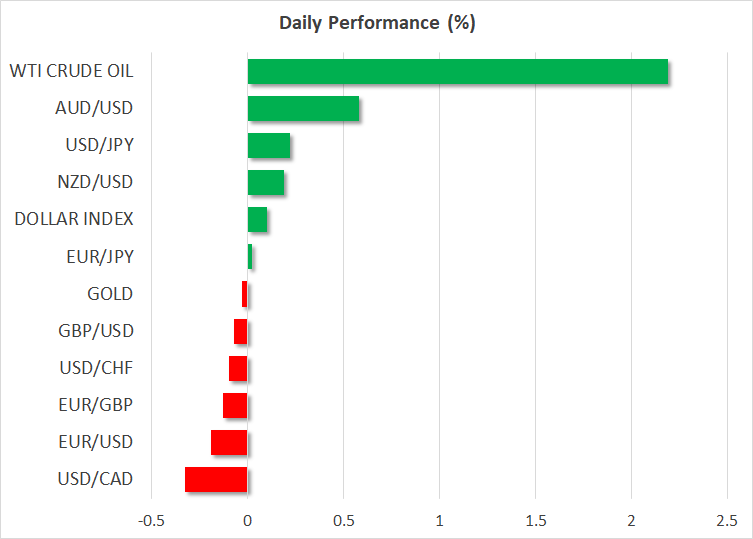
Equity markets were in a buoyant mood on Tuesday following a strong rebound on Wall Street yesterday. US stocks staged an impressive rally, with the Dow Jones gaining 1.9% and the S&P 500 1.2%, recouping last week’s losses. The Nasdaq Composite was a noticeable laggard, however, closing just 0.9% higher, as growth stocks were hit by a late selloff in long-dated Treasury notes. The yield on 10-year Treasuries jumped from around 1.35% to close above 1.43%.
With the evidence so far suggesting that the new Omicron variant causes only mild symptoms even if it is more transmissible than the Delta strain, investors are hoping that another winter of widespread economic shutdowns can be avoided this time. This is giving value stocks the edge as traditional sectors of the economy look poised to recover further while the hefty valuations of many growth stocks are coming into question as long-term borrowing costs begin to rise again.
Whilst there are still many unknowns about the Omicron variant and just how effective the current generation of vaccines will be in preventing a massive surge in hospitalizations, the inflation outlook is probably a bigger variable for investors in the medium term.
Most major central banks have begun to scale back their pandemic-era stimulus and are now pondering whether a faster withdrawal is warranted given the troubling inflation picture. There is a risk that policymakers overreact to the inflation threat and choke the economic recovery. But with some central banks such as the PBOC doing the opposite and announcing an easing of policy, markets are able to put those worries aside for now.
As expected, the PBOC cut the reserve requirement ratio for most commercial banks by 50 basis points on Monday. It followed it up today by lowering its relending rate for small and rural companies, raising speculation that the benchmark LPR rate could be cut next.
Chinese stocks rose but pared some of their earlier advances by the close. European bourses, however, posted solid gains in early trade, while US futures were also last up sharply.
Aussie and loonie lead the pack as safe havens retreat
The improved risk tone weighed on safe haven currencies, with the yen and Swiss franc slipping against most of their peers. The US dollar started the day broadly weaker too but later stood flat against a basket of currencies as it got shored up by the climb in Treasury yields.
The Australian dollar was once again an outperformer, flirting with the $0.71 level, after the Reserve Bank of Australia kept policy unchanged earlier today, signalling that it will taper its bond purchases further in February.
The Australian economy is making a strong comeback after months of lockdown and unless the Omicron outbreak derails the recovery, which doesn’t seem likely at this point, there is a good chance the RBA will end its bond purchases early and bring forward the timing of its first rate hike.
The Canadian dollar extended its gains too, firming to more than one-week highs versus the greenback. The Bank of Canada is due to announce its latest policy decision tomorrow and might follow in the RBA’s footsteps and maintain its optimism about the outlook. However, the loonie’s gains this week are likely being led by the rebound in oil prices.
After plunging to more than three-month lows last week, WTI and Brent crude futures are rallying on dimming hopes of a breakthrough in the nuclear talks between Iran and the West. In addition, fading fears about the Omicron outbreak are also boosting oil and other commodities.
Pound and euro lag
The pound was struggling to build on yesterday’s advances, stalling around $1.3260, amid mixed messages by Bank of England policymakers. One of the BoE’s biggest hawks – Michael Saunders – struck a cautious note on Monday, worried about the possible impact of the Omicron variant. But Deputy Governor Ben Broadbent warned that inflation could exceed 5% in the coming months.
The euro, meanwhile, remained under pressure, drifting towards $1.1250, as the ECB is increasingly alone in being relaxed about the upward spiral in inflation. The ECB, Fed and BoE are all due to meet next week, and with the latter two likely taking another hawkish turn, the euro’s woes could get much worse.