Sample Category Title
US Dollar Index: The Dollar Hits New Multi-Month High in Extension of Post-US CPI Rally
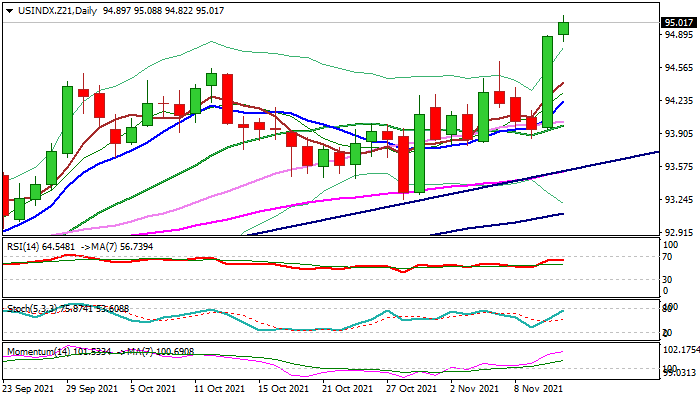
The dollar remains firm against the basket of major world currencies and extends advance to a new 16-month high on Thursday, following a strong rally on Wednesday, sparked by higher than expected rise in consumer prices.
The dollar index surged nearly 1% ( the biggest one-day gains in 2021) after data showed US inflation grew at the fastest annual pace since 1990 last month, boosting expectations that the Fed could respond by raising interest rates earlier than expected and before other major central banks.
The greenback’s upward momentum was boosted by the new hawkish view of Fed policy expectations, as the US currency already benefited from the recent dovish steer from other G10 central banks.
Fresh bullish acceleration broke above pivotal barriers at 94.68/74 (200WMA / Fibo 38.2% of larger 103.80/89.15 downtrend) with a weekly close above these levels to confirm strong bullish signal and open way for the continuation of recovery leg from 89.50 (May 25 higher low).
The price action is currently riding on the third wave of the five-wave cycle from 89.15 (2021 low) and eyeing the target at 95.45 (Fibo 138.2% expansion).
Bullish daily and weekly studies support the action, with dips expected to offer better buying opportunities.
Res: 95.08; 95.45; 95.68; 96.47.
Sup: 94.82; 94.55; 94.22; 93.98.
Stocks Flicker Green, Dollar Buoyant after Yesterday’s Upbeat CPI
Inflation expectations grow, down under jobs data disappoint and UK GDP dampens rate hikes
Public holidays in Canada and the US have investors’ focus turned to Australian employment, and the growth and trade data out of the UK.
Yesterday’s stronger US October CPI figures have boosted rate hike expectations as a higher inflation environment, which is aiding the greenback, is projected to put further pressure on the Fed to take action. The two-year US yield is also supporting the dollar, so the question is, is transitory inflation an old concept?
US growth is strong, and wages and inflation are increasing, so a positive narrative remains for 2 rate hikes, especially once further spending comes out of Congress.
The dollar index ticked above the 95.00 handle, while the euro was at $1.1462, its lowest point since July 2020, and the pound at $1.3385, last reached in December 2020. The swissie and yen also moved higher, pulled by the dollar, while additional underperformance from the reserve currency’s peers like the euro, pound and the aussie could enhance its strength.
On another note, if inflation runs away or stays elevated, and the Fed delays hikes, people may start to make moves to hedge their exposure, maybe back into gold and riskier assets.
UK GDP and trade data damage rate hopes
Inflation in the UK remains elevated due to issues around supply shortages and oil prices - though recently having eased slightly. The BoE has been unable to boost the pound after recently disappointing markets, after failing to raise interest rates, and that has kept the sterling heavy. The break below the $1.3411 key trough is of concern, because this increases the risk to the downside in the forex pair, which could also intensify, should the BoE have another rate mishap.
The FTSE 100 index shot up to 7370 and the pound dropped to $1.3385 on the back of the UK’s key Q3 GDP numbers and trade data. The Q3 preliminary GDP figures came in weaker than expectations of 1.5%, at 1.3%, considerably lower than the Q2. Furthermore, trade data was weaker with business investment in the UK increasing by 0.4% quarter-over-quarter, from July-September, falling way beneath market expectations of 2.6%. From a year-on-year perspective, business investment rose 0.8%, waning considerably from a 12.9% surge in Q2.
That said, investment in construction in September shot higher to 1.3% versus the estimate of 0.2% and the prior disappointing month, while September GDP was stronger at 0.6%, from -0.7% in the previous month, and past the 0.2% forecast.
Overall, the upbeat monthly GDP and construction components were overshadowed by poorer trade and preliminary GDP data, which suggests the slack in the UK economy may have damaged the outlook of the BoE raising interest rates in December and early on next year. This may keep the sterling pressured to the downside.
Nevertheless, the November CPI data will give the BoE one last snapshot of the economy before they decide to hike. Weaker results will not suffice for BoE action.
Australia’s October jobs data flop
The Australian dollar maintains its negative trajectory but experienced minor damage from today’s miss in employment data. The aussie is trading at S0.7290. The unemployment rate for October rose to 5.2% from September’s 4.6% figure, overshooting the 4.8% estimation. Moreover, an increase in 50.0k jobs was projected, however a drop in the number of employed people by 46.3k was logged, lower than the revised drop of 141.1k in September but still missed the forecast. Some credence can be given now to the RBA for mentioning that rates will not be hiked until 2024.
At 17:30 GMT, Governing board member Andrea Maechler of the SNB is speaking.
Then at 21:30 GMT, New Zealand’s Business manufacturing index is due.
NZ Dollar Extends Losses after US CPI
New Zealand dollar closing in on 70 level
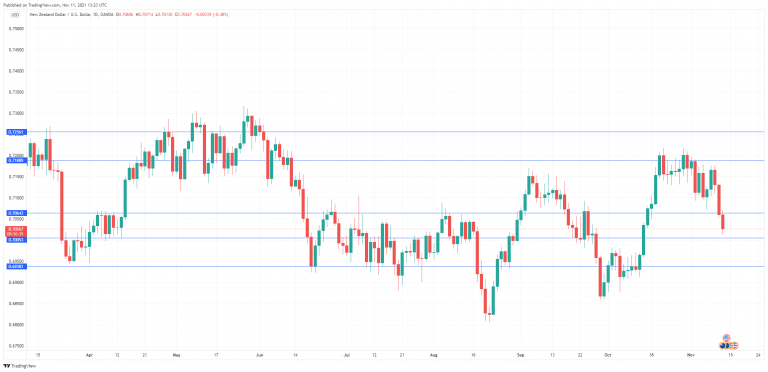
The New Zealand dollar is in negative territory for a third straight day. NZD/USD is currently trading at 0.7025, down 0.49% on the day. The pair is down 1.33% this week and is in danger of falling below the psychologically important 70 level.
As is the case with many developed economies, New Zealand has been experiencing surging inflation as the economy emerges from the Covid pandemic. In October, CPI for the third quarter jumped 4.9% y/y, up sharply from 3.3% in Q2. However, an important monthly inflation indicator, the Food Price Index, declined by 0.9% in October, the first decline in eight months.
The RBNZ has been cautiously optimistic about the country’s recovery from Covid, although higher global inflation remains a concern. Closer to home, the central bank has warned that the red-hot housing market runs the risk of a correction, as recent buyers could find themselves in trouble if mortgage rates rise or house prices fall. The bank has said that the economy has rebounded to pre-pandemic levels, but noted the recent Delta outbreak could hamper economic activity.
We’ll get another look at the mood of the business sector later in the day, with the release of BusinessNZ Manufacturing Index for October. The release comes on the heels of a disappointing ANZ Business Confidence index, which fell for a fourth consecutive month. The survey noted that costs for businesses have gone “through the roof”, with some 89% of firms reporting higher costs.
In the US, inflation shows no sins of slowing. CPI for October rose 6.2% y/y, above expectations and the largest gain since 1990. This sent US 10-year Treasury yields higher and boosted the US dollar. The markets have priced in several rate hikes in 2022, a much more hawkish projection than the Fed. With PPI and CPI at 30-year highs, the Fed’s message that inflation is transitory is becoming a harder sell to the markets.
NZD/USD Technical
- There is resistance at 0.7188 and 0.7255
- NZD/USD is testing support at 0.7063. Below, 0.7005 is under pressure, followed by support at 0.6938
EUR/USD Mid-Day Outlook
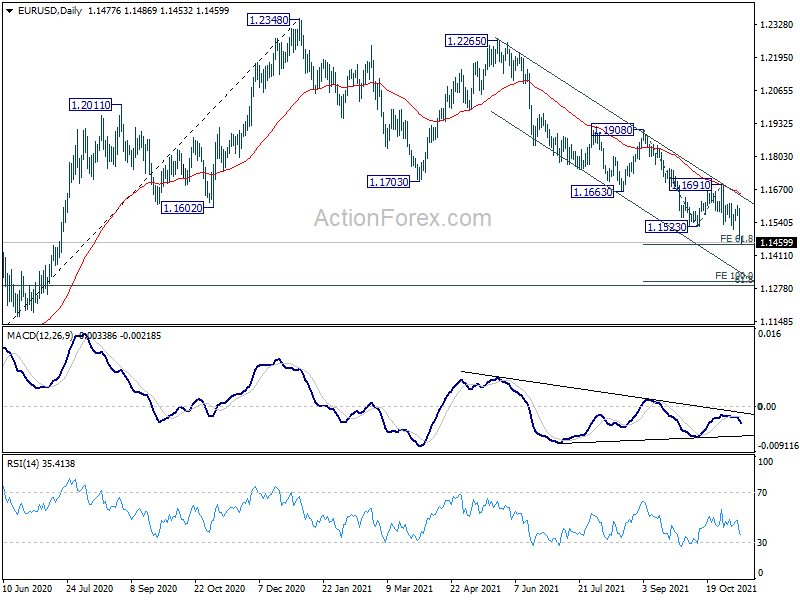
Daily Pivots: (S1) 1.1437; (P) 1.1516; (R1) 1.1556; More...
Intraday bias in EUR/USD remains on the downside as fall from 1.2348 is in progress. Firm break of 1.1908 to 1.1523 from 1.1691 at 1.1453 will pave the way to 100% projection at 1.1306. On the upside, break of 1.1607 resistance is needed to indicate short term bottoming. Otherwise, outlook will stay bearish in case of recovery.
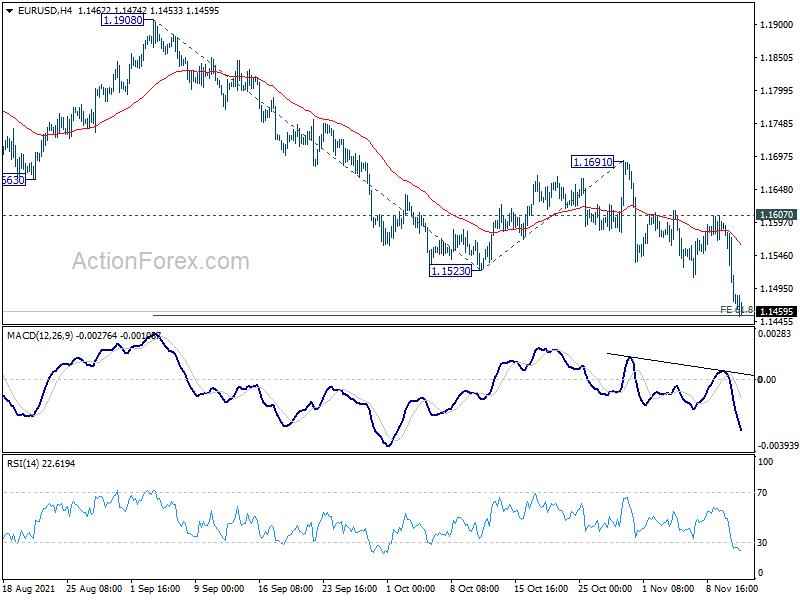
In the bigger picture, price actions from 1.2348 should at least be a correction to rise from 1.0635 (2020 low). As long as 1.1691 resistance holds, deeper fall would be seen to 61.8% retracement of 1.0635 to 1.2348 at 1.1289. Nevertheless break of 1.1691 resistance will revive medium term bullishness and turn focus back to 1.2348 high.
GBP/USD Mid-Day Outlook
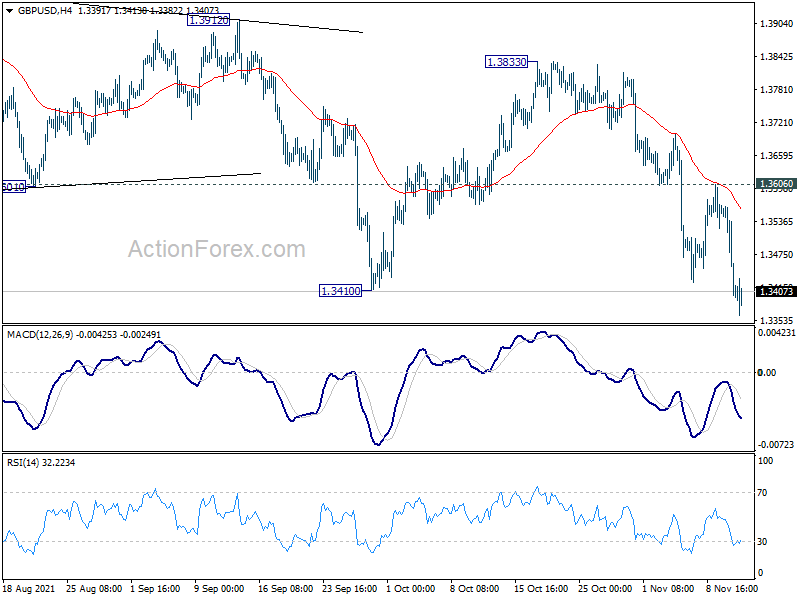
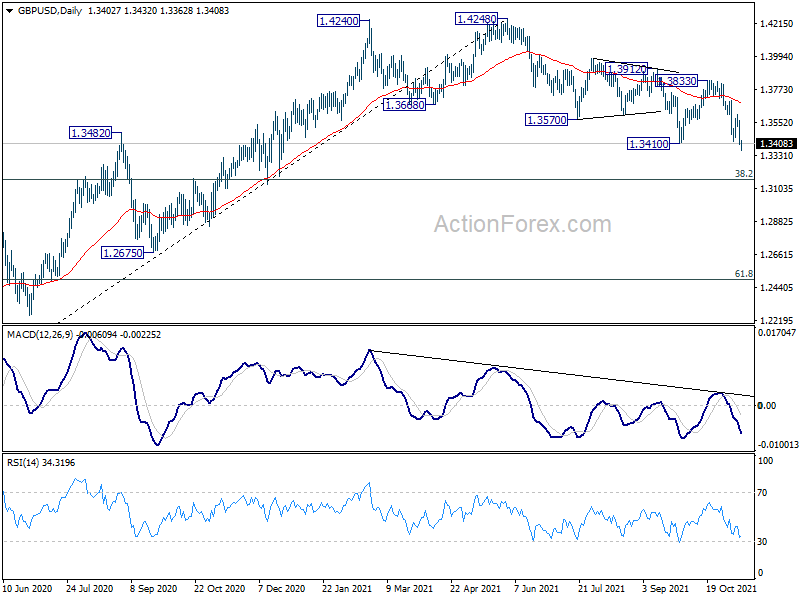
Daily Pivots: (S1) 1.3349; (P) 1.3457; (R1) 1.3511; More...
Intraday bias in GBP/USD stays on the downside for the moment. Fall from 1.4248 is in progress and should target 1.3164 fibonacci level next. On the upside, break of 1.3606 resistance is needed to indicate short term bottoming. Otherwise, outlook will stay bearish in case of recovery.
In the bigger picture, the structure of the fall from 1.4248 suggests that it's a correction to the up trend from 1.1409 (2020 low) only. While deeper fall cannot be ruled out yet, downside should be contained by 38.2% retracement of 1.1409 to 1.4248 at 1.3164, at least on first attempt, to bring rebound. On the upside, firm break of 1.4376 key resistance (2018 high) will add to the case of long term bullish reversal. However, sustained trading below 1.3164 will revive some medium term bearishness and target 61.8% retracement at 1.2493.
USD/CHF Mid-Day Outlook
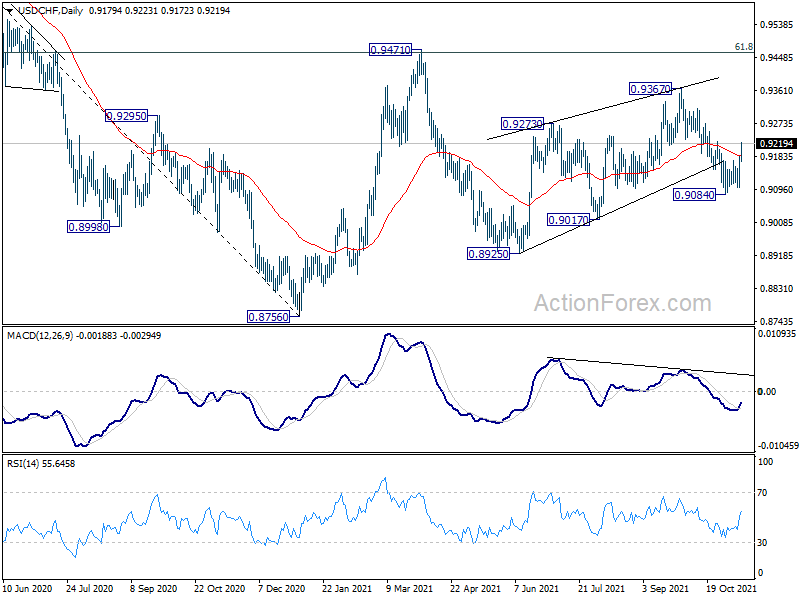
Daily Pivots: (S1) 0.9132; (P) 0.9159; (R1) 0.9209; More....
Intraday bias in USD/CHF remains on the upside for the moment. Rebound from 0.9084 short term bottom would extend higher to 0.9367 resistance first. On the downside, below 0.9172 minor support will turn intraday bias back to the downside for 0.9084 instead.
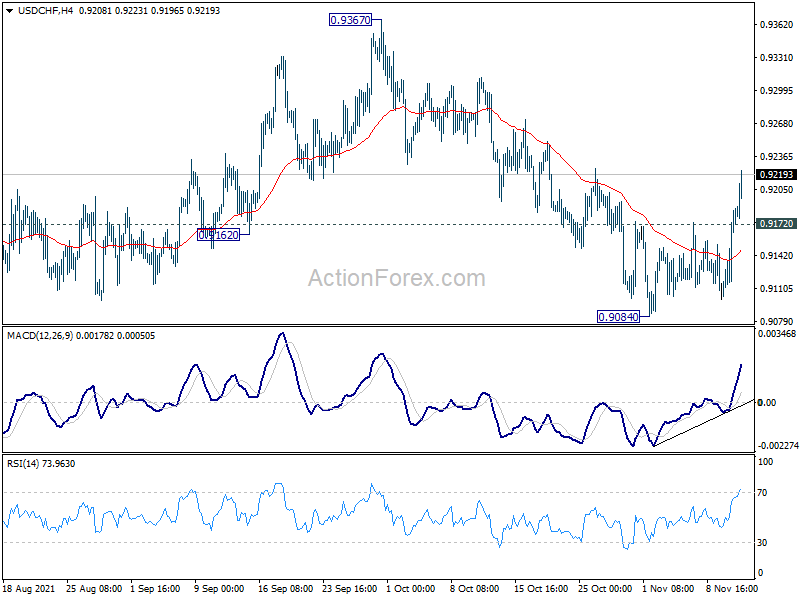
In the bigger picture, the corrective structure of the rebound from 0.8925 argues that fall from 0.9471 is not complete yet. It could either be the second leg of pattern from 0.8756 (2021 low), or resuming larger down trend from 1.0237 (2018 high). We'd pay attention to the downside momentum and assess the odds later. But for now, medium term outlook will be neutral at best as long as 0.9471 resistance holds.
USD/JPY Mid-Day Outlook
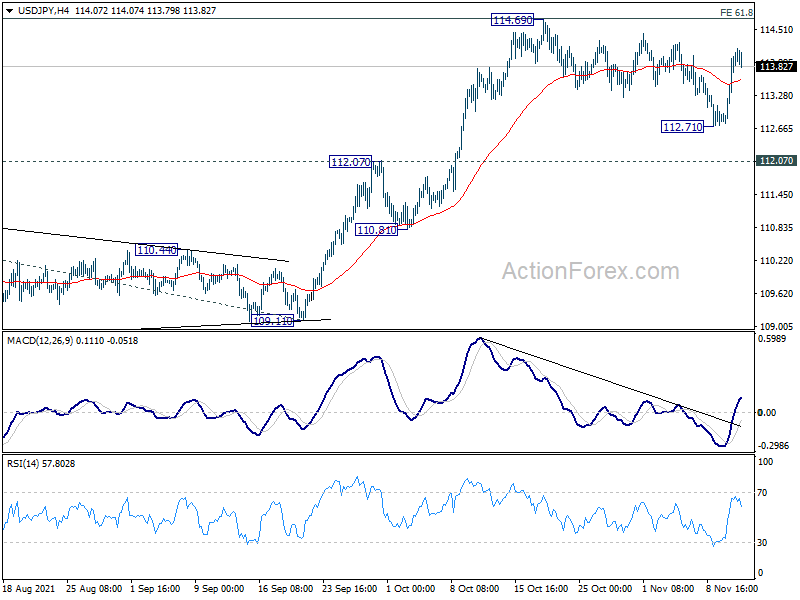
Daily Pivots: (S1) 113.12; (P) 113.56; (R1) 114.35; More...
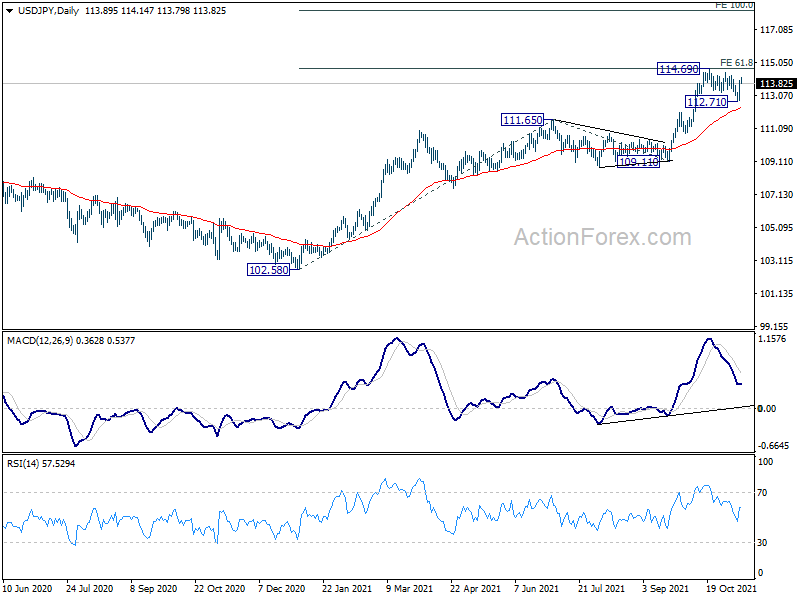
Intraday bias in USD/JPY stays mildly on the upside for retesting 114.69 high. Sustained break there will resume larger up trend for 100% projection of 102.58 to 111.65 from 109.11 at 118.18 next. On the downside, in case of another fall, we'd continue to expect downside to be contained above 112.07 resistance turned support to bring rebound.
In the bigger picture, corrective decline from 118.65 (2016 high) should have completed at 101.18 already. Rise from the 102.58 is seen as the third leg of the up trend from 101.18. Next target is 114.54 resistance and then 118.65 high. This will now be the preferred case as long as 109.11 support hold, even in case of deep pull back.
USD/CAD Mid-Day Outlook
Daily Pivots: (S1) 1.2422; (P) 1.2463; (R1) 1.2539; More...
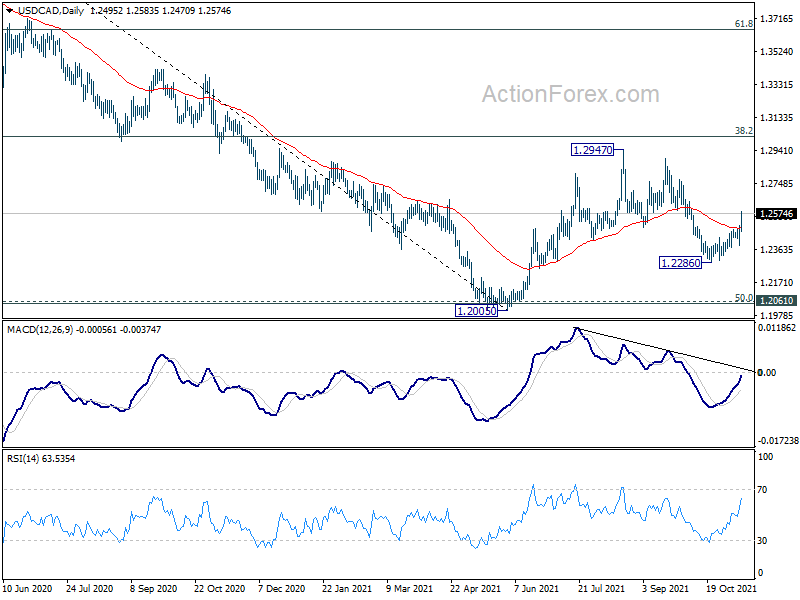
USD/CAD's rally from 1.2286 accelerates to as high as 1.2583 so far today. As noted before, fall from 1.2947 might have completed with three waves down to 1.2286. Further rally would be seen back to retest 1.2894/2947 resistance zone. On the downside, however, break of 1.2478 minor support will mix up near term outlook and turn intraday bias neutral again first.
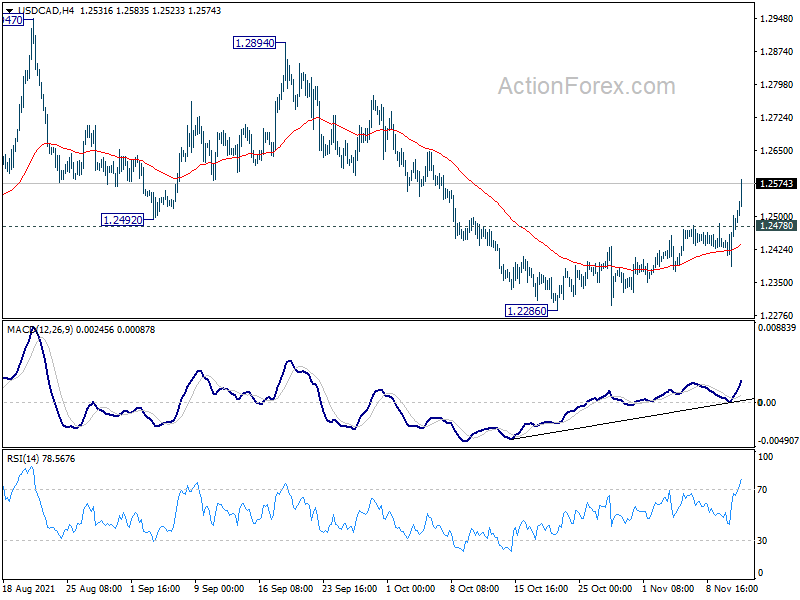
In the bigger picture, medium term outlook is neutral for now. The pair draw support from 1.2061 cluster and rebounded. Yet, upside was limited below 38.2% retracement of 1.4667 to 1.2005 at 1.3022. On the upside, firm break of 1.3022 should affirm the case of medium term bullish reversal. However, break of 1.2286 will turn focus back to 1.2005 low again.
Canadian Dollar Accelerates Down on Weakening Oil, Dollar Staying Strong
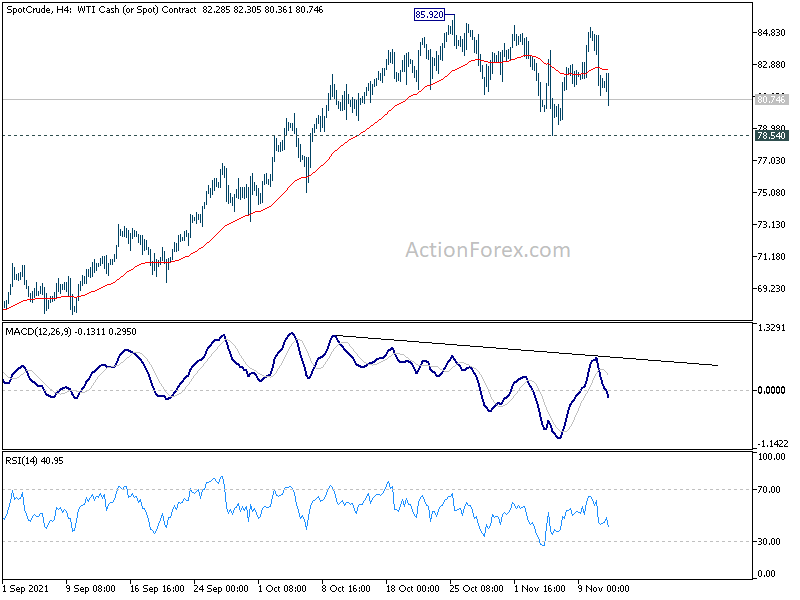
Selloff in Canadian Dollar gathers pace today as WTI oil price is quickly heading back towards 80 handle. Other commodity currencies are also weak, with Aussie weighed down by poor job data. On the other hand, Dollar is staying firm without clear sign of loss momentum yet. Yen is also not performing too bad, as it's still trying to eke out more gains in crosses. Euro is mixed for now, even though EU upgrades Eurozone inflation forecasts.
Technically, WTI crude oil has started another falling leg inside the consolidation pattern from 85.92. Some downside could be seen but strong support will likely be seen around 78.54 support to bring rebound. However, sustained break of 78.54 will at least bring deeper pull back to correct the rise from 61.90. In that case, we could be selling in Canadian Dollar intensify.
In Europe, at the time of writing, FTSE is up 0.33%. DAX is up 0.10%. CAC is up 0.03%. Germany 10-year yield is up 0.0107 at -0.235. Earlier in Asia, Nikkei rose 0.59%. Hong Kong HSI rose 1.01%. China Shanghai SSE rose 1.15%. Singapore Strait Times rose 0.21%. Japan 10-year JGB yield rose 0.0105 to 0.071.
EU expect Eurozone inflation to peak at 2.4% this year
In the Autumn Economic Forecast, European Commission upgraded 2021 GDP growth projection to 5.0% (vs Spring's forecast of 4.3%). Growth is projected to slow to 4.3% in 2022 (vs 4.4), and then 2.4% in 2023.
HICP inflation is projected to peak at 2.4% in 2021 (vs Spring's 1.7%), then slow to 2.2% in 2022 (vs prior 1.3%) and then slow to 1.4%.
Valdis Dombrovskis, Executive Vice-President for an Economy that Works for People, said: "This is no time for complacency: we continue to face uncertainty with this virus and there are some risks to contend with. Not least, we need to address bottlenecks in supply chains, as well as surging energy prices which will affect many households and companies across Europe. We also need to closely monitor inflation and adjust our policies if needed."
ECB bulletin: Market-based inflation indicators in line with transient but more persistent rise
In the monthly economic bulletin, ECB said the current phase of higher inflation will "last longer than originally expected", but it's "expected to decline in the course of next year". The factors include sharply risen energy prices, recovering demand outpacing supply, and based effects due to end of VAT cut in Germany. It added, "the influence of all three factors is expected to ease in the course of 2022 or to fall out of the year-on-year inflation calculation".
Meanwhile, ECB also noted that market-based indicators of longer-term inflation expects reached "new highs". Five-year forward inflation-linked swap (ILS) rate five years ahead rose above to 2.1%, highest since August 2014. But it also noted that the increase in ILS rate was "pronounced in short and medium-term maturities". That's "in line with a transient but more persistent increase in near-term inflation".
UK GDP grew 0.6% mom in Sep, 1.3% qoq in Q3
UK GDP grew 0.6% mom in September, slightly above expectation of 0.6% mom. GDP remained -0.6% below its pre-coronavirus level in February 2020. Looking at some details, services grew 0.7% mom. Production dropped -0.4% mom while manufacturing dropped -0.1% mom. Construction rose 1.3% mom.
For Q3 as a whole, GDP grew 1.3% qoq, below expectation of 1.5% qoq. It remains -2.1% below the pre-pandemic level in Q4 2019.
Manufacturing production dropped -0.1% mom, rose 2.8% yoy in September, versus expectation of 0.2% mom, 4.1% yoy. Industrial production dropped -0.4% mom, rose 2.9% yoy, versus expectation of 0.2% mom, 3.1% yoy.
Goods trade deficit widened to GBP -14.7B in September, versus expectation of GBP -14.3B.
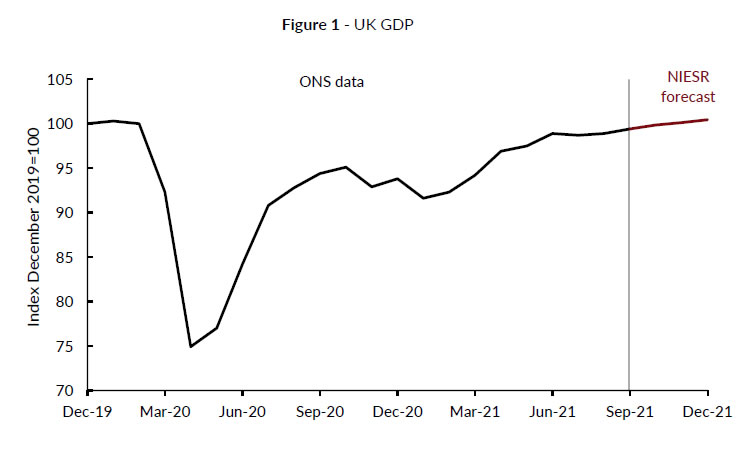
UK NIESR expects 1.1% GDP growth in Q4, as post-Covid bounce nearing its end
NIESR said it expects UK GDP to grow by 1.1% qoq in Q4, including 0.4% mom growth in October.
Rory Macqueen Principal Economist, Macroeconomic Modelling and Forecasting said: The post-Covid bounce seems to be nearing its end, with hospitality returning to normal growth rates in September after a bumper August. Wholesale and retail activity shrank for a fifth consecutive month and gas distribution for the fourth, which may suggest supply constraints or the unwinding of unusually high demand earlier in the year.
"Overall growth is likely to slow further in the fourth quarter but will benefit if public confidence in keeping Covid-19 under control has enabled a return to growth in consumer-facing services sectors."
Australia employment dropped -46.3k, unemployment rate jumped to 5.2%
Australia employment decreased -46.3k in October, much worse than expectation of 50k rise. At 12.84m, employment level was back below pre-pandemic peak. Full time jobs dropped -40.4k while part-time jobs dropped -5.9k.
Unemployment rate jumped sharply from 4.6% to 5.2%, well above expectation of 4.7%. But participation rate also rose slightly from 64.5% to 64.7%. Monthly hours worked dropped -1m hours.
Bjorn Jarvis, head of labour statistics at the ABS: "The increases in unemployment show that people were preparing to get back to work, and increasingly available and actively looking for work – particularly in New South Wales, Victoria and the Australian Capital Territory. This follows what we have seen towards the end of other major lockdowns, including the one in Victoria late last year."
"It may seem counterintuitive for unemployment to rise as conditions are about to improve. However, this shows how unusual lockdowns are, compared with other economic shocks, in how they limit being able to work and look for work."
Japan PPI surged to 8% yoy in Oct, highest since 1981
Japan corporate goods price index rose 8.0% yoy in October, up from September's 6.4% yoy, well above expectation of 6.9% yoy. That's also the highest level since January 1981.
Looking at some details, lumber & wood surged 57.0% yoy. Petroleum and cola rose 44.5% yoy. Iron and steel rose 21.8%. Nonferrous metals rose 31.4% yoy. Export price rose 13.7% yoy while import price rose 38.0% yoy.
USD/CAD Mid-Day Outlook
Daily Pivots: (S1) 1.2422; (P) 1.2463; (R1) 1.2539; More...
USD/CAD's rally from 1.2286 accelerates to as high as 1.2583 so far today. As noted before, fall from 1.2947 might have completed with three waves down to 1.2286. Further rally would be seen back to retest 1.2894/2947 resistance zone. On the downside, however, break of 1.2478 minor support will mix up near term outlook and turn intraday bias neutral again first.
In the bigger picture, medium term outlook is neutral for now. The pair draw support from 1.2061 cluster and rebounded. Yet, upside was limited below 38.2% retracement of 1.4667 to 1.2005 at 1.3022. On the upside, firm break of 1.3022 should affirm the case of medium term bullish reversal. However, break of 1.2286 will turn focus back to 1.2005 low again.
Economic Indicators Update
| GMT | Ccy | Events | Actual | Forecast | Previous | Revised |
|---|---|---|---|---|---|---|
| 23:50 | JPY | PPI Y/Y Oct | 8.00% | 6.90% | 6.30% | 6.40% |
| 0:01 | GBP | RICS Housing Price Balance Oct | 70% | 68% | 68% | 69% |
| 0:30 | AUD | Employment Change Oct | -46.3K | 50K | -138K | -141.1K |
| 0:30 | AUD | Unemployment Rate Oct | 5.20% | 4.70% | 4.60% | |
| 7:00 | GBP | GDP Q/Q Q3 P | 1.30% | 1.50% | 5.50% | |
| 7:00 | GBP | GDP M/M Sep | 0.60% | 0.50% | 0.40% | 0.20% |
| 7:00 | GBP | Index of Services 3M/3M Sep | 1.60% | 1.90% | 3.70% | 3.50% |
| 7:00 | GBP | Manufacturing Production M/M Sep | -0.10% | 0.20% | 0.50% | 0.30% |
| 7:00 | GBP | Manufacturing Production Y/Y Sep | 2.80% | 4.10% | 4.10% | |
| 7:00 | GBP | Industrial Production M/M Sep | -0.40% | 0.20% | 0.80% | 1.00% |
| 7:00 | GBP | Industrial Production Y/Y Sep | 2.90% | 3.10% | 3.70% | |
| 7:00 | GBP | Goods Trade Balance (GBP) Sep | -14.7B | -14.3B | -14.9B | -13.7B |
| 9:00 | EUR | ECB Monthly Bulletin | ||||
| 12:00 | GBP | NIESR GDP Estimate Oct | 1.50% |
UK NIESR expects 1.1% GDP growth in Q4, as post-Covid bounce nearing its end
NIESR said it expects UK GDP to grow by 1.1% qoq in Q4, including 0.4% mom growth in October.
Rory Macqueen Principal Economist, Macroeconomic Modelling and Forecasting said: The post-Covid bounce seems to be nearing its end, with hospitality returning to normal growth rates in September after a bumper August. Wholesale and retail activity shrank for a fifth consecutive month and gas distribution for the fourth, which may suggest supply constraints or the unwinding of unusually high demand earlier in the year.
"Overall growth is likely to slow further in the fourth quarter but will benefit if public confidence in keeping Covid-19 under control has enabled a return to growth in consumer-facing services sectors."