Sample Category Title
Dwindling Global Dollar Momentum Could Slow The Slide In EUR/USD
Markets
Democratic infighting on US President Biden’s massive fiscal stimulus agenda hurt risk sentiment and ended the positive correlation between stocks and bonds. At stake is yesterday’s delayed vote on the infrastructure agenda. Moderate Democrats want shovels in the ground ASAP and move on to discuss the huge $3.5tn social proposal in a next phase. Progressive Democrats want to tie both votes as they fear attempts to significantly water down the $3.5tn number once the infrastructure deal is up and running. The unwelcome outcome is that none of the spending plans makes any headway as discussions become stretched. Democrats additionally face the stand-off with Republicans over raising or suspending the debt ceiling by October 18. On both occasions, they aren’t really scoring points with next year’s mid-term elections already in mind. In any case, markets treated the fiscal mess in a textbook way. US stock markets lost up to 1.6% for the Dow Jones. The S&P 500 closed at the weakest level since mid-July, just holding above the mid-September sell-off low. The technical picture suggests that the correction lower has further to go. Core bonds ended with a late rally as less fiscal stimulus means a less stringent need to normalize monetary policy as at least one potential inflation booster fades away. US yields lost 1.4 bps to 3.3 bps in a daily perspective with the belly of the curve outperforming the wings. Details effectively showed real rates were responsible for the move. German Bunds underperformed US Treasuries as most of the action occurred after the European closing bell. German yields still recorded gains of up to 2.5 bps with national inflation prints (Germany, Spain & France) suggesting upward risks to today’s EMU number (3.3% Y/Y headline & 1.9% Y/Y core expected).
With stocks and bonds no longer selling-off in lockstep, the Japanese yen managed to restore its safe haven status vs other majors. USD/JPY arrived at key resistance near 112.23/40 (2019 & 2020 tops) yesterday morning before returning almost 1 big figure to currently trade near 111.20. The trade-weighted dollar lost momentum as well, treading water ahead of the key resistance zone which stretches from 94.47 (38% retracement on 2020 USD decline) to 94.74 (November 2020 top). The single currency still lacks the leverage to fight back with EUR/USD giving away the 1.16 big figure to close at 1.1580. Still, dwindling global dollar momentum could also slow the slide in EUR/USD. Apart from EMU CPI data, US PCE deflators and manufacturing ISM are scheduled for the release. Yesterday’s intraday dynamics suggest at least a short term return of the classic risk correlation between bonds and equities.
News headlines
OPEC+ is considering whether it should raise production more than has been agreed in July when it meets next week. The current agreement plans 400 000/day in November and December. The rumours followed after a meeting of the OPEC Joint Technical Committee that sees an oil supply deficit this year and sees a slightly smaller than expected surplus next year. No details on concrete volumes and dates have been provided. Even so, at $78/b Brent oil currently trades off the post-corona peak levels north of $80/b registered earlier this week.
The Czech government is voicing ever more objections on the hiking cycle of the Czech National bank after it unexpectedly raised the policy rate by 0.75% to 1.50% yesterday. Czech Finance Minister Alena Schillerova said the CNB is raising interest rates on corporate loans and mortgages while central bankers of developed countries continue to support wealth and living standards. There are general elections scheduled in the Czech Republic next week. The CNB justified yesterday’s decision as the unexpected acceleration in inflation is not only due to a rise in external prices, but mainly due to a further unexpectedly strong rise in core inflation, including owner-occupied housing and prices in the services sector. A further increase in electricity and natural gas prices might add to inflationary pressures later this year. The CNB sees significant upside risks to its inflation outlook, especially for the next few quarters. The autumn forecast available at next policy meeting will be key to guide the pace of further tightening.
EURUSD Is Possibly Bullish
Technical analysis
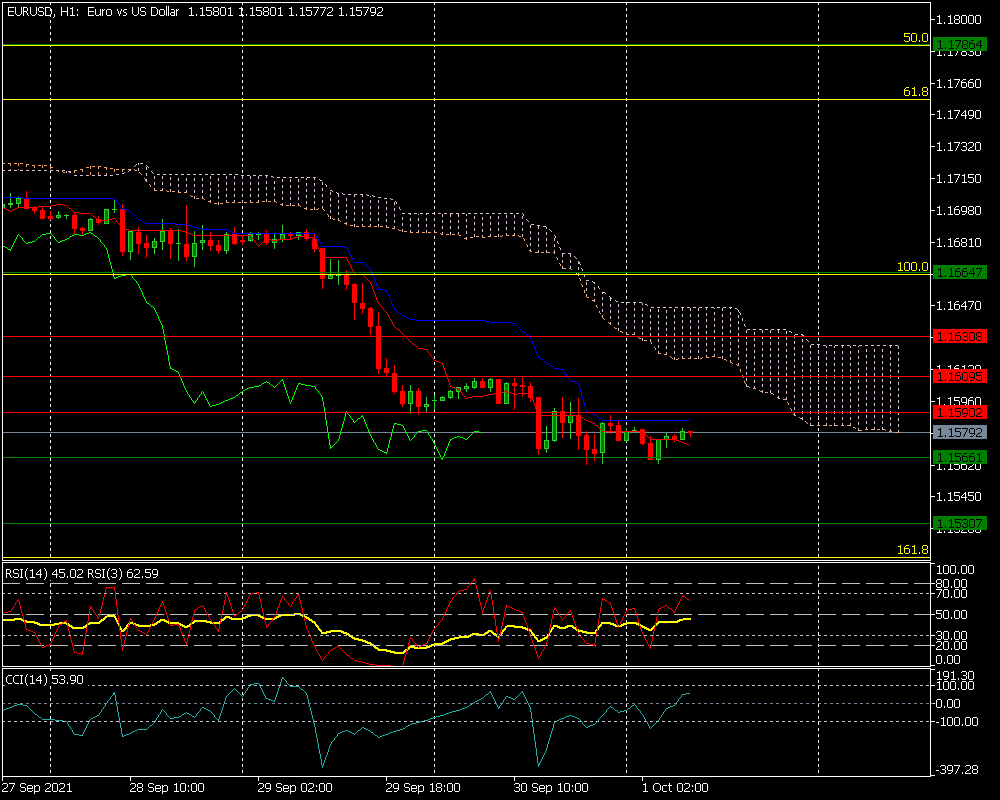
The RSI(14) and the RSI(3) point to a possible upwards correction
The Ichimoku indicator displays a prevailing downtrend
The CCI suggests a possible upwards movement.
Most likely scenario - BUY
Target prices: 1.15902 1.16095
Alternative scenario - SELL
Target prices: 1.15661 1.15307
Key levels
Support 1.15902 1.16095
Resistance 1.15661 1.15306
GOLD Price Rebounds As Demand For Safe-Havens Rise
American stocks crashed hard on Thursday as worries of a US government debt default rose. The Dow Jones index declined by more than 400 points while the S&P 500 and Nasdaq 100 indices declined by more than 40 and 50 points respectively. While the Senate managed to find a breakthrough on preventing a government shutdown, there are risks that a bill to suspend the debt ceiling will not pass. Therefore, investors are worried that such defaults by the US government will have significant consequences for the US economy. The stocks also rose after data revealed that the number of initial jobless claims rose for the second straight week.
The euro declined sharply ahead of the preliminary Eurozone consumer price index (CPI) that is due in the morning session. Economists polled by Reuters expect the data to show that the headline CPI rose from 3.0% in August to 3.3% in September. Excluding food and energy, analysts expect that inflation rose from 1.6% to 1.9%. On Thursday, preliminary data showed that German inflation jumped to 4.1% in September while Italian inflation rose to 2.6%. While these numbers are bigger than the ECB target of 2.0%, the bank believes that inflation will normalize in the coming few months.
The economic calendar will have several important economic numbers today. In Germany, the statistics agency will release the latest retail sales numbers. At the same time, Markit will publish the latest manufacturing PMI data from most countries like the US, UK, and the Eurozone. These numbers are expected to show that manufacturing activity declined slightly in September. Finally, the US statistics agency will deliver the latest personal income and spending and PCE numbers. PCE is the Fed’s favourite gauge of inflation.
EURUSD
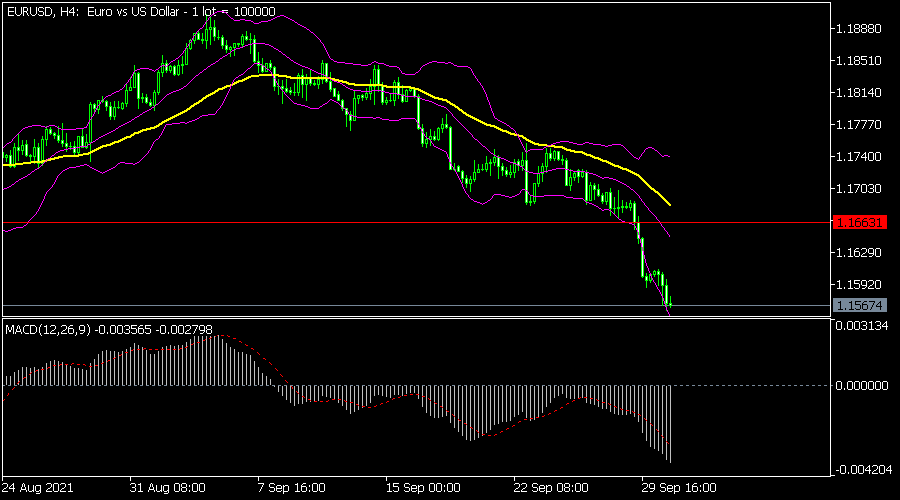
The steep sell-off of the EURUSD pair continued in the overnight session. The pair declined to a low of 1.1566, which was the lowest level since last year. The pair has also dropped substantially from this week’s high of 1.1750. It has moved below the 25-day and 50-day moving averages and is along the lower line of the Bollinger Bands. The pair will likely have a relief rally as bulls attempt to buy the dips as the month starts.
NDX100
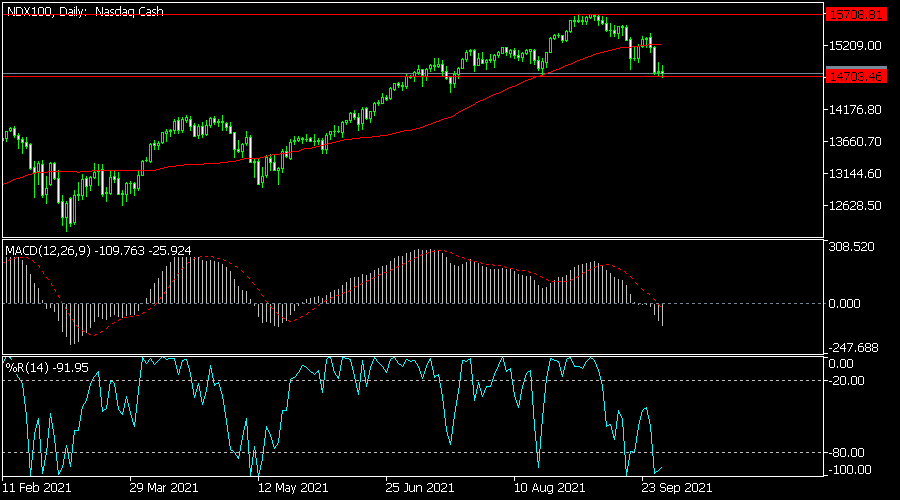
The Nasdaq 100 index declined to a low of $14,680, which is substantially below the all-time high of $15,708. On the daily chart, the index moved below the 25-day moving average. The MACD managed to move below the neutral level. The Williams %R has also declined to the oversold level. Therefore, the index will likely keep falling as bears target the next key support at $14,500.
XAUUSD
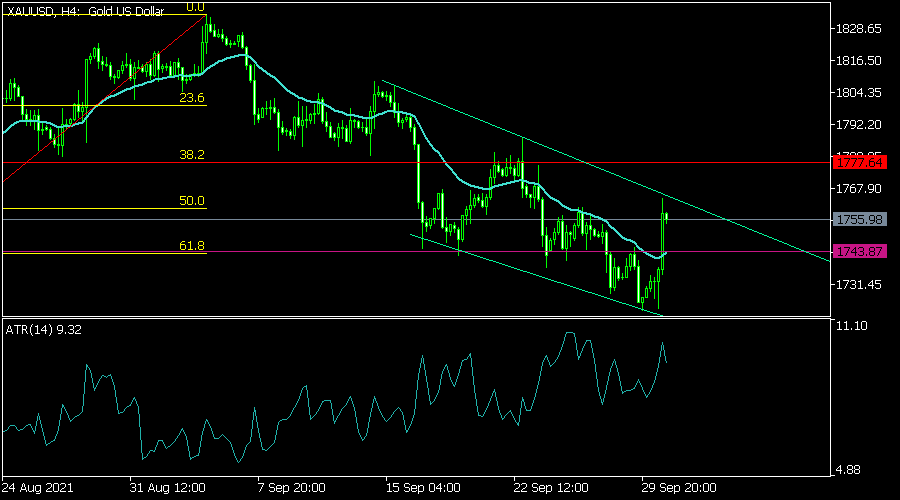
The XAUUSD pair popped on Thursday as investors moved to safe havens. It jumped to a high of 1,764, which was the highest level since Monday. On the four-hour chart, it moved to the 50% Fibonacci retracement level. It also rose above the 25 and 50-day moving averages. The pair also tested the upper side of the descending channel. Therefore, the pair will likely resume the bearish trend as bears target the key support at 1,720.
US Averts Shutdown, But Market Mood Remains Sour
The US government won’t be shut today, as Joe Biden signed a funding bill that should keep the US government agencies running until December 3rd. But that doesn’t resolve the whole debt ceiling issue, nor avert the risk of an eventual US default. Treasury Secretary Janet Yellen says that if the debt ceiling is not raised by October 18th, US may not be able to service its debt. And she wants to see the debt ceiling removed altogether, and indeed, if it is raised each time, it doesn’t mean anything, it doesn’t serve a real purpose except from leading to some heated discussions every now and then which finally end with a higher debt ceiling.
So, the short-term solution to the US debt ceiling issue should give a certain relief to US equity markets in the short-run, after the S&P500 finally couldn’t hold on for longer and gave in the 100-dma resistance to close the session a touch above the 4300 mark. As such the index ended the month of September some 5% lower, which was the worst month since the terrible March 2020 plunge. Now, we are just at the lower end of the 5-10% downside correction that the bearish call givers were looking for. Let’s see if the stopgap deal in the US could help the index rebound from the 4300 mark, or would the bears remain in charge of the market and carry on with a deeper downside correction, targeting the 200-dma support, which could mean another 3-3.5% drop in the index valuation.
Nasdaq on the other hand consolidates losses below the 15000 for the third day, but Netflix continues outperforming the tech space, partly thanks to the Korean show Squid Game that could attract more subscribers to the streaming platform in the weeks ahead. Netflix hit a fresh record yesterday, trading close to the $620 per share for the first time. But if the overall sentiment doesn’t improve, we shall see some consolidation and perhaps a downside correction from the actual levels.
Chinese Big Tech on the other hand remains on a free-fall pattern. Alibaba shares are now below the $150 level for the first time since May 2019, JD.com sees the latest wave of optimism abated. And the aversion of the US government shutdown will certainly not help the Chinese stocks getting their heads above water, as the Chinese government keeps punching from different and unexpected angles, and investors have had enough, for now.
Despite the US debt ceiling relief, US futures are in the red as Asian equity markets kicked off the new month on quite a negative note. We saw Japan’s Nikkei index plunge more than 2.5% overnight, as Australian ASX200 slid close to 2% on rising inflation fears, which would keep the central banks’ hands tied faced with a slower economic recovery due to the skyrocketing energy and commodity prices.
In summary, the high inflation is about to become a worst headache than the pandemic itself, as at least for the pandemic, central banks had tools to use. With this high inflation, they have nothing to do.
Now the traditional hedge for inflation, and a market rout has not shouted present in September decline in equity markets. On the contrary, the price of announce dived more than 6% during the month, proving once again that the yellow metal is no longer the dream hedge for inflation, nor a souring market sentiment
So speaking of inflation, Eurozone flash CPI estimate should print an advance to 3.3% in September from 3% printed a month earlier. Inflation Europe is on a rising path, as elsewhere in the world, but the European Central Bank (ECB) head Christine Lagarde stays firmly behind her supportive monetary policy despite a couple of nations within the Eurozone that get tenser with the rising inflation, such as Germany, Netherlands and Austria. Therefore, a sustained increase in European inflation, which seems inevitable looking at the exponential rise in European energy prices, should still revive the ECB doves and limit the losses we see in the single currency against a broadly stronger US dollar.
US on the other hand will reveal its jobs figures next Friday, after having posted at least three consecutive rises in the weekly jobless claims. We will talk about it in detail next week.
More globally, in FX, the currencies of hawkish central banks will likely outperform along with rising inflation pressures. So, we may see an extended period of softness in EUR, JPY and Swiss franc. Energy and commodity currencies on the other hand should stand up against a globally stronger US dollar. In this respect, we shall see a further advance in USDCAD towards the 1.30 level.
Speaking of oil, the upside pressure in oil prices seem to start easing as buyers become rare above the $75pb mark in US crude. An eventual downside correction could find support near the $70-72 range, as the global energy crunch will likely outdo any concerns of slowing demand due to the Covid worries, even less now that the 4th wave of Covid starts easing in many places across the globe.
US Avoided Government Shutdown For Now
Market movers today
- Euro Area Flash HICP for September is due for release, we look for headline inflation at 3.4% y/y and core at 1.8%. Fed's preferred measure of inflation, the PCE is also released, we look for slight moderation and headline at 4.1% y/y and core at 3.4% y/y.
- We will also get Manufacturing PMIs from Sweden and Norway, while US ISM Manufacturing is due for release in the afternoon. We will also follow US August Private Consumption data for further signs of normalizing consumption patterns.
- From central banks, Fed's Harker and Mester as well as ECB's Schnabel will be on the wires.
The 60 second overview
US debt limit: As expected, the US congress passed a stopgap bill overnight ensuring funding for the federal government until 3 December, thus avoiding a shutdown today. While the bill did not contain any progress on the debt ceiling issue, and rather just provided more time for the negotiations, we expect Congress to eventually either re-suspend or increase the debt ceiling one way or another. Read our more in-depth take: Research US - Government shutdowns are usually short-lived and no one is interested in a default by the end of the day, 29 September.
Energy: Energy prices continued higher, with Dutch natural gas 1M TFF forward just below 90EUR/MWh. Chinese Vice Premier Han Zheng ordered country's energy companies to secure supply ahead of winter after power rationing has forced industrial companies to reduce output recently. OPEC+ is also considering increasing its supply of crude oil more than previously agreed in its meeting next week, Brent is trading near yesterday's levels around USD 78/bbl.
Inflation: Higher energy prices are pushing up inflation figures and yesterday the German Flash CPI for September rose to 4.1% y/y from 3.9% y/y. While VAT base effects continue to distort the German prints, energy was the biggest inflationary driver (+14.3%). We expect similar developments in the Euro Area Flash HICP readings today, and look for 3.4% y/y and core at 1.8%.
Equities: Equities took another beating yesterday despite starting the day in solid gains. Yesterday, and continuing this morning, a new shift is taking place as the risk-off sentiment is sneaking into bond markets, and yields are creeping lower. This is no cure for equities but will simply mean a new rotation story as a full fetched move toward defensive and minimum volatility stocks. If current market continues it will mean an end to the latest value outperformance and hence also make banks underperform. In US yesterday, Dow -1.6%, S&P 500 -1.2%, Nasdaq -0.4% and Russell 2000 -0.9%. Switching to Q4 does not mean any change in Asia this morning. Indices across the region are lower, led by Japan down 2.5%. China has started the Golden Week celebration this morning and hence Chinese markets are closed. Futures in Europe sharply lower this morning, led by Euro Stoxx 50 down 1.5%. US futures holding up a bit better, down 0.5%.
FI: After markets taking a short breather from the sell-off on Wednesday, EGBs continued the sell-off yesterday. Core and semi-core spreads tightened marginally, while peripheral spreads widened. Notably the long-end came under pressure amid the inflation prints from Germany that came out at 4.1% in September
FX: Month-end flows were a dominating driver in yesterday's session which overall left a reversal of previous sessions' price action: the USD weakened while ZAR, AUD and NZD gained. We expect this to reverse in the coming week. Also, CZK was one of the big outperformers following a larger than expected rate hike from the Czech central bank. Lastly, EUR/DKK rose on the back of a unilateral 10bp Danish rate cut.
Credit: Credit markets came under pressure again yesterday where HY bonds were hit particularly hard and widened almost 10bp while IG widened a more modest 0.4bp. Xover and Main widened 4.6bp and 0.6bp, respectively.
Nordic macro
Norway: Unemployment fell further than many anticipated over the summer, and we expect this to continue in September. Based on the weekly figures, we expect the registered jobless rate to drop to 2.5% (seasonally adjusted), with the risk to the downside. The manufacturing PMI has surprised to the upside in recent months, especially given that the global manufacturing cycle appears to have peaked. We expect the slowdown to show up soon in export-oriented industries, with the PMI probably dipping below 60 in September.
EUR/USD Daily Outlook
Daily Pivots: (S1) 1.1556; (P) 1.1583; (R1) 1.1603; More...
EUR/USD's fall is still in progress and intraday bias remains on the downside. It's now in a deeper correction to whole rise from 1.0634. Next target is 1.1289 medium term fibonacci level. On the upside, above 1.1608 minor resistance will turn intraday bias neutral and bring consolidations first. But risk will stay on the downside as long as 1.1908 resistance holds.
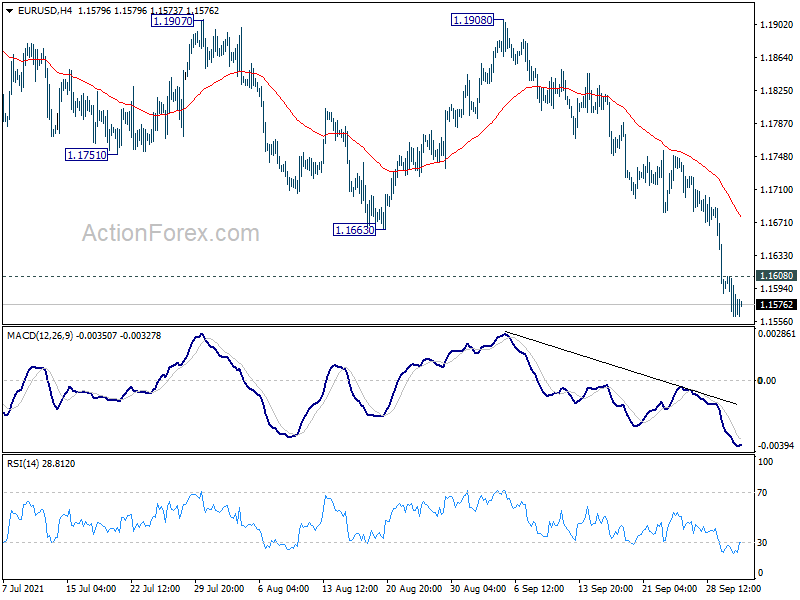
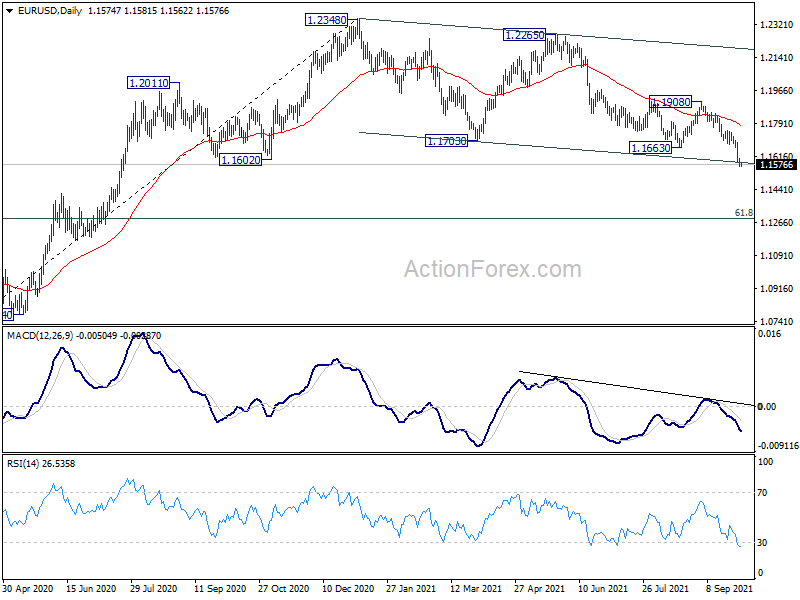
In the bigger picture, sustained break of 1.1602 will argue that rise from 1.0635 (2020 low) has completed at 1.2348. Deeper fall would be seen to 61.8% retracement of 1.0635 to 1.2348 at 1.1289. Note also that the firm break of 55 week EMA (1.1830) also carries medium term bearish implication. Firm break of 1.1289 will pave the way to retest 1.0635 low. On the upside, though, break of 1.1908 resistance will revive medium term bullishness and turn focus back to 1.2348 high.
GBP/USD Daily Outlook
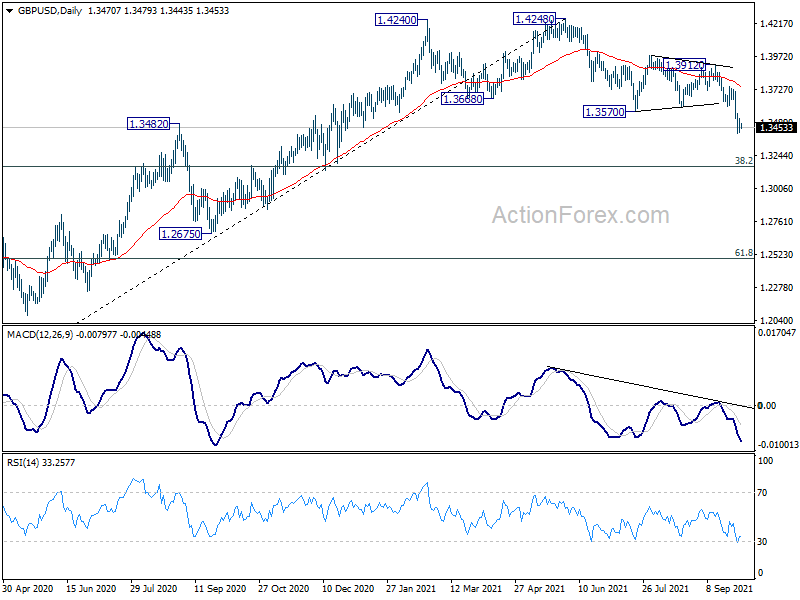
Daily Pivots: (S1) 1.3418; (P) 1.3467; (R1) 1.3519; More...
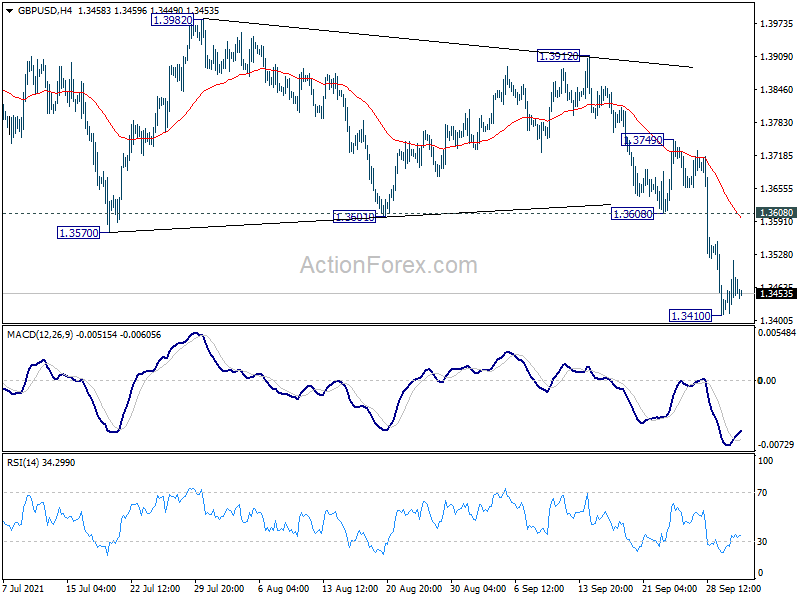
A temporary low is formed at 1.3410 in GBP/USD and intraday bias is turned neutral first. Further fall is expected as long as 1.3608 support turned resistance holds. Below 1.3410 will extend the fall form 1.4248 to 1.3163 medium term fibonacci level next. Nevertheless, firm break of 1.3608 will turn bias back to the upside for stronger rebound.
In the bigger picture, fall from 1.4248 is at least a correction to the up trend from 1.1409 (2020 low). Such correction could extend to 38.2% retracement of 1.1409 to 1.4248 at 1.3164 before completion. However, considering the rejection by 1.4376 key resistance (2018 high), sustained trading below 1.3164 will argue that it's indeed a bearish trend reversal and would target 61.8% retracement at 1.2493. Nevertheless, break of 1.3912 resistance will revive medium term bullishness and target 1.4248/4376 resistance zone again.
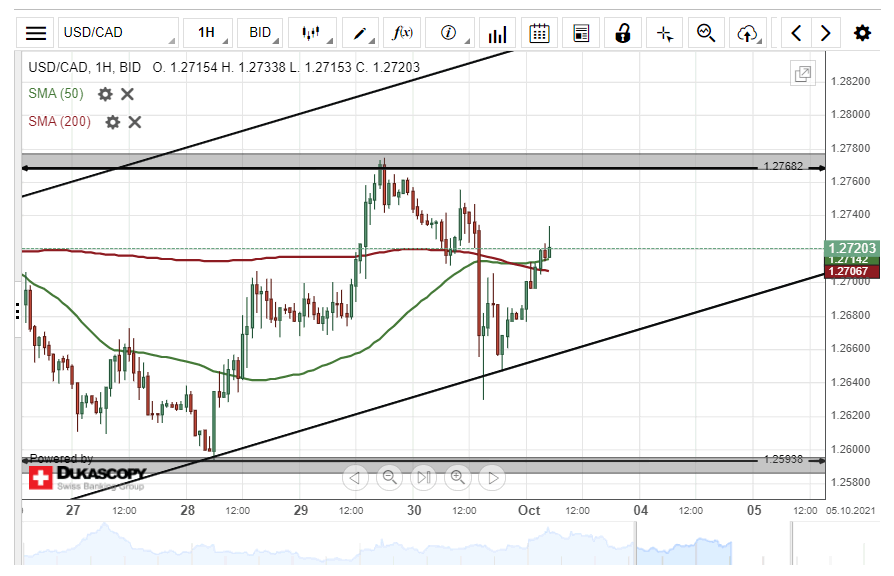
USD/CAD Bounces Off Support
On Thursday, the US Dollar declined by 88 pips or 0.69% against the Canadian Dollar. The currency pair tested the lower boundary of an ascending channel pattern during yesterday's trading session.
Given that the support level of 1.2580 holds, bullish traders may pressure the exchange rate higher during Friday's trading session. The potential target for buyers would be near the 1.2780 area.
However, the 200– hour SMA at 1.2665 could provide resistance for the USD/CAD currency exchange rate in the shorter term.
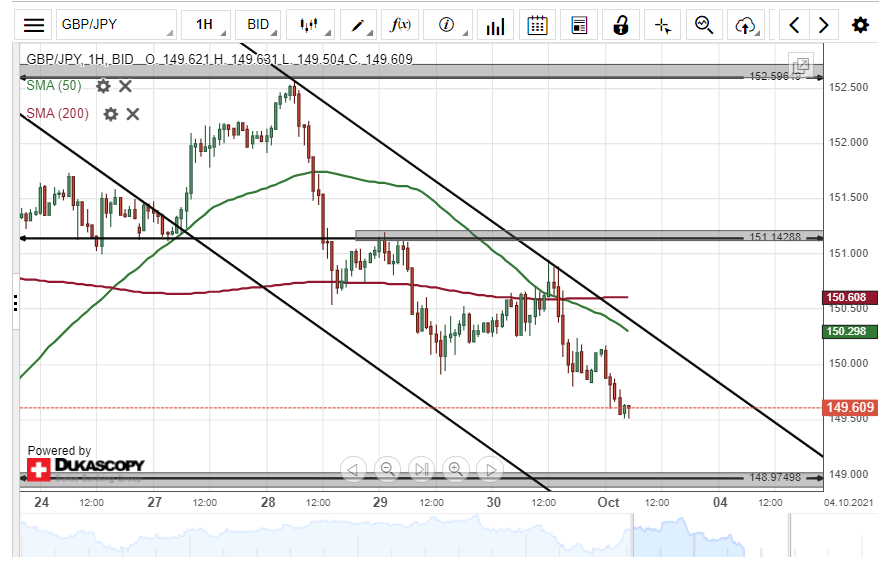
GBP/JPY Potential Target At 148.50
The GBP/JPY currency pair failed to break the 150.60 resistance level on Thursday. As a result, the British Pound fell by 96 pips or 0.64% against the Japanese Yen during Thursday's trading session.
The exchange rate could continue to edge lower in a descending channel pattern during the following trading session. The possible target for sellers would be near the 148.50 area.
However, the support line at 149.98 could provide a barrier for bearish traders within this session.
AUD/USD Likely To Maintain Channel
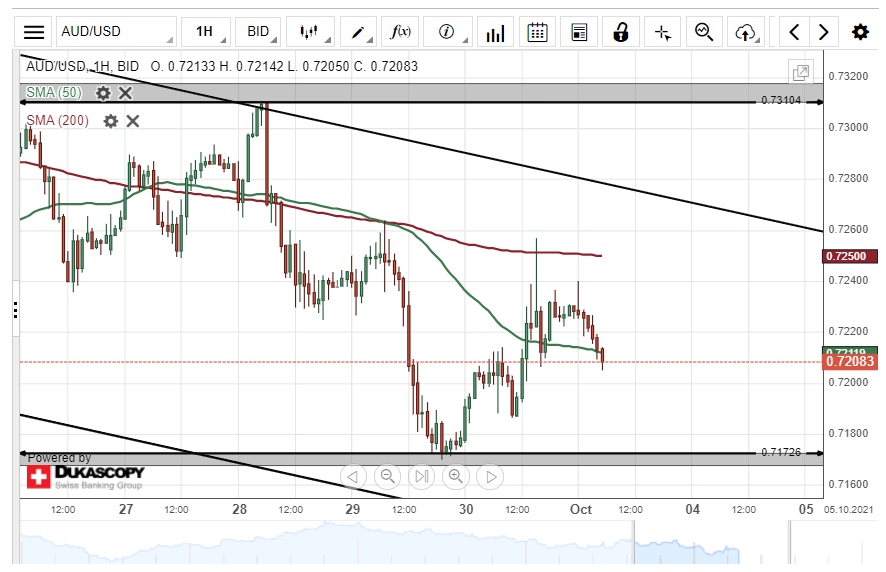
On Thursday, the Australian Dollar edged higher by 55 pips or 0.77% against the US Dollar. The surge was stopped by the 200– hour simple moving average at 0.7250 during Thursday's trading session.
Technical indicators suggest selling signals on the 4H, daily and weekly time-frame charts. Most likely, the exchange rate could maintain the descending channel pattern during the following trading session.
However, the 50– hour simple moving average at 0.7212 could provide support for the currency exchange rate within this session.