Sample Category Title
Cliff Notes: Australia Shows Underlying Strength as Risks Mount for China and the US
Key insights from the week that was.
Data received in Australia this week focused on the consumer and housing. Housing also remained a major focus for China, albeit for very different reasons. Meanwhile in the US, yet another long partisan fight over the Budget and debt is brewing.
Australian August retail sales were broadly in line with our expectations, sales falling 1.7% in the month. The state declines were distributed in line with the severity of lockdowns, the largest falls seen in the ACT (-20%) as well as NSW and Victoria (respectively -3.5% and -3.0%). Meanwhile, SA received a large re-opening dividend (+6.6%) and WA gained 2.8%.
Dwelling approvals subsequently surprised in August, gaining 6.8% against a -5.0% consensus expectation. The detailed data contained in the release provided no evidence of another lockdown effect. Indeed, the August data instead points to strength in the underlying trend for approvals and hence housing construction over the coming year.
Having increased 85% over the nine months to March 2021 on recovery as well as the bringing-forward of activity by policy support and locked borders, the consequent unwind looks as though it may prove fleeting (-25% over the four months to July). Highlighting this possibility, August’s strength was broad based, including in sub-categories which previously saw a strong pull-forward of activity.
The established housing market also continues to show signs of persistent strength, with yet another strong monthly gain for house prices to be confirmed today for September.
From the credit data, owner-occupiers remain the driving force behind these gains, credit provided to owner occupiers up 10.8% on an annualised basis over the three months to August against 2.8% for investors. That leaves total housing credit growth at 8.1% on an annualised three-month basis, the fastest pace since April 2010. Authorities have taken note of the strength in credit growth in 2021 and are expected to act in coming months to slow momentum, with the ratio of debt to income for new borrowers reportedly a particular focus.
Switching to China, Evergrande remains in the headlines and front of mind for investors. We remain of the view that, for the real economy, even the breaking up of the company would prove only a modest and temporary negative. The principal reason this is the case is that the structure of Evergrande allows for the parent’s construction subsidiaries to be sold or allocated to other developers for completion without the burden of many of the parent company’s existing liabilities, such as their outstanding bond liabilities.
Each subsidiary’s project finance is largely self-contained, so too their workforces. As a result, households who have purchased off the plan and the workers on site can be made whole, likely with limited delays to the planned timeline – assuming authorities work quickly to bring in new developers. Payment on the rest of the liabilities of Evergrande is far less certain in quantum and timing; but, as these are high-yield, high-risk securities, investor appetite for the sector broadly and China overall should not see a lasting impact.
Where there is a greater threat to economic growth is via the power outages that have been seen in recent weeks. An already stretched supply chain trying to heal from 2020 is now facing the threat of intermittent multi-day outages in several regions. If only seen a few times, production will easily be able to catch up through Q4. However, if the outages persist, production, income and consequently GDP growth could suffer a material hit in Q4 and early-2022.
Highlighting that this situation is a real threat, China’s official PMI fell to a contractionary reading of 49.6 in September for the first time since late-2019 (excluding early-2020’s one-month pandemic shock). The deterioration was evident across production, new orders and employment, but all these outcomes likely understate the cumulative effect of the disruptions because the cost grew through the month.
Note however there are offsets to consider. After being hit by delta uncertainties in August, China’s services sector snapped back to healthy growth in September, the non-manufacturing PMI rising from 47.5 to 53.2. The construction sector measure also remained strong in the month at 57.5, near its 5-year average, despite the uncertainties around Evergrande. These outcomes suggest to us that it is best to have faith in the capacity of Chinese authorities to act to resolve economic concerns rather than immediately price weakness into baseline views. For now, we regard current circumstances as only a downside risk to our 8.5%/5.7% 2021/2022 growth forecasts as we await further information.
Finally, to the US. This week has seen little new data, but a lot of headlines regarding fiscal policy. With but a few hours to spare, another government shutdown has been averted. However, as the bill passed by Congress merely extends spending approval to 3 December, immense uncertainty surrounding the medium-term outlook for US fiscal policy remains.
Ahead, to avoid the Treasury running out of cash and a potential default event, the debt ceiling must be raised by 18 October. Here the Republicans are intent on forcing the Democrats to pass the legislation themselves, a protracted and risky approach that requires budget reconciliation measures be used. And come December, there is no guarantee that even a short-term extension of the spending authority will be easily won either, with 2022 a mid-term election year and President Biden’s infrastructure push still in play – for which the budget reconciliation process also must be used for part two, and competing priorities and preferences are apparent even within the Democratic party.
The risk to confidence is great, with the infrastructure plans of the administration already largely priced into market growth expectations and the risks around the debt ceiling largely being ignored. Highlighting this, the US dollar jumped higher this week to a 12-month high despite global risks being most pervasive and persistent within US borders.
Eco Data 10/1/21
[php_everywhere instance="1"]
RBNZ Preview – Rate Hike Cycle Begins
The RBNZ is almost certain to raise the OCR by +25 bps to 0.5% next week. The Funding-For-Lending program (FLP) will stay unchanged at NZ$28B. This should not be affected by the slowdown in economic activities in the third quarter. While cautioning about the uncertainty of the pandemic and economic damage brought about by the lockdown, policymakers should still see a rate hike the option of “least regret”. The upside surprise in 2Q21 GDP growth, continued inflation strength and the resilient job market are supportive of the move. Forward guidance of the future rate hike path would be closely watched.
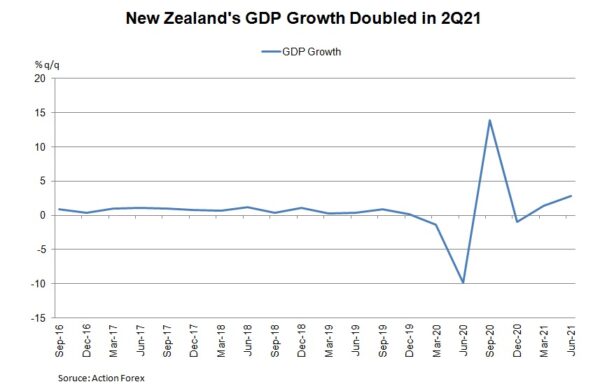
Economic data released since the August meeting has been strong, reinforcing the rhetoric of rate hike. GDP growth accelerated to +2.8% q/q in 2Q21, doubling the prior quarter’s +1.4% and consensus of +1.1%. From year ago, the economy expanded +17.4%, compared with +2.9% in the first quarter. Besides base effect, the strength was attributed to stimulus-induced consumption and business investment.
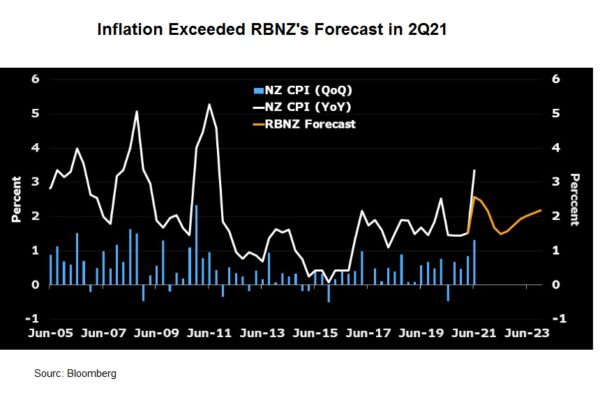
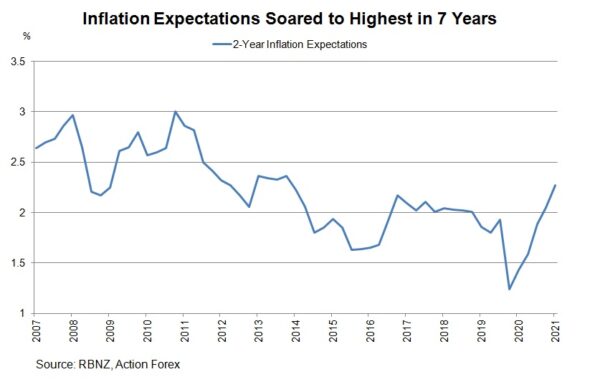
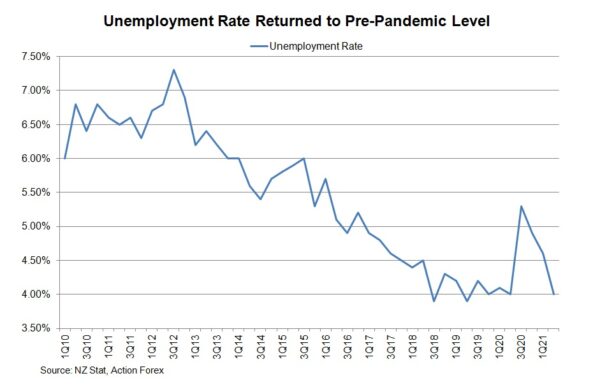
Global inflation has spiked. The same is true for New Zealand. Recalled that headline CPI more than doubled to +3.3% y/y in 2Q21, compared with consensus of +2.7%. The RBNZ survey of inflation expectations 2 years ahead soared +2.27% as of September. This marks the highest reading since June 2014. Meanwhile, the unemployment rate returned to pre-pandemic level of 4% in the June quarter.
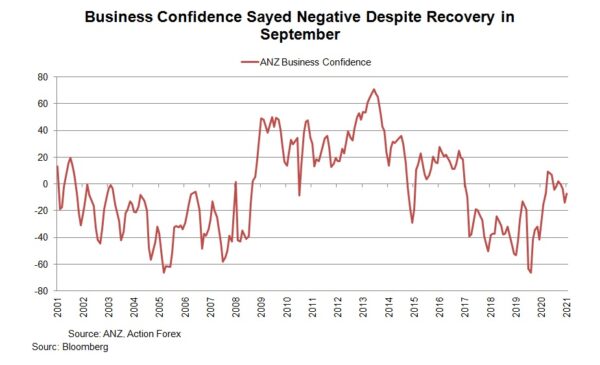
The recovery momentum is prone to slow in the third quarter, especially due to Auckland’s lockdown. Sentiment data have already suggested so. ANZ’s business confidence index was revised lower to -7.2 in September, from an initial reading of -6.8. The activity outlook index steadied at 18.2. Westpac’s consumer confidence slipped -4.4 points to 102.7 in 3Q21. Manufacturing activities have moderated rather sharply with the manufacturing PMI slumped to 40.1 in August, from the downwardly revised 62.2 in July.
The hiccups in the third quarter should be viewed as temporary as would not affect the monetary policy stance. In August, the central bank affirmed that the “clear direction is to reduce policy stimulus”, and “significant changes in demand” are needed to “change course” of this plan.
The market has almost fully priced in a +25 bps OCR increase next week. Speculations of a +50 bps hike are rising. Yet, we expect the former is more likely to occur as policymakers normalize its policy gradually. The focus of the meeting is the guidance of further tightening. We expect to see more rate hikes in subsequent meetings.
Stocks Edge Lower as Quarter Draws to a Close
Stock markets are a little lower on Thursday, bringing an end to a disappointing quarter and going into a new one fraught with risk.
There's an enormous amount of uncertainty in the markets at the moment and that's clearly taken its toll. There's still clearly plenty of appetite to buy the dips but the risks are becoming impossible to ignore.
Central banks are doing their best to reassure us that inflation remains just a temporary, supply-side issue but there also seems to be less conviction in their views. Pandemic stimulus measures are being withdrawn at a time of real uncertainty for the markets, whether that be around Covid, the energy crisis or Evergrande, to name just a few.
And that's before we even consider events in Washington, where lawmakers look set to back a continuing resolution to prevent a government shutdown until early December. While that may relieve some pressure, there's still the small issue of the debt ceiling and not defaulting in less than three weeks to resolve.
With Republicans refusing to aid Democrats in lifting the debt ceiling, insisting instead on using reconciliation - a process deemed extremely risky by Senate majority leader Chuck Schumer. There'll be plenty of theatre around the debt ceiling over the coming weeks before a solution is inevitably found. Although the closer we get to the deadline, investors may become more nervous.
Numerous Fed policymakers are due to speak again today, including Chair Jerome Powell who's making appearances on a daily basis at the moment. I don't expect to hear anything new from them today, with the message being clear and consistent in recent weeks. The conditions are almost met to start paring back net asset purchases and an announcement is likely in November.
Data encouraging despite jobless claims miss
There's been plenty of economic data for traders to get their teeth stuck into today, although nothing that's sent any shockwaves. The second-quarter GDP readings from the US and UK were revised a little higher, while inflation continued to creep higher in Europe as unemployment ticked lower.
Jobless claims, meanwhile, spiked again hitting 362,000 up from 351,000 last week and well above expectations of 333,000. The rise is not likely anything to be concerned about, with the after-effects of Hurricane Ida potentially behind it.
Oil rally eases but outlook remains bullish
Oil's rally has stalled in recent days just as Brent was closing in on $80. A number of factors have contributed to crude prices pulling back including surprise inventory builds from API and EIA, a stronger dollar and more risk aversion in the markets. It's also impossible to ignore just how close Brent came to $80 which suggests there's a strong element of profit-taking in there as well.
The outlook for oil prices remains bullish despite an almost 4% correction so far. The key test below comes around $75 in Brent and $73 in WTI but we're still a little away from there at the moment. Ultimately, the energy crisis is only going to further support the rally in oil prices and the pressures here are certainly not easing up yet.
OPEC+ could take some heat out of the market next week but I struggle to see them doing so. With so much uncertainty still existing, I think they'll view prices as acceptable for now and potentially be tempted into accelerating production over the coming months if some downside risks to demand don't materialise. Much to the annoyance of the White House, no doubt.
Gold support may be short-lived
Gold has finally found some support on Thursday after falling as low as $1,720 a day earlier. Some profit-taking in the dollar may have brought some reprieve to gold, which is up around $12 on the day to trade a little shy of $1,740. Any rallies are likely to face significant resistance though, especially around current levels, with them being important previous areas of support.
Momentum has eased a little during the recent declines in gold but there's still plenty there which may suggest any rallies will be short-lived for now. We're fast approaching major levels of support, with $1,700 being a big psychological test and $1,680 long-term support.
Bitcoin remains in consolidation
Bitcoin continues to consolidate between $40,000 and $45,000 as bullish traders refuse to concede defeat no matter how short-lived these rallies are becoming. And who knows, their incredible resilience may eventually be rewarded, but for now, bitcoin remains in a corrective move and one that looks more likely to continue than not.
Of course, every failure to break $40,000 casts further doubt over its ability to do so and bulls may be encouraged by the resilience displayed so far. And a break of $45,000 would certainly give them more confidence, should that occur before $40,000 falls.
Week Ahead – US Jobs Report, RBNZ Rate Hike May Further Roil Markets Amid Turbulence
Just as central banks thought it was safe to begin closing the taps on stimulus, warning signals are flashing red across the markets as fears grow of a sharp slowdown in growth in the major economies. However, policymakers are expected to stay on the tightening path for now, with the September jobs report likely giving the Fed the green light to taper in November, while the Reserve Bank of New Zealand will probably press on with a telegraphed rate hike. In the meantime, with oil prices at three-year highs, OPEC+ will be under pressure to pump more oil at its monthly meeting.
RBNZ to raise rates but downside risks for kiwi
New Zealand’s economy may have made a quick bounce back but uncertainty about the outlook has increased since the country was plunged back into lockdown in August due to a local outbreak of the Delta variant. The RBNZ held off from raising rates at its August meeting following the lockdown announcement, but policymakers made it clear that tightening is still on the agenda.
However, although the latest shutdowns were not initially thought to cause a too severe a dent in economic output, a full reopening may be weeks if not months away, increasing the prospect of a steep GDP contraction. Covid cases have spiked again in recent days, highlighting the difficulty of containing the Delta spread even with New Zealand’s zero-Covid strategy.
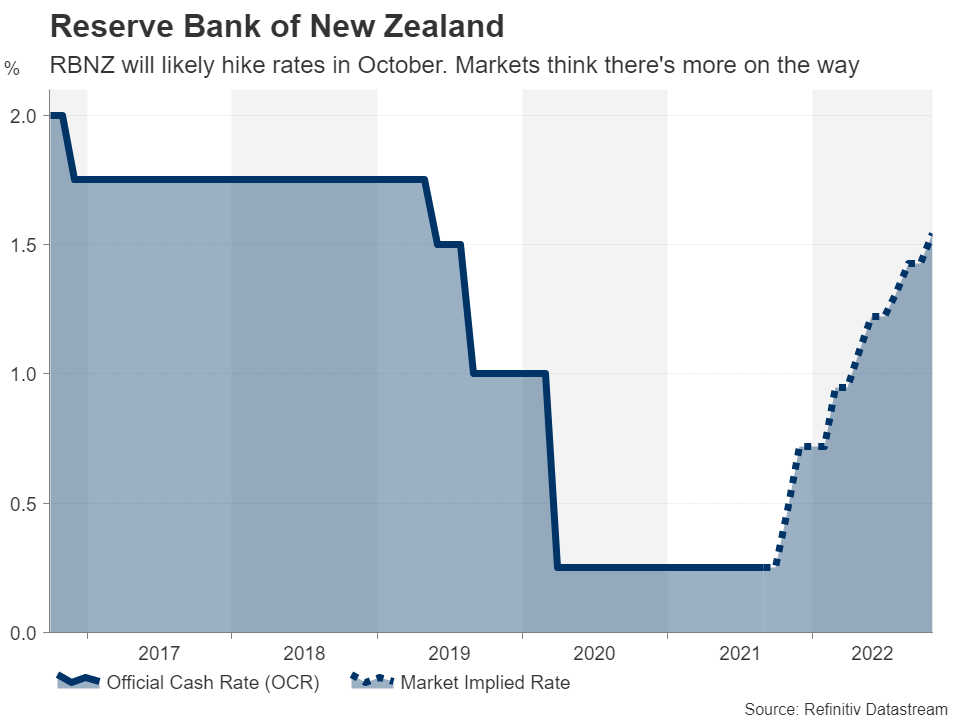
Subsequently, bullish expectations of a 50-basis points (bps) rate hike at Wednesday’s gathering have diminished and the RBNZ will probably lift the official cash rate by a smaller increment of 25bps to 0.50%. However, unless policymakers were to strongly flag more aggressive rate hikes in the future, there may not be much of a boost to the New Zealand dollar, especially now that US yields are also on the up.
Mounting worries for the RBA
Across the Tasman Sea, the Australian dollar is likely to see less action than the kiwi as the Reserve Bank of Australia is expected to keep rates on hold when it meets on Tuesday. Daily virus cases remain near record highs in Australia but with vaccination rates rising, the government is pressuring state authorities to ease some of the restrictions. But lockdowns are not the only major risk the Australian economy is facing right now. A deepening slowdown in China – Australia’s biggest trading partner – is another cloud hanging over the economy.
There’s a good chance therefore the RBA will sound somewhat less optimistic about a speedy recovery so investors will be on the lookout for a more cautious tone in the statement. However, with the next full policy review not anticipated before February, any tweaks in the language would probably be minor but could nevertheless exacerbate any fresh selloff in the aussie, which has been struggling for weeks.
Will September NFP be “reasonably good”?
The Federal Reserve has finally gotten the taper ball rolling, signalling that a November announcement is on the cards. The decision is conditional, though, on another solid jobs print, or to put it more vaguely, “a reasonably good employment report” as per how Chair Powell would like to see.
Friday’s jobs numbers may deliver just that. Nonfarm payrolls are projected to have increased by 500k in September, more than double the August figure, which came in at 235k. The unemployment rate is forecast to dip by 0.1 percentage point to 5.1%, while the month-on-month growth in average hourly earnings is projected to ease from 0.6% to 0.4%.
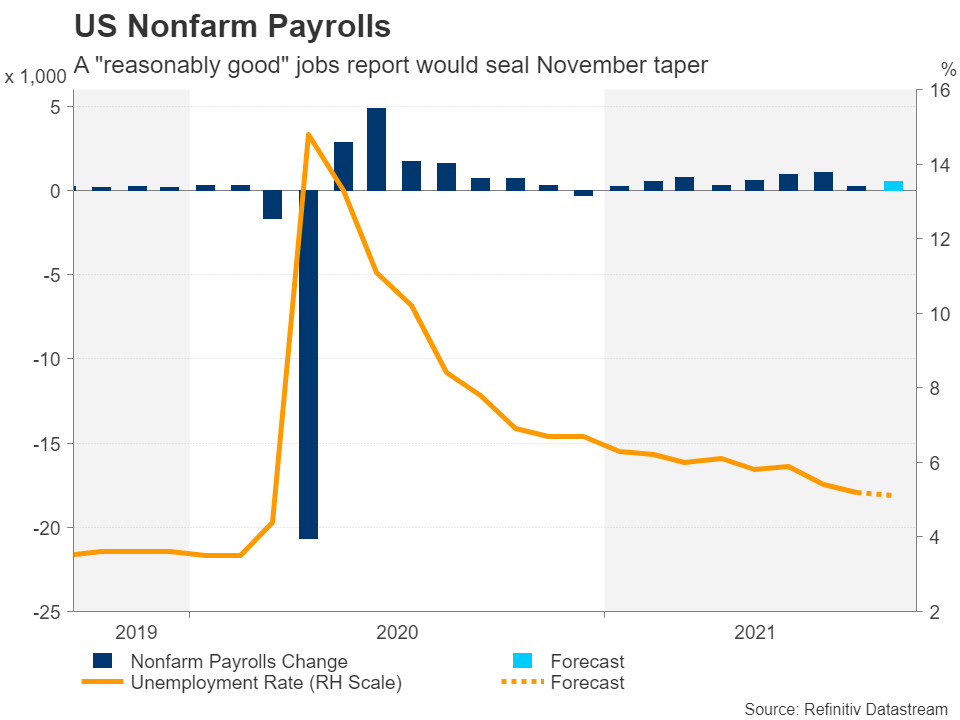
The end to federal unemployment benefits at the beginning of September is expected to have encouraged more Americans to seek employment. However, with the Delta strain still rampant in many states, not all who lost their benefits may have returned to work out of fear of catching the virus.
But would a slightly disappointing jobs report derail the Fed’s plans? That’s not very likely given that high inflation is fast becoming a bigger problem than what most policymakers had anticipated. Hence, unless the NFP reading is shockingly bad, the Fed is almost certain to go ahead with tapering at its next meeting.
In other data out of the United States, the ISM non-manufacturing PMI due Tuesday will also be watched for any possible signs that the US economy lost more steam in September.
Stronger-than-forecast jobs or PMI numbers next week are bound to push up the US dollar, which has been bolstered on the back of the Fed taper bets and safe haven demand. However, any surprise softness in the data may only spur a mild pullback if it’s not accompanied by a sharp rebound in risk appetite.
Canadian jobs and OPEC+ meeting on loonie’s radar
The Canadian dollar has been on a steady downtrend since June even as oil prices have scaled fresh highs during this period. The winding down of bond purchases by the Bank of Canada has also been unable to offset the negative forces emanating from the gradual deterioration in general risk appetite as well as the resurgent US dollar.
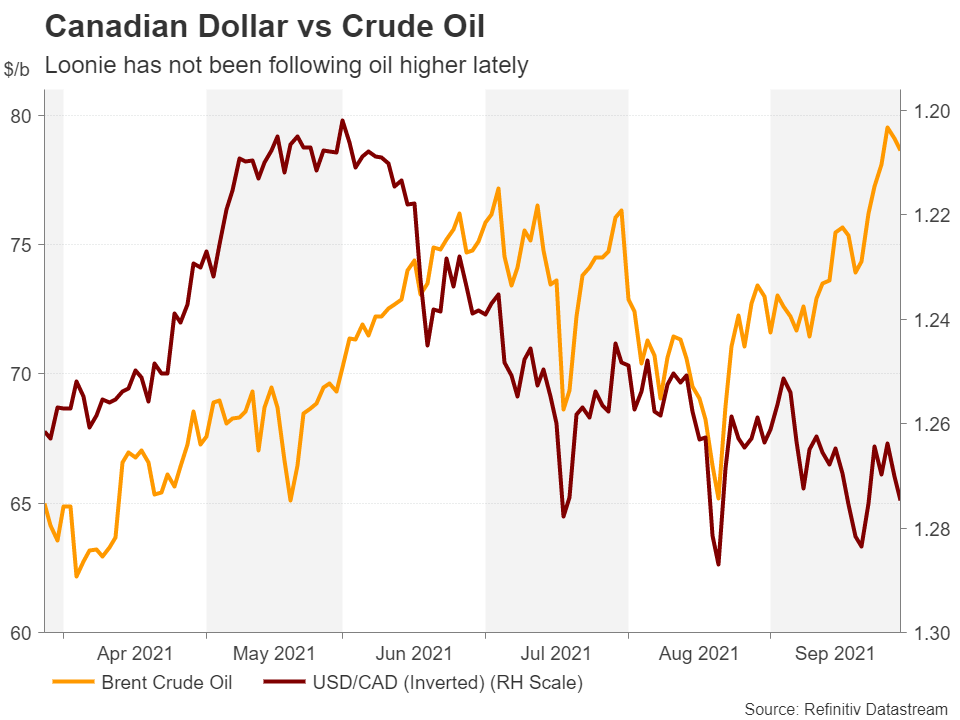
The loonie is in danger of coming under renewed attack next week if OPEC and its allies decide to raise oil output by more than the planned 400,000 barrels a day when they meet on Monday, although such a move is unlikely. The rally in energy markets has taken the price of Brent crude to three-year highs. The OPEC+ alliance is under pressure to ease the soaring cost of fuel and some producers might be inclined to give in to those demands.
However, it’s hard to see the likes of Saudi Arabia agreeing to a faster rollback of the production cuts in spite of the recent gains in oil futures. OPEC+ intends to phase out its pandemic-era supply curbs by September 2022 but may not yet see the market as being tight enough to warrant a change in the current policy. In the absence of any hints of a quicker phaseout, oil prices could extend their rally, lifting oil-linked currencies such as the loonie.
There could be additional support for the loonie on Friday as the September employment report is expected to point to a further recovery in Canada’s labour market. However, given the heightened anxieties surrounding the global growth outlook, any boost would likely be modest.
Mood sours in Europe
It will be somewhat of a quiet week in the euro area and the United Kingdom, with the main release being the final IHS Markit services PMIs on Tuesday. Eurozone retail sales on Wednesday and German industrial output on Thursday might attract some attention for the euro as well. Both currencies have slumped against the greenback lately as, apart from the Fed’s hawkish tilt, there are worries that the worsening energy crisis will weigh on growth, particularly in the UK, which is also facing significant supply disruptions due to a shortage of truck drivers.
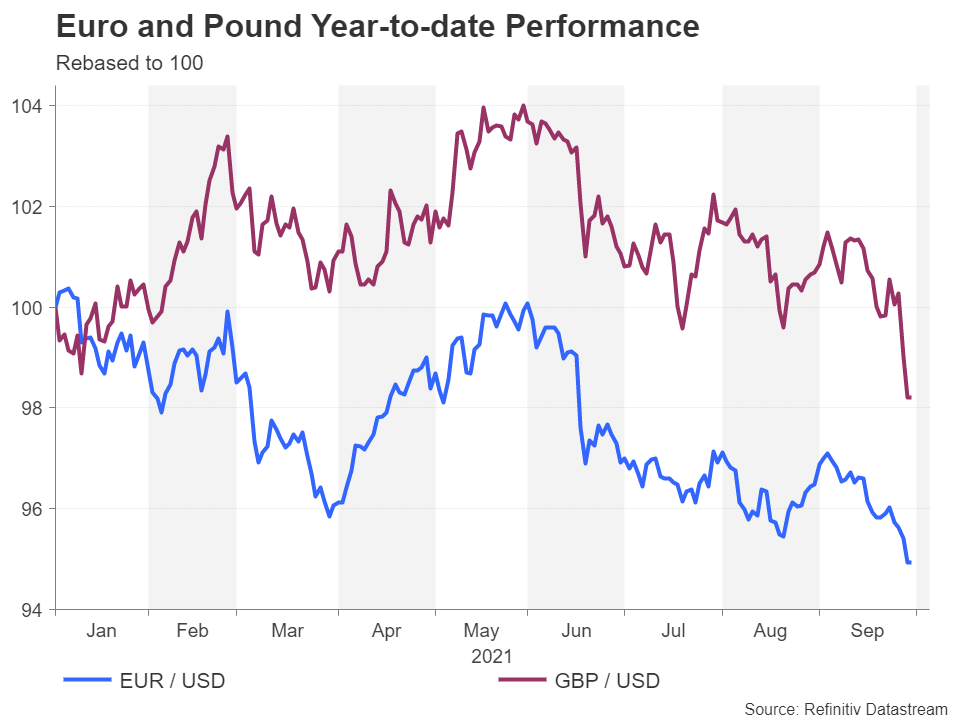
Those concerns are not likely to go away anytime soon so the slide in the euro and pound could continue in the coming days.
RBNZ to Raise Rates, the Sequel
After a surprise lockdown stopped policymakers from raising interest rates back in August, the Reserve Bank of New Zealand (RBNZ) is widely expected to make that move on Wednesday at 02:00 GMT. However, the risks surrounding the kiwi seem tilted to the downside as markets have almost fully priced in three rate hikes over the next three meetings, leaving scope for disappointment. In the bigger picture, China risks have also entered the equation.
Delayed, not cancelled
When the RBNZ hit pause on its plans to raise rates in August, it made it clear this was only a delay. Since then, incoming data have shown that the economy was incredibly strong heading into the lockdowns and has remained quite resilient throughout this ordeal.
Consumption naturally suffered and the number of people receiving unemployment benefits has risen lately, but the impact has been much smaller compared to the first lockdown last year. Meanwhile, various business and household surveys have been quite stable, suggesting that most economic actors are looking through the shutdowns and towards a full vaccine-enabled reopening. Indeed, many restrictions have been lifted already.
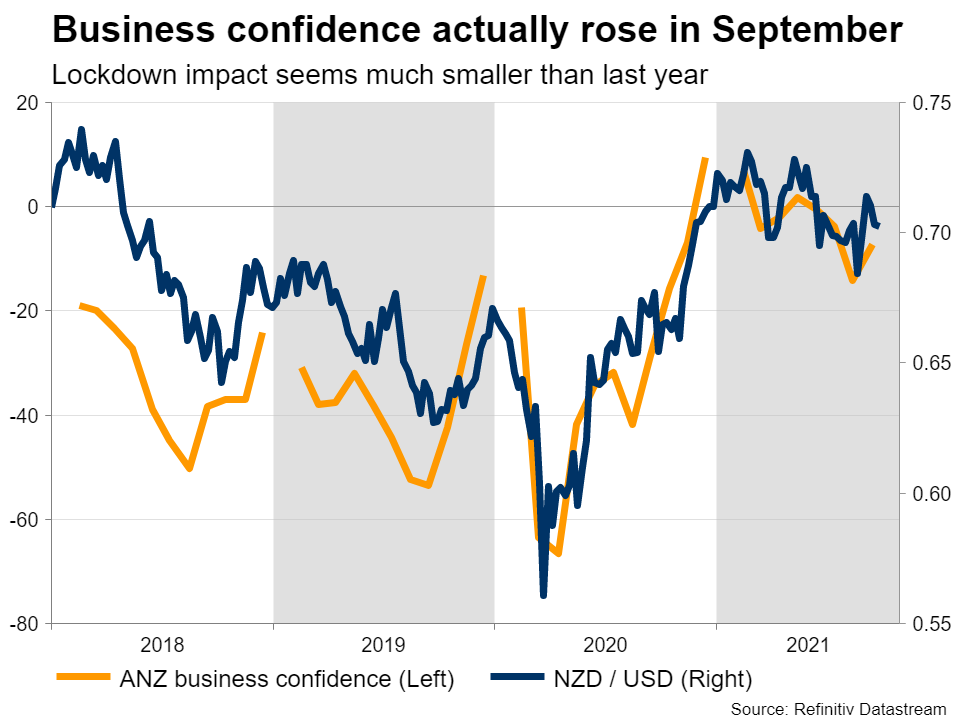
There will always be some damage from a lockdown - that’s inevitable. The question is how much, and in the case of New Zealand it doesn’t look very severe. Inflationary pressures are still intense, the economy was virtually at full employment before this shutdown, and the housing market is so hot the Reserve Bank cannot ignore it anymore.
Asymmetric risks
Therefore, markets are convinced the RBNZ will raise rates next week, pricing in a 90% probability for such action. Another rate increase is almost fully priced in for November, and then another one in February again. This is a really aggressive pricing - it implies the central bank will hike rates at each of its next three meetings without fail.
It very well might, but that’s already baked into the market, so there is scope for disappointment. In other words, the risk-to-reward profile for the kiwi doesn’t seem very attractive here.
If the RBNZ raises rates and says it will do so again soon, that’s already priced in, so any boost to the kiwi could be minor. On the other hand, if the RBNZ hikes rates and doesn’t commit to an immediate follow-up move in November, or if something happens in the meantime that doesn’t allow that to happen, the currency could suffer as short-term yields decline.
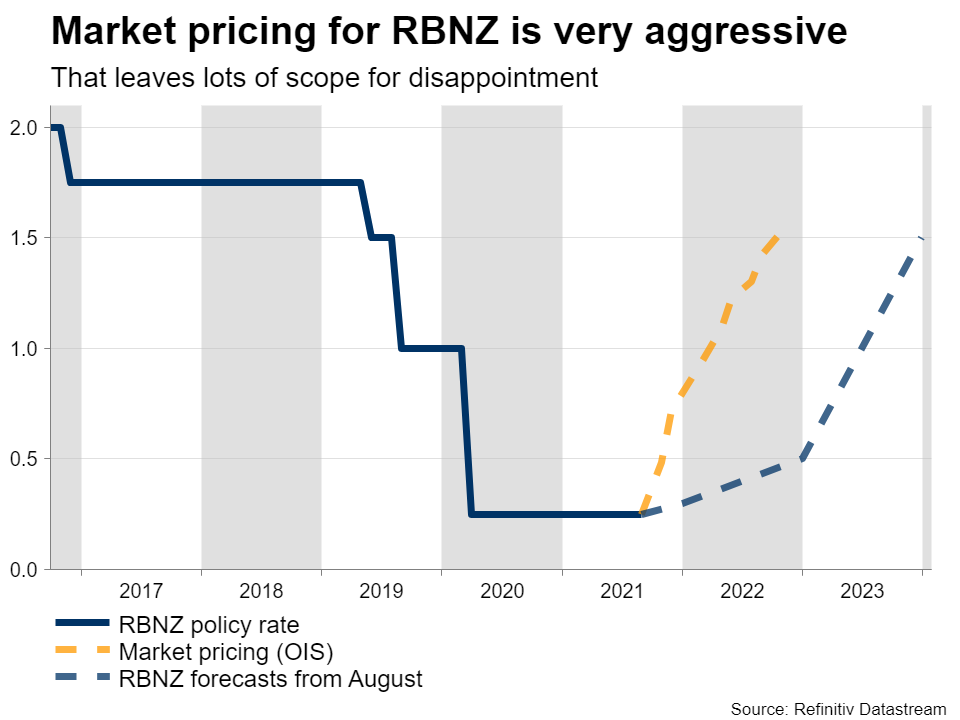
This is a classic example of a central bank being priced for perfection, which means the risks surrounding the kiwi are likely asymmetric and tilted to the downside.
Big picture - neutral?
Taking a step back, the picture for the kiwi seems neutral at this stage. On the bright side, the domestic economy looks likely to rebound from the shutdowns with force, commodity prices are elevated, and growing interest rate differentials will likely support the currency over time, especially against low-yielders like the euro and yen.
That said, the kiwi will also have to grapple with the mounting risks around China, which is the nation’s biggest trading partner by far. There are essentially two crises playing out at the same time, with a painful deleveraging in the real estate sector being compounded by widespread power outages that have plagued heavy industry.
The end result might be a sharp slowdown in Chinese economic growth as these issues get ironed out, which would inevitably hit New Zealand through the export channel. A potential game-changer in this sense would be if the Chinese authorities really started to pull on the stimulus levers, but until then, it’s somewhat difficult to be optimistic on the kiwi.
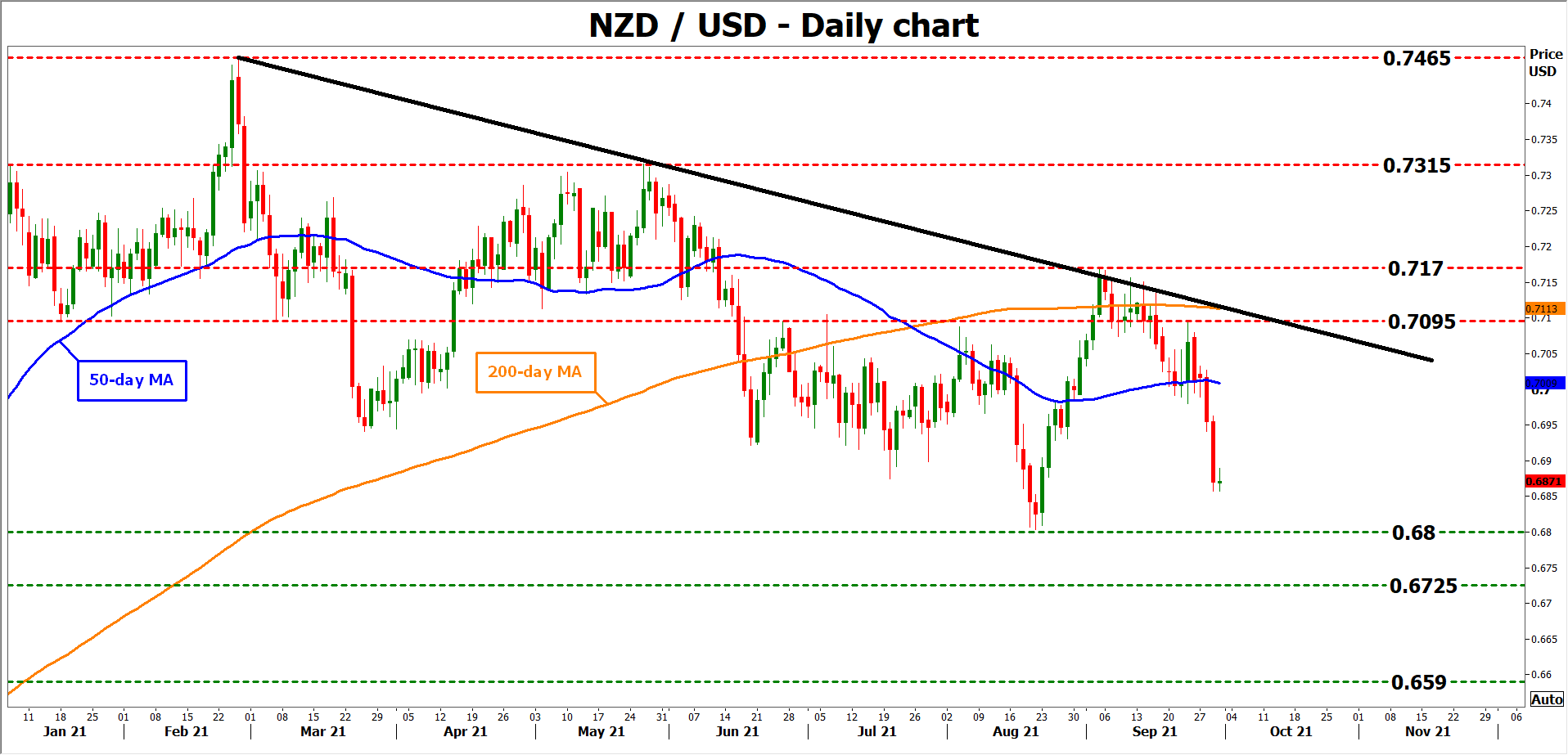
Taking a technical look at kiwi/dollar, initial support to further declines may be found around the 0.6800 handle, a violation of which would turn the focus towards 0.6725.
On the upside, the first major target for the bulls could be the crossroads of the 0.7095 zone and the downward sloping line drawn from the highs of February.
NZ Dollar Stops the Bleeding
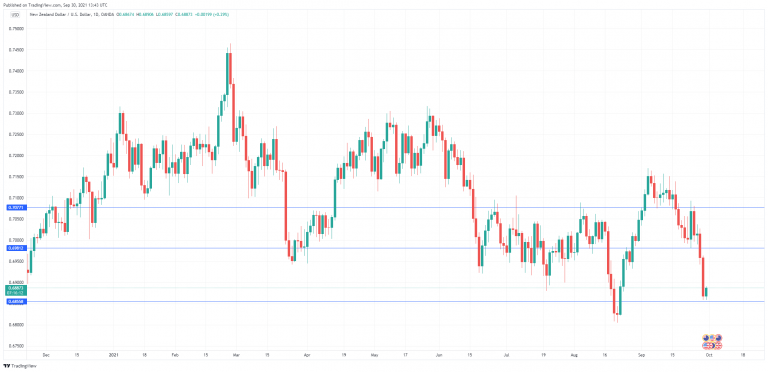
The New Zealand dollar has reversed directions on Thursday and is in positive territory. NZD/USD is currently trading at 0.6887, up 0.29% on the day.
New Zealand dollar slides to 4-week low
It has been a rough patch for the New Zealand dollar, which has fallen 1.9% this week and fell to a 4-week low. The currency dropped 1.30% overnight, as the number of Covid cases rose in Auckland and Federal Reserve members sent out hawkish signals.
Authorities in Auckland reported 45 new Covid cases, bring the number of cases in the current wave to 1,230. These numbers are low compared to other countries, but New Zealand was free of Covid until August. The government responded with a nationwide lockdown, and Auckland has been under lockdown for over a month. There are growing calls to review the ‘zero tolerance’ stance and reopen the country’s borders and revive the dormant tourist industry.
The US dollar is looking sharp. The dollar index rose to 94.47 earlier today, just below its 52-week high of 94.50, and 10-year Treasury yields are at their highest levels since June. The markets are of the view that higher inflation is not about to dissipate, and this is raising expectations that the Fed will respond by tightening policy in order to keep a lid on inflation. Fed Chair Jerome Powell acknowledged in congressional testimony this week that the jump in inflation could last longer than the Fed had anticipated.
Fed members have been sending out hawkish messages this week. James Bullard said that the Fed might need two rate hikes in 2022 in order to combat inflation, and Patrick Harker stated “it will soon be time to begin slowly and methodically” taper the Fed’s bond purchase program. Harker added that he would support tapering as early as November.
NZD/USD Technical
- There are resistance lines at 0.6981 and 0.7077
- There is weak support at 0.6855. Next is a monthly support line at 0.6698
Sunset Market Commentary
Markets
Some inflation readings of individual European countries today provided a taste of what to expect from the euro area wide figure tomorrow. French inflation accelerated from 2.4% y/y to 2.7% (vs 2.8% expected), matching the pace seen in 2011. Italian HICP fastened from 2.5% y/y to 3%, a 9-year high. In Germany, finally, prices rose a whopping record-breaking 4.1% y/y (vs 4% expected), up from 3.4%. Details are unavailable as of yet but what is clear is that the notion of “temporary” inflation needs another stretch into time. The eurozone figure tomorrow is estimated at 3.3%, which would be the strongest since September 2008. Today’s readings tilt the balance of risks in favour of a mild upward surprise which in turn spurs some market speculation on central bank action, even as Lagarde stuck to the temporary narrative at the ECB forum these past two days. German yields gapped higher at the open before paring gains soon thereafter along with a dwindling equity sentiment (EuroStoxx50 turned a 0.9% gain into a 0.3% loss). Slightly stronger-than-expected inflation later helped yields bottoming out again though on the back of real yields. The curve eventually bear steepens with changes varying from 3.1 to 3.6 bps at the long end of the curve. The 10y yield stays north of -0.20% resistance/support. US Treasuries outperform slightly. (Secondary) US jobless claims disappointed with a 362k increase vs a 330k consensus but largely went unnoticed. The curve steepens nonetheless, seeing yields change 0.8 bps (2y) over 2.4 bps (5y) to 3 bps (30y).
On FX markets the trade-weighted dollar eased for a first time in four days. DXY’s rally ran into resistance at 94.47, the crucial barrier that’s effectively the final hurdle before a return to the 96 area. EUR/USD finished below 1.1603 support yesterday and extended losses today. The pair is trading further sub 1.16 (1.1584 currently). The technical charts do not look good with a sustained break paving the way towards the 1.15 zone. USD/JPY (111.86) is taking a breather after rallying from the low 109 area to 112 in just six days. Sterling is performing better after a two-day whammy. Cable is still trading south of resistance around 1.35 but is up for the day from 1.3427 to 1.347. A weak euro is barely holding on to the EUR/GBP 0.86 big figure, a level it had taken out just two days ago.
News Headlines
According to the Minutes of the September meeting of the National bank of Poland, two motions to raise interest rates were rejected. One proposed to raise the reference by 15 bps tot 0.25%. Such a motion was already proposed at the policy meetings in June and July. This time also another minority motion proposing to take bold action by raising the reference rate to 2.0% was rejected. The majority still held the view that the interest rate should be kept unchanged. The results of the November projection of inflation and GDP were pointed out as being important. Should the uncertainty about the impact of the pandemic the economy subside and forecasts suggest a continuation of favourable economic conditions and the risk of inflation running above the NBP’s inflation target in the coming years, it could be warranted to consider adjusting monetary policy. Today, GUS statistical officed said that Polish average corporate gross wages rose by 8.0% Y/Y in the first half. This was only 5.8% over the same period last year.
The Czech central bank again delivered a hawkish surprise at its policy meeting today. Of late, the central bank warned that it could step up the pace of rate hikes after its started a hiking cycle with two 25 bps rate hikes in June and July. The market for today’s meeting expected a 50 bps rate hike, but the CNB doubled the repo rate to 1.50%. The CNB will comment the decision at news conference later today. An unexpectedly sharp rise in August inflation from 3.4% to 4.1% probably was an important factor. The Czech krone reversed recent risk-off driven correction and strengthened to EURCZK 25.33.
USD/JPY Mid-Day Outlook
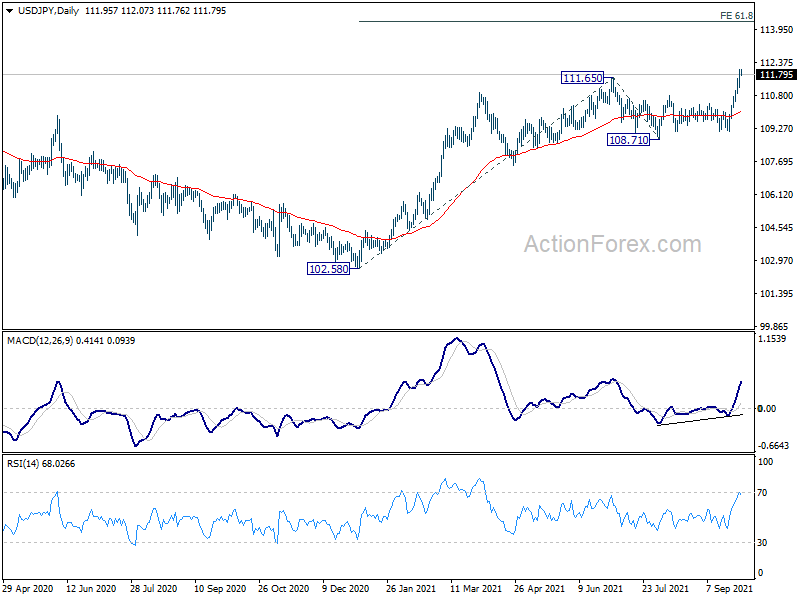
Daily Pivots: (S1) 111.44; (P) 111.75; (R1) 112.28; More...
Intraday bias in USD/JPY remains on the upside for the moment. As noted before, the break of 111.71 medium term structural resistance is seen as a sign of long term bullish reversal. Current rise would target 61.8% projection of 102.58 to 111.65 from 108.71 at 114.31 next. On the downside, below 111.19 minor support will turn bias neutral and bring retreat first, before staging another rally.
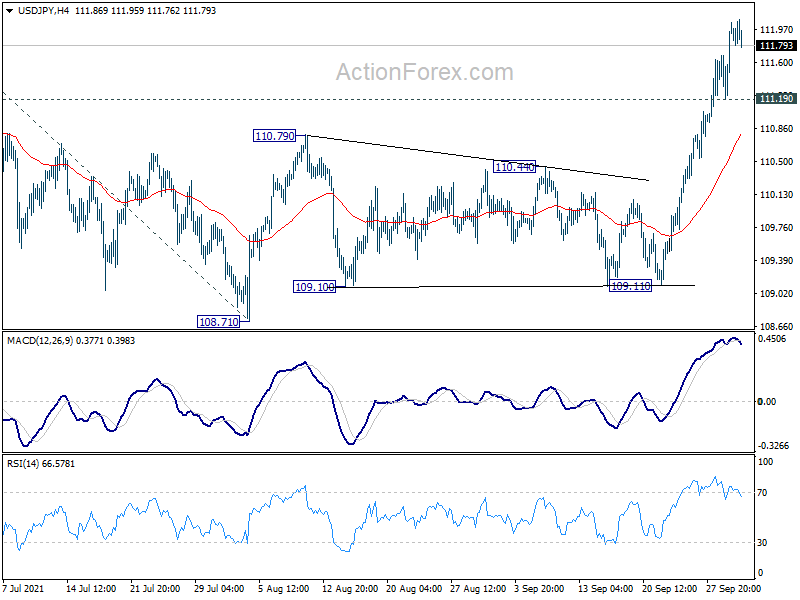
In the bigger picture, break of 111.71 resistance suggests that the whole corrective decline from 118.65 (2016 high) has completed at 101.18 (2020 low) already. Medium term bullishness is also affirmed as USD/JPY stays well above 55 week EMA (now at 108.60). Sustained trading above 111.71 will affirm this bullish case. Rise from 101.18 could then be resuming whole rally from 98.97 (2016 low) through 118.65. This will now be the preferred case as long as 108.71 support holds.
USD/CHF Mid-Day Outlook
Daily Pivots: (S1) 0.9300; (P) 0.9327; (R1) 0.9375; More....
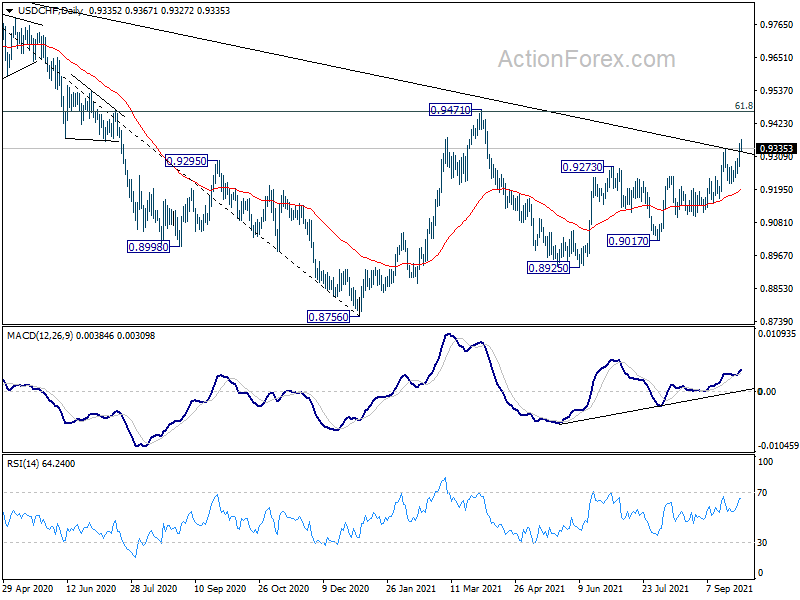
Intraday bias in USD/CHF remains on the upside for the moment. Current rise from 0.8925 should target 0.9471 resistance. Sustained break there will carry larger bullish implications. For now, further rally will remain in favor as long as 0.9214 support holds, in case of retreat.
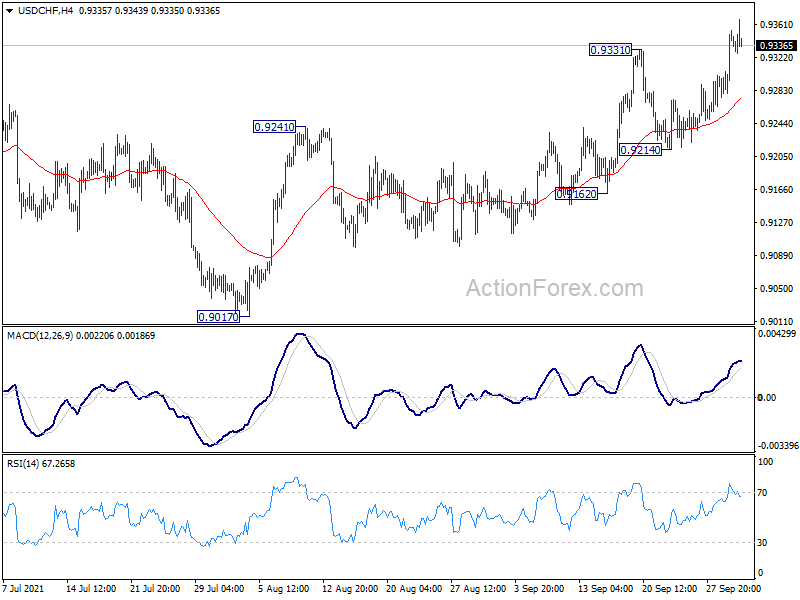
In the bigger picture, the strong rally above 55 week EMA (now at 0.9190) now tilts favor to the case of bullish trend reversal. That is, decline from 1.3042 (2016 high) is probably completed at 0.8756 already. Sustained break of 0.9471 resistance should confirm this case and pave the way to retest 1.0342 ahead. However, rejection by 0.9471 will mix up the outlook again and retain some medium term bearishness.