Sample Category Title
WTI Oil Futures Pause Bullish Party Near 2018 Top
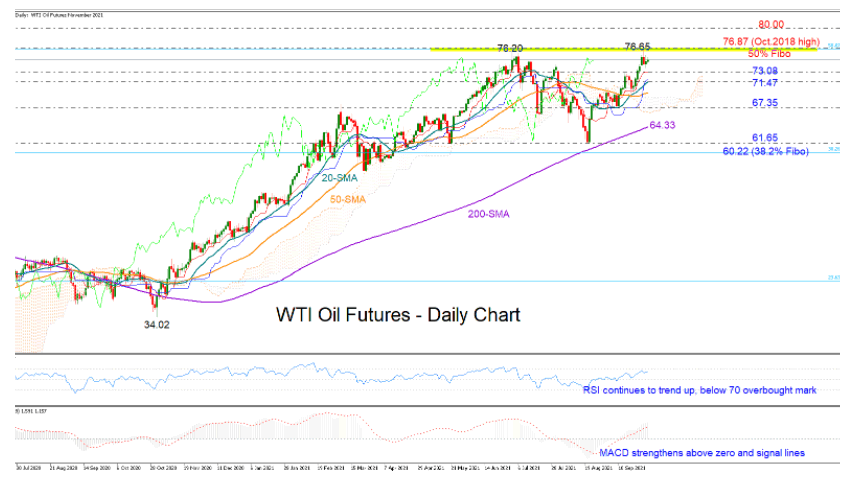
WTI oil futures (November delivery) are flirting again with the 2018 high of 76.87 thanks to the 20-day simple moving average (SMA), which has been assisting the commodity on the way up since the quick bounce near the 61.77 support area on August 23.
After a non-stop four-week-old rally, a downside correction is playing on the cards, especially as the 50% Fibonacci retracement of the 2008 – 2020 downtrend at 76.80 is cementing the 2018 ceiling.
That said, the momentum indicators keep the bias on the positive side, suggesting there is still some bullish fuel in store before the next bearish round starts. Specifically, the RSI is maintaining its upward direction below its 70 overbought mark and the MACD continues to stretch upwards comfortably above its zero and signal lines.
If the wall around 76.87 collapses, the price could advance towards the 80.00 psychological mark, last seen in September 2014. A move higher from here could take a breather within the 83.45 – 86.45 restrictive zone before the 90.00 round-level comes under the spotlight.
Alternatively, the red Tenkan-sen line at 73.08 and the 20-day SMA at 71.47 may resume their supportive role if negative pressures resurface. Failure to hold above the latter could trigger a sharper decline towards the 67.35 handle, while deeper, the 200-day SMA currently at 64.33 could come to the rescue, preventing a test of the August low of 61.77. Any step lower from here would further dampen confidence in the long-term uptrend.
Summarizing, WTI oil futures are trading at a crucial long-term resistance territory, strengthening the odds for a downside reversal, but the technical picture is still keeping optimism alive.
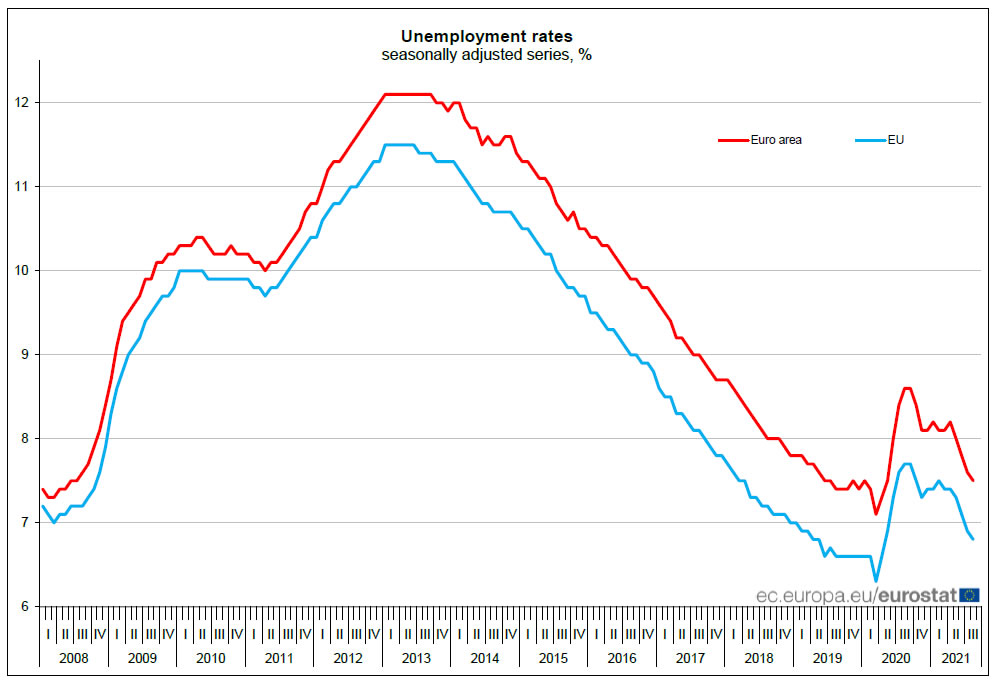
Eurozone unemployment rate dropped to 7.5% in Aug, EU dropped to 6.8%
Eurozone unemployment rate dropped from 7.6% to 7.5% in August, versus expectation of 7.6%. EU unemployment rate dropped from 6.9% to 6.8%.
Eurostat estimates that 14.469 million men and women in the EU, of whom 12.162 million in the euro area, were unemployed in August 2021. Compared with July 2021, the number of persons unemployed decreased by 224 000 in the EU and by 261 000 in the euro area.
USD Continues To Rise Pushed By Monetary Policy Expectations
The USD continued to strengthen against a number of its counterparts yesterday, pushed higher by market expectations for a tightening of the Fed’s monetary policy, while higher than expected pending home sales for August may have also contributed. It should be noted that in ECB’s banking forum Fed Chairman Powell characterised inflation as frustrating and expressed worries for a possible conflict between jobs and inflation and that should be the chief challenge facing the Fed. As the USD continued to strengthen gold prices were forced to retreat given also that US yields tended to remain at rather high levels. On the other hand, US stockmarkets tended to show little volatility with some mixed signals being provided by the markets. Today we highlight the release of the final US GDP rate for Q2 as well as the weekly initial jobless claims figure, while a high number of Fed policymakers are scheduled to speak and could sway the market’s mood.
The USD index continued to rise breaking the 94.10 (S1) resistance line, now turned to support. We tend to maintain a bullish outlook for the index which corrected a bit lower during today’s Asian session. The RSI indicator below our 4-hour chart is clearly above the reading of 70 confirming the bulls’ dominance yet that may imply that a correction lower could be in the cards for the index as it may be overbought. Please note that the index is currently is at levels not seen since last November. Should the bulls actually continue to guide the index we may see it breaking the 94.60 (R1) resistance line and aim for the 95.00 (R2) level. Should the bears take over, we may see the index breaking below the 94.10 (S1) support line and aim if not breach the 93.70 (S2) support level.
EUR continues to weaken
The common currency retreated against the USD and JPY yet remained rather stable against the weakening GBP yesterday. It should be noted that ECB President Lagarde had remained rather dovish in the past days as she stated that the bank will not overreact to inflationary pressures in the Zone, thus allowing for a more accommodative monetary policy to remain present. The statements differentiated ECB’s monetary policy outlook from other central banks such as the Fed and the BoE, which are expected to keep a close eye on inflation and are expected to start tightening their monetary policies earlier. Today we highlight the release of Germany’s and France’s preliminary HICP rates for September which are expected to accelerate and if so, could underscore the inflationary pressures in the Area, thus adding pressure on the ECB and could be providing some support for the EUR.
EUR/USD retreated further yesterday breaking the 1.1615 (R1) support line, now turned to resistance. We tend to maintain a bearish sentiment for the EUR/USD given that the pairs’ RSI indicator below our 4-hour chart is below the reading of 30, albeit that may also be signalling that the pair is oversold and a correction higher could be performed. Should the selling interest be extended we may see the pair aim if not break the 1.1520 (S1) support line, while should a correction higher take place we may see EUR/USD breaking the 1.1615 (R1) line, paving the way for the 1.1695 (R2) level.
Other economic highlights today and the following Asian session:
Today during the European session, we note UK’s GDP rates for Q2, UK’s Nationwide house prices for September, Frances’ and Germany’s preliminary HICP rates for September, Switzerland’s KOF indicator for September and Turkey’s Trade Balance for August. In the American session, we get from the Czech Republic CNB’s interest rate decision and from the US the final GDP rate for Q2 and the weekly initial jobless claims figure, while a number of Fed policymakers is scheduled to speak. During tomorrow’s Asian session we note the release of Japan’s Tankan indicators for Q3.
USD index H4 Chart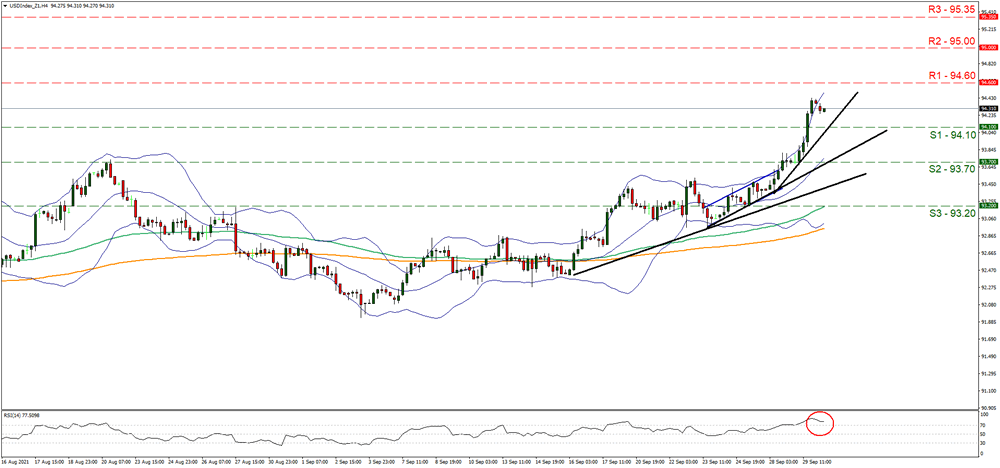
Support: 94.10 (S1), 93.70 (S2), 93.20 (S3)
Resistance: 94.60 (R1), 95.00 (R2), 95.35 (R3)
EUR/USD H4 Chart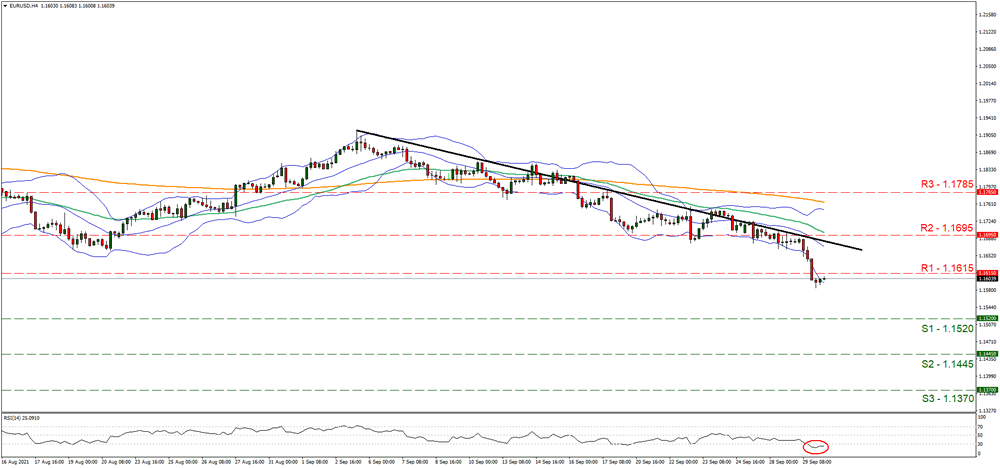
Support: 1.1520 (S1), 1.1445 (S2), 1.1370 (S3)
Resistance: 1.1615 (R1), 1.1695 (R2), 1.1785 (R3)
China Is Ready To Buy Coal At Any Price Because Of The Energy Crisis
The US stock market closed without a single trend yesterday. The Dow Jones index increased by 0.26%, the S&P 500 added 0.16%, and the NASDAQ lost 0.24%. The dollar increased to its highest level in almost a year despite a possible US default and the prospect of more budget cuts than originally planned. Though, according to preliminary information, Democratic leaders have reached an agreement on a vote on the debt limit. Republicans will no longer block the vote.
Fed Chairman Jerome Powell said in his speech yesterday that the US was getting closer to cutting asset purchases. Analysts expect the official announcement to be made at the next Fed meeting in early November.
European stock indices increased yesterday. The British FTSE 100 added 1.1% to a three-week high, German DAX and French CAC 40 added 0.8% each, Italian FTSE MIB increased by 0.6%, Spanish IBEX 35 jumped by 1.3%. AstraZeneca (+4.2%) was one of the leaders in the growth of quotes on Wednesday. The pharmaceutical company announced the purchase of a stake in Caelum Biosciences Inc. for 150 million euros. Also, the quotes of the Italian UniCredit bank (+3.7%) and the Spanish Banco de Sabadell S.A. (+3.7%) significantly increased.
The balance sheet of the European Central Bank reached another record, showing that Europe keeps printing money to the max. Total assets grew by 28.6 billion. The ECB balance is >80% of Eurozone GDP against 37.3% for the Fed, 38.8% for the Bank of England, and 133.7% for the Bank of Japan. ECB President Christine Lagarde says that the EU will return to pre-pandemic levels by the end of the year, and supply chain problems should disappear in the first half of 2022.
Despite an increase of more than 500,000 barrels a day in oil production, the recovery from Hurricane Ida continues to lag as US oil production remains lower by 400,000 barrels a day.
As the dollar index and US government bond yields rise, gold and silver prices are declining. Fundamentally, there is no reason to buy these precious metals now.
Since winter is coming and natural gas prices are at record highs, economies around the world are competing for limited coal supplies. China's energy crisis has led to a surge in shipping costs as the nation is buying up coal to power its economy this winter. China's coal shortage means higher prices for the rest of the world. China, the world's top coal consumer, is in dire need of more supplies and is willing to pay any price. Such a move threatens to leave less fuel for energy-starved competitors. Industrial activity in China declined in September for the first time since the pandemic began last year. It is a sign of the damage that the power shortages are doing to the economy.
Japan's Nikkei index lost 0.36% over the day after Japan's ruling party chose Fumio Kishida as its new leader and prime minister. Fumio Kishida supports a conservative policy.
Main market quotes:
- S&P 500 (F) 4,359.46 +6.83 (+0.16%)
- Dow Jones 34,390.72 +90.73 (+0.26%)
- DAX 15,365.27 +116.71 (+0.77%)
- FTSE 100 7,108.16 +80.06 (+1.14%)
- USD Index 94.40 +0.63 (+0.67%)
Important events for today:
- Japan Industrial Production (m/m) at 02:50 (GMT+3);
- Japan Retail Sales (m/m) at 02:50 (GMT+3);
- China Manufacturing PMI (m/m) at 04:00 (GMT+3);
- UK GDP (q/q) at 09:00 (GMT+3);
- Japan BoJ Gov Haruhiko Kuroda’s Speech at 10:10 (GMT+3);
- German Unemployment Rate (m/m) at 10:55 (GMT+3);
- Eurozone Unemployment Rate (m/m) at 12:00 (GMT+3);
- US Initial Jobless Claims (w/w) at 15:30 (GMT+3);
- US GDP (q/q) at 15:30 (GMT+3);
- US Chicago PMI (m/m) at 16:45 (GMT+3);
- US FOMC Member Williams’s Speech at 17:00 (GMT+3);
- US Natural Gas Storage (w/w) at 17:30 (GMT+3);
- US FOMC Member Bostic’s Speech at 18:00 (GMT+3).
King Dollar Reclaims Throne, Stocks Stabilize
- Dollar powers higher as traders play defense, sterling in pain
- Stocks stabilize amid some bargain hunting but remain fragile
- Gold trades heavy, government shutdown vote in Congress today
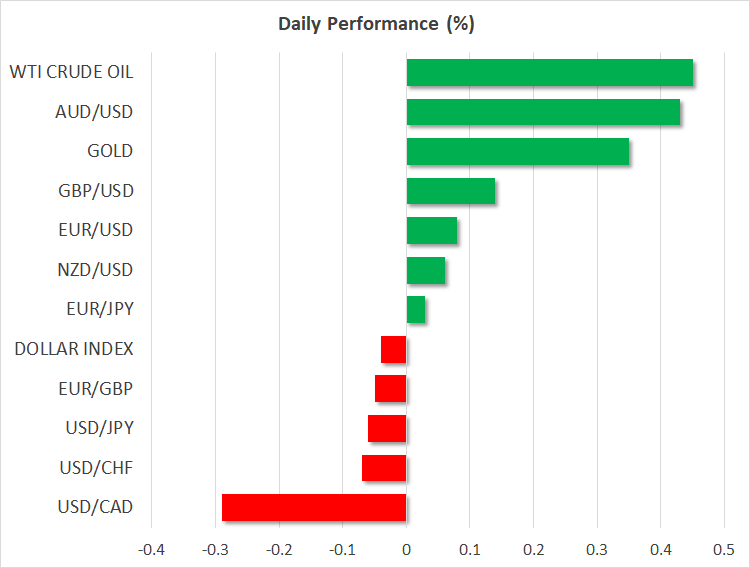
Dollar takes no prisoners
The US dollar sliced through several crucial resistance barriers yesterday, reclaiming its throne as the king of the FX arena without any clear catalyst behind this powerful move. Some players are likely just playing defense, hedging against a range of devastating scenarios such as a persistent rally in yields, the energy crisis intensifying, or a global slowdown driven by supply bottlenecks.
The reserve currency is arguably the only defensive hedge left across all asset classes, as neither bonds nor the yen nor gold are particularly attractive in a world of rising yields. In turn, yields seem to be grinding higher on concerns around stickier inflation as supply disruptions aren’t getting any better, and expectations that central banks will ultimately be forced to respond by hitting the brakes.
In theory, central banks shouldn’t respond to inflation caused by supply disruptions, as interest rates can only influence the demand side of the economy. In reality though, there is a limit to how much inflation pain they are willing to tolerate and for how long. Indeed, judging by the comments from Fed chief Powell yesterday, the original confidence that this inflation episode will be short-lived is fading quickly.
As for the dollar, it’s difficult to see what will stand in its way now that technical barriers have also given way. We are currently in the sweet spot where the greenback enjoys both safe-haven demand and inflows from central bank divergence, making it the ultimate ‘all weather’ currency.
Stocks stabilize, but sentiment shaky
Wall Street remains caught in limbo. Market sentiment has improved a little, with the S&P 500 managing to close in the green yesterday, but the recovery isn’t convincing. Investors are trying to balance the lack of alternatives to equities against the various risks threatening the outlook, from rising yields to power and goods shortages.
The result has been some choppy trading, with the technical picture for the S&P 500 also turning darker as the index remains trapped between the 50- and 100-day moving averages. The Nasdaq is even worse in this respect as it carved out a new low yesterday.
One issue facing asset managers is that for all the headlines about rising yields lately, real yields remain deeply negative across the major economies. Ergo, bonds are still money-losing assets, so the only real reason to slash your exposure to equities is to try and sidestep a deeper correction, not to buy something else. Stocks or cash - that’s the name of the game.
Looking ahead, this correction doesn’t seem to be over as there are several risks that remain unresolved, although bargain hunters are also waiting in the wings. The main event today will be the vote in the US Senate to avert a government shutdown, but don’t expect much market reaction. Investors have seen this movie many times - there’s a lot of drama but it always concludes with a happy ending.
Sterling and gold stay heavy
Another victim of the equity selloff and the dollar’s resurgence has been the British pound, which is highly correlated to risk sentiment thanks to the UK’s twin deficits. Beyond that, the pound also seems to be grappling with fears the Bank of England could raise rates prematurely to fight inflation, which might ultimately do more harm than good as growth momentum seems to be fading already.
Gold prices are also under pressure, suffering at the hands of the usual suspects - rising real rates and a firmer dollar. The fundamental equation for bullion seems quite grim as we may still be in the early stages of the recovery in real US yields, and the technical picture isn’t pretty either, without much support until the $1,680 per ounce region if $1,720 is violated.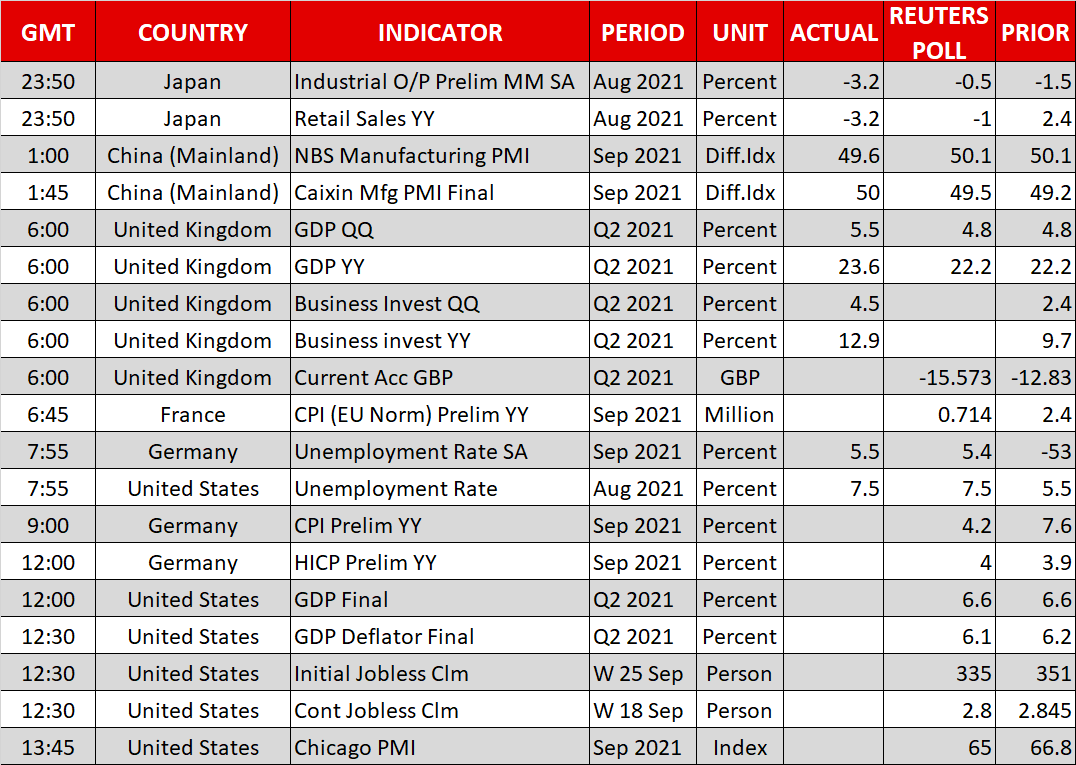
Oil Steady, Gold Extends Losses
Oil consolidates
Oil prices finished almost unchanged overnight, with Brent crude closing at USD 78.45 and WTI at USD 74.70 a barrel. In a moribund pre-China holiday session, prices are unchanged in Asia.
Despite the narrow ranges, I note two important occurrences that suggest oil prices remain very well supported at these levels. Firstly, the mighty US dollar rally overnight did not dent oil prices by one iota. Secondly, US official Crude Inventories followed the API data and posted a surprise 4.50 million-plus gain in crude stocks. Once again oil prices did not move, as opposed to the drop the day before the API data caused. That suggests that the speculative long-covering that pushed Brent crude of its highs above USD 80.00 a barrel may have run its course for now and that oil’s price action is far more constructive than the headline changes suggest.
The Northern hemisphere energy crisis isn’t going to disappear over the weekend, another underlying supportive factor. I also believe that OPEC+ will not be spurred into increasing their production targets next week at the JMMC meeting. The grouping has shown before that they are not reactive to short-term moves in spot markets. A China holiday from tomorrow for a week may take the heat out of the oil rally, but there are few reasons to suggest it is anything but a buy on dips.
Only a fall by Brent crude through USD 76.00 a barrel temporarily delays the bullish outlook while resistance lies at USD 79.50 and USD 80.70 a barrel. Similarly, WTI would need to fall through USD 73.00 a barrel to change the bullish outlook, while resistance lies at USD 75.70 and USD 76.70 a barrel.
Gold’s retreat continues
Gold continued its journey south overnight and given the strength of the US dollar on currency markets, I am surprised that gold only fell modestly. Gold finished the night 0.43% lower at USD 1726.50 after testing support at USD 1720.00 an ounce intra-day. In Asia, gold has risen 0.30% to USD 1732.00 an ounce as investors lock in some risk insurance ahead of the week-long China holiday.
Risk hedging, and if we are honest, there are plenty of reasons to want to have some at the moment, may well be playing a major part in taking the edge of the gold sell-off. However, gold still looks very vulnerable, and rallies have quickly dissipated.
Another bout of US dollar strength in US markets tonight could see gold test support at USD 1720.00 an ounce. After that, USD 1700.00 offers only psychological support ahead of the critical longer-term support zone between USD 1675.00 and USD 1680.00 an ounce. Failure of the latter could well set off another wave of investor liquidation and push gold, rather quickly, as low as USD 1600.00 an ounce. Above, gold still faces challenging resistance at USD 1640.00, USD 1660.00, and USD 1680.00 an ounce.
US Dollar On A Roll
The US dollar steamrolls everything
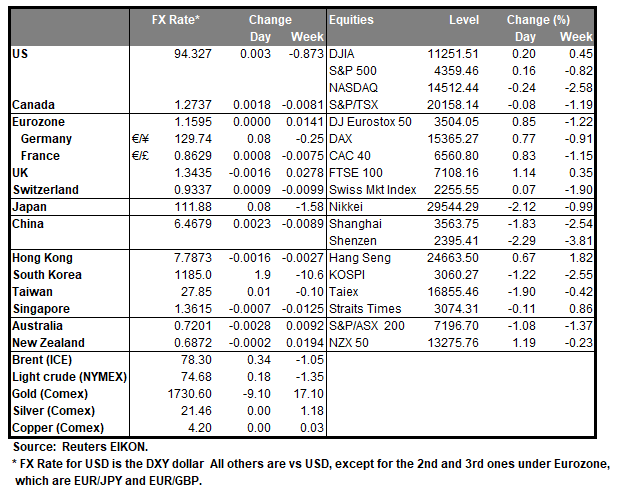
The US dollar leapt higher versus DM and EM currencies overnight although it is hard to attribute the sudden acceleration to any one input. Month and quarter-end flows could be distorting markets. Equally a pricing in of a Fed taper and higher US yields, or hopes that a debt ceiling deal will be reached could equally be to blame. The US dollar may also be receiving inflows related to its bond market or from haven buyers nervous about negative developments around the world. You could take your pick from any or all of that smorgasbord as a reason to buy USD, but when looked at in totality, you would struggle to find a reason to sell the greenback and perhaps that is part of the answer. For this pilot fish of the world’s capital markets, I am content to mumble “I love it when a plan comes together.”
The dollar index powered 0.68% higher to 94.36 overnight, a huge move. Although easing slightly in a dull Asian session to 94.27, there appears to be no sign of the rally losing steam. The index reached 11-month highs overnight and technical indicators suggest it may be overbought in the near term. That could see some consolidation today, but I anticipate a test of 94.75 by early next week.
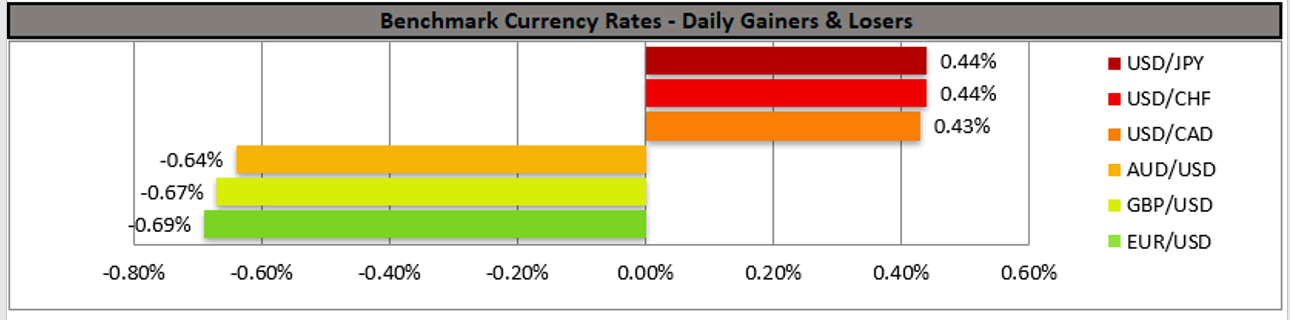
EUR/USD has fallen by 0.75% and is flirting with major support at 1.1600 this morning. Rallies should be limited to 1.1670, but a daily close under 1.1600 signals a much deeper decline is in play, potentially reaching 1.1200. GBP/USD fell 1.20% to 1.3435 overnight before recovering to 1.3455 in Asia. Britain faces its own energy and supply chain winter of discontent and has already tumbled through 1.3610 this week. Nearly 200 points lower now, the charts still indicate further losses targeting 1.3200 in the days ahead. USD/JPY has risen 0.40% to 111.85 and as a US/Japan yield differential play, could extend gains to 114.00.
Always vulnerable to a heightened fear environment in financial markets, the Australian and New Zealand dollars were stretchered off the field overnight, falling by 0.80% and 1.30% respectively. Fears over a Kurt Russell moment and a potential Covid-19, Escape From Auckland are weighing on the kiwi heavily in the background. Both currencies have rallied today on the US funding news and the rallies in commodity prices, notably iron ore. AUD/USD has risen 0.40% to 0.7205, and NZD/USD had risen 0.25% to 0.6885. With the US dollar resplendent though, and plenty of reasons around the world to be nervous generally, both remain acutely vulnerable to heightened fear sentiment returning. Only moves above 0.7250 and 0.69050 would alleviate that.
The PBOC set a slightly weaker fixing for the CNY today at 6.4854, although in open market trading the CNY continues to trade firmer at 6.4640 with officialdom, perhaps with one eye on imported energy costs, keen to ensure the CNY goes into the week-long holiday on a firm note. Regional currencies though are under pressure and if indeed the US dollar move overnight was a Fed taper response, will continue to do so. As I have stated repeatedly, a disconnect between Asian and US monetary policy has negative implications for most countries in the region unless they want to start burning through foreign currency reserves.
Some of that may be occurring today with USD/KRW topping out at 1188.00, once again suggesting that the Bank of Korea doesn’t want 1190.00 to break for now. Similarly, the Philippine peso, logically one of the more vulnerable currencies, with stagflationary monetary policy and plenty of overseas borrowings, is finding it hard to breach 51.00. The BSP could be on top here for now. The Indonesian rupiah is in much the same boat and USD/IDR is starting to rise today, climbing to 14,300.00. USD/INR, also with reference rates well below inflation like the Philippines, has risen steadily this month and accelerated in the last few days. INR may have been temporarily boosted by investor inflows that left China and India’s hot IPO market. If that has abated, a stronger US dollar and higher US yields will weigh heavily on the INR. USD/INR rose to nearly 74.400 overnight and if the US dollar stays strong, could revisit 75.000 sooner rather than later.
The Thai baht is in a similar boat and along with PHP, IDR and INR, remains highly sensitive to higher US yields and a Fed taper. USD/THB has risen to 33.914 and unless the BOT is on the offer at 34.000, looks set to book more losses in the week ahead. USD/MYR will also have a serious monetary policy disconnect, although high oil prices and an economic reopening seem to be shielding the ringgit from the worst of the US dollar rally. Nevertheless, USD/MYR has risen to 4.1880 as of today, and a close above 4.1900 tomorrow signals a move higher to 4.2200 initially.
A Mixed Day For Asia
Asian markets showing caution
US equities traded sideways overnight with the S&P 500 edging 0.16% higher, the Nasdaq falling -0.24% and the Dow Jones rising 0.27% today. Early Asian markets were under pressure, but a rebound of sorts has happened after a deal to avert a US government shutdown was announced, and China’s PMIs showed stability after last month’s poor showing. US index futures have rallied strongly as a result, taking the edge of Asian concerns. The S&P futures have jumped 0.50% with Nasdaq futures rallying 0.60% and Dow futures climbing 0.40%.
The Nikkei 225 and Kospi have reversed early losses, but the Nikkei 225 is still down 0.40% even as the Kospi climbs into the green by 0.10% with both countries releasing soft economic data this morning.
In China, news that Evergrande had sold a banking stake yesterday and had resumed work on some housing projects has also given markets some respite. The PBOC also added a small liquidity injection. Evergrande and China’s energy crunch still hang over equity markets, but mainland markets seem intent on going into the week-long holiday on a positive note. The Shanghai Composite has risen by 0.40%, while the CSI 300 is 0.50% higher. Hong Kong is faring worse though, with the Hang Seng falling by 1.10% so far.
Regional Asia has also reversed its early cautious sentiment after the US government funding announcement, helped along by lower currencies. Singapore has risen by 0.45%, while Taipei is 0.35% higher. Kuala Lumpur has edged 0.25% lower with Bangkok 0.10% lower, even as Manila climbs 0.70% higher and Jakarta rises by 0.85%. The US announcement, a lower currency, decent data and higher iron prices have sparked a broad rally in the ever-optimistic Australian markets today. The ASX and All Ordinaries have leapt higher by 1.30%.
With European currencies and the pound being slammed overnight by the US dollar juggernaut, pleasing for exporters, and with Asian markets recovering on the US government funding news, European markets should open higher this afternoon. With the quarter-end and month-end upon us, I expect rebalancing flows to cause choppy sessions in both Europe and the US on a quiet data day.
Pimp Up My Greenback
US dollar extends gains
Markets indulged in a choppy but ultimately range-trading day overnight. Equities and bonds moved sideways, while base metals had a mixed day as did energy, where oil remained steady but natural gas gave back some of its recent gains. The exception was currency markets where the US dollar rallied aggressively versus both developed and emerging market currencies.
There was no obvious driver behind the move. The overnight central banker forum stayed in Team Transitory, although that mantra appears to be falling on more and more deaf ears. Much talk was made of the reality of the Fed taper, something that has been telegraphed ad nauseum by the author in recent times. However, before jumping on the “team taper” bandwagon with regards to the overnight US dollar rally, I would note that currency markets may also be being distorted by end of quarter and end of month rebalancing flows. I'd like to see the US dollar hold on to all its gains and possibly advance further before jumping in with both feet on that. Although US yields have risen, equity markets are still trading sideways in the big picture. The scale of those moves is not yet consistent with a full-on taper repricing.
Certainly, Asia-Pacific equity markets are not in taper-tantrum mode, with price moves heading in polar opposites across the region. That may be due to the various data inputs we have seen in Asia today after what was a sideways session for most asset classes in New York overnight.
South Korean Industrial Production outperformed year-on-year, but underperformed month-on-month for August, falling by -0.70%. MoM retail sales also lagged falling by -0.80%, although once again, the YoY data outperformed. While the South Korean data was unspectacular, the Japan data was disappointing. MoM industrial production fell by a whopping -3.20% for August and retail sales MoM slumped by -0.40%. Covid restrictions will be dampening retail demand and should improve as restrictions are lifted this week. But industrial production is challenging with car manufacturing and electronic devices leading the charge lower. The new Japanese prime minister said as much, blaming supply-chain woes and semiconductor shortages. Mr Kishida has promised to open the fiscal pumps again and looking at the data, it comes none too soon.
China's PMI data was a mixed bag. The official NBS Manufacturing PMI for September fell into contractionary territory at 49.60, while the Caixin PMI rose slightly to 50.0. Official Non-Manufacturing PMI rebounded from last month's sharp drop as Covid restrictions eased, jumping back to 53.2. The data itself won't be filling the street with confidence though against the developing background of China's energy shortages, the relentless “shared prosperity” crackdown, and the Evergrande situation. Yesterday it was the turn of banking trading floors with government officials arriving to put a clamp on excessive speculative trading and ordering trading spreads to be tightened. With China on holiday for a week from tomorrow, the manufacturing PMIs are unlikely to rebound anyway for October.
In contrast, Australian data was relatively healthy. Building Permits leapt higher by 6.80% MoM for August, and MoM private sector credit expanded at a healthy clip, rising by 0.60%. With a lower Australian dollar overnight, natural gas prices holding up, iron ore rallying ahead of the China holiday and an earlier easing of restrictions being dangled by the NSW premier, it's perhaps not surprising that Australian equities are rallying today.
Sentiment in Asia appears to be receiving a modest lift from news that a deal to extend funding of the government until December this year seems to have been agreed upon among Senate leaders. Markets love kicking the can down the road almost as much as outright certainty. It is unlikely to be enough to lift the gloom across most Asian markets entirely though.
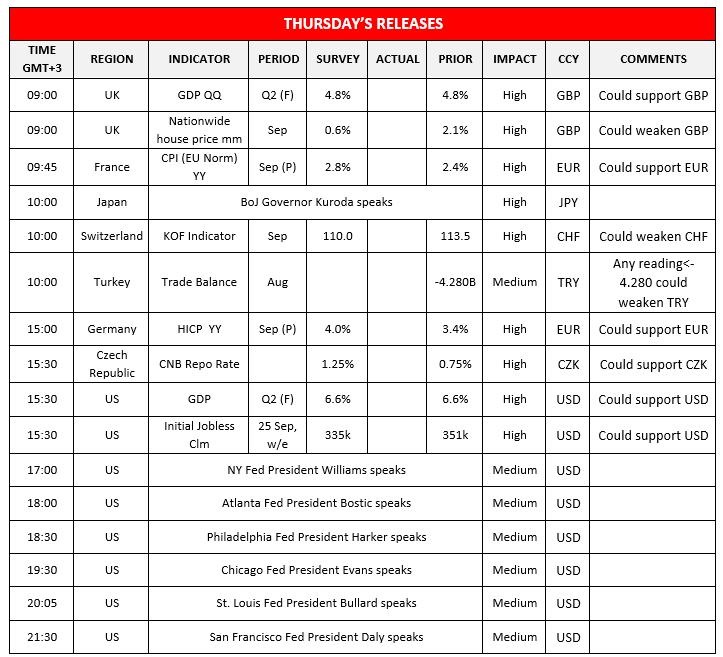
Except for German inflation this afternoon, the rest of the day's data calendar is second tier. US Q2 GDP Prices and Growth and Q2 PCE Prices will be old news. US markets are likely to be much more engaged with happenings on Capitol Hill today, with Thursday a pseudo deadline for the debt extension and infrastructure/spending votes across both houses.
Tomorrow's Japan Tankan survey, Eurozone Inflation and US Personal Spending and Income (a Fed fav) and ISM Manufacturing PMI will be of far greater interest. Asian liquidity tomorrow will be sapped by a China and Hong Kong holiday and markets tonight, will be left to the tender devices of month-end and quarter-end flows.
CAD/JPY Bullish Trend To Continue
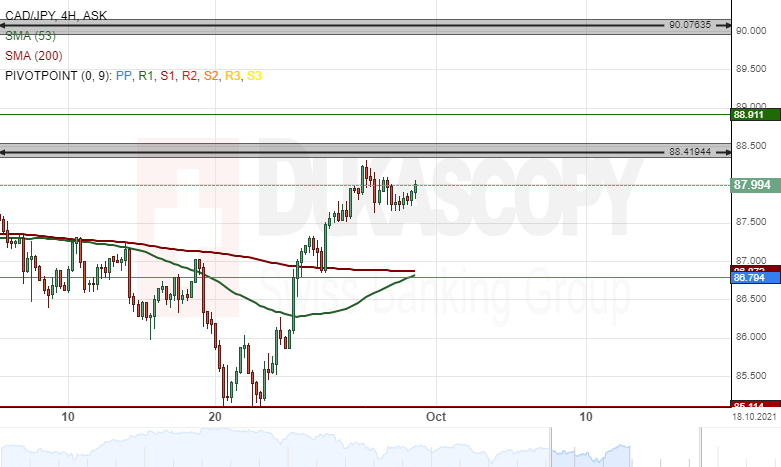
The CAD/JPY currency pair bounced off a support level at 85.11 on September 22. As a result, the Canadian Dollar has surged by 3.70% against the Japanese Yen since last week's trading sessions.
Everything being equal, the exchange rate could continue to trend higher during the following trading sessions. The potential target for buyers would be near the 90.00 level.
However, the currency exchange rate could find resistance at 88.41 within this week's trading sessions.