

Sample Category Title
ECB Kazimir: PEPP will be terminated with the end of the pandemic
ECB Governing Council member said Peter Kazimir said "concerns about the cliff effect (of ending PEPP) cannot automatically mean demands for increasing the standard programs (APP)". "There is no automatic formula," he said. "We'll be deciding according to conditions at the given time."
He also said, the PEPP has been "functioning very well and naturally it is now in the final stage of its life cycle." "It's a special tool designed for a special situation, and it will be phased out when it's not needed anymore," he added. "The market seems to understand that this tool will be terminated with the end of the pandemic."
"If inflation remains elevated next year because of supply bottlenecks, my concern is that it could spill into wage negotiations for the following year as well," he said. But "we are not seeing this happening in key countries so far."
Sunset Market Commentary
Markets:
Price action on global markets followed yesterday’s roadmap. Core yields continue marching north. Commodity indices (CRB), mainly driven by energy sub-components (oil, natural gas, …) reminded markets of persistent (supply driven) inflationary pressure. It is unsure how decisively central banks will (be able to) react to the kind of inflation that is to a large extent independent of the domestic economic performance. BoE’s Bailey yesterday at least suggested the BoE considers taking some ‘pre-emptive’ steps to contain unwarranted second round effects. Uncertainty on central bank’s reaction function probably explains way the rise in (US) yields is more or less equally divided between real yields and inflation expectations. The US curve further bear steepens with yields rising between 3.25 bp (2-y) and 9.5 bp (30-y). The rise in the two year yield is partially due to a benchmark change. Even so, it suggests markets are ever more considering a scenario where CB’s might be forced to raise rates earlier than deemed possible until now. The lingering debate on the US debt ceiling also doesn’t help Treasuries (cf infra). The German yield curve also bear steepens with yields rising between 1.2 bp (2-y) and 3.5 bp (10-y). This rise was solely due to higher inflation expectations, with the 10-y EMU inflation swap rising 5 bp to 1.90%. At the September press conference, ECB Lagarde indicated that the 1.75% level in the 5Y5Y forward inflation swap was one (of several) pointer(s) on the ECB’s inflation radar (currently 1.81%). Even so, at the opening of the ECB Forum, Lagarde repeated the mantra that most of current inflation is temporary and that the ECB will maintain supportive financing conditions. For now, the impact of higher core yields had only limited impact on peripheral bonds. Even so, Italy for the 3th consecutive day underperforms with the 10-y spread again widening 3 bps. A continuation of this pattern could complicate the ECB’s aim for equally supportive financing conditions across the EMU. Over the previous days, there was no one-on-one link between higher core yields and the performance of risky assets/equites. However, especially European indices today feel growing headwinds (EuroStoxx 50, 1.4%). US indices open with losses of 0.25% (Dow) to 1.3% (Nasdaq). …
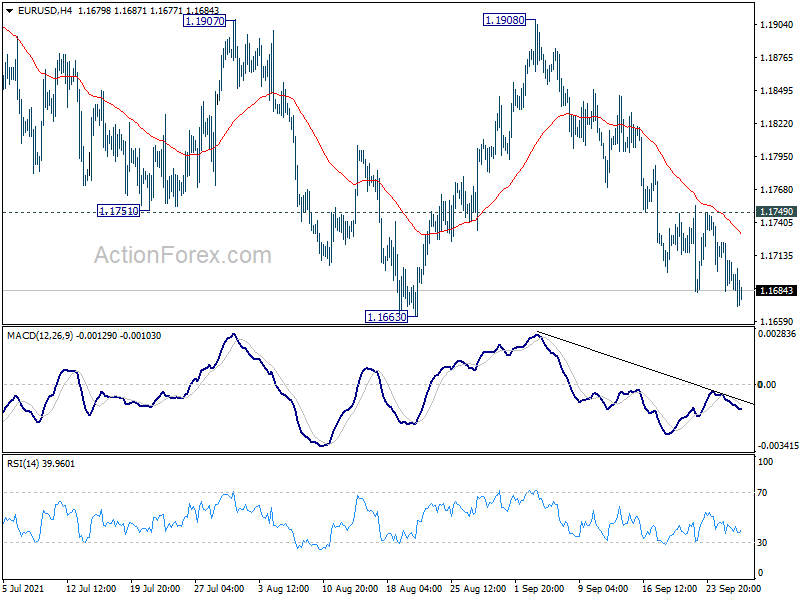
The combination of a wider ST USD-EMU interest rate differential and rising EMU inflation expectations logically puts EUR/USD under pressure (1.1680 area). The 1.1664 support is at high risk. Sterling again failed to profit further from yesterday’s ‘hawkish’ comments from chairman Bailey. On the contrary, his colleague Catherine Mann at the ECB forum subscribed the thesis of ‘transitory inflation’. EUR/GBP even jumped north of 0.86(2), testing short term resistance. The rise in core yields again inflicts big damage for CE countries with especially the forint (EUR/HUF 359.75) and the zloty (EURPLN 3.63) in heavy weather.
News Headlines:
St.-Louis Fed Bullard ruffled his hawkish feathers today. He expects inflation to remain at 2.8% through next year, suggesting more aggressive action by the Fed. He proposes to start winding down the central bank’s balance sheet as soon as net asset purchases end, while arguing already in favour of 2 rate hikes in 2022. Apart from the inflation overshoot, he points to the health of the US economy – already back at pre-pandemic levels – which allows for a much faster normalization process compared to the previous cycle.
US Treasury Secretary Yellen warned in a letter to congressional leaders that the Treasury is likely to exhaust its extraordinary measures if Congress has not acted to raise or suspend the debt limit by October 18. At that point, the Treasury would be left with very limited resources that would be depleted quickly. It is uncertain whether they would continue to meet all the nation’s commitments after that date. Yellen’s warning comes after a bill to suspend the limit and provide the government from short term funding failed to pass through US Senate with Republicans holding their view that Democrats should bypass the 60-seat required Senate majority. Republicans don’t want to be associated by President Biden’s spending plans, while Democrats urge them to take responsibility for historical debts.
Dollar Turns to US Data Releases as Yields Spike
With yields going berserk, the upcoming batch of US economic data on Friday could be crucial for the dollar’s fortunes. Personal income and consumption numbers along with the Fed’s favorite inflation metric will hit the markets at 12:30 GMT, before the ISM manufacturing survey is released at 14:00 GMT. Overall, the outlook for the dollar remains positive against the euro and yen.
Brace for earlier rate hikes
The Fed is turning more hawkish. Chairman Powell stated quite clearly last week that unless a catastrophe strikes, his central bank will start dialing back its asset purchases this year. More importantly, the new interest rate projections showed the FOMC being split 9-9 on whether liftoff will begin next year already.
Markets seem much more certain though, as the first quarter-point rate increase is now fully priced in for December 2022. This has propelled Treasury yields higher, along with some signs that inflation is unlikely to cool anytime soon amid an energy crisis in China that threatens to exacerbate supply disruptions. The dollar typically benefits when yields spike higher, particularly against the yen.
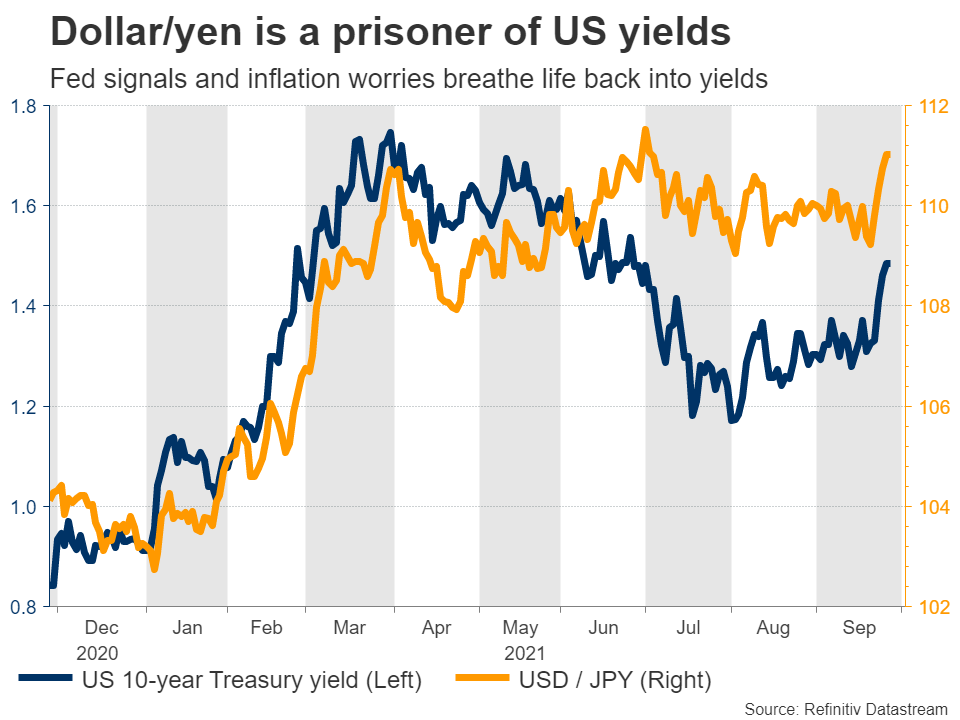
The central question that will drive the dollar moving forward is whether an even earlier rate increase is possible, for instance in September 2022. Markets currently assign a 60% probability to that scenario.
ISM manufacturing in sight
There are several releases slated for Friday, but the most important one is the ISM manufacturing PMI. That’s because it’s a forward-looking indicator. It will reveal whether supply chains worsened further in September and give us an early look into how the labor market performed during the month.
Personal consumption and income numbers for August, as well as the core PCE price index are quite important too, but they usually don’t move the markets much. Investors already have a very good idea of how the economy and inflation evolved in August, so this would essentially be ‘old news’.
Dollar/yen cruises higher
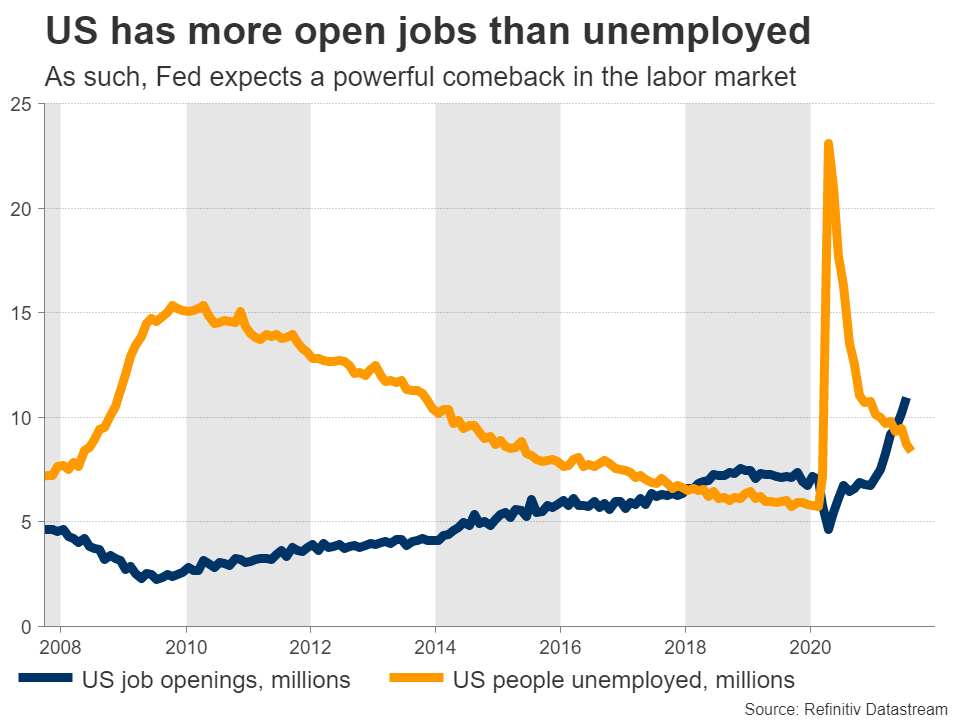
In the big picture, the outlook for the dollar seems positive, particularly against the euro and yen. American inflation could become persistent as supply chain disruptions continue to rage, consumption is booming with retail sales being far above their pre-crisis levels, and the labor market could be back to full employment by next year.
Don’t forget about Congress either. If the Democrats manage to pass anything remotely close to the $3.5 trillion social package they are working on, it could be a real game-changer. It would juice up economic growth for years, and likely push yields even higher on expectations of bigger deficits and a more aggressive Fed.
In contrast, neither the Bank of Japan nor the European Central Bank will raise rates in the coming years. Japan is still trapped in deflation and economic growth is anemic. Meanwhile, European inflation has accelerated lately but that won’t change much for the ECB, which is confident that price pressures will cool once supply chain disruptions ease.
Central banks view inflation through the prism of the labor market. If inflation is hot because of supply problems but your economy is still far away from full employment, inflation is unlikely to be persistent because consumers don’t have the pockets to sustain it. That’s the situation in Europe.
The Fed might be a different story though, as the US labor market recovery is at a much more advanced stage. Hence, the Fed will most likely out-normalize the ECB and BoJ, ultimately making the dollar more attractive from a relative rates perspective.
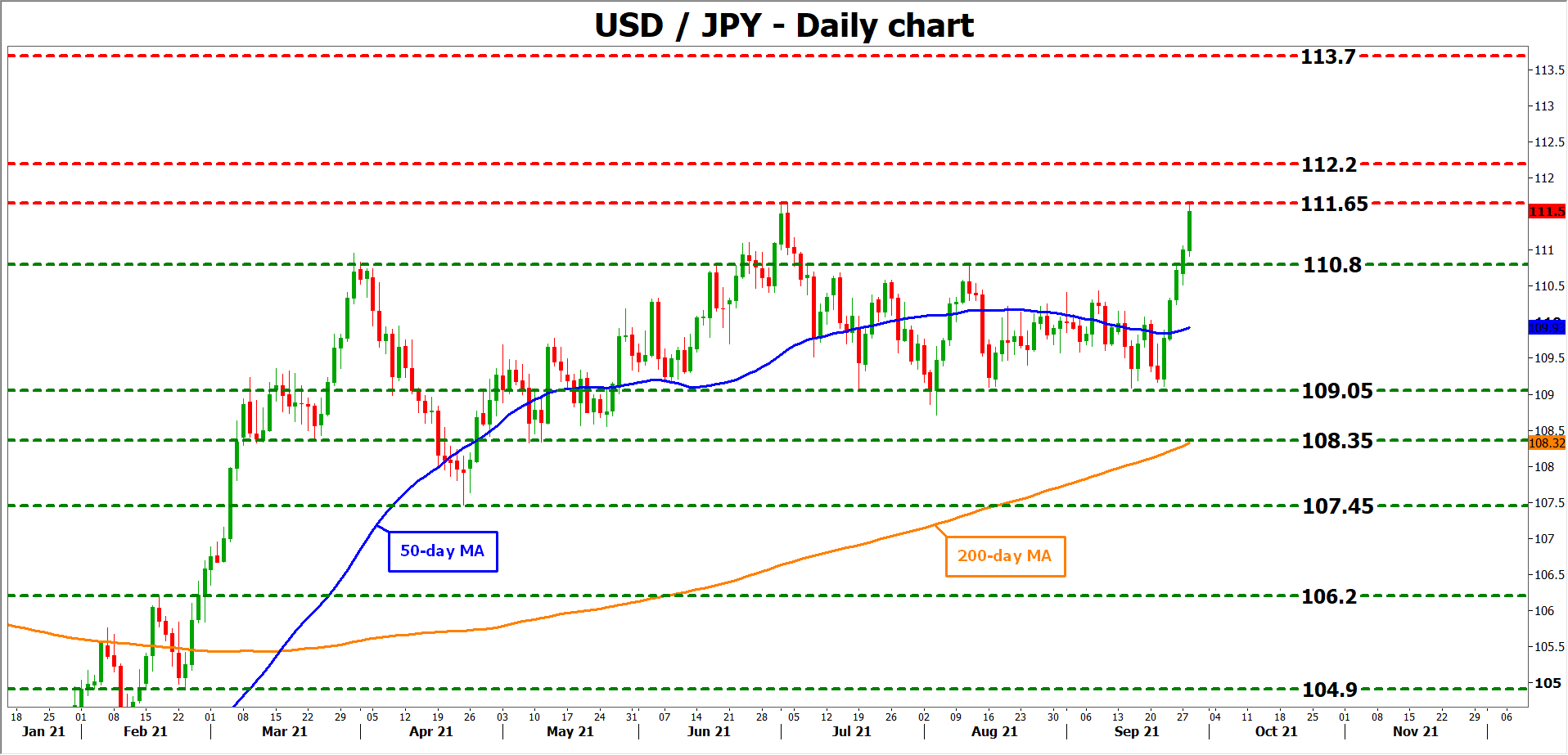
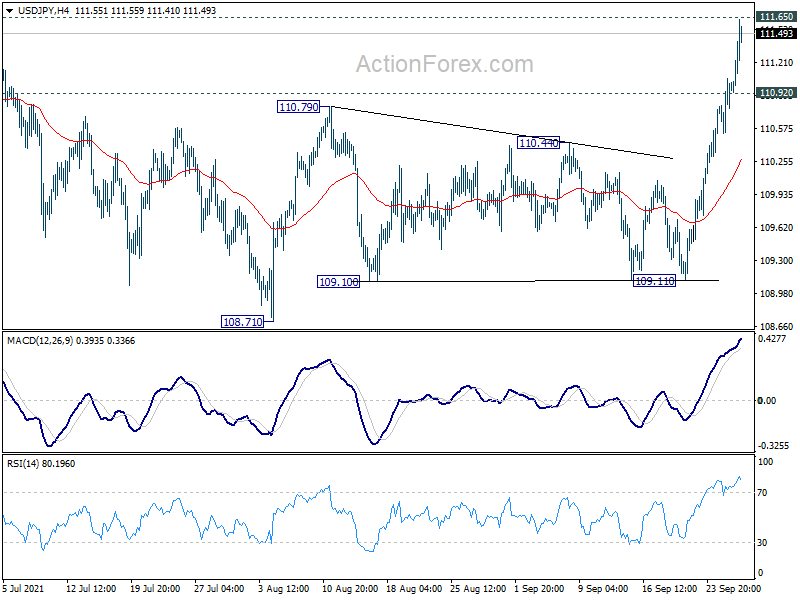
Taking a technical look at dollar/yen, if the bulls manage to overcome the 111.65 barrier, their next target might be the 112.20 area, marked by the high of 2020.
On the flipside, a reversal lower could encounter initial support near the 110.80 region, before the focus turns towards the 109.05 zone.
US consumer confidence dropped to 109.3, spread of Delta dampens optimism
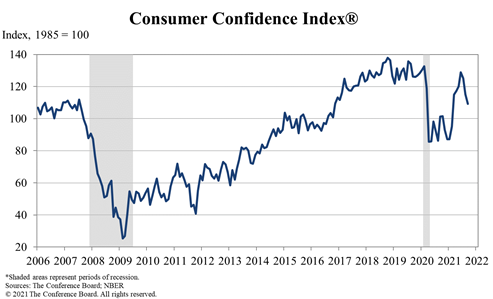
US Conference Board Consumer Confidence Index dropped to 109.3 in September, down from 115.2, below expectation of 114.3. Present Situation Index dropped from 148.9 to 143.4. Expectations Index dropped from 92.8 to 86.6.
"Consumer confidence dropped in September as the spread of the Delta variant continued to dampen optimism," said Lynn Franco, Senior Director of Economic Indicators at The Conference Board.
"Concerns about the state of the economy and short-term growth prospects deepened, while spending intentions for homes, autos, and major appliances all retreated again. Short-term inflation concerns eased somewhat, but remain elevated.
"Consumer confidence is still high by historical levels—enough to support further growth in the near-term—but the Index has now fallen 19.6 points from the recent peak of 128.9 reached in June. These back-to-back declines suggest consumers have grown more cautious and are likely to curtail spending going forward."
USD/JPY Mid-Day Outlook
Daily Pivots: (S1) 110.68; (P) 110.87; (R1) 111.21; More...
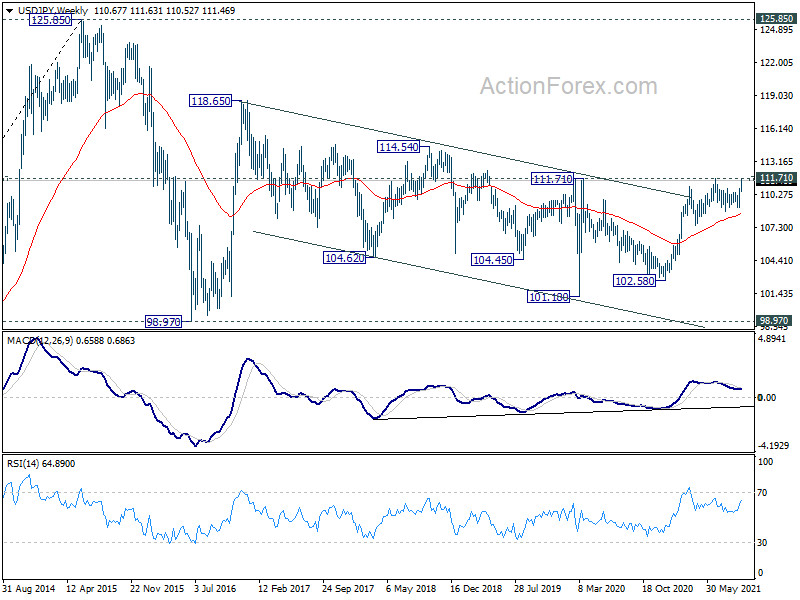
Intraday bias in USD/JPY remains on the upside with focus on 111.65/71 resistance zone. Sustained break there will resume the up trend from 102.58, and suggest larger bullish trend reversal. Further rally would be seen to 114.54 resistance next. On the downside, however, break of 110.92 minor support will delay the bullish case and turn intraday bias neutral first.
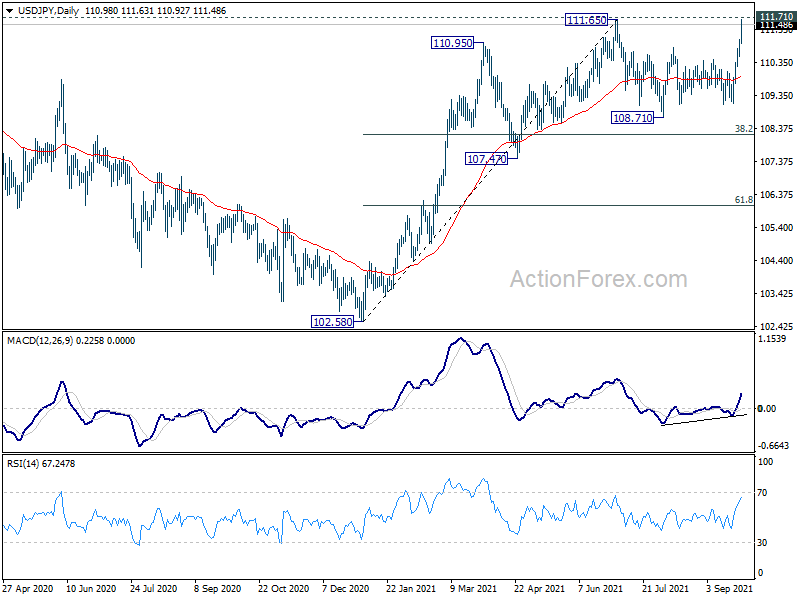
In the bigger picture, medium term outlook is staying neutral with 111.71 resistance intact. The pattern from 101.18 could still extend with another falling leg. Sustained trading below 55 day EMA will bring deeper fall to 107.47 support and below. Nevertheless, strong break of 111.71 resistance will confirm completion of the corrective decline from 118.65 (2016 high). Further rise should then be seen to 114.54 and then 118.65 resistance.
USD/CHF Mid-Day Outlook
Daily Pivots: (S1) 0.9236; (P) 0.9264; (R1) 0.9285; More....
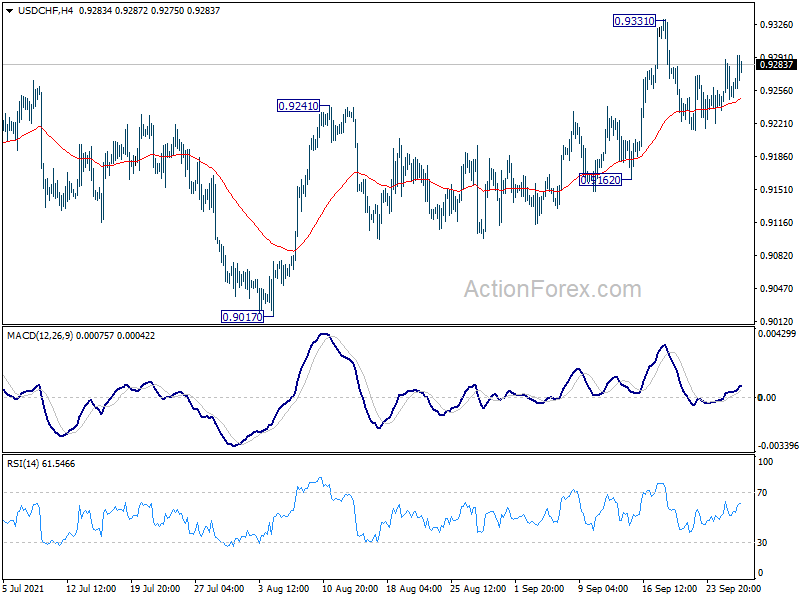
Intraday bias in USD/CHF stays neutral as it's still bounded in consolidation from 0.9331 is extending. Overall, further rally is expected as long as 0.9162 support holds. On the upside, break of 0.9331 will target 0.9471 key resistance. Sustained break there will carry larger bullish implications. However, break of 0.9162 will turn bias back to the downside for 0.9017 support instead.
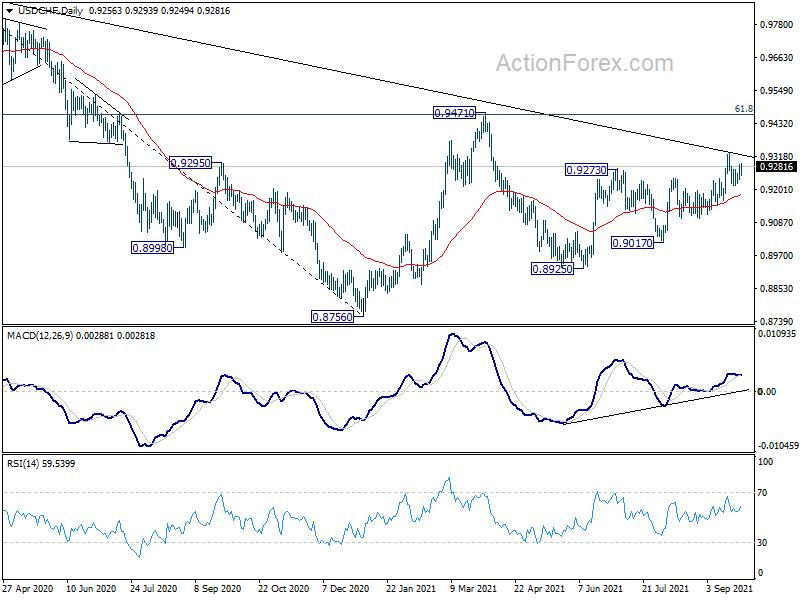
In the bigger picture, the strong rally above 55 week EMA (now at 0.9175) now tilts favor to the case of bullish trend reversal. That is, decline from 1.3042 (2016 high) is probably completed at 0.8756 already. Sustained break of 0.9471 resistance should confirm this case and pave the way to retest 1.0342 ahead. However, rejection by 0.9471 will mix up the outlook again and retain some medium term bearishness.
EUR/USD Mid-Day Outlook
Daily Pivots: (S1) 1.1678; (P) 1.1703; (R1) 1.1720; More...
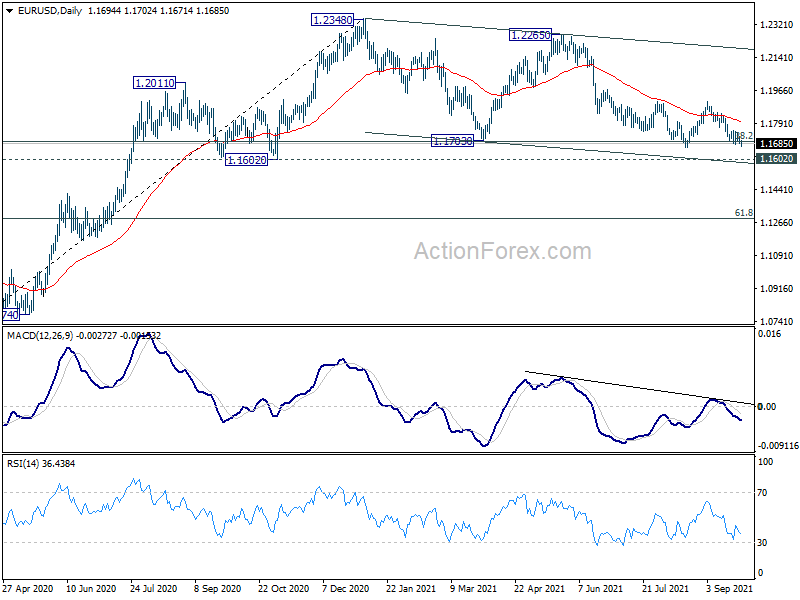
Intraday bias in EUR/USD remains on the downside for 1.1663 support. Firm break there will resume the fall from 1.2265, and the pattern from 1.2348, to 1.1602 key support next. On the upside, however, above 1.1749 minor resistance will turn bias back to the upside for 1.1908 again.
In the bigger picture, rise from 1.0635 is seen as the third leg of the pattern from 1.0339 (2017 low). Further rally remains in favors long as 1.1602 support holds, to cluster resistance at 1.2555 next, (38.2% retracement of 1.6039 to 1.0339 at 1.2516). However sustained break of 1.1602 will argue that the rise from 1.0635 is over, and turn medium term outlook bearish again. Deeper fall would be seen to 61.8% retracement of 1.0635 to 1.2348 at 1.1289 and below.
GBP/USD Mid-Day Outlook
Daily Pivots: (S1) 1.3664; (P) 1.3697; (R1) 1.3735; More...
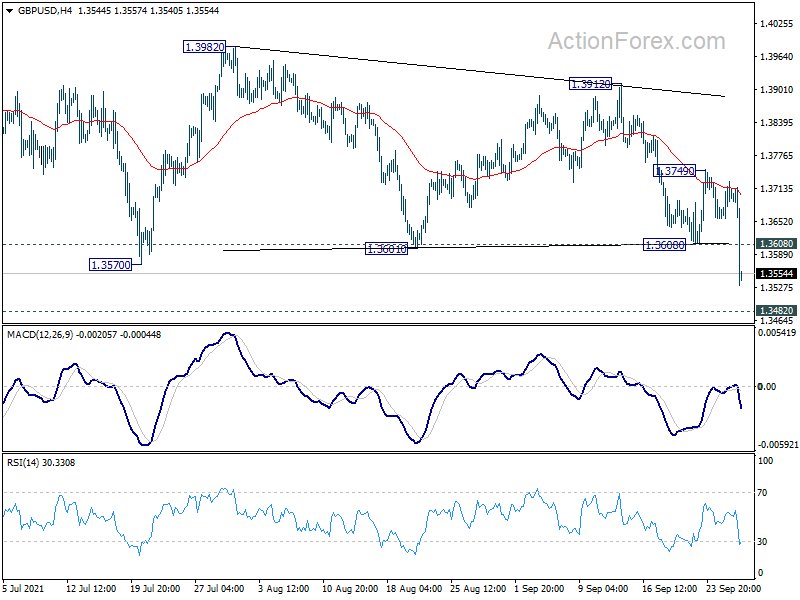
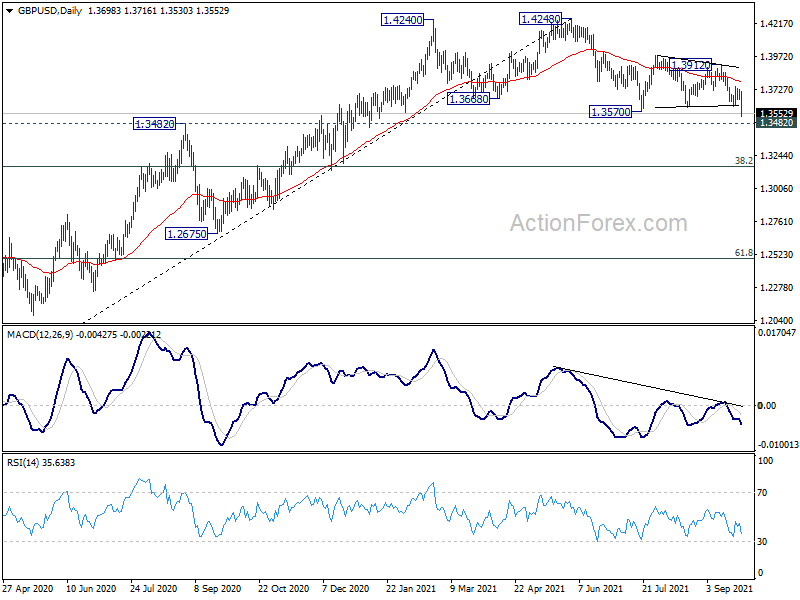
GBP/USD's break of 1.3570 support indicates resumption of fall from 1.4248. Intraday bias is back on the downside for 1.3482 resistance turned support next. Sustained break there will target 1.3163 fibonacci level. On the upside, though, above 1.3608 support turned resistance will turn intraday bias neutral first. But risk will stay on the downside as long as 1.3748 resistance holds.
In the bigger picture, fall from 1.4248 is at least a correction to the up trend from 1.1409 (2020 low). Such correction could extend to 38.2% retracement of 1.1409 to 1.4248 at 1.3164 before completion. However, considering the rejection by 1.4376 key resistance (2018 high), sustained trading below 1.3164 will argue that it's indeed a bearish trend reversal and would target 61.8% retracement at 1.2493. Nevertheless, break of 1.3912 resistance will revive medium term bullishness and target 1.4248/4376 resistance zone again.
Sterling Tumbles on Energy Worries, Rising Yields Supports Dollar
Sterling tumbles broadly today on increasing talks of energy shortages due to a post-Brexit shortage of truck drivers, as well as a halt to license testing during pandemic lockdowns. Mild risk aversion, which start in European markets, is also weighing down some commodity currencies. Nevertheless, there is little lift to Yen overall, which stays weak against most. Surge US treasury yields is boosting Dollar while German yield is also supporting Euro.
Technically, GBP/USD's break of 1.3570 support indicates resumption of fall from 1.4248 to 1.3482 key structural support. Break will confirm that it's in a medium term correction that should at least target 1.3163 fibonacci level. At this same time, 111.65/71 resistance zone in USD/JPY is now an immediate focus. Sustained break there will be a signal of long term bullish reversal.
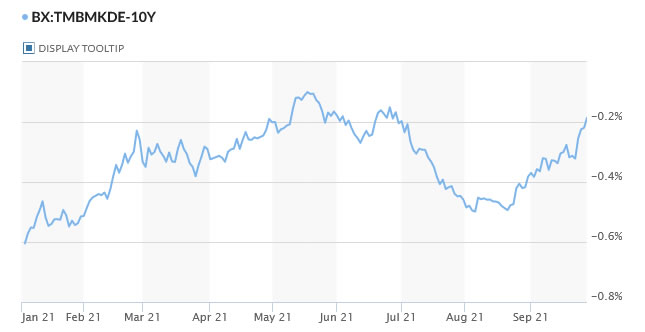
In Europe, at the time of writing, FTSE is down -0.12%. DAX is down -1.32%. CAC is down -1.63%. Germany 10-year yield is up 0.0032 at -0.187, back above -0.2 handle. Earlier in Asia, Nikkei dropped -0.19%. Hong Kong HSI rose 1.20%. China Shanghai SSE rose 0.54%. Singapore Strait Times dropped -0.73%. Japan 10-JGB yield rose 0.0187 to 0.075.
Fed Bullard sees risk of inflation being too high for too long
St. Louis Fed President James Bullard said he expects inflation to remain above 2.8% through next year. It's going to "stay above target over the forecast horizon", and there is "now a risk we are going to overachieve and be too high for too long".
In his outlook, interest rates should be raised twice next year, reflecting faster and more persistent inflation than foreseen. It may all work out "and we will converge into bliss at the steady state where inflation is at 2% and we never change the funds rate again," he said. "That is the current scenario...We all know reality will probably be something messier."
"It could easily be the case that inflation could fall back to target and it will be all beautiful the way we have described it," he added. "Inflation could also be a lot more persistent than we had hoped and in that case we will have to recalibrate how we are going to keep inflation under control."
US goods trade deficit widened to USD 87.6B in Aug
US exports of goods rose USD 1.1B to USD 149.0B in August. Imports of goods rose USD 1.9B to AUD 236.6B. Goods trade balance deficit widened to USD -87.6B, versus expectation of USD -87.0B. Wholesale inventories rose 1.2% mom to USD 731.0B. Retail inventories rose 0.1% mom to USD 603.3B.
ECB Lagarde: Key challenge is not to overreact to transitory supply shocks
In a speech, ECB President Christine Lagarde said, "the key challenge is to ensure that we do not overreact to transitory supply shocks that have no bearing on the medium term, while also nurturing the positive demand forces that could durably lift inflation towards our 2% inflation target."
And, "once the pandemic emergency comes to an end – which is drawing closer – our forward guidance on rates as well as purchases under the asset purchase programme will ensure that monetary policy remains supportive of the timely attainment of our medium-term 2% target."
Germany Gfk consumer confidence rose to 0.3, too early for talk of a fundamental trend shift
Germany Gfk consumer confidence for October rose to 0.3, up from -1.1. For September, economic expectations rose from 40.8 to 48.5. Income expectations rose from 30.5 to 37.4. Prospensity to buy rose form 10.3 to 13.4.
"At the time of the survey, the incidence increase had noticeably slowed and currently, values are even declining slightly. As a result, consumers are more optimistic that the fourth wave will be less pronounced than many feared. That is why many consumers can once again see scope for restrictions to be eased further" explains Rolf Bürkl, GfK consumer expert.
"Even if the consumer sentiment has almost reached its pre-crisis level, it is still too early for talk of a fundamental trend shift. Instead, we must first see how the infection situation develops in the winter months and if new restrictions become necessary."
BoJ minutes: Full-fledged recovery to be delayed
In the minutes of BoJ's July meeting, a few members said "the timing of a full-fledged recovery in Japan's economy was likely to be somewhat delayed" comparing with the expectations in April.
Many members warned of the high uncertainty on overseas outlook. In particular, one member noted the deceleration in China's economy "should be born in mind." Also, one member warned, "if the rise in U.S. long-term interest rates accelerated, we must be vigilant to the risk of capital outflows from emerging economies."
Australia retail sales dropped -1.7% mom in Aug, negatively impacted by lockdown restrictions
Australia retail sales dropped -1.7% mom in August, better than expectation of -2.5% mom. It's the third consecutive monthly fall after -2.7% in July, and -1.8% in June.
Ben James, Director of Quarterly Economy Wide Surveys, said: "Retail turnover continues to be negatively impacted by lockdown restrictions, with each of the eastern mainland states experiencing falls in line with their respective level of restrictions. In direct contrast, states with no lockdowns performed well with Western Australia and South Australia enjoying strong rises as physical stores were open for trade."
GBP/USD Mid-Day Outlook
Daily Pivots: (S1) 1.3664; (P) 1.3697; (R1) 1.3735; More...
GBP/USD's break of 1.3570 support indicates resumption of fall from 1.4248. Intraday bias is back on the downside for 1.3482 resistance turned support next. Sustained break there will target 1.3163 fibonacci level. On the upside, though, above 1.3608 support turned resistance will turn intraday bias neutral first. But risk will stay on the downside as long as 1.3748 resistance holds.
In the bigger picture, fall from 1.4248 is at least a correction to the up trend from 1.1409 (2020 low). Such correction could extend to 38.2% retracement of 1.1409 to 1.4248 at 1.3164 before completion. However, considering the rejection by 1.4376 key resistance (2018 high), sustained trading below 1.3164 will argue that it's indeed a bearish trend reversal and would target 61.8% retracement at 1.2493. Nevertheless, break of 1.3912 resistance will revive medium term bullishness and target 1.4248/4376 resistance zone again.
Economic Indicators Update
| GMT | Ccy | Events | Actual | Forecast | Previous | Revised |
|---|---|---|---|---|---|---|
| 23:50 | JPY | BoJ Minutes | ||||
| 00:30 | AUD | Retail Sales M/M Aug | -1.70% | -2.50% | -2.70% | |
| 06:00 | EUR | Germany Gfk Consumer Confidence Oct | 0.3 | -1.6 | -1.2 | -1.1 |
| 12:30 | USD | Goods Trade Balance (USD) Aug P | -87.6B | -87.0B | -86.4B | -86.8B |
| 12:30 | USD | Wholesale Inventories Aug P | 1.20% | 0.80% | 0.60% | |
| 13:00 | USD | S&P/Case-Shiller 20 Cities Home Price Y/Y Jul | 19.95% | 20.10% | 19.10% | |
| 13:00 | USD | Housing Price Index M/M Jul | 1.40% | 1.50% | 1.60% | |
| 14:00 | USD | Consumer Confidence Sep | 114.3 | 113.8 |
Fed Bullard sees risk of inflation being too high for too long
St. Louis Fed President James Bullard said he expects inflation to remain above 2.8% through next year. It's going to "stay above target over the forecast horizon", and there is "now a risk we are going to overachieve and be too high for too long".
In his outlook, interest rates should be raised twice next year, reflecting faster and more persistent inflation than foreseen. It may all work out "and we will converge into bliss at the steady state where inflation is at 2% and we never change the funds rate again," he said. "That is the current scenario...We all know reality will probably be something messier."
"It could easily be the case that inflation could fall back to target and it will be all beautiful the way we have described it," he added. "Inflation could also be a lot more persistent than we had hoped and in that case we will have to recalibrate how we are going to keep inflation under control."