

Sample Category Title
Sunset Market Commentary
Markets
Global markets were supposed to stay in some kind of countdown modus looking forward to the Fed Jackson Hole symposium at the end of this week. For European markets, tomorrow’s publication of the minutes of the July ECB meeting is also a wildcard. With respect to the latter (EMU outlook) some related info kicked in. Contrary to solid EMU PMI’s earlier this week, German IFO business confidence missed expectations. The headline business climate index declined from 100.7 to 99.4. The assessment of the current situation still improved further from 100.4 to 101.4 but the expectations component made a rather big step backward from 101.0 to 97.5. According to Ifo, supply bottlenecks for intermediate products in manufacturing and worries about rising infection numbers are putting a strain on the economy. The release had only a limited and temporary impact on European markets. Later this morning, attention on the European (interest rate) markets was captured by some comments from ECB’s Vice President de Guindos. He assessed the third quarter indicators as positive, expects the ECB forecasts to be upwardly revised and is of the view that if the economy normalizes, fiscal and monetary policy should also so. European/German yields started a gradual intraday rise in the wake of the comments. Admittedly, later in the session, the market hardly reacted to the headlines of a Reuters interview with ECB’s Lane. He held a much more dovish tone, stressed the need for keeping ample financing conditions and also indicated any amendment to PEPP buying is subordinated to this commitment of maintaining favourable financing conditions at least until March next year. Still German bunds today clearly underperformed US Treasuries. German yields are rising between 0.8 bp ( 2-y) and 5.5 bp (30-y). On the other hand, US yields only show marginal gains (10-y yield 1 bp higher at 1.305%). The US July durable goods orders report was close to expectations with overall orders declining -0.1% after a rise of 0.8% the previous month, but shipments of core capital goods still printed at a strong 1% M/M suggesting a positive contribution of investments to GDP growth. On other markets, the rebound in commodities continues with Brent oil trading north of $ 71 p/b. Equities mostly show limited gains, with US indices (S&P and Nasdaq) testing record levels.
Moves in the FX markets were modest compared to the price action on European bond markets. The euro failed to profit from rising interest rate support. EUR/USD is hovering sideways in the lower half of the 1.17 big figure (currently 1.1735). USD/JPY tries to regain the 110 mark. Sterling shows no clear trend with EUR/GBP trading little changed near 0.8560.
News Headlines
The Chair of the US Securities and Exchange Commission Gensler warned Chinese companies with a US listing he plans to strictly enforce a three-year deadline that requires Chinese firms to permit inspections of their financial audits. They risk delisting from NYSE and Nasdaq if they refuse. US Congress gave the SEC a mandate to do so after passing the Holding Foreign Companies Accountable Act in December 2020. Gensler said investors need “full and fair” disclosure on the risks they face, including from a regulatory and political perspective. His comments refer to the recent steep declines in Chinese (tech) stocks after the China’s crackdown on companies that it blames for exacerbating inequality and increasing financial risk.
Belgian business confidence retreated from a historically high 10.10 to a still-elevated 7.60 in August, the NBB’s monthly survey showed today. The decline took place in all sectors with sentiment in manufacturing being hurt most by a much less optimistic view on inventories and to a lesser extend overall demand. Service company leaders turned more cautious on their current activity though the opposite was true for expected future output. In construction, companies saw a significant pullback in order books but stayed positive about demand. Trade, finally, saw prospects for employment increase but sentiment about future demand turned sour.
Jet Lag: Durable Goods Orders Slip 0.1% Amid Pullback in Aircraft Orders
Summary
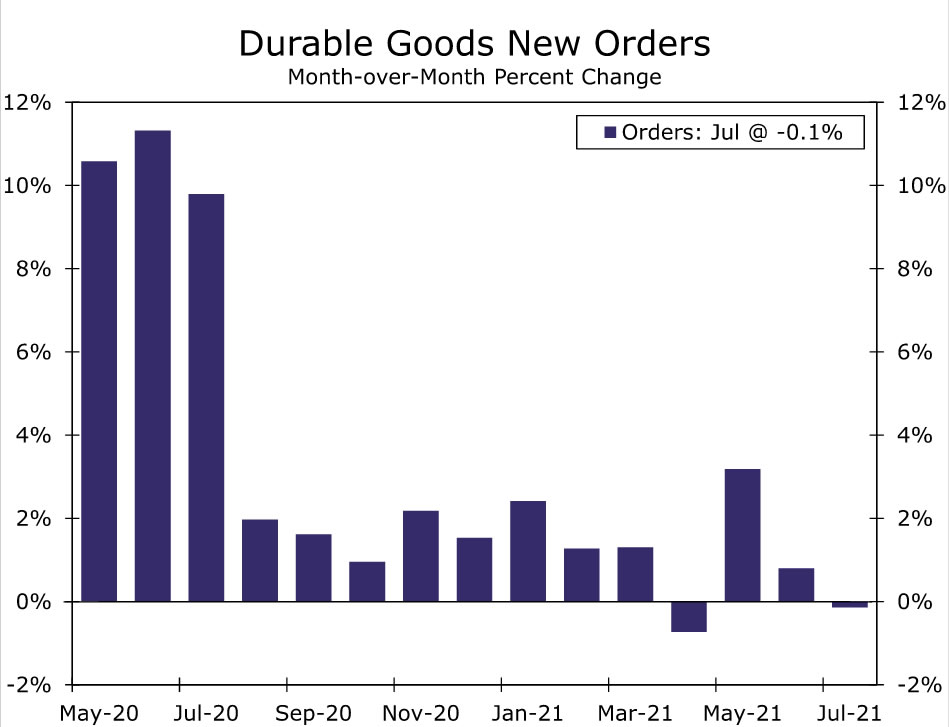
The scant 0.1% decline in durable good orders in July is not as large a dip as had been expected. The not-as-bad outcome is due in part to surging orders for autos and many old-line manufacturing categories. Core capital goods shipments rose 1.0%, pointing to another incremental step in the right direction for supply chain pressures.
This Just In: Auto Dealers May Actually Have Vehicles to Sell
This is only the second time since the initial reopening of the economy in May of last year that durable goods orders posted a decline. We were braced for a larger one. The scant 0.1% dip in orders for durable goods is remarkable after accounting for the fact that civilian aircraft orders fell by about half during the month.
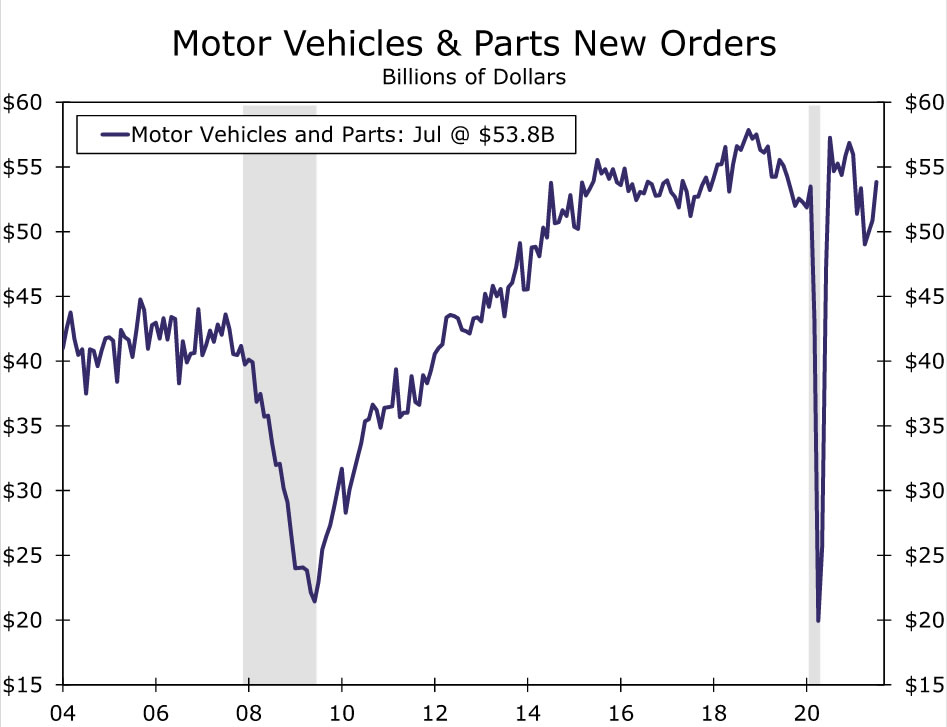
It is still mad times in the auto market, but there are some signs of improvement. Orders for vehicles and parts shot up 5.8%. Aside from the reopening of auto plants last summer, that is the biggest monthly gain in more than six years. As anyone who has been in the market for a vehicle in the COVID-era can tell you though: taking the order is easy, delivering on it is what is tough. But in a welcome development, shipments of vehicles and parts rose a slightly larger 5.9% in July. Auto dealers may gradually begin to refill nearly empty lots. But make no mistake, auto-production is still struggling to keep up with demand.
Elsewhere, spending was a mixed picture. After increased spending on tech over the past year or so, some pullback was evident in July. Electrical equipment orders fell 1.8% and computers and other electronics products slipped 0.4%
But old-line manufacturing continues to flex its muscles with orders for fabricated metals adding 0.3%, primary metals orders up 2.7% and bookings for machinery up 2.9%. Machinery orders have done nothing but rise since April of last year. The level of orders today is up 12.2% from where it was at its 2018 peak before the trade war began a trend decline through 2019 and early 2020.
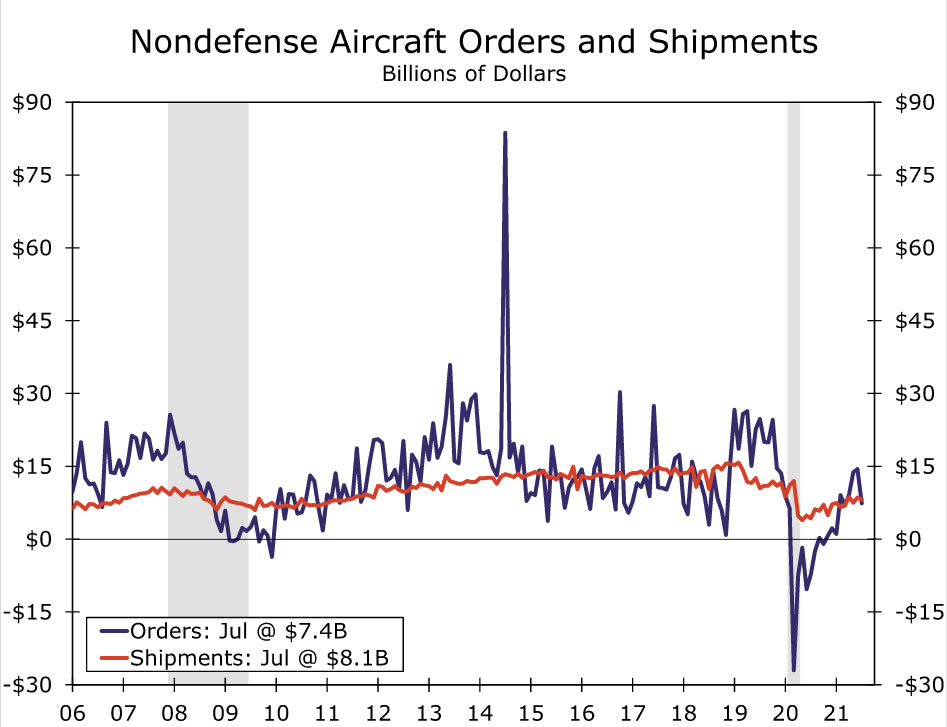
A bulk of the weakness in orders therefore came from nondefense aircraft orders, which tumbled nearly 50% in July. Excluding transportation, durable goods orders rose 0.7%. Based on our calculations from Boeing's publicly available data, there were only 14 net new orders during the month after accounting for cancellations, a considerable pullback from the 146 net orders last month.
Civilian aircraft orders had been rebounding in recent months but amid renewed concern about whether the pandemic has permanently changed demand for business travel. Even before accounting for cancellations Boeing's 31 gross monthly orders were less than half what we'd see in a typical July; that month's average gross increase since 2000 is 75 orders.
Another Step in the Right Direction for Core Shipments
Core capital goods orders were flat in July, but the run-up in goods consumption during the pandemic has resulted in a speedy rebound in orders to date. An upward revision to June data suggest orders are 9.2% ahead of their prior cycle peak through July. With some business demand being pulled forward last year to facilitate work from home and consumer spending transitioning back to services from goods, some weakness in demand is understandable. But we expect the need for businesses to replenish scant inventory levels to keep orders strong in coming months. Still-constrained supply chains will weigh on fulfillment as unfilled orders continue to rise at a decent clip, suggesting some weakness in July may be due to bottlenecks rather than weak demand. The value of unfilled orders for motor vehicles, for example, increased to a fresh record as the sector struggles to get the inputs in needs to produce.
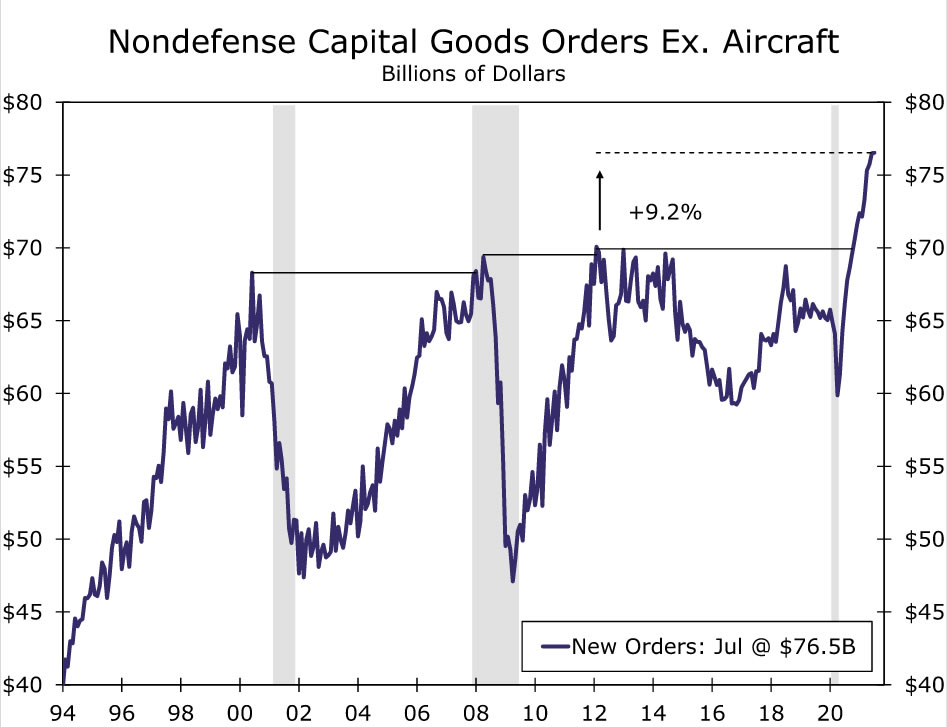
Shipments did pick up during the month with core capital goods shipments up 1.0%, which brought the three-month annualized growth rate of the three-month moving average to 12.1%. This is a positive indication of strong equipment spending in the third quarter, but as we've cautioned in recent months, the true pace of real equipment spending will likely be less impressive as orders and shipments are reported in nominal dollars. The recent run-up in prices, therefore will likely eat into some of the gain. Increases in shipments were broad based with all core shipment categories rising last month.
Dollar Pushes Yen Close to 110
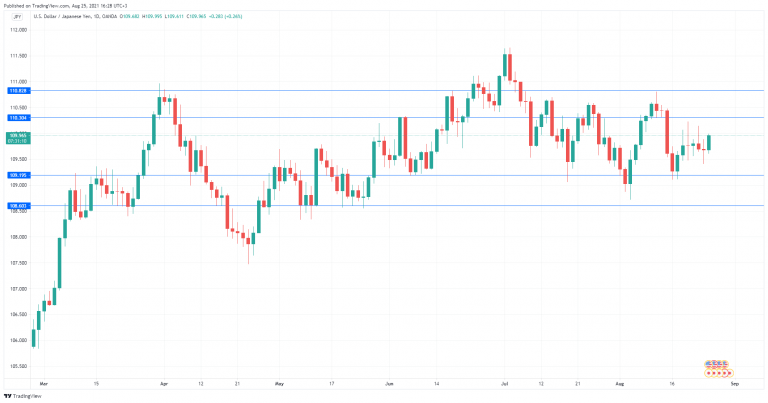
The Japanese yen is in negative territory on Wednesday. Currently, USD/JPY is trading at 109.99, up 0.28% on the day.
It has been a relatively quiet week for the yen, which is hovering around the 110 line, which has psychological significance. With the markets in wait-and-see mode ahead of the Jackson Hole Symposium, the lack of substantial movement from the yen is likely to continue. This could change dramatically on Friday, when the star performer of the show, Fed Chair Jerome Powell, gives a speech that will be analysed with a microscope.
Will Powell announce a taper timeline?
Just a few weeks ago, the markets were confident that Powell would use the get-together to announce a timeline for Fed tapering, or at least provide some strong hints in that regard. However, the severe outbreak of the Covid-19 Delta variant may cause Powell to apply the brakes to any taper announcement, which would allow the Fed to digest further economic data as we move into September.
The recent FOMC minutes were viewed by the markets as hawkish, and the US dollar responded with broad gains. However, that rally has fizzled as the markets are no longer taking for granted that a taper is imminent. If the cautious Fed chair does not provide a timeline for a taper, the markets could react with disappointment and send the US dollar lower.
On the economic calendar, the only events out of Japan this week are all inflation releases. BoJ Core CPI for June, the Bank of Japan’s preferred inflation gauge, came in at 0.2%, up from 0.1% beforehand. Still, this gain wasn’t enough to give the Japanese yen a lift. Japan will release the Services Producer Price Index later today, followed by Tokyo Core CPI on Thursday. With the Covid Delta variant running rampant and the government extending the state of emergency, inflation, which is at low levels, could fall even further.
USD/JPY Technical
- USD/JPY faces resistance at 110.30. Next, there is resistance at 110.82
- On the downside, there is support at 109.19. Below, we find support at 108.60
EUR/USD Mid-Day Outlook
Daily Pivots: (S1) 1.1735; (P) 1.1750; (R1) 1.1773; More...
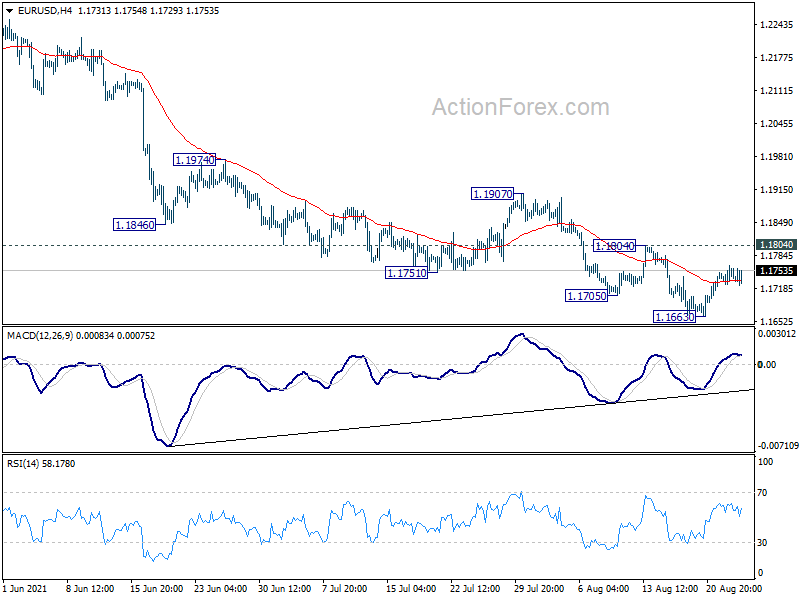
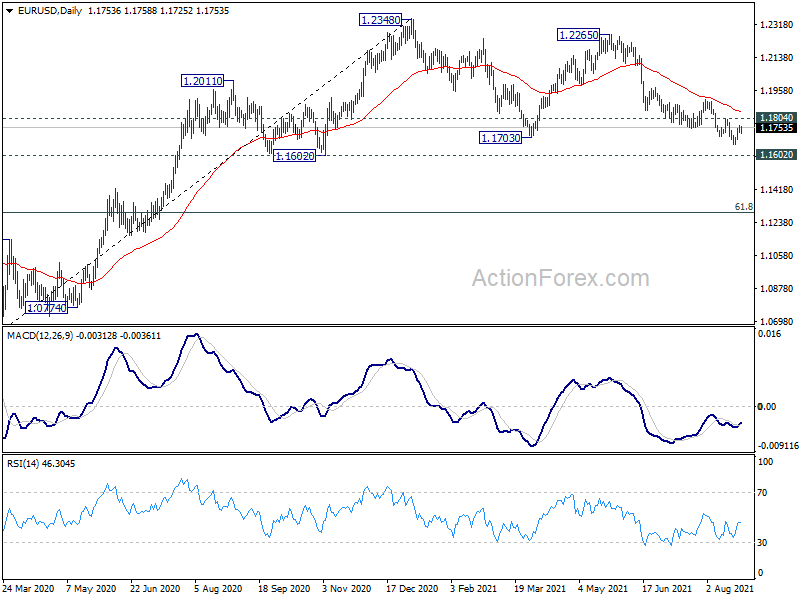
Intraday bias in EUR/USD remains neutral as range trading continues. With 1.1804 resistance intact, another fall cannot be ruled out yet. But we'd continue to look for strong support from 1.1602/1703 key support zone to bring rebound. On the upside, above 1.1804 resistance will turn bias back to the upside for 1.1907 resistance first. However, sustained break of 1.1602/1703 will carry larger bearish implication and pave the way to 1.1289 fibonacci support.
In the bigger picture, rise from 1.0635 is seen as the third leg of the pattern from 1.0339 (2017 low). Further rally remains in favors long as 1.1602 support holds, to cluster resistance at 1.2555 next, (38.2% retracement of 1.6039 to 1.0339 at 1.2516). However sustained break of 1.1602 will argue that the rise from 1.0635 is over, and turn medium term outlook bearish again. Deeper fall would be seen to 61.8% retracement of 1.0635 to 1.2348 at 1.1289 and below.
GBP/USD Mid-Day Outlook
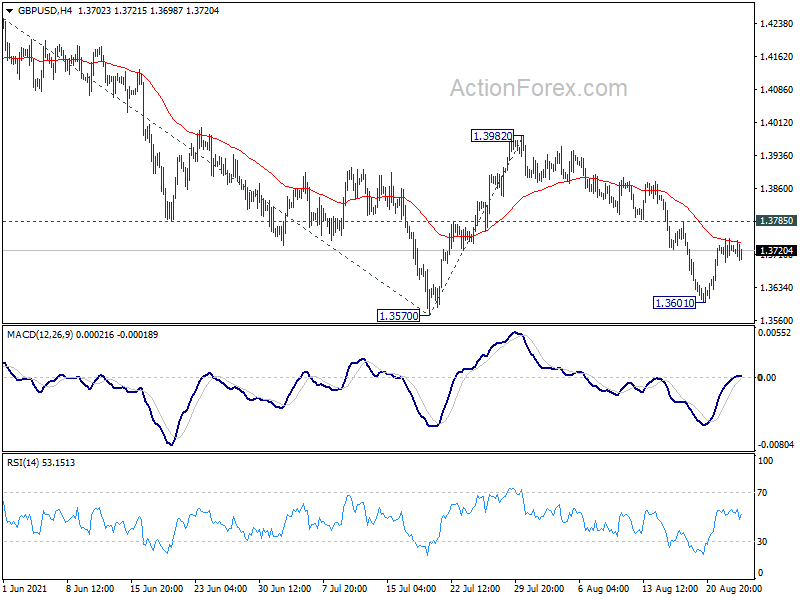
Daily Pivots: (S1) 1.3700; (P) 1.3724; (R1) 1.3754; More...
Intraday bias in GBP/USD stays neutral for the moment. Another fall is in favor with 1.3785 minor resistance intact. On the downside, firm break of 1.3570 will resume larger fall from 1.4248 to 1.3482 resistance turned support next. Break there will target 100% projection of 1.4248 to 1.3570 from 1.3982 at 1.3304. However, on the upside, break of 1.3785 will turn bias back to the upside for 1.3982 resistance intact.
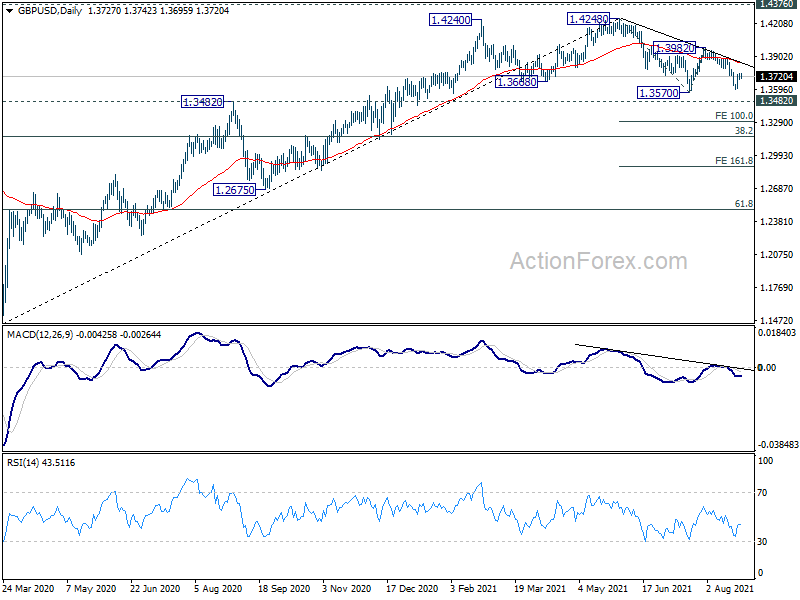
In the bigger picture, current development argues that rise from 1.1409 (2020 low) has completed at 1.4248, after failing 1.4376 resistance. Fall from there could either be correcting the rise form 1.1409, or starting another falling leg inside long term sideway pattern. In either case, sustained break of 1.3482 resistance turned support will target 38.2% retracement of 1.1409 to 1.4248 at 1.3164 first. Break there will pave the way to 61.8% retracement at 1.2493.
USD/CHF Mid-Day Outlook
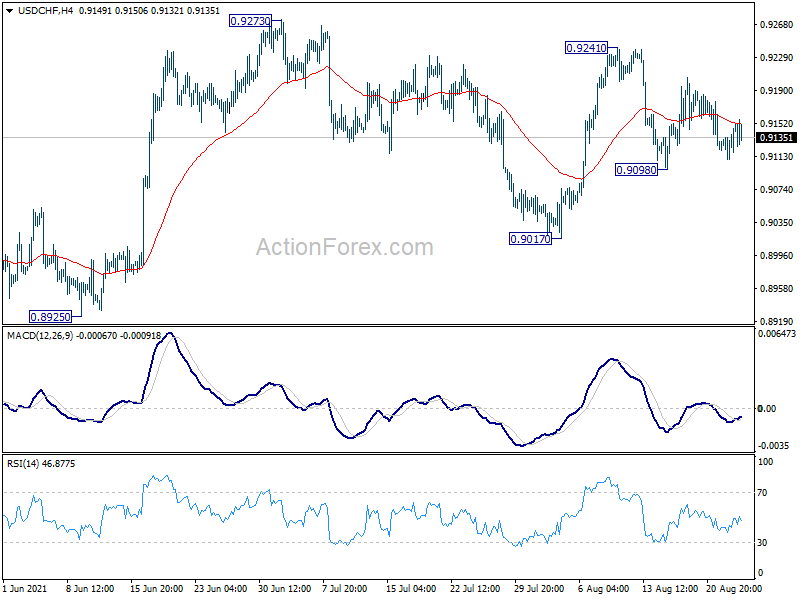
Daily Pivots: (S1) 0.9114; (P) 0.9126; (R1) 0.9142; More....
Intraday bias in USD/CHF remains neutral for the moment. On the upside, break of 0.9241 resistance should resume the rise from 0.8925 through 0.9273. On the downside, break of 0.9098 will target 0.9017 support first. Further break there will likely resume the decline from 0.9471 through 0.8925 low.
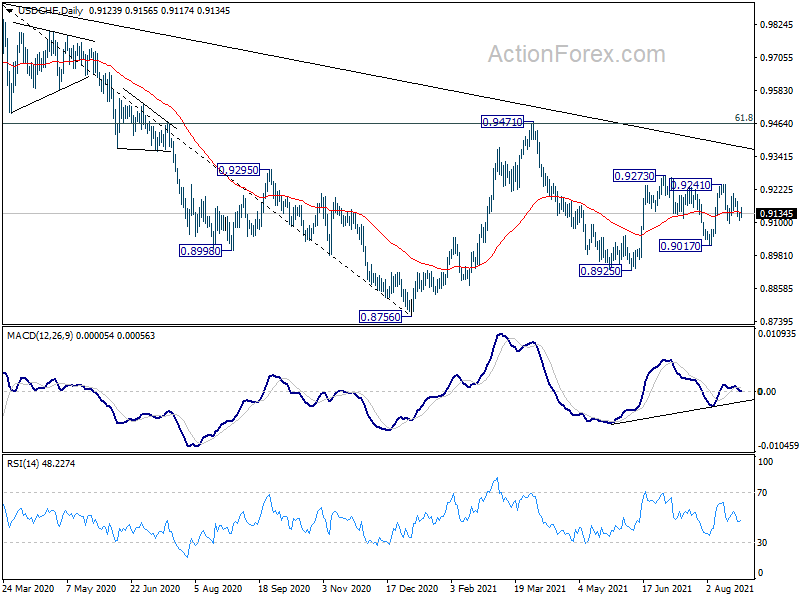
In the bigger picture, the failure to sustain above 55 week EMA (now at 0.9180) retains medium term bearishness in USD/CHF. Break of 0.8925 support should resume the whole decline form 1.0342 (2016 high) through 0.8756 low. However, break of 0.9273 resistance and sustained trading above 55 week EMA will be an early sign of bullish trend reversal. Focus will then turn to 0.9471 resistance for confirmation.
USD/JPY Mid-Day Outlook
Daily Pivots: (S1) 109.45; (P) 109.66; (R1) 109.91; More...
USD/JPY recovers mildly today but stays in range of 109.10/110.79. Intraday bias remains neutral at this point. On the upside, break of 110.79 will resume the rebound from 108.71 to retest 111.65 high. On the downside, break of 109.10 will target 108.71 support first. Firm break there will resume the decline from 111.65 and target 38.2% retracement of 102.58 to 111.65 at 108.18 next.
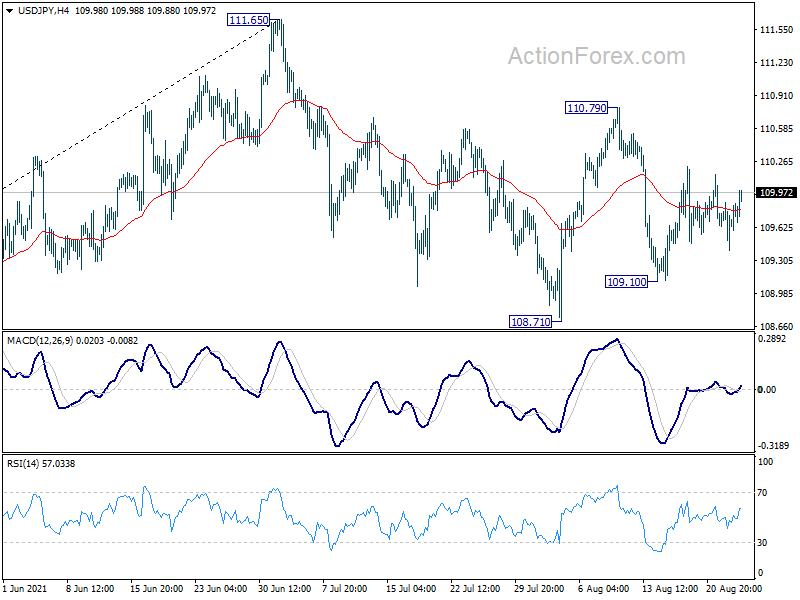
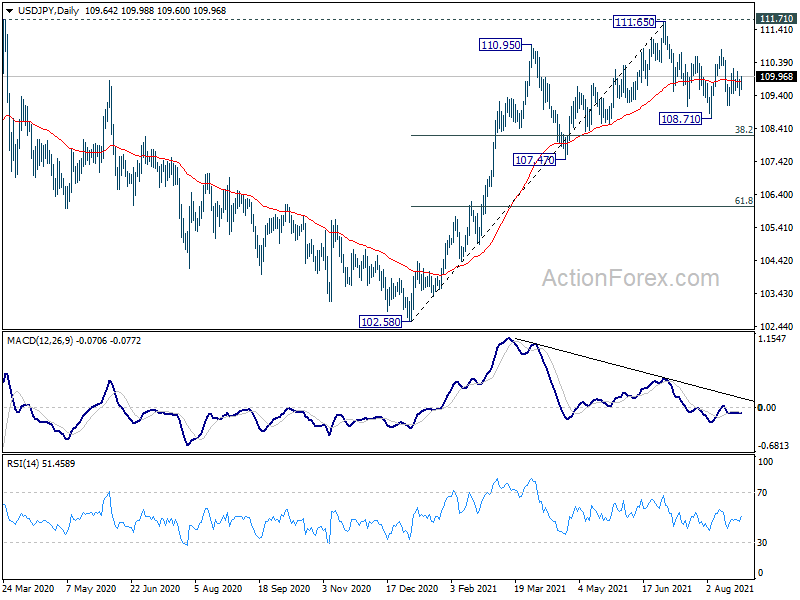
In the bigger picture, medium term outlook is staying neutral with 111.71 resistance intact. The pattern from 101.18 could still extend with another falling leg. Sustained trading below 55 day EMA will bring deeper fall to 107.47 support and below. Nevertheless, strong break of 111.71 resistance will confirm completion of the corrective decline from 118.65 (2016 high). Further rise should then be seen to 114.54 and then 118.65 resistance.
Dollar Continues to Recover after Durable Goods Orders, Markets Mixed
Dollar continues to pare back some of this week's losses in early US session, after slightly better than expected durable goods orders. But strength of recovery is so far relatively weak. Markets are also generally in mixed mode. Euro has litter reaction to worst than expected Germany business climate data, too. Overall, traders are turning cautious, awaiting Fed Chair Jerome Powell's inspiration from his Jackson Hole speech.
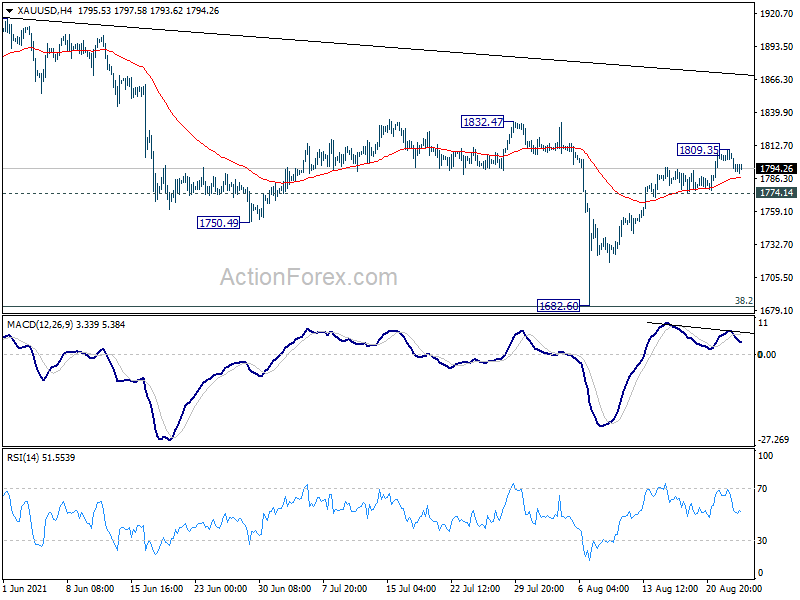
Technically, Gold's development is worth a note. Apparently, it lacks follow through buying to sustain above 1800 handle. Yet, retreat is held comfortably above 1774.14 support so far. We'd continue to monitor the next move. Sustained trading above 1800/32 resistance zone will suggest larger reversal, which could be accompanied by another round of selloff in Dollar. On the other hand, break of 1774.14 will indicate completion of rebound from 1682.60 and Dollar could rebound in tandem.
In Europe, at the time of writing, FTSE is up 0.34%. DAX is down -0.13%. CAC is up 0.24%. Germany 10-year yield is up 0.0337 at -0.440. Earlier in Asia, Nikkei closed down -0.03%. Hong Kong HSI dropped -0.13%. China Shanghai SSE rose 0.74%. Singapore Strait Times dropped -0.0%. Japan 10-year JGB yield rose 0.0007 to 0.021.
US durable goods orders dropped -0.1% in Jul, ex-transport orders rose 0.7% mom
US durable goods orders dropped -0.1% mom to USD 257.2B in July, better than expectation of -0.2% mom. Ex-transport orders rose 0.7% mom, above expectation of 0.5% mom. Ex-defense orders dropped -1.2% mom. Transportation equipment, dropped -2.2% to USD 75.3B.
ECB Lane: There could be counterbalances in H2
ECB Chief Economist Philip lane said in an interview, Q2 GDP came in "well ahead of out June projections", reflecting an "earlier opening up", "strength of the world economy" and "progress in vaccinations". It's "still early days" regarding H2, and there could be "counterbalance" like bottlenecks, moderation in world economy, and the Delta variant. Overall, he said, "we're broadly not too far away from what we expected in June for the full year."
The Delta variant is now "part of the mix in the US and global economies", while Europe "may not be among the regions hardest-hit thanks to high vaccination rates and prior lockdown measures. Also, the infrastructure and system for vaccination has "eliminated uncertainty about Europe's ability to carry out vaccinations."
On PEPP, Lane said "we'll have to assess at the September meeting the appropriate calibration for the final quarter of the year". He emphasized that "single philosophy" of maintaining favorable financing conditions regarding PEPP. "If favourable financing conditions require more purchases, we'll conduct more purchases," he said.
Germany Ifo business climate dropped to 99.4 in Aug, supply bottlenecks and rising inflections
Germany Ifo Business Climates dropped from 100.8 to 99.4 in August, below expectation of 100.4. Current Assessment index rose from 100.4 to 101.4, above expectation of 100.8. However, Expectations index dropped from 101.2 to 97.5, below expectation of 100.0.
Looking at some more details, manufacturing dropped from 27.4 to 24.1. Services dropped from 19.8 to 17.7. Trade dropped from 15.8 to 9.0. Construction rose from 6.0 to 7.8.
Ifo said: "This decline was due mainly to significantly less optimism in companies' expectations. Concerns are growing in the hospitality and tourism sectors in particular. By contrast, companies assessed their current situation as somewhat better than in the previous month. Supply bottlenecks for intermediate products in manufacturing and worries about rising infection numbers are putting a strain on the economy."
BoJ Nakamura warned of delayed spending, Japan expands state of emergency
BoJ board member Toyoaki Nakamura warned in a speech today that the economy is still in a "severe state" and outlook was "highly uncertain" with risks skewed to the downside. He added, "the resurgence in infections may have somewhat delayed the timing for when pent-up demand materializes."
But he's hopeful that economic activity would strengthen strongly as pandemic impact subsides. Inflation is likely to gradually accelerate as the economy recovers. Also, he expects exports to increase steadily on robust global demand and recovery in capital expenditure.
Separately, Japan is set p expand a state of emergency to 8 more prefectures. That takes the total to 21 out of 47 total prefectures. Economy Minister Yasutoshi Nishimura emphasized, "the most important task is to beef up the medical system."
New Zealand goods exports rose 15% yoy in Jul, imports rose 35% yoy
New Zealand goods exports rose 15% yoy to NZD 5.8B in July. Goods imports rose sharply by 35% yoy to NZD 6.2B. Monthly trade balance was a deficit of NZD -402m, versus expectation of NZD 100m surplus.
Exports to all trading partners were up (China +25% yoy, Australia 22% yoy, EU + 7.4% yoy, Japan +26% yoy), except the US (down -2.9% yoy. Imports from all top trading partners were up (China +22% yoy, EU + 38% yoy, Australia + 12% yoy, US + 14% yoy, Japan +71% yoy).
From Australia, construction work done rose 0.8% in Q2, below expectation of 2.8%.
USD/JPY Mid-Day Outlook
Daily Pivots: (S1) 109.45; (P) 109.66; (R1) 109.91; More...
USD/JPY recovers mildly today but stays in range of 109.10/110.79. Intraday bias remains neutral at this point. On the upside, break of 110.79 will resume the rebound from 108.71 to retest 111.65 high. On the downside, break of 109.10 will target 108.71 support first. Firm break there will resume the decline from 111.65 and target 38.2% retracement of 102.58 to 111.65 at 108.18 next.
In the bigger picture, medium term outlook is staying neutral with 111.71 resistance intact. The pattern from 101.18 could still extend with another falling leg. Sustained trading below 55 day EMA will bring deeper fall to 107.47 support and below. Nevertheless, strong break of 111.71 resistance will confirm completion of the corrective decline from 118.65 (2016 high). Further rise should then be seen to 114.54 and then 118.65 resistance
Economic Indicators Update
| GMT | Ccy | Events | Actual | Forecast | Previous | Revised |
|---|---|---|---|---|---|---|
| 22:45 | NZD | Trade Balance (NZD) Jul | -402M | 100M | 261M | 245M |
| 01:30 | AUD | Construction Work Done Q2 | 0.80% | 2.80% | 2.40% | |
| 08:00 | CHF | Credit Suisse Economic Expectations Aug | -7.8 | 42.8 | ||
| 08:00 | EUR | Germany IFO Business Climate Aug | 99.4 | 100.4 | 100.8 | |
| 08:00 | EUR | Germany IFO Current Assessment Aug | 101.4 | 100.8 | 100.4 | |
| 08:00 | EUR | Germany IFO Expectations Aug | 97.5 | 100 | 101.2 | |
| 12:30 | USD | Durable Goods Orders Jul | -0.10% | -0.20% | 0.90% | |
| 12:30 | USD | Durable Goods Orders ex Transportation Jul | 0.70% | 0.50% | 0.50% | |
| 14:30 | USD | Crude Oil Inventories | -1.9M | -3.2M |
Euro in Wait-and-See-Mode before Powell
The euro rally has taken a pause in the Wednesday session., Currently, EUR/USD is trading at 1.1736, up 0.03% on the day.
All eyes on Powell speech at Jackson Hole
With markets in a holding pattern ahead of the Jackson Hole meeting, which starts on Thursday, the euro could continue to drift. The lack of activity is likely to change on Friday, when Fed Chair Jerome Powell delivers a highly-anticipated speech. The question on the minds of investors is whether Powell will provide any details or hints as to the timing of a Fed taper. Risk sentiment has improved with the Biden Administration making progress on its budget and infrastructure proposals, but the mood could quickly shift, depending on what Powell says or doesn’t say. If he hints that a taper is imminent, that would likely give the dollar a boost. If, however, Powell chooses to lay low and doesn’t provide any news about a taper, risk sentiment could improve and send the dollar downwards.
German business sentiment remains high, but there are concerns as the Ifo Business Climate index worsened for a second straight month. In August, the index fell to 99.4, down from 100.7 (exp. 100.3). The well-respected survey found that businesses expressed worries about supply bottlenecks and the resurgence of Covid-19 Delta variant. Supply problems were also reflected in Germany’s PMI Manufacturing report for July, which was the lowest in six months. The unleashing of pent-up demand has led to a shortage in materials, which has had a negative effect on factory production. The severe shortage of auto chips has had a detrimental effect on German car production, with auto production expected to be “significantly below expectations”, according to the German auto industry association.
EUR/USD Technical
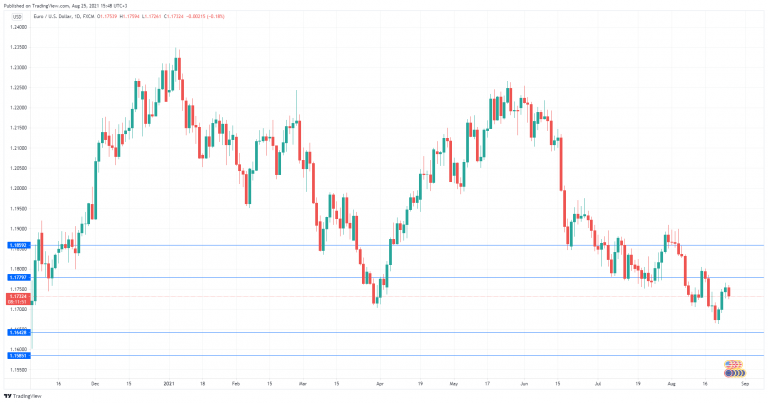
- Support and resistance levels have remained unchanged this week
- There are resistance lines at 1.1779 and 1.1859
- On the downside, we find support lines at 1.1642 and 1.1585
ECB Lane: There could be counterbalances in H2
ECB Chief Economist Philip lane said in an interview, Q2 GDP came in "well ahead of out June projections", reflecting an "earlier opening up", "strength of the world economy" and "progress in vaccinations". It's "still early days" regarding H2, and there could be "counterbalance" like bottlenecks, moderation in world economy, and the Delta variant. Overall, he said, "we're broadly not too far away from what we expected in June for the full year."
The Delta variant is now "part of the mix in the US and global economies", while Europe "may not be among the regions hardest-hit thanks to high vaccination rates and prior lockdown measures. Also, the infrastructure and system for vaccination has "eliminated uncertainty about Europe's ability to carry out vaccinations."
On PEPP, Lane said "we'll have to assess at the September meeting the appropriate calibration for the final quarter of the year". He emphasized that "single philosophy" of maintaining favorable financing conditions regarding PEPP. "If favourable financing conditions require more purchases, we'll conduct more purchases," he said.