

Sample Category Title
US 10-year yield jumped as focus turns to Jackson Hole
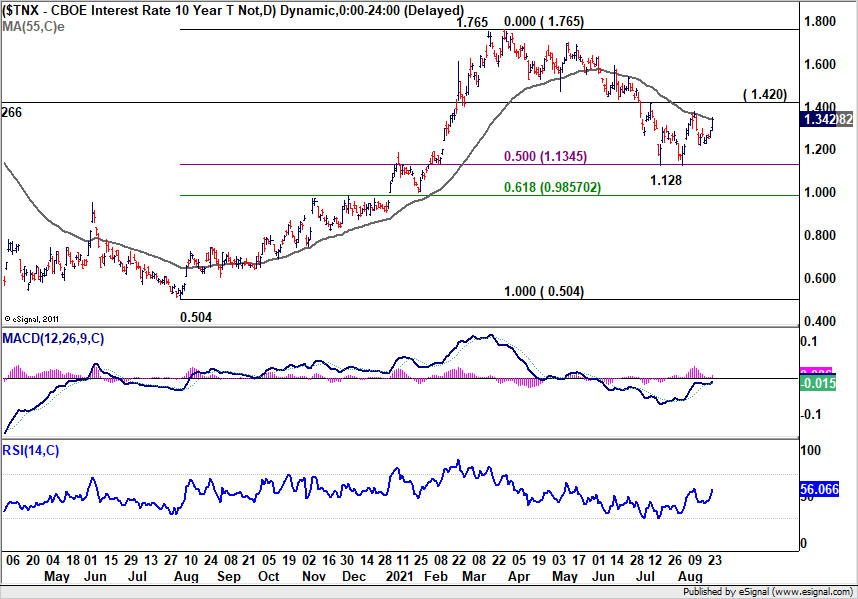
US 10-year yield staged a strong rally overnight, closing up 0.052 at 1.342. The development came as markets are awaiting the highly anticipated Jackson Hole Symposium, which kicks off today. While the main highlight is Fed Chair Jerome Powell's speech on Friday, there would likely be continuous news flow of central banker comments ahead of that.
After Fed hawk Robert Kaplan's comments the possibly of adjusting the timing of tapering, it seems less likely for Fed to make a September announcement. We'll look forward to other Fed officials for guidance, as Powell would act like what he used you be, composed, balanced, but non-inspirational.
Some suggested reading on Jackson Hole:
- Jackson Hole Symposium Preview: Affirming Likelihood of Taper Announcement in November while Striking Balance between Strong Data and Pandemic Resurgence
- What Will the Fed Signal at Jackson Hole?
- Jackson Hole Symposium Preview: Powell Under Pressure
As for 10-year yield, it's back pressing 55 day EMA (now at 1.344) with yesterday's rise. Sustained trading above there, followed by firm break of 1.420 resistance, should confirm that the correction from 1.765 has completed 1.128. That came after hitting 50% retracement at 1.1345. We should then see further rise back to retest 1.1765 high during the rest of the year, as the world is well-vaccinated to live with the coronavirus.
Market Morning Briefing: Aussie Could Hold Below 0.73 In The Near Term
STOCKS
Dow closed on a positive note but the other indices mentioned below closed in the red, dipping slightly from higher levels seen over the last few sessions. We need to watch price action to see if Nifty and sensex can produce a short corrective dip and Shanghai can hold below crucial resistance at 3550 and fall further in the near term. Nikkei also needs to break above 28000 to turn bullish but will it see a corrective dip before rising again? We would wait and watch price action near respective immediate supports and resistance levels.
Dow (35405.50, +39.24, +0.11%) has been rising in line with our expectations. A rise to35500-35750 is expected soon.
DAX (15860.66, -45.19, -0.28%) has dipped slightly after testing 15932 on the upside. Note that 16000 can produce a small corrective dip that could be short lived and extend to 15800-15650 before the upmove resumes again. Watch price action near current levels. A break above 16000 on the flip side will be strongly bullish.
Nikkei (27693.42, -31.38, -0.11%) has come down slightly today. The resistance at 28000 is holding fow now.A strong break above the level of 28000 is needed for the view to be bullish towards 29000.While below 28000, the chances of seeing a fall towards 27000 cannot be negated.
Shanghai (3520.18, -20.20, -0.57%) has come down after testing a high of 3540 yesterday. Note that 3550 is an important resistance on the 3-day candles and while that holds, Shanghai can fall towards 3500-3450 initially while on the broader range there is scope towards 3350 on the downside. A break above 3550 will be needed to make the index strongly bullish.
Nifty (16634.65, +10.05, +0.06%) has come off yesterday after testing the level of 16712.45 in line with our expectations. A corrective fall towards 16500 is possible now before we see a rise towards 16700 and eventually 16800.
Sensex (55944.21, -14.77, -0.026%) has come down after testing 56000. A fall towards 54000 is possible from here before we see an eventual rise towards 57000 in the medium term.
COMMODITIES
Crude prices trade higher ahead of the Fed’s Jackson Hole meeting and on hopes of increase in oil demand after US drug Regulator granted full approval to the Pfizer Inc/BioNTech SE Covid-19 vaccine that is expected to impact the Covid vaccine rates. Brent and WTI may face rejection fro immediate resistance near 72.50 and 68-70 respectively. Failure to face rejection from 72.50 on Brent can open up chances of a further rise to 75 before the expected fall takes place. Gold trades lower while Silver is up today. Copper will have to break above 4.30 to rise further and while below 4.30, a dip to 4.20/4.00 cannot be ruled out.
Brent (71.80) has risen today and is likely to test 72.50 before coming off from there. Failure to fall from 72.50 will open up chances of a possible test of 75 on the upside before a sharp decline sets it. We would initially look at price action near 72.50 which is expected to produce a rejection over the next 1-2 sessions.
WTI (67.81) can test 68-70 before the expected dip is seen.
Gold (1791.20) has dipped to test 1788 before bouncing from there. If the bounce holds, we may expect a re-test of 1800-1810 region in the near term else a fall back towards 1770/65 cannot be ruled out. Watch price action near current levels.
Silver (23.84) has risen from levels seen yesterday and could be headed towards 24 in the next few sessions. A sustained and strong rise above 24 is needed to negate bearishness towards 23-22.50 in the medium term.
Copper (4.2505) has dipped as the interim resistance near 4.30 seems to be holding well. A fall to 4.00 is possible on a break below 4.20. Else the price needs to rise above 4.30 to head higher.
FOREX
Dollar Index has fallen sharply ahead of the Jackson Hole meeting due tomorrow pulling up Euro to levels above 1.1750. Euro needs to hold above 1.1750 to trade higher else it can fall back to lower levels soon. Similarly support at 92.50 is expected to hold on Dollar-Index. Aussie, Pound and EURJPY have risen well but a small corrective dip could be expected in the next few sessions before resumption of upmove again. USDINR may fall back towards 74.10/74.00 while broad range of 74.0-74.50 is likely to hold in the medium term. Dollar Yen and USDCNY is ranged for now.
Dollar Index (92.88) has fallen sharply ahead of the Jackson Hole meeting scheduled tomorrow. A test of 92.50/60 is possible before the index bounces higher again. Failure to hold above 92.50 will turn bearish opening up chances of a fall to 92. Watch price action near 92.60/50 on a further dip from current levels.
Euro (1.1763) rose to test immediate trend resistance at 1.1774 before dipping slightly from there. While the resistance holds, Euro can come down towards 1.1748-1.1730 in the near term. A break above 1.1774-1.18 will be needed for it to turn bullish again.
EURJPY (129.38) has dipped from 129.50 and could dip further towards 129 before bouncing back from there. A broad range of 128-130.50 continues to hold in the medium term.
Dollar-Yen (109.99) has risen as expected but the broad range of 109-110.50 continues to hold unless a sustained break on either side is seen. There is resistance near 110.20-110.50 from where the pair can again face rejection.
Aussie (0.7263) could hold below 0.73 in the near term. A corrective dip to 0.7250/30 looks possible before it bounces back again to higher levels.
Pound (1.3753) has dipped slightly from 1.3766 and could fall towards 1.37 before again rising up sharply.
USDCNY (6.4820) has risen and could head towards 6.49/50 in the near term. A broad range of 6.50-6.45 can hold for the medium term.
USDINR (74.25) closed above 74.20 yesterday but selling is seen on the NDF markets that quotes 74.11 just now indicating a possible decline in the pair today. A broad range of 74.50-74.00 is likely to hold for the medium term within which the pair is likely to trade within 74.10-74.30 region for most of the time. The movement in the Dollar-Rupee has been sideways and unable to give clarity on further direction. At such times we would like to wait for a clear break out on either side of the mentioned range that would turn out to be a sharp movement to be seen soon. For now watch for a possible dip to 74.10 today. The RBI will be keen to prevent a month close below 74.
INTEREST RATES
The US Treasury yields have risen well and have room to move up further ahead of the Jackson Hole meeting tomorrow. Strong resistances are ahead which we expect to hold. Can the yields come down again following the Fed Chairman’s speech at Jackson Hole tomorrow? We will have to wait and see. The German yields have moved up and are in a corrective rally now. A further rise is possible from here before the broader downtrend resumes. The 5Yr GoI is stuck in a narrow range and looks mixed in the near-term with equal chances of moving on either side from here.
The US 2Yr (0.24%) Treasury yield remains stable while the 5Yr (0.83%), 10Yr (1.34%) and the 30Yr (1.95%) have risen further sharply. The 10Yr has risen past 1.3% and can now head towards 1.4%-1.45%. The 30Yr can surge to 2.1% on a break above 2%. The price action thereafter will need a close watch to see if the yields are reversing lower again or not.
The German 2Yr (-0.75%), 5Yr (-0.71%), 10Yr (-0.42%) and 30Yr (0.04%) yields have moved up sharply especially at the far-end. The expected corrective rally is happening now. The 10Yr can go up to -0.30%/-0.25% and the 30Yr to 0.10%-0.15% in the coming days. Thereafter we expect a fresh fall and the broader downtrend can resume again.
The 5Yr GOI (5.6854%) is stuck in a narrow range of 5.68%-5.72% over the last few days. The near-term outlook is mixed. A breakout on either side of 5.68%-5.72% can take it up to 5.74%-5.76% or drag it down to 5.66%-5.62%. Broadly, 5.62%-5.76% could be the range of trade.
Gold Price Faces Resistance, US GDP Next
Key Highlights
- Gold price started a strong upward move from the $1,680 region.
- It broke a key bearish trend line with resistance at $1,788 on the 4-hours chart.
- Crude oil price recovered above $65.00, but it is still well below $70.00.
- The US GDP could grow 6.7% in Q2 2021 (preliminary), up from 6.5%.
Gold Price Technical Analysis
Earlier this month, gold price saw a sharp decline below $1,750 against the US Dollar. The price even declined below $1,700 before the bulls appeared near $1,680.
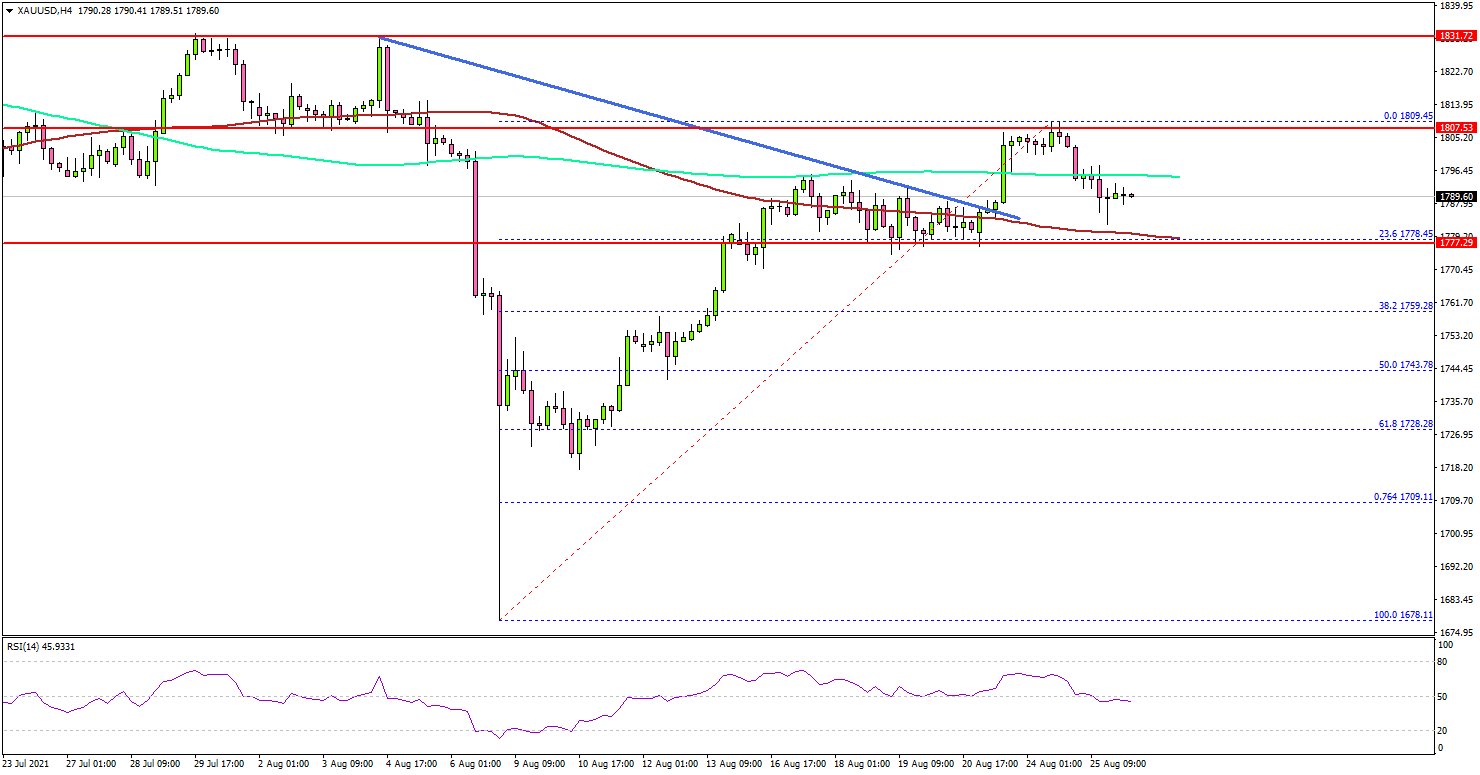
The 4-hours chart of XAU/USD indicates that the price traded as low as $1,678. Recently, there was a strong recovery wave above the $1,720 and $1,750 resistance levels.
There was a break above a key bearish trend line with resistance at $1,788. The pair surpassed the $1,800 level, the 100 simple moving average (red, 4-hours), and the 200 simple moving average (green, 4-hours).
However, there was no upside continuation above $1,810. A high is formed near $1,808 and the price is now correcting gains. On the downside, there is a major support forming near $1,778 and the 100 simple moving average (red, 4-hours).
The 23.6% Fib retracement level of the upward move from the $1,678 swing low to $1,808 high is also near $1,778. If there is a downside break below $1,778, the price could correct lower towards $1,750.
The next major support could be $1,743 or the 50% Fib retracement level of the upward move from the $1,678 swing low to $1,808 high. On the upside, the price is facing resistance near $1,808 and $1,810.
The main resistance sits near $1,830, above which the price could rise towards $1,850. Looking at EUR/USD, the pair could attempt a recovery wave above the 1.1800 zone. Besides, GBP/USD could test the main 1.3800 resistance zone.
Economic Releases to Watch Today
- US Initial Jobless Claims - Forecast 350K, versus 348K previous.
- US Gross Domestic Product Q2 2021 (Preliminary) – Forecast 6.7% versus previous 6.5%.
Eco Data 8/26/21
[php_everywhere instance="1"]
Bitcoin – Poised for a Correction?
Running on fumes after 70% rally
Bitcoin has enjoyed a good run this past month but recent rallies are struggling to generate much momentum, which suggests a corrective move may be on the cards.
There was a lot of excitement as bitcoin broke back above $50,000 for the first time since May but it wasn’t long until profit-taking once again kicked in.
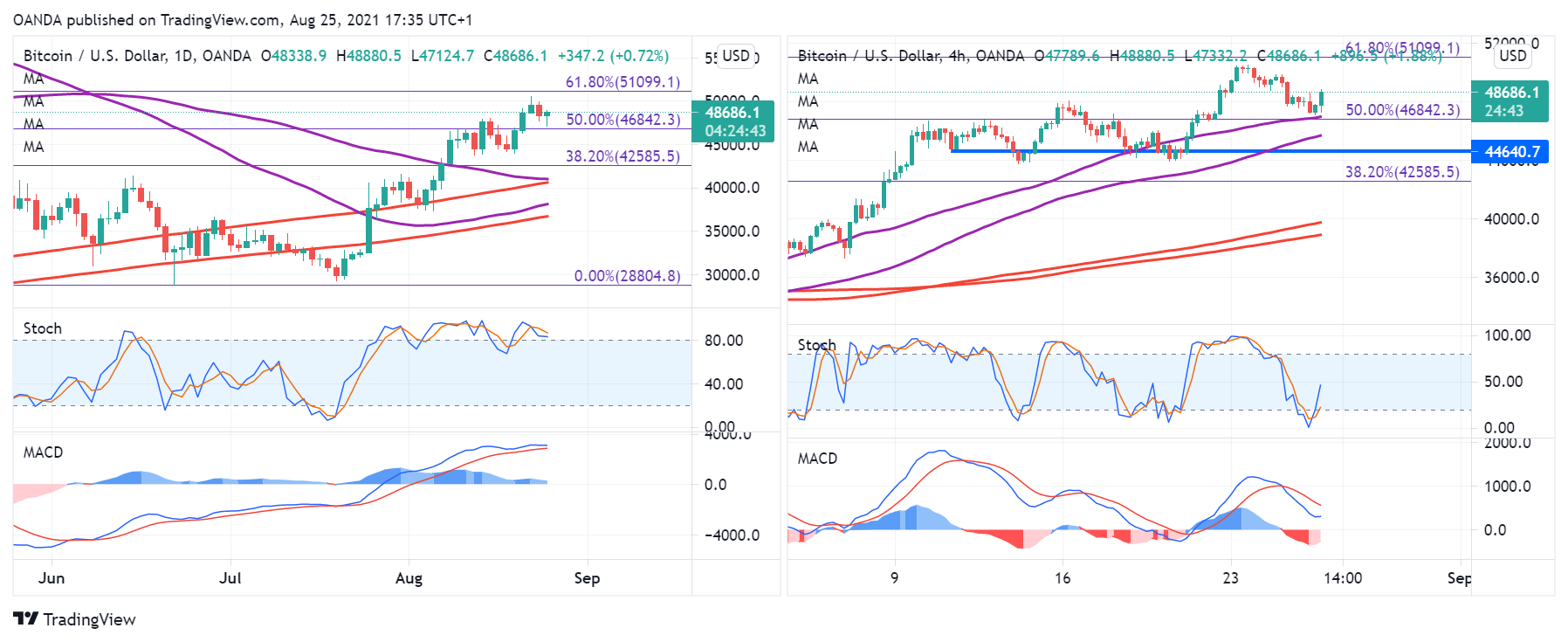
There is resistance around $51,000 – the 61.8% retracement of the April highs to June lows – which may be contributing to the profit-taking we appear to be seeing.
The momentum indicators on the daily chart are also both showing divergences – lower highs as price action makes new highs – which is another sign that the trend is weakening.
A correction would be interesting at this point, with bitcoin having rallied more than 70% in a little over a month.
Not exactly extraordinary for bitcoin considering what we’ve become accustomed to but still very substantial. The longer-term still looks bullish but perhaps a correction would be healthy.
With bitcoin having tracked the 55/89 SMA band higher on the 4-hour chart, a move below here could signal a correction is underway.
Markets Steady ahead of Jackson Hole
Back on the fence
A relatively muted session on Wednesday as investors sit on the fence ahead of the Jackson Hole Symposium later in the week.
It’s all gone very quiet in the markets, which is hardly surprising under the circumstances. The combination of light news flow, few economic releases and caution ahead of the Jackson Hole event has taken all of the excitement out of the markets. Instead, it’s been replaced by nervous anticipation as we wait to see what the Fed will do next.
Frankly, I wouldn’t be surprised if this turns out to be one big anticlimax, with Powell saying very little of note and instead insisting that the data will dictate any decisions in the upcoming meetings. In other words, the Chairman may simply kick the can down the road and buy the central bank a few more weeks.
Rather sensible in the grand scheme of things. But it may not do much for these markets unless it’s accompanied by something more substantial. If not, then the next few weeks may see plenty more of this kind of inactivity, as anticipation builds ahead of the September meeting.
Durable goods orders provide cause for optimism
US durable goods orders remained strong in July despite a slight dip in the headline number driven by a drop in Boeing aircraft purchases.
These are very volatile large orders which is why the core number is often a better reflection of spending habits. Core orders rose 0.7% – ahead of expectations – while the June reading was also revised higher by 0.2%.
While recent PMIs suggest growth may have slowed a little, which could be reflected in future orders, the US continues to look in a healthy position and that should be reflected in the data in the longer term.
Large cash piles and a willingness to invest is exactly what the economy needs. Supply chains and staffing issues may take the edge off in the near term.
Oil stabilises after a bumper start to the week
Oil prices have seen their resurgence grind to a halt on Wednesday, following a remarkable start to the week.
A 15% decline between early July and late August has been followed by a 10% rally this week alone as new Chinese Covid cases fell to zero, putting at ease concerns about more severe restrictions and lower growth.
The rally began to falter on Tuesday as API reported a weekly draw of only 1.622 million barrels, a little short of expectations. Prices did recover early in Europe but once again ran into a wall as we moved into the US session. This came around the 50% retracement level – July highs to August lows – and shortly after the durable goods orders release.
What we’re probably seeing is just a bit of profit-taking in choppy trading, with the 50% level providing a perfect opportunity. We have seen a small bounce after EIA reported a larger drawdown of three million barrels but prices are still largely flat on the day.
Gold rally hangs on Powell comments
Gold is also seeing some profit-taking after a bumper couple of weeks.
The yellow metal managed to break above $1,800 but failed to generate any significant momentum. There was plenty of resistance just above here, with gold rotating off the 200-day SMA before heading lower.
A move above here would have been a very bullish signal and could still come if Powell fails to signal that a taper is likely this year. While the 200-day SMA was the turning point this time, this also falls around key Fibonacci levels and a significant area of resistance over the last couple of months. A move above $1,833 could be very bullish.
Taper talk around the September decision could kill hopes of $1,800 before it even had a chance at a serious run above it. Perhaps it’s this fear that’s triggering the profit-taking we’re seeing in gold after a very good run in recent weeks. The yellow metal has rallied roughly 6% since the flash crash, not a bad return considering how bad things were looking at that point.
AUD/USD: Bulls are Pausing and Awaiting Fresh Signals from Jackson Hole Event
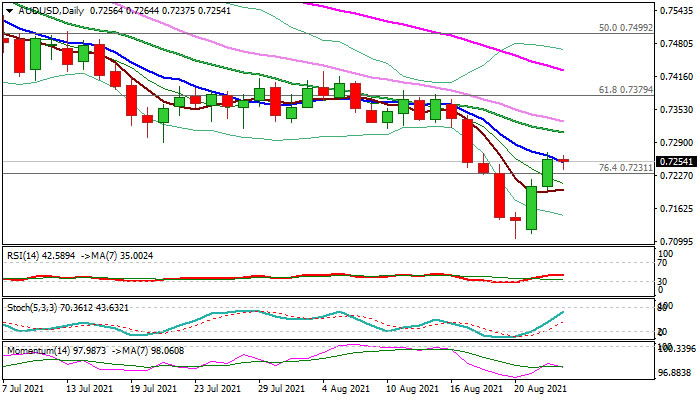
The AUDUSD is holding within narrow consolidation on Wednesday, after Mon-Tue bounce retraced over a half of last week’s sharp bearish acceleration which hit a multi-month low at 0.7106.
Fresh bulls faced strong headwinds from falling 10DMA (0.7252) while rising bearish momentum on daily chart also caused recovery to lose steam.
Traders await the outcome of Jackson Hole symposium which starts on Thursday with central bankers’ rhetoric likely to signal near-term direction.
Hawkish stance would inflate the US dollar on expectations for early tapering and policy tightening that would bring Aussie dollar under fresh pressure.
Also, deteriorating health situation on record new Covid-19 infections in some parts of Australia, would contribute to bearish sentiment.
On the other side, the Aussie would receive fresh boost if the US central bankers keep dovish stance, however overall picture would remain soured by worsened health conditions that may limit recovery.
Res: 0.7289; 0.7310; 0.7329; 0.7372
Sup: 0.7237; 0.7200; 0.7142; 0.7106
Sunset Market Commentary
Markets
Global markets were supposed to stay in some kind of countdown modus looking forward to the Fed Jackson Hole symposium at the end of this week. For European markets, tomorrow’s publication of the minutes of the July ECB meeting is also a wildcard. With respect to the latter (EMU outlook) some related info kicked in. Contrary to solid EMU PMI’s earlier this week, German IFO business confidence missed expectations. The headline business climate index declined from 100.7 to 99.4. The assessment of the current situation still improved further from 100.4 to 101.4 but the expectations component made a rather big step backward from 101.0 to 97.5. According to Ifo, supply bottlenecks for intermediate products in manufacturing and worries about rising infection numbers are putting a strain on the economy. The release had only a limited and temporary impact on European markets. Later this morning, attention on the European (interest rate) markets was captured by some comments from ECB’s Vice President de Guindos. He assessed the third quarter indicators as positive, expects the ECB forecasts to be upwardly revised and is of the view that if the economy normalizes, fiscal and monetary policy should also so. European/German yields started a gradual intraday rise in the wake of the comments. Admittedly, later in the session, the market hardly reacted to the headlines of a Reuters interview with ECB’s Lane. He held a much more dovish tone, stressed the need for keeping ample financing conditions and also indicated any amendment to PEPP buying is subordinated to this commitment of maintaining favourable financing conditions at least until March next year. Still German bunds today clearly underperformed US Treasuries. German yields are rising between 0.8 bp ( 2-y) and 5.5 bp (30-y). On the other hand, US yields only show marginal gains (10-y yield 1 bp higher at 1.305%). The US July durable goods orders report was close to expectations with overall orders declining -0.1% after a rise of 0.8% the previous month, but shipments of core capital goods still printed at a strong 1% M/M suggesting a positive contribution of investments to GDP growth. On other markets, the rebound in commodities continues with Brent oil trading north of $ 71 p/b. Equities mostly show limited gains, with US indices (S&P and Nasdaq) testing record levels.
Moves in the FX markets were modest compared to the price action on European bond markets. The euro failed to profit from rising interest rate support. EUR/USD is hovering sideways in the lower half of the 1.17 big figure (currently 1.1735). USD/JPY tries to regain the 110 mark. Sterling shows no clear trend with EUR/GBP trading little changed near 0.8560.
News Headlines
The Chair of the US Securities and Exchange Commission Gensler warned Chinese companies with a US listing he plans to strictly enforce a three-year deadline that requires Chinese firms to permit inspections of their financial audits. They risk delisting from NYSE and Nasdaq if they refuse. US Congress gave the SEC a mandate to do so after passing the Holding Foreign Companies Accountable Act in December 2020. Gensler said investors need “full and fair” disclosure on the risks they face, including from a regulatory and political perspective. His comments refer to the recent steep declines in Chinese (tech) stocks after the China’s crackdown on companies that it blames for exacerbating inequality and increasing financial risk.
Belgian business confidence retreated from a historically high 10.10 to a still-elevated 7.60 in August, the NBB’s monthly survey showed today. The decline took place in all sectors with sentiment in manufacturing being hurt most by a much less optimistic view on inventories and to a lesser extend overall demand. Service company leaders turned more cautious on their current activity though the opposite was true for expected future output. In construction, companies saw a significant pullback in order books but stayed positive about demand. Trade, finally, saw prospects for employment increase but sentiment about future demand turned sour.
Jet Lag: Durable Goods Orders Slip 0.1% Amid Pullback in Aircraft Orders
Summary
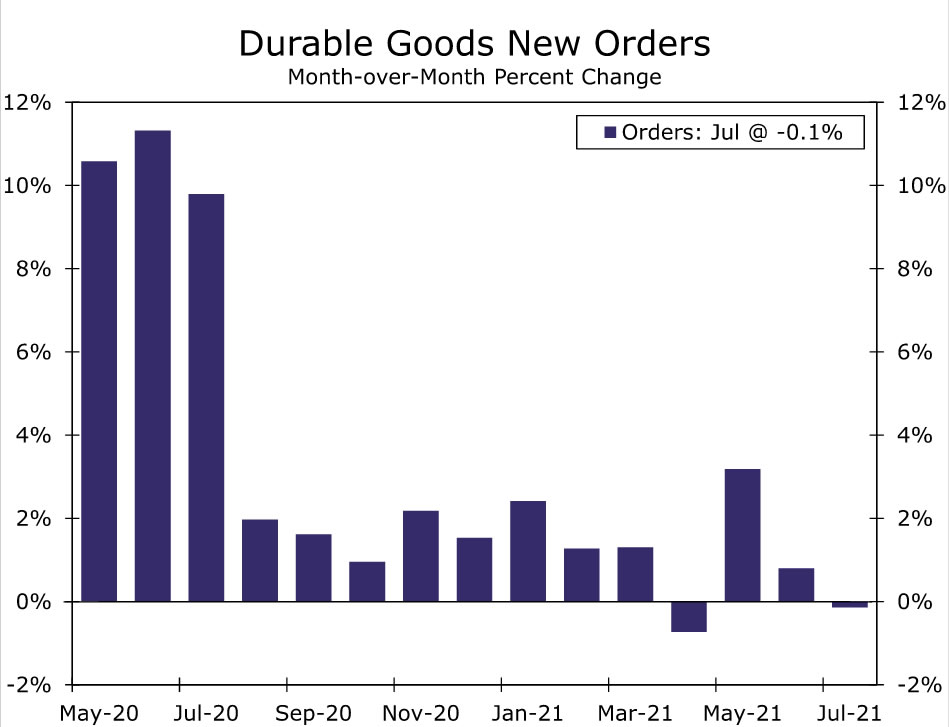
The scant 0.1% decline in durable good orders in July is not as large a dip as had been expected. The not-as-bad outcome is due in part to surging orders for autos and many old-line manufacturing categories. Core capital goods shipments rose 1.0%, pointing to another incremental step in the right direction for supply chain pressures.
This Just In: Auto Dealers May Actually Have Vehicles to Sell
This is only the second time since the initial reopening of the economy in May of last year that durable goods orders posted a decline. We were braced for a larger one. The scant 0.1% dip in orders for durable goods is remarkable after accounting for the fact that civilian aircraft orders fell by about half during the month.
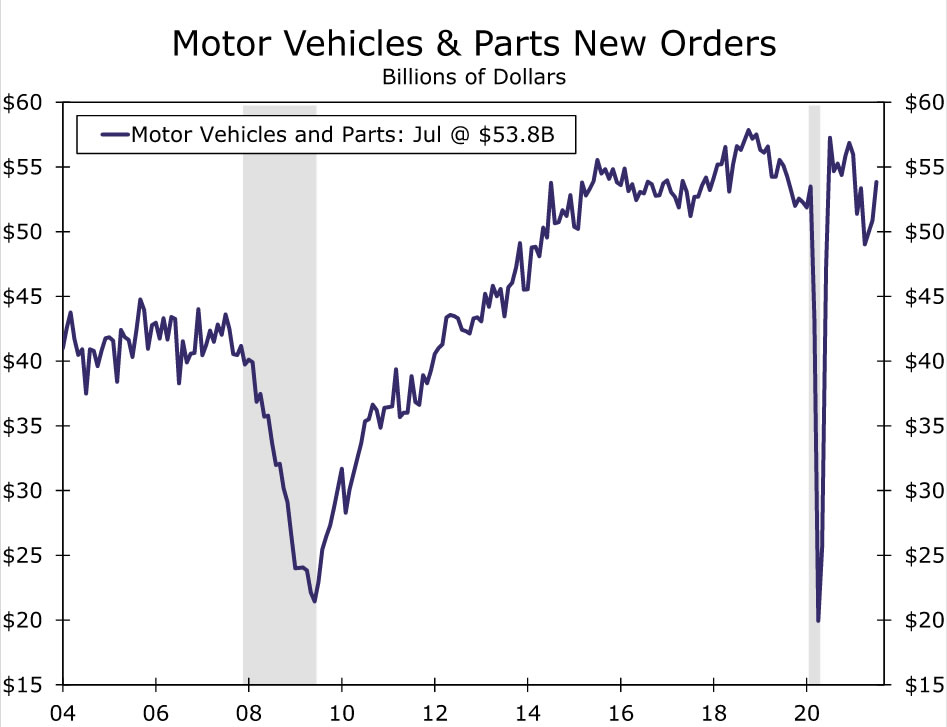
It is still mad times in the auto market, but there are some signs of improvement. Orders for vehicles and parts shot up 5.8%. Aside from the reopening of auto plants last summer, that is the biggest monthly gain in more than six years. As anyone who has been in the market for a vehicle in the COVID-era can tell you though: taking the order is easy, delivering on it is what is tough. But in a welcome development, shipments of vehicles and parts rose a slightly larger 5.9% in July. Auto dealers may gradually begin to refill nearly empty lots. But make no mistake, auto-production is still struggling to keep up with demand.
Elsewhere, spending was a mixed picture. After increased spending on tech over the past year or so, some pullback was evident in July. Electrical equipment orders fell 1.8% and computers and other electronics products slipped 0.4%
But old-line manufacturing continues to flex its muscles with orders for fabricated metals adding 0.3%, primary metals orders up 2.7% and bookings for machinery up 2.9%. Machinery orders have done nothing but rise since April of last year. The level of orders today is up 12.2% from where it was at its 2018 peak before the trade war began a trend decline through 2019 and early 2020.
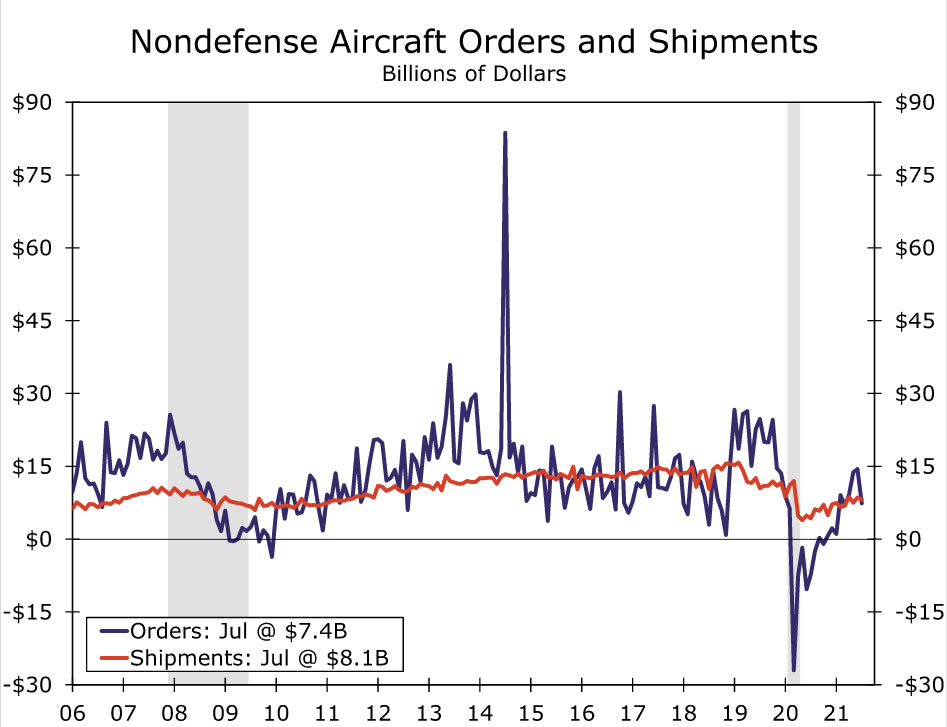
A bulk of the weakness in orders therefore came from nondefense aircraft orders, which tumbled nearly 50% in July. Excluding transportation, durable goods orders rose 0.7%. Based on our calculations from Boeing's publicly available data, there were only 14 net new orders during the month after accounting for cancellations, a considerable pullback from the 146 net orders last month.
Civilian aircraft orders had been rebounding in recent months but amid renewed concern about whether the pandemic has permanently changed demand for business travel. Even before accounting for cancellations Boeing's 31 gross monthly orders were less than half what we'd see in a typical July; that month's average gross increase since 2000 is 75 orders.
Another Step in the Right Direction for Core Shipments
Core capital goods orders were flat in July, but the run-up in goods consumption during the pandemic has resulted in a speedy rebound in orders to date. An upward revision to June data suggest orders are 9.2% ahead of their prior cycle peak through July. With some business demand being pulled forward last year to facilitate work from home and consumer spending transitioning back to services from goods, some weakness in demand is understandable. But we expect the need for businesses to replenish scant inventory levels to keep orders strong in coming months. Still-constrained supply chains will weigh on fulfillment as unfilled orders continue to rise at a decent clip, suggesting some weakness in July may be due to bottlenecks rather than weak demand. The value of unfilled orders for motor vehicles, for example, increased to a fresh record as the sector struggles to get the inputs in needs to produce.
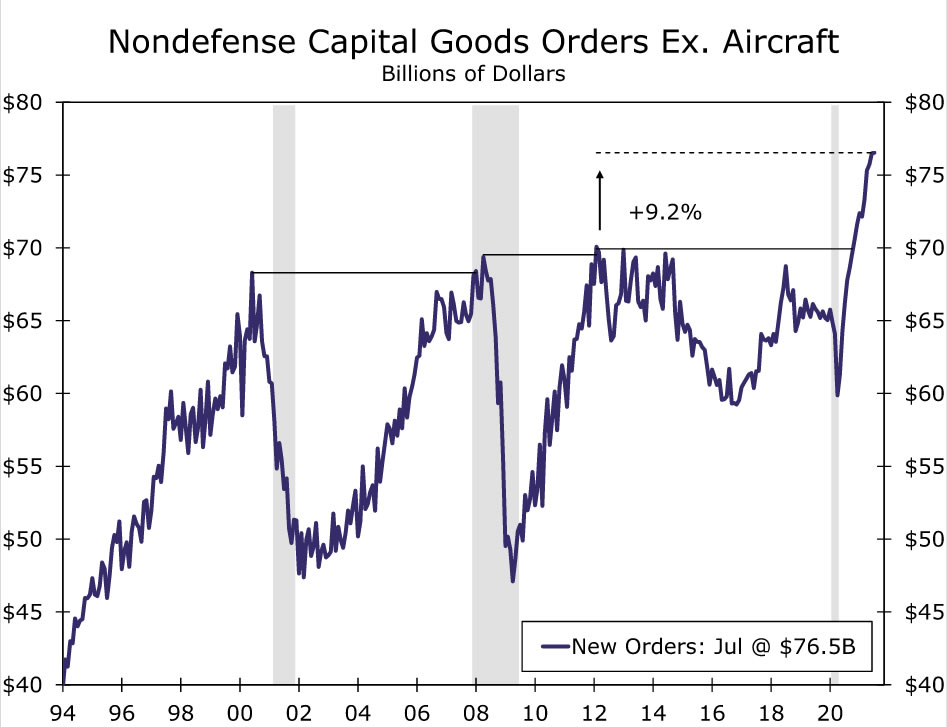
Shipments did pick up during the month with core capital goods shipments up 1.0%, which brought the three-month annualized growth rate of the three-month moving average to 12.1%. This is a positive indication of strong equipment spending in the third quarter, but as we've cautioned in recent months, the true pace of real equipment spending will likely be less impressive as orders and shipments are reported in nominal dollars. The recent run-up in prices, therefore will likely eat into some of the gain. Increases in shipments were broad based with all core shipment categories rising last month.
Dollar Pushes Yen Close to 110
The Japanese yen is in negative territory on Wednesday. Currently, USD/JPY is trading at 109.99, up 0.28% on the day.
It has been a relatively quiet week for the yen, which is hovering around the 110 line, which has psychological significance. With the markets in wait-and-see mode ahead of the Jackson Hole Symposium, the lack of substantial movement from the yen is likely to continue. This could change dramatically on Friday, when the star performer of the show, Fed Chair Jerome Powell, gives a speech that will be analysed with a microscope.
Will Powell announce a taper timeline?
Just a few weeks ago, the markets were confident that Powell would use the get-together to announce a timeline for Fed tapering, or at least provide some strong hints in that regard. However, the severe outbreak of the Covid-19 Delta variant may cause Powell to apply the brakes to any taper announcement, which would allow the Fed to digest further economic data as we move into September.
The recent FOMC minutes were viewed by the markets as hawkish, and the US dollar responded with broad gains. However, that rally has fizzled as the markets are no longer taking for granted that a taper is imminent. If the cautious Fed chair does not provide a timeline for a taper, the markets could react with disappointment and send the US dollar lower.
On the economic calendar, the only events out of Japan this week are all inflation releases. BoJ Core CPI for June, the Bank of Japan’s preferred inflation gauge, came in at 0.2%, up from 0.1% beforehand. Still, this gain wasn’t enough to give the Japanese yen a lift. Japan will release the Services Producer Price Index later today, followed by Tokyo Core CPI on Thursday. With the Covid Delta variant running rampant and the government extending the state of emergency, inflation, which is at low levels, could fall even further.
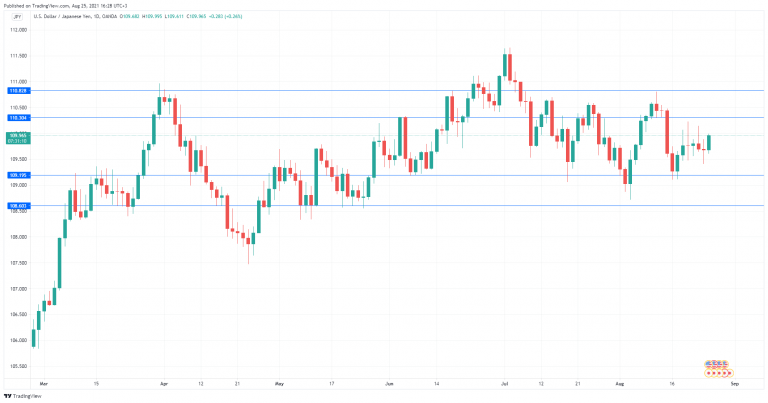
USD/JPY Technical
- USD/JPY faces resistance at 110.30. Next, there is resistance at 110.82
- On the downside, there is support at 109.19. Below, we find support at 108.60