Sample Category Title
PBOC Left Policy Rate Unchanged. Further Easing Inevitable as Economy Prone to Weaken in Second Half
PBOC left the loan prime rate (LPR) unchanged at 3.85% in July. The inaction does not suggest that the current monetary policy is appropriate. Weakness in economic activities is expected to exacerbate in the second half of the year, thanks to the resurgence of the pandemic and the lingering consequences of the flood. Speculations of a rate cut have recently heightened, sending renminbi to lowest in 3 weeks against the US dollar.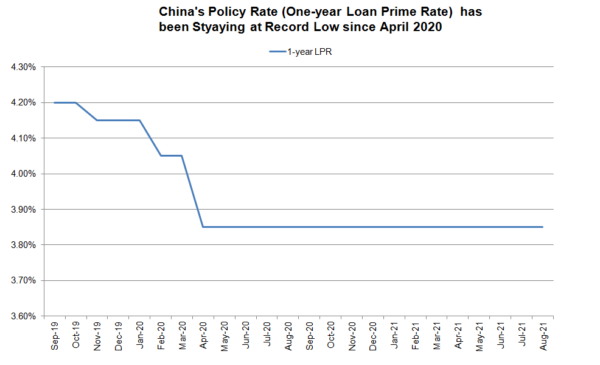
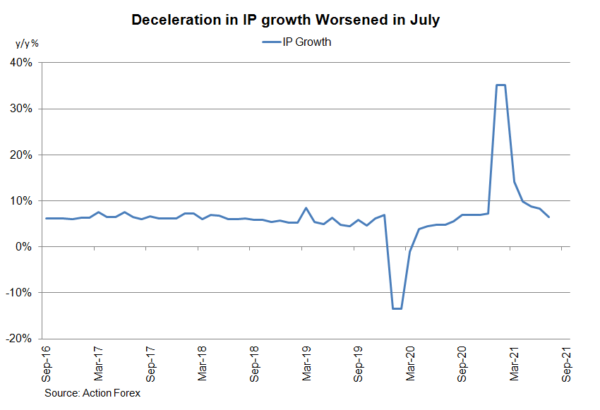
Economic data released earlier in the week signaled a bad start of the third quarter. Industrial production (IP) grew +6.4% y/y in July, moderating from +8.3% a month ago. This also missed consensus of +7.9%. The slowdown was broadly based. For instance, the growth in machinery manufacturing sector eased amidst slower export growth. Coal mining activities weakened as the government tightened policy for environmental protection. Moreover, automobile manufacturing contracted -8.5% y/y during the month as a result chip shortage.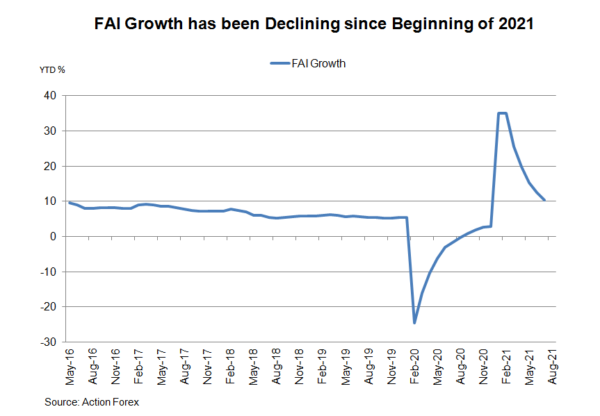
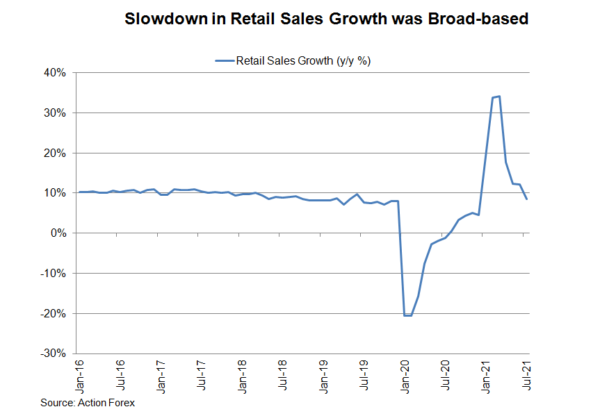
Retail sales expanded +8.5% y/y in July, worse than consensus of +10.9% and June’s +12.1%. Looking into the details, sales in clothing and smartphones worsened significantly. Growth in the former moderated to +7.5% y/y from June’s +12.8%. The latter only edged +0.1% y/y higher, compared with June’s +15.9%. Meanwhile, automobile sales among enterprises of a minimum size contracted - 1.8% y/y, after a +4.5% growth in June. Growth in catering sales also decelerated to +14.3% from June’s +20.2%. Online goods sales only expanded +11.0% y/y in July, compared with +14.6% in the prior month. We believe the moderation in retail sales growth revealed fragile consumer confidence, probably amidst concerns over resurgence of the pandemic.
Fixed asset investment rose +10.3% y/y in the first 7 months of the year. Specifically, investment in manufacturing and infrastructure grew +17.3% and +4.6%, respectively. In order to stimulate the economy, the government has sped up the approval process of investments. In July, investment worth of CNY 58.2B was approved, up about +50% from the prior month. The State Council noted earlier this week that it would increase effective investment by better utilizing local government special-purpose bonds, which are issued mainly to fund infrastructure projects.
Weakness in July’s data was mainly driven the massive flood in central Henan province that caused at least 302 deaths and nearly 9K home damage. The aftermath of the flood should continue dampen economic activities in coming months. Additionally, the resurgence of the pandemic has spread to all over China. Economic impacts of renewed lockdowns and social distancing restrictions would gradually be revealed in coming months.
The PBOC would have to loosen its monetary policy to boost growth. It has been doing so indeed. While keeping the MLF rate unchanged, the central bank on Monday injected CNY600B into the financial system via the facility, close to the CNY700B maturing the day after. This came in more than expectations of CNY500B. The move pressured bond yields and Chinese yuan. We expect the central bank would announce further reduction in the reserve requirement ratio (RRR) in coming months.
EUR/USD Outlook: The Pair Broke the Key 1.1750 Support Zone to Move into a Bearish Zone
The Euro failed to clear the 1.1800 resistance and started a fresh decline against the US Dollar. The EUR/USD pair broke the key 1.1750 support zone to move into a bearish zone.
It even broke the 1.1700 support level and settled below the 50 hourly simple moving average. A low is formed near 1.1665 and the pair is now consolidating losses. An initial support on the downside is near the 1.1665 level.
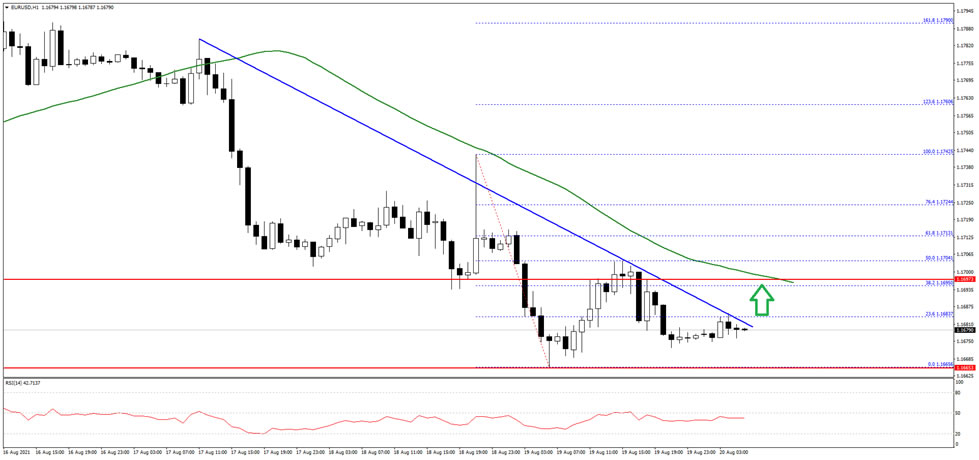
The first major support is near the 1.1650 level. Any more losses could lead the pair towards the 1.1600 support zone in the coming sessions.
On the upside, an initial resistance is near the 1.1680 level on FXOpen. There is also a key bearish trend line with resistance near 1.1680 on the hourly chart. A clear break above the trend line could start a decent recovery towards the 1.1720 level or even 1.1750.
Can The Eurozone’s PMIs Rescue The Euro?
With the euro slicing through some crucial support levels lately, there will be a lot of attention on the upcoming PMI business surveys from the euro area. The show will start with the French data at 07:15 GMT Monday. Overall, the Eurozone economy is healing but the outlook for the euro looks bleak, with the ECB likely to be left behind in the central bank normalization game.
Reopening boom
The Eurozone is finally coming back to life. Virus restrictions have been eased dramatically thanks to widespread vaccinations, enabling consumers to enjoy a summer spending spree. Unemployment is on a steady decline, demand is strong, and inflation has even surpassed the European Central Bank’s elusive target.
That all sounds great, but unfortunately, this is mainly a reopening boom. When an economy exits a lockdown, it typically enjoys a strong spell of growth that ultimately fades after a few quarters. We are in the middle of this process right now, so the risk is that growth begins to slow down heading towards year-end.
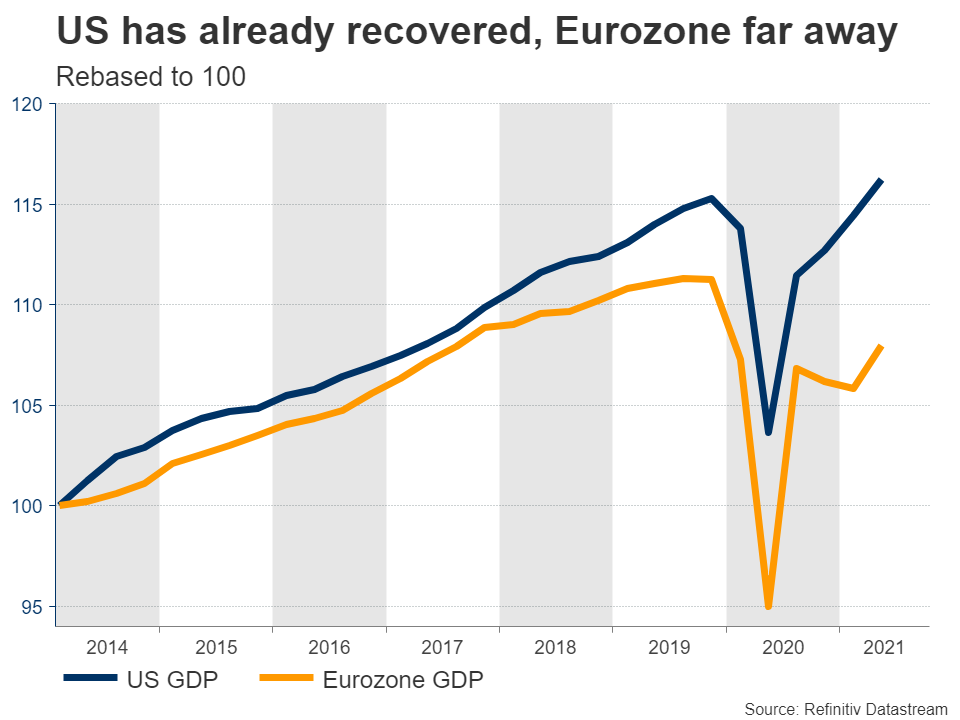
And while the European recovery has been solid, it pales in comparison to America’s. The US economy is now bigger than it was before the crisis hit, turbocharged by multi-trillion spending packages from Congress. In contrast, the Eurozone economy isn’t expected to recover all its losses until next year.
Optimists argue that more government help is on the way in Europe. The Recovery Fund money has finally started to be distributed to member states, which will hopefully help economies like Italy and Spain to heal their wounds. Unfortunately, this recovery package is way too small to make a real difference and there isn’t much political appetite for any more, with government debts ballooning already.
Data could reflect Delta worries
Turning to the upcoming PMIs for August, forecasts point to a slight retreat. The Eurozone manufacturing index is expected to tick down to 62.2 from 62.8 previously, while the services PMI is anticipated to hold steady at 59.8.
The only data that has been released so far for August has been Germany’s ZEW survey of investor sentiment, where the forward-looking expectations index fell sharply as fears over the Delta outbreak and a slowdown in China intensified. 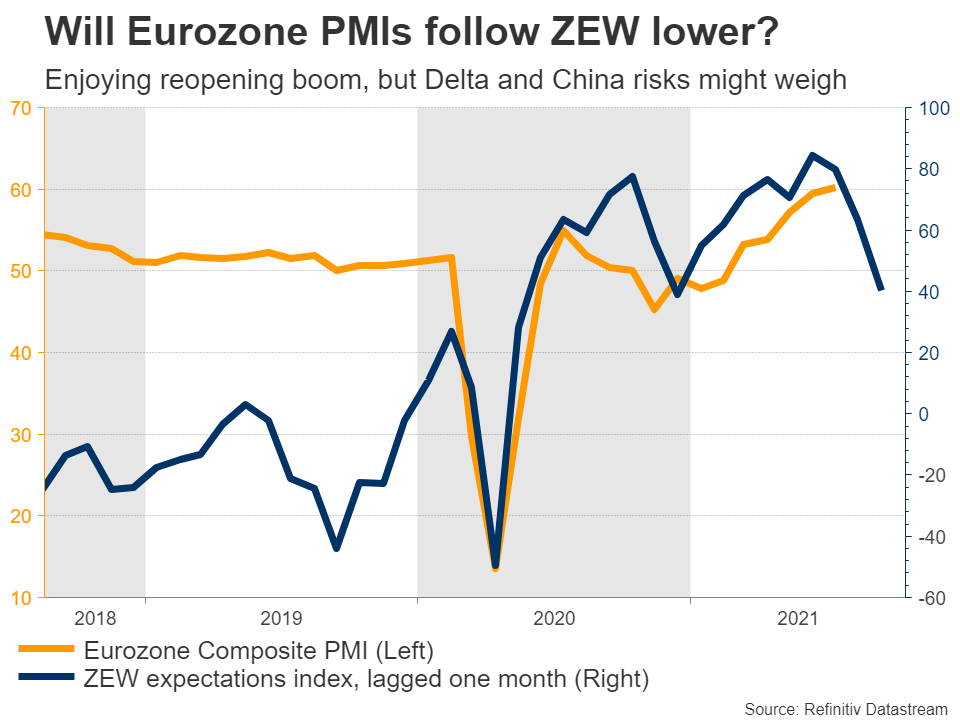
If those concerns are reflected in the PMIs too, there could be a pullback in the composite index from its recent highs. That would signal that growth is cooling down, even though it remains positive.
Euro could struggle amid ECB/Fed divergence
In the big picture, the euro doesn’t look particularly attractive. The Eurozone economy is doing better, but when compared to America, it is still lagging behind. And the US Congress is already working on a new multi-trillion spending package, whereas the European Union is still trying to distribute the recovery funds it agreed to last year.
All that is increasingly reflected in monetary policy. The Federal Reserve is preparing to dial back its asset purchases soon and it could raise interest rates next year already if the US recovery stays on track. On the other hand, the European Central Bank just committed to maintaining negative rates for several years.
Over time, this central bank divergence could allow US yields to rise faster than their European counterparts, making the dollar more attractive from a relative interest rate viewpoint. 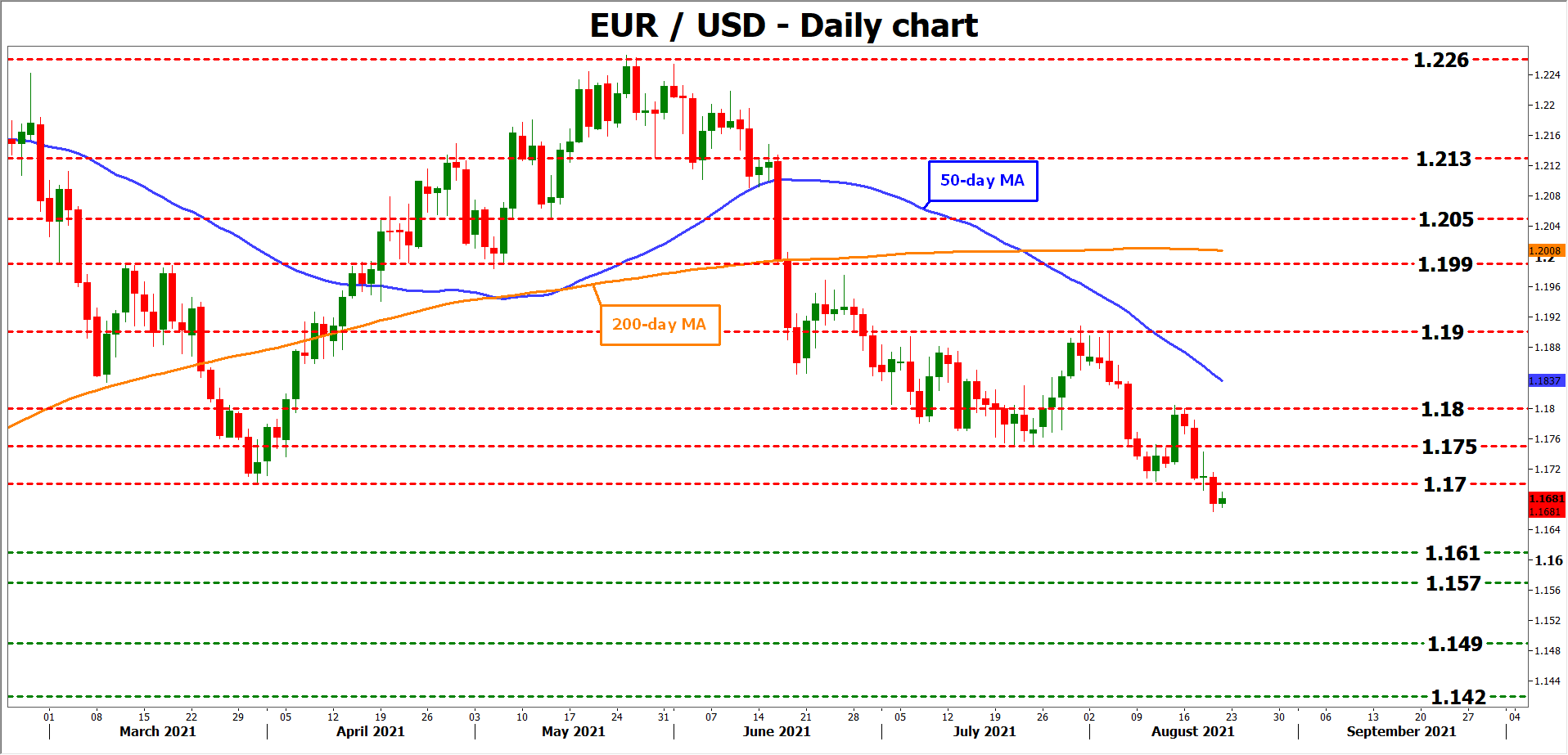
The chart tells a similar story, with euro/dollar slicing through 1.1700 this week to carve out new lows for the year. If the pair manages to close the week below this crucial level, that would solidify a bearish bias, potentially opening the door for 1.1610 next.
On the flipside, if the bulls retake control and push the market back above 1.1700, the next region to provide resistance may be around 1.1750. Another push higher would then turn the focus towards 1.1805.
Pound Tumbles Ahead Of UK PMIs As Global Sentiment Sours
It’s been a bruising week for sterling as investors have been selling riskier currencies and buying US dollars amid fresh jitters about the global growth outlook. A mixed bag of data out of the United Kingdom over the past week hasn’t helped matters for the pound and Monday’s flash PMI prints due at 08:30 GMT probably won’t either.
Delta scare wreaking havoc
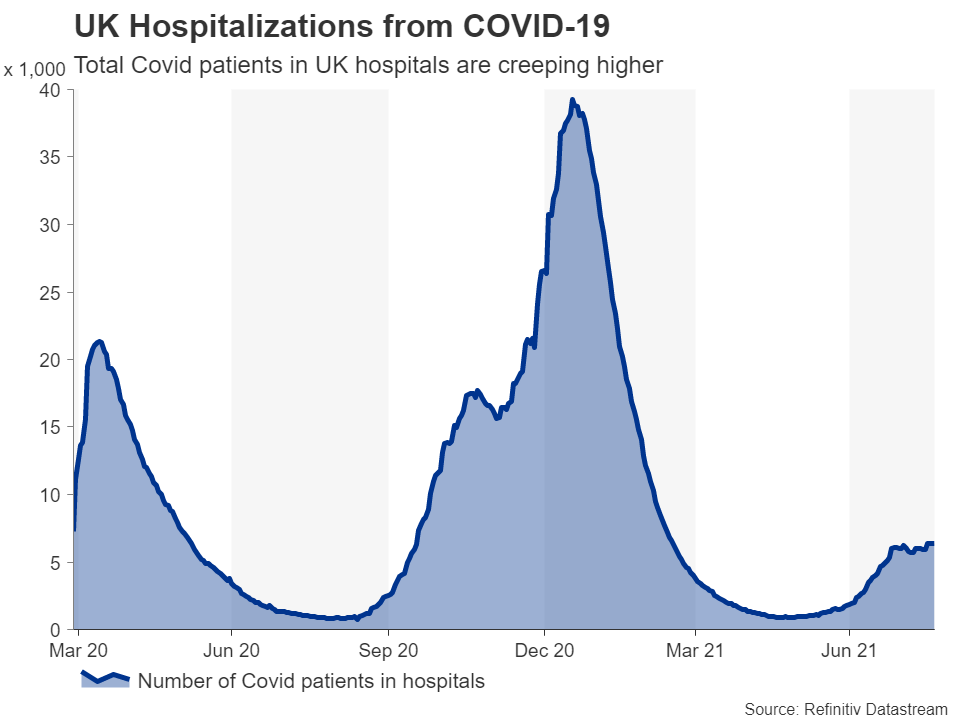
The Delta variant has been front and centre for investors this week as its spread is showing no sign of receding. Countries that had managed to stay relatively virus-free this year have been plunged into lockdown, while those boasting high vaccination rates are seeing hospitalizations creep up. In the UK, which falls into the latter category and where the only restrictions kept in place are those on international travel, hopes were raised after the number of Covid patients in hospitals started to level off in late July but are now edging up again.
But that’s not the reason why the pound is falling as there’s no immediate prospect of the UK government changing its response to the Delta variant and reimposing some virus curbs. It’s the broader theme in global markets that’s weighing on the British currency, which tends to lose out at times of increased risk aversion due to the UK’s massive current account deficit that makes sterling more exposed to capital outflows.
UK recovery solid but slowing
Should the situation worsen to the degree where the government has no choice but to reintroduce restrictive social distancing measures, the currency’s losses could become even more dramatic. But for now, it’s mainly a dollar and risk-off story, which can also mean that the pound’s fortunes could easily turn around if sentiment were to improve.
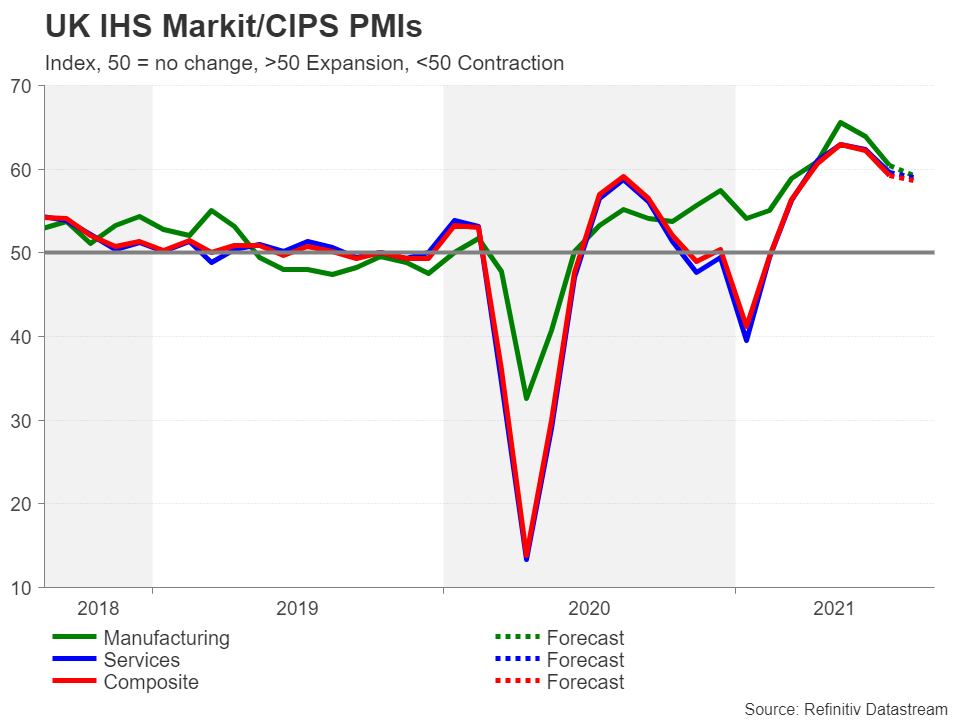
Combined with some solid PMI readings, sterling could get a nice lift next week if the panic subsides. The flash estimates are expected to show the UK economy lost some steam in August but continues to grow at a healthy pace. The composite PMI is forecast to moderate from 59.2 to 58.7, with the services PMI expected at 59.0 and the manufacturing PMI at 59.3.
BoE tapering should support pound
However, that’s not to say that the pound’s woes won’t deepen if there is a negative surprise in the PMIs, as it would come hot on the heels of today’s retail sales figures, which showed an unexpected drop for July. The jobs data earlier in the week was much more encouraging and overall, the outlook for the UK economy remains positive, with the Bank of England widely anticipated to end its QE programme by the end of the year.
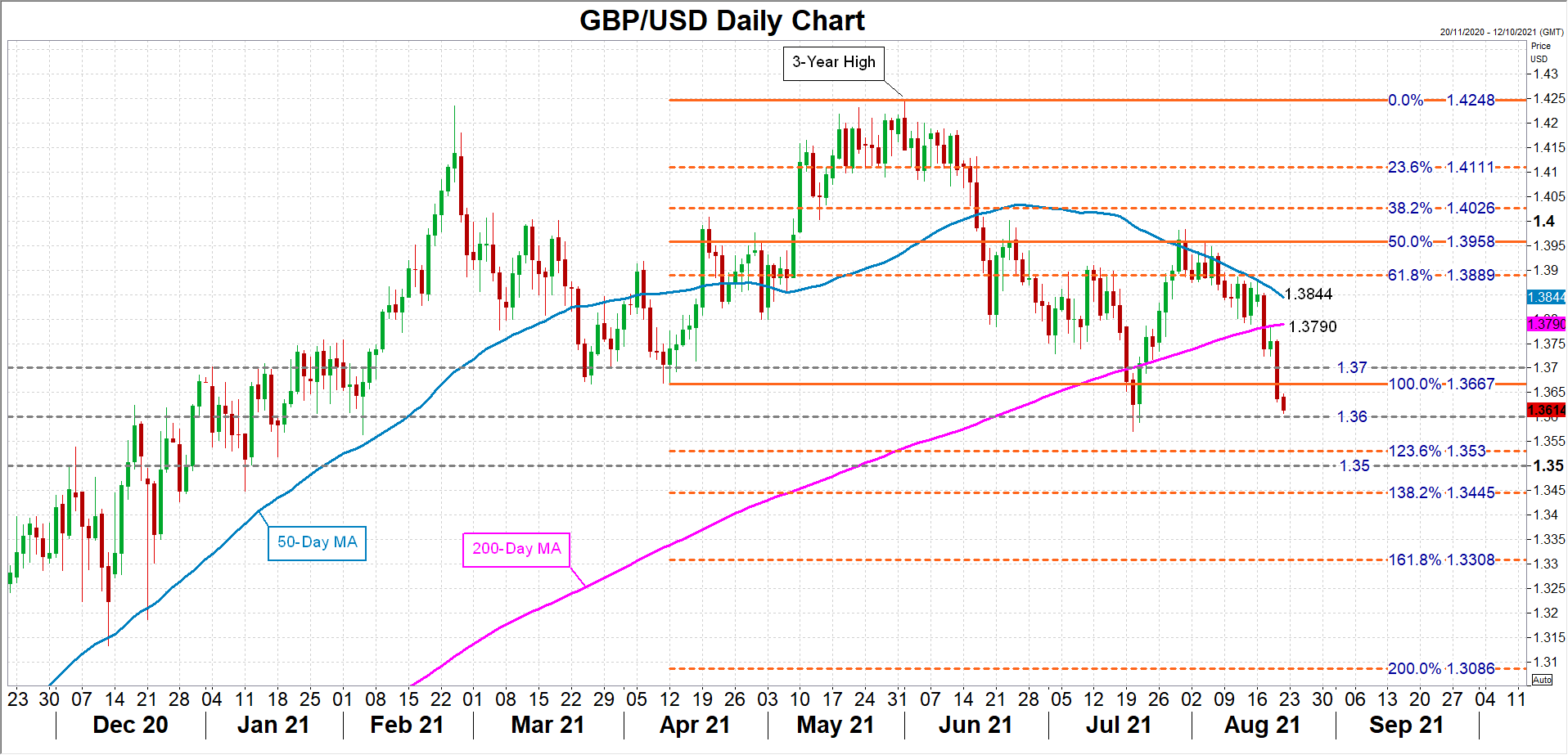
Tapering expectations should provide some support to cable as the latest risk-off drama plays out, and if the $1.36 level holds, pound/dollar could reverse higher. The key tests to the upside will come from the March/April lows around $1.3667, followed by the 50- and 200-day moving averages at 1.3844 and 1.3790, respectively.
EURUSD Is Possibly Bearish
Technical analysis
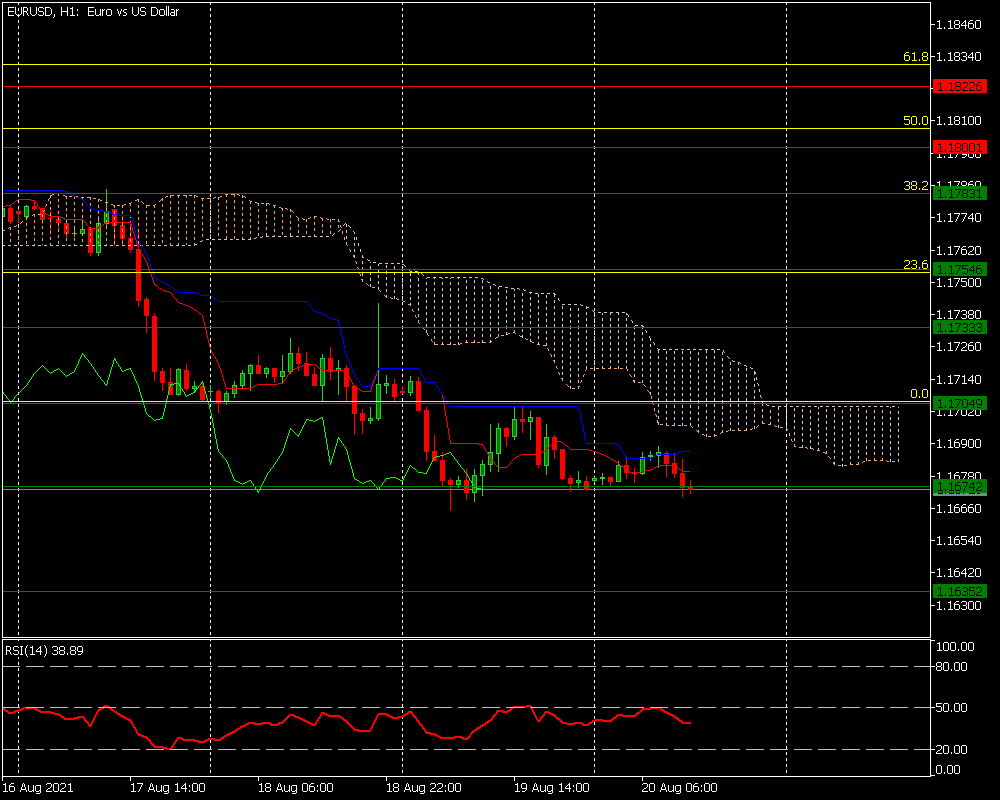
The RSI is under the line 50, indicating that a downtrend may prevail
The Ichimoku indicator displays a bearish sentiment.
What the possible outcomes are
In the most likely scenario, EURUSD may challenge the first support level of 1.16742
A pass below the first support level can move the price up lower towards 1.16550 and 1.16352.
Alternatively, the EURUSD pair may fail to break to the first support level and rebound towards 1.16900 and 1.17049.
Key levels
Support 1.16352 1.16550 1.16742
Resistance 1.16900 1.17049 1.17333
Pound Under Pressure
The British pound has steadied on Friday, after suffering sharp losses a day earlier. GBP/USD is currently trading at 1.3627, down 0.07% on the day.
The pound is hoping for a quick end to what has been a miserable week quickly. The currency has fallen 1.7% so far this week.
UK Retail Sales slide
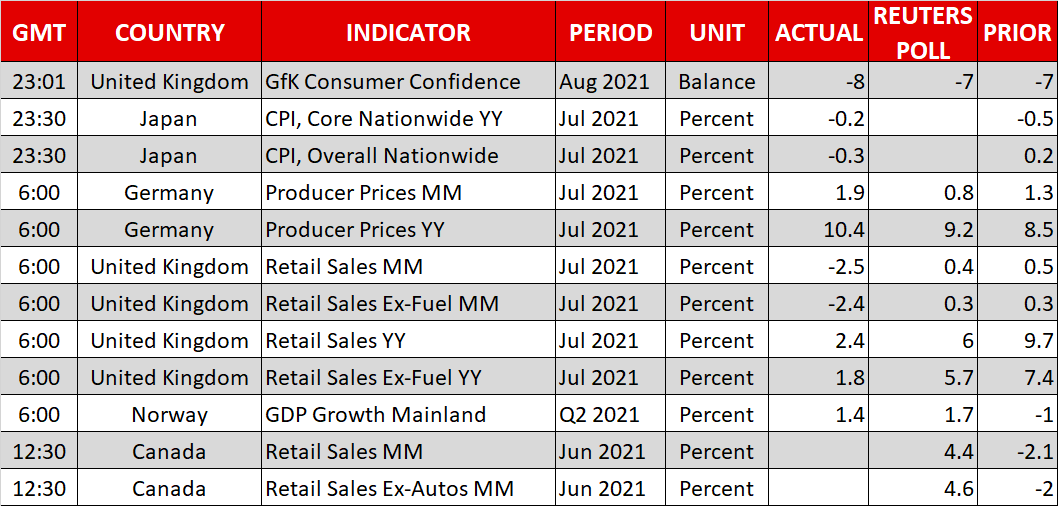
UK Retail Sales in July fell by 2.5% compared to June, well off the forecast of +0.4%. It was a similar story for Core Retail Sales, which came in at -.2.4%, versus 0.3% exp. Still, the reaction of the pound has been muted, as the picture isn’t nearly as grim if we look at the overall picture. Retail Sales were up 5.2% in the three months to July compared to the previous three months, and 5.8% higher than in February 2020, prior to Covid-19.
Nevertheless, the pound is in trouble, as the US dollar continues to roll. Sterling is closing in on its lowest level since February, and we could see the currency drop into 1.35-territory early next week.
Investors have been flocking to the safe-haven US dollar, as risk appetite has eroded due to surging infections rates of the delta variant of Covid. This has led to renewed lockdowns and health restrictions and could hamper the nascent global recovery.
The dollar has looked sharp post-FOMC, as the markets judged the Fed minutes to be hawkish, despite the lack of a timeframe for a tapering. With most members on board for a taper on either side of December, it’s clear that a taper is a question of when, rather than if, at this stage. The minutes stressed that there was no mechanical link between tapering and rate hikes. This is not really a new development, as the Fed has said in the past that it does not plan to raise rates before tapering is completed.
With risk appetite curbed by a resurgence in Covid and investors on alert for the announcement of a timeframe for tapering, the outlook for the US dollar remains positive.
GBP/USD Technical Analysis
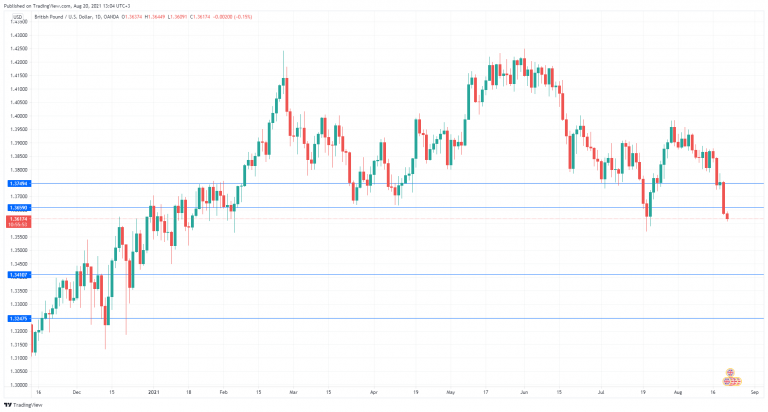
- On the upside, there is monthly resistance at 1.3659. Above, there is resistance at 1.3749
- There is support at 1.3409, followed by 1.3247
The Sharp Increasse In Delta Cases Worldwide Is Negatively Affeccting The Global Economic Recovery
US jobless claims fell to a pre-pandemic low of 348,000 (previously 377,000), indicating a recovery in the labor market. On the one hand, this is very good for the economy and the dollar index. On the other hand, the labor market recovery can influence the Federal Reserve, so it will begin to reduce the QE program, triggering massive sales in the financial markets. The US stock market ended Thursday's trading without a single dynamic. Index Dow Jones decreased by 0.19%, S&P 500 added 0.13% and NASDAQ added 0.11%. The FOMC minutes indicate that the Federal Reserve may begin cutting the QE program at any time, but analysts tend to think it will happen between September 22, 2021, and January 1, 2022. Investors are likely to be very cautious all this time, so the growth potential of indexes will be limited.
European stock indices closed in the red zone yesterday. The British FTSE 100 decreased by 1.5% (a 3 month low), German DAX decreased by 1.25%, French CAC 40 lost 2.4%. The European Central Bank and the Bank of England are not going to change their monetary policy at the moment. Given Europe's conservatism, the EU is likely to be the last on the list to tighten monetary policy.
The gold situation remains unchanged. Now it is important to know when the Fed will start cutting the QE program. Reducing the Fed's debt purchases will raise US government bond yields, which will lead to a sharp drop in gold. But as long as the monetary policy remains unchanged, gold and silver prices will rise.
Oil prices fell to a 3-month minimum. The sharp increase in Delta cases around the world is worsening the outlook for global fuel demand.
The People's Bank of China (PBOC) kept the loan prime rate (LPR) unchanged. China aims to build modern socialism in the country. At a meeting on financial and economic issues, Chinese President Xi Jinping said that excessive income should be combated and called on citizens and companies with high incomes to give back more to society for the prosperity of all. Amid the news, Hong Kong's index fell by 2.28% to a low this year, while China's blue chips decreased by 2.4%. In July, Japan's consumer price index fell by 0.3% on a year-on-year basis. It didn’t meet the forecasts of economists, who had expected a 0.5% decline. The core consumer price index, which excludes changes in food and fuel prices, fell by 0.2% on a year-on-year basis, beating economists' expectations. The coronavirus continues to constrain economic activity in most cities across the country. Seven more prefectures are under a state of emergency. Analysts believe the quarantine will hit the already weak household incomes. Japan's Nikkei index decreased by 0.87% to a seven-month low. Quarantine restrictions in Sydney were extended for another month.
Main market quotes:
- S&P 500 (F) 4,405.80 +5.53 (+0.13%)
- Dow Jones 34,894.12 −66.57 (−0.19%)
- DAX 15,765.81 −200.16 (−1.25%)
- FTSE 100 7,058.86 −110.46 (−1.54%)
- USD Index 93.56 +0.42 (+0.45%)
Important events for today:
- Japan National Core Consumer Price Index (m/m) at 02:30 (GMT+3);
- China PBoC Loan Prime Rate (m/m) at 04:30 (GMT+3);
- UK Retail Sales (m/m) at 09:00 (GMT+3);
- Canada Retail Sales (m/m) at 15:30 (GMT+3).
UK Retail Sales Data Highlights Recovery Losing Momentum
Notes/Observations
- UK July retail sales data misses consensus suggesting recovery losing momentum.
- UK July budget deficit narrows to almost half of pandemic level.
Asia
- Japan July National CPI Y/Y: -0.3% v -0.4%e; CPI ex-fresh food (core) Y/Y: -0.2% v -0.4%e.
- China Monthly 1-year and 5-year Loan Prime Rate setting unchanged; but future rate cut expectations growing.
- China said to have postponed a vote to add anti sanctions law to Hong Kong Law (unexpected). Legislation which would punish companies that abide by the US sanctions or do not carry out China's law.
Coronavirus
- Sydney lockdown extended until end of Sept.
- New Zealand lockdown level 4 lockdown to be extended until at least early next week.
- Three fully vaccinated Senators (Independent King, Republican Wicker and Democrat Hickenlooper) tested positive for C-19.
Europe
- Germany Finance Ministry Monthly Report stated that the economy was on track for stronger growth in Q3.
Americas
- Fed Chair Powell to deliver a speech on the economic outlook at the Jackson Hole Symposium on Aug 27th.
- Treasury Sec Yellen letter to Senators noted the Delta variant might challenge local markets and the economy; States could use relief funds to assist the unemployed.
Speakers/Fixed income/FX/Commodities/Erratum
Equities
- Indices [Stoxx600 -0.18% at 466.42, FTSE -0.19% at 7,045.44, DAX -0.35% at 15,709.90, CAC-40 -0.23% at 6,590.55, IBEX-35 +0.16% at 8,916.00, FTSE MIB -0.39% at 25,828.50, SMI -0.33% at 12,362.90, S&P 500 Futures -0.42%].
- Market Focal Points/Key Themes: European indices open mixed; ; ; FTSE 100 supported by M&A; Morrisons agrees to be acquired by CD&R at improved price, Fortress yet to respond; Norway Royal Salmon to be acquired by SalMar; focus on release of EMA’s CHMP decisions later; earnings expected in the upcoming US session include Foot Locker, The Buckle and Deere.
Equities
- Consumer discretionary: Marks & Spenser [MKS.UK] +11% (trading update), Norway Royal Salmon [NRS.NO] +14% (offer), WM Morrison Supermarkets [MRW.UK] +4% (confirms offer).
- Healthcare: AstraZeneca [AZN.UK] -1% (COVID-19 drug trial results).
- Industrials: Heijmans [HEIJ.NL] -9% (earnings).
Speakers
- Netherlands Bureau for Economic Policy Analysis (CPB) updated its growth outlook which raised 2021 GDP growth from 3.2% to 3.8%and cut 2022 GDP growth from 3.3% to 3.2%.
- Turkey Fin Min Elvan saw 2021 GDP growth over 8.0%; Reiterates govt’s priority was to reverse inflation tendency path.
- Libya PM Dbeibah pledged to hold elections in December.
Currencies/ Fixed income
- USD maintained its firm tone aided by safe-haven flows aide by worries about widespread coronavirus infections. Greenback also getting support from prospect of a looming Fed taper which continued to throw cold water on risk appetite.
- GBP/USD holding above the 1.36 level after UK July retail sales registered its sharpest decline since the economy was in lockdown in January.
- EUR/USD reproaching its 9-month low as the pair remained below the 1.17 handle.
Economic data
- (DE) Germany July PPI M/M: 1.9% v 0.8%e; Y/Y:10.4 % v 9.2%e.
- (UK) July Retail Sales (ex-auto/fuel) M/M: -2.4% v +0.1%e; Y/Y: 1.8% v 5.8%e.
- (UK) July Retail Sales (including auto/fuel) M/M: -2.5% v +0.2%e; Y/Y: 2.4% v 5.9%e.
- (UK) July Public Finances (PSNCR): -£2.3B v +£11.2B prior; Net Borrowing: £9.6B v £11.0Be; Central Government NCR: £1.8B v £19.2B prior; PSNB (ex-banking groups): £10.4B v £11.9Be.
- (NO) Norway Q2 Overall GDP Q/Q: +1.1% v -0.6% prior; GDP Mainland Q/Q: 1.4% v 1.6%e.
- (NO) Norway Jun Overall GDP M/M: 0.8% v 1.0% prior; GDP Mainland M/M: 0.7% v 1.3%e.
- (MY) Malaysia mid-Aug Foreign Reserves: $111.3B v $111.1B prior.
- (SE) Sweden Q2 Industry Capacity: 91.3% v 89.7% prior.
- (SE) Sweden Q2 Total No. of Employees Y/Y: +1.6% v -1.5% prior.
- (CN) Weekly Shanghai copper inventories (SHFE): 85.6K v 93.0K tons prior.
- (TW) Taiwan July Export Orders Y/Y: 21.4% v 21.5%e.
- (PL) Poland July Real Retail Sales M/M: 2.1% v 3.0%e ; Y/Y: 3.9% v 4.7%e; Retail Sales Y/Y: 8.9% v 8.1%e.
- (PL) Poland July Construction Output Y/Y: 3.3% v 6.8%e.
- (RU) Russia Narrow Money Supply w/e Aug 13th (RUB): 14.33T v 14.25T prior.
- (TW) Taiwan Q2 Current Account Balance: $B v $26.0B prior.
- (BE) Belgium Aug Consumer Confidence Index: 5 v 8 prior.
Fixed income issuance
- None seen.
Looking ahead
- 05:25 (EU) Daily ECB Liquidity Stats.
- 05:30 (IN) India to sell combined INR260B in 2023, 2031 and 2061 bonds.
- 05:30 (ZA) South Africa to sell combined ZAR1.2B in I/L 2033, 2038 and 2046 Bonds.
- 06:00 (IE) Ireland July PPI M/M: No est v 0.9% prior; Y/Y: No est v -5.3% prior.
- 06:00 (UK) DMO to sell £3.0B in 1-month, 3-month and 6-month bills (£0.5B, £1.0B and £1.5B respectively).
- 06:45 (US) Daily Libor Fixing.
- 07:00 (IN) India announces upcoming bill issuance (held on Wed).
- 07:30 (IS) Iceland to sell 2024 and 2030 RIKB Bonds.
- 07:30 (IN) India Weekly Forex Reserve w/e Aug 13th: No est v $621.5B prior.
- 08:00 (UK) Daily Baltic Dry Bulk Index.
- 08:30 (CA) Canada Jun Retail Sales M/M: +4.5%e v -2.1% prior; Retail Sales (ex-auto) M/M: +4.5%e v -2.0% prior.
- 11:00 (EU) Potential sovereign ratings after European close.
- (AR) Argentina July Budget Balance (ARS): No est v -153.2B prior.
- (MX) Mexico Citibanamex Survey of Economists.
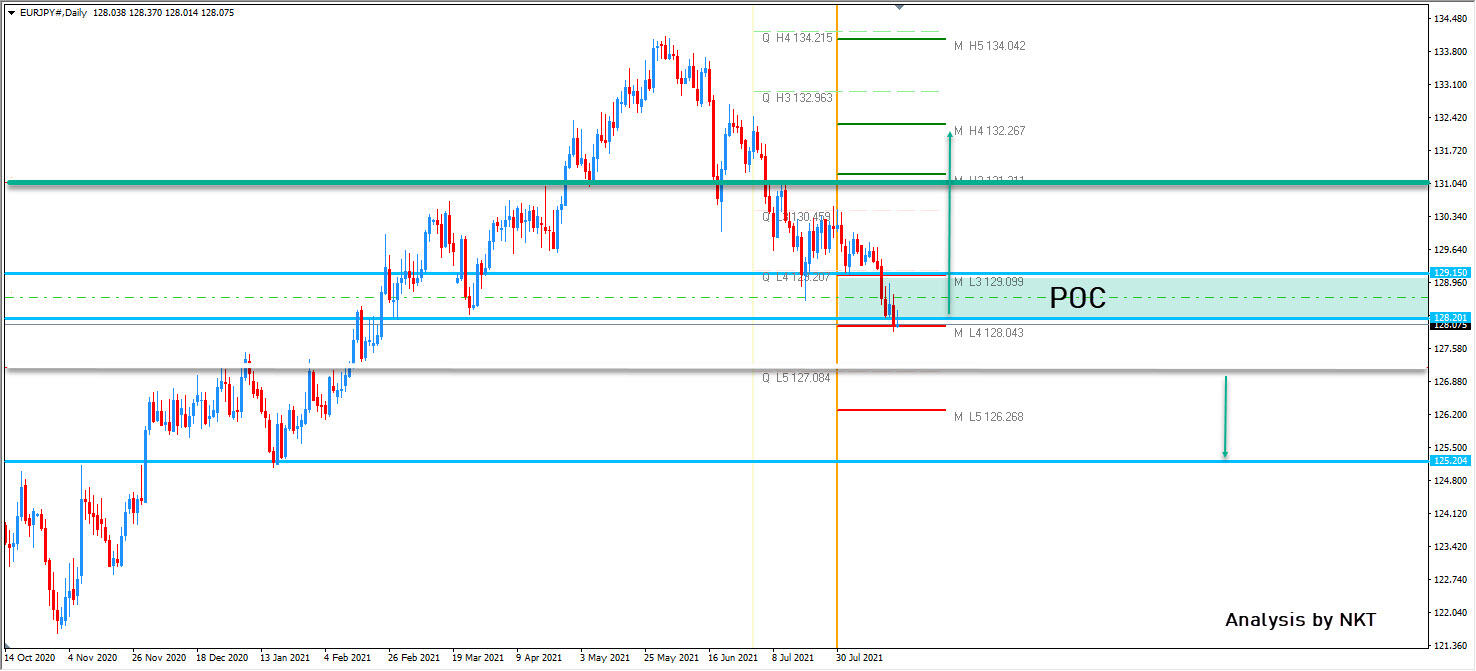
EUR/JPY Daily Chart Might Turn Bullish
The EUR/JPY might make a possible bounce in the zone as the price is supported by historical buying.
We might see a nice move in EUR/JPY as the price is in the POC zone. If 127.00 stays strong we could see rejections between 127.10-128.00 and the market might go up. If that happens, targets are 130.45, 131.30 and 132.26. This is a possible swing trade idea and it can take some time to develop.
Commodity Currencies In Agony, Stocks Undecided
- Dollar stands tall as commodity FX continues to break down
- Big tech keeps US stocks afloat, Chinese markets sink
- All eyes on Fed’s Jackson Hole symposium next week
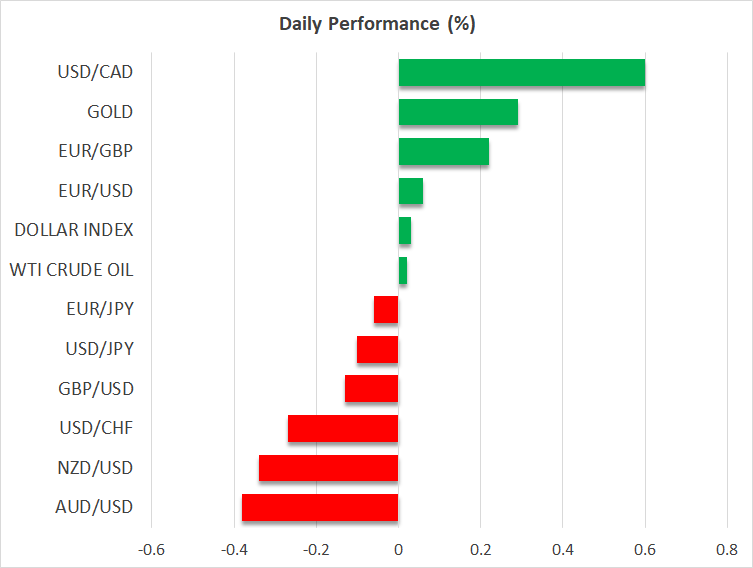
Commodity currencies bite the dust
It has been a wild week for financial markets, dominated by concerns that the Delta outbreak will put the brakes on the global economic recovery. Even though many of the major economies are protected by a vaccine shield, the fear is that the virus could cool demand in developing markets, which ultimately comes back to bite everyone.
Adding fuel to the pessimism has been the relentless regulatory crackdown in China, where Beijing continues to tighten the screws on the tech sector. The nation just passed a strict data protection law, the latest in a long series of moves to align the Chinese economy with the party’s social values.
All this is playing out against the background of a slowing Chinese economy, amid a fading credit impulse and new restrictions to battle the Delta variant. As a result, commodities and commodity-linked currencies have been taken to the cleaners, with the loonie, aussie, and kiwi all headed for a weekly loss of around 3% against the mighty dollar. Crude oil and iron ore prices tell the same story.
While most charts are painting a scary picture right now, past episodes of covid-fueled panic didn’t last very long. This is almost a self-correcting mechanism. If virus fears escalate enough, there comes a point where investors begin to anticipate greater liquidity injections from central banks and more fiscal firepower from governments, which ultimately calms market nerves. That said, it might get even uglier before we reach that point.
Wall Street fights back
The volatility in equity markets is starting to reach a crescendo. Wall Street managed to hang on for dear life on Thursday, with the major indices erasing some early losses to close virtually unchanged, propped up by tech heavyweights like Microsoft. However, futures are pointing lower again on Friday.
While indices like the S&P 500 haven’t fallen much, there is a major sector rotation taking place under the hood. Small caps and unprofitable ‘growth’ stocks have gotten smoked whereas the tech titans stood their ground, highlighting that quality tech has almost transformed into a defensive play during this crisis.
The overall message seems clear. Small caps will either suffer from a global slowdown or from a withdrawal of Fed liquidity, as investors move higher along the quality spectrum. Neither will be as damaging for mega-cap US tech.
Of course, China is a different beast. Tech stocks have been getting slaughtered lately as Beijing’s regulatory crusade continues, with the pain now spilling over into other sectors like healthcare and alcohol producers amid concerns the hammer will fall on those next. Hong Kong’s Hang Seng index lost almost 2% today to touch new lows for the year.
Dollar awaits Powell’s signals
The calendar is almost empty today, with the only noteworthy release being Canada's retail sales for July. It has been a tremendously difficult week for the loonie despite the nation’s inflation rate rising further, as the currency realigned itself with suffering oil prices.
On the other hand, all this pessimism has put the wind back into the dollar’s sails, which won the battle against some crucial technical levels across multiple charts and is now headed for a healthy weekly gain.
Whether all this lasts will depend on next week’s speech by Fed Chairman Powell at the Jackson Hole economic symposium. Will he lay the groundwork for a September taper announcement or will he play it slow? The answer will likely drive the dollar for now, even though it doesn’t matter much in the big picture whether tapering is announced in September or November.