Sample Category Title
Fed Rosengren wouldn’t want to wait any later than December on tapering
Boston Fed President Eric Rosengren said the US had over 900k jobs growth for two months in a row and unemployment rate dropped by half a percent to 5.4%. He added, "if we get another strong labor market report, I think that I would be supportive of announcing in September that we are ready to start the taper program."
"I think it's appropriate to start in the fall. That would be October or November," Rosengren told CNBC. "I certainly wouldn't want to wait any later than December. My preference would be probably for sooner rather than later." He also said that "there's no reason to drag it out as long as the economy continues to progress as we expect."
On the other hand, he'd prefer to see more progress before moving on to raising interest rate. "The criteria for starting to raise rates is that we see outcomes that are consistent with sustainable inflation at a little bit above 2%," he reiterated Fed's general position.
(RBA) Minutes of the Monetary Policy Meeting of the Reserve Bank Board
Videoconference – 3 August 2021
Members present
Philip Lowe (Governor and Chair), Guy Debelle (Deputy Governor), Mark Barnaba AM, Wendy Craik AM, Ian Harper AO, Carolyn Hewson AO, Steven Kennedy PSM, Carol Schwartz AO, Alison Watkins
Others participating
Luci Ellis (Assistant Governor, Economic), Christopher Kent (Assistant Governor, Financial Markets)
Anthony Dickman (Secretary), Penelope Smith (Deputy Secretary), Michele Bullock (Assistant Governor, Financial System), Alexandra Heath (Head, International Department), Bradley Jones (Head, Economic Analysis Department), Jonathan Kearns (Head, Financial Stability Department), Marion Kohler (Head, Domestic Markets Department)
International economic developments
Members commenced their discussion of international economic developments by noting that the global economy had continued to recover from the largest contraction in decades, supported by a substantial fiscal and monetary policy response and the easing of measures to contain the virus in some countries. There were widening gaps in the outlook across economies, however, which largely reflected differences in health outcomes and progress with the vaccination of populations. Higher vaccination rates and the associated relaxation of containment measures had enabled a rapid recovery in several advanced economies, but in countries with low vaccine coverage, the rapid spread of the Delta variant of COVID-19 was tempering the economic outlook. Access to vaccines was an ongoing concern for some emerging market countries and high case numbers were putting health systems under considerable strain.
The medium-term outlook for Australia's major trading partners generally remained solid. The Chinese economy continued to grow in line with pre-pandemic expectations. In a number of economies in Asia, strong global demand for goods had led to stronger export growth and increased investment in manufacturing capacity, although a resurgence of the virus and restrictions on activity in some countries were weighing on domestic demand. The recovery was expected to continue in countries in North America and Europe where progress with vaccination programs allowed for an easing of containment measures. Fiscal settings remained highly stimulatory in the United States.
Members noted that substantial spare capacity remained in most advanced economies' labour markets, despite the strong recovery in economic activity. In contrast to Australia, employment, participation rates and hours worked remained well below pre-pandemic levels in many countries. Lower labour force participation in some countries reflected the impact of prolonged school closures on child care responsibilities, lingering health concerns and ongoing provision of wage subsidies.
Headline inflation had picked up in a number of advanced economies. However, this was in large part the result of pandemic-related disruptions, including supply chain bottlenecks and unusually high shipping costs, which were likely to be temporary. Members observed that there were both upside and downside risks to global inflation in the near term, and that the outlook for inflation in the medium term would largely depend on how quickly spare capacity in labour markets was absorbed and how wages responded to this.
Domestic economic developments
Turning to domestic economic developments, members noted that the recovery had established strong momentum prior to recent outbreaks of the Delta variant of COVID-19. GDP had recovered to its pre-pandemic level in the March quarter and timely indicators suggested that growth in private demand had remained strong in the June quarter. Labour market conditions had also strengthened further in the June quarter.
More recently, outbreaks of the Delta variant and accompanying lockdowns had introduced a high degree of uncertainty to the outlook for the second half of 2021. Members observed that economic activity and employment were expected to decline in the September quarter. The high transmissibility of the Delta variant raised the possibility that a more gradual reopening of the economy in affected areas would be needed compared with earlier episodes of lockdown restrictions. Under the assumption that further lengthy lockdowns would be limited, the economy was forecast to rebound from the current setback later in the year as restrictions are eased, consistent with the previously observed pattern in Australia and overseas.
Members noted that the prospects for recovery beyond the effects of the recent virus outbreaks are supported by a number of factors. These include the underlying momentum in the economy and strengthened balance sheets prior to the recent virus outbreaks, the substantial fiscal support offered to households and businesses in areas affected by lockdowns, progress with the vaccination rollout and the ability of the economy to adapt. In the meantime, health outcomes would continue to present the main source of uncertainty for the economic outlook.
Beyond the near term, the level of output at the end of the forecast period in 2023 was expected to be a little higher than had been forecast in May, underpinned by stronger private investment and public demand. Under the baseline scenario, GDP was forecast to grow by a little above 4 per cent over 2022, and around 2½ per cent over 2023.
Members noted that household spending had been tracking strongly in the months prior to the recent lockdowns. Consumption had continued to recover over April and May before restrictions affected spending in June. Timely indicators suggested that household consumption would contract in the September quarter in response to the extended lockdown in Greater Sydney and the shorter lockdowns elsewhere. This was expected to account for much of the quarterly decline in GDP. Later in 2021 and early the following year, consumption was forecast to recover in affected areas. The outlook for consumption in 2022 and 2023 was expected to be supported by increased opportunities for spending on discretionary services as restrictions are eased, together with higher household income and wealth. The household saving ratio was expected to increase temporarily in the September quarter, reflecting reduced consumption in areas affected by the lockdowns, before declining steadily thereafter.
The outlook for dwelling and business investment would continue to be supported by accommodative financing conditions and fiscal policy measures. Recent lockdowns and restrictions on construction activity in Greater Sydney and elsewhere were anticipated to affect both residential and non-residential investment in the September quarter, but this was generally expected to lead to plans being deferred rather than cancelled. Residential building approvals had eased, as expected, following the end of the application period for the HomeBuilder program. However, approvals remained at a high level and the large volume of residential building work in the pipeline was likely to support dwelling investment for some time. The recovery in non-mining investment over the forecast period was expected to be led by spending on machinery and equipment, underpinned by tax incentives, high levels of business confidence, declining spare capacity and strong business balance sheets. Mining investment was at its highest level since 2017 and a further gradual increase was expected over the forecast period, mainly to replace existing capacity. Growth in mining investment was likely to be modest relative to the very high levels of commodity prices.
Members noted that conditions in established housing markets remained strong, in contrast to the experience during the extended lockdowns in 2020. National housing prices had increased further in July following a 6 per cent increase in the June quarter. Prices for detached houses and units in Sydney had continued to increase in July despite the lockdowns. Owner-occupiers had accounted for a large share of purchases in the period to mid 2021, but investor activity had picked up in recent months. The number of newly listed properties for sale had declined recently; however, online auctions were reported to have become more common and sales activity had held up well compared with the experience during the lockdowns in 2020. Members also noted that advertised rents for houses had continued to increase in recent quarters. In regional areas and smaller cities, growth in rents had been strong and vacancy rates remained very low. Rental conditions in apartment markets in Sydney and Melbourne had begun to stabilise following the earlier decline in rents.
Members observed that labour market conditions had continued to improve at a faster-than-expected pace through the June quarter. The unemployment rate had declined to 4.9 per cent in June and labour force participation remained around record highs. The rate of underemployment was around its lowest level in a number of years. Growth in full-time employment had been particularly strong. Job vacancies had been at record high levels and there had been ongoing reports of labour shortages in parts of the economy.
Improvements in labour market conditions were expected to reverse temporarily in the September quarter as a result of the lockdowns in Greater Sydney and other parts of the country. The restrictions on activity were expected to result in a substantial decline in average hours worked. Labour force participation was also expected to decline for a period as people delayed searching for work while restrictions on mobility remain in place, as had been seen during previous lockdowns. Some employment losses were expected, although a fall in labour force participation was anticipated to limit the increase in the unemployment rate. The high level of job vacancies and increased fiscal support would also help limit job losses. However, much would depend on health outcomes and the duration of the lockdowns.
Looking further ahead, members noted that the eventual lifting of restrictions and underlying strength in economic conditions are expected to result in the labour market recovery regaining momentum. In the baseline scenario, the unemployment rate was forecast to decline to around 4¼ per cent by the end of 2022 and to 4 per cent by the end of 2023, which was lower than previously forecast. Members noted that, in the preceding half-century, this was a level that had been reached only briefly during the mining investment boom and in the early 1970s, when the structure of the economy had been very different.
With the unemployment rate expected to decline to a lower level than previously forecast, wages growth and inflation were also expected to pick up at a slightly faster pace. The Wage Price Index was forecast to increase gradually to around 2¾ per cent by the end of 2023, and broader measures of growth in labour costs were expected to be running at a slightly faster pace by that time.
CPI inflation increased to 3.8 per cent over the year to the June quarter, although most of this increase reflected the reversal of earlier large falls in certain prices related to the pandemic. Much of the 0.8 per cent increase in the June quarter was accounted for by large increases in the prices of fuel and fruit and vegetables, and the unwinding of earlier electricity rebates. Members observed that there would continue to be some divergence between headline and underlying inflation as some of the recent one-off boosts to inflation were unwound. Underlying inflation had stabilised recently, and was a little below ½ per cent in the June quarter and 1¾ per cent over the year. Underlying inflation was likely to remain subdued over subsequent quarters, given the expected decline in activity in the September quarter and the absence of broad-based inflationary pressures, and then gradually increase to 2¼ per cent by the end of 2023.
Members discussed the balance of risks to the forecasts. The baseline scenario assumed that the domestic vaccine rollout would accelerate in the months ahead, reducing the frequency and severity of lockdowns and allowing the international border to be reopened gradually from mid 2022. It also assumed that the Greater Sydney lockdown would extend through the September quarter, with some further brief and/or less severe restrictions assumed to occur in parts of Australia in the December quarter.
A downside scenario assumed more extended and widespread lockdowns and a more gradual reopening of the international border than in the baseline scenario. In this scenario, restrictions on the consumption of discretionary services, coupled with precautionary behaviour, would be expected to result in a higher rate of household saving and lower household consumption. Private investment and services exports would also be lower. Lower activity would result in the unemployment rate rising in subsequent months and remaining above 5 per cent over coming years. In this scenario, underlying inflation would be expected to remain in the range of 1¼–1½ per cent through to 2023.
Members also considered an upside scenario premised on the assumption that the virus would be contained more quickly than in the baseline scenario, with household consumption and private investment increasing rapidly once containment measures are lifted. In this scenario, households would be more willing and able to consume out of their savings and wealth than in the baseline scenario, supported by higher household income and fewer restrictions on discretionary services. International travel would recover more quickly once the international border was reopened, boosting services exports. In this scenario, the unemployment rate would be expected to decline more rapidly and by more than in the baseline scenario, with inflation increasing to the upper half of the target range by the end of 2023.
International financial markets
Yields on longer-term government bonds had fallen over preceding months in many countries, as optimism about the global recovery was tempered by the rapid spread of the Delta variant of COVID-19 and the risks of future variants emerging. This had unwound much of the increase in yields seen globally earlier in the year, which had reflected a faster-than-expected economic recovery and a rise in inflation expectations to be more consistent with central banks' inflation targets. Much of the recent declines in longer-term bond yields in the United States and Australia had reflected declines in real yields.
Despite the renewed concerns over the pace of the global economic recovery, market pricing implied that the expected path of central bank policy rates was still higher than at the start of the year. Some central banks were widely expected to lift policy rates before the end of 2021 because they were nearer to their inflation goals, while other central banks were not expected to raise their policy rates for a number of years.
Several central banks had reduced their purchases of government bonds, or were soon expected to do so. Members observed that the Reserve Bank of New Zealand had halted its asset purchases in July and market pricing implied that it was expected to start raising the policy rate before the end of 2021. This had followed stronger-than-expected data, which suggested that capacity constraints were evident in the New Zealand economy.
Financing conditions for businesses in advanced economies had remained highly favourable. In corporate bond markets, spreads to risk-free rates had remained low and bond issuance had remained around, or in some cases above, pre-pandemic levels. Equity prices had remained high in these countries, including Australia. Share prices in the United States and Europe had been supported by recent positive earnings reports.
In China, equity prices had fallen sharply following a tightening of regulations on private-sector companies in the technology and education sectors. More broadly, financial conditions in China had been supported by an unexpected reduction in reserve requirements for banks. By contrast, some other emerging market central banks had started to raise their policy rates in response to rising inflation, despite slow recoveries in output.
The US dollar had appreciated against most currencies over the preceding couple of months. The Australian dollar had correspondingly depreciated to around its lowest levels in 2021. Members noted that this had occurred despite commodity prices being at high levels.
Domestic financial markets
In Australia, the Bank's policy measures continued to underpin very low interest rates. Members observed there had been little movement in yields following the announcement of the Board's decisions in July to maintain the yield target for the April 2024 bond and to continue purchasing government bonds, following the completion of the current program in early September 2021, at a reduced rate of $4 billion per week until at least mid November 2021.
With the ongoing lockdowns and other containment measures affecting economic conditions and the outlook in the near term, yields on longer-term Australian government bonds had declined by a little more than those globally, to be back around early 2021 levels. A number of market economists had suggested that the Board might reconsider its decision to taper bond purchases. Market pricing continued to imply expectations that the cash rate would increase to around 25 basis points in the second half of 2022, but the expected path thereafter was a little lower than it had been a month earlier.
Members discussed the fact that banks' funding costs and lending rates had drifted down to new lows. Funding costs had benefited from significant final drawdowns from the Term Funding Facility in June and deposit rates having edged down further. In turn, average interest rates on outstanding housing and business loans had also continued to drift lower.
Credit growth had picked up in June for both households and businesses, although members noted that these data largely predated the recent lockdowns. Firms' demand for credit had picked up strongly in June, with sizeable contributions from large and medium-sized businesses. This potentially reflected the pick-up in business confidence in preceding months and followed subdued demand over much of the previous year. Demand for housing finance had strengthened further in June, with growth in housing credit rising to nearly 6¾ per cent on a six-month-ended-annualised basis. Overall, it appeared that banks' lending standards were being maintained. Non-bank housing credit growth had been particularly strong over recent months, with non-bank lenders benefitting from favourable conditions in securitisation markets.
Members noted that measures to contain the virus in a number of states might result in a reduction in demand for new loans from July, particularly if these measures remained in place for an extended period. Banks had offered support to household and business borrowers affected by the lockdowns, and the Australian Prudential Regulation Authority had provided regulatory relief for these support measures, as it had done in 2020.
Considerations for monetary policy
In considering the policy decision, members observed that the recent outbreaks of the Delta variant of COVID-19 had interrupted the recovery and that the near-term outlook was highly uncertain and dependent on health outcomes. However, the economy had entered the current episode of outbreaks and lockdowns with more momentum than previously expected, and fiscal and monetary policy support was already cushioning the economic effects. Domestic financial conditions remained highly accommodative and the fiscal responses by the Australian Government and the state and territory governments were providing welcome support to the economy at a time of significant short-term disruption.
Experience to date had been that, once virus outbreaks were contained, the economy bounced back quickly. The vaccination program would assist with containment of the virus and longer-term economic recovery. Although uncertainty had increased, the central scenario was still that the Australian economy would grow strongly again next year. Prior to the recent outbreaks, the labour market recovery had been stronger than expected. Job vacancies had been high and there had been ongoing reports of labour shortages in parts of the economy. The unemployment rate was expected to increase in the near term, but then recover quickly when restrictions are eased and trend lower over 2022 and 2023 to reach around 4 per cent at the end of 2023.
Members observed that wages growth and underlying inflation would remain subdued for some time yet, despite the positive medium-term outlook for output and employment. Headline inflation had spiked to be temporarily above the target in the June quarter as earlier pandemic-related price declines were unwound. But, in underlying terms, inflation remained low. A pick-up in both wages growth and underlying inflation was expected, but this pick-up was likely to be only gradual. In the Bank's central scenario, it would take some years for the stronger economy to feed through into wage and price increases that would be consistent with the inflation target. Australia had no recent experience of unemployment rates that had been sustained at the low levels being forecast. A significant source of uncertainty was how wages and prices would behave at these low levels of unemployment.
Members noted that housing markets had continued to strengthen, with prices rising in all major markets. Housing credit growth had also increased. Given the environment of strong demand for housing, rising housing prices and low interest rates, members continued to emphasise the importance of maintaining lending standards and carefully monitoring trends in borrowing.
The Board remained committed to maintaining highly accommodative monetary conditions to support a return to full employment in Australia and inflation consistent with the target. Together, the low level of the cash rate, the bond purchase program, the yield target and the ongoing funding that had been provided under the Term Funding Facility were providing substantial support to the Australian economy in the face of the current lockdowns and the expected resumption of the economic expansion.
At its July meeting, the Board had decided to continue with the bond purchase program at a reduced rate of $4 billon a week, once the second $100 billion of purchases is complete in September 2021. This adjustment reflected the better-than-expected progress that had been made towards the Bank's goals and the improved outlook. The Board had agreed in July to keep the rate of bond purchases under review and adjust the rate of purchases in either direction as appropriate.
The current virus outbreaks and lockdowns had interrupted the recovery and many households and businesses were facing difficult conditions. Members therefore considered the case for delaying the tapering of bond purchases to $4 billion a week currently scheduled for September 2021. They noted that the outlook for the economy is for a resumption of strong growth in 2022. Members judged that any additional bond purchases would have their maximum effect at that time, with only a marginal effect at present, which is when the extra support might be required.
Recognising that fiscal policy is a more appropriate instrument than monetary policy for providing support in response to a temporary, localised reduction in incomes, members welcomed the substantial fiscal measures that had been announced. Given these considerations, the Board reaffirmed the previously announced change in the rate of bond purchases. That said, the bond purchase program will continue to be reviewed in light of economic conditions and the health situation, and their implications for the expected progress towards full employment and the inflation target. The Board would be prepared to act in response to further bad news on the health front should that lead to a more significant setback for the economic recovery. In any event, the Board will not increase the cash rate until actual inflation is sustainably within the 2 to 3 per cent target range. The central scenario for the economy is that this condition will not be met before 2024. Meeting this condition will require the labour market to be tight enough to generate wages growth that is materially higher than it is currently.
The decision
The Board reaffirmed the existing policy settings, namely:
- maintain the cash rate target at 10 basis points and the interest rate on Exchange Settlement balances of zero per cent
- maintain the target of 10 basis points for the April 2024 Australian Government bond
- continue to purchase government securities at the rate of $5 billion a week until early September 2021 and then $4 billion a week until at least mid November 2021.
Eco Data 8/17/21
[php_everywhere instance="1"]
RBNZ to Lift Rates, What to Expect
The Reserve Bank of New Zealand (RBNZ) is almost certain to raise interest rates when it concludes its meeting at 02:00 GMT Wednesday. Markets have already fully priced in a regular rate increase and are also assigning a small chance for a ‘double’ hike. The kiwi dollar could be disappointed in case it is just a ‘single’ rate hike, but the overall trend seems positive, especially against the euro and yen.
Overheating
The New Zealand economy is firing on all cylinders. The government went for draconian lockdowns last year, closing down its borders and unleashing a tremendous amount of spending to keep the economy going. As a result, the island nation is virtually virus-free and the economy is booming.
Unemployment is back to pre-crisis levels, economic growth has been impressive, the housing market is scorching hot, and inflation is firing up. The striking part is that this inflation episode probably isn’t ‘transitory’, as wage growth dynamics have started heating up. When you run a closed-borders economy that is almost at full employment, workers suddenly gain much more bargaining power in wage negotiations.
Reflecting this, recent business surveys show that wage pressures are rising. Inflation expectations have also shot higher lately. This is absolutely crucial. It implies that inflationary pressures won’t cool just because supply chain disruptions will fade, like in other economies.
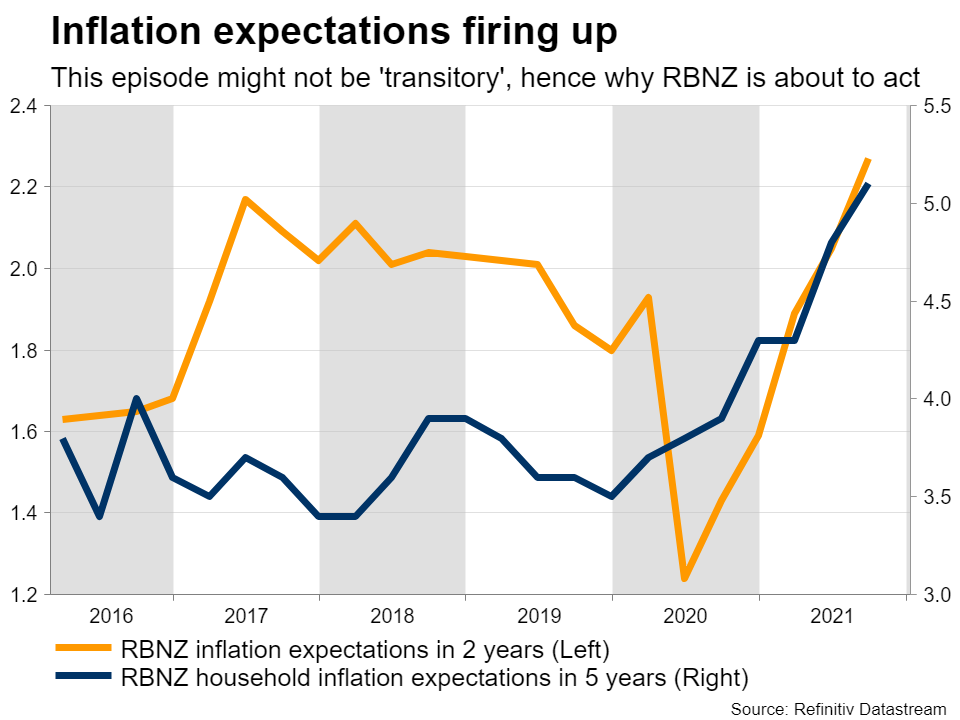
Therefore, with the economy about to overheat, it is high time for the Reserve Bank to step on the brakes. That is done by raising interest rates. Higher rates will ultimately slow down borrowing and spending in the economy, helping to keep inflation under control.
Single or double?
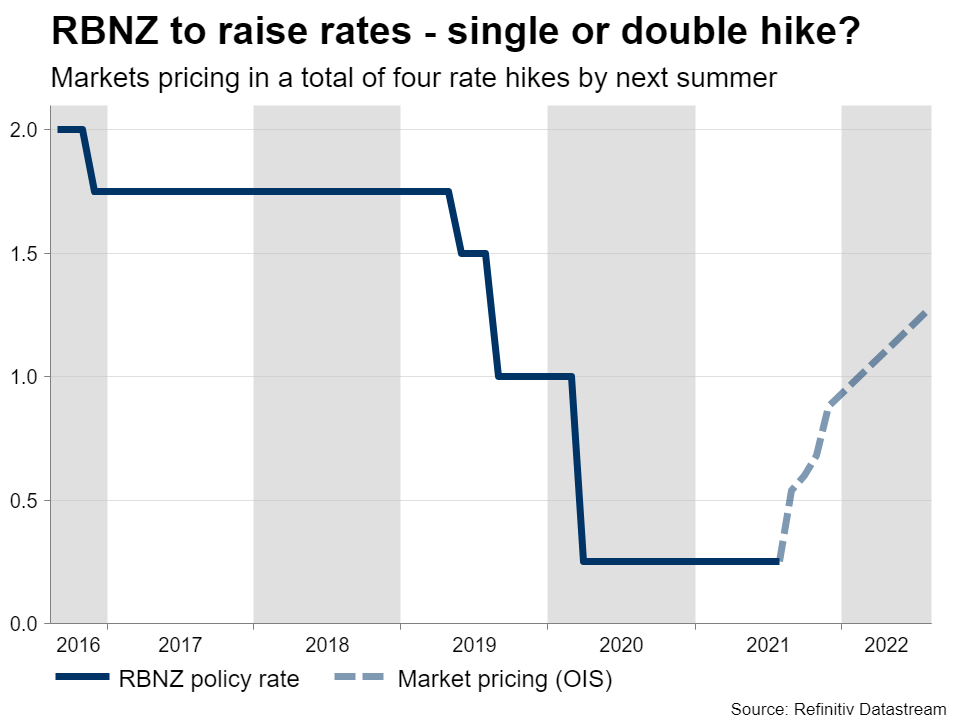
The upcoming meeting promises some fireworks. Markets have fully priced in a regular 25 basis points rate increase, and are also assigning a 20% probability for a ‘double’ hike of 50 points. Investors are essentially saying a rate hike is all but certain - the real question is how aggressive it will be.
It will most probably be a ‘single’ move. A double hike doesn’t make much sense from a risk-management perspective. It could shock the economy and also put massive upward pressure on the exchange rate, which the RBNZ wants to avoid.
The other element arguing against an aggressive move is the global environment. New Zealand is a small export-heavy economy after all, so its fortunes are ultimately tied to the global outlook. That doesn’t look great right now, with the Delta variant rampaging much of Asia.
The point is, the central bank doesn’t need to pull the handbrake while the car is going at full speed. Stepping gently on the brakes works for now. If everything goes well, rates can be raised again in a few weeks. In this case, the initial reaction in the kiwi could be negative, as those looking for a double rate increase are left disappointed.
Carry trade
But in the bigger picture, the outlook for the kiwi seems very encouraging. The currency will soon enjoy higher interest rates, way ahead of any other developed economy. By next summer, markets have baked in four RBNZ rate increases.
This implies the kiwi will soon become the market’s favorite currency for carry trades, whereby investors borrow in a low-yielding currency like the euro or the yen, to invest in a higher-yielding currency like the kiwi and bank a profit on the difference.
Over time, this could help the kiwi attract more demand than the euro and yen, whose central banks won’t be raising interest rates anytime soon. The missing ingredient for all that to happen is an improvement in the global outlook. If worries around global growth and the Delta variant fade a little, the kiwi could be the biggest beneficiary.
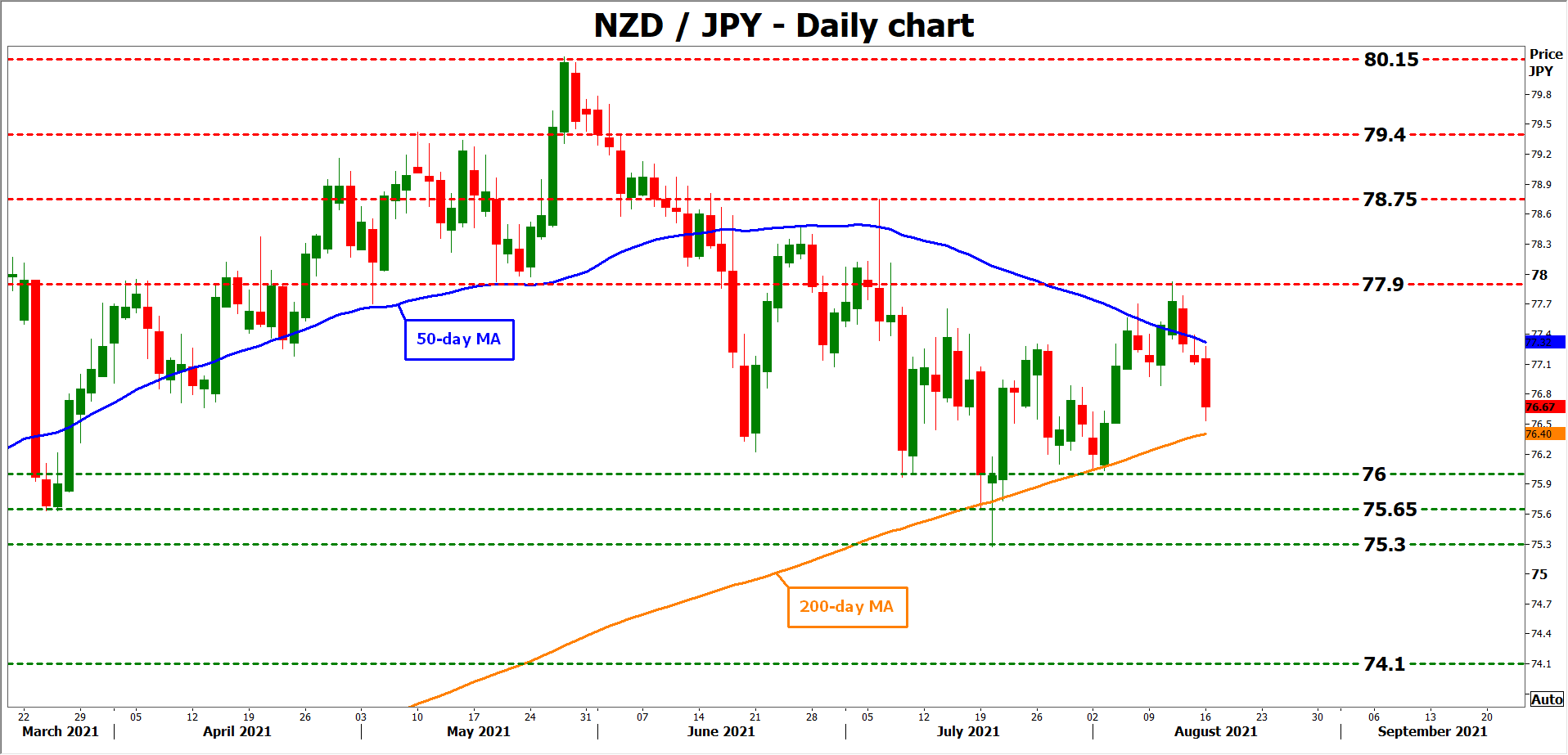
Taking a technical look at kiwi/yen, if the RBNZ simply delivers a single rate hike, the pair could edge lower to test the 76.00 zone. A break would turn the focus towards 75.65.
On the upside, the first target for buyers might be the recent highs around 77.90, where a violation could open the door towards the 78.75 region.
A Troubling Start to the Week
Sentiment has soured at the start of the week, with Europe seeing its winning streak broken and the US continuing to add to Friday's retracement.
Stock markets have been on a good run in recent weeks and the pullback on Monday probably has a lot to do with it. Yes, there's been a few bad economic numbers, starting with the UoM consumer sentiment reading on Friday, when the corrective move started, but the market was primed for some profit taking anyway and investors are probably seizing the opportunitely.
The Chinese data overnight is going to feed into the near-term uncertainty in the country as it desperately tries to get its Covid outbreak under control early. Retail sales, industrial production and fixed asset investment all significantly missed while unemployment was a little higher at 5.1%.
While some of the miss was attributed to weather-related issues, the Covid outbreak and containment measures are going to take a toll as well, creating problems not just for China but trading partners as well. More supply issues and bottlenecks are likely if these measures don't resolve the issue quickly.
Chinese growth has been a downside risk for the markets for weeks though and the data is just confirming what many suspected. The US survey is unwelcome but the other data we've seen from the country has been far better. And concerns about the outlook with delta cases surging around the world is perfectly understandable and not new, as we saw in the euro area ZEW data last week.
With so much seemingly riding on the Fed in the coming weeks, I wonder whether we may see some more caution now in the run up to next week's Jackson Hole event, when Jerome Powell may lay the groundwork for a tapering announcement in September.
We also have Fed minutes this week - although they're arguably very outdated at this point following a plethora of Fed speakers in recent weeks - and Chair Powell will speak at a Town Hall event tomorrow which will no doubt be followed closely. That aside, it isn't the busiest of weeks for the markets.
Oil testing lows on China growth concerns
Oil prices are pulling back once more on Monday and once again taking a run at those lows we saw mid-July and last week. The sell-off has accelerated today but actually started last Thursday after WTI ran into a wall of resistance just shy of $70, which aside from being a psychological barrier is also a 50% retracement of the move from the late July highs to last week's lows.
This doesn't bode well for crude in the near-term, especially with risk appetite looking a little more negative at the start of the week and Chinese growth fears rising. A move below $65 would see attention shift back to $60, a surprisingly large correction overall when just over a month ago it was not far from $80. But the near-term trend is very much against it and the Chinese near-term outlook is weighing heavily.
Gold leaps higher but challenges remain above
Gold is surprisingly thriving a week after a small flash crash sent it tumbling back towards $1,680. Since then, the yellow metal has done well; a combination of an overexaggerated initial move being unwound and a softer dollar/lower yields giving it new life. The US consumer sentiment data on Friday was particularly good for gold as it sent US yields and the dollar sharply lower.
I think people had become overly bullish following a raft of good data and hawkish Fed commentary so when the profit taking came, it did so in aggressive fashion. Naturally, the worst sentiment reading in almost a decade turbo-charged the move, which is why gold exploded back above the $1,740-$1,760 resistance zone and now finds itself flirting with $1,800 once more.
Unfortunately for the yellow metal, unless this is the first in a series of shocking economic numbers for the US, I don't think it's fortunes have drastically improved. It will struggle to break $1,800 and the fact that it marks the 50% retracement of the early June highs to August lows won't help matters.
Bitcoin breaks resistance but lacks momentum
Bitcoin finally broke $47,000 earlier today but once again it made new highs without the corresponding surge in momentum which isn't ideal. While through the 50% retracement level, finally, after a week of running into significant resistance, this loss of momentum on route to $50,000 isn't exactly filling me with confidence.
While the outlook continues to look bullish in the medium-term, a near-term correction may be on the cards. It's rallied strongly over the last month but there's no doubt it's been running on fumes the last week. While $50,000 looks a big psychological barrier, $51,000 is the 61.8% retracement of the move from the all-time highs to the June lows, which could provide a significant wall of resistance.
Sunset Market Commentary
Markets
Lacking impetus from the economic calendar, the elements that colored the Asian session extended into European and early US dealings. Reports of the state of emergency (Japan) or general lockdowns (Australia) being prolonged came amid a disappointing batch of monthly Chinese data that suggested growth momentum is easing. The main victim of today’s minor risk-off setting are equities. European stocks slide between 0.6 and 1%. The EuroStoxx50 is thus set to snap an impressive 10-day winning streak. Wall Street sheds up to 0.8% (DJI). Core bond yields initially held up well, erasing most or all of earlier safe-haven driven losses. But things took a turn for the worse when the US started joining. The US yield curve now bull flattens with losses mounting up to 4.8 bps (10y). German Bunds return back to their opening highs, sending the yield curve a little less than 2 bps lower at the long end. Peripheral spread changes vs the German 10y yield widen with Italy and Greece (+3 bps) underperforming peers.
The US dollar holds an advantage on FX markets though its performance isn’t very convincing. The UST outperformance perhaps has something to do with it. In any case, the greenback is only marginally strengthening against the likes of the euro and even losing a tad against the British pound. EUR/USD retreats from around 1.18 this morning to 1.178 at the time of writing. Cable (GBP/USD) is meandering around 1.385. The other major sterling cross currency, EUR/GBP, is continuing its battle over the 0.85 big figure. It may take the UK labour market report and/or inflation figures to break the tie. The outperformers today are the Japanese yen and the Swiss Franc. USD/JPY is painting a consecutive large blue candle, bringing the pair back to the low 109(.18) zone vs 110.5 end of last week. EUR/JPY is nearing the July intermediate support at 128.6 after opening as high as 129.71. EUR/CHF slumps sub 1.08 to 1.074, probably adding to the Swiss central bank’s frustration over the “highly valued” franc. Today’s data showed Swiss sight deposits increasing by 1.04 billion francs to 714.6bn in the week ending August 13. These level of increases could well be the result of the central bank intervening on currency markets, like when EUR/CHF was on track to touch 1.07. For the sake of comparison: back in March the pair traded at 1.11; at the height of the pandemic panic the scoreboard showed 1.05.
News Headlines
Polish CPI inflation as measured by the central bank (NBP) accelerated in July. The headline number rose to 5% Y/Y. The NBP’s preferred gauge, CPI net of food and energy prices, rose from 3.5% Y/Y to 3.7% Y/Y (0.4% M/M). Polish core CPI now equals or exceeds the upper fluctuation band (3.5%) for an 18th month running. The Polish zloty didn’t respond to the inflation outcome. EUR/PLN last week approached 4.60 resistance on PLN weakness because of controversial domestic policies. A real test didn’t occur. The pair currently changes hands around 4.5650. A minority of Polish central bankers sees inflation developments as a trigger to start hiking policy rates later year.
The Bulgarian National Statistical Institute published July inflation and labour market data today. CPI inflation accelerated by 0.8% M/M to 3% Y/Y, the highest level since Q1 2020. Details from the monthly number showed especially price rises in recreation and culture (+4.2% M/M), transport and (+2.8% M/M), housing, water, electricity, gas and other fuels (+2.7% Y/Y). The unemployment rate fell to 5%, the lowest level on record with data dating back to January 1996.
GBP/JPY Mid-Day Outlook
Daily Pivots: (S1) 151.77; (P) 152.17; (R1) 152.40; More...
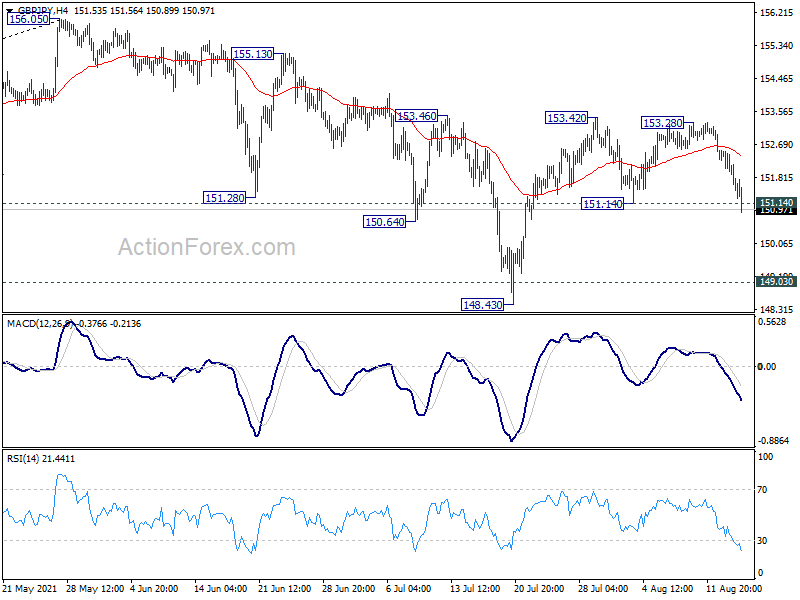
GBP/JPY's break of 151.14 support suggests that rebound from 148.43 has completed at 153.42. Intraday bias is turned back to the downside for 148.43 support first. On the upside, break of 153.28 resistance is now needed to indicate resumption of rebound from 148.43. Otherwise, risk will stay mildly on the downside in case of recovery.
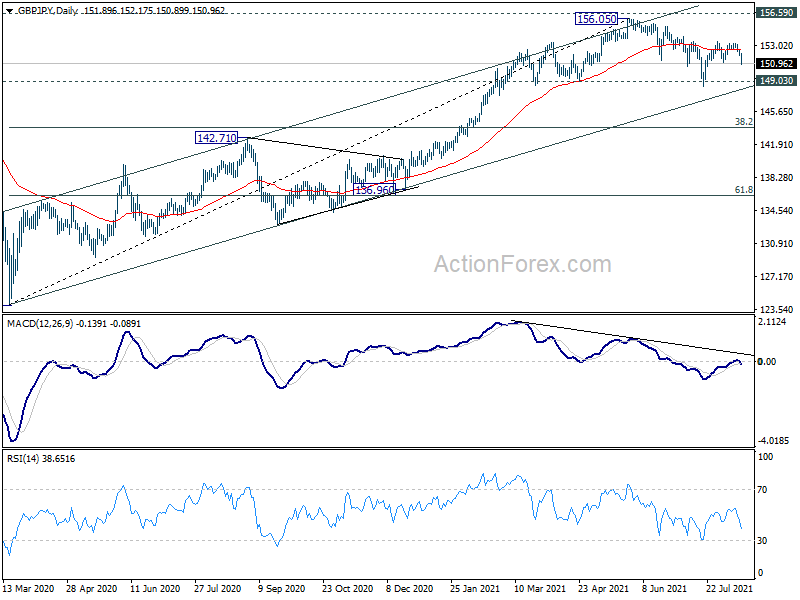
In the bigger picture, rise from 123.94 is seen as the third leg of the pattern from 122.75 (2016 low). Focus remains on 156.59 resistance (2018 high). Sustained break there should confirm long term bullish trend reversal. Next target is 61.8% retracement of 195.86 (2015 high) to 122.75 at 167.93. On the downside, sustained break of 149.03 support, however, will indicate rejection by 156.59. Fall from 156.05 would be at least correcting the whole rise from 123.94. Deeper fall would be seen back to 142.71 resistance turned support first.
EUR/JPY Mid-Day Outlook
Daily Pivots: (S1) 129.12; (P) 129.41; (R1) 129.58; More....
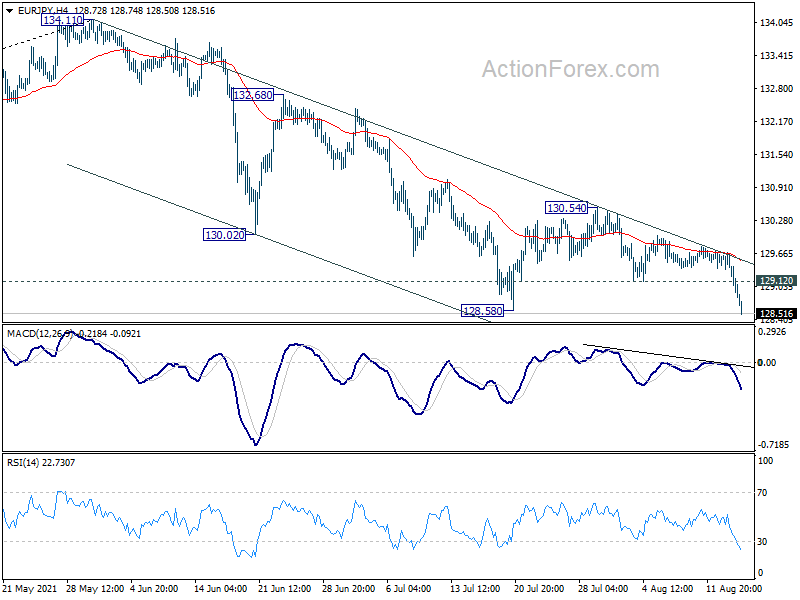
EUR/JPY's break of 128.58 support suggests resumption of whole decline from 134.11 Intraday bias stays on the downside for 127.07 resistance turned support next. That is close to 38.2% retracement of 114.42 to 134.11 at 126.58. On the upside, above 129.12 minor resistance will turn intraday bias neutral first.
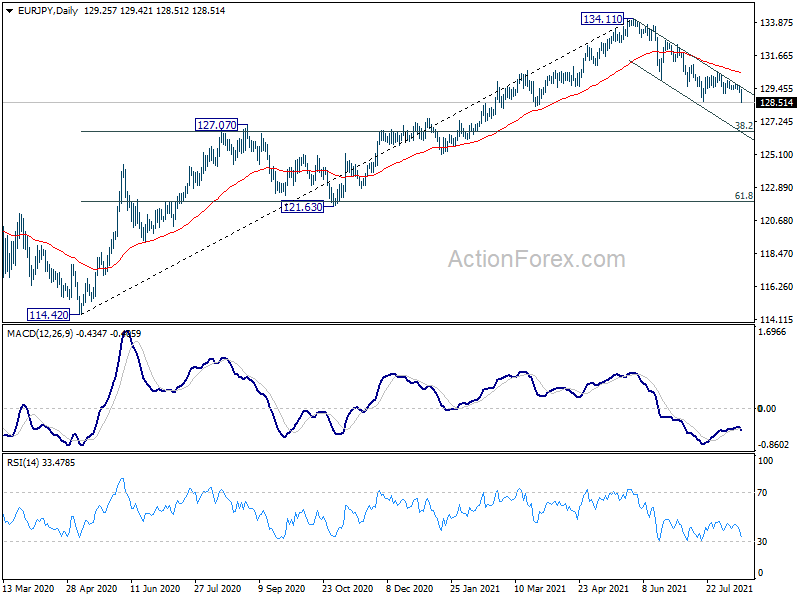
In the bigger picture, rise from 114.42 is seen as a medium term rising leg inside a long term sideway pattern. As long as 127.07 resistance turned support holds, further rise is still expected to retest 137.49 (2018 high). However, firm break of 127.07 will argue that the medium term trend has reversed, and open up the case for retesting 114.42.
US Retail Sales, Fed Minutes & Powell Could Spark Summer Fireworks for the Dollar
The US dollar is just reeling from unexpectedly weak consumer sentiment data but there could be more trouble on the way as retail sales numbers due Tuesday (12:30 GMT) are not anticipated to impress. However, none of that may matter if there are further hawkish soundbites coming from the Fed’s way when Chair Jerome Powell speaks on Tuesday (17:30 GMT) and the July FOMC minutes are published on Wednesday (18:00 GMT).
Will there be another hawkish lean by the Fed?
It’s proving to be a bit of a rollercoaster summer for the greenback even if the broader trajectory for the currency is an upward one. Fed speakers have been out in droves lately, making the case for a reduction in the US central bank’s massive monthly dose of asset purchases. The change in tone follows a series of strong labour market indicators that took the Fed several steps closer to achieving “substantial further progress” towards its goals.
However, investors have yet to hear from Powell after the last unquestionably solid NFP report so any remarks on the economy on Tuesday will be heeded by the markets. Similarly, the minutes of the July meeting are expected to disclose more detail about how much taper discussions have progressed. After the recent run of upbeat US data and Fed views, it would be far too easy to assume that a further hawkish shift is in order this week. But the constantly evolving virus landscape means the Fed isn’t about to throw caution to the wind just yet.
Plunge in consumer confidence muddies the outlook
The drop in the University of Michigan’s closely watched consumer sentiment gauge to a post-pandemic low in August is a stark reminder that the Covid nightmare is far from over. The Delta-led surge in US infections appears to be significantly denting confidence among consumers. Although disappointment that even with vaccines the virus threat is still present may be magnifying the downbeat sentiment.
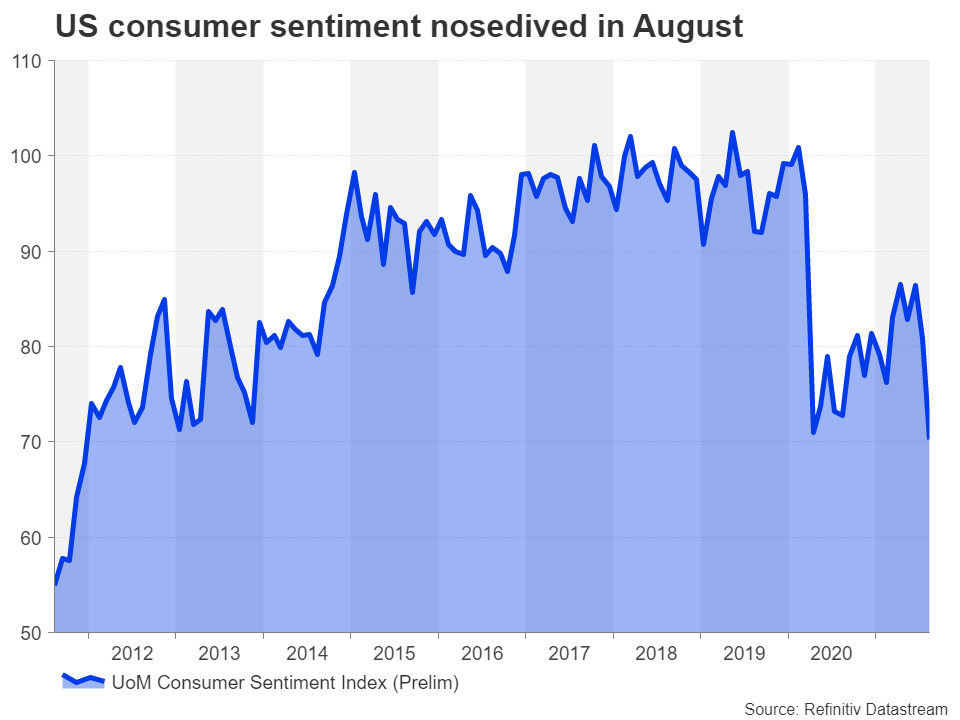
Hence, policymakers will probably not put too much weight on the August figure, especially seeing as it’s the preliminary reading and might get revised higher. The same can be said for the July CPI print, which raised hopes that the spike in inflation may be easing. However, these ‘outliers’ in the data in an otherwise improving trend may bolster the argument for the Fed doves who are maintaining their stance that they’d like to see “a few more” strong jobs reports before making a decision on tapering. Powell likely falls within this camp and there’s a good chance he will push for an end-of-year move than a September one, which the hawks are calling for.
Retail sales data may help the doves
If the upcoming retail sales figures underwhelm, it will add to the number of reasons for the Fed to stay overly cautious a while longer. Retail sales are expected to have fallen by 0.2% month-on-month in July after rising by 0.6% in the prior period. The control group of retail sales, which is an alternative core measure that excludes automobiles, gasoline, building materials and restaurants and tracks GDP much more closely, is forecast to have stayed unchanged.
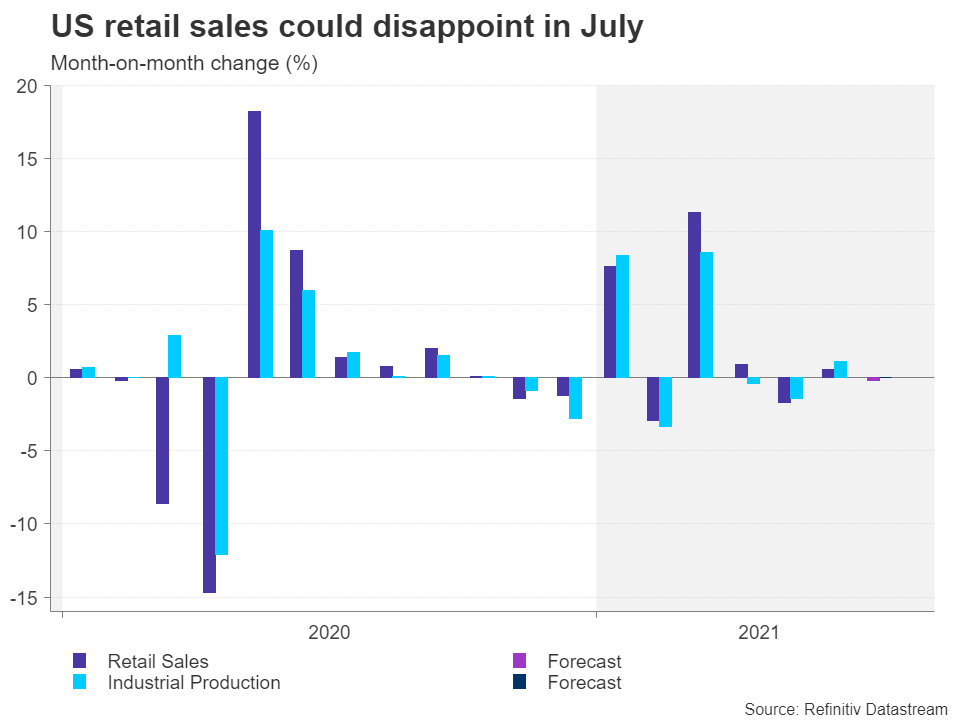
Industrial production readings due later in the day at 13:15 GMT is anticipated to be more positive, growing by 0.5% m/m in July.
Strong obstacles for dollar advances
Nevertheless, while the data releases are bound to bring some volatility to the dollar, it will be the message coming from Powell and the minutes that ultimately decide its fate this week and possibly until the Jackson Hole conference next week. The dollar index has formed a short-term trading range between 91.80 and 93.20, with the 93 handle proving quite challenging to reclaim. If Powell or the minutes hint that a September taper announcement is more likely than a delay, the dollar index might just be able to power through this resistance area and make a push towards the March 31 peak of 93.44.
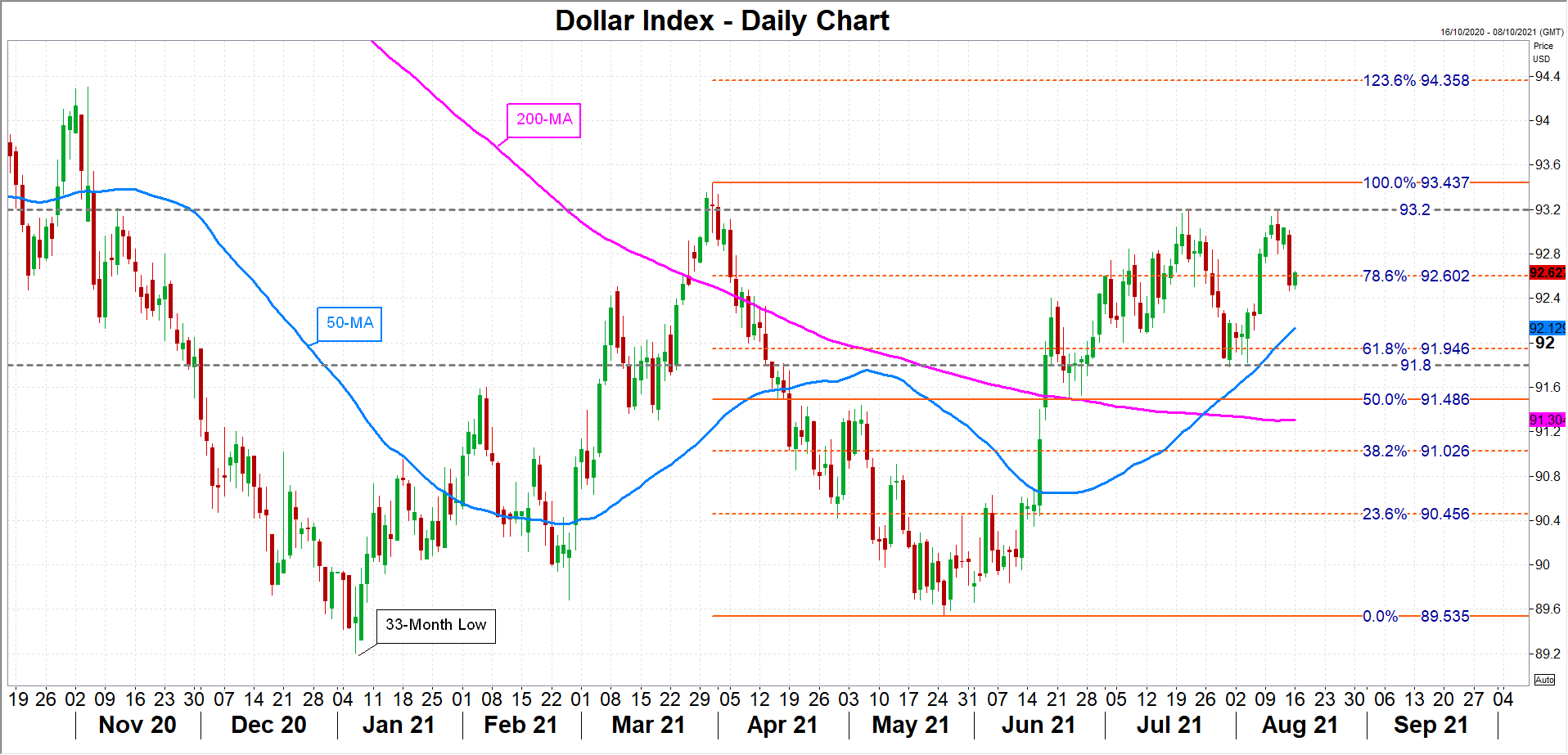
However, should Powell & Co fail to send clear signals this week and the minutes underscore the divisions within the Fed, the dollar index could slip towards its 50-day moving average, currently at 91.13, taking it closer to the bottom of the range. Breaching the recent troughs around 91.80 would pave the way for the 50% Fibonacci retracement of the March-May downtrend at 91.49.
EUR/USD Mid-Day Outlook
Daily Pivots: (S1) 1.1749; (P) 1.1777; (R1) 1.1824; More...
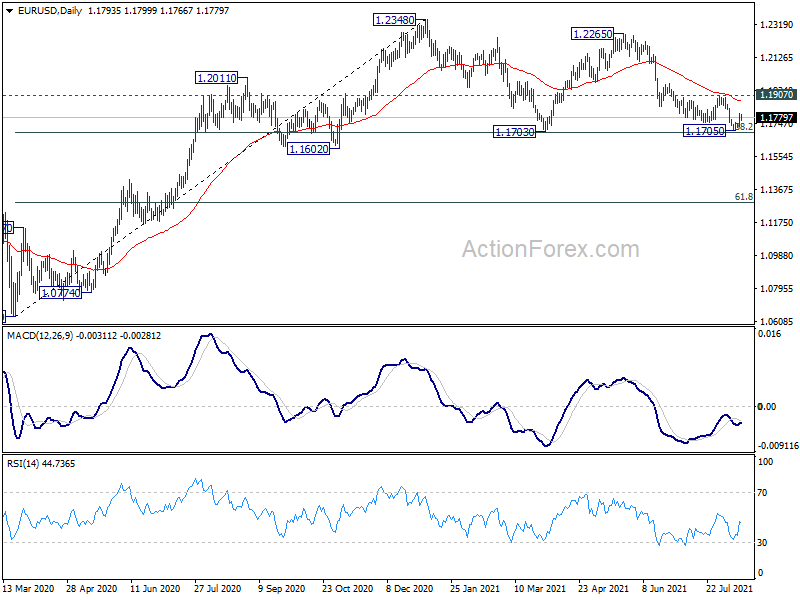
Intraday bias in EUR/USD stays mildly on the upside for the moment. Rebound from 1.1705 short term bottom is in progress for 1.1907 resistance. Firm break there will suggest that fall from 1.2265, as well as consolidation pattern from 1.2348, have completed. Near term outlook will be turned bullish for retesting 1.2265/2348 resistance zone. However, below 1.1705 will turn focus back to 1.1602/1703 key support zone again.
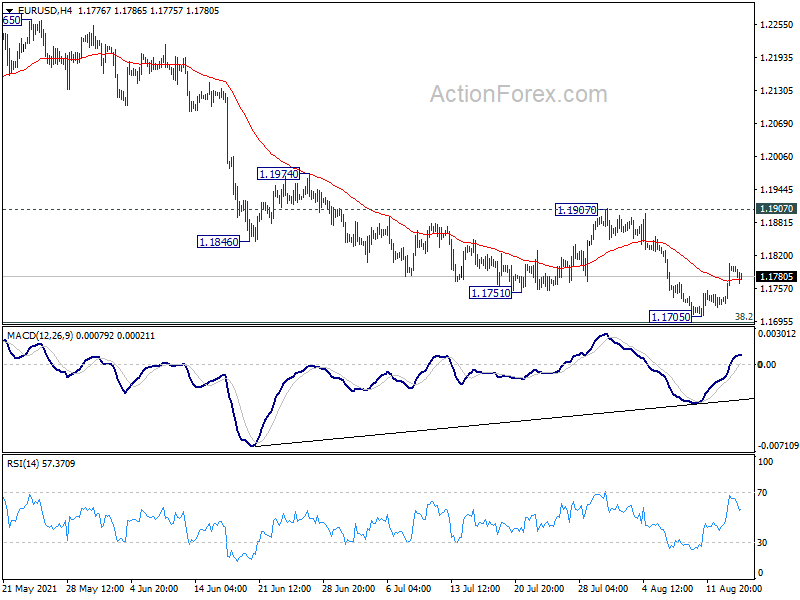
In the bigger picture, rise from 1.0635 is seen as the third leg of the pattern from 1.0339 (2017 low). Further rally remains in favors long as 1.1602 support holds, to cluster resistance at 1.2555 next, (38.2% retracement of 1.6039 to 1.0339 at 1.2516). Reaction from 1.2555 should reveal underlying long term momentum in the pair. However sustained break of 1.1602 will argue that the rise from 1.0635 is over, and turn medium term outlook bearish again.