

Sample Category Title
USD/CHF Daily Outlook
Daily Pivots: (S1) 0.9123; (P) 0.9181; (R1) 0.9211; More....
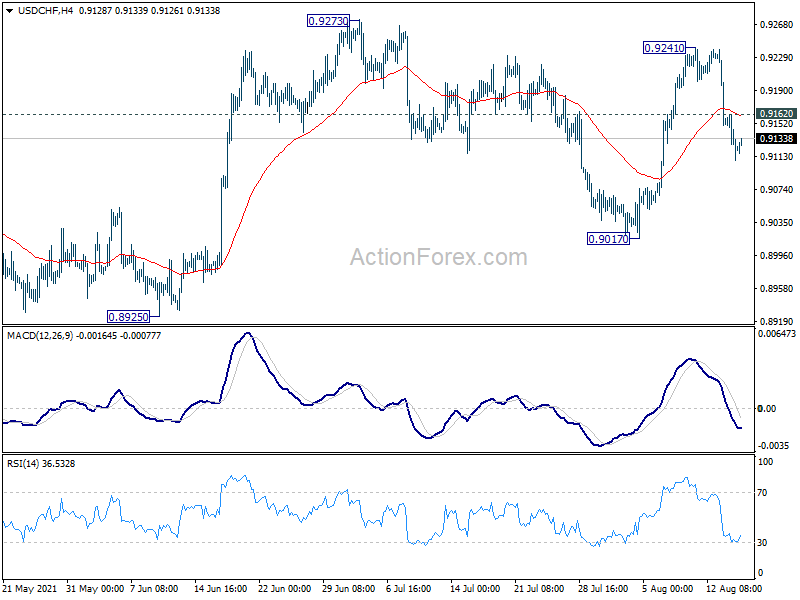
Intraday bias in USD/CHF remains mildly on the downside, as fall from 0.9241 would target 0.9017 support. Break there will likely resume the decline from 0.9471 through 0.8925 low. On the upside, above 0.9162 minor resistance will mix up the near term outlook and turns intraday bias neutral first.
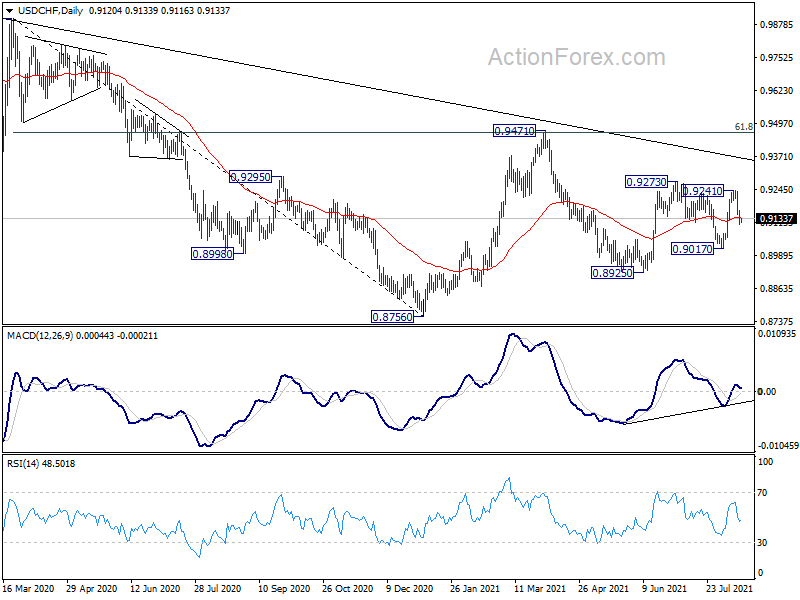
In the bigger picture, the failure to sustain above 55 week EMA (now at 0.9184) retains medium term bearish in USD/CHF. Break of 0.8925 support should resume the whole decline form 1.0342 (2016 high) through 0.8756 low. However, break of 0.9273 resistance and sustained trading above 55 week EMA will be an early sign of bullish trend reversal. Focus will then turn to 0.9471 resistance for confirmation.
USD/JPY Daily Outlook
Daily Pivots: (S1) 109.00; (P) 109.38; (R1) 109.64; More...
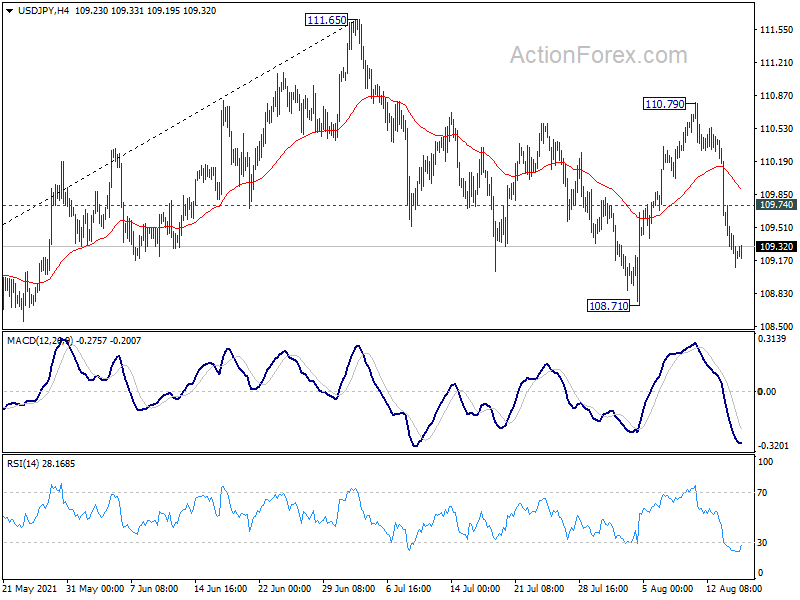
Intraday bias in USD/JPY remains on the downside, as fall from 110.79 is in progress for 108.71 support. Firm break there will resume the decline from 111.65 and target 38.2% retracement of 102.58 to 111.65 at 108.18 next. On the upside, above 109.74 minor resistance will turn intraday bias neutral first. But risk will stay mildly on the downside as long as 110.79 resistance holds.
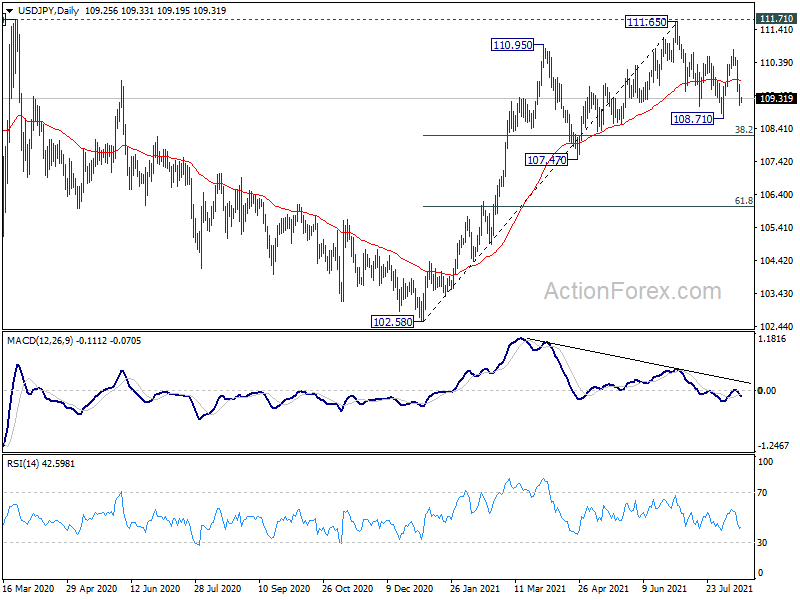
In the bigger picture, medium term outlook is staying neutral with 111.71 resistance intact. The pattern from 101.18 could still extend with another falling leg. Sustained trading below 55 day EMA will bring deeper fall to 107.47 support and below. Nevertheless, strong break of 111.71 resistance will confirm completion of the corrective decline from 118.65 (2016 high). Further rise should then be seen to 114.54 and then 118.65 resistance.
USD/CAD Daily Outlook
Daily Pivots: (S1) 1.2531; (P) 1.2557; (R1) 1.2603; More...
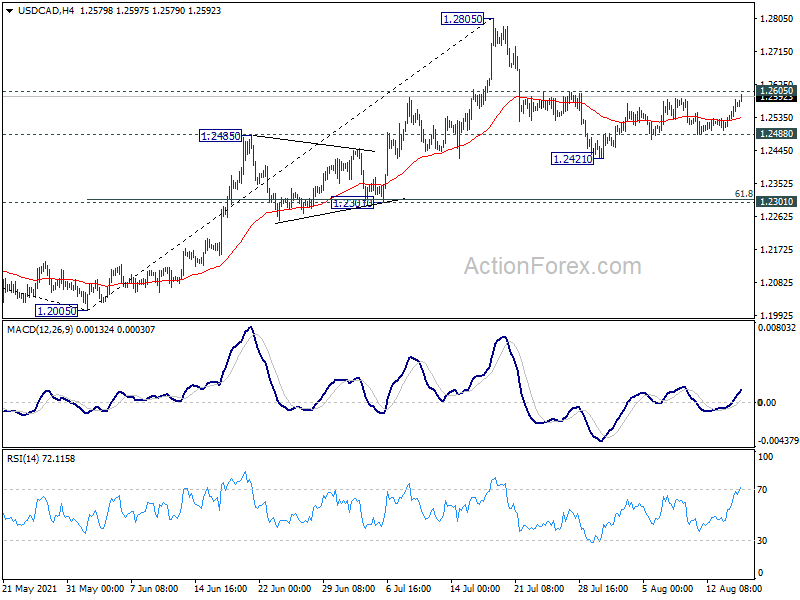
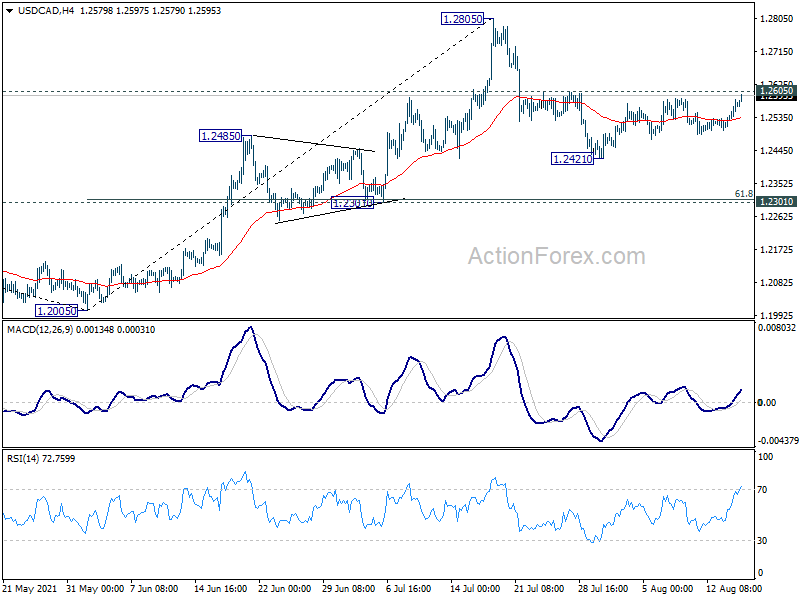
USD/CAD's rebound from 1.2421 resumed today but stays below 1.2605 resistance. Intraday bias remains neutral first. On the upside, firm break of 1.2605 will argue that pull back from 1.2805 has completed. Intraday bias will turn back to the upside for retesting 1.2805 high first. On the downside, below 1.2488 minor support should turn bias to the downside, to resume the fall from 1.2805 through 1.2421 support, to 1.2301 cluster support (61.8% retracement of 1.2005 to 1.2805 at 1.2311).
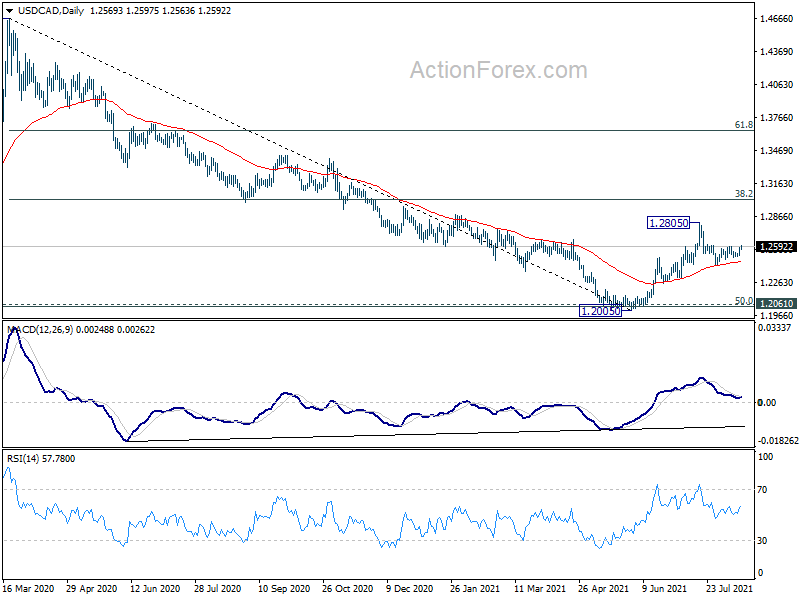
In the bigger picture, fall from 1.4667 is seen as the third leg of the corrective pattern from 1.4689 (2016 high). It should have completed after hitting 1.2061 (2017 low) and 50% retracement of 0.9406 to 1.4689 at 1.2048. Sustained break of 38.2% retracement of 1.4667 to 1.2005 at 1.3022 will pave the way to 61.8% retracement at 1.3650 and above. Overall, medium term outlook remains neutral at worst with 1.2048/61 support zone intact.
GBP/USD: Why 1.3800 Holds The Key In Near Term
Key Highlights
- GBP/USD is struggling to climb above the 1.3900 resistance zone.
- A key declining channel is forming with resistance near 1.3885 on the 4-hours chart.
- EUR/USD failed to clear the main 1.1800 resistance zone.
- The UK ILO Unemployment rate could remain at 4.8% in June 2021 (3M).
GBP/USD Technical Analysis
The British Pound started a downside correction after it failed to surpass 1.4000 against the US Dollar. GBP/USD moved below the 1.3900 support, which is now acting as a resistance.
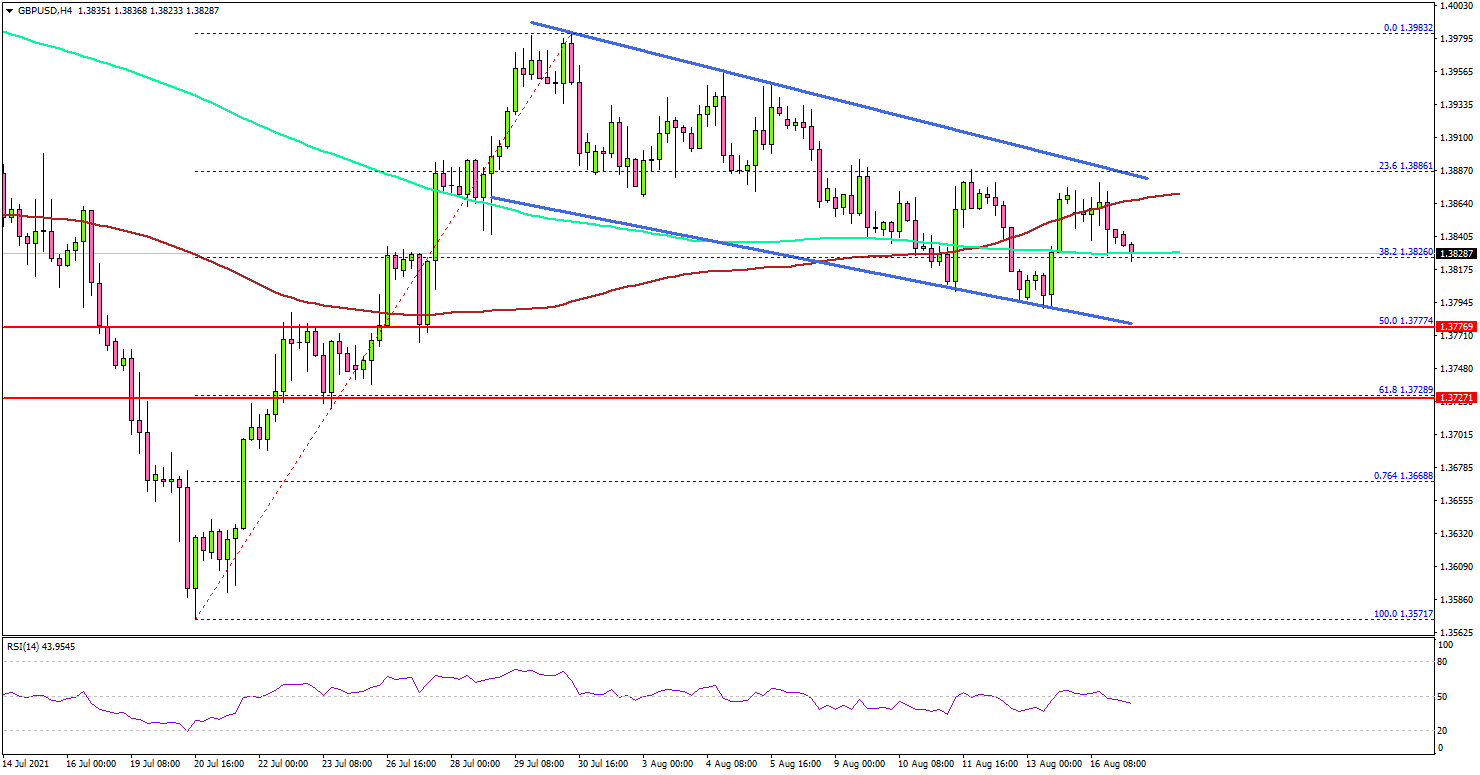
Looking at the 4-hours chart, the pair extended its decline below the 1.3850 support level and the 100 simple moving average (red, 4-hours). There was also a break below the 38.2% Fib retracement level of the upward move from the 1.3571 swing low to 1.3981 high.
However, the bulls are now protecting the 1.3780-1.3800 support zone. The 50% Fib retracement level of the upward move from the 1.3571 swing low to 1.3981 high is also near 1.3774.
If GBP/USD breaks the 1.3780-1.3800 support zone, there is a risk of a sharp decline. The next major support sits at 1.3725, below which the pair might revisit 1.3650.
On the upside, an initial resistance is near the 1.3880 level. There is also a key declining channel forming with resistance near 1.3885 on the same chart. A clear break above the channel resistance and 1.3900 might open the doors for a steady increase. The next key resistance could be 1.4000.
Looking at EUR/USD, the pair made an attempt to clear the 1.1800-1.1810 resistance zone, but it failed and it now remains at a risk of more downsides.
Economic Releases
- UK Claimant Count Change for July 2021 – Forecast -80.0K, versus -114.8K previous.
- UK ILO Unemployment Rate for June 2021 (3M) – Forecast 4.8%, versus 4.8% previous.
- Euro Zone GDP for Q2 2021 (Preliminary) (QoQ) - Forecast 2%, versus 2% previous.
- US Retail Sales for July 2021 (MoM) – Forecast -0.2%, versus +0.6% previous.
RBA Minutes Confirm Reasoning Behind August Policy Decision
Westpac was surprised by the decision at the August Board meeting to maintain the policy to begin tapering bond purchases in early September. Since then near term growth prospects have deteriorated further. However that deterioration would need to trigger a rethink on the strength of the recovery to see a policy reversal.
Essentially the Board recognised that activity and employment were expected to decline in the September quarter due to the disruptions particularly in NSW but the economy was forecast to rebound later in the year as restrictions are eased consistent with the previously observed pattern in Australia and overseas.
Due to the strong momentum in the labour market prior to the NSW lock down and mindful of the expected bounce back the Board observed that the Bank’s forecasts for the unemployment rate by end 2022 had been lowered from 4.5% to 4.25% and wages growth had been lifted from 2.25% to 2.5%.
A note of caution around the wages and inflation forecast was raised. The Board pointed out that unemployment rates in the low 4’s had only been experienced during the pre GFC mining boom and in the early 1970’s implying that a degree of care around the inflation and wages forecasts would be appropriate.
The forecasts are based on the lock down in Sydney extending to the end of the September quarter.
Readers will be aware that Westpac expected that in response to the sharp deterioration in the near-term outlook the Board would decide to use its flexible bond buying policy to boost support for the economy. We expected that would entail an immediate increase in purchases from $5 billion per week to $6 billion to be reviewed at the November Board meeting.
Markets generally took a more conservative approach by expecting that the Board would defer its planned taper in purchase pace from $5 billion to $4 billion from early September.
As we know neither approach was taken and the Board decided to not respond at all to the sudden near term deterioration.
The Minutes note that “members therefore considered the case for delaying the taper of bond purchases …. but noted that the outlook for the economy is for a resumption of strong growth in 2022. Members judged that any additional bond purchases would have their maximum effect at that time, with only a marginal effect at present.”
The Board also recognised that “fiscal policy is a more appropriate instrument than monetary policy for providing support in response to a temporary localised reduction in incomes.”
However, the Board did note that “the bond purchase program would continue to be reviewed in light of economic conditions and the health situation.”
So, while recognising a sharp near-term deterioration in the outlook the policy response was to rely on forecasts rather than responding to the current developments. This approach is different to the avowed approach to the inflation target where policy would be targeted at actual developments rather than forecasts.
Westpac agrees that a strong rebound in activity is the central case for 2022 although there are undoubtedly risks around the delta variant; the possibility of other variants that are resistant to current vaccines; and a more cautious response from businesses and households than we saw in 2020 in light of the less generous packages for business and the unemployed.
The near-term outlook has also deteriorated significantly since the Board meeting.
The Board was advised that the economy could contract by at least 1 ppt in the September quarter. At that time Westpac’s estimate was for a contraction of 2.2% based on a Sydney reopening at end September.
We have recently revised down the growth outlook further to take into account a state-wide lock down in NSW which will extend until end October; and the extended lock down in Melbourne.
Westpac now expects a contraction of 2.6% in the September quarter and growth of 2.6% in the December quarter (down from 3.0%).
Consistent with the theme of a strong recovery we have lifted our 2022 growth forecast from 4.2% to 5.0%.
It is likely that the RBA staff will already be advising of a down grade from the forecasts that were discussed at the August Board meeting.
However, for the Board to change its policy stance adopted in the August meeting there would need to be some greater doubt cast on the strength of the recovery and Westpac’s forecasts are certainly not signalling that approach.
Conclusion
By characterising the sudden deterioration in the economy as a short-term development and maintaining prospects for a strong recovery the Board decided not to respond to the near-term threats.
An even deeper near term “hole”, which now seems certain, would only prompt a change in policy if doubt was cast on the pace of recovery.
Given that the Board did not respond to those risks in August it seems likely that it will take the same approach in September.
So, we are now likely to see the bizarre development where the health situation points to a sharp deterioration in the near term and the Board proceeds almost immediately after the September Board meeting with a tightening of its only active policy instrument.
I agree that will be a highly unusual situation but can only point to the decision, and reasoning set out in the Minutes, as the most likely outcome of the September Board meeting.
The September Board meeting is three weeks away on 7th September and much can change over that period.
Given how surprised I was with the August decision we cannot rule out a policy change in September especially if future developments raise some questions as to the vulnerability of the expected recovery.
AUD/USD Daily Report
Daily Pivots: (S1) 0.7312; (P) 0.7343; (R1) 0.7365; More...
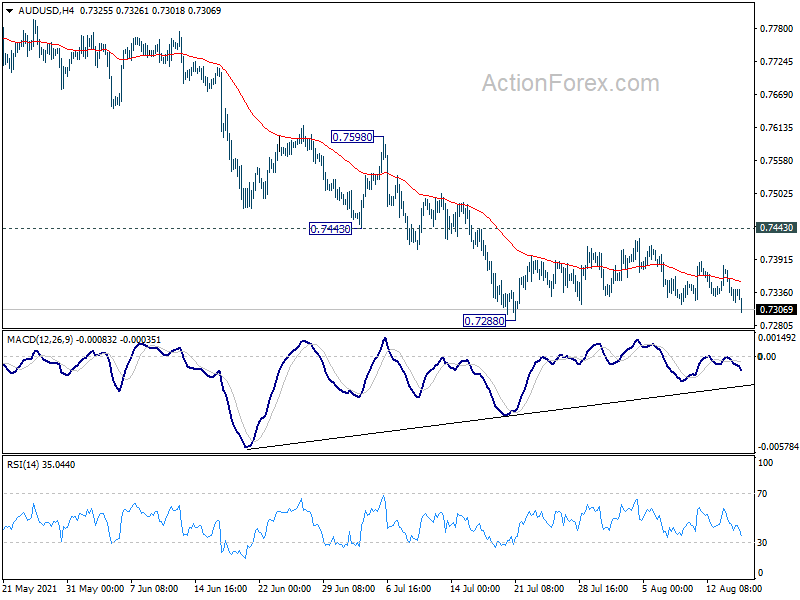
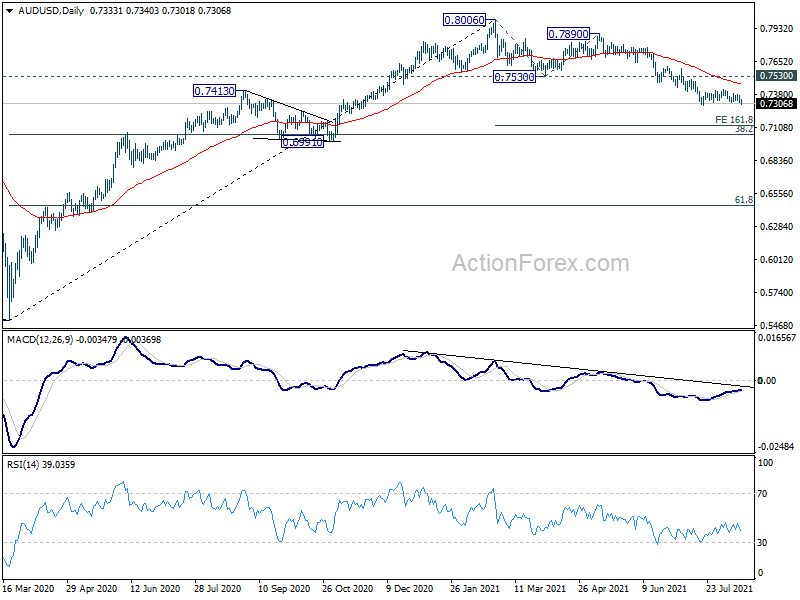
AUD/USD dips notably in Asian session but stays above 0.7288 low. Intraday bias remains neutral first. As long as 0.7443 resistance holds, outlook stays bearish for further decline. On the downside, break of 0.7288 will resume the fall from 0.8006 to 161.8% projection of 0.8006 to 0.7530 from 0.7890 at 0.7120 next. On the upside, break of 0.7443 will bring stronger rebound to 0.7530 support turned resistance instead.
In the bigger picture, rise from 0.5506 medium term bottom could have completed at 0.8006, after failing 0.8135 key resistance. Correction from there could target 0.6991 cluster support (38.2% retracement of 0.5506 to 0.8006 at 0.7051). We'd look for strong support from there to bring rebound. However, sustained break of this level would argue that the whole medium term trend has indeed reversed.
Aussie Stays Weak after RBA Minutes, Same as Other Commodity Currencies
Commodity currencies remained generally pressured in Asian session today. While DOW and S&P 500 managed to reverse initial losses to close at new record highs, there is no follow through risk-on sentiment in Asia. Canadian Dollar is additionally weighed down with WTI crude oil dipping below 68 handle. Aussie is getting not particular support from the balanced RBA minutes. Yen and Swiss Franc are still the stronger ones, but Dollar is trying to catch up, against others.
Technically, USD/CAD is now eyeing 1.2605 minor resistance as rebound from 1.2421 resumes. Firm break there will suggest that pull back from 1.2805 has already completed and bring retest of this high. At the same time, AUD/USD is dipping towards 0.7288 low. Break there will resume the larger decline from 0.8006. Both developments could signal further selling in commodity currencies elsewhere.
In Asia, at the time of writing, Nikkei is up 0.17%. Hong Kong HSI is down -0.40%. China Shanghai SSE is down -0.43%. Singapore Strait Times is down -0.48%. Japan 10-year JGB yield is up 0.0031 at 0.020. Overnight, DOW rose 0.31%. S&P 500 rose 0.26%. NASDAQ dropped -0.20%. 10-year yield dropped -0.040 to 1.257.
RBA minutes: Central scenario still for the economy to growth strongly again next year
In the minutes of August 3 meeting, RBA said recent outbreaks of the Delta variant of had "interrupted the recovery". But the economy entered lockdowns with "more momentum than previously expected", with fiscal and monetary support already cushion the economic effects. It added, "experience to date had been that, once virus outbreaks were contained, the economy bounced back quickly." The "central scenario" was still for the economy to "growth strongly again next year".
Committee members considered the case to delay tapering of asset purchases to AUD 4B a week scheduled for September. But they noted that additional bond purchases would only have a "marginal effect" at present", but "maximum effect" during the resumption of strong growth in 2022. Also fiscal policy is recognized as a "more appropriate instrument" in response to a "temporary, localized reduction in incomes". Thus, the Board reaffirmed the previously announced schedule for tapering.
RBA also reiterated that the condition for raising interest rate is not expected to be met before 2024. "Meeting this condition will require the labour market to be tight enough to generate wages growth that is materially higher than it is currently," it said.
Fed Rosengren wouldn't want to wait any later than December on tapering
Boston Fed President Eric Rosengren said the US had over 900k jobs growth for two months in a row and unemployment rate dropped by half a percent to 5.4%. He added, "if we get another strong labor market report, I think that I would be supportive of announcing in September that we are ready to start the taper program."
"I think it's appropriate to start in the fall. That would be October or November," Rosengren told CNBC. "I certainly wouldn't want to wait any later than December. My preference would be probably for sooner rather than later." He also said that "there's no reason to drag it out as long as the economy continues to progress as we expect."
On the other hand, he'd prefer to see more progress before moving on to raising interest rate. "The criteria for starting to raise rates is that we see outcomes that are consistent with sustainable inflation at a little bit above 2%," he reiterated Fed's general position.
Looking ahead
UK employment data and Eurozone GDP will be featured in European session. Canada housing starts and foreign securities purchases will be released later in the day. But main focus will be on US retail sales, while industrial production, business inventories and NAHB housing index will be released too.
AUD/USD Daily Report
Daily Pivots: (S1) 0.7312; (P) 0.7343; (R1) 0.7365; More...
AUD/USD dips notably in Asian session but stays above 0.7288 low. Intraday bias remains neutral first. As long as 0.7443 resistance holds, outlook stays bearish for further decline. On the downside, break of 0.7288 will resume the fall from 0.8006 to 161.8% projection of 0.8006 to 0.7530 from 0.7890 at 0.7120 next. On the upside, break of 0.7443 will bring stronger rebound to 0.7530 support turned resistance instead.
In the bigger picture, rise from 0.5506 medium term bottom could have completed at 0.8006, after failing 0.8135 key resistance. Correction from there could target 0.6991 cluster support (38.2% retracement of 0.5506 to 0.8006 at 0.7051). We'd look for strong support from there to bring rebound. However, sustained break of this level would argue that the whole medium term trend has indeed reversed.
Economic Indicators Update
| GMT | Ccy | Events | Actual | Forecast | Previous | Revised |
|---|---|---|---|---|---|---|
| 01:30 | AUD | RBA Meeting Minutes | ||||
| 04:30 | JPY | Tertiary Industry Index M/M Jun | 1.80% | -2.70% | ||
| 06:00 | GBP | Claimant Count Change Jul | -114.8K | |||
| 06:00 | GBP | ILO Unemployment Rate (3M) Jun | 4.80% | 4.80% | ||
| 06:00 | GBP | Average Earnings Excluding Bonus 3M/Y Jun | 7.40% | 6.60% | ||
| 06:00 | GBP | Average Earnings Including Bonus 3M/Y Jun | 8.70% | 7.30% | ||
| 09:00 | EUR | Eurozone GDP Q/Q Q2 P | 2.0% | 2.0% | ||
| 09:00 | EUR | Eurozone Employment Change Q/Q Q2 P | -0.50% | -0.30% | ||
| 12:15 | CAD | Housing Starts Jul | 275K | 282K | ||
| 12:30 | CAD | Foreign Securities Purchases (CAD) Jun | 20.79B | |||
| 12:30 | USD | Retail Sales M/M Jul | -0.20% | 0.60% | ||
| 12:30 | USD | Retail Sales ex Autos M/M Jul | 0.10% | 1.30% | ||
| 13:15 | USD | Industrial Production M/M Jul | 0.40% | 0.40% | ||
| 13:15 | USD | Capacity Utilization Jul | 75.70% | 75.40% | ||
| 14:00 | USD | Business Inventories Jun | 0.80% | 0.50% | ||
| 14:00 | USD | NAHB Housing Market Index Aug | 80 | 80 |
Market Morning Briefing: Aussie Has Broken Below The Mentioned Support At 0.7325
STOCKS
Equities are mixed today. While Dow Jones has risen well and looks strongly bullish, Dax has fallen slightly over the last 2-sessions but could test support at 15800 before bouncing back from there. We are cautious on Nikkei while below 28000 and shanghai on a break below 3500. Nifty and Sensex trade higher and look bullish for a further rise this week.
Dow (35625.40, +110.02, +0.31%) has risen well, breaking above our expected 35600. The view continues to remain bullish for this week. A further rise to 37000-38000 could be on the cards soon.
DAX (15925.73, -51.71, -0.32%) has dipped slightly and has support near 15800 which if holds can produce a bounce back towards 16000-16200 in the medium term.
Nikkei (27569.84, +46.65, 0.17%) has risen slightly today but continues to trade below 28000.The support at 27250 seems to be holding well. A strong break above 28000 will negate the view of seeing a dip towards 27000-26500 on the downside mentioned yesterday. Watch price action near 28000.
Shanghai (3501.96, 15.39, -0.44%) has fallen to test 3500 and unless a bounce is seen immediately, there could be scope for a fall to 3400 before a bounce is seen. An immediate bounce, if seen could take it higher to 3600.
Nifty (16563.05, +33.95, +0.21%) rose yesterday and is heading towards 16600 in line with our expectations. The view is bullish to see a break above 16600 soon. Any immediate corrective dip if seen could be short lived and limited to 16400/350.
Sensex (55582.58, +145.29, +0.26%) has also risen and us heading towards 56000 in the coming sessions. Any corrective dip, if seen could be limited to 54500.
COMMODITIES
Brent and WTI trade lower and could move towards $65 while Gold and Silver have risen today and may move up further to test 1800-1810 and 24.0-24.50 respectively. Copper holds below crucial near term resistance at 4.40 and could fall to 4.30/20 before bouncing back again in the medium term.
Brent (69.62) and WTI (67.43) have both come off slightly from levels seen yesterday and could be headed towards $65 soon. View is bearish while below $72-70 on both.
Gold (1788.30) has slightly risen and could head towards 1800-1810 soon while it trades above 1750. On the flip side, a break below 1750, if seen can drag it lower towards 1700. Watch price action near current levels.
Silver (23.84) has risen today and could head towards 24-24.50 soon. Immediate view is bullish.
Copper (4.3245) has fallen. While below resistance at 4.40, there is scope for a fall towards 4.20 before a bounce is seen.
FOREX
Dollar Index has bounced well dragging Euro down from 1.18 as expected. Euro could extend fall to 1.1750 from where a bounce can take place else we cannot negate a possible fall to 1.17. Aussie, Pound, EURJPY are all trading strongly bearish and could continue for a few more sessions. USDCNY can head towards 6.49/50 while USDINR may hold above support at 74.20 and rise higher.
Dollar Index (92.68) has risen today extending the bounce seen from 92.47. But unless the bounce leads to a sharp and sustained rise above 93.20/30, view is still bearish to see an eventual fall back to 92.0-91.75 or even lower in the coming sessions.
Euro (1.1770) tested 1.18 yesterday but has come off from there. The fall may extend to 1.1750 before another reversal is seen. Watch immediate support at 1.1750.
EURJPY (128.62) has fallen as expected but could face support at 128.50-128 which could hold and produce a bounce back towards 130-130.50 soon.
Dollar-Yen (109.28) has is headed towards 109 which if breaks can drag the pair towards 108.30-108.00 before another bounce from there is seen. Overall a broad range of 110.50/80-108.30/00 can hold for the next 1-2 weeks. Immediate view is bearish towards 109 and lower.
Aussie (0.7312) has broken below the mentioned support at 0.7325. While the fall sustains, Aussie can extend towards 0.7290-0.7250 soon before bouncing back.
Pound (1.3822) fell as immediate resistance near 1.39 held. If Pound falls below 1.39, we may expect a further fall towards 1.37-1.36 soon. View is bearish for the near term.
USDCNY (6.4790) has bounced well and if the rise holds, it can move up to test 6.49/50 again.
USDINR (74.25) has held above 74.20 last week but we need to see if it manages to hold above 74.20 this week too and rise back to 74.40/50 or breaks lower to test 74.00-73.80 eventually. Watch price action near 74.20 this week.
INTEREST RATES
The US Treasury yields remain lower. Inability to rise back from here can drag the yields further lower in the coming days and will reduce the chances of seeing an extended corrective rally that we had been expecting. The German yields sustain above their support and are likely to see a corrective rally in the coming weeks before the broader downtrend resumes again. The 5Yr GoI looks mixed and can trade in a sideways range for some time.
The US 2Yr (0.21%), 5Yr (0.75%), 10Yr (1.25%) and the 30Yr (1.91%) Treasury yields continue to trade lower and stable. As mentioned yesterday, the 10Yr can fall to 1.18% while below 1.3%. Similarly, the 30Yr can test 1.85%-1.8% on a fall below 1.9%. The 30Yr has to rise sharply from here and breach 2% and the 10Yr will have to rise past 1.3% to bring back the chances of seeing 1.4%-1.45% (10Yr) and 2.1%-2.2% (30Yr) on the upside into the picture.
The German 2Yr (-0.75%), 5Yr (-0.73%), 10Yr (-0.47%) and 30Yr (-0.03%) yields continue to hover near their supports. Our view remains the same. We expect the -0.45%/-0.50% support zone on the 10Yr and -0.05% on the 30Yr to hold for now and trigger a corrective rally to -0.30%/-0.25% (10Yr) and 0.10% (30Yr) in the coming weeks. Thereafter a fresh fall can happen indicating the resumption of the broader downtrend.
The 5Yr GOI (5.7326%) is likely to oscillate in a broad range of 5.7%-5.78%/5.8% in the coming days.
The Illusion Of Certainty
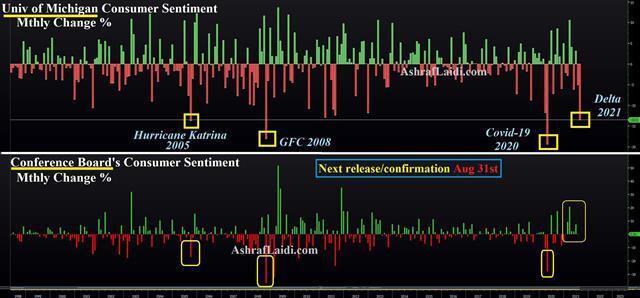
As the situation in Afghanistant accelerates from chaos to outright mass danger to human lives, focus turns to US president Biden's imminent speech on the situation. But for now, let us weigh in Friday's UMich consumer sentiment survey, showing the 4th biggest decline of the last 30 years. The report reminds us we're in an unprecedented era and that predicting economic behaviour in the months ahead will be perilous. Also today, the Empire Fed manufacturing survey fell from 43 to 18.3 vs expectations of 28.5. The chart below shows the other 3 times when UMich sentiment fell by more than it did last Friday. This should raise further debate on the timing of the taper as well as upcoming sentiment surveys.
This decade so far has been completely unpredictable starting with a global pandemic followed by unprecedented stimulus leading to a remarkably quick recovery. Since then, a strong consensus has emerged that the recovery will continue with the main question about how inflationary it will be.
Friday's UMich sentiment survey was a reminder that the consensus can be badly wrong. The survey plunged to 70.2 from 81.2 in a move no economist came close to forecasting. Shockingly, sentiment was even worse than in April 2020 at the height of the pandemic.
Many market watchers were simply in disbelief but the survey takers pointed to delta risks and reality that the grand reopening has turned into a stumble in the US as hospitalizations and cases surge. New questions about safety and schools have soured great hopes and the political situation (which the UMich survey unfortunately tracks better than consumer spending) remains bitterly polarized.
Is the optimism misplaced? Probably not. Kids are at threat to delta but the numbers with serious illness are staggeringly low. In Europe, the Stoxx 600 rose for 10 straight days through Friday. The recovery may unfold more slowly and covid will remain a risk for years but consumer and business balance sheets are strong.
The numbers will give the Fed some pause and that diminishes the chance of a September taper or a quick taper once it starts. Because of that, selling the dollar was the right reaction for now.
With regards to Afghanistan, any sort of US military resurgence into the country is unlikely to weigh on markets. But if persistent news of escalating US hospitalisations and school closures emerge from the Delta variant, then this is likely to bring up other variables as a valid catalyst for risk-off, namely the Fed taper and Afghanistan.
RBA minutes: Central scenario still for the economy to growth strongly again next year
In the minutes of August 3 meeting, RBA said recent outbreaks of the Delta variant of had "interrupted the recovery". But the economy entered lockdowns with "more momentum than previously expected", with fiscal and monetary support already cushion the economic effects. It added, "experience to date had been that, once virus outbreaks were contained, the economy bounced back quickly." The "central scenario" was still for the economy to "growth strongly again next year".
Committee members considered the case to delay tapering of asset purchases to AUD 4B a week scheduled for September. But they noted that additional bond purchases would only have a "marginal effect" at present", but "maximum effect" during the resumption of strong growth in 2022. Also fiscal policy is recognized as a "more appropriate instrument" in response to a "temporary, localized reduction in incomes". Thus, the Board reaffirmed the previously announced schedule for tapering.
RBA also reiterated that the condition for raising interest rate is not expected to be met before 2024. "Meeting this condition will require the labour market to be tight enough to generate wages growth that is materially higher than it is currently," it said.