Sample Category Title
Could UK Retail Sales & Flash PMI Figures Stop the Pound Bears?
Boris Johnson lifted the final coronavirus curbs on Monday after a four-week delay, but the rising Covid infections made investors see the glass half empty, pressing the pound to a five-month low. UK retail sales for June and July’s flash Markit/CIPS PMI figures could challenge the sell-off on Friday at 06:00 GMT and 08:30 GMT respectively as the case of monetary tightening seems to be gaining traction again in the UK.
Covid conditions weigh on pound
The fast spread of the delta covid variant and the evolution of additional mutated strains worldwide pushed traders towards safe havens, causing a 2.0% damage in pound/yen and a 1.8% decline in pound/dollar.
The fact that the UK government has snapped social distancing and mask wearing restrictions despite infections shooting up to reach January’s levels, put the economy at a relatively worst position in investors’ eyes. Still, the low hospitalization and death rates are currently a ray of hope that the removal of lockdowns could be irreversible and an opportunity for the economy to absorb the pandemic slack.
Retail sales & flash PMIs could add to growth jitters
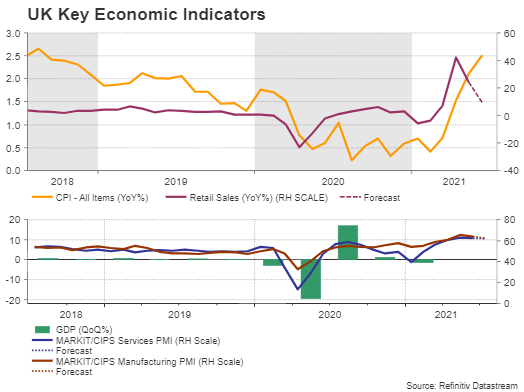
The new concern that arises at this point, however, is that economic growth has likely reached its speed limit, with high inflation measures, and the reversal in cyclical stocks making this scenario more real recently. Probably the softness in Friday’s data may not be enough to dampen market sentiment yet, though the stats could shed some light to these thoughts, showing a significant slowdown in retail sales from 24.6% y/y to 9.6% in June – but still remaining well above pre-pandemic levels because of base effects.
A few hours later, the flash Markit/CIPS PMIs for the month of July could also reflect some normalization from previous booming months, with the manufacturing index easing to 62.5 from 63.9 and the services sector, which drives growth in the UK economy, pulling to 62.00 from 62.4 before.
 Divisions widen within Bank of England
As regards the impact on the pound, investors could become more sensitive to data releases as surging infections are a threat to the economic recovery and the next Bank of England meeting, which will include fresh economic projections, is in two-weeks time from now on August 5.
Back in May, BoE chief Andrew Bailey attempted to convince investors that the latest reduction of bond purchases was not a tapering action, while during the previous policy meeting, the Bank messaged that it “does not intend to tighten monetary policy at least until there is clear evidence that significant progress is being made in eliminating spare capacity and achieving the 2% inflation target sustainably”.
More recently, however, comments from policymakers revealed divisions within the board, with Saunders arguing that government bond purchases may need to stop early because of an unexpectedly sharp rise in inflation measures. A few days later Haskel opposed that statement, saying that reducing stimulus is not the right option for the foreseeable future, despite rising inflation.
Hence, with the confusion growing larger about the Bank's policy intentions and inflation jumping above the target to peak at 2.5%, investors may look at the data for direction before the BoE policy meeting.
Pound reaction
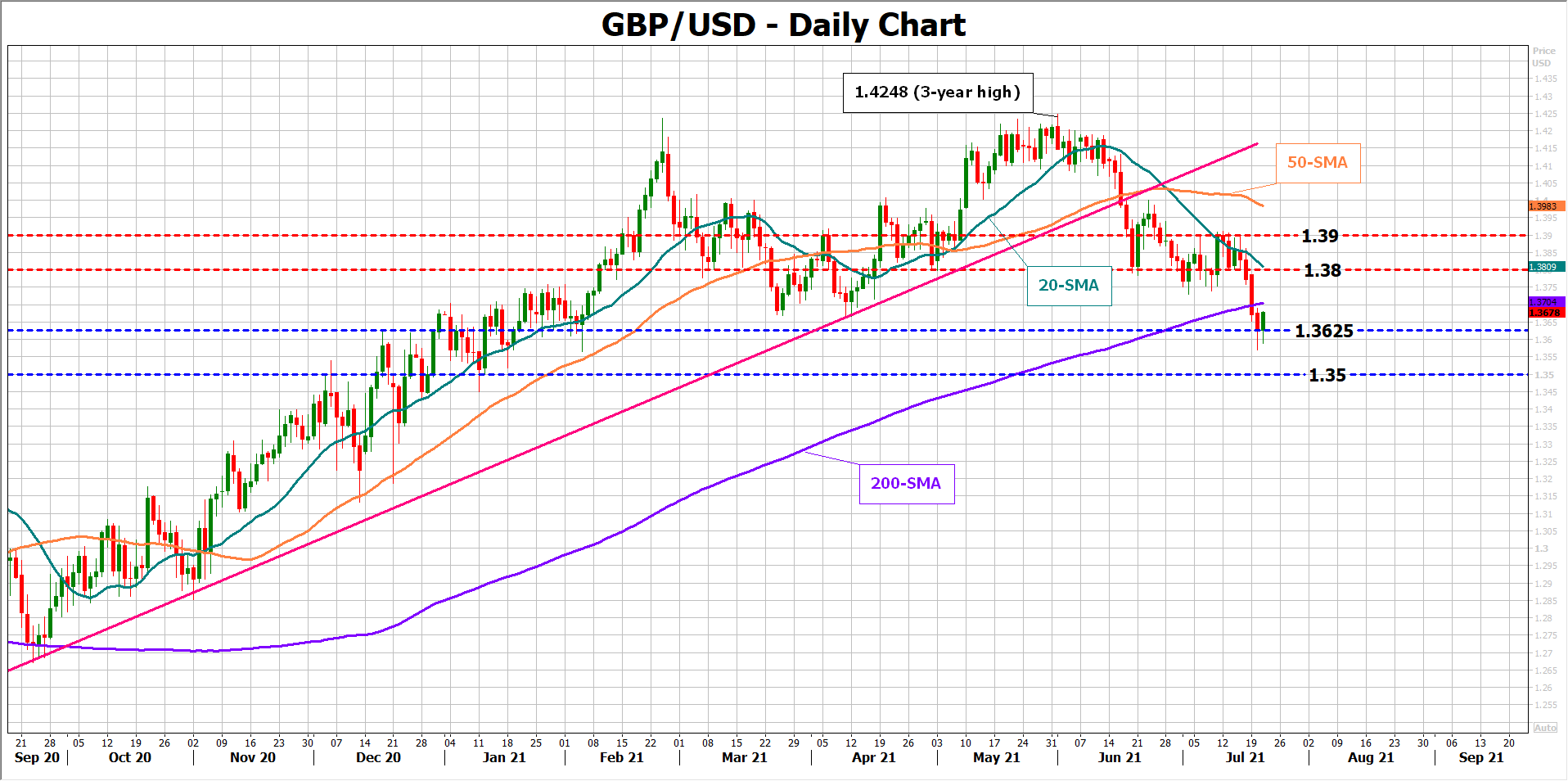
Given the uncertainty around economic growth, a sharper-than-expected pullback in the data could add legs to the pound's sell-off, sending pound/dollar below the 1.3625 support area and towards the 1.3500 psychological level.
On the other hand, the impressive expansion observed in the data during the first quarter may take a while to re-emerge, making any middle-of-the-road outcome less exciting to react. Hence, unless a heavy beat in forecasts raises the odds for bond tapering, there is some doubt about whether any moderate upside surprise could help pound/dollar run above the key 1.3800 resistance.
XAU/USD: Near-Term Action Lack Direction Due to Mixed Signals
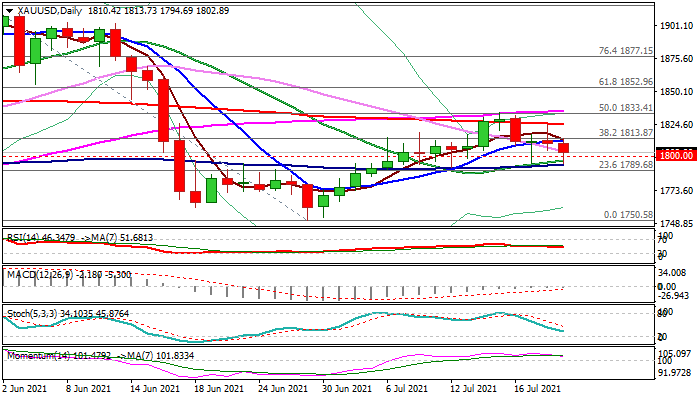
Spot gold probed again below $1800 support on Wednesday, as rising dollar dents metal’s safe-haven appeal, but growing fears about pandemic resurgence and new lockdowns could hurt global economic recovery, keep the metal afloat.
The price action of past three sessions lack direction, as long tail of Monday’s daily candle (action was contained by 20DMA) and long upper shadow of Thursday’s candle (the action was capped by 200DMA) signal.
Technical studies show MA’s in mixed setup, while bullish momentum is fading but still holding in the positive territory, suggesting that traders are awaiting clearer signal.
Initial support at $1800 is holding for now, with repeated close above here to keep in play hopes for fresh attempts higher.
Conversely, break of $1800 pivot and converged 20/100DMA’s ($1796/94) would weaken near-term structure and signal extension of pullback from $1834 (July 15 recovery high).
Res: 1813; 1824; 1833; 1852
Sup: 1800; 1794; 1789; 1782
Earnings Mostly Impress, Bond Market Selloff May Last, Bitcoin Boom
Strong earnings lift US equity markets
US stocks are rising after a wrath of earnings showed mostly better-than-expected results and guidance, except for Netflix. The lessons learned from the bond market should be that Wall Street needs to expect excessive volatility over the next few months as the Fed manages a taper announcement as pressure grows for them to normalize rates. The Dow Jones Industrial is leading the charge higher while the Nasdaq is barely positive.
If the theme from earnings season continues to be an upbeat outlook for the economy and strong consumer that is handling the current price increases, Treasuries could plunge even further, and the 10-year yield could be back above 1.40% by the time earnings season wraps. The reflation trade is back and this time it might stick around.
Earnings
Netflix was the first FAANG stock to report and did they disappoint. Netflix earnings came in at USD 2.97 a miss of the USD 3.14 estimate, while revenue rose to USD 7.34 billion in line with expectations. Traders did not like the guidance for subscriber growth, 3.5 million subscribers are expected in Q3, short of the 5.86 million that Wall Street was anticipating.
Netflix seems like they will be spending a lot more in the foreseeable future on both content and as they try to break into video games. The streaming giant stated they will create original games and that it will be included in members’ Netflix subscriptions at no additional cost.
Chipotle
Chipotle delivered a robust earnings report with strong beats across the board, a stock buyback announcement, and optimism that lunch is starting to return. Second-quarter adjusted EPS impressed at USD 7.46, much higher than the analysts’ estimate of USD 6.53, while comp sales rose to 31.2%, better than the 29.8% estimate.
Chipotle CFO Hartung noted that they have not seen any resistance whatsoever to higher menu prices, a sign that the US consumer is still very strong given the recent inflation surge.
J&J
The New Brunswick, New Jersey-based drugmaker delivered a solid earnings beat and raised both sales and EPS guidance. J&J had robust sales with both devices at USD 6.98 billion, better than the USD 6.59 billion estimate, and with most of their drugs.
Coca-Cola
The soft drink giant’s business is thriving as the reopening of the economy is unlocking a key portion of the business that was lost last year. Coca-Cola crushed this earnings report with strong EPS and organic revenue beats along with boosting full-year organic revenue guidance.
Verizon
Verizon posted strong wireless-subscriber growth along with a raised outlook. Verizon CEO noted that they are not seeing any supply chain constraints. With 20% of their customers having 5G phones, Verizon still sees strong upside in gaining new customers.
This round of earnings covered many sectors and was fairly impressive. The remaining second-quarter results look like they will also come in strong and show that peak earnings growth expectations did not disappoint.
Bitcoin
It appears crypto traders will not see a plunge towards USD 20,000 as too many retail and institutional traders started to line up entry orders to buy what was believed to be the last major dip. Risky assets are rebounding across the board, especially bitcoin, as calm returns to Wall Street as the panic-selling frenzy appears to be over. Some traders are viewing today’s rebound as an all-clear signal for getting back into bitcoin, but that probably won’t be confirmed until financial markets see if risk appetite is upheld after the FOMC policy next Wednesday.
Over the next couple of months, bitcoin will predominantly trade as a risk-on asset and not so much as an inflationary hedge. Bitcoin’s best friend will be a dovish Fed and as long as that remains the case, prices could continue to stabilize going forward.
Oil climbs on higher risk appetite
Crude prices are soaring as risk appetite returns and energy traders believed a 15% pullback over the past two weeks was excessive given how tight market conditions remain.
Yesterday, prices initially plunged after the API reported a surprise build of 806,000 barrels last week, the first time stockpiles rose since May. Today’s EIA crude oil inventory report showed stockpiles rose more 2.1 million bpd, more than the analysts’ consensus of a 3.9 million draw. A big build in the Gulf Coast stemmed from an almost 40% drop in exports. Imports rose to the highest levels since last July.
WTI crude initially dipped on the crude build but resumed climbing higher as US production stayed steady at 11.4 million bpd. Private operators may take advantage of supportive oil prices above USD 60 and that should suggest US producers may start to increase output. OPEC+ isn’t fearful of US production ramping up too much and that should allow this market to remain tight.
Gold
Gold prices slumped on both rebounding Treasury yields that sent the dollar higher and as robust earnings dented demand for safe-havens. Gold may consolidate around the USD 1,800 level, but the longer-term outlook is still bullish as the fight against COVID-19 will drag into next summer as every nation tries to get around 70% of their population vaccinated. Gold should see steady inflows since the global economic recovery is still vulnerable to further restrictions of movement, alongside some signs that inflationary pressures are peaking, which could delay tightening cycles for some central banks. A lower interest rate environment across the major central banks is inevitable and that should be a key argument for holding onto bullion.
Another reason why gold is underperforming the risk-on trade today is that bitcoin is seeing strong demand. The institutional world has slowly been increasing crypto exposure as some traders moved funds that normally would go to gold into cryptocurrencies. If the bitcoin boom reasserts itself, that could mitigate some of the upside potential for gold.
EUR/USD Outlook: Bears Remain in Play but Face Headwinds from Key Supports, ECB in Focus
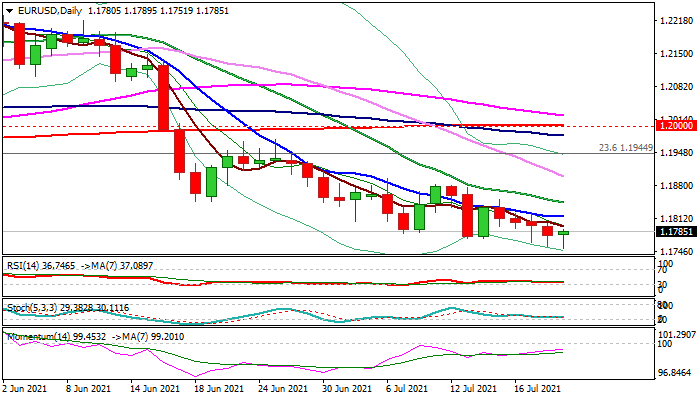
The Euro hit new 3 –1/2 month low (1.1751) in European session on Wednesday. But bears started to face headwinds on approach to key supports at 1.1704/1.1694 (2021 low, posted on Mar 31 / Fibo 38.2% of 1.0635/1.2349 rally), that resulted in subsequent 40-pips bounce.
Negative studies maintain overall bearish picture. Expectations that the ECB will keep dovish stance on Thursday’s policy meeting, adds to negative outlook.
Upticks are expected to provide better selling opportunities, with falling 10DMA to cap consolidation and maintain bearish bias.
Violation of 1.1704/1.1694 pivots would signal reversal of 1.0635/1.2349 uptrend, with negative signal to be reinforced by completion of bearish failure swing on weekly chart.
Bearish daily studies support scenario, but the outcome of the ECB’s meeting is likely to be pair’s key driver.
Caution on acceleration above descending 20DMA (1.1845) that would ease downside pressure and shift near-term focus higher.
Res: 1.1795; 1.1816; 1.1845; 1.1881.
Sup: 1.1751; 1.1737; 1.1704; 1.1694.
Virus is Surging and Yields are Tumbling; Is Inflation Already Yesterday’s News?
The last time there was so much panic in the markets about higher inflation was probably in the 1970s when oil price shocks were a common phenomenon. Although there’s not as much chance of inflation hitting the double digits this time round, major central banks are for the first time in decades facing the prospect of missing their upper price targets by a substantial margin. However, all the excitement may yet prove to have been about nothing as the global recovery is suddenly under threat from a new Covid strain and optimism about a full economic reopening is waning.
Inflation – an unintended consequence?
One of the unintended consequences of lockdowns during the pandemic have been the severity of disruptions on production and supply chains, which have resulted in worldwide shortages of key components, bottlenecks as well as pushing commodity prices spiralling higher. Add to this the pent-up demand that has been unleashed as economies reopen, and it’s no wonder that the prices of goods and services worst hit by the shutdowns are soaring.
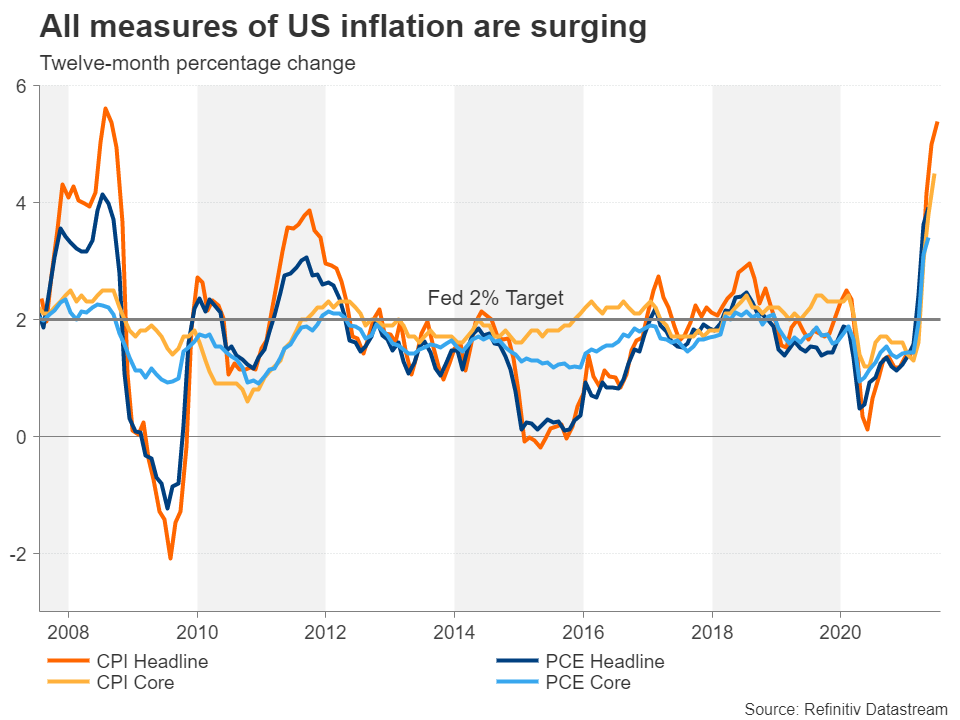
Central banks, notably the Federal Reserve, are insisting that these effects will be transitory and that once the supply-side issues are resolved and the demand boost from the reopening fades, inflation will fall back. But the big question for the markets has always been about how soon these supply disruptions will sort themselves out, and with the added threat of wage inflation, investors have been more worried about these price hikes becoming “sticky” than policymakers have.
Another day, another virus scare
However, inflation jitters appear to have taken a backseat lately as fears that the rapid spread of the Delta variant around the world will derail the full reopening of the major economies is now seen as a bigger headwind. Investors have been steadily pouring into safe havens since June, but that trend accelerated this week as the Delta outbreak is showing no sign of abating.
Having first ripped through Asia, this new more dangerous strain is currently sweeping across Europe and infections are creeping higher in the United States as well. Some traders are already predicting that lockdowns will become necessary again by September and the narrative that vaccines will bring an end to the pandemic is beginning to crumble.
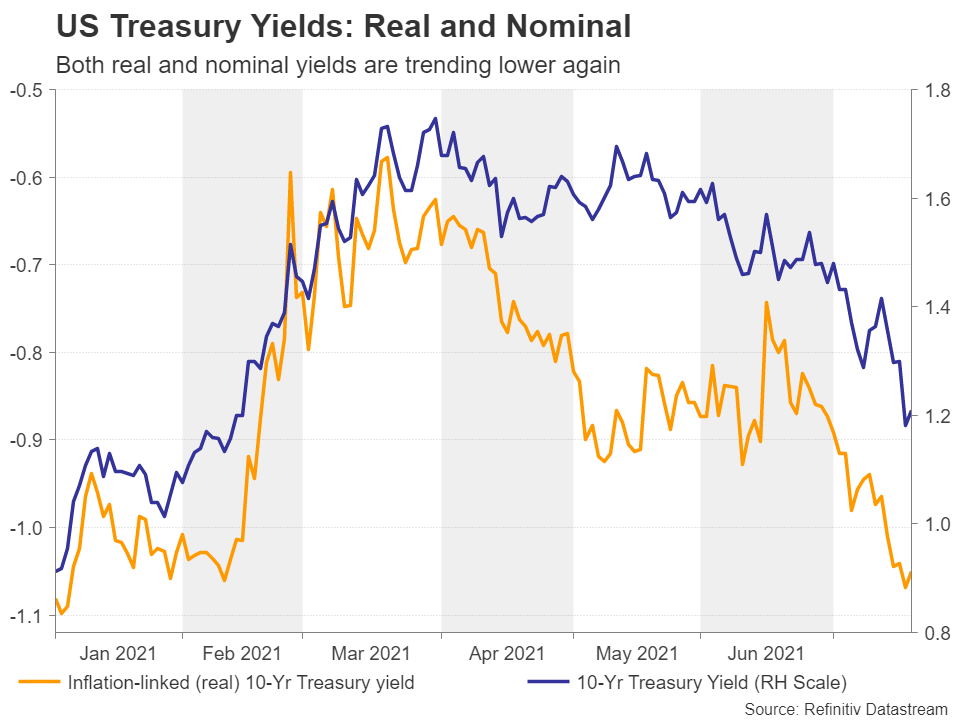
All this has sparked a reversal in the reflation trade that had boosted riskier assets while hammering sovereign bonds. But bonds are now rallying at their strongest since the height of the virus crisis and Treasury yields are sinking; the 10-year US yield has plummeted to 5-month lows, dropping below 1.20%.
Falling yields signal ominous clouds are gathering
The slump in yields indicates investors are turning more wary about the outlook, paring back their earlier optimistic growth expectations as the latest virus escalation looks set to hinder the recovery in a growing list of countries. Safe-haven currencies such as the Japanese yen and Swiss franc are also enjoying a revival on the back of the risk-off trades. But the most impressive rally has been that of the US dollar, which has surged even as both nominal and real US yields have plunged.
The dollar index has broken above the 93.0 level for the first time since early April and its 50- and 200-day moving averages look poised for a bullish crossover. If the bullish momentum is sustained, the index could soon surpass the March 31 peak of 93.437 and head towards the 123.6% Fibonacci extension of the March-May downtrend at 94.358.
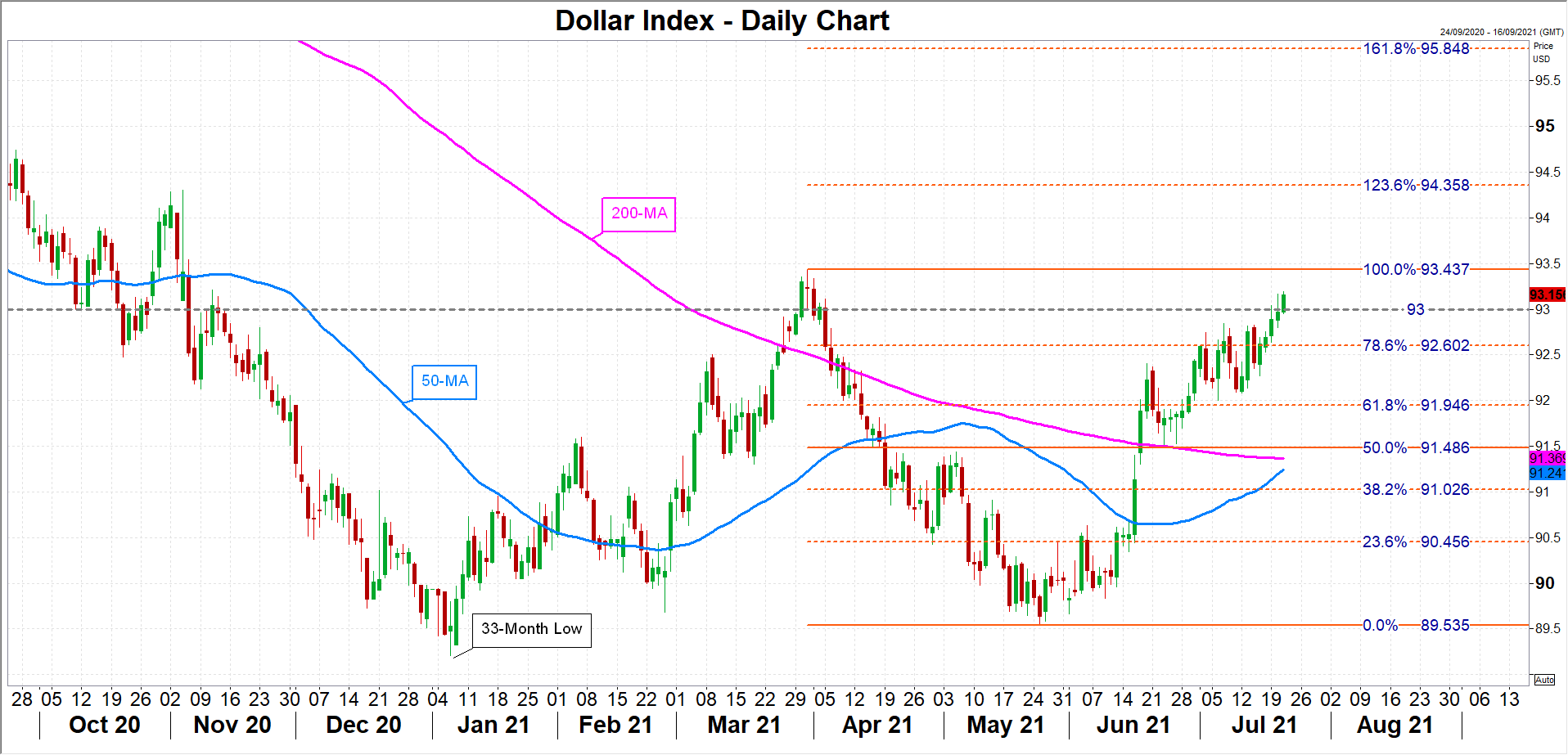
As far as the major dollar crosses are concerned, the $1.17 handle is at risk for the euro, the $1.3530 Fibonacci level for the pound and the $0.7230 Fibonacci mark for the Australian dollar, should the greenback continue to draw safe haven flows.
Worst might be over for euro, not so much for the pound and aussie
Interestingly, having already taken a heavy beating in June on diverging monetary policy paths between the Eurozone and America, the euro’s downside could be milder than that of the pound and aussie if the latest virus wave doesn’t recede quickly.
That is because investors had placed more hawkish bets for the Bank of England and the Reserve Bank of Australia than for the European Central Bank, which was on a more dovish path even before the Delta variant broke loose around the globe. How the United Kingdom, in particular, copes with the fresh spike in infections will be watched by the rest of the world.
A dangerous experiment
Britain has lifted almost all restrictions despite daily virus cases skyrocketing to the highest since January as the government is banking on the country’s high vaccination rate to keep hospitalizations and deaths low. However, scientists have accused the government of a “dangerous and unethical experiment” because letting the virus run rampant might create the ideal breeding ground for vaccine-resistant mutations.
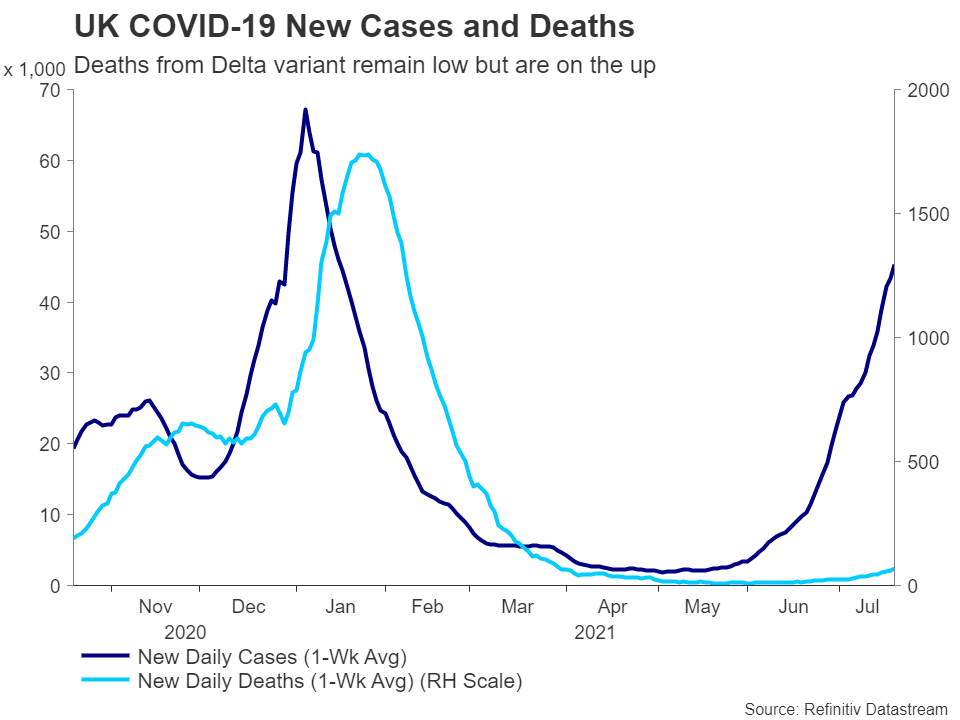
But aside from that, the uncontrollable spread of the Delta strain has already started to put pressure on hospitals, suggesting that even with vaccines, some degree of social distancing is required. If in the coming weeks, the UK government is forced to backtrack on its ‘Freedom Day’ pledge, that could be a sell signal not just for the pound but for risk assets in general such as stocks as it would be a warning for other countries too.
Will lockdowns force RBA U-turn?
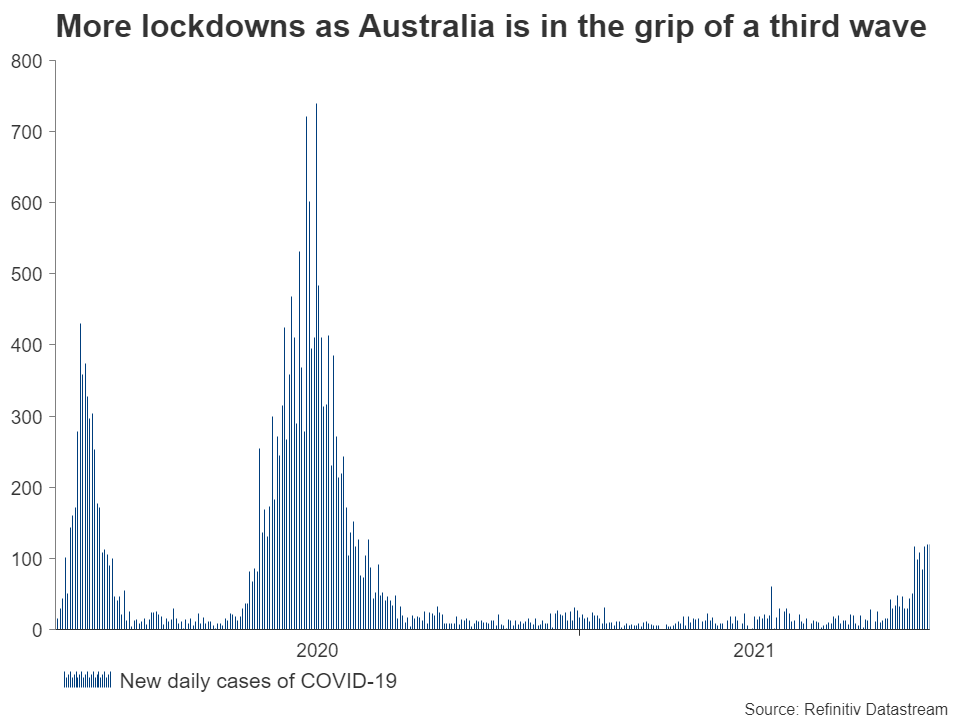
In Australia, the situation is somewhat different as the nation had until recently, been able to avoid prolonged lockdowns. But the highly contagious Delta variant emerged at a time when Australia was only just getting started with its vaccine rollout. The longer it takes for the latest lockdowns to be lifted, the more likely the RBA will keep its QE programme running for longer and possibly even reverse the recently announced reduction in bond purchases. This could spell disaster for the aussie.
Taper or not, dollar is safe
However, for the greenback, more negative virus headlines would probably bolster it further, even if the Fed’s plan to start taper discussions in the summer is also thrown off course, as it’s safe-haven status should protect it. The biggest downside risk for the dollar right now is if infection rates in Europe and Asia begin to slow, easing fears about the growth outlook, and markets can breathe a sigh of relief. Then, the focus would turn back to US inflation and how soon and at what level will it peak.
The return of stagflation?
But what if the Delta outbreak were to worsen in the coming months and the global economic rebound is materially set back? Demand would be supressed again and the inflation problem might go away, but only temporarily. The trouble is, more lockdowns could further exacerbate the supply chain issues in the long run. This may then create the perfect conditions for stagflation as governments reach the limits of their fiscal purse strings and economic growth is unable to bounce back as strongly.
Such a scenario would pose an even greater headache for central banks than the current balancing act of supporting the recovery without stoking inflation. But for the Fed, it will likely press on with a debate on tapering its asset purchases and the uncertainty in the run up to a possible flagging of a decision at the Jackson Hole summit in late August could itself be contributing to the volatility in the bond markets.
Either way, the next few weeks will be crucial on three fronts: first, if the Fed will go ahead and taper and how gradually will it do so, second, if inflationary pressures will show signs of subsiding, and lastly, if virus numbers will continue to spike at a worrying rate.
Dollar Pushes Yen above 110
The Japanese yen has lost ground for a second straight day. In the North American session, USD/JPY is trading at 110.29, up 0.41% on the day.
BoJ can’t get a handle on inflation
Bank of Japan minutes are invariably a tame affair, and there were no surprises contained in the minutes from the June meeting. At that meeting, the Bank maintained its monetary policy and introduced a new plan to combat climate change. The minutes went into some detail about the discussion policymakers had with regard to the outlook inflation. The word “clueless” might be a tad harsh, but it’s no exaggeration to say that Bank officials are confused when it comes to setting an inflation policy.
The reason is that inflation indicators are not presenting a clear picture. The improvement in the global economy in recent months has led to a rise in commodity prices, and this has been reflected in domestic wholesale inflation. Companies are grappling with higher prices, but there is a general reluctance to pass on these costs to the consumer, which has meant that CPI continues to hover at low levels.
Will consumer inflation rise in the coming months? The minutes indicated that Bank policymakers disagree on that key point. One view is that CPI will rise as the consumer demand recovers from Covid, while other members argued that wage growth is weak and a “deflationary frame of mind” could dampen any inflationary pressures. As well, some members expressed concern that if companies do not pass on higher costs to consumers, this could translate into weaker economic growth.
Given the lack of clarity from the BoJ and the weak economy, it seems that the yen has only its safe haven status to attract investors; if the gobal Covid picture worsens and investors lose their appetite for risk, the yen could rebound.
USD/JPY Technical
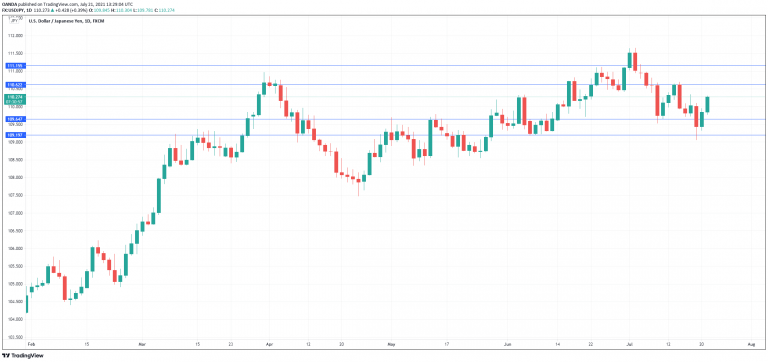
- USD/JPY is putting some pressure on 110.62. Next, there is resistance at 111.15
- On the downside, there is support at 109.64. Below, we find support at 109.19
EUR/USD Mid-Day Outlook
Daily Pivots: (S1) 1.1758; (P) 1.1780; (R1) 1.1805; More...
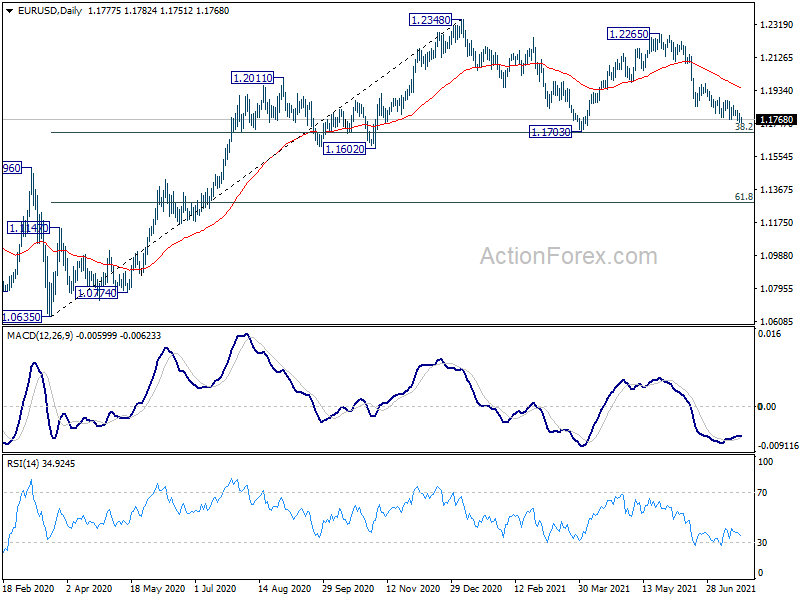
Intraday bias in EUR/USD remains on the downside for the moment. Decline from 1.2265, as the third leg of correction from 1.2348, would target 1.1703 support. On the upside, though, break of 1.1880 will indicate short term bottoming and turn bias back to the upside for stronger rebound to 1.1974 resistance first.
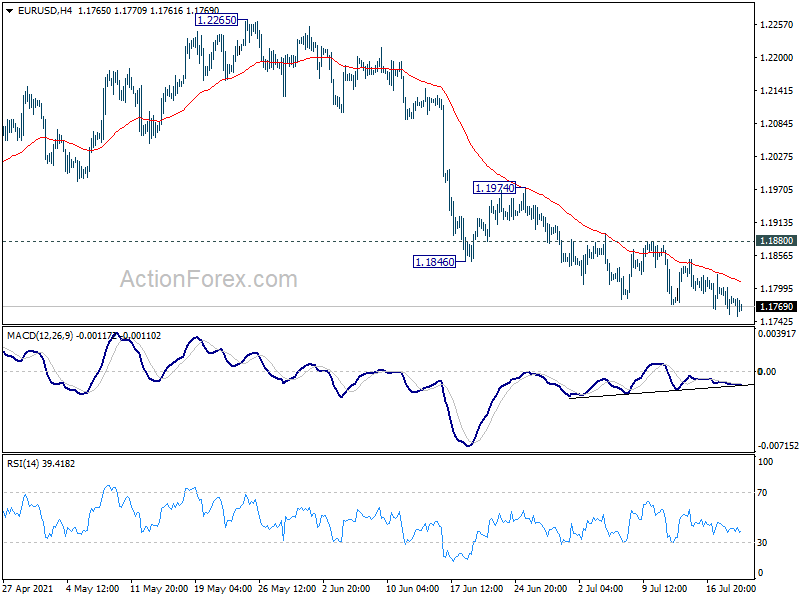
In the bigger picture, rise from 1.0635 is seen as the third leg of the pattern from 1.0339 (2017 low). Further rally could be seen to cluster resistance at 1.2555 next, (38.2% retracement of 1.6039 to 1.0339 at 1.2516). This will remain the favored case as long as 1.1602 support holds. Reaction from 1.2555 should reveal underlying long term momentum in the pair. However sustained break of 1.1602 will argue that the rise from 1.0635 is over, and turn medium term outlook bearish again.
GBP/USD Mid-Day Outlook
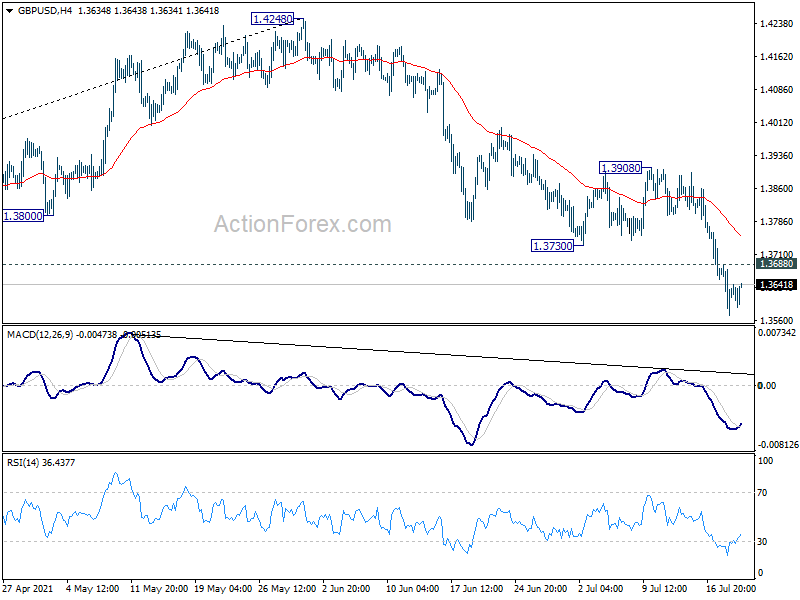
Daily Pivots: (S1) 1.3570; (P) 1.3630; (R1) 1.3687; More....
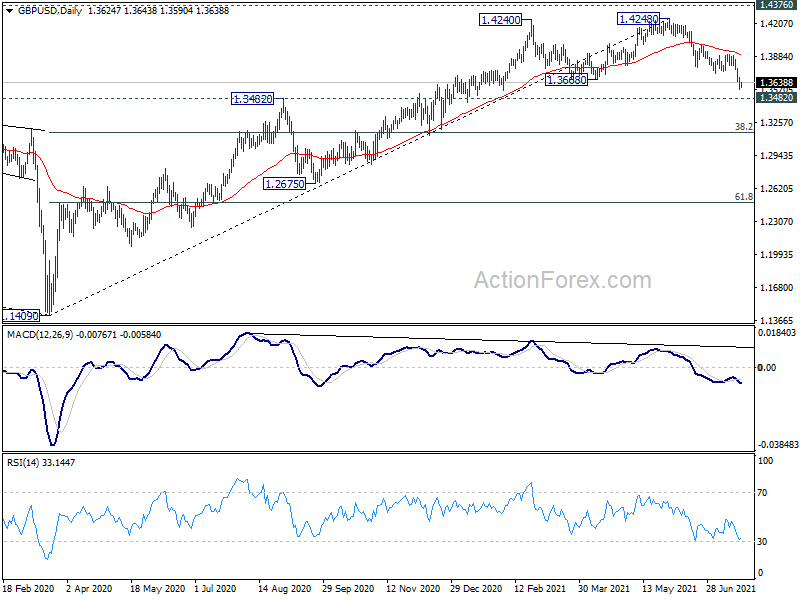
Intraday bias in GBP/USD stays on the downside, and current fall from 1.4248 is in progress for 1.3482 resistance turned support next. Decisive break there will indicate that it's already correcting whole up trend from 1.1409. Next target will then be 38.2% retracement of 1.1409 to 1.4248 at 1.3164. On the upside, above 1.3688 minor resistance will turn intraday bias neutral first. But further fall will remain in favor as long as 1.3908 resistance holds.
In the bigger picture, as long as 1.3482 resistance turned support holds, up trend from 1.1409 should still continue. Decisive break of 1.4376 resistance will carry larger bullish implications. However, firm break of 1.3482 support will argue that the rise from 1.1409 has completed. GBP/USD would then be seen in another leg of long term range pattern between 1.1409 and 1.4376. Deeper fall could then be seen to 61.8% retracement of 1.1409 to 1.4248 at 1.2493, and even below.
USD/CHF Mid-Day Outlook
Daily Pivots: (S1) 0.9180; (P) 0.9206; (R1) 0.9240; More....
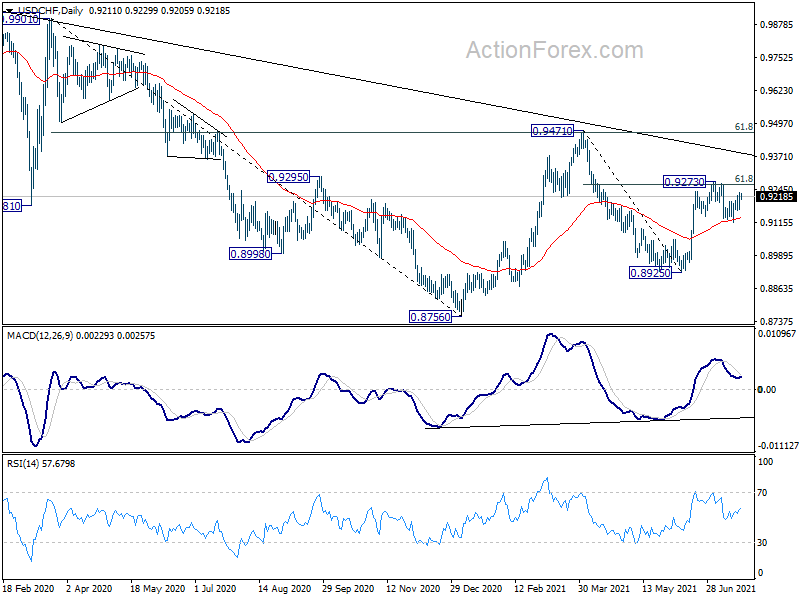
USD/CHF is still bounded in range of 0.9116/9273 and intraday bias remains neutral first. On the downside, break of 0.9116 support will affirm the case that rebound from 0.8925 has completed at 0.9273. Deeper fall would then be seen back to retest 0.8925 low. On the upside, however, break of 0.9273 and sustained trading above 61.8% retracement of 0.9471 to 0.8925 at 0.9262 will target 0.9471 resistance next.
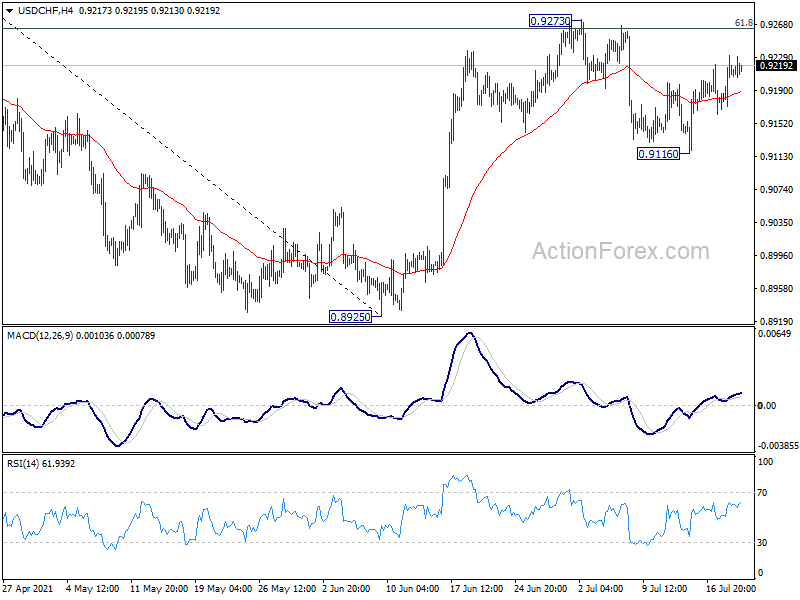
In the bigger picture, medium term outlook is currently neutral with focus on 0.9471 resistance. Sustained break there will indicate completion of whole decline from 1.0342 (2016 high). Medium term outlook will be turned bullish for a test on 1.0342 high. But, rejection by 0.9471 again will revive bearishness for another fall through 0.8756 low.
USD/JPY Mid-Day Outlook
Daily Pivots: (S1) 109.47; (P) 109.72; (R1) 110.10; More...
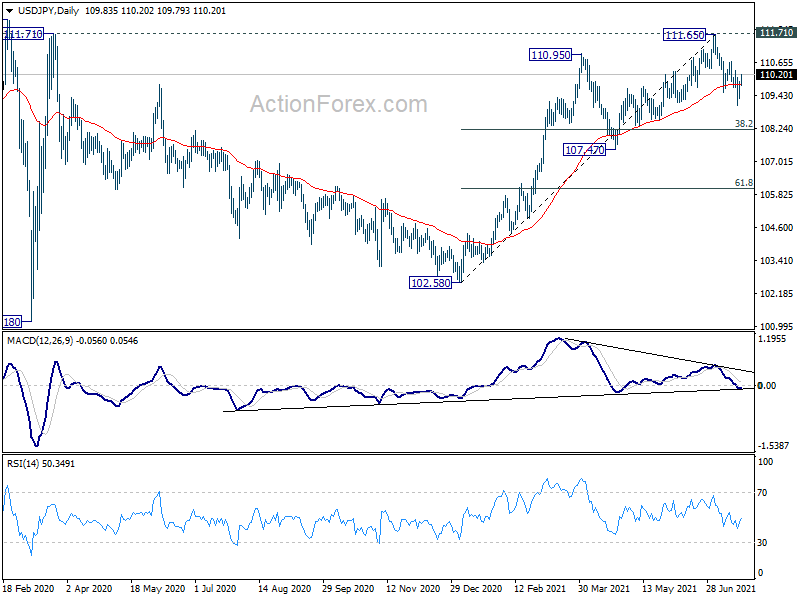
Intraday bias in USD/JPY remains neutral at this point. Further fall will remain in favor as long as 110.33 resistance intact. On the downside, break of 109.05 will target 38.2% retracement of 102.58 to 111.65 at 108.18. However, on the upside, break of 110.33 will argue that the choppy fall from 111.65 has completed, and turn bias back to the upside for retesting this high.
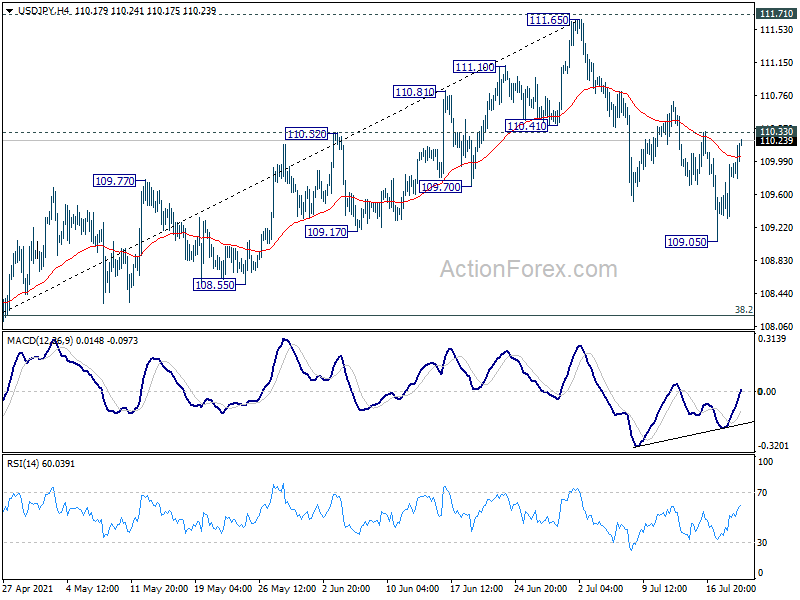
In the bigger picture, medium term outlook is staying neutral with 111.71 resistance intact. Sustained trading below 55 day EMA would argue that the pattern from 101.18 is starting another falling leg, that could head back to 102.58 support and below. For now, outlook won't turn bullish as long as 111.71 resistance holds, even in case of strong rebound.